Feeds:
Posts
Comments

Posts Tagged ‘World War II’

Francis Curry, WWII Medal of Honor, with students.

Francis Curry, WWII Medal of Honor, with students.

FOUR years ago today the most incredible week concluded with former soldiers and the Holocaust survivors they saved watching this newscast together in cocktail lounge of the Georgian Resort in Lake George along with teachers and students from Hudson Falls High School. Thank you Tara, Mary, Lisa, Rene, and all the staff. And to ABC World News for recognizing the importance of the occasion, and to the United States Holocaust Memorial Museum and the Bergen Belsen Memorial for their attendance and support.

A teacher’s job is to toss pebbles. Several of the participants are gone now, but the ripples here became huge, and no one will forget what they meant, where they came from, or what they have led to.

Watch a story about how a teacher fellow from the Museum reunited Jewish prisoners with U.S. Army soldiers who liberated them from a train near Magdeburg, Germany, on April 13, 1945.

Read Full Post »

I met Leslie Meisels exactly four years ago today, when he and  Ariela Rojek and Paul Arato drove all the way down from Toronto, Canada to meet their actual liberators.

Leslie is one of the most gracious men I have ever met; I am honored to have him as one of my friends and am proud to be in on what he calls the latest miracle of his life.

I wrote to a reporter/columnist in Toronto, Canada, several months back to comment on a story that she had written, and she then had the opportunity to interview several of my survivor friends in the community who had been liberated on the Train Near Magdeburg. She struck up a friendship with Leslie, and this ebook resulted.

A sample:

When I first reached Leslie Meisels on the phone one afternoon in late April and asked for an interview, he told me to hold on a minute — he needed to get his day planner.

I thought he was joking.

Leslie is 86. What could he possibly be doing to fill up a day planner?

A lot, it turns out.

He has a wife, two daughters, four grandchildren. He is an active member of the North York Philatelic Society and a committee member of Circle of Care, an organization that provides services for Holocaust survivors. And he is a regular speaker with the Holocaust Education Centre’s survivor speakers bureau. This spring there were weeks when he addressed four different groups of students about his experience during World War II.

This was one of those weeks. He squeezed me in. I wanted to talk to him about the Holocaust and, more precisely, about his liberation from the Nazi murderers by a dozen surprised American soldiers who found Leslie and about 2,500 other captives near the end of the war, packed in cattle cars on a German train.

An email from an American teacher had tipped me off to the fact that a number of Toronto Holocaust survivors had recently been reunited with their liberators.

Leslie was one of them.

Of course, you can’t talk about liberation without talking first about enslavement. So, sitting on the couch of the neat, spacious penthouse condominium he shares with his wife, Eva, in Thornhill, Leslie started proudly with his family history in eastern Hungary.

Then came his carefree childhood. Then the introduction of anti-Semitic laws, the ghetto, the trains, the months of slave labour and the horrors of the Bergen-Belsen concentration camp, where more than 70,000 prisoners — most of them Jews — were killed.

Our interview lasted more than three hours, fueled by many cups of coffee and servings of fresh cheese palacsintas (crêpes) whipped up by Eva.

I noticed Leslie’s hands while we spoke. They are enormous — each finger twice as thick as mine, the palms like dinner plates. They are a working man’s hands, without any of the dirt. Everything about Leslie is immaculate — his neatly clipped and cleaned fingernails, his ironed pants and pressed dress shirt with a silver pen poking from its breast pocket, his freshly shaven face. His stories of being treated like a rabid dog were cast in relief by the careful pride he took in his appearance. There is an Old World elegance about him.

But the thing that struck me most about Leslie was his cheeky humour. His brown eyes narrowed and sparkled repeatedly as he took a “side step” to tell me about the girl he was “necking” with while a slave labourer or a refugee. Despite the horrors he endured, or perhaps because of them, Leslie maintained his champagne spirit.

Near the end of the interview, a question bubbled in my mind: what did you take with you? The Nazis had invaded Hungary in 1944. They ordered all the Jews in Leslie’s and other towns to first leave their homes, and then to leave town altogether on a train we now know was headed towards slavery or murder. What would you take if you could carry only a small bag or pillowcase to hold your belongings?

“Underwear,” Leslie responded, “and my stamp collection.”

I wrote that down and moved on. There were a lot of overpowering details in Leslie’s stories, and I still needed to hear about the reunion. But the stamps snagged my attention. There was a boyish innocence about them.

What happened to those stamps, I asked him over the phone a couple days later.

He responded: “I still have them. My mother sewed them into the lining of my jacket.”

Imagine that! Most Jews had all their clothing and belongings stripped away upon entering the concentration camps. You can see their boot brushes, ceramic pots and dolls piled up behind glass cases in the Auschwitz-Birkenau State Museum in Poland. That Leslie managed to keep his jacket was surprising enough. But that fragile pieces of paper survived the horrendous conditions — well,that seemed miraculous.

I drove back to their condominium for a third interview, this one in Leslie and Eva’s little office. I asked to see some of those stamps.

So Leslie pulled out his master list — a two-page typewritten list of all the stamp albums he has. There are dozens and dozens. He found one with his early Hungarian stamps and pulled it down from the shelf. Inside he’d arranged thousands of stamps in neat rows.

When I expressed surprise at the number of stamps he had, he smiled and opened a drawer in his desk.

“A crazy stamp collector saves all the stamps he comes across,” he said, pulling out a Tupperware container brimming with stamps. “When there are many, many, many, he bundles them up . . . and stores them away. I have millions of stamps.”

Leslie’s wife calls herself a “stamp widow.” She says he spends hours with his stamps a day. He loves them still, like he did when he started his collection 78 years ago. He loves the precision of arranging them. He loves the challenge of collecting a full set of stamps. He loves their colours and their stories. Every stamp, he says, depicts a story of a place, a historic moment or figure, a cause. “You can learn about the world through stamps,” he said.

As we flipped through his collection and he began to tell me the rest of his story, I could see snatches of it reflected in his stamps.

It is the tale not just of an idyllic childhood followed by the horrors of the Holocaust, but also that of a man who lived under Communism, escaped, lived for two years in a refugee camp, arrived in North America with nothing and then built up his life for a second time. Just as every stamp embodies a public story, a bit of history, Leslie’s stamps also tell the story of his life, its joys and deep sorrows, its disasters and its miracles.

************************************************

He is giving his 25th lecture on the Holocaust since April.

“Put yourself in my shoes,” he says to the Cardinal Carter Catholic High School students. “I think you are between 16 and 18, right? You can feel what I felt when I experienced those horrors.”

“They have to know,” Leslie says. “Otherwise, it will be forgotten and could be repeated.”

He talks for just over an hour, pausing only twice for a sip of water.

The stories pour out of him — of the deaf village elder who was strung up by his wrists to a cattle car, of the SS guards with their dogs who laughed at the sight of him naked with his grandmother and mother, of the hunger. He stirs in life lessons — like how his woodworking knowledge saved his life in Bergen-Belsen. “You are the same age as I was,” he says. “Never think you are studying for your teachers or your parents. Whatever you are putting in your head, you never know how it will serve you in life.”

But Leslie’s descriptions are muted at times. He clutters his sentences with clauses and chooses math over graphic detail to describe some horrors. The train crowding, for instance, affords each person a “square foot.” He mentions the bucket but doesn’t fill in the details of how that meant people were forced to defecate in their pants. He is old-school; talk like that seems degrading. Or perhaps the pungent details are too dangerous for him, scratching away the protective layers on his memories.

A girl in a powder-blue sweatshirt in the second-last row appears to have fallen asleep.

Is he getting through to them? Like most Holocaust survivors,

Leslie won’t be around to recount these stories for much longer. That inescapable truth adds an urgency to his message. Who then will bear witness?

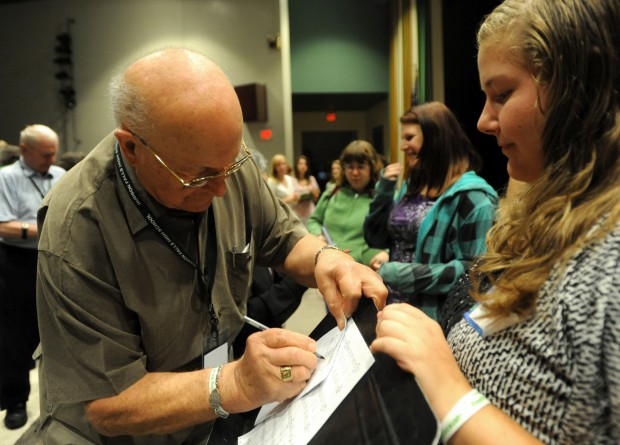
Holocaust survivor Leslie Meisels, left, signs a program for Hudson Falls senior Taylor Bump during Wednesday's "Remembering the Holocaust, Repairing the World" event. Meisels, who currently lives in Toronto, stressed the importance of relaying his experience to young people "so they remember and fight against discrimination, hatred and injustice." Jason McKibben Glens Falls Post Star

Holocaust survivor Leslie Meisels, left, signs a program for Hudson Falls senior Taylor Bump during Wednesday’s “Remembering the Holocaust, Repairing the World” event. Meisels, who currently lives in Toronto, stressed the importance of relaying his experience to young people “so they remember and fight against discrimination, hatred and injustice.”
Jason McKibben Glens Falls Post Star

He finishes his talk and asks for questions. The girl in the powder- blue sweatshirt from the back asks two. The second one is: “If you could go back, would you change any decisions you made?” She was listening, just with her eyes closed. Holocaust educator Ruth Ekstein says she often sees that — “the most fidgety kids you want to strangle, they are absorbing the most.” The content is so painful, it forces people to scratch and shuffle, or to close their eyes.

“Never allow this to happen to someone in the future, if you see an injustice,” Leslie tells the group. “Never just look at each other as equals. Treat each other as equals.”

************************************************

The last miracle

In 2001, Matt Rozell went to the home of one of his students in Hudson Falls, N.Y. Rozell is a high school history teacher there. He regularly assigned his Grade 10 students to interview the veterans in their family about World War II as a way to bring history alive.

That summer, he decided he would do the interviewing himself.

The veteran was retired New York State Supreme Court Justice Carrol Walsh Jr.

After two hours, when the interview was ending, Walsh’s daughter elbowed him and said, “Did you mention the train at all?”

“What?” Walsh said.

“The train.”

So Rozell asked to hear about this train, whatever it was.

Walsh told him about the beautiful, sunny day in April 1945, when after 10 months of fighting their way through France, Belgium,and Holland, and into Germany, his tank and his buddy George Gross’s tank were pulled out of the battalion to check out an abandoned train. An army scout had come across some Finnish prisoners of war in bad condition who reported they had escaped ,the train and that it was packed with prisoners.

Rozell posted the moving interview, as well as Gross’s astonishing photos from that day, on the school’s oral history website, where it sat quietly for four years.

That is, until a grandmother from Australia contacted him to ,say she had been a little girl on that train. The next month he got another email, and another, and another.

In September 2007, Rozell hosted the first reunion of Walsh and three survivors from that train. An Associated Press reporter wrote a story about the day-long event which was published around the world.

Paul Arato’s son Daniel read the story on the Internet. Arato was the 5-year-old boy who witnessed the birthday “present” of a bullet to the head in the Bergen-Belsen roll call. He was also a ,Hungarian Jew who grew up not far from Leslie. He, too, escaped Hungary in 1956 and resettled in Canada. An industrial designer, he was a work associate of Leslie. At the end of a business meeting, the topic of the Holocaust somehow came up. They discovered, to their shock, that they had both been on that train from Bergen-

Belsen. Paul, in turn, told Leslie about the Hudson Falls reunion.

Two years later, they both ventured down to Hudson Falls for a second reunion — a three-day symposium that brought together nine survivors and seven soldiers, including two of their liberators

— Frank Towers and Carrol Walsh.

On the drive down, Leslie was very excited. The initial meeting, over dinner, was spectacular.

“No words can explain the feeling of shaking hands, hugging, laughing and crying with the people who gave me back my life on April 13,” he says. “I never ever imagined that would happen.”

He calls the veterans “angels of my life.” They, in turn, said they were just doing their job.

Leslie and Walsh became close friends. They talked regularly on the phone. They spent some time together in Florida, before Walsh died last winter at the age of 91.

Leslie calls that friendship the last miracle of his life.

Leslie’s 17-year-old granddaughter, Jessica, visited Auschwitz last spring while participating in the two-week educational trip March of the Living. She left behind a small, hand-written sign that said: “I am marching in honour of my grandparents Eva and Leslie Meisels. As well as a soldier, Carrol Walsh.”

******************************************

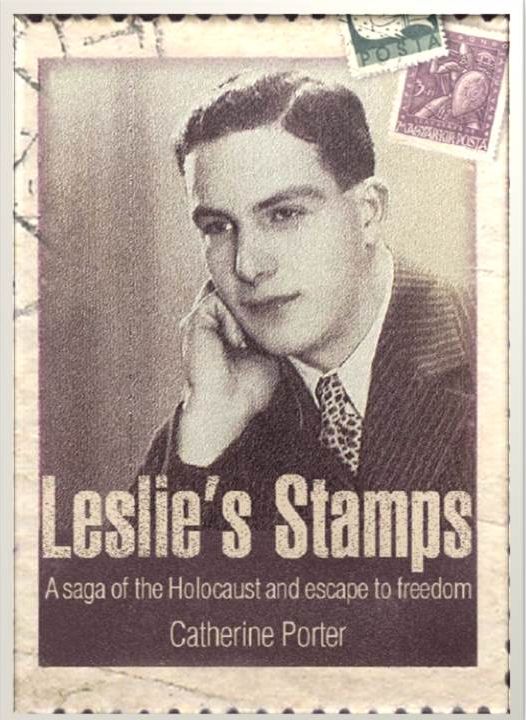
Leslie's StampsLeslie’s Stamps: A Saga of the Holocaust and Escape to Freedom

He had an idyllic childhood in a small Hungarian town where, it seemed, there was no animosity between the Christian majority and Jews like him. But with the rise of Hitler and the Nazis, everything changed for Leslie Meisels, who ended up in Bergen-Belsen concentration camp with his family. Through his wartime ordeals, Leslie carried his stamp collection, started when he was 8, in the lining of his jacket. In Leslie’s Stamps: A Saga of the Holocaust and Escape to Freedom, award-winning Toronto Star columnist Catherine Porter tells the dramatic story of Leslie’s life through his stamps. It is a tale of love, courage and the power of the human spirit.

Leslie’s Stamps: A Saga of the Holocaust and Escape to Freedom is available for $2.99 at http://starstore.ca/collections/star-dispatches-ereads/products/leslies-stamps and itunes.com/stardispatches.

Read Full Post »

guns at last lightI’m recovering from a foot injury and it has given me time to finish Rick Atkinson’s latest release, The Guns at Last Light: The War in Western Europe, 1944-1945 in his Liberation Trilogy. With school around the corner, I am excited to be teaching a couple dozen seniors once again about World War II, and in the springtime, the Holocaust.

I’m happy with Mr. Atkinson’s coverage of the heroics of the 30th Infantry Division-he even made a research pilgrimage to Hill 314 in Mortain, where elements of the 30th held off against a Hitler-ordered panzer counterattack for 6 days, saving the Allied breakout in Normandy in August 1944. 

If you are a follower of this site, you will know that that division is dear to my heart, not because of any blood relations who fought in it, but because they named me an honorary member of their Veterans of World War II Association for my work in the classroom and in uncovering and reuniting the story of the liberation of the concentration camp train at Farsleben, Germany on Friday, April 13, 1945.

So you can imagine my excitement when I ran across this passage last evening from page 599 of Rick’s book. He writes about some of the chaos that unfolded as POWs, slave laborers, and concentration camps were liberated in Germany:

“Instead, starvation, revenge, indiscipline, and chaos often created what Allied officers called a “liberation complex.” SHAEF [Supreme Headquarters Allied Expeditionary Forces ] had presumed that refugees “would be tractable, grateful, and powerless after their domination for from two to five years as the objects of German slave policies.” As an Army assessment concluded, “They were none of these things.… Newly liberated persons looted, robbed, murdered, and in some cases destroyed their own shelter.” Freed laborers plundered houses in the Ruhr, burning furniture for cook fires and discarding slave rags to dress in business suits, pajamas, and evening clothes ransacked from German wardrobes. Ravenous ex-prisoners licked flour off the floor of a Farsleben bakery. In Osnabrück, “rampageous” Russian slaves died after swilling V-2 rocket fuel discovered in a storage yard. Others smashed wine barrels and liquor bottles in a Hanover cellar, drinking so heavily from a sloshing, six-inch-deep pool of alcohol on the floor that several collapsed in a stupor and drowned before U.S. MPs could close the entrance.”

So I did a double take: Ravenous ex-prisoners licked flour off the floor of a Farsleben bakery. I checked his notes-page 801, sure enough, 30th Division G-2 report. I know I have read this before in my research of primary source documentation, originally sent to me by Frank Towers, one of the liberators.  Here it is.

30th Division Medical Detachment Diary & Log

Of course, the backstory surrounding the document above is the story that I have to tell- the soldiers of the 30th Infantry Division and the attached 743rd Tank Battalion, the Holocaust survivors whom they stumbled upon, liberated, and were reunited with 62 years later at our high school and subsequent events.  I’ll probably share the Benjamin photo with Mr. Atkinson on his FB page. 

Anyway, I recommend the book to any of my followers interested in the history of World War II in the European theater, and am really pumped to teach some very excited and motivated students this year, including the grandson of the tank commander who was sent to investigate the train.

This is how you “do” history, and how the teaching of history can sometimes take on a life of its own. So cool to be a part of it, and to read something in a best seller and be able to grasp the incredible backstory that awaits to be told.

Read Full Post »

BusterOne of the hard parts about this project is that people whom you come to know and love get older and pass away on you. But you are thankful that you came to know them, and how you saw them enrich your life and the lives of others.

I first met Buster over five years ago, when I attended my first 30th Infantry Division reunion and he served as the chaplain and the master of ceremonies and chief auctioneer at our final banquet. He had a funny way of putting folks at ease, and the auctions were like a comedy act. He was very devout and serious about his chaplain duties, though.

I have a couple short video clips to share. The first I post on D-Day every year. A producer from ABC News in New York called me looking for the Benjamin photo for a piece on veterans returning to Normandy. Though the 30th did not land until after D-Day, the fact is that Allied forces were only ten miles in, with some very heavy and decisive battles still ahead for the 30th. They would also be bombed not once but twice by Allied heavy bombers on two consecutive days before the launch of Operation Cobra.Buster was a combat medic. “You did not stop to think about how you would cope. You just did the best you could.”

Buster was so taken with the appearance of the Holocaust survivors in the Old Hickorymen’s lives after 62 years, he told the story everywhere he went. After his wife died unexpectedly, he was at a loss, but I know that getting out into the community to tell the story of the Holocaust and the 30th’s connection to this amazing photograph kept him going for a while. He’d call me up at school, looking for pictures to share with students down South in the classrooms. He became a Holocaust educator! And he was sure proud to be an American.

He and his son Sandy, who also recently passed, expended a great deal of energy traveling to our high school in upstate NY for the last reunion with soldiers and survivors at our high school. At the tail end of this short clip he describes one of the wonders of this trip for him. I guess if I was dancing with a lovely young thing, or two, or three, I would say the same!

To close, I wish to paraphrase the reporter for the ABC story, Erin Hayes:

Maybe, just maybe, a group of students like those at College of the Ozarks will discover [veterans] and they’ll get them to tell their stories, to hear what I heard … that a generation that will soon be gone left us a legacy of bravery and wisdom and resilience.

We really, really should treasure that — before it’s too late.

Rest on, Buster. Peace to their families.

*******************************************************************

Buster Marion Simmons, 91, a resident of Farmington, Ark., passed away July 20, 2013 in Fayetteville. He was born July 7, 1922 in Orange County, N.C, the son of Tom and Olivia Jackson Simmons.

Buster served in the United States Army during World War II. He was a Combat Medic in the 30th Infantry Division throughout the European theater. He served as the Chaplain for the 30th Infantry Division reunions. Buster attended many reunions in Europe and all over the USA. His favorite trip to Europe was in 1994 when his granddaughter traveled with him. He worked until he was more than 80 years old.

He was preceded in death by his parents; wife of 67 years Bessie Mae Simmons; two sons, Eric G. Simmons and William J. “Sandy” Simmons; three brothers, William Clinton, Glimer and Wayne; one sister Lucille Oakley.

Survivors include one daughter-in-law Kathy Simmons; one granddaughter, Nancy Woodward and husband Rusty; one great-grandson Garrett Woodward and his grand dachshund Buster, all of Farmington.

A Memorial Service will be held at 4 p.m. Tuesday, July 23, 2013, at the Luginbuel Chapel in Prairie Grove with Preston Beeks officiating. He will be interred in Burlington, N.C. at a later date.

Memorials may be made to the Willard Walker Hospice Home, 325 E. Longview St. Fayetteville, AR. 72704; Farmington Senior Center – Meals on Wheels, 340 W. Main, Farmington, AR. 72730 or a charity of your choice .

Read Full Post »

World War II infantry veteran Carrol Walsh, top, hugs Holocaust survivor Paul Arato at a reunion in Queensbury, N.Y., on Tuesday, Sept. 22, 2009. Walsh’s unit liberated a Nazi train carrying 2,500 Jewish prisoners, including Arato, from the Bergen-Belsen concentration camp in Germany during the war’s waning days. (AP Photo/Tim Roske)

I am reposting this today to honor both of the men below. Paul Arato passed away this week in Toronto, Canada and his memorial service is today. Carrol Walsh, his liberator, died in Dec. at his home in Florida and his memorial service was last Friday in New York.

Paul and Rona would also check in annually for dinner with the Walsh family when they passed through our town. The last time I saw both of them together was in 2011 at one of these dinners in a local restaurant. They sat together and laughed and joked like old pals. Paul told the story of how he arrived in Detroit after the war as an eager late teen anxious to find work designing fast cars in the automobile industry and was driven to the bridge in Canada by law enforcement and pointed to the bridge to Canada, as he did not have the proper documentation. Picturing the scene in his mind, Carrol would laughed outloud and slapped his knee. Both men were so happy to have found each other.

Rest on, friends.

Holocaust Survivors Reunite With US Veterans

NY high school reunites Holocaust survivors liberated from Nazi death train by US soldiers

By CHRIS CAROLA

The Associated Press

HUDSON FALLS, N.Y.

The Holocaust survivor was 6 on that spring day in 1945 when he last saw the U.S. Army soldiers outside Magdeburg, Germany.

Paul Arato was among 2,500 starving and sickly Jewish prisoners from the Bergen-Belsen concentration camp, their train abandoned by its crew and Nazi guards as Allied forces advanced. Two U.S. Army tanks on a scouting patrol — one of them commanded by Carrol Walsh, then 24 — came upon the stopped boxcars.

Arato, now 71, and Walsh, 88, met again this week.

“Please give me a hug. You saved my life,” Arato told Walsh in an emotional reunion of concentration camp survivors and some of the veterans of the 30th Infantry Division who liberated them.

Arato, an industrial designer from Toronto, and Walsh, a retired state Supreme Court judge from Hudson Falls, came together for a Hudson Falls High School history symposium inspired by history teacher Matthew Rozell’s original World War II project in 2007.

“You were all kids on that train,” Walsh told the survivors, most of them in their early 70s, as they and their families greeted the veteran. “I was an old man. I was 24 years old!”

Those arriving early for Wednesday’s opening session gathered Tuesday night for an impromptu reunion before having dinner surrounded by the faux Adirondack decor of the nearly deserted indoor water park. Four of the five Nazi train survivors at the dinner had never met Walsh.

Walsh’s tank patrol discovered the desperate Bergen-Belsen survivors on April 13 — hundreds of emaciated Jewish prisoners who had been herded aboard one of three trains leaving the camp a week earlier to keep them from being liberated by advancing Allied forces.

Walsh’s patrol stayed for a time, handing out candy to some of the children, then moved on after reporting their discovery. Frank Towers, a 27-year-old first lieutenant in the 30th Division, led a convoy that took the newly liberated prisoners to a German town where they were given food and shelter.

For weeks, the men of the 30th had heard of Nazi atrocities against Jews and dismissed the stories as propaganda, Towers said. That all changed when they encountered the train.

“Then we believed,” said Towers, 93, of Brooker, Fla.

This week’s reunion is the fourth since 2007, when Walsh was joined by three of the train survivors at Hudson Falls High. History teacher Rozell’s World War II project included an Internet posting of Walsh’s account of the train liberation.

An Associated Press report of that first reunion prompted more survivors to come forward, some from as far away as Israel, Rozell said. In all, he has confirmed that more than 60 survivors are still living and has been in contact with about two dozen of them.

Nine survivors of the Nazi death train are participating in this symposium, along with Walsh, Towers and four other veterans of the 30th who fought in Germany. Rozell said this week’s gathering is likely to be the last such event of its scope, given the advanced ages of the veterans and survivors.

For Arato, Tuesday night’s reunion with Walsh brought back a flood of memories. He recalled getting candy from one of the soldiers and a handgun to play with.

“I remember it was a Tootsie Roll,” he said. “The gun wasn’t loaded.”

Arato fretted over one detail. He recalled seeing a Jeep along with the American tanks, but fellow survivor Fred Spiegel of Howell, N.J., didn’t remember seeing a third vehicle. Later, Walsh said his patrol consisted of two tanks — and a Jeep.

“There WAS a Jeep,” Arato said, a smile breaking out on his face. “I remembered it right.”

———

On the Net:

Hudson Falls High School World War II Living History Project: http://www.hfcsd.org/ww2

http://www.huffingtonpost.com/wires/2009/09/23/holocaust-survivors-reuni_0_ws_296673.html

http://www.ynetnews.com/articles/0,7340,L-3781062,00.html

Read Full Post »

This is from last evening’s PBS NewsHour. Book is on my summer reading list. April 1945 a focus of my studies.

‘Bad to the Very End’: Author Reflects on the Long, Deadly Road to WWII Victory

In honor of the 69th anniversary of D-Day, Ray Suarez talks to historian Rick Atkinson about his new book, “The Guns at Last Light,” which chronicles the brutal fight for victory at the end of World War II.

JEFFREY BROWN: Finally tonight, we mark June 6, D-Day.

Ray is back with book conversation he recorded recently about World War II.

RAY SUAREZ: The war that had a hand in cementing U.S. status as a superpower and created the map of the modern world ended almost 70 years ago.

You could fill a library with books about the Second World War, yet historians still find new things to say and new ways to say it.

Award-winning author and historian Rick Atkinson has just completed the third book in his “Liberation Trilogy,” “The Guns at Last Light: The War in Western Europe, 1944-1945.” And he joins me now.

And, Rick, if nothing else, this book is a reminder that, with D-Day, there was still some of the worst fighting of the war left to go.

RICK ATKINSON, author, “The Guns at Last Light”: That’s certainly true, Ray.

I think the horror of it is difficult to imagine 70 years later. And it continues really after D-Day, almost to the last gunshot. There were almost 11,000 Americans killed in Germany in April 1945, the last full month of the war in Europe. And that’s nearly as many as died in June 1944, the month of invasion.

So the bloodletting continued right to the end. The notion that many Americans have that it was bad on the beaches, and then something bad happened during the Battle of the Bulge in December 1944, and then it was kind of sweeping into Germany and the war was essentially over is actually quite incorrect. It was bad to the very end, almost to May 8, 1945, when the war in Europe ended.

RAY SUAREZ: Terrible, ferocious, deadly fighting through Northern France, through Holland and Belgium, and finally into the German homeland.

Then you bring us to one British officer who says, “Why don’t the silly bastards give up?”

What was the German calculation in those last months, when it was clear they could no longer militarily prevail?

RICK ATKINSON: Well, there are several things at play.

Part of it is terror. Hitler had a police state of the first order. And those who showed any sign of being weak-kneed faced prison or often summary execution. That prevented a lot of people who knew that the war was not going to turn out well for Germany from giving up.

In other cases, you have to say that 80 million Germans tended in large measure to be true believers, that they believed in the fuhrer almost to the bitter end. You would see parades, for example, on Hitler’s birthday, April 20, 1945, in Berlin — this is 10 days before he kills himself — of young girls, young boys who are too young to go into the military carrying flags and singing patriotic songs, people cheering along the streets of a badly battered Berlin at that point.

So, the German psyche was such that they’d been heavily influenced by propaganda. And they were just generally disinclined to give up.

RAY SUAREZ: Rick, you also remind us that the war got deadlier as it went on, because both sides were innovating, inventing new ways of killing the other side practically until the last day of the war.

RICK ATKINSON: That’s true, Ray. The lethality increases as the war goes along, and it — it’s extraordinary how brutal it is.

We Americans, for example, invented something called the POZIT Fuse. That was the code name. There was a little radar sensor in the nose of an artillery shell, and it could, by emanating radar signals, determine when a passing plane or when an approaching target was just within the kill radius of the burst, and detonate that shell.

It was used for the first time in the Battle of the Bulge in December 1944. The Germans called it pure manslaughter. It was part and parcel of a generation of weapons that came along, napalm used for the first time around this time. The Germans had invented the V-1 and V-2 flying bombs and then a ballistic missile, the V-2, with terrifying results, most of them launched against London or Antwerp with devastating results to civilians.

RAY SUAREZ: We have in the final weeks and months of the war some moments where it’s hard to tell where moral authority existed, if such a thing any longer existed.

How could you tell concentration camp inmates not to rise up and kill their captors who were trying to surrender and act like normal soldiers? How could you put trial Americans who, sickened by the slaughter, would just turn and around pop these guys with their sidearms as they tried to surrender? It got nasty, brutal, and frightening in those final weeks.

RICK ATKINSON: This is true.

And it’s not just the final weeks, actually. There’s killing of prisoners that begins early in the liberation of Europe by American, British, Canadian soldiers, and, of course, by the Germans. It intensifies during that last 11 months from Normandy on.

But when you get to the camp liberation phase, particularly in April 1945, for example, at Dachau, American soldiers coming into this camp, tens of thousands of emaciated, horribly treated prisoners, and thousands of bodies lying around, and there were soldiers that went on a rampage. There were at least a couple dozen S.S. guards who had surrendered, had been taken into custody who were murdered, probably more than that.

This is at the same time that there are liberated inmates rampaging, tearing literally some camp guards limb from limb. There was an investigation. The investigators found that, yes, there had been prisoners murdered by American soldiers. Nothing was ever done of it. No one really had the stomach to prosecute American soldiers under these circumstances.

This is just one example of many, though, of the barbarity that war unleashes with — inside otherwise good soldiers.

RAY SUAREZ: I want to continue this conversation with you online.

The book is “The Guns at Last Light.”

Rick Atkinson, thanks a lot.

RICK ATKINSON: Thank you, Ray.

http://www.pbs.org/newshour/bb/military/jan-june13/atkinson_06-06.html


Read Full Post »

American Cemetery overlooking Omaha Beach, the primary landing zone for Americans during the D-Day invasion June 6, 1944. (U.S. Air Force Photo)Today one of my former students emailed me to visit saying that she had a surprise for me. She brought me a present- sand from the beach at Omaha in Normandy.

This was originally posted four Junes ago, I re-post here now.

I came into school today, on a Saturday, to start packing up my room for a move to another room.

But it is the 6th of June.

Instead I am getting nothing done, mesmerized by the scenes, live from Normandy, of the 65th anniversary celebration.

The President is there and so are 250 American veterans of the battle for Normandy,  including one of my good  friends, Buster Simmons, of the 30th Infantry Division. The Greatest Generations Foundation sponsored his visit with 9 other vets and college kids. Now I’m looking for him in the sea of faces.

My son Ned and I watched him last night as a “Person of the Week” on ABC World News in a story I contributed to. If you view the clip, you can see the photograph I provided ABC with, taken by Major Clarence Benjamin, of the liberation of the train. This is the photo that Buster uses when he speaks to high school classes to tell this story.

I am hopeful that we can get Buster to come to our high school for the  liberator-survivor reunion in September.

It was twenty five years ago, on this anniversary, that I wrote an essay in the local newspaper expressing my appreciation for the veterans of World War II. And as I begin to sort through and pack up 20+ years of memories in this room, three things are becoming clear: 1) my love for these men and women and what they did only increases as time passes; 2) the rest of my career will be focused on the promotion of narrative history in the classroom, linking students, veterans and survivors together; and 3) I won’t be getting any packing done this day.

Take a minute to watch Buster in the clip and take his optimism about the future of our nation to heart. Especially if -“you’re an American.”

Read Full Post »

Lautenberg was the last World War II veteran in Senate

By Chris Cillizza and Steve Vogel, Washington Post

Published: June 3 | Updated: Tuesday, June 4, 6:58 PM

In the not very very distant past, the corridors of the U.S. Senate were alive with men who had served in World War II, among them such powerful icons as John Warner of Virginia, Ted Stevens of Alaska, Daniel Inouye of Hawaii and Ernest Hollings of South Carolina.

But with the death Monday of Frank R. Lautenberg (D-N.J.), not a single one of the 115 World War II veterans who served in the Senate remain, the latest evidence of the rapid decline in members of Congress with military service.

The passing of Lautenberg and the dearth of veterans in Congress is a concern for veterans advocates, who have seen a number of senior senators with clout and sympathy toward their positions pass from the scene in recent years.

“It’s a sad day,” said Louis Celli, national legislative director for the American Legion. “These were some of the most ferocious advocates for veterans that we had. We as veterans counted on the senior leadership, the World War II veterans, to represent us. We respected them, they respected us, and without them, there’s going to be a void.”

Lautenberg “was a real champion for veterans,” said Bob Wallace, executive director of Veterans of Foreign Wars. “He was very proud of the fact that he served in World War II and got educated on the GI Bill. He wanted to do the same for younger veterans, no matter what generation they served.”

More than a badge of honor, the common military service bonded many of the World War II senators, who would often come together to foster a spirit of cooperation throughout the legislative body.

“It cut across ideological lines,” said Donald Ritchie, the Senate historian. “They could put aside the politics and talk about when they were in the South Pacific together.”

For a time, the Senate was home to three men — Inouye, Bob Dole of Kansas and Phil Hart of Michigan — who had recuperated at the same Army hospital from serious wounds incurred in World War II combat.

As recently as the 111th Congress, which ended Jan. 3, 2011, there were 26 members of the Senate who were veterans. Today, 12 of those 26 are gone, due to a variety of causes, from death to retirement to electoral defeat. Two more veterans — Sen. Tom Harkin (D-Iowa) and Sen. Tim Johnson (D-S.D.) — are retiring at the end of the 113th Congress next year.

In the House, only 19 percent of House members were active-duty military, the lowest percentage of veterans since World War II, a decline fueled in part by the end of the military draft in the early 1970s. The highest percentage was in 1977, when eight in 10 members of Congress had some form of military service.

Veterans of Iraq and Afghanistan have not been elected to Congress in large numbers. “So far, it doesn’t look like it’s happening,” Celli said. “It’s going to take a while.”

Two veterans of World War II — John D. Dingell (D-Mich.) and Ralph M. Hall (R-Tex.) — remain in the House.

Dingell issued a statement Monday saluting Lautenberg. “In his work on behalf of the people of New Jersey, and his time spent in the Army in defense of our nation — a brother of mine in arms during World War II — Senator Lautenberg did his job and did it well,” Dingell said.

Ritchie noted that a Civil War sesquicentennial exhibit on display at the Capitol tells the story of the more than 150 Union and Confederate veterans who served in the Senate through 1929, when the last of them, Francis E. Warren of Wyoming, died.

“Here we are commemorating it 150 years later as the last veteran of World War II dies,” Ritchie said.

http://www.washingtonpost.com/politics/lautenberg-was-the-last-world-war-ii-veteran-in-senate/2013/06/03/df979880-cc82-11e2-9f1a-1a7cdee20287_story.html

Read Full Post »

My boys. Thanks to my friend Chris Carola at the AP and Senator Little’s office for recognizing them while they were still with us.

2 NY vets of Edson’s Raiders recall WWII battles

By CHRIS CAROLA

— May. 26 3:38 PM EDT

In this Wednesday, May 22, 2013 photo, World War II veterans Bob Addison, left, and Jerry West pose for a photo, in Glens Falls, N.Y. Addison and West share more than a longtime friendship. They share some of the same memories of bloody battles fought on Pacific islands while serving with an elite Marine Corps unit that was the forerunnner of today's U.S. Special Forces. Living just miles apart, the two men are among the last surviving members of the original Marine Raider battalions that were the first American ground troops to attack Japanese-held territory. (AP Photo/Mike Groll)

In this Wednesday, May 22, 2013 photo, World War II veterans Bob Addison, left, and Jerry West pose for a photo, in Glens Falls, N.Y. Addison and West share more than a longtime friendship. They share some of the same memories of bloody battles fought on Pacific islands while serving with an elite Marine Corps unit that was the forerunnner of today’s U.S. Special Forces. Living just miles apart, the two men are among the last surviving members of the original Marine Raider battalions that were the first American ground troops to attack Japanese-held territory. (AP Photo/Mike Groll)

Gerald West held the laminated sheet of paper fellow World War II combat veteran Robert Addison pulled from an old briefcase and perused the 300-plus names listed under the words, “Lest We Forget.”

“I knew quite a few of those guys,” said West, 93, who made the short drive to Addison’s home 45 miles north of Albany recently to reminisce about their wartime service with the legendary Edson’s Raiders, an elite Marine Corps unit that was the forerunnner of today’s U.S. Special Forces.

The document Addison keeps among his wartime mementos and literature lists the names of members of the 1st Marine Raider Battalion who died while fighting the Japanese in the South Pacific. Addison and West are among the dwindling number of Edson’s Raiders still alive. Out of an original roster of about 900 men, fewer than 150 are believed to survive, according to Bruce Burlingham, historian for U.S. Marine Raider Association.

Dubbed Edson’s Raiders after their colorful, red-haired commander, Col. Merritt “Red Mike” Edson, the unit was the first U.S. ground force to attack Japan-held territory after Pearl Harbor. Landing on Tulagi in the Solomon Islands in August 1942, they beat the larger 1st Marine Division’s arrival on nearby Guadalcanal by an hour.

https://i0.wp.com/tsealey.net/thegunny/gfx/raiders.jpgThe 1st and 2nd Raider battalions, formed just days apart in February 1942, were the first commando-style units in the American military, predating the creation of the U.S. Army Rangers by four months. Trained in jungle warfare and hand-to-hand combat, the Raiders’ leatherneck pride paired with a pirate’s attitude was reflected in their distinctive battalion patch: a white death’s head skull in a red diamond, set against a blue background with five white stars representing the Southern Cross constellation.
Addison, an Alliance, Ohio, native, and West, who grew up outside Glens Falls, both fought at Tulagi and later on Guadalcanal, where Edson’s Raiders earned their vaunted place in American military lore for anchoring the thinly stretched Marine defenses that decimated Japanese forces during successive nighttime assaults in September 1942.

Fighting from positions separated by a few hundred yards along high ground near the island’s airfield, Addison and West helped defend what became known as Bloody Ridge _ but that the Marines called “Edson’s Ridge.” They wouldn’t learn until much later that the fight was considered a turning point that started the U.S. on its island-hopping road to victory in the Pacific.

“In combat, you only know what’s going on in your little world,” West said.

Edson was awarded the Medal of Honor for his front-line leadership during the battle, during which his Raiders suffered more than 250 killed and wounded. Bigger, bloodier battles awaited, but Edson’s Ridge and the Raiders hold a special place among leathernecks of all generations, according to Beth Crumley, a historian with the U.S. Marine Corps History Division.

“Anybody who has taken an interest in the history of the corps, they’re going to know the story about Edson and they’re going to know about the Raiders and know about the Battle of Edson’s Ridge,” she said.

After the Raiders’ next campaign on the island of New Georgia in the summer of 1943, Addison and West were sent back to the U.S. Addison was attending college as part of an officers program, and West was in Guam preparing for the invasion of Japan when the war ended.

They went their separate ways and didn’t get reacquainted until the early 1960s, when Addison moved to Glens Falls to become athletic director at a new community college. He ran into West at a Sears store where West was working, and they’ve remained close friends ever since.

“They were America’s first elite force unit and showed future units like the U.S. Army Special Forces what could be done with a handful of determined, well-trained, well-armed troops against a determined enemy,” said Robert A. Buerlein, co-author of “Our Kind of War: Illustrated Saga of the U.S. Marine Raiders of World War II.

http://bigstory.ap.org/article/2-ny-vets-edsons-raiders-recall-wwii-battles

********************************************

Gerry West and Bob Addison, U.S. Marine “Edson’s Raiders” World War II veterans, honored in Albany

By Betty Little
Posted by Betty Little on Tuesday, May 21st, 2013
Gerry West and Bob Addison, World War II veterans who served in the same elite U.S. Marines unit and have remained lifelong friends, were inducted into the New York State Senate Veterans Hall of Fame at a ceremony in Albany today.

Gerry West and Bob Addison, World War II veterans who served in the same elite U.S. Marines unit and have remained lifelong friends, were inducted into the New York State Senate Veterans Hall of Fame at a ceremony in Albany today.

Senator Betty Little nominated Addison of Glens Falls and West of Fort Edward.

“These two soldiers were among the first Americans to engage the Japanese in combat less than a year after Pearl Harbor,” said Senator Little.  “They were specially selected and trained to serve in the First Marine Raider Battalion, called Edson’s Raiders, and fought in critical and victorious battles on Guadalcanal.

“After the war, they returned home, started families and careers, but never lost touch and remained lifelong friends.  They are among the few remaining Edson’s Raiders and their bond is unique.  It was a wonderful honor for me to have them here today, along with their family and friends, to share their story and see them receive this well-deserved recognition.”

West and Addison were suggested to Senator Little by Hudson Falls history teacher Matthew Rozell.  Rozell is in the process of writing a series of articles on World War II, based on class archives of interviews, for the Washington County Historical Society Journal.  The following are excerpts from a part of the series entitled “Recording the Voices of World War II – From Pearl Harbor to Tokyo Bay”:

On September 14th, 1942, first light at Guadalcanal revealed over a thousand Japanese dead on the ridge.  Outnumbered five to one, for two nights the Raiders held on against Japanese shelling by sea and Imperial troops, and the battle became legendary in Marine Corps history.

            West recalls: “Most of us just refer to it as Bloody Ridge.  We had 50% casualties that night…two men in our battalion received the Congressional Medal of Honor and there were thirteen Navy Crosses awarded to men in our battalion just for that one battle, which is unheard of.”

            Suppressed from the public at the time, more than 7,000 U.S. Marines, soldiers and sailors would die in the six month Guadalcanal campaign.  Japanese losses were much higher.

            Bob Addison: “They called it Hell Island, the Japanese, because they had to live out in the jungles…They had lost over 26,000 men.”

            Only a handful of the original Marine Raiders are left.  Addison and West survived to return home, marry, and raise children.  Seventy one years later, their friendship endures.

The New York State Veterans’ Hall of Fame was created to honor and recognize outstanding veterans from the Empire State who have distinguished themselves both in military and civilian life.  The Hall of Fame can be accessed online at www.nysenate.gov/honoring-our-veterans .

Read Full Post »

By OMAR RICARDO AQUIJE- Glens Falls Post Star

HUDSON FALLS —Fred Spiegel was asked if he felt resentment toward the Nazis.

“Yes, to the Nazis, but not the Germans,” Spiegel said.

The question came from a student at Hudson Falls High School, at which Spiegel was invited Friday to discuss his life during the Holocaust.

On April 13, 1945, a train traveled across Germany, carrying 2,500 Jews en route to a concentration camp.

Spiegel was among them. He was 13.

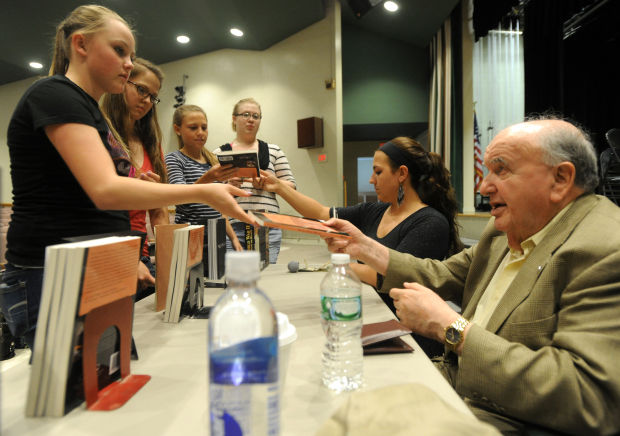
Holocaust survivor Fred Spiegel sells and autographs copies of his book, "Once the Acacias Bloomed," for students at Hudson Falls High School on Friday, May 24. Spiegel, who was liberated by U.S. troops as a young boy during World War II, spoke about his experiences and answered students' questions. (Jason McKibben -

Holocaust survivor Fred Spiegel sells and autographs copies of his book, “Once the Acacias Bloomed,” for students at Hudson Falls High School on Friday, May 24. Spiegel, who was liberated by U.S. troops as a young boy during World War II, spoke about his experiences and answered students’ questions. (Jason McKibben –

Spiegel, 81, visits schools to talk about how he survived. He brings copies of his book, “Once The Acacias Bloomed,” which explains his life as a Nazi prisoner.

Most of the schools he visits are in New Jersey, where he lives. The farthest he travels is Hudson Falls, a school he visited a few times in recent years, a school he included in his book because it was here an important moment in his life occurred.

“They invited me,” Spiegel said of his reason for returning to Hudson Falls. “How can I say no?”

During Friday’s presentation, Spiegel often said he was lucky to be alive.

Other trains carrying Jewish prisoners made it to their destination. His did not.

His train suddenly stopped near Magdeburg. Spiegel said the train’s engineer and Nazi soldiers fled for fear of capture. U.S. troops was cutting across Germany.

Then, a few U.S. soldiers on tanks found the train and freed the captives. The soldiers included Carroll Walsh, of the 743rd Tank Battalion.

Spiegel was later reunited with his family. It was 65 years later when the unexpected happened: He was invited to Hudson Falls to meet others who were prisoners on the train.

He also got to meet some of the liberators, including Walsh, who was living in Hudson Falls at the time.

Matt Rozell, a Hudson Falls history teacher, organized the reunion. He met Walsh in 2001. He interviewed the former soldier, and learned about the train near Magdeburg.

Walsh died in December. He was 91 and a former state judge.

Spiegel, a native of Germany, said people have shown more interest in the Holocaust over the years.

During Friday’s visit to Hudson Falls, he spoke to about 30 sophomores. Some of them had copies of Spiegel’s book. Others bought the book after the presentation.

Armand Ryther, a student, approached Spiegel to shake his hand.

“I find it very interesting that he could survive what he did,” Ryther said.

Ryther said he read Spiegel’s book.

Jamie Hughes, a fellow sophomore, said it was interesting to hear about Spiegel’s experiences.

“I think it’s really amazing that he would want to share his experiences with everybody,” she said.

Tara Sano, a Hudson Falls history teacher, said the event was planned near Memorial Day so students can reflect on the efforts of veterans.

“My hope is that when you are taking your three-day weekend, you think about why you have a three-day weekend,” she told students at the start of the presentation.

http://poststar.com/news/local/article_00a9219c-c648-11e2-ae69-001a4bcf887a.html

See Fred meet his liberator for the first time.

Read Full Post »

« Newer Posts - Older Posts »