"for the sake of humanity"… A small town American high school history project changes lives worldwide. These are the observations of a veteran teacher- on the Power of Teaching, the importance of the study of History, and especially the lessons we must learn, and teach, on the Holocaust. Click on "Holocaust Survivors, Liberators Reunited" tab above to begin.
I wrote this midway though my teaching career. Almost twenty years and eleven books later, almost all of the men and women I talked to are indeed gone. I like to say that for me, I feel like everyday is Memorial Day.
But are they forgotten? Do we still teach our children? I hope someone does.
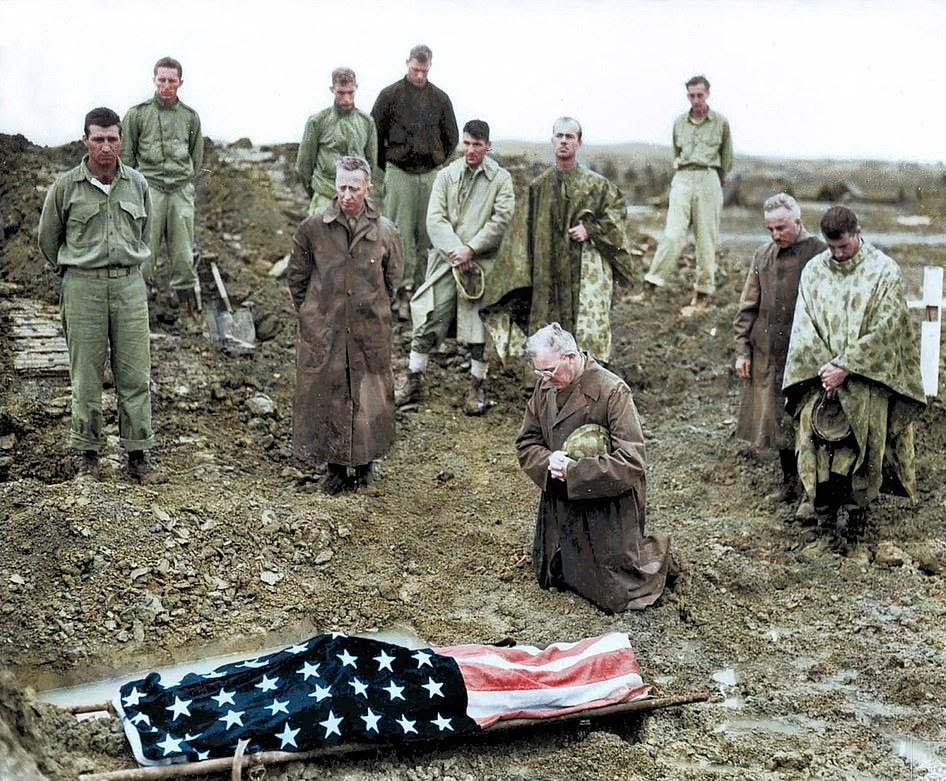
Colonel (later Brigadier General) Francis I. Fenton buries his son Michael on Okinawa, May, 1945.
Scene #1: The morning of December 16, 1944. A lonely outpost on the Belgian frontier.
In subzero temperatures, the last German counteroffensive of World War II had begun. Nineteen thousand American lives would be lost in the Battle of the Bulge. “Hell came in like a freight train. I heard an explosion and went back to where my friend was. His legs were blown off-he bled to death in my arms.” The average age of the American “replacement” soldier? 19.
Scene #2: Memorial Day, sixty-plus years later. In a small town in the United States, it is a day off from work or school and it is the unofficial start to the busy summer season. We sit in our lawn chairs, we chat with neighbors and sip our drinks when the gentlemen with the flag march past.
The holiday known originally as “Decoration Day” originated at the end of the Civil War when a general order was issued designating May 30, 1868, “for the purpose of strewing with flowers or otherwise decorating the graves of comrades who died in defense of their country during the late rebellion.” When Congress passed a law formally recognizing the last Monday in May as the day of national celebration, we effectively got our three-day weekend and our de facto beginning of summer.
Of the sixteen million American men and women who served in WWII, a half million died on the field of conflict. In 2007, over 1200 veterans of World War II quietly slip away every day. The national memory of the war that did more than any other event in the last century to shape the history of the American nation is dying with them. Incredibly, it comes as a shock to most Americans today that the “Battle of the Bulge” didn’t originate as a weight-loss term.
In the high school where I teach, I have been inviting veterans to my classroom to share their experiences with our students. As their numbers dwindled, I smartened up, bought a camera, and began to record their stories. We’ve spoken at length with a pilot forced to bail out at 28,000 feet of his flaming B-17 bomber, only to watch crew members die in the subsequent explosion and then be taken prisoner himself. We have had conversations with POWs who survived forced marches in brutal weather, and with Jewish infantrymen who were among the first to liberate the death camp at Dachau. We have met men who were handcuffed to Nazi war criminals at Nuremberg and who were assigned to suicide watch guard shifts there after fighting their way across Germany. We can imagine what it was like to sail eerily into Pearl Harbor 36 hours after the Japanese attack and see no lights except the USS Arizona still blazing with the bodies of hundreds of Americans entombed in it. We are with the torpedo bomber pilot as he takes off from the flight deck of the carrier USS Yorktown during the epic battle of Midway, and is forced to land on the deck of another carrier as the Yorktown burns and later slides to the bottom of the sea. We intently listen to a blind Marine describe what it was like to lose his eyesight fifty-nine years to the day of his being struck by mortar fragments, not once, but twice in the same day at Okinawa (and he told us that ” the hardest part was telling my mother”). Across a kitchen table I have discussions with other veterans, including a former 17 year old describing what it was like to share a foxhole with a headless fellow US Marine on Iwo Jima. My students and I are just “one person away” from the shock of Pearl Harbor, the chaos at Omaha Beach and the Huertgen Forest, the horrors of Guadalcanal, Tarawa, and Peleliu Island.
Sixty-plus years ago these men and women saved the world. I think about this: by the time my teaching career ends in 10 or 15 years, almost all of the survivors will be gone.
It’s not enough that I have an interest in their stories. I have long looked out into a sea of faces, some students mildly interested in what I have to say, but many others displaying a quiet and disturbing apathy about the past. What is infinitely reassuring and comforting to me, however, is that they all seem to have a genuine interest in a “real” connection with the past, with a person who becomes the ultimate source, because he or she was there.
These men and women have helped to spark students’ interest in finding out more about our nation’s past and the role of the individual in shaping it. On our website we have worked to weave the stories of our community’s sacrifices into the fabric of our national history. And that, to me, is what teaching history should be all about. After all, if we allow ourselves to forget about the teenager who bled to death in his buddy’s arms, if we overlook the sacrifices it took to make this nation strong and proud, we may as well forget everything else. Where will we be when there is nothing important about our past to remember? The answer is found in simple study of any other great civilization in history that allowed the collective memory of the past that once bound them together to be trivialized and blurred, to be eroded away and forgotten-
This week, I hit upon a realization, so bear with me as I unpack A LOT in this post.
The realization that has been simmering for over a quarter-century is that my students and I were, for years, performing a form of unintentional psychotherapy for the “Greatest Generation”, and perhaps now their children.
This past Monday, I sat in a room at SUNY Oneonta surrounded by educators from across New York State. We were there for the central NY DCMO BOCES session titled “Growing Global Citizens,” focused on the new NYS Standard of “Portrait of a Graduate”, and guidance for Holocaust education. There is a resurgence of discussion in educational circles about Project-Based Learning (PBL) and “Inquiry-Based Learning”; in fact, in addition to human rights and the Holocaust, that is what today was all about, and why I was asked to present.
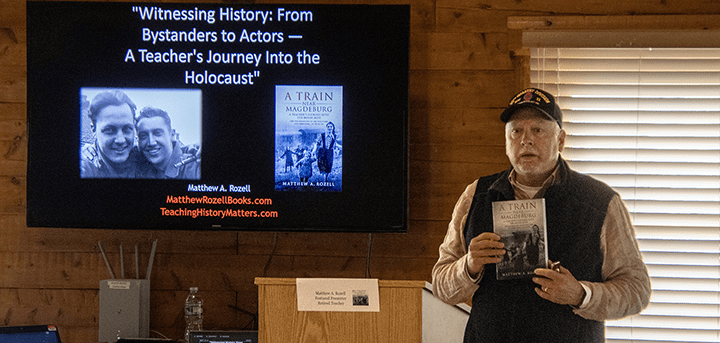
Retired Hudson Falls social studies teacher, award-winning educator and author Matthew Rozell holds a copy of his book A Train Near Magdeburg while speaking to educators on Monday at a professional learning event organized by DCMO BOCES. The book is currently being made into a movie.(DCMO BOCES)
Looking back, I think I was a “Godfather” to these concepts before we even had a name for them. But what we did not realize at the time was that the “project” was never just about history; it was about healing.
The Generation Gap and the Floodgates
For decades, an entire generation of veterans lived in a self-imposed silence. When they came home, they couldn’t speak of what they experienced with their parents or girlfriends or wives. Later, with their own children the veterans didn’t want to burden them with the weight of what they had seen. And the fact is when they came home, in many instances leaving friends behind overseas, no one wanted to hear about it. The war was over. It was “time to move on”. It took the passage of decades—and the curiosity of the grandchildren’s generation—to finally open the floodgates.
I see the evidence of this silence every day in my inbox, and in my social media posts on my Facebook page. I receive countless messages from the “Second Generation”—the children of these veterans—who come to me to finally learn about the father they never truly knew. They remember what they themselves experienced, growing up:
The father who walked the halls at night, his muffled cries echoing through the bedroom walls.
The father who needed his own space on a certain day of the year, retreating into the “frenzy” he left behind decades ago.
The dad who you never touched or shook to wake up.
This is the true legacy of the World War II Living History Project. Beyond the history textbooks, it gave soldiers a final chance to “get it off their chests” before they passed. And I suppose I became an unintentional conduit, providing a modicum of peace by allowing them to share their truth with the youth of our country. That’s why they became books, for if I had left the interviews in the filing cabinet, they likely would have wound up in the dumpster the week after my retirement.
I remember a tough Marine, interviewed by a teenage girl in my class. She was assigned to interview him about his experiences in the Pacific in the island hopping campaigns. And she was so nervous that she would open a wound by asking her questions. Well, Joe Fiore picked up his second Purple Heart on Saipan. But he still cried 60 years later remembering his mother’s reaction to the news, though he recovered and finished the interview. She gave him the space to feel, to share these emotions before he died.
Jimmy Butterfield, a fellow Marine and Joe’s friend, recalled his own mother with emotion to a classful of teenagers who themselves were about to go out into the world. The telephone rang on the hospital floor in Hawaii, and they told him it was his mother on the line, the phone call he had been dreading. He’d lost part of his face to a Japanese sniper on Okinawa, and after many surgeries, the doctor had finally told him that at age 19, he would never see again. The pain and shock was one thing. But now he had to tell her, from 5000 miles away. ‘So I had a hard two months, I guess. I kept mostly to myself. I wouldn’t talk to people. I tried to figure out what the hell I was going to do when I got home. How was I going to tell my mother this? You know what I mean?’ [The Things Our Fathers Saw—The Untold Stories of the World War II Generation From Hometown, USA-Volume I: Voices of the Pacific Theater]
A soft-spoken man, James Castiglione was a Navy veteran, sharing his story from the heart, bringing to life once more the things he saw that he could never forget, and carried for so many years. “Right in the passageway [on the ship], there was a young lad there. All I could hear him say is, ‘Ma.’ He’d take a breath, and it’d be a whistle. ‘Ma.’ [cries softly] Oh, God. I was looking down at him lying on the deck. He looked up at me. ‘Ma.’ Then I realized what was happening. When he was going, ‘Ma,’ he was taking a breath, and his lungs were filling up with air, and it was leaking out the back. He had a little hole in the top of his lung up here, but it came out and it ripped a couple of his ribs off, and knocked a couple of his vertebrae out of line. He had a hole in his back about that big [gestures with hands]. They couldn’t do nothing for him. All they did was, they padded him up with absorbent cotton and bandaged him up. They said, ‘Just wait for him to die.’ When I was there with him, I knelt by him. I held his hand. He felt I held his hand; [he gripped my] hand tight, very tight. I knew he was still alive. Those things, you can’t forget. You don’t forget. I thank God that I was able to help some of those boys. Whenever there was an operation going on in the sick bay, not only the sick bay, the state rooms had to be turned into operating rooms, doctors all over operating, taking arms off.” [D-Day and Beyond: The Things Our Fathers Saw—The Untold Stories of the World War II Generation-Volume V]
Walter Gantz couldn’t speak to his parents about what he saw, taking care of the death train survivors [A Train Near Magdeburg] in the aftermath of the Holocaust. A 15 year old girl in his care died one evening, and although he didn’t have to, he cradled her emaciated body down the stairs to the morgue tent, tears flowing. He parents asked him why he didn’t sleep at night. He never told them. He came to one of my talks, and you can see the trauma as he speaks to college students, and actually get to unburden himself to them, and to a survivor he just met who was on the train and also traveled to my talk.
The Weight of the Work
I’ll be honest: I was emotionally drained for two days after presenting that morning and afternoon. I hardly remember the drive back home.
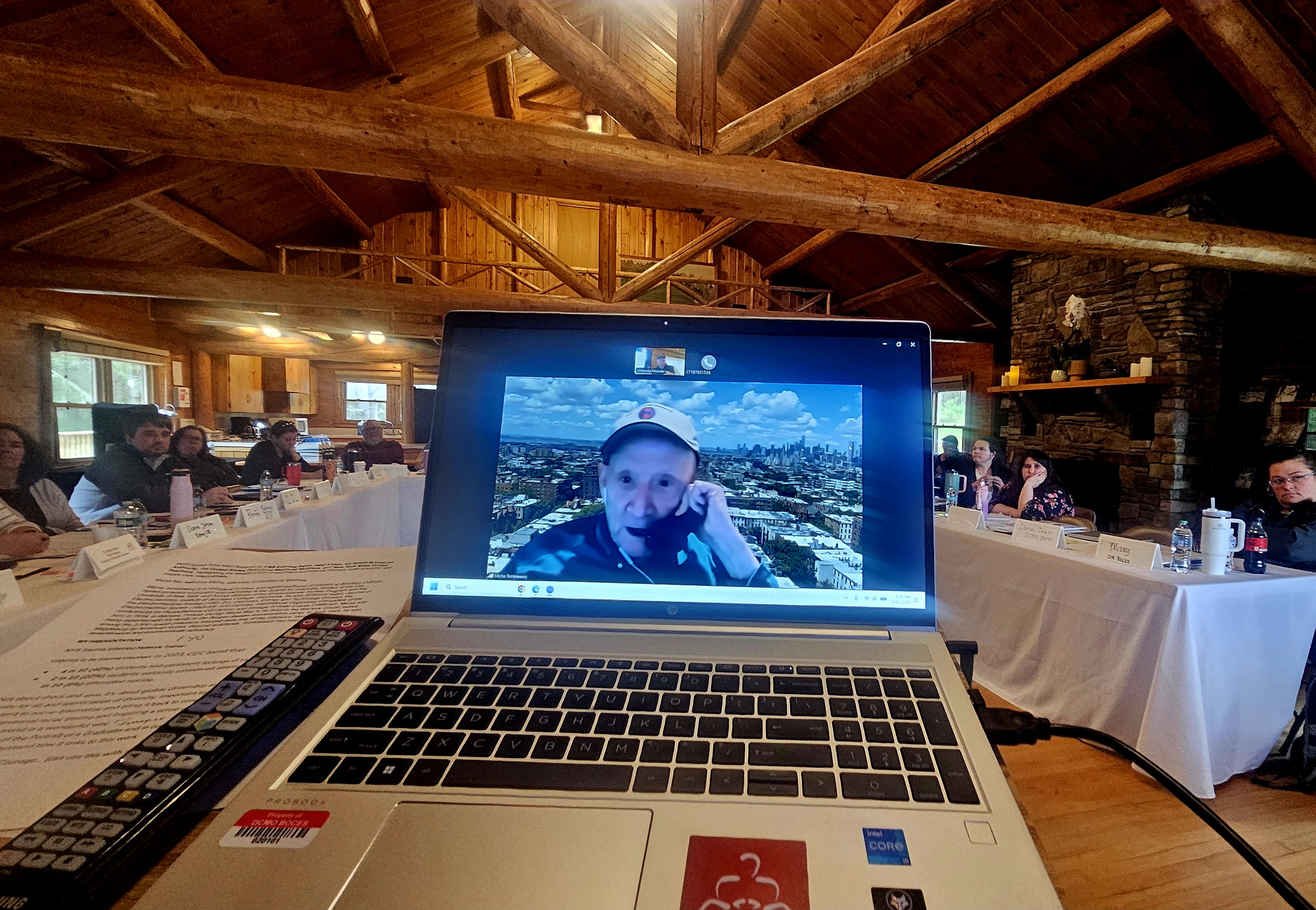
Expounding on all this that day with thirty teachers, while reconnecting via Zoom with my friend Micha Tomkiewicz, topped off this day with the teachers. Micha, a retired professor and the second survivor from that train near Magdeburg to ever contact me, is turning 87 in two weeks. Seeing his face on that screen, watching him answer questions—and his ever present good humor intact!—from a new generation of teachers, reminds me of the stakes. He was a six year old boy rescued on the train with his mother, and there with me from the beginning of this odyssey—the only survivor to attend every single reunion, on four (!) continents—and in some respects just about the “last man standing”.
I have spent 40% of my life on this planet immersed in these stories. It never truly ends, and it never gets easier to recount. But I do it because I hope to inspire other teachers to embrace this realm of “project-based” learning—where the “project” at hand is our shared human history and how we choose to carry it.
And another legacy is illustrated in a Facebook post I made which unintentionally became a message board that illustrated that the trauma is real, and passed on.
A veteran of Vietnam wrote, “My dad served in the army and my uncle served in the air force. Both survived European Theater. Neither talked about war much, only occasionally to one another. My dad never slept without socks on, and you never touched him to wake him up. I never asked him why. When I got my draft notice, he knew I wanted to go to Nam, it was the first time in my life I saw him cry tears. And he was a tough man. Thanks dad. See you again someday.”
One woman wrote, to another on my thread, “Survivor’s guilt is such a painful thing. My mother finally explained after my dad passed away that he was stuck in a ravine in his tank until someone finally rescued him, and he missed the dinner being served for Christmas. When he got back to his unit he found out his buddies had been killed while standing in line for chow. If Dad hadn’t been in the ravine, he would have been in line with them. This finally explained the stress every Christmas that we couldn’t possibly understand as kids. As with your father, it wasn’t something to talk about. Both of our dads, as with countless others, came home feeling like they should be ‘man enough’ to put all those feelings aside. If only they’d realized they were all in the same boat, needed help, and it was nothing to be ashamed of! With all the comments coming in, it makes me realize that many in our generation were struggling to understand our fathers’ emotional issues, nightmares, and erratic behaviors. Thanks so much for reaching out! Me, in reply: “You hit the nail on the head. This began as a post for my books… but it is touching something very, very deep. My books go there, and I think that some of these discussions in their own way are helping bring peace to you, the ‘second generation’ World War II survivors. Because that is exactly what you are. Trauma certainly is passed on, maybe to a lesser extent, even if we don’t realize it. I have done extensive work with Holocaust survivors and their kids too, and first recognized it there!” Our work then, and my books now, heal.
A Message to My Fellow Educators
I closed my talk in Oneonta by asking those teachers to go even further, and think of that one student in their classroom who depends on them.
There is always a student who gets up and comes to school simply because you are their hope. They may be navigating their own trauma at home. You inspire, you challenge, and you look to your students as the future—but you must realize that you are the conduit to that future.
Most days, you won’t see the fruit of your labor. You’ll feel the exhaustion long before you feel the reward. But my hope is that someday, your actions will come back to you in spades. You will rest easy knowing you made a difference in the world—not just as a teacher of facts, but as a cultivator of global citizens.
It is an awesome, heavy responsibility. But you were born for it. And skillfully teaching this subject helps kids realize, they are not alone in this confusing, often traumatic experience called life. The great leaders, the teachers in history, fall back upon the past to look for guidance in troubled times. You do the same for your students.
And Micha—you have saved me!
The DCMO BOCES “Growing Global Citizens” Event
Earlier this week, I had the honor of presenting alongside Dr. Doyle Stevick—a scholar and executive director of the Anne Frank Center at the University of South Carolina—speaking about the study of the Holocaust as a moral “call to action” against racism and prejudice, and a panel of dedicated educators. Our goal was to move beyond historical facts and address the moral implications of the Holocaust. To learn more about these professional learning opportunities, you can read an article here.
Matthew RozellAuthor of The Things Our Fathers Saw series and A Train Near MagdeburgMatthewRozellBooks.com
A girl smiles while recuperating from the concentration camp Bergen Belsen sometime following liberation in the spring of 1945.
Tomorrow in central New York I am presenting at a workshop for teachers about Project Based Learning, which I was doing 30 years ago with my students before it even had a name. My books are a result of that today, to keep the history alive. The story below is of a good example of that. Happy Mothers Day!
A Holocaust survivor recounts how she got a message to her mother that she was still alive, a beautiful anecdote that can also be found in my book ‘A Train Near Magdeburg’. There are no coincidences.
It was a beautiful, balmy morning in April 1945, when I entered Major Adams’ makeshift office in Farsleben, a small town in Germany, to offer my services as an interpreter. It made me feel good that I could show, in a small way, the gratitude I felt for the 9th American Army, which had liberated us as we were being transported from Bergen-Belsen concentration camp.
Orders found by the Americans in the German officer’s car directed that the train was to be stopped on the bridge crossing the Elbe River at Magdeburg, then the bridge was to be blown up, also destroying the train and its cargo all at once. The deadline was noon, Friday the 13th, and at 11 A.M. we were liberated!
With the liberation had come the disquieting news that President Roosevelt had died, and while I was airing concern that the new President, Harry Truman, (a man unknown to us) could continue the war, a sergeant suddenly said, “Hey, you speak pretty good English. I am sure the major would like to have you serve as his interpreter.”
Major Adams had not been told of my coming, so he was startled when he saw me. No wonder! There stood a young woman as thin as a skeleton, dressed in a two-piece suit full of holes. The suit had been in the bottom of my rucksack for 20 months, saved for the day we might be liberated, but the rats in Bergen-Belsen must have been as hungry as we were and had found an earlier use for my suit. For nine days we had been on the train, and this was the only clean clothing I owned.
Major Adams quickly recovered from his initial shock and seemed delighted after I explained why I had come. He asked how his men had treated us, and I heaped glowing praise on the American soldiers who had shared their food so generously with the starving prisoners. Then he took me outside to meet the “notables” of the German population, and with glee I translated orders given to them by the American commander. The irony of the reversal of roles was not lost on me nor the recipients; I was now delivering orders to those who had been ordering me around for so long! The Germans were obsequious, profusely claiming they never wanted Hitler or agreed with his policies and hoped the war would soon be over.
When asked to come back the next day, I was delighted but hesitated, wondering if it would be appropriate to ask a favor. Major Adams picked up on my hesitation, so I asked him to help me contact my family in America. We had emigrated to the U.S. in 1939, but after six months I returned to Holland to join my fiancé who was in the Dutch army. My parents knew that eight months after we were married my husband was taken as a hostage and sent to Mauthausen concentration camp where he was killed in 1941, but they did not know if I was alive, not having heard from me in more than two years.
Major Adams gave me a kind glance, saying, “Give me a few handwritten lines, in English, and I will ask my parents to forward the letter to them.”
When he saw the address on the note he looked at me, his mouth open in total amazement, and then he started to laugh – his parents and my parents lived in the same apartment building in New York City!
And so it was on Mother’s Day that his mother brought to my mother my message:
“I am alive!”
Lisette Lamon was a Holocaust survivor liberated on the Train near Magdeburg on April 13, 1945, and later in life became a psychotherapist at White Plains Hospital outside of New York City, a pioneer in the treatment of trauma back in the days when the field was in its infancy.
Eighty-four years ago today, a young man from the Adirondack Mountains of upstate New York was spending his 25th birthday under relentless Japanese bombardment — fighting for his life, and for an island that could not be saved.
The hell would come soon enough.
Joseph Minder 1941. Color restoration by Matthew Rozell.
Private Joseph Minder of the 803rd Engineer Aviation Battalion had been fighting and surviving since the Japanese attack on the Philippines in December 1941 — retreating across Luzon, digging foxholes on Bataan, watching friends die, eating whatever he could find. By the time Bataan fell on April 9, 1942, Joe had made it across the water to the fortress island of Corregidor, where the shelling never really stopped.
He kept writing it all down — on cigarette paper and scraps, hidden from his captors.
May 5, 1942:
“Plenty of fireworks to celebrate my birthday today! The Japs have been shelling and bombing continually since early this morning. All communications have been cut off from the other end of Corregidor!”
11:00 p.m.:
“For the past three hours, there hasn’t been a single break in the hundreds of shells which hit this end of the island!”
11:30 p.m.:
“INVASION!”
That night, Joe and a group of men loaded into a truck — its tires flat from shrapnel — and drove over a shell-blasted road to set up a machine gun on a small hill overlooking the beach. They held through the night. One of his close calls came when an American soldier, mistaking him for a Japanese sniper in the darkness, opened up on him with a tommy gun.
Then came daylight.
May 6, 1942 — 8:00 a.m.:
“By this time we have suffered many losses; we managed, however, to continue holding back the main force of Japs until they started landing tanks. With no guns left to combat the tanks, we were forced to surrender at noon. Then is when I received the bad news of Drake’s and Bailey’s deaths, two very close buddies of mine.”
General Jonathan Wainwright had already radioed President Roosevelt: “There is a limit of human endurance, and that point has long been passed.” The formal surrender on May 6 marked the complete fall of the Philippines — the largest surrender of American-led forces in U.S. history. Joe Minder, exhausted, scratched, and now a prisoner of the Imperial Japanese Army, climbed on top of a stack of empty ammunition boxes and slept until the Japanese came and stripped him of his belongings.
What followed was a descent that is almost beyond comprehension. The 92nd Garage holding pen. Starvation and disease. By July 1942 — early in his captivity — Joe weighed 115 pounds, and things would only get worse. He would endure the horrors of the hellships — crammed into the holds of unmarked vessels dodging American torpedoes and bombs — writing in his diary as he crossed the seas: “I hate to think of dodging those torpedoes and bombs on the open seas again, but God saved us on that last trip and if he answers our prayers, we will make this okay, also.”
Eventually he ended up slaving in a freezing copper mine in northern Japan, carrying 70-pound bags of ore on 16-hour days while being beaten by guards. By 1945, men were passing out on the job — walking skeletons, in their own words. Nearly forty percent of the 27,000 American slave laborers did not survive captivity.
Joe did.
August 20, 1945:
“War’s end was officially announced by interpreter, ‘Mosiki,’ at 1:15 p.m.! Still hard to believe!”
Two days later came a moment he would carry for the rest of his life. The camp tailor had worked through the night to construct an American flag — blue from a GI barracks bag, red from a Japanese comforter, white from an Australian bed sheet. Joe walked out of the barracks and saw it flying.
August 22, 1945:
“After three and a half years of starvation and brutal treatment, that beautiful symbol of freedom once more flies over our head! When I came out of the barracks and saw those beautiful colors for the first time, I felt like crying! I know now, like I never did before, what it means to be able to live in a peaceful nation like the U.S.A. with its unlimited amount of liberties and freedom.”
The B-29s dropped supplies. Joe ate his first doughnuts since May 1942. He gained 13 pounds in 19 days, packed his belongings — stuffed into old barracks bags that had come all the way from Bataan — and boarded a train for the coast. He sailed home past Corregidor on October 10.
The joyful reunion was tempered by the news that his mother had died while he was in captivity.
Joe Minder came home to North Creek, New York, married Hazel Allen in 1948, raised two sons, worked at the local garnet mine, and became a beloved ski instructor — patiently teaching the community’s young people the sport he had loved since the age of seven. He gave back through his church, his fire department, and countless civic organizations.
Despite everything he had endured — the beatings, the starvation, the years of brutal captivity — he never harbored bitterness or hatred. His ethos of patience, kindness, and compassion for others shines forth in every page of his diary, and was confirmed in the way he lived out his days. That, too, is something we cherish as Americans — the capacity to suffer greatly in freedom’s defense, and then come home and quietly build something good.
When Joseph Minder passed away in 2006 at the age of 88, the entire community grieved. The local ski bowl lodge was named in his honor.


 Teaching History Matters