Feeds:
Posts
Comments

Posts Tagged ‘teaching history matters’


So, it is the sixth of June again.

American Cemetery overlooking Omaha Beach, the primary landing zone for Americans during the D-Day invasion June 6, 1944. (U.S. Air Force Photo)The ocean pounds the advance of sand amidst the relics of a different age, the hulking remnants of the tide of battle. The surf rolls in and kisses the beach, as the last participants mix on the hallowed bluff above with the politicians who have gathered from all over the world.

Thirty years ago I watched as the American president honored  the fallen, and the living, at the cemetery for the fortieth anniversary. Just out of college, something stirred inside me. Something was awoken.

Thirty years have passed. I began by writing letters to the newspaper. I began to interview D-Day veterans and others. I began to collect stories- not relics, prizes, or artifacts. I really had little interest in captured Nazi flags or samurai swords.

I wanted to talk to the men who were there.

The fiftieth anniversary came next with great pomp and more reflection. It graced the covers of the major newsweeklies. “Saving Private Ryan” stirred the consciousness of a new generation, and reflections of the old. And I learned so much more of the war beyond the beachhead. That there were so many beachheads.

The sixtieth anniversary came around. Students on their bi-annual trips to France would bring me back their photographs and the requisite grains of white sand from Omaha Beach. Teenagers had their emotions  a bit tempered, I think. I would go on to introduce them to so many who were there. When they themselves were teenagers.

So now it is the seventieth. On the 65th, I wrote about a friend who is no longer here for the 70th. Another president spoke today, and the 75th will bring fewer who were there back to Normandy.

*****************************************

Today I would like to introduce you to a survivor of D Day who is still with us.

I first met Bill Gast at a reunion of 30th Infantry Division and 743rd Tank Battalion soldiers at a reunion in March 2008, in which I  was present with several Holocaust survivors who were meeting their liberating soldiers for the first time. Later, Bill came to my high school to speak to students. I think the experience of sharing, and meeting the Holocaust survivors whom the 743rd came upon and liberated, affected him deeply.

Unlike many who may be physically able, Bill has no intention of going back to the sands of Omaha for this anniversary. As he explained to our students in 2009,

“I’m listed [in the event program] as a liberator- however, I am also a survivor of World War II, having landed on Omaha Beach in Normandy, France on D-day and fighting through to the end when the Germans surrendered, May the 7th, 1945.”

“Pictures.

Video games.

Movies.

Words.

They simply do not covey the feeling of fear.

The shock.

The stench.

The noise.

The horror, and the tragedy.

The injured.

The suffering.

The dying, and the dead.”

A  couple weeks ago this article popped up. So glad to see Bill’s name.

*****************************************

D-Day: the view from a tank on Omaha Beach

Washington (AFP) – From inside his tank, the young soldier could see “practically nothing” on Omaha Beach.

Seventy years later, William Gast still wonders whether he rolled over his comrades sheltering from German gunfire that day.

Gast was 19 years old the morning of June 6, 1944. “We came in at H-10, that was 10 minutes before the designated hour.”

He cannot recall why he and his fellow soldiers arrived early, but he has other memories that have never left him.

As part of Company A, 743rd Tank Battalion, 1st Army, Gast remembers the training beforehand in Britain, when he rehearsed driving the Sherman tank onto the landing craft. And then floating in the English Channel.

“Another night we went out and we didn’t come back. That was it.”

Gast got to know the captain of the landing craft that would ferry his tank to the beaches of Normandy.

The skipper promised he would get them close enough that they would not be submerged in water, like so many tanks were that day.

He kept his word.

Another tank unit at Omaha Beach was less fortunate, with 27 of 32 tanks launched at sea five kilometers (three miles) from the coast sinking before they could reach land, despite being outfitted with a flotation screens.

“The order was given to go, we started our engines up, they lowered the ramp,” said Gast.

Amid German shrapnel and sea spray, he “could feel the tracks spinning.”

At last, the tank tracks took hold on the sandy sea bottom and he drove up the beach.


– Like throwing marbles at a car –

Down below in the driver’s seat, Gast tried to steer the tank with the aid of a small, manual periscope.

“You can imagine how much we could see, practically nothing,” he said.

The radios inside the tank were so unreliable that his commander would tell Gast which way to turn by kicking him on the left or right shoulder.

The difficulty in seeing the way ahead has left Gast with a gnawing sense that he may have run over the bodies of American soldiers on the beach.

“The saddest part about the whole thing is, not being able to see, I may have run over some of my own people.

“And if I did, I don’t even know it. I can’t ever get that out of my mind, you know?”

Bill Gast awarded the Silver Star.

Bill Gast awarded the Silver Star.

Corporal Gast heard machine gun bullets hitting the side of the tank, “like throwing marbles at a car — that’s what it sounded like.”

“And there were shells that exploded right beside me. You could feel the tank shake.”

For Gast, it was a day of fear and terror, and following orders without reflection.

“I can’t tell much about what happened, I was scared to death to start with,” he said.

“It was just like putting it on automatic, you just did what you had to do, did what you were told to do.”

By noon, close to 19,000 American soldiers who landed at Omaha were still pinned down on the beach.

– High school sweetheart –

Carefully laid plans had unraveled as the beach became a killing zone, with troops mowed down under a fusillade of German machine gun, artillery and mortar fire.

Small teams of US troops eventually managed to break through on the bluffs between German positions, with the help of combat engineers blowing up obstacles.

The losses were staggering: more than 2,000 dead, wounded and missing on Omaha beach. The exact toll is still unknown. Of the 15 tanks in Gast’s Company A, only five survived without damage.

Gast, from Lancaster, Pennsylvania, earned the Silver Star and the Purple Heart during his combat tour, and went on to marry his high school sweetheart.

Now 89 years old, he recently was awarded France’s Legion d’Honneur at a small ceremony for World War II veterans at the French embassy in Washington.

Bill Gast, Silver Star citation.

Bill Gast, Silver Star citation.

The short, soft spoken man stood up to receive the medal and shook hands with a French diplomat. But he has no plans to return to Normandy for the 70th anniversary of the D-Day landings.

His son, Bill, said his father did not want to relive that day: “It’s important we don’t forget but you try to hide things somewhere.”

http://news.yahoo.com/d-day-view-tank-omaha-beach-104656852.html

*****************************************

Read Full Post »

April 30 1945 Headlines. Hangs in my classroom.

April 30 1945 Headlines. Hangs in my classroom.

Today, April 29th, is the anniversary of the liberation of Dachau, 69 years on. Today, if it is brought up at all, some of us might respond with a vacant stare. More might shrug and turn away. I suppose that is to be expected. But you know me. I just think that as a nation, sometimes we allow things to slip from memory at our peril.

It was real, and it happened. And it was American GIs who overran this camp and many others in the closing days of World War II.

The men of the 42nd and 45th Infantry Division arrived independently of each other, here, in southern Germany, at Dachau, on this day. A concentration camp, they were told. Their noses gave them a hint of what they were about to uncover, miles before the camp appeared in sight.

Read the headlines, above. Note the sub article:

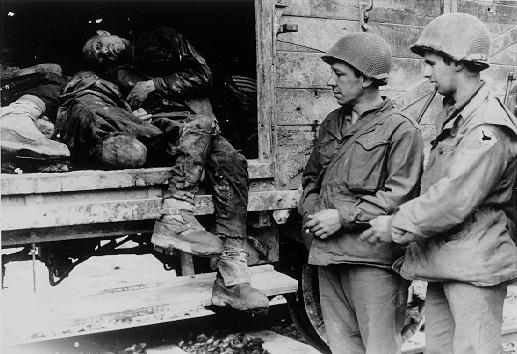
Boxcars of Dead at Dachau. 32,000 captives freed.

American soldiers view the bodies in one of the open railcars of the Dachau death train. USHMM

American soldiers view the bodies in one of the open railcars of the Dachau death train. USHMM

And so after some resistance, into the camp they entered. Life changing events were about to unfold for the American soldier.

***************************

For me, it’s not about hero worship, or glorifying the liberator or any World War II soldier as some kind of savior. Many of the liberating soldiers I know would resist this, to the point of rejecting the term, “liberator”… “It all sounds so exalted, so glamorous” said one. But they will all accept the term, “eyewitness”.

Witnesses to the greatest crime in the history of the world.

So instead I think it is about honoring their experiences, their shock, the horror, the puking and the crying, the rage-and then, the American GIs recognizing that something had to be done. And they did suffer for it, for trying to do the right thing. Many tried to help by offering food to starving prisoners who just were not ready to handle it, only to see them drop dead. Or having to manhandle these emaciated victims who were tearing away at each other as food was being offered.

Some guys never got over it. How could you?

I have learned so much over the past few years from these guys, just through the way that they carried themselves and tried to cope with what they witnessed. In my World War II studies and Holocaust class, we discuss these issues at length. I’m so lucky to be able to teach it.


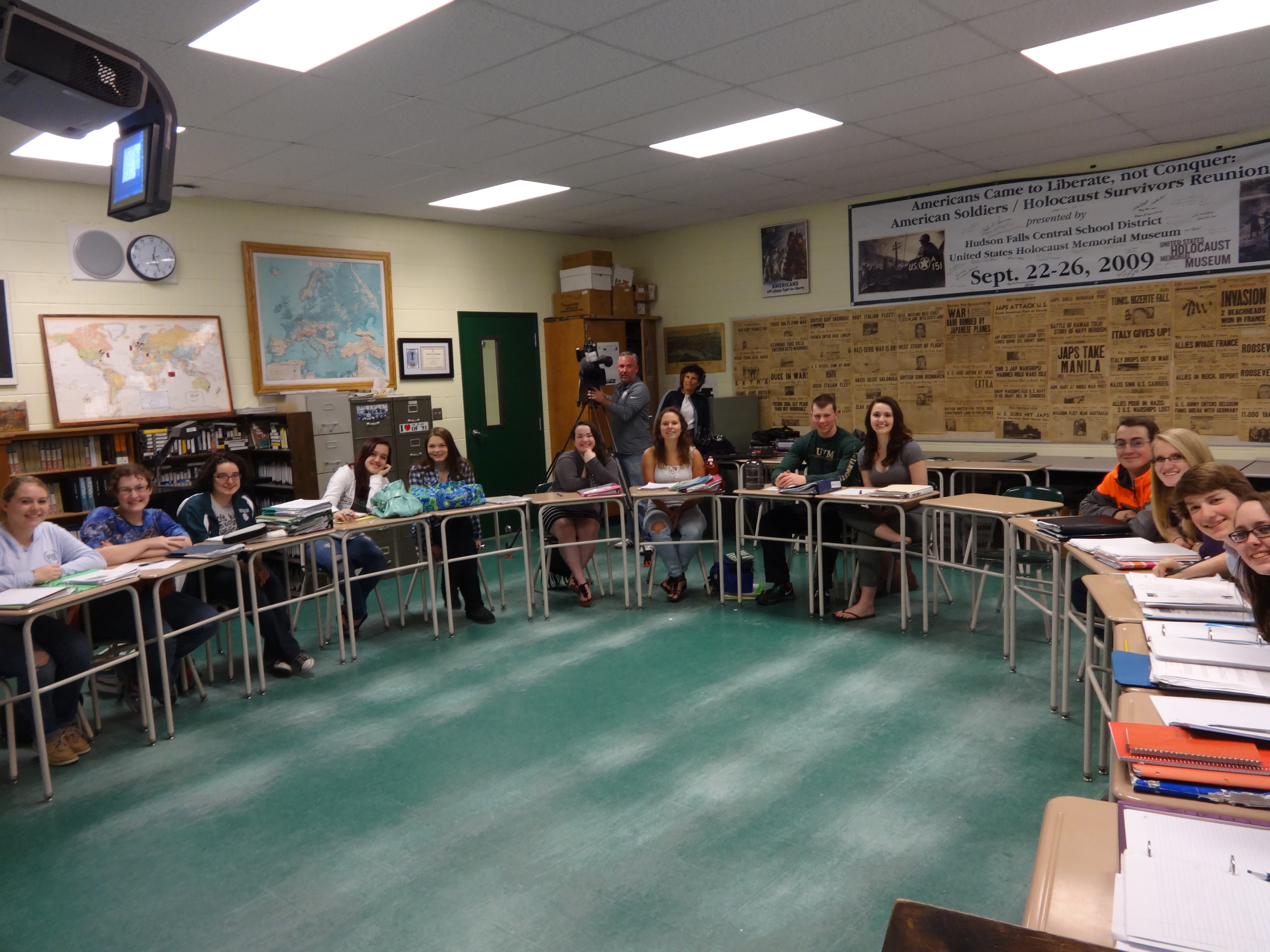
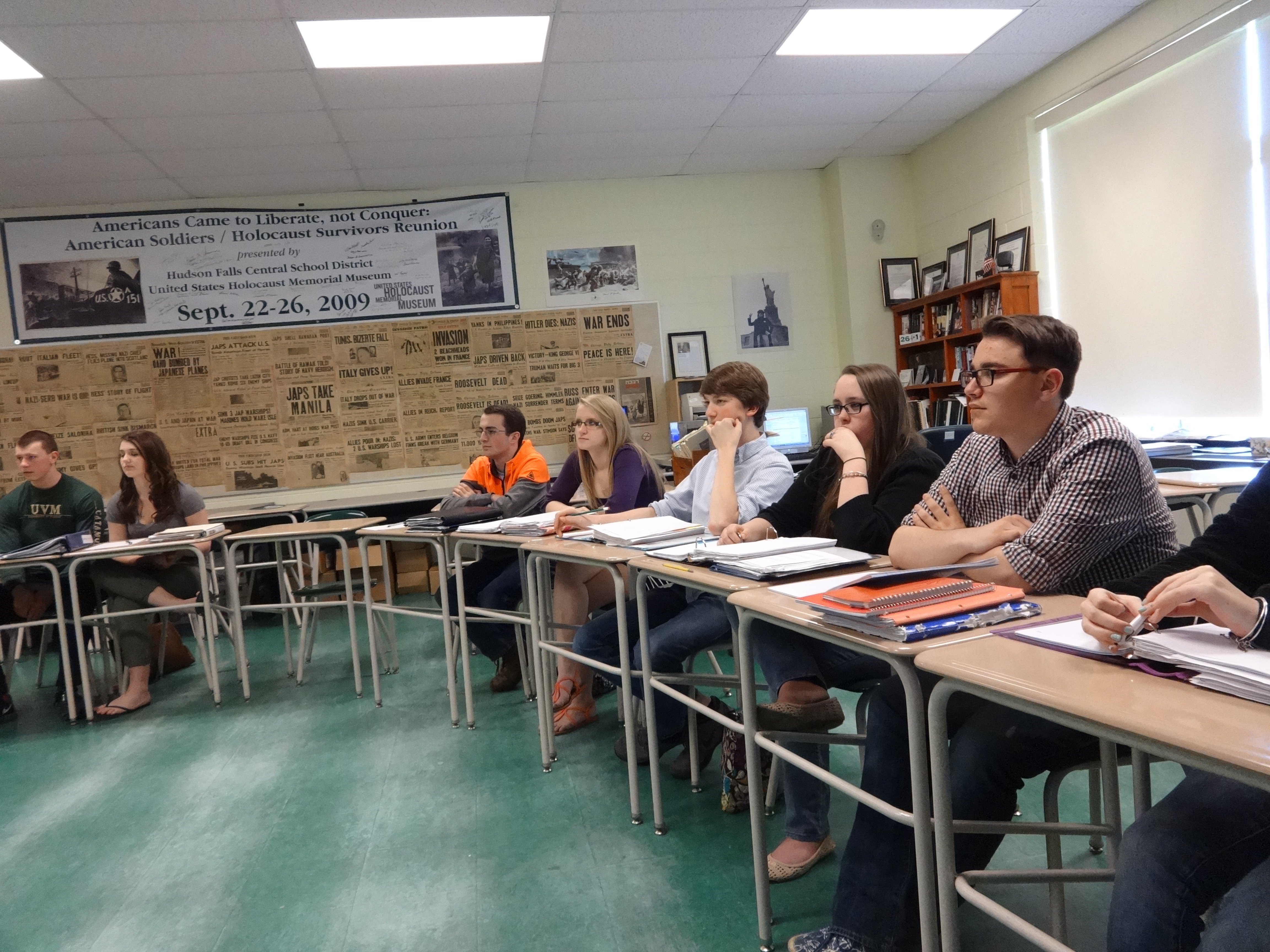
Class of 2014 in my classroom. Watching archival footage of the liberation.

Class of 2014 in my classroom. Watching archival footage of the liberation.

So yesterday, a film crew arrived from NBCLearn, a division of NBC News, all the way up from New York City. No, I did not call them. They found me. They were doing a related story, so I talked them into coming up (shout out here to the producer, Norm).

They decided they wanted to learn something from our kids- ultimately, I think, whether or not history really mattered anymore.

We have had many lessons on the Holocaust, on the victims especially, but also on the  perpetrators and the bystanders. Lessons on the liberation, and what we have been studying all along.

These kids have witnessed soldiers’ and survivors’ testimony. They have interviewed their own subjects, firsthand, and established relationships with this generation. And therefore, they become the new witnesses to the deeds of this generation. And with this, they will carry a new responsiblity. To never forget, and to not let others forget, the lessons of the past.

***************************

The raw film is rolling in the classroom. I guess it’s time for me to see what has happened to change the kids. What have they learned, and how have they grown? But today it is time to set the written exam to the side.

We watch the testimony of the  liberator who had visited our school in the past, and viewed the archival footage and photographs from 69 years ago.

And then editor poses the questions for the kids. “Why is it important to study the Holocaust? “What difference do you think it makes to know about this, our past? What do you think motivated our soldiers to go off and fight? Was it just “patriotism?”

What did your class learn? What have YOU learned?”

The completed video will be shown in schools across the country. Below are some of the kids of Hudson Falls, who make their small town  proud.

Meg V.

Meg V.


Koreena H

Koreena H

Klayton S.

Klayton S.


Class of 2014 in my classroom, April 28, 2014. NBC News has arrived.

Class of 2014 in my classroom, April 28, 2014. NBC News has arrived.


Read Full Post »

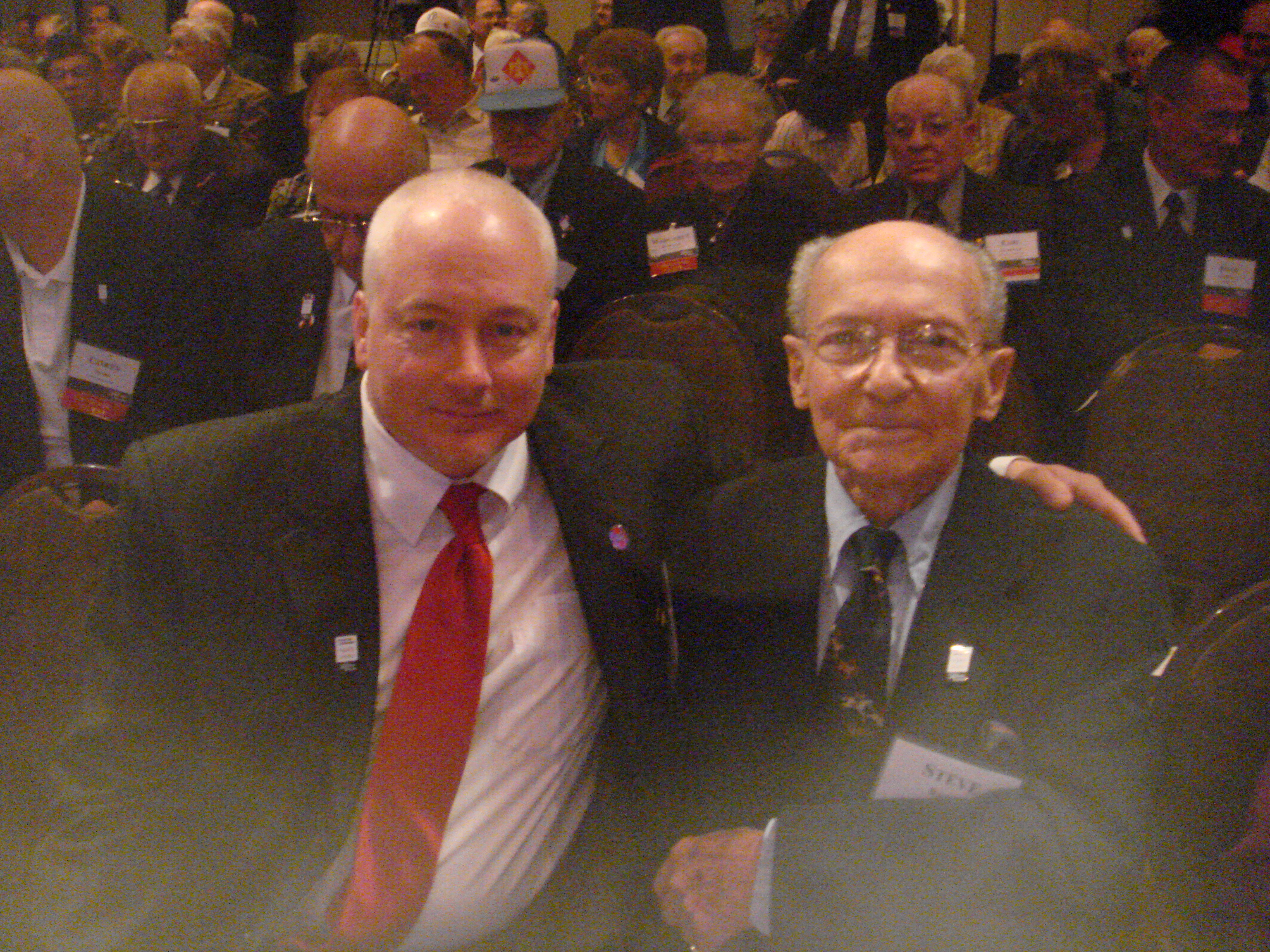
Matthew Rozell, Stephen Barry, National DOR Ceremony, Washington, DC April 2010. This photo was taken the day after the 65th anniversary of Steve's liberation in April 1945. We had just been honored by the director of the United States Holocaust Memorial Museum before the national ceremony in the Capitol Rotunda.

Matthew Rozell, Stephen Barry, National DOR Ceremony, Washington, DC April 2010. This photo was taken the day after the 65th anniversary of Steve’s liberation in April 1945. We had just been honored by the director of the United States Holocaust Memorial Museum before the national ceremony in the Capitol Rotunda.

So, the ripples continue. Somebody said it was like pebbles being tossed into the still water. This may sound strange, but I am keenly aware of the cosmic element. We tripped the wires of the cosmos.

~”It’s not for my sake, it’s for the sake of humanity, that they will remember”~

I got a nice email  recently. My friend Steve Barry was honored Tuesday evening at the United States Holocaust Memorial Museum. Steve’s daughters wanted me to know that his family made a donation in his name and set up two fellowships for scholars at the USHMM in the Stephen B. Barry Memorial Fellowship. His girls mentioned me in their speech Tuesday night in Washington. Thanks ladies. You know he was a hero. He reached out and touched an awful lot of students in the short time that we were together.

Steve will be one of the persons who will be featured in my book. Against all the odds he survived the Holocaust and later even went on to become a US Army Ranger in the Korean War! I was pretty close to him. Right now I am wistfully looking at his homemade holiday greeting cards under my desk glass, and to my left, a foot away, are the shelves containing his Holocaust library, which was passed on to me after he passed away. He was so funny, too.  He told me he nearly “choked on my bagel” a few years back when he opened his newspaper in Florida and read about me and the train he had been looking for, for so many years!

I miss the guy. You can read more about him here.


Steve's name on the wall of donors, USHMM, unveiled April 29, 2014.

Steve’s name on the wall of donors, USHMM, unveiled April 29, 2014.

The inscription kind of says it all. He uttered these words in my very classroom on a Thursday morning to a film crew from New York City, aimed at the 1500 students that he and the other survivors and American soldier/liberators had come to address. That Friday evening of our big soldier/survivor reunion, we watched it together on national news before our final banquet.

You can see the video at the bottom-he’s the one in the preview addressing the interviewer- but the transcript is below.

ABC WORLD NEWS TONIGHT, FRIDAY, SEPTEMBER 26, 2009

Diane Sawyer: And finally tonight, our Persons of the Week. It is a story that began almost 65 years ago in the darkest days of World War II. Yet this week, a new chapter unfolded. An unforgettable reunion of Holocaust survivors, and the American troops who freed them, and all made possible by a high school history class.

Matthew Rozell: This is history coming alive.
Veteran 1, entering school with his wife: Here we are, we have arrived!
Matthew Rozell: This is walking, talking, living history. They’re (the students) shaking hands with the past…

Diane Sawyer: It was 2001 when high school history teacher Matt Rozell decided to begin an oral history project. He and his students would just interview family members in the small town of Hudson Falls, New York, to capture fading stories of World War II.
Interviewer (soldier’s daughter): Did you mention the train [to Mr. Rozell] at all before?
Carrol Walsh, former soldier: No I didn’t tell him about the train.

Diane Sawyer: The students unearthed a forgotten crossroads in history. (Gunfire, archival film footage) Near the very end of World War II, April 13th, 1945, the American 30th Infantry Division was pushing its way into central Germany.
Carrol Walsh: We came to a place where there was a long train, of boxcars.

Diane Sawyer: They found a train, holding nearly 2,500 emaciated Jewish prisoners, many just children, being moved from the Bergen-Belsen concentration camp, to another camp and certain death. Their German guards had just abandoned them, fleeing the Americans.

Carrol Walsh: A feeling of helplessness. What are we going to do with all these people?
Frank Towers, former soldier: We had never ever seen anything so, (pauses) filthy.

Diane Sawyer: The American soldiers fed the prisoners, and brought them to safety.

Stephen Barry: For 42 years I collected anything that I could to try to find any article regarding the train. It just didn’t exist!

Diane Sawyer: But Mr. Rozell’s class put their interviews with veterans up on a website, along with these photographs taken by the American soldiers.

George Gross: Just very courageous people, little girls who with big smiles on their faces, one of them with their arms out, just aware that the Americans are there. [camera pans over 1945 liberation photograph]

Diane Sawyer: Out there on the web, Holocaust survivors all around the world began to notice.

Stephen Barry: I mean, how many people have a picture of their moment of liberation forever? [camera pans over 1945 liberation photograph]

(students and veterans and survivors singing “The Star Spangled Banner”)

Diane Sawyer: A reunion of the survivors and their liberators took place this week at Hudson Falls High School.

Emily Murphy, student: When they speak to us, you can’t say that you feel how they felt. But you get the feeling, you feel like you were there.

Diane Sawyer: In an age where there are still those who deny the Holocaust ever existed, these survivors say they are the living proof.

Stephen Barry: It’s not for my sake, it’s for the sake of humanity, that they will remember.

Diane Sawyer: And so we choose history teacher Matt Rozell, his class, the Holocaust survivors of that train, and the American soldiers who kept them and their story alive. And that is World News for this Friday. I am Diane Sawyer, and from all of us at ABC News, we hope you have a great weekend.

And here is a link to the 2014 United States Days of Remembrance Capitol Ceremony. Steve’s daughters and granddaughters are in the back row!


Read Full Post »

Yom HaShoah is Holocaust Remembrance Day. It marks the anniversary of the Warsaw ghetto uprising.

Clara Rudnick around age 15.

Clara Rudnick, center, around age 15.

I recently visited the local synagogue where my friend Clara Rudnick was to speak.   I was very gratified that several of my students also decided to come, and that when we arrived, they and I were also invited to participate in the readings and the candle lighting for the commemoration.

My wife and daughter also accompanied me. It was their first time in temple and the commemoration deeply touched them.

IMG_0006

Clara lit up when she saw the girls and I. She came right over, smothered me with a big hug, and went right over to the girls.

She and her twin brother Avreminkeh were about my daughter’s age, early teens, when the Germans arrived in Lithuania in June 1941. Her oldest brother Itze was 23 years old, and her two sisters Chiyeh and Dorkeh were 20 and 13. Her proud parents Yossel and Chiyena Charmatz were 42 and 40. They ran a highly regard restaurant and bakery that had been in business for generations, in a community of 10,000 that had had a Jewish presence since the 1300s. Forty percent of the prewar population of Sventzion was Jewish.

The townspeople turned on their neighbors. Even the Catholic and Orthodox churches collaborated in providing information needed to terrorize the community. In July, 1941, Lithuanian collaborators took a nearly a hundred teenage boys and young men including Itze outside of town, locked them in a building, and burned them alive. Hysteria rippled through the Jewish community now. In August, nearly a hundred more, including her twin brother, were taken outside of town on Shabbat, forced to dig their own graves and shot. A few weeks later, also on the Sabbath, eight thousand men women boys and girls were ordered to stand in the town square, where they were shot, including her mother and two sisters. Clara was saved only because her father had given her his coat and told her to hide in the local steam bath.

After the shooting, he came for her at night and took her to the forest for two nights without food and water. They found a farmer who was secretly a Jew and stayed until more refugees began to arrive. Deciding it was no longer safe, they

Students Chelsea R., Paige L., Meg V., Cheyenne B., Mary R. flank survivor Clara Rudnick at reception following Yom Hashoah commemoration, 2014.

Students Chelsea R., Paige L., Meg V., Cheyenne B., Mary R. flank survivor Clara Rudnick at reception following Yom Hashoah commemoration, 2014.

moved to the farm of a Christian friend who accepted their money to hide them. Later, they found themselves in the ghetto at Swir. ” I was 15 years old, I had lost my mother, brothers and sisters, and I was very upset.” And in a constant state of peril.

In the middle of February, 1942, the Germans came to liquidate the ghetto. Clara and her father managed to escape with others across a frozen lake as the Nazis shot at them. Her father broke through the ice and placed Clara in the freezing water and lay on top of her to protect her in the cold winter night, until the Germans left.

They traveled twenty kilometers to another ghetto at Mishaleikse, where they were arrested in April and sent to the Vilna Ghetto, subjected to hard labor. Here Clara witnessed starvation, disease, street executions, babies killed and placed in the back of trucks. Mistreatment was widespread and deportations to concentration camps and extermination centers occurred almost daily. Clara again was able to escape, but this time without her father. A local cinema owner told her father he would take care of her. She would see her father only one more time.

In the summer of 1942 (the same summer that Anne Frank would go into hiding, Clara notes) a handsome sum of gold was given to another Christian and Clara was hidden in a dark hidden cellar with a trap door for seven months, emerging only once a day to answer nature’s call. One day she peeped through the hatch to see what was going on upstairs, as there was a great deal of commotion and noise. Bullets raked the hiding spot and she was grazed in the stomach, the cinema owner killed. Clara was caught again.

She was taken before the Gestapo in Kalich, where as a slave laborer she was forced to make fur coats for the Germans fighting on the Russian front. Then the slaves were placed into two trucks. One went to the execution site of Panar, the other to the camp at Kaiserwald. Clara considers it another miracle that she was on the truck to Kaiserwald. Here she worked with dangerous acid to make batteries. She was afraid the acid would scar her and she would be killed.

After some time, she was sent to Stutthof on the Baltic. It was here that she saw her father, through the chain link fence, for the last time. He and 85,000 others perished here. She was terrified.

As the Red Army closed in she was marched out and placed in a barn, locked with other women to die from starvation. It was here that she was liberated by Soviet forces on march 11, 1945. She states, matter of factly, that the soldiers moved on immediately, having no time to care for them.

Heading to Lodz,  Poland shortly after, she did not find any family members anywhere. Regaining her strength, she met another survivor, Abraham Rudnick, a Lithuanian Jew like her who had been liberated by the Americans at Dachau on April 29, 1945. They married in a DP camp and emigrated to the United States in 1949, where they raised a family and built a plumbing and heating business in upstate New York.

So tonight she is here with her grandson and recounts the story, and the postscript of her summer trip back to Vilna and her hometown in Lithuania, and her realization that no one in Lithuania seems to want to acknowledge the countries complicity in the murder of her family and hundreds of thousands of others. But here, speaking in the temple for perhaps the last time, she has her North Country family, and has certainly won over the hearts of a few young ladies this evening. They wont forget, Clara, and they are the new witnesses. It’s so.

Clara told me some years ago that her sons had my dad as their history teacher in high school and that he was held in high regard. As we bid her goodbye, she whispered in my daughter’s ear-“Don’t tell your father, but I love him!” I am blessed to know you now, as was my dad and now my girl, and my students. We’ll keep you close, and remember your mother and father, your brothers and sisters, and all those murdered in those not so distant days.

Clara Rudnick by Erica Miller


Read Full Post »


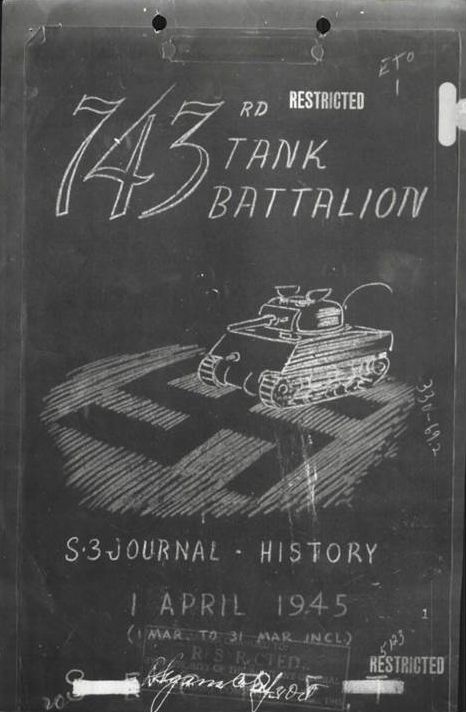
Cover of After Action Report for April 1945.

Cover of After Action Report for April 1945.

Today is the 69th anniversary of the liberation of the train near Magdeburg. How fitting it was/is falling at Passover time.

Emails and greetings are flying back and forth through the liberator/survivor network that we created.  Liberator Frank Towers always sends a message on this anniversary to the survivors.

From my one of my survivor friends:

Hello to all of you ‘my twins’ on our 69th birthday and to those who fought to give back our lives. Like the years before, there are no words enough to express our thanks to them.

How appropriate is this year for us who celebrate Seder to read, as an addition to the Hagaddah, Frank Towers’ beautiful greetings remembering OUR liberation from not just slavery but certain death.

Here is the opening of my new article. You can see the rest in the previous post.

Blessings to all on this reflective occasion.


~THE TRANSPORT TO LIFE~

With the end of the war in sight, a startling encounter takes place between Jewish victims of the Holocaust and American combat troops who have survived nine months of grueling combat across Northern France, Belgium, Holland and now Germany. In 2001, interviews conducted by a high school history teacher and his class paved the way for several joyful reunions between the survivors and their American soldier liberators over sixty years later.


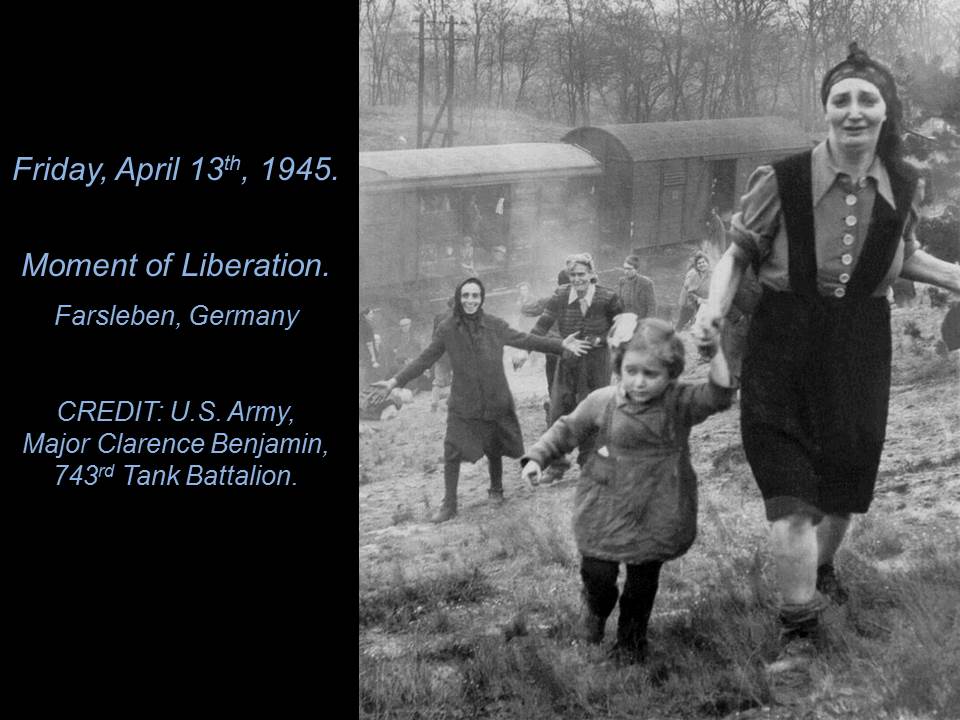
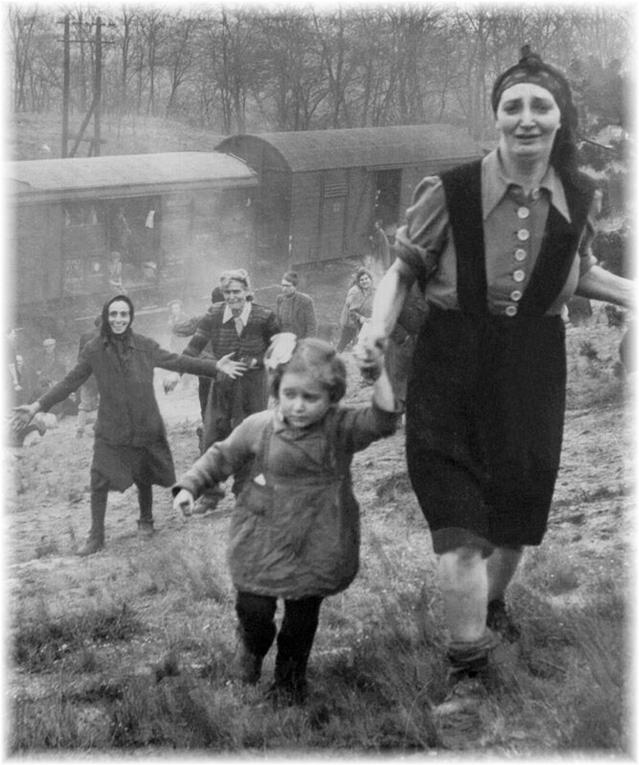
The photograph  is striking.

Query the word “train” and Holocaust” in an image search and the results returned generally show victims being deported to killing centers.

This is the opposite.Matthew Rozell

It is a cool spring morning. In the background, down the hill, are two cattle cars. At the opening of the sliding doors on one of the cars we can see a figure sitting on the edge, perhaps too weak to climb out yet soaking up some energy from the warming April sun. In front of him, a wisp of smoke seems to rise from a small makeshift fire that others have gathered around.

This is an appropriate backdrop for the drama unfolding in the foreground. Trudging up the hill toward the photographer, now only a few steps away, are a mother and her young daughter. The mother has her hair wrapped in a scarf and is clutching the hand of the girl with her right hand. Her left hand is extended outward as if in greeting; her face is turning into a half smile in a mixture of astonishment and enveloping joy, as if she is on the cusp of accepting the belief that she and her daughter have just been saved.

The little girl is shooting a sideways glance away from the camera. Her expression is one of distress- she looks terrified. On this morning in Germany in 1945, she may very well be responding to the two Sherman tanks that are now clanking up to the train, behind the photographer who is in the jeep with the white star.

Following the mother and daughter up the hill towards the soldiers are two other women. One welcomes the tanks with outstretched arms and a wide grin as she moves up the hill. The other follows behind her. She appears to be crying.

It is Friday, the 13th of April, 1945. Led by their major scouting in a jeep, Tanks 12 and 13 of the 743rd Tank Battalion of the U.S. Army have just liberated a train transport with thousands of sick and emaciated victims of the Holocaust. Major Clarence L. Benjamin snaps a photograph, which will be inserted into his official report back to headquarters.

But what have they stumbled upon? Where have these people come from?

And what do the soldiers do now?

**********************************************
Read Full Post »

PRISM SPR. 2014 I’ve had an article published in the Spring 2014 edition of PRISM: An Interdisciplinary Journal for Holocaust Educators, an “internationally renowned, annual, peer-reviewed journal” published by the Azrieli Graduate School of Jewish Education of Yeshiva University of New York, reaching readers in 35 countries and in all 50 American states. It is important to me to set the record straight and allow others the opportunity to read how this  history unfolded.

“In preserving and investigating the history, in interviewing liberators and Holocaust survivors, and in working with museums and memorial sites, Mr. Rozell and his students are also creating new knowledge, the highest form of academic achievement. Most importantly, in studying about the Holocaust, he and his students are also helping to rescue the evidence that can help stem the rising and dangerous tide of denial before it is too late.”

You can read the full edition here. The article appears on page 94. Obviously space did not allow for the full story to be told but that will come out in the book, so if it appears that a supporter, survivor or liberator friend has been left out, that is not the  real case. As always, thanks for your support, and thanks to editor Dr. Karen Shawn for recognizing the significance and the potential.

Read Full Post »

Matthew Rozell, 30th Infantry Veterans of WWII, Holocaust survivors at Mighty Eighth Air Force Museum, March 2, 2012.

Matthew Rozell, 30th Infantry Veterans of WWII, Holocaust survivors at Mighty Eighth Air Force Museum, March 2, 2012.

Have you ever been to a reunion of folks who have been annually meeting one another, every year, for nearly 70 years?

Where the main participants had their youths forged in the steel of battle, and come together annually to remind themselves of what it was all about?

I have been honored and privileged to attend six such reunions with the veterans of the 30th Infantry Division of World War II.

To sit with these men, and their wives and family members and hear their stories, and chuckle as they josh with each other, or to shed a tear at the memorial service for the ones who were lost, is an incredible experience.

What has made it even more profound, over the last few years, has been the inclusion of the Holocaust survivors that they saved, and their extended families who would not be here today, if not for their efforts, at these gatherings. And add a Medal of Honor recipient, one of the few surviving from World War II, for good measure.

Worthwhile? I had a 94 year old veteran grab me by the arm a couple years back, and he said to me, after listening to me and the survivors of the Holocaust speak, “Now I know what I fought for.”

This year, the reunion is unfolding as I write this in Savannah, Georgia, with the gracious hosts Carol Thompson and Jack Sullivan and his wife Stella, the children of one of the soldiers who served in the 118th Artillery.  Unfortunately I am snowed in up north, digging out under 18 inches. I’ve included my greetings to the gathering below as they meet on the 69th anniversary of the end of World War II. Next year is the 70th and I really hope that they meet again and that I can be there. As the letter indicates, they helped to send me to Europe this summer as well. Here is a PDF of what I saw.

Matthew Rozell

February 14, 2014

AND HERE IS MY REUNION GREETINGS MESSAGE AND PICS

Read Full Post »

NOTE: Below is an article I found at the PBS website. In my trip to Germany this summer I encountered some of the same experiences. Happily I met many Germans who are actively making a difference. Compare this to nations like Lithuania.

WILLIAM BRANGHAM:  From the outside, it looks like a beautiful old estate, but this is no private residence. Inside, investigators for the German Federal Government are poring through decades old records, searching for the last remaining Nazi war criminals who might have escaped justice.

This is part of a much broader national effort underway in Germany to wrestle with the legacy of the holocaust… it includes the construction of memorials and museums at a record pace —  the revamping of the nation’s curriculum so that all German school kids get a fuller understanding of the Nazi era.

But perhaps few are as crucial to this effort as this man.  His name is Kurt Schrimm, and he runs the central office in Germany that’s still trying to bring former Nazis to justice.


KURT SCHRIMM: (translated from German) Right now only murder is punishable. All other crimes have passed the statute of limitations and can no longer be punished.

WILLIAM BRANGHAM: Thirty one years ago, Schrimm was a local public prosecutor investigating robberies, murders and gun crimes… but when this history buff heard of an opening in a regional office investigating war criminals, he jumped at the chance.  And soon after, a conversation with one Holocaust survivor drove home the importance of this work.

KURT SCHRIM: (translated from German) I met an elderly Jewish lady in New York at the end of the 1980’s who had survived the war. She said “I’ve been waiting more than 40 years for a German official to be interested in my case.” She told me “it doesn’t matter whether this person is put to trial or goes to prison; the most important thing is that you listened to my story.”

WILLIAM BRANGHAM:   Schrimm would like to see the men he’s investigating prosecuted… but establishing their guilt in court has been complicated….   Following World War II, to convict a German soldier of murder, prosecutors had to prove a direct, personal responsibility for the killing of an innocent person.

But several years ago, Germany successfully prosecuted 91 year-old retired Ohio autoworker John Demjanjuk with being an accessory to the murders committed while he was a guard at the Nazi’s Sobibor death camp.…and now Schrimm is hoping to use that legal precedent to prosecute dozens of others, including guards who worked at the Auschwitz-Birkenau camp.

To build their cases, they’ve not only talked to survivors… but drawing on the Nazis own meticulous records and maps of the camps, investigators try to determine if guards, or even low-level workers like cooks, knew about, or witnessed the genocide.

KURT SCHRIMM: (translated from German) For these cases we went to Auschwitz personally and looked at the whole camp and checked whether it was possible to see from the kitchen whether a new train of prisoners was arriving, or whether you could see the gas chambers.

WILLIAM BRANGHAM:   After completing their investigation, Schrimm’s office has recommended that thirty former Auschwitz guards – men now in their late 80s and 90s – be prosecuted as accessories to murder.

WILLIAM BRANGHAM:  Given that many of these men are in their mid to late 90s, and many of them may not even live to see a trial, let alone a prison cell, how much of this, do you believe, is symbolism, and how much of this justice being served?

KURT SCHRIM:  (translated from German) I think on one hand it’s important for the survivors, for the victims, that these cases are investigated. On the other hand, it’s also important for Germany. // Germany during the war committed such terrible crimes that, after the war, Germany had a terrible reputation.  So we try to improve that reputation by prosecuting these cases.

ERNST GRUBE: (translated from German) The current generation no longer has to confront what happened, so in my opinion, the Demianiuk trials, and these 30 or however many names that were found, they have a function to explain again to people what happened — the crimes of that period.

WILLIAM BRANGHAM:  Ernst Grube is an 81 year-old Holocaust survivor. As a child growing up in Munich, he and his family lived right next to the old Jewish synagogue, which the Nazis destroyed… he and his family were eventually sent to a concentration camp.  (we sat down in Munich’s Jewish museum, directly across from the newly built synagogue.)

Grube says the priority today must be to understand the roots of those crimes, not just prosecuting the perpetrators of them.

WILLLIAM BRANGHAM: As somone who has witnessed these crimes firsthand, it seems you must have a very personal connection to these prosecutions?

ERNST GRUBE: (translated from German) Given that, apart from my parents, all our family was killed, it goes without saying that it‘s always a difficult moment for me, and the older I get, the more emotional the impact it has on me.  But it can’t be about that. // We want the words we say to help make sure these crimes don’t happen again.  The emphasis should be on the time running up to the war, and, of course, what’s happening today.

WILLIAM BRANGHAM:   What’s happening today, is the rise of what Grube believes are frighteningly similar prejudices in German society – similar to what he experienced as a Jewish child seventy years ago.

According to the German government, there has been a rise in neo-Nazi crimes in Germany in recent years. Most of them targeted at germany’s growing immigrant population, including Turks and Roma immigrants, derisively called „gypsies“

In one of Germany’s most high profile cases – members of a neo-Nazi subgroup are currently on trial for ten racially motivated murders across the country.

Last year, German chancellor Angela Merkel felt the need to publicly apologize for these racist crimes, calling them her country’s “shame”

And later, Merkel visited the Dachau concentration camp– and again warned of the growing extremism in her country.

For his part, Ernst Grube counters that extremism by visiting classrooms, telling his story, and reminding students that there are echoes of the past all around.

ERNST GRUBE: (translated from German) So, what shapes my life today are my childhood experiences of being ostracized, being mocked for being a Jew, being isolated for being a Jew, being attacked for being a “gypsy”, as people said at the time this is something that must – and I believe can – be conveyed to young people. That is what drives me to be so active today.

WILLIAM BRANGHAM:  This ongoing remembrance of the Holocaust is hardly limited to the few remaining survivors of the war…

Germany has been putting up holocaust memorials, Nazi musuems and historical exhibitions in nearly all its major cities.  The nations’ schools are required to teach in depth lessons on the Nazi era to middle and high schoolers and almost all German students have visited a concentration camp or holocaust museum.

And the commemorations also come in more personal ways

WOLFRAM KASTNER:  I hope that it will never happen again, but if it would start again, it would start not anywhere but here.  In our mind, in our streets, in our city, in our village, in our school.

WILLIAM BRANGHAM:  Wolfram Kastner is an artist in Munich – the city which Adolph Hitler called the capitol of the Nazi movement and one city that has often been criticized for down-playing its role in the rise of the third Reich.

While Munich saw the opening of the Jewish museum in 2007 and is currently building a major center on the history of Nazism, critics argue the city still doesn’t do nearly enough to acknowledge its past.

For example, at one of the city’s major landmarks — the Konigsplatz – there’s barely a sign that it was center stage for many of Hitler’s large Nazi rallies or that this was where Nazi youth had their notorious book burnings.

WOLFRAM KASTNER:  They want the city very clean for tourism.  To invite all people from all over the world to come to Munich to Oktoberfest, and it’s all nice and wonderful and pretty, and it’s so marvelous,  And the black marks, the dark points of the history are cleaned away.

WILLIAM BRANGHAM:   among his many works, Kastern has defied authorities by burning black circles in the grass at Konigsplatz – a symbolic reminder of those book burnings seventy years ago.

Kastner’s current project has been to tell the stories of particular Jewish families who lived in Munich during the 1930s, and were sent to concentration camps by the nazis. To do so, he paints these suitcases – similar to the ones victims carried to the camps — and places them outside the very buildings where the families lived, along with a plaque telling their stories.

WOLFRAM KASTNER: There lived a family– Meyer.  And– they were killed.  Why?”   But if you see a girl, a face, a story, a history of her, It’s another feeling, and it– history comes near.

WILLIAM BRANGHAM:   In the end, Germany is doing what few nations have done before…. Not celebrating its greatest accomplishments, but building monuments to its darkest time.   …determined to keep history clearly in sight.

ERNST GRUBE:  I think nowadays, it’s about communicating how it even came to pass that such things could happen. What happened before Auschwitz, what happened before Buchenwald, what happened before Dachau, and after Dachau, after the concentration camp? So it’s about the question: “how could this happen?”, that’s one aspect. And the other is: “yes, ok, but what’s that got to do with me, today?

KURT SCHRIMM (translated from German) According to German law we are committed to prosecuting these cases —  it is true that because of their age they may never reach trial or go to prison, but  it is just and right that we go after these cases.

See the video here: http://www.pbs.org/newshour/bb/world/jan-june14/nazilegacy_01-12.html

Read Full Post »

TWELVE YEARS A SLAVEI have been thinking a lot lately about Solomon Northup and Twelve Years a Slave.

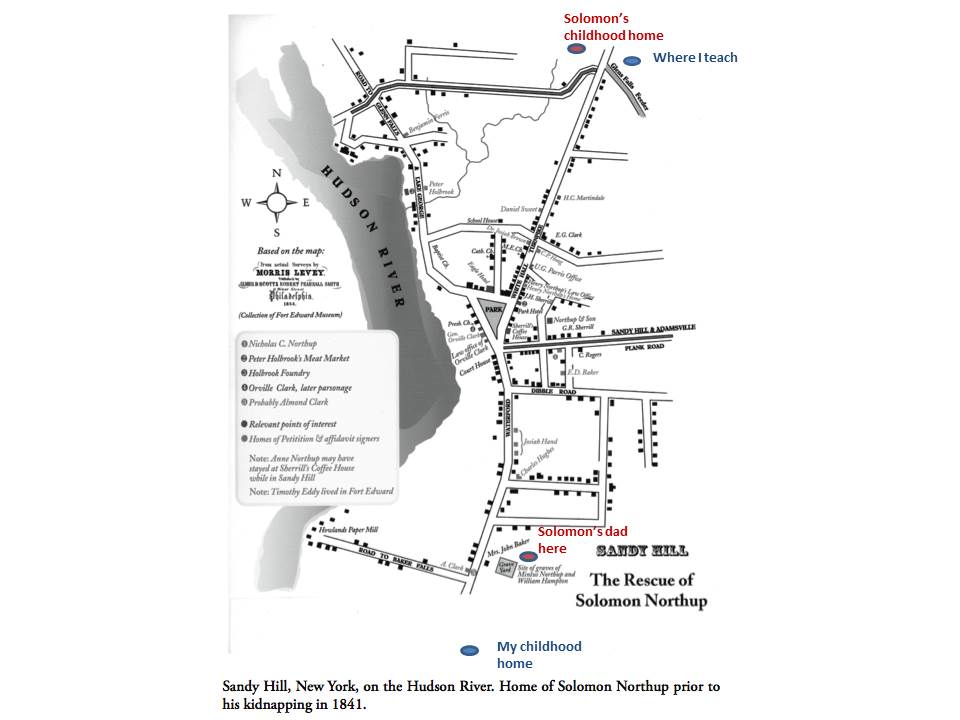
I always knew about him, as a kid I played and explored in the abandoned graveyard where his father is buried. He grew up on his family’s farm in Sandy Hill-today Hudson Falls- a couple stones throw’s away from my classroom, and roomed a few hundred feet in Fort Edward  from some of my greatest archaeological discoveries. All true. But until all the hype, can you believe that I had never read his book?

Fort Edward historian (and friend) Paul MCarty shows a damaged gravestone for Mintus Northup, father of Solomon Northup, who is buried in Fort Edward, on Monday, Oct. 14, 2013. The Northups lived in the Fort Edward area for many years. A new feature film portrays the freed slave's story from free man to slave and back to a free man. (Derek Pruitt - dpruitt@poststar.com)

Fort Edward historian (and friend) Paul MCarty shows a damaged gravestone for Mintus Northup, father of Solomon Northup, who is buried in Fort Edward, on Monday, Oct. 14, 2013. The Northups lived in the Fort Edward area for many years. A new feature film portrays the freed slave’s story from free man to slave and back to a free man. (Derek Pruitt – dpruitt@poststar.com)

So I searched it up, and discovered that it was a twelve year old girl in the 1920s who rediscovered this man and devoted the rest of her life to him, publishing a major work at age 88. It was her efforts that led to Solomon being re-discovered. I was so inspired that I wrote a speech on scholarship for our new National Honor Society members, borrowing heavily from her website.

My observations. Man’s capacity for evil never ceases to amaze….But also his capacity for goodness.

Read the book-his autobiography is just 99 cents. Get this version. For an additional 2 bucks Louis Gossett Jr will read it to you.

I saw the film 2 weeks after I completed the book. Overall thumbs up. No spoilers here, but the book has been verified. The film stays fairly true, though Henry Northup’s intense role in Solomon’s freedom maybe could have been spelled out clearer. Whether mainstream America gives crap is a fair question, but I’m fairly jacked up about it. Which means some students will be, too.

 **********************************************************************
~Scholarship~


In the mid-1920s, a 12-year-old girl in central Louisiana reached upon the library shelf of a plantation home and discovered a dusty copy of the book that would determine her life’s path. The autobiography that the future historian Dr. Sue Eakin became fascinated with also reverberates with us today, thanks to her drive.
Most of you know by now the story of Solomon Northup, a free black man who lived in this area and who was kidnapped in 1841 and spent twelve years in captivity in the Deep South. When he was rescued, his supporters urged him to write his narrative to help reveals the horrors of slavery in the United States. The book was an immediate sensation, and along with Uncle Tom’s Cabin, probably did much to hasten the coming of the American Civil War and the end of slavery. You may also know that Solomon’s father is buried in the Baker Cemetery in Hudson Falls. But did you know that his compelling narrative Twelve Years a Slave was essentially lost to history by the time of the early twentieth century, when it could not be located by libraries, stores or catalogs?

Sandy Hill. Today, Hudson Falls.

Sandy Hill. Today, Hudson Falls.


Growing up near the Louisiana plantation that Solomon was held at, Professor Eakin went on to write her master’s thesis about his story, and after decades of research, produced the first authenticated edition of the book in 1968. In 2007, at the age of 88, she completed her final definitive edition. Dr. Eakin also authored over a dozen other acclaimed history books and became an award-winning history professor, Hall of Fame journalist, civil rights leader and internationally recognized authority on antebellum plantation life.
After her passing at age 90 in 2009, her priceless historical archive was donated by her family to Louisiana State University. The Smithsonian Institute is creating a permanent exhibit featuring her Twelve Years a Slave research materials, and her family carries on her work.

In a sense, a twelve year old girl’s curiosity brought Twelve Years a Slave back to life, just as the American Civil Rights movement was dawning. May you too have the passion of the scholar, and cherish the importance of your vision and your work, and realize the impact that your actions may have on others.

http://twelveyearsaslave.org/

 **********************************************************************

Also a great recent interview from New York Magazine, with Levar Burton, the kid who got his break in Roots, back when I was in high school. I highlighted part of what he said. I think it relates to my philosophy on the teaching of the Holocaust as well.

You got your big break when you were cast in Roots as Kunta Kinte, a West African man who is captured and brought to America as a slave. During production, was there a sense that Roots was more than just a television mini-series?
You have to remember we’re looking back through the lens of a 19-year-old. I had never faced any of the challenges the veterans—the Cicely Tysons, the Lou ­Gossetts—had in terms of finding work. But what I was aware of was that all of the veterans thought that this material was special. All of them were very clear that telling the story of slavery in America through the eyes of the African had never been done before. It wasn’t Gone With the Wind. It wasn’t just glossing over the human costs. Roots wasn’t just art for art’s sake. It was art as a way of moving the ­culture forward.

And do you think Roots did that?
I like to think so. Roots became a part of the fabric of American culture. After Roots, we all had a similar frame of reference and context for what we talk about when we talk about slavery in America. You have to acknowledge that there’s a wound before it can even begin to get better.

You’ve spoken of a “post-Roots disappointment,” that the series didn’t actually change Holly­wood and that this galvanizing cultural moment didn’t fully pan out. After all, if most Americans watched parts of Roots, it meant that civil-rights leaders were tuning in alongside avowed ­racists—
Who were watching Roots and having a profound human experience of identification and compassion that was probably new. And then you have the rubber-band effect of those record numbers of viewership snapping back to red and blue, right? That has been ultimately the path of least resistance to retrench and go back to old ways of thinking rather than to roll up our sleeves and do the hard work.

And you see us as retrenched now?
Look at the rubber-band effect from the night of the inauguration of Barack Obama to today. There was this enormous sense of finally. Well, finally what? Finally, we have a black man in the White House who at least on some level has an understanding of the black experience in America. But that in no way makes this a post-racial society.

And now we have 12 Years a Slave. Critics have called it a breakthrough for showing the brutality of slavery and for finally vanquishing the myth of Gone With the Wind. But Roots was supposed to have done that. What have we been doing for the past 36 years?
That’s a very good question, and I wish I had an answer for you. But I don’t. We would love to forget, I think. We would love to go back to the fairy tale, to the fantasy of Tara. But it’s too easy to try and erase the sins of the past and claim, “That wasn’t me.” We are all capable of unspeakable horror. We are all capable of unthinkable brutality. We have to be ever vigilant and continue to remind ourselves of our propensity for monstrosity. And there’s a lot of resistance to revisiting this issue. I’ve heard disquieting chatter on both sides of the color line. Why do we have to revisit this again? Well, we have to revisit this again because all of us have forgotten!

12 Years will never have the viewership of Roots. Do you think it’ll still have some impact?
Steve McQueen is a brilliant storyteller, and he’s taken a very difficult subject and told it in a very accessible, however difficult, way. Now, I wish more people were going to see it. It’s going to play really well in New York and L.A. and some other cities, and I hope that it plays incredibly well overseas as well. It’ll be interesting if anybody is bothered to book a theater in certain locales—certain territories, as they say.

What did you think of the last slavery film to have a big cultural footprint, Django Unchained? Quentin Tarantino argued it was one of the few slave movies about black empowerment.
[Chuckles] Yeah, well …

Do I sense skepticism in your voice?
[More chuckles] Yes. Django Unchained is a fantasy, let’s be clear. And when Quentin Tarantino says that Django is more real than Roots, I call bullshit. I got nothing against him, but don’t go there, okay? Don’t go there, Quentin. Too many people who look like me bled and died for you to have the opportunity to satirize the slave narrative. There’s a place for satire in culture. Taken at face value, as a piece of satire, I went and enjoyed it. It was fun. Let’s just not get it twisted. Django was not real.

In another 36 years, are we going to be discussing another brutal slavery film that critics hail as finally vanquishing the myth of Gone With the Wind?
At the screening of 12 Years a Slave, no less a personage than Russell Simmons told me that Roots was being remade. And my initial reaction was, Why? But, look, the bottom line for me is if one soul is moved irrevocably toward the side of humanity, then it’s worth it. Human beings are the laziest creatures in the history of creation. We would rather not do anything if we could avoid it. But social justice requires rolling up your sleeves and getting your hands dirty. And I think moments like Roots and 12 Years a Slave are opportunities for art as a cultural force to step forward and lead the way. What we do with it is up to us.

http://nymag.com/news/frank-rich/roots-levar-burton-2013-11/

Read Full Post »

A Conversation with Rona Arato, author of THE LAST TRAIN: A HOLOCAUST STORY

By Sharon Salluzzo

In The Last Train, Rona Arato deftly tells her husband Paul’s remembrances of his life between April 1944 and November 1945. Paul was five years old when he, his ten-year-old brother, Oscar, and their mother (his father had already been taken away to a work camp) were taken from their home and forced into a ghetto, put in boxcars and taken to a farm in Austria, and finally to Bergen Belsen Concentration Camp. In April 1945, Paul and his family were again put in boxcars. American soldiers, who were in combat at the time, liberated the train near Farsleben, Germany. The physical and psychological horrors endured by Paul make a very strong impact. Rona lets the events carry the book.

But the story doesn’t end there. In September 2009, Hudson Falls, NY history teacher, Matt Rozell, held a Holocaust Symposium and a reunion for the train survivors and the soldiers who liberated the train. They spoke with students, and with one another. It was a time of great emotion, constantly moving between sorrow and joy. I am so glad that Rona included Paul’s remarks to the students in her book. I was fortunate to be in the audience at the symposium, and I will never forget listening to Paul as he spoke. I grew up having seen a photograph that Paul waited sixty years to see. My father was one of the U.S. soldiers who liberated the train. I sat next to Rona at dinner that last night of the reunion. She said she wanted to write Paul’s story. Four years later it has now been published. I am delighted to share a conversation I recently had with her.

Sharon: What kind of preparation did you have to do in order to write THE LAST TRAIN?

Rona: I often tell people that when I married Paul, I married the Holocaust. While it was at the symposium at Hudson Falls High School that I became determined to write Paul’s story, I have been accumulating information and background since our marriage. To get a better understanding of his background, I interviewed Holocaust survivors for Steven Spielberg’s Survivors of the Shoa Visual History Foundation between 1994 and 1998. Paul had applied for family reparations after the War, and I read the outlines. Occasionally, he would tell me some of his experiences. In the late 1970s or early 80s, he and I visited Karcag, Hungary, Paul’s hometown. It was still under Communist control and very much the way it was when Paul lived there. The roads were mud. Some of the people were still pumping their water from the community well. I was able to get a feeling for his life and what they had been through. Writing this book was an emotional journey but also a fascinating journey. I heard the testimony of other train survivors during the symposium. One of them, Leslie Meisels, had worked with Paul for years before they discovered they were both on that train. Isn’t that an amazing coincidence? Of course I was doing research through books and online websites right up to publication. In fact, I had to call my editor and say “Stop the presses!” as I discovered a key fact. We had thought that these Hungarian Jews were rounded up and sent off by Nazi SS guards. Paul and I learned that it was actually Hungarian Gendarmes under SS troops who were sent by Adolf Eichmann. Paul said to me, “No wonder I could understand them. They were speaking Hungarian.” The end papers of the book are a copy of the transport page from the Bergen Belsen Memorial in Germany. The United States Holocaust Memorial Museum checked facts for me. And my editor was wonderful in telling me where I needed to fill in background information.

Sharon: Paul has his sixth birthday during this time. How do you get into the mind of a six-year-old boy who is held in a Nazi Concentration Camp?

Rona: While Paul’s childhood in Hungary and mine in the United States were very different, the timeframe was the same. It was easy for me to go back to what it was like growing up in the 1940s. I have a good imagination and can close my eyes and remember what it felt like to be that age. In addition, my grandchildren are young, and I am able to observe them and their reactions to situations.

Sharon: There are a number of photographs, including Paul’s parents as a young married couple, and Paul’s nursery school picture. How were these preserved?

Rona: Their house in Hungary was bombed, so there were no pictures left there after the war. Some photos were sent to Paul’s uncle in Cleveland. After the war, almost every town made a Yizkor book – Yizkor is the Hebrew word for memorial. These books chronicle the history of the town, the Jews who lived there before the war and list those who did not return. Paul’s nursery school picture comes from the Karcag book. When Paul and I visited Karcag, we photographed the water pump and the Synagogue. Some of the photos in the book were taken by the soldiers on the days the train and the camp were liberated. Did you know that the photograph of the woman and her daughter emerging from the death train is now on a list of the 40 most iconic Jewish pictures?

Sharon: That is amazing, Rona, because until a few years ago, it was known to only the soldiers who liberated the train. My Dad kept it in his top dresser drawer. When he told his story to (history teacher) Matt Rozell, Matt put it on his website. The Internet has been a powerful tool in spreading this story.

moment-of-liberation1.jpg

Rona: That was how we learned about the work Matt Rozell was doing. My son read an article on the Internet about the train and sent it to me. I gave it to Paul who recognized it as the train he had been on. We contacted Matt who said he was organizing a symposium at Hudson Falls High School. It was there that Paul and your Dad (Carrol Walsh) met. I included that wonderful picture of Paul and your Dad embracing right after Paul said, “Give me a hug. You saved my life!”

Sharon: Not only is it a great picture of Paul and Dad, but it captures the feeling of all the survivors who had spent a lifetime searching for the soldiers who saved them.

Sharon: How did you approach the actual writing and selection of words and language?

Rona: I wrote the story in English, not Hungarian, but I wrote in a way they might have spoken. I tried to use the vernacular of the time. We don’t have a record of their exact words but we do know how they would have spoken, and what they were feeling at the time. When I have included Hungarian or Yiddish words, I have included explanations for them. Writers always need to listen to how people speak.

Sharon: THE LAST TRAIN recounts historical events for which you have created dialogue between characters. How would you classify this book?

Rona: I would call it creative nonfiction, or fictionalized nonfiction. The events that happened to Paul are all true. Occasionally, I needed a bridge between incidents or to show the passage of time. When I created a scene, I discussed it with Paul for authenticity. For example, I included a scene in which Paul sights the return of the storks, and has a conversation with his mother. I needed something to create a sense of time and place, and what they were feeling in the absence of Paul’s father. When Paul told me there were storks that returned every spring, I knew I had found the bridge I needed. My intention was to recreate the history. To bring the reader along, the writer needs to show the drama of the events.

Sharon: There are many heart-stopping scenes: when Paul is confronted, nose-to-snout with the ferocious German Shepherd dogs; when he is separated from his mother and brother at the train station; when he sneaks through Bergen Belsen to visit his uncle; and, of course, when the SS guard shoots the boy standing next to Paul.

Rona: I was not going to include that last event. I thought it was too strong for my audience. I was telling my editor about it, and he insisted that I include it. He said it was important to tell exactly what happened.

Sharon: What did Paul think of the way you portray him?

Rona: When he first read it he said, “You are making me look like a bratty little kid.” I responded, “Well, you were!” But what I actually meant by that is he acted like a typical 5 or 6 year-old in that he was terrified. But his own distinctive personality also shows through where he was both feisty and stubborn. These were important traits to have.

Sharon: Why did you include the reunion in the book?

Rona: The reunion was approximately 60 years after their liberation. It was, without a doubt, one of the most amazing shared experiences of my life. The powerful feelings shared by the soldiers and survivors radiated to their families and to the students at the high school. They were reunited because a high school history teacher interviewed a soldier and the information was put on his website. For the survivors and soldiers to share this experience with the students is so important. These students will share what they heard with their children. They are the ones who will pass along what happened. It was a life changing experience for everyone involved.

Sharon: What has surprised you most about the publication of THE LAST TRAIN?

Rona: That the audience goes beyond middle school and high school. Their parents and other adults are reading the book and responding.

Sharon: What would you like to see children and adults take away from this book?

Rona: This is a universal story of survival. I want my readers to see how this family and their extended family took care of each other and watched over each other. Paul’s mother was suffering with typhus and her young sons literally propped her up at roll call so the soldiers would not see how ill she was. Oscar became a father figure for Paul. He told Paul to stand up straight and not to cry. In the camps you don’t break down. I want my readers to be able to say, “Thank God I have the right to show my emotions. It’s okay to be a kid.”

Sharon: Thank you for speaking with me today. Paul’s family returned to Hungary, but life changed tremendously. He eventually came to Canada. Is there another book here?

Rona: There very well could be! It was not easy getting out of Communist Hungary.

The Last Train offers so much in terms of discussion points. It makes a huge impact in its 142 pages. It would be a great introduction to a study of the Holocaust for high school students. It is also accessible for 10 year-year-olds. Adults will truly understand the importance of both parts of this story. Of course there are the general topics of World War II and the Holocaust but there are also topics of bullying, physical and psychological fears, strength and courage, mother-child relationship, sibling relationship, family and friendship, defining a hero, the impact of a photograph, and hope. It is a story of captivity and deliverance; a story of new-found friendships, deep respect and a sense of inner peace discovered sixty years beyond the events of World War II.

WATCH PAUL ARATO SPEAK TO STUDENTS FOR THE FIRST TIME

Rona’s presentation on THE LAST TRAIN includes a Power Point display including original photographs. It is suitable for children nine and up as well as adults. For more information about Rona Arato, her books and her presentations, visit www.ronaarato.com.

To book Rona for a visit, go to www.childrenslit.com/bookingservice/arato-rona

If, after reading The Last Train, you would like more information about the train to Magdeburg and the Hudson Falls High School symposium, please go to Matt Rozell’s site: https://teachinghistorymatters.com/. By the way, train survivors are still contacting Matt from all around the world. Frank Towers, the lieutenant who oversaw the liberation, has made it his life’s work to locate any remaining survivors. To date, about 350 have been found.

found at http://www.clcd.com/features/th_Rona_Arato_Final.php

Read Full Post »

« Newer Posts - Older Posts »