Feeds:
Posts
Comments

Posts Tagged ‘Holocaust Education’

April 30 1945 Headlines. Hangs in my classroom.

April 30 1945 Headlines. Hangs in my classroom.

Today, April 29th, is the anniversary of the liberation of Dachau, 69 years on. Today, if it is brought up at all, some of us might respond with a vacant stare. More might shrug and turn away. I suppose that is to be expected. But you know me. I just think that as a nation, sometimes we allow things to slip from memory at our peril.

It was real, and it happened. And it was American GIs who overran this camp and many others in the closing days of World War II.

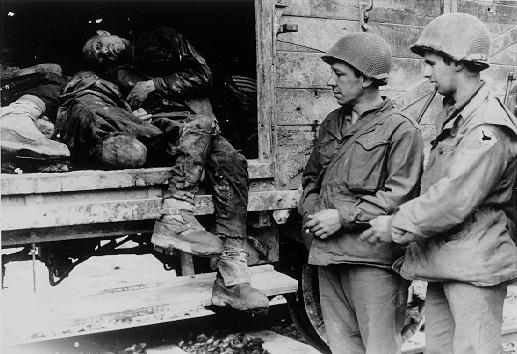
The men of the 42nd and 45th Infantry Division arrived independently of each other, here, in southern Germany, at Dachau, on this day. A concentration camp, they were told. Their noses gave them a hint of what they were about to uncover, miles before the camp appeared in sight.

Read the headlines, above. Note the sub article:

Boxcars of Dead at Dachau. 32,000 captives freed.

American soldiers view the bodies in one of the open railcars of the Dachau death train. USHMM

American soldiers view the bodies in one of the open railcars of the Dachau death train. USHMM

And so after some resistance, into the camp they entered. Life changing events were about to unfold for the American soldier.

***************************

For me, it’s not about hero worship, or glorifying the liberator or any World War II soldier as some kind of savior. Many of the liberating soldiers I know would resist this, to the point of rejecting the term, “liberator”… “It all sounds so exalted, so glamorous” said one. But they will all accept the term, “eyewitness”.

Witnesses to the greatest crime in the history of the world.

So instead I think it is about honoring their experiences, their shock, the horror, the puking and the crying, the rage-and then, the American GIs recognizing that something had to be done. And they did suffer for it, for trying to do the right thing. Many tried to help by offering food to starving prisoners who just were not ready to handle it, only to see them drop dead. Or having to manhandle these emaciated victims who were tearing away at each other as food was being offered.

Some guys never got over it. How could you?

I have learned so much over the past few years from these guys, just through the way that they carried themselves and tried to cope with what they witnessed. In my World War II studies and Holocaust class, we discuss these issues at length. I’m so lucky to be able to teach it.


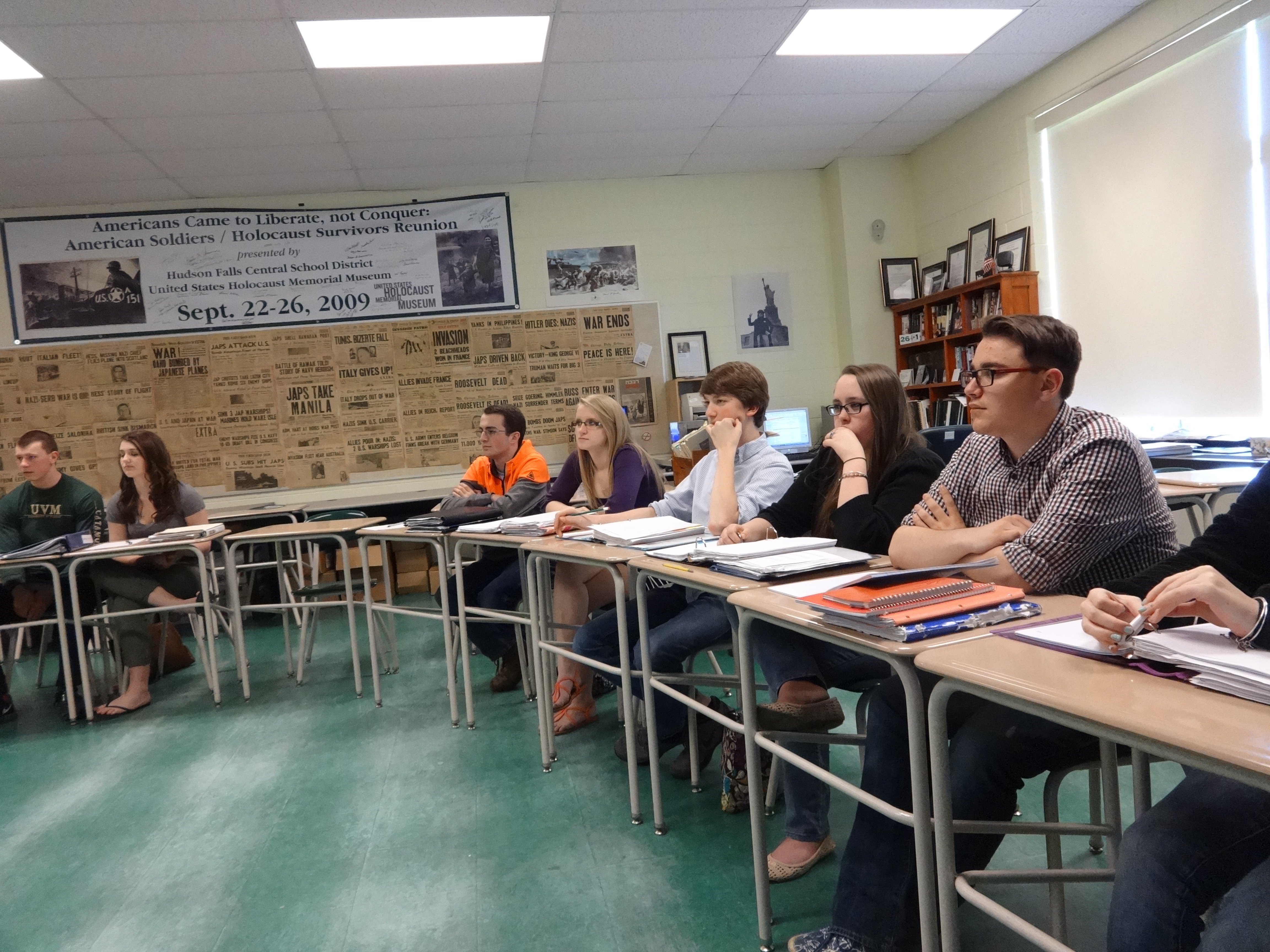
Class of 2014 in my classroom. Watching archival footage of the liberation.

Class of 2014 in my classroom. Watching archival footage of the liberation.

So yesterday, a film crew arrived from NBCLearn, a division of NBC News, all the way up from New York City. No, I did not call them. They found me. They were doing a related story, so I talked them into coming up (shout out here to the producer, Norm).

They decided they wanted to learn something from our kids- ultimately, I think, whether or not history really mattered anymore.

We have had many lessons on the Holocaust, on the victims especially, but also on the  perpetrators and the bystanders. Lessons on the liberation, and what we have been studying all along.

These kids have witnessed soldiers’ and survivors’ testimony. They have interviewed their own subjects, firsthand, and established relationships with this generation. And therefore, they become the new witnesses to the deeds of this generation. And with this, they will carry a new responsiblity. To never forget, and to not let others forget, the lessons of the past.

***************************

The raw film is rolling in the classroom. I guess it’s time for me to see what has happened to change the kids. What have they learned, and how have they grown? But today it is time to set the written exam to the side.

We watch the testimony of the  liberator who had visited our school in the past, and viewed the archival footage and photographs from 69 years ago.

And then editor poses the questions for the kids. “Why is it important to study the Holocaust? “What difference do you think it makes to know about this, our past? What do you think motivated our soldiers to go off and fight? Was it just “patriotism?”

What did your class learn? What have YOU learned?”

The completed video will be shown in schools across the country. Below are some of the kids of Hudson Falls, who make their small town  proud.

Meg V.

Meg V.


Koreena H

Koreena H

Klayton S.

Klayton S.


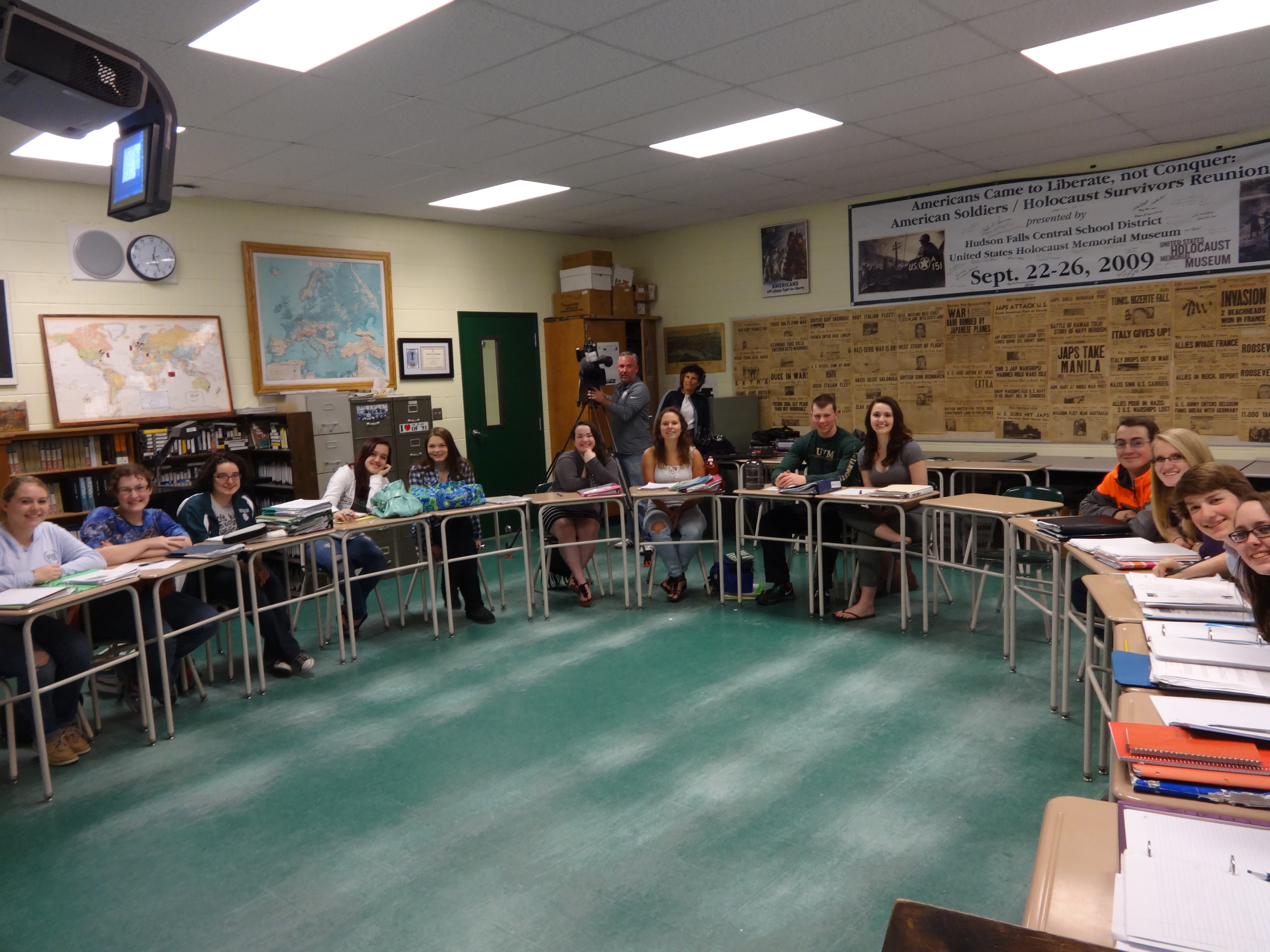
Class of 2014 in my classroom, April 28, 2014. NBC News has arrived.

Class of 2014 in my classroom, April 28, 2014. NBC News has arrived.


Read Full Post »

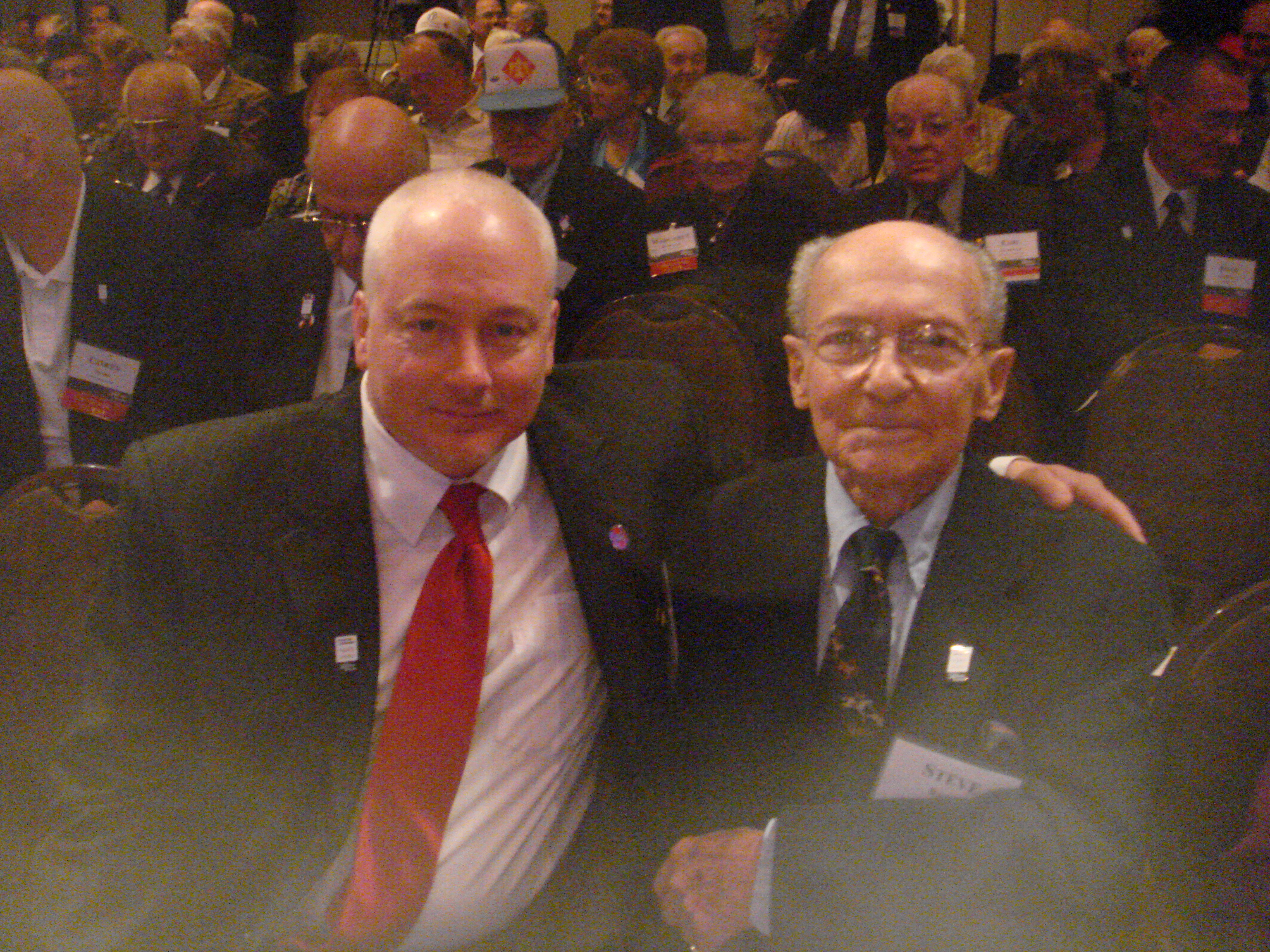
Matthew Rozell, Stephen Barry, National DOR Ceremony, Washington, DC April 2010. This photo was taken the day after the 65th anniversary of Steve's liberation in April 1945. We had just been honored by the director of the United States Holocaust Memorial Museum before the national ceremony in the Capitol Rotunda.

Matthew Rozell, Stephen Barry, National DOR Ceremony, Washington, DC April 2010. This photo was taken the day after the 65th anniversary of Steve’s liberation in April 1945. We had just been honored by the director of the United States Holocaust Memorial Museum before the national ceremony in the Capitol Rotunda.

So, the ripples continue. Somebody said it was like pebbles being tossed into the still water. This may sound strange, but I am keenly aware of the cosmic element. We tripped the wires of the cosmos.

~”It’s not for my sake, it’s for the sake of humanity, that they will remember”~

I got a nice email  recently. My friend Steve Barry was honored Tuesday evening at the United States Holocaust Memorial Museum. Steve’s daughters wanted me to know that his family made a donation in his name and set up two fellowships for scholars at the USHMM in the Stephen B. Barry Memorial Fellowship. His girls mentioned me in their speech Tuesday night in Washington. Thanks ladies. You know he was a hero. He reached out and touched an awful lot of students in the short time that we were together.

Steve will be one of the persons who will be featured in my book. Against all the odds he survived the Holocaust and later even went on to become a US Army Ranger in the Korean War! I was pretty close to him. Right now I am wistfully looking at his homemade holiday greeting cards under my desk glass, and to my left, a foot away, are the shelves containing his Holocaust library, which was passed on to me after he passed away. He was so funny, too.  He told me he nearly “choked on my bagel” a few years back when he opened his newspaper in Florida and read about me and the train he had been looking for, for so many years!

I miss the guy. You can read more about him here.


Steve's name on the wall of donors, USHMM, unveiled April 29, 2014.

Steve’s name on the wall of donors, USHMM, unveiled April 29, 2014.

The inscription kind of says it all. He uttered these words in my very classroom on a Thursday morning to a film crew from New York City, aimed at the 1500 students that he and the other survivors and American soldier/liberators had come to address. That Friday evening of our big soldier/survivor reunion, we watched it together on national news before our final banquet.

You can see the video at the bottom-he’s the one in the preview addressing the interviewer- but the transcript is below.

ABC WORLD NEWS TONIGHT, FRIDAY, SEPTEMBER 26, 2009

Diane Sawyer: And finally tonight, our Persons of the Week. It is a story that began almost 65 years ago in the darkest days of World War II. Yet this week, a new chapter unfolded. An unforgettable reunion of Holocaust survivors, and the American troops who freed them, and all made possible by a high school history class.

Matthew Rozell: This is history coming alive.
Veteran 1, entering school with his wife: Here we are, we have arrived!
Matthew Rozell: This is walking, talking, living history. They’re (the students) shaking hands with the past…

Diane Sawyer: It was 2001 when high school history teacher Matt Rozell decided to begin an oral history project. He and his students would just interview family members in the small town of Hudson Falls, New York, to capture fading stories of World War II.
Interviewer (soldier’s daughter): Did you mention the train [to Mr. Rozell] at all before?
Carrol Walsh, former soldier: No I didn’t tell him about the train.

Diane Sawyer: The students unearthed a forgotten crossroads in history. (Gunfire, archival film footage) Near the very end of World War II, April 13th, 1945, the American 30th Infantry Division was pushing its way into central Germany.
Carrol Walsh: We came to a place where there was a long train, of boxcars.

Diane Sawyer: They found a train, holding nearly 2,500 emaciated Jewish prisoners, many just children, being moved from the Bergen-Belsen concentration camp, to another camp and certain death. Their German guards had just abandoned them, fleeing the Americans.

Carrol Walsh: A feeling of helplessness. What are we going to do with all these people?
Frank Towers, former soldier: We had never ever seen anything so, (pauses) filthy.

Diane Sawyer: The American soldiers fed the prisoners, and brought them to safety.

Stephen Barry: For 42 years I collected anything that I could to try to find any article regarding the train. It just didn’t exist!

Diane Sawyer: But Mr. Rozell’s class put their interviews with veterans up on a website, along with these photographs taken by the American soldiers.

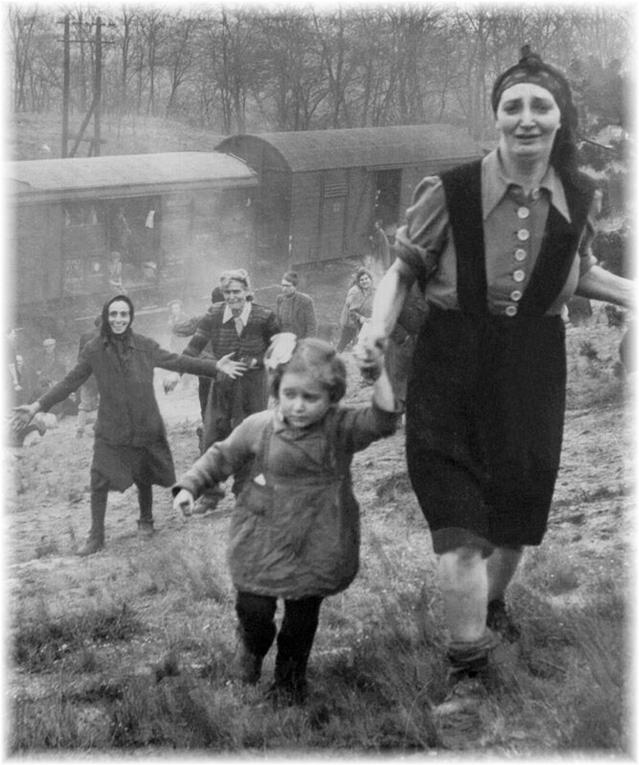
George Gross: Just very courageous people, little girls who with big smiles on their faces, one of them with their arms out, just aware that the Americans are there. [camera pans over 1945 liberation photograph]

Diane Sawyer: Out there on the web, Holocaust survivors all around the world began to notice.

Stephen Barry: I mean, how many people have a picture of their moment of liberation forever? [camera pans over 1945 liberation photograph]

(students and veterans and survivors singing “The Star Spangled Banner”)

Diane Sawyer: A reunion of the survivors and their liberators took place this week at Hudson Falls High School.

Emily Murphy, student: When they speak to us, you can’t say that you feel how they felt. But you get the feeling, you feel like you were there.

Diane Sawyer: In an age where there are still those who deny the Holocaust ever existed, these survivors say they are the living proof.

Stephen Barry: It’s not for my sake, it’s for the sake of humanity, that they will remember.

Diane Sawyer: And so we choose history teacher Matt Rozell, his class, the Holocaust survivors of that train, and the American soldiers who kept them and their story alive. And that is World News for this Friday. I am Diane Sawyer, and from all of us at ABC News, we hope you have a great weekend.

And here is a link to the 2014 United States Days of Remembrance Capitol Ceremony. Steve’s daughters and granddaughters are in the back row!


Read Full Post »

Yom HaShoah is Holocaust Remembrance Day. It marks the anniversary of the Warsaw ghetto uprising.

Clara Rudnick around age 15.

Clara Rudnick, center, around age 15.

I recently visited the local synagogue where my friend Clara Rudnick was to speak.   I was very gratified that several of my students also decided to come, and that when we arrived, they and I were also invited to participate in the readings and the candle lighting for the commemoration.

My wife and daughter also accompanied me. It was their first time in temple and the commemoration deeply touched them.

IMG_0006

Clara lit up when she saw the girls and I. She came right over, smothered me with a big hug, and went right over to the girls.

She and her twin brother Avreminkeh were about my daughter’s age, early teens, when the Germans arrived in Lithuania in June 1941. Her oldest brother Itze was 23 years old, and her two sisters Chiyeh and Dorkeh were 20 and 13. Her proud parents Yossel and Chiyena Charmatz were 42 and 40. They ran a highly regard restaurant and bakery that had been in business for generations, in a community of 10,000 that had had a Jewish presence since the 1300s. Forty percent of the prewar population of Sventzion was Jewish.

The townspeople turned on their neighbors. Even the Catholic and Orthodox churches collaborated in providing information needed to terrorize the community. In July, 1941, Lithuanian collaborators took a nearly a hundred teenage boys and young men including Itze outside of town, locked them in a building, and burned them alive. Hysteria rippled through the Jewish community now. In August, nearly a hundred more, including her twin brother, were taken outside of town on Shabbat, forced to dig their own graves and shot. A few weeks later, also on the Sabbath, eight thousand men women boys and girls were ordered to stand in the town square, where they were shot, including her mother and two sisters. Clara was saved only because her father had given her his coat and told her to hide in the local steam bath.

After the shooting, he came for her at night and took her to the forest for two nights without food and water. They found a farmer who was secretly a Jew and stayed until more refugees began to arrive. Deciding it was no longer safe, they

Students Chelsea R., Paige L., Meg V., Cheyenne B., Mary R. flank survivor Clara Rudnick at reception following Yom Hashoah commemoration, 2014.

Students Chelsea R., Paige L., Meg V., Cheyenne B., Mary R. flank survivor Clara Rudnick at reception following Yom Hashoah commemoration, 2014.

moved to the farm of a Christian friend who accepted their money to hide them. Later, they found themselves in the ghetto at Swir. ” I was 15 years old, I had lost my mother, brothers and sisters, and I was very upset.” And in a constant state of peril.

In the middle of February, 1942, the Germans came to liquidate the ghetto. Clara and her father managed to escape with others across a frozen lake as the Nazis shot at them. Her father broke through the ice and placed Clara in the freezing water and lay on top of her to protect her in the cold winter night, until the Germans left.

They traveled twenty kilometers to another ghetto at Mishaleikse, where they were arrested in April and sent to the Vilna Ghetto, subjected to hard labor. Here Clara witnessed starvation, disease, street executions, babies killed and placed in the back of trucks. Mistreatment was widespread and deportations to concentration camps and extermination centers occurred almost daily. Clara again was able to escape, but this time without her father. A local cinema owner told her father he would take care of her. She would see her father only one more time.

In the summer of 1942 (the same summer that Anne Frank would go into hiding, Clara notes) a handsome sum of gold was given to another Christian and Clara was hidden in a dark hidden cellar with a trap door for seven months, emerging only once a day to answer nature’s call. One day she peeped through the hatch to see what was going on upstairs, as there was a great deal of commotion and noise. Bullets raked the hiding spot and she was grazed in the stomach, the cinema owner killed. Clara was caught again.

She was taken before the Gestapo in Kalich, where as a slave laborer she was forced to make fur coats for the Germans fighting on the Russian front. Then the slaves were placed into two trucks. One went to the execution site of Panar, the other to the camp at Kaiserwald. Clara considers it another miracle that she was on the truck to Kaiserwald. Here she worked with dangerous acid to make batteries. She was afraid the acid would scar her and she would be killed.

After some time, she was sent to Stutthof on the Baltic. It was here that she saw her father, through the chain link fence, for the last time. He and 85,000 others perished here. She was terrified.

As the Red Army closed in she was marched out and placed in a barn, locked with other women to die from starvation. It was here that she was liberated by Soviet forces on march 11, 1945. She states, matter of factly, that the soldiers moved on immediately, having no time to care for them.

Heading to Lodz,  Poland shortly after, she did not find any family members anywhere. Regaining her strength, she met another survivor, Abraham Rudnick, a Lithuanian Jew like her who had been liberated by the Americans at Dachau on April 29, 1945. They married in a DP camp and emigrated to the United States in 1949, where they raised a family and built a plumbing and heating business in upstate New York.

So tonight she is here with her grandson and recounts the story, and the postscript of her summer trip back to Vilna and her hometown in Lithuania, and her realization that no one in Lithuania seems to want to acknowledge the countries complicity in the murder of her family and hundreds of thousands of others. But here, speaking in the temple for perhaps the last time, she has her North Country family, and has certainly won over the hearts of a few young ladies this evening. They wont forget, Clara, and they are the new witnesses. It’s so.

Clara told me some years ago that her sons had my dad as their history teacher in high school and that he was held in high regard. As we bid her goodbye, she whispered in my daughter’s ear-“Don’t tell your father, but I love him!” I am blessed to know you now, as was my dad and now my girl, and my students. We’ll keep you close, and remember your mother and father, your brothers and sisters, and all those murdered in those not so distant days.

Clara Rudnick by Erica Miller


Read Full Post »

PRISM SPR. 2014 I’ve had an article published in the Spring 2014 edition of PRISM: An Interdisciplinary Journal for Holocaust Educators, an “internationally renowned, annual, peer-reviewed journal” published by the Azrieli Graduate School of Jewish Education of Yeshiva University of New York, reaching readers in 35 countries and in all 50 American states. It is important to me to set the record straight and allow others the opportunity to read how this  history unfolded.

“In preserving and investigating the history, in interviewing liberators and Holocaust survivors, and in working with museums and memorial sites, Mr. Rozell and his students are also creating new knowledge, the highest form of academic achievement. Most importantly, in studying about the Holocaust, he and his students are also helping to rescue the evidence that can help stem the rising and dangerous tide of denial before it is too late.”

You can read the full edition here. The article appears on page 94. Obviously space did not allow for the full story to be told but that will come out in the book, so if it appears that a supporter, survivor or liberator friend has been left out, that is not the  real case. As always, thanks for your support, and thanks to editor Dr. Karen Shawn for recognizing the significance and the potential.

Read Full Post »

NOTE: Below is an article I found at the PBS website. In my trip to Germany this summer I encountered some of the same experiences. Happily I met many Germans who are actively making a difference. Compare this to nations like Lithuania.

WILLIAM BRANGHAM:  From the outside, it looks like a beautiful old estate, but this is no private residence. Inside, investigators for the German Federal Government are poring through decades old records, searching for the last remaining Nazi war criminals who might have escaped justice.

This is part of a much broader national effort underway in Germany to wrestle with the legacy of the holocaust… it includes the construction of memorials and museums at a record pace —  the revamping of the nation’s curriculum so that all German school kids get a fuller understanding of the Nazi era.

But perhaps few are as crucial to this effort as this man.  His name is Kurt Schrimm, and he runs the central office in Germany that’s still trying to bring former Nazis to justice.


KURT SCHRIMM: (translated from German) Right now only murder is punishable. All other crimes have passed the statute of limitations and can no longer be punished.

WILLIAM BRANGHAM: Thirty one years ago, Schrimm was a local public prosecutor investigating robberies, murders and gun crimes… but when this history buff heard of an opening in a regional office investigating war criminals, he jumped at the chance.  And soon after, a conversation with one Holocaust survivor drove home the importance of this work.

KURT SCHRIM: (translated from German) I met an elderly Jewish lady in New York at the end of the 1980’s who had survived the war. She said “I’ve been waiting more than 40 years for a German official to be interested in my case.” She told me “it doesn’t matter whether this person is put to trial or goes to prison; the most important thing is that you listened to my story.”

WILLIAM BRANGHAM:   Schrimm would like to see the men he’s investigating prosecuted… but establishing their guilt in court has been complicated….   Following World War II, to convict a German soldier of murder, prosecutors had to prove a direct, personal responsibility for the killing of an innocent person.

But several years ago, Germany successfully prosecuted 91 year-old retired Ohio autoworker John Demjanjuk with being an accessory to the murders committed while he was a guard at the Nazi’s Sobibor death camp.…and now Schrimm is hoping to use that legal precedent to prosecute dozens of others, including guards who worked at the Auschwitz-Birkenau camp.

To build their cases, they’ve not only talked to survivors… but drawing on the Nazis own meticulous records and maps of the camps, investigators try to determine if guards, or even low-level workers like cooks, knew about, or witnessed the genocide.

KURT SCHRIMM: (translated from German) For these cases we went to Auschwitz personally and looked at the whole camp and checked whether it was possible to see from the kitchen whether a new train of prisoners was arriving, or whether you could see the gas chambers.

WILLIAM BRANGHAM:   After completing their investigation, Schrimm’s office has recommended that thirty former Auschwitz guards – men now in their late 80s and 90s – be prosecuted as accessories to murder.

WILLIAM BRANGHAM:  Given that many of these men are in their mid to late 90s, and many of them may not even live to see a trial, let alone a prison cell, how much of this, do you believe, is symbolism, and how much of this justice being served?

KURT SCHRIM:  (translated from German) I think on one hand it’s important for the survivors, for the victims, that these cases are investigated. On the other hand, it’s also important for Germany. // Germany during the war committed such terrible crimes that, after the war, Germany had a terrible reputation.  So we try to improve that reputation by prosecuting these cases.

ERNST GRUBE: (translated from German) The current generation no longer has to confront what happened, so in my opinion, the Demianiuk trials, and these 30 or however many names that were found, they have a function to explain again to people what happened — the crimes of that period.

WILLIAM BRANGHAM:  Ernst Grube is an 81 year-old Holocaust survivor. As a child growing up in Munich, he and his family lived right next to the old Jewish synagogue, which the Nazis destroyed… he and his family were eventually sent to a concentration camp.  (we sat down in Munich’s Jewish museum, directly across from the newly built synagogue.)

Grube says the priority today must be to understand the roots of those crimes, not just prosecuting the perpetrators of them.

WILLLIAM BRANGHAM: As somone who has witnessed these crimes firsthand, it seems you must have a very personal connection to these prosecutions?

ERNST GRUBE: (translated from German) Given that, apart from my parents, all our family was killed, it goes without saying that it‘s always a difficult moment for me, and the older I get, the more emotional the impact it has on me.  But it can’t be about that. // We want the words we say to help make sure these crimes don’t happen again.  The emphasis should be on the time running up to the war, and, of course, what’s happening today.

WILLIAM BRANGHAM:   What’s happening today, is the rise of what Grube believes are frighteningly similar prejudices in German society – similar to what he experienced as a Jewish child seventy years ago.

According to the German government, there has been a rise in neo-Nazi crimes in Germany in recent years. Most of them targeted at germany’s growing immigrant population, including Turks and Roma immigrants, derisively called „gypsies“

In one of Germany’s most high profile cases – members of a neo-Nazi subgroup are currently on trial for ten racially motivated murders across the country.

Last year, German chancellor Angela Merkel felt the need to publicly apologize for these racist crimes, calling them her country’s “shame”

And later, Merkel visited the Dachau concentration camp– and again warned of the growing extremism in her country.

For his part, Ernst Grube counters that extremism by visiting classrooms, telling his story, and reminding students that there are echoes of the past all around.

ERNST GRUBE: (translated from German) So, what shapes my life today are my childhood experiences of being ostracized, being mocked for being a Jew, being isolated for being a Jew, being attacked for being a “gypsy”, as people said at the time this is something that must – and I believe can – be conveyed to young people. That is what drives me to be so active today.

WILLIAM BRANGHAM:  This ongoing remembrance of the Holocaust is hardly limited to the few remaining survivors of the war…

Germany has been putting up holocaust memorials, Nazi musuems and historical exhibitions in nearly all its major cities.  The nations’ schools are required to teach in depth lessons on the Nazi era to middle and high schoolers and almost all German students have visited a concentration camp or holocaust museum.

And the commemorations also come in more personal ways

WOLFRAM KASTNER:  I hope that it will never happen again, but if it would start again, it would start not anywhere but here.  In our mind, in our streets, in our city, in our village, in our school.

WILLIAM BRANGHAM:  Wolfram Kastner is an artist in Munich – the city which Adolph Hitler called the capitol of the Nazi movement and one city that has often been criticized for down-playing its role in the rise of the third Reich.

While Munich saw the opening of the Jewish museum in 2007 and is currently building a major center on the history of Nazism, critics argue the city still doesn’t do nearly enough to acknowledge its past.

For example, at one of the city’s major landmarks — the Konigsplatz – there’s barely a sign that it was center stage for many of Hitler’s large Nazi rallies or that this was where Nazi youth had their notorious book burnings.

WOLFRAM KASTNER:  They want the city very clean for tourism.  To invite all people from all over the world to come to Munich to Oktoberfest, and it’s all nice and wonderful and pretty, and it’s so marvelous,  And the black marks, the dark points of the history are cleaned away.

WILLIAM BRANGHAM:   among his many works, Kastern has defied authorities by burning black circles in the grass at Konigsplatz – a symbolic reminder of those book burnings seventy years ago.

Kastner’s current project has been to tell the stories of particular Jewish families who lived in Munich during the 1930s, and were sent to concentration camps by the nazis. To do so, he paints these suitcases – similar to the ones victims carried to the camps — and places them outside the very buildings where the families lived, along with a plaque telling their stories.

WOLFRAM KASTNER: There lived a family– Meyer.  And– they were killed.  Why?”   But if you see a girl, a face, a story, a history of her, It’s another feeling, and it– history comes near.

WILLIAM BRANGHAM:   In the end, Germany is doing what few nations have done before…. Not celebrating its greatest accomplishments, but building monuments to its darkest time.   …determined to keep history clearly in sight.

ERNST GRUBE:  I think nowadays, it’s about communicating how it even came to pass that such things could happen. What happened before Auschwitz, what happened before Buchenwald, what happened before Dachau, and after Dachau, after the concentration camp? So it’s about the question: “how could this happen?”, that’s one aspect. And the other is: “yes, ok, but what’s that got to do with me, today?

KURT SCHRIMM (translated from German) According to German law we are committed to prosecuting these cases —  it is true that because of their age they may never reach trial or go to prison, but  it is just and right that we go after these cases.

See the video here: http://www.pbs.org/newshour/bb/world/jan-june14/nazilegacy_01-12.html

Read Full Post »

A Conversation with Rona Arato, author of THE LAST TRAIN: A HOLOCAUST STORY

By Sharon Salluzzo

In The Last Train, Rona Arato deftly tells her husband Paul’s remembrances of his life between April 1944 and November 1945. Paul was five years old when he, his ten-year-old brother, Oscar, and their mother (his father had already been taken away to a work camp) were taken from their home and forced into a ghetto, put in boxcars and taken to a farm in Austria, and finally to Bergen Belsen Concentration Camp. In April 1945, Paul and his family were again put in boxcars. American soldiers, who were in combat at the time, liberated the train near Farsleben, Germany. The physical and psychological horrors endured by Paul make a very strong impact. Rona lets the events carry the book.

But the story doesn’t end there. In September 2009, Hudson Falls, NY history teacher, Matt Rozell, held a Holocaust Symposium and a reunion for the train survivors and the soldiers who liberated the train. They spoke with students, and with one another. It was a time of great emotion, constantly moving between sorrow and joy. I am so glad that Rona included Paul’s remarks to the students in her book. I was fortunate to be in the audience at the symposium, and I will never forget listening to Paul as he spoke. I grew up having seen a photograph that Paul waited sixty years to see. My father was one of the U.S. soldiers who liberated the train. I sat next to Rona at dinner that last night of the reunion. She said she wanted to write Paul’s story. Four years later it has now been published. I am delighted to share a conversation I recently had with her.

Sharon: What kind of preparation did you have to do in order to write THE LAST TRAIN?

Rona: I often tell people that when I married Paul, I married the Holocaust. While it was at the symposium at Hudson Falls High School that I became determined to write Paul’s story, I have been accumulating information and background since our marriage. To get a better understanding of his background, I interviewed Holocaust survivors for Steven Spielberg’s Survivors of the Shoa Visual History Foundation between 1994 and 1998. Paul had applied for family reparations after the War, and I read the outlines. Occasionally, he would tell me some of his experiences. In the late 1970s or early 80s, he and I visited Karcag, Hungary, Paul’s hometown. It was still under Communist control and very much the way it was when Paul lived there. The roads were mud. Some of the people were still pumping their water from the community well. I was able to get a feeling for his life and what they had been through. Writing this book was an emotional journey but also a fascinating journey. I heard the testimony of other train survivors during the symposium. One of them, Leslie Meisels, had worked with Paul for years before they discovered they were both on that train. Isn’t that an amazing coincidence? Of course I was doing research through books and online websites right up to publication. In fact, I had to call my editor and say “Stop the presses!” as I discovered a key fact. We had thought that these Hungarian Jews were rounded up and sent off by Nazi SS guards. Paul and I learned that it was actually Hungarian Gendarmes under SS troops who were sent by Adolf Eichmann. Paul said to me, “No wonder I could understand them. They were speaking Hungarian.” The end papers of the book are a copy of the transport page from the Bergen Belsen Memorial in Germany. The United States Holocaust Memorial Museum checked facts for me. And my editor was wonderful in telling me where I needed to fill in background information.

Sharon: Paul has his sixth birthday during this time. How do you get into the mind of a six-year-old boy who is held in a Nazi Concentration Camp?

Rona: While Paul’s childhood in Hungary and mine in the United States were very different, the timeframe was the same. It was easy for me to go back to what it was like growing up in the 1940s. I have a good imagination and can close my eyes and remember what it felt like to be that age. In addition, my grandchildren are young, and I am able to observe them and their reactions to situations.

Sharon: There are a number of photographs, including Paul’s parents as a young married couple, and Paul’s nursery school picture. How were these preserved?

Rona: Their house in Hungary was bombed, so there were no pictures left there after the war. Some photos were sent to Paul’s uncle in Cleveland. After the war, almost every town made a Yizkor book – Yizkor is the Hebrew word for memorial. These books chronicle the history of the town, the Jews who lived there before the war and list those who did not return. Paul’s nursery school picture comes from the Karcag book. When Paul and I visited Karcag, we photographed the water pump and the Synagogue. Some of the photos in the book were taken by the soldiers on the days the train and the camp were liberated. Did you know that the photograph of the woman and her daughter emerging from the death train is now on a list of the 40 most iconic Jewish pictures?

Sharon: That is amazing, Rona, because until a few years ago, it was known to only the soldiers who liberated the train. My Dad kept it in his top dresser drawer. When he told his story to (history teacher) Matt Rozell, Matt put it on his website. The Internet has been a powerful tool in spreading this story.

moment-of-liberation1.jpg

Rona: That was how we learned about the work Matt Rozell was doing. My son read an article on the Internet about the train and sent it to me. I gave it to Paul who recognized it as the train he had been on. We contacted Matt who said he was organizing a symposium at Hudson Falls High School. It was there that Paul and your Dad (Carrol Walsh) met. I included that wonderful picture of Paul and your Dad embracing right after Paul said, “Give me a hug. You saved my life!”

Sharon: Not only is it a great picture of Paul and Dad, but it captures the feeling of all the survivors who had spent a lifetime searching for the soldiers who saved them.

Sharon: How did you approach the actual writing and selection of words and language?

Rona: I wrote the story in English, not Hungarian, but I wrote in a way they might have spoken. I tried to use the vernacular of the time. We don’t have a record of their exact words but we do know how they would have spoken, and what they were feeling at the time. When I have included Hungarian or Yiddish words, I have included explanations for them. Writers always need to listen to how people speak.

Sharon: THE LAST TRAIN recounts historical events for which you have created dialogue between characters. How would you classify this book?

Rona: I would call it creative nonfiction, or fictionalized nonfiction. The events that happened to Paul are all true. Occasionally, I needed a bridge between incidents or to show the passage of time. When I created a scene, I discussed it with Paul for authenticity. For example, I included a scene in which Paul sights the return of the storks, and has a conversation with his mother. I needed something to create a sense of time and place, and what they were feeling in the absence of Paul’s father. When Paul told me there were storks that returned every spring, I knew I had found the bridge I needed. My intention was to recreate the history. To bring the reader along, the writer needs to show the drama of the events.

Sharon: There are many heart-stopping scenes: when Paul is confronted, nose-to-snout with the ferocious German Shepherd dogs; when he is separated from his mother and brother at the train station; when he sneaks through Bergen Belsen to visit his uncle; and, of course, when the SS guard shoots the boy standing next to Paul.

Rona: I was not going to include that last event. I thought it was too strong for my audience. I was telling my editor about it, and he insisted that I include it. He said it was important to tell exactly what happened.

Sharon: What did Paul think of the way you portray him?

Rona: When he first read it he said, “You are making me look like a bratty little kid.” I responded, “Well, you were!” But what I actually meant by that is he acted like a typical 5 or 6 year-old in that he was terrified. But his own distinctive personality also shows through where he was both feisty and stubborn. These were important traits to have.

Sharon: Why did you include the reunion in the book?

Rona: The reunion was approximately 60 years after their liberation. It was, without a doubt, one of the most amazing shared experiences of my life. The powerful feelings shared by the soldiers and survivors radiated to their families and to the students at the high school. They were reunited because a high school history teacher interviewed a soldier and the information was put on his website. For the survivors and soldiers to share this experience with the students is so important. These students will share what they heard with their children. They are the ones who will pass along what happened. It was a life changing experience for everyone involved.

Sharon: What has surprised you most about the publication of THE LAST TRAIN?

Rona: That the audience goes beyond middle school and high school. Their parents and other adults are reading the book and responding.

Sharon: What would you like to see children and adults take away from this book?

Rona: This is a universal story of survival. I want my readers to see how this family and their extended family took care of each other and watched over each other. Paul’s mother was suffering with typhus and her young sons literally propped her up at roll call so the soldiers would not see how ill she was. Oscar became a father figure for Paul. He told Paul to stand up straight and not to cry. In the camps you don’t break down. I want my readers to be able to say, “Thank God I have the right to show my emotions. It’s okay to be a kid.”

Sharon: Thank you for speaking with me today. Paul’s family returned to Hungary, but life changed tremendously. He eventually came to Canada. Is there another book here?

Rona: There very well could be! It was not easy getting out of Communist Hungary.

The Last Train offers so much in terms of discussion points. It makes a huge impact in its 142 pages. It would be a great introduction to a study of the Holocaust for high school students. It is also accessible for 10 year-year-olds. Adults will truly understand the importance of both parts of this story. Of course there are the general topics of World War II and the Holocaust but there are also topics of bullying, physical and psychological fears, strength and courage, mother-child relationship, sibling relationship, family and friendship, defining a hero, the impact of a photograph, and hope. It is a story of captivity and deliverance; a story of new-found friendships, deep respect and a sense of inner peace discovered sixty years beyond the events of World War II.

WATCH PAUL ARATO SPEAK TO STUDENTS FOR THE FIRST TIME

Rona’s presentation on THE LAST TRAIN includes a Power Point display including original photographs. It is suitable for children nine and up as well as adults. For more information about Rona Arato, her books and her presentations, visit www.ronaarato.com.

To book Rona for a visit, go to www.childrenslit.com/bookingservice/arato-rona

If, after reading The Last Train, you would like more information about the train to Magdeburg and the Hudson Falls High School symposium, please go to Matt Rozell’s site: https://teachinghistorymatters.com/. By the way, train survivors are still contacting Matt from all around the world. Frank Towers, the lieutenant who oversaw the liberation, has made it his life’s work to locate any remaining survivors. To date, about 350 have been found.

found at http://www.clcd.com/features/th_Rona_Arato_Final.php

Read Full Post »

Holocaust Survivor Clara Rudnick in her home, Photo Erica Miller 8/31/10

Holocaust Survivor Clara Rudnick in her home, Photo Erica Miller 8/31/10

I gave my first talk last night after returning this summer from an intensive 3 week European study tour. Arriving early to prepare and set up, I looked up and in walked Siobhan, a former student, and her mom, followed a little while by an older woman I was surprised and delighted to see- Mrs. Rudnick, or Clara. She gave me a hug and took off her coat and told me that she had taken a cab to the site of the lecture, and, oh, could I please give her a ride home? I was delighted.

During the lecture I recognized her before the audience, and thanked her for coming out. She told the audience how proud she was to live in the “North Country” of upstate New York. Heck, she’s lived here since 1949, a dozen years before I was born! She was moved to tears, as was Siobhan, who gave her a hug.

During the talk, she nodded her head in agreement to many of my points. Afterwards, she pulled out a piece of paper, a short statement that she had written, explaining that she had been meaning to call me.  You see, she was not the only traveler to Europe this summer. While I was in Poland touring Holocaust related sites, Mrs. Rudnick had returned to Lithuania of her youth.

Not an easy thing, given that

a. Clara is 89 years old;

b. Clara is a Holocaust survivor;

c. Clara lost most of her family to the SS Einsatzgruppen and their Lithuanian collaborators.

She and her late husband Abe were two of only 7000 survivors of the 70,000 Jews of Vilna. I was familiar with a lot of the history, but to understand more of what she had gone through, I looked up the following at the USHMM website:

The Lithuanians carried out violent riots against the Jews both shortly before and immediately after the arrival of German forces. In June and July 1941, detachments of German Einsatzgruppen (mobile killing units), together with Lithuanian auxiliaries, began murdering the Jews of Lithuania. By the end of August 1941, most Jews in rural Lithuania had been shot. By November 1941, the Germans also massacred most of the Jews who had been concentrated in ghettos in the larger cities. The surviving 40,000 Jews were concentrated in the Vilna, Kovno, Siauliai, and Svencionys ghettos, and in various labor camps in Lithuania. Living conditions were miserable, with severe food shortages, outbreaks of disease, and overcrowding.

In 1943, the Germans destroyed the Vilna and Svencionys ghettos, and converted the Kovno and Siauliai ghettos into concentration camps. Some 15,000 Lithuanian Jews were deported to labor camps in Latvia and Estonia. About 5,000 Jews were deported to extermination camps in Poland, where they were murdered. Shortly before withdrawing from Lithuania in the fall of 1944, the Germans deported about 10,000 Jews from Kovno and Siauliai to concentration camps in Germany.

Soviet troops reoccupied Lithuania in the summer of 1944. In the previous three years, the Germans had murdered about 90 percent of Lithuanian Jews, one of the highest victim rates in Europe.

Clara was anxious to speak to me. She told me of her trip with her son. Together they returned to Svinsyan, where her parents, two sisters and two brothers lived. To one of my students, a few years back, she told the following story:

On June 21st, 1941, the Nazis came into my town, I lived with my mother and father, two brother and two sisters. In July 4th, they took my oldest brother and burned him alive, with 90 other Jewish teenagers in my town. In the early part of August they came in and took my twin brother, along with another 100 teenagers and dug a big hole and buried them alive. In September they took the whole town about 8,000 people and brought then to where we held our flea markets- this was both of my sisters and my mother- out into the woods where they lined them up and shot them and left them there. This is where my father and I escaped- he knew a lot of men- and we went to farm to farm and hid out until the Nazis would come, and we would leave because if they caught us they would kill us and the people we were staying with, because they were harboring  fugitives.

At the town’s museum, she stopped to ask where the memorial of the murder site, Poligon, could be found. Clara said that they  told her that they did not know where it was, though half the town’s population, many of the families having lived their since the 1300s, had been murdered there.

At the hotel in Vilna she inquired how she could get to Ponary, and was simply told “there is nothing there”. Google Ponary. 110000 relevant results. 70,000 Jews were shot to death there by the Germans and Lithuanians.

Taking the English speaking bus tour of the Old City of Vilna, the guide described the Philharmonic Hall but did not tell the tourists that this was the entrance to the Vilna Ghetto, where she had been imprisoned until being deported to a slave labor camp and later to a concentration camp. When Clara asked why the guide did not mention this, the guide said that she “did not know.”

Maybe the guide was young and was not taught this history in school. Or maybe it was not important enough to be part of the official program. 90 to 95% of Lithuania’s Jews were murdered in the Holocaust. To one lady on the bus, and her son, it was important. In Clara’s words, “In just three days, I learned that Lithuania has not faced it history of the destruction of its 250,000 Jews”.

Clara is happy that I am keeping the memory alive. She put on her coat and climbed up into my pickup truck without assistance. She chatted all the way home as I tried to navigate to her house in the dark. She thanked me over and over. Not at all. Thank you for coming into my life and making me, and my students, a part of yours.

Here is an informative article which reveals exactly what Clara wanted me to know. Responsibility is not big on the list of Lithuania’s priorities.

Read Full Post »

DSC01140One of the things that came up in my talk last night was the question of what does one do in the classroom to use the Holocaust as a jumping point to address current world or national issues. In other words, what is the purpose of teaching the Holocaust?

Another question that always comes up, and came up last night as well, is how can people deny that the Holocaust ever took place?

These are very good questions and ones that I have wrestled with for some time, myself. I guess in formulating my response, I would have to consider my experiences, and relate one to the other.

1. When you really, really study and think about the Holocaust, as I have, the more it becomes clear that the subject is so expansive, there is so much that you do not know. I consider myself fairly well informed and educated on the subject, but as I stated in a previous post, KNOWLEDGE is not the same as UNDERSTANDING. So I guess I will defer to the survivor I know, asked the same question by a student, after giving his testimony to young people: “There will be always be those who deny or minimize the extent of the Holocaust. How can one even begin to understand the magnitude of the crime?”

It IS quite unbelievable, in a sense.

Which begs the question: How could the enormity of this watershed event, the greatest crime committed in the history of the world, happen?

The answer, simple but again in a general sense, too true. Mass ignorance is not an excuse. People knew.

In reality, few people gave a damn. Political leaders had more important priorities. Ordinary people went about their business.

2. Now the extrapolation*. Today in many schools the Holocaust is simplistically packaged up and sold to promote the cause du jour, whatever it may be, from bullying in the schoolyard to consequences of gun control. We boil down the causes to bullying gone wild, or handing over our guns, saying “See? This is what happens”.

Here is the eye opener for many educators out there.

The cause of the Holocaust was not a simple issue of “intolerance”.

Jewish and gentile communities lived side by side and interacted for hundreds of years. Men, women, and little children were not “bullied” to death. They were murdered on an industrial scale.

3. The only lesson I will promote in the classroom is to outline the enormity of the complexity, to go beyond just advocating “tolerance” and “diversity training” to make an attempt of a systematic examination of the abrogation of personal moral responsibility in the face of  an agenda that was made quite clear from the outset.

So what does this look like? Let’s take a quick look.

a. Mein Kampf was published in 1925. And Hitler never killed a single person in anger by his own hand. There is a reason why, in touring our national Holocaust museum, you will find few references in the exhibits to Hitler alone.

b. Mass murder didn’t just “happen”. There were a lot of logistical problems that had to be overcome. Statisticians, bankers, businessmen, engineers and  architects, mechanics and clerks sold the tabulating machines, arranged the train schedules, drew up the gas chambers, tested the crematoria, installed the hardware, and pushed the paper that meant life or death. Teachers taught lessons handed down by the state, doctors and nurses learned how to kill. Lawyers and judges perverted the notion of justice. Town cops and public servants with families back home were drafted into extermination brigades and became murderers of women and children. The few who refused to pull the trigger were not punished severely.

As I was packing up to leave, a doctor friend who attended my talk stopped me and told me that what I was doing was important, if only as a reminder, I suppose. She stated that in a recent public information event on the Affordable Care Act, someone rose and exclaimed with passion that the those without health insurance should be allowed to die. All around her, the statement was greeted with an outpouring of applause.

I’ll refrain from analogies-but, what, then, was it that she took away from the lecture?

Maybe it was the point that there are no simple explanations or lessons, that that there were no monsters, that to label a perpetrator as a monster is to strip him/her of our common link- humanity- which perversely, somehow absolves him, the nonhuman, of responsibility.

Maybe we are not so far removed, after all.

As I was leaving, in a quiet tone, she said:

The veneer is very thin.”

*If you are an educator looking for more guidance, here is a  a short video I made for the teaching of the Holocaust, according to USHMM guidelines.

Read Full Post »

Francis Curry, WWII Medal of Honor, with students.

Francis Curry, WWII Medal of Honor, with students.

FOUR years ago today the most incredible week concluded with former soldiers and the Holocaust survivors they saved watching this newscast together in cocktail lounge of the Georgian Resort in Lake George along with teachers and students from Hudson Falls High School. Thank you Tara, Mary, Lisa, Rene, and all the staff. And to ABC World News for recognizing the importance of the occasion, and to the United States Holocaust Memorial Museum and the Bergen Belsen Memorial for their attendance and support.

A teacher’s job is to toss pebbles. Several of the participants are gone now, but the ripples here became huge, and no one will forget what they meant, where they came from, or what they have led to.

Watch a story about how a teacher fellow from the Museum reunited Jewish prisoners with U.S. Army soldiers who liberated them from a train near Magdeburg, Germany, on April 13, 1945.

Read Full Post »

I met Leslie Meisels exactly four years ago today, when he and  Ariela Rojek and Paul Arato drove all the way down from Toronto, Canada to meet their actual liberators.

Leslie is one of the most gracious men I have ever met; I am honored to have him as one of my friends and am proud to be in on what he calls the latest miracle of his life.

I wrote to a reporter/columnist in Toronto, Canada, several months back to comment on a story that she had written, and she then had the opportunity to interview several of my survivor friends in the community who had been liberated on the Train Near Magdeburg. She struck up a friendship with Leslie, and this ebook resulted.

A sample:

When I first reached Leslie Meisels on the phone one afternoon in late April and asked for an interview, he told me to hold on a minute — he needed to get his day planner.

I thought he was joking.

Leslie is 86. What could he possibly be doing to fill up a day planner?

A lot, it turns out.

He has a wife, two daughters, four grandchildren. He is an active member of the North York Philatelic Society and a committee member of Circle of Care, an organization that provides services for Holocaust survivors. And he is a regular speaker with the Holocaust Education Centre’s survivor speakers bureau. This spring there were weeks when he addressed four different groups of students about his experience during World War II.

This was one of those weeks. He squeezed me in. I wanted to talk to him about the Holocaust and, more precisely, about his liberation from the Nazi murderers by a dozen surprised American soldiers who found Leslie and about 2,500 other captives near the end of the war, packed in cattle cars on a German train.

An email from an American teacher had tipped me off to the fact that a number of Toronto Holocaust survivors had recently been reunited with their liberators.

Leslie was one of them.

Of course, you can’t talk about liberation without talking first about enslavement. So, sitting on the couch of the neat, spacious penthouse condominium he shares with his wife, Eva, in Thornhill, Leslie started proudly with his family history in eastern Hungary.

Then came his carefree childhood. Then the introduction of anti-Semitic laws, the ghetto, the trains, the months of slave labour and the horrors of the Bergen-Belsen concentration camp, where more than 70,000 prisoners — most of them Jews — were killed.

Our interview lasted more than three hours, fueled by many cups of coffee and servings of fresh cheese palacsintas (crêpes) whipped up by Eva.

I noticed Leslie’s hands while we spoke. They are enormous — each finger twice as thick as mine, the palms like dinner plates. They are a working man’s hands, without any of the dirt. Everything about Leslie is immaculate — his neatly clipped and cleaned fingernails, his ironed pants and pressed dress shirt with a silver pen poking from its breast pocket, his freshly shaven face. His stories of being treated like a rabid dog were cast in relief by the careful pride he took in his appearance. There is an Old World elegance about him.

But the thing that struck me most about Leslie was his cheeky humour. His brown eyes narrowed and sparkled repeatedly as he took a “side step” to tell me about the girl he was “necking” with while a slave labourer or a refugee. Despite the horrors he endured, or perhaps because of them, Leslie maintained his champagne spirit.

Near the end of the interview, a question bubbled in my mind: what did you take with you? The Nazis had invaded Hungary in 1944. They ordered all the Jews in Leslie’s and other towns to first leave their homes, and then to leave town altogether on a train we now know was headed towards slavery or murder. What would you take if you could carry only a small bag or pillowcase to hold your belongings?

“Underwear,” Leslie responded, “and my stamp collection.”

I wrote that down and moved on. There were a lot of overpowering details in Leslie’s stories, and I still needed to hear about the reunion. But the stamps snagged my attention. There was a boyish innocence about them.

What happened to those stamps, I asked him over the phone a couple days later.

He responded: “I still have them. My mother sewed them into the lining of my jacket.”

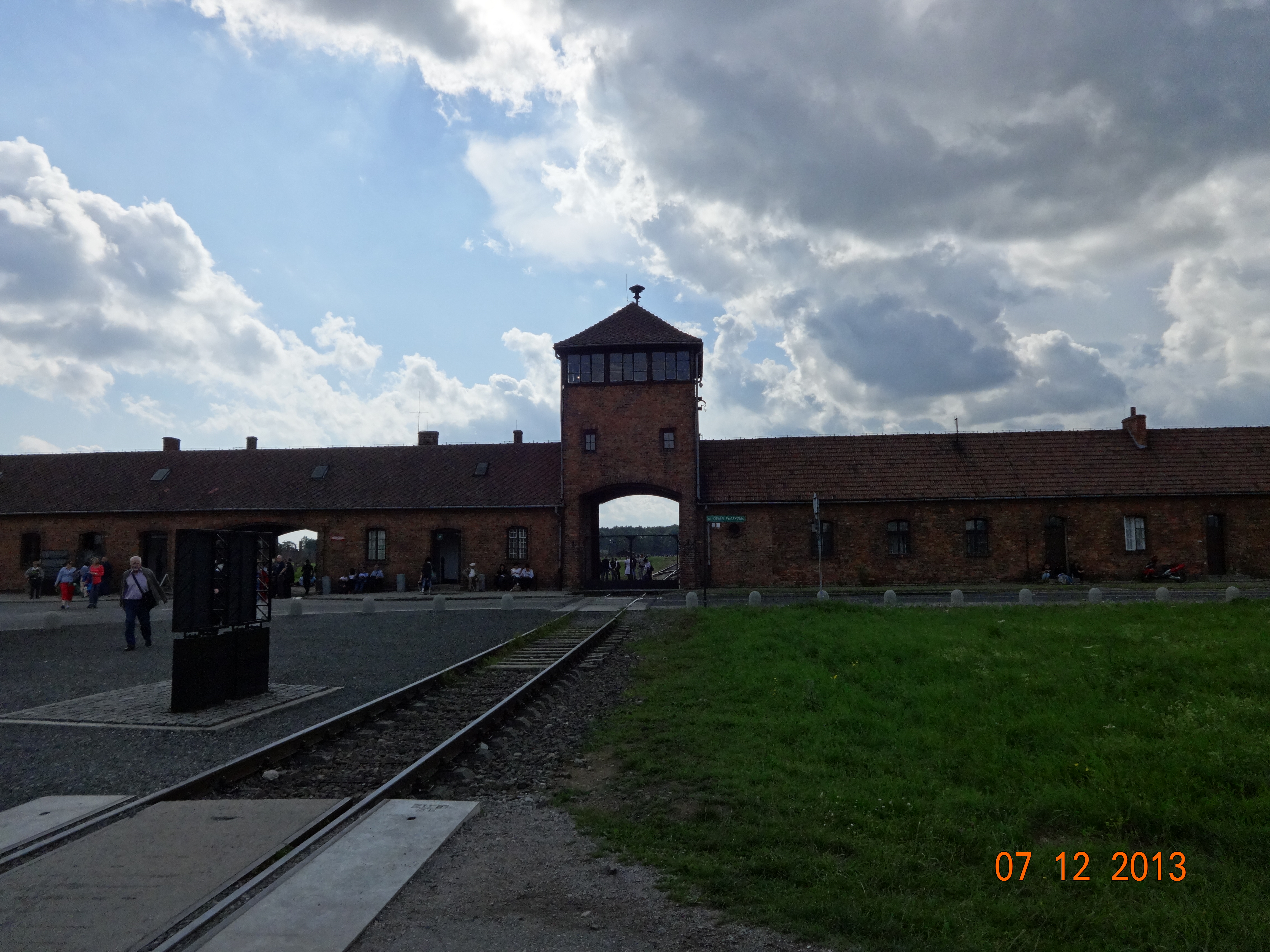
Imagine that! Most Jews had all their clothing and belongings stripped away upon entering the concentration camps. You can see their boot brushes, ceramic pots and dolls piled up behind glass cases in the Auschwitz-Birkenau State Museum in Poland. That Leslie managed to keep his jacket was surprising enough. But that fragile pieces of paper survived the horrendous conditions — well,that seemed miraculous.

I drove back to their condominium for a third interview, this one in Leslie and Eva’s little office. I asked to see some of those stamps.

So Leslie pulled out his master list — a two-page typewritten list of all the stamp albums he has. There are dozens and dozens. He found one with his early Hungarian stamps and pulled it down from the shelf. Inside he’d arranged thousands of stamps in neat rows.

When I expressed surprise at the number of stamps he had, he smiled and opened a drawer in his desk.

“A crazy stamp collector saves all the stamps he comes across,” he said, pulling out a Tupperware container brimming with stamps. “When there are many, many, many, he bundles them up . . . and stores them away. I have millions of stamps.”

Leslie’s wife calls herself a “stamp widow.” She says he spends hours with his stamps a day. He loves them still, like he did when he started his collection 78 years ago. He loves the precision of arranging them. He loves the challenge of collecting a full set of stamps. He loves their colours and their stories. Every stamp, he says, depicts a story of a place, a historic moment or figure, a cause. “You can learn about the world through stamps,” he said.

As we flipped through his collection and he began to tell me the rest of his story, I could see snatches of it reflected in his stamps.

It is the tale not just of an idyllic childhood followed by the horrors of the Holocaust, but also that of a man who lived under Communism, escaped, lived for two years in a refugee camp, arrived in North America with nothing and then built up his life for a second time. Just as every stamp embodies a public story, a bit of history, Leslie’s stamps also tell the story of his life, its joys and deep sorrows, its disasters and its miracles.

************************************************

He is giving his 25th lecture on the Holocaust since April.

“Put yourself in my shoes,” he says to the Cardinal Carter Catholic High School students. “I think you are between 16 and 18, right? You can feel what I felt when I experienced those horrors.”

“They have to know,” Leslie says. “Otherwise, it will be forgotten and could be repeated.”

He talks for just over an hour, pausing only twice for a sip of water.

The stories pour out of him — of the deaf village elder who was strung up by his wrists to a cattle car, of the SS guards with their dogs who laughed at the sight of him naked with his grandmother and mother, of the hunger. He stirs in life lessons — like how his woodworking knowledge saved his life in Bergen-Belsen. “You are the same age as I was,” he says. “Never think you are studying for your teachers or your parents. Whatever you are putting in your head, you never know how it will serve you in life.”

But Leslie’s descriptions are muted at times. He clutters his sentences with clauses and chooses math over graphic detail to describe some horrors. The train crowding, for instance, affords each person a “square foot.” He mentions the bucket but doesn’t fill in the details of how that meant people were forced to defecate in their pants. He is old-school; talk like that seems degrading. Or perhaps the pungent details are too dangerous for him, scratching away the protective layers on his memories.

A girl in a powder-blue sweatshirt in the second-last row appears to have fallen asleep.

Is he getting through to them? Like most Holocaust survivors,

Leslie won’t be around to recount these stories for much longer. That inescapable truth adds an urgency to his message. Who then will bear witness?

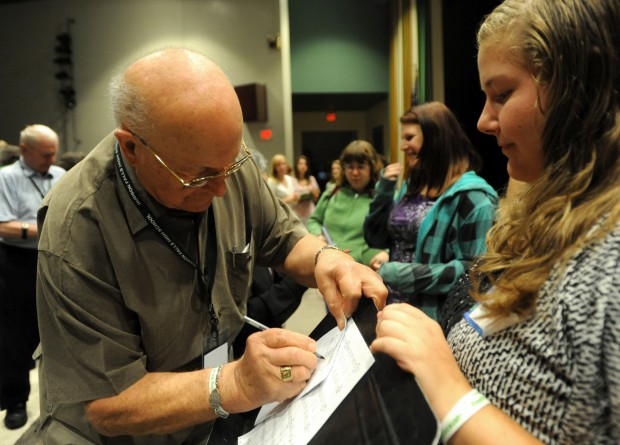
Holocaust survivor Leslie Meisels, left, signs a program for Hudson Falls senior Taylor Bump during Wednesday's "Remembering the Holocaust, Repairing the World" event. Meisels, who currently lives in Toronto, stressed the importance of relaying his experience to young people "so they remember and fight against discrimination, hatred and injustice." Jason McKibben Glens Falls Post Star

Holocaust survivor Leslie Meisels, left, signs a program for Hudson Falls senior Taylor Bump during Wednesday’s “Remembering the Holocaust, Repairing the World” event. Meisels, who currently lives in Toronto, stressed the importance of relaying his experience to young people “so they remember and fight against discrimination, hatred and injustice.”
Jason McKibben Glens Falls Post Star

He finishes his talk and asks for questions. The girl in the powder- blue sweatshirt from the back asks two. The second one is: “If you could go back, would you change any decisions you made?” She was listening, just with her eyes closed. Holocaust educator Ruth Ekstein says she often sees that — “the most fidgety kids you want to strangle, they are absorbing the most.” The content is so painful, it forces people to scratch and shuffle, or to close their eyes.

“Never allow this to happen to someone in the future, if you see an injustice,” Leslie tells the group. “Never just look at each other as equals. Treat each other as equals.”

************************************************

The last miracle

In 2001, Matt Rozell went to the home of one of his students in Hudson Falls, N.Y. Rozell is a high school history teacher there. He regularly assigned his Grade 10 students to interview the veterans in their family about World War II as a way to bring history alive.

That summer, he decided he would do the interviewing himself.

The veteran was retired New York State Supreme Court Justice Carrol Walsh Jr.

After two hours, when the interview was ending, Walsh’s daughter elbowed him and said, “Did you mention the train at all?”

“What?” Walsh said.

“The train.”

So Rozell asked to hear about this train, whatever it was.

Walsh told him about the beautiful, sunny day in April 1945, when after 10 months of fighting their way through France, Belgium,and Holland, and into Germany, his tank and his buddy George Gross’s tank were pulled out of the battalion to check out an abandoned train. An army scout had come across some Finnish prisoners of war in bad condition who reported they had escaped ,the train and that it was packed with prisoners.

Rozell posted the moving interview, as well as Gross’s astonishing photos from that day, on the school’s oral history website, where it sat quietly for four years.

That is, until a grandmother from Australia contacted him to ,say she had been a little girl on that train. The next month he got another email, and another, and another.

In September 2007, Rozell hosted the first reunion of Walsh and three survivors from that train. An Associated Press reporter wrote a story about the day-long event which was published around the world.

Paul Arato’s son Daniel read the story on the Internet. Arato was the 5-year-old boy who witnessed the birthday “present” of a bullet to the head in the Bergen-Belsen roll call. He was also a ,Hungarian Jew who grew up not far from Leslie. He, too, escaped Hungary in 1956 and resettled in Canada. An industrial designer, he was a work associate of Leslie. At the end of a business meeting, the topic of the Holocaust somehow came up. They discovered, to their shock, that they had both been on that train from Bergen-

Belsen. Paul, in turn, told Leslie about the Hudson Falls reunion.

Two years later, they both ventured down to Hudson Falls for a second reunion — a three-day symposium that brought together nine survivors and seven soldiers, including two of their liberators

— Frank Towers and Carrol Walsh.

On the drive down, Leslie was very excited. The initial meeting, over dinner, was spectacular.

“No words can explain the feeling of shaking hands, hugging, laughing and crying with the people who gave me back my life on April 13,” he says. “I never ever imagined that would happen.”

He calls the veterans “angels of my life.” They, in turn, said they were just doing their job.

Leslie and Walsh became close friends. They talked regularly on the phone. They spent some time together in Florida, before Walsh died last winter at the age of 91.

Leslie calls that friendship the last miracle of his life.

Leslie’s 17-year-old granddaughter, Jessica, visited Auschwitz last spring while participating in the two-week educational trip March of the Living. She left behind a small, hand-written sign that said: “I am marching in honour of my grandparents Eva and Leslie Meisels. As well as a soldier, Carrol Walsh.”

******************************************

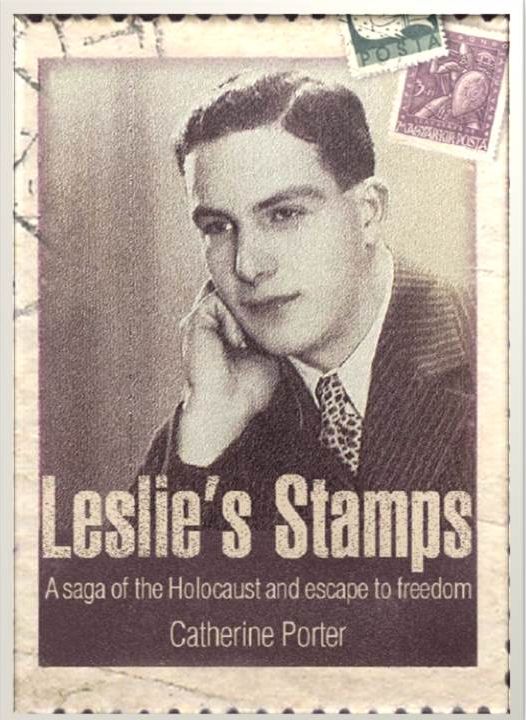
Leslie's StampsLeslie’s Stamps: A Saga of the Holocaust and Escape to Freedom

He had an idyllic childhood in a small Hungarian town where, it seemed, there was no animosity between the Christian majority and Jews like him. But with the rise of Hitler and the Nazis, everything changed for Leslie Meisels, who ended up in Bergen-Belsen concentration camp with his family. Through his wartime ordeals, Leslie carried his stamp collection, started when he was 8, in the lining of his jacket. In Leslie’s Stamps: A Saga of the Holocaust and Escape to Freedom, award-winning Toronto Star columnist Catherine Porter tells the dramatic story of Leslie’s life through his stamps. It is a tale of love, courage and the power of the human spirit.

Leslie’s Stamps: A Saga of the Holocaust and Escape to Freedom is available for $2.99 at http://starstore.ca/collections/star-dispatches-ereads/products/leslies-stamps and itunes.com/stardispatches.

Read Full Post »

« Newer Posts - Older Posts »