Feeds:
Posts
Comments

Posts Tagged ‘Holocaust Education’

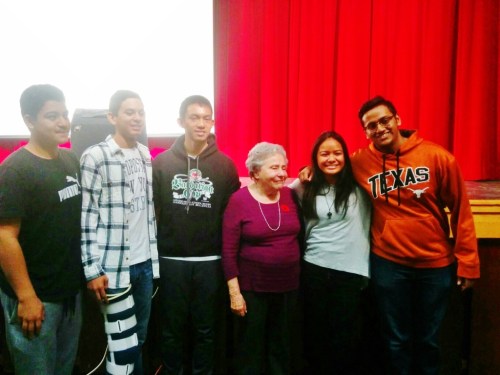
I have just returned from an invitation to participate in Toronto’s Neuberger Holocaust Education Centre’s Holocaust Education Week, spending some time with maybe a thousand high school kids at the Cardinal Newman Catholic High School. I had  a morning and an afternoon session.

image (1)

Holocaust survivor Ariela Rojek and her young admirers at Blessed Cardinal Newman Catholic High School.

I had an hour in the morning and I ended early so that they could come up and meet Ariela, my  “adoptive mother”. You see, a few years back, I connected her and several Toronto area survivors with their actual American liberators. Yesterday, at a family gathering at her daughter’s house, she brought out the scrapbook and showed me the pictures of her parents and family who did not survive the Holocaust, and even the original letter that her father wrote on the eve of his transfer from prison to Auschwitz-where he would be murdered, along with her grandfather and uncle. Ariela’s mother, only 36, both of her grandmothers, her other grandfather and two aunts were murdered at Belzec.


With Mark Celinscak, York University professor and author of the new book, "Distance from the Belsen Heap: Allied Forces and the Liberation of a Nazi Concentration Camp", and survivor Leslie Meisels before our afternoon talk.

With Mark Celinscak, Trent University professor and author of the new book, “Distance from the Belsen Heap: Allied Forces and the Liberation of a Nazi Concentration Camp”, and survivor Leslie Meisels before our afternoon talk.

Toronto talk descriptionIn the afternoon, I was with my good friend Leslie Meisels, an experienced speaker who told the kids about his Holocaust journey, and the miracles in his life that led he and I to be on the same stage together. Leslie was from Hungary, and liberated on the same day as Ariela, on the same train, and by the same soldiers. I did my bit and turned it over to him, and relayed questions from the students to him.

Now when you are teaching it is true that many times you have no idea of whether or not you are getting through to the kids. Some may have a bored expression as you hammer the message home, eyes not meeting yours, or looking like this is the last place they want to be. But in the end, you know, it behooves us as educators to give them space, and maybe time, to process. (And I did include a brief “debriefing guide” for teachers to use if they wanted to, after the presentation.)

But it was the outpouring of love for the survivors who were with me today, that really made my trip, and my efforts worth it.

Holocaust survivor Leslie Meisels with Blessed Cardinal Newman Catholic High School students  where they learned about reuniting Holocaust survivors with their American liberators. Photo by Joan Shapero.

Holocaust survivor Leslie Meisels with Blessed Cardinal Newman Catholic High School students where they learned about reuniting Holocaust survivors with their American liberators.

Leslie and Ariela are family, and a new group of students became witnesses to the greatest crime in history, and one that the world allowed to unfold. In the end my message was to simply amplify the lessons these survivors, and liberators, have inspired through their example- that we are all part of the family of mankind and that in living out our lives, we have the responsibility to make a difference- and that one person can make a change that will ripple onward for generations to come.

Read Full Post »


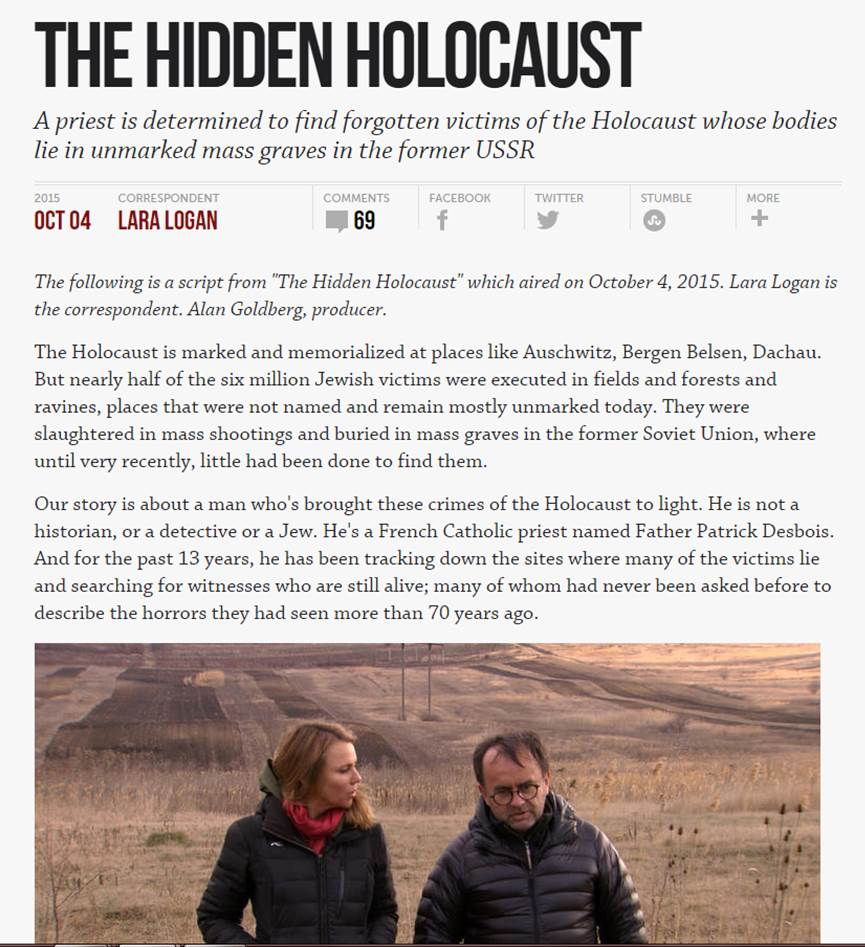
This is an important story which aired on Oct. 4th on CBS 60 Minutes. I’ve known about Father Dubois for quite some time and we do have mutual friends/acquaintances. His book,  The Holocaust by Bullets, can be ordered here. I’m glad that his important work is having such an impact, and being recognized as groundbreaking. Remember, we are only 75 years after the events… As I am at work on my own book about the Holocaust, I find myself admiring a kindred spirit, in a sense. I’m not Jewish, but Catholic like him, but that is hardly relevant, except to call attention to what happened from the perspective of a non-Jew. For deniers, it won’t make a difference-but as we study, and interview, we become witnesses, too. 

He can’t mark the mass graves that he finds, and sadly I already knew what to expect when I reached the comments section of the article. And I am told that Father Dubois has received death threats at his residence in Paris.

hidden holocaust

“The Holocaust is marked and memorialized at places like Auschwitz, Bergen Belsen, Dachau. But nearly half of the six million Jewish victims were executed in fields and forests and ravines, places that were not named and remain mostly unmarked today. They were slaughtered in mass shootings and buried in mass graves in the former Soviet Union, where until very recently, little had been done to find them.

Our story is about a man who’s brought these crimes of the Holocaust to light. He is not a historian, or a detective or a Jew. He’s a French Catholic priest named Father Patrick Desbois. And for the past 13 years, he has been tracking down the sites where many of the victims lie and searching for witnesses who are still alive; many of whom had never been asked before to describe the horrors they had seen more than 70 years ago.”

Lara Logan: So what you’re learning here is completely unrecorded?

Father Desbois: Yeah, if we didn’t come, we’ll never know they killed Jews. These Jews would have never been counted as dead, never known, and the mass grave is totally unknown.

Gheorghe brought us down this road where, he said, all the Jewish families from the village were taken. He told us the day of the shooting he was tending to cows nearby. Now 70 years later, we watched as he traced the victims steps to the edge of the ravine.

Read the transcript and view the report: http://www.cbsnews.com/news/hidden-holocaust-60-minutes/

http://www.yahadinunum.org/

Rleated article: Voices of ghosts: Remembering the Holocaust’s mass killings
‘I have lived with the Holocaust my entire life — and I still don’t understand how this could have happened’

Read Full Post »

It was six years ago this evening, we shared a meal on the eve of Shabbat, after watching ourselves on a national broadcast that reached millions. Why does it seem, so long ago?

Maybe because it all seems so unbelievable- that out of the darkness of the past, on a day when the sun dawned clearly and was warming the Earth in its mid-April morning ascent, a low rumble was heard by  hushed and huddled groupings of tormented humanity as they strained to hope for friends amidst their lurking murderers. As the metallic clanking grew louder, over the horizon broke the earthly angels, two Sherman light tanks and an American Jeep with the emblem of the white star. A cry broke out. They realized they were saved, and the American major snapped a photograph at the exact moment the overjoyed survivors realized it.

And out of the past on a warm September day, we brought them all together again. Who would have believed that 62 years later, a high school in a quiet, rural part of the world would  bring the soldier-liberators and the rescued survivors together from the US, Canada, Israel and elsewhere? All because I couldn’t let go of a good narrative history, and pursued the story behind the photographs that proved it really happened?

And think about the risk you run, inviting hundreds of octogenarians to come to a high school for half a week to mingle with thousands of high school and middle schoolers? Talk about sweating bullets. What if they are uncomfortable? Cranky? Complaining? What if the kids I can’t control are rude? And what if one of these “old” folks, who I don’t even know, dies on our watch? I would lie awake at night wondering if I was out of my mind.

But the miracle came to be-for the two dozen or so elders who could come, tears flowed, wine spilled, and our “new grandparents” danced with young teenagers who adored them, but only after the risk was accepted, with the enthusiastic help of Mary Murray, Tara Winchell-Sano, and Lisa Hogan, Rene Roberge and others. Have a look at the videos, and feel the love. We created ripples, and tripped the wires of the cosmos, and the reverberations are still echoing. To date, with Varda Weisskopf’s and Frank Towers’ help, the list is at 275 survivors whom we have found. And how many generations has it effected?

This is the subject of my second book, due out this next summer. In the meantime, I am working on a shorter work of what I have learned in teaching the lessons of the Holocaust. So take a look at the videos, and remember the words of the liberator:

“Here we are! We have arrived!”

Read Full Post »

At my keynote talk in Rochester, NY, two weeks ago, several people came up to me after the ceremony and greeted me warmly. One man came with an envelope and shook my hand, explaining that his father had been an American medic. In the envelope were photographs and Vincent’s handwritten letter describing a talk that he had had with his dad a couple years before he passed. I have finally gotten around to transcribing it; it comes on the 70th anniversary of his father’s traumatic shock at a subcamp of Dachau where Jewish slave laborers were being worked to death mining out mountains so the Reich could shelter its fledgling jet industries from Allied bombing. Many of the prisoners were dying of typhus. Below you will find the letter and two of his photos.

Vincent F. Butler, Sr.

Vincent F. Butler, Sr.

4/15/2015

Dear Matt,

These are copies made from the original pictures taken by my father, Vincent F. Butler, Sr., at the concentration camp in Landsberg, Germany toward the end of World War II. He did not date the pictures, but I have included a copy in his handwriting of the location. My father was a medic in the XXI Medical Corps when his unit liberated this camp.

My father never really talked about the war except for a funny story once in a while. About 2 years before he died he first showed me these pictures. He described the encounter as “the worst thing I had ever seen”. That says a lot considering he was a frontline medic in Europe. He also said that he “could not understand how someone could do something so horrible against other human beings.” He uttered “Why…Why…Why…” several times during our talk. He gave me these pictures with the directive: “Never let anyone say that this did not happen. It did – I saw it.”

Landsberg Area, Germany. A subcamp of Dachau.

Landsberg Area, Germany. A subcamp of Dachau.

That was one of the few actual directives that my father ever gave me, and I must say, it was his most serious. Looking back, and finally knowing what he had been through, I am sure that this had the biggest impact and was the most traumatic effect on him.

He did talk about how they tried to save as many people as they could. He said they had to very slowly give people food because large amounts would shut their system down. He said he was not aware of these camps until they came upon this one.

Thank you for telling the story so that the Holocaust is never repeated. I think that my father’s pictures and his recollection through me may help in some small way.

Vincent Butler, Jr.


http://www.ushmm.org/wlc/en/article.php?ModuleId=10006171

*************************************************************

Matthew Rozell is a United States Holocaust Memorial Museum Teacher Fellow and teaches history at his alma mater in upstate New York. His work has resulted in the reuniting of 275 Holocaust survivors and the American soldiers who freed them.

His first book, ‘The Things Our Fathers Saw’, is being released to coincide with the 70th anniversary of the end of World War II. His second book, in progress, is on the power of  teaching, remembering the Holocaust, the Benjamin photograph and the liberation of the “Train Near Magdeburg’. He can be reached at marozell at gmail dot com.

Read Full Post »

April 30 1945 Headlines. Hangs in my classroom.

April 30 1945 Headlines. Hangs in my classroom.

Today, April 29th, is the anniversary of the liberation of Dachau, 70 years on.

Today, if it is brought up at all, some of us might respond with a vacant stare. More might shrug and turn away. I suppose that is to be expected. But you know me. I just think that as a nation, sometimes we allow things to slip from memory at our peril.

It was real, and it happened. And it was American GIs who overran this camp and many others in the closing days of World War II.

The men of the 42nd and 45th Infantry Division arrived independently of each other, here, in southern Germany, at Dachau, on this day. A concentration camp, they were told. Their noses gave them a hint of what they were about to uncover, miles before the camp appeared in sight.

Read the headlines, above. Note the subarticle:

Boxcars of Dead at Dachau. 32,000 captives freed.

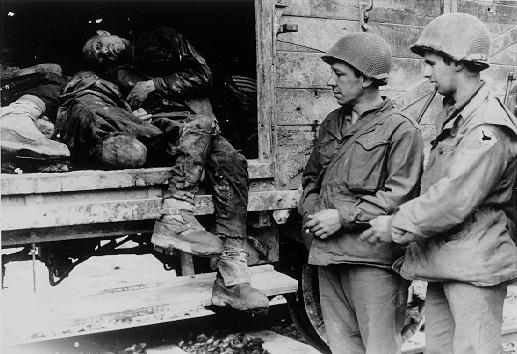
American soldiers view the bodies in one of the open railcars of the Dachau death train. USHMM

American soldiers view the bodies in one of the open railcars of the Dachau death train. USHMM

And so after some resistance, into the camp they entered. Life changing events were about to unfold for the American soldier.

***

For me, it’s not about hero worship, or glorifying the liberator or any World War II soldier as some kind of savior. Many of the liberating soldiers I know would resist this, to the point of rejecting the term, “liberator”… “It all sounds so exalted, so glamorous” said one. But they will all accept the term, “eyewitness”.

Witnesses to the greatest crime in the history of the world.

So instead I think it is about honoring their experiences, their shock, the horror, the puking and the crying, the rage-and then, the American GIs recognizing that something had to be done. And they did suffer for it, for trying to do the right thing. Many tried to help by offering food to starving prisoners who just were not ready to handle it, only to see them drop dead. Or having to manhandle these emaciated victims who were tearing away at each other as food was being offered.

Some guys never got over it. How could you?

I have learned so much over the past few years from these guys, just through the way that they carried themselves and tried to cope with what they witnessed. In my World War II studies and Holocaust class, we discuss these issues at length. I’m so lucky to be able to teach it.

Last year, I was privileged to teach a lesson to my high school seniors for NBC Learn, which was shared with other districts across the nation. This year, I stumbled upon this piece by the late author Tony Hays, who writes about his liberator father and his own encounter with the past. Thanks to the Get It Write folks; the original link is at the bottom.

***

Dachau Will Always Be With Us

by Tony Hays

This is not so much a post about writing as one about a writer’s education, about one of those experiences that molds us, shapes us into storytellers. I read yesterday the story of Joseph Corbsie, whose father, a World War II veteran, left him with a special legacy from the war, from the hideous Nazi concentration camp at Dachau. I feel a particular kinship with Mr. Corbsie.

My father, Robert Hays, was the son of an alcoholic tenant farmer in rural west Tennessee. If the appellation “dirt poor” fit anyone, it fit my grandfather’s family. Daddy served in the Civilian Conservation Corps during the 30s. He and my mother, who was in the woman’s equivalent of the CCC, working as a nurse’s aide at Western State Mental Hospital in Bolivar, Tennessee, met on a blind date in early 1940 and married in September of that year.

But just over a year later, Pearl Harbor happened. America was in the war. My father was among the first of those drafted in 1942. I won’t bore you with the details, but he participated in the North African, Salerno, Anzio, and southern France invasions, saved by the luck of the draw from Normandy. But they slogged through France and on to Germany. On April 29, 1945, Allied troops liberated the Dachau concentration camp. I don’t know whether he entered Dachau that day or the next, but that he was there within hours of the liberation is beyond dispute. A few months later, after more than three years overseas, he came home.

In later years, he would talk occasionally about the war, providing anecdotes that showed the chaos and random chance of battle. He spoke of driving through Kasserine Pass in North Africa just hours before the Germans killed thousands of Allied troops in a stunning attack. He spoke of a friend, defending his position from a foxhole, who was thought dead after an artillery shell landed right next to him. When the dust cleared, the friend was buried up to his neck in dirt, but did not have a scratch on him. He spoke often of Anzio, where he was wounded, and of the massive German air assaults on those soldiers clinging to that tiny sliver of beach along the Italian coast.

But he never spoke of Dachau.

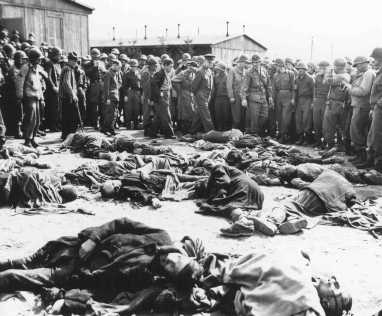
The bodies of former prisoners are piled in the crematorium mortuary in the newly liberated Dachau concentration camp. Dachau, Germany, April 29, 1945.

The bodies of former prisoners are piled in the crematorium mortuary in the newly liberated Dachau concentration camp. Dachau, Germany, April 29, 1945. USHMM.


Ever.

When he died in 1981, we found a photo in his wallet. An old sepia-toned shot like others he had taken during the war, pictures that he kept in an old brown bag. But this one was different.

It showed a pile of naked bodies. Well, really more skeletons than not, with their skin stretched pitifully over their bones. On the back, as had been his habit, was typed simply “Dachau.”

I was confused. Why would he keep this one photo in his wallet all of those years? Especially a photo of a place and event that he never spoke about. It obviously had some deeper meaning for him than the other photographs. If it had been a shot of the building he was in when he was wounded (hit by an artillery shell), I could have seen that. A reminder of his closest brush with death. Yeah, I could buy that. But this macabre photo? That, I couldn’t see.

So, for the next fifteen years, I remained puzzled.

Until the fall of 1996. I was working in Poland, and I had some time off. I took an overnight bus from Katowice, Poland to Munich. It was an interesting trip all in itself. We sat in a line of buses at midnight on the Polish/German border, waiting for our turn to cross, next to a cemetery, as if in some Cold War spy movie. I remember passing Nuremburg and thinking that my father had been there at the end of the war. And then there was Munich.

I spent a day or two wandering through the streets, drinking beer in the Marienplatz. I’m a historical novelist, so the short trip out to Dachau was a no-brainer. Of course it was as much my father’s connection with it as anything else that spurred the visit. But I’m not sure that I was completely aware of that at the time.

Dachau literally sits just on the outskirts of the Munich metropolitan area. I looked at the sign on the train station with a sadness, wondering for how many people that had been one of the last things they saw. It was only later that I discovered there had been another depot for those passengers.

The Dachau Memorial is a place of deep emotion. In the camp proper, mostly all that are left are the foundations of the barracks. One has been reconstructed to give an idea of how horrible life must have been. The camp was originally intended to hold 6,000 inmates; when the Allies liberated Dachau in 1945, they found 30,000. The museum and exhibits are primarily in the old maintenance building. I looked with awe at life size photos of prisoners machine gunned, their hands torn to ribbons from the barbed wire they had tried to climb in a futile attempt at escape.

I followed the visitors (I can’t call them tourists) north to where you crossed over into the crematorium area. It was there that the full brunt of what had taken place at Dachau really hit me. A simple brick complex, it seemed so peaceful on the fall day that I stood before it. But as I read the plaques and consulted my guidebook, as I stepped through the door and actually saw the “shower” rooms where the prisoners were gassed, as I stared into the open doors of the ovens, I felt a rage unlike any I had ever known consume me.
Covering my eyes, embarrassed at the tears, I slipped back outside. It took more than a few minutes to regain my composure. I thought then that I understood why my father kept that photo close to him for so long. It was a reminder of what one group of people had done to another group of fellow humans. The obscenity of it had overwhelmed him as it had me.

That night, I went to the famous Hofbrauhaus in Munich, to wash the images of the ovens away with some beer. I hadn’t been there long when an elderly American couple sat at the table. They were from Florida, a pleasant couple. He had been a young lieutenant in the American army on the push into Munich. In fact, it had been his pleasure to liberate the Hofbrauhaus from the Germans.

Of course, I asked the question. “Were you at Dachau?”

He didn’t answer for several seconds, tears glistening in the corners of his eyes as his wife’s hand covered his and squeezed. Finally, he nodded, reached into a back pocket and pulled out his wallet.

With a flick of his wrist, a photo, just as wrinkled, just as bent, as the one my father had carried landed on the table. It wasn’t the same scene, but one just like it.

Here was my chance, the opportunity to ask the question I had never been able to ask my father. I pulled the photo from my own wallet and lay it next to his. “Why? Why have you carried it so long? To remind you of the horror of Dachau, of what had been done here?”

His face carried the faintest of smiles as he shook his head. “No, son, to remind us of the horrors that we are capable of, to remind us not to go down that road again.”

The difference was subtle, but in that moment, I learned two lessons invaluable to a writer, subtle differences are important, and when you want to know the truth, go to the source.

As I sit here now and look at that same photograph, I realize that it was my father’s legacy to me, of Dachau. Joe Corbsie’s father left him something more tangible, a reminder of the same thing for the same reason, but more forcefully stated — a tiny box of human ash from the ovens.

Now, nearly 70 years after that day in 1945, Dachau is still with us, and I hope the legacy left by our fathers always will be.
 

Read Full Post »

30th Infantry Division Veterans of World War II, Nashville Tennessee, April 2015, 70th anniversary of the end of WWII. Credit: Larry S Powell.

30th Infantry Division Veterans of World War II, Nashville Tennessee, April 2015, 70th anniversary of the end of WWII. Credit: Larry S Powell.

The poet Yaakov Barzilai was on the ‘Train Near Magdeburg’. Originally composed in Hebrew, a  translation has been provided by fellow survivor Micha Tomkiewicz. He has agreed to share his poem on the 70th anniversary of the liberation. ’11:55′  refers to the author’s recollection of the time of the day of the liberation of the train transport; ‘five minutes before the bitter end’.

Dedicated to Frank Towers and 30th Infantry Division soldiers, US liberators of the death train from Bergen-Belsen on April 13, 1945


At Eleven fifty-five.

Return to the Place of Liberation, April 13, 1945, after 65 years.


The train stopped under the hill, huffing and puffing, as though it reached the end of the road.

An old locomotive pulling deteriorating train cars that became obsolete long ago, not even fit for carrying horses.

To an approaching visitor, the experience was of a factory of awful smell – really stinking.

Two thousand four hundred stinking cattle heading for slaughter were shoved to the train cars.

The butterflies into the surrounding air were blinded by the poisonous stench.

The train moved for five days back and forth between Bergen-Belsen and nowhere.

On the sixth day, a new morning came to shine over our heads.

Suddenly the heavy car doors were opened.

Living and dead overflowed into the surrounding green meadow.

Was it a dream or a delayed awakening of God?

When we identified the symbols of the American army, we ran to the top of the hill as though bitten by an army of scorpions, to kiss the treads of the tanks and to hug the soldiers with overflowing love.

Somebody cried: “Don’t believe it, it is a dream”. When we pinched ourselves; we felt the pain – it was real.

Mama climbed to the top of the hill. She stood in the middle of the field of flowers and prayed an almost a silent prayer from the heart.

Only few words escaped to the blowing wind:

‘Soon…Now…..To the chimneys of death…I gave new life….to my children…. and this day… my grandchildren were born… to a good life.

Amen and Amen’.

Yaakov Barzilai.

‘Yaakov Barzilai is an esteemed Israeli poet; he is also a survivor of The Shoah. Born in Hungary in 1933, the year Hitler came to power in Germany he shares, in poetry and prose, a child’s memories of the horrors that befell the Jewish people. He tells of acts of great humanity and others of exceptional, he recounts tales of transportation and eventual rescue. He speaks of losses – family, potential and describes the eventual triumph of man over inhumanity.’ [www.cduniverse.com/productinfo.asp?pid=8756081] 

בְּאַחַת עֶשְׂרֵה חֲמִשִּׁים וְחָמֵשׁ


שִׁיבָה לִמְקוֹם הַשִּׁחְרוּר בִּ 13 בְּאַפְּרִיל 1945

                     כַּעֲבֹר 65 שָׁנָה

הָרַכֶּבֶת עָצְרָה מִתַּחַת לַגִּבְעָה

נוֹשֶׁפֶת וְנוֹהֶמֶת

כְּמִי שֶׁהִגִּיעַ לְסוֹף דַּרְכּוֹ

קַטָּר זָקֵן גָּרַר קְרוֹנוֹת יְשָׁנִים

שֶׁאָבַד עֲלֵיהֶם כֶּלַח,

לֹא רְאוּיִים אֲפִלּוּ לִמְגוּרֵי סוּסִים.

מִי שֶׁהִזְדַּמֵּן לַסְּבִיבָה

הֶאֱמִין שֶׁנִּקְלַע לְבֵית חֲרֹשֶׁת לְסֵרָחוֹן

אַלְפַּיִם אַרְבַּע מֵאוֹת רָאשֵׁי בָּקָר מַסְרִיחִים

שֶׁנּוֹעֲדוּ לִשְׁחִיטָה

נִדְחְסוּ לַקְּרוֹנוֹת

כָּל הַפַּרְפַּרִים בַּסְּבִיבָה הִתְעַוְרוּ

מִסֵּרָחוֹן מַדְמִיעַ.

חֲמִשָּׁה יָמִים נָסְעָה הָרַכֶּבֶת הָלוֹךְ וַחֲזֹר

בֵּין בֶּרְגֶן-בֶּלְזֶן לְשׁוּם מָקוֹם

בַּיּוֹם הַשִּׁשִּׁי, בֹּקֶר חָדָשׁ זָרַח מֵעָלֵינוּ.

בְּבַת אַחַת נִפְתְחוּ הַדְּלָתוֹת הַכְּבֵדוֹת שֶׁל הַקְּרוֹנוֹת

חַיִּים וּמֵתִים נִשְׁפְּכוּ בְּיַחַד

אֶל הַיָּרֹק הַמִּשְׁתּוֹלֵל בַּשָּׂדוֹת.


הַאִם הָיָה זֶה חֲלוֹם

אוֹ הַצָּתָה מְאֻחֶרֶת שֶׁל אֱלֹהִים?

כְּשֶׁזִּהִינוּ אֶת סֵמֶל הַצָּבָא הַאָמֶרִיקָאִי,

כִּנְשׁוּכֵי עַקְרָב שָׁעֲטְנוּ בְּמַעֲלֵה הַגִּבְעָה

לְנַשֵּׁק אֶת שַׁרְשְׁרָאוֹת הַטַּנְקִים

וְלַחֲנֹק אֶת הַחַיָּלִים מֵרֹב אַהֲבָה.

מִישֶׁהוּ צָעַק: “אַל תַּאֲמִינוּ זֶה רַק חֲלוֹם”

וּכְשֶׁצָּבַטְנוּ אֶת עָצַמְנוּ

כָּאָב לָנוּ בֶּאֱמֶת.

גַּם אִמָּא טִפְּסָה אֶל גִּבְעַת הַנִּצָּחוֹן

הִיא עָמְדָה בְּתוֹךְ שָׂדֶה שֶׁל פְּרָחִים וְהִתְפַּלְּלָה

מִתּוֹךְ הַתְּפִלָּה הַחֲרִישִׁית שֶׁנֶּאֶמְרָה בַּלֵּב

רַק מִלִּים בּוֹדְדוֹת הִסְתַנְנוּ אֶל אֲוִיר הָעוֹלָם:

” וְכָאן… וְעַכְשָׁו… עַל פַּסֵי הָרַכֶּבֶת…

קָרוֹב… לַאֲרֻבּוֹת הַמָּוֶת…נָתַתִּי…

חַיִּים חֲדָשִׁים…לִילָדַי… וְהַיּוֹם הַזֶּה…

נוֹלְדוּ גַּם נְכָדַי… לְחַיִּים טוֹבִים…

אָמֵן… וְאָמֵן…                                                                     יעקב ברזילי

Read Full Post »

Friday the 13th. Today is the 70th anniversary, to the day.

This account comes to me from a survivor’s son who lives in Hungary. He had read of Carrol Walsh’s passing on the internet and contacted me. It is Carrol who is commanding one of these tanks. Sgt. George Gross commanded the other, and took photographs.

I just came across this website . My father was on this train.
He passed away twenty years ago, in April 1992.

Here is an excerpt from his memoirs about his liberation day.
—————————————————-

Translation from my father’s Memoirs pp. 302-304.
————————————————-

The day of April 13 1945 was a Friday and a sunny and windy day. In the morning, the SS opened the doors of the freight cars, after they had argued with each other whether they should kill us with their submachine guns. But the US troops were too close.

——————————————————————-

Perhaps it was an older SS man who prevented our execution. Later that day, a Jewish woman, who had been his lover in the camp, saved him from becoming a prisoner of war or worse. She got him civilian clothes, I do not know how. The same woman became the lover of an American soldier later.
——————————————————————

Several hundred people wrapped in rags streamed through the open doors, if they could be called people at all. We were all mere skeletons.

The train was idling in a deepening, so I climbed uphill, across a road and to a field. I was pulling out potatoes planted on the field, when a motorcycle approached. It was a motorcycle with a side-car. There was an elegant SS or Nazi leader in the front: I could not decide, since he was wearing a mixture of uniform and civilian clothes. It must have been his wife sitting behind him and his child in the side-car. He pulled over and offered me a cigarette. I told him I did not smoke, so he closed his silver-looking cigarette-case and started the engine.
He seemed to hesitate about the direction he should take.

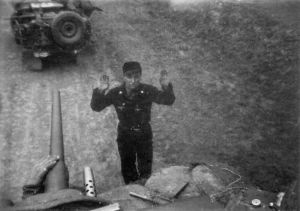
Prisoner taken. Photo by tank commander George C Gross, April, 1945.

Prisoner taken. Photo by tank commander George C Gross, April, 1945.

Then two small American tanks arrived. I was standing in the middle of the road, and noticed that the American soldier leaning out of the turret of one of the tanks aimed his gun at me.
The tank came closer and closer, and the soldier lowered his submachine gun. I must have looked terrible, so he did not take me for an enemy. I was lucky he had not shot me from the distance, since my small coat and boots vaguely resembled a military uniform. Lice were crawling all over my clothes and skin.

The few hundred former inhabitants of the concentration camp surrounded the tanks right away. Suddenly somebody remembered that the SS guarding us were still in the carriages. The SS were caught quickly, and lined up. The “intrepid” SS were trembling so heavily that their pants were flapping.

The first thing a Jewish woman asked from the soldier leaning out from the tank was money, and she received a dollar bill. She must have established her future with this dollar.

My attention was drawn to something else: in the rear of the tank there was a box of canned food. I climbed under the tank, emerged at its end, and pulled out a can. It turned out that I stole a can of oranges. This was my luck. I ate the potatoes charred in the can with the oranges, and probably this combination saved my life. Everyone who ate meat or anything greasy died within hours or within one or two days at the latest.

I felt fever in my body, undressed completely naked in front of staring women, and went into the ice-cold water of the lake next to the railroad. People warned me not to do this, but I went into the water, felt good, felt that I got rid of the lice and the burning heat of the fever. When I put on my rags again, I felt the fever ever stronger.

I asked an American soldier to sign the photo of my fiancee (I still have this photo). To my surprise, he signed the name Churchill. I thought he was joking. But he reassured me that his name was really Churchill.

(Once I read about a father named Churchill, who went to see his son’s grave in Vietnam during that war. The report mentioned that the father had been a soldier in World War II. He must have been my Churchill)

In the evening, there were news that we should flee, because the Germans pushed back the Americans. The Germans would massacre us for sure, the women had pulled out material for parachutes from a carriage in order to make clothes.

I was already so weak that I did not care whether the returning Germans would kill me: I stayed in one of the carriages, and fell asleep.

On Saturday, April 14, German peasant [horse-drawn] carts came for us by some order, so I was carried to Hillersleben. I dragged myself to the first floor of the first building, it looked like an office building, lay down under the sink of the bathroom, and fell asleep.

I am sure the American soldiers had no idea who we were and what we went through.

*******************************

First published in 2013. I am off to the last survivors/liberators reunion in Nashville Tennessee, this weekend.

Read Full Post »


General Dwight D. Eisenhower (center), Supreme Allied Commander, views the corpses of inmates who perished at the Ohrdruf camp. Ohrdruf, Germany, April 12, 1945. — National Archives and Records Administration, College Park, Md. USHMM

We are told the American soldier does not know what he is fighting for. Now, at least he knows what he is fighting against.

— General Dwight D. Eisenhower, on visiting a subcamp of Buchenwald, April 12, 1945

April 4, 1945: The U.S. 4th Armored Division liberates the concentration camp at Ohrdruf, Germany, a subcamp of Buchenwald, the site of more than 4000 deaths during the previous three months. Victims were Jews, Poles, and Soviet POWs. Hundreds shot just before liberation had been working to build an enormous underground radio and telephone communications center. Very few inmates remain alive at liberation.

April, 1945: U.S. Generals Dwight Eisenhower, George Patton, and Omar Bradley visit the camp at Ohrdruf, Germany, and view corpses and other evidence of Nazi atrocities.

In late March 1945, the camp had a prisoner population of some 11,700, but in early April the SS evacuated almost all the prisoners on death marches to Buchenwald. The SS guards killed many of the remaining prisoners who were too ill to walk to the railcars.

When the soldiers of the 4th Armored Division entered the camp, they discovered piles of bodies, some covered with lime, and others partially incinerated on pyres. The ghastly nature of their discovery led General Dwight D. Eisenhower, Supreme Commander of the Allied Forces in Europe, to visit the camp on April 12, with Generals George S. Patton and Omar Bradley. After his visit, Eisenhower cabled General George C. Marshall, the head of the Joint Chiefs of Staff in Washington, describing his trip to Ohrdruf:

. . .the most interesting–although horrible–sight that I encountered during the trip was a visit to a German internment camp near Gotha. The things I saw beggar description. While I was touring the camp I encountered three men who had been inmates and by one ruse or another had made their escape. I interviewed them through an interpreter. The visual evidence and the verbal testimony of starvation, cruelty and bestiality were so overpowering as to leave me a bit sick. In one room, where they were piled up twenty or thirty naked men, killed by starvation, George Patton would not even enter. He said that he would get sick if he did so. I made the visit deliberately, in order to be in a position to give first-hand evidence of these things if ever, in the future, there develops a tendency to charge these allegations merely to “propaganda.”


Seeing the Nazi crimes committed at Ohrdruf made a powerful impact on Eisenhower, and he wanted the world to know what happened in the concentration camps. On April 19, 1945, he again cabled Marshall with a request to bring members of Congress and journalists to the newly liberated camps so that they could bring the horrible truth about Nazi atrocities to the American public. He wrote:

We continue to uncover German concentration camps for political prisoners in which conditions of indescribable horror prevail. I have visited one of these myself and I assure you that whatever has been printed on them to date has been understatement. If you could see any advantage in asking about a dozen leaders of Congress and a dozen prominent editors to make a short visit to this theater in a couple of C-54’s, I will arrange to have them conducted to one of these places where the evidence of bestiality and cruelty is so overpowering as to leave no doubt in their minds about the normal practices of the Germans in these camps. I am hopeful that some British individuals in similar categories will visit the northern area to witness similar evidence of atrocity.

That same day, Marshall received permission from the Secretary of War, Henry Lewis Stimson, and President Harry S. Truman for these delegations to visit the liberated camps.

Ohrdruf made a powerful impression on General George S. Patton as well. He described it as “one of the most appalling sights that I have ever seen.” He recounted in his diary that

In a shed . . . was a pile of about 40 completely naked human bodies in the last stages of emaciation. These bodies were lightly sprinkled with lime, not for the purposes of destroying them, but for the purpose of removing the stench.

When the shed was full–I presume its capacity to be about 200, the bodies were taken to a pit a mile from the camp where they were buried. The inmates claimed that 3,000 men, who had been either shot in the head or who had died of starvation, had been so buried since the 1st of January.

When we began to approach with our troops, the Germans thought it expedient to remove the evidence of their crime. Therefore, they had some of the slaves exhume the bodies and place them on a mammoth griddle composed of 60-centimeter railway tracks laid on brick foundations. They poured pitch on the bodies and then built a fire of pinewood and coal under them. They were not very successful in their operations because there was a pile of human bones, skulls, charred torsos on or under the griddle which must have accounted for many hundreds.

Source(s):

Weber, Louis. The Holocaust Chronicle. Publications International Ltd., 2007. http://www.holocaustchronicle.org

The United States Holocaust Memorial Museum, 1945- The Year of Liberation. 1995.

http://www.ushmm.org/wlc/en/media_ph.php?ModuleId=10006131&MediaId=3711

http://www.ushmm.org/wlc/en/article.php?ModuleId=10006131

*************************************************************

Matthew Rozell is a United States Holocaust Memorial Museum Teacher Fellow and teaches history at his alma mater in upstate New York. This year, he is authoring a series of posts under the heading of ‘Seventy Years’, marking the 70th anniversary of the close of World War II and of the ‘liberation phase’  of the Holocaust. His work has reunited 275 Holocaust survivors with the American soldiers who freed them.

His first book, a narrative of World War II in the Pacific as told through the previously unpublished recollections of two dozen veterans, is due out this spring. His second book, in progress, is on the power of  teaching, remembering the Holocaust, and this “Train Near Magdeburg’. He can be reached at marozell at gmail dot com.

Read Full Post »

{To commemorate the spring of 1945 and  liberation seventy years on, I  am posting the unfolding nature of the discovery of the Holocaust as Allied troops closed in from the East and the West.}

March 19, 1945:

Adolf Hitler issues the Nero-Befehl (Nero Order), a scorched-earth directive intended to leave only a ruined Germany for advancing troops.
March 19, 1945:

Two hundred survivors out of 1000 Jewish women who began a forced march from the Neusalz, Poland, slave-labor camp on January 26 are evacuated by train to the concentration camp at Bergen-Belsen, Germany; see this post.

Source: Weber, Louis. The Holocaust Chronicle. Publications International Ltd., 2007. http://www.holocaustchronicle.org

I  received this email from the son of survivors:

Dear Mr. Rozell,

My mother was one of the 200 or so that survived that “death march”!  The survivors were transported to the camp at Bergen-Belsen, where my mother was ultimately liberated on April 15, 1945.

Many years ago, she did relate to me a wartime story of hers which I wrote up in 2006, and had published.

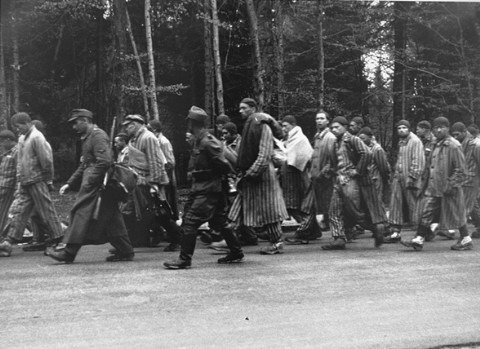
Prisoners on a death march from Dachau move towards the south along the Noerdliche Muenchner street in Gruenwald. German civilians secretly photographed several death marches from the Dachau concentration camp as the prisoners moved slowly through the Bavarian towns of Gruenwald, Wolfratshausen, and Herbertshausen. Few civilians gave aid to the prisoners on the death marches. Germany, April 29, 1945.  — KZ Gedenkstaette Dachau. USHMM

Prisoners on a death march from Dachau move towards the south along the Noerdliche Muenchner street in Gruenwald. German civilians secretly photographed several death marches from the Dachau concentration camp as the prisoners moved slowly through the Bavarian towns of Gruenwald, Wolfratshausen, and Herbertshausen. Few civilians gave aid to the prisoners on the death marches. Germany, April 29, 1945. — KZ Gedenkstaette Dachau. USHMM


The Defining Moment

By Joseph H. Danziger

It happened more than sixty years ago- and not to me- but I cannot dislodge it from my mind’s eye.  My consciousness will not surrender the thought of what it must have been like for my mother, especially on one ominous day. I am a child of Holocaust survivors.

My parents, and thousands like the, each have personal stories of their incarceration in the various concentration camps that dotted Germany, Poland and neighboring countries during World War II.

My parents rarely shared with me their accounts of that desperate period of their lives. When prodded, they might offer an occasional vignette. Seeing the pain on their faces in talking of these experiences, however, I didn’t push for details. Those are memories they certainly preferred to have long forgotten.

Of the stories that were begrudgingly told to me, one shared by my mother will haunt me forever. The soul-searching decision with which she was confronted on that fateful day so long ago is unfathomable to me. As a result of the decision she made that say, I am here to tell the tale.

My mother spent the flower of her youth- ages 17 through 20- within the confines of a concentration camp in Neusalz, Poland. It was a women’s “slave-labor” camp where yarn was processed for the war effort. Although it was not one of the infamous “death” camps such as Auschwitz, Treblinka or Sobibor, the distinction between these titles is hardly significant. In a death camp the aim was to kill as many and as quickly humanly possible. In a slave-labor camp the goal was, in effect, to work the laborers to death, with an ever-replenishing supply of labor. The death tolls in each were mind-boggling. The human skeletons who managed to survive all looked the same and had similar stories of deprivation, torture, depravity and the wanton taking of life.

In the midst of this living hell, an opportunity presented itself to my mother. She saw a possible means of escape. Despite knowing that if she got caught she would face certain death, she took the chance. She escaped, although she never explained exactly how.

Clad only in rags, she trudged through unfamiliar territory until she came to a house. She knocked on the door. She related her circumstance to the master of the house and pleaded for food and a place to hide. Although sympathetic to her plight, he told her he could not jeopardize his family. If found to have secreted a Jew, especially one who escaped from a nearby camp, he and his whole family would most likely be killed as a lesson to the community.

Yet, seeing my mother’s emaciated condition and dire need- and against his better judgment- he took pity on her. He invited her into his home, let her eat, bathe and sleep the night. Before the break of dawn, however, he said she must be gone. She thanked him and availed herself on his family’s kindness. For one night during a span of three years she had a full stomach, clean clothes and a restful night’s sleep.

She left before dawn, as promised. But where would she go? Only then did the truly desperate nature of her circumstance become apparent. For one such as she there was nowhere to go.

My mother was confronted with an unimaginable predicament, a sort of Gordian knot. Should she hazard freedom in an unfamiliar countryside filled with antisemitism where peril and betrayal would be her constant companions? Or should she attempt the inconceivable- a stealth re-entry into the camp from which she had just risked her life to escape- hoping the guards had not noticed her absence? As least there she reasoned, she had the known quantity of a controlled environment offering minimal subsistence, albeit in a horrific setting and under subhuman conditions. She chose the latter. In her mind, that choice offered the best chance for survival. As remarkable as was her original escape, doubly remarkable was her ability to re-enter the camp, unnoticed, and return to her quarters before the morning roll call.

With the memory of nearly one full day of freedom, my mother persevered. Then, in January 1945, together with 1,000 other interned women, she was set on a one-and-a-half-month forced to march to the concentration camp at Flossenburg, Germany, some 200 miles to the southwest. This was one of many so-called “death marches” that occurred toward the end of the war, in a calculated maneuver by the Nazis to deceive the Allies about the vast network of fully functioning concentration camps in operation during the war years.

Along the way to Flossenburg, 800 women were beaten, shot or left to die when they collapsed in the harsh winter. Upon their arrival, the remaining 200 women were transported to the concentration camp in Bergen-Belsen. On April 15, 1945, the British and the Canadians liberated the scant number of those remaining. One of those was my mother. One year later, after surviving family members were reunited, she married my father.

I cannot imagine any other Holocaust survivor choosing a purposeful re-entry into a concentration camp after an earlier successful escape. The very idea is mind-numbing. But she chose wisely, for which her five children and six grandchildren are her testament. I will forever marvel at the immense resolve of this remarkable woman and her relentless insistence on survival.


(Article first appeared in THE PHILADELPHIA LAWYER , SUMMER 2006. Retyped by student Jana Putzig. Used with permission.)

*************************************************************

Matthew Rozell is a United States Holocaust Memorial Museum Teacher Fellow and teaches history at his alma mater in upstate New York. This year, he is authoring a series of posts under the heading of ‘Seventy Years’, marking the 70th anniversary of the close of World War II and of the ‘liberation phase’  of the Holocaust. His work has reunited 275 Holocaust survivors with the American soldiers who freed them.

His first book, a narrative of World War II in the Pacific as told through the previously unpublished recollections of two dozen veterans, is due out this spring. His second book, in progress, is on the power of  teaching, remembering the Holocaust, and this “Train Near Magdeburg’. He can be reached at marozell at gmail dot com.

Read Full Post »

The cosmos trips once more. This month, shortly after my previous post about the discovery of previously unknown artwork by Hungarian Holocaust survivor Ervin Abadi, I was contacted by the family of another American soldier who was at Hillersleben camp as the survivors of the train were being nursed back to health by the medics of the 95th Medical Gas Battalion. They sent me most of the drawings below [Monroe Williams credit, courtesy the Williams family], published here for the first time.

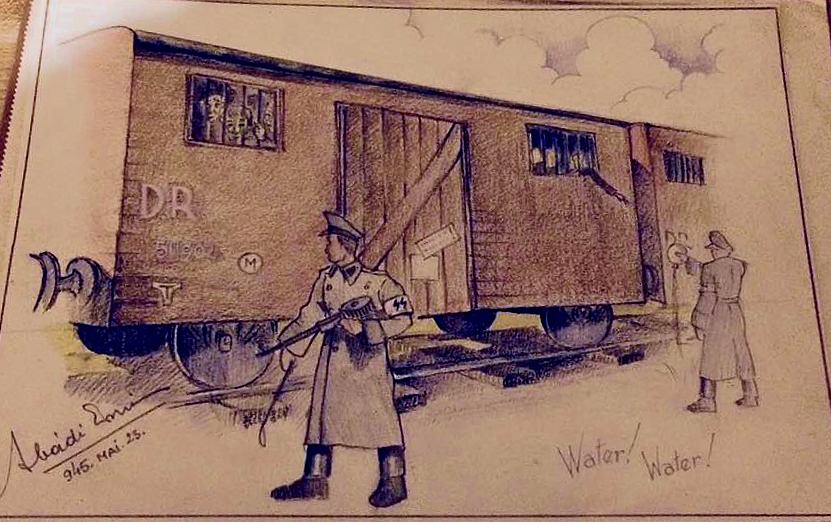
Abadi’s recently discovered artwork matches that of his previously known work, some of which is housed in the archives of the United States Holocaust Memorial Museum.

Ervin Abadi, Typhus. USHMM Collection. Probably completed at Hillersleben DP Camp, May, 1945.

Ervin Abadi, Typhus. USHMM Collection. Probably completed at Hillersleben DP Camp, May, 1945.

(If you suspect that you have any of Abadi’s art in your family, or if anyone remembers his time at Hillersleben or Bergen Belsen, please drop me a line at the bottom.)


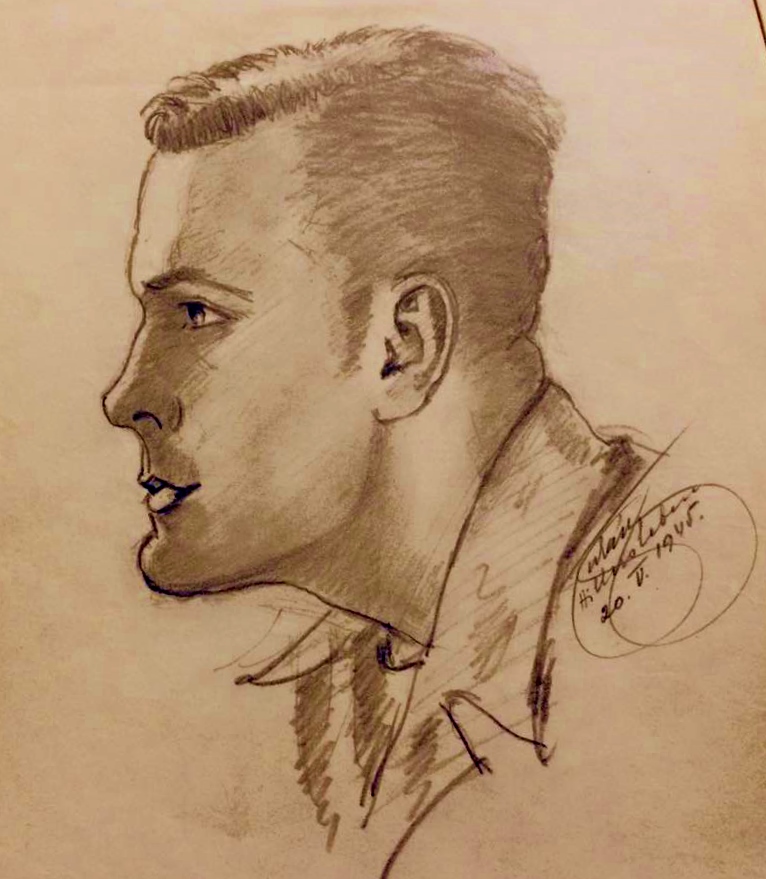
He was driven to express his gratitude for the American soldiers who freed him from the train, brought him to the hospital at Hillersleben, nursed him back to health and protected him in his stay at the displaced persons camp. These important drawings are proof of that, and confirm his dedication to feverishly recording everything that he could about those days. He drew his surroundings, his memories of the horrors of Bergen Belsen, and the beautiful young American soldiers around him, and even their precious photos of loved ones in their wallets!

In his words:

“Let these drawings serve as proof of my everlasting gratitude towards those to whom I owe my life. … To the soldiers of the United States Army, particularly to our immediate liberators, those soldiers of the 9th regiment who first entered the village of Zilitz and gave us bread, milk, chocolate, and cigarettes….”

American soldier at Hillersleben, 'Man'.  Ervin Abadi. Completed at Hillersleben DP camp, May, 1945. Soldier Monroe Williams collection.

American soldier at Hillersleben, ‘Man’. Ervin Abadi. Completed at Hillersleben DP camp, May, 1945. Soldier Monroe Williams collection.

American soldier-medic at Hillersleben.  Ervin Abadi. Completed at Hillersleben DP camp, May, 1945. Soldier Monroe Williams collection.

American soldier-medic at Hillersleben. Ervin Abadi. Completed at Hillersleben DP camp, May, 1945. Soldier Monroe Williams collection.

A kapo inflicts a beating at Bergen-Belsen. Ervin Abadi. Completed at Hillersleben DP camp, May, 1945. Soldier Monroe Williams collection.

A kapo inflicts a beating at Bergen-Belsen. Ervin Abadi. Completed at Hillersleben DP camp, May, 1945. Soldier Monroe Williams collection.

The American hospital at Hillersleben. Ervin Abadi. Completed at Hillersleben DP camp, May, 1945. Soldier Monroe Williams collection.

The American hospital at Hillersleben. Ervin Abadi. Completed at Hillersleben DP camp, May, 1945. Soldier Monroe Williams collection.

Soldier Monroe Williams' parents. Probably sketched from wallet photo.  Ervin Abadi. Completed at Hillersleben DP camp, May, 1945. Soldier Monroe Williams collection.

Soldier Monroe Williams’ parents. Probably sketched from wallet photo. Ervin Abadi. Completed at Hillersleben DP camp, May, 1945. Soldier Monroe Williams collection.

Ervin Abadi. Completed at Hillersleben DP camp, May, 1945. Soldier Monroe Williams collection.

Ervin Abadi. Completed at Hillersleben DP camp, May, 1945. Soldier Monroe Williams collection.

The 'casino' at Hillersleben. Ervin Abadi. Completed at Hillersleben DP camp, May, 1945. Soldier Monroe Williams collection. Note Red Cross tents in foreground. May have served as temporary morgue station.

The ‘casino’ at Hillersleben. Ervin Abadi. Completed at Hillersleben DP camp, May, 1945. Soldier Monroe Williams collection. Note Red Cross tents in foreground. May have served as temporary morgue station.

Former hospital at Hillersleben today. (Christian Wolpers photo.)

Former hospital at Hillersleben today. (Christian Wolpers photo.)

'Hillersleben-some disorderly DPs getting a shower bath (DDT?)' Soldier Luca Furnari photograph.

‘Hillersleben-some disorderly DPs getting a shower bath (DDT?)’ Soldier Luca Furnari photograph.

*****

Former American medic Walter Gantz called me out of the blue 3 years ago. Like all of the soldiers now reappearing in Abadi’s drawings, he was there. A couple newspaper articles appeared about Walter’s experience at  Hillersleben shortly thereafter. I put survivors in touch with him:

By the fall of 1944, the 95th [Medical Gas]Battalion was stationed at the Belgian-German border.

That winter, Mr. Gantz helped treat the wounded at the Battle of the Bulge in the Ardennes region, and by the spring of ’45 his unit had made its way into Germany.

In mid-April, they were in the town of Hillersleben setting up a displaced persons hospital when the Allies came across a train that had come from the Nazi concentration camp Bergen-Belsen, where over 35,000 people, the vast majority of them Eastern European Jews, had died of typhus during the first few months of that year.

All told, there were roughly 2,400 emotionally damaged, disease-ridden and terribly malnourished people aboard the train. “Walking skeletons” was an apt description, according to Mr. Gantz.

“We weren’t knowledgeable about these (concentration camps) at the time,” said Mr. Gantz, who visited Bergen-Belsen days after it was liberated. There, he saw countless dead bodies “strewn everywhere.”

“It was hard to explain,” he said. “I cried. And then I prayed for these people. Not only were you angry about what happened, but you felt so helpless.”

Mr. Gantz’s unit spent about six weeks treating the survivors. A good 70 or 80 of them died, mostly of typhus. Among the biggest challenges was acquiring enough food supplies to feed them all. Many could only take their nourishment intravenously.

“A lot of them, if you were to give them food, they would gorge themselves and kill themselves. You had to be very careful as to what they ate,” he said. “Boy, oh boy, they would scream. Those screams would go right through your body.”

“Hillersleben was a living nightmare,” he added. “You don’t shake these horrible scenes from one’s mind.” {see more https://teachinghistorymatters.com/2011/11/04/my-parents-couldnt-understand-why-i-couldnt-sleep-at-times/}

***

Blessed – or maybe cursed – with a terrific memory, he can vividly recall the screams and overall sense of dread permeating the hospital, where he and his fellow medics wore a daily uniform of surgical masks, gloves and rubber aprons.

He remembers scooping handfuls of lice out of patients’ hair and administering countless needles and the time he had to carry the body of a little girl to a tent serving as a makeshift morgue.

“I still get flashbacks to that,” he said.

Many died, mostly of typhus. Among the biggest challenges was acquiring enough food to feed them all, since a good portion of them could only take their nourishment intravenously. One of the survivors Mr. Gantz has spoken with, Lexie Keston, now a resident of Australia, told him she weighed just 30 pounds at the time of the rescue. She was 8 years old.

As a result of Mr. Rozell’s [work], a handful of Bergen-Belsen survivors have been in touch with Mr. Gantz, including Ariela Rojek, a Toronto resident who was 11-1/2 years old at the time of the rescue.

Mrs. Rojek, a Pole who lost all but an aunt during the Holocaust, was among those suffering from typhus. She spent three weeks in semi-consciousness, and remembers having to be tied to the bed by medics trying to restrain her. Mr. Gantz could have been one of them, she said.

“Those soldiers, they gave me my life. Because I was very sick,” she said.

“It was tough. Some of our guys couldn’t take it,” Mr. Gantz said. “I have to admit, I did a lot of crying. I tried not to do it around the patients.”

Now, though, he has the peace of mind of knowing firsthand that, despite all the horrors, life did go on for the survivors of Bergen-Belsen, just as it did for him and his fellow veterans. Asked once by a friend what he took from his wartime experience, Mr. Gantz thought for a moment, then replied, “It made me stronger spiritually.”

“I’ve been blessed,” he said. “I thank the good Lord every day.”

“He’s one of the angels,” Mrs. Rojek said of Mr. Gantz. “I’m really grateful. Whenever I get a name and phone number, I always call them. They gave me a second life.”

Mr. Gantz, 87, said the whole experience has made him feel “10 feet tall.”

“I have to use the word mind-boggling. I guess you’d have to put it in the category of a dream,” he said. “I have to be honest with you, it’s embarrassing. All they keep saying is, ‘Thank you, thank you, thank you.’”

{see more https://teachinghistorymatters.com/2012/03/04/it-was-tough-some-of-our-guys-couldnt-take-it/}

********

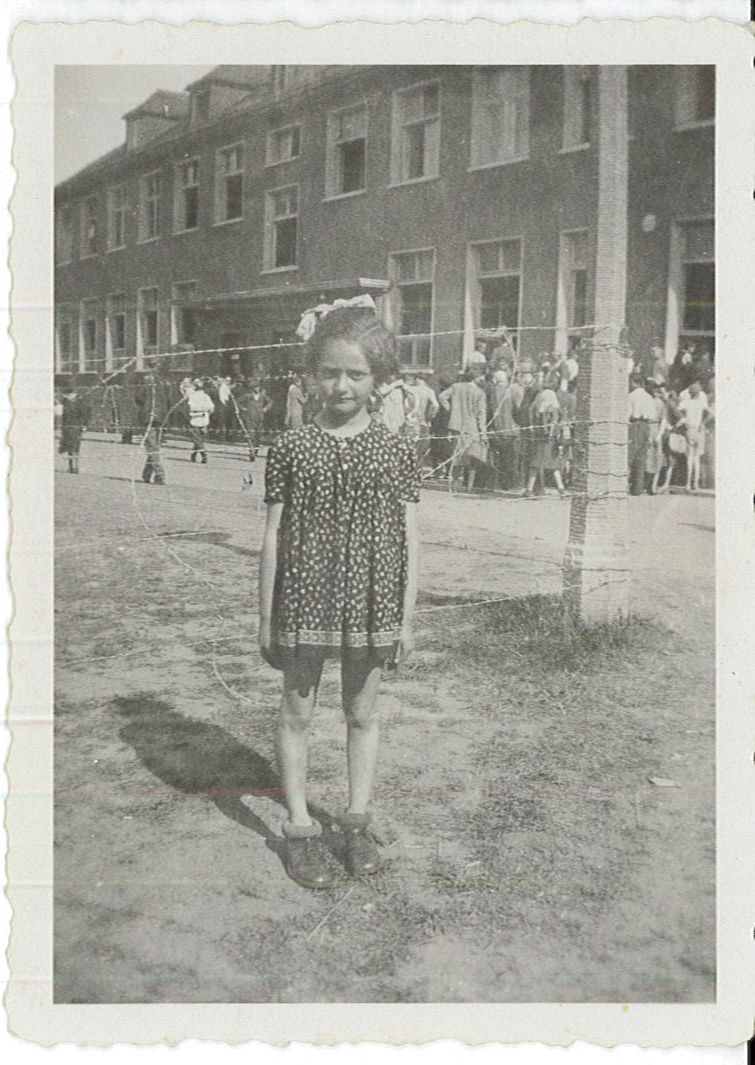
FINAL NOTE. We are also looking for this little girl, a survivor at Hillersleben. Her name was Irene. You can read the backstory here. Please contact me below.

'Hillersleben-Irene is in the flowered dress' Soldier Luca Furnari photograph.

‘Hillersleben-Irene is in the flowered dress’ Soldier Luca Furnari photograph.


*************************************************************

Matthew Rozell is a United States Holocaust Memorial Museum Teacher Fellow and teaches history at his alma mater in upstate New York. This year, he is authoring a series of posts under the heading of ‘Seventy Years’, marking the 70th anniversary of the close of World War II and of the ‘liberation phase’  of the Holocaust. His work has reunited 275 Holocaust survivors with the American soldiers who freed them.

His first book, a narrative of World War II in the Pacific as told through the previously unpublished recollections of two dozen veterans, is due out this spring. His second book, in progress, is on the power of  teaching, remembering the Holocaust, and this “Train Near Magdeburg’. He can be reached at marozell at gmail dot com.

Read Full Post »

« Newer Posts - Older Posts »