Feeds:
Posts
Comments

Posts Tagged ‘Holocaust’

A year ago I took one of the most transformative journeys of my life, with 24 fellow educators, to study the Holocaust and the Jewish resistance to it, in Washington, DC, Germany, the Czech Republic, and Poland. I kept an extensive diary and took tons of photographs. And contrary to many assumptions, it was a journey that led to profound understandings about life, not death.  For the next several days, I have decided to go back and retrace my steps and try to process what unfolded for me. Not weighty tomes, but maybe a picture and a note from the diary.

************

We followed our visit to Ravensbruck with a visit to Sachsenhausen, though Sachsenhausen was known earlier by the name of the nearby town as Oranienburg,  the model SS camp built between 1936 and 1938, an SS military training facility. Here also was the headquarters for the Inspectorate of Concentration Camps, the closest to the center of power, about 40 km outside Berlin.

Classroom at Sachenhausen.

Classroom at Sachsenhausen.


Our historian/guide at Sachsenhausen, Martin S.

Our historian/guide at Sachsenhausen, Martin S.

We have another passionate young German historian-Martin S. In March 1933, Oranienburg became one of the first KZ-Konzentrationslager, or concentration camp. Due to its proximity to the capital of the Reich, local political opponents were held here. As a simple matter of natural progression, the Gestapo would also shoot political prisoners here in the “shooting pit.”

The shooting pit at Sachsenhausen.

The shooting pit at Sachsenhausen.

After the invasion of the USSR, Sachsenhausen was used to murder Soviet POWs as well. In the infamous”neck shot facility”, over 10,000 were murdered in ten weeks in 1941.

Shooting barracks at Sachsenhausen, for Soviet POWs.

Shooting barracks at Sachsenhausen, for Soviet POWs.


Here, crematoria were developed, and vast shipments of stolen property from the East were later unloaded and warehoused. A brick factory was opened, making bricks for “GERMANIA” to be used in the new Reich construction in Berlin. Life expectancy there was six to eight weeks.

Here, also, scientists and engineers tested gassing vans and facilities. Doctors experimented on live subjects. Always testing. And as we know, major corporations had their hands in it as well, profiting from the slave labor that left the camp each day and were paraded through the surrounding community.

After 1936, authorities toned down the visibility/profile of the camp, due to the sinister application of state policy. But again, nearly 200,000 persons passed through the camp gates. Is it hiding in plain sight?

431

Or do we, as neighbors, simply turn away?

And, nearly eighty years on, why do American educators spend a good chunk of their “vacation” absorbing such new knowledge?

The persons on this trip know why.


Read Full Post »

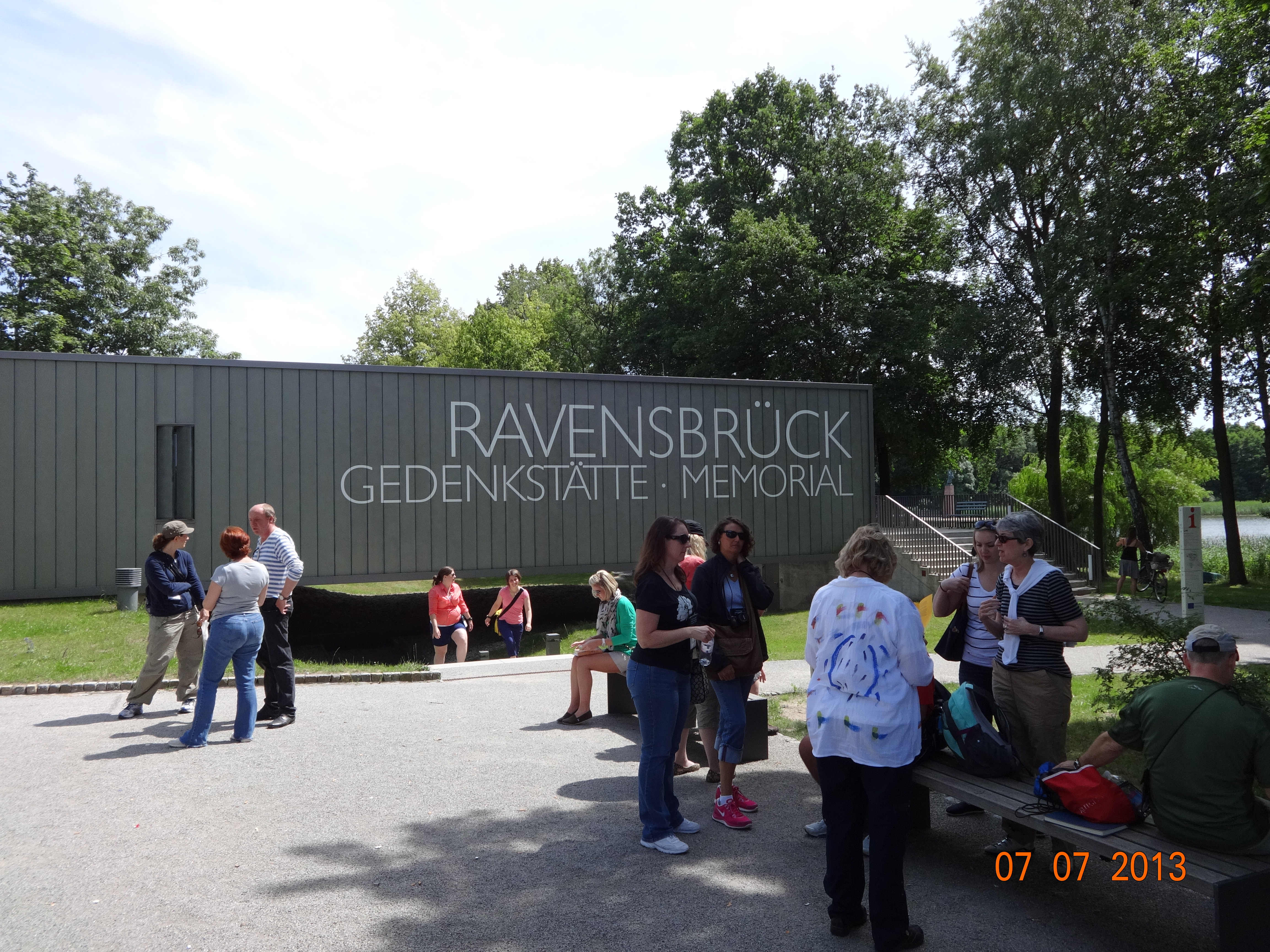
Ravensbruck.

Ravensbruck.

A year ago I took one of the most transformative journeys of my life, with 24 fellow educators, to study the Holocaust and the Jewish resistance to it, in Washington, DC, Germany, the Czech Republic, and Poland. I kept an extensive diary and took tons of photographs. And contrary to many assumptions, it was a journey that led to profound understandings about life, not death.  For the next several days, I have decided to go back and retrace my steps and try to process what unfolded for me. Not weighty tomes, but maybe a picture and a note from the diary.

****************************************

We have visited a lot of sites in Germany since Bergen Belsen-in Berlin, the Wannsee Villa, where preliminary plans for the “Final Solution ” were signed off on after a one day conference, the Memorial to the Murdered Jews of Europe in the heart of the city, the Reichsbahn train platform, Track 17, where the Jews of Berlin were deported almost everyday for nearly two and a half years. We also visited Ravensbruck and Sachenhausen.

Ravensbruck.

Ravensbruck.

Ravensbruck is a couple of hours north of Berlin, in the former East Germany. It is notable for many reasons, probably first that it was a camp for women, and also a training faculty for SS camp guards-3500 women guards were trained here, and about 500 were in service. 130,000 women prisoners passed through here, and towards the end of the war, another 20,000 men.  No barracks are standing today, the houses for the SS leadership remain just outside the camp wall, where they lived with their families. Each day the camp gates would open and thousands of prisoners would stream out into the community for their slave labor assignments. Kind of hard to hide it from the kids. I suppose the attitude was that it was difficult, distasteful work, but the kids had to realized that it had to be done for the wonderful world that they were creating for the children’s future.

Immediately after the war the barracks were dismantled and given to refugees who had fled the Eastern

Matthias H our guide. Photo by Alan Bush.

Matthias H our guide. Photo by Alan Bush.

Reich as it collapsed. Some are still used as houses today. The SS women guard barracks is used as a youth hostel education center today. They have a program where survivors interact with the kids for about 4 days, and sleep here at night. Our guide is the historian Matthias H. at the Gedenkstatte (Memorial). He appears to be in his early 40s and is passionate and knowledgeable, as are all of the German historians I have met thus far. Here are some of his observations that strike me the most:

In his opinion, the majority of Germans supported the master race theory. What disturbs him today is that in his opinion, few Germans today seem conscious of this. It is a very complex topic. The historians talk about the mass crimes, and in Matthias’ words, they work on thin ice. The responses range from some people wanted to know more- after all, many of them learned nothing about it from their teachers, many of whom were bystanders or even perpetrators. Some quietly deny the extent-but I have found that as you study it, you learn how vast and almost unbelievable it is in scope. Others, are tired of the topic- “yes, it happened, so what, enough…”

For Matthias, herein lies the greatest danger. It is important to have the past in front of you- NOT in the back of one’s mind, as one moves forward. The lesson may be simply how to “behave” , not just for Germans but for everyone.

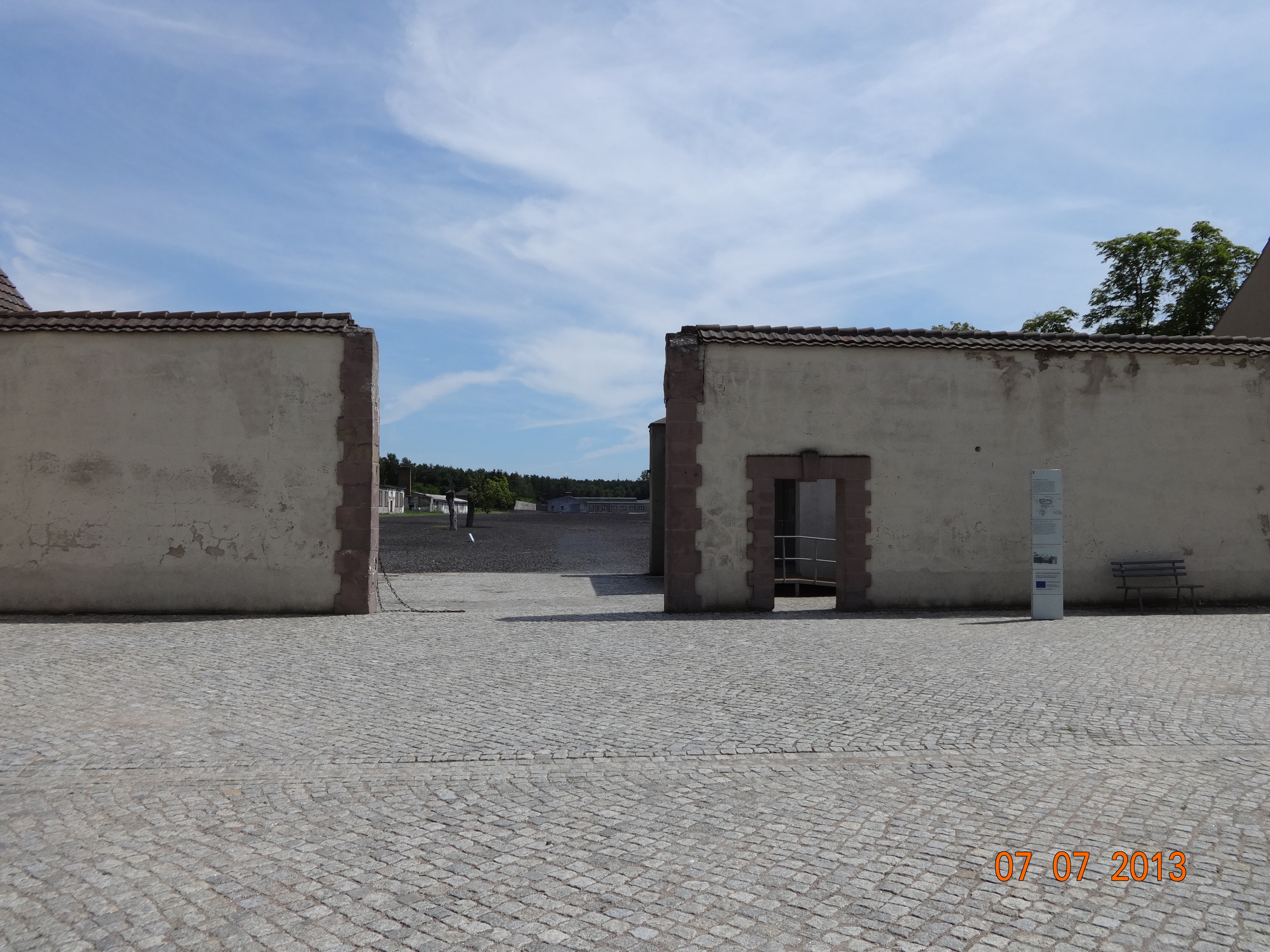
Ravensbruck. Prisoners' gate on left, SS on right.

Ravensbruck. Prisoners’ gate on left, SS on right.

He walks us through the main camp entrance, where thousands of prisoners would pass everyday, explaining that for years he would avoid the single door entrance that the SS guards used-until one day a survivor he was leading on a tour walked through it, to symbolize her victory at this place.

He notes a few additional stories. Survivors corroborate that when new SS female guard recruits would come for training, initially they do not know how to deal with the new job. Industries wanting slave labor must send their own guard recruits, too.  They are not kind, but they do not seem possessed with the will to carry out this abhorrent work. Former prisoners would say that always within about two weeks new staff would have overcome the “cognitive dissonance” that would allow them to do their job without compassion. They become “hardened” and “get over it”.

Book of Names. Faces.

Book of Names. Faces.

Ravensbruck was built for 3000 prisoners. At its height it held 35,000. 30,000 were killed here. In the beginning the SS does  NOT want women with children in the camp. But as more and more territory is overrun, the camp swells. After the Warsaw Ghetto uprising in 1943, there are hundreds of pregnant women. Some are forced to abort; as numbers well, women give birth and the babies are taken to a “hospital” where they slowly starve to death. The crematorium works nonstop. Ash piles are created and dumped into the nearby lake as the Russians close in. When the camp is overrun by the Red Army, 2000 women and 2000 men, mostly too infirm to be death marched out of the camp, are found, but not before the Germans had installed a small operating gas chamber, where 5000 Hungarian women were murdered in 1944.

I think that the following story resonated the most with me as an educator of young people.

The butcher’s son delivered fresh cuts of meat nearly daily to the SS mess hall, which still stands. Late in life, the old man tells Matthias of his feeling as a young teen-going through the camp gates to deliver the meat, seeing the emaciated and foul smelling prisoners, and believing fully all he has been taught- that these people are indeed subhuman, vermin to be eliminated. It’s true. Just look at them. Just smell them. Disgusting. Everyday it is the same. They even march through the town to the labor sites. Best to keep a distance from them.

It’s the same until one cold morning when a new transport of women arrive-stripped naked, healthy, humiliated, shivering, crying, shocked, trying to cover themselves in the plaza. Now it is his turn for a shock. These are not subhuman, but girls his age and older, in distress.

And they are naked. He has probably never even seen his mother or sister undressed before. And it is at this moment that he realizes that his teachers and the adults in his life are wrong- that what he is witnessing is a crime. And now perhaps sixty years later he unburdens himself.

Finally, a survivor, Annika, recounts that the Scandinavian Red Cross appeared in the weeks before liberation and in the presence of these new people, the women stroke their hair (as it is growing in again after being shorn off) trying to make themselves presentable. As she is evacuated over the Danish border, something strange happens. People are crying at her miserable condition. At every stop, they crowd around tearfully, and want to help… What is this? Traveling through the towns in Germany, she recounts, no one cried. No one helped. To date, says Matthias, no former German perpetrator has shown remorse for his/her wartime behavior.

The bystanders probably included most of the victims’ neighbors and acquaintances, and certainly most of the townspeople where the crimes were perpetrated,  of thinking age.

Prisoners on a death march from Dachau move towards the south along the Noerdliche Muenchner street in Gruenwald. German civilians secretly photographed several death marches from the Dachau concentration camp as the prisoners moved slowly through the Bavarian towns of Gruenwald, Wolfratshausen, and Herbertshausen. Few civilians gave aid to the prisoners on the death marches. Germany, April 29, 1945.  — KZ Gedenkstaette Dachau. USHMM

Prisoners on a death march from Dachau move towards the south along the Noerdliche Muenchner street in Gruenwald. German civilians secretly photographed several death marches from the Dachau concentration camp as the prisoners moved slowly through the Bavarian towns of Gruenwald, Wolfratshausen, and Herbertshausen. Few civilians gave aid to the prisoners on the death marches. Germany, April 29, 1945. — KZ Gedenkstaette Dachau. USHMM

But they all knew.

That for me is one of the axioms that will come out on this trip. But, suspending judgment- we were not there ourselves and placed in that position-we have a lot to think about.

But we must think about this too-Hitler never murdered anyone by himself.

The lake at Ravensbruck, where ashes were dumped.

The lake at Ravensbruck, where ashes were dumped.

Read Full Post »

A year ago I took one of the most transformative journeys of my life, with 24 fellow educators, to study the Holocaust and the Jewish resistance to it, in Washington, DC, Germany, the Czech Republic, and Poland. I kept an extensive diary and took tons of photographs. And contrary to many assumptions, it was a journey that led to profound understandings about life, not death.  For the next several days, I have decided to go back and retrace my steps and try to process what unfolded for me. Not weighty tomes, but maybe a picture and a note from the diary.

*********************************************************************

Track 17. All aboard. Now.

Track 17. All aboard. Now.

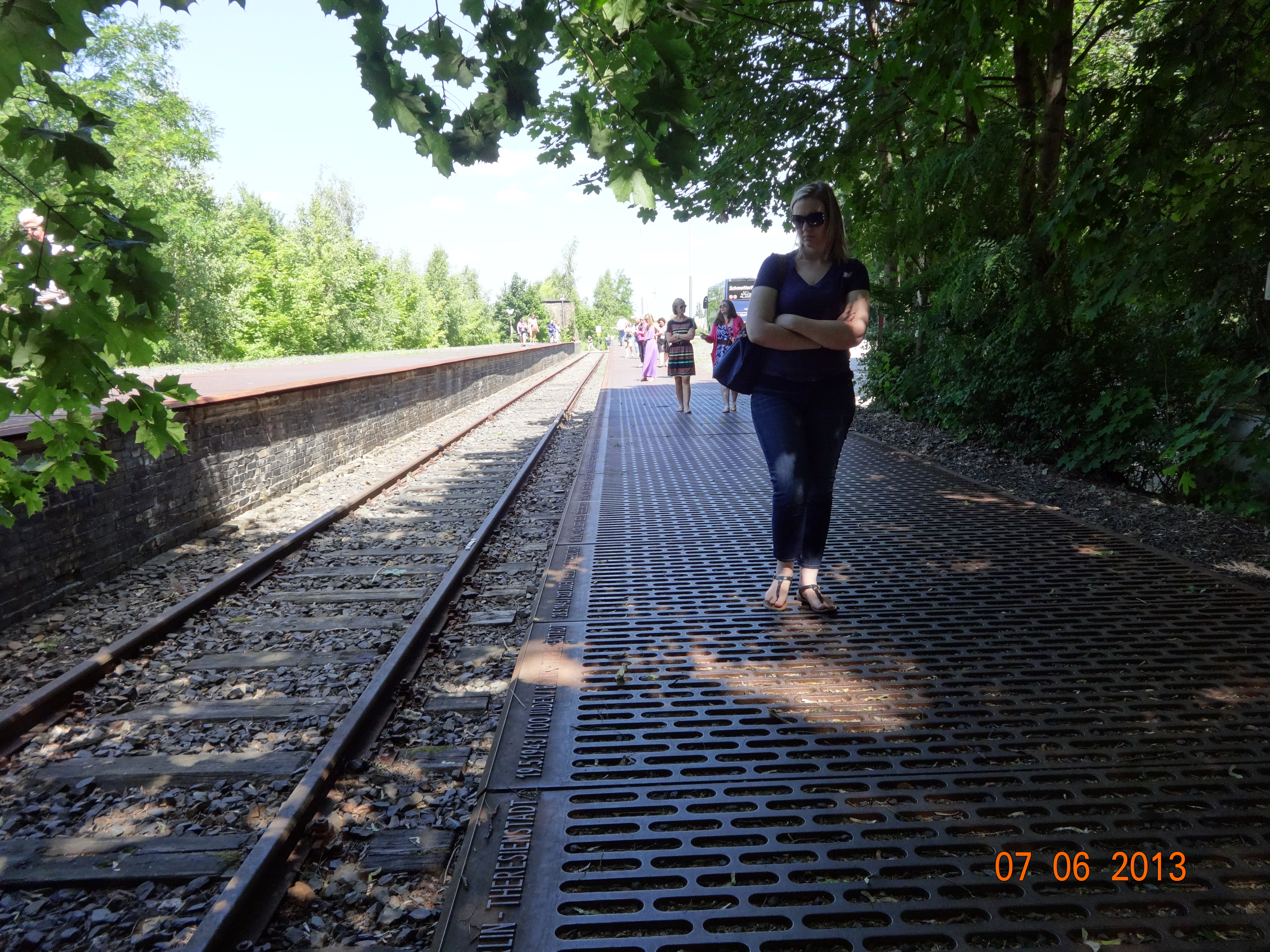
Our state of the art bus brings us to a place seemingly on the edge of nowhere in Berlin. There is no train station that we can see. Just tracks that end abruptly and loading platforms, one spur of rails below, but no train.

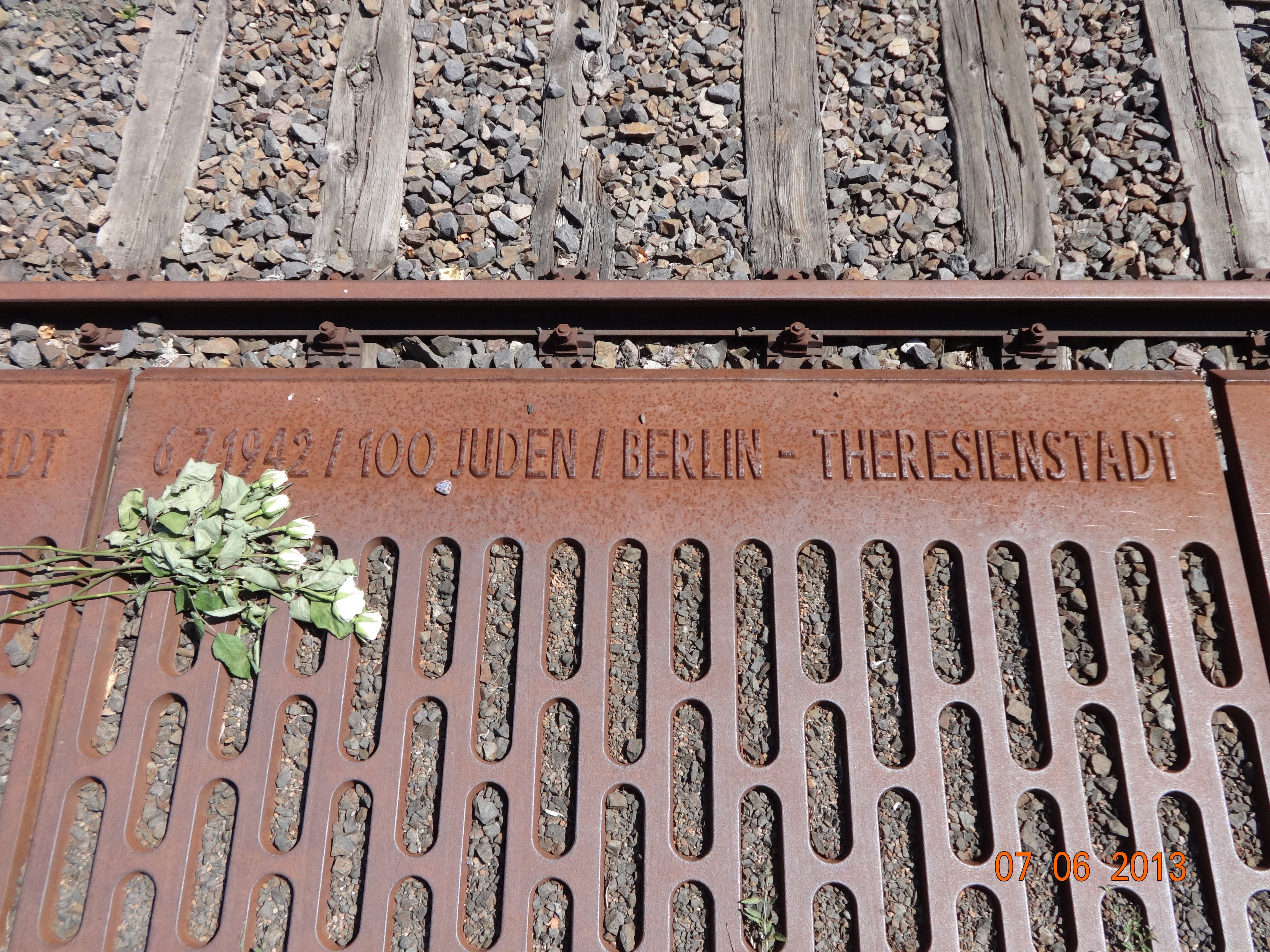
The you notice the stepping grates.

You look down:

Oct. 18, 1941. 1251 Jews. Destination: Lodz Ghetto.

Oct. 18, 1941. 1251 Jews. Destination: Lodz Ghetto.

What does this mean? On that day, the first of the mass deportations from Berlin, 1251 people were rounded up and sent to board the trains of the Reichsbahn. “The police and SS had assembled the people for this transport in a collection camp for Jews, which was located in the synagogue in Levetzowstraße in Berlin’s Moabit district. They then chased most of the men, women and children to Grunewald by foot. Until March 1945, about 180 further transports from Berlin to the ghettos followed; from August 1942, transports were also directly headed for extermination camps.” (Source: Gleis 17 Memorial – Berlin Grunewald)

282


“At first, the special trains consisted of passenger cars, yet from 1942 on, the Reichsbahn increasingly began using cattle cars for the deportations.”


Now, tell me, who is going to pay for all of this? After all, there is a war on. Well, who do you think?

“The conveyance of the Jews was billed to the Jewish community: 4 pfennigs were charged per kilometer for adults and 2 pfennigs for children above the age of four.”  The Jewish community of Berlin is essentially forced to buy tickets to its annihilation.

March 27th, 1945. The last transport out of Berlin. Theresienstadt is the only destination. Note that for later.

March 27th, 1945. The last transport out of Berlin. Theresienstadt is the only destination. Note that for later.

As we prepare to board the bus to our final stop for today, July 6, I pause by myself. It is a beautiful  summer day. A breeze ripples gently, the trees reclaiming the site shimmer and whisper.  And then the whistle blows. Nearby, an unseen train is passing, the click on the tracks steadily growing louder, then trailing off slowly in the wind.

283

No, you cannot be forgotten.

*********************************************************************

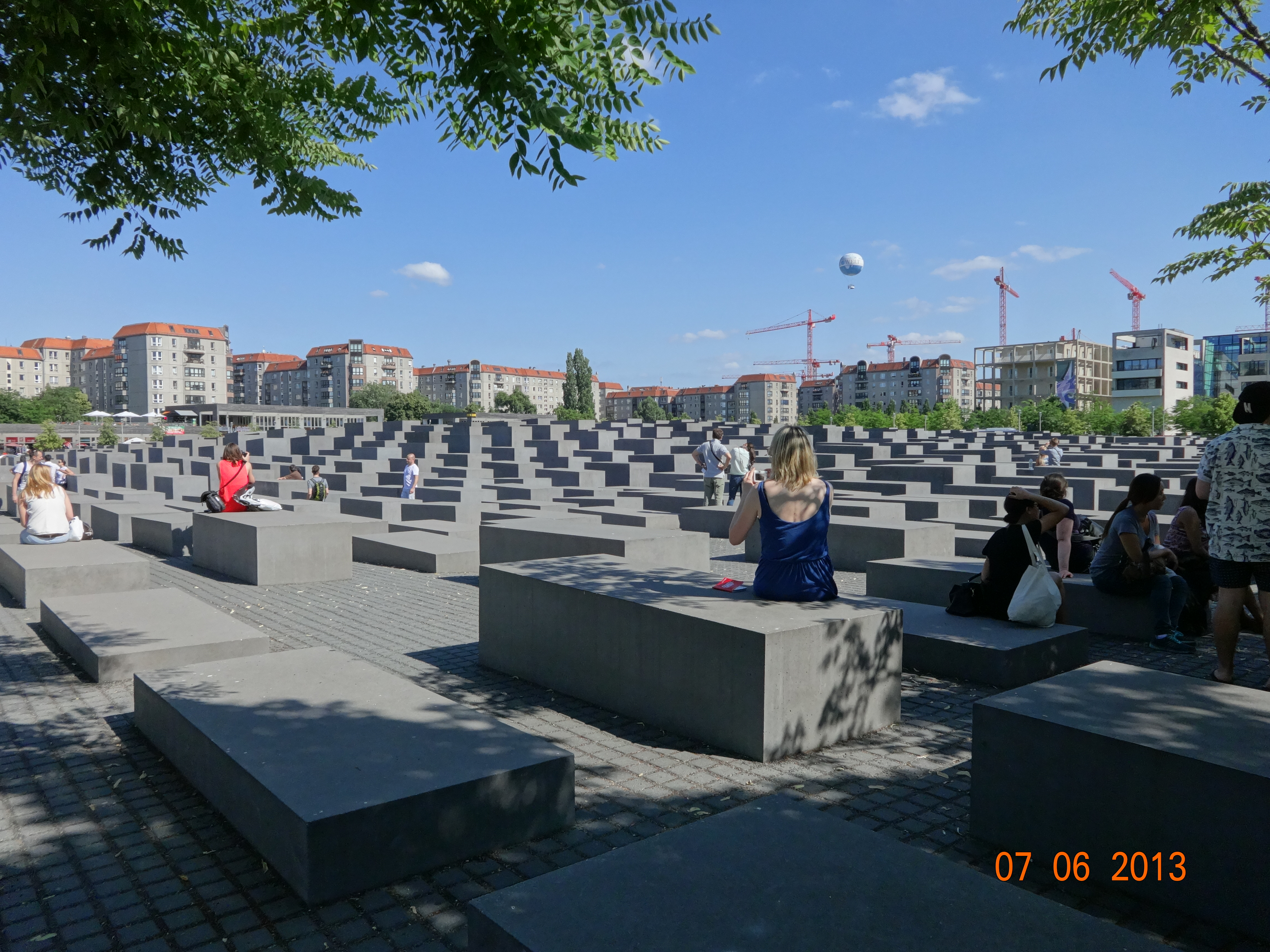
Memorial to the Murdered Jews of Europe.

Memorial to the Murdered Jews of Europe. Heart of Berlin.


Memorial to the Murdered Jews of Europe. Heart of Berlin.

Memorial to the Murdered Jews of Europe. Heart of Berlin.

Memorial to the Murdered Jews of Europe.

Memorial to the Murdered Jews of Europe.


It is not a maze, but you feel you are lost. The walking surface is uneven. Which way do you turn? Where are you going? Now go below, into the subground museum/memorial.

Letting the images tell the story now.

Deportation. Memorial to the Murdered Jews of Europe.

Deportation. Memorial to the Murdered Jews of Europe.


And just where do these photographs come from?


351 352


Deportation. Memorial to the Murdered Jews of Europe.

Deportation. Memorial to the Murdered Jews of Europe.

361


Read Full Post »

A year ago I took one of the most transformative journeys of my life, with 24 fellow educators, to study the Holocaust and the Jewish resistance to it, in Washington, DC, Germany, the Czech Republic, and Poland. I kept an extensive diary and took tons of photographs. And contrary to many assumptions, it was a journey that led to profound understandings about life, not death.  For the next several days, I have decided to go back and retrace my steps and try to process what unfolded for me. Not weighty tomes, but maybe a picture and a note from the diary.

**********************************************************************

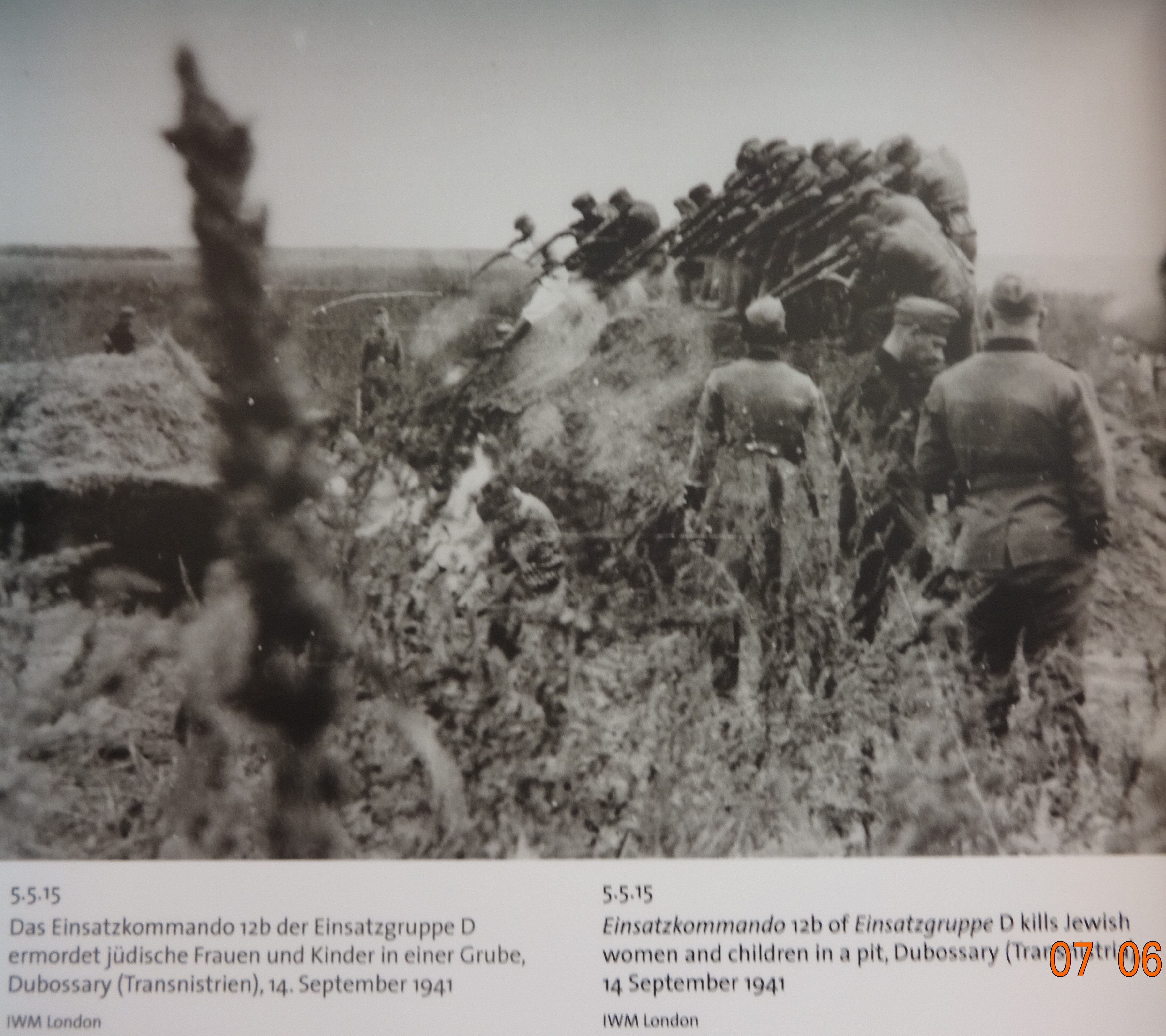
“Einsatzkommando 12b of  Einsatzgruppe D kills Jewish women and children in a pit, Dubossary,  Moldova/Transnistria, 14 Sept. 1941.” Imperial War Museum.

“Einsatzkommando 12b of Einsatzgruppe D kills Jewish women and children in a pit, Dubossary, Moldova/Transnistria, 14 Sept. 1941.” Imperial War Museum.

A photograph for you to see. I tend to stay away from displaying more graphic images on this blog, but a year ago on this day I was confronted with it, and many others, at the Wannsee Villa outside of Berlin, where the intentionality of the planning of the Holocaust hits you square in the face, as the photograph on the wall above does.

And it is worth noting the date. Eleven weeks after the start of Operation Barbarossa. You see, now that the Soviet Union has been invaded, there are millions more Jews in the path of the genocidal war machine. The Holocaust here was carried out by soldiers with bullets. Entire villages and districts. Over 1.5 million victims. The dirty work gets done, but given the headaches and the bottlenecks, “there has to be a better way”.

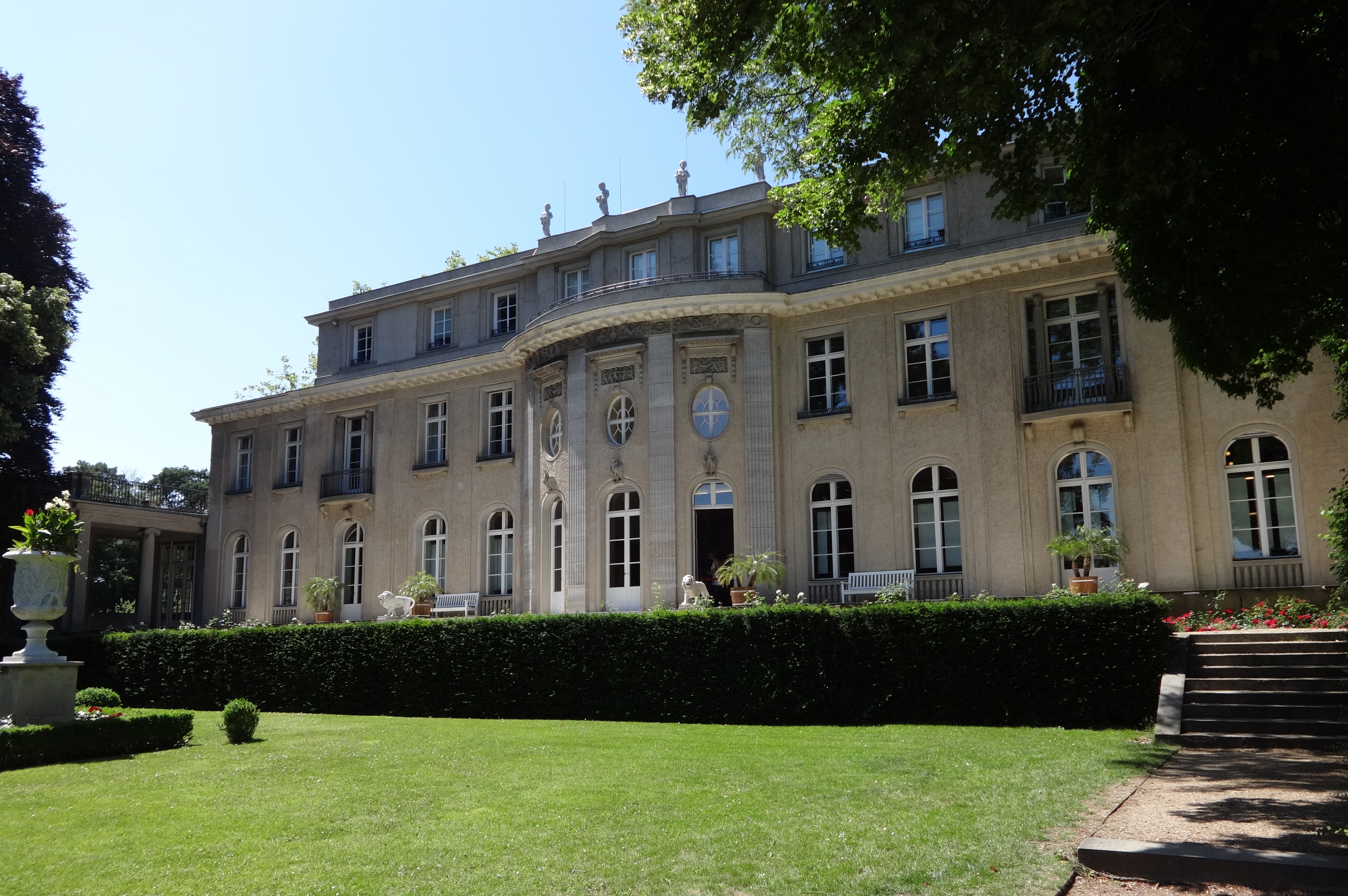
Wannsee Villa, July 6, 2013.

Wannsee Villa, July 6, 2013.

Which brings us to this lovely site. At the Villa outside of Berlin, on 20 January 1942, 15 German military and government heads meet for a day to discuss the Jewish problem in euphemisms. As scholars have noted, the Wannsee Conference was not called to decide the fate of European Jews, but to clarify all points regarding their demise.

From the USHMM: “The “Final Solution” was the code name for the systematic, deliberate, physical annihilation of the European Jews. At some still undetermined time in 1941, Hitler authorized this European-wide scheme for mass murder.”


The display where the "table" around which discussions were held at the villa.

The display where the “table” around which discussions were held at the villa.

“At the time of the Wannsee Conference, most participants were already aware that the National Socialist regime had engaged in mass murder of Jews and other civilians in the German-occupied areas of the Soviet Union and in Serbia. Some had learned of the actions of the Einsatzgruppen and other police and military units, which were already slaughtering tens of thousands of Jews in the German-occupied Soviet Union. Others were aware that units of the German Army and the SS and police were killing Jews in Serbia. None of the officials present at the meeting objected to the Final Solution policy that SS General Reinhard Heydrich announced.”

A number's man, Heydrich was.

A number’s man, Heydrich was.

“Heydrich indicated that approximately 11,000,000 Jews in Europe would fall under the provisions of the “Final Solution.” In this figure, he included not only Jews residing in Axis-controlled Europe, but also the Jewish populations of the United Kingdom, and the neutral nations (Switzerland, Ireland, Sweden, Spain, Portugal, and European Turkey).

Heydrich announced that “during the course of the Final Solution, the Jews will be deployed under appropriate supervision at a suitable form of labor deployment in the East. In large labor columns, separated by gender, able-bodied Jews will be brought to those regions to build roads, whereby a large number will doubtlessly be lost through natural reduction. Any final remnant that survives will doubtless consist of the elements most capable of resistance. They must be dealt with appropriately, since, representing the fruit of natural selection, they are to be regarded as the core of a new Jewish revival.” (my emphasis)

Nice place to plan and coordinate mass murder of millions.

Nice place to plan and coordinate mass murder of millions.

For a good short essay on the conference, click here. For the actual meeting minutes, click here.

Now we are off to Track 17 in Berlin, to be followed by a visit to the Memorial to the Murdered Jews of Europe.

Read Full Post »

A year ago I took one of the most transformative journeys of my life, with 24 fellow educators, to study the Holocaust and the Jewish resistance to it, in Washington, DC, Germany, the Czech Republic, and Poland. I kept an extensive diary and took tons of photographs. For the next several days, I have decided to go back and retrace my steps and try to process what unfolded for me. Not weighty tomes, but maybe a picture and a note from the diary.

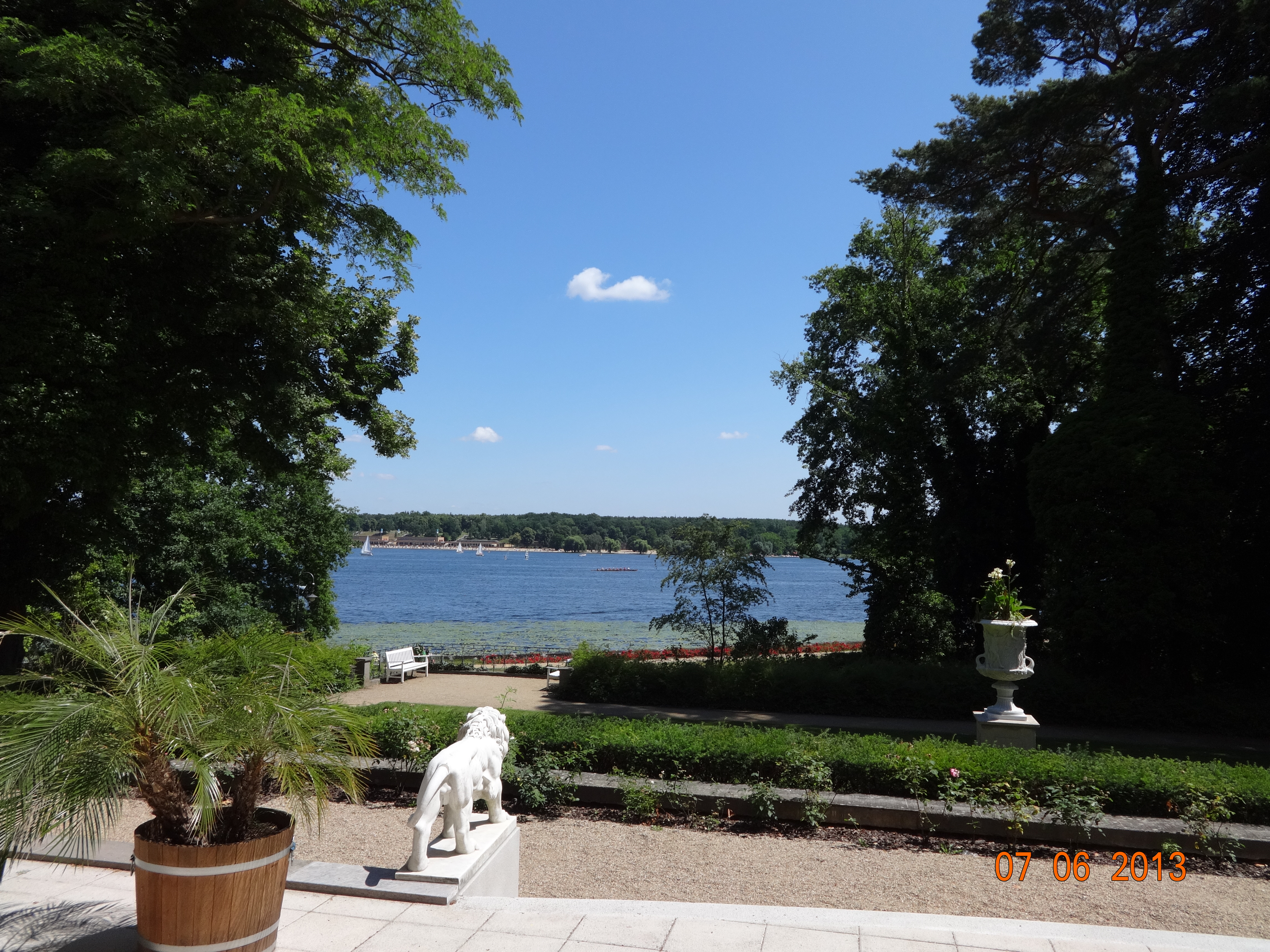
Berlin. We arrived here late in the evening on the 5th from Hannover by rail, and set up headquarters in the Marriott Berlin, which is very nice, for a few days. On the 6th we ventured out by our tour bus to several places of note. Below I will show you the photos I took, and the World War II era context, and help you connect the dots.

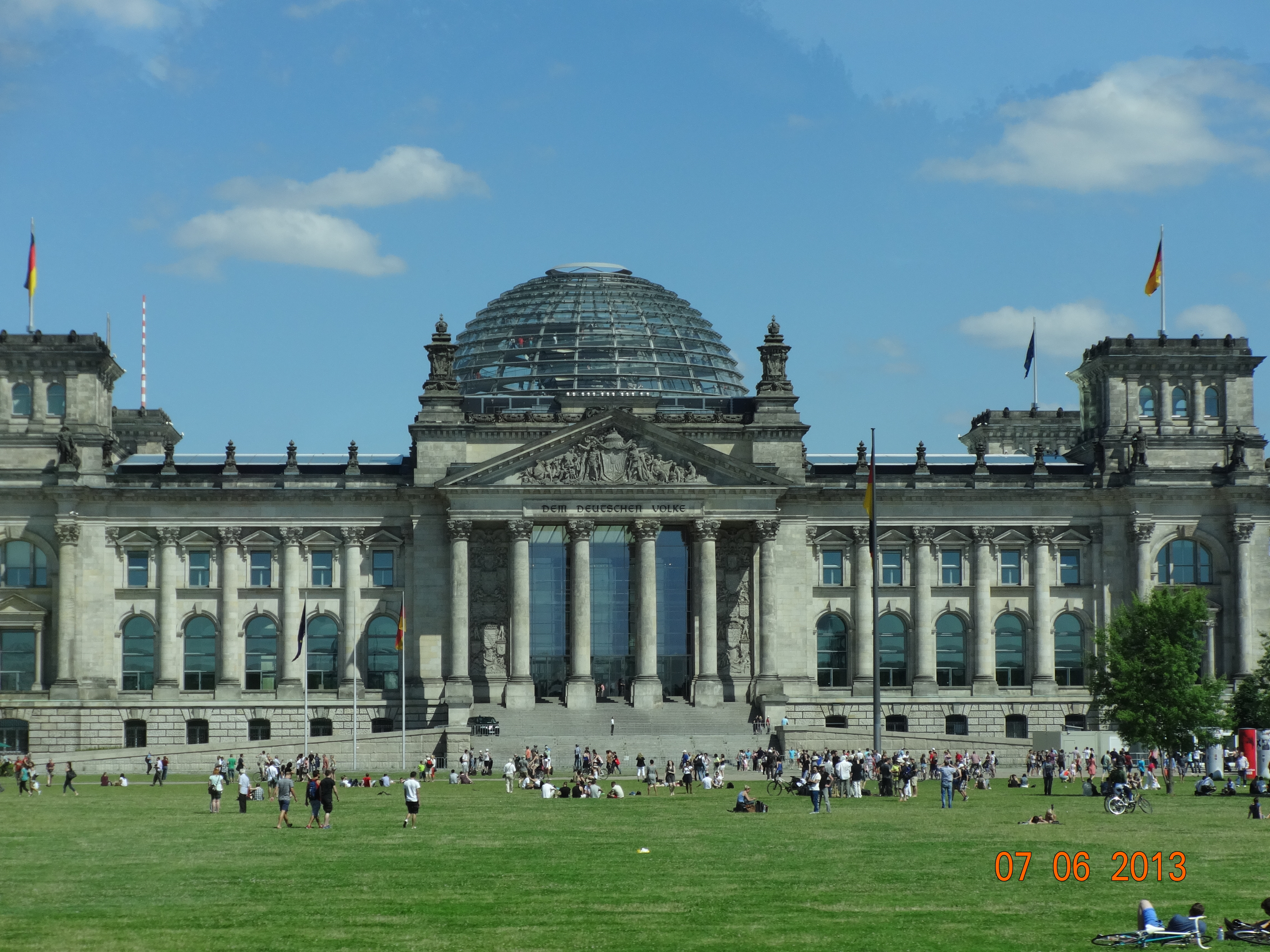
The Reichstag.

The Reichstag.

The Reichstag with its transparent dome, so citizens today can literally look down and see what their legislators are up to. Hmmmm.

The Reichstag in 1945.

The Reichstag in 1945.

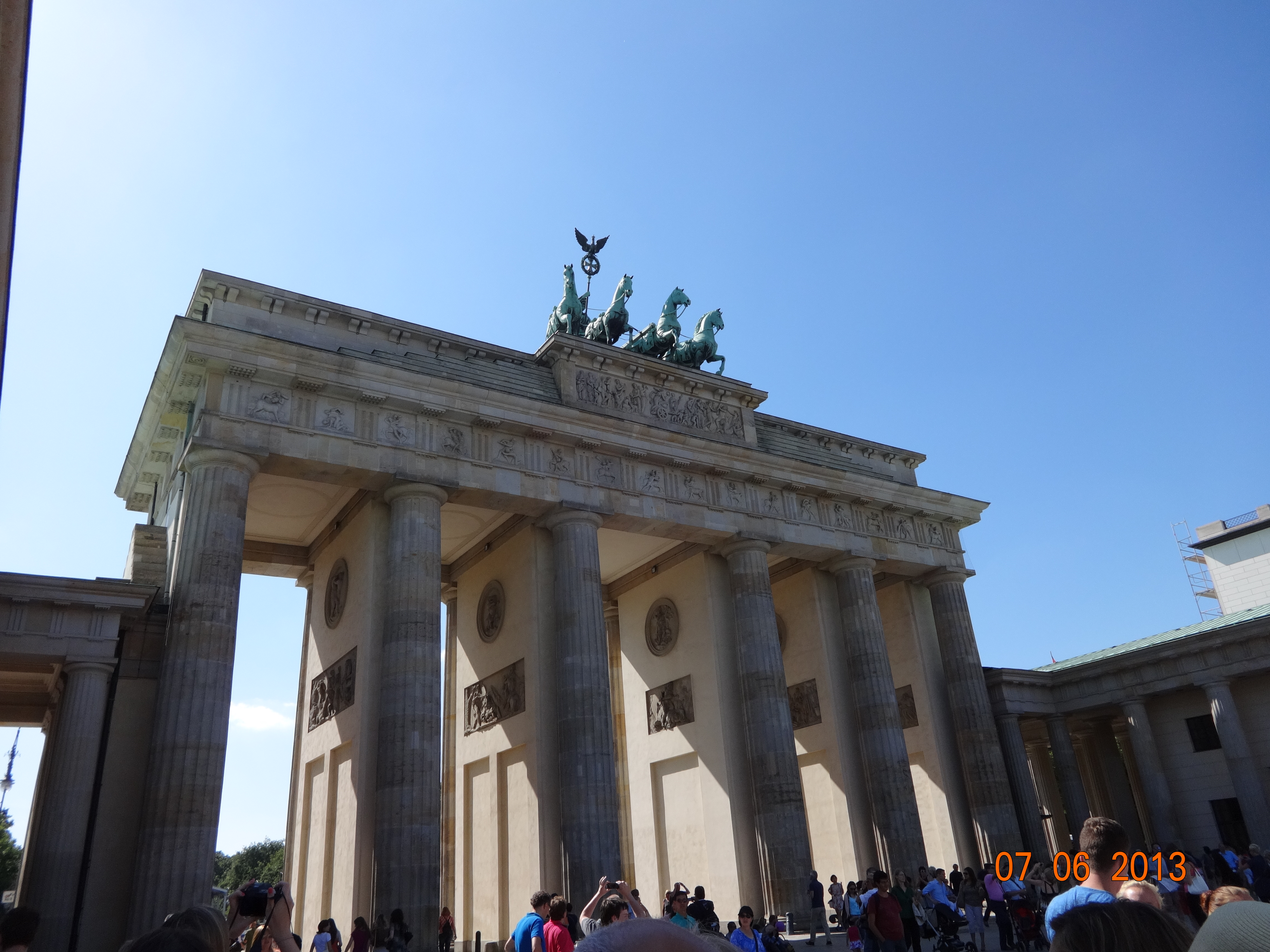
Brandenburg Gate.

Brandenburg Gate. Tourists.

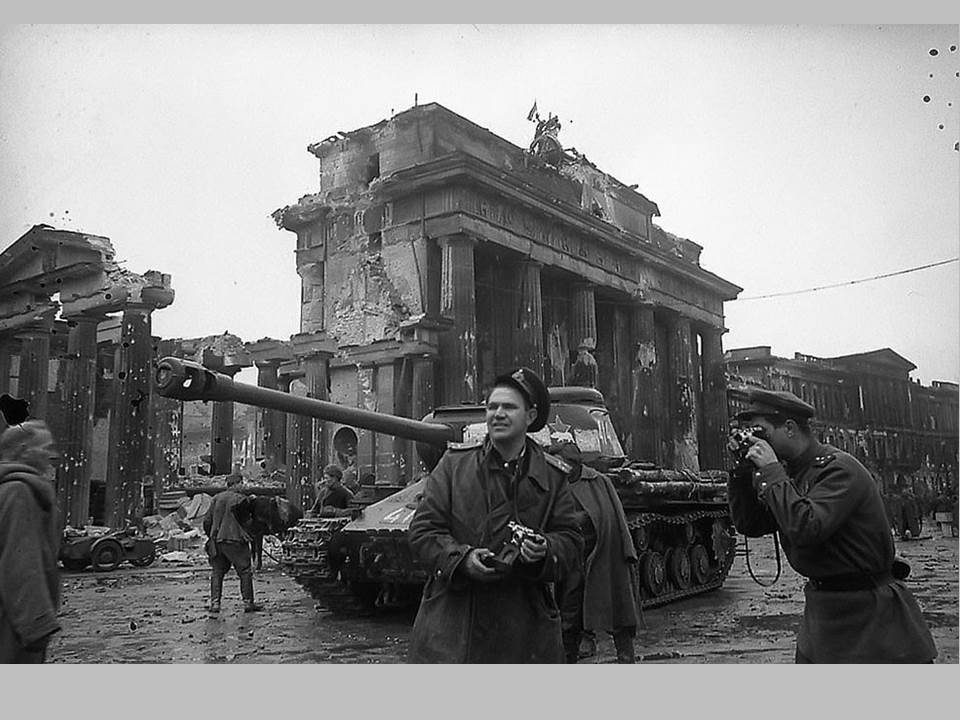
Brandenburg Gate, 1945. Tourists. Of the Soviet persuasion.

Brandenburg Gate, 1945. Tourists. Of the Soviet persuasion.

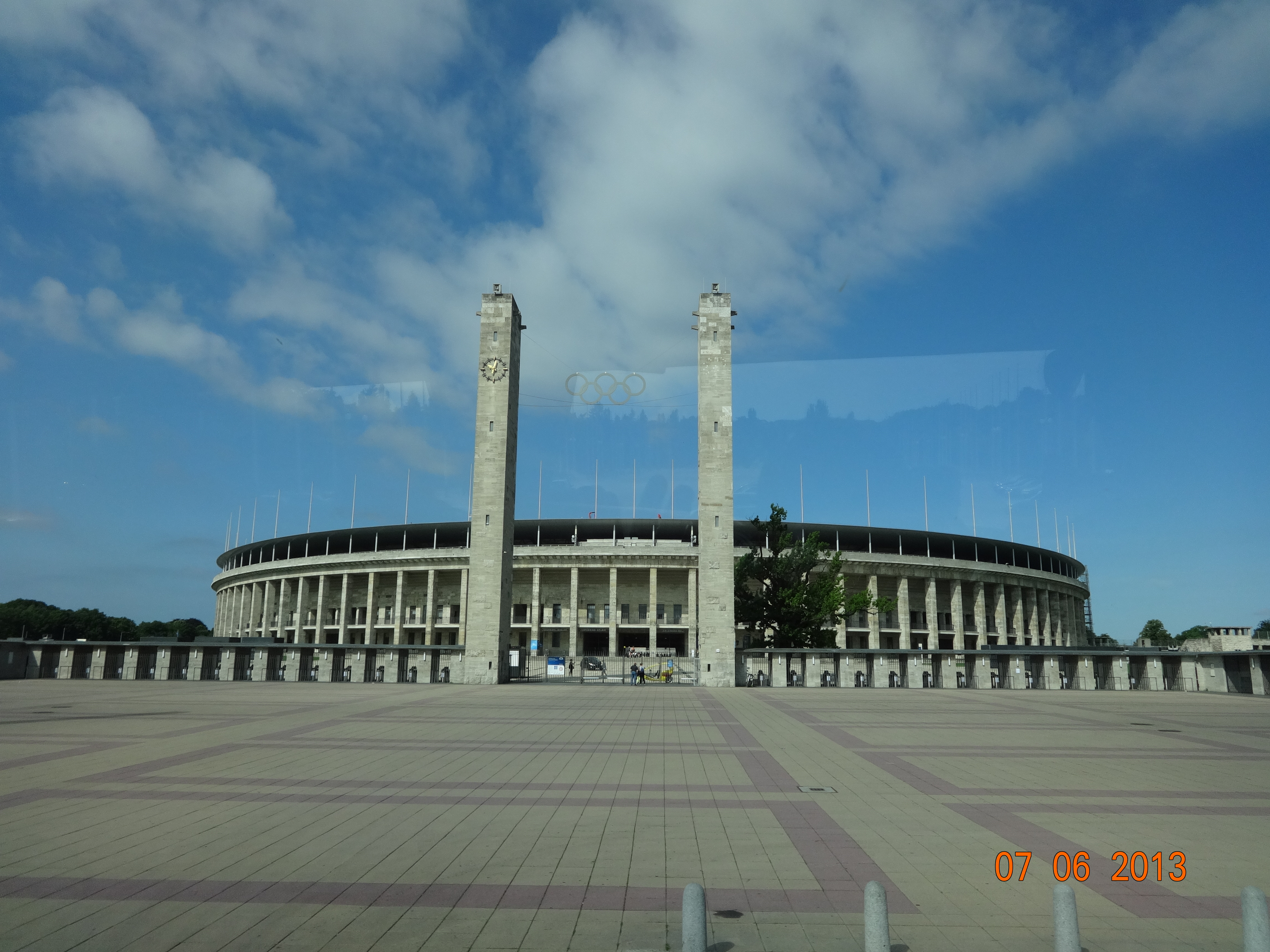
162Above is the stadium built for the 1936 Berlin Summer Olympics. Still in use today.

stadium 1936Inside during the Games in 1936. Kinda makes you think a lot about how Hitler and the Nazi party came to power. Don’t forget, no one is forcing these good citizens to make the salute. Exhibit A: The power of nationalism, and charisma.

Olympic Stadium from the tower.

Olympic Stadium from the tower.

i know that guy...

I know that guy…and so much for painting with too broad a brush.

181

reviewing stands outside the stadium proper.

reviewing stands outside the stadium proper.


Read Full Post »

A year ago I took one of the most transformative journeys of my life, with 24 fellow educators, to study the Holocaust and the Jewish resistance to it, in Washington, DC, Germany, the Czech Republic, and Poland. I kept an extensive diary and took tons of photographs.  For the next several days, I have decided to go back and retrace my steps and try to process what unfolded for me. Not weighty tomes, but maybe a picture and a note from the diary.

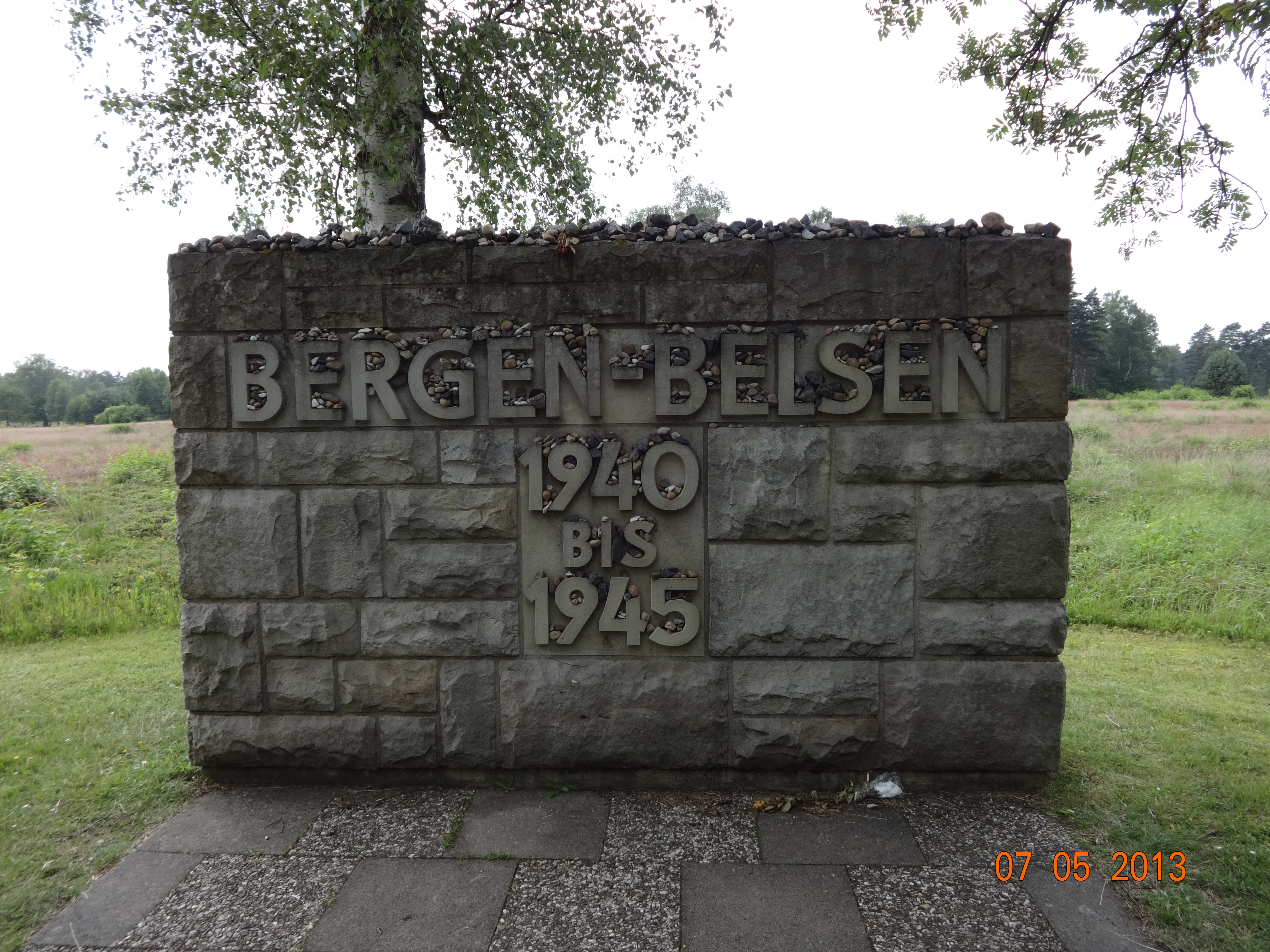
Bergen Belsen on July 5, 2013.

Bergen Belsen on July 5, 2013.

“Belsen! I think they had been in Belsen.”

On July 5, 2013, we are on our way from the hotel in nearly Celle to this destination. Our first concentration camp of the tour.

Trying to remember the name of the concentration camp, the elderly gentleman exclaimed these words as he animated his story from the rocking chair across from me. I was in his daughter’s house on a brilliant July day, twelve summers before. It seems like a lifetime ago. But if I had not taken the time to go there and sit down with him, you would not be reading any of this.

People, mostly news media, get the story wrong all the time.  I had not invited the veteran to class because I had had his grandson. It was a series of coincidences that changed so many lives, but then again, I am sure there are no coincidences.

Is it a coincidence that I am making my first trip to Belsen on the day that he is being laid to rest in his hometown back in New York state? Or that by 8pm I will be traveling on the same spur of tracks toward Magdeburg, on which the Sherman light tank he was commanding sixty-eight springs ago came to the train with 2500 Jewish victims of the Holocaust onboard?

I was picking my young children up from daycare. I knew Tim, the other father there at the same time, picking up his young son. I had his older son in class at the time. Tim knew I liked to talk to World War II veterans, and he invited me to come over and speak to his father in law, a retired NYS Supreme Court justice, who was coming up to stay for the summer. So I took him up on it. What a great man, funny too. We conversed on tape for nearly two hours, and I was about to turn the camera off, and his daughter, Tim’s wife Elizabeth, spoke up:

Daughter: Did you mention the train at all? That was kind of interesting.
CW: No, I didn’t tell him about the train.
MR: What was that?
CW: Well, late in the war, again a nice, beautiful April day… we were shooting like crazy across the top of Germany and Major Benjamin of the 743rd was kind of out ahead scouting a little bit… he came back to the battalion and he pulled my tank and George Gross’s tank [fellow tank commander] out. He told us to go with him. So we did.
We came to a place where there was a long train of boxcars. … I can remember pulling up alongside the train of boxcars, Gross and I, and Major Benjamin. As it turned out, it was a train full of concentration camp victims, prisoners, who were being transported from one of their camps…Belsen!  I think they had been in Belsen, on their way to another camp…
So there they were. All of these people, men, women, children, jam-packed in those boxcars, I couldn’t believe my eyes. And there they were! So, now they knew they were free, they were liberated. That was a nice, nice thing. I was there for a while that afternoon. You know, you got to feed these people. Give them water. They are in bad shape. Major Benjamin took some pictures, and George Gross took some pictures too…

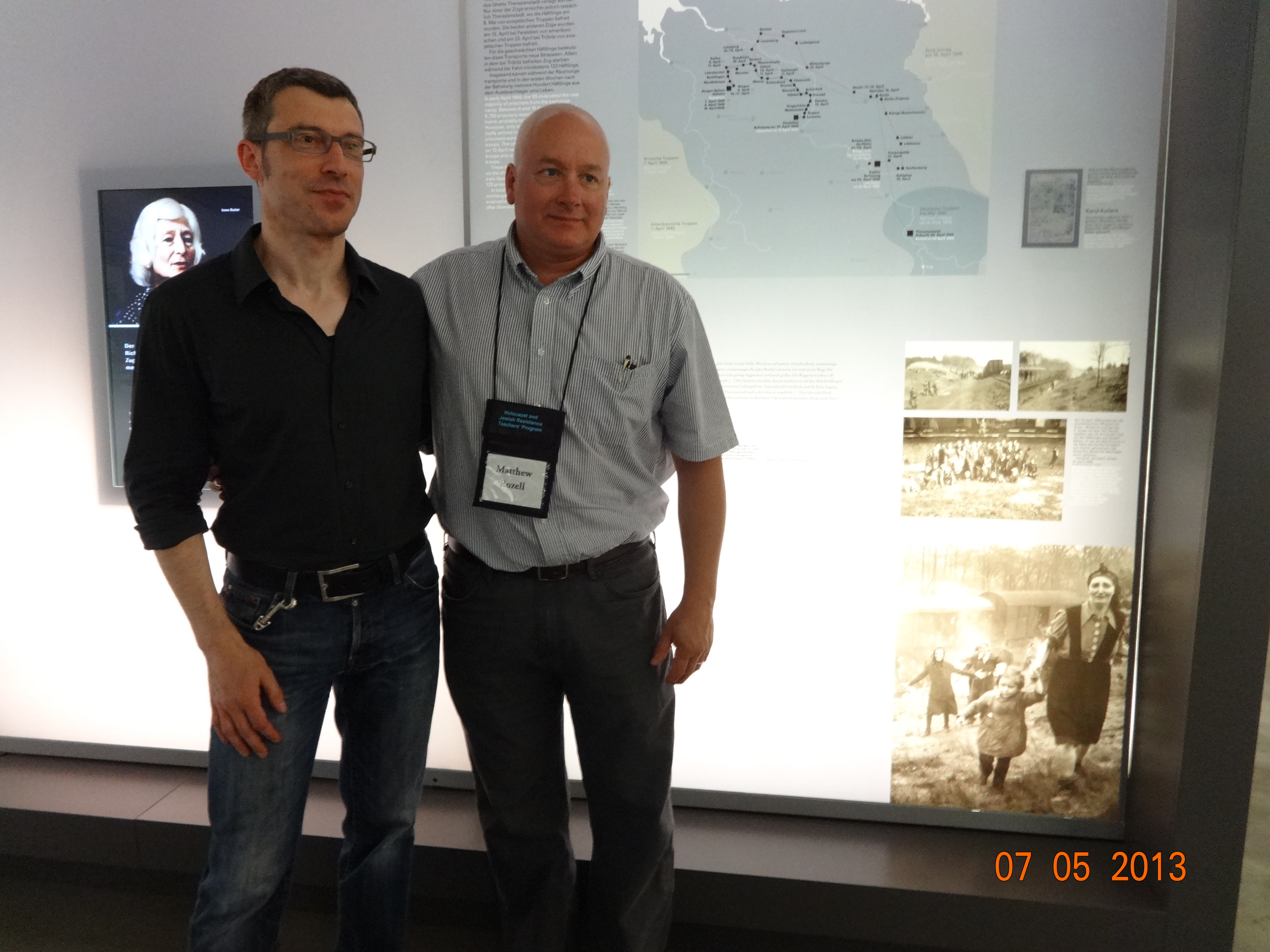
 Bernd Horstmann, Custodian of the Book of Names,  Matthew Rozell, History Teacher, July 5, 2013. Bergen Belsen, Evacuation transports exhibit.

Bernd Horstmann, Custodian of the Book of Names, Matthew Rozell, History Teacher, July 5, 2013. Bergen Belsen, Evacuation transports exhibit.

Twelve years later and here I am. I know some of the historians who work here-they have been to America to meet me- and I am going to see an exhibit that in fact incorporates some of the fruits of my labors. To date, we have reunited over 240 persons who were on that transport with the soldiers who liberated them. And I found the photographs that tell the story so well, photos that through the generosity of the soldiers who shared them with me, are now also in the United States Holocaust Memorial Museum, our national institution.

In brief context: 120,000 prisoners passed through Bergen Belsen, and not all of them Jewish. 52,000 died here, perhaps 30,000 of them were Jewish. Belsen actually began as a POW camp- 20,000 Russians died here in the winter of 1941-42. In 1943, Himmler (the head of the SS) ordered that an exchange camp be set up for Jews who might possess foreign certificates or visas to emigrate, perhaps to use to bargain for German families interned abroad. 14,000 people went through the exchange camp. In November, 1944, thousands of women, and some children, arrived from Auschwitz, to be “housed” near the exchange camp, including Anne Frank and her sister Margot. What they received, in their miserable condition, were 18 oversized old tents which promptly blew down during a winter storm shortly after their arrival. With the arrival also of brutal SS administrators and guards, conditions deteriorated rapidly as the winter of 1944-45 turned into spring.

The camp system began collapsing with the advance of the Red Army in the east and the British and Americans in the West. By the time the British arrived on April 15th at the camp gates, over 50,000 prisoners were suffering from extreme malnutrition, typhus, typhoid fever, and dysentery. Nearly ten thousand corpses lay about as the crematorium had long since broken down. Anne and Margot were dead, as the first Yanks crossed the Rhine River at the end of March. Hundreds died on the day of liberation. A true scene of horror.

Shortly before the liberation, between April 6 and 9, 1945, 6700 men, women, and children from the exchange camp passed through the camp gates and marched several kilometers to the railhead that many had arrived at months or years earlier. Three train transports of cattle cars and shabby passenger cars were prepared and loaded. Some people were executed for attempting to steal sugar beets at the railhead .
The transports would be headed for the Theresienstadt concentration camp, which at the time was far enough from advancing Allied lines and indeed would prove to be the last camp liberated on the last day of the war (I will trace that route later in our journey). Only one train made it there. The other two were liberated, one by the Americans at Farsleben near Magdeburg, and the other by the Russians near Tröbitz.
The first train left Bergen-Belsen on 6 April 1945 and travelled for six days before coming to a stop near the village of Farsleben. It was this transport that the soldiers I interviewed came upon on Friday, April 13, 1945.

I promised no weighty tomes, but maybe it is too late. After an introduction to the history of the site, we  watch the silent movies shot by the British beginning the second day after the liberation. Perhaps you’ve seen the photos or the films.  If you see a photo of a soldier wearing a mask, maneuvering a bulldozer to push corpses into an open pit, that was Bergen Belsen. Just over a month later, the British commander ordered the lice infested, typhus ridden barracks put to the torch. So today, to some visitors, there is nothing here, just inviting walkways with interpretive signage and some markers. Woods, and open fields.

Matthew Rozell and the ruins at Belsen, 7-5-2013. Jerrilyn Miller photo.

Matthew Rozell and the ruins at Belsen, 7-5-2013. Jerrilyn Miller photo.

But on closer inspection, we see the outlines of the past in the ruins. We walk to barracks ten of the exchange camp. You can see the outline at the woodline. Some of the foundation stones are marked with the names of those who passed through them. We retrace the steps from the barracks to the latrine, now many meters away off a footpath in the enveloping woods. Nature reclaims. Out of the corner of my eye, down the long narrow strip mowed to infinity where a fenceline once ran, I see a large deer guide out of the woods, pause and look my way, and vanish just as soon as it appeared. Is it obscene to find in this place now a feeling of inner peace, to find beauty in the stillness of a grey afternoon? Maybe so.

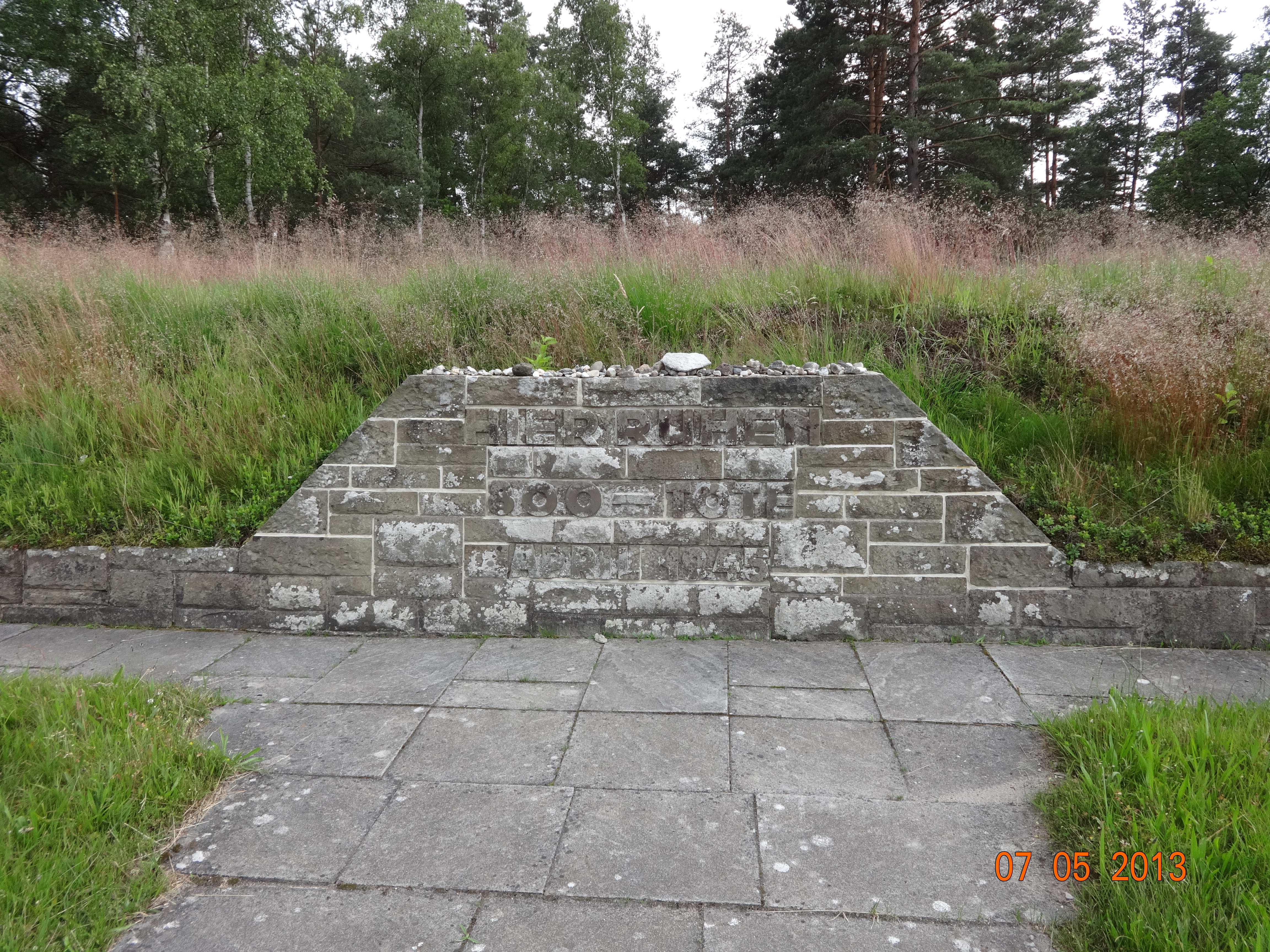
DSC00490Back out to the camp. The solemn monuments marking the mass graves. 1000 Tote. One thousand dead. 2500 Tote. Two thousand five hundred dead. And on and on, elevated mass graves. On to the commemoration room.

Candles are lit, stones are placed, the prayers are recited in Hebrew and English, led by Pauline, the only other New Yorker on the trip with me. We are all moved.

Now I think of Carrol Walsh, the tank commander who led me to this story, the liberator who did not want to be called a hero, or even a liberator. His own memorial service is today, half a world away, but I am here in this place to remember him as well. It is altogether fitting and proper. And I am sure that cosmically, it is also something destined to be.

This evening we depart from Hannover to Berlin. It is pretty crazy and unsettling at the Friday evening platform. 27 people have to run for the train, as the track has changed, with hundreds of others. Our original seats are taken, so we have to find other due to a mixup. But we do not lose anyone, and as I settle in next to a kind stranger, made welcome, I notice our station stops along the way- Brunswick. Magdeburg.

This was not planned, either. We are roughly following the route of the train, and the 30th Infantry Division in 1945. What take us 35 minutes to cover, takes 6 nights and 7 days in April 1945.

We tripped the wires of the cosmos. Today was the culmination of something incredible I am still trying to figure it all out- but this trip is helping me to place in proper context the elements of the greatest crime in the history of the world. As we leave this place of obscene beauty and peace, I think of  the I think of  the survivor’s words:

Remember Me.

136


Read Full Post »

A year ago I took one of the most transformative journeys of my life, with 24 fellow educators, to study the Holocaust and the Jewish resistance to it, in Washington, DC, Germany, the Czech Republic, and Poland. I kept an extensive diary and took tons of photographs.  For the next several days, I have decided to go back and retrace my steps and try to process what unfolded for me. Not weighty tomes, but maybe a picture and a note from the diary.

040So here is Frankfurt. We arrived at 5am local time after a transatlantic flight. Before we even hit our hotel properly we were off on the tour. The old girl goes back a ways. For the last eight hundred years or so, there was a significant  Jewish population, decimated by the occasional pogrom but somehow bouncing back. That is until Kristallnacht, when the largest synagogues were burned to the ground. In 1933, 30,000 Jews lived in Frankfurt; in 1945, only 600 remained (you can read more here).


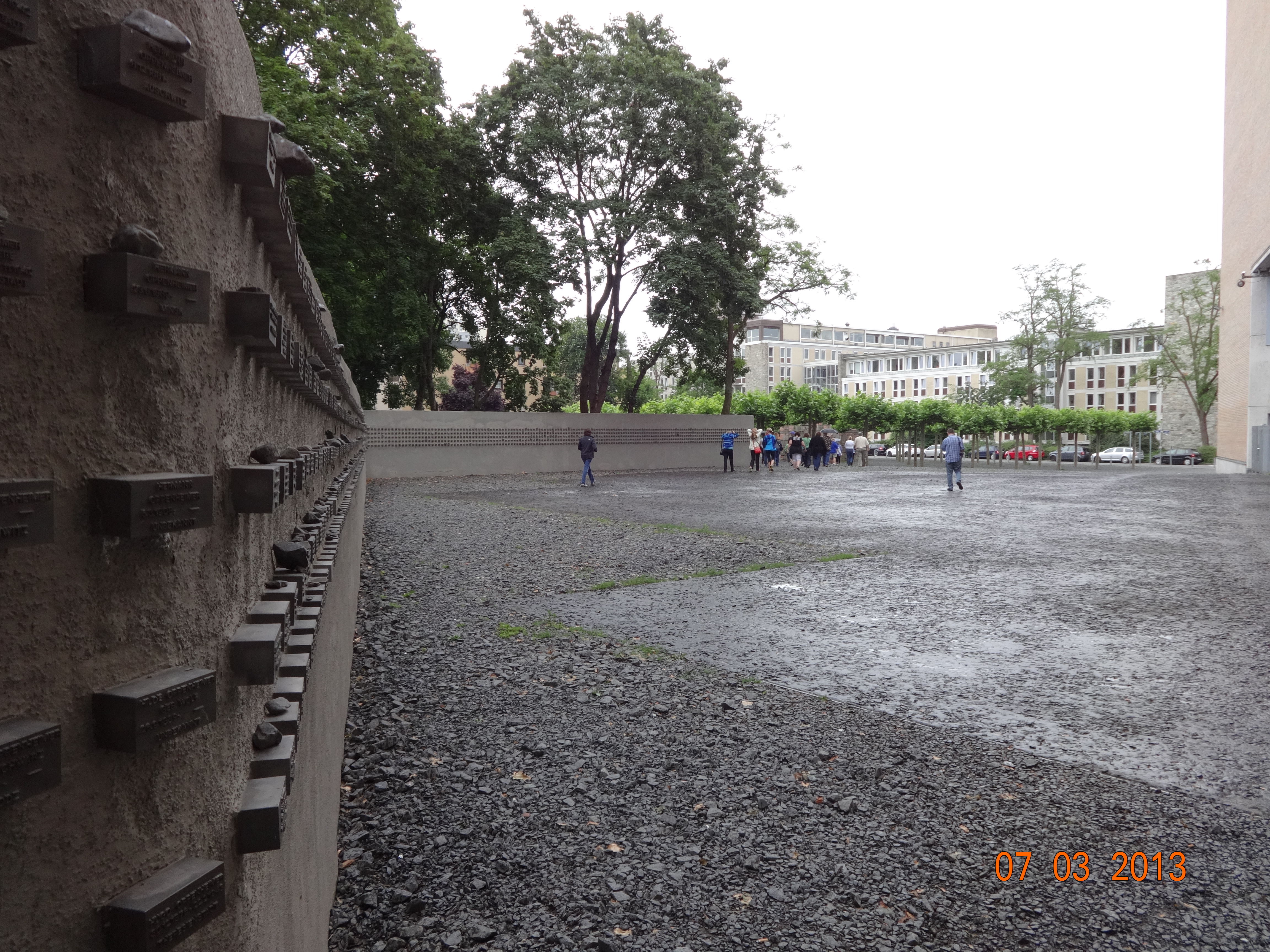
The Memorial to the Frankfurt Jews was a testament to the tens of thousands denounced and deported, by date and destination, to their deaths by their neighbors and the Nazi regime.

Memorial to the Frankfurt Jews. July 3 2013

Memorial to the Frankfurt Jews. July 3 2013

Each metal bump out has a person’s name. Shortly afterwards, we drove past the Frank House, from which the Frank family made their way to “safety” in the Netherlands, a path followed by many. You know the rest of the story. Anne Frank. We’ll connect more dots later on the tour.


I suppose there is a lot more to Frankfurt but we are not here long, though I do sneak out of the hotel several times to explore, solo and with like minded companions. As this trip begins, so does the wondering. You know, just the night before I heard testimony

Matt Rozell and Henry Greenbaum, Washington, DC, July 1, 2013

Matt Rozell and Henry Greenbaum, Washington, DC, July 1, 2013

of survivor Henry Greenbaum and had dinner with him and the group. He is part of the family on Geddy Lee’s mother’s side, Polish survivors who made their way to North America after the war. If you are not quite sure who Geddy Lee is, he is the bass player and vocalist for one of the most talented power trios on Earth. And he is playing Frankfurt. His mother and father met in a work camp in Poland, then Auschwitz.  His dad was liberated by the Americans at Dachau, his mom by the British at Belsen, where we are heading soon. And they returned for the 50th anniversary of the liberation in 1995, at the invitation of the Germans, with hundreds of others, walking the ground, healing some wounds.

“Dankeschön, Frankfurt!” he happily exclaims several times during the show here. How much do we read into that? Nothing, I suppose.  Though there is something magnificent about Geddy’s roots, the family history, and Rush coming to Frankfurt and just nailing it. The German fans, the lovers of the band, of the music, of Geddy… It literally brings a happy tear to my eye.

And of course the eternal question-what else did the world lose, because of the Holocaust? Unfathomable.

But here is a taste.

Read Full Post »

April 30 1945 Headlines. Hangs in my classroom.

April 30 1945 Headlines. Hangs in my classroom.

Today, April 29th, is the anniversary of the liberation of Dachau, 69 years on. Today, if it is brought up at all, some of us might respond with a vacant stare. More might shrug and turn away. I suppose that is to be expected. But you know me. I just think that as a nation, sometimes we allow things to slip from memory at our peril.

It was real, and it happened. And it was American GIs who overran this camp and many others in the closing days of World War II.

The men of the 42nd and 45th Infantry Division arrived independently of each other, here, in southern Germany, at Dachau, on this day. A concentration camp, they were told. Their noses gave them a hint of what they were about to uncover, miles before the camp appeared in sight.

Read the headlines, above. Note the sub article:

Boxcars of Dead at Dachau. 32,000 captives freed.

American soldiers view the bodies in one of the open railcars of the Dachau death train. USHMM

American soldiers view the bodies in one of the open railcars of the Dachau death train. USHMM

And so after some resistance, into the camp they entered. Life changing events were about to unfold for the American soldier.

***************************

For me, it’s not about hero worship, or glorifying the liberator or any World War II soldier as some kind of savior. Many of the liberating soldiers I know would resist this, to the point of rejecting the term, “liberator”… “It all sounds so exalted, so glamorous” said one. But they will all accept the term, “eyewitness”.

Witnesses to the greatest crime in the history of the world.

So instead I think it is about honoring their experiences, their shock, the horror, the puking and the crying, the rage-and then, the American GIs recognizing that something had to be done. And they did suffer for it, for trying to do the right thing. Many tried to help by offering food to starving prisoners who just were not ready to handle it, only to see them drop dead. Or having to manhandle these emaciated victims who were tearing away at each other as food was being offered.

Some guys never got over it. How could you?

I have learned so much over the past few years from these guys, just through the way that they carried themselves and tried to cope with what they witnessed. In my World War II studies and Holocaust class, we discuss these issues at length. I’m so lucky to be able to teach it.


Class of 2014 in my classroom. Watching archival footage of the liberation.

Class of 2014 in my classroom. Watching archival footage of the liberation.

So yesterday, a film crew arrived from NBCLearn, a division of NBC News, all the way up from New York City. No, I did not call them. They found me. They were doing a related story, so I talked them into coming up (shout out here to the producer, Norm).

They decided they wanted to learn something from our kids- ultimately, I think, whether or not history really mattered anymore.

We have had many lessons on the Holocaust, on the victims especially, but also on the  perpetrators and the bystanders. Lessons on the liberation, and what we have been studying all along.

These kids have witnessed soldiers’ and survivors’ testimony. They have interviewed their own subjects, firsthand, and established relationships with this generation. And therefore, they become the new witnesses to the deeds of this generation. And with this, they will carry a new responsiblity. To never forget, and to not let others forget, the lessons of the past.

***************************

The raw film is rolling in the classroom. I guess it’s time for me to see what has happened to change the kids. What have they learned, and how have they grown? But today it is time to set the written exam to the side.

We watch the testimony of the  liberator who had visited our school in the past, and viewed the archival footage and photographs from 69 years ago.

And then editor poses the questions for the kids. “Why is it important to study the Holocaust? “What difference do you think it makes to know about this, our past? What do you think motivated our soldiers to go off and fight? Was it just “patriotism?”

What did your class learn? What have YOU learned?”

The completed video will be shown in schools across the country. Below are some of the kids of Hudson Falls, who make their small town  proud.

Meg V.

Meg V.


Koreena H

Koreena H

Klayton S.

Klayton S.


Class of 2014 in my classroom, April 28, 2014. NBC News has arrived.

Class of 2014 in my classroom, April 28, 2014. NBC News has arrived.


Read Full Post »

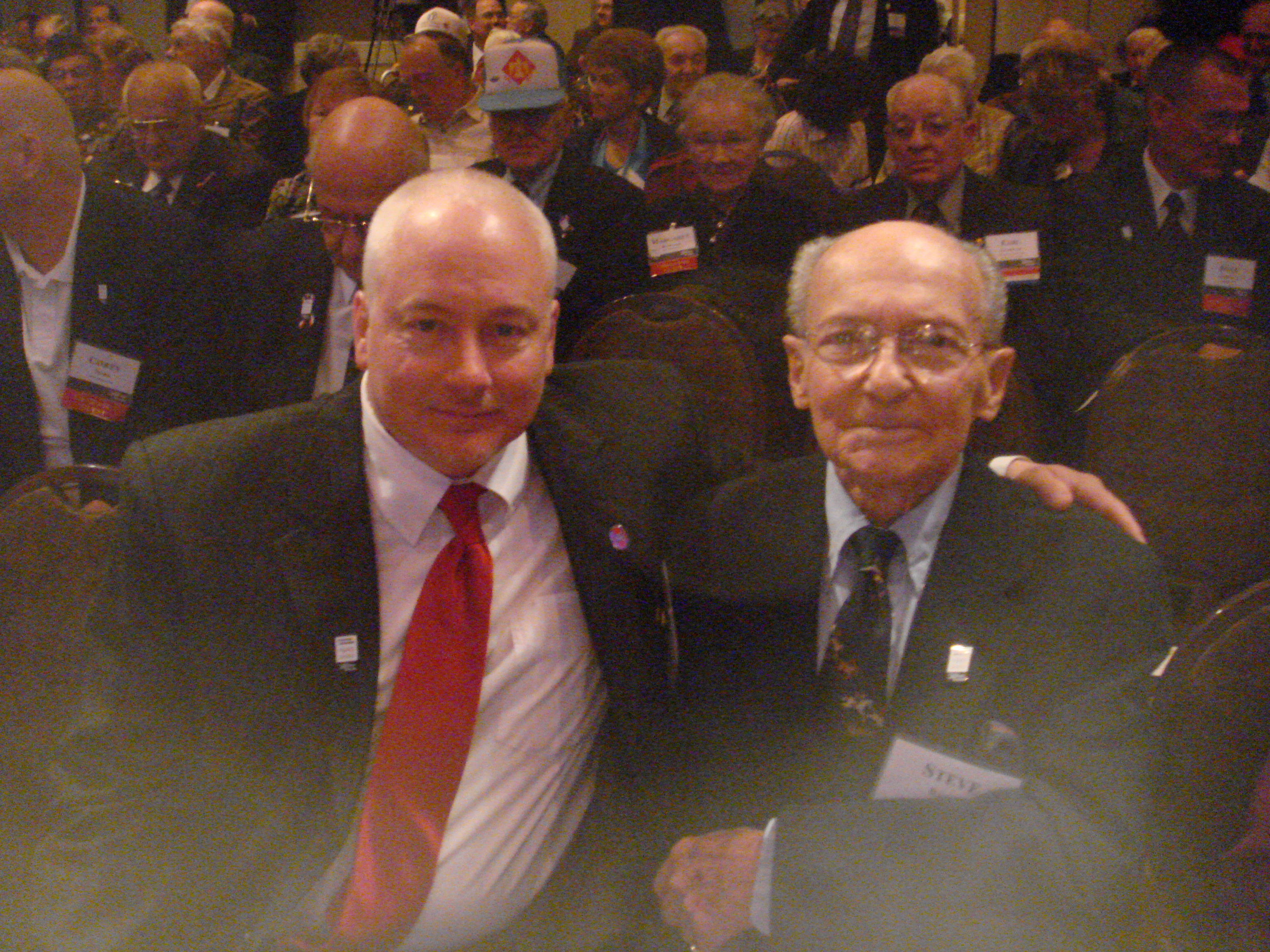
Matthew Rozell, Stephen Barry, National DOR Ceremony, Washington, DC April 2010. This photo was taken the day after the 65th anniversary of Steve's liberation in April 1945. We had just been honored by the director of the United States Holocaust Memorial Museum before the national ceremony in the Capitol Rotunda.

Matthew Rozell, Stephen Barry, National DOR Ceremony, Washington, DC April 2010. This photo was taken the day after the 65th anniversary of Steve’s liberation in April 1945. We had just been honored by the director of the United States Holocaust Memorial Museum before the national ceremony in the Capitol Rotunda.

So, the ripples continue. Somebody said it was like pebbles being tossed into the still water. This may sound strange, but I am keenly aware of the cosmic element. We tripped the wires of the cosmos.

~”It’s not for my sake, it’s for the sake of humanity, that they will remember”~

I got a nice email  recently. My friend Steve Barry was honored Tuesday evening at the United States Holocaust Memorial Museum. Steve’s daughters wanted me to know that his family made a donation in his name and set up two fellowships for scholars at the USHMM in the Stephen B. Barry Memorial Fellowship. His girls mentioned me in their speech Tuesday night in Washington. Thanks ladies. You know he was a hero. He reached out and touched an awful lot of students in the short time that we were together.

Steve will be one of the persons who will be featured in my book. Against all the odds he survived the Holocaust and later even went on to become a US Army Ranger in the Korean War! I was pretty close to him. Right now I am wistfully looking at his homemade holiday greeting cards under my desk glass, and to my left, a foot away, are the shelves containing his Holocaust library, which was passed on to me after he passed away. He was so funny, too.  He told me he nearly “choked on my bagel” a few years back when he opened his newspaper in Florida and read about me and the train he had been looking for, for so many years!

I miss the guy. You can read more about him here.


Steve's name on the wall of donors, USHMM, unveiled April 29, 2014.

Steve’s name on the wall of donors, USHMM, unveiled April 29, 2014.

The inscription kind of says it all. He uttered these words in my very classroom on a Thursday morning to a film crew from New York City, aimed at the 1500 students that he and the other survivors and American soldier/liberators had come to address. That Friday evening of our big soldier/survivor reunion, we watched it together on national news before our final banquet.

You can see the video at the bottom-he’s the one in the preview addressing the interviewer- but the transcript is below.

ABC WORLD NEWS TONIGHT, FRIDAY, SEPTEMBER 26, 2009

Diane Sawyer: And finally tonight, our Persons of the Week. It is a story that began almost 65 years ago in the darkest days of World War II. Yet this week, a new chapter unfolded. An unforgettable reunion of Holocaust survivors, and the American troops who freed them, and all made possible by a high school history class.

Matthew Rozell: This is history coming alive.
Veteran 1, entering school with his wife: Here we are, we have arrived!
Matthew Rozell: This is walking, talking, living history. They’re (the students) shaking hands with the past…

Diane Sawyer: It was 2001 when high school history teacher Matt Rozell decided to begin an oral history project. He and his students would just interview family members in the small town of Hudson Falls, New York, to capture fading stories of World War II.
Interviewer (soldier’s daughter): Did you mention the train [to Mr. Rozell] at all before?
Carrol Walsh, former soldier: No I didn’t tell him about the train.

Diane Sawyer: The students unearthed a forgotten crossroads in history. (Gunfire, archival film footage) Near the very end of World War II, April 13th, 1945, the American 30th Infantry Division was pushing its way into central Germany.
Carrol Walsh: We came to a place where there was a long train, of boxcars.

Diane Sawyer: They found a train, holding nearly 2,500 emaciated Jewish prisoners, many just children, being moved from the Bergen-Belsen concentration camp, to another camp and certain death. Their German guards had just abandoned them, fleeing the Americans.

Carrol Walsh: A feeling of helplessness. What are we going to do with all these people?
Frank Towers, former soldier: We had never ever seen anything so, (pauses) filthy.

Diane Sawyer: The American soldiers fed the prisoners, and brought them to safety.

Stephen Barry: For 42 years I collected anything that I could to try to find any article regarding the train. It just didn’t exist!

Diane Sawyer: But Mr. Rozell’s class put their interviews with veterans up on a website, along with these photographs taken by the American soldiers.

George Gross: Just very courageous people, little girls who with big smiles on their faces, one of them with their arms out, just aware that the Americans are there. [camera pans over 1945 liberation photograph]

Diane Sawyer: Out there on the web, Holocaust survivors all around the world began to notice.

Stephen Barry: I mean, how many people have a picture of their moment of liberation forever? [camera pans over 1945 liberation photograph]

(students and veterans and survivors singing “The Star Spangled Banner”)

Diane Sawyer: A reunion of the survivors and their liberators took place this week at Hudson Falls High School.

Emily Murphy, student: When they speak to us, you can’t say that you feel how they felt. But you get the feeling, you feel like you were there.

Diane Sawyer: In an age where there are still those who deny the Holocaust ever existed, these survivors say they are the living proof.

Stephen Barry: It’s not for my sake, it’s for the sake of humanity, that they will remember.

Diane Sawyer: And so we choose history teacher Matt Rozell, his class, the Holocaust survivors of that train, and the American soldiers who kept them and their story alive. And that is World News for this Friday. I am Diane Sawyer, and from all of us at ABC News, we hope you have a great weekend.

And here is a link to the 2014 United States Days of Remembrance Capitol Ceremony. Steve’s daughters and granddaughters are in the back row!


Read Full Post »

Yom HaShoah is Holocaust Remembrance Day. It marks the anniversary of the Warsaw ghetto uprising.

Clara Rudnick around age 15.

Clara Rudnick, center, around age 15.

I recently visited the local synagogue where my friend Clara Rudnick was to speak.   I was very gratified that several of my students also decided to come, and that when we arrived, they and I were also invited to participate in the readings and the candle lighting for the commemoration.

My wife and daughter also accompanied me. It was their first time in temple and the commemoration deeply touched them.

IMG_0006

Clara lit up when she saw the girls and I. She came right over, smothered me with a big hug, and went right over to the girls.

She and her twin brother Avreminkeh were about my daughter’s age, early teens, when the Germans arrived in Lithuania in June 1941. Her oldest brother Itze was 23 years old, and her two sisters Chiyeh and Dorkeh were 20 and 13. Her proud parents Yossel and Chiyena Charmatz were 42 and 40. They ran a highly regard restaurant and bakery that had been in business for generations, in a community of 10,000 that had had a Jewish presence since the 1300s. Forty percent of the prewar population of Sventzion was Jewish.

The townspeople turned on their neighbors. Even the Catholic and Orthodox churches collaborated in providing information needed to terrorize the community. In July, 1941, Lithuanian collaborators took a nearly a hundred teenage boys and young men including Itze outside of town, locked them in a building, and burned them alive. Hysteria rippled through the Jewish community now. In August, nearly a hundred more, including her twin brother, were taken outside of town on Shabbat, forced to dig their own graves and shot. A few weeks later, also on the Sabbath, eight thousand men women boys and girls were ordered to stand in the town square, where they were shot, including her mother and two sisters. Clara was saved only because her father had given her his coat and told her to hide in the local steam bath.

After the shooting, he came for her at night and took her to the forest for two nights without food and water. They found a farmer who was secretly a Jew and stayed until more refugees began to arrive. Deciding it was no longer safe, they

Students Chelsea R., Paige L., Meg V., Cheyenne B., Mary R. flank survivor Clara Rudnick at reception following Yom Hashoah commemoration, 2014.

Students Chelsea R., Paige L., Meg V., Cheyenne B., Mary R. flank survivor Clara Rudnick at reception following Yom Hashoah commemoration, 2014.

moved to the farm of a Christian friend who accepted their money to hide them. Later, they found themselves in the ghetto at Swir. ” I was 15 years old, I had lost my mother, brothers and sisters, and I was very upset.” And in a constant state of peril.

In the middle of February, 1942, the Germans came to liquidate the ghetto. Clara and her father managed to escape with others across a frozen lake as the Nazis shot at them. Her father broke through the ice and placed Clara in the freezing water and lay on top of her to protect her in the cold winter night, until the Germans left.

They traveled twenty kilometers to another ghetto at Mishaleikse, where they were arrested in April and sent to the Vilna Ghetto, subjected to hard labor. Here Clara witnessed starvation, disease, street executions, babies killed and placed in the back of trucks. Mistreatment was widespread and deportations to concentration camps and extermination centers occurred almost daily. Clara again was able to escape, but this time without her father. A local cinema owner told her father he would take care of her. She would see her father only one more time.

In the summer of 1942 (the same summer that Anne Frank would go into hiding, Clara notes) a handsome sum of gold was given to another Christian and Clara was hidden in a dark hidden cellar with a trap door for seven months, emerging only once a day to answer nature’s call. One day she peeped through the hatch to see what was going on upstairs, as there was a great deal of commotion and noise. Bullets raked the hiding spot and she was grazed in the stomach, the cinema owner killed. Clara was caught again.

She was taken before the Gestapo in Kalich, where as a slave laborer she was forced to make fur coats for the Germans fighting on the Russian front. Then the slaves were placed into two trucks. One went to the execution site of Panar, the other to the camp at Kaiserwald. Clara considers it another miracle that she was on the truck to Kaiserwald. Here she worked with dangerous acid to make batteries. She was afraid the acid would scar her and she would be killed.

After some time, she was sent to Stutthof on the Baltic. It was here that she saw her father, through the chain link fence, for the last time. He and 85,000 others perished here. She was terrified.

As the Red Army closed in she was marched out and placed in a barn, locked with other women to die from starvation. It was here that she was liberated by Soviet forces on march 11, 1945. She states, matter of factly, that the soldiers moved on immediately, having no time to care for them.

Heading to Lodz,  Poland shortly after, she did not find any family members anywhere. Regaining her strength, she met another survivor, Abraham Rudnick, a Lithuanian Jew like her who had been liberated by the Americans at Dachau on April 29, 1945. They married in a DP camp and emigrated to the United States in 1949, where they raised a family and built a plumbing and heating business in upstate New York.

So tonight she is here with her grandson and recounts the story, and the postscript of her summer trip back to Vilna and her hometown in Lithuania, and her realization that no one in Lithuania seems to want to acknowledge the countries complicity in the murder of her family and hundreds of thousands of others. But here, speaking in the temple for perhaps the last time, she has her North Country family, and has certainly won over the hearts of a few young ladies this evening. They wont forget, Clara, and they are the new witnesses. It’s so.

Clara told me some years ago that her sons had my dad as their history teacher in high school and that he was held in high regard. As we bid her goodbye, she whispered in my daughter’s ear-“Don’t tell your father, but I love him!” I am blessed to know you now, as was my dad and now my girl, and my students. We’ll keep you close, and remember your mother and father, your brothers and sisters, and all those murdered in those not so distant days.

Clara Rudnick by Erica Miller


Read Full Post »

« Newer Posts - Older Posts »