Feeds:
Posts
Comments

Posts Tagged ‘743rd Tank Battalion’

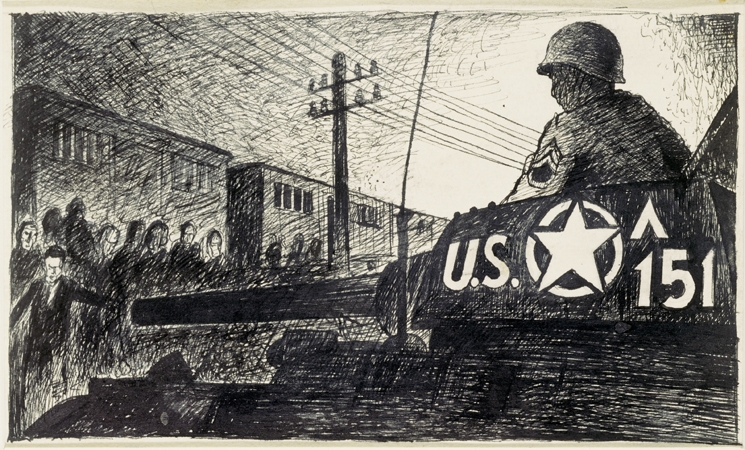
Liberation, April 13th, 1945. Drawing by survivor Ervin Abadi. USHMM.

Liberation, April 13th, 1945. Drawing by survivor Ervin Abadi. USHMM.

DEAR MR. ROZELL–I READ TODAY WITH GREAT INTEREST THE AP ARTICLE ABOUT THE TRAIN AND YOUR PROJECT…

MY MOTHER, SISTER AND I WERE ON THAT TRAIN . I WOULD LIKE TO SHARE WITH YOU SOME OF MY MEMORIES.

THE FIRST SIGHT I HAD OF THE AMERICANS FROM INSIDE THE TRAIN WAS OF AN EMPTY VEHICLE SUCH AS WE HAD NEVER SEEN BEFORE—IT HAD A GREAT WHITE STAR ON IT, AND SOMEONE-FAMILIAR WITH THAT STAR SAID:” THE AMERICANS ARE HERE” .

NOW I KNOW THAT IT WAS A JEEP—AND IT MUST HAVE BEEN ON A RECONNAISSANCE MISSION, AND IT WAS EMPTY MAYBE, BECAUSE THE SOLDIERS TOOK COVER, SEEING THE TRAIN.

I WILL FOREVER SEE THE WHITE STAR AND THAT AMAZING JEEP IN MY HEART—

SOON, THE SOLDIERS CAME AND TOLD US SADLY THAT FRANKLIN DELANO ROOSEVELT HAD DIED THE DAY BEFORE ON APR 12.. THEY TOLD US, THAT IT WAS FRIDAY, APR 13, 1945—WE DID NOT KNOW THE MONTHS AND THE DAYS ANYMORE, LOST COUNT OF TIME IN BERGEN BELSEN.LONG BEFORE.

THE SOLDIERS CAME, AND WERE GENTLE AND GAVE US FOOD. FOR 2 DAYS WE SLEPT ON THE HILLSIDE—AND THEN WE WERE BILLETED INTO ABANDONED GERMAN HOMES IN A TOWN CALLED HILLERSLEBEN JUST OUTSIDE OF MAGDEBURG.

D.D.T. HAS A VERY BAD REPUTATION TODAY—- BUT I WILL FOREVER THINK OF THE D.D.T WITH A GREAT DEAL OF AFFECTION. WE WERE LINED UP, SPRAYED WITH DDT THAT KILLED THE MILLIONS OF LICE THAT INFESTED US. THE AMERICANS BURNED OUR RAGS AND GOD KNOWS FROM WHERE GAVE US CLEAN CLOTHES.

AS I WAS A CHILD I FANTASIZED THAT THE SOLDIERS WERE ANGELS, WITH THEIR WINGS HIDDEN UNDER THEIR UNIFORM SHIRTS.

TODAY I KNOW THAT THIS WAS NO FANTASY. IN THAT PLACE, AND AT THAT TIME THE AMERICAN SOLDIERS WERE ANGELS INDEED.I WAS 10, MY SISTER WAS 8. WE WERE HUNGARIAN JEWS.I, TOO HAVE MANY QUESTIONS FOR YOU, AND WILL CALL YOU SOON…

-I JUST CAN NOT BELIEVE THIS IS HAPPENING —THE AP ARTICLE —YOUR PROJECT—–62 YEARS LATER—

WILL YOU BE SO KIND TO FORWARD MY “TRAIN” LETTER TO MR WALSH AND MR GROSS. PLEASE TELL THEM THAT I LOVE THEM AND THAT IS NOT AN OVERSTATEMENT—

SO MUCH THANKS TO YOU, DARLING MATT

SINCERELY YOURS WITH MANY THANKS FOR YOUR PROJECT

AGNES B.

**********

a lovely reminder of the power of this project, one of many sent to me by survivors on September 15th, 2007.

Read Full Post »

A year ago I took one of the most transformative journeys of my life, with 24 fellow educators, to study the Holocaust and the Jewish resistance to it, in Washington, DC, Germany, the Czech Republic, and Poland. I kept an extensive diary and took tons of photographs.  For the next several days, I have decided to go back and retrace my steps and try to process what unfolded for me. Not weighty tomes, but maybe a picture and a note from the diary.

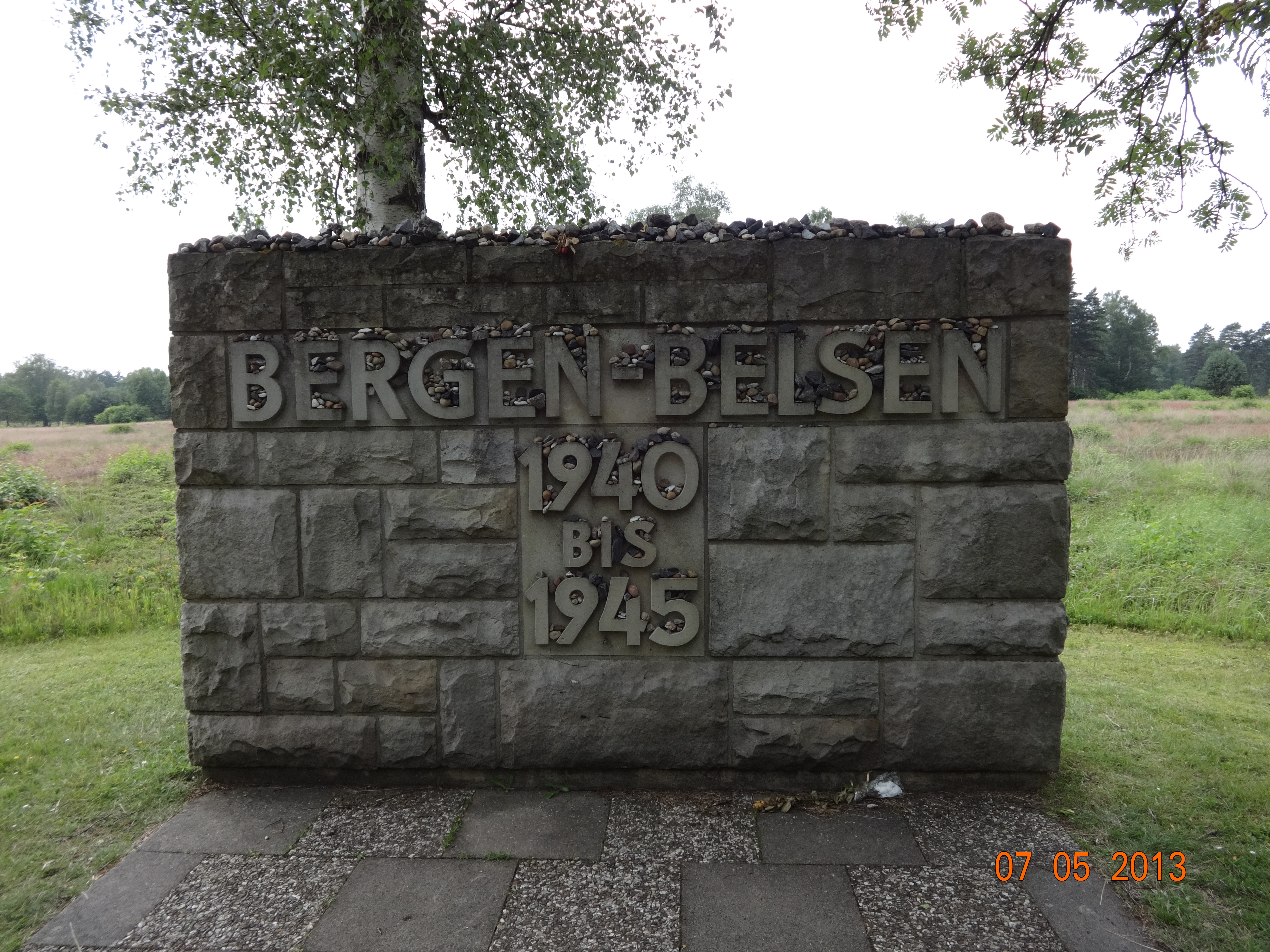
Bergen Belsen on July 5, 2013.

Bergen Belsen on July 5, 2013.

“Belsen! I think they had been in Belsen.”

On July 5, 2013, we are on our way from the hotel in nearly Celle to this destination. Our first concentration camp of the tour.

Trying to remember the name of the concentration camp, the elderly gentleman exclaimed these words as he animated his story from the rocking chair across from me. I was in his daughter’s house on a brilliant July day, twelve summers before. It seems like a lifetime ago. But if I had not taken the time to go there and sit down with him, you would not be reading any of this.

People, mostly news media, get the story wrong all the time.  I had not invited the veteran to class because I had had his grandson. It was a series of coincidences that changed so many lives, but then again, I am sure there are no coincidences.

Is it a coincidence that I am making my first trip to Belsen on the day that he is being laid to rest in his hometown back in New York state? Or that by 8pm I will be traveling on the same spur of tracks toward Magdeburg, on which the Sherman light tank he was commanding sixty-eight springs ago came to the train with 2500 Jewish victims of the Holocaust onboard?

I was picking my young children up from daycare. I knew Tim, the other father there at the same time, picking up his young son. I had his older son in class at the time. Tim knew I liked to talk to World War II veterans, and he invited me to come over and speak to his father in law, a retired NYS Supreme Court justice, who was coming up to stay for the summer. So I took him up on it. What a great man, funny too. We conversed on tape for nearly two hours, and I was about to turn the camera off, and his daughter, Tim’s wife Elizabeth, spoke up:

Daughter: Did you mention the train at all? That was kind of interesting.
CW: No, I didn’t tell him about the train.
MR: What was that?
CW: Well, late in the war, again a nice, beautiful April day… we were shooting like crazy across the top of Germany and Major Benjamin of the 743rd was kind of out ahead scouting a little bit… he came back to the battalion and he pulled my tank and George Gross’s tank [fellow tank commander] out. He told us to go with him. So we did.
We came to a place where there was a long train of boxcars. … I can remember pulling up alongside the train of boxcars, Gross and I, and Major Benjamin. As it turned out, it was a train full of concentration camp victims, prisoners, who were being transported from one of their camps…Belsen!  I think they had been in Belsen, on their way to another camp…
So there they were. All of these people, men, women, children, jam-packed in those boxcars, I couldn’t believe my eyes. And there they were! So, now they knew they were free, they were liberated. That was a nice, nice thing. I was there for a while that afternoon. You know, you got to feed these people. Give them water. They are in bad shape. Major Benjamin took some pictures, and George Gross took some pictures too…

 Bernd Horstmann, Custodian of the Book of Names,  Matthew Rozell, History Teacher, July 5, 2013. Bergen Belsen, Evacuation transports exhibit.

Bernd Horstmann, Custodian of the Book of Names, Matthew Rozell, History Teacher, July 5, 2013. Bergen Belsen, Evacuation transports exhibit.

Twelve years later and here I am. I know some of the historians who work here-they have been to America to meet me- and I am going to see an exhibit that in fact incorporates some of the fruits of my labors. To date, we have reunited over 240 persons who were on that transport with the soldiers who liberated them. And I found the photographs that tell the story so well, photos that through the generosity of the soldiers who shared them with me, are now also in the United States Holocaust Memorial Museum, our national institution.

In brief context: 120,000 prisoners passed through Bergen Belsen, and not all of them Jewish. 52,000 died here, perhaps 30,000 of them were Jewish. Belsen actually began as a POW camp- 20,000 Russians died here in the winter of 1941-42. In 1943, Himmler (the head of the SS) ordered that an exchange camp be set up for Jews who might possess foreign certificates or visas to emigrate, perhaps to use to bargain for German families interned abroad. 14,000 people went through the exchange camp. In November, 1944, thousands of women, and some children, arrived from Auschwitz, to be “housed” near the exchange camp, including Anne Frank and her sister Margot. What they received, in their miserable condition, were 18 oversized old tents which promptly blew down during a winter storm shortly after their arrival. With the arrival also of brutal SS administrators and guards, conditions deteriorated rapidly as the winter of 1944-45 turned into spring.

The camp system began collapsing with the advance of the Red Army in the east and the British and Americans in the West. By the time the British arrived on April 15th at the camp gates, over 50,000 prisoners were suffering from extreme malnutrition, typhus, typhoid fever, and dysentery. Nearly ten thousand corpses lay about as the crematorium had long since broken down. Anne and Margot were dead, as the first Yanks crossed the Rhine River at the end of March. Hundreds died on the day of liberation. A true scene of horror.

Shortly before the liberation, between April 6 and 9, 1945, 6700 men, women, and children from the exchange camp passed through the camp gates and marched several kilometers to the railhead that many had arrived at months or years earlier. Three train transports of cattle cars and shabby passenger cars were prepared and loaded. Some people were executed for attempting to steal sugar beets at the railhead .
The transports would be headed for the Theresienstadt concentration camp, which at the time was far enough from advancing Allied lines and indeed would prove to be the last camp liberated on the last day of the war (I will trace that route later in our journey). Only one train made it there. The other two were liberated, one by the Americans at Farsleben near Magdeburg, and the other by the Russians near Tröbitz.
The first train left Bergen-Belsen on 6 April 1945 and travelled for six days before coming to a stop near the village of Farsleben. It was this transport that the soldiers I interviewed came upon on Friday, April 13, 1945.

I promised no weighty tomes, but maybe it is too late. After an introduction to the history of the site, we  watch the silent movies shot by the British beginning the second day after the liberation. Perhaps you’ve seen the photos or the films.  If you see a photo of a soldier wearing a mask, maneuvering a bulldozer to push corpses into an open pit, that was Bergen Belsen. Just over a month later, the British commander ordered the lice infested, typhus ridden barracks put to the torch. So today, to some visitors, there is nothing here, just inviting walkways with interpretive signage and some markers. Woods, and open fields.

Matthew Rozell and the ruins at Belsen, 7-5-2013. Jerrilyn Miller photo.

Matthew Rozell and the ruins at Belsen, 7-5-2013. Jerrilyn Miller photo.

But on closer inspection, we see the outlines of the past in the ruins. We walk to barracks ten of the exchange camp. You can see the outline at the woodline. Some of the foundation stones are marked with the names of those who passed through them. We retrace the steps from the barracks to the latrine, now many meters away off a footpath in the enveloping woods. Nature reclaims. Out of the corner of my eye, down the long narrow strip mowed to infinity where a fenceline once ran, I see a large deer guide out of the woods, pause and look my way, and vanish just as soon as it appeared. Is it obscene to find in this place now a feeling of inner peace, to find beauty in the stillness of a grey afternoon? Maybe so.

DSC00490Back out to the camp. The solemn monuments marking the mass graves. 1000 Tote. One thousand dead. 2500 Tote. Two thousand five hundred dead. And on and on, elevated mass graves. On to the commemoration room.

Candles are lit, stones are placed, the prayers are recited in Hebrew and English, led by Pauline, the only other New Yorker on the trip with me. We are all moved.

Now I think of Carrol Walsh, the tank commander who led me to this story, the liberator who did not want to be called a hero, or even a liberator. His own memorial service is today, half a world away, but I am here in this place to remember him as well. It is altogether fitting and proper. And I am sure that cosmically, it is also something destined to be.

This evening we depart from Hannover to Berlin. It is pretty crazy and unsettling at the Friday evening platform. 27 people have to run for the train, as the track has changed, with hundreds of others. Our original seats are taken, so we have to find other due to a mixup. But we do not lose anyone, and as I settle in next to a kind stranger, made welcome, I notice our station stops along the way- Brunswick. Magdeburg.

This was not planned, either. We are roughly following the route of the train, and the 30th Infantry Division in 1945. What take us 35 minutes to cover, takes 6 nights and 7 days in April 1945.

We tripped the wires of the cosmos. Today was the culmination of something incredible I am still trying to figure it all out- but this trip is helping me to place in proper context the elements of the greatest crime in the history of the world. As we leave this place of obscene beauty and peace, I think of  the I think of  the survivor’s words:

Remember Me.

136


Read Full Post »


So, it is the sixth of June again.

American Cemetery overlooking Omaha Beach, the primary landing zone for Americans during the D-Day invasion June 6, 1944. (U.S. Air Force Photo)The ocean pounds the advance of sand amidst the relics of a different age, the hulking remnants of the tide of battle. The surf rolls in and kisses the beach, as the last participants mix on the hallowed bluff above with the politicians who have gathered from all over the world.

Thirty years ago I watched as the American president honored  the fallen, and the living, at the cemetery for the fortieth anniversary. Just out of college, something stirred inside me. Something was awoken.

Thirty years have passed. I began by writing letters to the newspaper. I began to interview D-Day veterans and others. I began to collect stories- not relics, prizes, or artifacts. I really had little interest in captured Nazi flags or samurai swords.

I wanted to talk to the men who were there.

The fiftieth anniversary came next with great pomp and more reflection. It graced the covers of the major newsweeklies. “Saving Private Ryan” stirred the consciousness of a new generation, and reflections of the old. And I learned so much more of the war beyond the beachhead. That there were so many beachheads.

The sixtieth anniversary came around. Students on their bi-annual trips to France would bring me back their photographs and the requisite grains of white sand from Omaha Beach. Teenagers had their emotions  a bit tempered, I think. I would go on to introduce them to so many who were there. When they themselves were teenagers.

So now it is the seventieth. On the 65th, I wrote about a friend who is no longer here for the 70th. Another president spoke today, and the 75th will bring fewer who were there back to Normandy.

*****************************************

Today I would like to introduce you to a survivor of D Day who is still with us.

I first met Bill Gast at a reunion of 30th Infantry Division and 743rd Tank Battalion soldiers at a reunion in March 2008, in which I  was present with several Holocaust survivors who were meeting their liberating soldiers for the first time. Later, Bill came to my high school to speak to students. I think the experience of sharing, and meeting the Holocaust survivors whom the 743rd came upon and liberated, affected him deeply.

Unlike many who may be physically able, Bill has no intention of going back to the sands of Omaha for this anniversary. As he explained to our students in 2009,

“I’m listed [in the event program] as a liberator- however, I am also a survivor of World War II, having landed on Omaha Beach in Normandy, France on D-day and fighting through to the end when the Germans surrendered, May the 7th, 1945.”

“Pictures.

Video games.

Movies.

Words.

They simply do not covey the feeling of fear.

The shock.

The stench.

The noise.

The horror, and the tragedy.

The injured.

The suffering.

The dying, and the dead.”

A  couple weeks ago this article popped up. So glad to see Bill’s name.

*****************************************

D-Day: the view from a tank on Omaha Beach

Washington (AFP) – From inside his tank, the young soldier could see “practically nothing” on Omaha Beach.

Seventy years later, William Gast still wonders whether he rolled over his comrades sheltering from German gunfire that day.

Gast was 19 years old the morning of June 6, 1944. “We came in at H-10, that was 10 minutes before the designated hour.”

He cannot recall why he and his fellow soldiers arrived early, but he has other memories that have never left him.

As part of Company A, 743rd Tank Battalion, 1st Army, Gast remembers the training beforehand in Britain, when he rehearsed driving the Sherman tank onto the landing craft. And then floating in the English Channel.

“Another night we went out and we didn’t come back. That was it.”

Gast got to know the captain of the landing craft that would ferry his tank to the beaches of Normandy.

The skipper promised he would get them close enough that they would not be submerged in water, like so many tanks were that day.

He kept his word.

Another tank unit at Omaha Beach was less fortunate, with 27 of 32 tanks launched at sea five kilometers (three miles) from the coast sinking before they could reach land, despite being outfitted with a flotation screens.

“The order was given to go, we started our engines up, they lowered the ramp,” said Gast.

Amid German shrapnel and sea spray, he “could feel the tracks spinning.”

At last, the tank tracks took hold on the sandy sea bottom and he drove up the beach.


– Like throwing marbles at a car –

Down below in the driver’s seat, Gast tried to steer the tank with the aid of a small, manual periscope.

“You can imagine how much we could see, practically nothing,” he said.

The radios inside the tank were so unreliable that his commander would tell Gast which way to turn by kicking him on the left or right shoulder.

The difficulty in seeing the way ahead has left Gast with a gnawing sense that he may have run over the bodies of American soldiers on the beach.

“The saddest part about the whole thing is, not being able to see, I may have run over some of my own people.

“And if I did, I don’t even know it. I can’t ever get that out of my mind, you know?”

Bill Gast awarded the Silver Star.

Bill Gast awarded the Silver Star.

Corporal Gast heard machine gun bullets hitting the side of the tank, “like throwing marbles at a car — that’s what it sounded like.”

“And there were shells that exploded right beside me. You could feel the tank shake.”

For Gast, it was a day of fear and terror, and following orders without reflection.

“I can’t tell much about what happened, I was scared to death to start with,” he said.

“It was just like putting it on automatic, you just did what you had to do, did what you were told to do.”

By noon, close to 19,000 American soldiers who landed at Omaha were still pinned down on the beach.

– High school sweetheart –

Carefully laid plans had unraveled as the beach became a killing zone, with troops mowed down under a fusillade of German machine gun, artillery and mortar fire.

Small teams of US troops eventually managed to break through on the bluffs between German positions, with the help of combat engineers blowing up obstacles.

The losses were staggering: more than 2,000 dead, wounded and missing on Omaha beach. The exact toll is still unknown. Of the 15 tanks in Gast’s Company A, only five survived without damage.

Gast, from Lancaster, Pennsylvania, earned the Silver Star and the Purple Heart during his combat tour, and went on to marry his high school sweetheart.

Now 89 years old, he recently was awarded France’s Legion d’Honneur at a small ceremony for World War II veterans at the French embassy in Washington.

Bill Gast, Silver Star citation.

Bill Gast, Silver Star citation.

The short, soft spoken man stood up to receive the medal and shook hands with a French diplomat. But he has no plans to return to Normandy for the 70th anniversary of the D-Day landings.

His son, Bill, said his father did not want to relive that day: “It’s important we don’t forget but you try to hide things somewhere.”

http://news.yahoo.com/d-day-view-tank-omaha-beach-104656852.html

*****************************************

Read Full Post »

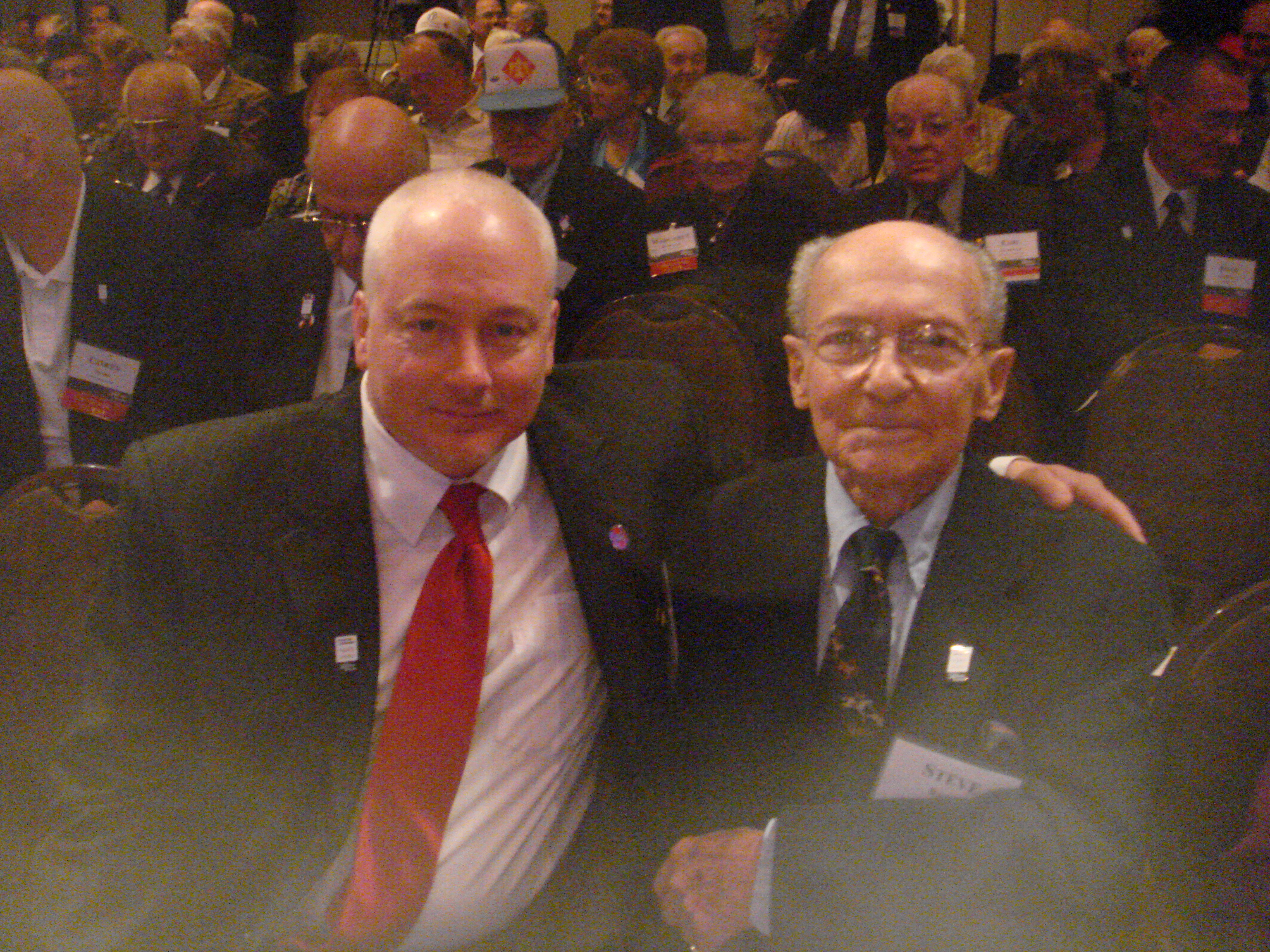
Matthew Rozell, Stephen Barry, National DOR Ceremony, Washington, DC April 2010. This photo was taken the day after the 65th anniversary of Steve's liberation in April 1945. We had just been honored by the director of the United States Holocaust Memorial Museum before the national ceremony in the Capitol Rotunda.

Matthew Rozell, Stephen Barry, National DOR Ceremony, Washington, DC April 2010. This photo was taken the day after the 65th anniversary of Steve’s liberation in April 1945. We had just been honored by the director of the United States Holocaust Memorial Museum before the national ceremony in the Capitol Rotunda.

So, the ripples continue. Somebody said it was like pebbles being tossed into the still water. This may sound strange, but I am keenly aware of the cosmic element. We tripped the wires of the cosmos.

~”It’s not for my sake, it’s for the sake of humanity, that they will remember”~

I got a nice email  recently. My friend Steve Barry was honored Tuesday evening at the United States Holocaust Memorial Museum. Steve’s daughters wanted me to know that his family made a donation in his name and set up two fellowships for scholars at the USHMM in the Stephen B. Barry Memorial Fellowship. His girls mentioned me in their speech Tuesday night in Washington. Thanks ladies. You know he was a hero. He reached out and touched an awful lot of students in the short time that we were together.

Steve will be one of the persons who will be featured in my book. Against all the odds he survived the Holocaust and later even went on to become a US Army Ranger in the Korean War! I was pretty close to him. Right now I am wistfully looking at his homemade holiday greeting cards under my desk glass, and to my left, a foot away, are the shelves containing his Holocaust library, which was passed on to me after he passed away. He was so funny, too.  He told me he nearly “choked on my bagel” a few years back when he opened his newspaper in Florida and read about me and the train he had been looking for, for so many years!

I miss the guy. You can read more about him here.


Steve's name on the wall of donors, USHMM, unveiled April 29, 2014.

Steve’s name on the wall of donors, USHMM, unveiled April 29, 2014.

The inscription kind of says it all. He uttered these words in my very classroom on a Thursday morning to a film crew from New York City, aimed at the 1500 students that he and the other survivors and American soldier/liberators had come to address. That Friday evening of our big soldier/survivor reunion, we watched it together on national news before our final banquet.

You can see the video at the bottom-he’s the one in the preview addressing the interviewer- but the transcript is below.

ABC WORLD NEWS TONIGHT, FRIDAY, SEPTEMBER 26, 2009

Diane Sawyer: And finally tonight, our Persons of the Week. It is a story that began almost 65 years ago in the darkest days of World War II. Yet this week, a new chapter unfolded. An unforgettable reunion of Holocaust survivors, and the American troops who freed them, and all made possible by a high school history class.

Matthew Rozell: This is history coming alive.
Veteran 1, entering school with his wife: Here we are, we have arrived!
Matthew Rozell: This is walking, talking, living history. They’re (the students) shaking hands with the past…

Diane Sawyer: It was 2001 when high school history teacher Matt Rozell decided to begin an oral history project. He and his students would just interview family members in the small town of Hudson Falls, New York, to capture fading stories of World War II.
Interviewer (soldier’s daughter): Did you mention the train [to Mr. Rozell] at all before?
Carrol Walsh, former soldier: No I didn’t tell him about the train.

Diane Sawyer: The students unearthed a forgotten crossroads in history. (Gunfire, archival film footage) Near the very end of World War II, April 13th, 1945, the American 30th Infantry Division was pushing its way into central Germany.
Carrol Walsh: We came to a place where there was a long train, of boxcars.

Diane Sawyer: They found a train, holding nearly 2,500 emaciated Jewish prisoners, many just children, being moved from the Bergen-Belsen concentration camp, to another camp and certain death. Their German guards had just abandoned them, fleeing the Americans.

Carrol Walsh: A feeling of helplessness. What are we going to do with all these people?
Frank Towers, former soldier: We had never ever seen anything so, (pauses) filthy.

Diane Sawyer: The American soldiers fed the prisoners, and brought them to safety.

Stephen Barry: For 42 years I collected anything that I could to try to find any article regarding the train. It just didn’t exist!

Diane Sawyer: But Mr. Rozell’s class put their interviews with veterans up on a website, along with these photographs taken by the American soldiers.

George Gross: Just very courageous people, little girls who with big smiles on their faces, one of them with their arms out, just aware that the Americans are there. [camera pans over 1945 liberation photograph]

Diane Sawyer: Out there on the web, Holocaust survivors all around the world began to notice.

Stephen Barry: I mean, how many people have a picture of their moment of liberation forever? [camera pans over 1945 liberation photograph]

(students and veterans and survivors singing “The Star Spangled Banner”)

Diane Sawyer: A reunion of the survivors and their liberators took place this week at Hudson Falls High School.

Emily Murphy, student: When they speak to us, you can’t say that you feel how they felt. But you get the feeling, you feel like you were there.

Diane Sawyer: In an age where there are still those who deny the Holocaust ever existed, these survivors say they are the living proof.

Stephen Barry: It’s not for my sake, it’s for the sake of humanity, that they will remember.

Diane Sawyer: And so we choose history teacher Matt Rozell, his class, the Holocaust survivors of that train, and the American soldiers who kept them and their story alive. And that is World News for this Friday. I am Diane Sawyer, and from all of us at ABC News, we hope you have a great weekend.

And here is a link to the 2014 United States Days of Remembrance Capitol Ceremony. Steve’s daughters and granddaughters are in the back row!


Read Full Post »


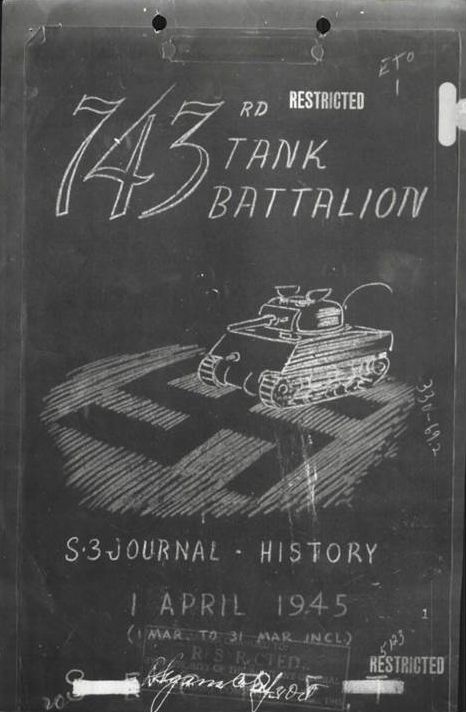
Cover of After Action Report for April 1945.

Cover of After Action Report for April 1945.

Today is the 69th anniversary of the liberation of the train near Magdeburg. How fitting it was/is falling at Passover time.

Emails and greetings are flying back and forth through the liberator/survivor network that we created.  Liberator Frank Towers always sends a message on this anniversary to the survivors.

From my one of my survivor friends:

Hello to all of you ‘my twins’ on our 69th birthday and to those who fought to give back our lives. Like the years before, there are no words enough to express our thanks to them.

How appropriate is this year for us who celebrate Seder to read, as an addition to the Hagaddah, Frank Towers’ beautiful greetings remembering OUR liberation from not just slavery but certain death.

Here is the opening of my new article. You can see the rest in the previous post.

Blessings to all on this reflective occasion.


~THE TRANSPORT TO LIFE~

With the end of the war in sight, a startling encounter takes place between Jewish victims of the Holocaust and American combat troops who have survived nine months of grueling combat across Northern France, Belgium, Holland and now Germany. In 2001, interviews conducted by a high school history teacher and his class paved the way for several joyful reunions between the survivors and their American soldier liberators over sixty years later.


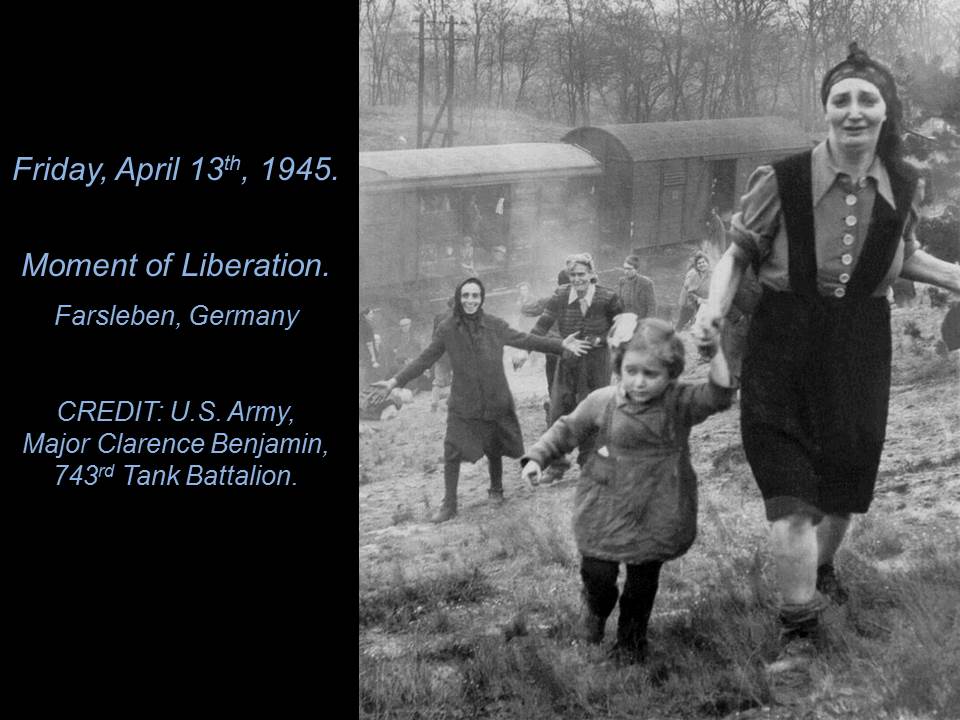
The photograph  is striking.

Query the word “train” and Holocaust” in an image search and the results returned generally show victims being deported to killing centers.

This is the opposite.Matthew Rozell

It is a cool spring morning. In the background, down the hill, are two cattle cars. At the opening of the sliding doors on one of the cars we can see a figure sitting on the edge, perhaps too weak to climb out yet soaking up some energy from the warming April sun. In front of him, a wisp of smoke seems to rise from a small makeshift fire that others have gathered around.

This is an appropriate backdrop for the drama unfolding in the foreground. Trudging up the hill toward the photographer, now only a few steps away, are a mother and her young daughter. The mother has her hair wrapped in a scarf and is clutching the hand of the girl with her right hand. Her left hand is extended outward as if in greeting; her face is turning into a half smile in a mixture of astonishment and enveloping joy, as if she is on the cusp of accepting the belief that she and her daughter have just been saved.

The little girl is shooting a sideways glance away from the camera. Her expression is one of distress- she looks terrified. On this morning in Germany in 1945, she may very well be responding to the two Sherman tanks that are now clanking up to the train, behind the photographer who is in the jeep with the white star.

Following the mother and daughter up the hill towards the soldiers are two other women. One welcomes the tanks with outstretched arms and a wide grin as she moves up the hill. The other follows behind her. She appears to be crying.

It is Friday, the 13th of April, 1945. Led by their major scouting in a jeep, Tanks 12 and 13 of the 743rd Tank Battalion of the U.S. Army have just liberated a train transport with thousands of sick and emaciated victims of the Holocaust. Major Clarence L. Benjamin snaps a photograph, which will be inserted into his official report back to headquarters.

But what have they stumbled upon? Where have these people come from?

And what do the soldiers do now?

**********************************************

Read Full Post »

PRISM SPR. 2014 I’ve had an article published in the Spring 2014 edition of PRISM: An Interdisciplinary Journal for Holocaust Educators, an “internationally renowned, annual, peer-reviewed journal” published by the Azrieli Graduate School of Jewish Education of Yeshiva University of New York, reaching readers in 35 countries and in all 50 American states. It is important to me to set the record straight and allow others the opportunity to read how this  history unfolded.

“In preserving and investigating the history, in interviewing liberators and Holocaust survivors, and in working with museums and memorial sites, Mr. Rozell and his students are also creating new knowledge, the highest form of academic achievement. Most importantly, in studying about the Holocaust, he and his students are also helping to rescue the evidence that can help stem the rising and dangerous tide of denial before it is too late.”

You can read the full edition here. The article appears on page 94. Obviously space did not allow for the full story to be told but that will come out in the book, so if it appears that a supporter, survivor or liberator friend has been left out, that is not the  real case. As always, thanks for your support, and thanks to editor Dr. Karen Shawn for recognizing the significance and the potential.

Read Full Post »

Matthew Rozell, 30th Infantry Veterans of WWII, Holocaust survivors at Mighty Eighth Air Force Museum, March 2, 2012.

Matthew Rozell, 30th Infantry Veterans of WWII, Holocaust survivors at Mighty Eighth Air Force Museum, March 2, 2012.

Have you ever been to a reunion of folks who have been annually meeting one another, every year, for nearly 70 years?

Where the main participants had their youths forged in the steel of battle, and come together annually to remind themselves of what it was all about?

I have been honored and privileged to attend six such reunions with the veterans of the 30th Infantry Division of World War II.

To sit with these men, and their wives and family members and hear their stories, and chuckle as they josh with each other, or to shed a tear at the memorial service for the ones who were lost, is an incredible experience.

What has made it even more profound, over the last few years, has been the inclusion of the Holocaust survivors that they saved, and their extended families who would not be here today, if not for their efforts, at these gatherings. And add a Medal of Honor recipient, one of the few surviving from World War II, for good measure.

Worthwhile? I had a 94 year old veteran grab me by the arm a couple years back, and he said to me, after listening to me and the survivors of the Holocaust speak, “Now I know what I fought for.”

This year, the reunion is unfolding as I write this in Savannah, Georgia, with the gracious hosts Carol Thompson and Jack Sullivan and his wife Stella, the children of one of the soldiers who served in the 118th Artillery.  Unfortunately I am snowed in up north, digging out under 18 inches. I’ve included my greetings to the gathering below as they meet on the 69th anniversary of the end of World War II. Next year is the 70th and I really hope that they meet again and that I can be there. As the letter indicates, they helped to send me to Europe this summer as well. Here is a PDF of what I saw.

Matthew Rozell

February 14, 2014

AND HERE IS MY REUNION GREETINGS MESSAGE AND PICS

Read Full Post »

Francis Curry, WWII Medal of Honor, with students.

Francis Curry, WWII Medal of Honor, with students.

FOUR years ago today the most incredible week concluded with former soldiers and the Holocaust survivors they saved watching this newscast together in cocktail lounge of the Georgian Resort in Lake George along with teachers and students from Hudson Falls High School. Thank you Tara, Mary, Lisa, Rene, and all the staff. And to ABC World News for recognizing the importance of the occasion, and to the United States Holocaust Memorial Museum and the Bergen Belsen Memorial for their attendance and support.

A teacher’s job is to toss pebbles. Several of the participants are gone now, but the ripples here became huge, and no one will forget what they meant, where they came from, or what they have led to.

Watch a story about how a teacher fellow from the Museum reunited Jewish prisoners with U.S. Army soldiers who liberated them from a train near Magdeburg, Germany, on April 13, 1945.

Read Full Post »

I met Leslie Meisels exactly four years ago today, when he and  Ariela Rojek and Paul Arato drove all the way down from Toronto, Canada to meet their actual liberators.

Leslie is one of the most gracious men I have ever met; I am honored to have him as one of my friends and am proud to be in on what he calls the latest miracle of his life.

I wrote to a reporter/columnist in Toronto, Canada, several months back to comment on a story that she had written, and she then had the opportunity to interview several of my survivor friends in the community who had been liberated on the Train Near Magdeburg. She struck up a friendship with Leslie, and this ebook resulted.

A sample:

When I first reached Leslie Meisels on the phone one afternoon in late April and asked for an interview, he told me to hold on a minute — he needed to get his day planner.

I thought he was joking.

Leslie is 86. What could he possibly be doing to fill up a day planner?

A lot, it turns out.

He has a wife, two daughters, four grandchildren. He is an active member of the North York Philatelic Society and a committee member of Circle of Care, an organization that provides services for Holocaust survivors. And he is a regular speaker with the Holocaust Education Centre’s survivor speakers bureau. This spring there were weeks when he addressed four different groups of students about his experience during World War II.

This was one of those weeks. He squeezed me in. I wanted to talk to him about the Holocaust and, more precisely, about his liberation from the Nazi murderers by a dozen surprised American soldiers who found Leslie and about 2,500 other captives near the end of the war, packed in cattle cars on a German train.

An email from an American teacher had tipped me off to the fact that a number of Toronto Holocaust survivors had recently been reunited with their liberators.

Leslie was one of them.

Of course, you can’t talk about liberation without talking first about enslavement. So, sitting on the couch of the neat, spacious penthouse condominium he shares with his wife, Eva, in Thornhill, Leslie started proudly with his family history in eastern Hungary.

Then came his carefree childhood. Then the introduction of anti-Semitic laws, the ghetto, the trains, the months of slave labour and the horrors of the Bergen-Belsen concentration camp, where more than 70,000 prisoners — most of them Jews — were killed.

Our interview lasted more than three hours, fueled by many cups of coffee and servings of fresh cheese palacsintas (crêpes) whipped up by Eva.

I noticed Leslie’s hands while we spoke. They are enormous — each finger twice as thick as mine, the palms like dinner plates. They are a working man’s hands, without any of the dirt. Everything about Leslie is immaculate — his neatly clipped and cleaned fingernails, his ironed pants and pressed dress shirt with a silver pen poking from its breast pocket, his freshly shaven face. His stories of being treated like a rabid dog were cast in relief by the careful pride he took in his appearance. There is an Old World elegance about him.

But the thing that struck me most about Leslie was his cheeky humour. His brown eyes narrowed and sparkled repeatedly as he took a “side step” to tell me about the girl he was “necking” with while a slave labourer or a refugee. Despite the horrors he endured, or perhaps because of them, Leslie maintained his champagne spirit.

Near the end of the interview, a question bubbled in my mind: what did you take with you? The Nazis had invaded Hungary in 1944. They ordered all the Jews in Leslie’s and other towns to first leave their homes, and then to leave town altogether on a train we now know was headed towards slavery or murder. What would you take if you could carry only a small bag or pillowcase to hold your belongings?

“Underwear,” Leslie responded, “and my stamp collection.”

I wrote that down and moved on. There were a lot of overpowering details in Leslie’s stories, and I still needed to hear about the reunion. But the stamps snagged my attention. There was a boyish innocence about them.

What happened to those stamps, I asked him over the phone a couple days later.

He responded: “I still have them. My mother sewed them into the lining of my jacket.”

Imagine that! Most Jews had all their clothing and belongings stripped away upon entering the concentration camps. You can see their boot brushes, ceramic pots and dolls piled up behind glass cases in the Auschwitz-Birkenau State Museum in Poland. That Leslie managed to keep his jacket was surprising enough. But that fragile pieces of paper survived the horrendous conditions — well,that seemed miraculous.

I drove back to their condominium for a third interview, this one in Leslie and Eva’s little office. I asked to see some of those stamps.

So Leslie pulled out his master list — a two-page typewritten list of all the stamp albums he has. There are dozens and dozens. He found one with his early Hungarian stamps and pulled it down from the shelf. Inside he’d arranged thousands of stamps in neat rows.

When I expressed surprise at the number of stamps he had, he smiled and opened a drawer in his desk.

“A crazy stamp collector saves all the stamps he comes across,” he said, pulling out a Tupperware container brimming with stamps. “When there are many, many, many, he bundles them up . . . and stores them away. I have millions of stamps.”

Leslie’s wife calls herself a “stamp widow.” She says he spends hours with his stamps a day. He loves them still, like he did when he started his collection 78 years ago. He loves the precision of arranging them. He loves the challenge of collecting a full set of stamps. He loves their colours and their stories. Every stamp, he says, depicts a story of a place, a historic moment or figure, a cause. “You can learn about the world through stamps,” he said.

As we flipped through his collection and he began to tell me the rest of his story, I could see snatches of it reflected in his stamps.

It is the tale not just of an idyllic childhood followed by the horrors of the Holocaust, but also that of a man who lived under Communism, escaped, lived for two years in a refugee camp, arrived in North America with nothing and then built up his life for a second time. Just as every stamp embodies a public story, a bit of history, Leslie’s stamps also tell the story of his life, its joys and deep sorrows, its disasters and its miracles.

************************************************

He is giving his 25th lecture on the Holocaust since April.

“Put yourself in my shoes,” he says to the Cardinal Carter Catholic High School students. “I think you are between 16 and 18, right? You can feel what I felt when I experienced those horrors.”

“They have to know,” Leslie says. “Otherwise, it will be forgotten and could be repeated.”

He talks for just over an hour, pausing only twice for a sip of water.

The stories pour out of him — of the deaf village elder who was strung up by his wrists to a cattle car, of the SS guards with their dogs who laughed at the sight of him naked with his grandmother and mother, of the hunger. He stirs in life lessons — like how his woodworking knowledge saved his life in Bergen-Belsen. “You are the same age as I was,” he says. “Never think you are studying for your teachers or your parents. Whatever you are putting in your head, you never know how it will serve you in life.”

But Leslie’s descriptions are muted at times. He clutters his sentences with clauses and chooses math over graphic detail to describe some horrors. The train crowding, for instance, affords each person a “square foot.” He mentions the bucket but doesn’t fill in the details of how that meant people were forced to defecate in their pants. He is old-school; talk like that seems degrading. Or perhaps the pungent details are too dangerous for him, scratching away the protective layers on his memories.

A girl in a powder-blue sweatshirt in the second-last row appears to have fallen asleep.

Is he getting through to them? Like most Holocaust survivors,

Leslie won’t be around to recount these stories for much longer. That inescapable truth adds an urgency to his message. Who then will bear witness?

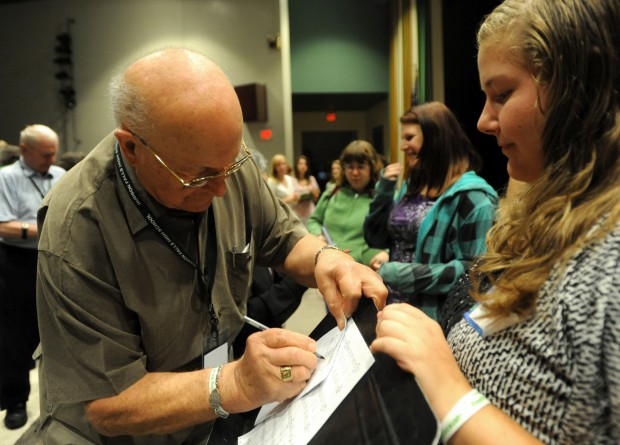
Holocaust survivor Leslie Meisels, left, signs a program for Hudson Falls senior Taylor Bump during Wednesday's "Remembering the Holocaust, Repairing the World" event. Meisels, who currently lives in Toronto, stressed the importance of relaying his experience to young people "so they remember and fight against discrimination, hatred and injustice." Jason McKibben Glens Falls Post Star

Holocaust survivor Leslie Meisels, left, signs a program for Hudson Falls senior Taylor Bump during Wednesday’s “Remembering the Holocaust, Repairing the World” event. Meisels, who currently lives in Toronto, stressed the importance of relaying his experience to young people “so they remember and fight against discrimination, hatred and injustice.”
Jason McKibben Glens Falls Post Star

He finishes his talk and asks for questions. The girl in the powder- blue sweatshirt from the back asks two. The second one is: “If you could go back, would you change any decisions you made?” She was listening, just with her eyes closed. Holocaust educator Ruth Ekstein says she often sees that — “the most fidgety kids you want to strangle, they are absorbing the most.” The content is so painful, it forces people to scratch and shuffle, or to close their eyes.

“Never allow this to happen to someone in the future, if you see an injustice,” Leslie tells the group. “Never just look at each other as equals. Treat each other as equals.”

************************************************

The last miracle

In 2001, Matt Rozell went to the home of one of his students in Hudson Falls, N.Y. Rozell is a high school history teacher there. He regularly assigned his Grade 10 students to interview the veterans in their family about World War II as a way to bring history alive.

That summer, he decided he would do the interviewing himself.

The veteran was retired New York State Supreme Court Justice Carrol Walsh Jr.

After two hours, when the interview was ending, Walsh’s daughter elbowed him and said, “Did you mention the train at all?”

“What?” Walsh said.

“The train.”

So Rozell asked to hear about this train, whatever it was.

Walsh told him about the beautiful, sunny day in April 1945, when after 10 months of fighting their way through France, Belgium,and Holland, and into Germany, his tank and his buddy George Gross’s tank were pulled out of the battalion to check out an abandoned train. An army scout had come across some Finnish prisoners of war in bad condition who reported they had escaped ,the train and that it was packed with prisoners.

Rozell posted the moving interview, as well as Gross’s astonishing photos from that day, on the school’s oral history website, where it sat quietly for four years.

That is, until a grandmother from Australia contacted him to ,say she had been a little girl on that train. The next month he got another email, and another, and another.

In September 2007, Rozell hosted the first reunion of Walsh and three survivors from that train. An Associated Press reporter wrote a story about the day-long event which was published around the world.

Paul Arato’s son Daniel read the story on the Internet. Arato was the 5-year-old boy who witnessed the birthday “present” of a bullet to the head in the Bergen-Belsen roll call. He was also a ,Hungarian Jew who grew up not far from Leslie. He, too, escaped Hungary in 1956 and resettled in Canada. An industrial designer, he was a work associate of Leslie. At the end of a business meeting, the topic of the Holocaust somehow came up. They discovered, to their shock, that they had both been on that train from Bergen-

Belsen. Paul, in turn, told Leslie about the Hudson Falls reunion.

Two years later, they both ventured down to Hudson Falls for a second reunion — a three-day symposium that brought together nine survivors and seven soldiers, including two of their liberators

— Frank Towers and Carrol Walsh.

On the drive down, Leslie was very excited. The initial meeting, over dinner, was spectacular.

“No words can explain the feeling of shaking hands, hugging, laughing and crying with the people who gave me back my life on April 13,” he says. “I never ever imagined that would happen.”

He calls the veterans “angels of my life.” They, in turn, said they were just doing their job.

Leslie and Walsh became close friends. They talked regularly on the phone. They spent some time together in Florida, before Walsh died last winter at the age of 91.

Leslie calls that friendship the last miracle of his life.

Leslie’s 17-year-old granddaughter, Jessica, visited Auschwitz last spring while participating in the two-week educational trip March of the Living. She left behind a small, hand-written sign that said: “I am marching in honour of my grandparents Eva and Leslie Meisels. As well as a soldier, Carrol Walsh.”

******************************************

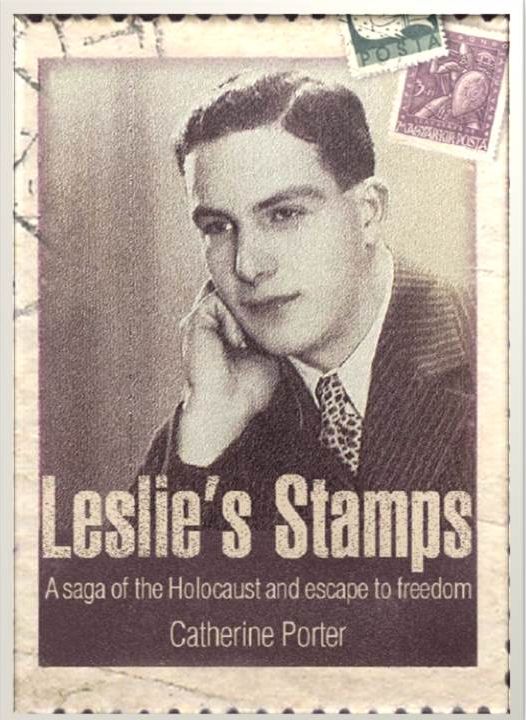
Leslie's StampsLeslie’s Stamps: A Saga of the Holocaust and Escape to Freedom

He had an idyllic childhood in a small Hungarian town where, it seemed, there was no animosity between the Christian majority and Jews like him. But with the rise of Hitler and the Nazis, everything changed for Leslie Meisels, who ended up in Bergen-Belsen concentration camp with his family. Through his wartime ordeals, Leslie carried his stamp collection, started when he was 8, in the lining of his jacket. In Leslie’s Stamps: A Saga of the Holocaust and Escape to Freedom, award-winning Toronto Star columnist Catherine Porter tells the dramatic story of Leslie’s life through his stamps. It is a tale of love, courage and the power of the human spirit.

Leslie’s Stamps: A Saga of the Holocaust and Escape to Freedom is available for $2.99 at http://starstore.ca/collections/star-dispatches-ereads/products/leslies-stamps and itunes.com/stardispatches.

Read Full Post »

guns at last lightI’m recovering from a foot injury and it has given me time to finish Rick Atkinson’s latest release, The Guns at Last Light: The War in Western Europe, 1944-1945 in his Liberation Trilogy. With school around the corner, I am excited to be teaching a couple dozen seniors once again about World War II, and in the springtime, the Holocaust.

I’m happy with Mr. Atkinson’s coverage of the heroics of the 30th Infantry Division-he even made a research pilgrimage to Hill 314 in Mortain, where elements of the 30th held off against a Hitler-ordered panzer counterattack for 6 days, saving the Allied breakout in Normandy in August 1944. 

If you are a follower of this site, you will know that that division is dear to my heart, not because of any blood relations who fought in it, but because they named me an honorary member of their Veterans of World War II Association for my work in the classroom and in uncovering and reuniting the story of the liberation of the concentration camp train at Farsleben, Germany on Friday, April 13, 1945.

So you can imagine my excitement when I ran across this passage last evening from page 599 of Rick’s book. He writes about some of the chaos that unfolded as POWs, slave laborers, and concentration camps were liberated in Germany:

“Instead, starvation, revenge, indiscipline, and chaos often created what Allied officers called a “liberation complex.” SHAEF [Supreme Headquarters Allied Expeditionary Forces ] had presumed that refugees “would be tractable, grateful, and powerless after their domination for from two to five years as the objects of German slave policies.” As an Army assessment concluded, “They were none of these things.… Newly liberated persons looted, robbed, murdered, and in some cases destroyed their own shelter.” Freed laborers plundered houses in the Ruhr, burning furniture for cook fires and discarding slave rags to dress in business suits, pajamas, and evening clothes ransacked from German wardrobes. Ravenous ex-prisoners licked flour off the floor of a Farsleben bakery. In Osnabrück, “rampageous” Russian slaves died after swilling V-2 rocket fuel discovered in a storage yard. Others smashed wine barrels and liquor bottles in a Hanover cellar, drinking so heavily from a sloshing, six-inch-deep pool of alcohol on the floor that several collapsed in a stupor and drowned before U.S. MPs could close the entrance.”

So I did a double take: Ravenous ex-prisoners licked flour off the floor of a Farsleben bakery. I checked his notes-page 801, sure enough, 30th Division G-2 report. I know I have read this before in my research of primary source documentation, originally sent to me by Frank Towers, one of the liberators.  Here it is.

30th Division Medical Detachment Diary & Log

Of course, the backstory surrounding the document above is the story that I have to tell- the soldiers of the 30th Infantry Division and the attached 743rd Tank Battalion, the Holocaust survivors whom they stumbled upon, liberated, and were reunited with 62 years later at our high school and subsequent events.  I’ll probably share the Benjamin photo with Mr. Atkinson on his FB page. 

Anyway, I recommend the book to any of my followers interested in the history of World War II in the European theater, and am really pumped to teach some very excited and motivated students this year, including the grandson of the tank commander who was sent to investigate the train.

This is how you “do” history, and how the teaching of history can sometimes take on a life of its own. So cool to be a part of it, and to read something in a best seller and be able to grasp the incredible backstory that awaits to be told.

Read Full Post »

« Newer Posts - Older Posts »