Feeds:
Posts
Comments

Posts Tagged ‘30th Infantry Division’

I am reposting this today for Veterans’ Day 2013. Also tune into CBS 6 Albany NY at 6pm this evening for a feature story on him. Frank was in the 30th Infantry Division, which liberated the Train Near Magdeburg; he came to our school.

The morning of December 16, 1944. A lonely outpost on the Belgian frontier.

“Both the enemy and the weather could kill you, and the two of them together was a pretty deadly combination.” Bulge veteran Bart Hagerman. Photo: George Silk/Time & Life Pictures/Getty Images Dec 20, 1944

In subzero temperatures, the last German counteroffensive of World War II had begun. Nineteen thousand American lives would be lost in the Battle of the Bulge. “Hell came in like a freight train. I heard an explosion and went back to where my friend was. His legs were blown off-he bled to death in my arms.” The average age of the American “replacement” soldier? 19.

Of the sixteen million American men and women who served in WWII, four and a quarter hundred thousand died on the field of conflict. In 2011, nearly 1000 veterans of World War II quietly slip away every day. The national memory of the war that did more than any other event in the last century to shape the history of the American nation is dying with them. The Germans threw 250,000 well trained troops and tanks against a lightly defended line on the Ardennes frontier in Belgium and Luxembourg, which created a pocket or “bulge” in the Allied offensive line, the objective being to drive to the port of Antwerp to split the American and British advance and force a separate peace with the Western Allies. What ensued was the bloodiest battle in American history. It saddens me that it comes as a shock to many Americans today that the “Battle of the Bulge” didn’t originate as a weight-loss term.

On a personal note, I have had the privilege of interviewing many of the veterans of this battle. In the high school where I teach, I have been inviting veterans to my classroom to share their experiences with our students. As their numbers dwindled, I smartened up, bought a camera, and began to record their stories. And for the past decade, I have been sending kids out into the field to record the stories of World War II before this generation fades altogether. These men and women have helped to spark students’ interest in finding out more about our nation’s past and the role of the individual in shaping it. On our website we have worked to weave the stories of our community’s sacrifices into the fabric of our national history. And that, to me, is what teaching history should be all about. After all, if we allow ourselves to forget about the teenager who bled to death in his buddy’s arms, if we overlook the sacrifices it took to make this nation strong and proud, we may as well forget everything else. I shudder for this country when I see what we have all forgotten, so soon. But if you are taking the time to read this post I suppose I am preaching to the saved.

I will close with the account of a nineteen year old infantryman who in fact survived the battle and the war, and who I was able to introduce to many Hudson Falls students on more than one occasion. Sixty-nine years ago this December, a day began that would forever change his life.  Frank is now the only living Medal of Honor recipient from World War II left in New York State and New England.

In the winter of 1944, nineteen year old Private First Class Currey’s infantry squad was fighting the Germans in the Belgian town of Malmédy to help contain the German counteroffensive in the Battle of the Bulge. Before dawn on December 21, Currey’s unit was defending a strong point when a sudden German armored advance overran American antitank guns and caused a general withdrawal. Currey and five other soldiers—the oldest was twenty-one—were cut off and surrounded by several German tanks and a large number of infantrymen. They began a daylong effort to survive.

Francis Currey MOH and Ned Rozell March 2010-Ned is friends with the last WWII Medal of Honor recipient in NY and NE, Frances Currey. Yes, the special edition GI Joe he signed for Ned is  19 yr. old Frank!

Francis Currey MOH and Ned Rozell March 2010-Ned is friends with the last WWII Medal of Honor recipient in NY and NE, Frances Currey. Yes, the special edition GI Joe he signed for Ned is 19 yr. old Frank!

The six GIs withdrew into an abandoned factory, where they found a bazooka left behind by American troops. Currey knew how to operate one, thanks to his time in Officer Candidate School, but this one had no ammunition. From the window of the factory, he saw that an abandoned half-track across the street contained rockets. Under intense enemy fire, he ran to the half-track, loaded the bazooka, and fired at the nearest tank. By what he would later call a miracle, the rocket hit the exact spot where the turret joined the chassis and disabled the vehicle.

Moving to another position, Currey saw three Germans in the doorway of an enemy-held house and shot all of them with his Browning Automatic Rifle. He then picked up the bazooka again and advanced, alone, to within fifty yards of the house. He fired a shot that collapsed one of its walls, scattering the remaining German soldiers inside. From this forward position, he saw five more GIs who had been cut off during the American withdrawal and were now under fire from three nearby German tanks. With antitank grenades he’d collected from the half-track, he forced the crews to abandon the tanks. Next, finding a machine gun whose crew had been killed, he opened fire on the retreating Germans, allowing the five trapped Americans to escape.

Deprived of tanks and with heavy infantry casualties, the enemy was forced to withdraw. Through his extensive knowledge of weapons and by his heroic and repeated braving of murderous enemy fire, Currey was greatly responsible for inflicting heavy losses in men and material on the enemy, for rescuing 5 comrades, 2 of whom were wounded, and for stemming an attack which threatened to flank his battalion’s position.

At nightfall, as Currey and his squad, including the two seriously wounded men, tried to find their way back to the American lines, they came across an abandoned Army jeep fitted out with stretcher mounts. They loaded the wounded onto it, and Currey, perched on the jeep’s spare wheel with a Browning automatic rifle in his hand, rode shotgun back to the American lines.

After the war in Europe had officially ended, Major General Leland Hobbs made the presentation on July 27, 1945, at a division parade in France.

source material Medal of Honor: Portraits of Valor Beyond the Call of Duty by Peter Collier.

Frank on TV   http://www.cbs6albany.com/news/features/top-story/stories/hometown-heroes-sergeant-francis-currey-12021.shtml

Frank signs autographs at our school.

Read Full Post »

Francis Curry, WWII Medal of Honor, with students.

Francis Curry, WWII Medal of Honor, with students.

FOUR years ago today the most incredible week concluded with former soldiers and the Holocaust survivors they saved watching this newscast together in cocktail lounge of the Georgian Resort in Lake George along with teachers and students from Hudson Falls High School. Thank you Tara, Mary, Lisa, Rene, and all the staff. And to ABC World News for recognizing the importance of the occasion, and to the United States Holocaust Memorial Museum and the Bergen Belsen Memorial for their attendance and support.

A teacher’s job is to toss pebbles. Several of the participants are gone now, but the ripples here became huge, and no one will forget what they meant, where they came from, or what they have led to.

Watch a story about how a teacher fellow from the Museum reunited Jewish prisoners with U.S. Army soldiers who liberated them from a train near Magdeburg, Germany, on April 13, 1945.

Read Full Post »

I met Leslie Meisels exactly four years ago today, when he and  Ariela Rojek and Paul Arato drove all the way down from Toronto, Canada to meet their actual liberators.

Leslie is one of the most gracious men I have ever met; I am honored to have him as one of my friends and am proud to be in on what he calls the latest miracle of his life.

I wrote to a reporter/columnist in Toronto, Canada, several months back to comment on a story that she had written, and she then had the opportunity to interview several of my survivor friends in the community who had been liberated on the Train Near Magdeburg. She struck up a friendship with Leslie, and this ebook resulted.

A sample:

When I first reached Leslie Meisels on the phone one afternoon in late April and asked for an interview, he told me to hold on a minute — he needed to get his day planner.

I thought he was joking.

Leslie is 86. What could he possibly be doing to fill up a day planner?

A lot, it turns out.

He has a wife, two daughters, four grandchildren. He is an active member of the North York Philatelic Society and a committee member of Circle of Care, an organization that provides services for Holocaust survivors. And he is a regular speaker with the Holocaust Education Centre’s survivor speakers bureau. This spring there were weeks when he addressed four different groups of students about his experience during World War II.

This was one of those weeks. He squeezed me in. I wanted to talk to him about the Holocaust and, more precisely, about his liberation from the Nazi murderers by a dozen surprised American soldiers who found Leslie and about 2,500 other captives near the end of the war, packed in cattle cars on a German train.

An email from an American teacher had tipped me off to the fact that a number of Toronto Holocaust survivors had recently been reunited with their liberators.

Leslie was one of them.

Of course, you can’t talk about liberation without talking first about enslavement. So, sitting on the couch of the neat, spacious penthouse condominium he shares with his wife, Eva, in Thornhill, Leslie started proudly with his family history in eastern Hungary.

Then came his carefree childhood. Then the introduction of anti-Semitic laws, the ghetto, the trains, the months of slave labour and the horrors of the Bergen-Belsen concentration camp, where more than 70,000 prisoners — most of them Jews — were killed.

Our interview lasted more than three hours, fueled by many cups of coffee and servings of fresh cheese palacsintas (crêpes) whipped up by Eva.

I noticed Leslie’s hands while we spoke. They are enormous — each finger twice as thick as mine, the palms like dinner plates. They are a working man’s hands, without any of the dirt. Everything about Leslie is immaculate — his neatly clipped and cleaned fingernails, his ironed pants and pressed dress shirt with a silver pen poking from its breast pocket, his freshly shaven face. His stories of being treated like a rabid dog were cast in relief by the careful pride he took in his appearance. There is an Old World elegance about him.

But the thing that struck me most about Leslie was his cheeky humour. His brown eyes narrowed and sparkled repeatedly as he took a “side step” to tell me about the girl he was “necking” with while a slave labourer or a refugee. Despite the horrors he endured, or perhaps because of them, Leslie maintained his champagne spirit.

Near the end of the interview, a question bubbled in my mind: what did you take with you? The Nazis had invaded Hungary in 1944. They ordered all the Jews in Leslie’s and other towns to first leave their homes, and then to leave town altogether on a train we now know was headed towards slavery or murder. What would you take if you could carry only a small bag or pillowcase to hold your belongings?

“Underwear,” Leslie responded, “and my stamp collection.”

I wrote that down and moved on. There were a lot of overpowering details in Leslie’s stories, and I still needed to hear about the reunion. But the stamps snagged my attention. There was a boyish innocence about them.

What happened to those stamps, I asked him over the phone a couple days later.

He responded: “I still have them. My mother sewed them into the lining of my jacket.”

Imagine that! Most Jews had all their clothing and belongings stripped away upon entering the concentration camps. You can see their boot brushes, ceramic pots and dolls piled up behind glass cases in the Auschwitz-Birkenau State Museum in Poland. That Leslie managed to keep his jacket was surprising enough. But that fragile pieces of paper survived the horrendous conditions — well,that seemed miraculous.

I drove back to their condominium for a third interview, this one in Leslie and Eva’s little office. I asked to see some of those stamps.

So Leslie pulled out his master list — a two-page typewritten list of all the stamp albums he has. There are dozens and dozens. He found one with his early Hungarian stamps and pulled it down from the shelf. Inside he’d arranged thousands of stamps in neat rows.

When I expressed surprise at the number of stamps he had, he smiled and opened a drawer in his desk.

“A crazy stamp collector saves all the stamps he comes across,” he said, pulling out a Tupperware container brimming with stamps. “When there are many, many, many, he bundles them up . . . and stores them away. I have millions of stamps.”

Leslie’s wife calls herself a “stamp widow.” She says he spends hours with his stamps a day. He loves them still, like he did when he started his collection 78 years ago. He loves the precision of arranging them. He loves the challenge of collecting a full set of stamps. He loves their colours and their stories. Every stamp, he says, depicts a story of a place, a historic moment or figure, a cause. “You can learn about the world through stamps,” he said.

As we flipped through his collection and he began to tell me the rest of his story, I could see snatches of it reflected in his stamps.

It is the tale not just of an idyllic childhood followed by the horrors of the Holocaust, but also that of a man who lived under Communism, escaped, lived for two years in a refugee camp, arrived in North America with nothing and then built up his life for a second time. Just as every stamp embodies a public story, a bit of history, Leslie’s stamps also tell the story of his life, its joys and deep sorrows, its disasters and its miracles.

************************************************

He is giving his 25th lecture on the Holocaust since April.

“Put yourself in my shoes,” he says to the Cardinal Carter Catholic High School students. “I think you are between 16 and 18, right? You can feel what I felt when I experienced those horrors.”

“They have to know,” Leslie says. “Otherwise, it will be forgotten and could be repeated.”

He talks for just over an hour, pausing only twice for a sip of water.

The stories pour out of him — of the deaf village elder who was strung up by his wrists to a cattle car, of the SS guards with their dogs who laughed at the sight of him naked with his grandmother and mother, of the hunger. He stirs in life lessons — like how his woodworking knowledge saved his life in Bergen-Belsen. “You are the same age as I was,” he says. “Never think you are studying for your teachers or your parents. Whatever you are putting in your head, you never know how it will serve you in life.”

But Leslie’s descriptions are muted at times. He clutters his sentences with clauses and chooses math over graphic detail to describe some horrors. The train crowding, for instance, affords each person a “square foot.” He mentions the bucket but doesn’t fill in the details of how that meant people were forced to defecate in their pants. He is old-school; talk like that seems degrading. Or perhaps the pungent details are too dangerous for him, scratching away the protective layers on his memories.

A girl in a powder-blue sweatshirt in the second-last row appears to have fallen asleep.

Is he getting through to them? Like most Holocaust survivors,

Leslie won’t be around to recount these stories for much longer. That inescapable truth adds an urgency to his message. Who then will bear witness?

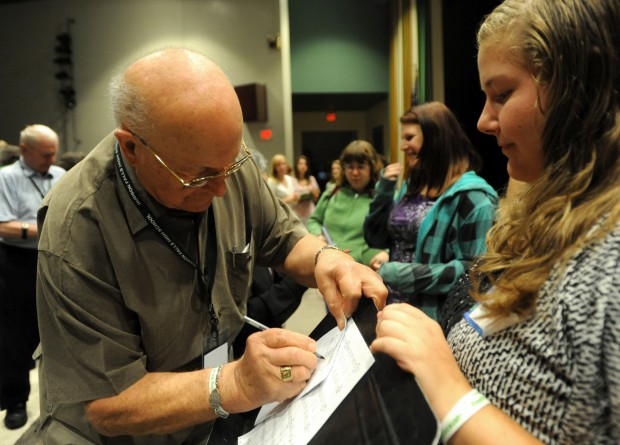
Holocaust survivor Leslie Meisels, left, signs a program for Hudson Falls senior Taylor Bump during Wednesday's "Remembering the Holocaust, Repairing the World" event. Meisels, who currently lives in Toronto, stressed the importance of relaying his experience to young people "so they remember and fight against discrimination, hatred and injustice." Jason McKibben Glens Falls Post Star

Holocaust survivor Leslie Meisels, left, signs a program for Hudson Falls senior Taylor Bump during Wednesday’s “Remembering the Holocaust, Repairing the World” event. Meisels, who currently lives in Toronto, stressed the importance of relaying his experience to young people “so they remember and fight against discrimination, hatred and injustice.”
Jason McKibben Glens Falls Post Star

He finishes his talk and asks for questions. The girl in the powder- blue sweatshirt from the back asks two. The second one is: “If you could go back, would you change any decisions you made?” She was listening, just with her eyes closed. Holocaust educator Ruth Ekstein says she often sees that — “the most fidgety kids you want to strangle, they are absorbing the most.” The content is so painful, it forces people to scratch and shuffle, or to close their eyes.

“Never allow this to happen to someone in the future, if you see an injustice,” Leslie tells the group. “Never just look at each other as equals. Treat each other as equals.”

************************************************

The last miracle

In 2001, Matt Rozell went to the home of one of his students in Hudson Falls, N.Y. Rozell is a high school history teacher there. He regularly assigned his Grade 10 students to interview the veterans in their family about World War II as a way to bring history alive.

That summer, he decided he would do the interviewing himself.

The veteran was retired New York State Supreme Court Justice Carrol Walsh Jr.

After two hours, when the interview was ending, Walsh’s daughter elbowed him and said, “Did you mention the train at all?”

“What?” Walsh said.

“The train.”

So Rozell asked to hear about this train, whatever it was.

Walsh told him about the beautiful, sunny day in April 1945, when after 10 months of fighting their way through France, Belgium,and Holland, and into Germany, his tank and his buddy George Gross’s tank were pulled out of the battalion to check out an abandoned train. An army scout had come across some Finnish prisoners of war in bad condition who reported they had escaped ,the train and that it was packed with prisoners.

Rozell posted the moving interview, as well as Gross’s astonishing photos from that day, on the school’s oral history website, where it sat quietly for four years.

That is, until a grandmother from Australia contacted him to ,say she had been a little girl on that train. The next month he got another email, and another, and another.

In September 2007, Rozell hosted the first reunion of Walsh and three survivors from that train. An Associated Press reporter wrote a story about the day-long event which was published around the world.

Paul Arato’s son Daniel read the story on the Internet. Arato was the 5-year-old boy who witnessed the birthday “present” of a bullet to the head in the Bergen-Belsen roll call. He was also a ,Hungarian Jew who grew up not far from Leslie. He, too, escaped Hungary in 1956 and resettled in Canada. An industrial designer, he was a work associate of Leslie. At the end of a business meeting, the topic of the Holocaust somehow came up. They discovered, to their shock, that they had both been on that train from Bergen-

Belsen. Paul, in turn, told Leslie about the Hudson Falls reunion.

Two years later, they both ventured down to Hudson Falls for a second reunion — a three-day symposium that brought together nine survivors and seven soldiers, including two of their liberators

— Frank Towers and Carrol Walsh.

On the drive down, Leslie was very excited. The initial meeting, over dinner, was spectacular.

“No words can explain the feeling of shaking hands, hugging, laughing and crying with the people who gave me back my life on April 13,” he says. “I never ever imagined that would happen.”

He calls the veterans “angels of my life.” They, in turn, said they were just doing their job.

Leslie and Walsh became close friends. They talked regularly on the phone. They spent some time together in Florida, before Walsh died last winter at the age of 91.

Leslie calls that friendship the last miracle of his life.

Leslie’s 17-year-old granddaughter, Jessica, visited Auschwitz last spring while participating in the two-week educational trip March of the Living. She left behind a small, hand-written sign that said: “I am marching in honour of my grandparents Eva and Leslie Meisels. As well as a soldier, Carrol Walsh.”

******************************************

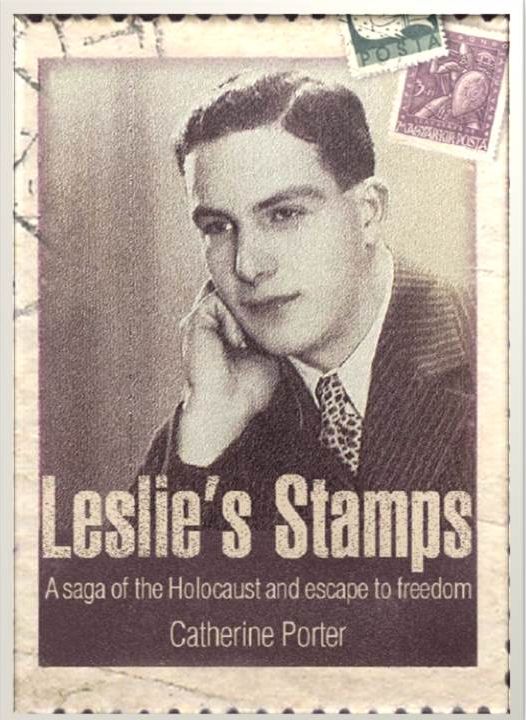
Leslie's StampsLeslie’s Stamps: A Saga of the Holocaust and Escape to Freedom

He had an idyllic childhood in a small Hungarian town where, it seemed, there was no animosity between the Christian majority and Jews like him. But with the rise of Hitler and the Nazis, everything changed for Leslie Meisels, who ended up in Bergen-Belsen concentration camp with his family. Through his wartime ordeals, Leslie carried his stamp collection, started when he was 8, in the lining of his jacket. In Leslie’s Stamps: A Saga of the Holocaust and Escape to Freedom, award-winning Toronto Star columnist Catherine Porter tells the dramatic story of Leslie’s life through his stamps. It is a tale of love, courage and the power of the human spirit.

Leslie’s Stamps: A Saga of the Holocaust and Escape to Freedom is available for $2.99 at http://starstore.ca/collections/star-dispatches-ereads/products/leslies-stamps and itunes.com/stardispatches.

Read Full Post »

guns at last lightI’m recovering from a foot injury and it has given me time to finish Rick Atkinson’s latest release, The Guns at Last Light: The War in Western Europe, 1944-1945 in his Liberation Trilogy. With school around the corner, I am excited to be teaching a couple dozen seniors once again about World War II, and in the springtime, the Holocaust.

I’m happy with Mr. Atkinson’s coverage of the heroics of the 30th Infantry Division-he even made a research pilgrimage to Hill 314 in Mortain, where elements of the 30th held off against a Hitler-ordered panzer counterattack for 6 days, saving the Allied breakout in Normandy in August 1944. 

If you are a follower of this site, you will know that that division is dear to my heart, not because of any blood relations who fought in it, but because they named me an honorary member of their Veterans of World War II Association for my work in the classroom and in uncovering and reuniting the story of the liberation of the concentration camp train at Farsleben, Germany on Friday, April 13, 1945.

So you can imagine my excitement when I ran across this passage last evening from page 599 of Rick’s book. He writes about some of the chaos that unfolded as POWs, slave laborers, and concentration camps were liberated in Germany:

“Instead, starvation, revenge, indiscipline, and chaos often created what Allied officers called a “liberation complex.” SHAEF [Supreme Headquarters Allied Expeditionary Forces ] had presumed that refugees “would be tractable, grateful, and powerless after their domination for from two to five years as the objects of German slave policies.” As an Army assessment concluded, “They were none of these things.… Newly liberated persons looted, robbed, murdered, and in some cases destroyed their own shelter.” Freed laborers plundered houses in the Ruhr, burning furniture for cook fires and discarding slave rags to dress in business suits, pajamas, and evening clothes ransacked from German wardrobes. Ravenous ex-prisoners licked flour off the floor of a Farsleben bakery. In Osnabrück, “rampageous” Russian slaves died after swilling V-2 rocket fuel discovered in a storage yard. Others smashed wine barrels and liquor bottles in a Hanover cellar, drinking so heavily from a sloshing, six-inch-deep pool of alcohol on the floor that several collapsed in a stupor and drowned before U.S. MPs could close the entrance.”

So I did a double take: Ravenous ex-prisoners licked flour off the floor of a Farsleben bakery. I checked his notes-page 801, sure enough, 30th Division G-2 report. I know I have read this before in my research of primary source documentation, originally sent to me by Frank Towers, one of the liberators.  Here it is.

30th Division Medical Detachment Diary & Log

Of course, the backstory surrounding the document above is the story that I have to tell- the soldiers of the 30th Infantry Division and the attached 743rd Tank Battalion, the Holocaust survivors whom they stumbled upon, liberated, and were reunited with 62 years later at our high school and subsequent events.  I’ll probably share the Benjamin photo with Mr. Atkinson on his FB page. 

Anyway, I recommend the book to any of my followers interested in the history of World War II in the European theater, and am really pumped to teach some very excited and motivated students this year, including the grandson of the tank commander who was sent to investigate the train.

This is how you “do” history, and how the teaching of history can sometimes take on a life of its own. So cool to be a part of it, and to read something in a best seller and be able to grasp the incredible backstory that awaits to be told.

Read Full Post »

BusterOne of the hard parts about this project is that people whom you come to know and love get older and pass away on you. But you are thankful that you came to know them, and how you saw them enrich your life and the lives of others.

I first met Buster over five years ago, when I attended my first 30th Infantry Division reunion and he served as the chaplain and the master of ceremonies and chief auctioneer at our final banquet. He had a funny way of putting folks at ease, and the auctions were like a comedy act. He was very devout and serious about his chaplain duties, though.

I have a couple short video clips to share. The first I post on D-Day every year. A producer from ABC News in New York called me looking for the Benjamin photo for a piece on veterans returning to Normandy. Though the 30th did not land until after D-Day, the fact is that Allied forces were only ten miles in, with some very heavy and decisive battles still ahead for the 30th. They would also be bombed not once but twice by Allied heavy bombers on two consecutive days before the launch of Operation Cobra.Buster was a combat medic. “You did not stop to think about how you would cope. You just did the best you could.”

Buster was so taken with the appearance of the Holocaust survivors in the Old Hickorymen’s lives after 62 years, he told the story everywhere he went. After his wife died unexpectedly, he was at a loss, but I know that getting out into the community to tell the story of the Holocaust and the 30th’s connection to this amazing photograph kept him going for a while. He’d call me up at school, looking for pictures to share with students down South in the classrooms. He became a Holocaust educator! And he was sure proud to be an American.

He and his son Sandy, who also recently passed, expended a great deal of energy traveling to our high school in upstate NY for the last reunion with soldiers and survivors at our high school. At the tail end of this short clip he describes one of the wonders of this trip for him. I guess if I was dancing with a lovely young thing, or two, or three, I would say the same!

To close, I wish to paraphrase the reporter for the ABC story, Erin Hayes:

Maybe, just maybe, a group of students like those at College of the Ozarks will discover [veterans] and they’ll get them to tell their stories, to hear what I heard … that a generation that will soon be gone left us a legacy of bravery and wisdom and resilience.

We really, really should treasure that — before it’s too late.

Rest on, Buster. Peace to their families.

*******************************************************************

Buster Marion Simmons, 91, a resident of Farmington, Ark., passed away July 20, 2013 in Fayetteville. He was born July 7, 1922 in Orange County, N.C, the son of Tom and Olivia Jackson Simmons.

Buster served in the United States Army during World War II. He was a Combat Medic in the 30th Infantry Division throughout the European theater. He served as the Chaplain for the 30th Infantry Division reunions. Buster attended many reunions in Europe and all over the USA. His favorite trip to Europe was in 1994 when his granddaughter traveled with him. He worked until he was more than 80 years old.

He was preceded in death by his parents; wife of 67 years Bessie Mae Simmons; two sons, Eric G. Simmons and William J. “Sandy” Simmons; three brothers, William Clinton, Glimer and Wayne; one sister Lucille Oakley.

Survivors include one daughter-in-law Kathy Simmons; one granddaughter, Nancy Woodward and husband Rusty; one great-grandson Garrett Woodward and his grand dachshund Buster, all of Farmington.

A Memorial Service will be held at 4 p.m. Tuesday, July 23, 2013, at the Luginbuel Chapel in Prairie Grove with Preston Beeks officiating. He will be interred in Burlington, N.C. at a later date.

Memorials may be made to the Willard Walker Hospice Home, 325 E. Longview St. Fayetteville, AR. 72704; Farmington Senior Center – Meals on Wheels, 340 W. Main, Farmington, AR. 72730 or a charity of your choice .

Read Full Post »

World War II infantry veteran Carrol Walsh, top, hugs Holocaust survivor Paul Arato at a reunion in Queensbury, N.Y., on Tuesday, Sept. 22, 2009. Walsh’s unit liberated a Nazi train carrying 2,500 Jewish prisoners, including Arato, from the Bergen-Belsen concentration camp in Germany during the war’s waning days. (AP Photo/Tim Roske)

I am reposting this today to honor both of the men below. Paul Arato passed away this week in Toronto, Canada and his memorial service is today. Carrol Walsh, his liberator, died in Dec. at his home in Florida and his memorial service was last Friday in New York.

Paul and Rona would also check in annually for dinner with the Walsh family when they passed through our town. The last time I saw both of them together was in 2011 at one of these dinners in a local restaurant. They sat together and laughed and joked like old pals. Paul told the story of how he arrived in Detroit after the war as an eager late teen anxious to find work designing fast cars in the automobile industry and was driven to the bridge in Canada by law enforcement and pointed to the bridge to Canada, as he did not have the proper documentation. Picturing the scene in his mind, Carrol would laughed outloud and slapped his knee. Both men were so happy to have found each other.

Rest on, friends.

Holocaust Survivors Reunite With US Veterans

NY high school reunites Holocaust survivors liberated from Nazi death train by US soldiers

By CHRIS CAROLA

The Associated Press

HUDSON FALLS, N.Y.

The Holocaust survivor was 6 on that spring day in 1945 when he last saw the U.S. Army soldiers outside Magdeburg, Germany.

Paul Arato was among 2,500 starving and sickly Jewish prisoners from the Bergen-Belsen concentration camp, their train abandoned by its crew and Nazi guards as Allied forces advanced. Two U.S. Army tanks on a scouting patrol — one of them commanded by Carrol Walsh, then 24 — came upon the stopped boxcars.

Arato, now 71, and Walsh, 88, met again this week.

“Please give me a hug. You saved my life,” Arato told Walsh in an emotional reunion of concentration camp survivors and some of the veterans of the 30th Infantry Division who liberated them.

Arato, an industrial designer from Toronto, and Walsh, a retired state Supreme Court judge from Hudson Falls, came together for a Hudson Falls High School history symposium inspired by history teacher Matthew Rozell’s original World War II project in 2007.

“You were all kids on that train,” Walsh told the survivors, most of them in their early 70s, as they and their families greeted the veteran. “I was an old man. I was 24 years old!”

Those arriving early for Wednesday’s opening session gathered Tuesday night for an impromptu reunion before having dinner surrounded by the faux Adirondack decor of the nearly deserted indoor water park. Four of the five Nazi train survivors at the dinner had never met Walsh.

Walsh’s tank patrol discovered the desperate Bergen-Belsen survivors on April 13 — hundreds of emaciated Jewish prisoners who had been herded aboard one of three trains leaving the camp a week earlier to keep them from being liberated by advancing Allied forces.

Walsh’s patrol stayed for a time, handing out candy to some of the children, then moved on after reporting their discovery. Frank Towers, a 27-year-old first lieutenant in the 30th Division, led a convoy that took the newly liberated prisoners to a German town where they were given food and shelter.

For weeks, the men of the 30th had heard of Nazi atrocities against Jews and dismissed the stories as propaganda, Towers said. That all changed when they encountered the train.

“Then we believed,” said Towers, 93, of Brooker, Fla.

This week’s reunion is the fourth since 2007, when Walsh was joined by three of the train survivors at Hudson Falls High. History teacher Rozell’s World War II project included an Internet posting of Walsh’s account of the train liberation.

An Associated Press report of that first reunion prompted more survivors to come forward, some from as far away as Israel, Rozell said. In all, he has confirmed that more than 60 survivors are still living and has been in contact with about two dozen of them.

Nine survivors of the Nazi death train are participating in this symposium, along with Walsh, Towers and four other veterans of the 30th who fought in Germany. Rozell said this week’s gathering is likely to be the last such event of its scope, given the advanced ages of the veterans and survivors.

For Arato, Tuesday night’s reunion with Walsh brought back a flood of memories. He recalled getting candy from one of the soldiers and a handgun to play with.

“I remember it was a Tootsie Roll,” he said. “The gun wasn’t loaded.”

Arato fretted over one detail. He recalled seeing a Jeep along with the American tanks, but fellow survivor Fred Spiegel of Howell, N.J., didn’t remember seeing a third vehicle. Later, Walsh said his patrol consisted of two tanks — and a Jeep.

“There WAS a Jeep,” Arato said, a smile breaking out on his face. “I remembered it right.”

———

On the Net:

Hudson Falls High School World War II Living History Project: http://www.hfcsd.org/ww2

http://www.huffingtonpost.com/wires/2009/09/23/holocaust-survivors-reuni_0_ws_296673.html

http://www.ynetnews.com/articles/0,7340,L-3781062,00.html

Read Full Post »

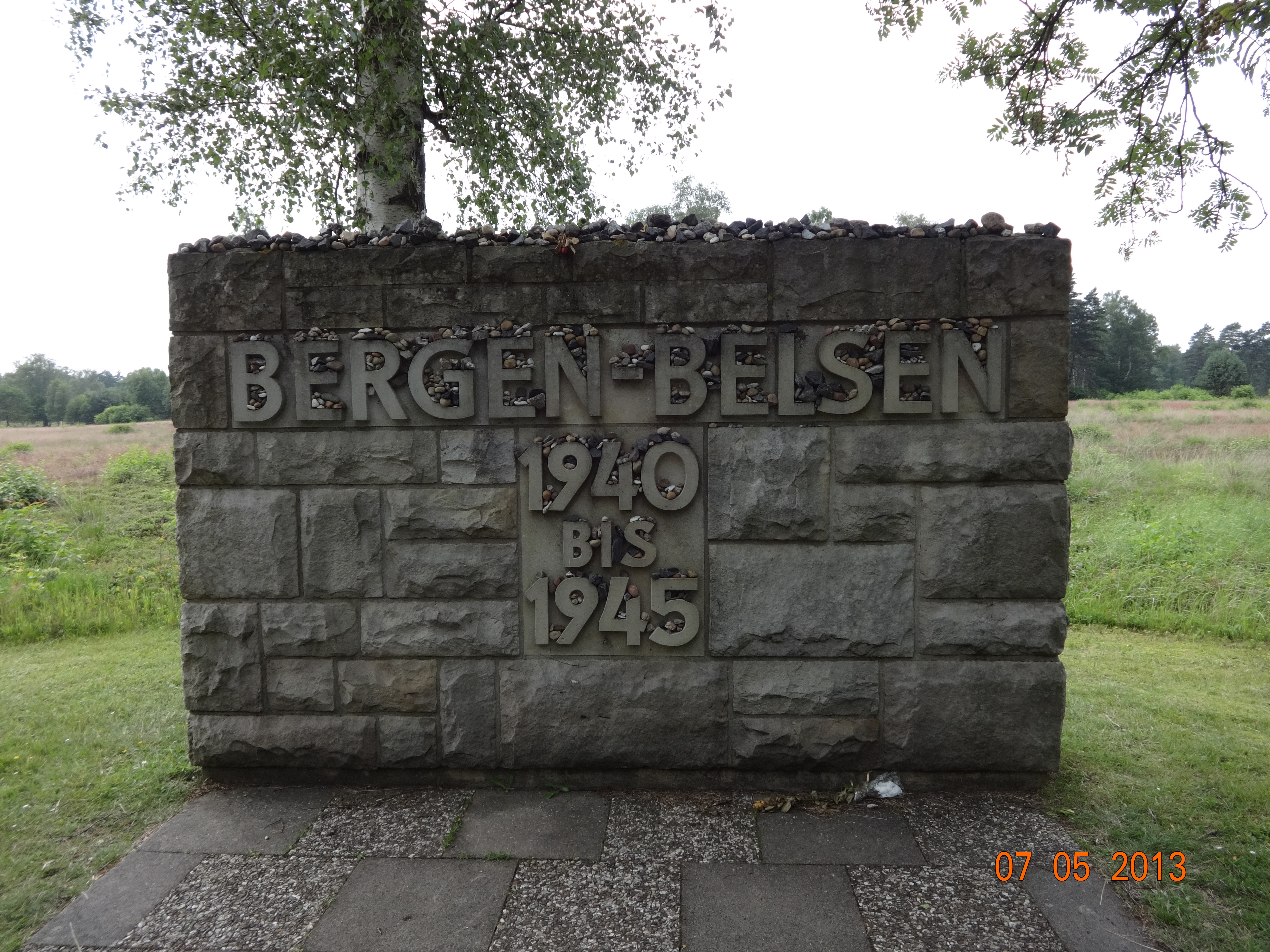
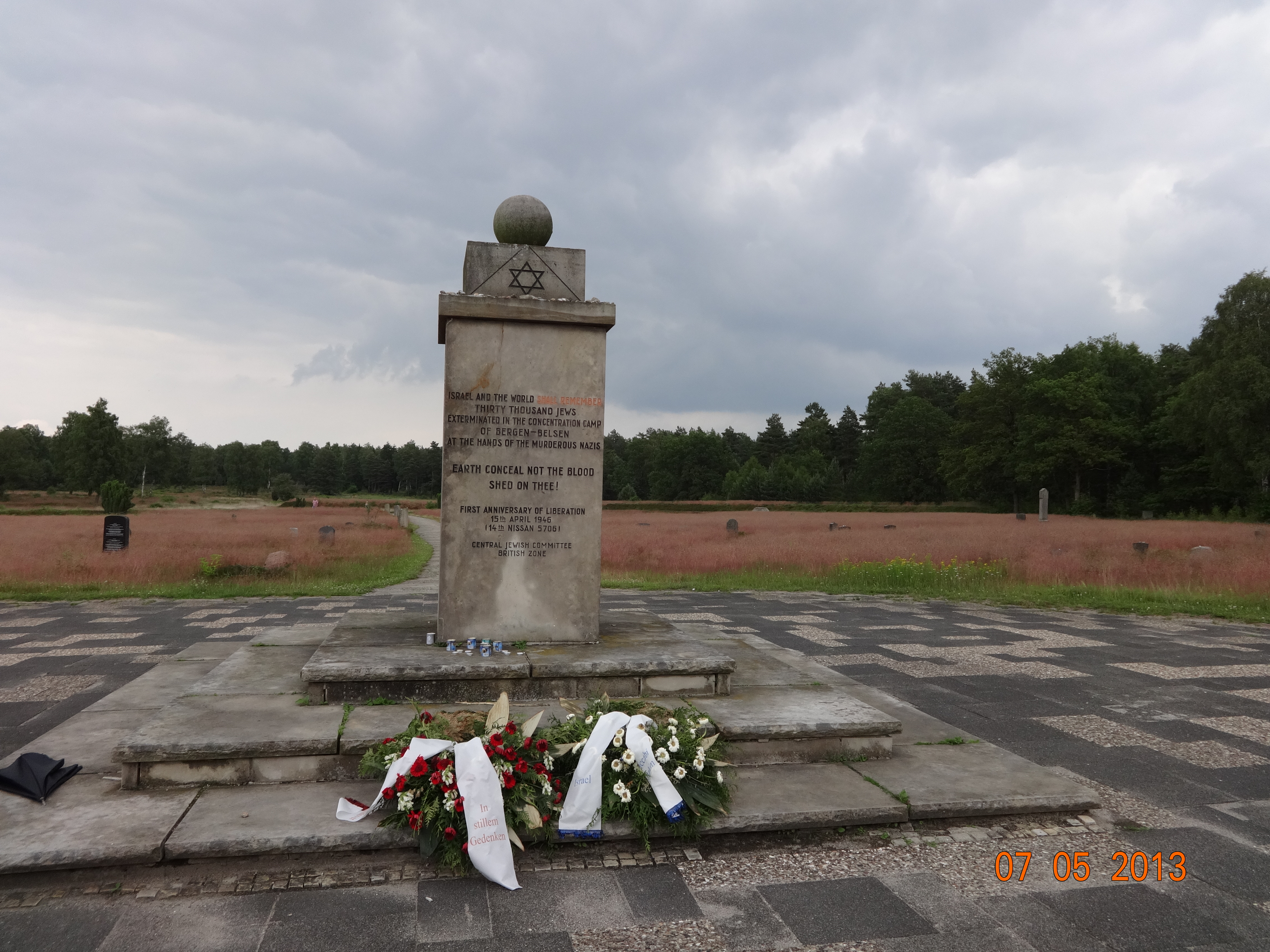
Bergen Belsen on July 5, 2013.

Bergen Belsen on July 5, 2013.

I am in Europe on a study tour of the Holocaust with 25 fellow educators of the United States. I am typing this as the morning breaks in the heart of Berlin, Germany. I had hoped to be able to get on-line and write more frequently but that is just not possible. There is too much to do while we are here visiting these authentic sites. But it is time to stop and reflect on some of the things that I have seen and experienced.

Our itinerary includes stops in Germany, the Czech Republic, and Poland. The power of visiting these sites after studying them so long can not be overstated.

Bergen-Belsen. For me, visiting this place after studying it in depth in relation to the exchange camps that were here was a powerful experience. Readers of the blog know of the stories of many of the survivors of Bergen Belsen who were in the exchange camp and their liberation on April 13, 1945 at Farsleben. Two days ago I got the back story of the exhibition panels you see here, that feature the photographs and the work that our project has uncovered.

In brief context: 120,000 prisoners passed through Bergen Belsen, and not all of them Jewish. 52,000 died here, perhaps 30,000 of them were Jewish. Belsen actually began as a POW camp- 20,000 Russians died here in the winter of 1941-42. In 1943, Himmler (the head of the SS) ordered that an exchange camp be set up for Jews who might possess foreign certificates or visas to emigrate, perhaps to use to bargain for German families interned abroad. 14,000 people went through the exchange camp. In November, 1944, thousands of women, and some children, including the Frank sisters, arrived from Auschwitz, to be “housed” near the exchange camp. What they received, in their miserable condition, were 18 oversized old tents which promptly blew down during a winter storm shortly after their arrival. With the arrival also of brutal SS administrators and guards, conditions deteriorated rapidly as the winter of 1944-45 turned into spring. The camp system began collapsing with the advance of the Red Army in the east and the British and Americans in the West. By the time the British arrived on April 15th at the camp gates, over 50,000 prisoners were suffering from extreme malnutrition, typhus, typhoid fever, and dysentery. Nearly ten thousand corpses lay about as the crematorium had long since broken down. Hundreds died on the day of liberation.

I'm here. Finally.  Jerrilyn Miller photo.

I’m here. Finally. Jerrilyn Miller photo.

So here I am. The bus guides swiftly through the beautiful German countryside. A night in the picturesque town of Celle the evening before has us well rested. The fields and forests bid us peaceful feelings as we move with our rendezvous with the past. It feels as if as we move we are stepping back in time.

Memorial site, Bergen Belsen.

Memorial site, Bergen Belsen.

We see the road signs for the memorial and I think many of us on the bus draw a collective breath as it turns into the parking lot of Gedenkstatte (Memorial) Bergen Belsen. It is surrounded by trees. We are the only persons, besides staff, who are here. As we disembark off the bus, Tif ties an Israeli flag around her neck so it drapes like a cape. It is quiet. But the birds are singing.

Now I remember that in 2007 I was beginning my first communications with Christian and Bernd, then staff members at the Memorial. They were excited about the opening of their new exhibition hall and education center. Two years later they would fly over, with the historian Thomas, to take part in our 2009 reunion. So now I am here for the first time to see them again.

We meet the staff, who are still preparing for us. I’m listed on the program at lunchtime for a talk about the exchange camps and how the project is incorporated into the exhibition. Bernd enters the room and greets me warmly.

After an introduction to the history of the site, we  watch the silent movies shot by the British beginning the second day after the liberation. Perhaps you’ve seen the photos or the films. Belsen, in 1945, was the last stop, the terminus of the Holocaust, as one historian has described it. It was a scene of horror. If you see a photo of a soldier wearing a mask, maneuvering a bulldozer to push corpses into an open pit, that was Bergen Belsen. Just over a month later, the British commander ordered the lice infested, typhus ridden barracks put to the torch.
So now we are on the grounds of the former camp. As we exit the exhibition memorial hall, we are confronted with a long narrow corridor of concrete that we must pass through, reinforcing the fact that we are moving from present to past. And now we are here.DSC00432
To some visitors, there is nothing here, just inviting walkways with interpretive signage and some markers. Woods, and open fields. But on closer inspection, we see the outlines of the past in the ruins. We walk to barracks ten of the exchange camp. You can see the outline at the woodline. Some of the foundation stones are marked with the names of those who passed through them. We retrace the steps from the barracks to the latrine, now many meters away off a footpath in the enveloping woods. Nature reclaims. Out of the corner of my eye, down the long narrow strip mowed to infinity where a fenceline once ran, I see a large deer guide out of the woods, pause and look my way, and vanish just as soon as it appeared. Is it obscene to find in this place now a feeling of inner peace, to find beauty in the stillness of a grey afternoon? Maybe so. But I feel it.
Back inside, Bernd is talking to our group at the Exhibit where the evacuation transports from the exchange camps are outlined with the photographs of Major Benjamin and Dr. Gross. He explains that between April 6 and 9th, 6700 men, women and children were evacuated on three transports. The “lucky” train was liberated by the Americans on April 13. Friday. One train did make it to the destination of Theresienstadt, where the occupants were liberated the last day of the war. On April 23rd, the third train was liberated by the Red Army at Trobitz, across the Elbe.

 Bernd Horstmann, Custodian of the Book of Names,  Matthew Rozell, History Teacher, July 5, 2013. Bergen Belsen, Evacuation transports exhibit.

Bernd Horstmann, Custodian of the Book of Names, Matthew Rozell, History Teacher, July 5, 2013. Bergen Belsen, Evacuation transports exhibit.

Bernd explains that as the exhibition was being planned, his colleague Christian discovered the photographs that I had been given by the Dr. Gross to place on my website. It altered their vision of the exhibition and he described their excitement as the corroborated the testimony of the soldiers with the photographs. Yes, this is the Farsleben transport. Yes, this is the transport that the Americans called “The Train Near Magdeburg”. My fellow teachers ask questions, and learn more about the exchange camp. They are putting faces to the victims when they see the pictures. I am happy to share this experience with them. I am here, and I am seeing it for the first time with them. They are part of this experience, at our first major stop on the trip. Later, on the bus, some are excited to see the Benjamin photo in the official Bergen Belsen guidebook. In my being caught up in the presence of the moment, I neglected to purchase one for myself, but there it is. I was not even aware of it.
Back out to the camp. The solemn monuments marking the mass graves. 1000 Tote. One thousand DSC00490dead. 2500 Tote. Two thousand five hundred dead. And on and on, elevated mass graves. On to the commemoration room. Candles are lit, stones are placed, the prayers are recited in Hebrew and English, led by Pauline, the only other New Yorker on the trip with me. We are all moved. I think of Carrol Walsh, the tank commander who led me to this story, the liberator who did not want to be called a hero, or even a liberator. His own memorial service is today, half a world away, but I am here in this place to remember him as well. It is altogether fitting and proper. And perhaps it is also something destined to be.

This evening we depart from Hannover to Berlin. It is pretty crazy and unsettling at the Friday evening platform. 27 people have to run for the train, as the track has changed, with hundreds of others. Our original seats are taken, so we have to find other due to a mixup. But we do not lose anyone, and as I settle in next to a kind stranger, made welcome, I notice our station stops along the way- Brunswick. Magdeburg. We are roughly following the route of the train, and the 30th Infantry Division in 1945. What take us 35 minutes to cover, takes 6 nights and 7 days in April 1945.
Today was also something destined to be, the culmination of something incredible I am still trying to figure it all out- but this trip is helping me to place in proper context the elements of the greatest crime in the history of the world. As we leave this place of obscene beauty and peace, I think of  the I think of  the survivor’s words:

Remember Me.

Remember. Bergen Belsen, July 5, 2013.

Remember. Bergen Belsen, July 5, 2013.

Read Full Post »

American Cemetery overlooking Omaha Beach, the primary landing zone for Americans during the D-Day invasion June 6, 1944. (U.S. Air Force Photo)Today one of my former students emailed me to visit saying that she had a surprise for me. She brought me a present- sand from the beach at Omaha in Normandy.

This was originally posted four Junes ago, I re-post here now.

I came into school today, on a Saturday, to start packing up my room for a move to another room.

But it is the 6th of June.

Instead I am getting nothing done, mesmerized by the scenes, live from Normandy, of the 65th anniversary celebration.

The President is there and so are 250 American veterans of the battle for Normandy,  including one of my good  friends, Buster Simmons, of the 30th Infantry Division. The Greatest Generations Foundation sponsored his visit with 9 other vets and college kids. Now I’m looking for him in the sea of faces.

My son Ned and I watched him last night as a “Person of the Week” on ABC World News in a story I contributed to. If you view the clip, you can see the photograph I provided ABC with, taken by Major Clarence Benjamin, of the liberation of the train. This is the photo that Buster uses when he speaks to high school classes to tell this story.

I am hopeful that we can get Buster to come to our high school for the  liberator-survivor reunion in September.

It was twenty five years ago, on this anniversary, that I wrote an essay in the local newspaper expressing my appreciation for the veterans of World War II. And as I begin to sort through and pack up 20+ years of memories in this room, three things are becoming clear: 1) my love for these men and women and what they did only increases as time passes; 2) the rest of my career will be focused on the promotion of narrative history in the classroom, linking students, veterans and survivors together; and 3) I won’t be getting any packing done this day.

Take a minute to watch Buster in the clip and take his optimism about the future of our nation to heart. Especially if -“you’re an American.”

Read Full Post »

By OMAR RICARDO AQUIJE- Glens Falls Post Star

HUDSON FALLS —Fred Spiegel was asked if he felt resentment toward the Nazis.

“Yes, to the Nazis, but not the Germans,” Spiegel said.

The question came from a student at Hudson Falls High School, at which Spiegel was invited Friday to discuss his life during the Holocaust.

On April 13, 1945, a train traveled across Germany, carrying 2,500 Jews en route to a concentration camp.

Spiegel was among them. He was 13.

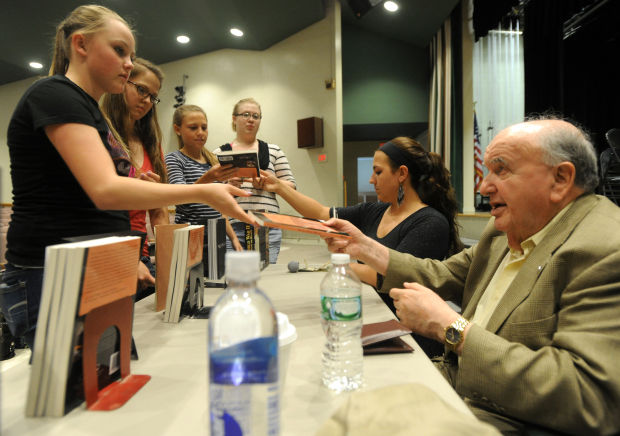
Holocaust survivor Fred Spiegel sells and autographs copies of his book, "Once the Acacias Bloomed," for students at Hudson Falls High School on Friday, May 24. Spiegel, who was liberated by U.S. troops as a young boy during World War II, spoke about his experiences and answered students' questions. (Jason McKibben -

Holocaust survivor Fred Spiegel sells and autographs copies of his book, “Once the Acacias Bloomed,” for students at Hudson Falls High School on Friday, May 24. Spiegel, who was liberated by U.S. troops as a young boy during World War II, spoke about his experiences and answered students’ questions. (Jason McKibben –

Spiegel, 81, visits schools to talk about how he survived. He brings copies of his book, “Once The Acacias Bloomed,” which explains his life as a Nazi prisoner.

Most of the schools he visits are in New Jersey, where he lives. The farthest he travels is Hudson Falls, a school he visited a few times in recent years, a school he included in his book because it was here an important moment in his life occurred.

“They invited me,” Spiegel said of his reason for returning to Hudson Falls. “How can I say no?”

During Friday’s presentation, Spiegel often said he was lucky to be alive.

Other trains carrying Jewish prisoners made it to their destination. His did not.

His train suddenly stopped near Magdeburg. Spiegel said the train’s engineer and Nazi soldiers fled for fear of capture. U.S. troops was cutting across Germany.

Then, a few U.S. soldiers on tanks found the train and freed the captives. The soldiers included Carroll Walsh, of the 743rd Tank Battalion.

Spiegel was later reunited with his family. It was 65 years later when the unexpected happened: He was invited to Hudson Falls to meet others who were prisoners on the train.

He also got to meet some of the liberators, including Walsh, who was living in Hudson Falls at the time.

Matt Rozell, a Hudson Falls history teacher, organized the reunion. He met Walsh in 2001. He interviewed the former soldier, and learned about the train near Magdeburg.

Walsh died in December. He was 91 and a former state judge.

Spiegel, a native of Germany, said people have shown more interest in the Holocaust over the years.

During Friday’s visit to Hudson Falls, he spoke to about 30 sophomores. Some of them had copies of Spiegel’s book. Others bought the book after the presentation.

Armand Ryther, a student, approached Spiegel to shake his hand.

“I find it very interesting that he could survive what he did,” Ryther said.

Ryther said he read Spiegel’s book.

Jamie Hughes, a fellow sophomore, said it was interesting to hear about Spiegel’s experiences.

“I think it’s really amazing that he would want to share his experiences with everybody,” she said.

Tara Sano, a Hudson Falls history teacher, said the event was planned near Memorial Day so students can reflect on the efforts of veterans.

“My hope is that when you are taking your three-day weekend, you think about why you have a three-day weekend,” she told students at the start of the presentation.

http://poststar.com/news/local/article_00a9219c-c648-11e2-ae69-001a4bcf887a.html

See Fred meet his liberator for the first time.

Read Full Post »

Two Toronto Holocaust survivors meet their liberators 65 years later
Two survivors of a death train out of Bergen-Belsen concentration camp finally link up with American soldiers who freed them in 1945.

A WWII-era booklet still possessed by Leslie Meisels documents his liberation as a young boy from a train destined for a death camp. Meisels, who eventually ended in Toronto, met a few of the surviving soldiers who freed him and 2,500 prisoners on the train.

A WWII-era booklet still possessed by Leslie Meisels documents his liberation as a young boy from a train destined for a death camp. Meisels, who eventually ended in Toronto, met a few of the surviving soldiers who freed him and 2,500 prisoners on the train.

Leslie Meisels is 86.

Leslie Meisels turned 68 last month.

Every April, since he was 18, Meisels has celebrated his rebirth. Sixty-eight years ago he was on the cusp of death, packed into a cattle car in a freight train with some 2,500 other skeletal Jewish prisoners. He weighed only 75 pounds.

Then a miracle. That train, which had set off from a concentration camp, was liberated by 12 shocked American soldiers in two tanks and an army jeep near Farsleben, Germany.

Up until then, the American GIs had assumed the gruesome stories they had heard about German death camps were just Allied propaganda devised to make them fight harder. But as they unlocked the boxcar doors, they witnessed humanity’s true capacity for evil.

They called it the death train. For Meisels, it was a train of life.

This past week marked the 68th anniversary of V-E Day, the end of the Second World War in Europe. It’s a good moment to tell the story of that train from Bergen-Belsen.

I heard about it last month in an email from a history teacher in upstate New York. He put me in touch with Meisels and Paul Arato: two Holocaust survivors from Hungary who in 1956 escaped their homeland, by then under Communist rule, and settled in North York.

Their stories are remarkably parallel. They grew up in nearby towns in eastern Hungary, they were both imprisoned by the Nazis in 1944, and they were sent first to Austrian farms as slave labourers and then to the Bergen-Belsen concentration camp in northern Germany.

Have you ever seen the horrifying Holocaust photos of dead, naked bodies being pushed by a bulldozer into open pits? That was Bergen-Belsen. Some 70,000 people were murdered there, including Anne Frank. They weren’t killed in gas chambers, like at Auschwitz. Instead the Nazis used starvation, sadism and disease here.

Meisels remembers mostly the hunger. They were given only watery turnip soup and a piece of bread each day. In four months, he lost 100 pounds.

Arato, just 6 then, remembers the rattling cold and twice-daily roll calls that often lasted hours. He and his older brother Oscar had to hold their mother upright, she was so weak from typhus. One day a boy in their line smiled because it was his birthday. As his “present,” an SS guard shot him dead. It was Oscar’s birthday the next day.

The horror is ungraspable.

By April 1945, the Nazis were retreating as both the Allied and Soviet armies advanced. One morning, both Meisels and Arato were awakened by guards and told to march. “We dragged our bodies over five kilometres,” says Meisels, “back to the train.”

Trains in Nazi Germany usually led to death. This one was no different. It was destined for another concentration camp in Czechoslovakia, but the guards also had orders to execute passengers. Meisels remembers one afternoon when all males 12 and older were ordered out of the packed boxcars and lined up in front of machine guns. They stood there two hours before being herded back into the putrid cars.

Over six days, the train progressed only 135 kilometres.

Arato remembers peering through between the wooden boxcar slats and seeing the SS guards drop their weapons and start running. Then he glimpsed a tank with a star on it.

The door slid open shortly and they were greeted by stunned American soldiers.

“It was hard for us to believe what we were actually seeing,” says one of those soldiers, Frank Towers, on the phone from Brooker, Fla. “We weren’t prepared for it. We were there to fight a war. We weren’t humanitarians. We didn’t know what to do.”

Says Meisels: “We cried, ‘Oh God, we are going to be free. We are going to be human beings again.’ ”

Towers, who was serving in the 30th Infantry Division, spent a day those taken off the train to convalescence homes and a hospital nearby before he had to push on with his battalion.

Meisels and Arato spent five months recovering in Germany before they could finally return to Hungary to search for the rest of their families. Eleven years later, they escaped Hungary and started their lives for a second time: getting married, building careers, having children, then grandchildren. Decades went by.

Then, a few years ago, their paths crossed at a business meeting. Arato, since retired, was an industrial designer. Meisels ran a family company making plastic moulds. At the end of the meeting, the topic of the Holocaust was raised. They discovered, to their shock, they had both been on that train from Bergen-Belsen.

Around the same time, that high school history teacher in New York named Matt Rozell stumbled upon the story.

To bring Second World War history alive, he’d instructed his Grade 10 students to interview their grandparents about the war. One summer, he visited one of his students’ grandfather: Carrol Walsh, a veteran turned New York State Supreme Court judge.

“After two hours, when the interview was ending, his daughter elbowed him and told him to tell me about the train,” Rozell says.

He learned Walsh had been in one of those tanks that chased away the SS soldiers and liberated the train.

Rozell posted the story on his website, Teaching History Matters, and a few years later a survivor from that train contacted him from Australia. Since then, 240 more have been located.

In 2007, Rozell hosted his first symposium on the train, bringing together survivors and liberators. Arato’s son came across a story about the reunion on the Internet by chance.

Arato told Meisels about it, and two years later they both traveled down to Hudson Falls, N.Y., for the second symposium. There they met Walsh and Towers.

That moment was a second liberation for Arato, now 74.

“A blanket was pulled from me,” he says. “I was always very lonesome. I didn’t share my stories with anybody. I grew up and spent all my years being angry. This meant I don’t have to be angry anymore.”

His wife, Rona, has just published a book about his story called The Last Train: A Holocaust Story.

Meisels visits schools around Toronto to speak about the Holocaust every week.

His message? “Hatred is something we have to fight against. When you hear a derogatory comment, say out loud that it is not right. When you are silent, you are not neutral. You are supporting the oppressor.”

He and Towers went to Washington, D.C. last month to celebrate the 20th anniversary of the Holocaust Museum there. Towers, now 96, is the last living U.S. veteran who liberated that train. Walsh died last December.

“We hugged,” Meisels says. “Whenever we are together, I am so overwhelmed by gratitude and joy.”

Truth can be more horrifying and wonderful than fiction. Every life is precious.

CLICK HERE FOR THE STORY OF ANOTHER TORONTO RESIDENT WHO FOUND HERSELF IN THE 1945 PHOTOGRAPHS


by Catherine Porter 

http://www.thestar.com/news/gta/2013/05/10/two_toronto_holocaust_survivors_meet_their_liberators_65_years_later_porter.html

Read Full Post »

« Newer Posts - Older Posts »