I received this press release and am passing it on with notes and the interview I conducted 14 years ago with one of the panel members.
As part of an intergenerational project focused on collecting oral histories of local elders, a panel of World War II veterans from the local community will speak on Wednesday, April 25th from 6:30-8:00 p.m. in Gannett Auditorium in Palamountain Hall at Skidmore College. One veteran is a POW from the infamous Stalag Luft III, the setting of the movie, The Great Escape.
Panel members will include:
Earl Morrow, Hartford, NY. Army Air Corps. B-17 pilot, shot down over Germany and held a POW for nine months.
Jack Springer, Kingsbury, NY. US Navy, South Pacific
Bob Addison, Glens Falls, NY. USMC, Guadalcanal etc Edson’s Raiders
Gerry West, Fort Edward, NY. USMC, Guadalcanal etc Edson’s Raiders
The following interview was conducted by Matthew Rozell and recorded before a classroom full of students on October 22, 1998.

Earl Morrow, B-17 pilot. photo by Rob Barendese.
Matthew Rozell: Our guest today is Mr. Earl Morrow. Mr. Morrow, can you tell us how old you are?
Earl Morrow: Seventy-seven.
Fifty-four years next month, Mr. Morrow was a captain of a B-17 Flying Fortress during WWII. He was the commander of the aircraft that had nine crew members on it. His mission was to fly over Nazi-Germany, daylight missions, and basically drop bombs to try and reduce the enemies’ capacity to wage war. He is here to tell us a little bit about his experiences. About fifty four years ago next month, on his seventeenth combat mission over enemy territory, Mr. Morrow and his crew went down. They were shot down by German flak and German aircraft and he was taken prisoner. He remained prisoner until the Allies under General George Patton came through and liberated him. He actually got to see General Patton. So he is here to tell us a little bit about his story, and to remind us that even though it was fifty-four years ago and that it seems like an eternity to us, it’s not for him. And we have to remember what his generation did, because it could happen again.
Mr. Morrow, you said you flew in 17 combat missions. Did you find that many of them, obviously from what we heard, the hardest part was the return trip?
It varied depending on where you were going. We lost one engine just due to mechanical failure one time going in, which caused us to slow down and we were pulling full power on the other three all the way in. That’s when they really worked to stay in formation. When you are sending up a thousand airplanes a day on a single target, if you are on the outside of a formation and you’re making a left turn, you are going to have full power just to stay in. On the other hand, if they are going the other way you are on the inside, then you are going to be stalling out. So when you really haven’t got your full power, then you’ve really got problems. We only saw fighters three times in the 17 missions, and all three times they were on us after we had hit the target.

Crew of B-17. Pilot Earl Morrow far left.
I have a photograph here, maybe I can get Mr. Morrow to explain who’s in it. This is a photograph of Mr. Morrow and his crew. He had 9 men in his crew. I asked Mr. Morrow to list the ages of the crewmembers. In the front row kneeling you had the officers.
(Pointing) This one was me, the captain of the airplane. (Pointing at another) Co-captain, he was an older gentleman, he was so old, he was 27, we called him “Pa”.
How old were you?
I was 22. This is the navigator.
When we take off we have to get in to formation. He had all the maps and everything. And if something happened, to lead the formation, it was his job to get us back. It did happen a couple of times, and he got us back in good shape. This is the bombardier; he’s just a month older than I am. This gentleman over here was just a little older than the rest of us. He stayed in the service and he was a top turret gunner. He retired in ’72 as a brigadier general. When we were flying, he was a sergeant.
This was our radio operator; he was killed in action the day we were shot down. This is the waist gunner; he was also killed the day we were shot down. Robert Carter was a ball turret operator, which is the worst position you can be in on the aircraft. You are down underneath, you can’t even see it on here (pointing to a model airplane). I got in it once and the sergeant put his foot on my back and shoved me in. You can’t see the airplane, all you got is your two guns down there and you can turn that thing up, down, all around, but it has stops on it where you can’t shoot your own airplane. That’s the worst place to be in. He (Carter) also was killed in action that day.
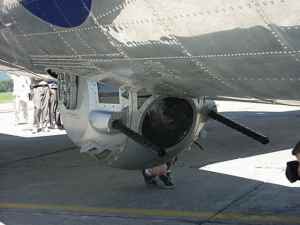
B-17 ball turret.
(Pointing again at photograph of crew) This gentleman didn’t go with us that day because they took the gun in the radio room out. They took it out and they decided it wasn’t of much value, which it wasn’t, and the operator would go back and work on the waist guns, so we would leave one man home.
This one was a tail gunner, and he survived.
Your waist gunner, Joe Calerno, who was killed in action on the second of November, 1944, the day you were shot down. He’s not real tall in this picture and that’s because, how old was he?
He was 18. He went in the service, kind of told a fib about his age because they wouldn’t take anybody under 18.
So that’s his crew and I’ll pass that around. I have another photograph of Mr. Morrow standing next to his airplane. Now did you fly the same throughout all 17 missions?
I had one airplane-we only flew it three times. The rest of the time they were putting it back together from battle damages and so forth.
Here is one of the landings you had to make when the landing craft was shot off.
The landing gear collapsed there due to the drag link on the gear, and it had been about three-quarters shot off when the weight of the airplane settled down and the left gear just collapsed, and we made a 180 degree turn. We were almost stopped anyway, so we didn’t do any damage other than the props.
They were pretty twisted up. Can you, and I’m sure you can, think of a lot of particular instances that really stand out in your mind when you were captain of the ship? You had so many men dependent on you. You all had a job to do. What was it like to, well what kind of relationship did you have with your crew?
I think I had the best crew that was over there. We all had nicknames for each other. I told the guys right off the start. There were four of us that were officers, commission officers, and the rest of them were non-commission officers, but they were the highest ranked sergeants you could have. I told them right at the beginning, ‘I don’t want any one of you to ever salute me, unless there’s somebody standing over there that expects you to, then do it.’ We were all in this small machine, well it’s a big machine but you crowd nine men in it, it’s small then. When you’re going over there and they’re shooting at you in a small space, you better know who your buddies are and I know I could depend on anybody in that crew. It took a while for the men to get faith in me, because we were the ones to get that airplane off the ground and get it back on the ground. We got shot up, keep it in the air as long as we could and get it back and we made landing before we got overseas. That’s probably the best thing that’s happened to the crew. We made landing on a dark night, we had a real problem and were afraid the thing might catch on fire, we made landing in almost a cow pasture where they had two flares on one end of the field and two flares on the other end of the field. We got the thing in there at night and the next day they sent somebody up with equipment to fix the airplane. They stripped down the airplane, they made three passes at daylight before they got in. So the crew had decided I was a pretty good pilot. The proof I got later on was on a forced march. My bombardier had complete amnesia and I was taking care of him and keeping him going.
This was after you were shot down?
Yes, at the P.O.W. camp, and he finally looked at me and he said, “I know who you are. You’re the best damn pilot in the world.” I kid him even today. You had to get him knocked out completely with amnesia before he would admit it. The truth comes out then. But every man in the crew did his job and did it well.
Technically, when you were off duty, you weren’t supposed to fraternize with them.
Once we were over seas and not at base you could just do about what they wanted. As a matter of fact, I had a bicycle, and I could never find my bicycle because some of the enlisted men, they didn’t give them bicycles, our bicycles were always gone. We would fraternize with them, we’d go to town, we’d do it a lot and you’d go together.
So, to get to know each other was really important. Mr. Morrow also brought in some of the citations in the wars that he got, and not every veteran gets these medals. When did you get this medal?
1990.
Can you describe this medal for us?
That’s a POW medal, it shows the eagle, but all around it is barbed wire so he can’t fly.
(to students) And this of course is perhaps one you’ve seen before.
That’s a Purple Heart, issued to people who were killed in action or wounded in action. I got it just a year ago, the reason for that was we had no medical records and Congress finally passed the law that all POWs could apply for it and they would determine that you were probably wounded in action. You would get it so I got it last fall, it was 54 years later…And then when I applied for it I got a letter back from the air force asking me to be patient.
I have an account of the last mission Mr. Morrow flew. What did your crew call you?
Shad.
I had gotten married just before the crew got together, and they said I kind of got skinny and so you could hardly see my shadow I was so skinny, so they called me “Shad”. That was the name of our airplane. The crew did all, I let them name it.
I’m going to read this account and then maybe we can talk about your experiences when you were in captivity.
(Mr. Rozell begins to read) ” It was early in the morning on November 2nd 1944 that we were awakened and informed that we were going on a bombing mission. We got dressed and ready for breakfast in the mess hall. It was a cold and rainy morning and we got fresh eggs for breakfast. No one was talking much, it seemed that everyone was buried in their own thoughts. After breakfast we went to the briefing room and got the bad news. We were going all the way into E. Germany (pointing to E. Germany) to bomb a synthetic oil refinery in Mersburg. We knew that the Germans would have put up all they had, as they were short on their oil supply.
We had 16 missions and we had seen enemy fighters only 3 to possibly four times. It was assumed that they were short of fuel. We went out to our airplanes and started our routine of checking everything. My top turret gunner advised me that everything had checked O.K. and added that he just put several hundred rounds of ammunition in his guns, he said we might need the extra today! My radio operator informed me that he had lost his dog tags. I told him that we would have to wait until after we were back from the mission and I would go with him to get a new set.
Shortly we were in our airplane and taxiing out for takeoff and soon we were joining our group and heading out over the English Channel and climbing to our altitude of 28,000 feet, over 5 miles. It was a long flight all the way into E. Germany and most all the flight was over enemy territory. Everyone had to stay alert for enemy aircraft. We finally arrived in the vicinity of our target and we started the bomb run. (MR to EM): What was the bomb run about?
They gave you an initial point and from there on everything was straight and level right in. You take no evasive action and its about five miles. You go straight in to the target, drop your bombs and after that, the group can take evasive action. From the initial point in, you just sit there and fly straight and level no matter who’s out there or what.
MR(back to account): There was a lot of heavy and accurate flak and we had several flak hits, but there was no severe damage to our aircraft. We dropped our bombs on target and started home. My navigator advised me that our group was not following the proper course and were fast becoming quite a distance from the whole formation. (MR to EM): So the formation, how many planes about were on that?
About a thousand, and our group of thirty-six, were off on another course.
(Back to the account): I ordered my radio operator to call the lead ship and advise them. We got a message back to maintain radio silence. About this time my top turret gunner, sighted a dog fight at six o’clock high. That means our fighters were engaging theirs behind and above us. I ordered everyone to be alert as this meant we were about to be attacked by enemy fighters. As we suspected, their fighters drew our escort into a fight and another German group hit us. They would come in behind us, drop their flaps, slow up and began pumping 20mm cannon shells into us at close range. Up front where I was, we never saw a fighter as they would roll and dive down behind us. We however could hear and feel cannon shells hitting our plane. I was advised that my vertical stabilizer…..
The end rudder was shot off just above the tail gunner’s head. They were coming in at about fifteen at a time. The second wave hit us in our left wing and knocked ten to twelve feet off the wing.
I just saw a crease go up the wing, an explosion, and then the whole thing fell off.
The third wing seemed to miss us. I was still flying in formation, but I was thinking, “If we make it out of this one, will I be able to fly this Fortress back and land it with so much damage?” My thoughts were interrupted with two cannon shells exploding in the cockpit, between my co-pilot, and his side of the airplane.
It set us on fire.
We were on fire and the cockpit filled up with smoke so bad. The only way I could see was with my face up against the window. My top turret gunner left his guns and was fighting the fire. We thought we had it out, when it all flared up again. We had no choice but to get out before the ship blew up. I gave the “bail out” signal and pulled my co-pilot out of his seat. I got him started down the front where the escape path was.
We all had to go out a small trap door below the cockpit, so I had to get my co-pilot out of his seat. He was wounded real badly. I just yanked him out of his seat and we all went down under the instrument panel into the front. You just sit there with your feet hanging out and you fall out. I left my seat to follow him and then I felt the airplane climbing. I knew that if it had climbed too steep, it would haul out into a spin and no one would go out. I went back into the controls and forced the plane into a shallow fly. Then I went down and forward to get out.
My co-pilot was sitting in the escape path, so I put my foot in his back and shoved him out. I immediately followed. Just as I cleared the plane, she blew. All I saw was a huge flash and felt some of the concussion. I was in the clouds and got scared and knew that if I opened my chute, it would be damaged by air currents. I decided to delay opening until I broke out into the clear, which I estimated to be about ten thousand feet. I played around and found that I could keep myself face down if I kept the wind in my face. Suddenly I broke out and saw Germans all over the area. I said a few choice words of profanity and ripped my chute cord, which opened perfectly.
I was on the ground and almost able to stay on my feet. I was dragged over backwards but managed to get on my feet to see three women bearing down on me with pitchforks. (MR to EM): We know that three of your crewmembers didn’t make it out of the plane.
The tail gunner got out. He had an escape hatch way on the other side, on the tail section. The others were supposed to go out a door on the other side just back of the waist gun window. The tail gunner saw that the escape door was gone so apparently someone had got out the back. But he said the waist gunner, Joe Calerno, was standing there, so he motioned for him to go over and Calerno went like this, (blank stare), and the only thing we can figure is that Calerno went straight off with Kerner in the ball turret. Now I think they had a pact between them that if he’s not out of that ball turret, that’s the hardest place to get out of, you don’t go to climb out. I think Joe was waiting for Kerner to get out. I feel that we lost the man mainly because he wanted to make sure his buddy was out.
I got on my feet to see three women bearing down on me with pitchforks. I was wearing a 45 automatic in my shoulder holster. I unstrapped the holster and had my hand on the grip but did not take it out of the holster. It stopped the women and I ran down a bank across the road and started across the field. They were coming in from all directions so I just sat down and let them come and get me. I spotted a man in uniform at a distance and tried to tell these people that I wanted to go to him, the man in uniform, but to no avail. So I started walking toward the man in uniform and was knocked down two or three times ‘till they finally escorted me to the soldier.
We were instructed to get under military control as soon as possible. There were kids throwing stones and women spitting like pigs. The big surprise, all the little kids can talk perfect English. I knew know just how much the Germans had planned on winning the war. The soldier took me into a little town and put me with some other crewmembers. I found four of my crew, which meant my co-pilot, radio operator, waist-gunner, and ball turret gunner were all missing. There were 33 of us rounded up and we figured that we had lost 9 aircraft. That would be 81 men and there were only 33 of us.
We were put into what looked like a one-room schoolhouse. We had no intentions of going anywhere. Many of the 33 men were badly injured from broken bones and severe burns. It had been a very long day. Now we were really starting to think about the situation that we were in. I was concerned that our families would not know about our whereabouts or our condition. I was sure that I didn’t want to get sick, as I would have no access to a doctor or medicine. A couple of days later, my co-pilot was brought in to where we were. He was very badly wounded but only lost a small amount of blood as he opened his chute immediately after jumping from the aircraft. His bleeding froze and coagulated in the lower altitude. (It was 60 degrees below zero when we bailed out.)
We were moved out a few days later and sent by train to Frankfort where we spent about five days being interrogated. We were separated and the officers were sent to one of the prisoners of war camps south of south east of Berlin and the non-commissioned officers were sent to another camp. Life was not easy, we were always cold, bored, hungry and very anxious about our future. Hitler even gave the order that all air crewmembers were to be killed, but someone failed to carry out the order, which we were very grateful for. We were moved twice to different camps and General Patton and his troops finally liberated us. (MR to EM): So that was in November of 1944. Do you remember the day you were liberated?
The first of May.
The first of May, 1945. The German High Command formally surrendered one week later. Can you tell us where you were when that came through?
We were down in the Bavaria, a little town in Brunswick, near Munich. We were pretty close to Switzerland. As a matter of fact, a Red Cross truck was getting to us then out of Switzerland. My co-pilot, we picked him up in Nuremberg and then when they started marching us out of there they never took that flak out of him, a piece of it moved and paralyzed him. They put him in a Red Cross truck and drove him over to Switzerland then they flew him out to England. So he survived.
You were telling me this summer when I came to your house about the march that you were forced on.
That was in January of 1945. They started about ten thousand of us in this camp. They put us on a march because the Russians were getting close and we started out at one o’clock in the morning. As we went out the gate they threw a Red Cross package at us and they started us. We would run ten minutes, walk ten minutes…, and they kept this up. At the end of the hour they have a five-minute break and then right back into it until about five in the afternoon.
It was about thirty below zero, the worst blizzard they had in Germany. At about five in the afternoon they gave us about a half-hour break and I tried to change my socks. I had GI shoes on that were the high tops. I got my shoes off, I got my new socks on and my shoes were frozen and I couldn’t get them back on, that’s how cold it was outside.
We lost a lot of boys by that march, just falling out. They said if you fell out the Germans would run you through with a bayonet. We were guarded by German soldiers with machine guns and dogs. We finally, after about 38 hours, by the time they put us in churches in town we were cold. There was a burgermaster (who was the same as a town mayor) who had a son, I guess, who was a POW over here who opened up a pottery factory. They let us sit down in the drying factories where it was warm. He kept us there and overruled the military for about three days and kept us there.
They put us on freight cars where it was so crowded you couldn’t even sit down. We stayed on those for about three days, we were still fighting the war though. When they slowed down in the town or stopped in a town, that’s when we’d open the doors and go to the bathroom anything to desecrate their property. Even as a POW, we were still doing everything we could to upset the Germans.
On that march, we went to Nuremberg. When the American’s were getting closer they took us down into Bavaria. It was fairly warm weather. The co-pilot was with us, he showed up in Nuremberg. He started walking and a piece of that stuff settled on him, and the Red Cross trucks were getting to us. We were getting a little bit of food from them. They took him out and a lot of us were in bad shape. I was able to buy from a German woman a chassis of a baby buggy so I had piled a couple of other guy’s stuff on that and I was pushing a baby buggy across Germany. The first day out, we were attacked by American airplanes, we peeled off our clothes and made a big POW sign in the field and from then on, we had fighter escort. No one was hurt but they fired a few shots to let us know they were there. As far as they knew we were POWs and we had fighter escorts all the rest of the way on the march.
We got down to Mersburg and it was real nice there because we were in tent and we had clean straw on the ground and at Nuremberg it was infested with rats and mice and I was covered from head to foot with bug bites. We had a doctor in there and he figured out that the food we were getting then, if we lay at bedrest we still weren’t getting enough to survive.
So living at Nuremberg, we were in really bad shape. We had a radio in there, the Germans knew it, but they could never find it. Every time they put us on the march, they asked if we were bringing the radio. We got a message in from England on the radio that General Patton would attack the town of Mersburg on Sunday at 10am. Sure enough, Sunday morning at 10am, the first tank rolled over the top of the hill and it started pouring heavy stuff into the town and it wasn’t but 30 minutes later that the American flag went up over town, a tank came down and just didn’t open the gate. It just came on through, and General Patton was right behind him standing in a pickup truck with his pearl handle pistols. I wasn’t moving around too fast , but I looked around the corner of a building and I threw him a salute and he returned it, so I got a salute out of General Patton.
He made a little speech to us, he said,” You are the best morale bunch that I have liberated up to this point.” That is because they actually parachuted a whole crew in to get a colonel in there to take over a camp. Every Saturday you stood inspection, cleanly shaved, with your pants pressed. All you had to shave was a razor blade and a glass of cold water, no soap. But if you were cleanly shaved, as a result of that Patton said we were the best morale, the best looking group that he liberated.
The Allies purposely dropped him in?
Yes, because there was general in there, and he wouldn’t fight the Germans at all, he just gave up. So they sent this colonel in, and I saw him walk up and stand in front of the Germans and tell the German general that he could go to hell. He told him one time, the Germans were ready to start shooting, and he said, “If you want to start shooting, you can start on me right now!” He stood up, he was an older gentleman, but he really made life worthwhile. You have a tendency to let yourself go, unless you have somebody making sure, discipline doesn’t hurt anybody.
Does anyone have a question? Did you see the movie “Saving Private Ryan”?
No, I haven’t yet. I heard it was the only movie made that makes the Americans come out a hero, for once.
Did you see the “remake” of the “Memphis Belle” that was supposed to be patterned off the [William Wyler] war documentary? You didn’t think highly of that film, did you?
No. It seemed like everyone on the crew had a sight problem. They were screaming and hollering on the mission…
I had a crew that, we never had that. I can remember the first time we saw a fighter, one came in close behind and the tail gunner got his thumb on the intercom -He says, ‘Come on in you..’in the movie it would be just cut off right there. But on our intercom, the real thing was, ‘Come on in, you S.O.B.’ Then you heard the 20mm go off and you heard him say, ‘I got the bastard. I sawed him right in half.’
Note. Matthew Rozell also did an extended interview at a reunion with Earl, his bombardier, and the lead navigator on the 11-2-1944 mission in July, 2001. It can be read here; sadly, the other two gentlemen have since passed on.
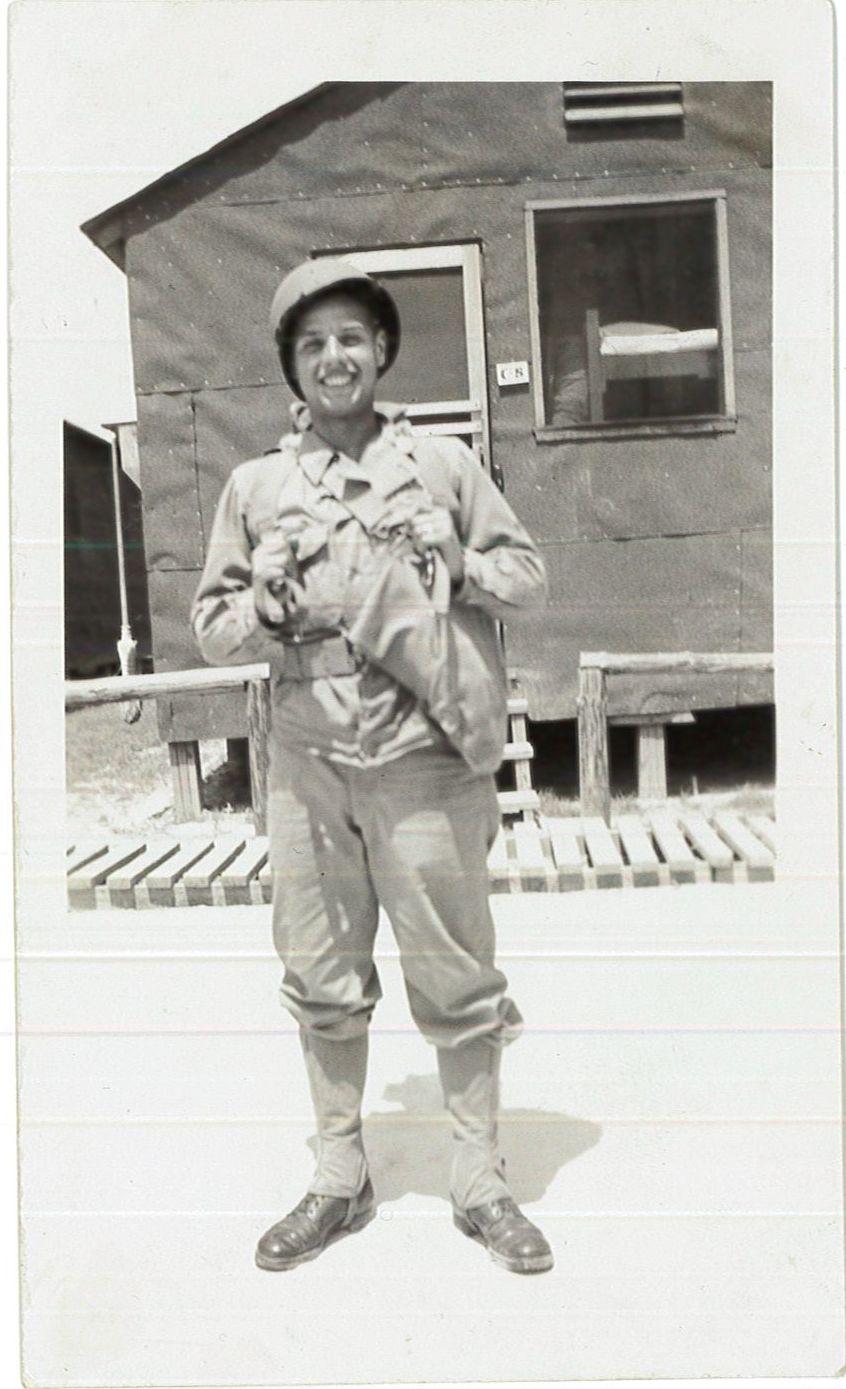
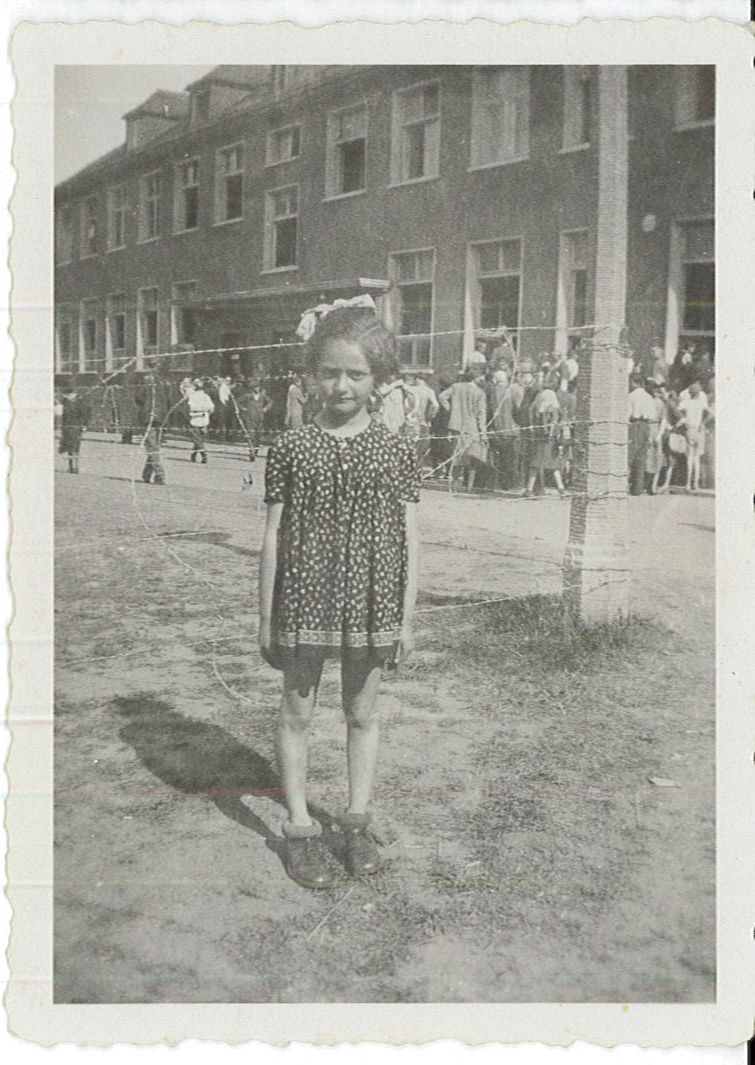


 He rarely wrote home. He did write home to his minister about one event that evidently really caused him to stop and think. Attached is a copy of that letter that his sister transcribed – making copies for others to read. The letter describes the Farsleben train and his experience there.


 Teaching History Matters
