"for the sake of humanity"… A small town American high school history project changes lives worldwide. These are the observations of a veteran teacher- on the Power of Teaching, the importance of the study of History, and especially the lessons we must learn, and teach, on the Holocaust. Click on "Holocaust Survivors, Liberators Reunited" tab above to begin.
I had some pretty big news I wanted to share today. Good news. But on Saturday, eleven human beings were slaughtered in their sacred house of worship, their synagogue, in Pittsburgh, PA, USA.
It can wait a little longer.
I was at my six-year-old niece’s birthday party as the news unfolded. Little ones were running about the house—it was raining hard outside, the chill of a late October Saturday nor’easter—laughing, playing, joyful. Life!
But an all-too-familiar numbness crept in. How does one make sense of the senseless? How does one begin to find the words, to explain, to understand? And I began to sense the continuation of a profound shift on a national level.
And today we are approaching the 80th anniversary of Kristallnacht, the so-called Night of Broken Glass, when the massive state orchestrated pogrom against the Jews in Germany was unleashed.
How many Americans even know what that means? Or that it all started years before, with words?
Burning synagogue in Ober-Ramstadt, Hesse; Darmstadt, Germany, November 10, 1938. Credit: USHMM, courtesy of Trudy Isenberg
How many good, ordinary Germans looked the other way? Or straight into the camera as their neighbors’ synagogue went up in flames, the firemen dousing the nearby non-Jewish community houses to keep those flames from jumping?
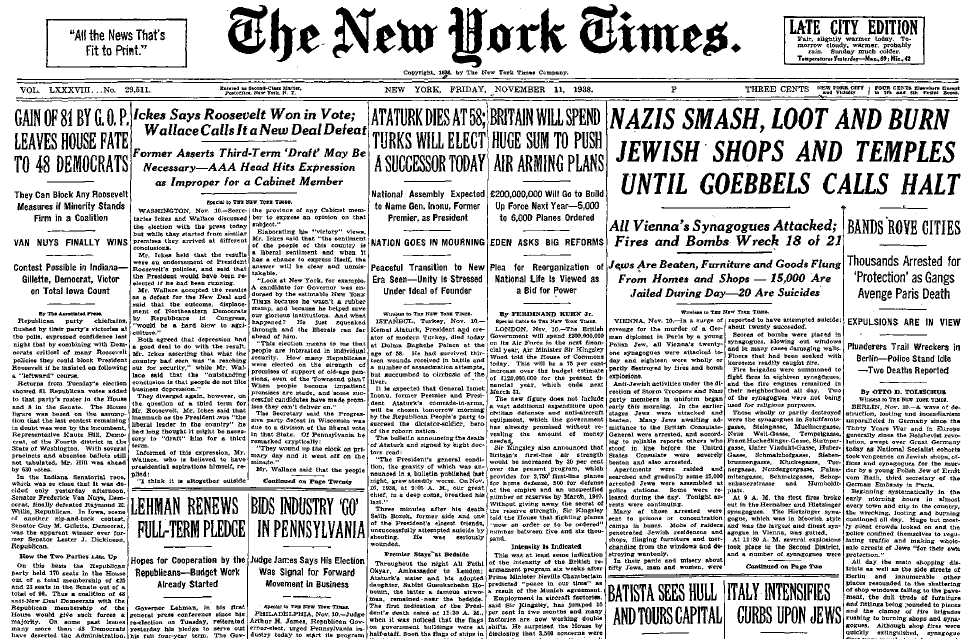
How many good, ordinary Americans read those newspaper headlines on Nov. 10, 1938, and turned to the sports pages? In a just a few short years, two-thirds of Europe’s Jewish community would be slaughtered.
And writing this, here in America, brings forth a flash of memory. Several summers back I was flipping through the Wall Street Journal in a quiet setting with a companion sitting nearby, normally a champion of human rights for all. It was just the two of us and he suddenly remarked something to the effect that “it’s the Jews who control Wall Street”. I was shocked, because he was aware of my work with Holocaust survivors and Holocaust education. He has Jewish friends, so I think he thought he was needling me, but he kept pushing—”you going to tell me it’s not true?”—so that he could argue it, and he struck me as serious. I felt a chill. I didn’t understand then, and I don’t now, what brought that on. For sport? I didn’t engage with him, like he wanted, but something shifted then on a level that I’m still trying to figure out.
And I’ve been trying to figure out a lot of things these past couple years. Because I think words, like history, matter.
I will always love my friend, but I sometimes think there are times when some people may wonder when I’m going to get off this ‘Holocaust affectation’. Well, probably never. Because I guess they don’t get it. There is a reason I am here to do what I do. There is a reason I spent ten years, the last one feverishly, writing a book while teaching full time, a couple times wondering if I would survive it. If they struggle to understand how an interest became a passion that became a mission, they should pick it up sometime.
Because it’s never over.
Because I’m tired of trying to explain, to ‘understand’.
Richard Gottfried, 65
Rose Mallinger, 97
Jerry Rabinowitz, 66
Cecil Rosenthal, 59
David Rosenthal, 54
Bernice Simon, 84
Sylvan Simon, 86
Daniel Stein, 71
Melvin Wax, 88
Irving Younger, 69
A mutual friend in Holocaust education circles found the words on Saturday.
Today is why.
By Juanita Ray, North Carolina Council on the Holocaust
October 27, 2018
If you want to know why I study the causes, events, and horrors of the Holocaust…today is why.
If you want to know why I left my dear, beloved theatre kids to teach this dark history…today is why.
If you want to know why I spend my retirement time working with the NC Council on the Holocaust and the NC Center for the Advancement of Teaching to train teachers in Holocaust Education…today is why.
If you want to know why many of my posts are about love, acceptance, justice, and tolerance…today is why.
If you want to know why we still bother to teach this history that “was so long ago” and
“not on my end of course test”…today is why.
If you want to know why I still read and research and teach about the dangers of extremist political ideologies…today is why.
If you want to know why I taught my students to be upstanders- not bystanders…today is why.
If you want to know why when I visited a synagogue in Vienna in 2011, I had to show my passport…today is why.
If you still believe the horrors of past antisemitism could never happen here, or again…open your eyes.
Don’t become too comfortable with events like today. Guard you words, guard your hearts. Love your neighbors as yourselves. Seek to do good and repair the world– Tikkun Olam.
If you have any doubt where I stand… I stand with, for, and beside those who are hated, bullied, dehumanized, ostracized, targeted, scapegoated, threatened, harmed, and sadly, killed. But I cannot just stand by. Perhaps I have a bleeding heart, but I cannot have a hardened heart.
Esther 4:14– Perhaps you were born for such a time as this.
NO ONE, EVER, ANYWHERE should have to be afraid to enter a house of worship.
Floyd Dumas (L) and two other escapees, Bill Robb of Scotland and a South African, pose for a portrait while behind enemy lines in Rome, 1944. Courtesy Floyd Dumas.
I’ll share a few more stories from the book in the coming weeks.
From the deserts of North Africa to the mountains of Italy, the men and women veterans of the Italian campaign open up about a war that was so brutal, news of it was downplayed at home. As we forge ahead as a nation, we owe it to ourselves to become reacquainted with a generation that is fast leaving us, who asked for nothing but gave everything, to attune ourselves as Americans to a broader appreciation of what we stand for.
***
Floyd Dumas was a soldier in the 45th Infantry Division. The author had heard about Floyd’s story and called him up to invite him in for a World War II prisoner of war symposium at his high school. Mr. Dumas was gracious and thankful on the phone, but initially declined. Then he had a change of heart. He had something to say.
Escape
[The day I escaped], it was in the afternoon and we were in the big building where they’d lock us in at night, after they gave us the loaf of bread. During the day they kept it unlocked, so you could be in the building or out in the yard. There were a bunch of us playing cards in the big building when an air raid sounded. All the guards were looking up at the sky and watching our Air Force bombing near the prison camp. One of the men who was in the yard came in while we were playing cards and said two men ripped the fence and escaped. He asked if anyone else wanted to try and get out. I said, ‘I’ll go,’ and a British guy said, ‘I’ll go,’ but no one else would try.
We went out in the yard. The fence was ripped open and a large group stood around to block the guards’ view, and the Englishman and I went through, but we were still inside the prison camp! We scouted around and found a small room with fake scenery in it, I suppose as a part of the movie industry. We hid in this room until dark, [and miraculously] a storm came up and it started to rain hard, with thunder and lightning, which was good for us—I don’t know how we got that lucky. Now I don’t care if you’re an American soldier, a British soldier, or a Japanese soldier, but when you’re on guard duty and it’s raining, you’re going to look for a spot where you’re not going to get too wet, and that’s what the Germans did—they never saw us going through the yard even with the lights on.
The Germans must’ve been doing some work next to the [outside] wall, and they had thrown dirt up against it just high enough so we could get up to the top of the wall and throw ourselves over. They had barbed wire and broken glass on top of the wall, but the two of us got over and fell down on the other side.
We ran across the countryside, and on the way we were so hungry, we’re pulling up carrots and stuff and eating the dirt and all. We came upon a farmhouse and knocked on the door, and an old Italian couple was sleeping next to a fireplace on the floor, an old man and the old lady. We knocked on the door, they came, and we had little [Army] booklets with Italian language phrases, you know, so we said, ‘Americano soldato’ and ‘Inglese soldato.’ They said, ‘Sì,’ and let us in. We were wringing wet, but we were able to dry out our clothes; they had us sit by the fireplace and dry off and gave us some bread and ricotta, which the woman warmed up. The old man spoke a little English, he said, ‘You no can stay here tomorrow, the Germans catch you here, they kill us.’
We said, ‘Well, what are we going to do? Where are we going to go?’
He said, ‘Half a mile away down the road there’s a bombed-out house. You can go down in there and hide for a while.’
At daybreak, the Englishman and I left and found it, but then he wanted to try to get back to our lines. Can you imagine that? [Laughs] Here we are, way behind the German lines, and he wants to get back to our lines.
I said, ‘What are you, crazy? You can’t get through all those German soldiers!’
He said, ‘Well, I think we should try.’
I said, ‘You want to try, you go ahead.’
He tried, he got challenged by a German outpost, and they shot him right there. I heard the shot.
I stayed at that bombed house for three or four days, and I still had an American uniform on. I said to myself, ‘I’ve got to do something pretty soon.’ There was a small town not too far away. I said, ‘I got to take a chance and when there’s no Germans around, I’m going to have to walk into the [town] and tell them I’m an American soldier.’ The people all hated the Germans anyway, so they greeted me, and I was all right.
They got me into civilian clothes. I traded my combat jacket to a sheep herder for his long black coat, [and the family I stayed with gave me] a silk shirt and an old pair of shoes with holes in the toes; I wish I had a picture of that. I held on to my dog tags and put them in my shoe, to prove I was an American GI, and I stayed there quite a few days. I heard there was another soldier nearby—an Indian soldier who spoke English, so they got me in touch with him. I don’t know if he was [an escaped] prisoner of war, I don’t know what he was. He was staying with an Italian family and had learned a lot of the language, and we got to talking.
Each morning, the Indian and I would go to a neighbor with a bucket to get some ricotta cheese. There were a lot of Germans manning anti-aircraft guns in the area. One morning, one of the Germans asked the Indian, ‘Why doesn’t your friend with you ever talk?’
The Indian responded, ‘He was in the Italian Army and a bomb fell near him, and he became deaf and dumb.’
The German said, ‘That’s too bad.’ So this is what I did. After living in this little village for about a month, more and more German soldiers arrived in and around the village. I started to get a bit scared that I would get caught; maybe one of the villagers would squeal on me. I said to the Indian, ‘I don’t like staying in the country here like this.’
He said, ‘Well, I’ve been here quite a while, and they haven’t been bothering me at all.’
I said, ‘Well, you’ve got to notice that the Vatican was taking in escaped prisoners of war, so you suppose you could get me into Rome and over to the Vatican and I could try to get in there?’
He said, ‘Yes, in a couple of days.’ So we headed for Rome.
Rome
Getting to Rome was not a picnic. We had to go through a number of German roadblocks [to get to the train station], but they did not bother us as hundreds of people went into Rome each day to bring their produce to the open market. Some walked the eighteen miles; some took buses, drove horses and carts in, or took a train. We walked to the train station and got on the train. The train was always packed with people bringing in pigs, hens, and vegetables for the market. When the train stopped in Rome, we took a bus to Vatican City. We went up and the Indian talked to one of the Swiss guards at the Vatican.
He said, ‘No, they’ve not allowed any more prisoners in the Vatican. We’re neutral and we’re not allowed to do it.’
I said, ‘Well, we’ve heard that there were escaped prisoners in here.’
He said, ‘There are, but they’ve put a stop to it.’ They wouldn’t let us in.
He said, ‘But you’ve got to go back to the country where you were, and after three days, you come back here, and right over to the left here, there’s an alleyway. When that clock strikes twelve there, you look across the street. There’ll be a man standing there with a black overcoat on, and in his right-hand pocket he’ll have a newspaper. When he takes the newspaper down from his face and puts it in his pocket, you go across the street and say, ‘Americano soldato,’ and that’s all you’ve got to say.’
We went back to the country, and then three days later we went back there, and that’s exactly how it happened. The man I met with the newspaper was a priest; he worked with the Italian underground. The priest went ahead and I followed him onto a bus. He paid the tokens and we got on the bus, rode for a while, and then transferred to another very crowded bus. Finally, after about an hour of busing, we got off and walked two blocks and came to a big building surrounded by a high wall, with a huge iron gate and a bell on the side.
The priest rang the doorbell, and soon a nun came to the gate and let us in. We walked in a side entrance and opened a door that led to a small room. A small table for two was set with a loaf of bread and a bottle of red wine. The priest closed the door and put out his hand and said, ‘You did fine, and we got here okay.’
He said, ‘Tomorrow you will be introduced to a Scotsman who is here, and you will be together until Rome falls to the Allies.’
The Scotsman’s name was Bill Robb, from Aberdeen, Scotland. He was taken prisoner at Tobruk in the desert of North Africa by the Germans. [In Italy], the Germans piled him and a large group of prisoners into a train to send them to Germany. He tore the bars off the boxcars and jumped off the train. He broke his left leg in the jump, but the Italians hid him and nursed him back to health. He had been behind the lines a long time and learned the Italian language fluently. So, we met in that convent and would stay together until the war in Italy was over.
* Liberation
We went back up to [that cave near] Tor Sapienza. We had the young Italian kids on guard while we slept at night. Finally, one morning at 5:30, two of the young guards came in the cave and hollered, ‘The Americans are here, in the town next to us. There are dead German soldiers all over the place!’
We said, ‘Ahh, you’re crazy, they’re not here yet. They aren’t going to take Rome yet.’
‘Come here, come here!’ They showed us a package of Camel cigarettes, and Holy Jesus, right away I knew it was true! I’ll never forget it. Sure enough, the 88th Infantry Division was coming through, so we walked right in with them. We talked to an American officer and told him who we were; I showed him my dog tags and we followed them into the city of Rome. There were German tanks burning in the streets and snipers shooting all over the place in the city, but in six hours, Rome was completely taken.
We were interrogated by American officers and told them our story. They turned us over to a British outfit; I guess they were going to stay in Rome to keep things under control. The British said we had to get out of the civilian clothes. So, they gave us British uniforms, shorts, knee socks, heavy shoes, a shirt, and a beret.
They gave me the name of a captain who was in Naples and said I was to report to him as soon as possible.
I said, ‘How do I get to Naples?’
They gave me a map and said, ‘Hitchhike. We have no transportation for you.’
So, with my nice new British uniform on, I did just that. I found the address I had been given but it took some time, as Naples is a large city. The captain I was to see ran a PoW camp with hundreds of German prisoners. He asked me a lot of questions about what we did behind the lines and what we saw, then told me to get out of the British uniform and he would supply me with one of ours.
I was in Naples about a week before he could get me a plane to Oran on July 21, 1944, a mail plane with bucket seats and everything. From North Africa I was put on a ship for Hampton Roads, Virginia, for about ten days. Eventually I was flown with three other soldiers from Camp Pickett, Virginia, to Washington, D.C. The Army put us up in a beautiful hotel and gave us money from the American Red Cross. For two hours each morning, we had to answer questions from high officials at a building in Washington. After that, we were on our own to do whatever we wanted; we had a great time, drank a lot of beer, and ate in nice restaurants—but the next morning we had to go back to interrogation.
Home
I was out of the Army in 1945 and was working for a milk company, and there was an ad in the paper for a men’s clothing store. I went and applied for the job; I had to learn tailoring, store management, window trimming, and all that. I got the job and I picked up the tailoring really quickly. I learned it in six months; they couldn’t understand [how I picked up the trade so fast]. I’m telling my sister this, and she said, ‘Well, your Uncle Eli was the top tailor in Malone here years ago, maybe he’s brushing off on you.’ After my training was done in the Malone store, they gave me a store to run in Danbury, Connecticut. Then they transferred me to Glens Falls, Steins’ Men’s Clothing Store, and I have been here ever since; now I do tailoring out of my [basement shop]. Do you know that I have had three millionaires as my clients? That’s right, Charley Wood used to come over to my house to get measured up. Then I started going to his place…
*
Bill Robb went back to Aberdeen, Scotland, and we kept in touch over the years. He had got married and had a child, but couldn’t find work in Aberdeen. [Unbeknownst to me], he moved to Montreal, Quebec, just an hour and a half from my hometown, Malone, New York! He was in a pub drinking beer in Montreal and these old guys were talking about Malone.
‘Jesus,’ he said, ‘that guy Giovanni behind the lines with me in Italy said he was from Malone!’ [Laughs] In Italy, my [alias] was Giovanni Ganzi; there’s no Floyd Dumas in Italy. [Laughs] So he said to his wife, ‘I’ve got to go see him,’ and jumped in his car and went to Malone. He found my parents on Brown Street, and my parents said, ‘No, he now lives in Danbury, Connecticut!’ They told him how to get there.
He came and stayed two weeks with us; can you imagine that? [Laughs] Everything panned out good. And I used to hear from him here and there. In the last Christmas card I got from him quite a few years ago, he was a steel worker in Chicago working on bridges, but that was the end. I haven’t heard from him since; [he probably] died like a lot of them. I don’t know of one other person who is still alive in the company that I was in; I don’t even run into anybody in my division.
*
The war affected my life, sure, but I would say that I got over it good. Yes, I’ve thought a lot about it. I used to have wicked dreams, but I wouldn’t talk about it for a long, long time. Finally, I sat there with my wife and I said, ‘What’s the matter with me? They’re not teaching this in school. I better start opening my mouth.’ So, I went to Hudson Falls High School and I gave [several] talks over the years, and Mr. Rozell tells my story.
Looking out of my writing studio, Oct. 2017. Pic by me.
Matthew Rozell will have a book launch, talk and signing at 6:30 p.m. Thursday at the Easton Library, 1074 State Route 40, Easton, NY. Signed books will be available for $20.
As I write this, it’s rainy and cool here in upstate New York after a long hot summer. I haven’t posted in a while as I find myself making the transition from classroom teacher to full-time writer, and the seasonal changes are almost a metaphor for what’s going on in my life, though at heart I’ll always be an educator with something to say. So, I keep writing, and it’s that time of year to introduce a new book to the world. But first…
I’ve been fortunate that my books have resonated with people on a national scale. The other day I did an assessment and over 75K copies of my books have been sold, mostly ebooks but plenty of paperbacks, and some audiobooks as well, on a trajectory with some better known, more traditionally published authors. And it’s seven days a week hard work. I’m amazed, too, that I wrote the first three and a half while I was also teaching full time. This time of the year though, I like to set the pen down and go out into the world to meet the people who read them.
I did a session of meet and greet in our village park last Sunday, a beautiful second day of fall—brisk in the morning, warming by afternoon, bright sunshine and blue skies. Traffic was light, but people showed interest in the books and I had some great conversations. My fourth-grade teacher happened to pass by, and said she was downsizing last week and found a booklet of our class’s writings (1970-71) that she had ‘published’ on the old blue mimeograph paper, I think, including some words by yours truly! You know, I suddenly remembered all that, and how proud I was, how proud my mother in particular was, at the time. Unfortunately, Mrs. F tossed it in the dumpster, something I would have regretted if I were her [ha ha]… but don’t be surprised if I packed it away somewhere, too.
A young girl appeared, picked up my books, wondering incredulously if I had written them all. I told her I did. She was impressed, and had many questions about the process, even the cost, which I answered. “Make sure you hire a good cover artist, for one, and a proofreader!” She picked up the heftiest one, ‘A Train Near Magdeburg’, and asked flat out how long it had taken to write. “Ten years”, I replied. Her eyes bulged out of her sockets as she exclaimed, “Ten years! That’s how long I have been alive!” I chuckled at that, explaining that I had to learn a lot in order to understand what I was writing, and asked her if she liked to write. She nodded, and I asked her if she liked to read. “Good”, I said as she nodded again. “Because that is how you become a great writer.” She got it, thanked me politely, and scampered off to join her family, though she peppered me with questions for so long that they were no longer in sight!
A former student or two came by again, including one who told me she had been at the Red Lion Inn in a town in the Berkshires, in western Massachusetts, about a hundred miles away, a place my late mother loved to go to on her forays to the Berkshires arts scene. This former student, now a mom herself, overheard a group of women discussing a read about the Holocaust that they had undertaken together (as a book club probably), and she realized they were discussing ‘A Train Near Magdeburg’. I’ve been thinking of putting out a discussion guide for a while now, so maybe this was the sign to get moving on it. There is a lot to talk about…history is sooo not dead. To quote William Faulkner, “The past is never dead. It’s not even past.”
Some more of my superfans came by to pick up the ‘must have’ books that they missed, including a guy I was talking to for quite a while before he reminded me of his name, one of my sister’s first boyfriends going back to the days when he would help my father split wood at camp! Humbled and honored that people are touched enough by my words to come out and talk to me, and my next talk is in a couple days.
Anyway, thought I would give you an update. The new book is on the war in North Africa and Italy, a campaign so brutal, news of it was downplayed at home. Did you know that 20% of the Medal of Honor awards given in World War II came out of this 900-day campaign? Don’t worry, nobody does. My book helps to fill in the gaps, in their own words. I’ll give a talk about it Thursday evening, details below from today’s newspaper. I’ll also be posting more about the new book, upcoming gigs, and other developments; feel free to follow me at my Facebook author page for daily links to articles on WW2 and the Holocaust that I find facinating.
When Matthew Rozell started teaching history, he felt a two-day lesson on World War II just wasn’t enough.
“I said, ‘How many of you have a parent or grandparent who was in World War II?’ and every kid shot up at least one hand,’ ” said Rozell, who taught at Hudson Falls High School for almost 30 years.
He sent home surveys with his students with the assignment to interview their World War II veteran relatives, who had spent years keeping their war memories to themselves.
“These guys were ready to talk,” said Rozell, sitting in a windowed room at his post-and-beam Hartford home with views of Crane and Gore mountains.
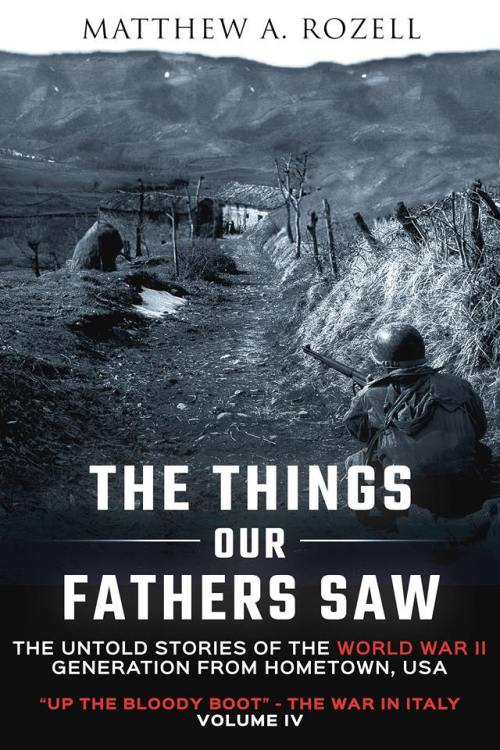
Rozell and his students spent years interviewing veterans, resulting in six books. Rozell’s latest book, the fourth volume of the series “The Things Our Fathers Saw,” is now available. He has sold more than 75,000 books based on the interviews he has conducted with local World War II veterans.[1]
The fourth volume, “Up the Bloody Boot — The War in Italy,” tells firsthand accounts of combat and brotherhood from the war in Italy. One of the stories in the book is about local tailor Floyd Dumas, who was captured by the Germans at a major battle in Italy. He escaped and was on the run for four months.
“A lot of these guys were ready to talk to young people,” Rozell said, pointing out that “some of the stories that they told, they had never told anyone besides their friends who’d had the same experience.”
For some veterans, they were realizing that people were forgetting and didn’t understand the enormity and aftermath of the war that left no American community unscathed.
Rozell knew he needed to do something with all the research and collection of personal stories. He published his first book in July 2015, two years before he retired from teaching. It was about the men and women in the Pacific.
For some unexplained reason, book sales took off two years ago, and Rozell was selling 100 books a day in e-books, print books and audio books.
Through his interviews, research and books, Rozell has been able to reunite 275 Holocaust survivors with their liberators and has seen them come together at reunions.
“This is the story of a person,” Rozell said, “who had an interest, that turned into a passion, that turned into a mission.”
Rozell will have a book launch, talk and signing at 6:30 p.m. Thursday at the Easton Library, 1074 State Route 40. Signed books will be available for $20. All his books are available on Amazon or MatthewRozell.com.
[1]Almost all the first-person interviews my students and I collected over the years were deposited in the New York State Military Museum for future generations to learn from—over a hundred to date. As one of the most active contributors to their program, I also leaned on them for some related interviews I edited with a loving hand for this book.
(What if you imagined something, beyond imagination?)
My last child graduated from high school today, the same high school that I graduated from nearly 40 years ago.
The two of us piled into the truck for the 15-minute commute to the school, one we have been making for the past 13 years. She had her green graduation gown already on, and before I turned the key, I turned to look at her and say, ‘You know, this is our last trip together to the school.’ Mary replied, ‘Let’s go Dad! I’m going to be late!’ And that was that…
I got the call about 6 weeks ago that they wanted to start a new tradition, and add a keynote speaker to the graduation program. They picked me for the inaugural. This is a class I regretted leaving when I retired just before their senior year.
The venue, our air conditioned high school gymnasium, was packed. The salutatorian and valedictorian, who I was so proud of, delivered their own addresses to their peers that mirrored what we all had to say perfectly.
Anyway, I was grateful for the opportunity to speak. Afterwards, I went to the cemetery and stood before my parents’ grave, in the pouring rain. I updated them on the kids, read their inscriptions aloud, wished them a happy upcoming anniversary, told them I hoped I’d made them and my hometown proud.
I walked away with the rain, and maybe something else, streaming down my face.
***
Today is the day of your high school graduation. It’s called commencement because today is the beginning of the rest of your life, beyond these hallowed halls.
This is the day that you have long awaited, that some of you perhaps are meeting with equal parts excitement and sorrow, a day that you may remember for the rest of your life. So when I was asked to address you, the Class of 2018, I was honored, I was flattered, and I was happy to know I would have your full and complete attention for at least one time in my life.
*
You are going out into a brave new world, a scary place to navigate. It helps to have a bedrock of confidence, a road map, a plan ‘A’, a plan ‘B’. But the fact is that you can’t plan. Some of my best planned lessons were destroyed by factors beyond my control, like the 3-minute PA announcement of Prom Court just as a World War II veteran was finishing a tearful story. And sometimes the best received lessons were totally unscripted and from the heart.
But alas, today I am forced to stay on message, so to keep this short, I came up with a ‘graduation advice list’ on my own, without cheating on Google. I now gift you with Mr. Rozell’s 15 Words of Wisdom.
#1. Don’t address your new boss, or your new drill instructor, or your new college professor by their last name only, no matter how cool it sounds. It’s not going to end well.
#2. It’s nice to have a plan. But if you don’t know what you want to do with your life right now, you don’t have to collapse into a quivering mess after the ceremony.
#3. A plan is a nice touch, but your life will thank you more if you have a passion. Now take that further. Turn your passion into a PURPOSE.
#4 Accept that ‘stuff’ happens. For example, as I was typing this, my daughter decided that that exact moment would be the best time to finally turn on the vacuum cleaner and attack her room, instigating major writer’s distraction. But life is what happens to you while you’re busy making other plans.
#5. Recognize that your setbacks are gifts in disguise. How you react to your failures or disappointments can be defining moments and set the table for your achievements. [The noisy vacuum reminds me of my delight in being Mary’s dad, the daily gift of her presence in our lives, tinged with a bittersweet understanding that someday all will be quiet.]
#6. Appreciate your education. Value learning. Teach yourself something new every day. Ignorance is not really bliss, as proven hourly in your social media feed. Recognize too that knowledge does not always equate to understanding. Sometimes you just have to accept the mystery.
#7. See the world with a sense of wonder. Be open to new experiences and new people. Un-plug. If you can’t travel, lose yourself in a book.
#8. Try to see something good in a person or a situation where you think there can’t possibly be anything good. Take a sad song, and make it better.
#9 Be curious. Ask questions. Recognize that having the question is more important than getting the answer.
#10. Be terrified of that first new step. Then take it. Take risks. Ask yourself “WHAT IF?”
#11. Guard your reputation. Honor your integrity. Cultivate your character. And audit your friends for the same.
#12. Use your gifts for the power of good. Kindness is contagious. There’s no such thing as coincidence. There is such a thing as karma.
#13. Miracles happen. Recognize the miracles in your life. Recognize that your existence is a miracle.
#14. No matter how much you want to get out of Hudson Falls or the high school, don’t forget where you came from and the people who shaped you. I’ve met people who were honored by their school who then talked trash about their own hometown. Don’t be that guy or girl, ever. If you don’t like what you see, change it. Don’t walk away and badmouth it from a safe distance.
Finally, #15. If you ever have to give a speech like this, remember that no one will remember your advice unless you tell a story to go with it. Also remind your audience at that point that your remarks are half over.
*
Forty years ago when I was a senior in high school, I told my parents that I did not know what I wanted to do, but I did know I was not going to stay in Hudson Falls. I also smugly informed my father, a history teacher, that I was not going to be a teacher. Seven years later I was living back under their roof and driving his car up Main Street to Hudson Falls High School. Most of the waking hours of my life were spent in these very halls.
When I started as a teacher I was the students’ third teacher that year. They did not welcome me with open arms, and I saw them as mean 9th graders. It was rough. I was still living with my parents down across from the Dog Shack praying I would get laid off because I was too chicken to quit. I got through the first year, but I almost cried when I saw my class list the next fall. But a funny thing happened, the now-tenth graders were genuinely glad to see me. I became their class advisor, and some of them are friends and teachers today.
When we began to interview World War II veterans I let my passion become a purpose in the classroom and it became contagious. Seventeen summers ago, I interviewed Judge Walsh on Coleman Avenue. I was going to shut the video camera off, but his daughter Elizabeth Connolly prodded him to tell me about a train he encountered with another tank commander at the end of WW2. My PASSION to learn more would not allow me to let it go. I contacted the other tank commander, who had more stories and even pictures of the liberation of a train full of concentration camp victims.
With PURPOSE I put them on the school website I built. Four whole years went by and then I heard from a grandmother in Australia who had been a 7-year-old girl on that train. Just then three more survivors appeared-all organically, and all within reasonable distance, but in hindsight, I don’t believe in coincidences.
At the time I just asked myself, “WHAT IF?” And our school community got behind it and we pulled off a reunion at the high school between the survivors and Judge Walsh in 2007, the first of 11 reunions worldwide that reunited 300 survivors and their families with the soldiers who freed them. I had taken the risk and spent many sleepless nights, I was terrified. What if the students are rude? What if one of the elderly people has a heart attack? But it was nothing less than an outpouring of love from this school and this community. And this love was powerful enough to break the barriers of space and time; we all became overnight best friends.
*
I want to close with the miracles and mysteries of life. Leslie Meisels, a survivor from Hungary, told me he had always thought for all his adult life that he had been graced with three miracles.
The first was after the Germans had invaded his country and the family was forced to wait for transports that, unknown to his community were heading straight to Auschwitz where up to 25,000 people were being murdered every day. At a time when 17-year-old boys did not talk back to their mothers (his father was already taken) he defied her and insisted that his mother and his younger siblings board a train they were not supposed to be on. She relented, and that transport was the only one shunted away from Auschwitz that day.
The second miracle was as he just finished handing off a bag of stolen beets to his mother behind a guard’s back when the guard suddenly whipped around and barked orders to him. The guard then shot another boy to death, catching him in the act of stealing beets for survival as Leslie had just done.
The third miracle, he would tell his audiences, was the day of his liberation at the hands of U.S. forces. April 13th, 1945. Friday the 13th. His luckiest day, his new birthday.
Today Leslie goes to schools and tells of the fourth miracle, being able to meet and laugh and cry with his actual liberators, whom he met at this very high school nine years ago —and that it was ‘just beyond imagination’. And every April 13th, he emails birthday greetings to all his ‘twins’, his fellow survivors of that train whom he met right here in Hudson Falls.
Most of the soldiers are dead now, but those ripples go forth, still, and for all time. Why did that ‘fourth miracle’ unfold at that time in his life? That is the question I have asked myself many, many times. And to me it will have to remain a MYSTERY, one that began with another question: “WHAT IF?”
A final thought: Students like you had good questions, too. One asked another survivor if anything good came out of the Holocaust. The survivor thought a minute, because it was an important question, and replied, ‘Yes. My rescuers.’ A victim of the greatest crime in the history of the world found some good out of the evil.
*
Some of you will remember the days when I began my lessons with, ‘Today is the first day of the rest of your life’, and it wasn’t just on the days when I was passing tests back.
Maybe today you will take me seriously.
Your life is a miracle and you are adored by everyone in this room.
Have a purpose, cherish your honor, and don’t look back in old age with regrets.
Have fun, keep that sense of wonder, and don’t be afraid to ask the words, “WHAT IF?”
My friend Frank Towers would have turned 101 years old today. Frank passed on July 4th, 2016.
Frank W. Towers.
Frank was born on June 13, 1917. Think about that for a minute. John F. Kennedy also came into the world, less than a month before Frank. ‘Buffalo Bill’ Cody left the world. American involvement in WWI was just getting underway, and Frank’s future 30th Infantry Division was formally activated. Gandhi was tromping around India, investigating the poor conditions of local farmers under British rule. Revolutionaries in Ireland were still licking their wounds after the doomed Easter Rising against the British the year before. The Russian Revolution was just getting started. American suffragettes that summer were arrested for picketing the White House for the right to vote for women.
So into this world came Frank W. Towers. And Frank Towers came into my life after he had already lived a good, long one, in September, 2007, shortly after he turned 90. But he had more things to do before the Almighty called him home.
Frank Towers by Pete Fredlake, USHMM, 2010.
He did not know me, and I did not know him-I have never even been to Florida, where he lived. But, from the news he learned of a reunion that we had recently done at our high school. He read about how I had reunited World War II tank commanders from the US Army 743rd Tank Battalion and 30th Infantry Division with the children of the Holocaust who he also had helped to liberate. And Frank said to himself, “Wait, I know about this. I was there, too.”
Frank reached out to me and we began a fruitful partnership in trying to locate more of the survivors who were on that train. He invited me, and the survivors, to the 30th Infantry Division Veterans of World War II reunions that they held annually down south. And these were powerfully moving events, to see the soldiers touched by the gestures of the survivors; and for the survivors to laugh and cry with their liberators was a gift that they, their children and grandchildren, will never forget. We also held additional reunions at our school, for the sake of making students the new witnesses to what happened during the Holocaust. Varda W., a survivor’s daughter in Israel, even orchestrated a massive reunion of 55 survivors and their children for Frank in Rehovot, Israel when he was almost 94… talk about a rock star. I was there to see him mobbed.
Frank Towers greeting survivors at the Weizmann Institute, Rehovot, Israel, May 2011. Credit: Matthew Rozell
*
There’s talk this week in Holocaust education circles of another important birthday, and another ‘Frank’-Anne Frank would have turned 89 yesterday. She came into the world on June 12, 1929, in Frankfurt, Germany; I’ve seen the house where she was born, and I’ve been to the place where she died, at age 15. Just shy of her last birthday, on June 6th, 1944, she recorded the following entry:
‘This is D-Day,’ the BBC announced at 12 o’clock. This is the day. The invasion has begun!
Anne Frank iat school in 1940,Amsterdam, the Netherlands). Unknown photographer; public domain.
Is this really the beginning of the long-awaited liberation? The liberation we’ve all talked so much about, which still seems too good, too much of a fairy tale ever to come true?… The best part of the invasion is that I have the feeling that friends are on the way. Those terrible Germans have oppressed and threatened us for so long that the thought of friends and salvation means everything to us!
On D-Day, 26 year old 1st Lieutenant Frank Towers was also listening to this news in England as the 30th Infantry Division was preparing to ship out to the battle a few days later. Anne and her family would be betrayed in Amsterdam that August, as Frank’s 30th infantry Division held off a massive German counterattack in Mortain, France. The family was deported to Auschwitz and then Anne and her sister Margot were sent to Bergen Belsen, all the while with the Allies slugged forth through that long summer, fall and winter into 1945. Anne and Margot died in Belsen before the spring came, and liberation; there is a marker to honor them but they lie in a mass grave there today, whereabouts unknown, like so many thousands of others. Frank would not know them, but would help to liberate and rescue some 2500 from the train near Magdeburg, including some who knew of the Frank sisters. And yes, we are left to ponder some of Anne Frank’s closing words to humanity:
I keep my ideals, because in spite of everything I still believe that people are really good at heart.
The United States Holocaust Memorial Museum estimates that only 5,000 of the 107,000 Jews deported from the Netherlands between 1942 and 1944 survived. That’s less than 5%. But I close today with Frank Towers, at age 97, in the Netherlands in 2014 meeting the generations who survived because of that fateful day when the US Army investigated a curious Bergen-Belsen transport stopped by the tracks near the Elbe River. And listen to the little girl in the video. The world was too late for Anne Frank, but maybe her ideals indeed live on.
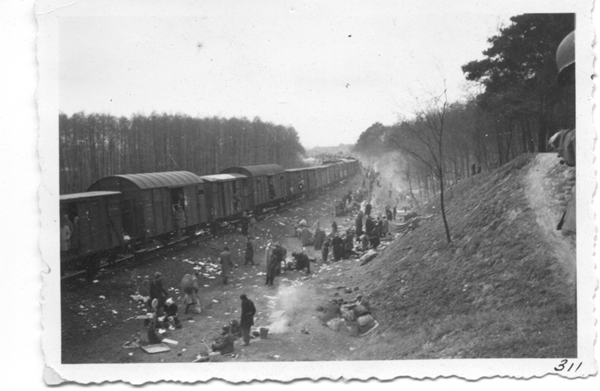
My tree in my hometown of Hudson Falls NY, 2018, and some of the just-liberated survivors of the ‘Train near Magdeburg’ on Friday, April 13, 1945, Farsleben, Nazi Germany. Sgt. George C. Gross photo.
The Remembering Tree {Words written for the occasion of the dedication of a tree in my honor in my hometown, May, 2018.}
I recently got a late-night email from a friend whose father I wrote about in my first book on the War in the Pacific.
“Thank you for helping my dad live forever.”
I met Ron when he emailed to say that he often thought of my own father, his high school history teacher, class of 1965. It was in my dad’s class that he and a friend made plans to join the Marines, where they would wind up in combat in Vietnam.
Ron’s dad had been a survivor of the infamous Bataan Death March, and a prisoner of the Japanese for three and a half years. As a result, he was bedridden by the time Ron reached his teens. He died as Ron started high school. Fifty years later, I wrote about his dad; the book has been a best seller in World War II circles.
Over the course of writing another four (and counting) books profiling the men and women who fought in World War II, or survived the Holocaust, I have heard similar statements, most from people who I never even met.
“My father would never talk about it. Thank you for helping me understand him.”
“I thought about my father and cried all the way through your book.”
“Thank you for sharing the love and admiration you had for the survivors and the liberators.”
“Thank you for giving back to your community by making history real for your students and readers.”
And the comments, really I suppose the catharses, always move me, especially when I think of where, and how, it all started.
***
When I was a kid, I rose early on summer mornings to get out of the house at 2 Main Street before the rest of my four siblings got up. The subliminal goal was to have some time to myself, to explore the village where I was about to awaken to so much history. I walked uptown past the new ‘savings & loan’ on the corner of the block, past the stately brick mansion where General Lafayette himself lunched after the Revolution he helped to save fifty years before was being fought in the vicinity. So here, along the banks of the meandering Hudson River, I was heading to while away the summer morning in search of old bottle dumps and buried treasures from the Revolution and colonial wars that raged through two hundred years ago.
I continued past Fielder’s Drug Store and Carleton’s Funeral Home, past the august old high school that now served as the place where we ‘southies’ attended our sixth grade before moving up to the new junior high school. I walked past the New Deal post office with its earthy WPA murals of local scenes of the river industries, logging and paper making, Depression-era farmers in blue overalls coming into town. The churches were now in sight, as was the turn-of-the-century county courthouse on the corner. Crossing Maple Street, I was in the heart of the business district, full of former hotels and more family drugstores and businesses.
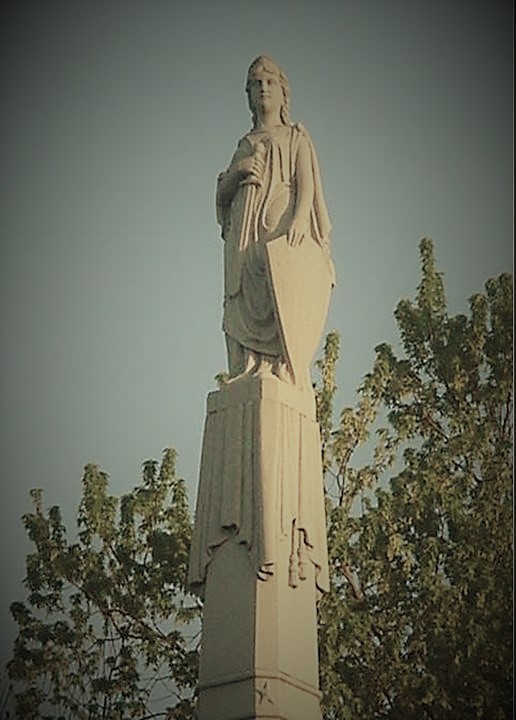
Soldiers Monument, Hudson Falls, on the Hudson River, in 1946.
And looming at the head of the village park was Miss Columbia atop the Civil War Soldiers Monument, who with her drawn sword and battle shield struck a commanding posture that seemed to say, ‘Go ahead. Make my day’.
I’d oblige the old girl in a few years as a mid-teen, a brush that involved my first and last tastes of whiskey from the bottle and a rude late-night attempt to scale her. When I awoke the next morning (to my horrified stupefaction, in my mother’s bed), I think Miss Columbia cracked a stony smile from her perch a mile away. A youthful indiscretion, a painful lesson learned. This teen burned with shame, but he would make amends someday, and somehow Miss Columbia knew that.
***
By 1979 when I graduated from Hudson Falls High School, I had also acquired the teenage itch to leave for the greener pastures of higher education. In conversation with my father as a senior in high school, I responded to his questions about my plans with the timeless wisdom and wit of the eighteen-year old—‘I’m leaving this town, I don’t know what I want to do, but I do know I am NOT going to become a teacher, like you’—a passing shot before I headed off to college a few hundred miles away. Take that, old man.
But, touché. He had the last laugh, because at 26, I was now paying him a token in rent and driving his old car around town. And I became a teacher, a high school teacher like him, and wait—oh, yes—teaching the exact same subject that he had been teaching for thirty years, high school history. Even the young can’t outrun the karmic wheel. But then, maybe there was a higher purpose in coming home to serve my community that I could not begin to understand yet. You see, if I had not returned, a lot of very cool things would not have happened, and it’s times like these that I have to just stop and think about that.
I was a young teacher, but soon enough I began casting pebbles. I began to interview World War II veterans when they were still ‘a dime a dozen’, drawing their stories out, following leads, and putting my own students on the hunt for a good story. It took a bit of time and an almost obsessive dedication. But thank goodness I did that, as an adult coming of age, back in my hometown.
I’d have more encounters with that monument in the park, too. I wanted to know her history, what she admonished, and what that terrible war meant to our town and our nation. She obliged one Saturday evening when I sat with a survivor of the WWII Battle of Midway, a recipient of the Navy Cross and the Silver Star. I remember:
He settles into a comfortable chair across from me and lights up a cigarette, relaxing and clearly delighted with the company. His wife has passed, his children have long since moved on, and he and I are alone. With a twinkle in his eye, he tells me joke after joke and regales me with one incredible World War II story after the other. We laugh and pass the time; the lifeblood of this small town is being transfused as he recalls his life and his old companions in the quiet of his living room, and then he tells me something that will resonate with me to this day:
‘This monument is presented by Dr. Erskine G. Clark to the Village of Sandy Hill Dedicated to the honor and patriotism of the soldiers of Washington County who served in our war to suppress the southern rebellion of 1861, waged against the life of the nation. ———————- Dedicated June 30, 1887′
A little boy in the 1920s walks the streets of this town with his grandfather, hand in hand. They near the Soldiers Monument erected in the 1880s to remember the young men of the community who fell in the Civil War. The old man stops, points, and wipes his eye, proclaiming bitterly to the youngster that ‘there stands nothing but a tribute to Southern marksmanship’.Here is the young kid who would go on to pilot dozens of harrowing combat missions in World War II, the little boy holding the hand of his aged grandfather who had fought at terrible places like Gettysburg two generations earlier. In shaking Judge John Leary’s hand, eighty years on, I am suddenly conscious that I am now physically connected to the sixteen-year-old boy from our town who fought in the furious action at the turning point of the Civil War.[1]
So there it was. This is what Miss Columbia wanted me to find out, to try to understand.[i] We had come full circle, I supposed. But not quite yet. For it was also in this time that I sat down with another veteran here in my hometown as he recounted his Army travails as a combat tank soldier across northern Europe into Germany. I took the time to talk to Judge Carrol Walsh, and somehow the universe tilted just long enough for a crack to be opened across time and space.
In 1945, Sergeant Walsh was a tank commander fighting across northern Europe and into Germany. That July afternoon nearly sixty years later he told me many stories of pitched battles and close calls, of weeks that alternated between the extremes of boredom and sheer terror. And then at his daughter’s prompting, he spoke of this:
Well, late in the war, again a nice, beautiful April day—we were shooting like crazy across the top of Germany, and Major Benjamin of the 743rd was kind of out ahead scouting a little bit—he came back to the battalion and he pulled my tank and George Gross’s tank [fellow tank commander] out. He told us to go with him. So we did.
We came to a place where there was a long train of boxcars. I can remember pulling up alongside the train of boxcars, Gross and I, and Major Benjamin. As it turned out, it was a train full of concentration camp victims, prisoners who were being transported from one of their camps… I think they had been in Bergen-Belsen, on their way to another camp…
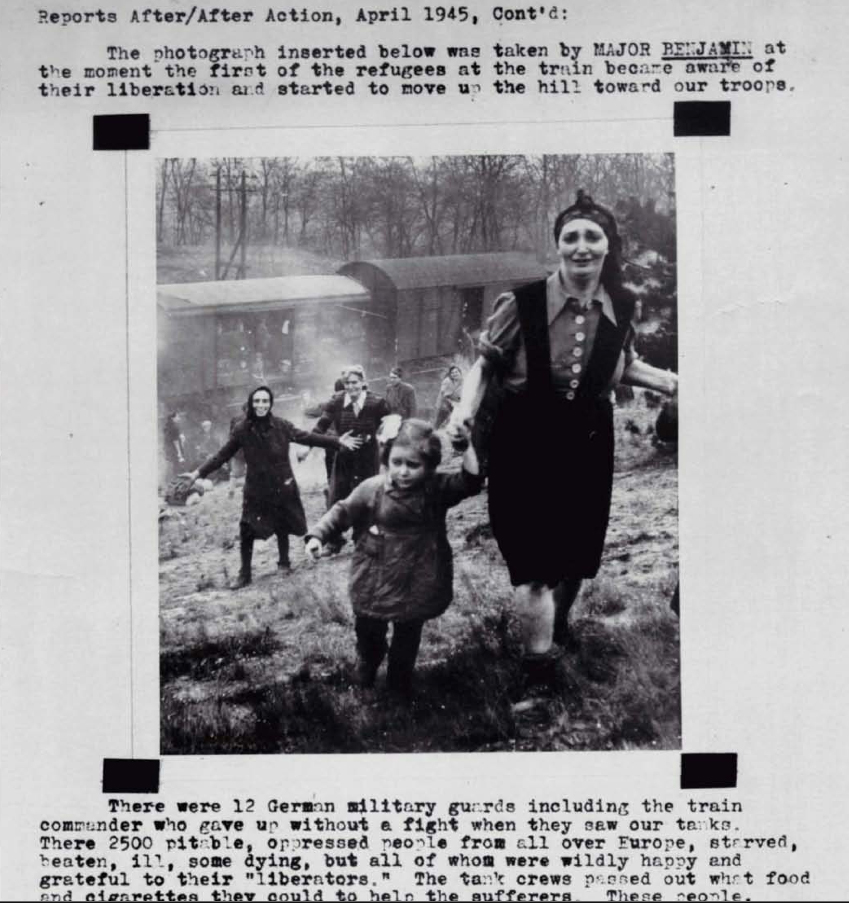
743rd S-3 After Action journal report- the moment of liberation
So there they were. All of these people, men, women, children, jam-packed in those boxcars, I couldn’t believe my eyes. And there they were! So, now they knew they were free, they were liberated. That was a nice, nice thing. I was there for a while that afternoon. You know, you got to feed these people! Give them water. They are in bad shape! Major Benjamin took some pictures, and George Gross took some pictures too…[2]
‘That was a nice, nice thing.’ Later, this will strike me as the under-statement of all time. Though we could not know it at that moment in the summer of 2001, a portal across time and space had just unlocked, and I would wind up stepping across the threshold; our lives and the lives of thousands of other people would be affected, for the better, and there was healing.
***
Ten years after that interview on Coleman Avenue in this village, I was invited to attend a special reunion in Rehovot, Israel, where liberator Frank Towers and I addressed an auditorium filled with fifty-five survivors of the ‘Train Near Magdeburg’ and their children and grandchildren.[3] In the audience were over 500 people who probably would not have been born, had it not been for the actions of this soldier and the others. As we listened to the testimony, a woman began softly crying behind me. I kept my cool and bit my lip and didn’t cry until another survivor’s daughter approached me and told me that my name in Hebrew meant something along the lines of, ‘Mystery of God’. Heavy, heavy words. Yet here I was, halfway around the world, connecting people unknowingly bound together in the greatest crime in the history of the world. Watching families heal. We would have eleven reunions on three continents, the first right here in Hudson Falls. The ripples continue to reverberate; I still get emails expressing thanks and amazement from survivor families who come across my work anew.
That’s not to say it’s all been an easy road. I had to become extremely conversant in the macro and micro aspects of the study of the Holocaust, and extremely proficient in the teaching of it (and there are a lot of ways to get it wrong). I’ve sat at the feet of the best instructors in the world, who helped me reach powerful insights, and gave me the tools to defend myself and to prepare my course of action when I come under attack by Holocaust deniers and minimizers.
Don’t forget, I am not Jewish, and I will assert that that is not without some import here (I don’t think I was even in a synagogue or temple until my forties, though our folks certainly had Jewish friends). It’s important because I truly believe I was chosen, as a gentile, to be a witness myself. I had no ‘agenda’, and I can’t explain why I have the occasion now to write all this any other way, let alone start this blog 10.5 years ago (closing this year in on a half-million hits), or write that book for ten years that clocked in at 500 pages (and nearly killed me in the process). And now I’m working with an Emmy Award-winning filmmaker, also a gentile and a friend, to bring it to the world on another platform it deserves. The Greater Glens Falls Jewish community has honored me many times over, contributing to my journeys to the authentic sites of the Holocaust and my study in Israel.[4] Now they have asked the village for permission to honor me where it all started, the hometown where I wandered so freely, the hometown I tried to escape as a restless teen, the hometown that called me back and gave rise to an incredible career. This is the place where the trauma was recalled, and where our students became new witnesses. My hometown is also where new miracles occurred, and where this healing first began. My survivor friend Leslie, who traveled from Toronto to be at two of the Hudson Falls reunions, expressed to his liberators and to the students at Hudson Falls High:
“I survived because of many miracles. But for me to actually meet, shake hands, hug, and cry together with my liberators—the ‘angels of life’ who literally gave me back my life—was just beyond imagination.”
***
I recently left the classroom after more than 31 years, but with my fifth book due in a few weeks, I’m still busy honoring memory. My dear mother and father, and many of the World War II veterans and Holocaust survivors I interviewed, are now gone. And so we come back to this tree. If you don’t know history, you don’t know anything. You are like the leaf that doesn’t know it is part of the tree.[5] This tree commemorating my pilgrimage is an appropriate symbol, a gentle reminder to the young to be curious, to wonder, to hope, to dream, to take risks, to take advantage of the memory and knowledge of those who came before them. This tree symbolizes life, and its roots are anchored in memory.
‘Prosit’, the old man would say on occasion, invoking his schoolboy Latin. ‘So it is, and may it be to your advantage.’ As the breezes caress this maple’s leaves, in the rustling may you hear the whispers of those who came before us, those who like Miss Columbia inexorably called me home to attend to a life’s work. Now with this ‘remembering tree’ growing in her garden, may the ripples continue to go forth and ping the past, and may your fathers, and mothers, live forever.
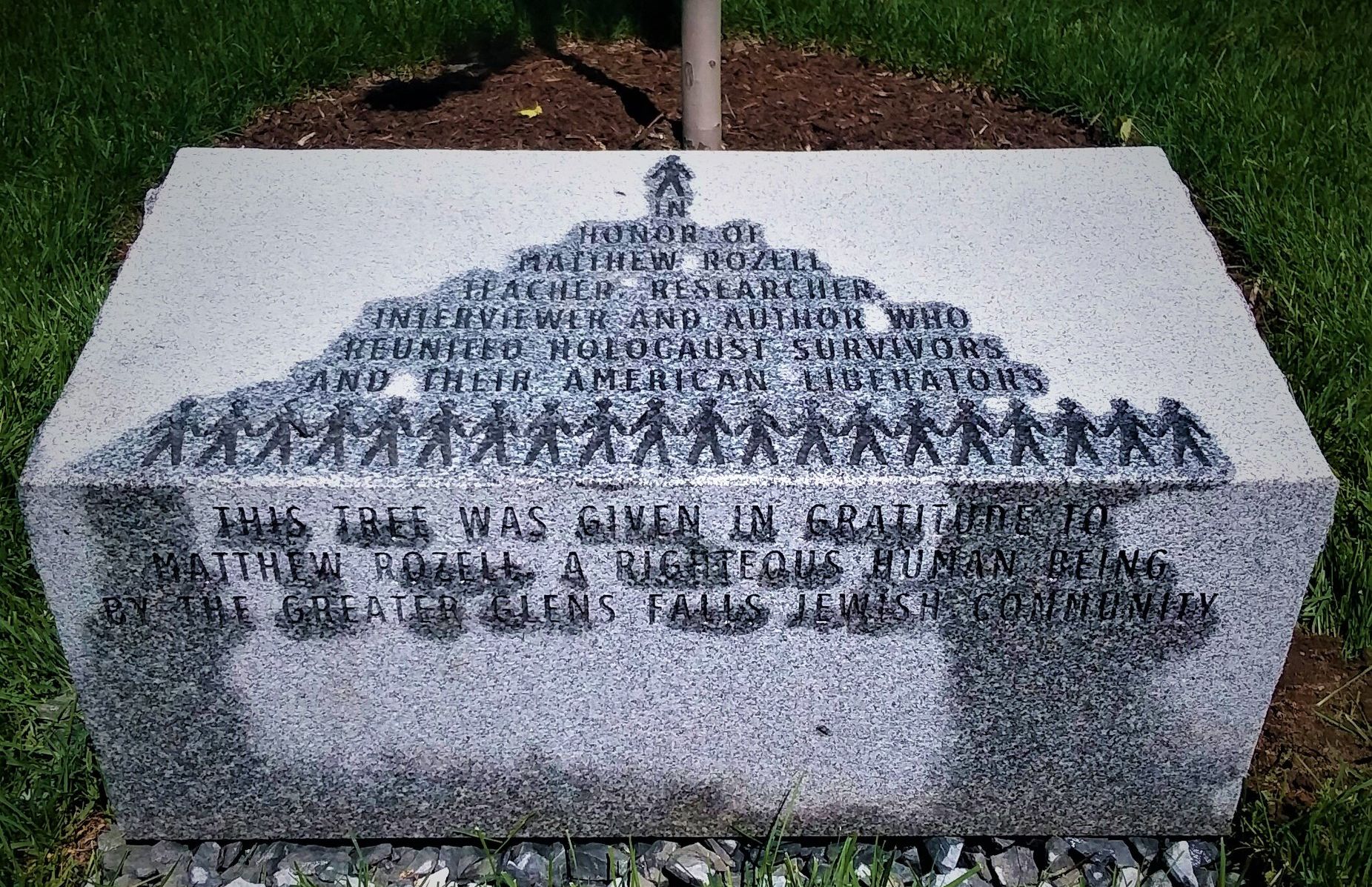
“Marker for special dedication ceremony to honor Matthew Rozell on Sunday, May 27, 2018, at 1:00 p.m. at Juckett Park in downtown Hudson Falls. At this ceremony, we will dedicate the tree purchased by the Greater Glens Falls Jewish Community in recognition of Matt as a righteous human being for his work as a historian, teacher, Holocaust educator and author who reunited survivors and their American liberators. Through his teachings, writings and efforts, Matt has brought a greater awareness of the Holocaust not only to our community but also globally. The tree was planted by the Village of Hudson Falls, and the special marker was installed by Loiselle Memorials.”
*************
Some notes:
[1] Excerpted from my first book, The Things Our Fathers Saw—The Untold Stories of the World War II Generation From Hometown, USA-Volume I: Voices of the Pacific Theater.
[2] Excerpted from my second book, A Train Near Magdeburg: A Teacher’s Journey into the Holocaust, and the reuniting of the survivors and liberators, 70 years on.
[3] Expertly organized by survivor’s daughter and my friend, Varda Weisskopf.
[4] My dear friend and supporter Sunny Buchman spearheaded this effort.
[5] I stole this leaf/tree quote from Michael Crichton’s book, Timeline.
[i]This is what Miss Columbia wanted me to find out, to try to understand—As a ‘soapbox’ aside, the teacher still in me has to add that learning all this is one of the reasons I find the I’m-a-rebel-on-a-new-bandwagon-and-in-your-face-if you-don’t-like-it display of the Stars and Bars locally both profane and contemptuous. Because here in the northern towns where your own great-great-great-grandfathers were from, fighting and dying in those far-off fields, never to return home, there is still something to be said about cracking a book and educating oneself, or not sleeping or texting thru history class… something important about REMEMBERING.
I was unpacking a box from my classroom last week, full of framed pictures and awards from my previous life as a classroom teacher of history and the Holocaust. Yes, I know it is February, and I ‘retired’ in June. I guess that it’s taking so long because some days I wrestle with the fact that I’m no longer in the classroom with the kids everyday. But I can tell you that students and teachers have been on my mind all week long, given the events in a Florida high school.
So I’m unpacking this box (and subliminally wondering why I am even bothering to unpack the box, now eight months down the line), dusting off the frames but noticing a few small yellow spots that don’t go away with a wipe, but can be scraped away with a fingernail. I’m curious, and then it all comes flooding back.
Oh yeah. It was from that day a few years ago when an enraged 18-year-old in my classroom (whom I had been walking on eggshells around all year long) suddenly sprang out of his seat like a coiled spring and hurled his books at me from across the room, narrowly missing me, and, rapid reload, fired his 20-ounce sticky breakfast energy drink which exploded at the horizon line above my head where the yellow painted cinderblock wall and ceiling met, spattering and raining sticky golden gunk everywhere. He turned and it seemed like he nearly tore the metal classroom door out of its frame, opening it with such a velocity that it ricocheted off the closet, and stormed out of the room and down the hall.
I instinctively walked quickly to the door, closed it, and locked it. My stunned students were quiet as I returned to my desk and called the office. And then I somehow managed to carry on with the lesson, until I could follow up the next period. Must keep things ‘normal’. But I was shaking. All I had done was ask him nicely, respectfully, and personally, three times, to stop texting during the lesson. I was gentle, quiet. I even said please. I don’t think the other kids even heard me, hence their stunned incredulity at the explosive reaction of the student. Later I insisted that he not be allowed in the vicinity of my classroom, and maybe I was lucky that my wish was granted. I’m sure I was lucky on many levels. I never saw him again.
All of this brought back what I have been thinking about all week. It was not my first brush with some level of threatening or violent behavior in the classroom. We, kids and their teachers, administrators, deal with this enough so that the ‘what ifs’ are always present, but now they are again hurtling from the back to the forefront of our lives.
And so to my teacher friends, some of whom, hearts heavy, cried in front of their students this past week, it’s okay. You’re bombarded and pounded-again-but your kids know that you are there to listen to them. So that’s just where it is right now. You are there for them, and frankly, in this moment, they are there for you, too.
Now I circle back to that question-was there every really a time when I would not have put it on the line for my kids? Not at all. And truth be told now, I always balanced a 3-foot-long piece of angle iron (left over from school construction) on my knees, when seated just behind the door, while the kids were huddled in the corner during the shooter drills. (Maybe it wouldn’t do any good, but it sure felt comforting to hold on to a heavy piece of metal.) And after a week of fumbling to find the right words, I read this article in the NY Times. Yes. Times like these I really miss my school family, and the beautiful human beings we nurture and cultivate. And kudos to Bruce Klasner, fellow Holocaust and Jewish Resistance Teachers’ Program alumnus. I don’t know Bruce, but he nailed it for me.
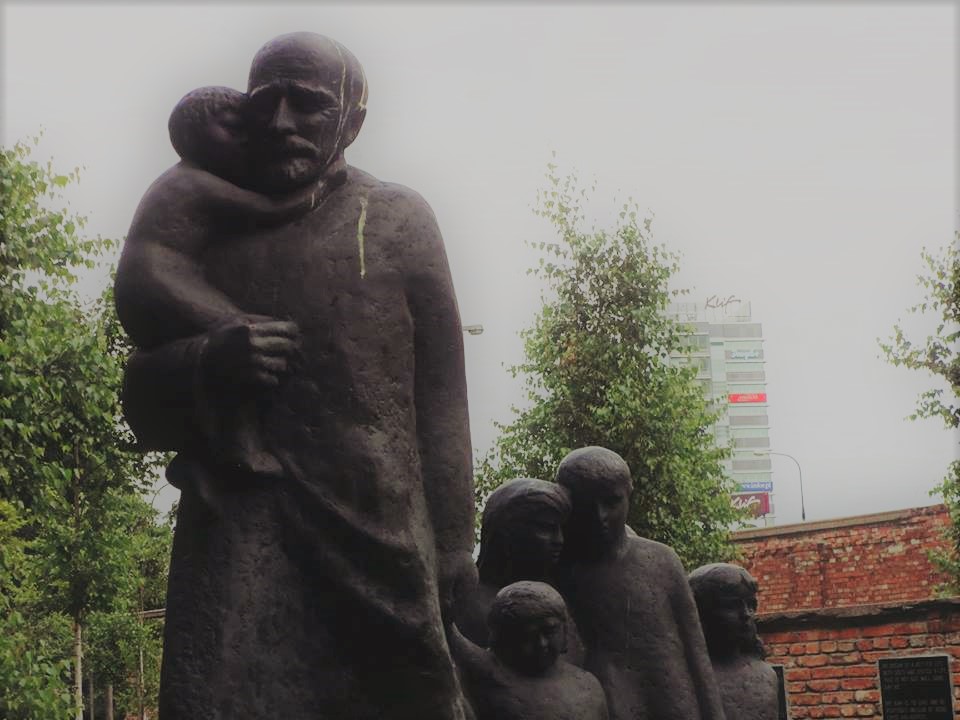
Janusz Korczak memorial, Warsaw, Poland. I took this while on myHolocaust and Jewish Resistance Teachers’ Program journey. Look him up sometime. And read below.
*********************
School Shootings Put Teachers in New Role as Human Shields
By JULIE TURKEWITZ FEB. 19, 2018
TAMARAC, Fla. — The shooting was all over, but the emotional reckoning had just begun, and so on Saturday the teachers of Broward County packed their union hall to discuss what it meant to have become the nation’s human shields.
“Last night I told my wife I would take a bullet for the kids,” said Robert Parish, a teacher at an elementary school just miles from Marjory Stoneman Douglas High, where a former student killed 17 people, including three staff members who found themselves in the line of fire.
Since the attack last week, said Mr. Parish, “I think about it all the time.”
Across the country, teachers are grappling with how their roles have expanded, from educator and counselor to bodyguard and protector. They wonder if their classrooms are properly equipped, if they would recognize the signs of a dangerous student, and most of all, if they are prepared to jump in front of a bullet.
In the last few days, teachers wrote to Congress, urging bans on assault weapons, and to state lawmakers, seeking permission to carry firearms to school. They attended local protests and reviewed safety plans with students. And in the evenings, they spoke with friends and family about an excruciating reality — that teachers, who once seemed mostly removed from the life-or-death risks faced by the ranks of police officers and firefighters, might now be vulnerable.
“I visualized what it would look like, and it made me sick,” said Catherine Collett, 28, a sixth-grade teacher in Northern Virginia who has spent recent days running through a thousand violent scenarios. “Could I empty out the cabinet and throw out the shelves and put kids in the cabinets? Is my better chance just barricading the doors? Can I move furniture that fast? Do I ask my kids to help me?”
Many teachers said even contemplating such worries felt far from what they had once imagined their challenges would be. As if the mounting pressures of test scores and email messages to parents and bus duty and hall duty and new certifications and all those meetings wasn’t enough. But the death toll has piled up — staff killed in shootings at Columbine High School in Colorado in 1999, Sandy Hook Elementary in 2012 and now at Stoneman Douglas in Florida — and is forcing a shift in how teachers view their responsibilities.
“When I started teaching, I thought I was just coming in to teach,” said José Luis Vilson, 36, a middle school math teacher in New York City. Now he has come to view himself as a first responder, too, and added that instruction on topics such as conflict resolution and first aid would be useful.
Bo Greene, 56, a calculus and statistics teacher in Bar Harbor, Me., said the planning for dangerous situations had increased and grown more specific in the last year, even in her quiet school district. All of it feels jarring after decades in education, she added.
“I never had any of this,” Ms. Greene said. “We had the basic fire drills.”
Nowhere was the conversation among teachers more intense than in Broward County, where Stoneman Douglas is one of more than 300 schools, and Nikolas Cruz, charged in the shooting, had been among the district’s 270,000 students.
Laurel Holland, who was Mr. Cruz’s 11th-grade English teacher, said teachers in big public schools cannot possibly be expected to look into every student’s background to know if they have long been troubled. The year that she taught Mr. Cruz, she had more than 150 students, she said.
“There’s not enough time,” she said.
In the case of Mr. Cruz, she said, it was clear something was wrong. “He didn’t work and play well with others,” she said. “I was frightened.”
Ms. Holland eventually reported him to the administration, and he was removed from her class after one semester.
Inside the crowded union building on Saturday, educators held hands and shouted “Union strong!” before getting down to business.
How, they asked, were they going to stop the next one?
For hours they spoke of the golf clubs and baseball bats they would like to keep in their classrooms, of the bulletproof vests they wish they had, of the challenges of removing mass killers from their midst.
“I’m curious to know, out of the people here, how many Nikolases they have at their school?” said Elizabeth Sundin, 48, a teacher’s assistant. “Because I have one at our school.”
Outside, in the balmy Florida night, Mr. Parish, 51, of Broadview Elementary, was wrestling with the question of the class door. When an armed attacker begins to prowl, and a student is left in the hall, “Do I let the kid in, and maybe the gunman behind her?” he said. “Or do I not let them in and save the whole class? That’s a decision I can’t make.”
Inside, under the glare of fluorescent lights, Bruce Klasner, 61, of Everglades High was wondering why the district had not created a text message system that could send instructions in the event of an attack.
“I teach the Holocaust,” he shouted at the rows of exhausted teachers. “I taught them,” he said of his students, “about a man by the name of Janusz Korczak who walked into the gas chambers with his children because he refused to leave them. And after this happened my kids are sitting outside saying, ‘Mr. K, would you give your life for me?’”
Mr. Klasner said he would — of course. “I said, ‘Did you even have to ask?’”
In a corner, Andrea Suarez, 35, of Westpine Middle School was worried about her own students, who have special needs and often make loud noises, meaning it is almost impossible to hide them.
These days, she said her plan for responding to a shooting involves corralling the children into a closet, occupying them with snacks, and positioning herself in front of the closet door with a pair of sharp scissors.
“I’ve been having a lot of difficulty sleeping,” said Ms. Suarez, whose four children have been urging her to leave the profession. “I keep hearing kids screaming and gunshots in my head.”
Here in Tamarac, the union meeting was wrapping up.
Jim Gard, in cargo pants and a union polo, stood outside, amid palm trees. At 58, he has been a teacher for 36 years, he said, and works at Stoneman Douglas. When the shooting broke out, he was in math class, not far from where many were shot. He had taught Mr. Cruz, as well as two of the dead.
“You know, if I go through my college transcripts — master’s degree, doctorate courses, all that — I know for sure there are no courses that say: ‘Shooter on Campus 101,’” he said.
The Broward County school district announced on Monday that staff members would return to Stoneman Douglas at the end of the week. Classes are expected to resume on Tuesday, Feb. 27.
Mr. Gard said many of his colleagues were struggling with the idea of returning.
And yet, he said, “I want to go back. I want to go back to my kids. I want to go back to my classroom. I want to see the kids, I want to teach the kids — and that’s the bottom line.”
Here’s a recent article from the Museum Teacher Fellowship Program at the USHMM. Many friends, so dedicated to this mission we are all on. Thanks Josh.
Interview and Article by: Josha Sietsma, Netherlands (MTF 2016)
For Matt Rozell (Granville, NY; MTF 2008), the term ‘retired’ doesn’t define his state of being. A real teacher never stops teaching. Writing books that educate, and with a bigger audience than ever, Matt talks to us on his connection with the Museum and connecting survivors with liberators: “I think [also] it is true that our work as educators is never ever done”.
To start, what are your tools of trade? What is essential to your work, your performance. A passion to connect to history using real people. When I begin to speak about the history, Holocaust or otherwise, there is a level of excitement and passion that just flows out of me and engages my audience, be it high school students or senior citizens listening to one of my presentations. And it has been with me since my earliest days…
Matthew Rozell is a teacher who has studied at the United States Holocaust Memorial Museum and Yad Vashem, Israel’s Holocaust Martyrs and Heroes Remembrance Authority. His second book, A Train Near Magdeburg, is on teaching and remembering the Holocaust.
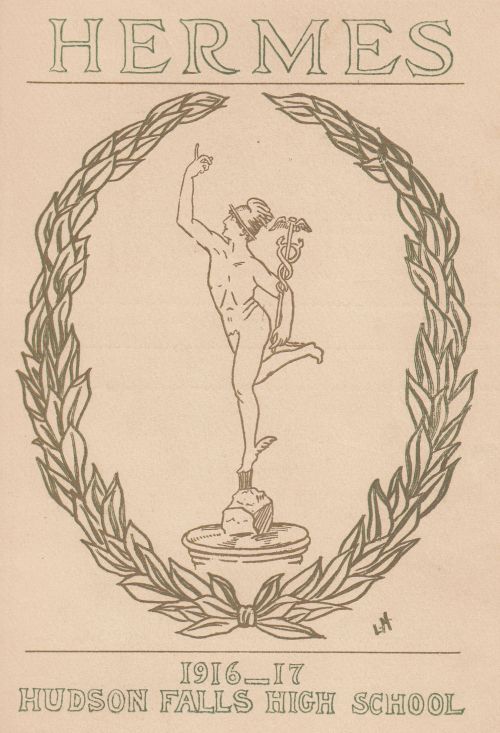
I have not posted a lot since I “retired” but here is one I wanted to sneak in before the new year dawns. Actually I should have done it a long time ago, but the fact is it only came to light last spring. Deep in a filing cabinet, a copy of the very first yearbook of our school district emerged- exactly 100 years later. So I scanned it and here it is, in its entirety. Our yearbook staff used some of it in the 2017 Hudson Falls CSD yearbook. Thanks to some eagle-eyed staff members, it’s safe in the district vault now as well. There are actually two copies known now to exist. Believe me, I searched for them for years. The earliest I could find in the vault was 1919.
I could ramble on about its significance to our community, but I will let the pages speak for themselves now. Most of the folks who get this notice in their email inbox signed up to learn more about the Holocaust, or WWII, or the importance of teaching history. But this is the community that raised my dad, and me and my brothers and sisters, and that my mom became a big part of. It’s the school that produced yours truly and many fascinating people. It’s where I spent my career, and did the things you come here for. It’s also a snapshot of an American small town 100 years ago. And for my ‘former’ school community, this is me, Mr. Rozell, still here, charging up the parapet on the last day, and holding the fort.
Hermes. The messenger of the gods. I hope you enjoy it-I compressed it to 10MB I think- Have a wonderful 2018, but here is to 2017, and 1917.
Click on the cover photo, or here to download. Catch you on the rebound. Have a great 2018!











 Teaching History Matters