Feeds:
Posts
Comments

Posts Tagged ‘teaching history matters’

Thirty years ago next month I began my career teaching history in a summer school, getting my foot in the door. Shortly thereafter I wound up back at my own high school, just eight years after telling my parents I was leaving my hometown for good (I had also told my history teacher father that I certainly was NOT going to be an educator like him and my school-nurse mom). Now I was living in their garage, no less, commuting up the main street to my old high school in my dad’s  hand-me-down car. Karma can be interesting.

So there I was, a rookie newbie history teacher shuffling from class to class with with no classroom to call my own, pushing a cart like an unknown peddler through the crowded halls of my alma mater. There were times when I was sure I was going to leave the profession in those early days. (Maybe in some of the later ones too.) But I kept plugging, through the rough days and good. I didn’t quit.

New York State Education Department Building. Photo by Matt H. Wade at Wikipedia, CC-BY-SA-3.0

New York State Education Department Building. Photo by Matt H. Wade at Wikipedia, CC-BY-SA-3.0

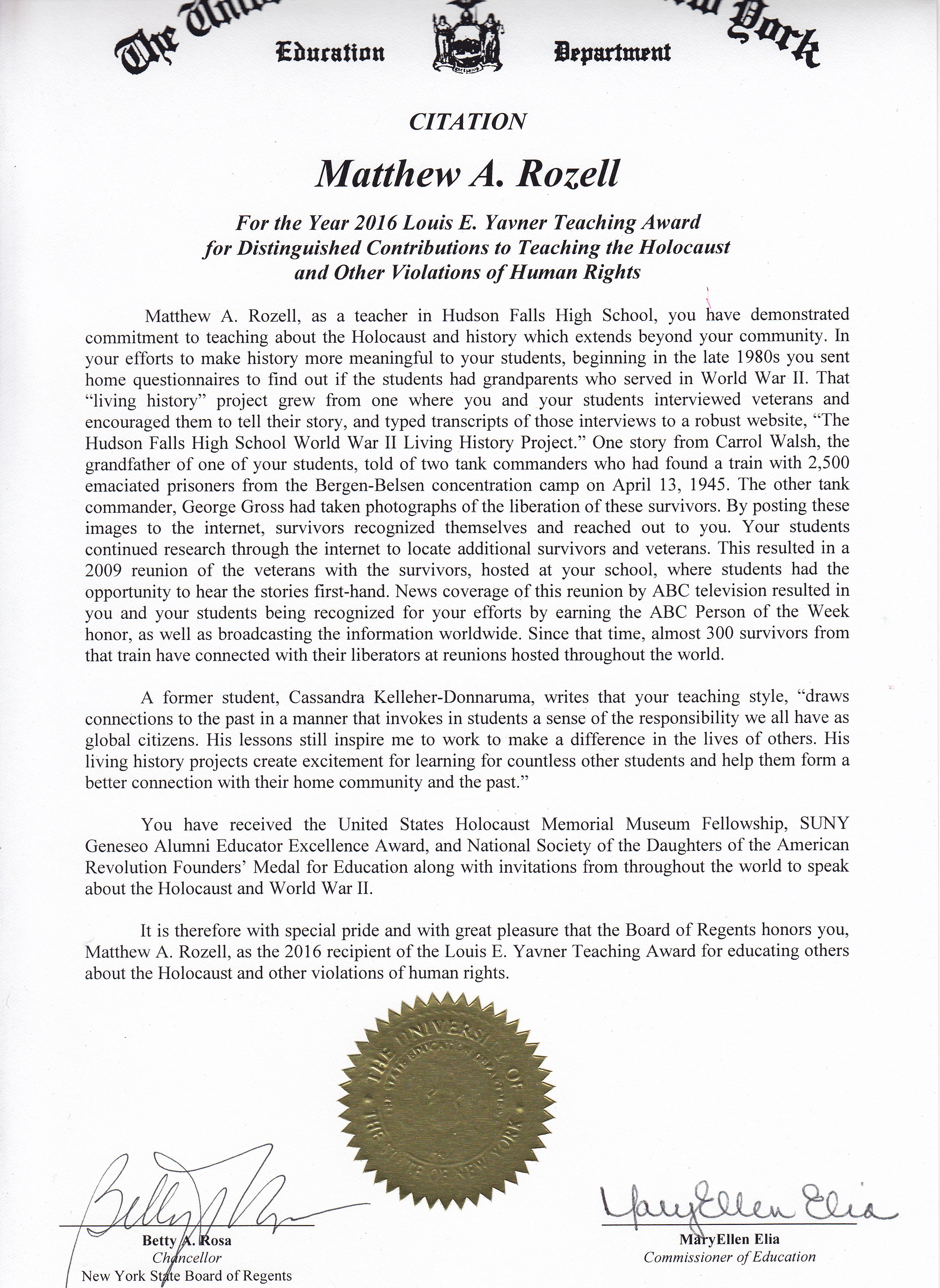
This week I was called to Albany to be honored by the New York State Education Department Board of Regents, and the Commissioner of Education herself. It is close to the highest honor that a teacher in this state can have, to get a standing ovation from the movers and shakers in the field, to sit at their table and be able to thank them for the recognition and to explain why you think that your career path was somehow ordained by forces beyond your control. To the Louis E. Yavner Award Committee, thank you for counting me as worthy.

IMG_0013

Commisioner Elia's (L) tweet. Chancellor Rosa, asked me to sit in her chair and address the Regents at their meeting, May 17. 2016.

Commissioner Elia’s (L) tweet. Chancellor Rosa, asked me to sit in her chair and address the Regents at their meeting, May 17. 2016.

Sometimes you lie awake and wonder if it has been worth it. I guess I don’t really need an award to tell me that it has, but it feels nice, and I hope that other teachers know that they make the same difference everyday.

Sometimes karma is not such a bitch, after all.

Video of acceptance speech below.

New York State United Teachers article here.

New York State Legislature recognition below.

Read Full Post »


So, it is the sixth of June again.

American Cemetery overlooking Omaha Beach, the primary landing zone for Americans during the D-Day invasion June 6, 1944. (U.S. Air Force Photo)The ocean pounds the advance of sand amidst the relics of a different age, the hulking remnants of the tide of battle. The surf rolls in and kisses the beach, as the last participants mix on the hallowed bluff above with the politicians who have gathered from all over the world.

Thirty-two years ago I watched as the American president honored  the fallen, and the living, at the cemetery for the fortieth anniversary. Just out of college, something stirred inside me. Something was awoken.

I began by writing letters to the newspaper. I began to interview D-Day veterans and others. I began to collect stories- not relics, prizes, or artifacts. I really had little interest in captured Nazi flags or samurai swords.

I wanted to talk to the men who were there.

The fiftieth anniversary came next with great pomp and more reflection. It graced the covers of the major newsweeklies. “Saving Private Ryan” stirred the consciousness of a new generation, and reflections of the old. And I learned so much more of the war beyond the beachhead. That there were so many beachheads.

The sixtieth anniversary came around. Students on their bi-annual trips to France would bring me back their photographs and the requisite grains of white sand from Omaha Beach. Teenagers had their emotions  a bit tempered, I think. I would go on to introduce them to so many who were there. When they themselves were teenagers.

So now it is the seventy-second. On the 65th, I wrote about a friend who is no longer here for the 72nd,  and the 75th will bring fewer who were there back to Normandy.

*****************************************

Today I would like to introduce you to a survivor of D Day who is still with us.

I first met Bill Gast at a reunion of 30th Infantry Division and 743rd Tank Battalion soldiers at a reunion in March 2008, in which I  was present with several Holocaust survivors who were meeting their liberating soldiers for the first time. Later, Bill came to my high school to speak to students. I think the experience of sharing, and meeting the Holocaust survivors whom the 743rd came upon and liberated, affected him deeply.

Unlike many who may be physically able, Bill has no intention of going back to the sands of Omaha for this anniversary. As he explained to our students in 2009,

“I’m listed [in the event program] as a liberator- however, I am also a survivor of World War II, having landed on Omaha Beach in Normandy, France on D-day and fighting through to the end when the Germans surrendered, May the 7th, 1945.”

“Pictures.

Video games.

Movies.

Words.

They simply do not covey the feeling of fear.

The shock.

The stench.

The noise.

The horror, and the tragedy.

The injured.

The suffering.

The dying, and the dead.”

https://www.youtube.com/watch?v=GmKNYMaa_sU


*****************************************

D-Day: the view from a tank on Omaha Beach

Washington (AFP) – From inside his tank, the young soldier could see “practically nothing” on Omaha Beach.

Seventy years later, William Gast still wonders whether he rolled over his comrades sheltering from German gunfire that day.

Gast was 19 years old the morning of June 6, 1944. “We came in at H-10, that was 10 minutes before the designated hour.”

He cannot recall why he and his fellow soldiers arrived early, but he has other memories that have never left him.

As part of Company A, 743rd Tank Battalion, 1st Army, Gast remembers the training beforehand in Britain, when he rehearsed driving the Sherman tank onto the landing craft. And then floating in the English Channel.

“Another night we went out and we didn’t come back. That was it.”

Gast got to know the captain of the landing craft that would ferry his tank to the beaches of Normandy.

The skipper promised he would get them close enough that they would not be submerged in water, like so many tanks were that day.

He kept his word.

Another tank unit at Omaha Beach was less fortunate, with 27 of 32 tanks launched at sea five kilometers (three miles) from the coast sinking before they could reach land, despite being outfitted with a flotation screens.

“The order was given to go, we started our engines up, they lowered the ramp,” said Gast.

Amid German shrapnel and sea spray, he “could feel the tracks spinning.”

At last, the tank tracks took hold on the sandy sea bottom and he drove up the beach.


– Like throwing marbles at a car –

Down below in the driver’s seat, Gast tried to steer the tank with the aid of a small, manual periscope.

“You can imagine how much we could see, practically nothing,” he said.

The radios inside the tank were so unreliable that his commander would tell Gast which way to turn by kicking him on the left or right shoulder.

The difficulty in seeing the way ahead has left Gast with a gnawing sense that he may have run over the bodies of American soldiers on the beach.

“The saddest part about the whole thing is, not being able to see, I may have run over some of my own people.

“And if I did, I don’t even know it. I can’t ever get that out of my mind, you know?”

Bill Gast awarded the Silver Star.

Bill Gast awarded the Silver Star.

Corporal Gast heard machine gun bullets hitting the side of the tank, “like throwing marbles at a car — that’s what it sounded like.”

“And there were shells that exploded right beside me. You could feel the tank shake.”

For Gast, it was a day of fear and terror, and following orders without reflection.

“I can’t tell much about what happened, I was scared to death to start with,” he said.

“It was just like putting it on automatic, you just did what you had to do, did what you were told to do.”

By noon, close to 19,000 American soldiers who landed at Omaha were still pinned down on the beach.

– High school sweetheart –

Carefully laid plans had unraveled as the beach became a killing zone, with troops mowed down under a fusillade of German machine gun, artillery and mortar fire.

Small teams of US troops eventually managed to break through on the bluffs between German positions, with the help of combat engineers blowing up obstacles.

The losses were staggering: more than 2,000 dead, wounded and missing on Omaha beach. The exact toll is still unknown. Of the 15 tanks in Gast’s Company A, only five survived without damage.

Gast, from Lancaster, Pennsylvania, earned the Silver Star and the Purple Heart during his combat tour, and went on to marry his high school sweetheart.

Now 89 years old, he recently was awarded France’s Legion d’Honneur at a small ceremony for World War II veterans at the French embassy in Washington.

The short, soft spoken man stood up to receive the medal and shook hands with a French diplomat. But he has no plans to return to Normandy for the 70th anniversary of the D-Day landings.

His son, Bill, said his father did not want to relive that day: “It’s important we don’t forget, but you try to hide things somewhere.”

Mr. & Mrs. Gast, Holocaust Survivors-American Soldiers reunion, 2009.

Mr. & Mrs. Gast, Holocaust Survivors-American Soldiers reunion, 2009.

*****************************************

Read Full Post »

Lisette Lamon was a Holocaust survivor liberated on the train near Magdeburg on April 13, 1945, and later in life a psychotherapist at White Plains Hospital outside of New York City, a pioneer in the treatment of trauma back in the days when the field was in its infancy. She had experienced it herself. She was from the Netherlands, and lost her first husband Benjamin ‘Benno’ Soep at the Mauthausen slave labor concentration camp in Austria in 1941 (she appears on the manifest list: Soep-Lamon Lisette DOB 14.05.1920 Amsterdam).

This article originally appeared in the New York Times on Mother’s Day, May 12, 1979, back when I was a young buck itching to graduate high school and go out into the unknown world. Of course I did not see this article then, but the people she was with on that train and the soldiers who liberated them would go on to change my life. I wonder if at the time my own mother, relaxing in her silk robe on Sunday afternoons with the NYT as she frequently did in her respite from the workweek, read this letter… It was presented to me by fellow survivor Elisabeth Seaman, whose mother had been in contact with Ms. Lamon (Ms. Lamon passed in 1982).

Here’s to all mothers, a beautiful anecdote that will no doubt make it into my upcoming book. Happy Mother’s Day, indeed.

It was a beautiful, balmy morning in April 1945, when I entered Major Adams’ makeshift office in Farsleben, a small town in Germany, to offer my services as an interpreter.  It made me feel good that I could show, in a small way, the gratitude I felt for the 9th American Army, which had liberated us as we were being transported from Bergen-Belsen concentration camp.

Orders found by the Americans in the German officer’s car directed that the train was to be stopped on the bridge crossing the Elbe River at Magdeburg, then the bridge was to be blown up, also destroying the train and its cargo all at once. The deadline was noon, Friday the 13th, and at 11 A.M. we were liberated!

Victory, 1945. Watercolor, Ervin Abadi. Train near Magdeburg survivor. Hillersleben, Germany, May 1945.

Victory, 1945. Watercolor, Ervin Abadi. Train Near Magdeburg survivor. Hillersleben, Germany, May 1945. Credit Chriss Brown.

With the liberation had come the disquieting news that President Roosevelt had died, and while I was airing concern that the new President, Harry Truman, (a man unknown to us) could continue the war, a sergeant suddenly said, “Hey, you speak pretty good English. I am sure the major would like to have you serve as his interpreter.”

Major Adams had not been told of my coming so he was startled when he saw me. No wonder! There stood a young woman as thin as a skeleton, dressed in a two-piece suit full of holes. The suit had been in the bottom of my rucksack for 20 months, saved for the day we might be liberated, but the rats in Bergen-Belsen must have been as hungry as we were and had found an earlier use for my suit. For nine days we had been on the train, and this was the only clean clothing I owned.

Major Adams quickly recovered from his initial shock and seemed delighted after I explained why I had come. He asked how his men had treated us, and I heaped glowing praise on the American soldiers who had shared their food so generously with the starving prisoners. Then he took me outside to meet the “notables” of the German population, and with glee I translated orders given to them by the American commander. The irony of the reversal of roles was not lost on me nor the recipients; I was now delivering orders to those who had been ordering me around for so long! The Germans were obsequious, profusely claiming they never wanted Hitler or agreed with his policies and hoped the war would soon be over.

When asked to come back the next day, I was delighted but hesitated, wondering if it would be appropriate to ask a favor. Major Adams picked up on my hesitation, so I asked him to help me contact my family in America. We had emigrated to the U.S. in 1939, but after six months I returned to Holland to join my fiancé who was in the Dutch army. My parents knew that eight months after we were married my husband was taken as a hostage and sent to Mauthausen concentration camp where he was killed in 1941, but they did not know if I was alive, not having heard from me in more than two years.

Major Adams gave me a kind glance and said “Give me a few lines in your handwriting, written in English, and I will ask my parents to forward it to them.” When he saw the address on the note he looked at me, his mouth open in total amazement, and then he started to laugh – his parents and my parents lived in the same apartment building in New York City!

And so it was on Mother’s Day that his mother brought to my mother my message:

“I am alive!”

Retyped by my student Caitlin Coutant ’16. Click here to learn more about my upcoming book on this subject. Feel free to ‘SHARE”, below!


Read Full Post »

April 30 1945 Headlines. Hangs in my classroom.

April 30 1945 Headlines. Hangs in my classroom.

Today, April 29th, is the anniversary of the liberation of Dachau, 71 years on.

Today, if it is brought up at all, some of us might respond with a vacant stare. More might shrug and turn away. I suppose that is to be expected. But you know me. I just think that as a nation, sometimes we allow things to slip from memory at our peril.

It was real, and it happened. And it was American GIs who overran this camp and many others in the closing days of World War II.

The men of the 42nd and 45th Infantry Division arrived independently of each other, here, in southern Germany, at Dachau, on this day. A concentration camp, they were told. Their noses gave them a hint of what they were about to uncover, miles before the camp appeared in sight.

Read the headlines, above. Note the subarticle:

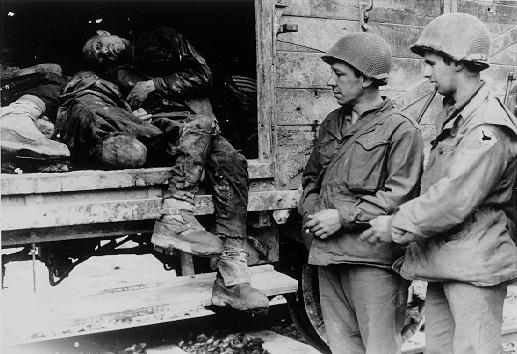
Boxcars of Dead at Dachau. 32,000 captives freed.

American soldiers view the bodies in one of the open railcars of the Dachau death train. USHMM

American soldiers view the bodies in one of the open railcars of the Dachau death train. USHMM

And so after some resistance, into the camp they entered. Life changing events were about to unfold for the American soldier.

***

For me, it’s not about hero worship, or glorifying the liberator or any World War II soldier by placing him on a pedestal. Our time with them is now limited, but many of the liberating soldiers I know push back at this, to the point of rejecting the term, “liberator”- “It all sounds so exalted, so glamorous” said one. But they will all accept the term, “eyewitness”.

Witnesses to the greatest crime in the history of the world.

So instead I think it is about honoring their experiences, their shock, the horror, the puking and the crying, the rage-and then, the American GIs recognizing that something had to be done. And they did suffer for it, for trying to do the right thing. Many tried to help by offering food to starving prisoners who just were not ready to handle it, only to see them drop dead. Or having to manhandle these emaciated victims who were tearing away at each other as food was being offered.

Some guys never got over it. How could you?

I have learned so much over the past few years from these guys, just through the way that they carried themselves and tried to cope with what they witnessed. In my World War II studies and Holocaust class, we discuss these issues at length. I’m so lucky to be able to teach it.

Last year, I was privileged to teach a lesson to my high school seniors for NBC Learn, which was shared with other districts across the nation. Later, I stumbled upon this piece by the late author Tony Hays, who writes about his liberator father and his own encounter with the past. Thanks to the Get It Write folks; the original link is at the bottom.

***

Dachau Will Always Be With Us

by Tony Hays

This is not so much a post about writing as one about a writer’s education, about one of those experiences that molds us, shapes us into storytellers. I read yesterday the story of Joseph Corbsie, whose father, a World War II veteran, left him with a special legacy from the war, from the hideous Nazi concentration camp at Dachau. I feel a particular kinship with Mr. Corbsie.

My father, Robert Hays, was the son of an alcoholic tenant farmer in rural west Tennessee. If the appellation “dirt poor” fit anyone, it fit my grandfather’s family. Daddy served in the Civilian Conservation Corps during the 30s. He and my mother, who was in the woman’s equivalent of the CCC, working as a nurse’s aide at Western State Mental Hospital in Bolivar, Tennessee, met on a blind date in early 1940 and married in September of that year.

But just over a year later, Pearl Harbor happened. America was in the war. My father was among the first of those drafted in 1942. I won’t bore you with the details, but he participated in the North African, Salerno, Anzio, and southern France invasions, saved by the luck of the draw from Normandy. But they slogged through France and on to Germany. On April 29, 1945, Allied troops liberated the Dachau concentration camp. I don’t know whether he entered Dachau that day or the next, but that he was there within hours of the liberation is beyond dispute. A few months later, after more than three years overseas, he came home.

In later years, he would talk occasionally about the war, providing anecdotes that showed the chaos and random chance of battle. He spoke of driving through Kasserine Pass in North Africa just hours before the Germans killed thousands of Allied troops in a stunning attack. He spoke of a friend, defending his position from a foxhole, who was thought dead after an artillery shell landed right next to him. When the dust cleared, the friend was buried up to his neck in dirt, but did not have a scratch on him. He spoke often of Anzio, where he was wounded, and of the massive German air assaults on those soldiers clinging to that tiny sliver of beach along the Italian coast.

But he never spoke of Dachau.

The bodies of former prisoners are piled in the crematorium mortuary in the newly liberated Dachau concentration camp. Dachau, Germany, April 29, 1945.

The bodies of former prisoners are piled in the crematorium mortuary in the newly liberated Dachau concentration camp. Dachau, Germany, April 29, 1945. USHMM.


Ever.

When he died in 1981, we found a photo in his wallet. An old sepia-toned shot like others he had taken during the war, pictures that he kept in an old brown bag. But this one was different.

It showed a pile of naked bodies. Well, really more skeletons than not, with their skin stretched pitifully over their bones. On the back, as had been his habit, was typed simply “Dachau.”

I was confused. Why would he keep this one photo in his wallet all of those years? Especially a photo of a place and event that he never spoke about. It obviously had some deeper meaning for him than the other photographs. If it had been a shot of the building he was in when he was wounded (hit by an artillery shell), I could have seen that. A reminder of his closest brush with death. Yeah, I could buy that. But this macabre photo? That, I couldn’t see.

So, for the next fifteen years, I remained puzzled.

Until the fall of 1996. I was working in Poland, and I had some time off. I took an overnight bus from Katowice, Poland to Munich. It was an interesting trip all in itself. We sat in a line of buses at midnight on the Polish/German border, waiting for our turn to cross, next to a cemetery, as if in some Cold War spy movie. I remember passing Nuremburg and thinking that my father had been there at the end of the war. And then there was Munich.

I spent a day or two wandering through the streets, drinking beer in the Marienplatz. I’m a historical novelist, so the short trip out to Dachau was a no-brainer. Of course it was as much my father’s connection with it as anything else that spurred the visit. But I’m not sure that I was completely aware of that at the time.

Dachau literally sits just on the outskirts of the Munich metropolitan area. I looked at the sign on the train station with a sadness, wondering for how many people that had been one of the last things they saw. It was only later that I discovered there had been another depot for those passengers.

The Dachau Memorial is a place of deep emotion. In the camp proper, mostly all that are left are the foundations of the barracks. One has been reconstructed to give an idea of how horrible life must have been. The camp was originally intended to hold 6,000 inmates; when the Allies liberated Dachau in 1945, they found 30,000. The museum and exhibits are primarily in the old maintenance building. I looked with awe at life size photos of prisoners machine gunned, their hands torn to ribbons from the barbed wire they had tried to climb in a futile attempt at escape.

I followed the visitors (I can’t call them tourists) north to where you crossed over into the crematorium area. It was there that the full brunt of what had taken place at Dachau really hit me. A simple brick complex, it seemed so peaceful on the fall day that I stood before it. But as I read the plaques and consulted my guidebook, as I stepped through the door and actually saw the “shower” rooms where the prisoners were gassed, as I stared into the open doors of the ovens, I felt a rage unlike any I had ever known consume me.
Covering my eyes, embarrassed at the tears, I slipped back outside. It took more than a few minutes to regain my composure. I thought then that I understood why my father kept that photo close to him for so long. It was a reminder of what one group of people had done to another group of fellow humans. The obscenity of it had overwhelmed him as it had me.

That night, I went to the famous Hofbrauhaus in Munich, to wash the images of the ovens away with some beer. I hadn’t been there long when an elderly American couple sat at the table. They were from Florida, a pleasant couple. He had been a young lieutenant in the American army on the push into Munich. In fact, it had been his pleasure to liberate the Hofbrauhaus from the Germans.

Of course, I asked the question. “Were you at Dachau?”

He didn’t answer for several seconds, tears glistening in the corners of his eyes as his wife’s hand covered his and squeezed. Finally, he nodded, reached into a back pocket and pulled out his wallet.

With a flick of his wrist, a photo, just as wrinkled, just as bent, as the one my father had carried landed on the table. It wasn’t the same scene, but one just like it.

Here was my chance, the opportunity to ask the question I had never been able to ask my father. I pulled the photo from my own wallet and lay it next to his. “Why? Why have you carried it so long? To remind you of the horror of Dachau, of what had been done here?”

His face carried the faintest of smiles as he shook his head. “No, son, to remind us of the horrors that we are capable of, to remind us not to go down that road again.”

The difference was subtle, but in that moment, I learned two lessons invaluable to a writer, subtle differences are important, and when you want to know the truth, go to the source.

As I sit here now and look at that same photograph, I realize that it was my father’s legacy to me, of Dachau. Joe Corbsie’s father left him something more tangible, a reminder of the same thing for the same reason, but more forcefully stated — a tiny box of human ash from the ovens.

Now, nearly 70 years after that day in 1945, Dachau is still with us, and I hope the legacy left by our fathers always will be.

The late Tony Hays.

 

Read Full Post »

A survivor writes to his fellow survivors today, on the anniversary of their liberation. An excerpt:

For the 13th of April 2016.
Hello again to all of you ‘my twins’ on our 71st birthday.
I hope my good wishes find all of you in good health, both physical and mental.
It is a blessing to be alive and being able to think back of that ‘special birthday’ of ours.
To think about those who fought to give back our lives, whom we call ‘our angels of life’.
Like the years before; there are no words enough to express our thanks for them.


[My new book on this will be out this July. You can put in a pre-order notice, above- GET THE BOOK HERE]

30th Infantry Division Veterans of World War II, Nashville Tennessee, April 2015, 70th anniversary of the end of WWII. Credit: Larry S Powell.

30th Infantry Division Veterans of World War II, Nashville Tennessee, April 2015, 70th anniversary of the end of WWII. Credit: Larry S Powell.

Here also is an anniversary poem.

The poet Yaakov Barzilai was on the ‘Train Near Magdeburg’. Originally composed in Hebrew, a  translation has been provided by fellow survivor Micha Tomkiewicz. He has agreed to share his poem on the 70th anniversary of the liberation. ’11:55′  refers to the author’s recollection of the time of the day of the liberation of the train transport; ‘five minutes before the bitter end’.

Dedicated to Frank Towers and 30th Infantry Division soldiers, US liberators of the death train from Bergen-Belsen on April 13, 1945


At Eleven fifty-five.

Return to the Place of Liberation, April 13, 1945                                                                                 

The train stopped under the hill, huffing and puffing, as though it reached the end of the road.

An old locomotive pulling deteriorating train cars that became obsolete long ago, not even fit for carrying horses.

To an approaching visitor, the experience was of a factory of awful smell – really stinking.

Two thousand four hundred stinking cattle heading for slaughter were shoved to the train cars.

The butterflies into the surrounding air were blinded by the poisonous stench.

The train moved for five days back and forth between Bergen-Belsen and nowhere.

On the sixth day, a new morning came to shine over our heads.

Suddenly the heavy car doors were opened.

Living and dead overflowed into the surrounding green meadow.

Was it a dream or a delayed awakening of God?

When we identified the symbols of the American army, we ran to the top of the hill as though bitten by an army of scorpions, to kiss the treads of the tanks and to hug the soldiers with overflowing love.

Somebody cried: “Don’t believe it, it is a dream”. When we pinched ourselves; we felt the pain – it was real.

Mama climbed to the top of the hill. She stood in the middle of the field of flowers and prayed an almost a silent prayer from the heart.

Only few words escaped to the blowing wind:

‘Soon…Now

From the chimneys of death, I gave new life, to my children….

And this day-my grandchildren were born,  to a good life.

Amen and Amen’.

-Yaakov Barzilai.

*

בְּאַחַת עֶשְׂרֵה חֲמִשִּׁים וְחָמֵשׁ 

שִׁיבָה לִמְקוֹם הַשִּׁחְרוּר בִּ 13 בְּאַפְּרִיל 1945

                     כַּעֲבֹר 65 שָׁנָה

הָרַכֶּבֶת עָצְרָה מִתַּחַת לַגִּבְעָה

נוֹשֶׁפֶת וְנוֹהֶמֶת

כְּמִי שֶׁהִגִּיעַ לְסוֹף דַּרְכּוֹ

קַטָּר זָקֵן גָּרַר קְרוֹנוֹת יְשָׁנִים

שֶׁאָבַד עֲלֵיהֶם כֶּלַח,

לֹא רְאוּיִים אֲפִלּוּ לִמְגוּרֵי סוּסִים.

מִי שֶׁהִזְדַּמֵּן לַסְּבִיבָה

הֶאֱמִין שֶׁנִּקְלַע לְבֵית חֲרֹשֶׁת לְסֵרָחוֹן

אַלְפַּיִם אַרְבַּע מֵאוֹת רָאשֵׁי בָּקָר מַסְרִיחִים

שֶׁנּוֹעֲדוּ לִשְׁחִיטָה

נִדְחְסוּ לַקְּרוֹנוֹת

כָּל הַפַּרְפַּרִים בַּסְּבִיבָה הִתְעַוְרוּ

מִסֵּרָחוֹן מַדְמִיעַ.

חֲמִשָּׁה יָמִים נָסְעָה הָרַכֶּבֶת הָלוֹךְ וַחֲזֹר

בֵּין בֶּרְגֶן-בֶּלְזֶן לְשׁוּם מָקוֹם

בַּיּוֹם הַשִּׁשִּׁי, בֹּקֶר חָדָשׁ זָרַח מֵעָלֵינוּ.

בְּבַת אַחַת נִפְתְחוּ הַדְּלָתוֹת הַכְּבֵדוֹת שֶׁל הַקְּרוֹנוֹת

חַיִּים וּמֵתִים נִשְׁפְּכוּ בְּיַחַד

אֶל הַיָּרֹק הַמִּשְׁתּוֹלֵל בַּשָּׂדוֹת.

הַאִם הָיָה זֶה חֲלוֹם

אוֹ הַצָּתָה מְאֻחֶרֶת שֶׁל אֱלֹהִים?

כְּשֶׁזִּהִינוּ אֶת סֵמֶל הַצָּבָא הַאָמֶרִיקָאִי,

כִּנְשׁוּכֵי עַקְרָב שָׁעֲטְנוּ בְּמַעֲלֵה הַגִּבְעָה

לְנַשֵּׁק אֶת שַׁרְשְׁרָאוֹת הַטַּנְקִים

וְלַחֲנֹק אֶת הַחַיָּלִים מֵרֹב אַהֲבָה.

מִישֶׁהוּ צָעַק: “אַל תַּאֲמִינוּ זֶה רַק חֲלוֹם”

וּכְשֶׁצָּבַטְנוּ אֶת עָצַמְנוּ

כָּאָב לָנוּ בֶּאֱמֶת.

גַּם אִמָּא טִפְּסָה אֶל גִּבְעַת הַנִּצָּחוֹן

הִיא עָמְדָה בְּתוֹךְ שָׂדֶה שֶׁל פְּרָחִים וְהִתְפַּלְּלָה

מִתּוֹךְ הַתְּפִלָּה הַחֲרִישִׁית שֶׁנֶּאֶמְרָה בַּלֵּב

רַק מִלִּים בּוֹדְדוֹת הִסְתַנְנוּ אֶל אֲוִיר הָעוֹלָם:

” וְכָאן… וְעַכְשָׁו… עַל פַּסֵי הָרַכֶּבֶת…

קָרוֹב… לַאֲרֻבּוֹת הַמָּוֶת…נָתַתִּי…

חַיִּים חֲדָשִׁים…לִילָדַי… וְהַיּוֹם הַזֶּה…

נוֹלְדוּ גַּם נְכָדַי… לְחַיִּים טוֹבִים…

אָמֵן… וְאָמֵן…                                                                     יעקב ברזילי

‘Yaakov Barzilai is an esteemed Israeli poet; he is also a survivor of The Shoah. Born in Hungary in 1933, the year Hitler came to power in Germany he shares, in poetry and prose, a child’s memories of the horrors that befell the Jewish people. He tells of acts of great humanity and others of exceptional, he recounts tales of transportation and eventual rescue. He speaks of losses – family, potential and describes the eventual triumph of man over inhumanity.’ [www.cduniverse.com/productinfo.asp?pid=8756081]

Read Full Post »

My friend Gordon Hanna died the other day. He was my electrician, and I’m sure the electrician for half of the small town I live in, at least. He was 90.

He was also a World War II veteran. How wonderful that we had the foresight to interview him at his homestead here in Hartford a few years back. We always ask, ‘when and where were you born’. Kaylee got a surprise when he pointed up over his head- to the bedroom upstairs. As Gordon’s generation go, we are leaving an older world behind. I’m not convinced that the newer one is better.

I always say that this is the toughest part about doing projects like these; your friends go and die on you.

Next time I flip the switch in my house I’ll think of him.

Gordon Hanna : There was a big farm down the road. It was the Clifford Sheldon farm, about a three hundred acre farm. And I started working for him when I was eleven year old. Nights after school, and Saturdays and Sundays.
Kaylee Merlow (student interviewer): Where your parents farmers, or …?
GH: My parents, lived down the road, where my father, and my uncle, and my grandfather, owned Hanna Hardware up in Hartford, up here.
KM: Was it difficult for you to balance both school and working on a farm?
GH: No, it wasn’t that bad. Because you got out early. We got out about three o’clock. You would work until dark. But, I worked Saturdays and Sundays. I did all the plowing and fitting the ground and like that. I thought I was doing pretty good. I was getting $1 a day. When that’s when, grown men, that’s all they were getting for work at that time.
KM: Were you raised in like a religious home or….? Like did you attending church every Sunday?
GH: Yes I went to church regularity. White church, Congregational church up here. Then later on I taught Sunday school up there.
KM: Mr. Rozell told me that you worked in Smiths Basin harvesting ice?
GH: Yes, Mr. Rozell thought that that might be something you hadn’t ever heard of. Well, milk was transported from all the farms. There used to be a lot more farms around here than there are now. And the milk was transported in cans. Over to Smiths Basin there’s a big, well, you ever go through Smiths Basin, across the railroad tracks? There’s still a great big building there. That was a creamery. And the milk was all taken in there. Well in that time there was no chemical refrigeration as you know it today, so we had to refrigerate everything with ice. So the canal runs right along there and up the canal right next to the locks they used to cut the ice. They cut it with an old model Ford motor and a great big 48 inch round circle saw. Which you probably never saw sawing wood or anything but that’s what they used. And they cut slices in the ice two feet wide and then they would cross cut them, every three feet, so a cake of ice was two by three by whatever depth it froze to. Long later in the winter, February, like that, they would get up to three feet thick. So a cake of ice, at that time, would weigh probably three hundred lbs. They had, the canal sits a lot lower than about the bank up here when you go down the canal. They had a long ramp made of wood with sides on it, narrow sides like that [hand gestures for ramp], with a walkway up and down it. Then they had a winch, up on top, which one of the farmers would bring his tractor there and run this winch. And they had what the called a ‘crab’ which was a metal thing, shaped like that [hand gestures], with a handle up there. What they would do, they had this ice all scored. They would take it and they had it right up to that ramp. They would take spuds,  just a big knife, about that wide [hand gestures for width], sharp, on a handle. They take that go in the scores where they scored the ice, and that would split off the cakes, individual cakes. They would bring them over to the ramp. Then they would  hook that back of it, then the farmer would start the winch, pulling it up. He’d have to walk along the side of it to keep it from kicking up.
KM: My gosh.
GH: Well, some of the guys he’d go up then up onto a platform up on top. Then all the farmers that brought in milk would have their trucks there. That was a big thing, since that paid good money at that time. And they would slide it onto the trucks, then they’d transport it over to the ice house. Then at the ice house, they had a …. Ice house, about three stories high, they had a big frame work that went up. It had a, like an elevator, well it was slanted like that, made of steel. A farmer would have a tractor on a winch, at that point. He would slide the cake on, when he brought out the truck, it would go onto the elevator. Of course it started down oh say this high, so the elevator would just go up , the cake would slide off into the ice house. Well, as it got a layer of ice, of course it kept going higher and higher and higher. Enough, about three stories high.
KM: When did you ice harvest?
GH: January. It was done in January and February.
KM: So it was only just two months?
GH: Yes.
KM: Because an ice house can only be –
GH: Yes. It normally started in January, which was of course good for me because – [interrupted]
KM: Because of the timing?
GH: -The vacation in January, from school. And I was able to get on the job, that was a privilege to get on that job because at that time, it was paying as I remember, I think it was paying $5 an hour – when the average man was getting $1 a day.

Interviewed by Kaylee Merlow, Dec. 19, 2010.


Read Full Post »

I just finished the first draft of Chapter One of my new book. It took several weeks but in my head I have been writing it for years.

The chapter is called ‘Hell on Earth’. It’s Bergen Belsen in the spring of 1945. If you don’t know a lot about the concentration camp system, this 40 plus page chapter will tell you, but for now it is where Anne Frank, her sister, and 70,000 others were murdered.

The chapter has been a ton of research and I think kind of draining, but you get through it. In order to show the tremendous highs, you kind of have to go and plumb the depths. Hard to get much lower than this. And for you teachers out there, remember to be judicious with the graphic imagery in the classroom. Answer the question first- why am I teaching this? It should be more than a cheap gimmick to grab a kid’s attention. In the chapter, I chose to use some troublesome material. Not for shock value, but to better serve humanity, in context–but I am not publishing that here right now because that context is missing.

DSCN3857.2

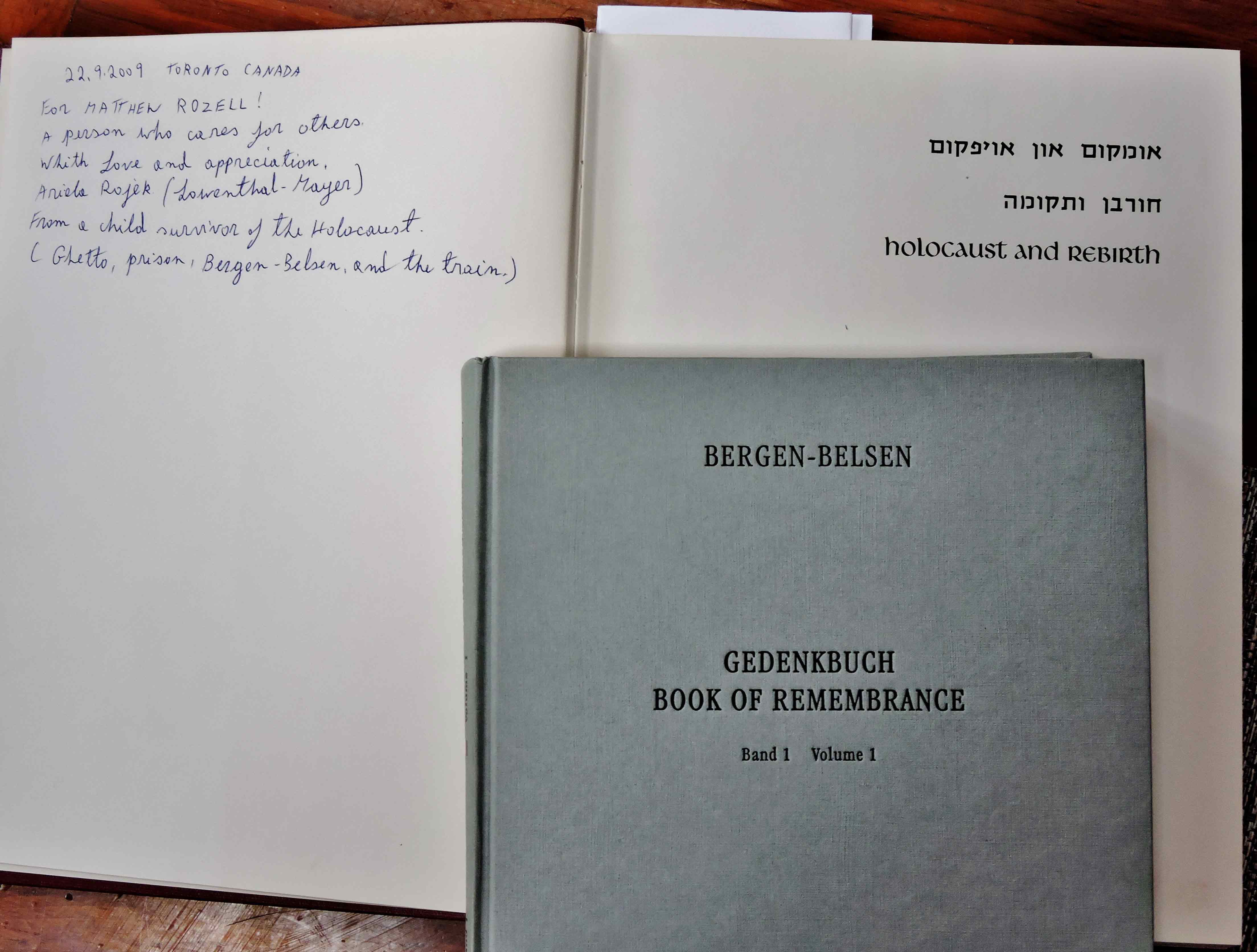
Some of my research material. Books presented to me by my friends at the 2009 reunion; the 20th anniversary commemoration of the liberation of Bergen Belsen book, and Volume 1 of the Book of Names, an attempt to compile the list of all those who suffered here.

I learned a lot. Sometimes you wonder how much you take for granted. And that is probably one of the main points of my book.

This excerpt from an eleven year old girl.

At the end of November it was very cold in Europe. Finally I was given some rags and one black ladies shoe with a high heel and one red girl’s shoe. Imagine the agony of a young girl having to walk unevenly like that for half a year.

In those shoes I marched into Bergen Belsen concentration camp on December 2nd, 1944. In those shoes my legs froze while I was enduring roll calls, which lasted between two to five hours.

When the mounds of dead bodies started to pile up nearby in a frightening manner, we, the children, made bets between us, as to who would die tomorrow and who would die the day after. Every one of them had his signs. I had become an old woman already, eleven and half years old.

During the breaks between roll calls, if it wasn’t too cold, I would stand by the fence and look at the naked dead bodies with their gaping mouths. I used to wonder what it was that they still wanted to shout out loud and couldn’t. I tried to determine who were men, and who were women. But they were only skin and bones. I tried to imagine how I could dress these dead bodies in clothes for dinner; their pale skin color did not always match the clothes.

Another eleven year old girl:

When told to prepare ourselves for the departure in the train I was already very weak and sick. Two weeks prior I had a very high fever. I was in Bergen Belsen with my aunt, my father’s sister, as by then I had lost my entire family.

The Germans let us know that all those who could not walk would have to stay behind. My aunt wanted to stay because she knew that I was already very weak; however, I insisted on going. I said to my aunt, “You know that they kill the weak and the sick. We will go with the healthy people.” Although I was only 11½ years old, my aunt listened to me. I probably had a very strong will to live.

Before we left, they gave each of us a raw potato, and somehow we managed to bake them over a wood fire. My aunt then said to me, “You know that now is the Passover holiday”—we barely remembered what day of the week it was, let alone the date. On Passover, according to the story, our forefather Moses took us out of Egypt. Maybe G–d is bringing us to freedom, and maybe we will live?

A seventeen year old girl:

Saturday, ‎April 7th, ‎ ‎1945. Our transport is stranded at the Bergen–Celle railway station. Our irresponsible captors no longer provide us with food. After suffering from constant starvation for six long months at the death factory of Bergen Belsen, the German SS leaves us now in total hunger and total thirst. We are too exhausted, dizzy and weak to grasp how grave our situation is.

What do the Nazis have in mind?

What do the Nazis have in mind, indeed. On to Chapter Two to find out. The book should be done this summer.

For updates, follow this blog. For advance notice, sign up at bit.ly/RozellNewBook.


Read Full Post »

I’ve been working a bit lately on my next two upcoming books, The Things Our Fathers Saw II and the one closest to my heart, working title, A Train Near Magdeburg or The Last Transport. And I have been struggling with that book for years. It’s a hard story to tell because it has to be done right, the first time.

TNMMy own personal connection and closeness to the subject has been documented at this blog since 2007, when we hosted the first reunion before a student audience at our high school, when we knew of only 2 liberators and 4 survivors. Today, that number has grown over 7 fold. Unbeknownst when we began, this story has grown and taken over the second half of my career as an educator.

Trying to take on the subject matter of the Holocaust as a classroom teacher is a daunting task, and one not to be taken lightly. Trying to convey that through the eyes of your survivor friends is exponentially difficult. But when you open yourself up, palms up and arms out, especially at the authentic sites where millions of families suffered, there is a coupling of the past and the present.

It’s not an easy thing to open yourself up to. But if you think that it is all in the past, you are very, very mistaken.

Now throw into the mix the experience of the young American boys, battle hardened and hardly innocents by now, who stumbled across the train and the horrors of the Holocaust. Confronted with the reality of sick and starving people, and a war in its closing days where the enemy, the perpetrators of this evil, are still shooting at them. They have a mission they have been tasked with, and it’s not a humanitarian rescue operation that they trained for.

Oh no. They had no idea. Many of these young guys were haunted for life by what they encountered.

A picture is worth a thousand words, so they say. In my case, more like one hundred thousand. Behind the camera, the major in the jeep snaps a photo as specters emerge from the springtime morning mist. The little girl turns her head in terror at the two monsters clamoring behind the jeep with the white star,  Tanks 12 and 13 of the 743rd Tank Battalion and the 30th Infantry Division of the United States Army. It is April 13, 1945, deep in the heart of the Reich. Friday the 13th. Tank 13 stays on after securing the perimeter to protect the vulnerable from their would-be murderers.

For the young beautiful men with perfect teeth and handsome uniforms, the first instinct is to recoil. This is not natural and these people have been reduced to stinking animals. Lice infested. Stench ridden. Infected with bad, bad disease. Revulsion and vomiting is a common reaction.  These are not human beings.

But, they are.

They are.

And what are we going to do about this? The battalion commander cocks his .45 and calmly places it to the head of the local burgermeister when he displays reluctance to comply with the order to open homes and feed the prisoners.

And next up on the roller coaster ride for the incredulous GIs  is stomping rage and jags of crying. Generations later, an 89 year old tells me, “My parents wondered why I couldn’t sleep at night, after returning home.”

The soldiers transport the victims out of the line of fire. The medics get to work. People continue to die, but somehow humanity returns. The war ends. The survivors and the soldiers go their own ways, most refusing to speak of this time for decades. For many, the trauma passes onto the children  of the generations that come after.

And then, in the twilight of living memory, a high school teacher with an unassuming project has the encounter with the unknown photographs, and asks the unasked questions.

Seventy years later, across time and space, the portal has been entered. The wires of the cosmos have been tripped. And the universe channels the unassuming power of love across the abyss as the aged rescuers and survivors and their descendants are brought together to meet again.

It is a miracle of healing and reconnection. A cosmic circuit has been completed, but maybe, in some small way, another pathway to undoing a tragic cycle is opened. And it is not a coincidence.

As I wrap up this post, I am pinged with an email from my ‘second mom’ in Toronto, survivor Ariela. She was 11 when she was liberated on the train with her aunt. Her parents and grandparents were murdered in Poland by the Germans. She’s good on Facebook, but has a tough time with email. She’s thinking of me, and the book which has to tell the story. The email comes through now, loud and clear.

This is the train that should have led to death. Instead, it leads to life, and a legacy of the triumph of good over evil. And maybe, just maybe, amidst all of the horror and the suffering, there is a lesson here, somewhere.

I’d like to think so.


Read Full Post »

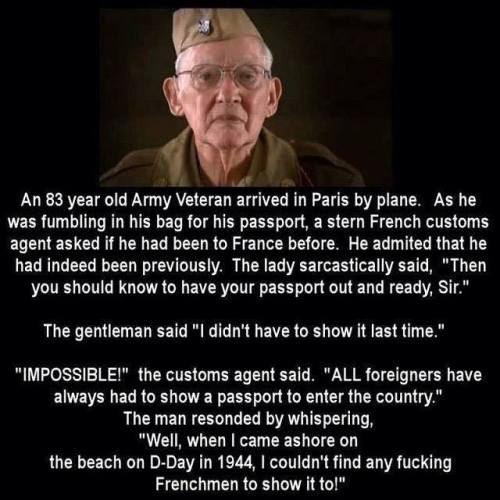
Here is one that has been making the rounds for a while (note the age of the veteran- he would have been 11 in 1944). I’ve gotten it forwarded to me or seen it online for like the 25th time since it first appeared about a dozen years ago.


83 yr old army veteran


Give it to him, Gramps!

Too bad it’s not true. You can substitute the American soldier for British or Canadian, if you really want to google it.

I suppose I should laugh, take it as a joke, if that was the purpose.  There are rude customs officials, for sure. And on my first read,  I’m sure the tale resonated at some level that made me proud.

But, then I read comments online like this:

“I have heard about that encounter before and I love to hear it re-told……too bad some of the nations thatt America has liberated or protected no longer appreciate it….or even seem to remember.” 

And since that seems to be a very common reaction, maybe it’s time to call bullshit.

Here’s why.

I know a ton of American World War II veterans who returned to France and the Low Countries after they retired, well after the war. And far from forgetting, the memory of what the liberators underwent is indelibly seared into the consciousness on the continent where our troops fought, three generations later, and passed on to the children in who live in those places today. They turn out by the THOUSANDS to greet our veterans, and adopt the graves of fallen Americans to care for in their lands.

This American soldier was killed a month before the war ended and lies in the Netherlands, his grave tended by three generations of the same family. And the little guy, probably the 4th generation, is not American.

The vets are honored everywhere they go. One of my overseas acquaintances even runs a private museum (link above) dedicated to the sacrifices of the American soldiers who liberated his town in the Netherlands. I have been to WWII reunions here in the States where citizens and film crews from these countries have flown over to attend and honor these veterans. They are welcomed back to the concentration camp memorials in Germany with red carpet treatment and private tours.

The meme makes us feel good for our imaginary veteran, I suppose. But I get more misty-eyed watching my ninety-something year old friend from Buffalo, NY, Dick Lacey, riding in the jeep, overwhelmed at all the attention, who can only choke back five words- “Wow! Look at all the people!”  – seeing the crowds who have come out to wish him well.

***

Read this article for starts. Look at the monuments to honor the American sacrifices throughout NW Europe, through the eyes and the ears of our veterans returning one last time.

PNGAnd did you know that France’s highest award, the Legion of Honor, is given to American veterans who fought in France? The Legion of Honor was created by Napoleon, and is reserved for  outstanding service to France. A lot of my friends have received it in ceremonies at French embassies or consulates, and it proudly donned on very special occasions.  [Download the form below if you know a qualifying vet, before it is too late.  They don’t award it posthumously.] So when it comes to our veterans, so much for that legendary French snobbery and ingratitude.

The Legion d’Honneur for US Veterans

Upon presentation of their military file as detailed hereunder, US veterans who risked their life during World War II to fight on French territory, may be awarded this distinction. Those selected are appointed to the rank of Knight of the Legion of Honor.

thank you very much


Read Full Post »

I hope you had a great weekend. I decided to spend my weekend with a fellow who has been gone for a while. And I had a blast.

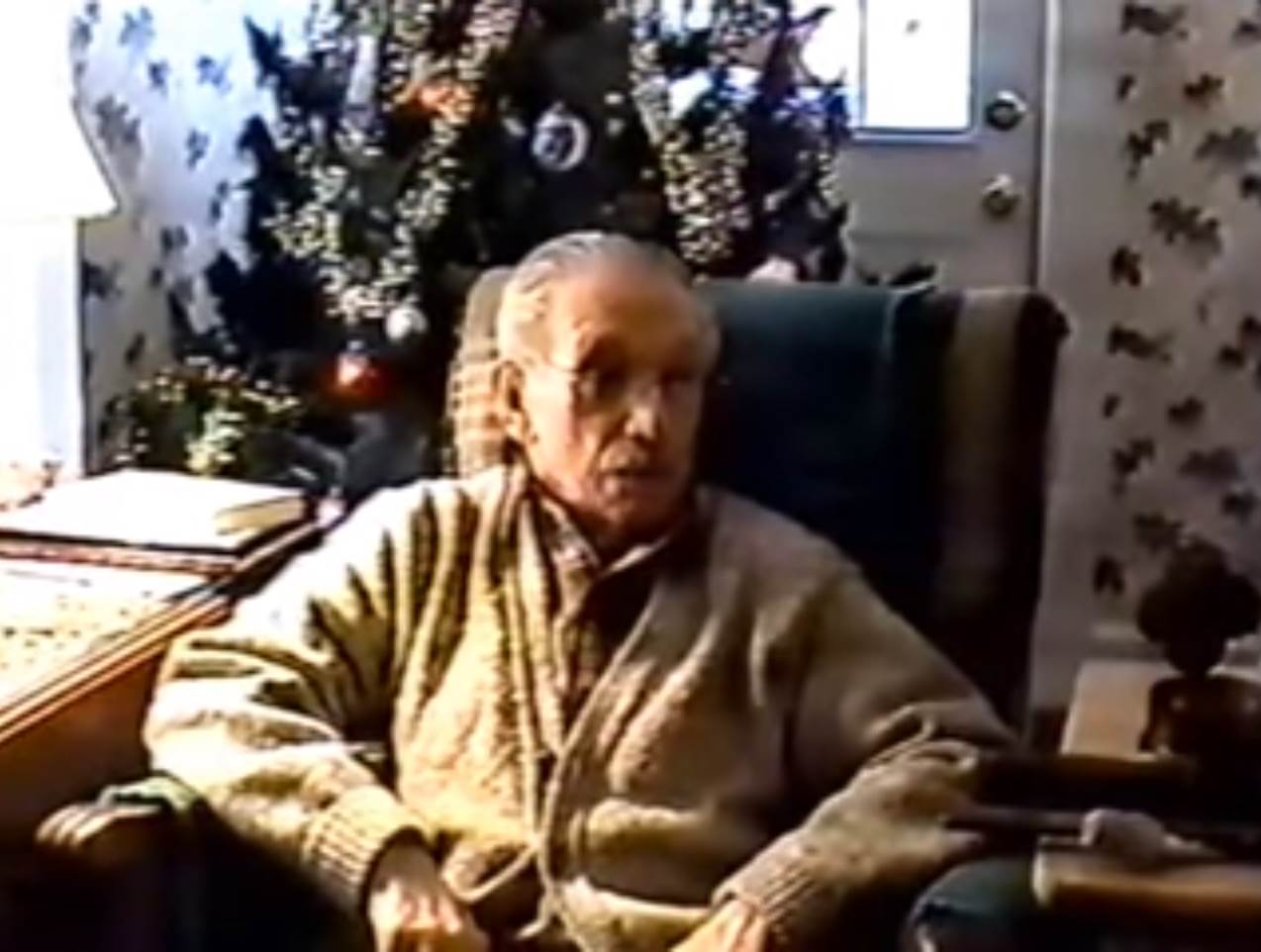
tom collins jan 04

This weekend I edited an interview we did six or seven years before the our veteran, sitting comfortably in his favorite chair in his button-down sweater in front of the Christmas tree, passed. He was suddenly alive, animated, an old man telegraphing the emotions and feelings long buried about some of the most formative years of his life-conveying them to a young person who was genuinely interested; who CARED.

When you edit a raw interview, you have to absorb it all first. The surroundings, the line of questioning, the emotions and the back and forth of the memory machine. You pray that the transcriber, if it was not you originally, was relatively engaged and committed to a literal interpretation. And thank goodness for the advent of the digital access to the tapes we made, when we donated a copy to the New York State Military Museum.

We’d move on a minute’s notice and find a place to put our guns into position. [When we were in combat] there was fear, lots of it. But I was in charge of the howitzer and the gun crew. We might be getting shelled ourselves and our infantry getting pounded. We sometimes found ourselves in fluid situations. The Germans might be attacking or we might be attacking and it was very fluid—we might be moving forward or backing up. You never knew—[behind the lines], you never knew what was happening, whether we had them on the run or whether they were counterattacking—so we had to think in terms of getting things ready to move, because we might have to get the hell out of here. We had the fear but we were so busy and had so much to do and make sure it got done that it sort of beat the fear. In other words, you were scared to death, but you did the best you possibly could.

Armed with all this, without putting words in the subject’s mouth, I have to arrange his recollections in line with the actual events of the day. Thus it was with Mr. Tom Collins, an artillery sergeant responsible for a 105 mm gun crew in Italy.  As it turned out, he was interviewed by his own granddaughter, one of my students a long time before he passed. And he told her things that he had never told anyone else in his life–but only because she cared, and asked the right follow-up questions. That is clear in the transcript she produced for her project afterwards.

When we got home, the sudden change [to civilian life] seemed difficult for me. I felt more and more that I had changed, so I would stay home. I didn’t go anywhere. It took me a couple of weeks before I would go out, you know, go downtown. I remember the first few times I went uptown from there—I wouldn’t go unless my sister was with me, I wouldn’t go alone. I can’t really put words on it but I really felt strange. I felt unusual. I thought, ‘Will I talk right, will I act right?’ because when we were in the army, foul language was common place and using crazy phrases like the southerners used, things like that, it became the way I was speaking and living. But [after a while] I warmed up and I was fine.

Tom Collins passed in 2011. Yet because of the prescient efforts  we made, years and years ago, he will live on in the minds of more than just his family. You can see more about him below, and you can read about him in the upcoming book I am working on. You did good, young Catie.

Thank you, sweetheart. It was a pleasure.

Rest on, Tom Collins.

(You can order the first book here.)


Read Full Post »

« Newer Posts - Older Posts »