Feeds:
Posts
Comments

Posts Tagged ‘Matthew Rozell’

This past Friday, I spoke to scores of educators interested in the Holocaust and genocide, people who were also attempting to teach about these crimes against humanity. As a teacher, you have to be very committed to do this seriously- just to try to attempt to understand these events, let alone teach about them to young people.

I was invited by the New Jersey Council of Holocaust Educators in cooperation with the Center for the Holocaust, Human Rights, and Genocide Education at Brookdale College. I have my take on things, and that is what I am working on now, in my new book. I was also in some pretty good company.

My good friend and fellow educator Alan Bush, who drove two hours on his own time to come out and support me (even though he told me I was not as attractive as the previous speakers).

My good friend and fellow educator Alan Bush, who drove two hours on his own time to come out and support me (even though he told me I was not as attractive as the previous speakers).

In the morning Alexandra Zapruder engaged with the teachers by reading excerpts from her seminal work, Savaged Pages, Young Writers’ Diaries of the Holocaust, creating a dialogue about how the young people who left behind diaries left so much more than just the written word of their time of horror and oppression. This was not Anne Frank, but a deeper dialogue about attempting to make sense of the senseless, and the conflicting emotions that really encourage us to look into the abyss, beyond the standard narrative of what we think we know about the Holocaust- powerfully, from teenager to teenager. And Alex is the perfect vessel.

Meline Toumani read from her book, There Was and There Was Not: A Journey Through Hate and Possibility in Turkey, Armenia, and Beyond, about growing up in the Armenian Diaspora community and her process of discovery in the context of the conflicting narratives of Armenian genocide of 1915 and her attempt to get to the root of her own self identity. Her book came out on the eve of the 100th anniversary, and the topic resonates especially as we try to make sense of the larger picture of genocide and the ripples that these actions, and our own re-actions, create. She spent her entire 30s in the process, and this is what also fascinated me, as her book is classified as a memoir. I am now tearing through her work, making notes, highlighting certain passages. For the passionate, writing indeed becomes a huge part of your life.

Then it was my turn.

I fumbled a bit, looking up this website to display for the crowd and typing in misspelling after misspelling for the Jumbotron, but quickly won them over by simply showing the teachers a photo of my classroom

the last generationand reminding them that I was also missing a day of school today,  but what were were all doing together had a meaning and importance that really transcended our normal daily routine. It was okay- we were in this together, and I would show them how one person could make a difference and that one person is YOU, the teacher.

So I began to tell my story, the one that I will be detailing in my upcoming book, about how I had no intention of becoming a teacher, in fact, NO intention of ever returning to my hometown after high school–and how seven years later I was living in a room off my parents’ garage, and working on the other side of the desk in the high school I swore I would never return to.  And it was survival mode for the first few years. If someone had shown me the easy way out, I would have jumped. But I did not, *for some reason*, and because I stuck with it I was standing before them that day, about to tell my story.

So I did. They laughed, and they got emotional. There were powerful messages imbedded in the narrative that followed, though I tried not to point them out. I didn’t have to-they got it. Some people teared up. I think I did too, when I showed the videos and remembered the people that I have lost over the course of this wonderful journey. So I share it here again for the benefit of those who maybe would like to see it again, or might like to use it in their own classrooms.

It is the story of my main character, the “liberator” Carrol “Red” Walsh, who passed three years ago this month, and Steve Barry, the 20 year old survivor who graphically describes his Holocaust experience, his day of liberation, and searching for so many years and finally finding his liberators, due to my teacher project. I forgot to tell my attentive audience that after Steve made it to the USA, he was drafted and served as a US Army Ranger in Korea- and that he called himself the “Happiest Korean Conflict Draftee”. Or that after he passed, his daughters boxed up his library of Holocaust-related books, and sent them to me. But I did tell them that forevermore, his words will remain inscribed in granite at the Donors’ Wall of the United States Holocaust Memorial Museum- “It’s not for my sake that people should remember the Holocaust, it is FOR THE SAKE OF HUMANITY”.

Steve's name on the wall of donors, USHMM, unveiled April 29, 2014.

Steve’s name on the wall of donors, USHMM, unveiled April 29, 2014.

When I was finished, there was no real time for a Q and A session left-but people streamed over to me, taking my hand in many instances, and thanked me for something really simple-inspiration. And that is what meant the most, that these people were TEACHERS, like me. I drove the next the five hours on a cloud, just thinking about the day.

We have so much power to change the world, so much responsibility. Especially those of us who take on these topics. We get so caught up in the day to day milieu- we don’t see the forest. Today, thanks to the program and its organizers and speakers, we all at least caught a glimpse of it. The chief architect and MC, Colleen Tambuscio, radiated the collaborative enthusiasm that really carried the day and tied everything, and everyone, together.

*So, the ripples continue, and the generations go forth. Somebody said it was like pebbles being tossed into the still water. This may sound strange, but I have become keenly aware of the cosmic element-

We have the power to trip the wires of the cosmos.


Read Full Post »

In a video interview with LookTV, Matthew Rozell describes his new book in preparation for his upcoming lecture at the Hyde Museum, Sunday, November 15, 2015.

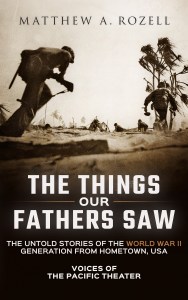
The Things Our Fathers Saw - Front CoverAt the height of World War II, LOOK Magazine profiled Glens Falls and surrounding communities for a series of articles portraying them as “Hometown, USA”, the wholesome, patriotic model of life on the home front. Decades later, history teacher Matthew Rozell and his students tracked downed over thirty survivors who fought the war in the Pacific, from Pearl Harbor to the surrender at Tokyo Bay.  In the his new book, The Things Our Fathers Saw, first-person accounts of combat, brotherhood, captivity and redemption are presented for the first time.  Mr. Rozell will discuss his book and the aftermath of the war that left no American community unscathed- the stories that the magazine could not tell, from the perspective of a vanishing generation speaking to America today.

Book signing will follow the lecture.

LINK TO EVENT: http://www.hydecollection.org/events_and_programs/Coming_Home_Reflections_on_the_70th_Anniversary_of_the_End_of_WWII_545.htm

http://www.looktvonline.com/matt-rozell-the-things-our-fathers-saw/


Read Full Post »

It was six years ago this evening, we shared a meal on the eve of Shabbat, after watching ourselves on a national broadcast that reached millions. Why does it seem, so long ago?

Maybe because it all seems so unbelievable- that out of the darkness of the past, on a day when the sun dawned clearly and was warming the Earth in its mid-April morning ascent, a low rumble was heard by  hushed and huddled groupings of tormented humanity as they strained to hope for friends amidst their lurking murderers. As the metallic clanking grew louder, over the horizon broke the earthly angels, two Sherman light tanks and an American Jeep with the emblem of the white star. A cry broke out. They realized they were saved, and the American major snapped a photograph at the exact moment the overjoyed survivors realized it.

And out of the past on a warm September day, we brought them all together again. Who would have believed that 62 years later, a high school in a quiet, rural part of the world would  bring the soldier-liberators and the rescued survivors together from the US, Canada, Israel and elsewhere? All because I couldn’t let go of a good narrative history, and pursued the story behind the photographs that proved it really happened?

And think about the risk you run, inviting hundreds of octogenarians to come to a high school for half a week to mingle with thousands of high school and middle schoolers? Talk about sweating bullets. What if they are uncomfortable? Cranky? Complaining? What if the kids I can’t control are rude? And what if one of these “old” folks, who I don’t even know, dies on our watch? I would lie awake at night wondering if I was out of my mind.

But the miracle came to be-for the two dozen or so elders who could come, tears flowed, wine spilled, and our “new grandparents” danced with young teenagers who adored them, but only after the risk was accepted, with the enthusiastic help of Mary Murray, Tara Winchell-Sano, and Lisa Hogan, Rene Roberge and others. Have a look at the videos, and feel the love. We created ripples, and tripped the wires of the cosmos, and the reverberations are still echoing. To date, with Varda Weisskopf’s and Frank Towers’ help, the list is at 275 survivors whom we have found. And how many generations has it effected?

This is the subject of my second book, due out this next summer. In the meantime, I am working on a shorter work of what I have learned in teaching the lessons of the Holocaust. So take a look at the videos, and remember the words of the liberator:

“Here we are! We have arrived!”

Read Full Post »

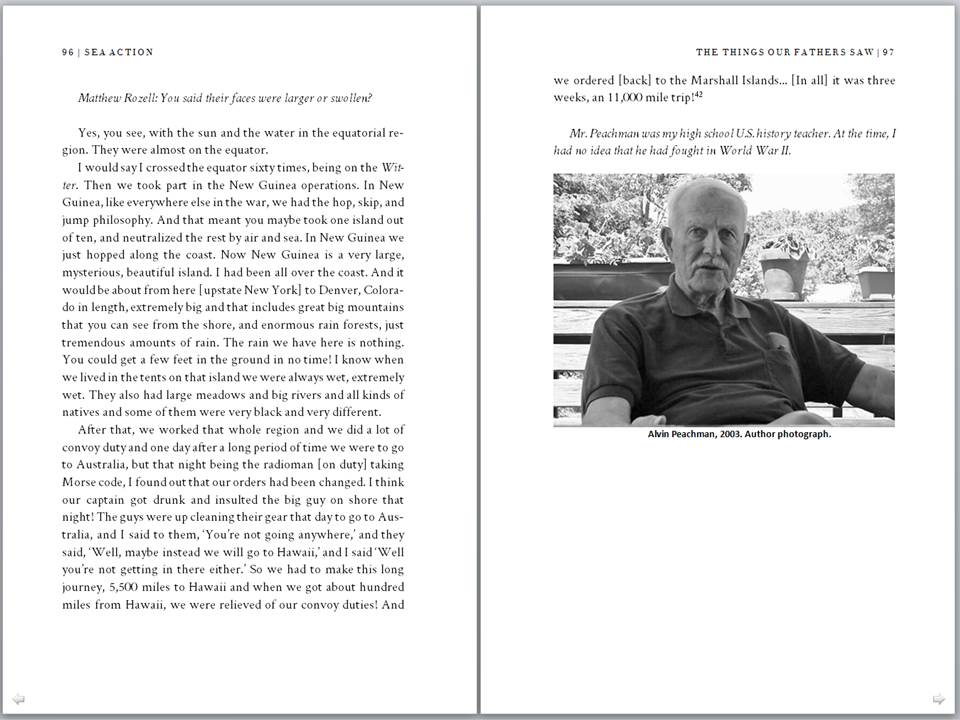
In 2003, I set out to interview a retiree living on the quiet boulevard leading up to our high school. I sat on his backporch with him for a few hours on a late spring afternoon. Born in 1922, he was in the Navy, serving as a radioman on a destroyer escort, and he seemed to be everywhere in the Pacific during World War II. Like John A. Leary, he also spent a great deal of time supporting the Marines, and saw his first action in the South Pacific in the reduction of the massive Japanese base at Rabaul on New Britain.

Mr. Peachman turned 93 this past March. He was my high school history teacher.


Alvin Peachman

From “The Things Our Fathers Saw” by Matthew Rozell.

From “The Things Our Fathers Saw” by Matthew Rozell.


You can view a book preview at the Amazon site. Available in digital and paperback format. Book can also be purchased at http://matthewrozell.com/order-the-things-our-fathers-saw/

*************************************************************


 Book Description: At the height of World War II, LOOK Magazine profiled an upstate New York community for a series of articles portraying it as the wholesome, patriotic model of life on the home front. Seventy years later, a high school history teacher and his students track down over two dozen veterans residing around ‘Hometown, USA’ who fought the war in the Pacific, from Pearl Harbor to the surrender at Tokyo Bay. They resurrect firsthand accounts of combat and brotherhood, of captivity and redemption, and the aftermath of a war that left no community unscathed. Here are the stories that the magazine could not tell, from a special generation of Americans speaking to the youth of America today.  270 pages.

About the Author: Matthew Rozell’s teaching career is now spanning 4 decades, beginning as a quiet kid returning to teach in his own hometown to being recognized as a national History Teacher of the Year and as a recipient of a national Medal for History Education. Rozell is a United States Holocaust Memorial Museum Teacher Fellow, has had his lessons filmed for NBC Learn, and has even been chosen as the ABC World News Person of the Week. He is also a recipient of several state and local awards for history education. He writes on the power of teaching and the importance of the study of history at his website,teachinghistorymatters.com.

He can be reached at marozell at gmail dot com.

Read Full Post »

Yom HaShoah ceremony and service, Jewish Federation of greater Rochester, New York, April 15, 2015. 700 folks come out on a midweek night. From an audience member: ‘The most beautiful, inspirational Yom HaShoah service I have ever been to.’

It was indeed a moving service and I was honored to have a part in it.

We stop and we pause, to reflect and remember.

Key take-aways from my presentation:


  1. The American Army was involved in a shooting war. More soldiers would die in the days to come. But they stopped. They helped these people. And some carried the trauma with them for the rest of their lives.
  2. People need heroes. But few of the liberators would like to be remembered this way. Maybe we should all take a moment to think about our own obligation to humanity.
  3. For every one person who was liberated on this ‘Train Near Magdeburg, nearly 2500 persons, keep close the reality that another 2500 perished in the Holocaust.
  4. Finally, the voices of the eyewitnesses need to always be with us. We need to keep them close. Or forget at our peril.

***

Carrol Walsh, liberator: Our lives were joined at that moment on April 13, 1945, and now we meet face to face and recall together that moment when my tank reached the train.

Steve Barry, survivor:There is no other army in this world that would stop and help 2500 lice-ridden, emaciated Jews, to save them. What army would stop, except the American army?

Steve Barry: Mounted SS troops came around, rode by the train, and started to yell ‘Raus, Raus, get out of the train!  Get out of the cars!’  And we saw them putting up machine gun nests. So obviously, even at that last moment, they were still trying to murder us.

Carrol Walsh: I had no idea who they were, where they had come from, where they were going – nothing. No idea. All I knew: here’s a train with these boxcars and people jammed in those boxcars. No idea. No, I had no idea.

Steve Barry: Very shortly after that we saw the first American GIs.  Well, actually there were two tanks.  I still get tears in my eyes. Right now I have tears in my eyes and I always will when I think about it.  That’s when we knew we were safe.

Letter  from Carrol Walsh to Steve Barry, 2008: ‘You are always expressing gratitude to me, the 743rd Tank Battalion and the 30th Infantry Division. But I do not believe gratitude is deserved because we were doing what we, and the whole world, should have been doing- rescuing and protecting innocent people from being killed, murdered by vicious criminals. You do not owe us. We owe you.  We can never repay you and the Jewish people of Europe for what was stolen from you: your homes, your possessions, your businesses, your money, your art, your family life, your families, your childhood, your dreams, and all your lives.’

Steve Barry:  Is this a beautiful person?

Carrol Walsh:  I think, I cannot believe today, as I look back on those, on those years and on what was happening, I cannot believe that the… world almost ignored those people and what was happening. I cannot believe it. How could we have all stood by and have let that happen? We owe those people a great deal. We owe those people everything. They do not owe us anything. We owe them for what we allowed to happen to them. That is how I feel.


Read Full Post »


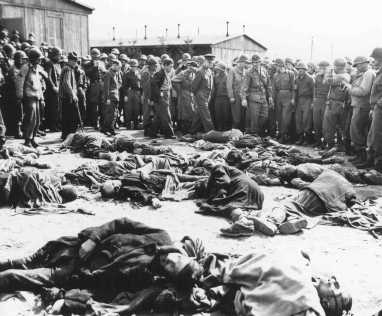
General Dwight D. Eisenhower (center), Supreme Allied Commander, views the corpses of inmates who perished at the Ohrdruf camp. Ohrdruf, Germany, April 12, 1945. — National Archives and Records Administration, College Park, Md. USHMM

We are told the American soldier does not know what he is fighting for. Now, at least he knows what he is fighting against.

— General Dwight D. Eisenhower, on visiting a subcamp of Buchenwald, April 12, 1945

April 4, 1945: The U.S. 4th Armored Division liberates the concentration camp at Ohrdruf, Germany, a subcamp of Buchenwald, the site of more than 4000 deaths during the previous three months. Victims were Jews, Poles, and Soviet POWs. Hundreds shot just before liberation had been working to build an enormous underground radio and telephone communications center. Very few inmates remain alive at liberation.

April, 1945: U.S. Generals Dwight Eisenhower, George Patton, and Omar Bradley visit the camp at Ohrdruf, Germany, and view corpses and other evidence of Nazi atrocities.

In late March 1945, the camp had a prisoner population of some 11,700, but in early April the SS evacuated almost all the prisoners on death marches to Buchenwald. The SS guards killed many of the remaining prisoners who were too ill to walk to the railcars.

When the soldiers of the 4th Armored Division entered the camp, they discovered piles of bodies, some covered with lime, and others partially incinerated on pyres. The ghastly nature of their discovery led General Dwight D. Eisenhower, Supreme Commander of the Allied Forces in Europe, to visit the camp on April 12, with Generals George S. Patton and Omar Bradley. After his visit, Eisenhower cabled General George C. Marshall, the head of the Joint Chiefs of Staff in Washington, describing his trip to Ohrdruf:

. . .the most interesting–although horrible–sight that I encountered during the trip was a visit to a German internment camp near Gotha. The things I saw beggar description. While I was touring the camp I encountered three men who had been inmates and by one ruse or another had made their escape. I interviewed them through an interpreter. The visual evidence and the verbal testimony of starvation, cruelty and bestiality were so overpowering as to leave me a bit sick. In one room, where they were piled up twenty or thirty naked men, killed by starvation, George Patton would not even enter. He said that he would get sick if he did so. I made the visit deliberately, in order to be in a position to give first-hand evidence of these things if ever, in the future, there develops a tendency to charge these allegations merely to “propaganda.”


Seeing the Nazi crimes committed at Ohrdruf made a powerful impact on Eisenhower, and he wanted the world to know what happened in the concentration camps. On April 19, 1945, he again cabled Marshall with a request to bring members of Congress and journalists to the newly liberated camps so that they could bring the horrible truth about Nazi atrocities to the American public. He wrote:

We continue to uncover German concentration camps for political prisoners in which conditions of indescribable horror prevail. I have visited one of these myself and I assure you that whatever has been printed on them to date has been understatement. If you could see any advantage in asking about a dozen leaders of Congress and a dozen prominent editors to make a short visit to this theater in a couple of C-54’s, I will arrange to have them conducted to one of these places where the evidence of bestiality and cruelty is so overpowering as to leave no doubt in their minds about the normal practices of the Germans in these camps. I am hopeful that some British individuals in similar categories will visit the northern area to witness similar evidence of atrocity.

That same day, Marshall received permission from the Secretary of War, Henry Lewis Stimson, and President Harry S. Truman for these delegations to visit the liberated camps.

Ohrdruf made a powerful impression on General George S. Patton as well. He described it as “one of the most appalling sights that I have ever seen.” He recounted in his diary that

In a shed . . . was a pile of about 40 completely naked human bodies in the last stages of emaciation. These bodies were lightly sprinkled with lime, not for the purposes of destroying them, but for the purpose of removing the stench.

When the shed was full–I presume its capacity to be about 200, the bodies were taken to a pit a mile from the camp where they were buried. The inmates claimed that 3,000 men, who had been either shot in the head or who had died of starvation, had been so buried since the 1st of January.

When we began to approach with our troops, the Germans thought it expedient to remove the evidence of their crime. Therefore, they had some of the slaves exhume the bodies and place them on a mammoth griddle composed of 60-centimeter railway tracks laid on brick foundations. They poured pitch on the bodies and then built a fire of pinewood and coal under them. They were not very successful in their operations because there was a pile of human bones, skulls, charred torsos on or under the griddle which must have accounted for many hundreds.

Source(s):

Weber, Louis. The Holocaust Chronicle. Publications International Ltd., 2007. http://www.holocaustchronicle.org

The United States Holocaust Memorial Museum, 1945- The Year of Liberation. 1995.

http://www.ushmm.org/wlc/en/media_ph.php?ModuleId=10006131&MediaId=3711

http://www.ushmm.org/wlc/en/article.php?ModuleId=10006131

*************************************************************

Matthew Rozell is a United States Holocaust Memorial Museum Teacher Fellow and teaches history at his alma mater in upstate New York. This year, he is authoring a series of posts under the heading of ‘Seventy Years’, marking the 70th anniversary of the close of World War II and of the ‘liberation phase’  of the Holocaust. His work has reunited 275 Holocaust survivors with the American soldiers who freed them.

His first book, a narrative of World War II in the Pacific as told through the previously unpublished recollections of two dozen veterans, is due out this spring. His second book, in progress, is on the power of  teaching, remembering the Holocaust, and this “Train Near Magdeburg’. He can be reached at marozell at gmail dot com.

Read Full Post »

{To commemorate the spring of 1945 and  liberation seventy years on, I  am posting the unfolding nature of the discovery of the Holocaust as Allied troops closed in from the East and the West.}

March 19, 1945:

Adolf Hitler issues the Nero-Befehl (Nero Order), a scorched-earth directive intended to leave only a ruined Germany for advancing troops.
March 19, 1945:

Two hundred survivors out of 1000 Jewish women who began a forced march from the Neusalz, Poland, slave-labor camp on January 26 are evacuated by train to the concentration camp at Bergen-Belsen, Germany; see this post.

Source: Weber, Louis. The Holocaust Chronicle. Publications International Ltd., 2007. http://www.holocaustchronicle.org

I  received this email from the son of survivors:

Dear Mr. Rozell,

My mother was one of the 200 or so that survived that “death march”!  The survivors were transported to the camp at Bergen-Belsen, where my mother was ultimately liberated on April 15, 1945.

Many years ago, she did relate to me a wartime story of hers which I wrote up in 2006, and had published.

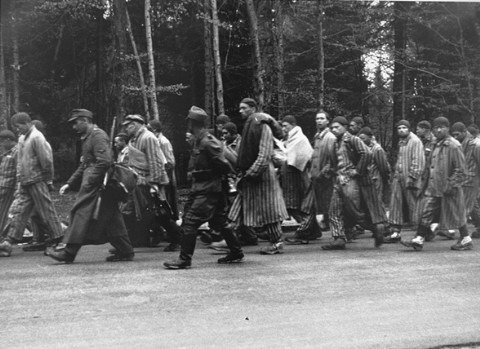
Prisoners on a death march from Dachau move towards the south along the Noerdliche Muenchner street in Gruenwald. German civilians secretly photographed several death marches from the Dachau concentration camp as the prisoners moved slowly through the Bavarian towns of Gruenwald, Wolfratshausen, and Herbertshausen. Few civilians gave aid to the prisoners on the death marches. Germany, April 29, 1945.  — KZ Gedenkstaette Dachau. USHMM

Prisoners on a death march from Dachau move towards the south along the Noerdliche Muenchner street in Gruenwald. German civilians secretly photographed several death marches from the Dachau concentration camp as the prisoners moved slowly through the Bavarian towns of Gruenwald, Wolfratshausen, and Herbertshausen. Few civilians gave aid to the prisoners on the death marches. Germany, April 29, 1945. — KZ Gedenkstaette Dachau. USHMM


The Defining Moment

By Joseph H. Danziger

It happened more than sixty years ago- and not to me- but I cannot dislodge it from my mind’s eye.  My consciousness will not surrender the thought of what it must have been like for my mother, especially on one ominous day. I am a child of Holocaust survivors.

My parents, and thousands like the, each have personal stories of their incarceration in the various concentration camps that dotted Germany, Poland and neighboring countries during World War II.

My parents rarely shared with me their accounts of that desperate period of their lives. When prodded, they might offer an occasional vignette. Seeing the pain on their faces in talking of these experiences, however, I didn’t push for details. Those are memories they certainly preferred to have long forgotten.

Of the stories that were begrudgingly told to me, one shared by my mother will haunt me forever. The soul-searching decision with which she was confronted on that fateful day so long ago is unfathomable to me. As a result of the decision she made that say, I am here to tell the tale.

My mother spent the flower of her youth- ages 17 through 20- within the confines of a concentration camp in Neusalz, Poland. It was a women’s “slave-labor” camp where yarn was processed for the war effort. Although it was not one of the infamous “death” camps such as Auschwitz, Treblinka or Sobibor, the distinction between these titles is hardly significant. In a death camp the aim was to kill as many and as quickly humanly possible. In a slave-labor camp the goal was, in effect, to work the laborers to death, with an ever-replenishing supply of labor. The death tolls in each were mind-boggling. The human skeletons who managed to survive all looked the same and had similar stories of deprivation, torture, depravity and the wanton taking of life.

In the midst of this living hell, an opportunity presented itself to my mother. She saw a possible means of escape. Despite knowing that if she got caught she would face certain death, she took the chance. She escaped, although she never explained exactly how.

Clad only in rags, she trudged through unfamiliar territory until she came to a house. She knocked on the door. She related her circumstance to the master of the house and pleaded for food and a place to hide. Although sympathetic to her plight, he told her he could not jeopardize his family. If found to have secreted a Jew, especially one who escaped from a nearby camp, he and his whole family would most likely be killed as a lesson to the community.

Yet, seeing my mother’s emaciated condition and dire need- and against his better judgment- he took pity on her. He invited her into his home, let her eat, bathe and sleep the night. Before the break of dawn, however, he said she must be gone. She thanked him and availed herself on his family’s kindness. For one night during a span of three years she had a full stomach, clean clothes and a restful night’s sleep.

She left before dawn, as promised. But where would she go? Only then did the truly desperate nature of her circumstance become apparent. For one such as she there was nowhere to go.

My mother was confronted with an unimaginable predicament, a sort of Gordian knot. Should she hazard freedom in an unfamiliar countryside filled with antisemitism where peril and betrayal would be her constant companions? Or should she attempt the inconceivable- a stealth re-entry into the camp from which she had just risked her life to escape- hoping the guards had not noticed her absence? As least there she reasoned, she had the known quantity of a controlled environment offering minimal subsistence, albeit in a horrific setting and under subhuman conditions. She chose the latter. In her mind, that choice offered the best chance for survival. As remarkable as was her original escape, doubly remarkable was her ability to re-enter the camp, unnoticed, and return to her quarters before the morning roll call.

With the memory of nearly one full day of freedom, my mother persevered. Then, in January 1945, together with 1,000 other interned women, she was set on a one-and-a-half-month forced to march to the concentration camp at Flossenburg, Germany, some 200 miles to the southwest. This was one of many so-called “death marches” that occurred toward the end of the war, in a calculated maneuver by the Nazis to deceive the Allies about the vast network of fully functioning concentration camps in operation during the war years.

Along the way to Flossenburg, 800 women were beaten, shot or left to die when they collapsed in the harsh winter. Upon their arrival, the remaining 200 women were transported to the concentration camp in Bergen-Belsen. On April 15, 1945, the British and the Canadians liberated the scant number of those remaining. One of those was my mother. One year later, after surviving family members were reunited, she married my father.

I cannot imagine any other Holocaust survivor choosing a purposeful re-entry into a concentration camp after an earlier successful escape. The very idea is mind-numbing. But she chose wisely, for which her five children and six grandchildren are her testament. I will forever marvel at the immense resolve of this remarkable woman and her relentless insistence on survival.


(Article first appeared in THE PHILADELPHIA LAWYER , SUMMER 2006. Retyped by student Jana Putzig. Used with permission.)

*************************************************************

Matthew Rozell is a United States Holocaust Memorial Museum Teacher Fellow and teaches history at his alma mater in upstate New York. This year, he is authoring a series of posts under the heading of ‘Seventy Years’, marking the 70th anniversary of the close of World War II and of the ‘liberation phase’  of the Holocaust. His work has reunited 275 Holocaust survivors with the American soldiers who freed them.

His first book, a narrative of World War II in the Pacific as told through the previously unpublished recollections of two dozen veterans, is due out this spring. His second book, in progress, is on the power of  teaching, remembering the Holocaust, and this “Train Near Magdeburg’. He can be reached at marozell at gmail dot com.

Read Full Post »

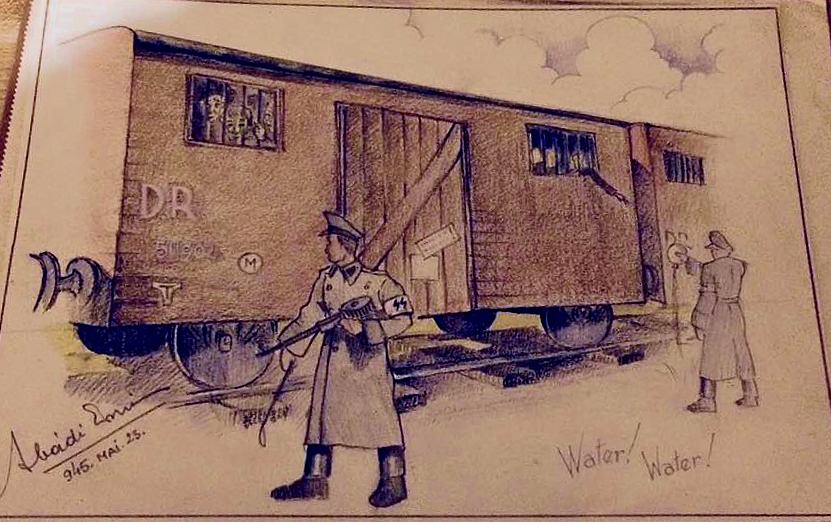
The cosmos trips once more. This month, shortly after my previous post about the discovery of previously unknown artwork by Hungarian Holocaust survivor Ervin Abadi, I was contacted by the family of another American soldier who was at Hillersleben camp as the survivors of the train were being nursed back to health by the medics of the 95th Medical Gas Battalion. They sent me most of the drawings below [Monroe Williams credit, courtesy the Williams family], published here for the first time.

Abadi’s recently discovered artwork matches that of his previously known work, some of which is housed in the archives of the United States Holocaust Memorial Museum.

Ervin Abadi, Typhus. USHMM Collection. Probably completed at Hillersleben DP Camp, May, 1945.

Ervin Abadi, Typhus. USHMM Collection. Probably completed at Hillersleben DP Camp, May, 1945.

(If you suspect that you have any of Abadi’s art in your family, or if anyone remembers his time at Hillersleben or Bergen Belsen, please drop me a line at the bottom.)


He was driven to express his gratitude for the American soldiers who freed him from the train, brought him to the hospital at Hillersleben, nursed him back to health and protected him in his stay at the displaced persons camp. These important drawings are proof of that, and confirm his dedication to feverishly recording everything that he could about those days. He drew his surroundings, his memories of the horrors of Bergen Belsen, and the beautiful young American soldiers around him, and even their precious photos of loved ones in their wallets!

In his words:

“Let these drawings serve as proof of my everlasting gratitude towards those to whom I owe my life. … To the soldiers of the United States Army, particularly to our immediate liberators, those soldiers of the 9th regiment who first entered the village of Zilitz and gave us bread, milk, chocolate, and cigarettes….”

American soldier at Hillersleben, 'Man'.  Ervin Abadi. Completed at Hillersleben DP camp, May, 1945. Soldier Monroe Williams collection.

American soldier at Hillersleben, ‘Man’. Ervin Abadi. Completed at Hillersleben DP camp, May, 1945. Soldier Monroe Williams collection.

American soldier-medic at Hillersleben.  Ervin Abadi. Completed at Hillersleben DP camp, May, 1945. Soldier Monroe Williams collection.

American soldier-medic at Hillersleben. Ervin Abadi. Completed at Hillersleben DP camp, May, 1945. Soldier Monroe Williams collection.

A kapo inflicts a beating at Bergen-Belsen. Ervin Abadi. Completed at Hillersleben DP camp, May, 1945. Soldier Monroe Williams collection.

A kapo inflicts a beating at Bergen-Belsen. Ervin Abadi. Completed at Hillersleben DP camp, May, 1945. Soldier Monroe Williams collection.

The American hospital at Hillersleben. Ervin Abadi. Completed at Hillersleben DP camp, May, 1945. Soldier Monroe Williams collection.

The American hospital at Hillersleben. Ervin Abadi. Completed at Hillersleben DP camp, May, 1945. Soldier Monroe Williams collection.

Soldier Monroe Williams' parents. Probably sketched from wallet photo.  Ervin Abadi. Completed at Hillersleben DP camp, May, 1945. Soldier Monroe Williams collection.

Soldier Monroe Williams’ parents. Probably sketched from wallet photo. Ervin Abadi. Completed at Hillersleben DP camp, May, 1945. Soldier Monroe Williams collection.

Ervin Abadi. Completed at Hillersleben DP camp, May, 1945. Soldier Monroe Williams collection.

Ervin Abadi. Completed at Hillersleben DP camp, May, 1945. Soldier Monroe Williams collection.

The 'casino' at Hillersleben. Ervin Abadi. Completed at Hillersleben DP camp, May, 1945. Soldier Monroe Williams collection. Note Red Cross tents in foreground. May have served as temporary morgue station.

The ‘casino’ at Hillersleben. Ervin Abadi. Completed at Hillersleben DP camp, May, 1945. Soldier Monroe Williams collection. Note Red Cross tents in foreground. May have served as temporary morgue station.

Former hospital at Hillersleben today. (Christian Wolpers photo.)

Former hospital at Hillersleben today. (Christian Wolpers photo.)

'Hillersleben-some disorderly DPs getting a shower bath (DDT?)' Soldier Luca Furnari photograph.

‘Hillersleben-some disorderly DPs getting a shower bath (DDT?)’ Soldier Luca Furnari photograph.

*****

Former American medic Walter Gantz called me out of the blue 3 years ago. Like all of the soldiers now reappearing in Abadi’s drawings, he was there. A couple newspaper articles appeared about Walter’s experience at  Hillersleben shortly thereafter. I put survivors in touch with him:

By the fall of 1944, the 95th [Medical Gas]Battalion was stationed at the Belgian-German border.

That winter, Mr. Gantz helped treat the wounded at the Battle of the Bulge in the Ardennes region, and by the spring of ’45 his unit had made its way into Germany.

In mid-April, they were in the town of Hillersleben setting up a displaced persons hospital when the Allies came across a train that had come from the Nazi concentration camp Bergen-Belsen, where over 35,000 people, the vast majority of them Eastern European Jews, had died of typhus during the first few months of that year.

All told, there were roughly 2,400 emotionally damaged, disease-ridden and terribly malnourished people aboard the train. “Walking skeletons” was an apt description, according to Mr. Gantz.

“We weren’t knowledgeable about these (concentration camps) at the time,” said Mr. Gantz, who visited Bergen-Belsen days after it was liberated. There, he saw countless dead bodies “strewn everywhere.”

“It was hard to explain,” he said. “I cried. And then I prayed for these people. Not only were you angry about what happened, but you felt so helpless.”

Mr. Gantz’s unit spent about six weeks treating the survivors. A good 70 or 80 of them died, mostly of typhus. Among the biggest challenges was acquiring enough food supplies to feed them all. Many could only take their nourishment intravenously.

“A lot of them, if you were to give them food, they would gorge themselves and kill themselves. You had to be very careful as to what they ate,” he said. “Boy, oh boy, they would scream. Those screams would go right through your body.”

“Hillersleben was a living nightmare,” he added. “You don’t shake these horrible scenes from one’s mind.” {see more https://teachinghistorymatters.com/2011/11/04/my-parents-couldnt-understand-why-i-couldnt-sleep-at-times/}

***

Blessed – or maybe cursed – with a terrific memory, he can vividly recall the screams and overall sense of dread permeating the hospital, where he and his fellow medics wore a daily uniform of surgical masks, gloves and rubber aprons.

He remembers scooping handfuls of lice out of patients’ hair and administering countless needles and the time he had to carry the body of a little girl to a tent serving as a makeshift morgue.

“I still get flashbacks to that,” he said.

Many died, mostly of typhus. Among the biggest challenges was acquiring enough food to feed them all, since a good portion of them could only take their nourishment intravenously. One of the survivors Mr. Gantz has spoken with, Lexie Keston, now a resident of Australia, told him she weighed just 30 pounds at the time of the rescue. She was 8 years old.

As a result of Mr. Rozell’s [work], a handful of Bergen-Belsen survivors have been in touch with Mr. Gantz, including Ariela Rojek, a Toronto resident who was 11-1/2 years old at the time of the rescue.

Mrs. Rojek, a Pole who lost all but an aunt during the Holocaust, was among those suffering from typhus. She spent three weeks in semi-consciousness, and remembers having to be tied to the bed by medics trying to restrain her. Mr. Gantz could have been one of them, she said.

“Those soldiers, they gave me my life. Because I was very sick,” she said.

“It was tough. Some of our guys couldn’t take it,” Mr. Gantz said. “I have to admit, I did a lot of crying. I tried not to do it around the patients.”

Now, though, he has the peace of mind of knowing firsthand that, despite all the horrors, life did go on for the survivors of Bergen-Belsen, just as it did for him and his fellow veterans. Asked once by a friend what he took from his wartime experience, Mr. Gantz thought for a moment, then replied, “It made me stronger spiritually.”

“I’ve been blessed,” he said. “I thank the good Lord every day.”

“He’s one of the angels,” Mrs. Rojek said of Mr. Gantz. “I’m really grateful. Whenever I get a name and phone number, I always call them. They gave me a second life.”

Mr. Gantz, 87, said the whole experience has made him feel “10 feet tall.”

“I have to use the word mind-boggling. I guess you’d have to put it in the category of a dream,” he said. “I have to be honest with you, it’s embarrassing. All they keep saying is, ‘Thank you, thank you, thank you.’”

{see more https://teachinghistorymatters.com/2012/03/04/it-was-tough-some-of-our-guys-couldnt-take-it/}

********

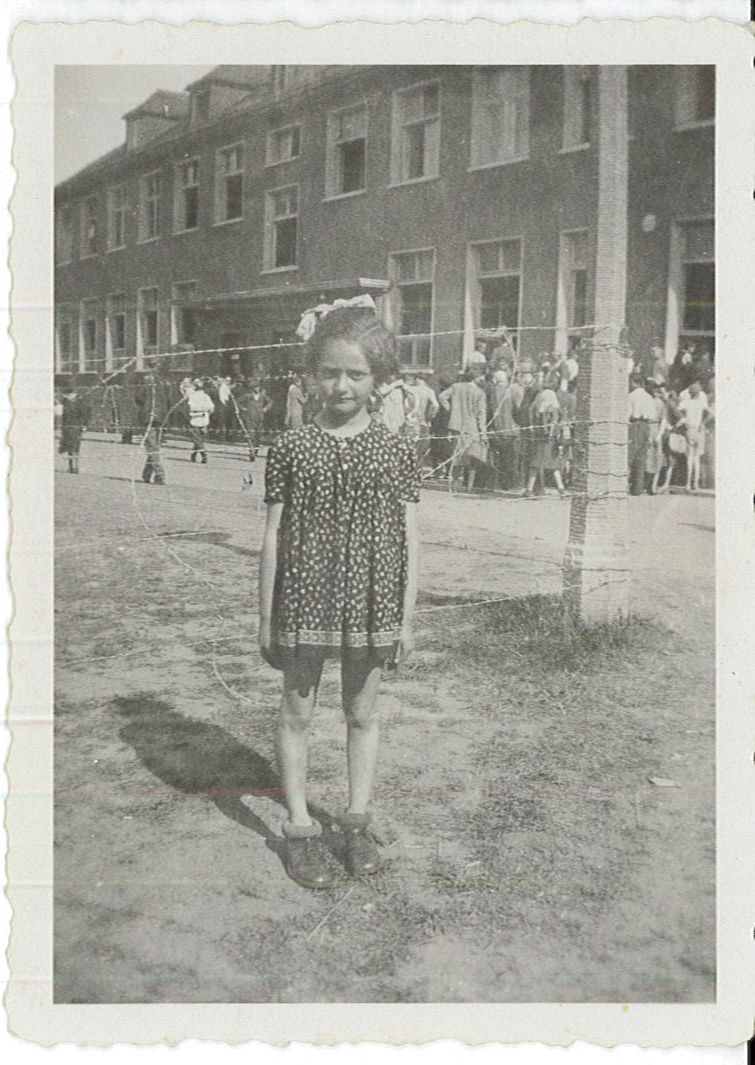
FINAL NOTE. We are also looking for this little girl, a survivor at Hillersleben. Her name was Irene. You can read the backstory here. Please contact me below.

'Hillersleben-Irene is in the flowered dress' Soldier Luca Furnari photograph.

‘Hillersleben-Irene is in the flowered dress’ Soldier Luca Furnari photograph.


*************************************************************

Matthew Rozell is a United States Holocaust Memorial Museum Teacher Fellow and teaches history at his alma mater in upstate New York. This year, he is authoring a series of posts under the heading of ‘Seventy Years’, marking the 70th anniversary of the close of World War II and of the ‘liberation phase’  of the Holocaust. His work has reunited 275 Holocaust survivors with the American soldiers who freed them.

His first book, a narrative of World War II in the Pacific as told through the previously unpublished recollections of two dozen veterans, is due out this spring. His second book, in progress, is on the power of  teaching, remembering the Holocaust, and this “Train Near Magdeburg’. He can be reached at marozell at gmail dot com.

Read Full Post »

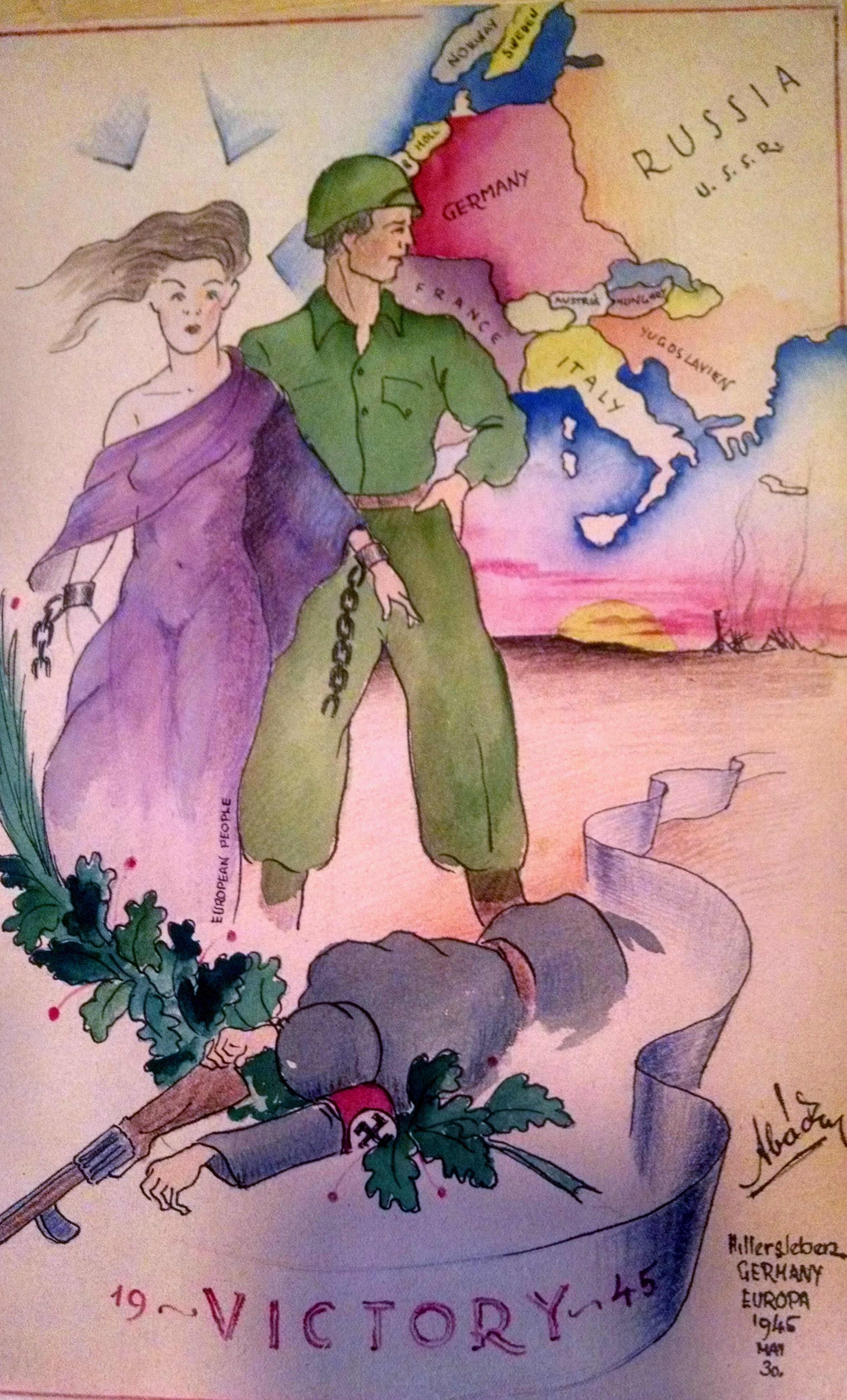
Victory, 1945. By Ervin Abadi. Hilersleben, Germany, May 1945.

Victory, 1945. By Ervin Abadi. Hillersleben, Germany, May 1945. Courtesy Chriss Brown, granddaughter of American soldier Don Rust.

The wires of the cosmos trip once more.

After almost exactly 70 years, a person came to this site on Jan. 30th with an inquiry:

I recently came across this site looking for a gentleman my grandfather became close to. My grandfather, Donald W. Rust of the 95th Medical Gas Treatment Battalion, helped him … and often spent time with him. The gentleman drew several pictures for my grandfather and I still have them today.

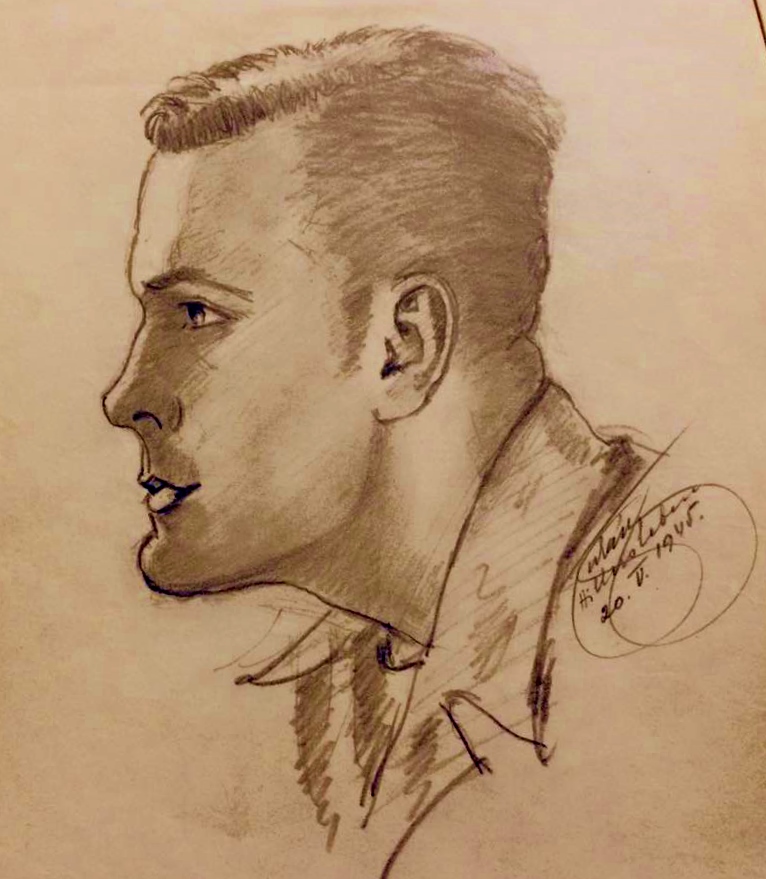
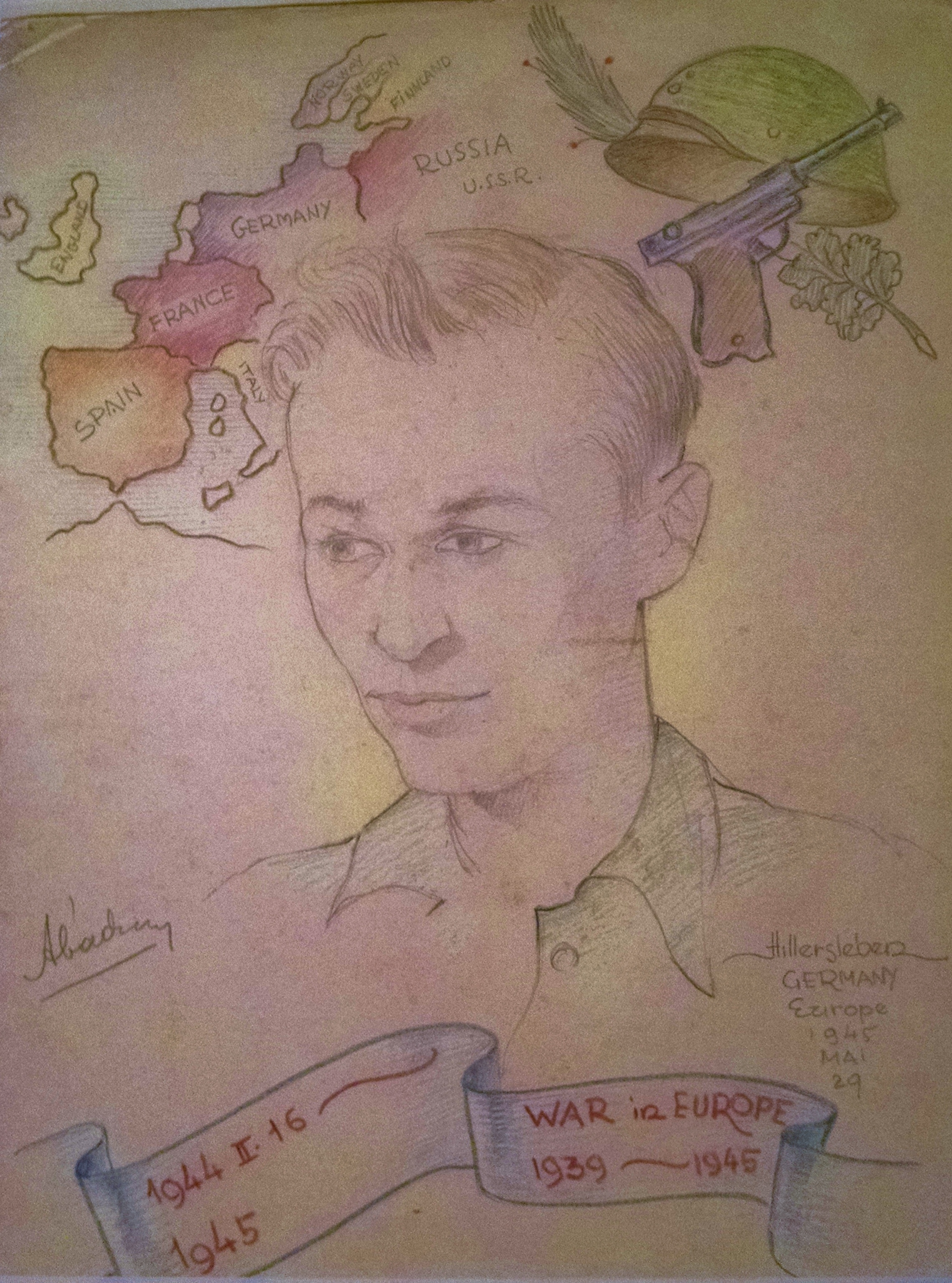
Donald W Rust of Kansas City KS. Hillersleben DP Camp, May 1945. Source: Chriss Brown, granddaughter of Don Rust.

Donald W Rust of Kansas City KS. Hillersleben DP Camp, May 1945. By Ervin Abadi. Source: Chriss Brown, granddaughter of Don Rust.

We looked while my grandfather was still alive but were unable to find any lists of the survivors until now. We cannot read his name clearly but we think the drawer’s name is ‘Albadi’ or something close to it. I would love to share the pictures he drew and also would like to hear if anyone can help me contact the survivor’s family. My grandmother turns 90 in March and it would mean the world to her to know what become of him.

My grandfather told us the gentleman was from Poland, but we don’t know what city. Unfortunately, my grandfather could not remember his name. If anyone can help, it would be much appreciated.  ~Chriss B.

***

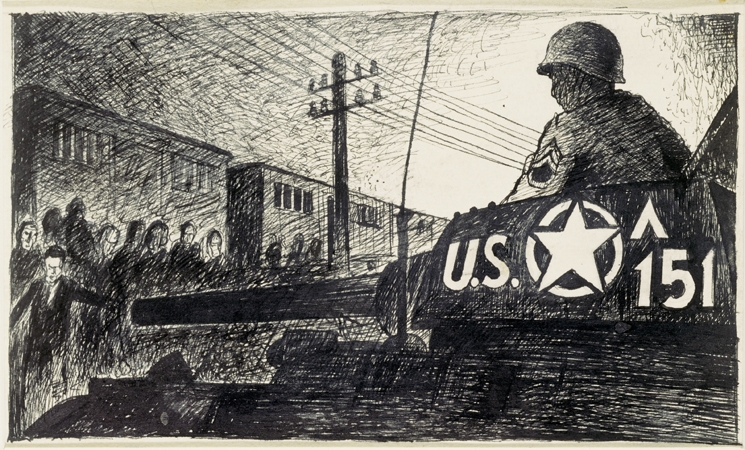
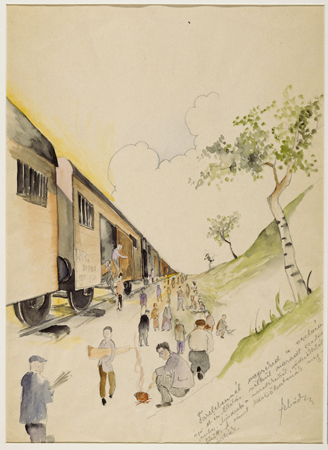
I immediately knew who she was talking about (though he hailed from Hungary, not Poland) and  got in touch with her. She sent me samples, and sure enough it was Ervin Abadi, whose work I was very familiar with. He had even sketched a drawing of the liberation with the tanks rolling in, but unfortunately he passed away 22 years before I sat down to do my interview with one of the tank commanders in the drawing.

Liberation, April 13th, 1945. Drawing by survivor Ervin Abadi. USHMM.

Liberation, April 13th, 1945. Drawing by survivor Ervin Abadi. USHMM.

The Liberation of the Train, by Ervin Abadi. USHMM.

The Liberation of the Train, Farsleben, Germany, April, 1945. Ervin Abadi. USHMM.


Dozens of Abadi’s pieces are at the United States Holocaust Memorial Museum, and his bio there reads as follows:

In his early twenties when the war broke out, Ervin Abadi lived in Budapest, Hungary and wanted to be a painter. But, as with all Jewish males his age, he was taken to Russia by the Hungarian Army as a forced laborer. Abadi managed to escape but was captured after hiding out in the Karpet Mountains. After being brutally mistreated he managed to escape again, but was recaptured and taken to Bergen Belsen. When the camp was liberated  by the US Army [incorrect: his train transport from Belsen to Theresienstadt] on April 13, 1945, Abadi was taken to a hospital in Hillersleben, where he recovered. While in the hospital (and possibly earlier in the camp) he made 25-30 watercolors, dealing with his arrival at Bergen Belsen, life in the camp and its liberation by the US Army. Abadi returned to Budapest where he told about his life as a forced laborer and and an inmate of Bergen Belsen in a collection of 30 ink drawings. The work was published in 500 copies with Hungarian and English captions in 1946. The foreword of the book says, in part, “Let these drawings serve as proof of my everlasting gratitude towards those to whom I owe my life. … To the soldiers of the United States Army, particularly to our immediate liberators, those soldiers of the 9th regiment who first entered the village of Zilitz and gave us bread, milk, chocolate, and cigarettes….” Abadi, however, became disallusioned by Communist Hungary and managed to leave for Israel in 1947 or 1948 where he lived in Israel for the rest of his life. There he wrote 15 books in both Hebrew and Hungarian. He died in 1979.  [my emphasis]

***

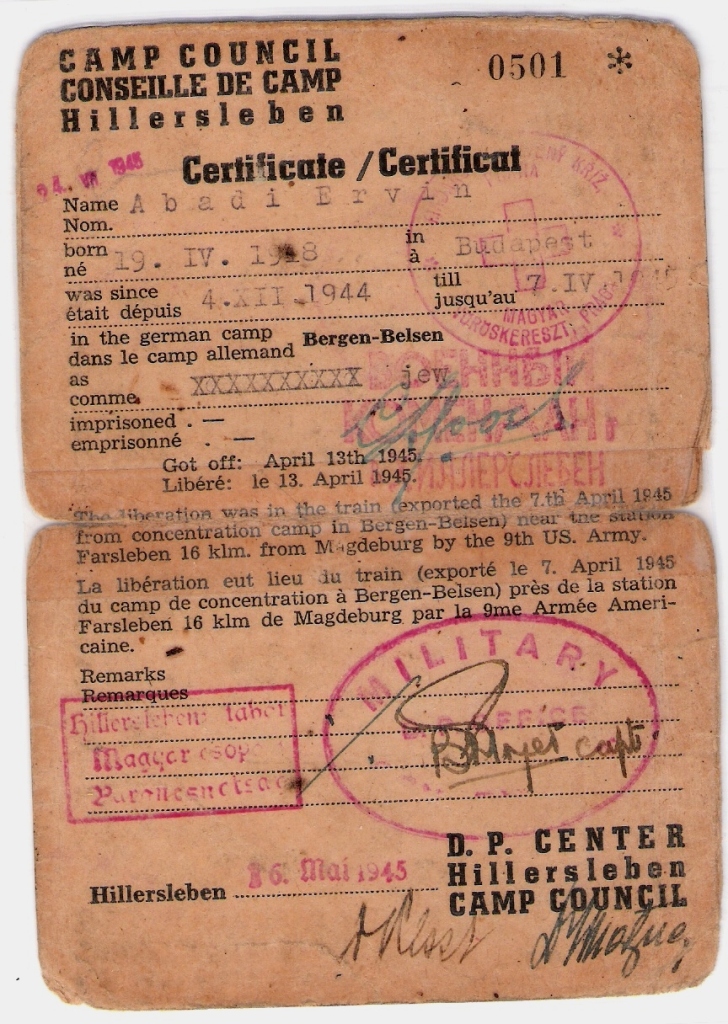
Ervin Abadi’s name is also the first on the existing manifest list. Some years ago, with the help of Varda W. in Israel, his daughter got in contact with me, and sent me his DP [displaced persons] document from Hillersleben:

Hillerleben Displaced Persons certificate-Ervin Abadi

Hillerleben Displaced Persons certificate-Ervin Abadi.

At that time, 5 years ago, his daughter wrote:

As you know, my father is a survivor from Bergen Belsen on the Magdeburg train. He got sick with typhus and was taken to the American Hospital at Hillersleben.

All my life my father told me to remember that he was saved by the Americans, and for that he will be grateful until his last day- and so must I, because if he was not to be saved- I wouldn’t be born.

My father passed away in 1979, and since then I tried to keep my promise to my father. I went to Normandy in France and walked the beaches that are soaked with the blood of the American soldiers and wanted to honor their memory, for because of them, I am living today.

A few years later I visited the World War II Memorial in Washington, DC. I met there an old gentleman and I found out that he was one of the American soldiers who fought on the beach on D-Day! I told him the story about my father and we both fell into each others arms crying. I felt like I fulfilled my promise to my father. ~Julia A. H.

**

So I dug out the letter, got in contact with Julia again,  and put her in touch with Chriss, the granddaughter of the soldier who in befriending Abadi, helped him in his recuperation.

Raymond D. Rape of Zelienople, PA ; Grafton D Junkin of Kennedy, Alabama ; Donald W Rust of Kansas City KS. Hillersleben DP Camp, May 1945. Source: Chriss Brown, granddaughter of Don Rust.

Raymond D. Rape of Zelienople, PA ; Grafton D Junkin of Kennedy, Alabama ; Donald W Rust of Kansas City KS. Hillersleben DP Camp, May 1945. Source: Chriss Brown, granddaughter of Don Rust.

From Julia, the artist’s daughter, last week:

I was very touched… 70 years after it happened, my father’s drawings came back to us.

We use to say that if his name is mentioned, a person lives forever.

Thank you again for remembering my father’s work of art.

*************************************************************


Read Full Post »

This week I introduced what will be a series of posts under the heading of ‘Seventy Years’, marking the 70th anniversary of the close of World War II and discovery of the magnitude of the most horrific crime in the history of the world, the Holocaust.

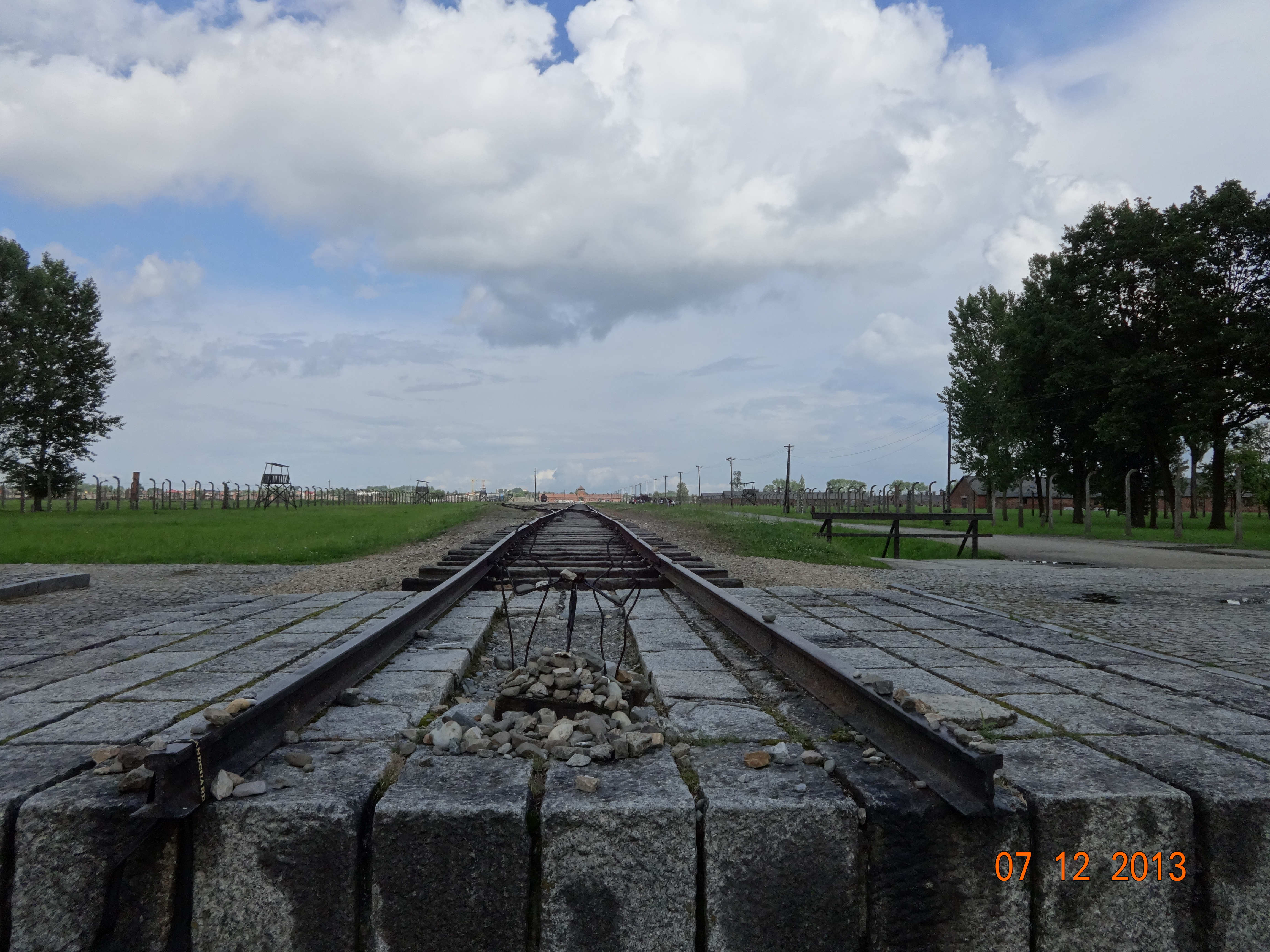
Today I travel again back to Auschwitz-Birkenau, sharing some of my personal observations and photographs on the anniversary of the liberation by Soviet troops 70 years ago this week.

*****

July 12.

After the tour of Auschwitz I, our teacher travel study group has lunch on the bus in the parking lot, then drive the three kilometers through town to Birkenau.

There it is. The entry tower. The iconic symbol of evil.

787

Main entrance to the Auschwitz-Birkenau extermination camp. USHMM

Main entrance to Auschwitz-Birkenau . USHMM


We follow the guide up the stairs in the tower. From here we can see the sheer vastness of the camp.

696


Women's Barracks. Auschwitz II.

Women’s Barracks. Auschwitz II.


Dozens of long narrow women’s barracks, brick, still stand, albeit some braced with wood on the gable ends to keep them from toppling until they can be re-pointed. A. indicates that historic preservation here is a major concern.
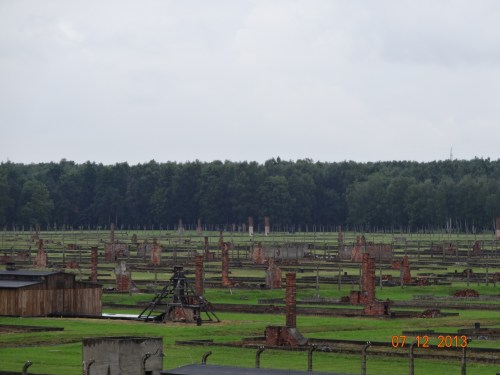
 

Vastness

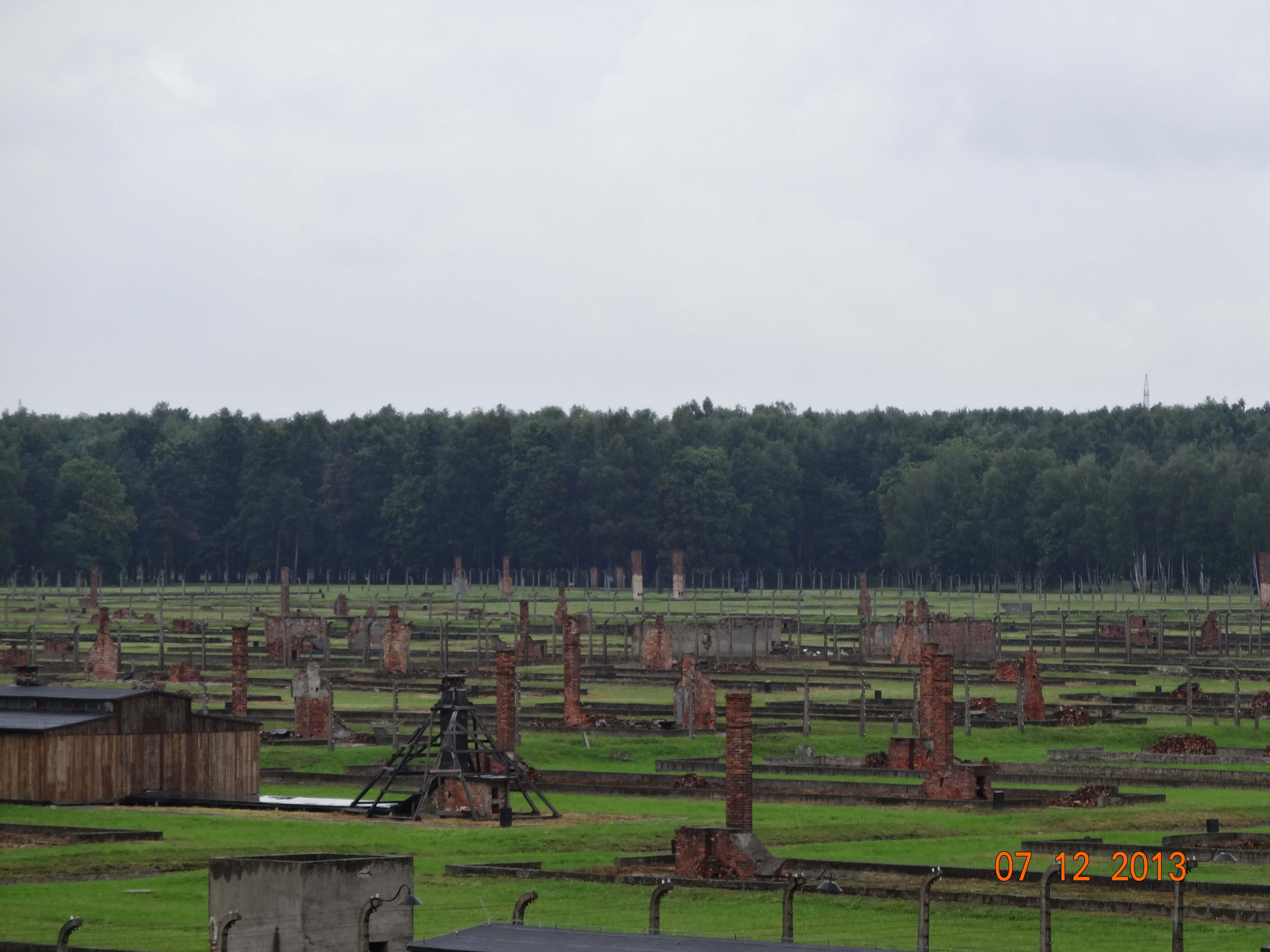
The rest of the camp is many square kilometers of row upon row of foundations and brick chimney stubs, surrounded by the menacing curved and tapered concrete concrete posts dotted with white insulators and strung with miles of parallel lines of barbed wire. In the summer of 1944, when hundreds of thousands of Hungarian families were deported here, the rail lines came right into the camp.
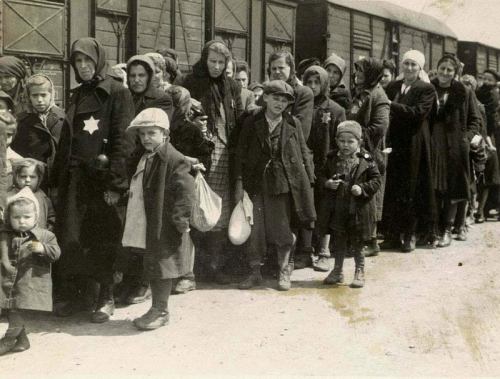
View of the Ramp at Auschwitz-Birkenau Showing the SS Selection of Hungarian Jews USHMM.

View of the Ramp at Auschwitz-Birkenau Showing the SS Selection of Hungarian Jews, USHMM.


View of the Ramp at Auschwitz-Birkenau Showing the SS Selection of Hungarian Jews, USHMM.

View of the Ramp at Auschwitz-Birkenau Showing the SS Selection of Hungarian Jews, USHMM.


Following the German invasion of Hungary in March 1944, over 400,000 Hungarian Jews  were deported and murdered at Auschwitz.


The Walk.

Our guide leads us along the path through the camp that leads to the gas chamber and crematorium. We walk in in silence along the roadway, the only sound the crunching of brick fragments and gravel underfoot.

Selected.

Selected.


The Walk.

707

It appears to have been paved with brick, slave labor, though in some spots it is hard to tell anymore. No one speaks, and on and on we walk. Two minutes. Five minutes. Ten minutes. Fifteen minutes. I’ve been on battlefields that are smaller than this site.


Flower ring as we make final approach to the chambers tucked into the wooded area nearby.

Finally we reach the end of the camp where the kitchens stood. A round concrete ring rises out of the earth, maybe 6 feet in diameter. Someone finally speaks and asks A. what it was. A giant flowerpot. She tells us also that they were placed near the entrances of the gas chambers. Flowers at the gas chambers.

Waiting. For what we do not know.

Waiting. For what we do not know. Exhausted from deportation and “travel”. We now know who they were. Yad Vashem.


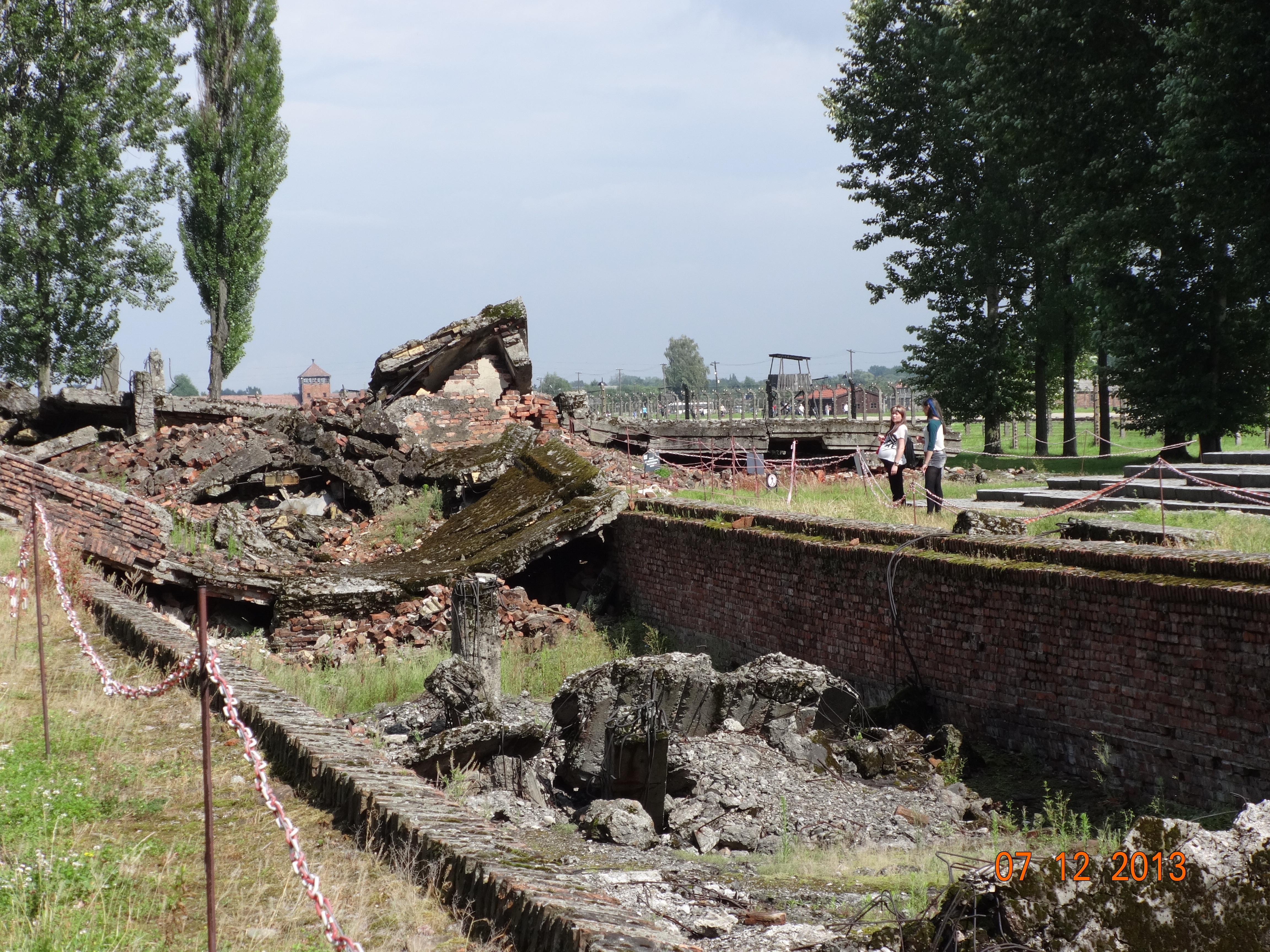
We turn left, and keep walking past interpretative signage. It seems like we are walking outside of camp perimeter. But we are not. Beautiful woods appear and we are walking on the edge of the woods with the camp to our left. We stop near another sign and rest for a moment, allowing the others to catch up. Then our guide calls our attention to the photo on the sign, showing Hungarian mothers and children doing the same thing we are doing. Halting and resting.  And a short path through the woods will take us to the ruins of the gas chamber/crematorium Number Five.

They waited here. Some days, in the summer of 1944, for hours.

They waited here. Some days, in the summer of 1944, for hours.


We are resting at the spot they rested at, 20 minutes after walking, immediately after disembarking of overcrowded transports that had been traveling for days. Here they waited, anxiously, as their turn to approach the chamber would come. But the victims of the transport ahead of them had to be removed from the chamber first. Some days in the summer of 1944 these victims were backed up for hours.

I pick up a rock from the path and carry it with me past the ruins. At the ashfield there is more signage and a memorial asking visitors not to walk through the field. I place my stone on the memorial, looking down to watch where I step. But it is probably a futile gesture-this whole place is an ashyard, a graveyard.


The secret sonderKommando photos. Where the bodies were burned in open air.

The secret sonderkommando photos. Where the bodies were burned in open air.


“So many Hungarian Jews were killed in the Auschwitz camps during that period that the crematoria were incapable of consuming all the bodies, and open pits for the purpose were dug.”
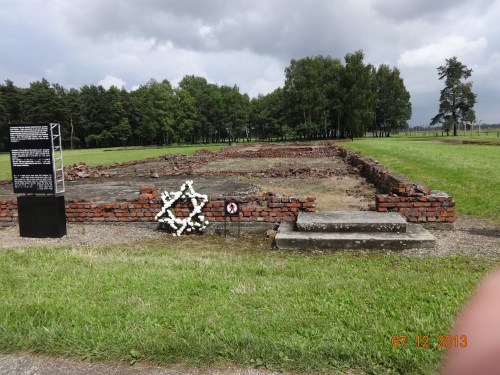
728

We turn again, and walk past the remains of crematorium Number Four. To the disinfection center for those selected to be worked to death. Again, a system. Disrobing. Wading through disinfectant. Shower. Uniform thrown at you, mismatched clogs or shoes.

 *****

E’s mother spent two years here. Her grandmother and the little ones were selected upon arrival. Her mom’s beloved sister was murdered in the quarry after slipping while carrying a large pot of soup in the ice and snow with three other girls. Today is a hard day. I want to comfort her, to carry her pack for her. I feel helpless. There is nothing I can do.

778

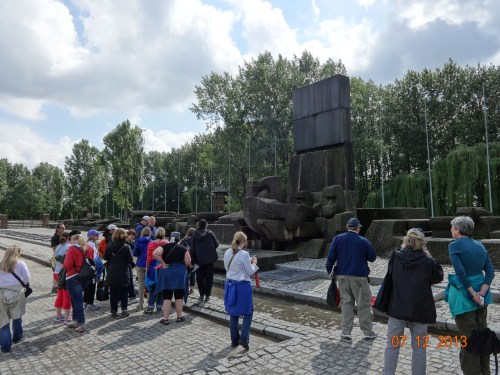
At the Soviet memorial constructed near the two destroyed gas chamber/crematoria at the end, we have a remembrance ceremony. Kaddish is recited in Hebrew. I read it aloud in English. With tears, E. tells us that she feels her grandmother smiling down on this extraordinary group of dedicated teachers. A lump rises, again. I swallow hard and try to blink back the wetness I feel welling in my eyes. Damn, I almost made it. Glad for the sunglasses, even though there is no sun.

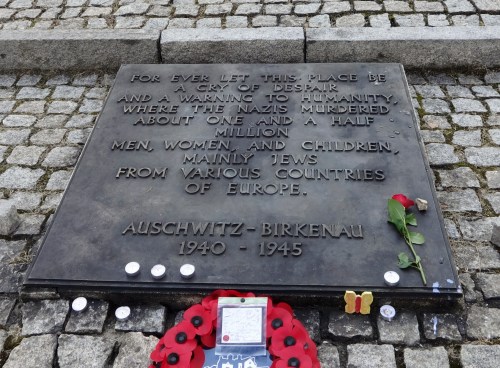
770

775


772

776


“A Warning to Humanity.”

We light candles, turn our backs, and walk out, which provides another twenty-minute stretch of personal reflection. We have toured the epicenter of evil. We have been here, we try to process-but we just cannot. We need the individuals to speak to us. And like E’s family, they do.


738


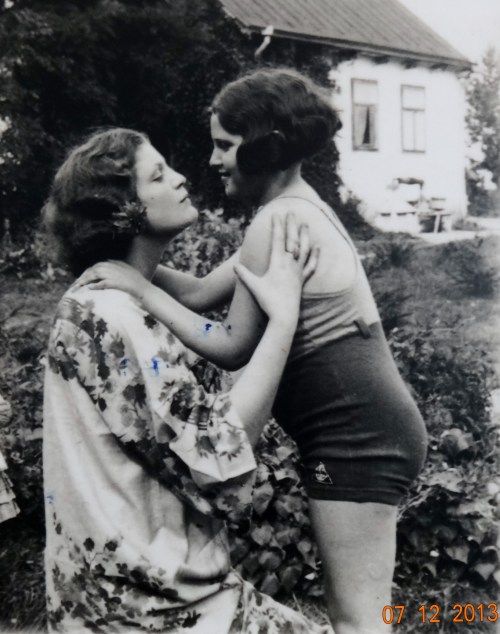
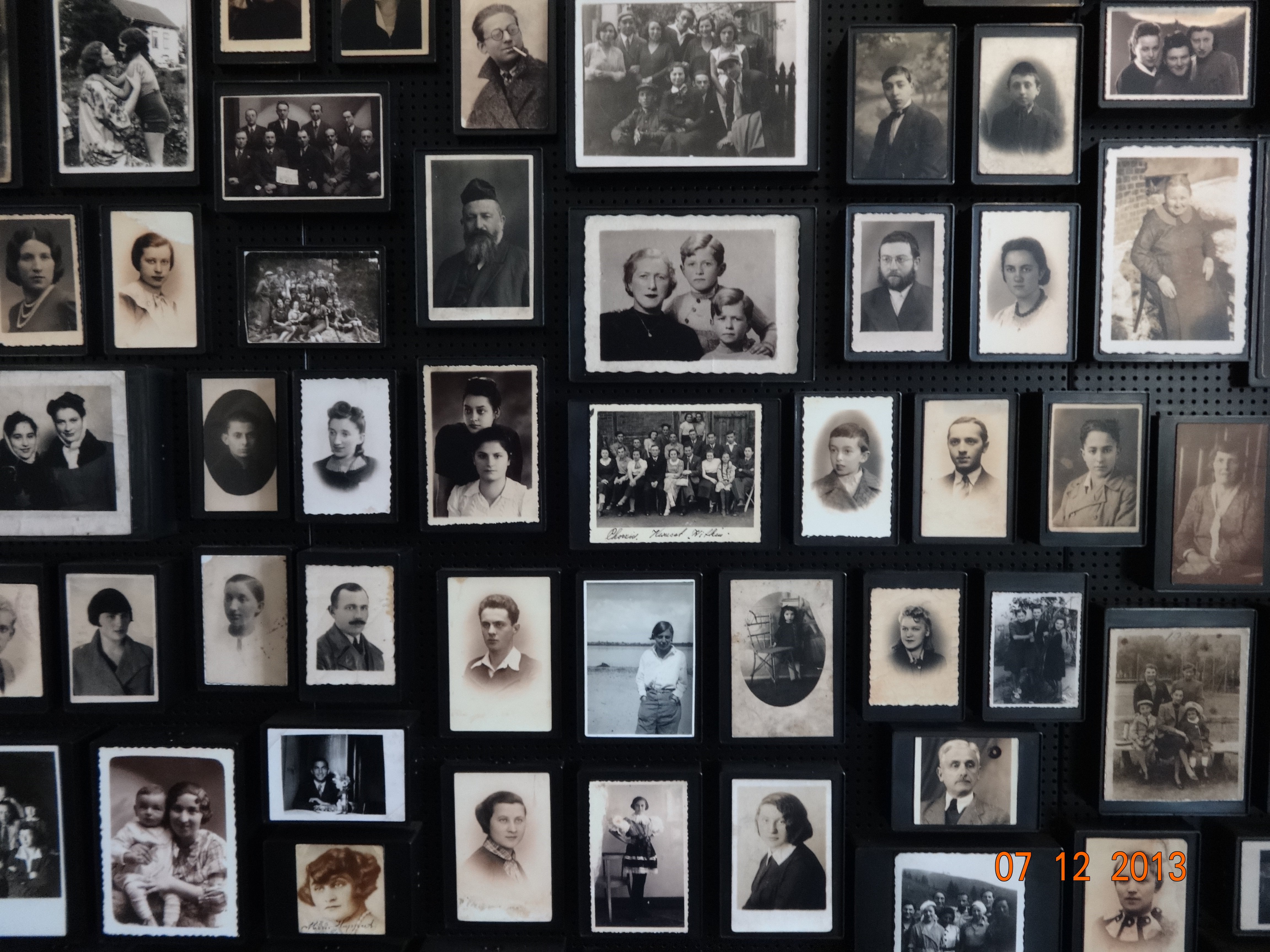
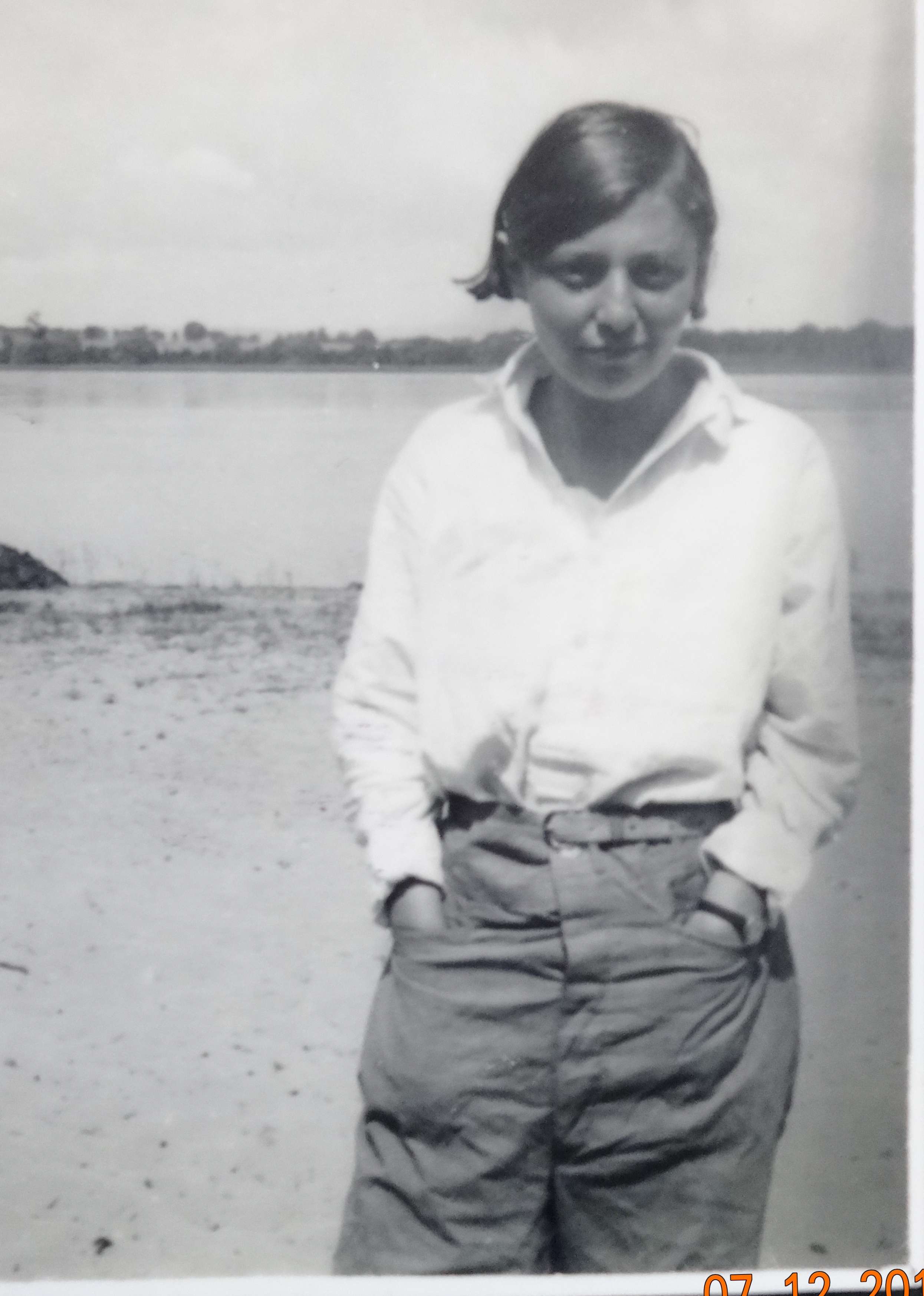
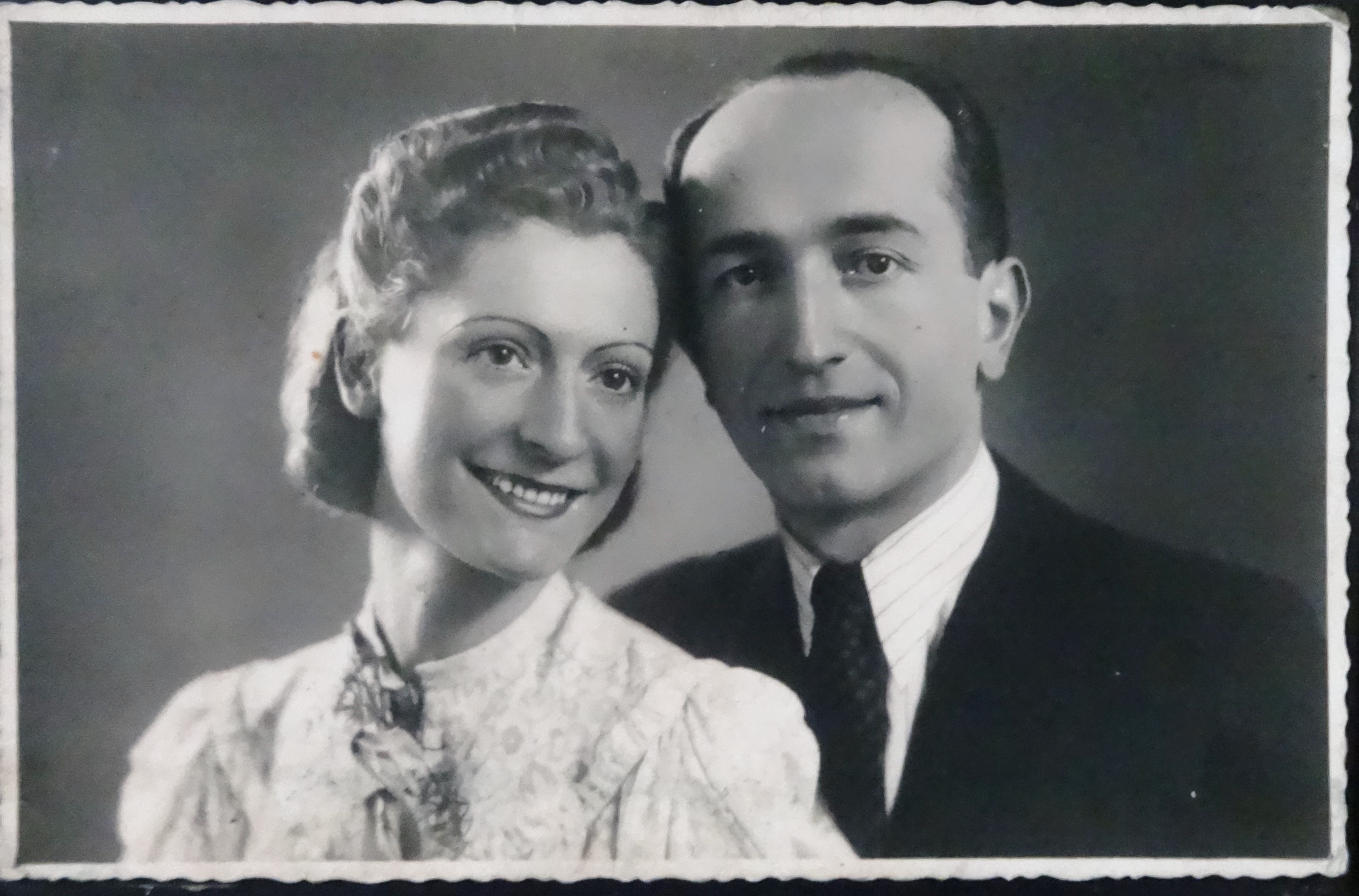
At the close of the disinfection center exhibit there are hundreds of photographs that had been discovered years after the camp was abandoned by the Germans. Pictures of loved ones who perished here.

For me, like the personal home movies of pre-war life for the victims at the exhibit at Auschwitz I, this is what has the most meaning. So I will leave you for now with a few close ups.
744

743

741

742


To Life.To Life.

*****

From National Public Radio:

A Holocaust Survivor, Spared From Gas Chamber By Twist Of Fate

by Soraya Sarhaddi Nelson, International Correspondent, Berlin

January 27, 2015 3:40 PM ET


Jack Mandelbaum, a Holocaust survivor from the Polish city of Gdynia, poses in front of a photograph showing him as a youth.

Jack Mandelbaum, a Holocaust survivor from the Polish city of Gdynia, poses in front of a photograph showing him as a youth. Tobias Schwarz/AFP/Getty Images

Seventy years ago, Soviet soldiers liberated Auschwitz, the most notorious of Nazi concentration camps.

Some 300 Holocaust survivors were at Auschwitz on Tuesday, along with several European presidents and other government officials, to honor at least 1.1 million people who were murdered, 1 million of whom were Jewish.

Among those killed there were Jack Mandelbaum’s mother and brother. The Polish-born Mandelbaum survived, spared at the last minute by an officer of the dreaded SS who yanked the teen away from his family and sent him instead to a forced labor camp.

Last week, Mandelbaum flew from his Naples, Fla., home to Berlin, to help open an exhibit on the children of Auschwitz, and to tell his story.

“I’m a person of action,” he says. “Anger doesn’t get you anyplace. Hate doesn’t get you anyplace.”

In August 1939, as the Nazis were about to invade Poland, Mandelbaum was 13 and living in the Polish port city of Gdynia. Mandelbaum says his father worried that the port would be attacked, so he sent his wife and three children to stay with relatives in the countryside.

He promised to join them six weeks later, but he never arrived. About a year later, he sent them a postcard from the Stutthof concentration camp.

“I guess he didn’t want us to worry about him, so he said he was OK,” Mandelbaum says.

He never saw his father again. His sister later died on a forced march to another concentration camp.

Prisoner 16013

Then, before dawn on June 14, 1942, the SS came for what was left of the family.

“They banged on the door and everyone had to come out in five minutes, and there was a lot of shooting and crying, and people didn’t know what was happening because they had to rush out,” Mandelbaum recalls. “Many people were even in their bed clothes. And we were lined up in the market square, and then we were marched to a local brewery.”

An SS officer there began separating people to the left and to the right. Mandelbaum says he clung to his mother and brother, who were sent to the left. But the SS officer saw in his documents that Mandelbaum had worked as an electrician’s helper.

“He grabbed me and pushed me to the other side,” Mandelbaum says. As for his family, he says, “The people who were to the left were sent to Auschwitz to be gassed. I never saw them again.”

To the Nazis, he became prisoner 16013 and spent the next three years at seven concentration camps. The first was Gross-Rosen, where prisoners worked in a granite quarry.

“There were so many prisoners,” he says. “We were in a big barrack, it had a concrete floor, it had no beds. And we were lined up like herring on the floor, so when one person turned, everybody else had to turn, it was so tight.”

Food was scarce, and the daily meal amounted to a single piece of bread and what Mandelbaum describes as soup made out of grass.

He recalls emaciated prisoners stuffing paper into their mouths to fatten their cheeks so they’d look healthier to the guards assigned to remove the weak for extermination. His own weight eventually dropped to 80 pounds.

But Mandelbaum says he refused to give up hope. He poured what little energy he had into work, hoping it would eventually lead to his release.

Suddenly, Freedom

“We had a good life before the war. I went to a public school, I had good clothes and good food and a nice apartment,” he says. “My dream was to go back to this life and be reunited with my family and my sister and my brother, and that sustained me.”

It also helped that he didn’t know the Nazis were trying to slaughter all Jews, something he says he and other prisoners learned only after liberation.

Their sudden freedom, too, was a complete shock, Mandelbaum says. “We didn’t know anything, only on the morning when we woke up and the Nazi flag wasn’t flying and the guards weren’t there.”

Unlike at Auschwitz, Allied soldiers did not free them, as his camp was in a no man’s land between the fleeing Nazis and advancing Russians. He and a friend from the camp grabbed an abandoned horse-drawn wagon and left as quickly as they could.

“We came across a women’s concentration camp and they were still locked up, so we actually became the ‘liberators’ of the camp,” he says, with a laugh.

Mandelbaum was 17 when the Holocaust ended. He says he returned to Poland several times to see if he could find his family but failed. He did find an uncle living in a hamlet near Munich.

The following year, he immigrated to the United States and settled in Kansas City, Mo., where he married, had four children and became a successful importer of ladies’ handbags. It would be 16 years before he began speaking publicly about the Holocaust, something he says he decided to do after talking to one of his neighbors.

“He asked me what kind of sports did I play in the concentration camp, so all of the sudden it just opened everything up, how little people knew what was going on, and this was when I started to speak in different venues about my experiences,” he says.

That desire to educate people brought Mandelbaum, 87, to Berlin last week. He says it’s sad to see anti-Semitism on the rise in Germany and elsewhere in Europe, but he hopes he and other Holocaust survivors can make a difference.

“You know, when we were in the camps, we would always ask, ‘How can the world stand by and let this happen?’ ” he says. “So it’s a matter of being vigilant, a matter of trying to do as much as you can in order to enlighten people [about] how dangerous it is when you become a bystander.”

http://www.npr.org/2015/01/27/381876276/a-holocaust-survivor-spared-from-auschwitz-at-the-last-second

*****


Read Full Post »

« Newer Posts - Older Posts »