Feeds:
Posts
Comments

Posts Tagged ‘Holocaust Survivors’


April 17, 1945, was a Sunday. It was three days after the liberation of the train near Magdeburg, near the Elbe River, just miles from Berlin. War weary GIs had their first encounters with the conditions at the train. They would never forget what they saw.

April 17th. (1945)

Dear Chaplain;-

Haven’t written you in many months now, its funny how a few moments are so hard to find in which to write a letter way past due; it’s much easier to keep putting it off the way I’ve done. I’ll try to make up for it in this letter.

Today I saw a sight that’s impossible to describe, however I’ll try. Between 2400 and 3000 German refugees were overran by my division during our last operation; most of them were, or had been, inmates of concentration camps, their crimes the usual ones, – Jewish parentage, political differences with der Fuhrer, lack of sympathy for the SS, or just plain bad luck. Not one of these hundreds could walk one mile and survive; they had been packed on a train whose normal capacity was perhaps four or five hundred, and had been left there days without food.

Our division military government unit took charge of them, and immediately saw what a huge job it was going to be, so they sent out a call for help. Several of our officers went out to help them organize the camp they were setting up for them. The situation was extremely ticklish we soon learned; no one could smoke as it started a riot when the refugees saw the cigarette, and we couldn’t give the kiddies anything or they would have been trampled to death in the rush that would result when anything resembling food was displayed. The only nourishment they were capable of eating was soup; now the army doesn’t issue any of the Heinz’s 57 varieties, so we watered down C-ration[s] and it served quite well.  It was necessary to use force to make the people stay in line in order to serve them. They had no will power left, only the characteristics of beasts.

A few weeks of decent food will change them into a semblance of normal human beings; with God willing the plague of disease that was already underway, will be diverted; but I’m wondering what the affect of their ordeal they have been through, will be on their minds; most will carry scars for the rest of their days for the beatings that they were given. No other single thing had convinced me as this experience has that Germany isn’t fit to survive as a nation. I’ll never forget today.

I was going to write mother tonight but thought better of it. I’ll be in a better frame of mind tomorrow. I’m only a few dozen miles from Berlin right now, and its hard to realize the end is in sight. I’m always glad to receive your scandal sheet. You perhaps missed your calling, as your editorial abilities are quite plain.

As ever,

Charles.

March 11th, 2009

Dear Mr. Rozell: My father-in-law was 1st. Lt. Charles M. Kincaid. He was a Liaison Officer with the 30th. Division Artillery.  He was honored with an Air Medal in the battle of Mortain and a Bronze Medal in the battle of St. Lo.  In the battle of Mortain he won his Air Medal by calling in artillery adjustments while flying in a Piper L-4 over 4 panzer divisions on August 9, 1944.

He rarely wrote home. He did write home to his minister about one event that evidently really caused him to stop and think. Attached is a copy of that letter that his sister transcribed – making copies for others to read.  The letter describes the Farsleben train and his experience there.

I need to thank you for your website and work. You and your students work enabled me to connect the letter with the actual historical event. It further enabled me to show my children the pictures and to make their grandfather’s experience real, not just an old letter – that this event so affected him that he needed to tell his minister before he told his mother.

Thank you,
Mark A.

Read Full Post »

I am in Israel now to embark upon two and a half weeks of study at Yad Vashem, the Israeli Holocaust Martyrs’ and Heroes’ Remembrance Authority. I am humbled. But I was here before, in 2011, with liberator Frank Towers as he was recognized for his efforts 70 years ago, on behalf of American liberators everywhere. Here in Israel he met with statesmen and the head of the IDF, as well as over 50 survivors and their families who were liberated on April 13, 1945, an event that Frank had a direct hand in.

Varda Weisskopf, liberator Frank Towers, Matthew Rozell at Yad Vashem, May, 2011.

Varda Weisskopf, liberator Frank Towers, Matthew Rozell at Yad Vashem, May, 2011.

It’s a long story, but my work as a teacher has been here, too. In the background, note the Benjamin photo at the 2015 70th anniversary state ceremonies.

"The anguish of the liberation and return to life". Note the Benjamin photograph on the banner. Yad Vashem, 2015.

“The anguish of the liberation and return to life”. Note the Benjamin photograph on the banner. Yad Vashem, April 2015.

The short version of the story:

Fifteen summers ago I sat down to listen to an old gentleman in a rocking chair. A  war weary tank commander in 1945, he told me stories of his World War II experiences and then led me to his fellow tank commander, who showed me a picture that their major had taken on April 13, 1945. You see, those two were there, and their two tanks had liberated a concentration camp transport deep in the heart of war-torn Germany.

It would be the first time in decades that this picture had seen the light of day. And because of its discovery, and what we would do with it, thousands of lives were about to change.

Yad Vashem contacted me in December 2014 to inquire about using the Major Benjamin photo. I immediately sent them a copy. My friend Varda in Israel writes, ‘[The photograph above was taken] during the main ceremony at  the Holocaust Remembrance Day at Yad Vashem. This photo shows the President of Israel Reuven Rivlin make his speech. You can see your photo there at the middle (banner) and I now think it was there throughout all the ceremony.’

Below, a post from the time of the event in April, 2015..


My good friend in Israel let me know that the April 15th  commemoration of the Holocaust at Yad Vashem in Israel was a moving event and sent me the link to the video of the ceremony marking the 70th anniversary of the liberation. While the  narrative  behind the Major Benjamin photograph was not a focus, the photo that which now seems to be becoming a cornerstone of the history of Holocaust liberation is all throughout the ceremony, and especially at 8:31. One of my friends, a survivor who had been a six-year old boy on this transport that Major Benjamin photographed at the moment his jeep arrived at the train, notes,

The photograph wouldn’t be there if not for your effort. It was presiding on 1.5 hrs of national ceremony in the presence of Israel’s president, prime minister, the entire government, the top army guys, survivors, chief rabbis and was nationally broadcast. You have a direct hand in this.

Me, a lowly teacher, whose work for an evening is presiding as the backdrop for presidents and prime ministers. I am proud and hope that the story is told over and over, and that it serves the memory of the victims, the survivors, and the liberators well. I just can’t believe sometimes this path I have been down, since the day over a dozen years ago when I took the time to listen to a war veteran, and began to backtrack his story.  There are other forces at work here, I think… and there is a cosmic force that reverberates in you when you teach the Holocaust from the heart.

Teachers out there, you all know the power of what we do. I hope this serves as an affirmation.


*************************************************************

Matthew Rozell is a United States Holocaust Memorial Museum Teacher Fellow and teaches history at his alma mater in upstate New York. His work has resulted in the reuniting of 275 Holocaust survivors and the American soldiers who freed them.

His first book, ‘The Things Our Fathers Saw’, was released to coincide with the 70th anniversary of the end of World War II. His second book,  is on the power of  teaching, remembering the Holocaust, the Benjamin photograph and this ‘Train Near Magdeburg’. 


Read Full Post »

Lisette Lamon was a Holocaust survivor liberated on the train near Magdeburg on April 13, 1945, and later in life a psychotherapist at White Plains Hospital outside of New York City, a pioneer in the treatment of trauma back in the days when the field was in its infancy. She had experienced it herself. She was from the Netherlands, and lost her first husband Benjamin ‘Benno’ Soep at the Mauthausen slave labor concentration camp in Austria in 1941 (she appears on the manifest list: Soep-Lamon Lisette DOB 14.05.1920 Amsterdam).

This article originally appeared in the New York Times on Mother’s Day, May 12, 1979, back when I was a young buck itching to graduate high school and go out into the unknown world. Of course I did not see this article then, but the people she was with on that train and the soldiers who liberated them would go on to change my life. I wonder if at the time my own mother, relaxing in her silk robe on Sunday afternoons with the NYT as she frequently did in her respite from the workweek, read this letter… It was presented to me by fellow survivor Elisabeth Seaman, whose mother had been in contact with Ms. Lamon (Ms. Lamon passed in 1982).

Here’s to all mothers, a beautiful anecdote that will no doubt make it into my upcoming book. Happy Mother’s Day, indeed.

It was a beautiful, balmy morning in April 1945, when I entered Major Adams’ makeshift office in Farsleben, a small town in Germany, to offer my services as an interpreter.  It made me feel good that I could show, in a small way, the gratitude I felt for the 9th American Army, which had liberated us as we were being transported from Bergen-Belsen concentration camp.

Orders found by the Americans in the German officer’s car directed that the train was to be stopped on the bridge crossing the Elbe River at Magdeburg, then the bridge was to be blown up, also destroying the train and its cargo all at once. The deadline was noon, Friday the 13th, and at 11 A.M. we were liberated!

Victory, 1945. Watercolor, Ervin Abadi. Train near Magdeburg survivor. Hillersleben, Germany, May 1945.

Victory, 1945. Watercolor, Ervin Abadi. Train Near Magdeburg survivor. Hillersleben, Germany, May 1945. Credit Chriss Brown.

With the liberation had come the disquieting news that President Roosevelt had died, and while I was airing concern that the new President, Harry Truman, (a man unknown to us) could continue the war, a sergeant suddenly said, “Hey, you speak pretty good English. I am sure the major would like to have you serve as his interpreter.”

Major Adams had not been told of my coming so he was startled when he saw me. No wonder! There stood a young woman as thin as a skeleton, dressed in a two-piece suit full of holes. The suit had been in the bottom of my rucksack for 20 months, saved for the day we might be liberated, but the rats in Bergen-Belsen must have been as hungry as we were and had found an earlier use for my suit. For nine days we had been on the train, and this was the only clean clothing I owned.

Major Adams quickly recovered from his initial shock and seemed delighted after I explained why I had come. He asked how his men had treated us, and I heaped glowing praise on the American soldiers who had shared their food so generously with the starving prisoners. Then he took me outside to meet the “notables” of the German population, and with glee I translated orders given to them by the American commander. The irony of the reversal of roles was not lost on me nor the recipients; I was now delivering orders to those who had been ordering me around for so long! The Germans were obsequious, profusely claiming they never wanted Hitler or agreed with his policies and hoped the war would soon be over.

When asked to come back the next day, I was delighted but hesitated, wondering if it would be appropriate to ask a favor. Major Adams picked up on my hesitation, so I asked him to help me contact my family in America. We had emigrated to the U.S. in 1939, but after six months I returned to Holland to join my fiancé who was in the Dutch army. My parents knew that eight months after we were married my husband was taken as a hostage and sent to Mauthausen concentration camp where he was killed in 1941, but they did not know if I was alive, not having heard from me in more than two years.

Major Adams gave me a kind glance and said “Give me a few lines in your handwriting, written in English, and I will ask my parents to forward it to them.” When he saw the address on the note he looked at me, his mouth open in total amazement, and then he started to laugh – his parents and my parents lived in the same apartment building in New York City!

And so it was on Mother’s Day that his mother brought to my mother my message:

“I am alive!”

Retyped by my student Caitlin Coutant ’16. Click here to learn more about my upcoming book on this subject. Feel free to ‘SHARE”, below!


Read Full Post »

April 30 1945 Headlines. Hangs in my classroom.

April 30 1945 Headlines. Hangs in my classroom.

Today, April 29th, is the anniversary of the liberation of Dachau, 71 years on.

Today, if it is brought up at all, some of us might respond with a vacant stare. More might shrug and turn away. I suppose that is to be expected. But you know me. I just think that as a nation, sometimes we allow things to slip from memory at our peril.

It was real, and it happened. And it was American GIs who overran this camp and many others in the closing days of World War II.

The men of the 42nd and 45th Infantry Division arrived independently of each other, here, in southern Germany, at Dachau, on this day. A concentration camp, they were told. Their noses gave them a hint of what they were about to uncover, miles before the camp appeared in sight.

Read the headlines, above. Note the subarticle:

Boxcars of Dead at Dachau. 32,000 captives freed.

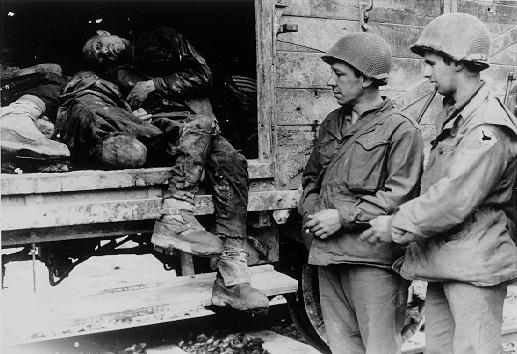
American soldiers view the bodies in one of the open railcars of the Dachau death train. USHMM

American soldiers view the bodies in one of the open railcars of the Dachau death train. USHMM

And so after some resistance, into the camp they entered. Life changing events were about to unfold for the American soldier.

***

For me, it’s not about hero worship, or glorifying the liberator or any World War II soldier by placing him on a pedestal. Our time with them is now limited, but many of the liberating soldiers I know push back at this, to the point of rejecting the term, “liberator”- “It all sounds so exalted, so glamorous” said one. But they will all accept the term, “eyewitness”.

Witnesses to the greatest crime in the history of the world.

So instead I think it is about honoring their experiences, their shock, the horror, the puking and the crying, the rage-and then, the American GIs recognizing that something had to be done. And they did suffer for it, for trying to do the right thing. Many tried to help by offering food to starving prisoners who just were not ready to handle it, only to see them drop dead. Or having to manhandle these emaciated victims who were tearing away at each other as food was being offered.

Some guys never got over it. How could you?

I have learned so much over the past few years from these guys, just through the way that they carried themselves and tried to cope with what they witnessed. In my World War II studies and Holocaust class, we discuss these issues at length. I’m so lucky to be able to teach it.

Last year, I was privileged to teach a lesson to my high school seniors for NBC Learn, which was shared with other districts across the nation. Later, I stumbled upon this piece by the late author Tony Hays, who writes about his liberator father and his own encounter with the past. Thanks to the Get It Write folks; the original link is at the bottom.

***

Dachau Will Always Be With Us

by Tony Hays

This is not so much a post about writing as one about a writer’s education, about one of those experiences that molds us, shapes us into storytellers. I read yesterday the story of Joseph Corbsie, whose father, a World War II veteran, left him with a special legacy from the war, from the hideous Nazi concentration camp at Dachau. I feel a particular kinship with Mr. Corbsie.

My father, Robert Hays, was the son of an alcoholic tenant farmer in rural west Tennessee. If the appellation “dirt poor” fit anyone, it fit my grandfather’s family. Daddy served in the Civilian Conservation Corps during the 30s. He and my mother, who was in the woman’s equivalent of the CCC, working as a nurse’s aide at Western State Mental Hospital in Bolivar, Tennessee, met on a blind date in early 1940 and married in September of that year.

But just over a year later, Pearl Harbor happened. America was in the war. My father was among the first of those drafted in 1942. I won’t bore you with the details, but he participated in the North African, Salerno, Anzio, and southern France invasions, saved by the luck of the draw from Normandy. But they slogged through France and on to Germany. On April 29, 1945, Allied troops liberated the Dachau concentration camp. I don’t know whether he entered Dachau that day or the next, but that he was there within hours of the liberation is beyond dispute. A few months later, after more than three years overseas, he came home.

In later years, he would talk occasionally about the war, providing anecdotes that showed the chaos and random chance of battle. He spoke of driving through Kasserine Pass in North Africa just hours before the Germans killed thousands of Allied troops in a stunning attack. He spoke of a friend, defending his position from a foxhole, who was thought dead after an artillery shell landed right next to him. When the dust cleared, the friend was buried up to his neck in dirt, but did not have a scratch on him. He spoke often of Anzio, where he was wounded, and of the massive German air assaults on those soldiers clinging to that tiny sliver of beach along the Italian coast.

But he never spoke of Dachau.

The bodies of former prisoners are piled in the crematorium mortuary in the newly liberated Dachau concentration camp. Dachau, Germany, April 29, 1945.

The bodies of former prisoners are piled in the crematorium mortuary in the newly liberated Dachau concentration camp. Dachau, Germany, April 29, 1945. USHMM.


Ever.

When he died in 1981, we found a photo in his wallet. An old sepia-toned shot like others he had taken during the war, pictures that he kept in an old brown bag. But this one was different.

It showed a pile of naked bodies. Well, really more skeletons than not, with their skin stretched pitifully over their bones. On the back, as had been his habit, was typed simply “Dachau.”

I was confused. Why would he keep this one photo in his wallet all of those years? Especially a photo of a place and event that he never spoke about. It obviously had some deeper meaning for him than the other photographs. If it had been a shot of the building he was in when he was wounded (hit by an artillery shell), I could have seen that. A reminder of his closest brush with death. Yeah, I could buy that. But this macabre photo? That, I couldn’t see.

So, for the next fifteen years, I remained puzzled.

Until the fall of 1996. I was working in Poland, and I had some time off. I took an overnight bus from Katowice, Poland to Munich. It was an interesting trip all in itself. We sat in a line of buses at midnight on the Polish/German border, waiting for our turn to cross, next to a cemetery, as if in some Cold War spy movie. I remember passing Nuremburg and thinking that my father had been there at the end of the war. And then there was Munich.

I spent a day or two wandering through the streets, drinking beer in the Marienplatz. I’m a historical novelist, so the short trip out to Dachau was a no-brainer. Of course it was as much my father’s connection with it as anything else that spurred the visit. But I’m not sure that I was completely aware of that at the time.

Dachau literally sits just on the outskirts of the Munich metropolitan area. I looked at the sign on the train station with a sadness, wondering for how many people that had been one of the last things they saw. It was only later that I discovered there had been another depot for those passengers.

The Dachau Memorial is a place of deep emotion. In the camp proper, mostly all that are left are the foundations of the barracks. One has been reconstructed to give an idea of how horrible life must have been. The camp was originally intended to hold 6,000 inmates; when the Allies liberated Dachau in 1945, they found 30,000. The museum and exhibits are primarily in the old maintenance building. I looked with awe at life size photos of prisoners machine gunned, their hands torn to ribbons from the barbed wire they had tried to climb in a futile attempt at escape.

I followed the visitors (I can’t call them tourists) north to where you crossed over into the crematorium area. It was there that the full brunt of what had taken place at Dachau really hit me. A simple brick complex, it seemed so peaceful on the fall day that I stood before it. But as I read the plaques and consulted my guidebook, as I stepped through the door and actually saw the “shower” rooms where the prisoners were gassed, as I stared into the open doors of the ovens, I felt a rage unlike any I had ever known consume me.
Covering my eyes, embarrassed at the tears, I slipped back outside. It took more than a few minutes to regain my composure. I thought then that I understood why my father kept that photo close to him for so long. It was a reminder of what one group of people had done to another group of fellow humans. The obscenity of it had overwhelmed him as it had me.

That night, I went to the famous Hofbrauhaus in Munich, to wash the images of the ovens away with some beer. I hadn’t been there long when an elderly American couple sat at the table. They were from Florida, a pleasant couple. He had been a young lieutenant in the American army on the push into Munich. In fact, it had been his pleasure to liberate the Hofbrauhaus from the Germans.

Of course, I asked the question. “Were you at Dachau?”

He didn’t answer for several seconds, tears glistening in the corners of his eyes as his wife’s hand covered his and squeezed. Finally, he nodded, reached into a back pocket and pulled out his wallet.

With a flick of his wrist, a photo, just as wrinkled, just as bent, as the one my father had carried landed on the table. It wasn’t the same scene, but one just like it.

Here was my chance, the opportunity to ask the question I had never been able to ask my father. I pulled the photo from my own wallet and lay it next to his. “Why? Why have you carried it so long? To remind you of the horror of Dachau, of what had been done here?”

His face carried the faintest of smiles as he shook his head. “No, son, to remind us of the horrors that we are capable of, to remind us not to go down that road again.”

The difference was subtle, but in that moment, I learned two lessons invaluable to a writer, subtle differences are important, and when you want to know the truth, go to the source.

As I sit here now and look at that same photograph, I realize that it was my father’s legacy to me, of Dachau. Joe Corbsie’s father left him something more tangible, a reminder of the same thing for the same reason, but more forcefully stated — a tiny box of human ash from the ovens.

Now, nearly 70 years after that day in 1945, Dachau is still with us, and I hope the legacy left by our fathers always will be.

The late Tony Hays.


Read Full Post »

A survivor writes to his fellow survivors today, on the anniversary of their liberation. An excerpt:

For the 13th of April 2016.
Hello again to all of you ‘my twins’ on our 71st birthday.
I hope my good wishes find all of you in good health, both physical and mental.
It is a blessing to be alive and being able to think back of that ‘special birthday’ of ours.
To think about those who fought to give back our lives, whom we call ‘our angels of life’.
Like the years before; there are no words enough to express our thanks for them.


[My new book on this will be out this July. You can put in a pre-order notice, above- GET THE BOOK HERE]

30th Infantry Division Veterans of World War II, Nashville Tennessee, April 2015, 70th anniversary of the end of WWII. Credit: Larry S Powell.

30th Infantry Division Veterans of World War II, Nashville Tennessee, April 2015, 70th anniversary of the end of WWII. Credit: Larry S Powell.

Here also is an anniversary poem.

The poet Yaakov Barzilai was on the ‘Train Near Magdeburg’. Originally composed in Hebrew, a  translation has been provided by fellow survivor Micha Tomkiewicz. He has agreed to share his poem on the 70th anniversary of the liberation. ’11:55′  refers to the author’s recollection of the time of the day of the liberation of the train transport; ‘five minutes before the bitter end’.

Dedicated to Frank Towers and 30th Infantry Division soldiers, US liberators of the death train from Bergen-Belsen on April 13, 1945


At Eleven fifty-five.

Return to the Place of Liberation, April 13, 1945                                                                                 

The train stopped under the hill, huffing and puffing, as though it reached the end of the road.

An old locomotive pulling deteriorating train cars that became obsolete long ago, not even fit for carrying horses.

To an approaching visitor, the experience was of a factory of awful smell – really stinking.

Two thousand four hundred stinking cattle heading for slaughter were shoved to the train cars.

The butterflies into the surrounding air were blinded by the poisonous stench.

The train moved for five days back and forth between Bergen-Belsen and nowhere.

On the sixth day, a new morning came to shine over our heads.

Suddenly the heavy car doors were opened.

Living and dead overflowed into the surrounding green meadow.

Was it a dream or a delayed awakening of God?

When we identified the symbols of the American army, we ran to the top of the hill as though bitten by an army of scorpions, to kiss the treads of the tanks and to hug the soldiers with overflowing love.

Somebody cried: “Don’t believe it, it is a dream”. When we pinched ourselves; we felt the pain – it was real.

Mama climbed to the top of the hill. She stood in the middle of the field of flowers and prayed an almost a silent prayer from the heart.

Only few words escaped to the blowing wind:

‘Soon…Now

From the chimneys of death, I gave new life, to my children….

And this day-my grandchildren were born,  to a good life.

Amen and Amen’.

-Yaakov Barzilai.

*

בְּאַחַת עֶשְׂרֵה חֲמִשִּׁים וְחָמֵשׁ 

שִׁיבָה לִמְקוֹם הַשִּׁחְרוּר בִּ 13 בְּאַפְּרִיל 1945

                     כַּעֲבֹר 65 שָׁנָה

הָרַכֶּבֶת עָצְרָה מִתַּחַת לַגִּבְעָה

נוֹשֶׁפֶת וְנוֹהֶמֶת

כְּמִי שֶׁהִגִּיעַ לְסוֹף דַּרְכּוֹ

קַטָּר זָקֵן גָּרַר קְרוֹנוֹת יְשָׁנִים

שֶׁאָבַד עֲלֵיהֶם כֶּלַח,

לֹא רְאוּיִים אֲפִלּוּ לִמְגוּרֵי סוּסִים.

מִי שֶׁהִזְדַּמֵּן לַסְּבִיבָה

הֶאֱמִין שֶׁנִּקְלַע לְבֵית חֲרֹשֶׁת לְסֵרָחוֹן

אַלְפַּיִם אַרְבַּע מֵאוֹת רָאשֵׁי בָּקָר מַסְרִיחִים

שֶׁנּוֹעֲדוּ לִשְׁחִיטָה

נִדְחְסוּ לַקְּרוֹנוֹת

כָּל הַפַּרְפַּרִים בַּסְּבִיבָה הִתְעַוְרוּ

מִסֵּרָחוֹן מַדְמִיעַ.

חֲמִשָּׁה יָמִים נָסְעָה הָרַכֶּבֶת הָלוֹךְ וַחֲזֹר

בֵּין בֶּרְגֶן-בֶּלְזֶן לְשׁוּם מָקוֹם

בַּיּוֹם הַשִּׁשִּׁי, בֹּקֶר חָדָשׁ זָרַח מֵעָלֵינוּ.

בְּבַת אַחַת נִפְתְחוּ הַדְּלָתוֹת הַכְּבֵדוֹת שֶׁל הַקְּרוֹנוֹת

חַיִּים וּמֵתִים נִשְׁפְּכוּ בְּיַחַד

אֶל הַיָּרֹק הַמִּשְׁתּוֹלֵל בַּשָּׂדוֹת.

הַאִם הָיָה זֶה חֲלוֹם

אוֹ הַצָּתָה מְאֻחֶרֶת שֶׁל אֱלֹהִים?

כְּשֶׁזִּהִינוּ אֶת סֵמֶל הַצָּבָא הַאָמֶרִיקָאִי,

כִּנְשׁוּכֵי עַקְרָב שָׁעֲטְנוּ בְּמַעֲלֵה הַגִּבְעָה

לְנַשֵּׁק אֶת שַׁרְשְׁרָאוֹת הַטַּנְקִים

וְלַחֲנֹק אֶת הַחַיָּלִים מֵרֹב אַהֲבָה.

מִישֶׁהוּ צָעַק: “אַל תַּאֲמִינוּ זֶה רַק חֲלוֹם”

וּכְשֶׁצָּבַטְנוּ אֶת עָצַמְנוּ

כָּאָב לָנוּ בֶּאֱמֶת.

גַּם אִמָּא טִפְּסָה אֶל גִּבְעַת הַנִּצָּחוֹן

הִיא עָמְדָה בְּתוֹךְ שָׂדֶה שֶׁל פְּרָחִים וְהִתְפַּלְּלָה

מִתּוֹךְ הַתְּפִלָּה הַחֲרִישִׁית שֶׁנֶּאֶמְרָה בַּלֵּב

רַק מִלִּים בּוֹדְדוֹת הִסְתַנְנוּ אֶל אֲוִיר הָעוֹלָם:

” וְכָאן… וְעַכְשָׁו… עַל פַּסֵי הָרַכֶּבֶת…

קָרוֹב… לַאֲרֻבּוֹת הַמָּוֶת…נָתַתִּי…

חַיִּים חֲדָשִׁים…לִילָדַי… וְהַיּוֹם הַזֶּה…

נוֹלְדוּ גַּם נְכָדַי… לְחַיִּים טוֹבִים…

אָמֵן… וְאָמֵן…                                                                     יעקב ברזילי

‘Yaakov Barzilai is an esteemed Israeli poet; he is also a survivor of The Shoah. Born in Hungary in 1933, the year Hitler came to power in Germany he shares, in poetry and prose, a child’s memories of the horrors that befell the Jewish people. He tells of acts of great humanity and others of exceptional, he recounts tales of transportation and eventual rescue. He speaks of losses – family, potential and describes the eventual triumph of man over inhumanity.’ [www.cduniverse.com/productinfo.asp?pid=8756081]

Read Full Post »

Helen Sperling passed away last week. She was an incredible woman, a Holocaust survivor whose mantra was “Thou shalt not be a bystander.”

I spoke at the annual Yom Hashoah lecture that she sponsored for her community in Utica a few years back. She lived about 100 miles away, so her friend Marsha drove her to Saratoga Springs, the halfway point for us, so that she could meet me and vet me for herself before committing to my lecture. I passed the test. later, my friends at the USHMM found some of her liberation documents for me, which I sent to her. I even found one of the US soldiers who liberated her, in the town near me.

The article and post below is from a couple years ago. I love the photo. Godspeed, Helen. Rest assured that all those whom you touched, will keep the memory alive.

******

Helen is a friend of mine. She was liberated in April 1945 by a division of American soldiers that included our high school secretary’s uncle.

At her invitation I traveled to central NY to speak 2 years ago.

She is still going strong. I love her! Her central message to students-“The world needs saving. So, get to it!”

BY RACHEL MURPHY
Rome Observer Staff Writer

Staff Photo by RACHEL MURPHY--Curtis Thompson, an eighth grader at Strough hugs Helen Sperling, a 93-year-old who survived the Holocaust. Sperling shared her story with the eighth grade class on Wednesday, after she finished every student hugged her.

ROME, NY. — Holocaust survivor Helen Sperling, 93, recounted the darkest moment of her life before a crowd of more than 300 eighth-graders at Lyndon H. Strough Middle School on Wednesday.

Sperling spoke for two hours about her time in the concentration camps.

Sperling was born to a middle class family where she lived in Poland.

During a school vacation when she was 22 years old, the Germans invaded her home and took her family into a ghetto.

“For the first time in my life, I was completely and utterly helpless,” she said.

During her time in the ghetto, Sperling remembered being able to contact a close friend to wish her a happy birthday. But when Sperling called her friend, who was a Gentile, the friend responded with a racial slur.

“You did not realize who was your friend and who was your enemy,” she said.

She explained that like many other Jewish families, hers was eventually taken from the ghetto and separated into prison camps. She was first placed into Ravensbrück, where she was forced to perform demeaning tasks the Nazi’s used as a way to break her spirit.

But despite the torture, hunger and fear, Sperling managed to survive, along with her younger brother.

“Ninety-nine percent of our survival was sheer luck,” she said. “A little tiny bit of it was hanging on to dignity. Once you lost that, you didn’t have a chance.”

Sperling’s parents did not survive.

Her family was among the 6 million other Jews that were sent to death camps and were killed by the Nazis.

Sperling placed two family photographs on a table nearby as she spoke to the students.

“These are mine, and I miss them terribly,” she said of her family members.

However, she continues to share her story to hopefully inspire and educate others.

“I want them to know that they can do something. I don’t want them to be bystanders,” she said.

Sperling added that even though it is difficult to retell it’s worth it.

“As long as I can do and as many schools as I can cover I want to,” she said.

Assistant Principal Michael Stalteri explained that he hopes the students learn from Sperling’s life and positive outlook.

“Her story resonates with what goes on in their lives when they’re being persecuted, picked on, harassed, bullied or made to feel different,” he said. “Hearing Mrs. Sperling’s story of triumph and her message is exhilarating.”

After Sperling finished her story each student hugged her, and she gave them an anti-bullying bracelet.

http://romeobserver.com/articles/2013/03/15/news/doc5140d89a9dd53321768186.txt?viewmode=fullstory

Read Full Post »

It was six years ago this evening, we shared a meal on the eve of Shabbat, after watching ourselves on a national broadcast that reached millions. Why does it seem, so long ago?

Maybe because it all seems so unbelievable- that out of the darkness of the past, on a day when the sun dawned clearly and was warming the Earth in its mid-April morning ascent, a low rumble was heard by  hushed and huddled groupings of tormented humanity as they strained to hope for friends amidst their lurking murderers. As the metallic clanking grew louder, over the horizon broke the earthly angels, two Sherman light tanks and an American Jeep with the emblem of the white star. A cry broke out. They realized they were saved, and the American major snapped a photograph at the exact moment the overjoyed survivors realized it.

And out of the past on a warm September day, we brought them all together again. Who would have believed that 62 years later, a high school in a quiet, rural part of the world would  bring the soldier-liberators and the rescued survivors together from the US, Canada, Israel and elsewhere? All because I couldn’t let go of a good narrative history, and pursued the story behind the photographs that proved it really happened?

And think about the risk you run, inviting hundreds of octogenarians to come to a high school for half a week to mingle with thousands of high school and middle schoolers? Talk about sweating bullets. What if they are uncomfortable? Cranky? Complaining? What if the kids I can’t control are rude? And what if one of these “old” folks, who I don’t even know, dies on our watch? I would lie awake at night wondering if I was out of my mind.

But the miracle came to be-for the two dozen or so elders who could come, tears flowed, wine spilled, and our “new grandparents” danced with young teenagers who adored them, but only after the risk was accepted, with the enthusiastic help of Mary Murray, Tara Winchell-Sano, and Lisa Hogan, Rene Roberge and others. Have a look at the videos, and feel the love. We created ripples, and tripped the wires of the cosmos, and the reverberations are still echoing. To date, with Varda Weisskopf’s and Frank Towers’ help, the list is at 275 survivors whom we have found. And how many generations has it effected?

This is the subject of my second book, due out this next summer. In the meantime, I am working on a shorter work of what I have learned in teaching the lessons of the Holocaust. So take a look at the videos, and remember the words of the liberator:

“Here we are! We have arrived!”

Read Full Post »

April 15th 1945                                                                                                                   Somewhere in Germany

You will probably be wondering who I am and what business I have, writing to you.- I am one of the millions of soldiers of the United States Army, who is fighting for all the oppressed peoples of the world and hopes to have reestablished decency and honor to all mankind, with the defeat of Hitlerism.

*****

My friend Varda in Israel sent me a copy of this letter she recently received from the widow of  Mr. Shmuel ‘Tommy’ Huppert of Israel. In it, an American soldier is taking the time to write to the husband of a Holocaust survivor to let him know that his wife and young son (Tommy) have been liberated, and that they have survived the horrors of the Holocaust and the carnage of ‘Hitlerism’.

Young Tommy and his mother, Mrs. Hilde Huppert,  were liberated at Farsleben on the transport from Bergen Belsen on April 13th, 1945. They managed to get to Palestine shortly after liberation, bringing with them many, many orphaned children, including my friend Lily Cohen.  Hilde’s manuscript, Hand in Hand with Tommy, was one of the first Holocaust memoirs completed after the war and a cathartic way for her to attempt to come to terms with what had happened.

It took years to be properly published, as it was originally rejected because it was ‘too soon after the war’. Later, at 93 years of age, Hilde was asked if there was anything specific she wished to convey to American readers of her book. She replied, ‘Tell them I will never forget those American GIs who liberated us from the Germans…I can still recall their amazed faces in that dusty jeep and the U.S. Army symbol. I remember kissing one of them, and I want the American people to know that I am grateful to them.’


READ ALL ABOUT IT IN MY BOOK HERE


One of the soldiers, on the Sunday following the Friday liberation, took the time to send this note on her behalf to her husband in Palestine. It now resides in the collection at Yad Vashem, Israel’s Holocaust Remembrance Authority.

4-15-45 Gartner to Huppert 1

April 15th 1945                                                                                                                      Somewhere in Germany

Dear Mr. Huppert,

You will probably be wondering who I am and what business I have, writing to you.- I am one of the millions of soldiers of the United States Army, who is fighting for all the oppressed peoples of the world and hopes to have reestablished decency and honor to all mankind, with the defeat of Hitlerism.

Two days ago, it was the priviledge (sic) of our unit, to be able to liberate a trainload full of people of all nations imaginable, who were being transferred from a concentration camp near Hannover, to some other place. Our advances were so swift, that the SS guards, left this particular train where it was and took off.

That is how I became acquainted with your wife, Mrs. Hilde Huppert, who asked me to drop you this note, saying, that both she and your son Tommy, are both healthy and well and now being well taken care of by our military governmental authorities. In actual fact, your wife wrote a message for you on a piece of paper in pencil, which she asked me to convey to you. Unfortunately, however, the penciled lines faded in my pocket, and I can no longer read what was written on it. The contents of the message, though, was to let you know that your wife and son are both safe and sound.

I am sure that your wife will soon be able to get into contact with you directly through the Red Cross, and I hope that in a none too distant future, your family will once more be peacefully united.

Sincerely yours,

Cpl. Frank Gartner

Fluent in many languages, Gartner was the translator for the 743rd Tank Battalion’s commander, Col. Duncan. He was originally from Estonia, and resided in Los Angeles, California.

BOOK HERE

If anyone knows more about Frank Gartner, please contact me at matthew @ teachinghistorymatters.com.. 

Transcribed by Alanna Belanger’15 and Alexis Winney ’15.

Read Full Post »

At my keynote talk in Rochester, NY, two weeks ago, several people came up to me after the ceremony and greeted me warmly. One man came with an envelope and shook my hand, explaining that his father had been an American medic. In the envelope were photographs and Vincent’s handwritten letter describing a talk that he had had with his dad a couple years before he passed. I have finally gotten around to transcribing it; it comes on the 70th anniversary of his father’s traumatic shock at a subcamp of Dachau where Jewish slave laborers were being worked to death mining out mountains so the Reich could shelter its fledgling jet industries from Allied bombing. Many of the prisoners were dying of typhus. Below you will find the letter and two of his photos.

Vincent F. Butler, Sr.

Vincent F. Butler, Sr.

4/15/2015

Dear Matt,

These are copies made from the original pictures taken by my father, Vincent F. Butler, Sr., at the concentration camp in Landsberg, Germany toward the end of World War II. He did not date the pictures, but I have included a copy in his handwriting of the location. My father was a medic in the XXI Medical Corps when his unit liberated this camp.

My father never really talked about the war except for a funny story once in a while. About 2 years before he died he first showed me these pictures. He described the encounter as “the worst thing I had ever seen”. That says a lot considering he was a frontline medic in Europe. He also said that he “could not understand how someone could do something so horrible against other human beings.” He uttered “Why…Why…Why…” several times during our talk. He gave me these pictures with the directive: “Never let anyone say that this did not happen. It did – I saw it.”

Landsberg Area, Germany. A subcamp of Dachau.

Landsberg Area, Germany. A subcamp of Dachau.

That was one of the few actual directives that my father ever gave me, and I must say, it was his most serious. Looking back, and finally knowing what he had been through, I am sure that this had the biggest impact and was the most traumatic effect on him.

He did talk about how they tried to save as many people as they could. He said they had to very slowly give people food because large amounts would shut their system down. He said he was not aware of these camps until they came upon this one.

Thank you for telling the story so that the Holocaust is never repeated. I think that my father’s pictures and his recollection through me may help in some small way.

Vincent Butler, Jr.


http://www.ushmm.org/wlc/en/article.php?ModuleId=10006171

*************************************************************

Matthew Rozell is a United States Holocaust Memorial Museum Teacher Fellow and teaches history at his alma mater in upstate New York. His work has resulted in the reuniting of 275 Holocaust survivors and the American soldiers who freed them.

His first book, ‘The Things Our Fathers Saw’, is being released to coincide with the 70th anniversary of the end of World War II. His second book, in progress, is on the power of  teaching, remembering the Holocaust, the Benjamin photograph and the liberation of the “Train Near Magdeburg’. He can be reached at marozell at gmail dot com.

Read Full Post »

April 30 1945 Headlines. Hangs in my classroom.

April 30 1945 Headlines. Hangs in my classroom.

Today, April 29th, is the anniversary of the liberation of Dachau, 70 years on.

Today, if it is brought up at all, some of us might respond with a vacant stare. More might shrug and turn away. I suppose that is to be expected. But you know me. I just think that as a nation, sometimes we allow things to slip from memory at our peril.

It was real, and it happened. And it was American GIs who overran this camp and many others in the closing days of World War II.

The men of the 42nd and 45th Infantry Division arrived independently of each other, here, in southern Germany, at Dachau, on this day. A concentration camp, they were told. Their noses gave them a hint of what they were about to uncover, miles before the camp appeared in sight.

Read the headlines, above. Note the subarticle:

Boxcars of Dead at Dachau. 32,000 captives freed.

American soldiers view the bodies in one of the open railcars of the Dachau death train. USHMM

American soldiers view the bodies in one of the open railcars of the Dachau death train. USHMM

And so after some resistance, into the camp they entered. Life changing events were about to unfold for the American soldier.

***

For me, it’s not about hero worship, or glorifying the liberator or any World War II soldier as some kind of savior. Many of the liberating soldiers I know would resist this, to the point of rejecting the term, “liberator”… “It all sounds so exalted, so glamorous” said one. But they will all accept the term, “eyewitness”.

Witnesses to the greatest crime in the history of the world.

So instead I think it is about honoring their experiences, their shock, the horror, the puking and the crying, the rage-and then, the American GIs recognizing that something had to be done. And they did suffer for it, for trying to do the right thing. Many tried to help by offering food to starving prisoners who just were not ready to handle it, only to see them drop dead. Or having to manhandle these emaciated victims who were tearing away at each other as food was being offered.

Some guys never got over it. How could you?

I have learned so much over the past few years from these guys, just through the way that they carried themselves and tried to cope with what they witnessed. In my World War II studies and Holocaust class, we discuss these issues at length. I’m so lucky to be able to teach it.

Last year, I was privileged to teach a lesson to my high school seniors for NBC Learn, which was shared with other districts across the nation. This year, I stumbled upon this piece by the late author Tony Hays, who writes about his liberator father and his own encounter with the past. Thanks to the Get It Write folks; the original link is at the bottom.

***

Dachau Will Always Be With Us

by Tony Hays

This is not so much a post about writing as one about a writer’s education, about one of those experiences that molds us, shapes us into storytellers. I read yesterday the story of Joseph Corbsie, whose father, a World War II veteran, left him with a special legacy from the war, from the hideous Nazi concentration camp at Dachau. I feel a particular kinship with Mr. Corbsie.

My father, Robert Hays, was the son of an alcoholic tenant farmer in rural west Tennessee. If the appellation “dirt poor” fit anyone, it fit my grandfather’s family. Daddy served in the Civilian Conservation Corps during the 30s. He and my mother, who was in the woman’s equivalent of the CCC, working as a nurse’s aide at Western State Mental Hospital in Bolivar, Tennessee, met on a blind date in early 1940 and married in September of that year.

But just over a year later, Pearl Harbor happened. America was in the war. My father was among the first of those drafted in 1942. I won’t bore you with the details, but he participated in the North African, Salerno, Anzio, and southern France invasions, saved by the luck of the draw from Normandy. But they slogged through France and on to Germany. On April 29, 1945, Allied troops liberated the Dachau concentration camp. I don’t know whether he entered Dachau that day or the next, but that he was there within hours of the liberation is beyond dispute. A few months later, after more than three years overseas, he came home.

In later years, he would talk occasionally about the war, providing anecdotes that showed the chaos and random chance of battle. He spoke of driving through Kasserine Pass in North Africa just hours before the Germans killed thousands of Allied troops in a stunning attack. He spoke of a friend, defending his position from a foxhole, who was thought dead after an artillery shell landed right next to him. When the dust cleared, the friend was buried up to his neck in dirt, but did not have a scratch on him. He spoke often of Anzio, where he was wounded, and of the massive German air assaults on those soldiers clinging to that tiny sliver of beach along the Italian coast.

But he never spoke of Dachau.

The bodies of former prisoners are piled in the crematorium mortuary in the newly liberated Dachau concentration camp. Dachau, Germany, April 29, 1945.

The bodies of former prisoners are piled in the crematorium mortuary in the newly liberated Dachau concentration camp. Dachau, Germany, April 29, 1945. USHMM.


Ever.

When he died in 1981, we found a photo in his wallet. An old sepia-toned shot like others he had taken during the war, pictures that he kept in an old brown bag. But this one was different.

It showed a pile of naked bodies. Well, really more skeletons than not, with their skin stretched pitifully over their bones. On the back, as had been his habit, was typed simply “Dachau.”

I was confused. Why would he keep this one photo in his wallet all of those years? Especially a photo of a place and event that he never spoke about. It obviously had some deeper meaning for him than the other photographs. If it had been a shot of the building he was in when he was wounded (hit by an artillery shell), I could have seen that. A reminder of his closest brush with death. Yeah, I could buy that. But this macabre photo? That, I couldn’t see.

So, for the next fifteen years, I remained puzzled.

Until the fall of 1996. I was working in Poland, and I had some time off. I took an overnight bus from Katowice, Poland to Munich. It was an interesting trip all in itself. We sat in a line of buses at midnight on the Polish/German border, waiting for our turn to cross, next to a cemetery, as if in some Cold War spy movie. I remember passing Nuremburg and thinking that my father had been there at the end of the war. And then there was Munich.

I spent a day or two wandering through the streets, drinking beer in the Marienplatz. I’m a historical novelist, so the short trip out to Dachau was a no-brainer. Of course it was as much my father’s connection with it as anything else that spurred the visit. But I’m not sure that I was completely aware of that at the time.

Dachau literally sits just on the outskirts of the Munich metropolitan area. I looked at the sign on the train station with a sadness, wondering for how many people that had been one of the last things they saw. It was only later that I discovered there had been another depot for those passengers.

The Dachau Memorial is a place of deep emotion. In the camp proper, mostly all that are left are the foundations of the barracks. One has been reconstructed to give an idea of how horrible life must have been. The camp was originally intended to hold 6,000 inmates; when the Allies liberated Dachau in 1945, they found 30,000. The museum and exhibits are primarily in the old maintenance building. I looked with awe at life size photos of prisoners machine gunned, their hands torn to ribbons from the barbed wire they had tried to climb in a futile attempt at escape.

I followed the visitors (I can’t call them tourists) north to where you crossed over into the crematorium area. It was there that the full brunt of what had taken place at Dachau really hit me. A simple brick complex, it seemed so peaceful on the fall day that I stood before it. But as I read the plaques and consulted my guidebook, as I stepped through the door and actually saw the “shower” rooms where the prisoners were gassed, as I stared into the open doors of the ovens, I felt a rage unlike any I had ever known consume me.
Covering my eyes, embarrassed at the tears, I slipped back outside. It took more than a few minutes to regain my composure. I thought then that I understood why my father kept that photo close to him for so long. It was a reminder of what one group of people had done to another group of fellow humans. The obscenity of it had overwhelmed him as it had me.

That night, I went to the famous Hofbrauhaus in Munich, to wash the images of the ovens away with some beer. I hadn’t been there long when an elderly American couple sat at the table. They were from Florida, a pleasant couple. He had been a young lieutenant in the American army on the push into Munich. In fact, it had been his pleasure to liberate the Hofbrauhaus from the Germans.

Of course, I asked the question. “Were you at Dachau?”

He didn’t answer for several seconds, tears glistening in the corners of his eyes as his wife’s hand covered his and squeezed. Finally, he nodded, reached into a back pocket and pulled out his wallet.

With a flick of his wrist, a photo, just as wrinkled, just as bent, as the one my father had carried landed on the table. It wasn’t the same scene, but one just like it.

Here was my chance, the opportunity to ask the question I had never been able to ask my father. I pulled the photo from my own wallet and lay it next to his. “Why? Why have you carried it so long? To remind you of the horror of Dachau, of what had been done here?”

His face carried the faintest of smiles as he shook his head. “No, son, to remind us of the horrors that we are capable of, to remind us not to go down that road again.”

The difference was subtle, but in that moment, I learned two lessons invaluable to a writer, subtle differences are important, and when you want to know the truth, go to the source.

As I sit here now and look at that same photograph, I realize that it was my father’s legacy to me, of Dachau. Joe Corbsie’s father left him something more tangible, a reminder of the same thing for the same reason, but more forcefully stated — a tiny box of human ash from the ovens.

Now, nearly 70 years after that day in 1945, Dachau is still with us, and I hope the legacy left by our fathers always will be.


Read Full Post »

« Newer Posts - Older Posts »