Feeds:
Posts
Comments

Posts Tagged ‘American soldiers’


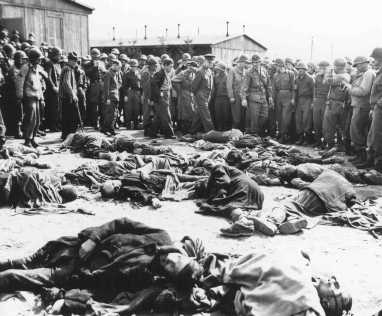
General Dwight D. Eisenhower (center), Supreme Allied Commander, views the corpses of inmates who perished at the Ohrdruf camp. Ohrdruf, Germany, April 12, 1945. — National Archives and Records Administration, College Park, Md. USHMM

We are told the American soldier does not know what he is fighting for. Now, at least he knows what he is fighting against.

— General Dwight D. Eisenhower, on visiting a subcamp of Buchenwald, April 12, 1945

April 4, 1945: The U.S. 4th Armored Division liberates the concentration camp at Ohrdruf, Germany, a subcamp of Buchenwald, the site of more than 4000 deaths during the previous three months. Victims were Jews, Poles, and Soviet POWs. Hundreds shot just before liberation had been working to build an enormous underground radio and telephone communications center. Very few inmates remain alive at liberation.

April, 1945: U.S. Generals Dwight Eisenhower, George Patton, and Omar Bradley visit the camp at Ohrdruf, Germany, and view corpses and other evidence of Nazi atrocities.

In late March 1945, the camp had a prisoner population of some 11,700, but in early April the SS evacuated almost all the prisoners on death marches to Buchenwald. The SS guards killed many of the remaining prisoners who were too ill to walk to the railcars.

When the soldiers of the 4th Armored Division entered the camp, they discovered piles of bodies, some covered with lime, and others partially incinerated on pyres. The ghastly nature of their discovery led General Dwight D. Eisenhower, Supreme Commander of the Allied Forces in Europe, to visit the camp on April 12, with Generals George S. Patton and Omar Bradley. After his visit, Eisenhower cabled General George C. Marshall, the head of the Joint Chiefs of Staff in Washington, describing his trip to Ohrdruf:

. . .the most interesting–although horrible–sight that I encountered during the trip was a visit to a German internment camp near Gotha. The things I saw beggar description. While I was touring the camp I encountered three men who had been inmates and by one ruse or another had made their escape. I interviewed them through an interpreter. The visual evidence and the verbal testimony of starvation, cruelty and bestiality were so overpowering as to leave me a bit sick. In one room, where they were piled up twenty or thirty naked men, killed by starvation, George Patton would not even enter. He said that he would get sick if he did so. I made the visit deliberately, in order to be in a position to give first-hand evidence of these things if ever, in the future, there develops a tendency to charge these allegations merely to “propaganda.”


Seeing the Nazi crimes committed at Ohrdruf made a powerful impact on Eisenhower, and he wanted the world to know what happened in the concentration camps. On April 19, 1945, he again cabled Marshall with a request to bring members of Congress and journalists to the newly liberated camps so that they could bring the horrible truth about Nazi atrocities to the American public. He wrote:

We continue to uncover German concentration camps for political prisoners in which conditions of indescribable horror prevail. I have visited one of these myself and I assure you that whatever has been printed on them to date has been understatement. If you could see any advantage in asking about a dozen leaders of Congress and a dozen prominent editors to make a short visit to this theater in a couple of C-54’s, I will arrange to have them conducted to one of these places where the evidence of bestiality and cruelty is so overpowering as to leave no doubt in their minds about the normal practices of the Germans in these camps. I am hopeful that some British individuals in similar categories will visit the northern area to witness similar evidence of atrocity.

That same day, Marshall received permission from the Secretary of War, Henry Lewis Stimson, and President Harry S. Truman for these delegations to visit the liberated camps.

Ohrdruf made a powerful impression on General George S. Patton as well. He described it as “one of the most appalling sights that I have ever seen.” He recounted in his diary that

In a shed . . . was a pile of about 40 completely naked human bodies in the last stages of emaciation. These bodies were lightly sprinkled with lime, not for the purposes of destroying them, but for the purpose of removing the stench.

When the shed was full–I presume its capacity to be about 200, the bodies were taken to a pit a mile from the camp where they were buried. The inmates claimed that 3,000 men, who had been either shot in the head or who had died of starvation, had been so buried since the 1st of January.

When we began to approach with our troops, the Germans thought it expedient to remove the evidence of their crime. Therefore, they had some of the slaves exhume the bodies and place them on a mammoth griddle composed of 60-centimeter railway tracks laid on brick foundations. They poured pitch on the bodies and then built a fire of pinewood and coal under them. They were not very successful in their operations because there was a pile of human bones, skulls, charred torsos on or under the griddle which must have accounted for many hundreds.

Source(s):

Weber, Louis. The Holocaust Chronicle. Publications International Ltd., 2007. http://www.holocaustchronicle.org

The United States Holocaust Memorial Museum, 1945- The Year of Liberation. 1995.

http://www.ushmm.org/wlc/en/media_ph.php?ModuleId=10006131&MediaId=3711

http://www.ushmm.org/wlc/en/article.php?ModuleId=10006131

*************************************************************

Matthew Rozell is a United States Holocaust Memorial Museum Teacher Fellow and teaches history at his alma mater in upstate New York. This year, he is authoring a series of posts under the heading of ‘Seventy Years’, marking the 70th anniversary of the close of World War II and of the ‘liberation phase’  of the Holocaust. His work has reunited 275 Holocaust survivors with the American soldiers who freed them.

His first book, a narrative of World War II in the Pacific as told through the previously unpublished recollections of two dozen veterans, is due out this spring. His second book, in progress, is on the power of  teaching, remembering the Holocaust, and this “Train Near Magdeburg’. He can be reached at marozell at gmail dot com.

Read Full Post »

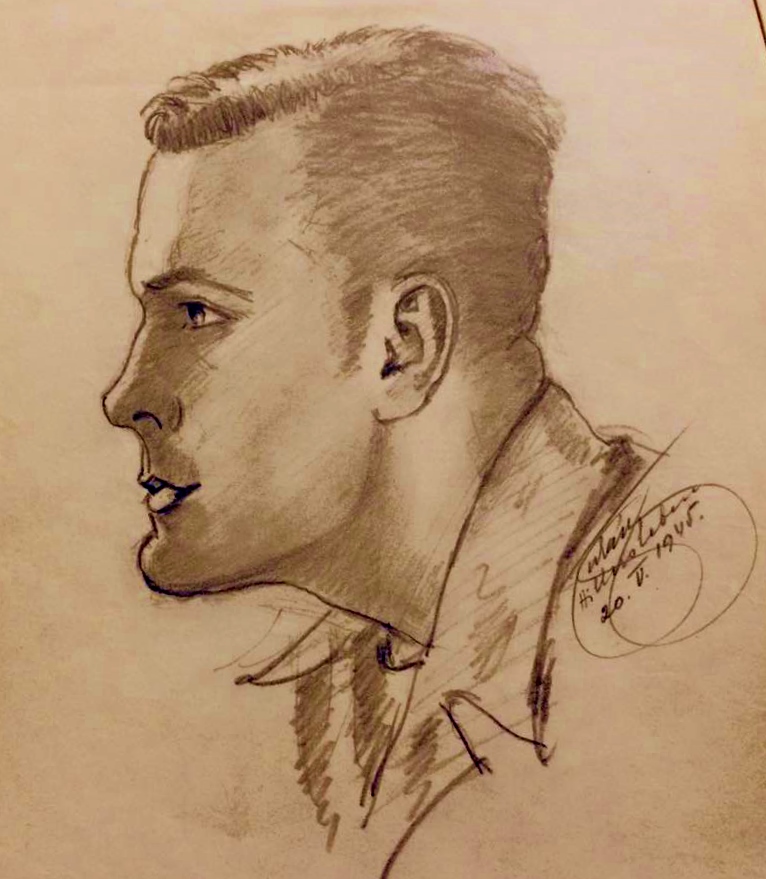
The cosmos trips once more. This month, shortly after my previous post about the discovery of previously unknown artwork by Hungarian Holocaust survivor Ervin Abadi, I was contacted by the family of another American soldier who was at Hillersleben camp as the survivors of the train were being nursed back to health by the medics of the 95th Medical Gas Battalion. They sent me most of the drawings below [Monroe Williams credit, courtesy the Williams family], published here for the first time.

Abadi’s recently discovered artwork matches that of his previously known work, some of which is housed in the archives of the United States Holocaust Memorial Museum.

Ervin Abadi, Typhus. USHMM Collection. Probably completed at Hillersleben DP Camp, May, 1945.

Ervin Abadi, Typhus. USHMM Collection. Probably completed at Hillersleben DP Camp, May, 1945.

(If you suspect that you have any of Abadi’s art in your family, or if anyone remembers his time at Hillersleben or Bergen Belsen, please drop me a line at the bottom.)


He was driven to express his gratitude for the American soldiers who freed him from the train, brought him to the hospital at Hillersleben, nursed him back to health and protected him in his stay at the displaced persons camp. These important drawings are proof of that, and confirm his dedication to feverishly recording everything that he could about those days. He drew his surroundings, his memories of the horrors of Bergen Belsen, and the beautiful young American soldiers around him, and even their precious photos of loved ones in their wallets!

In his words:

“Let these drawings serve as proof of my everlasting gratitude towards those to whom I owe my life. … To the soldiers of the United States Army, particularly to our immediate liberators, those soldiers of the 9th regiment who first entered the village of Zilitz and gave us bread, milk, chocolate, and cigarettes….”

American soldier at Hillersleben, 'Man'.  Ervin Abadi. Completed at Hillersleben DP camp, May, 1945. Soldier Monroe Williams collection.

American soldier at Hillersleben, ‘Man’. Ervin Abadi. Completed at Hillersleben DP camp, May, 1945. Soldier Monroe Williams collection.

American soldier-medic at Hillersleben.  Ervin Abadi. Completed at Hillersleben DP camp, May, 1945. Soldier Monroe Williams collection.

American soldier-medic at Hillersleben. Ervin Abadi. Completed at Hillersleben DP camp, May, 1945. Soldier Monroe Williams collection.

A kapo inflicts a beating at Bergen-Belsen. Ervin Abadi. Completed at Hillersleben DP camp, May, 1945. Soldier Monroe Williams collection.

A kapo inflicts a beating at Bergen-Belsen. Ervin Abadi. Completed at Hillersleben DP camp, May, 1945. Soldier Monroe Williams collection.

The American hospital at Hillersleben. Ervin Abadi. Completed at Hillersleben DP camp, May, 1945. Soldier Monroe Williams collection.

The American hospital at Hillersleben. Ervin Abadi. Completed at Hillersleben DP camp, May, 1945. Soldier Monroe Williams collection.

Soldier Monroe Williams' parents. Probably sketched from wallet photo.  Ervin Abadi. Completed at Hillersleben DP camp, May, 1945. Soldier Monroe Williams collection.

Soldier Monroe Williams’ parents. Probably sketched from wallet photo. Ervin Abadi. Completed at Hillersleben DP camp, May, 1945. Soldier Monroe Williams collection.

Ervin Abadi. Completed at Hillersleben DP camp, May, 1945. Soldier Monroe Williams collection.

Ervin Abadi. Completed at Hillersleben DP camp, May, 1945. Soldier Monroe Williams collection.

The 'casino' at Hillersleben. Ervin Abadi. Completed at Hillersleben DP camp, May, 1945. Soldier Monroe Williams collection. Note Red Cross tents in foreground. May have served as temporary morgue station.

The ‘casino’ at Hillersleben. Ervin Abadi. Completed at Hillersleben DP camp, May, 1945. Soldier Monroe Williams collection. Note Red Cross tents in foreground. May have served as temporary morgue station.

Former hospital at Hillersleben today. (Christian Wolpers photo.)

Former hospital at Hillersleben today. (Christian Wolpers photo.)

'Hillersleben-some disorderly DPs getting a shower bath (DDT?)' Soldier Luca Furnari photograph.

‘Hillersleben-some disorderly DPs getting a shower bath (DDT?)’ Soldier Luca Furnari photograph.

*****

Former American medic Walter Gantz called me out of the blue 3 years ago. Like all of the soldiers now reappearing in Abadi’s drawings, he was there. A couple newspaper articles appeared about Walter’s experience at  Hillersleben shortly thereafter. I put survivors in touch with him:

By the fall of 1944, the 95th [Medical Gas]Battalion was stationed at the Belgian-German border.

That winter, Mr. Gantz helped treat the wounded at the Battle of the Bulge in the Ardennes region, and by the spring of ’45 his unit had made its way into Germany.

In mid-April, they were in the town of Hillersleben setting up a displaced persons hospital when the Allies came across a train that had come from the Nazi concentration camp Bergen-Belsen, where over 35,000 people, the vast majority of them Eastern European Jews, had died of typhus during the first few months of that year.

All told, there were roughly 2,400 emotionally damaged, disease-ridden and terribly malnourished people aboard the train. “Walking skeletons” was an apt description, according to Mr. Gantz.

“We weren’t knowledgeable about these (concentration camps) at the time,” said Mr. Gantz, who visited Bergen-Belsen days after it was liberated. There, he saw countless dead bodies “strewn everywhere.”

“It was hard to explain,” he said. “I cried. And then I prayed for these people. Not only were you angry about what happened, but you felt so helpless.”

Mr. Gantz’s unit spent about six weeks treating the survivors. A good 70 or 80 of them died, mostly of typhus. Among the biggest challenges was acquiring enough food supplies to feed them all. Many could only take their nourishment intravenously.

“A lot of them, if you were to give them food, they would gorge themselves and kill themselves. You had to be very careful as to what they ate,” he said. “Boy, oh boy, they would scream. Those screams would go right through your body.”

“Hillersleben was a living nightmare,” he added. “You don’t shake these horrible scenes from one’s mind.” {see more https://teachinghistorymatters.com/2011/11/04/my-parents-couldnt-understand-why-i-couldnt-sleep-at-times/}

***

Blessed – or maybe cursed – with a terrific memory, he can vividly recall the screams and overall sense of dread permeating the hospital, where he and his fellow medics wore a daily uniform of surgical masks, gloves and rubber aprons.

He remembers scooping handfuls of lice out of patients’ hair and administering countless needles and the time he had to carry the body of a little girl to a tent serving as a makeshift morgue.

“I still get flashbacks to that,” he said.

Many died, mostly of typhus. Among the biggest challenges was acquiring enough food to feed them all, since a good portion of them could only take their nourishment intravenously. One of the survivors Mr. Gantz has spoken with, Lexie Keston, now a resident of Australia, told him she weighed just 30 pounds at the time of the rescue. She was 8 years old.

As a result of Mr. Rozell’s [work], a handful of Bergen-Belsen survivors have been in touch with Mr. Gantz, including Ariela Rojek, a Toronto resident who was 11-1/2 years old at the time of the rescue.

Mrs. Rojek, a Pole who lost all but an aunt during the Holocaust, was among those suffering from typhus. She spent three weeks in semi-consciousness, and remembers having to be tied to the bed by medics trying to restrain her. Mr. Gantz could have been one of them, she said.

“Those soldiers, they gave me my life. Because I was very sick,” she said.

“It was tough. Some of our guys couldn’t take it,” Mr. Gantz said. “I have to admit, I did a lot of crying. I tried not to do it around the patients.”

Now, though, he has the peace of mind of knowing firsthand that, despite all the horrors, life did go on for the survivors of Bergen-Belsen, just as it did for him and his fellow veterans. Asked once by a friend what he took from his wartime experience, Mr. Gantz thought for a moment, then replied, “It made me stronger spiritually.”

“I’ve been blessed,” he said. “I thank the good Lord every day.”

“He’s one of the angels,” Mrs. Rojek said of Mr. Gantz. “I’m really grateful. Whenever I get a name and phone number, I always call them. They gave me a second life.”

Mr. Gantz, 87, said the whole experience has made him feel “10 feet tall.”

“I have to use the word mind-boggling. I guess you’d have to put it in the category of a dream,” he said. “I have to be honest with you, it’s embarrassing. All they keep saying is, ‘Thank you, thank you, thank you.’”

{see more https://teachinghistorymatters.com/2012/03/04/it-was-tough-some-of-our-guys-couldnt-take-it/}

********

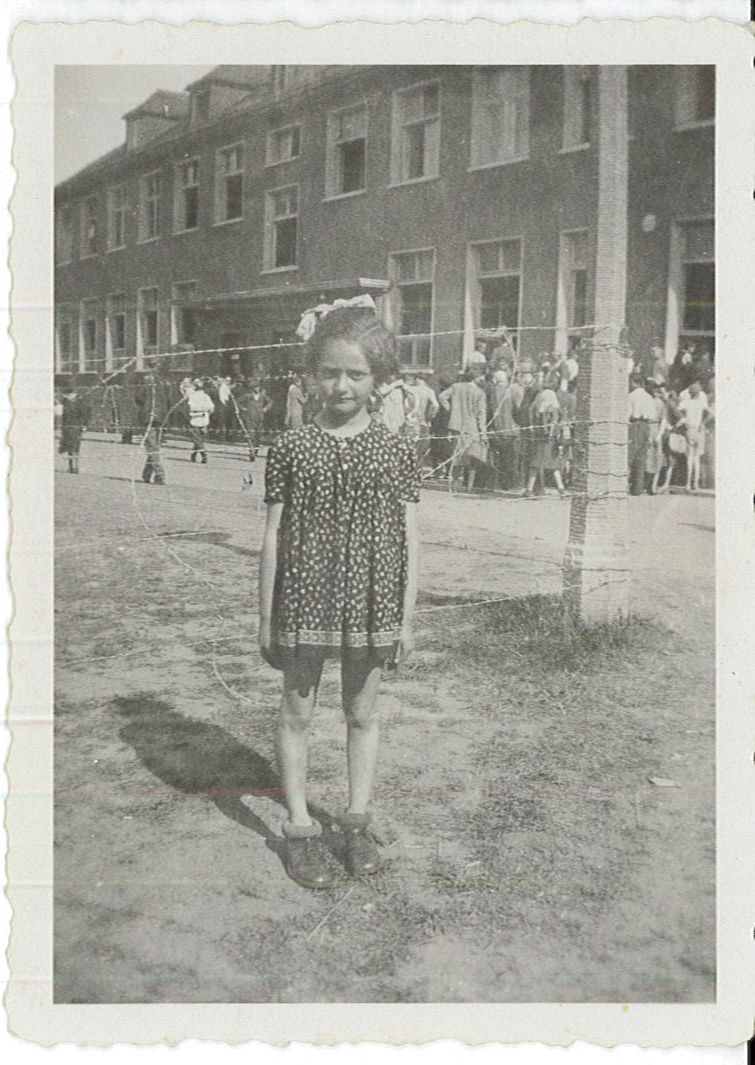
FINAL NOTE. We are also looking for this little girl, a survivor at Hillersleben. Her name was Irene. You can read the backstory here. Please contact me below.

'Hillersleben-Irene is in the flowered dress' Soldier Luca Furnari photograph.

‘Hillersleben-Irene is in the flowered dress’ Soldier Luca Furnari photograph.


*************************************************************

Matthew Rozell is a United States Holocaust Memorial Museum Teacher Fellow and teaches history at his alma mater in upstate New York. This year, he is authoring a series of posts under the heading of ‘Seventy Years’, marking the 70th anniversary of the close of World War II and of the ‘liberation phase’  of the Holocaust. His work has reunited 275 Holocaust survivors with the American soldiers who freed them.

His first book, a narrative of World War II in the Pacific as told through the previously unpublished recollections of two dozen veterans, is due out this spring. His second book, in progress, is on the power of  teaching, remembering the Holocaust, and this “Train Near Magdeburg’. He can be reached at marozell at gmail dot com.

Read Full Post »

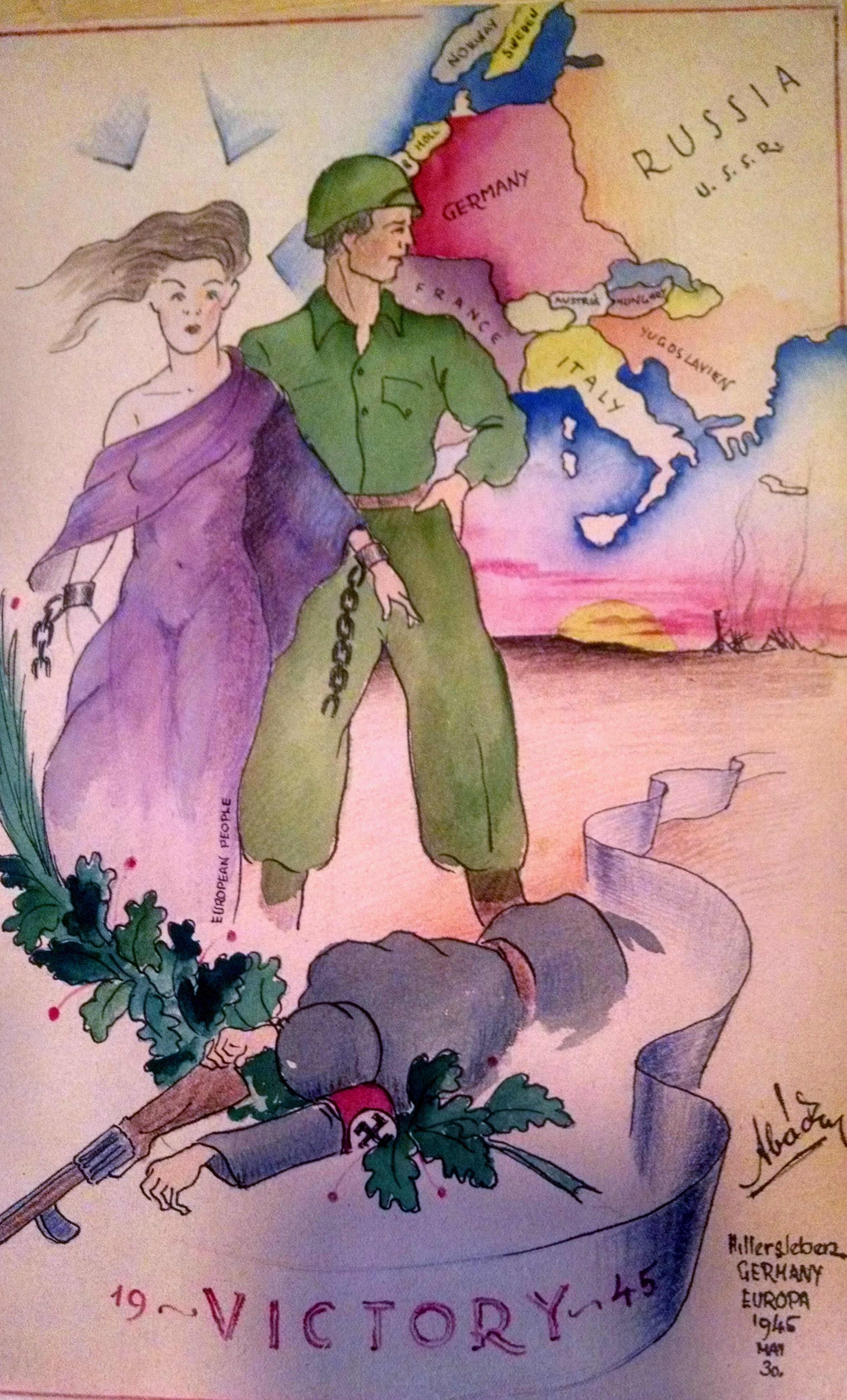
Victory, 1945. By Ervin Abadi. Hilersleben, Germany, May 1945.

Victory, 1945. By Ervin Abadi. Hillersleben, Germany, May 1945. Courtesy Chriss Brown, granddaughter of American soldier Don Rust.

The wires of the cosmos trip once more.

After almost exactly 70 years, a person came to this site on Jan. 30th with an inquiry:

I recently came across this site looking for a gentleman my grandfather became close to. My grandfather, Donald W. Rust of the 95th Medical Gas Treatment Battalion, helped him … and often spent time with him. The gentleman drew several pictures for my grandfather and I still have them today.

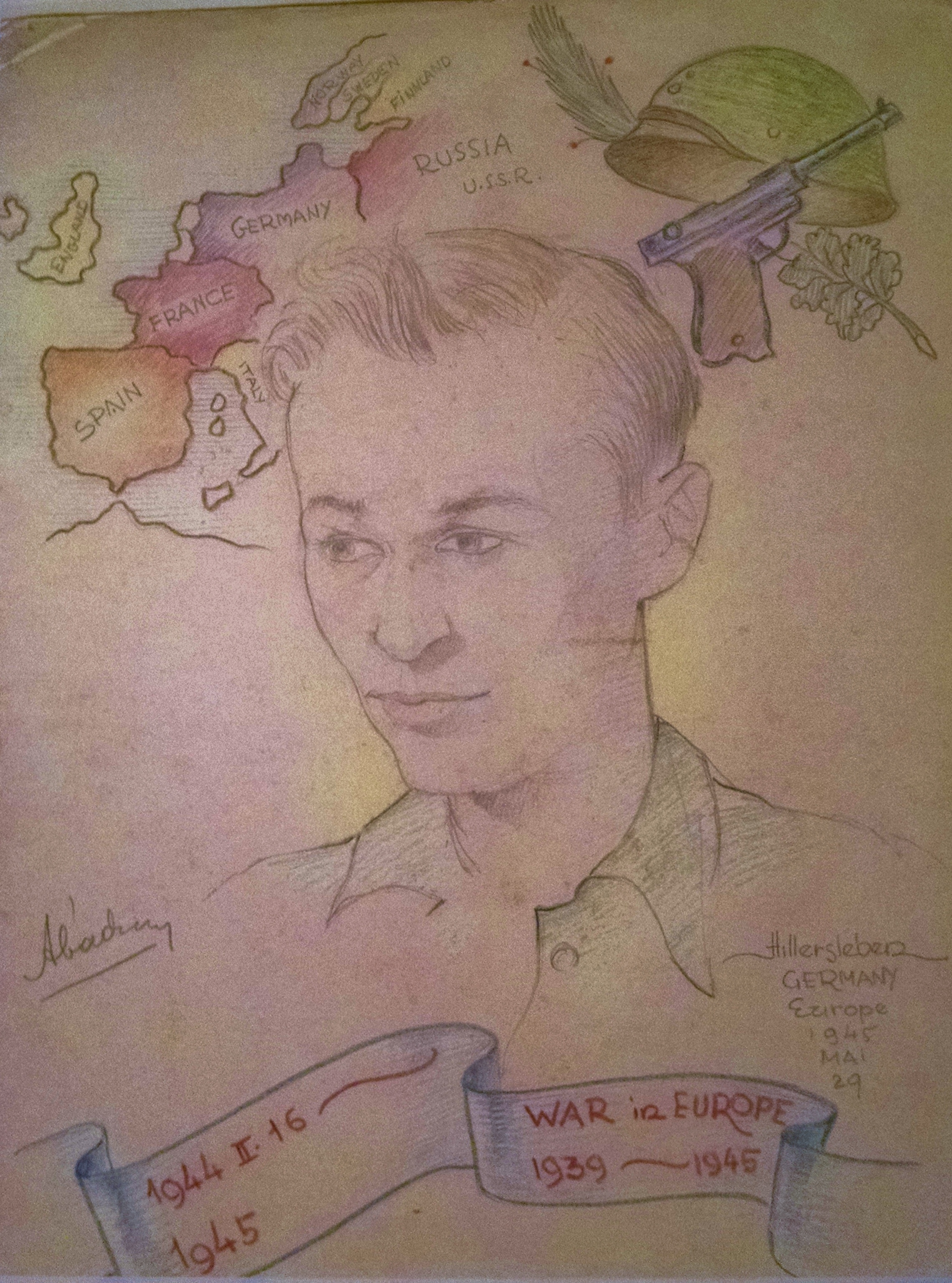
Donald W Rust of Kansas City KS. Hillersleben DP Camp, May 1945. Source: Chriss Brown, granddaughter of Don Rust.

Donald W Rust of Kansas City KS. Hillersleben DP Camp, May 1945. By Ervin Abadi. Source: Chriss Brown, granddaughter of Don Rust.

We looked while my grandfather was still alive but were unable to find any lists of the survivors until now. We cannot read his name clearly but we think the drawer’s name is ‘Albadi’ or something close to it. I would love to share the pictures he drew and also would like to hear if anyone can help me contact the survivor’s family. My grandmother turns 90 in March and it would mean the world to her to know what become of him.

My grandfather told us the gentleman was from Poland, but we don’t know what city. Unfortunately, my grandfather could not remember his name. If anyone can help, it would be much appreciated.  ~Chriss B.

***

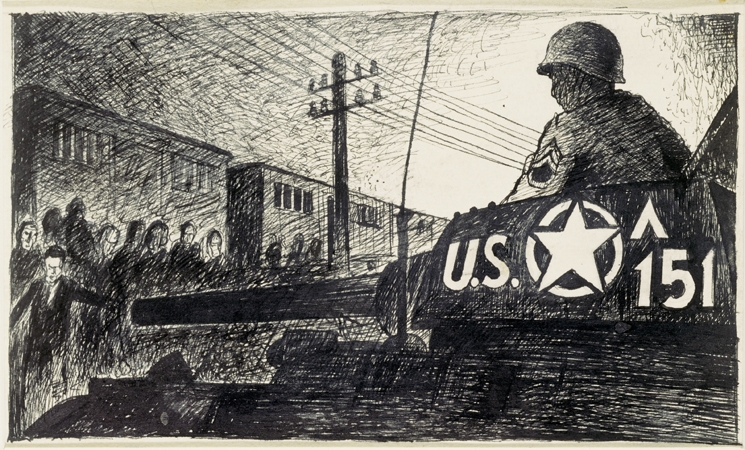
I immediately knew who she was talking about (though he hailed from Hungary, not Poland) and  got in touch with her. She sent me samples, and sure enough it was Ervin Abadi, whose work I was very familiar with. He had even sketched a drawing of the liberation with the tanks rolling in, but unfortunately he passed away 22 years before I sat down to do my interview with one of the tank commanders in the drawing.

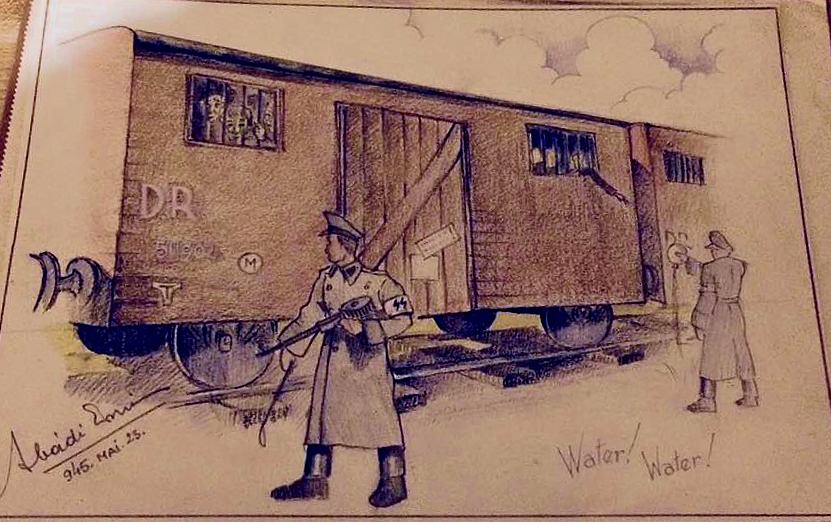
Liberation, April 13th, 1945. Drawing by survivor Ervin Abadi. USHMM.

Liberation, April 13th, 1945. Drawing by survivor Ervin Abadi. USHMM.

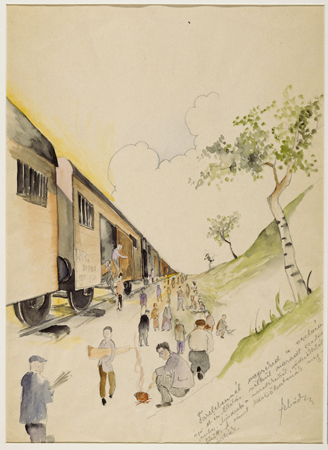
The Liberation of the Train, by Ervin Abadi. USHMM.

The Liberation of the Train, Farsleben, Germany, April, 1945. Ervin Abadi. USHMM.


Dozens of Abadi’s pieces are at the United States Holocaust Memorial Museum, and his bio there reads as follows:

In his early twenties when the war broke out, Ervin Abadi lived in Budapest, Hungary and wanted to be a painter. But, as with all Jewish males his age, he was taken to Russia by the Hungarian Army as a forced laborer. Abadi managed to escape but was captured after hiding out in the Karpet Mountains. After being brutally mistreated he managed to escape again, but was recaptured and taken to Bergen Belsen. When the camp was liberated  by the US Army [incorrect: his train transport from Belsen to Theresienstadt] on April 13, 1945, Abadi was taken to a hospital in Hillersleben, where he recovered. While in the hospital (and possibly earlier in the camp) he made 25-30 watercolors, dealing with his arrival at Bergen Belsen, life in the camp and its liberation by the US Army. Abadi returned to Budapest where he told about his life as a forced laborer and and an inmate of Bergen Belsen in a collection of 30 ink drawings. The work was published in 500 copies with Hungarian and English captions in 1946. The foreword of the book says, in part, “Let these drawings serve as proof of my everlasting gratitude towards those to whom I owe my life. … To the soldiers of the United States Army, particularly to our immediate liberators, those soldiers of the 9th regiment who first entered the village of Zilitz and gave us bread, milk, chocolate, and cigarettes….” Abadi, however, became disallusioned by Communist Hungary and managed to leave for Israel in 1947 or 1948 where he lived in Israel for the rest of his life. There he wrote 15 books in both Hebrew and Hungarian. He died in 1979.  [my emphasis]

***

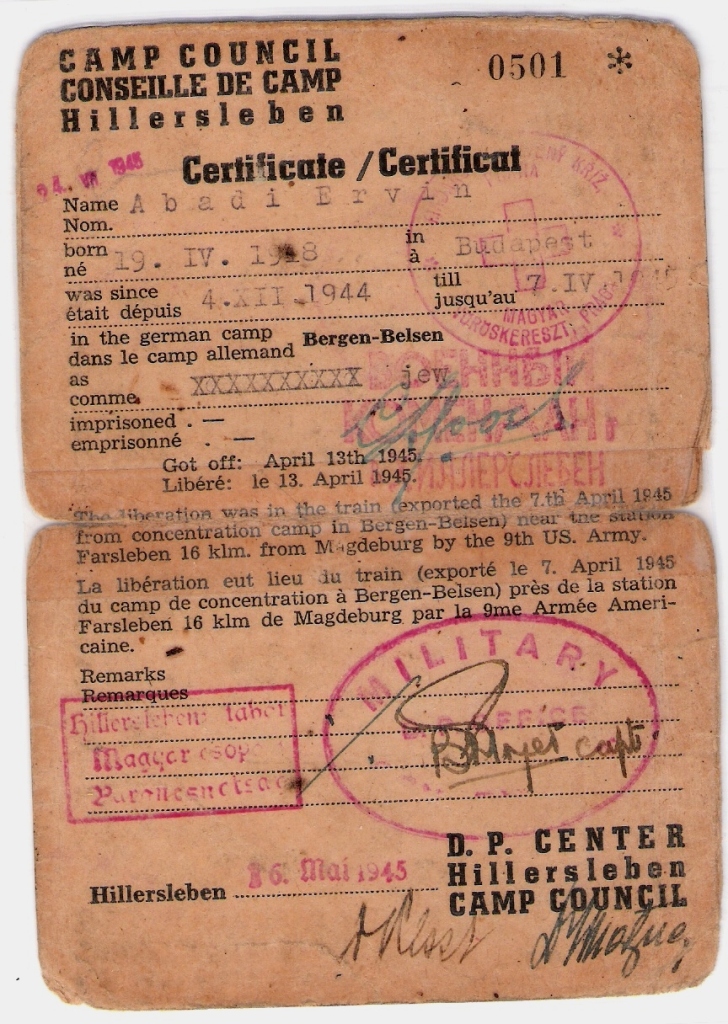
Ervin Abadi’s name is also the first on the existing manifest list. Some years ago, with the help of Varda W. in Israel, his daughter got in contact with me, and sent me his DP [displaced persons] document from Hillersleben:

Hillerleben Displaced Persons certificate-Ervin Abadi

Hillerleben Displaced Persons certificate-Ervin Abadi.

At that time, 5 years ago, his daughter wrote:

As you know, my father is a survivor from Bergen Belsen on the Magdeburg train. He got sick with typhus and was taken to the American Hospital at Hillersleben.

All my life my father told me to remember that he was saved by the Americans, and for that he will be grateful until his last day- and so must I, because if he was not to be saved- I wouldn’t be born.

My father passed away in 1979, and since then I tried to keep my promise to my father. I went to Normandy in France and walked the beaches that are soaked with the blood of the American soldiers and wanted to honor their memory, for because of them, I am living today.

A few years later I visited the World War II Memorial in Washington, DC. I met there an old gentleman and I found out that he was one of the American soldiers who fought on the beach on D-Day! I told him the story about my father and we both fell into each others arms crying. I felt like I fulfilled my promise to my father. ~Julia A. H.

**

So I dug out the letter, got in contact with Julia again,  and put her in touch with Chriss, the granddaughter of the soldier who in befriending Abadi, helped him in his recuperation.

Raymond D. Rape of Zelienople, PA ; Grafton D Junkin of Kennedy, Alabama ; Donald W Rust of Kansas City KS. Hillersleben DP Camp, May 1945. Source: Chriss Brown, granddaughter of Don Rust.

Raymond D. Rape of Zelienople, PA ; Grafton D Junkin of Kennedy, Alabama ; Donald W Rust of Kansas City KS. Hillersleben DP Camp, May 1945. Source: Chriss Brown, granddaughter of Don Rust.

From Julia, the artist’s daughter, last week:

I was very touched… 70 years after it happened, my father’s drawings came back to us.

We use to say that if his name is mentioned, a person lives forever.

Thank you again for remembering my father’s work of art.

*************************************************************


Read Full Post »

« Newer Posts