Feeds:
Posts
Comments

Posts Tagged ‘743rd Tank Battalion’

I am in Israel now to embark upon two and a half weeks of study at Yad Vashem, the Israeli Holocaust Martyrs’ and Heroes’ Remembrance Authority. I am humbled. But I was here before, in 2011, with liberator Frank Towers as he was recognized for his efforts 70 years ago, on behalf of American liberators everywhere. Here in Israel he met with statesmen and the head of the IDF, as well as over 50 survivors and their families who were liberated on April 13, 1945, an event that Frank had a direct hand in.
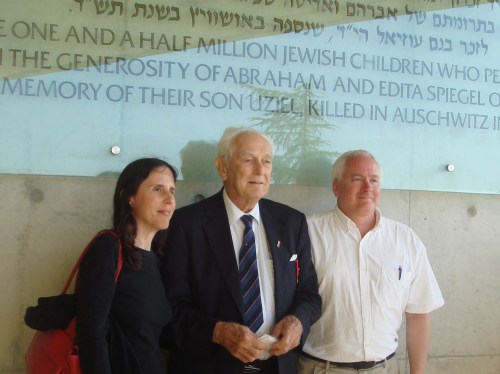
Varda Weisskopf, liberator Frank Towers, Matthew Rozell at Yad Vashem, May, 2011.

Varda Weisskopf, liberator Frank Towers, Matthew Rozell at Yad Vashem, May, 2011.

It’s a long story, but my work as a teacher has been here, too. In the background, note the Benjamin photo at the 2015 70th anniversary state ceremonies.

"The anguish of the liberation and return to life". Note the Benjamin photograph on the banner. Yad Vashem, 2015.

“The anguish of the liberation and return to life”. Note the Benjamin photograph on the banner. Yad Vashem, April 2015.

The short version of the story:

Fifteen summers ago I sat down to listen to an old gentleman in a rocking chair. A  war weary tank commander in 1945, he told me stories of his World War II experiences and then led me to his fellow tank commander, who showed me a picture that their major had taken on April 13, 1945. You see, those two were there, and their two tanks had liberated a concentration camp transport deep in the heart of war-torn Germany.

It would be the first time in decades that this picture had seen the light of day. And because of its discovery, and what we would do with it, thousands of lives were about to change.

Yad Vashem contacted me in December 2014 to inquire about using the Major Benjamin photo. I immediately sent them a copy. My friend Varda in Israel writes, ‘[The photograph above was taken] during the main ceremony at  the Holocaust Remembrance Day at Yad Vashem. This photo shows the President of Israel Reuven Rivlin make his speech. You can see your photo there at the middle (banner) and I now think it was there throughout all the ceremony.’

Below, a post from the time of the event in April, 2015..


My good friend in Israel let me know that the April 15th  commemoration of the Holocaust at Yad Vashem in Israel was a moving event and sent me the link to the video of the ceremony marking the 70th anniversary of the liberation. While the  narrative  behind the Major Benjamin photograph was not a focus, the photo that which now seems to be becoming a cornerstone of the history of Holocaust liberation is all throughout the ceremony, and especially at 8:31. One of my friends, a survivor who had been a six-year old boy on this transport that Major Benjamin photographed at the moment his jeep arrived at the train, notes,

The photograph wouldn’t be there if not for your effort. It was presiding on 1.5 hrs of national ceremony in the presence of Israel’s president, prime minister, the entire government, the top army guys, survivors, chief rabbis and was nationally broadcast. You have a direct hand in this.

Me, a lowly teacher, whose work for an evening is presiding as the backdrop for presidents and prime ministers. I am proud and hope that the story is told over and over, and that it serves the memory of the victims, the survivors, and the liberators well. I just can’t believe sometimes this path I have been down, since the day over a dozen years ago when I took the time to listen to a war veteran, and began to backtrack his story.  There are other forces at work here, I think… and there is a cosmic force that reverberates in you when you teach the Holocaust from the heart.

Teachers out there, you all know the power of what we do. I hope this serves as an affirmation.


*************************************************************

Matthew Rozell is a United States Holocaust Memorial Museum Teacher Fellow and teaches history at his alma mater in upstate New York. His work has resulted in the reuniting of 275 Holocaust survivors and the American soldiers who freed them.

His first book, ‘The Things Our Fathers Saw’, was released to coincide with the 70th anniversary of the end of World War II. His second book,  is on the power of  teaching, remembering the Holocaust, the Benjamin photograph and this ‘Train Near Magdeburg’. 


Read Full Post »


So, it is the sixth of June again.

American Cemetery overlooking Omaha Beach, the primary landing zone for Americans during the D-Day invasion June 6, 1944. (U.S. Air Force Photo)The ocean pounds the advance of sand amidst the relics of a different age, the hulking remnants of the tide of battle. The surf rolls in and kisses the beach, as the last participants mix on the hallowed bluff above with the politicians who have gathered from all over the world.

Thirty-two years ago I watched as the American president honored  the fallen, and the living, at the cemetery for the fortieth anniversary. Just out of college, something stirred inside me. Something was awoken.

I began by writing letters to the newspaper. I began to interview D-Day veterans and others. I began to collect stories- not relics, prizes, or artifacts. I really had little interest in captured Nazi flags or samurai swords.

I wanted to talk to the men who were there.

The fiftieth anniversary came next with great pomp and more reflection. It graced the covers of the major newsweeklies. “Saving Private Ryan” stirred the consciousness of a new generation, and reflections of the old. And I learned so much more of the war beyond the beachhead. That there were so many beachheads.

The sixtieth anniversary came around. Students on their bi-annual trips to France would bring me back their photographs and the requisite grains of white sand from Omaha Beach. Teenagers had their emotions  a bit tempered, I think. I would go on to introduce them to so many who were there. When they themselves were teenagers.

So now it is the seventy-second. On the 65th, I wrote about a friend who is no longer here for the 72nd,  and the 75th will bring fewer who were there back to Normandy.

*****************************************

Today I would like to introduce you to a survivor of D Day who is still with us.

I first met Bill Gast at a reunion of 30th Infantry Division and 743rd Tank Battalion soldiers at a reunion in March 2008, in which I  was present with several Holocaust survivors who were meeting their liberating soldiers for the first time. Later, Bill came to my high school to speak to students. I think the experience of sharing, and meeting the Holocaust survivors whom the 743rd came upon and liberated, affected him deeply.

Unlike many who may be physically able, Bill has no intention of going back to the sands of Omaha for this anniversary. As he explained to our students in 2009,

“I’m listed [in the event program] as a liberator- however, I am also a survivor of World War II, having landed on Omaha Beach in Normandy, France on D-day and fighting through to the end when the Germans surrendered, May the 7th, 1945.”

“Pictures.

Video games.

Movies.

Words.

They simply do not covey the feeling of fear.

The shock.

The stench.

The noise.

The horror, and the tragedy.

The injured.

The suffering.

The dying, and the dead.”

https://www.youtube.com/watch?v=GmKNYMaa_sU


*****************************************

D-Day: the view from a tank on Omaha Beach

Washington (AFP) – From inside his tank, the young soldier could see “practically nothing” on Omaha Beach.

Seventy years later, William Gast still wonders whether he rolled over his comrades sheltering from German gunfire that day.

Gast was 19 years old the morning of June 6, 1944. “We came in at H-10, that was 10 minutes before the designated hour.”

He cannot recall why he and his fellow soldiers arrived early, but he has other memories that have never left him.

As part of Company A, 743rd Tank Battalion, 1st Army, Gast remembers the training beforehand in Britain, when he rehearsed driving the Sherman tank onto the landing craft. And then floating in the English Channel.

“Another night we went out and we didn’t come back. That was it.”

Gast got to know the captain of the landing craft that would ferry his tank to the beaches of Normandy.

The skipper promised he would get them close enough that they would not be submerged in water, like so many tanks were that day.

He kept his word.

Another tank unit at Omaha Beach was less fortunate, with 27 of 32 tanks launched at sea five kilometers (three miles) from the coast sinking before they could reach land, despite being outfitted with a flotation screens.

“The order was given to go, we started our engines up, they lowered the ramp,” said Gast.

Amid German shrapnel and sea spray, he “could feel the tracks spinning.”

At last, the tank tracks took hold on the sandy sea bottom and he drove up the beach.


– Like throwing marbles at a car –

Down below in the driver’s seat, Gast tried to steer the tank with the aid of a small, manual periscope.

“You can imagine how much we could see, practically nothing,” he said.

The radios inside the tank were so unreliable that his commander would tell Gast which way to turn by kicking him on the left or right shoulder.

The difficulty in seeing the way ahead has left Gast with a gnawing sense that he may have run over the bodies of American soldiers on the beach.

“The saddest part about the whole thing is, not being able to see, I may have run over some of my own people.

“And if I did, I don’t even know it. I can’t ever get that out of my mind, you know?”

Bill Gast awarded the Silver Star.

Bill Gast awarded the Silver Star.

Corporal Gast heard machine gun bullets hitting the side of the tank, “like throwing marbles at a car — that’s what it sounded like.”

“And there were shells that exploded right beside me. You could feel the tank shake.”

For Gast, it was a day of fear and terror, and following orders without reflection.

“I can’t tell much about what happened, I was scared to death to start with,” he said.

“It was just like putting it on automatic, you just did what you had to do, did what you were told to do.”

By noon, close to 19,000 American soldiers who landed at Omaha were still pinned down on the beach.

– High school sweetheart –

Carefully laid plans had unraveled as the beach became a killing zone, with troops mowed down under a fusillade of German machine gun, artillery and mortar fire.

Small teams of US troops eventually managed to break through on the bluffs between German positions, with the help of combat engineers blowing up obstacles.

The losses were staggering: more than 2,000 dead, wounded and missing on Omaha beach. The exact toll is still unknown. Of the 15 tanks in Gast’s Company A, only five survived without damage.

Gast, from Lancaster, Pennsylvania, earned the Silver Star and the Purple Heart during his combat tour, and went on to marry his high school sweetheart.

Now 89 years old, he recently was awarded France’s Legion d’Honneur at a small ceremony for World War II veterans at the French embassy in Washington.

The short, soft spoken man stood up to receive the medal and shook hands with a French diplomat. But he has no plans to return to Normandy for the 70th anniversary of the D-Day landings.

His son, Bill, said his father did not want to relive that day: “It’s important we don’t forget, but you try to hide things somewhere.”

Mr. & Mrs. Gast, Holocaust Survivors-American Soldiers reunion, 2009.

Mr. & Mrs. Gast, Holocaust Survivors-American Soldiers reunion, 2009.

*****************************************

Read Full Post »

Here in the United States, Memorial Day will be upon us soon.

In researching for my upcoming book on the liberation of the train, I are reminded of the sacrifices of the soldiers, again and again. Right now I’m revisiting a horrific incident that occurred just across Hitler’s “West Wall”, the so-called Dragon’s Teeth that formed the three-mile deep defensive fortifications that our troops had to cross to enter German soil.  Resistance was stiff; on a cold and rainy day before Thanksgiving, 1944, several tanks of the 743rd Tank Battalion’s ‘D’ Company were wiped out in a muddy apple orchard a few miles across the border.

boller envelope

Letter to Marvin Boller postmarked 5 days after his death. It remains unopened in a museum in Belgium. Thanks to Vincent Heggen, the curator.

In 2012, I was alerted to the existence of an unopened WWII era letter in a memorial museum in Belgium. The envelope was postmarked Nov. 27, 1944, and addressed from the USA to PFC Marvin K. Boller, D Co., 743rd Tank Battalion. It was also stamped ‘DECEASED’. I wrote to Carrol Walsh, a liberator of the train near Magdeburg and a fellow member of Company D, and asked if he knew Boller; I also sent him this image of the envelope. He wrote back:

‘Hi Matt, I was stunned when I read your message. I remember Boller very well and remember when he got killed.  I believe it was just before Thanksgiving 1944 when a big German tank wiped out four tanks of the first platoon of Co. D of the 743rd. Every member of every crew of every one of the four tanks was killed.  I seem to remember packages arriving for some of these guys after they had been killed.  I used to tease Boller, who was an older man, because he wanted to vote for Tom Dewey and I was big for my pal, FDR.  Boy what a memory you stirred up.  I knew all the guys that got killed in that engagement.’

Walsh and others would survive and go on to liberate Holocaust survivors on April 13th, 1945.

So here is a tribute to Marvin Boller, and all who fell. His body was returned to the United States. Rest on.

Riverside Cemetery, Oshkosh, Winnebago County, Wisconsin, USA. Credit: J M Schumann


MARVIN K. BOLLER

PFC, 743 TANK BN WORLD WAR II

Birth: Oct. 9, 1908
Death: Nov. 22, 1944

More can also be seen here.

Read Full Post »

I’ve been working a bit lately on my next two upcoming books, The Things Our Fathers Saw II and the one closest to my heart, working title, A Train Near Magdeburg or The Last Transport. And I have been struggling with that book for years. It’s a hard story to tell because it has to be done right, the first time.

TNMMy own personal connection and closeness to the subject has been documented at this blog since 2007, when we hosted the first reunion before a student audience at our high school, when we knew of only 2 liberators and 4 survivors. Today, that number has grown over 7 fold. Unbeknownst when we began, this story has grown and taken over the second half of my career as an educator.

Trying to take on the subject matter of the Holocaust as a classroom teacher is a daunting task, and one not to be taken lightly. Trying to convey that through the eyes of your survivor friends is exponentially difficult. But when you open yourself up, palms up and arms out, especially at the authentic sites where millions of families suffered, there is a coupling of the past and the present.

It’s not an easy thing to open yourself up to. But if you think that it is all in the past, you are very, very mistaken.

Now throw into the mix the experience of the young American boys, battle hardened and hardly innocents by now, who stumbled across the train and the horrors of the Holocaust. Confronted with the reality of sick and starving people, and a war in its closing days where the enemy, the perpetrators of this evil, are still shooting at them. They have a mission they have been tasked with, and it’s not a humanitarian rescue operation that they trained for.

Oh no. They had no idea. Many of these young guys were haunted for life by what they encountered.

A picture is worth a thousand words, so they say. In my case, more like one hundred thousand. Behind the camera, the major in the jeep snaps a photo as specters emerge from the springtime morning mist. The little girl turns her head in terror at the two monsters clamoring behind the jeep with the white star,  Tanks 12 and 13 of the 743rd Tank Battalion and the 30th Infantry Division of the United States Army. It is April 13, 1945, deep in the heart of the Reich. Friday the 13th. Tank 13 stays on after securing the perimeter to protect the vulnerable from their would-be murderers.

For the young beautiful men with perfect teeth and handsome uniforms, the first instinct is to recoil. This is not natural and these people have been reduced to stinking animals. Lice infested. Stench ridden. Infected with bad, bad disease. Revulsion and vomiting is a common reaction.  These are not human beings.

But, they are.

They are.

And what are we going to do about this? The battalion commander cocks his .45 and calmly places it to the head of the local burgermeister when he displays reluctance to comply with the order to open homes and feed the prisoners.

And next up on the roller coaster ride for the incredulous GIs  is stomping rage and jags of crying. Generations later, an 89 year old tells me, “My parents wondered why I couldn’t sleep at night, after returning home.”

The soldiers transport the victims out of the line of fire. The medics get to work. People continue to die, but somehow humanity returns. The war ends. The survivors and the soldiers go their own ways, most refusing to speak of this time for decades. For many, the trauma passes onto the children  of the generations that come after.

And then, in the twilight of living memory, a high school teacher with an unassuming project has the encounter with the unknown photographs, and asks the unasked questions.

Seventy years later, across time and space, the portal has been entered. The wires of the cosmos have been tripped. And the universe channels the unassuming power of love across the abyss as the aged rescuers and survivors and their descendants are brought together to meet again.

It is a miracle of healing and reconnection. A cosmic circuit has been completed, but maybe, in some small way, another pathway to undoing a tragic cycle is opened. And it is not a coincidence.

As I wrap up this post, I am pinged with an email from my ‘second mom’ in Toronto, survivor Ariela. She was 11 when she was liberated on the train with her aunt. Her parents and grandparents were murdered in Poland by the Germans. She’s good on Facebook, but has a tough time with email. She’s thinking of me, and the book which has to tell the story. The email comes through now, loud and clear.

This is the train that should have led to death. Instead, it leads to life, and a legacy of the triumph of good over evil. And maybe, just maybe, amidst all of the horror and the suffering, there is a lesson here, somewhere.

I’d like to think so.


Read Full Post »

Last night we were all jolted out of our comfortable lives with the news of the attacks in Paris by what appears to be, once again, the handiwork of radical Islamists. I felt distress as the waves of Twitter updates came cascading in from Europe. Distress at the live updates, the storming of the Bataclan Theatre, the rising body counts, the survivor descriptions of what was unfolding, the young people being murdered on a Friday night out.  I felt distress at sitting on the couch in a warm comfortable home reading the updates. But what can one do?

So I sat there, maybe like you, feeling helpless. Maybe feeling guilty as well, for at times lately it seems as if I am rushing through my life with no time or appreciation for the little things, which, in truth, are the only things that matter.

Saturday morning now. After getting more updates on the latest crimes against humanity in Europe, I think back to an email I got this week from a producer of an about to be released film that features some of my work as a Holocaust/World War II educator, and as a “connector” between Holocaust survivors and their American soldier-liberators. He says ‘thank you’ for my help, my input and my interview, and that the documentary is ready for viewing with a private code, before its world premiere on Nov. 19th.

But I’ve been in documentaries before, and I’m busy, so I had put it off. Until just now, when I watched it for the first time.

And the light bulb just went off, like the kid in the class who finally gets the ‘big picture’. Like the 90 year old liberator to whom I  had introduced  people he saved 62 years ago, and to whom I taught about the Holocaust-for the first time in his life– who proclaimed excitedly “Yes! Yes! Now I know what I fought for!” And although on some level I have always ‘gotten it’, I see more clearly that this is what I am teaching for, and speaking for, and writing about-that this is what I am here to do-“to prevent one of history’s darkest chapters from repeating.”

***

We were at the last reunion of the 30th Infantry Veterans of World War II in Nashville, where I met Evelyn Marcus, the daughter of survivors and whose mom was liberated on the Train near Magdeburg in 1945. Raised in the Netherlands, she emigrated to the USA about a dozen years ago, due in large part to a rising wave of antisemitism sweeping that country, and Europe. And now she confronts it, after meeting her mother’s actual American liberators, and returns to the Netherlands for a deeper understanding of what is happening. And she is determined to make a difference.

And so am I. It’s what we do to honor the lives stolen, and to remember that we are all part of humanity and each one of us has a responsibility, and a role to play. I hope you have an opportunity to see the film. Maybe it’s time to ‘get it’ that ‘never again is now’.

*

FRANK, EVELYN

My name is Evelyn Markus. I am a Jew. I was born and raised in the Netherlands where my family history goes back more than 400 years. I grew up in the 60s and 70s in the world’s most liberal city –Amsterdam, where I enjoyed life with my long-time partner, Rosa. But 15 years ago, things started to change.

 We noticed and personally experienced rising anti-Semitism sweeping across Europe. As second-generation Holocaust survivors, we sensed a familiar evil on the horizon. In 2004, we decided to leave Europe for the United States, the nation that liberated my family from the horrors of the Holocaust.

 70 years later, I now understand the need to fight for freedom and the importance of acting on principles. America has molded my mission -–to tell the world, through my story —that Never Again Is Now.

FRANK


Watch the trailer.

NAIS

http://www.neveragainisnowfilm.com/#open


The film premieres on TheBlaze TV  on Thursday, Nov. 19 at 8PM. It will be released later to larger outlets, like Amazon.

Some quotes:

“If we bear all this suffering and if there are still Jews left, when it is over, then Jews, instead of being doomed, will be held up as an example.” 

Anne Frank

“Never in our training were we taught to be a humanitarian.  We were taught to be soldiers.”

Frank Towers

“It really is an incredible thing and I think about it all the time. I think it’s really important to keep the memory and the history alive.”

Matt Rozell

“My message was to make up for what Hitler destroyed. That was my function in life.”

Rosa Zeegers

“Life in the Netherlands if you are Jewish and you’re not ashamed oyour Jewishness is a predicament”

Ayaan Hirsi Ali

“The Jews were killed for the simple fact that they were Jews, and that made a very deep impression on me.”

Rabbi Raphael Evers

“These are the final struggles of a lost fight. Jewish life in Holland is almost non-existent.  In that regard, Hitler won.”

Leon de Winter

“At the end of the day for my children, if they want to live a Jewish life, I would honestly not advise them to stay in Europe.”

David Beesemer

“If you feel what happens, the horror of it, and you feel the pain of individuals it’s so much more important than if you just know facts.”

Jessica Durlacher

“I think if you have an opportunity to speak for those who are voiceless, who might be victims, I think it’s a responsibility.”

Qanta Ahmed


Read Full Post »

It was six years ago this evening, we shared a meal on the eve of Shabbat, after watching ourselves on a national broadcast that reached millions. Why does it seem, so long ago?

Maybe because it all seems so unbelievable- that out of the darkness of the past, on a day when the sun dawned clearly and was warming the Earth in its mid-April morning ascent, a low rumble was heard by  hushed and huddled groupings of tormented humanity as they strained to hope for friends amidst their lurking murderers. As the metallic clanking grew louder, over the horizon broke the earthly angels, two Sherman light tanks and an American Jeep with the emblem of the white star. A cry broke out. They realized they were saved, and the American major snapped a photograph at the exact moment the overjoyed survivors realized it.

And out of the past on a warm September day, we brought them all together again. Who would have believed that 62 years later, a high school in a quiet, rural part of the world would  bring the soldier-liberators and the rescued survivors together from the US, Canada, Israel and elsewhere? All because I couldn’t let go of a good narrative history, and pursued the story behind the photographs that proved it really happened?

And think about the risk you run, inviting hundreds of octogenarians to come to a high school for half a week to mingle with thousands of high school and middle schoolers? Talk about sweating bullets. What if they are uncomfortable? Cranky? Complaining? What if the kids I can’t control are rude? And what if one of these “old” folks, who I don’t even know, dies on our watch? I would lie awake at night wondering if I was out of my mind.

But the miracle came to be-for the two dozen or so elders who could come, tears flowed, wine spilled, and our “new grandparents” danced with young teenagers who adored them, but only after the risk was accepted, with the enthusiastic help of Mary Murray, Tara Winchell-Sano, and Lisa Hogan, Rene Roberge and others. Have a look at the videos, and feel the love. We created ripples, and tripped the wires of the cosmos, and the reverberations are still echoing. To date, with Varda Weisskopf’s and Frank Towers’ help, the list is at 275 survivors whom we have found. And how many generations has it effected?

This is the subject of my second book, due out this next summer. In the meantime, I am working on a shorter work of what I have learned in teaching the lessons of the Holocaust. So take a look at the videos, and remember the words of the liberator:

“Here we are! We have arrived!”

Read Full Post »

April 15th 1945                                                                                                                   Somewhere in Germany

You will probably be wondering who I am and what business I have, writing to you.- I am one of the millions of soldiers of the United States Army, who is fighting for all the oppressed peoples of the world and hopes to have reestablished decency and honor to all mankind, with the defeat of Hitlerism.

*****

My friend Varda in Israel sent me a copy of this letter she recently received from the widow of  Mr. Shmuel ‘Tommy’ Huppert of Israel. In it, an American soldier is taking the time to write to the husband of a Holocaust survivor to let him know that his wife and young son (Tommy) have been liberated, and that they have survived the horrors of the Holocaust and the carnage of ‘Hitlerism’.

Young Tommy and his mother, Mrs. Hilde Huppert,  were liberated at Farsleben on the transport from Bergen Belsen on April 13th, 1945. They managed to get to Palestine shortly after liberation, bringing with them many, many orphaned children, including my friend Lily Cohen.  Hilde’s manuscript, Hand in Hand with Tommy, was one of the first Holocaust memoirs completed after the war and a cathartic way for her to attempt to come to terms with what had happened.

It took years to be properly published, as it was originally rejected because it was ‘too soon after the war’. Later, at 93 years of age, Hilde was asked if there was anything specific she wished to convey to American readers of her book. She replied, ‘Tell them I will never forget those American GIs who liberated us from the Germans…I can still recall their amazed faces in that dusty jeep and the U.S. Army symbol. I remember kissing one of them, and I want the American people to know that I am grateful to them.’


READ ALL ABOUT IT IN MY BOOK HERE


One of the soldiers, on the Sunday following the Friday liberation, took the time to send this note on her behalf to her husband in Palestine. It now resides in the collection at Yad Vashem, Israel’s Holocaust Remembrance Authority.

4-15-45 Gartner to Huppert 1

April 15th 1945                                                                                                                      Somewhere in Germany

Dear Mr. Huppert,

You will probably be wondering who I am and what business I have, writing to you.- I am one of the millions of soldiers of the United States Army, who is fighting for all the oppressed peoples of the world and hopes to have reestablished decency and honor to all mankind, with the defeat of Hitlerism.

Two days ago, it was the priviledge (sic) of our unit, to be able to liberate a trainload full of people of all nations imaginable, who were being transferred from a concentration camp near Hannover, to some other place. Our advances were so swift, that the SS guards, left this particular train where it was and took off.

That is how I became acquainted with your wife, Mrs. Hilde Huppert, who asked me to drop you this note, saying, that both she and your son Tommy, are both healthy and well and now being well taken care of by our military governmental authorities. In actual fact, your wife wrote a message for you on a piece of paper in pencil, which she asked me to convey to you. Unfortunately, however, the penciled lines faded in my pocket, and I can no longer read what was written on it. The contents of the message, though, was to let you know that your wife and son are both safe and sound.

I am sure that your wife will soon be able to get into contact with you directly through the Red Cross, and I hope that in a none too distant future, your family will once more be peacefully united.

Sincerely yours,

Cpl. Frank Gartner

Fluent in many languages, Gartner was the translator for the 743rd Tank Battalion’s commander, Col. Duncan. He was originally from Estonia, and resided in Los Angeles, California.

BOOK HERE

If anyone knows more about Frank Gartner, please contact me at matthew @ teachinghistorymatters.com.. 

Transcribed by Alanna Belanger’15 and Alexis Winney ’15.

Read Full Post »

My good friend in Israel let me know that the April 15th  commemoration of the Holocaust at Yad Vashem in Israel was a moving event and sent me the link to the video of the ceremony marking the 70th anniversary of the liberation. While my work at piecing together the  narrative and the story behind the Major Benjamin photograph was not detailed, the photo which now seems to be becoming a cornerstone of the history of Holocaust liberation is all throughout the ceremony and especially at 8:31. One of my friends, a survivor who had been a six year old boy on this transport that Major Benjamin photographed at the moment his jeep arrived at the train, notes,

image.png

The photograph wouldn’t be there if not for your effort. It was presiding on 1.5 hrs of national ceremony in the presence of Israel’s president, prime minister, the entire government, the top army guys, survivors, chief rabbis and was nationally broadcast. You have a direct hand in this.

Me, a lowly teacher, whose work for an evening is presiding over presidents and prime ministers. I am proud and hope that the story is told over and over, and that it serves the memory of the victims, the survivors, and the liberators well. I just can’t believe sometimes this path I have been down, since the day 14 years ago when I took the time to listen to a war veteran, and began to backtrack his story.  There are other forces at work here, I think… and there is a cosmic force that reverberates in you when you teach the Holocaust from the heart.

Teachers out there, you all know the power of what we do. I hope this serves as an affirmation.

*************************************************************

Matthew Rozell is a United States Holocaust Memorial Museum Teacher Fellow and teaches history at his alma mater in upstate New York. His work has resulted in the reuniting of 275 Holocaust survivors and the American soldiers who freed them.

His first book, ‘The Things Our Fathers Saw’, is being released to coincide with the 70th anniversary of the end of World War II. His second book, in progress, is on the power of  teaching, remembering the Holocaust, the Benjamin photograph and this “Train Near Magdeburg’. He can be reached at marozell at gmail dot com.

Read Full Post »

"The anguish of the liberation and return to life". Note the Benjamin photograph on the banner.

“The anguish of the liberation and return to life”. Note the Benjamin photograph on the banner. From the Yad Vashem website.

Fourteen summers ago I sat down to listen to an old gentleman in a rocking chair. A  war weary tank commander in 1945, he told me stories of his World War II experiences and then showed me a picture that his major had taken on April 13, 1945. You see, he was there. It would be the first time in decades that this picture had seen the light of day. And because of its discovery, and what we would do with it, thousands of lives were about to change.

Yad Vashem, the Holocaust Authority in Israel, contacted me in December 2014 to inquire about using the Major Benjamin photo. I did immediately send them a high resolution copy. My friend in Israel writes, ‘[The photograph above was taken] during the main ceremony at  the Holocaust Remembrance Day at Yad Vashem. This photo shows the President of Israel Reuven Rivlin make his speech. You can see your photo there at the middle (banner) and I now think it was there throughout all the ceremony.’

I hope that whoever was present or sees this photograph will visit our website to learn the powerful story behind this amazing photograph in the context of the 70th anniversary of the liberation. No wonder the survivors of the train refer to April 13th as the day they were reborn. Below is the proper information.

Matthew Rozell

From Yad Vashem:

Holocaust Martyrs’ and Heroes’ Remembrance Day (Yom Hashoah in Hebrew) is a national day of commemoration in Israel, on which the six million Jews murdered in the Holocaust are memorialized. It is a solemn day, beginning at sunset on the 27th of the month of Nisan and ending the following evening, according to the traditional Jewish custom of marking a day. Places of entertainment are closed and memorial ceremonies are held throughout the country. The central ceremonies, in the evening and the following morning, are held at Yad Vashem and are broadcast on the television. Marking the start of the day-in the presence of the President of the State of Israel and the Prime Minister, dignitaries, survivors, children of survivors and their families, gather together with the general public to take part in the memorial ceremony at Yad Vashem in which six torches, representing the six million murdered Jews, are lit. The following morning, the ceremony at Yad Vashem begins with the sounding of a siren for two minutes throughout the entire country. For the duration of the sounding, work is halted, people walking in the streets stop, cars pull off to the side of the road and everybody stands at silent attention in reverence to the victims of the Holocaust. Afterward, the focus of the ceremony at Yad Vashem is the laying of wreaths at the foot of the six torches, by dignitaries and the representatives of survivor groups and institutions. Other sites of remembrance in Israel, such as the Ghetto Fighters’ Kibbutz and Kibbutz Yad Mordechai, also host memorial ceremonies, as do schools, military bases, municipalities and places of work. Throughout the day, both the television and radio broadcast programs about the Holocaust. In recent years, other countries and Jewish communities have adopted Yom Hashoah, the 27th of Nisan, to mark their own day of memorial for the victims of the Holocaust.

Holocaust Martyrs’ and Heroes’ Remembrance Day 2015 will be on Thursday, 16 April. The State opening ceremony will be held at Yad Vashem on Wednesday 15 April at 20:00.

Read Full Post »

Update from Nashville: At the 30th Infantry Veterans of WW2 70th anniversary reunion.

Today’s events began with the posting of the colors and a moving memorial service for the veterans of the 30th Infantry Division and 743rd Tank Battalion who have moved on. Missing many, especially for me Buster Simmons, who would offer up a prayer at this gathering in his capacity as chaplain. Rest on,old soldier.

94 year old veteran Marion Sanford comes up to me and grips my hand. I have not seen him in 2 years, but he is the same to me as he always was. As a reconnaissance man for the 30th Infantry Division, he tells me how much he saw and how much now in retrospect meeting the survivors and their families has meant to him. He saw many terrible things overseas, which he felt he had to leave out of his 2012 book, ‘Old Hickory Recon’. Don’t think for a minute that a soldier understood why a friend might be killed and the fickle hand of fate spared another. In what way can this be justified? Survivors’ guilt was not just for the Holocaust survivors to experience. But this ‘small’ incident, the liberation of the train near Magdeburg, seems to have altered his perspective and the perspective of many of the soldiers I have met at these reunions. It seems to have enhanced and  added to ‘man’s search for meaning’, in a sense, as far as the soldiers go.

0417151104-00

Posting the colors. MC Frank Towers in the background. Frank will be 98 in June.

 ***

After lunch, moving talks today by survivors George Somjen (Hungary), Elisabeth Seaman (Netherlands), Micha Tomkeiwitz (Poland) . To their liberators they recounted the events that they remembered and  more importantly, the impact that the liberation and the meeting of their liberators meant not only for them and their families, but also  the world.

Later, the amazing reflections of the 2nd generation ‘Train near Magdeburg’ survivors who are with us for the first time: Evelyn Marcus, formerly of the Netherlands, Orly Beigel of Mexico, and Marc Boyman of Canada. April 13th, the liberation date, for their families was a date always remembered and celebrated; a time to remember how the American soldiers loved life, and loved people, and treated the survivors with such tenderness, empathy, and respect, in marked contrast to the soldiers from another Allied nation who moved in to replace the Americans as the terms of the peace settlement were adjusted.


L-R: Peggy Wonder, 2nd G; Evelyn Markus, 2nd G; Frank Towers, liberator; Orly Beigel, 2nd G; Micha Tomkeiwicz, Elisabeth Seaman. Missing: Marc Boyman, 2nd G; George Somjen.

L-R: Marc Boyman, 2nd G; Peggy Wonder, 2nd G; Evelyn Markus, 2nd G; Frank Towers, liberator; Orly Beigel, 2nd G; Micha Tomkeiwicz, Elisabeth Seaman, Matthew Rozell Missing: George Somjen. Photo credit: Patti Jordan. 4-17-15.

I heard today so many vignettes of hope and promise for the future of mankind. And this, I witnessed with my own eyes. This gathering, this whole trip is an affirmation of the goodness of mankind, a meditation on the profound difference  that  one’s actions can make, and the confirmation that teaching history really does matter.

Orly Beigel’s mother, far left, 1945. Commonly mislabeled as ‘Buchenwald Survivors Entering Israel, 1945’. No. These girls ( L-Jetty (Jetta) Halpern and R-Magda Werber, together with Jetty’s older sister Golda Katz-Halpern, not pictured) pulled into the station at Guard d’Lion, Paris in France with much fanfare several weeks after liberation; there was a celebration as they arrived, so they thought that a celebrity must be on board. The war was over. In a rare instance, the survivors were the ones being celebrated.


Read Full Post »

« Newer Posts - Older Posts »