Feeds:
Posts
Comments

Archive for the ‘Uncategorized’ Category

Israeli archaeologist digs into Nazi death camp

 Wednesday Aug 22, 2012

Israeli archaeologist Yoram Haimi shows aluminum plate  at the site of the former German Nazi death camp of Sobibor. Photo / AP

I have been an avocational archaeologist for many years; have made some significant academically credited discoveries. This aspect of combating Holocaust denial really intrigues me. MR

When Israeli archaeologist Yoram Haimi decided to investigate his family’s unknown Holocaust history, he turned to the skill he knew best: He began to dig.

After learning that two of his uncles were murdered in the infamous Sobibor death camp, he embarked on a landmark excavation project that is shining new light on the workings of one of the most notorious Nazi killing machines, including pinpointing the location of the gas chambers where hundreds of thousands were killed.

Sobibor, in eastern Poland, marks perhaps the most vivid example of the “Final Solution,” the Nazi plot to wipe out European Jewry. Unlike other camps that had at least a facade of being prison or labor camps, Sobibor and the neighboring camps Belzec and Treblinka were designed specifically for exterminating Jews. Victims were transported there in cattle cars and gassed to death almost immediately.

But researching Sobibor has been difficult. After an October 1943 uprising at the camp, the Nazis shut it down and leveled it to the ground, replanting over it to cover their tracks.

Today, tall trees cover most of the former camp grounds. Because there were so few survivors – only 64 were known – there has never been an authentic layout of the camp, where the Nazis are believed to have murdered some 250,000 Jews over an 18-month period. From those few survivors’ memories and partial German documentation, researchers had only limited understanding of how the camp operated.

“I feel like I am an investigator in a criminal forensic laboratory,” Haimi, 51, said near his home in southern Israel this week, a day before departing for another dig in Poland. “After all, it is a murder scene.”

Over five years of excavations, Haimi has been able to remap the camp and has unearthed thousands of items. He hasn’t found anything about his family, but amid the teeth, bone shards and ashes through which he has sifted, he has recovered jewelry, keys and coins that have helped identify some of Sobibor’s formerly nameless victims.

The heavy concentration of ashes led him to estimate that far more than 250,000 Jews were actually killed at Sobibor.

“Because of the lack of information about Sobibor, every little piece of information is significant,” said Haimi. “No one knew where the gas chambers were. The Germans didn’t want anyone to find out what was there. But thanks to what we have done, they didn’t succeed.”

The most touching find thus far, he said, has been an engraved metal identification tag bearing the name of Lea Judith de la Penha, a 6-year-old Jewish girl from Holland who Israel’s Yad Vashem Holocaust memorial confirmed was murdered at the camp.

Haimi calls her the “symbol of Sobibor.”

“The Germans didn’t discriminate. They killed little girls too,” he said. “This thing (the tag) has been waiting for 70 years for someone to find it.”

Haimi’s digs, backed by Yad Vashem, could serve as a template for future scholarship into the Holocaust, in which the Nazis and their collaborators killed about 6 million Jews.

“I think the use of archaeology offers the possibility of giving us information that we didn’t have before,” Deborah Lipstadt, a prominent American Holocaust historian from Emory University, said. “It gives us another perspective when we are at the stage when we have very few people who can speak in the first person singular.”

She said that if the archaeological evidence points to a higher death toll at Sobibor than previously thought, “it is not out of sync with other research that has been done.”

Haimi’s basic method is similar to what he does at home, where he does digs for Israel’s antiquites authority in the south of the country – cutting out squares of land and sifting the earth through a filter. Because of the difficult conditions at Sobibor and the sensitive nature of the effort, he is also relying on more non-invasive, high-tech aids such as ground-penetrating radar and global positioning satellite imaging.

Based on debris collected and patterns in the soil, he has been able to figure out where the Nazis placed poles to hold up the camp’s barbed wire fences.

That led him to his major breakthrough – the mapping of what the Germans called the Himmelfahrsstrasse, or the “Road to Heaven,” a path upon which the inmates were marched naked into the gas chambers. He determined its route by the poles that marked the path. From that, he determined where the gas chambers would have been located.

He also discovered that another encampment was not located where originally thought and uncovered an internal train route within Sobibor. He dug up mounds of bullets at killing sites, utensils from where he believes the camp kitchen was located and a swastika insignia of a Nazi officer.

Along the way, he and his Polish partner Wojciech Mazurek, along with some 20 laborers, have stumbled on thousands of personal items belonging to the victims: eye glasses, perfume bottles, dentures, rings, watches, a child’s Mickey Mouse pin, a diamond-studded gold chain, a pair of gold earrings inscribed ER – apparently the owner’s initials – a silver medallion engraved with the name “Hanna.”

He also uncovered a unique version of the yellow star Jews were forced to wear by the Nazis, made out of metal instead of cloth, which researchers determined to have originated in Slovakia.

Marek Bem, a former director of the museum at Sobibor, said the first excavations began at the site in 2001, with several stages before he invited Haimi to join in 2007. He said the mapping of the 200-meter (yard) long Himmelfahrsstrasse opens the door for looking for the actual gas chambers.

“We are nearer the truth,” he said. “It tells us where to look for the gas chambers.”

Haimi is not allowed to take any of the items out of Poland, but he consults regularly with Yad Vashem’s International Institute for Holocaust Research, which helps him interpret his findings and gives them historical perspective.

Dan Michman, head of the institute, said Haimi’s research helps shed light on the “technical aspects” of the Holocaust. It also grants insight, for example, on what people chose to take with them in their final moments.

“His details are exact and that is an important tool against Holocaust denial. It’s not memories, it’s based on facts. It’s hard evidence,” he said.

But the accurate layout is Haimi’s greatest contribution, allowing researchers to learn more about how it functioned, said Deborah Dwork, director of the Strassler Family Center for Holocaust and Genocide Studies at Clark University in Worcester, Mass.

She said some critics have suggested that the sites of former death camps are “sacred” and “should remain untouched.” But she said she believes the excavation is justified. “I feel that our need for knowledge outweighs those concerns.”

Once his work in Sobibor is done, Haimi hopes to move on to research at Treblinka and other destroyed death camps.

Though archaeology is usually identified with the study of ancient history, Haimi thinks that with survivors rapidly dying it could soon become a key element in understanding the Holocaust.

“This is the future research tool of the Holocaust,” he said.

– AP

http://www.nzherald.co.nz/world/news/article.cfm?c_id=2&objectid=10828626&ref=rss

Read Full Post »

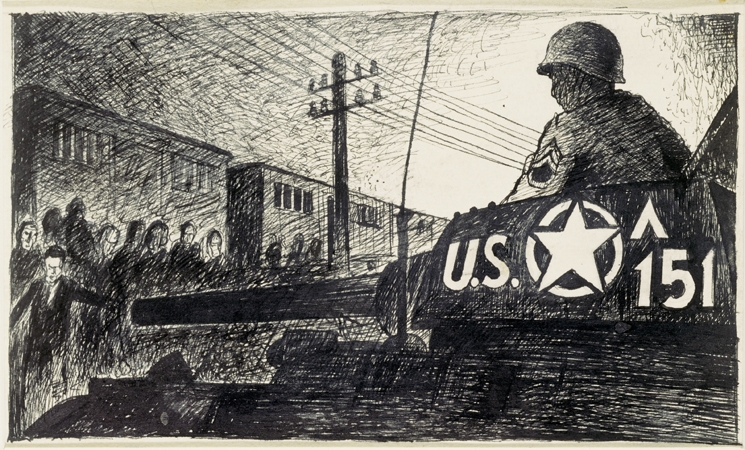
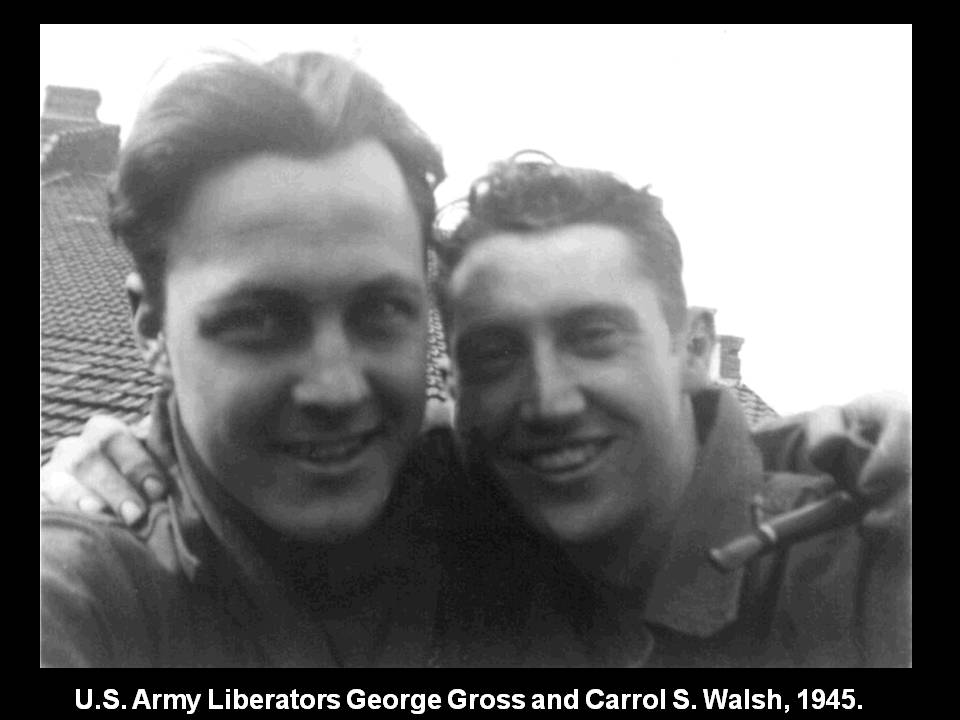
On the cusp of 100,000 visits to this site,  I am posting three photographs of the liberation of the train near Magdeburg that were discovered earlier this summer, with permission.  Gina Rappaport is the subject who appears in two of the photos, along with her sister and her cousin. I think it is shortly before tanker George Gross departed to join the rest of the battalion on Saturday morning, April 14, 1945.

“We were relieved the next morning, started up the tank, waved good-bye to our new friends, and followed a guiding jeep down the road to rejoin our battalion.  I looked back and saw a lonely Gina Rappaport standing in front of a line of people waving us good fortune.  On an impulse I cannot explain, I stopped the tank, ran back, hugged Gina, and kissed her on the forehead in a gesture I intended as one asking forgiveness for man’s terrible cruelty and wishing her and all the people a healthy and happy future. I pray they have had it.

Read Full Post »

Last week I had the honor of being the recipient of the Glen at Hiland Meadows President’s Award. For the last several years, my twelfth graders have interviewed this retirement community’s residents. One student is paired off with an individual whose life story is then documented by the student. An interview is conducted, transcribed, and then researched; a paper is produced that adds an important aspect of the story of World War II and the Great Depression to the historical record, a story that otherwise would have been lost. One copy is then sent to the state archives. The kids and the elders bond and learn a great deal from each other. My kids have produced two hundred plus folders of material and I am now in the process of sorting it all out for professional articles.

I had no formal remarks prepared. On the way over in the car the principal asked me how many awards I had received in my career. Self consciously I said that I thought this was the ninth or tenth. I had told no one but my students that I was going to the ceremony, as I would be missing them on the last day. I did not tell colleagues and I did not even tell my own wife, herself a teacher. They work every bit as hard as I do. Instead they get collectively kicked everyday by the local paper.

To my surprise, my wife had been contacted and entered the room to join us at a table that included a CEO, bank president, and health care executive. In the room also were board chairpersons, town supervisors, a school superintendent, Congressional staffers, judges, more bank presidents, other CEOs- you get the picture, the movers and shakers. They were very nice down-to-earth folks who seemed to relish the opportunity to step back from the office and network a bit with their peers.  One of them leaned into the principal and me and asked what our take was on the daily articles, editorials, and columns slamming everything in the education profession.

I knew right then what my remarks would be about. I thanked the audience but the first person I recognized was my wife- not just for her support, but because we were the only two teachers in the room (teachers could learn so much from networking like this, but instead she had to play hookey)! Then I thanked my principal and explained to the crowd that some of the most profound lessons can be found by allowing the teacher the latitude in the classroom to lead students on a journey of discovery that may not necessarily take the path of pretesting and post testing kids to death. I gave the example of a girl who interviewed a resident there, a grizzled Marine who survived many battles against the Japanese, including Iwo Jima, and lost quite a few friends in the process.  She was amazed at his life story, but something he said had struck a discordant note with her- here was a man who questioned the decision to use atomic force against the Japanese (combat Marines in World War II generally will tell you that it was the best thing that happened, from the standpoint of their own existence). So I gave Jillian books, articles, papers, websites, and off she went to produce a 45 page paper about Ralph and the controversy surrounding the 50th anniversary of the bombing and the national displaying of the Enola Gay. A connection was kindled, a publishable paper was written, a scholar was born, and today Jillian is in journalism school.

I don’t take credit for helping her find herself- she did all the work. But I know I won’t be getting the same results if I am turned into a “content support specialist”. While I recognize (and think I am pretty good at) my role as an assessment coach in certain subjects, I’m not a technician. I’m a history teacher. The new measures being instituted as a one-size-fits-all cure all by persons who are not even in the classroom  are myopic knee jerk political fixes that will have the effect of killing opportunities like these for our students. My senior elective which brought me to this awards ceremony and many others will likely be dead on arrival for not conforming to some narrow minded political quick fix. This class is not broken, but it will be killed off if it does not conform. And forget about bringing in World War II and Holocaust survivors to offer their life changing stories to the student body. Teachers are already scared to death to leave their classrooms. Shame on us all for allowing this.

Of course I did not bring that up, but I did tell them that contrary to what is read in the paper, punishing teachers is not going to solve the problems of society and will do more harm than good. (Do you know that we’ll even be graded for kids who are not in the classroom because an adult, somewhere, maybe a “parent”, lets them stay home all day?)

Personal responsibly and moral efficacy can’t be legislated- but they can be modeled and emulated. What better way to strengthen our national fiber, restore pride in ourselves and  draw courage from the lessons of the past than to charge a young person with preserving an older American’s story?

The talk was well received. Maybe I got to teach another lesson today. Fact is that some of the most powerful ones are unscripted.

Read Full Post »

“Those who can make you believe absurdities can make you commit atrocities.”
Voltaire (1694-1778)

In my state, New York, the educational gurus and data driven whiz kids at State Ed and outside testing consortiums are redefining public education in a way that is scary. Test, Test, Test. Measurement, accountability, formative assessment, summative assessment, normative assessment, on and on. Goodbye to meaning, depth, compassion, empathy.

How does one measure life changing experiences? The reunions I have organized of Holocaust survivors and their American liberators meeting with thousands of students are now a thing of the past. Now it’s time to focus on the pretests and the post tests. And the tests in between.

 God be with you if you as a teacher have the courage to stand up and say no.

German Medical Association Apologizes for Holocaust Horrors

The German Medical Association has apologized for sadistic experiments and other atrocious actions of doctors more than six decades ago under the Nazis.

By Christine Hsu | May 25, 2012

The German Medical Association has apologized for sadistic experiments and other atrocious actions of doctors more than six decades ago under the Nazis.

In the statement adopted on Wednesday at the Bundesärztekammer (German Medical Association) meeting in Nuremberg, the association said that many doctors under the Nazis were “guilty, contrary to their mission to heal, of scores of human rights violations and we ask the forgiveness of their victims, living and deceased, and of their descendants.”

The declaration also says that contrary to popular belief doctors were not ordered by political authorities to kill and to experiment on prisoners, instead the doctors had engaged in the Holocaust as leaders and enthusiastic Nazi supporters.

Besides conducting pseudo-scientific experiments on prisoners in Nazi concentration camps, German doctors played a large role in the Nazi’s program of forced sterilization or euthanasia of the mentally ill or others deemed “unworthy of life.”

The association noted that “outstanding representatives of renowned academic medical and research institutions were involved” in establishing and carrying out the mass execution of millions in the Holocaust.

They said “these crimes were not the actions of individual doctors but involved leading members of the medical community” and should serve as a warning for the future [my emphasis].

OK. About time, I suppose.

Now read the quote below. Israeli educational psychologist Haim Ginott writes about a letter that teachers would receive from their principal each year:

I am a survivor of a concentration camp. My eyes saw what no person should witness: gas chambers built by learned engineers. Children poisoned by educated physicians. Infants killed by trained nurses. Women and babies shot by high school and college graduates.

So, I am suspicious of education.

My request is this:  Help your children become human. Your efforts must never produce learned monsters, skilled psychopaths or educated Eichmanns. Reading, writing, and arithmetic are important only if they serve to make our children more human.

Read Full Post »

Dear Mr. Rozell,

Hilersleben -Luca Furnari

 My grandfather, Luca Furnari, is 90 years old and served in the 95th medical battalion with Mr. Gantz at Hillersleben. He has a number of photographs from this period.  For many years he has thought about trying to find a particular young girl who he helped sneak extra rations to at the DP camp and whose mother asked him to take back to the United States. He and some friends actually had a whole plan of how they were going to sneak her onto the boat back to the US, it’s a great story. Unfortunately, as you know, they were told they were going to the Pacific theatre and the plan became impossible.  Her name was Irene / Iren / Irena.  I have a photograph and have searched the manifest on your website, there are 3 possible people of approximately the right ages: Irena Gitler, Iren Roth and Iren Wittels.   I was wondering if you had come across any survivors from Hillersleben with the same name. 

Hilersleben-Irene is in the flowered dress

Also, I know my grandfather would love to be connected to any other surviving members from the US Army that were at Hillersleben.  

 My grandfather is the large picture on the left hand side.  Irene is in the flowered dress in the picture by herself and on the lap of another US soldier, whose name is Turner (?).  The picture with the baby is also Turner, and they are in the DP camp.  My grandfather’s inscription reads

Hilersleben-Turner-boy that kid sure did cry that day — until we gave her some chocolate.

“boy that kid sure did cry that day — until we gave her some chocolate”.  The picture of the building with barrels in the foreground is from Hillersleben too. It has a strange inscription from my grandfather

Hilersleben-some disorderly DPs getting a shower bath (DDT?)

“some disorderly DPs getting a shower bath”.  The one with the two girls just says “Two of the children that lived in the D.P. center we were taking care of. Cute eh hon?” (He was sending the pictures to my grandmother back in the States.)

The child Irene is the girl that my grandfather would like to try to locate. 

Soldier Turner and Irene.

Any help you can provide is MOST appreciated.

Best,
R.

Hilersleben-Two of the children that lived in the D.P. center we were taking care of. Cute eh hon?

Read Full Post »

PBS NEWSHOUR, MAY 2, 2012

JEFFREY BROWN: And finally tonight, one woman’s story of survival during the Holocaust and her new life in America as a champion of immigrants and citizenship.

Judy Woodruff has our conversation.

And a warning: It includes some disturbing images.

GERDA WEISSMANN KLEIN, Holocaust survivor: I guess we all knew that this was going to be the first step to the end of the road, either to liberation or to — to doom.

JUDY WOODRUFF: Those first steps for 20-year-old Gerda Weissmann from Bielsko, Poland, that snowy, frigid January in 1945 did lead to liberation, but only after three-and-a-half months and 350 miles of unimaginable horror.

Of the more than 2,000 young Jewish women and girls who the German S.S. forced to walk that death march through the snows of Eastern Europe, fewer than 150 survived. Most already had endured six years of ghettos, concentration camps and slave labor after Hitler’s army had invaded Czechoslovakia and Poland in 1939.

All had been separated from their families and loved ones.

GERDA WEISSMANN KLEIN: I was the only one from my family who survived, the only one of my dearest friends.

JUDY WOODRUFF: Among the American forces who found the starving and half-dead women was a young Jewish intelligence officer, Kurt Klein. While she was convalescing, Gerda and Kurt fell in love. They were married in 1946, and she emigrated to the U.S. They raised a family in Buffalo, N.Y., and devoted their lives to community service, working for tolerance, and honoring those who had died in the Holocaust.

Her 1957 memoir, “All But My Life,” led to an Oscar-winning documentary in 1996.

GERDA WEISSMANN KLEIN: I have been in a place for six incredible years where winning meant a crust of bread and to live another day.

JUDY WOODRUFF: In 2011, President Obama awarded her the Medal of Freedom, the highest honor a civilian can receive.

For the past several years, Gerda Weissmann Klein has been championing the values of citizenship and the immigrant’s role in creating a diverse and vibrant America.

And, Mrs. Klein, it’s an honor to have you with us.

GERDA WEISSMANN KLEIN: The honor is mine. I’m deeply grateful.

JUDY WOODRUFF: First of all, tell — tell me, why is it so important for people to keep talking about the Holocaust and what happened?

GERDA WEISSMANN KLEIN: I think, of course, the importance of the Holocaust should only be too illuminate the fact that it — that hatred and tyranny and all that is not over.

It is going on every single day. And I think that we should have more people come from countries where it is happening to see the type of pictures. You know, when I see pictures of little children holding battered little things for food, when villages are being burned, this is still going on.

I just think the Holocaust should be used as a beacon to show of what hatred and intolerance and all those things which have led to so much pain all over the world is capable.

JUDY WOODRUFF: People read your story or they hear your story, and they want to know what gave you the strength to survive, when so many others didn’t, that terrible experience.

GERDA WEISSMANN KLEIN: I do believe that it is 95 percent of luck, to be at the right moment at the right time, you know when selection came, you, you, you know.

Furthermore, I obviously had a very good and healthy constitution. And the will to live is extremely strong. You know, even I – I’ve just gone through quite a bit of illness. I’m going to be 88 years old, and I was in the hospital with people who were over 90, and the will to live is still strong.

I think that’s the very magic of life, and particularly if you were as young — we were all in our early 20s when it happened — or not quite 20 — the will to live pushes you on.

JUDY WOODRUFF: So, you’re now — what, it’s 62 years later. You are a very young 87. What’s kept you going?

GERDA WEISSMANN KLEIN: What kept me going is what kept everyone else going, the hope that, when it’s all over, we will go home to our families, to the life we left behind.

And I think that was probably the worst is, when it was over, there was nothing there. In my case, I met my beloved husband at the very moment of liberation, and my life took a different turn. And I could credit him with everything.

JUDY WOODRUFF: And what about in the six decades since? What’s kept you going all this time? You’ve dedicated yourself to work on. . .

JUDY WOODRUFF: . . . intolerance.

GERDA WEISSMANN KLEIN: I’ve been so fortunate.

I mean, you know, I need to ask myself every day, why am I here? I’m no better. Why was I was holding my children and grandchildren in my arms, sitting down to dinner with friends, walking in the rain? And I said I’ve been given the privilege of a meal. So, you know, you have to look back and say, if you have what you have, you know, survival is an incredible privilege. It’s also a very nagging and deep obligation. You know, it’s all the time.

JUDY WOODRUFF: And one of the ways you have given back is, you have been involved in so many causes.

GERDA WEISSMANN KLEIN: Well, hopefully to try to help a little.

JUDY WOODRUFF: … the Holocaust Museum. And you founded a few years ago this organization. . .

GERDA WEISSMANN KLEIN: Citizenship Counts.

JUDY WOODRUFF: . . . Citizenship Counts.

What is it that you want to convey to the younger generation through this?

GERDA WEISSMANN KLEIN: Well, let me put it this way.

I was so fortunate in meeting my husband, who brought me here, and I love this country. I love it with the love that only one who has been hungry and homeless for as long as I have been.

And my dream was, which probably is everybody else’s, complete assumption, my dream was to be married, of course to him, to live in a home and become a part of a community, to have children, to be involved. And all this became mine.

I came here not being able to speak English, and I always wanted to write. I came here not knowing one soul but my beloved husband. And look what happened. I didn’t — I wasn’t Mother Teresa. I didn’t work in the slums of Calcutta. I didn’t give my life to it. I have lived a good middle-class life. I didn’t discover a cure to cancer. You know, I didn’t become rich to endow great things.

I was just an average person. And why did it happen to me? And it only can happen in America, only in America. And I want to give back to this country.

JUDY WOODRUFF: Finally, do you think the United States is handling immigrants, immigration the way it should be today?

GERDA WEISSMANN KLEIN: I don’t know that — having had yearned so much for freedom, you can imagine that that’s a very difficult question for me.

And I hope and pray that, in the ultimate decision of justice, the heart will win over the brain.

JUDY WOODRUFF: Gerda Weissmann Klein, again, it’s our honor to talk with you. Thank you very much for being with us in the studio. Thank you.

GERDA WEISSMANN KLEIN: Thank you.

 
http://www-tc.pbs.org/s3/pbs.videoportal-prod.cdn/media/swf/PBSPlayer.swf

Watch Holocaust Survivor: Hatred, Tyranny Continue ‘Every Day’ on PBS. See more from PBS NewsHour.

Read Full Post »

“On April 30, 1945, Jewish-American G.I. Richard Marowitz  stormed into Hitler’s bedroom looking for anything he could bring back to headquarters.

Richard Marowitz of Albany , NY was on the scene for the liberation of Dachau. The following day he was at Hitler’s villa in Munich. Here is his story as told to Matthew Rozell and a group of students at Hudson Falls High School ten years ago.  Marowitz is a Jewish war veteran. Read the postscript to learn more about Hitler’s hat.

Richard M. Marowitz-42nd Rainbow Division-

The Liberation of Dachau

interviewed at Hudson Falls High School.

On the 29th of April 1945, my platoon was called into the command post, we were in a little village, I don’t remember the name of it, but it was probably about 25-30 miles from Dachau.  We were given new maps which showed Dachau, and we were told that the 20th Armored were already on the road to Dachau and our job was to take off and get to the tail end of the 20th Armored and be liaison between the 20th Armored and the infantry that would be coming down behind us in two and a half ton trucks, which is kind of idiotic but that’s the way the army was. The reason for that was we were having a race with the 3rd Division on one side of us, and the 45th Division on the other side of us, and they wanted the 42nd to win the race. So we took off on the road going very quickly like we usually do – if we came to a tree, the woods, or a village, we would stop and reconnoiter and find out if it was ok to go through without getting killed – and we kept getting pushed on the radio, ‘where are you,’ ‘what are your Greek coordinates,’ and ‘what’s taking so long? We are going to lose the race.’  After awhile of this kind of nonsense, Lieutenant Short stopped us and he said we to have to make a choice, either we’re going to have to step on the gas and go like hell and let surprise be on our side, or we’re going to lose the race and then everybody is going to get mad at us.  So we decided to step on the gas and go like hell, which is what we did. In the process, we ran into a whole lot of little hornet’s nests – it would have made a movie you wouldn’t have believed anyways – for example, we cut a German convoy in half that was going across a road that we were on, firing as we went through they didn’t know what happened because we weren’t supposed to be there and they were driving off the road. We did the same thing with another convoy that was going on a road in the opposite direction and parallel to ours, and we just fired on them as we went.  We came upon a village, and somebody fired on us and we went up on a small knoll next to the road and we dragged all the junk we had accumulated on the bottom of our jeeps like bazookas, mortars, etc. We fired on them and they probably thought they hit the front of the division. There’s no way they could’ve assumed it was only 28 men. Lieutenant Short stood up, honest to God, he actually said this: “Three men assault the town.” Three of us went in, Larry, myself and Howard Hughes, that’s his real name – great BAR man, Browning automatic rifle …and we claimed the first few houses, we accumulated 160, 170, 180 prisoners who looked around expecting to find more of us.  We broke up their weapons, told them to put their hands on their heads and walk back up the road.  They looked at us like were crazy; we looked back like we weren’t.   We went through another village and a German fired a panzerfaust, which is like a German bazooka, it landed on the other side of us and blew us out of the jeep. We dispatched quickly and we got back in the jeep and took off again.  These are the kinds of things that happened on the way to Dachau. 

When we got close to Dachau, you see there are a lot of smells in war, you smell the death smell all the time, but it’s usually farm animals who were rotting in the fields who were killed, rotting or whatever.  As we got closer to Dachau, we got this awful smell and we assumed it was farm animals, that we were going to pass a farm, or whatever. We finally got to the outskirts of Dachau and were pinned down.  Dachau was a favorite camp of the Germans, their first major camp, it was in Germany.  They didn’t want to give it up the other camps were walkovers.  The Germans just left them, and that was it.  But in this case at Dachau, they didn’t want to give it up too easily, there were a lot of SS guys around.  They were dropping some SS on us, and a lot of snipers – at one point an American tank came out of Dachau.  We were stuck in the ditch at that point, we stood up and realized we made a mistake when the gun came down on us – but at that instant, an American tank destroyer came up behind us and blew the tank away.  It happened to be an American tank that had been captured by the Germans and the guys in the tank destroyer knew that we didn’t have any tanks in there so therefore it had to be a captured tank.  I kissed a tank destroyer that day.     

    At that point, they told us to clean out the snipers and then proceeded to go into the camp.  At the outskirts of that camp, we went into a house – we banged on it, it was like a little small farm on the outskirts.  The door opened and there was a mother, a father, a daughter and a dog.  The mother had buckteeth, the father had buckteeth, the daughter had buckteeth, and when I looked down and saw that the dog had buckteeth, I was just hysterical.   It was the funniest sight, I was tense you know, and I could use anything at that point for a laugh.   Of course the other guys looked at me like I was nuts! Anyway, we did find some snipers – one we did away with that was firing away from a house nearby.  After we silenced him, we went up to see who it was.  He was eleven or twelve years old, one of the Hitler youth, who were actually worse than the SS.  They were just so brainwashed … we ran into a lot of those kids in their short pants. 

On the siding, you saw pictures of it in the slides, outside of the camp, adjacent to the camp, there were actually forty boxcars of bodies and

American soldiers of the U.S. 7th Army, force boys believed to be Hitler youth, to examine boxcars containing bodies of prisoners starved to death by the SS. USHMM

we found one man alive in that forty…there are some pictures of that one man, I don’t know whether he survived or not.  The prisoners were just walking skeletons, and they just dropped where they were and died.  There were piles of bodies, of bodies that had been gassed and readied for the ovens.  Some of them still lived because those boxcars were brought to Dachau to burn those bodies.  It was a total mess.  And the smell was not a farm; it was Dachau that we had smelled miles before we got there.  And yet, people in the village who were right next to the camps said they didn’t know what was going on.  People in Munich, which was actually only nine miles from Dachau, didn’t know what was going on.  Now if you want to believe that, the Brooklyn Bridge is still for sale.

    I never went back and I don’t intend to, I don’t feel like I want to.  But it is almost impossible to describe the feelings, so I’m not going to try.  But when you looked around some of these tough soldiers were throwing up and crying all over the place.  It is not possible to really describe the number of feelings you get when you walk into something like that.  Because that’s a scene that … well, first of all nobody told us about the camp!  We had no idea what a concentration camp did.  We were going to Dachau, period.  It was another village as far as we were concerned.  That’s kind of a shock to get all at one time. 

Interview recorded on May 3, 2002.

See Rich and I in a 2014 NBC LEARN video here.

POSTSCRIPT:

“On April 29, 1945, the 42nd Rainbow Division 222nd I&R platoon entered the gates of Dachau. One of many units sent to liberate the death camp, they saw first-hand the horrors of Hitler’s death machine.

The next day, 12 men of the I&R were ordered to search Adolph Hitler’s Munich apartment for military intelligence. Jewish-American G.I. Richard Marowitz, self-appointed wiseacre of the unit, stormed into Hitler’s bedroom looking for anything he could bring back to headquarters.

All he found was a black top hat.

Still angered by what he had seen at Dachau, Marowitz flew into a rage and jumped on the hat, crushing it, imagining Hitler’s head still inside. Then Marowitz, known for his comic antics even under stress, put Hitler’s crushed hat on his head and marched through the apartment with his best imitation of Charlie Chaplin doing Hitler from The Great Dictator. Tense from the day before, the I&R unit cracked up. Years later Marowitz found out that the same day he stomped Hitler’s hat, the Führer committed suicide in his bunker.

Marowitz returned home to Albany, N.Y., with the ultimate war souvenir stuffed into his duffel bag. He became a clothing manufacturer and professional magician and rarely talked about his war experiences. For the next 50 years, Hitler’s hat fittingly sat in a brown paper bag, buried at the bottom of his magic trick closet.

Following Marowitz to a Rainbow Division reunion, Hitler’s Hat interviews his I&R unit buddies to retell the story of Hitler’s hat. Daring and innovative, the documentary presents a rare mix of humor and history in an original take on World War II.”


“The Story of Hitler’s Hat”,
http://www.jeffkrulik.com/hitlershat/index.html

Read Full Post »

President Barack Obama tours the United States Holocaust Memorial Museum in Washington, D.C., with Sara Bloomfield, museum director, and Elie Wiesel, Nobel Peace Prize laureate and Holocaust survivor, April 23, 2012. (Official White House Photo by Pete Souza)

The President spoke yesterday at the USHMM in Washington, D.C. Below are his remarks and also the link to the video, where you can watch the introduction by Elie Wiesel.  (photo left: Sara Bloomfield introduced survivor Steve Barry and I to the gathering of soldier liberators in 2010.)

Remarks by the President at the United States Holocaust Memorial Museum

Washington, D.C.

10:00 A.M. EDT

THE PRESIDENT:  Good morning, everyone.  It is a great honor to be with you here today.  Of course, it is a truly humbling moment to be introduced by Elie Wiesel.  Along with Sara Bloomfield, the outstanding director here, we just spent some time among the exhibits, and this is now the second visit I’ve had here.  My daughters have come here.  It is a searing occasion whenever you visit.  And as we walked, I was taken back to the visit that Elie mentioned, the time that we traveled together to Buchenwald.

And I recall how he showed me the barbed-wire fences and the guard towers.  And we walked the rows where the barracks once stood, where so many left this Earth — including Elie’s father, Shlomo.  We stopped at an old photo — men and boys lying in their wooden bunks, barely more than skeletons.  And if you look closely, you can see a 16-year old boy, looking right at the camera, right into your eyes.  You can see Elie.

Survivors at Buchenwald Concentration Camp remain in their barracks after liberation by Allies on April 16, 1945. Elie Wiesel, the Nobel Prize winning author of Night, is on the second bunk from the bottom, seventh from the left. (Photo : Corbis)

And at the end of our visit that day, Elie spoke of his father.  “I thought one day I will come back and speak to him,” he said, “of times in which memory has become a sacred duty of all people of goodwill.”  Elie, you’ve devoted your life to upholding that sacred duty.  You’ve challenged us all — as individuals, and as nations — to do the same, with the power of your example, the eloquence of your words, as you did again just now.  And so to you and Marion, we are extraordinarily grateful.

To Sara, to Tom Bernstein, to Josh Bolten, members of the United States Holocaust Memorial Council, and everyone who sustains this living memorial — thank you for welcoming us here today.  To the members of Congress, members of the diplomatic corps, including Ambassador Michael Oren of Israel, we are glad to be with you.

And most of all, we are honored to be in the presence of men and women whose lives are a testament to the endurance and the strength of the human spirit — the inspiring survivors.  It is a privilege to be with you, on a very personal level.  As I’ve told some of you before, I grew up hearing stories about my great uncle — a soldier in the 89th Infantry Division who was stunned and shaken by what he saw when he helped to liberate Ordruf, part of Buchenwald.   And I’ll never forget what I saw at Buchenwald, where so many perished with the words of Sh’ma Yis’ra’eil on their lips.

I’ve stood with survivors, in the old Warsaw ghettos, where a monument honors heroes who said we will not go quietly; we will stand up, we will fight back.  And I’ve walked those sacred grounds at Yad Vashem, with its lesson for all nations — the Shoah cannot be denied.

During my visit to Yad Vashem I was given a gift, inscribed with those words from the Book of Joel:  “Has the like of this happened in your days or in the days of your fathers?  Tell your children about it, and let your children tell theirs, and their children the next generation.”  That’s why we’re here.  Not simply to remember, but to speak.

I say this as a President, and I say it as a father.  We must tell our children about a crime unique in human history.  The one and only Holocaust — six million innocent people — men, women, children, babies — sent to their deaths just for being different, just for being Jewish.  We tell them, our children, about the millions of Poles and Catholics and Roma and gay people and so many others who also must never be forgotten.  Let us tell our children not only how they died, but also how they lived — as fathers and mothers, and sons and daughters, and brothers and sisters who loved and hoped and dreamed, just like us.

We must tell our children about how this evil was allowed to happen — because so many people succumbed to their darkest instincts, and because so many others stood silent.  Let us also tell our children about the Righteous Among the Nations.  Among them was Jan Karski, a young Polish Catholic, who witnessed Jews being put on cattle cars, who saw the killings, and who told the truth, all the way to President Roosevelt himself.

Jan Karski passed away more than a decade ago.  But today, I’m proud to announce that this spring I will honor him with America’s highest civilian honor — the Presidential Medal of Freedom.  (Applause.)

We must tell our children.  But more than that, we must teach them.  Because remembrance without resolve is a hollow gesture.  Awareness without action changes nothing.  In this sense, “never again” is a challenge to us all — to pause and to look within.

For the Holocaust may have reached its barbaric climax at Treblinka and Auschwitz and Belzec, but it started in the hearts of ordinary men and women.  And we have seen it again — madness that can sweep through peoples, sweep through nations, embed itself.  The killings in Cambodia, the killings in Rwanda, the killings in Bosnia, the killings in Darfur — they shock our conscience, but they are the awful extreme of a spectrum of ignorance and intolerance that we see every day; the bigotry that says another person is less than my equal, less than human.  These are the seeds of hate that we cannot let take root in our heart.

“Never again” is a challenge to reject hatred in all of its forms — including anti-Semitism, which has no place in a civilized world.  And today, just steps from where he gave his life protecting this place, we honor the memory of Officer Stephen Tyrone Johns, whose family joins us today.

“Never again” is a challenge to defend the fundamental right of free people and free nations to exist in peace and security — and that includes the State of Israel.  And on my visit to the old Warsaw Ghetto, a woman looked me in the eye, and she wanted to make sure America stood with Israel.  She said, “It’s the only Jewish state we have.”  And I made her a promise in that solemn place.  I said I will always be there for Israel.

So when efforts are made to equate Zionism to racism, we reject them.  When international fora single out Israel with unfair resolutions, we vote against them.  When attempts are made to delegitimize the state of Israel, we oppose them.  When faced with a regime that threatens global security and denies the Holocaust and threatens to destroy Israel, the United States will do everything in our power to prevent Iran from getting a nuclear weapon.

“Never again” is a challenge to societies.  We’re joined today by communities who’ve made it your mission to prevent mass atrocities in our time.  This museum’s Committee of Conscience, NGOs, faith groups, college students, you’ve harnessed the tools of the digital age — online maps and satellites and a video and social media campaign seen by millions.  You understand that change comes from the bottom up, from the grassroots.  You understand — to quote the task force convened by this museum — “preventing genocide is an achievable goal.”  It is an achievable goal.  It is one that does not start from the top; it starts from the bottom up.

It’s remarkable — as we walked through this exhibit, Elie and I were talking as we looked at the unhappy record of the State Department and so many officials here in the United States during those years.  And he asked, “What would you do?”  But what you all understand is you don’t just count on officials, you don’t just count on governments.  You count on people — and mobilizing their consciences.

And finally, “never again” is a challenge to nations.  It’s a bitter truth — too often, the world has failed to prevent the killing of innocents on a massive scale.  And we are haunted by the atrocities that we did not stop and the lives we did not save.

Three years ago today, I joined many of you for a ceremony of remembrance at the U.S. Capitol.  And I said that we had to do “everything we can to prevent and end atrocities.”  And so I want to report back to some of you today to let you know that as President I’ve done my utmost to back up those words with deeds.  Last year, in the first-ever presidential directive on this challenge, I made it clear that “preventing mass atrocities and genocide is a core national security interest and a core moral responsibility of the United States of America.”

That does not mean that we intervene militarily every time there’s an injustice in the world.  We cannot and should not.  It does mean we possess many tools — diplomatic and political, and economic and financial, and intelligence and law enforcement and our moral suasion — and using these tools over the past three years, I believe — I know — that we have saved countless lives.

When the referendum in South Sudan was in doubt, it threatened to reignite a conflict that had killed millions.  But with determined diplomacy, including by some people in this room, South Sudan became the world’s newest nation.  And our diplomacy continues, because in Darfur, in Abyei, in Southern Kordofan and the Blue Nile, the killing of innocents must come to an end.  The Presidents of Sudan and South Sudan must have the courage to negotiate — because the people of Sudan and South Sudan deserve peace.  That is work that we have done, and it has saved lives.

When the incumbent in Côte D’Ivoire lost an election but refused to give it up — give up power, it threatened to unleash untold ethnic and religious killings.  But with regional and international diplomacy, and U.N. peacekeepers who stood their ground and protected civilians, the former leader is now in The Hague, and Côte D’Ivoire is governed by its rightful leader — and lives were saved.

When the Libyan people demanded their rights and Muammar Qaddafi’s forces bore down on Benghazi, a city of 700,000, and threatened to hunt down its people like rats, we forged with allies and partners a coalition that stopped his troops in their tracks.  And today, the Libyan people are forging their own future, and the world can take pride in the innocent lives that we saved.

And when the Lord’s Resistance Army led by Joseph Kony continued its atrocities in Central Africa, I ordered a small number of American advisors to help Uganda and its neighbors pursue the LRA.  And when I made that announcement, I directed my National Security Council to review our progress after 150 days.  We have done so, and today I can announce that our advisors will continue their efforts to bring this madman to justice, and to save lives.  (Applause.)  It is part of our regional strategy to end the scourge that is the LRA, and help realize a future where no African child is stolen from their family and no girl is raped and no boy is turned into a child soldier.

We’ve stepped up our efforts in other ways.  We’re doing more to protect women and girls from the horror of wartime sexual violence.  With the arrest of fugitives like Ratko Mladic, charged with ethnic cleansing in Bosnia, the world sent a message to war criminals everywhere:  We will not relent in bringing you to justice.  Be on notice.  And for the first time, we explicitly barred entry into the United States of those responsible for war crimes and crimes against humanity.

Now we’re doing something more.  We’re making sure that the United States government has the structures, the mechanisms to better prevent and respond to mass atrocities.  So I created the first-ever White House position dedicated to this task.  It’s why I created a new Atrocities Prevention Board, to bring together senior officials from across our government to focus on this critical mission.  This is not an afterthought.  This is not a sideline in our foreign policy.  The board will convene for the first time today, at the White House.  And I’m pleased that one of its first acts will be to meet with some of your organizations — citizens and activists who are partners in this work, who have been carrying this torch.

Going forward, we’ll strengthen our tools across the board, and we’ll create new ones.  The intelligence community will prepare, for example, the first-ever National Intelligence Estimate on the risk of mass atrocities and genocide.  We’re going to institutionalize the focus on this issue.  Across government, “alert channels” will ensure that information about unfolding crises — and dissenting opinions — quickly reach decision-makers, including me.

Our Treasury Department will work to more quickly deploy its financial tools to block the flow of money to abusive regimes.  Our military will take additional steps to incorporate the prevention of atrocities into its doctrine and its planning.  And the State Department will increase its ability to surge our diplomats and experts in a crisis.  USAID will invite people and high-tech companies to help create new technologies to quickly expose violations of human rights.  And we’ll work with other nations so the burden is better shared — because this is a global responsibility.

In short, we need to be doing everything we can to prevent and respond to these kinds of atrocities — because national sovereignty is never a license to slaughter your people.  (Applause.)

We recognize that, even as we do all we can, we cannot control every event.  And when innocents suffer, it tears at our conscience.  Elie alluded to what we feel as we see the Syrian people subjected to unspeakable violence, simply for demanding their universal rights.  And we have to do everything we can.  And as we do, we have to remember that despite all the tanks and all the snipers, all the torture and brutality unleashed against them, the Syrian people still brave the streets.  They still demand to be heard.  They still seek their dignity.  The Syrian people have not given up, which is why we cannot give up.

And so with allies and partners, we will keep increasing the pressure, with a diplomatic effort to further isolate Assad and his regime, so that those who stick with Assad know that they are making a losing bet.  We’ll keep increasing sanctions to cut off the regime from the money it needs to survive.  We’ll sustain a legal effort to document atrocities so killers face justice, and a humanitarian effort to get relief and medicine to the Syrian people.  And we’ll keep working with the “Friends of Syria” to increase support for the Syrian opposition as it grows stronger.

Indeed, today we’re taking another step.  I’ve signed an executive order that authorizes new sanctions against the Syrian government and Iran and those that abet them for using technologies to monitor and track and target citizens for violence.  These technologies should not empower — these technologies should be in place to empower citizens, not to repress them.  And it’s one more step that we can take toward the day that we know will come — the end of the Assad regime that has brutalized the Syrian people — and allow the Syrian people to chart their own destiny.

Even with all the efforts I’ve described today, even with everything that hopefully we have learned, even with the incredible power of museums like this one, even with everything that we do to try to teach our children about our own responsibilities, we know that our work will never be done. There will be conflicts that are not easily resolved.  There will be senseless deaths that aren’t prevented.  There will be stories of pain and hardship that test our hopes and try our conscience.  And in such moments it can be hard to imagine a more just world.

It can be tempting to throw up our hands and resign ourselves to man’s endless capacity for cruelty.  It’s tempting sometimes to believe that there is nothing we can do.  And all of us have those doubts.  All of us have those moments — perhaps especially those who work most ardently in these fields.

So in the end, I come back to something Elie said that day we visited Buchenwald together.  Reflecting on all that he had endured, he said, “We had the right to give up.”  “We had the right to give up on humanity, to give up on culture, to give up on education, to give up on the possibility of living one’s life with dignity, in a world that has no place for dignity.”  They had that right.  Imagine what they went through.  They had the right to give up.  Nobody would begrudge them that.  Who’d question someone giving up in such circumstances?

But, Elie said, “We rejected that possibility, and we said, no, we must continue believing in a future.”  To stare into the abyss, to face the darkness and insist there is a future — to not give up, to say yes to life, to believe in the possibility of justice.

To Elie and to the survivors who are here today, thank you for not giving up.  You show us the way.  (Applause.)  You show us the way.  If you cannot give up, if you can believe, then we can believe.  If you can continue to strive and speak, then we can speak and strive for a future where there’s a place for dignity for every human being.  That has been the cause of your lives.  It must be the work of our nation and of all nations.

So God bless you.  And God bless the United States of America.  Thank you very much.  (Applause.)

END
10:27 A.M. EDT

http://www.whitehouse.gov/photos-and-video/video/2012/04/23/president-obama-speaks-preventing-mass-atrocities#

Read Full Post »

I received this press release and am passing it on with  notes and the interview I conducted 14 years ago with one of the panel members.

As part of an intergenerational project focused on collecting oral histories of local elders, a panel of World War II veterans from the local community will speak  on Wednesday, April 25th from 6:30-8:00 p.m. in Gannett Auditorium in Palamountain Hall at Skidmore College. One veteran is a POW from the infamous Stalag Luft III, the setting of the movie, The Great Escape.

Panel members will include:

Earl Morrow, Hartford, NY. Army Air Corps. B-17 pilot, shot down over Germany and held a POW for nine months.
Jack Springer, Kingsbury, NY. US Navy, South Pacific
Bob Addison, Glens Falls, NY. USMC, Guadalcanal etc Edson’s Raiders
Gerry West, Fort Edward, NY. USMC, Guadalcanal etc Edson’s Raiders

The following interview was conducted by Matthew Rozell and recorded before a classroom full of students on October 22, 1998.

Earl Morrow, B-17 pilot. photo by Rob Barendese.

Matthew Rozell: Our guest today is Mr. Earl Morrow. Mr. Morrow, can you tell us how old you are?

Earl Morrow: Seventy-seven.

 Fifty-four years next month,  Mr. Morrow was a captain of a B-17 Flying Fortress during WWII. He was the commander of the aircraft that had nine crew members on it. His mission was to fly over Nazi-Germany, daylight missions, and basically drop bombs to try and reduce the enemies’ capacity to wage war. He is here to tell us a little bit about his experiences. About fifty four years ago next month,  on his seventeenth combat mission over enemy territory, Mr. Morrow and his crew went down. They were shot down by German flak and German aircraft and he was taken prisoner. He remained prisoner  until the Allies under General George Patton came through and liberated him. He actually got to see General Patton. So he is here to tell us a little bit about his story, and to remind us that even though it was fifty-four years ago and that it seems like an eternity to us, it’s not for him. And we have to remember what his generation did, because it could happen again.

Mr. Morrow, you said you flew in 17 combat missions.  Did you find that many of them, obviously from what we heard, the hardest part was the return trip?

It varied depending on where you were going. We lost one engine just due to mechanical failure one time going in, which caused us to slow down and we were pulling full power on the other three all the way in. That’s when they really worked to stay in formation. When you are sending up a thousand airplanes a day on a single target, if you are on the outside of a formation and you’re making a left turn, you are going to have full power just to stay in. On the other hand, if they are going the other way you are on the inside, then you are going to be stalling out. So when you really haven’t got your full power, then you’ve really got problems. We only saw fighters three times in the 17 missions, and all three times they were on us after we had hit the target.

Crew of B-17. Pilot Earl Morrow far left.

I have a photograph here, maybe I can get Mr. Morrow to explain who’s in it. This is a photograph of Mr. Morrow and his crew. He had 9 men in his crew. I asked Mr. Morrow to list the ages of the crewmembers. In the front row kneeling you had the officers.

(Pointing) This one was me, the captain of the airplane. (Pointing at another) Co-captain, he was an older gentleman, he was so old, he was 27, we called him “Pa”.

 How old were you?

I was 22. This is the navigator.

When we take off we have to get in to formation. He had all the maps and everything. And if something happened, to lead the formation, it was his job to get us back. It did happen a couple of times, and he got us back in good shape. This is the bombardier; he’s just a month older than I am. This gentleman over here was just a little older than the rest of us. He stayed in the service and he was a top turret gunner. He retired in ’72 as a brigadier general. When we were flying, he was a sergeant.

This was our radio operator; he was killed in action the day we were shot down. This is the waist gunner; he was also killed the day we were shot down. Robert Carter was a ball turret operator, which is the worst position you can be in on the aircraft. You are down underneath, you can’t even see it on here (pointing to a model airplane).  I got in it once and the sergeant put his foot on my back and shoved me in. You can’t see the airplane, all you got is your two guns down there and you can turn that thing up, down, all around, but it has stops on it where you can’t shoot your own airplane. That’s the worst place to be in. He (Carter) also was killed in action that day.

B-17 ball turret.

(Pointing again at photograph of crew) This gentleman didn’t go with us that day because they took the gun in the radio room out. They took it out and they decided it wasn’t of much value, which it wasn’t, and the operator would go back and work on the waist guns, so we would leave one man home.

This one was a tail gunner, and he survived.

 Your waist gunner, Joe Calerno, who was killed in action on the second of November, 1944, the day you were shot down. He’s not real tall in this picture and that’s because, how old was he?

He was 18. He went in the service, kind of told a fib about his age because they wouldn’t take anybody under 18.

So that’s his crew and I’ll pass that around. I have another photograph of Mr. Morrow standing next to his airplane. Now did you fly the same throughout all 17 missions?

I had one airplane-we only flew it three times. The rest of the time they were putting it back together from battle damages and so forth.

Here is one of the landings you had to make when the landing craft was shot off.

The landing gear collapsed there due to the drag link on the gear, and it had been about three-quarters shot off when the weight of the airplane settled down and the left gear just collapsed, and we made a 180 degree turn. We were almost stopped anyway, so we didn’t do any damage other than the props.

 They were pretty twisted up. Can you, and I’m sure you can, think of a lot of particular instances that really stand out in your mind when you were captain of the ship? You had so many men dependent on you. You all had a job to do. What was it like to, well what kind of relationship did you have with your crew?

I think I had the best crew that was over there. We all had nicknames for each other. I told the guys right off the start. There were four of us that were officers, commission officers, and the rest of them were non-commission officers, but they were the highest ranked sergeants you could have. I told them right at the beginning, ‘I don’t want any one of you to ever salute me, unless there’s somebody standing over there that expects you to, then do it.’ We were all in this small machine, well it’s a big machine but you crowd nine men in it, it’s small then. When you’re going over there and they’re shooting at you in a small space, you better know who your buddies are and I know I could depend on anybody in that crew. It took a while for the men to get faith in me, because we were the ones to get that airplane off the ground and get it back on the ground. We got shot up, keep it in the air as long as we could and get it back and we made landing before we got overseas. That’s probably the best thing that’s happened to the crew. We made landing on a dark night, we had a real problem and were afraid the thing might catch on fire, we made landing in almost a cow pasture where they had two flares on one end of the field and two flares on the other end of the field. We got the thing in there at night and the next day they sent somebody up with equipment to fix the airplane. They stripped down the airplane, they made three passes at daylight before they got in. So the crew had decided I was a pretty good pilot. The proof I got later on was on a forced march. My bombardier had complete amnesia and I was taking care of him and keeping him going.

This was after you were shot down?

Yes, at the P.O.W. camp, and he finally looked at me and he said, “I know who you are. You’re the best damn pilot in the world.” I kid him even today. You had to get him knocked out completely with amnesia before he would admit it. The truth comes out then. But every man in the crew did his job and did it well.

Technically, when you were off duty, you weren’t supposed to fraternize with them.

Once we were over seas and not at base you could just do about what they wanted. As a matter of fact, I had a bicycle, and I could never find my bicycle because some of the enlisted men, they didn’t give them bicycles, our bicycles were always gone. We would fraternize with them, we’d go to town, we’d do it a lot and you’d go together.

So, to get to know each other was really important. Mr. Morrow also brought in some of the citations in the wars that he got, and not every veteran gets these medals. When did you get this medal?

1990.

Can you describe this medal for us?

That’s a POW medal, it shows the eagle, but all around it is barbed wire so he can’t fly.

(to students) And this of course is perhaps one you’ve seen before.

That’s a Purple Heart, issued to people who were killed in action or wounded in action. I got it just a year ago, the reason for that was we had no medical records and Congress finally passed the law that all POWs could apply for it and they would determine that you were probably wounded in action. You would get it so I got it last fall, it was 54 years later…And then when I applied for it I got a letter back from the air force asking me to be patient.

I have an account of the last mission Mr. Morrow flew. What did your crew call you?

Shad.

I had gotten married just before the crew got together, and they said I kind of got skinny and so you could hardly see my shadow I was so skinny, so they called me “Shad”. That was the name of our airplane. The crew did all, I let them name it.

I’m going to read this account and then maybe we can talk about your experiences when you were in captivity.

(Mr. Rozell begins to read) ” It was early in the morning on November 2nd 1944 that we were awakened and informed that we were going on a bombing mission. We got dressed and ready for breakfast in the mess hall. It was a cold and rainy morning and we got fresh eggs for breakfast. No one was talking much, it seemed that everyone was buried in their own thoughts. After breakfast we went to the briefing room and got the bad news. We were going all the way into E. Germany (pointing to E. Germany) to bomb a synthetic oil refinery in Mersburg. We knew that the Germans would have put up all they had, as they were short on their oil supply.

We had 16 missions and we had seen enemy fighters only 3 to possibly four times. It was assumed that they were short of fuel. We went out to our airplanes and started our routine of checking everything. My top turret gunner advised me that everything had checked O.K. and added that he just put several hundred rounds of ammunition in his guns, he said we might need the extra today! My radio operator informed me that he had lost his dog tags. I told him that we would have to wait until after we were back from the mission and I would go with him to get a new set.

 Shortly we were in our airplane and taxiing out for takeoff and soon we were joining our group and heading out over the English Channel and climbing to our altitude of 28,000 feet, over 5 miles. It was a long flight all the way into E. Germany and most all the flight was over enemy territory. Everyone had to stay alert for enemy aircraft. We finally arrived in the vicinity of our target and we started the bomb run. (MR to EM): What was the bomb run about?

They gave you an initial point and from there on everything was straight and level right in. You take no evasive action and its about five miles. You go straight in to the target, drop your bombs and after that, the group can take evasive action. From the initial point in, you just sit there and fly straight and level no matter who’s out there or what.

MR(back to account): There was a lot of heavy and accurate flak and we had several flak hits, but there was no severe damage to our aircraft. We dropped our bombs on target and started home. My navigator advised me that our group was not following the proper course and were fast becoming quite a distance from the whole formation. (MR to EM): So the formation, how many planes about were on that?

About a thousand, and our group of thirty-six, were off on another course.

(Back to the account): I ordered my radio operator to call the lead ship and advise them. We got a message back to maintain radio silence. About this time my top turret gunner, sighted a dog fight at six o’clock high. That means our fighters were engaging theirs behind and above us. I ordered everyone to be alert as this meant we were about to be attacked by enemy fighters. As we suspected, their fighters drew our escort into a fight and another German group hit us. They would come in behind us, drop their flaps, slow up and began pumping 20mm cannon shells into us at close range. Up front where I was, we never saw a fighter as they would roll and dive down behind us. We however could hear and feel cannon shells hitting our plane. I was advised that my vertical stabilizer…..

The end rudder was shot off just above the tail gunner’s head. They were coming in at about fifteen at a time. The second wave hit us in our left wing and knocked ten to twelve feet off the wing.

I just saw a crease go up the wing, an explosion, and then the whole thing fell off.

The third wing seemed to miss us. I was still flying in formation, but I was thinking, “If we make it out of this one, will I be able to fly this Fortress back and land it with so much damage?” My thoughts were interrupted with two cannon shells exploding in the cockpit, between my co-pilot, and his side of the airplane.

It set us on fire.

We were on fire and the cockpit filled up with smoke so bad. The only way I could see was with my face up against the window. My top turret gunner left his guns and was fighting the fire. We thought we had it out, when it all flared up again. We had no choice but to get out before the ship blew up. I gave the “bail out” signal and pulled my co-pilot out of his seat. I got him started down the front where the escape path was.

     We all had to go out a small trap door below the cockpit, so I had to get my co-pilot out of his seat. He was wounded real badly. I just yanked him out of his seat and we all went down under the instrument panel into the front. You just sit there with your feet hanging out and you fall out. I left my seat to follow him and then I felt the airplane climbing. I knew that if it had climbed too steep, it would haul out into a spin and no one would go out. I went back into the controls and forced the plane into a shallow fly. Then I went down and forward to get out. 

    My co-pilot was sitting in the escape path, so I put my foot in his back and shoved him out. I immediately followed. Just as I cleared the plane, she blew. All I saw was a huge flash and felt some of the concussion. I was in the clouds and got scared and knew that if I opened my chute, it would be damaged by air currents. I decided to delay opening until I broke out into the clear, which I estimated to be about ten thousand feet. I played around and found that I could keep myself face down if I kept the wind in my face. Suddenly I broke out and saw Germans all over the area. I said a few choice words of profanity and ripped my chute cord, which opened perfectly. 

    I was on the ground and almost able to stay on my feet. I was dragged over backwards but managed to get on my feet to see three women bearing down on me with pitchforks. (MR to EM): We know that three of your crewmembers didn’t make it out of the plane.

The tail gunner got out. He had an escape hatch way on the other side, on the tail section. The others were supposed to go out a door on the other side just back of the waist gun window. The tail gunner saw that the escape door was gone so apparently someone had got out the back. But he said the waist gunner, Joe Calerno, was standing there, so he motioned for him to go over and Calerno went like this, (blank stare), and the only thing we can figure is that Calerno went straight off with Kerner in the ball turret. Now I think they had a pact between them that if he’s not out of that ball turret, that’s the hardest place to get out of, you don’t go to climb out. I think Joe was waiting for Kerner to get out. I feel that we lost the man mainly because he wanted to make sure his buddy was out.

 I got on my feet to see three women bearing down on me with pitchforks. I was wearing a 45 automatic in my shoulder holster. I unstrapped the holster and had my hand on the grip but did not take it out of the holster. It stopped the women and I ran down a bank across the road and started across the field. They were coming in from all directions so I just sat down and let them come and get me. I spotted a man in uniform at a distance and tried to tell these people that I wanted to go to him, the man in uniform, but to no avail. So I started walking toward the man in uniform and was knocked down two or three times ‘till they finally escorted me to the soldier.

    We were instructed to get under military control as soon as possible. There were kids throwing stones and women spitting like pigs. The big surprise, all the little kids can talk perfect English. I knew know just how much the Germans had planned on winning the war. The soldier took me into a little town and put me with some other crewmembers. I found four of my crew, which meant my co-pilot, radio operator, waist-gunner, and ball turret gunner were all missing. There were 33 of us rounded up and we figured that we had lost 9 aircraft. That would be 81 men and there were only 33 of us. 

    We were put into what looked like a one-room schoolhouse. We had no intentions of going anywhere. Many of the 33 men were badly injured from broken bones and severe burns. It had been a very long day. Now we were really starting to think about the situation that we were in. I was concerned that our families would not know about our whereabouts or our condition. I was sure that I didn’t want to get sick, as I would have no access to a doctor or medicine. A couple of days later, my co-pilot was brought in to where we were. He was very badly wounded but only lost a small amount of blood as he opened his chute immediately after jumping from the aircraft. His bleeding froze and coagulated in the lower altitude. (It was 60 degrees below zero when we bailed out.) 

    We were moved out a few days later and sent by train to Frankfort where we spent about five days being interrogated. We were separated and the officers were sent to one of the prisoners of war camps south of south east of Berlin and the non-commissioned officers were sent to another camp. Life was not easy, we were always cold, bored, hungry and very anxious about our future. Hitler even gave the order that all air crewmembers were to be killed, but someone failed to carry out the order, which we were very grateful for. We were moved twice to different camps and General Patton and his troops finally liberated us. (MR to EM): So that was in November of 1944. Do you remember the day you were liberated?

The first of May.

The first of May, 1945. The German High Command formally surrendered one week later. Can you tell us where you were when that came through?

We were down in the Bavaria, a little town in Brunswick, near Munich. We were pretty close to Switzerland. As a matter of fact, a Red Cross truck was getting to us then out of Switzerland. My co-pilot, we picked him up in Nuremberg and then when they started marching us out of there they never took that flak out of him, a piece of it moved and paralyzed him. They put him in a Red Cross truck and drove him over to Switzerland then they flew him out to England. So he survived.

You were telling me this summer when I came to your house about the march that you were forced on.

That was in January of 1945. They started about ten thousand of us in this camp. They put us on a march because the Russians were getting close and we started out at one o’clock in the morning. As we went out the gate they threw a Red Cross package at us and they started us. We would run ten minutes, walk ten minutes…, and they kept this up. At the end of the hour they have a five-minute break and then right back into it until about five in the afternoon.

It was about thirty below zero, the worst blizzard they had in Germany. At about five in the afternoon they gave us about a half-hour break and I tried to change my socks. I had GI shoes on that were the high tops. I got my shoes off, I got my new socks on and my shoes were frozen and I couldn’t get them back on, that’s how cold it was outside.

We lost a lot of boys by that march, just falling out. They said if you fell out the Germans would run you through with a bayonet. We were guarded by German soldiers with machine guns and dogs. We finally, after about 38 hours, by the time they put us in churches in town we were cold. There was a burgermaster (who was the same as a town mayor) who had a son, I guess, who was a POW over here who opened up a pottery factory. They let us sit down in the drying factories where it was warm. He kept us there and overruled the military for about three days and kept us there.

They put us on freight cars where it was so crowded you couldn’t even sit down. We stayed on those for about three days, we were still fighting the war though. When they slowed down in the town or stopped in a town, that’s when we’d open the doors and go to the bathroom anything to desecrate their property. Even as a POW, we were still doing everything we could to upset the Germans.

On that march, we went to Nuremberg. When the American’s were getting closer they took us down into  Bavaria. It was fairly warm weather. The co-pilot was with us, he showed up in Nuremberg. He started walking and a piece of that stuff settled on him, and the Red Cross trucks were getting to us. We were getting a little bit of food from them. They took him out and a lot of us were in bad shape. I was able to buy from a German woman a chassis of a baby buggy so I had piled a couple of other guy’s stuff on that and I was pushing a baby buggy across Germany. The first day out, we were attacked by American airplanes, we peeled off our clothes and made a big POW sign in the field and from then on, we had fighter escort. No one was hurt but they fired a few shots to let us know they were there. As far as they knew we were POWs and we had fighter escorts all the rest of the way on the march.

We got down to Mersburg and it was real nice there because we were in tent and we had clean straw on the ground and at Nuremberg it was infested with rats and mice and I was covered from head to foot with bug bites. We had a doctor in there and he figured out that the food we were getting then, if we lay at bedrest we still weren’t getting enough to survive.

So living at Nuremberg, we were in really bad shape. We had a radio in there, the Germans knew it, but they could never find it. Every time they put us on the march, they asked if we were bringing the radio. We got a message in from England on the radio that General Patton would attack the town of Mersburg on Sunday at 10am. Sure enough, Sunday morning at 10am, the first tank rolled over the top of the hill and it started pouring heavy stuff into the town and it wasn’t but 30 minutes later that the American flag went up over town, a tank came down and just didn’t open the gate. It just came on through, and General Patton was right behind him standing in a pickup truck with his pearl handle pistols. I wasn’t moving around too fast , but I looked around the corner of a building and I threw him a salute and he returned it, so I got a salute out of General Patton.

He made a little speech to us, he said,” You are the best morale bunch that I have liberated up to this point.” That is because they actually parachuted a whole crew in to get a colonel in there to take over a camp. Every Saturday you stood inspection, cleanly shaved, with your pants pressed. All you had to shave was a razor blade and a glass of cold water, no soap. But if you were cleanly shaved, as a result of that Patton said we were the best morale, the best looking group that he liberated.

The Allies purposely dropped him in?

Yes, because there was general in there, and he wouldn’t fight the Germans at all, he just gave up. So they sent this colonel in, and I saw him walk up and stand in front of the Germans and tell the German general that he could go to hell. He told him one time, the Germans were ready to start shooting, and he said, “If you want to start shooting, you can start on me right now!” He stood up, he was an older gentleman, but he really made life worthwhile. You have a tendency to let yourself go, unless you have somebody making sure, discipline doesn’t hurt anybody.

Does anyone have a question? Did you see the movie “Saving Private Ryan”?

No, I haven’t yet. I heard it was the only movie made that makes the Americans come out a hero, for once.

Did you see the “remake” of the “Memphis Belle” that was supposed to be patterned off the [William Wyler] war documentary? You didn’t think highly of that film, did you?

No. It seemed like everyone on the crew had a sight problem. They were screaming and hollering on the mission…

I had a crew that, we never had that. I can remember the first time we saw a fighter, one came in close behind and the tail gunner got his thumb on the intercom -He says, ‘Come on in you..’in the movie it would be just cut off right there. But on our intercom, the real thing was, ‘Come on in, you S.O.B.’ Then you heard the 20mm go off and you heard him say, ‘I got the bastard. I sawed him right in half.’

Note. Matthew Rozell also did an extended interview at a reunion with Earl, his bombardier, and the lead navigator on the 11-2-1944 mission in July, 2001. It can be read here; sadly, the other two gentlemen have since passed on.

Read Full Post »


April 17th. (1945)

Dear Chaplain;-

Haven’t written you in many months now, its funny how a few moments are so hard to find in which to write a letter way past due; it’s much easier to keep putting it off the way I’ve done. I’ll try to make up for it in this letter.

Today I saw a sight that’s impossible to describe, however I’ll try. Between 2400 and 3000 German refugees were overran by my division during our last operation; most of them were, or had been, inmates of concentration camps, their crimes the usual ones, – Jewish parentage, political differences with der Fuhrer, lack of sympathy for the SS, or just plain bad luck. Not one of these hundreds could walk one mile and survive; they had been packed on a train whose normal capacity was perhaps four or five hundred, and had been left there days without food.

Our division military government unit took charge of them, and immediately saw what a huge job it was going to be, so they sent out a call for help. Several of our officers went out to help them organize the camp they were setting up for them. The situation was extremely ticklish we soon learned; no one could smoke as it started a riot when the refugees saw the cigarette, and we couldn’t give the kiddies anything or they would have been trampled to death in the rush that would result when anything resembling food was displayed. The only nourishment they were capable of eating was soup; now the army doesn’t issue any of the Heinz’s 57 varieties, so we watered down C-ration[s] and it served quite well.  It was necessary to use force to make the people stay in line in order to serve them. They had no will power left, only the characteristics of beasts.

A few weeks of decent food will change them into a semblance of normal human beings; with God willing the plague of disease that was already underway, will be diverted; but I’m wondering what the affect of their ordeal they have been through, will be on their minds; most will carry scars for the rest of their days for the beatings that they were given. No other single thing had convinced me as this experience has that Germany isn’t fit to survive as a nation. I’ll never forget today.

I was going to write mother tonight but thought better of it. I’ll be in a better frame of mind tomorrow. I’m only a few dozen miles from Berlin right now, and its hard to realize the end is in sight. I’m always glad to receive your scandal sheet. You perhaps missed your calling, as your editorial abilities are quite plain.

As ever,

Charles.             (transcribed by Kaylee Merlow, HFHS ’11.)

March 11th, 2009

Dear Mr. Rozell:

My father-in-law was 1st. Lt. Charles M. Kincaid. He was a Liason Officer with the 30th. Division Artillery.  He was honored with an Air Medal in the battle of Mortain and a Bronze Medal in the battle of St. Lo.  In the battle of Mortain he won his Air Medal by calling in artillery adjustments while flying in a Piper L-4 over 4 panzer divisions on August 9, 1944.

first-lt-chuck-kincaid-sept-1944He rarely wrote home. He did write home to his minister about one event that evidently really caused him to stop and think. Attached is a copy of that letter that his sister transcribed – making copies for others to read.  The letter describes the Farsleben train and his experience there.

I need to thank you for your website and work. You and your students work enabled me to connect the letter with the actual historical event. It further enabled me to show my children the pictures and to make their Grandfather’s experience real, not just an old letter – that this event so affected him that he needed to tell his minister before he told his mother.

Thank you,
Mark A.

Read Full Post »

« Newer Posts - Older Posts »