Feeds:
Posts
Comments

Posts Tagged ‘World War II Living History Project’

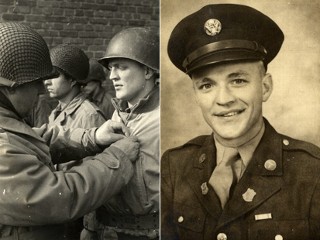
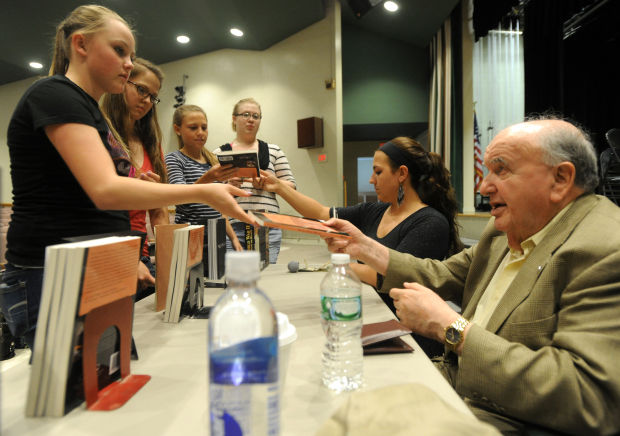
Francis Curry, WWII Medal of Honor, with students.

Francis Curry, WWII Medal of Honor, with students.

FOUR years ago today the most incredible week concluded with former soldiers and the Holocaust survivors they saved watching this newscast together in cocktail lounge of the Georgian Resort in Lake George along with teachers and students from Hudson Falls High School. Thank you Tara, Mary, Lisa, Rene, and all the staff. And to ABC World News for recognizing the importance of the occasion, and to the United States Holocaust Memorial Museum and the Bergen Belsen Memorial for their attendance and support.

A teacher’s job is to toss pebbles. Several of the participants are gone now, but the ripples here became huge, and no one will forget what they meant, where they came from, or what they have led to.

Watch a story about how a teacher fellow from the Museum reunited Jewish prisoners with U.S. Army soldiers who liberated them from a train near Magdeburg, Germany, on April 13, 1945.

Read Full Post »

I met Leslie Meisels exactly four years ago today, when he and  Ariela Rojek and Paul Arato drove all the way down from Toronto, Canada to meet their actual liberators.

Leslie is one of the most gracious men I have ever met; I am honored to have him as one of my friends and am proud to be in on what he calls the latest miracle of his life.

I wrote to a reporter/columnist in Toronto, Canada, several months back to comment on a story that she had written, and she then had the opportunity to interview several of my survivor friends in the community who had been liberated on the Train Near Magdeburg. She struck up a friendship with Leslie, and this ebook resulted.

A sample:

When I first reached Leslie Meisels on the phone one afternoon in late April and asked for an interview, he told me to hold on a minute — he needed to get his day planner.

I thought he was joking.

Leslie is 86. What could he possibly be doing to fill up a day planner?

A lot, it turns out.

He has a wife, two daughters, four grandchildren. He is an active member of the North York Philatelic Society and a committee member of Circle of Care, an organization that provides services for Holocaust survivors. And he is a regular speaker with the Holocaust Education Centre’s survivor speakers bureau. This spring there were weeks when he addressed four different groups of students about his experience during World War II.

This was one of those weeks. He squeezed me in. I wanted to talk to him about the Holocaust and, more precisely, about his liberation from the Nazi murderers by a dozen surprised American soldiers who found Leslie and about 2,500 other captives near the end of the war, packed in cattle cars on a German train.

An email from an American teacher had tipped me off to the fact that a number of Toronto Holocaust survivors had recently been reunited with their liberators.

Leslie was one of them.

Of course, you can’t talk about liberation without talking first about enslavement. So, sitting on the couch of the neat, spacious penthouse condominium he shares with his wife, Eva, in Thornhill, Leslie started proudly with his family history in eastern Hungary.

Then came his carefree childhood. Then the introduction of anti-Semitic laws, the ghetto, the trains, the months of slave labour and the horrors of the Bergen-Belsen concentration camp, where more than 70,000 prisoners — most of them Jews — were killed.

Our interview lasted more than three hours, fueled by many cups of coffee and servings of fresh cheese palacsintas (crêpes) whipped up by Eva.

I noticed Leslie’s hands while we spoke. They are enormous — each finger twice as thick as mine, the palms like dinner plates. They are a working man’s hands, without any of the dirt. Everything about Leslie is immaculate — his neatly clipped and cleaned fingernails, his ironed pants and pressed dress shirt with a silver pen poking from its breast pocket, his freshly shaven face. His stories of being treated like a rabid dog were cast in relief by the careful pride he took in his appearance. There is an Old World elegance about him.

But the thing that struck me most about Leslie was his cheeky humour. His brown eyes narrowed and sparkled repeatedly as he took a “side step” to tell me about the girl he was “necking” with while a slave labourer or a refugee. Despite the horrors he endured, or perhaps because of them, Leslie maintained his champagne spirit.

Near the end of the interview, a question bubbled in my mind: what did you take with you? The Nazis had invaded Hungary in 1944. They ordered all the Jews in Leslie’s and other towns to first leave their homes, and then to leave town altogether on a train we now know was headed towards slavery or murder. What would you take if you could carry only a small bag or pillowcase to hold your belongings?

“Underwear,” Leslie responded, “and my stamp collection.”

I wrote that down and moved on. There were a lot of overpowering details in Leslie’s stories, and I still needed to hear about the reunion. But the stamps snagged my attention. There was a boyish innocence about them.

What happened to those stamps, I asked him over the phone a couple days later.

He responded: “I still have them. My mother sewed them into the lining of my jacket.”

Imagine that! Most Jews had all their clothing and belongings stripped away upon entering the concentration camps. You can see their boot brushes, ceramic pots and dolls piled up behind glass cases in the Auschwitz-Birkenau State Museum in Poland. That Leslie managed to keep his jacket was surprising enough. But that fragile pieces of paper survived the horrendous conditions — well,that seemed miraculous.

I drove back to their condominium for a third interview, this one in Leslie and Eva’s little office. I asked to see some of those stamps.

So Leslie pulled out his master list — a two-page typewritten list of all the stamp albums he has. There are dozens and dozens. He found one with his early Hungarian stamps and pulled it down from the shelf. Inside he’d arranged thousands of stamps in neat rows.

When I expressed surprise at the number of stamps he had, he smiled and opened a drawer in his desk.

“A crazy stamp collector saves all the stamps he comes across,” he said, pulling out a Tupperware container brimming with stamps. “When there are many, many, many, he bundles them up . . . and stores them away. I have millions of stamps.”

Leslie’s wife calls herself a “stamp widow.” She says he spends hours with his stamps a day. He loves them still, like he did when he started his collection 78 years ago. He loves the precision of arranging them. He loves the challenge of collecting a full set of stamps. He loves their colours and their stories. Every stamp, he says, depicts a story of a place, a historic moment or figure, a cause. “You can learn about the world through stamps,” he said.

As we flipped through his collection and he began to tell me the rest of his story, I could see snatches of it reflected in his stamps.

It is the tale not just of an idyllic childhood followed by the horrors of the Holocaust, but also that of a man who lived under Communism, escaped, lived for two years in a refugee camp, arrived in North America with nothing and then built up his life for a second time. Just as every stamp embodies a public story, a bit of history, Leslie’s stamps also tell the story of his life, its joys and deep sorrows, its disasters and its miracles.

************************************************

He is giving his 25th lecture on the Holocaust since April.

“Put yourself in my shoes,” he says to the Cardinal Carter Catholic High School students. “I think you are between 16 and 18, right? You can feel what I felt when I experienced those horrors.”

“They have to know,” Leslie says. “Otherwise, it will be forgotten and could be repeated.”

He talks for just over an hour, pausing only twice for a sip of water.

The stories pour out of him — of the deaf village elder who was strung up by his wrists to a cattle car, of the SS guards with their dogs who laughed at the sight of him naked with his grandmother and mother, of the hunger. He stirs in life lessons — like how his woodworking knowledge saved his life in Bergen-Belsen. “You are the same age as I was,” he says. “Never think you are studying for your teachers or your parents. Whatever you are putting in your head, you never know how it will serve you in life.”

But Leslie’s descriptions are muted at times. He clutters his sentences with clauses and chooses math over graphic detail to describe some horrors. The train crowding, for instance, affords each person a “square foot.” He mentions the bucket but doesn’t fill in the details of how that meant people were forced to defecate in their pants. He is old-school; talk like that seems degrading. Or perhaps the pungent details are too dangerous for him, scratching away the protective layers on his memories.

A girl in a powder-blue sweatshirt in the second-last row appears to have fallen asleep.

Is he getting through to them? Like most Holocaust survivors,

Leslie won’t be around to recount these stories for much longer. That inescapable truth adds an urgency to his message. Who then will bear witness?

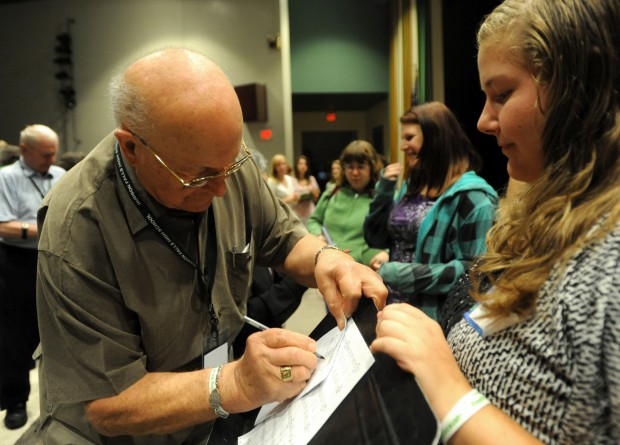
Holocaust survivor Leslie Meisels, left, signs a program for Hudson Falls senior Taylor Bump during Wednesday's "Remembering the Holocaust, Repairing the World" event. Meisels, who currently lives in Toronto, stressed the importance of relaying his experience to young people "so they remember and fight against discrimination, hatred and injustice." Jason McKibben Glens Falls Post Star

Holocaust survivor Leslie Meisels, left, signs a program for Hudson Falls senior Taylor Bump during Wednesday’s “Remembering the Holocaust, Repairing the World” event. Meisels, who currently lives in Toronto, stressed the importance of relaying his experience to young people “so they remember and fight against discrimination, hatred and injustice.”
Jason McKibben Glens Falls Post Star

He finishes his talk and asks for questions. The girl in the powder- blue sweatshirt from the back asks two. The second one is: “If you could go back, would you change any decisions you made?” She was listening, just with her eyes closed. Holocaust educator Ruth Ekstein says she often sees that — “the most fidgety kids you want to strangle, they are absorbing the most.” The content is so painful, it forces people to scratch and shuffle, or to close their eyes.

“Never allow this to happen to someone in the future, if you see an injustice,” Leslie tells the group. “Never just look at each other as equals. Treat each other as equals.”

************************************************

The last miracle

In 2001, Matt Rozell went to the home of one of his students in Hudson Falls, N.Y. Rozell is a high school history teacher there. He regularly assigned his Grade 10 students to interview the veterans in their family about World War II as a way to bring history alive.

That summer, he decided he would do the interviewing himself.

The veteran was retired New York State Supreme Court Justice Carrol Walsh Jr.

After two hours, when the interview was ending, Walsh’s daughter elbowed him and said, “Did you mention the train at all?”

“What?” Walsh said.

“The train.”

So Rozell asked to hear about this train, whatever it was.

Walsh told him about the beautiful, sunny day in April 1945, when after 10 months of fighting their way through France, Belgium,and Holland, and into Germany, his tank and his buddy George Gross’s tank were pulled out of the battalion to check out an abandoned train. An army scout had come across some Finnish prisoners of war in bad condition who reported they had escaped ,the train and that it was packed with prisoners.

Rozell posted the moving interview, as well as Gross’s astonishing photos from that day, on the school’s oral history website, where it sat quietly for four years.

That is, until a grandmother from Australia contacted him to ,say she had been a little girl on that train. The next month he got another email, and another, and another.

In September 2007, Rozell hosted the first reunion of Walsh and three survivors from that train. An Associated Press reporter wrote a story about the day-long event which was published around the world.

Paul Arato’s son Daniel read the story on the Internet. Arato was the 5-year-old boy who witnessed the birthday “present” of a bullet to the head in the Bergen-Belsen roll call. He was also a ,Hungarian Jew who grew up not far from Leslie. He, too, escaped Hungary in 1956 and resettled in Canada. An industrial designer, he was a work associate of Leslie. At the end of a business meeting, the topic of the Holocaust somehow came up. They discovered, to their shock, that they had both been on that train from Bergen-

Belsen. Paul, in turn, told Leslie about the Hudson Falls reunion.

Two years later, they both ventured down to Hudson Falls for a second reunion — a three-day symposium that brought together nine survivors and seven soldiers, including two of their liberators

— Frank Towers and Carrol Walsh.

On the drive down, Leslie was very excited. The initial meeting, over dinner, was spectacular.

“No words can explain the feeling of shaking hands, hugging, laughing and crying with the people who gave me back my life on April 13,” he says. “I never ever imagined that would happen.”

He calls the veterans “angels of my life.” They, in turn, said they were just doing their job.

Leslie and Walsh became close friends. They talked regularly on the phone. They spent some time together in Florida, before Walsh died last winter at the age of 91.

Leslie calls that friendship the last miracle of his life.

Leslie’s 17-year-old granddaughter, Jessica, visited Auschwitz last spring while participating in the two-week educational trip March of the Living. She left behind a small, hand-written sign that said: “I am marching in honour of my grandparents Eva and Leslie Meisels. As well as a soldier, Carrol Walsh.”

******************************************

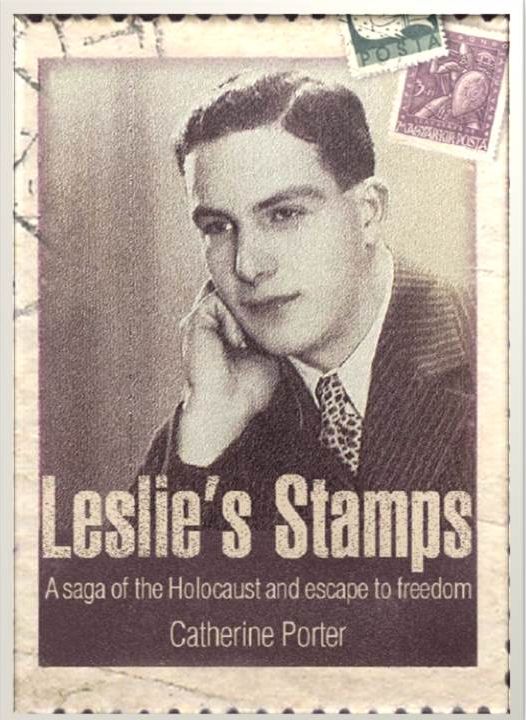
Leslie's StampsLeslie’s Stamps: A Saga of the Holocaust and Escape to Freedom

He had an idyllic childhood in a small Hungarian town where, it seemed, there was no animosity between the Christian majority and Jews like him. But with the rise of Hitler and the Nazis, everything changed for Leslie Meisels, who ended up in Bergen-Belsen concentration camp with his family. Through his wartime ordeals, Leslie carried his stamp collection, started when he was 8, in the lining of his jacket. In Leslie’s Stamps: A Saga of the Holocaust and Escape to Freedom, award-winning Toronto Star columnist Catherine Porter tells the dramatic story of Leslie’s life through his stamps. It is a tale of love, courage and the power of the human spirit.

Leslie’s Stamps: A Saga of the Holocaust and Escape to Freedom is available for $2.99 at http://starstore.ca/collections/star-dispatches-ereads/products/leslies-stamps and itunes.com/stardispatches.

Read Full Post »

BusterOne of the hard parts about this project is that people whom you come to know and love get older and pass away on you. But you are thankful that you came to know them, and how you saw them enrich your life and the lives of others.

I first met Buster over five years ago, when I attended my first 30th Infantry Division reunion and he served as the chaplain and the master of ceremonies and chief auctioneer at our final banquet. He had a funny way of putting folks at ease, and the auctions were like a comedy act. He was very devout and serious about his chaplain duties, though.

I have a couple short video clips to share. The first I post on D-Day every year. A producer from ABC News in New York called me looking for the Benjamin photo for a piece on veterans returning to Normandy. Though the 30th did not land until after D-Day, the fact is that Allied forces were only ten miles in, with some very heavy and decisive battles still ahead for the 30th. They would also be bombed not once but twice by Allied heavy bombers on two consecutive days before the launch of Operation Cobra.Buster was a combat medic. “You did not stop to think about how you would cope. You just did the best you could.”

Buster was so taken with the appearance of the Holocaust survivors in the Old Hickorymen’s lives after 62 years, he told the story everywhere he went. After his wife died unexpectedly, he was at a loss, but I know that getting out into the community to tell the story of the Holocaust and the 30th’s connection to this amazing photograph kept him going for a while. He’d call me up at school, looking for pictures to share with students down South in the classrooms. He became a Holocaust educator! And he was sure proud to be an American.

He and his son Sandy, who also recently passed, expended a great deal of energy traveling to our high school in upstate NY for the last reunion with soldiers and survivors at our high school. At the tail end of this short clip he describes one of the wonders of this trip for him. I guess if I was dancing with a lovely young thing, or two, or three, I would say the same!

To close, I wish to paraphrase the reporter for the ABC story, Erin Hayes:

Maybe, just maybe, a group of students like those at College of the Ozarks will discover [veterans] and they’ll get them to tell their stories, to hear what I heard … that a generation that will soon be gone left us a legacy of bravery and wisdom and resilience.

We really, really should treasure that — before it’s too late.

Rest on, Buster. Peace to their families.

*******************************************************************

Buster Marion Simmons, 91, a resident of Farmington, Ark., passed away July 20, 2013 in Fayetteville. He was born July 7, 1922 in Orange County, N.C, the son of Tom and Olivia Jackson Simmons.

Buster served in the United States Army during World War II. He was a Combat Medic in the 30th Infantry Division throughout the European theater. He served as the Chaplain for the 30th Infantry Division reunions. Buster attended many reunions in Europe and all over the USA. His favorite trip to Europe was in 1994 when his granddaughter traveled with him. He worked until he was more than 80 years old.

He was preceded in death by his parents; wife of 67 years Bessie Mae Simmons; two sons, Eric G. Simmons and William J. “Sandy” Simmons; three brothers, William Clinton, Glimer and Wayne; one sister Lucille Oakley.

Survivors include one daughter-in-law Kathy Simmons; one granddaughter, Nancy Woodward and husband Rusty; one great-grandson Garrett Woodward and his grand dachshund Buster, all of Farmington.

A Memorial Service will be held at 4 p.m. Tuesday, July 23, 2013, at the Luginbuel Chapel in Prairie Grove with Preston Beeks officiating. He will be interred in Burlington, N.C. at a later date.

Memorials may be made to the Willard Walker Hospice Home, 325 E. Longview St. Fayetteville, AR. 72704; Farmington Senior Center – Meals on Wheels, 340 W. Main, Farmington, AR. 72730 or a charity of your choice .

Read Full Post »

World War II infantry veteran Carrol Walsh, top, hugs Holocaust survivor Paul Arato at a reunion in Queensbury, N.Y., on Tuesday, Sept. 22, 2009. Walsh’s unit liberated a Nazi train carrying 2,500 Jewish prisoners, including Arato, from the Bergen-Belsen concentration camp in Germany during the war’s waning days. (AP Photo/Tim Roske)

I am reposting this today to honor both of the men below. Paul Arato passed away this week in Toronto, Canada and his memorial service is today. Carrol Walsh, his liberator, died in Dec. at his home in Florida and his memorial service was last Friday in New York.

Paul and Rona would also check in annually for dinner with the Walsh family when they passed through our town. The last time I saw both of them together was in 2011 at one of these dinners in a local restaurant. They sat together and laughed and joked like old pals. Paul told the story of how he arrived in Detroit after the war as an eager late teen anxious to find work designing fast cars in the automobile industry and was driven to the bridge in Canada by law enforcement and pointed to the bridge to Canada, as he did not have the proper documentation. Picturing the scene in his mind, Carrol would laughed outloud and slapped his knee. Both men were so happy to have found each other.

Rest on, friends.

Holocaust Survivors Reunite With US Veterans

NY high school reunites Holocaust survivors liberated from Nazi death train by US soldiers

By CHRIS CAROLA

The Associated Press

HUDSON FALLS, N.Y.

The Holocaust survivor was 6 on that spring day in 1945 when he last saw the U.S. Army soldiers outside Magdeburg, Germany.

Paul Arato was among 2,500 starving and sickly Jewish prisoners from the Bergen-Belsen concentration camp, their train abandoned by its crew and Nazi guards as Allied forces advanced. Two U.S. Army tanks on a scouting patrol — one of them commanded by Carrol Walsh, then 24 — came upon the stopped boxcars.

Arato, now 71, and Walsh, 88, met again this week.

“Please give me a hug. You saved my life,” Arato told Walsh in an emotional reunion of concentration camp survivors and some of the veterans of the 30th Infantry Division who liberated them.

Arato, an industrial designer from Toronto, and Walsh, a retired state Supreme Court judge from Hudson Falls, came together for a Hudson Falls High School history symposium inspired by history teacher Matthew Rozell’s original World War II project in 2007.

“You were all kids on that train,” Walsh told the survivors, most of them in their early 70s, as they and their families greeted the veteran. “I was an old man. I was 24 years old!”

Those arriving early for Wednesday’s opening session gathered Tuesday night for an impromptu reunion before having dinner surrounded by the faux Adirondack decor of the nearly deserted indoor water park. Four of the five Nazi train survivors at the dinner had never met Walsh.

Walsh’s tank patrol discovered the desperate Bergen-Belsen survivors on April 13 — hundreds of emaciated Jewish prisoners who had been herded aboard one of three trains leaving the camp a week earlier to keep them from being liberated by advancing Allied forces.

Walsh’s patrol stayed for a time, handing out candy to some of the children, then moved on after reporting their discovery. Frank Towers, a 27-year-old first lieutenant in the 30th Division, led a convoy that took the newly liberated prisoners to a German town where they were given food and shelter.

For weeks, the men of the 30th had heard of Nazi atrocities against Jews and dismissed the stories as propaganda, Towers said. That all changed when they encountered the train.

“Then we believed,” said Towers, 93, of Brooker, Fla.

This week’s reunion is the fourth since 2007, when Walsh was joined by three of the train survivors at Hudson Falls High. History teacher Rozell’s World War II project included an Internet posting of Walsh’s account of the train liberation.

An Associated Press report of that first reunion prompted more survivors to come forward, some from as far away as Israel, Rozell said. In all, he has confirmed that more than 60 survivors are still living and has been in contact with about two dozen of them.

Nine survivors of the Nazi death train are participating in this symposium, along with Walsh, Towers and four other veterans of the 30th who fought in Germany. Rozell said this week’s gathering is likely to be the last such event of its scope, given the advanced ages of the veterans and survivors.

For Arato, Tuesday night’s reunion with Walsh brought back a flood of memories. He recalled getting candy from one of the soldiers and a handgun to play with.

“I remember it was a Tootsie Roll,” he said. “The gun wasn’t loaded.”

Arato fretted over one detail. He recalled seeing a Jeep along with the American tanks, but fellow survivor Fred Spiegel of Howell, N.J., didn’t remember seeing a third vehicle. Later, Walsh said his patrol consisted of two tanks — and a Jeep.

“There WAS a Jeep,” Arato said, a smile breaking out on his face. “I remembered it right.”

———

On the Net:

Hudson Falls High School World War II Living History Project: http://www.hfcsd.org/ww2

http://www.huffingtonpost.com/wires/2009/09/23/holocaust-survivors-reuni_0_ws_296673.html

http://www.ynetnews.com/articles/0,7340,L-3781062,00.html

Read Full Post »

American Cemetery overlooking Omaha Beach, the primary landing zone for Americans during the D-Day invasion June 6, 1944. (U.S. Air Force Photo)Today one of my former students emailed me to visit saying that she had a surprise for me. She brought me a present- sand from the beach at Omaha in Normandy.

This was originally posted four Junes ago, I re-post here now.

I came into school today, on a Saturday, to start packing up my room for a move to another room.

But it is the 6th of June.

Instead I am getting nothing done, mesmerized by the scenes, live from Normandy, of the 65th anniversary celebration.

The President is there and so are 250 American veterans of the battle for Normandy,  including one of my good  friends, Buster Simmons, of the 30th Infantry Division. The Greatest Generations Foundation sponsored his visit with 9 other vets and college kids. Now I’m looking for him in the sea of faces.

My son Ned and I watched him last night as a “Person of the Week” on ABC World News in a story I contributed to. If you view the clip, you can see the photograph I provided ABC with, taken by Major Clarence Benjamin, of the liberation of the train. This is the photo that Buster uses when he speaks to high school classes to tell this story.

I am hopeful that we can get Buster to come to our high school for the  liberator-survivor reunion in September.

It was twenty five years ago, on this anniversary, that I wrote an essay in the local newspaper expressing my appreciation for the veterans of World War II. And as I begin to sort through and pack up 20+ years of memories in this room, three things are becoming clear: 1) my love for these men and women and what they did only increases as time passes; 2) the rest of my career will be focused on the promotion of narrative history in the classroom, linking students, veterans and survivors together; and 3) I won’t be getting any packing done this day.

Take a minute to watch Buster in the clip and take his optimism about the future of our nation to heart. Especially if -“you’re an American.”

Read Full Post »

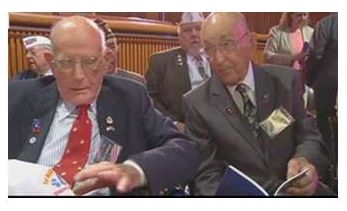
My boys. Thanks to my friend Chris Carola at the AP and Senator Little’s office for recognizing them while they were still with us.

2 NY vets of Edson’s Raiders recall WWII battles

By CHRIS CAROLA

— May. 26 3:38 PM EDT

In this Wednesday, May 22, 2013 photo, World War II veterans Bob Addison, left, and Jerry West pose for a photo, in Glens Falls, N.Y. Addison and West share more than a longtime friendship. They share some of the same memories of bloody battles fought on Pacific islands while serving with an elite Marine Corps unit that was the forerunnner of today's U.S. Special Forces. Living just miles apart, the two men are among the last surviving members of the original Marine Raider battalions that were the first American ground troops to attack Japanese-held territory. (AP Photo/Mike Groll)

In this Wednesday, May 22, 2013 photo, World War II veterans Bob Addison, left, and Jerry West pose for a photo, in Glens Falls, N.Y. Addison and West share more than a longtime friendship. They share some of the same memories of bloody battles fought on Pacific islands while serving with an elite Marine Corps unit that was the forerunnner of today’s U.S. Special Forces. Living just miles apart, the two men are among the last surviving members of the original Marine Raider battalions that were the first American ground troops to attack Japanese-held territory. (AP Photo/Mike Groll)

Gerald West held the laminated sheet of paper fellow World War II combat veteran Robert Addison pulled from an old briefcase and perused the 300-plus names listed under the words, “Lest We Forget.”

“I knew quite a few of those guys,” said West, 93, who made the short drive to Addison’s home 45 miles north of Albany recently to reminisce about their wartime service with the legendary Edson’s Raiders, an elite Marine Corps unit that was the forerunnner of today’s U.S. Special Forces.

The document Addison keeps among his wartime mementos and literature lists the names of members of the 1st Marine Raider Battalion who died while fighting the Japanese in the South Pacific. Addison and West are among the dwindling number of Edson’s Raiders still alive. Out of an original roster of about 900 men, fewer than 150 are believed to survive, according to Bruce Burlingham, historian for U.S. Marine Raider Association.

Dubbed Edson’s Raiders after their colorful, red-haired commander, Col. Merritt “Red Mike” Edson, the unit was the first U.S. ground force to attack Japan-held territory after Pearl Harbor. Landing on Tulagi in the Solomon Islands in August 1942, they beat the larger 1st Marine Division’s arrival on nearby Guadalcanal by an hour.

https://i0.wp.com/tsealey.net/thegunny/gfx/raiders.jpgThe 1st and 2nd Raider battalions, formed just days apart in February 1942, were the first commando-style units in the American military, predating the creation of the U.S. Army Rangers by four months. Trained in jungle warfare and hand-to-hand combat, the Raiders’ leatherneck pride paired with a pirate’s attitude was reflected in their distinctive battalion patch: a white death’s head skull in a red diamond, set against a blue background with five white stars representing the Southern Cross constellation.
Addison, an Alliance, Ohio, native, and West, who grew up outside Glens Falls, both fought at Tulagi and later on Guadalcanal, where Edson’s Raiders earned their vaunted place in American military lore for anchoring the thinly stretched Marine defenses that decimated Japanese forces during successive nighttime assaults in September 1942.

Fighting from positions separated by a few hundred yards along high ground near the island’s airfield, Addison and West helped defend what became known as Bloody Ridge _ but that the Marines called “Edson’s Ridge.” They wouldn’t learn until much later that the fight was considered a turning point that started the U.S. on its island-hopping road to victory in the Pacific.

“In combat, you only know what’s going on in your little world,” West said.

Edson was awarded the Medal of Honor for his front-line leadership during the battle, during which his Raiders suffered more than 250 killed and wounded. Bigger, bloodier battles awaited, but Edson’s Ridge and the Raiders hold a special place among leathernecks of all generations, according to Beth Crumley, a historian with the U.S. Marine Corps History Division.

“Anybody who has taken an interest in the history of the corps, they’re going to know the story about Edson and they’re going to know about the Raiders and know about the Battle of Edson’s Ridge,” she said.

After the Raiders’ next campaign on the island of New Georgia in the summer of 1943, Addison and West were sent back to the U.S. Addison was attending college as part of an officers program, and West was in Guam preparing for the invasion of Japan when the war ended.

They went their separate ways and didn’t get reacquainted until the early 1960s, when Addison moved to Glens Falls to become athletic director at a new community college. He ran into West at a Sears store where West was working, and they’ve remained close friends ever since.

“They were America’s first elite force unit and showed future units like the U.S. Army Special Forces what could be done with a handful of determined, well-trained, well-armed troops against a determined enemy,” said Robert A. Buerlein, co-author of “Our Kind of War: Illustrated Saga of the U.S. Marine Raiders of World War II.

http://bigstory.ap.org/article/2-ny-vets-edsons-raiders-recall-wwii-battles

********************************************

Gerry West and Bob Addison, U.S. Marine “Edson’s Raiders” World War II veterans, honored in Albany

By Betty Little
Posted by Betty Little on Tuesday, May 21st, 2013
Gerry West and Bob Addison, World War II veterans who served in the same elite U.S. Marines unit and have remained lifelong friends, were inducted into the New York State Senate Veterans Hall of Fame at a ceremony in Albany today.

Gerry West and Bob Addison, World War II veterans who served in the same elite U.S. Marines unit and have remained lifelong friends, were inducted into the New York State Senate Veterans Hall of Fame at a ceremony in Albany today.

Senator Betty Little nominated Addison of Glens Falls and West of Fort Edward.

“These two soldiers were among the first Americans to engage the Japanese in combat less than a year after Pearl Harbor,” said Senator Little.  “They were specially selected and trained to serve in the First Marine Raider Battalion, called Edson’s Raiders, and fought in critical and victorious battles on Guadalcanal.

“After the war, they returned home, started families and careers, but never lost touch and remained lifelong friends.  They are among the few remaining Edson’s Raiders and their bond is unique.  It was a wonderful honor for me to have them here today, along with their family and friends, to share their story and see them receive this well-deserved recognition.”

West and Addison were suggested to Senator Little by Hudson Falls history teacher Matthew Rozell.  Rozell is in the process of writing a series of articles on World War II, based on class archives of interviews, for the Washington County Historical Society Journal.  The following are excerpts from a part of the series entitled “Recording the Voices of World War II – From Pearl Harbor to Tokyo Bay”:

On September 14th, 1942, first light at Guadalcanal revealed over a thousand Japanese dead on the ridge.  Outnumbered five to one, for two nights the Raiders held on against Japanese shelling by sea and Imperial troops, and the battle became legendary in Marine Corps history.

            West recalls: “Most of us just refer to it as Bloody Ridge.  We had 50% casualties that night…two men in our battalion received the Congressional Medal of Honor and there were thirteen Navy Crosses awarded to men in our battalion just for that one battle, which is unheard of.”

            Suppressed from the public at the time, more than 7,000 U.S. Marines, soldiers and sailors would die in the six month Guadalcanal campaign.  Japanese losses were much higher.

            Bob Addison: “They called it Hell Island, the Japanese, because they had to live out in the jungles…They had lost over 26,000 men.”

            Only a handful of the original Marine Raiders are left.  Addison and West survived to return home, marry, and raise children.  Seventy one years later, their friendship endures.

The New York State Veterans’ Hall of Fame was created to honor and recognize outstanding veterans from the Empire State who have distinguished themselves both in military and civilian life.  The Hall of Fame can be accessed online at www.nysenate.gov/honoring-our-veterans .

Read Full Post »

By OMAR RICARDO AQUIJE- Glens Falls Post Star

HUDSON FALLS —Fred Spiegel was asked if he felt resentment toward the Nazis.

“Yes, to the Nazis, but not the Germans,” Spiegel said.

The question came from a student at Hudson Falls High School, at which Spiegel was invited Friday to discuss his life during the Holocaust.

On April 13, 1945, a train traveled across Germany, carrying 2,500 Jews en route to a concentration camp.

Spiegel was among them. He was 13.

Holocaust survivor Fred Spiegel sells and autographs copies of his book, "Once the Acacias Bloomed," for students at Hudson Falls High School on Friday, May 24. Spiegel, who was liberated by U.S. troops as a young boy during World War II, spoke about his experiences and answered students' questions. (Jason McKibben -

Holocaust survivor Fred Spiegel sells and autographs copies of his book, “Once the Acacias Bloomed,” for students at Hudson Falls High School on Friday, May 24. Spiegel, who was liberated by U.S. troops as a young boy during World War II, spoke about his experiences and answered students’ questions. (Jason McKibben –

Spiegel, 81, visits schools to talk about how he survived. He brings copies of his book, “Once The Acacias Bloomed,” which explains his life as a Nazi prisoner.

Most of the schools he visits are in New Jersey, where he lives. The farthest he travels is Hudson Falls, a school he visited a few times in recent years, a school he included in his book because it was here an important moment in his life occurred.

“They invited me,” Spiegel said of his reason for returning to Hudson Falls. “How can I say no?”

During Friday’s presentation, Spiegel often said he was lucky to be alive.

Other trains carrying Jewish prisoners made it to their destination. His did not.

His train suddenly stopped near Magdeburg. Spiegel said the train’s engineer and Nazi soldiers fled for fear of capture. U.S. troops was cutting across Germany.

Then, a few U.S. soldiers on tanks found the train and freed the captives. The soldiers included Carroll Walsh, of the 743rd Tank Battalion.

Spiegel was later reunited with his family. It was 65 years later when the unexpected happened: He was invited to Hudson Falls to meet others who were prisoners on the train.

He also got to meet some of the liberators, including Walsh, who was living in Hudson Falls at the time.

Matt Rozell, a Hudson Falls history teacher, organized the reunion. He met Walsh in 2001. He interviewed the former soldier, and learned about the train near Magdeburg.

Walsh died in December. He was 91 and a former state judge.

Spiegel, a native of Germany, said people have shown more interest in the Holocaust over the years.

During Friday’s visit to Hudson Falls, he spoke to about 30 sophomores. Some of them had copies of Spiegel’s book. Others bought the book after the presentation.

Armand Ryther, a student, approached Spiegel to shake his hand.

“I find it very interesting that he could survive what he did,” Ryther said.

Ryther said he read Spiegel’s book.

Jamie Hughes, a fellow sophomore, said it was interesting to hear about Spiegel’s experiences.

“I think it’s really amazing that he would want to share his experiences with everybody,” she said.

Tara Sano, a Hudson Falls history teacher, said the event was planned near Memorial Day so students can reflect on the efforts of veterans.

“My hope is that when you are taking your three-day weekend, you think about why you have a three-day weekend,” she told students at the start of the presentation.

http://poststar.com/news/local/article_00a9219c-c648-11e2-ae69-001a4bcf887a.html

See Fred meet his liberator for the first time.

Read Full Post »

Gerald West
Born: 1919
Served: U.S. Marines 1940-1957
U.S. Army 1957-1962
Residence: Fort Edward, New York
Nominated by Matthew Rozell, History teacher

Robert Addison
Born: 1922
Served: U.S. Marines 1942-1946; 1950-51
Residence: Glens Falls, New York
Nominated by Matthew Rozell, History teacher

Photo Credit: Robert H. Miller Gerry West and Bob Addison, Spring, 2011.

Photo Credit: Robert H. Miller
Gerry West and Bob Addison, Spring, 2011.

On May 21, 2013, local World War II veterans Gerald West and Robert Addison will be honored in a ceremony for the New York State Senate Veterans’ Hall of Fame. They were nominated by Senator Betty Little at the suggestion of Hudson Falls history teacher Matthew Rozell, whose students had interviewed these men several times.

Mr. Rozell is in the process of writing a series of articles on World War II for the Washington County Historical Society Journal utilizing the class archives of interviews. The following narrative is condensed from the upcoming Fall release of the Journal, which will publish Part II  (of 4) in the Pacific series entitled “Recording the Voices of World War II-From Pearl Harbor to Tokyo Bay.”

******************************************************************

 In this installment of an ongoing series, my students and I have pieced together narrative voices of local residents and their friends that show the enthusiasm for the war effort.  Maybe more importantly, their recollections amplify other points essential to an understanding of World War II, but often overlooked.  In the study of this war, we are tempted to both teach and learn the history as if the way things turned out was somehow preordained − as if, from the outset, it was a foregone conclusion the Allies would win the war.  Because we know how events turned out, we read the history with a sense of inevitability (as several historians have pointed out[1]).  Nothing could be further from the truth.

By talking to persons who lived through these troubled times, my students and I gained insight into the urgent, uncertain, confused way many events actually unfolded.   We confronted particularly – through the stories of local men and women − the nation’s unpreparedness in the first years of the Pacific War, beginning with the initial limited response to the Japanese attacks at Pearl Harbor, Wake Island, Guam, and the Philippines.  While military planners in Washington debated, numbers of local men would fight to survive in vicious jungle fighting.  Indeed, it was the incredible actions of these men, against overwhelming odds, which would shape events and force policymakers in Washington, D. C., to take notice.

******************************************************************

 Six months after Pearl Harbor, American naval forces won a decisive engagement at the Battle of Midway (June 4−7, 1942) At this time, advance elements of General Alexander Vandegrift’s 1st Marine Division were gathering in New Zealand, with no American offensive action planned until early 1943.  However, soon after Midway, intelligence showed a Japanese air base under construction at Guadalcanal in the Solomon Islands.  If finished, the Japanese noose encircling Australia would be complete and any Allied counteroffensive very difficult.  A U. S. amphibious landing was needed immediately, and on a scale not attempted since the World War I Allied debacle at Gallipoli (1915) − and with much less time to plan.  “I could not believe it,” General Vandegrift would later say of this plan.[2]

Vandegrift had within his command a special unit, under formation only since February 1942, the “1st Marine Raider Battalion,” which would play a key role in the ultimate U. S. success at Guadalcanal.  Schooled by veterans of Marine operations of the 1920s and 1930s in Central America and China, 900 specially selected young men formed a lightly-armed, mobile commando unit able to operate in sub-equatorial jungle − the vanguard for larger troop landings to follow.  Named “Edson’s Raiders” after their Colonel “Red Mike” Edson, the unit would earn combat honors unparalleled in Marine Corps history[3] in 18 weeks of violent engagements at Guadalcanal.

Of the 900 original Raiders, two local veterans interviewed by our class belonged to this elite group and currently reside in  Senator Little’s 45th Senate District.

Gerry West (R) shown training with Marine Gunner Angus H. Goss(L). When Japanese holed up in caves, the demolition platoon attached TNT charges to ends of poles and fashioned the techniques needed to root out the remaining defenders on the island of Tulagi in the first American ground offensive against Japanese troops in WW II. Department of Defense Photo (USMC) 55268

Gerry West (R) shown training with Marine Gunner Angus H. Goss (L). When Japanese holed up in caves, the demolition platoon attached TNT charges to ends of poles and fashioned the techniques needed to root out the remaining defenders on the island of Tulagi in the first American ground offensive against Japanese troops in WW II. Department of Defense Photo (USMC) 55268

Gerry West grew up in Fort Anne, and like many other during the Depression, decided to enlist in the Marine Corps following high school, and would remain in the military until 1962. In fact, he was already a Marine when he heard the news of Pearl Harbor. “I’ll never forget it. I was sitting in a barracks in Quantico, Virginia. I had the duty that weekend, and there were about ten of us there listening to the Washington Redskins football game which had just started…and something like 1:05 they broke in with the announcement saying that the Japanese had attacked Pearl Harbor.” Robert Addison of Glens Falls, originally from Ohio, spent 29 years as Athletic Director of Adirondack Community College.  He also recalls the day: “The Japanese bombed Pearl Harbor on my nineteenth birthday. A month later I found myself in the Marine Corps in a time compressed boot camp…When I was just about ready to finish boot camp, they were filling up and forming this Raider battalion.”

Addison made the cut and was interviewed by a Marine captain who told him the Raiders would be the cream of the Marine Corps, but also warned their mission would likely be “first in and last out.”[4]  Addison accepted the challenge and was assigned to a mortar squad in the fledgling Raiders.  More training followed.  Some days they marched, fully equipped, dozens of miles in the day, only to turn around and re-navigate the same terrain, in the dark, through swamps and across rivers.

Bob Addison: “When we got into the Raider Battalion, then we really got into the force.  On a Saturday morning, we would go on a 22-mile, full-pack, forced march − you know, in the morning − and then they give us liberty in the afternoon . . . And Edson was known for getting people in good physical condition.  He was the type of guy you would follow him anyplace, because what he would do when we were on these forced marches, he would stop and watch everybody go by, and he would walkie-talkie [to the head of the column], and they would hold up, and he would start [jogging past the men] double-time up [to the head of the column] . . .  When we came in, at the barracks, he would stand there and watch every man go by and give compliments to us − you know, “good job, good job.” That’s the type of leader he was.  Everybody practically worshipped him.  He was quite a leader.”[5]

The Raiders embarked on a cross-country train journey and were then, for two weeks, carried by reconverted World War I destroyers across the South Pacific to Samoa. There, in conditions of hot, muggy weather and frequent rain, training continued with cross-country hikes in a mountain terrain of steep ridges and slippery trails, often at night.  Sometimes pushed from 5:00 A. M. until 10:00 or 12:00 P. M., the men survived on skimpy rations, while also completing a training schedule that included practice landings in inflatable boats, Judo, bayonet combat, first aid, stalking, and demolition.[6]

Eight months after Pearl Harbor to the day, the Marines landed in combat. To secure Guadalcanal, the Raiders were assigned to take the neighboring island of Tulagi, where they would be up against the best of the Japanese combat forces, the Rikusentai  or Japanese “Special Naval Landing Forces.”  Coming in on Higgins Boats in the morning hours of August 7, 1942, the Raiders would clash for three days in vicious fighting, encountering hitherto-unknown Japanese cave bunkers plus their enemies’ sniper actions, night-fighting, and willingness to fight to the death.  The Raiders then conducted raids on Japanese camps on Guadalcanal, as enemy forces ere being reinforced at night, every night, while the US Navy left the scene.

From Addison scrapbook. Bob is at far left. ((Derek Pruitt/Post Star.)

From Addison scrapbook. Bob is at far left. ((Derek Pruitt/Post Star.)

Addison was trained as a mortar man and West was a demotions expert and tapped as a machine-gunner in the critical battles at Guadalcanal, where the Japanese were developing an airfield to support their attack on Australia. The Marines captured the airfield and the Raiders pulled back to high ground overlooking it to defend it. If the Ridge fell, Guadalcanal would fall; and if the ‘Canal fell, Australia might be next. A vicious battle for the high ground would ensue.

West recalls: “They did not get through us, if they had gotten through, they would’ve had the airstrip back. Most of us just refer to it as Bloody Ridge. We had 50% casualties that night…”

On September 14th, 1942, first light at Guadalcanal revealed over a thousand Japanese dead on the ridge.  Outnumbered five to one, for two nights the Raiders held on against Japanese shelling by sea and Imperial troops, and the battle has become legendary in Marine Corps history.

Battle of Edson's Ridge Painting by USMC artist who was at Guadalcanal.

Battle of Edson’s Ridge Painting by USMC artist who was at Guadalcanal.

West continues: “It was probably the decisive battle of the whole campaign. In the Battle of Bloody Ridge, just to give you an idea, two men in our battalion received the Congressional Medal of Honor and there were thirteen Navy Crosses awarded to men in our battalion just for that one battle, which is unheard of.”

Suppressed from the public at the time, more than 7000 U.S. Marines, soldiers and sailors would die in the six month Guadalcanal campaign. Japanese losses were much higher. By the time the last starving and dispirited Japanese troops left in Feb. 1943, further Japanese expansion into the South Pacific was halted.

Bob Addison: “They called it Hell Island, the Japanese, because they had to live out in the jungles… They had lost over 26,000 men. A lot of them died of starvation and diseases… When they left, they left 26,000 behind.”

Only a handful of the original Marine Raiders are left. Addison and West survived to return home, marry, and raise children. Seventy one years later, their friendship endures.

Condensed from the forthcoming Washington County Historical Society Journal.

The Washington County Historical Society Journal is an annual 96 page print publication of the WCHS. The Journal seeks to publish new research into any aspect of the County’s history, and this includes reminiscences and interesting unpublished source materials. All members of the WCHS receive it; for membership information, please visit their website at www.wchs-ny.org.

For more information contact Mr. Rozell at his website, http://teachinghistorymatters.com


[1] William Manchester, Goodbye, Darkness: A Memoir of the Pacific War (Boston: Little Brown, 1987) p. 167.

[2] Geoffrey C. Ward & Ken Burns, The War: An Intimate History (NYC: Knopf, 2007) pp. 47−49.

[3] Among them, 24 U. S. Navy ships would be named in honor of individual members of the Battalion before the war was over.  See Col. Joseph H. Alexander, Edson’s Raiders: The First Marine Raider Battalion in World War II (Annapolis: Naval Institute Press, 2000) p. 49.

[4] Alexander, op.cit., p. 32.

[5] Merritt “Red Mike” Edson was born just over the border from Washington Co. in Rutland, VT, in 1897. Retiring as a USMC Brigadier General, he returned to Vermont and became the first Commissioner of the Vermont State Police.

[6] Alexander, pp. 60−63.

************************************************************

From YNN News…

Bob and Jerry 5-21-13. YNN News, Albany, NY

Bob and Jerry 5-21-13. YNN News, Albany, NY

ALBANY, N.Y. — The souls who carry heavy memories from war were thanked in Albany on Tuesday for bearing the burden of our freedom.

World War II Veteran and Newburgh resident Warren Craig described, “We got hit 57 times. And I ended up jumping into the ocean at 12 o’clock at night, swimming with the sharks and the enemy.”

Craig enlisted when he was 17-years-old.

Fifty-four men and women have been added to the New York State Senate Veterans’ Hall of Fame for what they’ve done and kept doing over the years.

Senator Greg Ball explained, “Their heart never took the uniform off. And they continue to serve for the rest of their life.”

These men and women’s lives would then never be the same. Among them are Capt. Gerry West and Sgt. Robert Addison, who both served in the United States Marine Corp. during World War II. The two were part of the Edson’s Raiders, the original 900 members of a commando unit, and survived the battles of the Pacific Theater after Pearl Harbor.

“The bloody ridge on Guadalcanal. We were both there. It brings back a lot of memories,” said Addison, who now lives in Glens Falls.

West said, “The bad battles, like Bloody Ridge. You never forget something like that. We still talk about it and things we never forget.”

West resides in Fort Edward now.

“We’ve known each other for 71 years. Since February of ’42, so what would that be? 71 years,” he confirmed.

Now neighbors in the North Country, the two Edson’s Raiders are still right by each others’ side.

“Well, I just live down the road from him, so we’ve kept in touch all the time,” said Addison.

These legacies are once again being remembered and passed onto the younger generation.

“I grab a hold of fellas that don’t know what to do and take them with me, to get them started,” said Craig. “There’s so much opportunity out there.”

Troy native Daniel Honsinger, a veteran of the Vietnam War, said, “God bless America, that’s all.”

For more information on the Veterans’ Hall of Fame, visit www.nysenate.gov .

Read Full Post »

Two Toronto Holocaust survivors meet their liberators 65 years later
Two survivors of a death train out of Bergen-Belsen concentration camp finally link up with American soldiers who freed them in 1945.

A WWII-era booklet still possessed by Leslie Meisels documents his liberation as a young boy from a train destined for a death camp. Meisels, who eventually ended in Toronto, met a few of the surviving soldiers who freed him and 2,500 prisoners on the train.

A WWII-era booklet still possessed by Leslie Meisels documents his liberation as a young boy from a train destined for a death camp. Meisels, who eventually ended in Toronto, met a few of the surviving soldiers who freed him and 2,500 prisoners on the train.

Leslie Meisels is 86.

Leslie Meisels turned 68 last month.

Every April, since he was 18, Meisels has celebrated his rebirth. Sixty-eight years ago he was on the cusp of death, packed into a cattle car in a freight train with some 2,500 other skeletal Jewish prisoners. He weighed only 75 pounds.

Then a miracle. That train, which had set off from a concentration camp, was liberated by 12 shocked American soldiers in two tanks and an army jeep near Farsleben, Germany.

Up until then, the American GIs had assumed the gruesome stories they had heard about German death camps were just Allied propaganda devised to make them fight harder. But as they unlocked the boxcar doors, they witnessed humanity’s true capacity for evil.

They called it the death train. For Meisels, it was a train of life.

This past week marked the 68th anniversary of V-E Day, the end of the Second World War in Europe. It’s a good moment to tell the story of that train from Bergen-Belsen.

I heard about it last month in an email from a history teacher in upstate New York. He put me in touch with Meisels and Paul Arato: two Holocaust survivors from Hungary who in 1956 escaped their homeland, by then under Communist rule, and settled in North York.

Their stories are remarkably parallel. They grew up in nearby towns in eastern Hungary, they were both imprisoned by the Nazis in 1944, and they were sent first to Austrian farms as slave labourers and then to the Bergen-Belsen concentration camp in northern Germany.

Have you ever seen the horrifying Holocaust photos of dead, naked bodies being pushed by a bulldozer into open pits? That was Bergen-Belsen. Some 70,000 people were murdered there, including Anne Frank. They weren’t killed in gas chambers, like at Auschwitz. Instead the Nazis used starvation, sadism and disease here.

Meisels remembers mostly the hunger. They were given only watery turnip soup and a piece of bread each day. In four months, he lost 100 pounds.

Arato, just 6 then, remembers the rattling cold and twice-daily roll calls that often lasted hours. He and his older brother Oscar had to hold their mother upright, she was so weak from typhus. One day a boy in their line smiled because it was his birthday. As his “present,” an SS guard shot him dead. It was Oscar’s birthday the next day.

The horror is ungraspable.

By April 1945, the Nazis were retreating as both the Allied and Soviet armies advanced. One morning, both Meisels and Arato were awakened by guards and told to march. “We dragged our bodies over five kilometres,” says Meisels, “back to the train.”

Trains in Nazi Germany usually led to death. This one was no different. It was destined for another concentration camp in Czechoslovakia, but the guards also had orders to execute passengers. Meisels remembers one afternoon when all males 12 and older were ordered out of the packed boxcars and lined up in front of machine guns. They stood there two hours before being herded back into the putrid cars.

Over six days, the train progressed only 135 kilometres.

Arato remembers peering through between the wooden boxcar slats and seeing the SS guards drop their weapons and start running. Then he glimpsed a tank with a star on it.

The door slid open shortly and they were greeted by stunned American soldiers.

“It was hard for us to believe what we were actually seeing,” says one of those soldiers, Frank Towers, on the phone from Brooker, Fla. “We weren’t prepared for it. We were there to fight a war. We weren’t humanitarians. We didn’t know what to do.”

Says Meisels: “We cried, ‘Oh God, we are going to be free. We are going to be human beings again.’ ”

Towers, who was serving in the 30th Infantry Division, spent a day those taken off the train to convalescence homes and a hospital nearby before he had to push on with his battalion.

Meisels and Arato spent five months recovering in Germany before they could finally return to Hungary to search for the rest of their families. Eleven years later, they escaped Hungary and started their lives for a second time: getting married, building careers, having children, then grandchildren. Decades went by.

Then, a few years ago, their paths crossed at a business meeting. Arato, since retired, was an industrial designer. Meisels ran a family company making plastic moulds. At the end of the meeting, the topic of the Holocaust was raised. They discovered, to their shock, they had both been on that train from Bergen-Belsen.

Around the same time, that high school history teacher in New York named Matt Rozell stumbled upon the story.

To bring Second World War history alive, he’d instructed his Grade 10 students to interview their grandparents about the war. One summer, he visited one of his students’ grandfather: Carrol Walsh, a veteran turned New York State Supreme Court judge.

“After two hours, when the interview was ending, his daughter elbowed him and told him to tell me about the train,” Rozell says.

He learned Walsh had been in one of those tanks that chased away the SS soldiers and liberated the train.

Rozell posted the story on his website, Teaching History Matters, and a few years later a survivor from that train contacted him from Australia. Since then, 240 more have been located.

In 2007, Rozell hosted his first symposium on the train, bringing together survivors and liberators. Arato’s son came across a story about the reunion on the Internet by chance.

Arato told Meisels about it, and two years later they both traveled down to Hudson Falls, N.Y., for the second symposium. There they met Walsh and Towers.

That moment was a second liberation for Arato, now 74.

“A blanket was pulled from me,” he says. “I was always very lonesome. I didn’t share my stories with anybody. I grew up and spent all my years being angry. This meant I don’t have to be angry anymore.”

His wife, Rona, has just published a book about his story called The Last Train: A Holocaust Story.

Meisels visits schools around Toronto to speak about the Holocaust every week.

His message? “Hatred is something we have to fight against. When you hear a derogatory comment, say out loud that it is not right. When you are silent, you are not neutral. You are supporting the oppressor.”

He and Towers went to Washington, D.C. last month to celebrate the 20th anniversary of the Holocaust Museum there. Towers, now 96, is the last living U.S. veteran who liberated that train. Walsh died last December.

“We hugged,” Meisels says. “Whenever we are together, I am so overwhelmed by gratitude and joy.”

Truth can be more horrifying and wonderful than fiction. Every life is precious.

CLICK HERE FOR THE STORY OF ANOTHER TORONTO RESIDENT WHO FOUND HERSELF IN THE 1945 PHOTOGRAPHS


by Catherine Porter 

http://www.thestar.com/news/gta/2013/05/10/two_toronto_holocaust_survivors_meet_their_liberators_65_years_later_porter.html

Read Full Post »

  Monday, April 29, 2013
Frank this morning at the Museum - P. Fredlake

Frank this morning at the Museum – P. Fredlake

Today is the anniversary of the liberation of Dachau. I also got this photo from Peter Fredlake, the director of National Outreach for Teacher Initiatives at the USHMM which he took this morning in Washington.  Big day for Frank!

WASHINGTON (AP) — Elderly survivors of the Holocaust and the veterans who helped liberate them are gathering for what could be their last big reunion at the U.S. Holocaust Memorial Museum.

Some 1,000 survivors and World War II vets are coming together with President Bill Clinton and Elie Wiesel, a Holocaust activist and writer, on Monday when the museum marks its 20th anniversary. Organizers chose not to wait for the 25th milestone because many survivors and vets may not be alive in another five years.

Clinton and Nobel Peace Prize laureate Wiesel, who both dedicated the museum at its opening in 1993, will deliver keynote speeches. On Sunday night, the museum presented its highest honor to World War II veterans who ended the Holocaust. Susan Eisenhower accepted the award on behalf of her grandfather, U.S. Gen. Dwight D. Eisenhower, and all veterans of the era.

The museum also launched a campaign to raise $540 million by 2018 to keep the memory of the Holocaust alive and to combat anti-Semitism, Holocaust denial and contemporary genocide. It has already secured gifts totaling $258.7 million. The campaign will double the size of the museum’s endowment by its 25th anniversary. Also, a $15 million gift from Holocaust survivors David and Fela Shapell will help build a new Collections and Conservation Center.

Museum Director Sara Bloomfield said organizers wanted to show Holocaust survivors, veterans and rescuers the effort will continue to honor the memory of 6 million murdered Jews, in part by saving lives and preventing genocide in the future.

“We felt it was important, while that generation is still with us in fairly substantial numbers, to bring them together,” Bloomfield said, “to not only honor them, but in their presence make a commitment to them that not only this institution but the people we reach will carry forward this legacy.”

The museum continues collecting objects, photographs and other evidence of the Holocaust from survivors, veterans and archives located as far away as China and Argentina. Curators expect the collection to double in size over the next decade.

This week, the museum is opening a special, long-term exhibit titled “Some Were Neighbors: Collaboration and Complicity During the Holocaust.” It includes interviews with perpetrators that have never been shown before, as well as details of mass killings in the former Soviet Union that were only uncovered in more recent years.

Curator Susan Bachrach said the exhibit and its research challenge the idea that the Holocaust was primarily about Hitler and other Nazi leaders. Surveys at the museum show that’s what most visitors believe.

“That’s very comforting to people, because it puts distance between the visitors and who was involved,” Bachrach said.

So, the museum set out to look at ordinary people who looked on and were complicit in the killing and persecution of millions of Jews through greed, a desire for career advancement, peer pressure or other factors. It examines influences “beyond hatred and anti-Semitism,” Bachrach said.

Focusing only on fanatical Nazis would be a serious misunderstanding of the Holocaust, Bloomfield said.

“The Holocaust wouldn’t have been possible, first of all, without enormous indifference throughout Germany and German-occupied Europe, but also thousands of people who were, say, just doing their jobs,” she said, such as a tax official who collected special taxes levied against Jews.

In an opening film, some survivors recall being turned over to Nazi authorities in front of witnesses who did nothing. “The whole town was assembled … looking at the Jews leaving,” one survivor recalls.

Steven Fenves was a boy at the time. He recalled how in 1944, Hungary, allied with Nazi Germany, forced his family out of their apartment. The family was deported to Auschwitz, where Fenves’ mother was gassed.

“One of the nastiest memories I have is going on that journey and people were lined up, up the stairs, up to the door of the apartment, waiting to ransack whatever we left behind, cursing at us, yelling at us, spitting at us as we left,” he said in an interview with the museum.

The museum located images of bystanders looking on as Jews were detained, humiliated and taken away.

Non-Jews were also punished for violating German policies against the mixing of ethnic groups. For the first time, the museum is showing striking, rare footage of a ritualistic shaming of a Polish girl and a German boy for having a relationship. They are marched through the streets of a town in Poland, where the film was located in an attic. Dozens of people look on as Nazi officers cut the hair of the two teenagers. They are forced to look at their nearly bald heads in a mirror before their hair is burned.

“It’s hard not to focus on the cruelty that’s being perpetrated on this young couple,” Bachrach said. “But what we really want people to look at … is all the other people who are standing around watching this.”

Other items displayed include dozens of bullets excavated from the site of a mass grave in former Soviet territory and registration cards from city offices in Western and Southern Europe labeling people with a “J” for Jew.

The federally funded museum’s theme for its 20th anniversary is “Never Again: What You Do Matters.” The museum devotes part of its work and research to stopping current and preventing future genocides. A study released by the museum last month found that the longer the current conflict in Syria continues, the greater the danger that mass sectarian violence results in genocide.

Much more is still being learned about the Holocaust, as well, Bloomfield said. The museum is compiling an encyclopedia of all incarceration sites throughout Europe. When the project began, scholars expected to list 10,000 such sites. Now the number stands at 42,000.

The museum opened in 1993 as a living memorial to the Holocaust to inspire people worldwide to prevent genocide. A presidential commission called for such a museum in 1979. Since opening, it has counted more than 30 million visitors. The museum also provides resources for survivors. It has partnered with Ancestry.com to begin making the museum’s 170 million documents searchable online through the World Memory Project.

Read Full Post »

« Newer Posts - Older Posts »