Feeds:
Posts
Comments

Posts Tagged ‘teaching history matters’

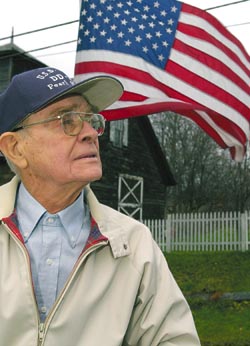
Seventy one years ago, it began. Hitler’s last gamble would claim more American lives than any battle in U.S. History. Frank Curry was there, and on a cold winter day in December, saved five men and kille scores of Germans singlehandedly. Frank was in the 30th Infantry Division, which liberated the Train Near Magdeburg; he came to our school.

The morning of December 16, 1944. A lonely outpost on the Belgian frontier.

“Both the enemy and the weather could kill you, and the two of them together was a pretty deadly combination.” Bulge veteran Bart Hagerman. Photo: George Silk/Time & Life Pictures/Getty Images Dec 20, 1944

In subzero temperatures, the last German counteroffensive of World War II had begun. Nineteen thousand American lives would be lost in the Battle of the Bulge. “Hell came in like a freight train. I heard an explosion and went back to where my friend was. His legs were blown off-he bled to death in my arms.” The average age of the American “replacement” soldier? 19.

Of the sixteen million American men and women who served in WWII, four and a quarter hundred thousand died on the field of conflict. In 2015, on the downward bell curve slope, nearly 500 veterans of World War II quietly slip away every day. The national memory of the war that did more than any other event in the last century to shape the history of the American nation is dying with them. The Germans threw 250,000 well trained troops and tanks against a lightly defended line on the Ardennes frontier in Belgium and Luxembourg, which created a pocket or “bulge” in the Allied offensive line, the objective being to drive to the port of Antwerp to split the American and British advance and force a separate peace with the Western Allies. What ensued was the bloodiest battle in American history. It saddens me that it comes as a shock to many Americans today that the “Battle of the Bulge” didn’t originate as a weight-loss term.

On a personal note, I have had the privilege of interviewing many of the veterans of this battle. In the high school where I teach, I have been inviting veterans to my classroom to share their experiences with our students. As their numbers dwindled, I smartened up, bought a camera, and began to record their stories. And for the past decade, I have been sending kids out into the field to record the stories of World War II before this generation fades altogether. These men and women have helped to spark students’ interest in finding out more about our nation’s past and the role of the individual in shaping it. In our books we have worked to weave the stories of our community’s sacrifices into the fabric of our national history. And that, to me, is what teaching history should be all about. After all, if we allow ourselves to forget about the teenager who bled to death in his buddy’s arms, if we overlook the sacrifices it took to make this nation strong and proud, we may as well forget everything else. I shudder for this country when I see what we have all forgotten, so soon. But if you are taking the time to read this post I suppose I am preaching to the saved.

I will close with the account of a nineteen year old infantryman who in fact survived the battle and the war, and who I was able to introduce to many Hudson Falls students on more than one occasion. Sixty-nine years ago this December, a day began that would forever change his life.  Frank is now the only living Medal of Honor recipient from World War II left in New York State and New England.

In the winter of 1944, nineteen year old Private First Class Currey’s infantry squad was fighting the Germans in the Belgian town of Malmédy to help contain the German counteroffensive in the Battle of the Bulge. Before dawn on December 21, Currey’s unit was defending a strong point when a sudden German armored advance overran American antitank guns and caused a general withdrawal. Currey and five other soldiers—the oldest was twenty-one—were cut off and surrounded by several German tanks and a large number of infantrymen. They began a daylong effort to survive.

Francis Currey MOH and Ned Rozell March 2010-Ned is friends with the last WWII Medal of Honor recipient in NY and NE, Frances Currey. Yes, the special edition GI Joe he signed for Ned is 19 yr. old Frank!

Francis Currey MOH and Ned Rozell March 2010-Ned is friends with the last WWII Medal of Honor recipient in NY and NE, Frances Currey. Yes, the special edition GI Joe he signed for Ned is 19 yr. old Frank!

The six GIs withdrew into an abandoned factory, where they found a bazooka left behind by American troops. Currey knew how to operate one, thanks to his time in Officer Candidate School, but this one had no ammunition. From the window of the factory, he saw that an abandoned half-track across the street contained rockets. Under intense enemy fire, he ran to the half-track, loaded the bazooka, and fired at the nearest tank. By what he would later call a miracle, the rocket hit the exact spot where the turret joined the chassis and disabled the vehicle.

Moving to another position, Currey saw three Germans in the doorway of an enemy-held house and shot all of them with his Browning Automatic Rifle. He then picked up the bazooka again and advanced, alone, to within fifty yards of the house. He fired a shot that collapsed one of its walls, scattering the remaining German soldiers inside. From this forward position, he saw five more GIs who had been cut off during the American withdrawal and were now under fire from three nearby German tanks. With antitank grenades he’d collected from the half-track, he forced the crews to abandon the tanks. Next, finding a machine gun whose crew had been killed, he opened fire on the retreating Germans, allowing the five trapped Americans to escape.

Deprived of tanks and with heavy infantry casualties, the enemy was forced to withdraw. Through his extensive knowledge of weapons and by his heroic and repeated braving of murderous enemy fire, Currey was greatly responsible for inflicting heavy losses in men and material on the enemy, for rescuing 5 comrades, 2 of whom were wounded, and for stemming an attack which threatened to flank his battalion’s position.

At nightfall, as Currey and his squad, including the two seriously wounded men, tried to find their way back to the American lines, they came across an abandoned Army jeep fitted out with stretcher mounts. They loaded the wounded onto it, and Currey, perched on the jeep’s spare wheel with a Browning automatic rifle in his hand, rode shotgun back to the American lines.

After the war in Europe had officially ended, Major General Leland Hobbs made the presentation on July 27, 1945, at a division parade in France.

source material Medal of Honor: Portraits of Valor Beyond the Call of Duty by Peter Collier.


Frank signs autographs at our school.

Read Full Post »

Helen Sperling passed away last week. She was an incredible woman, a Holocaust survivor whose mantra was “Thou shalt not be a bystander.”

I spoke at the annual Yom Hashoah lecture that she sponsored for her community in Utica a few years back. She lived about 100 miles away, so her friend Marsha drove her to Saratoga Springs, the halfway point for us, so that she could meet me and vet me for herself before committing to my lecture. I passed the test. later, my friends at the USHMM found some of her liberation documents for me, which I sent to her. I even found one of the US soldiers who liberated her, in the town near me.

The article and post below is from a couple years ago. I love the photo. Godspeed, Helen. Rest assured that all those whom you touched, will keep the memory alive.

******

Helen is a friend of mine. She was liberated in April 1945 by a division of American soldiers that included our high school secretary’s uncle.

At her invitation I traveled to central NY to speak 2 years ago.

She is still going strong. I love her! Her central message to students-“The world needs saving. So, get to it!”

BY RACHEL MURPHY
Rome Observer Staff Writer

Staff Photo by RACHEL MURPHY--Curtis Thompson, an eighth grader at Strough hugs Helen Sperling, a 93-year-old who survived the Holocaust. Sperling shared her story with the eighth grade class on Wednesday, after she finished every student hugged her.

ROME, NY. — Holocaust survivor Helen Sperling, 93, recounted the darkest moment of her life before a crowd of more than 300 eighth-graders at Lyndon H. Strough Middle School on Wednesday.

Sperling spoke for two hours about her time in the concentration camps.

Sperling was born to a middle class family where she lived in Poland.

During a school vacation when she was 22 years old, the Germans invaded her home and took her family into a ghetto.

“For the first time in my life, I was completely and utterly helpless,” she said.

During her time in the ghetto, Sperling remembered being able to contact a close friend to wish her a happy birthday. But when Sperling called her friend, who was a Gentile, the friend responded with a racial slur.

“You did not realize who was your friend and who was your enemy,” she said.

She explained that like many other Jewish families, hers was eventually taken from the ghetto and separated into prison camps. She was first placed into Ravensbrück, where she was forced to perform demeaning tasks the Nazi’s used as a way to break her spirit.

But despite the torture, hunger and fear, Sperling managed to survive, along with her younger brother.

“Ninety-nine percent of our survival was sheer luck,” she said. “A little tiny bit of it was hanging on to dignity. Once you lost that, you didn’t have a chance.”

Sperling’s parents did not survive.

Her family was among the 6 million other Jews that were sent to death camps and were killed by the Nazis.

Sperling placed two family photographs on a table nearby as she spoke to the students.

“These are mine, and I miss them terribly,” she said of her family members.

However, she continues to share her story to hopefully inspire and educate others.

“I want them to know that they can do something. I don’t want them to be bystanders,” she said.

Sperling added that even though it is difficult to retell it’s worth it.

“As long as I can do and as many schools as I can cover I want to,” she said.

Assistant Principal Michael Stalteri explained that he hopes the students learn from Sperling’s life and positive outlook.

“Her story resonates with what goes on in their lives when they’re being persecuted, picked on, harassed, bullied or made to feel different,” he said. “Hearing Mrs. Sperling’s story of triumph and her message is exhilarating.”

After Sperling finished her story each student hugged her, and she gave them an anti-bullying bracelet.

http://romeobserver.com/articles/2013/03/15/news/doc5140d89a9dd53321768186.txt?viewmode=fullstory

Read Full Post »

Vet tells his story: from Pearl Harbor to the classroom

by Liza Frenette

Alvin Peachman

Nineteen-year-old Alvin Peachman was playing pingpong when he heard about the Japanese attacks on Pearl Harbor on December 7, 1941. His heart might have skipped a few beats, like a ping-pong ball skittering across the table. But it didn’t take too many heartbeats after that for him to enlist in the Navy.

“We heard the news on the radio. There was no TV then,” he told students at Hudson Falls High School recently. The idea of the U.S. Navy being so outrageously attacked seemed unthinkable.

“We thought it was a joke. Then, we heard President Roosevelt ask Congress for a Declaration of War. And I knew that I’d be in it,” Peachman said. “There was war fever. There were posters to inflame your patriotism.”

Always interested in history and geography, he said he knew right where Pearl Harbor was. Information about Pearl Harbor Day can be accessed in a free lesson plan at the American Federation of Teachers’ “Share My Lesson” site.

“I volunteered for the Navy. You had to be in perfect physical condition,” Peachman said.

At the time, he was working on the docks in New York City, where he’d come to find work away from the coal mines of Appalachia, where he grew up. He unloaded coffee on the piers. “I could rip the pier up!” he boasted.

It’s been a long time since Peachman was in front of a classroom, teaching students about history. But, at 93, he still lives just down the street from the small and rural Hudson Falls High School where he taught from 1951 to 1983. So he came on over recently to spend several hours with two classes of students, talking about his experiences during WWII. He fought in the Pacific Theater, which spilled out on a map behind him for students to see. A white-haired man with sparkling blue eyes, he sat comfortably in front of the students, wearing a brown cardigan, telling them how he slept in a hammock on his ship with 50 men in a room the size of their classroom.

He showed them a metal chunk from a kamikaze plane that attacked the U.S.S. Witter, a destroyer escort ship off Okinawa. Peachman worked as a radio operator and barely escaped death. Students marveled at the piece of history.

Peachman earned $21 a month for his service in the military, but he had to pay $6.50 of that for insurance because, he recalled, “If you got killed and didn’t have insurance, your mother got nothing.”

His service included fighting in the Guadalcanal, Solomon Islands, the Marshall Islands and New Zealand. When fighting on land, he said his helmet served as a wash basin to shave and wash. Many comrades got malaria or other tropical diseases. “You’d get dysentery and be so sick, you wish you were dead,” he said.

Sometimes he was “10,000 to 12,000 miles away from anywhere on the ship,” he said. He crossed the equator a half dozen times and lived through a typhoon, where waves slammed the ships sideways. People had to be tied down so they didn’t get washed away. More than a thousand lives were lost during the two-week storm, Peachman said.

Those weren’t the only challenges.

“I saw no girls for two years and that bothered me,” he said, as students laughed with him. “You go nuts!”

He got out of the service on a Friday and enrolled in college in New York City the following Monday. “I studied like a bulldog,” he said. He worked on Wall Street and then for Western Electric, but his commute was long and he found the city crowded. He went to New York University to get his history degree, and then found a listing for a teaching job in Hudson Falls.

“When they told me the train fare was $15, I almost collapsed,” he said, breaking out into a huge smile.

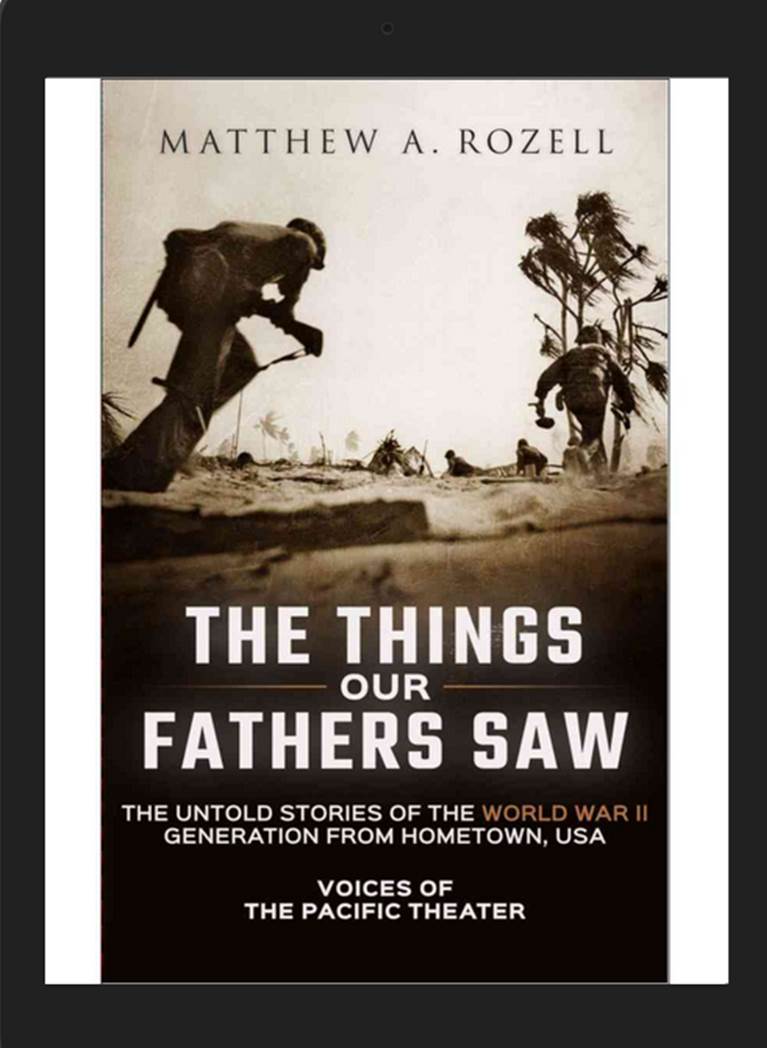
His host for the day at the school was Matt Rozell, who used to be Peachman’s student. Now, Rozell has written a book, The Things Our Fathers Saw (The Untold Stories of the WWII Generation from Hometown USA — which includes interviews with Peachman and many other veterans. Peachman also passed around a book with photos of his bombed out ship and pictures of his comrades.

“This book will help to remind those who are young and who are living in today’s confused world, that freedom is not free,” Peachman said.

http://blogs.nysut.org/blog/2015/12/07/pearl-harbor-attack-prompted-dockworker-to-enlist-retired-vet-and-teacher-tells-students/


Read Full Post »

the last generation

My 93 year old friend Alvin Peachman came into school on Friday. He was once a teacher at this same high school, and I was once his history student. Now he is in my first book, and it was one white haired old man interviewing another, before a polite and rapt audience of tenth and twelfth graders in my classroom. My friend Liza from the New York State United Teachers, who did a nice story on us for Veterans Day, also came up.


alvin 3

Alvin even brought in a fragment of the kamikaze plane that tried to do him in when it crashed into his ship, killing scores of his shipmates. As a radioman he would have been a target on the bridge of the ship, supporting the invasion of Okinawa, but he was not near that part of the ship when the suicide pilot struck that day.

Before the interview session began, I asked for a show of hands of the number of kids who knew of a World War II veteran, like Alvin, who was still alive. Two kids volunteered. Nearly thirty years ago, it was two hands in the air for every kid. And that is how this whole project got started.

Alvin was from a generation that knew firsthand of the Civil War veterans, and his father and his uncles were all veterans of the Western Front in World War I. He had a good day with the kids, and made them laugh on several occasions. But it got me to thinking. This is the last generation of kids to ever hear firsthand the stories of the most cataclysmic events in the history of the world, World War II and the Holocaust.

The students came up to Alvin after the lesson, some seeking his autograph, others just wanting to shake his hand and hang out a while longer with him. I think it made his day. I know it made theirs and it is not something they will soon forget- that they actually met a genuine World War II survivor and now have that tangible link to the past.

I hope it is not the last time, but they are certainly the last generation.

the last generation 4

Read Full Post »

I have just returned from an invitation to participate in Toronto’s Neuberger Holocaust Education Centre’s Holocaust Education Week, spending some time with maybe a thousand high school kids at the Cardinal Newman Catholic High School. I had  a morning and an afternoon session.

image (1)

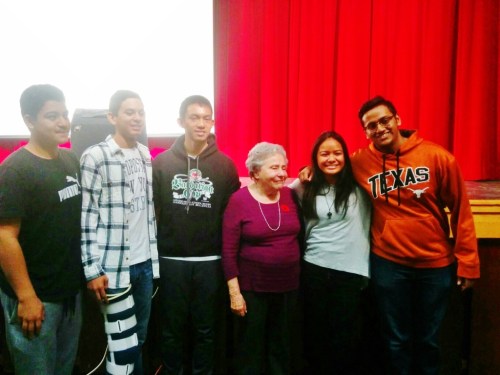
Holocaust survivor Ariela Rojek and her young admirers at Blessed Cardinal Newman Catholic High School.

I had an hour in the morning and I ended early so that they could come up and meet Ariela, my  “adoptive mother”. You see, a few years back, I connected her and several Toronto area survivors with their actual American liberators. Yesterday, at a family gathering at her daughter’s house, she brought out the scrapbook and showed me the pictures of her parents and family who did not survive the Holocaust, and even the original letter that her father wrote on the eve of his transfer from prison to Auschwitz-where he would be murdered, along with her grandfather and uncle. Ariela’s mother, only 36, both of her grandmothers, her other grandfather and two aunts were murdered at Belzec.


With Mark Celinscak, York University professor and author of the new book, "Distance from the Belsen Heap: Allied Forces and the Liberation of a Nazi Concentration Camp", and survivor Leslie Meisels before our afternoon talk.

With Mark Celinscak, Trent University professor and author of the new book, “Distance from the Belsen Heap: Allied Forces and the Liberation of a Nazi Concentration Camp”, and survivor Leslie Meisels before our afternoon talk.

Toronto talk descriptionIn the afternoon, I was with my good friend Leslie Meisels, an experienced speaker who told the kids about his Holocaust journey, and the miracles in his life that led he and I to be on the same stage together. Leslie was from Hungary, and liberated on the same day as Ariela, on the same train, and by the same soldiers. I did my bit and turned it over to him, and relayed questions from the students to him.

Now when you are teaching it is true that many times you have no idea of whether or not you are getting through to the kids. Some may have a bored expression as you hammer the message home, eyes not meeting yours, or looking like this is the last place they want to be. But in the end, you know, it behooves us as educators to give them space, and maybe time, to process. (And I did include a brief “debriefing guide” for teachers to use if they wanted to, after the presentation.)

But it was the outpouring of love for the survivors who were with me today, that really made my trip, and my efforts worth it.

Holocaust survivor Leslie Meisels with Blessed Cardinal Newman Catholic High School students  where they learned about reuniting Holocaust survivors with their American liberators. Photo by Joan Shapero.

Holocaust survivor Leslie Meisels with Blessed Cardinal Newman Catholic High School students where they learned about reuniting Holocaust survivors with their American liberators.

Leslie and Ariela are family, and a new group of students became witnesses to the greatest crime in history, and one that the world allowed to unfold. In the end my message was to simply amplify the lessons these survivors, and liberators, have inspired through their example- that we are all part of the family of mankind and that in living out our lives, we have the responsibility to make a difference- and that one person can make a change that will ripple onward for generations to come.

Read Full Post »

Pearl Harbor survivor was quick to share memories

OCTOBER 04, 2015 2:00 PM • BILL TOSCANO

Editor’s note: Every life has a story. In this column, we pay tribute to people who have died recently.

I wrote about Mr. Ross and his passing a few weeks ago. This article appeared in the Post Star yesterday as he was being laid to rest. The reporter had contacted me for comment. And just so folks are aware, I asked him not to mention my recent book unless it was okay with Mr. Ross’ family. Rest easy, Barney. You made a lot of people happy in this life.

Barney Ross by Erin Coker, Courtesy Post-Star

Barney Ross by Erin Coker, Courtesy Post-Star

There’s a footnote at the bottom of Page 21 of Matthew Rozell’s recently published “The Things Our Fathers Saw” that sums up the late Barney Ross perfectly.
“In his remembrances, Mr. Ross’ voice began to break up recalling his friends who had passed before him. Barney brought smiles through the tears as he reminded my students that, ‘I may get emotional, but I’m still a tough guy.’ “
Rozell and his students at Hudson Falls High School were among many who heard Ross’ first-hand story of the attack on Pearl Harbor, the Pacific War and the signing of the surrender in Tokyo Bay.
Over the years, he had to think a little harder and sometimes needed prompting, but once the Whitehall native started telling his story, the memory and emotion took over.
Gerald A. “Barney” Ross, 94, died Thursday, Aug. 27, at Indian River Rehabilitation and Nursing Center in Granville, and with him died another memory of the attack that brought the U.S. into World War II. Ross, a lifelong resident of Whitehall, was one of an estimated 2,000 to 2,500 survivors remaining out of 60,000 who were at Pearl Harbor on that day of infamy.
Ross was a 1940 graduate of Whitehall High School and played on the 1939 unbeaten, untied, unscored-upon team. He was a hunter, fisherman and lifelong communicant of Our Lady of Angels Roman Catholic Church.
Following graduation, Ross enlisted in the U.S. Navy in August 1940. He served on the USS Blue during the Japanese attack on Pearl Harbor on Dec. 7, 1941.
Ross met Alice Marie Doyle at a USO dance in Philadelphia, and they were married in 1946. He operated Ross’s Restaurant in Whitehall and was later employed as a machine operator at Decora Industries in Fort Edward, retiring after many years of service.
Indelible memories
Gerald An electrician’s mate aboard the USS Blue, Ross found himself in the destroyer’s magazine during the battle, feeding ammunition to an anti-aircraft gun on the top deck.
“I’d get a shell, put that in the hoist,” Ross said in one of his many interviews. “And I’d get a powder and put that in the hoist. That way, I was feeding the gun. … I feel that we did our job.”
He had been in the harbor on the USS Blue when the Japanese planes dove out of the sky and dropped their bombs, and when the enemy submarines simultaneously sent torpedoes into American ships, in the surprise attack on America’s Pacific fleet.
“When the Japanese attacked, I was on the deck waiting for a boat to take me to a church service,” Ross said. “We saw a plane dive toward the USS Utah, then within minutes, it was the worst devastation you could ever imagine — the USS Arizona was blown up and the USS Oklahoma was turned over on its belly.”
Over the past seven weeks, at least five other survivors of the attack have died, including Joe Langdell, who at 100 was the oldest survivor of the USS Arizona. Eight men who served on the Arizona during the attack remain alive.
Ray Chavez, who at 103 years old is believed to be the oldest living survivor of the attack, recently threw out the first pitch at a San Diego Padres game.
In all, 2,000 to 2,500 of the 60,000 survivors are thought to still be alive, according to USS Arizona Memorial officials. More than 2,400 Americans died during the attack, including 68 civilians. Most — 1,177 — were killed when the Arizona exploded and caught fire.
‘A real nice man’
Rozell said he had not been in touch with Ross recently, but the man left a deep impression on him.
“He came across as a real nice man — down to earth, with a great warmth for the students he met in my classroom. A man who loved his town, his family and the entire region. But having survived the shock of Pearl Harbor, he always left us with a warning: ‘Be vigilant.’ That was in 1988 [1998].”

Ross was one of the first of many veterans to visit Rozell’s classroom. He is the first veteran quoted in “The Things Our Fathers Saw.”
“As a nation, we were sleeping; it is a terrible thing to say, but we just …” Ross is quoted as saying.
“I was just standing there waiting for a motor launch to take me to a bigger ship to go to Mass, to go to church! We had no inkling, no inkling whatsoever,” he added.
“We were sitting there like sitting ducks! Here are men, if you can visualize, men struggling to get out of the ships. A lot of them were sleeping in because they had the day off. It was a horrible thing! This fleet was coming to blow us off the face of the earth.”
Paying respects
Ross is survived by his wife and his three sons, Gerald F. Ross and his wife, Patricia, of Hartford, Dennis A. Ross and his wife, Angella Gibbons, of Marshfield, Vermont, and Christopher D. Ross of Whitehall.
Ross lived at Indian River Nursing Home in Granville for the past six years, and his wife still lives there.
A Mass of Christian burial was celebrated Saturday at St. Mary’s Roman Catholic Church in Granville.
Rite of Committal will be celebrated at 1 p.m. Monday at Gerald B. H. Solomon Saratoga National Cemetery in Schuylerville with full military honors.

http://poststar.com/lifestyles/columns/local/epitaph/pearl-harbor-survivor-was-quick-to-share-memories/article_f37b8284-0a58-5d8f-b5c5-8576e20dd2bc.html

Read Full Post »

It was six years ago this evening, we shared a meal on the eve of Shabbat, after watching ourselves on a national broadcast that reached millions. Why does it seem, so long ago?

Maybe because it all seems so unbelievable- that out of the darkness of the past, on a day when the sun dawned clearly and was warming the Earth in its mid-April morning ascent, a low rumble was heard by  hushed and huddled groupings of tormented humanity as they strained to hope for friends amidst their lurking murderers. As the metallic clanking grew louder, over the horizon broke the earthly angels, two Sherman light tanks and an American Jeep with the emblem of the white star. A cry broke out. They realized they were saved, and the American major snapped a photograph at the exact moment the overjoyed survivors realized it.

And out of the past on a warm September day, we brought them all together again. Who would have believed that 62 years later, a high school in a quiet, rural part of the world would  bring the soldier-liberators and the rescued survivors together from the US, Canada, Israel and elsewhere? All because I couldn’t let go of a good narrative history, and pursued the story behind the photographs that proved it really happened?

And think about the risk you run, inviting hundreds of octogenarians to come to a high school for half a week to mingle with thousands of high school and middle schoolers? Talk about sweating bullets. What if they are uncomfortable? Cranky? Complaining? What if the kids I can’t control are rude? And what if one of these “old” folks, who I don’t even know, dies on our watch? I would lie awake at night wondering if I was out of my mind.

But the miracle came to be-for the two dozen or so elders who could come, tears flowed, wine spilled, and our “new grandparents” danced with young teenagers who adored them, but only after the risk was accepted, with the enthusiastic help of Mary Murray, Tara Winchell-Sano, and Lisa Hogan, Rene Roberge and others. Have a look at the videos, and feel the love. We created ripples, and tripped the wires of the cosmos, and the reverberations are still echoing. To date, with Varda Weisskopf’s and Frank Towers’ help, the list is at 275 survivors whom we have found. And how many generations has it effected?

This is the subject of my second book, due out this next summer. In the meantime, I am working on a shorter work of what I have learned in teaching the lessons of the Holocaust. So take a look at the videos, and remember the words of the liberator:

“Here we are! We have arrived!”

Read Full Post »

Veterans book

History teacher and author Matt Rozell, right, talks with World War II veteran and former history teacher Alvin Peachman at a book signing Sept. 11 on LaBarge Street in Hudson Falls. Peachman is one of several veterans featured in ‘The Things Our Fathers Saw.’ Ashleigh Abreu photo.

YOU CAN ORDER THE BOOK HERE

September 22, 2015 7:00 am •  by RHONDA TRILLER

HUDSON FALLS | Matt Rozell remembers the moment he realized his life’s work.

It was 1984, and as the nation marked the 40th anniversary of the D-Day invasion, President Ronald Reagan spoke at Normandy.

“Let us show them by our actions that we understand what they died for,” he said of the Americans who fought in World War II, during an iconic speech.

That year, “The Good War: An Oral History of World War Two” by Studs Terkel was published. In it, Terkel looked at the war from a historical perspective, told through some 120 interviews with the men who fought, as well as nurses, entertainers and bureaucrats. Terkel was awarded the 1985 Pulitzer Prize in nonfiction for the work.

“It was the first historical piece on World War II entirely told by regular people,” Rozell said, recalling the 600-page book was “this thick,” holding his thumb and index finger inches apart.

The book raised an interesting question about war, Rozell said.

“The war was put on a pedestal — it should be, especially now that so few of the men are left — but is any war good?” he said. “It was a fascinating book.”

“That’s when I woke up and that’s when my teaching career began,” Rozell said. “I think that’s when it finally dawned on me how important World War II was in history and in the fabric of our own country here, let alone the world.”

Rozell did, in fact, become a teacher — history, of course — at his alma mater, Hudson Falls High School.

But as important, he has devoted his life since to telling the stories of World War II veterans.

This summer, Rozell independently published “The Things Our Fathers Saw: The Untold Stories of the World War II Generation from Hometown USA.”

“I’ve thought about it for 20 years,” he said. “I was at that point, I had to get it out of me.”

The book recounts the war in the Pacific Theater, told from interviews and, in some cases, journal entries, of men from the Glens Falls area.

“The Things Our Fathers Saw” works through the war, beginning with the bombing of Pearl Harbor, following some of the men from enlistment, through battles and being taken prisoners of war. He includes lectures from veterans visiting his classroom, photographs and maps.

“It’s a war that, outside of Pearl Harbor and the dropping of atomic bombs, very few people have an understanding of what happened in the Pacific Theater,” Rozell said.

At a recent book signing, Rozell sat next to Alvin Peachman, 93, one of the veterans featured in the book.

Peachman is a longtime Hudson Falls resident and retired history teacher, who had Rozell as a student.

His classes were much different than Rozell’s, though.

“I don’t remember any teachers talking about their own experiences,” Peachman said, adding that he didn’t talk much about his service until years later. “Everybody wanted to learn about Adolf Hitler.”

Rozell studied history at SUNY Geneseo, but didn’t realize how much of a gap in knowledge the American public suffered until he started interviewing veterans and chronicling their stories.

“My interest was what Al Peachman was talking about when I was in school — Adolf Hitler this and Adolf Hitler that,” Rozell said.

“When you call for World War II stories and these people are talking about things you don’t know a thing about, you realize you have so much more to learn,” he said. “It’s the experience of a lot of Americans, I think.”

Rozell now teaches a separate course at Hudson Falls High School focused on World War II. The class is so popular, some students can’t get in.

Vinny Murphy, a senior, is among the lucky ones this semester. He wanted to take the class after attending a Rozell-organized assembly as a middle-schooler.
“For him to be a teacher and have an interest and want to share that with the students is very refreshing,” Murphy said. “He wants to teach us and remember this stuff and really take it to heart and make sure stuff like this never happens again.”

Until Rozell, Peachman said, the men who served in the Pacific got little recognition.

“We always fell second to Europe, although we did almost all the fighting in the Pacific,” he said.

As World War II veterans age — two of the men featured in Rozell’s book died in the past few weeks — Rozell is feeling a sense of urgency.

“I really wanted to get it out while some of the guys are still alive,” he said.

The book is a culmination of efforts that began years ago, when Rozell started inviting World War II veterans into his classroom in the early 1990s.

“It was really a two-fold thing: I need to make history alive for my kids; it’s their grandparents, their aunts, their uncles, in some cases, their actual parents who were involved in the war; and take that person’s story and find out more how this person fits into the big picture of the war, the big overall standard history, but at the same time realize that you as the interviewer, or the person talking to the adult, you are actually creating a new piece of history, which is really exciting,” Rozell said.

Students’ interest grew even more when, in 2001, Rozell initiated a living history project, A Train Near Madgeburg, in which he and his students reunited Holocaust survivors and the American soldiers who liberated them from a death train in April 1945.

“I think for most teachers … that’s why you teach, to bring history alive and, boy, did that ever do it for them,” Rozell said.

Rozell and his students were named People of the Week in September 2009 by Diane Sawyer on “ABC World News” for their work on the project.

The liberation is the subject of Rozell’s next book, which is tentatively scheduled for release in the summer of 2016.

“My story is to make it known,” Rozell said. “It’s their story; it’s in their words.

“I need to do it before everybody is gone.”

http://poststar.com/news/local/rozell-recounts-war-through-veterans-eyes/article_2ce81fd2-6d9c-55f2-8087-74e85834f741.html

History teacher and author Matthew Rozell has several speaking engagements lined up throughout the area, including:

Sunday: 9 a.m. to 1 p.m., Sandy Hill Farmers Market, Juckett Park, Hudson Falls

Oct. 16: 7 a.m. to 3:30 p.m., 39th annual Civics & Law-Related Education Conference, Saratoga Springs Holiday Inn

Oct. 21: 7 p.m., book signing/reading, Chapman Historical Museum, 348 Glen St., Glens Falls

Nov. 8: 11 a.m. to 3 p.m., The Chronicle Autumn Leaves Book Fair, Queensbury Hotel, 88 Ridge St., Glens Falls

Nov. 15: 2 p.m., book signing and talk, The Hyde Collection, 161 Warren St., Glens Falls

Read Full Post »

Danny.

Dan Lawler in my classroom, 2011. Portrait by Robert H. Miller.

Daniel Lawler in my classroom, 2011. Portrait by Robert H. Miller.

I’m staring down a stack of papers I have to grade, and the pile keeps growing higher. I’m too busy teaching and planning lessons at school, so like most teachers I know, I bring them home. I’ve gone through a ‘first look’ once, and that’s  a start. But I can’t get into the rhythm until I write about my friend Dan Lawler, who passed away almost a week ago at the age of 90.

I’m ashamed to say I missed his wake today, and tomorrow I will miss his funeral. But I think he knows that I will be doing my best in school and elsewhere to keep the memory alive.

Dan Lawler was a Marine’s Marine, World War II edition. He was wounded at Peleliu, and then miraculously made it all the way through the Battle for Okinawa. Later he served in China to protect against communist insurgents; he had many stories to tell and I detailed many of them in my book. But what struck me the most about Danny was his devotion to his friend, Jimmy Butterfield, and Jim’s wife Mary.

They would come to my classroom and entertain and enthrall the kids, but it was always tempered with the realities of what they truly experienced. You see, Jimmy was blinded for life at Okinawa. But Danny always got him to come in to school, and together they told the stories that only brothers can share. They would rib each other, fun stuff to reel the kids in. And then the stories would flow. It was never an act. It was brothers being brothers and letting us in on the most intimate stories that would bubble forth, sharing with the teenagers in my room, who fell in love with them, and for the moment, becoming the teenagers who they once were themselves.

People I don’t really even know, who have read my book where both are profiled, have reached out to me to express their condolences at my loss. Of course, that is one of the downsides of getting close to the folks who fought and sacrificed in World War II. Eventually their time is up, and they have to leave us.

And of course, my sorrow is nothing compared to that of his family, but remember this- Danny, and all the survivors of World War II who managed to make it back, had stories to share. I thank God that I knew Daniel Lawler, and Jim Butterfield, who passed 2 years before him. But it’s not just a loss for those who had the honor of getting to know him- it’s the loss for humanity. I just hope, Danny,  I did my part in keeping your memory alive.

Rest easy, Marine.

Read Full Post »

Dorothy Schechter probably saw Mr. Cole in his practice runs. The only female on the base in the Carolinas, she describes, in my new book, the experience of watching and wondering what the future Doolittle Raiders were up to.


cover

At 100, a Doolittle Raider recalls WWII suicide mission

Nathan Hunsinger/Staff Photographer, The Dallas Morning News

James Megellas (left), the 82nd Airborne’s most decorated officer, and Richard Cole, co-pilot to Jimmy Doolittle on his famous 1942 Tokyo raid, celebrated Cole’s birthday Monday by toasting during a reception for Doolittle raid survivors at the Frontiers of Flight Museum.

They took off knowing they wouldn’t be able to land.

When a Japanese fishing boat spotted the American aircraft carrier April 18, 1942, the Doolittle Raiders had to start their flight early. They had to strike back against Japanese assaults in the Pacific, even though they wouldn’t have enough fuel to reach landing strips in China.

On his 100th birthday Monday, sitting under a Frontiers of Flight Museum replica of the B-25 bomber he flew that day, Lt. Col. Dick Cole remembered everything.

“I was scared the entire time,” Cole said, noting that he knew he might die but “you’d hope you wouldn’t.”

Despite his apprehension, he was in awe serving as a co-pilot next to Jimmy Doolittle, “the greatest pilot in the world.”

As a kid, Cole would ride his bicycle to a levee above Ohio’s McCook Airfield, where he sometimes caught a glimpse of the famous pilot.

The eastern coast of Japan was peaceful the morning of the raid that changed the course of World War II, Cole recalled.

Japanese citizens waved, mistaking the plane for one of their own. Over Tokyo, Cole and Doolittle dropped incendiaries to light fires so the 15 planes behind them could see what to bomb.

Back over the water, sea spray and fog made it impossible to navigate. Doolittle guessed a direction toward China, and they flew until they ran out of fuel and bailed out.

2 still living

Most of the 80 airmen survived the raid, but Cole is one of only two who are still alive.

Cole, saying simply that it was his job, volunteered for the raid after seeing a listing saying “Wanted for dangerous mission.”

His centennial birthday celebration Monday at the museum included a screening of the new documentary Doolittle’s Raiders: A Final Toast.

About 600 people turned out to sing “Happy Birthday” to Cole.

“This is history that we’ve all known about in our lives, and we get to see it firsthand,” Navy veteran John Hansen said.

Jim Roberts, president of the American Veterans Center, said the story of the Doolittle Raiders resonates with young people more than many others from World War II.

“I think it’s because of the sheer audacity of the raid,” he said. “It was seen by many at the time as a suicide mission because it was a one-way trip.”

It was the first U.S. success in the Pacific after Pearl Harbor, heartening Americans and shaking Japan. It led the Japanese to attack Midway Island, where they suffered a defeat that marked the war’s turning point.

On the ground

After bailing out over China, Cole hiked for a day before he found Chinese soldiers who reunited him with Doolittle and smuggled them out of danger. The Japanese killed an estimated 100,000 Chinese in retaliation for the raid.

For more than a year, Cole stayed in Asia, setting up a link between India and China, and flying over the Himalayas.

Cole and his wife moved to Alamo in the Rio Grande Valley to grow oranges and grapefruit. They raised five children.

The Raiders had reunions every year until 2013, a tradition Cole said began after Doolittle kept his promise to throw “the biggest party you ever had” in Miami when the war ended. Doolittle died in 1993 at 96.

“Why did I get to be one of the last people? I didn’t do anything special,” said Cole, who now lives in Comfort.

Source: http://www.dallasnews.com/news/community-news/park-cities/headlines/20150907-at-100-a-doolittle-raider-recalls-wwii-suicide-mission.ece?hootPostID=efcab07f925d65315d623f5988358d4e


Read Full Post »

« Newer Posts - Older Posts »