Feeds:
Posts
Comments

Posts Tagged ‘teaching history matters’

 In April  2008 I was accepted into the  United States Holocaust Memorial Museum Teacher Fellowship Program. I was called out of my classroom to the principal’s office-wondering if I was in trouble, I was relieved and excited to learn that he had just received a phone call from Peter Fredlake, the museum official in charge of educational outreach, and that I and 13 other teachers from across the country would be heading to Washington DC for a week that coming summer.

dsc024721I cannot fathom that it was only 5 years ago. How my life has changed.

Since then I have been honored by the Museum director, had a Museum film made about me, and spoken on behalf of its educational program. I’ve helped to gather artifacts for donation to the Museum, and recently helped facilitate the transfer of the liberation photographs to the Museum photo archivist. And next week, I will be proud as the 30th Infantry Division flag is installed in entryway to the Museum, now formally recognized as a liberating division. I’ll probably cry when I return to the Museum this summer and see for myself that it has taken its rightful place.

It all begins with an idea, a vision, though no one knows what doors will be gone through to get there.

As the Museum commemorates it 20th anniversary this month, I’d like to share Michael Berenbaum’s piece below.

April 3, 2013

How the  U.S. Holocaust Memorial Museum changed my life

By Michael Berenbaum

JewishJournal.com

My daughter, Ilana, then a young college student, asked if she could go with me to the opening of the United States Holocaust Memorial Museum, on April 22, 1993 (the date was tied to the Warsaw Ghetto Uprising’s 50th anniversary). I said: “I will be leaving very early.” She responded: “I’ll be up.”

I couldn’t wait to get to the museum that morning. First of all, my home was in chaos. My sister and brother-in-law were in from Israel for the occasion. My mother came up from Florida. A couple of days before, they’d had an automobile accident, and, as a result, my mother was in a wheelchair. More importantly, the opening of the museum, which once seemed so far away, had finally arrived. I felt like a bridegroom on his wedding day or an expectant father after 14 years of gestation, filled with joy and anticipation, anxiety and excitement, even a bit of fear.

Ilana, for her part, was normally allergic to mornings. In those days, the only way she would be up at 6 a.m. was if she had pulled an all-nighter. But true to her word, she was ready to go. Then, no sooner had she gotten into the car, she turned to me and said: “It is time to quit.”

I was stunned. “Give me time to enjoy the opening,” I replied lamely.

*************************************************************************

I had been involved with the creation of the museum on and off for some 14 years. I began my professional life as a young academic teaching at Wesleyan University and serving as university Jewish chaplain when something rather unexpected happened. I was invited by Rabbi Irving “Yitz” Greenberg to head Zachor, the Holocaust Remembrance Institute of the National Jewish Conference Center, which he had founded. Then, just after I began my work there, President Jimmy Carter turned to Elie Wiesel to chair the President’s Commission on the Holocaust. Wiesel, in turn, asked Greenberg to be its director. Greenberg had just left City College to direct the Conference Center and was deeply committed there, so he accepted this unprecedented challenge with the understanding that he would not have to move to Washington and would serve only in a part-time capacity. He turned to me to move with my family to Washington, in January 1979, to serve as deputy director for the commission, which in reality meant leading a two-, then later, a three-person staff. We had just moved into a new home in Connecticut, my son, Lev, had been born the spring before, and Ilana had just started kindergarten, but opportunities like that do not come along often, so off we went to Washington.

The commission made three basic decisions in the first nine months of its work. President Carter had charged it with recommending an “appropriate national memorial to the victims of the Holocaust.” And the commission decided upon a “living memorial,” a museum to tell the story of the Holocaust, an educational institution but also an academic research institute, library and archives to teach the Holocaust and its lessons, to enhance scholarship and learning as well as a “Committee on Conscience” to warn of any impending genocide and arouse the conscience of the nation and of world leadership to combat genocide.

Banners commemorating the 20th anniversary hang on the 14th Street entrance to the United States Holocaust Memorial Museum. Photo courtesy of the U.S. Holocaust Memorial Museum

Second, the museum also would be built in Washington, where it would have to address the American experience as well as the national ethos. Some had argued for New York, then as now, the city with the largest Jewish population in the country. But since museums are always in dialogue with their visitors, the choice of Washington was to prove defining.

Third, the museum would be a public private-partnership, built on public land with private funds and gifted to the American people. At the time, we were in the middle of an energy crisis, a period of high inflation and high debt — or what seemed high at the time — and President Carter, in particular, was not anxious to undertake new expenditures. Working from January to September 1979 we submitted a report to the president, and the United States Holocaust Memorial Council was launched early the next year, first as a presidential initiative and later by a unanimous act of Congress, but not before there was a major struggle between the chairman and the president over the definition of the Holocaust.

At issue was whether the term Holocaust applied only to the 6 million Jews who were murdered, or to the 6 million Jews and the non-Jews who were victimized by the Nazis. President Carter wanted a broad definition, and Wiesel, who had dedicated his distinguished career to preserving the Jewishness of the Holocaust, would not work under the Carter definition. Wiesel had solved the problem of how to deal with non-Jewish victims of Nazism, with language: “While not all the victims were Jews, all Jews were victims.” and. “The uniqueness of the Holocaust is its universality.”

I was caught in the middle, between the president and the chairman, and was summarily fired. Disappointed, I thought that I would never have the opportunity to help build the museum that had just been conceived. I taught, I wrote, I directed the Jewish Community Council of Greater Washington.

I began to write about several of the issues that had been central to the commission’s concerns on the Americanization and later the nativization of the Holocaust — the clash between the stories retold on American soil and those which predominate in Israel and elsewhere, and the authentic and inappropriate ways in which past recollections are used to justify the present and to construct a future. And I continue focus much of my writing on this very same issue today, more than three decades later. I also wrote on commemorating the Holocaust and on the issue of the uniqueness and universality of the Holocaust, contending that only by including non-Jewish victims of Nazism could we understand the singularity of Jewish victimization during the Holocaust.

*************************************************************************

Many people falsely presume that to compare two events — genocides, in this case — is to equate them. In reality, only in comparison can we understand what is distinct about each. We must compare and contrast in order to understand.

Seven years elapsed, and Wiesel resigned as chairman on the eve of his departure to Oslo to receive the Nobel Peace Prize. In the interim, the council had been through several directors and several plans — none successful. I had remained close to the survivors with whom I had always had a special affinity — none more so than Miles Lerman and Benjamin Meed, and I was invited to rejoin the project to preserve its neshama (spirit), first as a consultant and later as project director.

My writings served me well, because I had been struggling with the question central to the museum’s mission: How do you move the audience of that time back 50 years and introduce them to a European event in the heart of the U.S. capital, the locus of the American national experience? How do you transmit an understanding of the Holocaust to the American people so that it resonates with the American narrative while still doing justice to the event? Would Jews — the prime creators of the museum — be courageous enough to bring a Judeo-centric story to the center of American life, and would the American people be interested or dismiss the museum as parochial?

I drew upon everything in my own life experience as a postwar child, born to American parents but taught by refugees and survivors, and attending an Orthodox synagogue established by people who had fled Frankfurt and Antwerp just after Kristallnacht, rebuilding their lives and re-creating the world they had left behind in Europe on American soil in the freedom of the new world.

The museum had been given prime land adjacent to the United States Mint — indeed, a crematorium had once been on the site, where dollars going out of circulation had been burned — and adjacent to the National Mall. Situated at the intersection between the museums of Washington, and the monuments of Washington, the site is also within blocks of the White House and Capitol Hill.

“By the Waters of Babylon we sat and we wept as we remembered Zion,” the Psalmist said.

The place from which you remember an event shapes how the event is remembered.

By its very nature, however, the museum would have to stand in contrast to its surroundings. Everywhere else, Washington’s museums celebrate human achievements in art, science, history, technology, scholarship and learning. The monuments pay homage to the great men (and, soon, women) of history — Washington and Jefferson, Lincoln and Roosevelt. And governmental Washington is power personified. The U.S. Holocaust Memorial Museum would demonstrate what could happen when human genius and technology, when men of history and the power of government are let loose without the restraints of “checks and balances,” without an appreciation for the “inalienable rights” of all, without separation of powers, without appreciating that all men are created equal.

After several false starts, we had a building replete with symbolism, created by master architect James Ingo Freed. The design included three floors of exhibition space, so the story of the Holocaust would have to be told in three chapters, leading to the question: Does one rise and then descend, or does one climb stairs from floor to floor? As we decided on descent, it became clear that the transition between the National Mall and the Holocaust experience would need to begin in the elevator. Three floors meant three acts to the drama: the World Before and the Rise of Nazism 1933-1939; the Holocaust 1940-1945; and then Resistance and Rescue, Liberation, the Nuremberg Trials and the survivors rebuilding their lives, first in the displaced-person camps and then in the United States and Israel. There were large exhibition spaces and bridges leading to four square rooms, followed by stairs. To fit an exhibition inside such a building, the bridges would serve as transition spaces, the sequential exhibition spaces that followed would lead to a story in four segments. The stairs would mark a descent deeper into the story, more engrossed in the Holocaust narrative.

*************************************************************************

Still, there was no exhibition.

We created a team. No single individual can create a museum; it takes a village of lay people, donors and professionals, historians and curators, fundraisers and institutional builders working together, despite differences, toward one unified goal. Jeshajahu “Shaike” Weinberg, who had created Beit Hatfutsot, the Museum of the Diaspora in Tel Aviv, came in first as a consultant and later as director to build the museum’s infrastructure to give us the benefit of his wisdom and of his experience. Martin Smith, a distinguished documentary filmmaker, also came on board and was joined by Ralph Appelbaum as the museum’s brilliant designer. I was the scholar of the team and most often the public face to the community, scholars, educators and donors, and we worked so closely that our ideas became enmeshed and often we cannot recall who first advanced the concept.

We knew the museum must become a storytelling institution. The two most powerful means of contemporary storytelling are novels and movies. But while film has a captive audience and moving imagery, a museum is just the opposite; its audience moves, its imagery is captive. (Those who have been to the Museum of Tolerance in Los Angeles can see a hybrid of the two, as that museum uses light and sound to keep its audience walking through its exhibits.) We believed that if we got the narrative right, if we made the story compelling, we could encourage the audience to walk through the exhibition at their own pace and still get the story.

But the story had to be personalized. Six million is a statistic. One person’s experience is a story. We decided that visitors would get an identification card so the events they were to see would be encountered through the lens of the victim whose story they carried with them.

Still, however smart you may think yourself to be, you are much better off if you are also lucky, and the museum has a piece of unbelievable luck. Communism was falling, the Soviet Union was in a steep and inexorable decline, and communist officialdom was looking to turn toward the West and away from Moscow. The museum project came along seeking to obtain artifacts just at a time when contact with Washington was welcomed — and here was a U.S. government project on a Jewish theme. Due to the political skill of Miles Lerman, then chair of the museum’s International Relations Committee, who spoke the native languages and could navigate his way about Eastern Europe — a former partisan, he could drink with the best of them, and that was so necessary in Eastern Europe — we were able to obtain on loan or as a gift many of the thousands of artifacts that comprise the museum, including the railcar of the type that was used to transport Jews from ghettos to death camps and the authentic barracks from Birkenau in which we depict the experience of the death camps. We also obtained one of the two milk cans that Emanuel Ringelblum used to bury the Oneg Shabbes archives in Warsaw; and 5,000 shoes, a dissecting table and a crematorium door from Majdanek, which shape the visitors’ understanding of gassing. Because of the plethora of artifacts, we were able to give the visitors a sense that a story lies behind each artifact.

And even Weinberg, who had pioneered the idea of an artifactless museum, had to change his ideology and help create an evidentiary-based, artifact-grounded exhibition.

We integrated films into the museum experience; 70 audio programs and three major films — one on anti-Semitism and one on the Nazi rise to power. Because the museum is situated in Washington, it had to tell the governmental story: What did America and the West know?  When did it know it? And, most importantly, what did it do with such knowledge? So the visitor pauses in the middle of telling a European story to tell the American story. Twice, the visitor has the choice of seeing any one or all of five short films on pre-World War II American policy on the top floor, and on the bottom floor of the exhibition, the wartime record of the American government. There was no pressure of museum staff or officials to soften the story and make the U.S. government look good. We felt compelled to tell the truth as we knew it, the whole truth as best we could.

We wrestled with the question of how to end the museum; our initial thoughts were trite, and an important story must have a significant ending. We came to the realization that the only ones who could bridge that world with our world would be those who have actually lived in both worlds. The museum could only end with the voices of survivors telling us their stories, brief glimpses into the concentration camp universe, specific understandings of the choiceless choices they were forced to make, moments where they felt some dignity and times when they felt the full measure of their defeat, of their loss. Those who were there were allowed to speak, and they reminded us that for every story that we heard there were 6 million stories that could not be told.

Some wanted an uplifting ending. After all, Americans like it when people live happily after. But although there are many uplifting stories told, in those 90 minutes we experience the whole of humanity — evil incarnate, goodness personified, courage without end, and the most craven of cowardice and everything in between.

The day the museum opened was the coldest April day in the history of Washington. The field beyond the museum, which would hold the massive crowds attending the opening — the survivors and their children and grandchildren, liberators and their families, donors and their descendants who were so very proud of what they had enabled to rise, as well as ordinary Americans who would form the core of the museum’s visitors — held knee-deep mud. The heads of state were there — presidents and prime ministers from many of the countries occupied by the Germans. The invitation to Franjo Tuđjman, the Holocaust-denying president of Croatia, had caused the museum considerable embarrassment. We had followed the advice of the State Department not to create an international incident. We should have remembered that we answered to a higher authority.

More than one survivor said that this was not ordinary rain: “The heavens were crying.” Perhaps they were. The Museum of Tolerance and New York’s Museum of Jewish Heritage: A Living Memorial to the Holocaust opened in rainstorms; Yad Vashem opened on a frigidly cold evening, so rare in May.

Menachem Rosensaft, child of Holocaust survivors, put it ever so wisely: “Every once in a while you learn that there is a God. No one should have enjoyed this event, and they couldn’t. And the presidents of Romania and Hungary, France and Germany —and even the president of the United States — were chilled to their bones at this ceremony, as they damn well should be.”

*************************************************************************

We had a dream that if we built it, they would come.

The farmer from Iowa and the factory worker from Detroit, schoolchildren from Maine to Florida, from Oregon to Texas, teachers and scholars, soldiers and policemen, heads of states and ordinary citizens — in the days and years that followed, the number of visitors exceeded even our most exalted of dreams in quantity — we dreamed of 1 million; we averaged almost twice that number — and, more importantly, in quality. Jews and non-Jews, Americans of all races and creeds, ages and educational backgrounds. Museums in Washington tend to be white institutions — not so the United States Holocaust Memorial Museum.

I turned to my daughter that morning with tears in my eyes. I understood that we had all paid a price, a steep price for the creation of this institution. I had worked on it 24/6 for many long years while raising my children, and having them in my sole custody. I had gone from youth to middle age. I had lost my father. I had divorced. My children had endured my absence and at times my distracted presence. They had grown up surrounded by ongoing discussions of death and destruction. Ilana had written her college essay on growing up with Zyklon B in the garage, just behind her tennis racket and skis. This was my life, and I chose it, but because of that choice it became theirs. I asked her indulgence: “Allow me to enjoy the opening,” I pleaded. And so she did.

Was it worth it? Surely it was.

Was the price to be paid steep? Yes. Would I do it again? In a minute; yet, hopefully, differently.

Still, my daughter intuited something I did not then know. I was soon to face an existential problem: What do you do after you have done everything you wanted to do? I was in my mid-40s, too young and too poor to retire. And stuck in the notion that for some of us, there is more challenge in creating something than in managing it.

Ilana and I spoke deeply that day. I told her that I could now die. Now she was stunned. I reassured her, seeing the look on her face: “Don’t worry, hopefully I won’t; and I have much, so much, to live for — but I could die and face my Maker saying that what I had done with the talents and the opportunities that I was given was worthy of a life. That feeling has never left me.

What do you do with the rest of your life? I now answer that day by day through new challenges, and wonderful and important opportunities to serve, grow, learn and contribute.

 http://www.jewishjournal.com/ yom_hashoah/article/how_the_u.s._holocaust_memorial_museum_changed_my_life/

Read Full Post »

Today is the 68th anniversary of the liberation of the train. We’ll have 80 for the final banquet tonight.

I am here in Louisville, KY at the reunion of 12 WW2 soldiers of the 30th Infantry Division and 5 Holocaust survivors who were given new life by these guys 68 years ago. And lots of 2nd generation and 3rd generation-sons and daughters, children and grandchildren, many here meeting their liberators for the first time.

In many ways it is a spiritual event.

Frank gave the introduction and described his role in transporting the prisoners from the train to safety. I spoke on how there were too many random “quirks of fate” to attribute this present gathering to coincidence. Had my wishes come true, and had I never returned to my hometown as I had hoped when I left it for college, the room would have been half empty. I would have never interviewed the tank commander who told me his story. None of these survivors would have known the rest of the story, so to speak; perhaps the soldiers too-

John D. thanked me afterward, describing his time carrying his rifle across Europe as a combat infantryman nearly seventy years ago. He told me now he knows, after meeting the survivors that he helped to liberate, what the true meaning of FREEDOM is, and what he fought for. He thanked me, a teacher. I resisted. He insisted. That about blew me away.

There was more to come.

Kurt and Gideon, “new” survivors, gave testimony for the first time to their liberators. Emotional. True freedom. Kurt remarked that he felt it when the Americans uttered “One Only” as nearly two dozen survivors were shown a clean room after liberation and proceed to attempt to occupy it. To be able to close the door when entering a bathroom, alone.

Eve, Kurt’s daughter, remarked through tears how she knew emotions would overwhelm, but she carried on and read fellow 2nd Generation survivor Sandy’s poem “I am a Survivor”.

She spoke of how difficult it was to grow up, with her two loving parents, knowing what they had been through-how do you, as a teen,  issue the normal teenage complaints when your parents had had it so much worse when they were your age? She ends beaming at her audience through wet eyes, the soldiers of World War II and their families who are returning the love in spades over this weekend.

Later I was very moved at Friday dinner when Gideon’s daughter gathered the children and others in the front, after calling our attention, and thanking God for these soldiers coming into their lives on April 13, 1945 and again now. Candles were lit, prayers were said, and Shabbat was ushered in, and we broke bread together, Gentile and Jew, survivor and soldier, sharing laughter and tears.

More later. For now would like to leave you with an account of the liberation by survivor Aliza Vitis-Shomron, who was recently featured in an AP article about the Warsaw Ghetto uprising. She, too, was a teen in the spring of 1945…

***************************************************

In Bergen Belsen

It is spring outside. The news we get from the older German soldiers who treat us humanely is that the end is approaching. Beyond the fence of the Dutch camp there is an open field. The wind brings in a horrible smell from there. In the distance we can see circles of smoke rising, and dark figures busy round the fire. What are they carrying? They are corpses for which there is no room in the crematorium, they are burning them on the ground one by one. Their ashes mingle with the soil, the rain creates human mud.

“All are of the dust, and all turn to dust again” – said the Lord.

Maybe that is God’s will – if He exists at all.

Human beings: beautiful, with black eyes, blue eyes; writers, teachers, students, disappointed lovers, proud, cowardly, selling fish on the market, fathers and mothers and those who had not yet tasted love. “The Chosen Jewish People” burnt like dung in the field.

At the beginning of 1945 the winter was hard. What may have saved us from starvation and death were the Red Cross parcels that arrived in March.

At the beginning of spring 1945 the cannons thundered. We felt that the end for the Germans was near, and there were many indications that it was so. The main one was that they stopped giving us food. Every day we stood at the fence along the main road, waiting for the soup which came late, often only in the evening.

Evacuation from Bergen-Belsen

Allied planes fly above us making a dull sound and there is nothing to stop them. A few days ago there was an air battle between English and German planes, right above the camp. I hid with the others under the bunks, not that I was afraid, but a shrewd thought was on my mind: Now, just before liberation and the end of the war, I could be killed by an allied bullet or bomb…

I am sure there is no God, only chance rules my life. There is no one to pray to, no one to beg – maybe my lucky star that has protected me until now will continue to do so… Will I manage to survive? A sweet feeling of revenge fills me as I realize that our murderers are also suffering and being killed! My strength        has waned, my feet are swollen from hunger, I have become apathetic to my surroundings.

On the 8th [7th] April, an unexpected order came to prepare for evacuation. We heard the thunder of cannons in the distance, they said that the city of Hanover was in the hands of the allied armies. And they are approaching the little town of Celle. Evacuation? Where? To the gas chambers?

There was a terrible smell in the air. I was hardened, cynical, no longer capable of feeling anything. After the terrible murders in Block Ten, adjacent to us, nothing could move me. I remembered I had to survive to tell the world about my friends. I hugged my mother and sister. They mustn’t separate us!

Mother consults uncle Leon Melamed. Aunt Irena, practical as usual, is already packing the most important things. “There is nothing we can do,” she says with typical decisiveness. “We have no choice. There is no point in staying in a camp that is no longer getting supplies of food. We’ll starve before they come to liberate us.” We agree with her. We get into a long line, men, women and the children who are with us, hundreds of Jews from various blocks.

The people’s faces mainly express uncertainty and acceptance of the situation. We again pass by the piles of skeletons, new ones every day. In the huge concentration camp on the other side of the road we see shadowy figures moving.

Mother and I take the few remaining clothes, the notes I have written in the camp and on the Aryan side, and a passport photo of father. We have no personal documents, nothing reminiscent of our previous life. Mother has only a silver fruit knife that she took with us when we went to the “selektzia” in Warsaw. My legs won’t carry me. We have to go eight kilometers to the railway station in Celle. The road seems endless, the body is weak and not used to moving. Every step calls for an inhuman effort. We crawl along slowly.

Gavriela is carrying her five-year-old brother on her back. Her face is red with the effort. The child has no strength left, he is apathetic. Their mother walks beside them and slaps him gently on his face. Her legs are also swollen from hunger. I walk on. I can’t help them, I have no strength left.

Suddenly a man walks up to me. I recognize him: It is my neighbor, from the next bunk. Without a word he puts his arms under my armpits and drags me along. I lean on him with all the weight of my body. I didn’t get to know him, although we “lived next door”; and now he is helping me!

Who can understand the depths of good and evil in the hearts of men! This small deed, the hand held out in support at a critical moment, imbued me with hope and strength to continue on my own.

People begin to drop their belongings. We also stop every fifteen minutes and sadly throw down a few things. At the end of the march my backpack only holds a little food and two or three items of underclothes.

This experience has affected my life-long attitude to things. Losing things or parting with them means nothing to me, causes me no sorrow. They certainly have no value in themselves, only if they are connected to some precious memory.

My legs are swollen and hurt. I can’t feel them any longer. I long to sit down, to rest, to close my eyes and disappear… I struggle constantly against this urge. Mother is dragging herself along, but walks erect, as always. Mirka walks along well. Suddenly we see railway carriages. Surprisingly, they are normal “pullmans”, not freight cars. The exhausted people lie down on the platform. At the station we are given a little food and water. The journey has begun.

The most precious turnips

We traveled by train for eight days. The train moved little, it remained standing a great deal. The frontline was everywhere and chaos all around us. German families flee with their belongings in all directions in carts and on foot. Have they been encircled? What a cheerful thought! Our leaders and various oracles, experts in solving riddles and interpreting rumors, say that the Germans want to use us as hostages. Besides our group, hundreds of Dutch, Greek and Hungarian Jews are with us on the train, all supposed to be exchanged, from the special camps in Bergen-Belsen. In the meantime the most important thing is to get hold of food.

During one of the stops I saw people jumping from the train and rolling down. I also wanted to do so, but my sister was quicker and out already. I joined her. We rolled down the high embankment to a wonderful pile of animal feed, yellow turnips. I filled up my dress feverishly, grabbing as much as I could carry and hop – climbed back. But at the moment when all the children and youth began climbing up, guards on the roof of the train opened fire on us. The Germans were apparently surprised and reacted late. I ran and lost my sister. I didn’t see a thing, but I was determined to get the turnips into the carriage. The bullets whistled around us, but I didn’t drop the turnips. I didn’t even look back to see who fell and who survived. Only on reaching the top, under cover, did I look back in great fear, in search of Mirka. She stood up next to me, trembling but smiling. We had food for the rest of the journey.

The danger is not over yet…

After a six-day journey we approached the frontline. We realized that we were apparently traveling southeast. The “experts” say that we are approaching a large city in central Germany, Magdeburg, on the banks of the Elbe.

One day the officer commanding the military escort called our representatives. He was well-mannered and received them politely. Hela Schüpper wrote in her book: “The commander took off his military cap and turned to the Jews in fear: ‘Ladies and gentlemen, the end of the war is near. What shall we do?’

Engineer Solovieczyk advised him to surrender to the Allies and put up a white flag on the roof of the train.” Our representatives came back and described the amazing meeting excitedly: The German asked the Jews for advice! Maybe he’ll also ask them for help? That’s a good sign.

In the night the whole escort team fled, using the locomotive. What will happen now, to us? We were alone. Slowly, people started leaving the carriages, the train was standing in the middle of a field. I also got off, with my faithful friend Tusia (Rina Altbecker). We saw a small pond not far away, and “our people” were catching little fish there. Those among them with initiative found a tin, made a fire and cooked the fish. We joined in, glad to share the job.

We breathe fresh air, the sky is clear, it is spring. Although we are weak, exhausted by hunger, hope is reflected in all the faces. Of course, there are also some “ravens”, prophesying that the Germans will not give up as long as they can harm us, but who listens to them? Mother is also pessimistic.

Visiting a village

Mirka and I join the stream of people going to the nearby village of Ferstleben [Farsleben]. The village houses are pretty, clean, surrounded by gardens with fruit trees. We entered a garden in fulllbloom. I knocked on the door of the house. A woman wearing a big apron came out. Her face expressed amazement at the two figures facing her. Evidently we looked like ghosts.

“Kartofel, Kartofel, bitte,” (Potatoes, potatoes, please) I whispered. At that moment the woman started to scream. I didn’t understand a word. She pushed us out. I ran to the trees and began to shake them, so the blossoms fell off the branches. A large stone flew at me. We ran away.

That was the first and last time I asked for food. I felt ashamed. Mirka and I decided not to tell mother about it.

The fate of the certificates

That night we were right in the frontline. We spent the night lying under the carriages. We did not dare flee from there, there was nowhere to go. To hide in the German village? They’ll chase us away like dogs and hand us over to the authorities. We had no choice but to remain in the carriages and underneath them. Whatever happens to the others will also happen to us. Cannon shells flew above us with a terrifying noise. They may have aimed at the train… It was a miracle that we survived till the next morning.

Before dawn the locomotive returned with our escort. People who got out of the carriages in the morning were amazed to see lots of pieces of paper floating on the small pond. They looked strange, and they had not been there on the previous day. When they went to look at them, they were devastated: these were our certificates and other papers protecting us! So we did have such papers. It wasn’t just a deception by the Germans!

{After the war the mystery was solved: as I wrote, at the end of 1944 a group of two thousand Hungarian Jews from Budapest came to Bergen-Belsen, on their way to Switzerland. Our leaders gave them a list of our names, and they passed it on to the Swiss and Jewish institutions in Palestine, trying to save Jews. Apparently it was only then that they sent us the certificates; now at the end of the war, the Germans found them useless.}

But the Germans escorting us had a different plan for getting rid of us. They didn’t want to let the birds in their hands escape, even though the Allies had already encircled them on all sides.

Liberation

Suddenly someone ran from carriage to carriage, screaming in terror: “The Germans want to drown the train in the river Elbe. Save yourselves!”

At the height of the panic, when we heard shots in the distance, we ran outside. People burst out of the carriages. Suddenly someone shouted:

“The Americans are coming!”

To our great surprise, a tank came slowly down the hill opposite, followed by another one. I ran towards the tank, laughing hysterically. It stopped. I embraced the wheels, kissed the iron plates.

The amazed soldier who came out called his friends and they immediately started throwing chocolate to us. They smiled in embarrassment and didn’t know what to do. We had won the war!

It was the 13th April 1945.

Read Full Post »

Marc Silver

National Geographic News

Published April 8, 2013

 Note: This is from National Geographic. As the nations commemorates Holocaust Remembrance Week, I’ll be flying to Louisville for the annual 30th Infantry Division Veterans of World war II reunion to take part in the reuniting of 5 survivors with the division that liberated them. The 30th will also be honored with a flag in the annual national ceremony at the Capitol Rotunda. In April 2010 I was honored to be in attendance at the Rotunda ceremony with 121 liberators and dozens of survivors.

I will post more about these events later. In the meantime, if you have not read the news below, it is a staggering development.

The map of the Third Reich is being dramatically redrawn.

Thirteen years ago, when he started digging into the past to document the number and nature of Nazi-era ghettos and camps, scholar Geoffrey Megargee expected to identify perhaps 7,000 sites. He vastly underestimated his task. More than 42,200 sites will be named in the planned seven-volume encyclopedia that he is editing: The United States Holocaust Memorial Museum Encyclopedia of Camps and Ghettos, 1933-1945.

This week is Holocaust remembrance week in the United States, with an official ceremony at the U.S. Capitol Rotunda on April 11 at 11 a.m. For the latest insights into the Nazi era, we spoke with Megargee and Martin Dean, editor of volume two of the encyclopedia: Ghettos in German-Occupied Eastern Europe.

“To document this on a map and see how the Holocaust affected every single community throughout Europe makes quite clear the scope of the Nazi regime’s murder campaign,” says Dean.

Investigating the Sites

To be included in the encyclopedia, a site had to have housed at least 20 people and have been in existence for at least a month. In addition, it had to have been identified on a map—not the easiest thing to do when some towns in question have changed their names several times since  World War II ended.

The scholars drew upon past research and interviews with survivors but also sought records that have “disappeared into archives in a dozen different countries,” says Megargee. Many of the archives were behind the Iron Curtain until the 1990s, off limits to outside scholars. Even now some are restricted.

The sites include the extermination camps where gas chambers were built for “the final solution” of murdering the Jewish people. But that’s only part of the project’s scope.

“We’re not just looking at sites directly involved with the Holocaust,” says Megargee, “but [also] with the entire range of persecutory facilities that the Nazis and their allies ran.”

Forced Laborers Everywhere

Each listing has a careful yet hair-raising description of the site, drawing from records as well as survivor testimony. Many of the encyclopedia entries were forced labor camps.

“Think of what life was like in Germany,” Megargee says. “There were foreign forced laborers in every conceivable kind of business: farms, factories, retail shops, hospitals, railroads. You couldn’t go anywhere in Germany without encountering people being held against their will and forced to work. Their rights were being violated.”

And it would have been no secret to German citizens that these laborers were in their midst. “Even in a large city, you know who lives in your neighborhood—and who doesn’t,” Megargee says. “And you could see barracks where these forced laborers lived.”

Workers thought to be shirking their duties were sent to work education camps. They faced up to eight weeks of very hard labor along with beatings and possibly solitary confinement. If there was evidence of a change in behavior, the worker could go back to the forced labor camp. If not, he or she might be sent to a concentration camp.

The Work Education Camp Watenstedt-Salzgitter, established “in some woods just to the northeast of Hallendorf” in Germany, could hold about 800 female prisoners and 1,000 males at a time. The Encyclopedia entry mentions 492 documented deaths there in 1942 attributed to “weak heart” or “shot while trying to escape.” A survivor of the camp recalls an SS man “who beat the prisoners on their way to breakfast.” (There were Jewish inmates at this camp, but in most forced labor and work education camps in Germany, the internees were typically non-Jewish Europeans.)

Staggering Death Rate

Megargee says some of the categories of sites he found were “particularly surprising or horrible.” The so-called Care Facilities for Foreign Women and Their Children were essentially holding pens for female workers, typically from Eastern Europe, who had become pregnant. At an earlier stage in the Nazi regime, these women would have been sent home to have the child. After 1943, they were sent to the Care Facilities, where “the baby was either aborted or, after birth, would be killed by slow starvation,” says Megargee.

European Jews were first confined to ghettos. When the ghettos were shut down, most Jews were killed; only a few were selected for work and sent to forced labor and concentration camps, where they again were periodically selected to continue working or to be killed. The death rate for European Jews in the camps and ghettos was a “staggering” 90 percent, compared with 10 percent for the foreign workers held in German forced labor camps, Dean notes.

The Encyclopedia of Camps and Ghettos pays tribute to those many millions imprisoned and slaughtered by the Nazis by its memorialization of all the site names. On its pages a reader will find camps that few people have heard of, like the work camp at St. Martin’s Cemetery in Poznan, Poland, where Jews had to excavate Polish graves to look for gold teeth, jewelry, or brass, and even smash up the headstones for the Nazi war effort. And there are the infamous names etched in the world’s memory, like Auschwitz-Birkenau with its gas chambers.

“This is giving recognition to all of the thousands of places where people suffered and died,” says Martin, “that would otherwise fade from people’s consciousness.”

http://news.nationalgeographic.com/news/2013/04/130408-encyclopedia-labor-camps-nazi-holocaust-memorial-museum-holocaust-remembrance-week/

Read Full Post »

I just got home from a Yom Hashoah event, Holocaust Remembrance, that was pretty intense.

Three American candles.You know that when folks come up after you speak and squeeze your hands that you have made a favorable impression. Teachers in the audience come up to say they feel inspired.

But  they know that it is not about me.

I let the liberator and the survivor do the talking (see link below), then spoke about our obligations as the new witnesses to carry on the story.

Of course the event is about those who perished. But we must listen while we can to the survivors and become the new witnesses.

For those of you who came out, I re-post the narrative here-scroll down to the bottom for the NPR story, in 3 parts, from You Tube.   To those of you who may be curious, do it. You don’t even have to watch, just turn it up and listen. Set aside a few moments of time to recall, together, the moment of liberation and the aftermath.

But also remember that if we let the liberator’s final message go by the wayside [part 3], then we have learned nothing. Our kids, our students deserve better. Trust me, if you are an educator, or an educational administrator {my emphasis} puzzled with how to get kids to DO ANYTHING for you, they will respond for you with this, if presented correctly.

And as a final aside, the three candles pictured above, Red, White, and Blue, are for

Major Clarence Benjamin,

Dr. (SGT) George C. Gross, tank commander,

and Judge (SGT) Carrol S. Walsh, tank commander.

I kept alive their stories tonight.

Thanks to survivor Bruria Falik for thinking of this, in addition to the six candles for the millions lost and the candle for the 2nd generation. It was my honor to explain their significance. To those of you who offered your support and feedback, in person or on line, thank you. It is what I kind of need sometimes to know that I am making a difference.

Feel free to leave response!

MR

April 7, 2013

Read Full Post »

USS Thresher Sinking: Impacts of Deadliest Submarine Disaster In U.S. History Remembered 50 Years Later

By David Sharp 04/05/13 02:47 AM ET EDT Associated Press

Note: Another somber anniversary. My friend Ted, a Cold War submariner, is in New Hampshire today to attend a reunion and also the ceremonies, to pay his respects.

KITTERY, Maine — The first sign of trouble for the USS Thresher was a garbled message about a “minor difficulty” after the nuclear-powered submarine descended to about 1,000 feet on what was supposed to be a routine test dive off Cape Cod.

Minutes later, the crew of a rescue ship made out the ominous words “exceeding test depth” and listened as the sub disintegrated under the crushing pressure of the sea. Just like that, the Thresher was gone, along with 129 men.

Fifty years ago, the deadliest submarine disaster in U.S. history delivered a blow to national pride during the Cold War and became the impetus for safety improvements. To this day, some designers and maintenance personnel listen to an audio recording of a submarine disintegrating to underscore the importance of safety.

“We can never, ever let that happen again,” said Vice Adm. Kevin McCoy, an engineer and former submariner who now serves as commander of the Naval Sea Systems Command in Washington, D.C.

This weekend, hundreds who lost loved ones when the Thresher sank will gather at memorial events in Portsmouth, N.H., and Kittery, Maine.

Built at Portsmouth Naval Shipyard in Kittery, and based in Groton, Conn., the first-in-class Thresher was the world’s most advanced fast attack submarine when it was commissioned in 1961.

Featuring a cigar-shaped hull and nuclear propulsion, the 278-foot-long submarine could travel underwater for unlimited distances. It could dive deeper than earlier submarines, enduring pressure at unforgiving depths. It was designed to be quieter, to avoid detection.

On April 10, 1963, the submarine already had undergone initial sea trials and was back in the ocean about 220 miles off Cape Cod, Mass., for deep-dive testing. Some submariners are baffled by the initial message about a minor difficulty because it’s believed a brazed joint on an interior pipe had burst – a problem anything but minor.

The Navy believes sea water sprayed onto an electrical panel, shorting it out and causing an emergency shutdown of the nuclear reactor.

The submarine alerted the USS Skylark, a rescue ship trailing it, that it was attempting to surface by emptying its ballast tanks. But that system failed, and the sub descended below crush depth.

Understanding their dire situation, Navy crew members and civilian technicians would have scrambled to close valves to try to stem the flooding, struggled with a ballast system disabled by ice, and worked to restore propulsion by restarting the reactor, a 20-minute process.

Their deaths would have been instant because of the force of the violent implosion. The sub’s remnants came to a rest on the ocean floor at a depth of 8,500 feet.

There was nothing the divers on the Skylark could do.

“It’s one of those times when there’s silence,” recalled Danny Miller, one of the Skylark divers, now 70 and living in Farmington, Mo. “You don’t know what to say. You don’t know how to feel. You just know something tragic has happened.”

The Thresher wreckage covers a mile of ocean floor, according to University of Rhode Island oceanographer Robert Ballard, who used his 1985 discovery of RMS Titanic as a Cold War cover for the fact that he had surveyed the Thresher on the same mission.

“It was like someone put the submarine in a shredding machine,” Ballard said in a recent interview. “It was breathtaking. There were only a couple of parts that looked like a submarine.”

Word of the disaster spread quickly.

Paul O’Connor, now a union president at Portsmouth Naval Shipyard, remembers seeing the bulletin on TV. He was 6. Barbara Currier, whose husband, Paul, was a civilian worker on the Thresher, was shopping with her daughters when she heard the news on the radio in a store.

What followed was a blur of activity for families. Navy officers in dress whites showed up on doorsteps. Friends and neighbors brought food.

After the submarine was declared sunk, President John F. Kennedy ordered the nation’s flags lowered to half-staff. International leaders sent condolences.

“The men, they were heroes. Most of them were doing what they wanted to do for their country to keep the country safe,” said Currier, 86, who never remarried and still lives in the same house in Exeter, N.H. “They were pushing things to the limit.”

For the families, the silver lining is that subs are now safer. The Navy accelerated safety improvements and created a program called “SUBSAFE,” an extensive series of design modifications, training and other improvements.

People involved in the SUBSAFE program are required to watch a documentary about the Thresher that ends with an actual underwater recording featuring the eerie sounds of metal creaking and bending as a U.S. Navy submarine breaks apart with the loss of all hands.

“Every job we do, we need to have in the back of our minds that we have the lives of the sailors in our hands. It’s that critical and it’s that literal,” said O’Connor, president of the Metal Trades Council.

Hundreds of family and friends of the Thresher’s crew, along with sailors who previously served on the submarine, will gather Saturday for a memorial service in Portsmouth, N.H. A day later, neighboring Kittery will dedicate a flagpole that stretches 129 feet high in remembrance of the number of lives lost.

Because of their tender ages, and the lack of a body or proper grave site, children like Vivian Lindstrom, who lost her father, Samuel Dabruzzi, a Navy electronics technician, were unable to grieve properly.

Thanks to the reunions, they at least know they’re not alone, said Lindstrom, of Glenwood City, Wis.

“We’ve experienced the same things, felt the same things,” she said. “We feel like family. We call ourselves the Thresher family.”

Read Full Post »

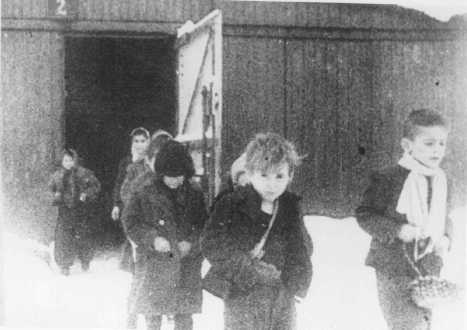
Soon after liberation, surviving children of the Auschwitz camp walk out of the children’s barracks. Poland, after January 27, 1945. — United States Holocaust Memorial Museum

Soon after liberation, surviving children of the Auschwitz camp walk out of the children’s barracks. Poland, after January 27, 1945. — United States Holocaust Memorial Museum

Today is International Holocaust Remembrance Day, the day Soviet troops over ran Auschwitz in 1945. This week I received a note from an Israeli survivor friend, shortly after the passing of one of her liberators, Carrol Walsh. Sara lost over 60 of her family there- and her immediate family was saved only because the day they arrived at Auschwitz, the death machinations were working at full capacity and her transport was rerouted to Belsen. She was liberated on 13 April on the evacuation transport near Farsleben, known here as the Train Near Magdeburg…

In her letter she asks important questions of me. I have responded the best that I could, below.

Dear Matthew,

 We were very sad to hear that Carrol Walsh passed away. Only lately did I get to know him, and he risked his life in order to save ours. It is a pity we did not get to meet more.

I can’t express in words the loving feelings for the young tank commander that for sure always had a smile on his face, and never stopped smiling after we met- 65 years after the victory. I am sure Carrol Walsh made the best out of his life; I was fulfilled to know him and his beautiful family.

I read about his profession in the years of his life. It was interesting to see how much meeting with us affected him.

I thank you for your unusual courage to initiate the exciting meeting [reunion].

I suppose you were very excited for the event you had initiated. Did the idea come in different parts? I am trying to understand the development of your thinking.
When you first wrote to me about the meeting [invitation to the proposed reunion], it was on the day we were released- the 13th of April. I got home after meeting my brothers and celebrating the release [liberation]day. I couldn’t relax, I immediately told all my brothers. I was so happy, as if it was happening again.

The meeting completed a missing part in the picture for me, after all the horrifying things we went through we couldn’t even dream of a miracle like that coming out of the blue.

I cannot go back more to the extermination camps and escort groups because I don’t have the physical nor mental power to do that anymore.

There are questions that bother me.

Are you able to answer them?

Why shouldn’t the world forget and let this be over?  

A. So, some people do want to forget. Others will say that it did not happen. For those reasons, it must never be forgotten. This is the biggest crime in the history of the world.

As Walsh states, how could humanity have stood by and let that happen?

Does my work, the hard work I do, do anything against the forgetting?

A.The most impressionable minds in the world are those of the youth. It is they who the Nazis “educated”; it made it easier for the crimes to be committed. This is why they must hear now.

The work that you, and I do, has an impression. I hope to continue this work after you must slow down. Please remember that.


You are a historian, should the memory be kept?

A.The memory must be kept. As educators it is our duty to keep it alive. We must fight those who trivialize or denigrate its importance.

Is there a proper way to keep the memory?

A.There is no one way except to be open to the discussion of humanity and how humans could do this to one another. We must also bear in mind however, that the soldiers who helped the suffering to new life bore their own pains in doing so, yet also made a choice to redeem humanity. Some did not sleep soundly for years.

I think this is so, and also must not be forgotten. The war brought out the most evil in the world. But I think it also revealed some goodness in the form of the soldiers who liberated or otherwise cared for the victims.

Who should be documenting everything, the “victim” or the “aggressor”?

A.The aggressor fades from memory. New generations asks questions. It is true that some are bothered by the questions. But the young will always be curious and want to know- is this a stain on the German people? I know some Germans today who work very hard to keep the memory alive, as you also do.

The victims give the testimony. This is all they can do. But it is the evidence of the crime, and one that new generations must work with. That is why your work is so important.

Who is in charge of making the conclusions?

A.I would say that institutions such as the United States Holocaust Memorial Museum and Yad Vashem are the world leaders in this area. I have been trained, well, I should hope, by the USHMM. I do not know enough about the German institutions but I hope to raise enough funds to travel to the camps and study there this summer.

Read Full Post »

West Ham send message to racist fans with Holocaust ceremony

Auschwitz survivor will lead pre-match ritual following anti-Semitic chants at Tottenham

Darren Richman /The Independent

Friday, 18 January 2013

West Ham will commemorate Holocaust Memorial Day today at Upton Park with a reminder to sections of their support that anti-Semitic chanting is unacceptable. The club have invited the Football Association chairman, David Bernstein, the Mayor of Newham and Holocaust survivor Zigi Shipper to attend the match against Queen’s Park Rangers and mark the occasion by lighting candles before kick-off. Lord Sacks, the Chief Rabbi, has written a piece in the programme emphasising the fact that sport can be a force for good in helping erase all forms of prejudice.

West Ham’s decision to honour the victims of the Holocaust in this manner is particularly admirable given the events that marred their trip to Tottenham in November. A vocal minority of fans engaged in abusive chanting and made hissing sounds to emulate the gas chambers. Shipper feels that education is the key.

“A lot of these people don’t know any Jewish people,” he said. “They don’t really know what a Jew is. They don’t realise the full scale of what happened. Six million Jews were murdered along with Gypsies, homosexuals and the physically and mentally handicapped. All just because of who they were.

“I have gone to many matches but never heard anything like that which was heard at White Hart Lane. I know for certain that I would have left the ground immediately if I’d been there. When I got off the boat and arrived in this country as a boy, I never imagined anything like that would happen.”

Shipper, 83, was sent to Auschwitz concentration camp in his teens and witnessed countless horrors. “I saw women and babies shot dead,” he said. “Every day I ask myself how human beings could possibly behave that way and then sit down with their wife and children. How could they eat dinner? How could they listen to music?”

Shipper settled in London shortly after the war and started his own stationery company, which is still active today. Most of his time now, however, is spent educating young people.

He said: “I travel round the country visiting schools and universities and share my story. It is important that people understand what millions of us went through. I don’t want the Holocaust to be forgotten because there is always the danger of history repeating itself.”

Of recent racist incidents in football, including Milan’s decision to walk off during a game, he said: “Is walking off letting the racists win? It’s hard to say but I would probably have done the same.”

Shipper has already been involved in spreading his word to football: he addressed the England squad before they departed for Euro 2012.

“I have met Prime Ministers and the Queen but being asked to speak to the players was the greatest honour of my life,” Shipper said. “All I kept thinking was that it’s not bad for a little Polish immigrant who came to this country with nothing more than the clothes he was wearing.”

http://www.independent.co.uk/sport/football/premier-league/west-ham-send-message-to-racist-fans-with-holocaust-ceremony-8458299.html#

Read Full Post »

Class Act
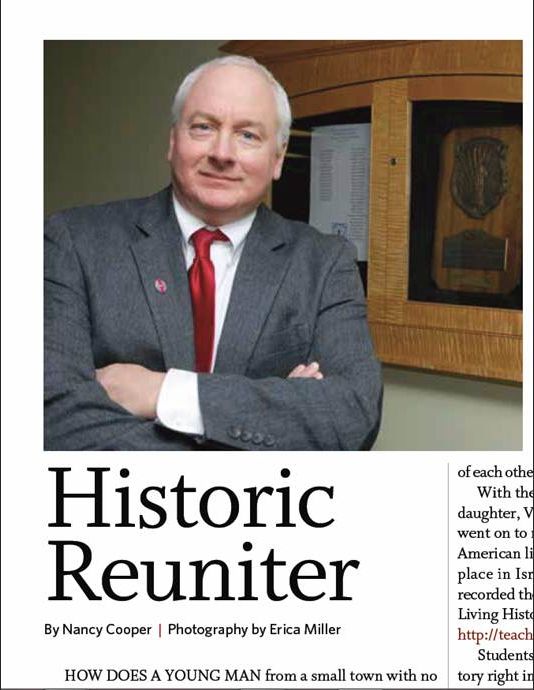
Historic Reuniter
By Nancy Cooper
Photography by Erica Miller
Volume 147, Number 1, January/February 2013, Page 7

How does a young man from a small town with no experience in Holocaust education become a well-regarded figure in World War II and Holocaust history nationwide?

Matthew Rozell 12-12 American Spirit magazine

Not purposely posed. Erica Miller photo. Click the photo to see what I mean…. Only thing missing from 1992 is Dad.

The answer is part of the story of the remarkable career of Matthew Rozell, history teacher at Hudson Falls High School in New York. Following in the footsteps of his father, who was a history teacher in a nearby town, Rozell has taught at his alma mater for the past 25 years.

When Rozell emphasizes to his students the importance of tracking down primary sources, he has a dramatic way of proving his point. Through such primary research, he and his students have been able to identify and reunite Holocaust survivors with the U.S. soldiers who freed them.

Rozell’s instrumental role in such a historic reunion began in 2001 when he sat with Carrol “Red” Walsh, tank commander, U.S. Army 743rd Tank Battalion, to listen to some of his World War II tales. After nearly two hours of conversation, Walsh was reminded by his daughter to “tell [Rozell] about the train.” That prompt was a catalyst to a bigger story.

Walsh related that in April 13, 1945, his tank division saw something unexpected near Magdeburg, Germany: freight train cars alone on a track. When he drove his tank alongside the train, he could see that the cars were filled with Jewish men, women and children—more than 2,000 of them.

Intrigued by the story, Rozell searched for photographs of the liberation, which he posted on his school’s website in 2002. It wasn’t until four years later that Rozell received an e-mail from a grandmother in Australia who had been a 7-year-old girl on that train. She said that as soon as saw the photographs, she fell out of her chair: This was the day of her liberation in 1945.

From then on, “Almost every time I opened my e-mail inbox, there would be another message from a survivor, somebody that I wasn’t aware of before,” Rozell says. “These people weren’t aware of each other for the most part before finding the site.”

With the help of liberator Frank Towers and a survivor’s daughter, Varda Weisskopf of Israel, Rozell and his students went on to reunite nearly 225 Holocaust survivors with their American liberators. Rozell organized 10 reunions: One took place in Israel and three happened at his school. Students recorded the individuals’ interviews as part of a World War II Living History Project (www.hfcsd.org/ww2). Learn more at https://teachinghistorymatters.wordpress.com.{clarification: there have been at least 10 reunions since Rozell began the project; however he did not organize the ones occurring off campus but rather participated in or otherwise helped to facilitate them.}

Students have said of Rozell and the project: “He puts history right in front of your eyes. Never could I have gotten the experience of meeting such inspiring people who learned to love after the ultimate form of prejudice was thrust upon them. A message of acceptance not only reached the little town of Hudson Falls, but the entire world.”

“It’s life-altering,” said another. “And because we’ve heard these stories, it’s our job to make sure it won’t happen again.”

The powerful lesson hasn’t been limited to his students at Hudson Falls. In 2008 Rozell was awarded a Museum Teacher Fellowship at the U.S. Holocaust Memorial Museum for his work in Holocaust education. The Tennessee Holocaust Commission has created workshops based on his work. On September 25, 2009, Rozell and his students were named ABC World News “Persons of the Week.” His project was also the subject of the U.S. Holocaust Memorial Museum documentary “Honoring Liberation,” which debuted at the Holocaust Days of Remembrance in Washington, D.C., in April 2010.

To keep his teaching methods fresh, Rozell says, “I listen to the kids and adjust all the time. Some days you do not know the impact you have, but I can look to the dozens of kids who have gone into history education as a feather in my cap of sorts.”

He advises today’s youth not to take the sacrifices of the past for granted: “Talk to older Americans who served their nation.”

-American Spirit Magazine, Jan.Feb. 2013. National Society Daughters of the American Revolution.

Read Full Post »

Another great and timely email…

From: Philip M.  Sent: Sunday, December 02, 2012 6:26 PM

Subject: Your Dad

I just wanted to take a moment to send you an e mail. I was in your Dad’s classes from 1977- 1978 at Glens Falls HS, He was a teacher who inspired learning.

He was my favorite teacher along with Mr Cubbins, I went on to teach French, Spanish, Social Studies, Economics, Government, World History, and many other classes…

Also I was able to earn a pension after many years from the US Army at the Rank of Major. Without good teachers, I never would have accomplished anything.

My Dad was a teacher also and he passed away 10 4 2004. Sincerely, Philip M.

++++++++++++++++++++++++++++++++++++++++++++++++++++++++++++++++++++++++++++

Today, Dec. 4th, would have been my dad Tony Rozell’s 81st birthday. He passed away in 2000. Phil’s email above was a reminder. Good timing, Phil! From  father to son! About the time you had my dad in the classroom I was trying to figure out how to get away from him, and this town!

A couple Dad stories.

tonewritin2Dad (Tony) entered the Air Force at the outbreak of the Korean Conflict and quickly rose through the ranks. He was a superior clerk and administrator who served in the war zone and saw death and destruction near the 38th parallel. There is one story Dad used to relate that I really like. In the early days of his service, he was singled out for abuse by a mean-spirited corporal who particularly delighted in bullying the 88 lb. runt from Hudson Falls. Years later, after Tony had proven his abilities and achieved the rank of Tech. Staff Sergeant, this same corporal came to his office to receive his orders. He avoided Dad’s eyes as Dad handed them to him, and Tony asked quietly if the corporal remembered him. The former bully’s eyes darted around the room and back to his feet, as he nervously replied, “No, sir!” With that, Dad nodded and bid his former tormenter farewell without the dressing down he so richly deserved. He could have shipped the guy to Timbuktu.

Dad had a large impact on a great many lives outside of the immediate family, and was a great influence on me as a teacher, though I never saw him teach myself. I do recall early in my teaching career going into his school with him to get some materials and encountering three boys kicking a crushed milk carton back and forth in a stairwell. I wondered how my father (the teacher) was going to handle this- would they be sent to the office? Reprimanded? Told to pick up the milk carton and exit the building promptly? I think they were wondering this, too, when Dad just jumped in the middle and began to kick it around with them…

He rarely had discipline problems because he loved the students more than he loved the authority and power he had over them. He was never sour or burned out. He always came home from school humming to himself and generally in an upbeat mood. I can remember him saying on many occasions how much he loved his career “because the kids are always different-no two are ever alike.”

Before he retired in the early 1990s, the Glens Falls Post Star ran a feature article on DaRozells profile Feb. 3, 1992d and I as teachers. I think Dad hit it right on the head when he said, “Teaching is not a matter of how smart you are, it’s a matter of personality…If you know your subject and you’re fair, it doesn’t make any difference what you teach.”

++++++++++++++++++++++++++++++++++++++++++++++++++++++++++

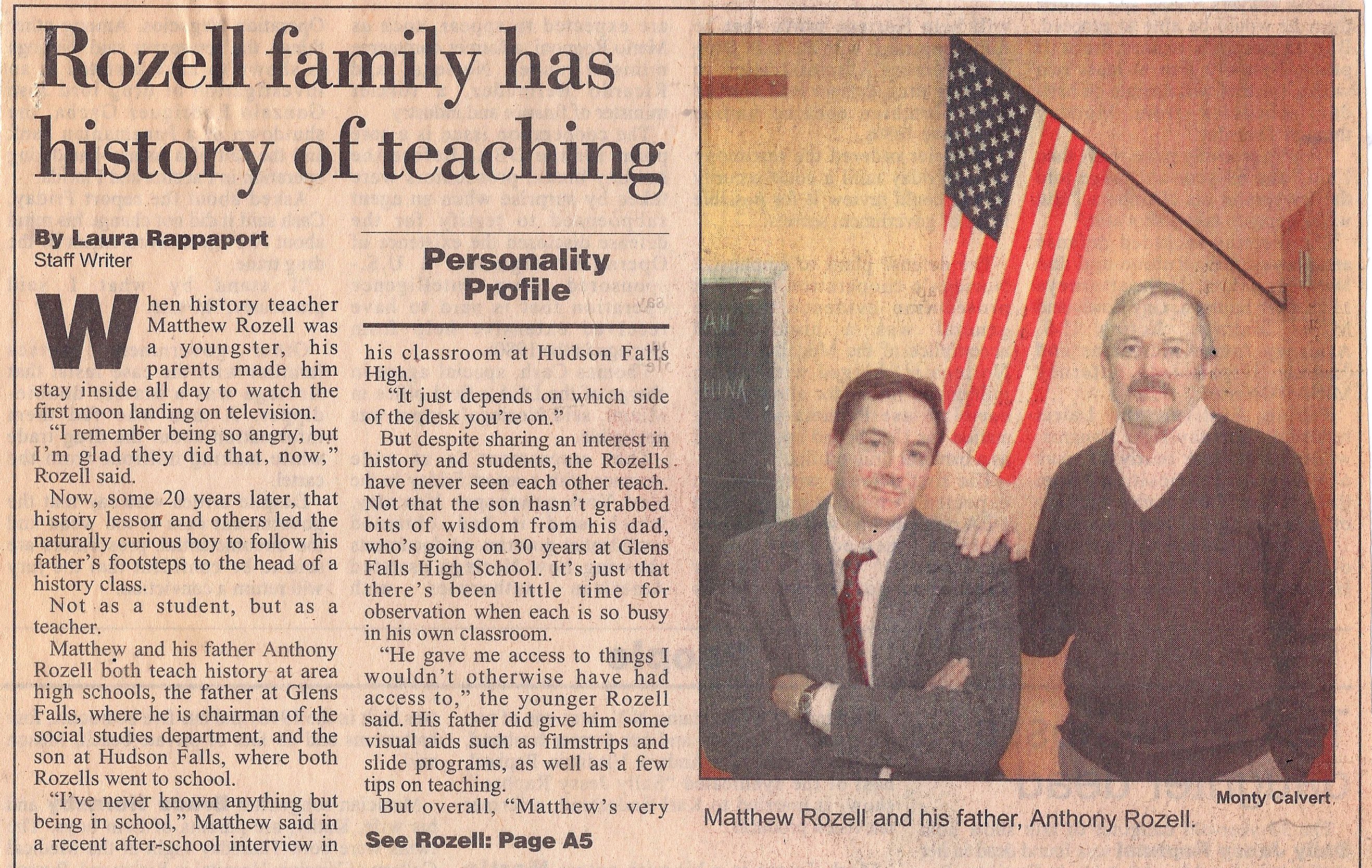
Feb 3, 1992 Glens Falls Post Star story. Captain and the Kid.

Feb 3, 1992 Glens Falls Post Star story. Captain and the Kid.

Rozell Family has “history” of teaching

By Laura Rappaport, Staff Writer

February 3, 1992

When history teacher Matthew Rozell was a youngster, his parents made him stay inside all day to watch the first moon landing on television.

“I remember being so angry, but I’m glad they did that, now,” Rozell said.

Now, some 20 years later, that history lesson and others led the naturally curious boy to follow his father’s footsteps to the head of a history class. Not as a student, but as a teacher.

Matthew and his father Anthony Rozell both teach history at area high schools, the father at Glens Falls, where he is chairman of the social studies department; and the son at Hudson Falls, where both Rozells went to school.

“I’ve never known anything but being in school,” Matthew said in a recent after-school interview in his classroom at Hudson Falls High, “It just depends on which side of the desk you’re on.”

But despite sharing an interest in history and students, the Rozells have never seen each other teach. Not that the son hasn’t grabbed bits of wisdom from his dad, who’s going on 30 years at Glens Falls High School. It’s just that there’s been little time for observation when each is so busy in his own classroom.

“He gave me access to things I wouldn’t otherwise have had access to,” the younger Rozell said. His father did give him some visual aids such as filmstrips and slide programs, as well as a few tips on teaching. But overall, “Matthew’s very independent,” his father said. Maybe so, but the younger Rozell credits his parents with kindling his interest in history by exposing him and his four siblings to it. On trips to Boston and New York City the family would visit the major museums and historical sites. “I was always very interested in what I saw,” said Matthew Rozell, adding that he usually had more questions than his brother and sisters. Also, with a father who teaches summer school, (Anthony taught summers in Hudson Falls for 21 years) it was hard to get away from school subjects – even for a few months. On summer afternoons or evenings, the father might play tapes or show slides of what he was working on in school. “It wasn’t like he would sit and make us watch it,” said Matthew. “I wasn’t enthralled, but at the same time I was exposed to it.” And his parents made sure their kids paid attention to important world events, like the historic moon landing. “He gave me money to go to the newsstand” for the momentous, occasions, Matthew said.

The elder Rozell is also a collector who hangs onto magazine and newspaper articles about the big stories of the day. His classroom bulletin boards at Glens Falls are covered with yellowing newspaper pages.

Contemplating retirement at the end of the next school year, the senior Rozell said he fell into teaching “out of the blue” in 1958 when there was a lack of teachers in the state. He had wanted to be a minister and started his education at St. Joseph’s Catholic Seminary in Yonkers. He already had almost all of the necessary graduate credits in history and was offered a chance to take a few more credits to become certified and guaranteed a teaching job. “I could not help but do that,” he recalled. “Once I got into it, everything fell into place, and 1’ve enjoyed it ever since.”

His son, now 30, followed a tougher path: jobs were scarce when he finished his teaching degree at State University of New York at Geneseo in 1985. He looked for work in the western part of the state, and even had the opportunity to run a restaurant or become a chef. But Matthew Rozell felt he shouldn’t throw away his education. “I spent too much money on my education to just give it up,” he said.

Failing to find a job in western New York, the young Rozell came home to Hudson Falls and stayed with his parents. He finally landed his present job – with a little help from dad,.- midway into the 1987 school year after a year at St. Mary’s Academy. He was the third teacher the class had that year, and it was a tough assignment. “When I first came here I was more interested in survival,” he acknowledged. “It’s like throwing a piece of meat to the wolves.” The more experienced Rozell helped his son through some of the rough spots in the beginning, and Matthew Rozell turns to his father less now, in his fifth year teaching.

Father and son are close, but they don’t spend a lot of time talking about education and lesson plans. The teachers’ wives may actually have been brought closer together by sharing similar work – in the South Glens Falls Central School District, Matthew observed. His wife Laura teaches special education at South Glens Falls, while his mother, Mary, is the school nurse teacher there. The two women have become very close, and usually go to staff meetings together, according to Matthew.

“They like to wear the same outfits on those days and see if anyone will notice,” he said.

Anthony Rozell looked back on his own long career in education and ahead to the future his son will face in the classroom. “A teacher today has access to so much material,” he said. “I didn’t have one iota of a film strip or a tape … I

21 years on. Article for release Feb. 2013. Dad is gone but spirit is raging. Erica Miller photo.

21 years on. Article for release Feb. 2013. Dad is gone but spirit is raging. Erica Miller photo.

just had to drum it into their heads,” Kids are different today, too, the father noted. More come to school with problems at home that can interfere with their studies. The students he gets the most joy from are those who bring with them a good attitude toward learning and toward life. “The ones you have that are happy people, smiling people, polite people, those are the ones you never forget,” he said. And those are usually students whose families take an interest in their learning and well-being. . “They know that they belong,” he said. “Their parents are really caretakers. That’s nice.”

And in the final analysis, said Anthony Rozell, there’s not a lot a father can really teach a son about the profession or art of teaching.

“A teacher finds, eventually, their own niche, their own method,” he said. “Teaching is not a matter of how smart you are, it’s a matter of personality …. If you’re strong and , fair, it doesn’t make any difference what you teach.”

++++++++++++++++++++++++++++++++++++++++++++++++++++++++++++++++++++++++++++++++++++

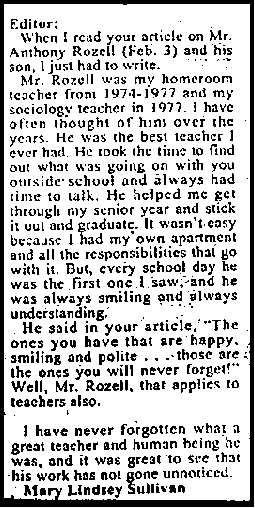
The Old Man was tickled when this letter to the editor appeared in the Post Star shortly thereafter…

I just had to write

++++++++++++++++++++++++++++++++++++++++++++++++++++++++++++++++++++++++++++++++++++

Brother Ned’s observations on the Dad’s 80th…

http://alaskatracks.blogspot.com/2011/12/tony-rozell.html

Read Full Post »

Just when you think that maybe things are “quieting down”,  an email comes in your inbox again.

At Thanksgiving Time.

Can’t wait to speak to Kurt. In the meantime, read below. He has to be around the 230th survivor of the train to make our acquaintance…good work Frank and Varda! Frank, you never cease to amaze me, at 95 yrs young, you are doing laps around me! So now I can share with the students, and fellow survivors and soldiers!

In the words of survivor Dr. Micha Tomkiewitz, “welcome to the family!”

—–Original Message—–
From: Kurt Bronner

Survivors Kurt Bronner and his lovely wife. Thanks to Frank and Varda W. for finding them- “welcome to the family”

Sent: Thursday, November 22, 2012 2:31 PM
To: Rozell Matt
Subject: Thanks

Dear Matt…This last week I have been in touch with Frank Towers and Varda W….They found me on the list on survivors of the deathtrain..I have seen movies and stories…Its like my past has been opened up…On this day of Thanksgiving I would like to wish you a happy peaceful Year and thank you for opening up a chapter of many survivors on that train…I live in Los Angeles and the Burbank school system has had a similar program and I have been talking to students in junior and high schools…Have 100s of letters from the students…Teachers like you are in my Golden book..Thank you for your groundbreaking efforts…with my best to You and your family with my love, Kurt Bronner

Teaching tolerance

April 08, 2000

by Irma Lemus, Burbank Leader

MEDIA DISTRICT NORTH — Fifty-five years have passed, but Kurt Bronner can still vividly recall his mother being beaten by a Nazi soldier as he watched helplessly through a barbed wire fence. It was the last time Bronner, now 74, ever saw his mother.

The Encino resident revisited the horrific nine months he spent at Bergen-Belsen, a concentration camp in northern Germany, Friday during a presentation to Burbank High School students.

The event was part of the Burbank Human Relations Council’s Holocaust remembrance program, held every April and May to coincide with Burbank’s Interfaith Days of Remembrance. About 25 Holocaust survivors and liberators are involved in the program, speaking at area schools about the human toll of hate and bigotry run amok

“If you remember anything from today, remember that hate exists and you, as future leaders, must stop the Holocaust from happening again,” Bronner, a Hungarian native, told the students.

“People think that it can’t happen here, but I remember my father once told me that it couldn’t happen in Hungary and it did,” said Bronner, who was removed from his home along with his family at the age of 17.

Don Duplechein, who served in the U.S. Army’s 567th Ambulance Company during World War II, also spoke to students Friday. He described the scene as he and about 30 other troops arrived at the Nazis’ Dachau death camp at the end of the war.

“You couldn’t believe it. When we arrived we saw people begging for food with lice all over their heads. We knew we had to feed and bathe these people,” Duplechein said.

To a small group of students who gathered after the presentation, Bronner spoke in more detail about his experiences in the concentration camp.

“A lot of people think that children were held at the camps, but the truth is that in a lot of the camps the children were killed and the only ones allowed to live were young people and adults,” he said.

Danny Screws, 17-year-old Burbank junior, said it was difficult to believe that nobody was willing to act to stop what was happening.

“I asked him [Bronner] how the government could let the people be treated that way. He told me that, although they were from Hungary, they were still Jews. I think that was wrong,” Screws said.

Bronner described traveling to the concentration camp by train with hundreds of people piled into a single boxcar, barely able to move or breathe . He talked about the horrible living conditions at the camps where thousands of people died from starvation and disease.

“I remember trying to find my father’s body as he was put on a horse-drawn carriage. I couldn’t find him to say goodbye because of all the bodies piled up,” said Bronner, whose father died at Bergen-Belsen.

Bronner was asked if he hated the Nazis for what they did to his family.

“You know, a student once asked me what I would do if the people that killed my parents walked through the door. I told the student that killing the person wouldn’t bring my parents back and it would make me a killer. You have to forgive, but never forget,” he said.

Read Full Post »

« Newer Posts - Older Posts »