Feeds:
Posts
Comments

Posts Tagged ‘Matthew Rozell’

guns at last lightI’m recovering from a foot injury and it has given me time to finish Rick Atkinson’s latest release, The Guns at Last Light: The War in Western Europe, 1944-1945 in his Liberation Trilogy. With school around the corner, I am excited to be teaching a couple dozen seniors once again about World War II, and in the springtime, the Holocaust.

I’m happy with Mr. Atkinson’s coverage of the heroics of the 30th Infantry Division-he even made a research pilgrimage to Hill 314 in Mortain, where elements of the 30th held off against a Hitler-ordered panzer counterattack for 6 days, saving the Allied breakout in Normandy in August 1944. 

If you are a follower of this site, you will know that that division is dear to my heart, not because of any blood relations who fought in it, but because they named me an honorary member of their Veterans of World War II Association for my work in the classroom and in uncovering and reuniting the story of the liberation of the concentration camp train at Farsleben, Germany on Friday, April 13, 1945.

So you can imagine my excitement when I ran across this passage last evening from page 599 of Rick’s book. He writes about some of the chaos that unfolded as POWs, slave laborers, and concentration camps were liberated in Germany:

“Instead, starvation, revenge, indiscipline, and chaos often created what Allied officers called a “liberation complex.” SHAEF [Supreme Headquarters Allied Expeditionary Forces ] had presumed that refugees “would be tractable, grateful, and powerless after their domination for from two to five years as the objects of German slave policies.” As an Army assessment concluded, “They were none of these things.… Newly liberated persons looted, robbed, murdered, and in some cases destroyed their own shelter.” Freed laborers plundered houses in the Ruhr, burning furniture for cook fires and discarding slave rags to dress in business suits, pajamas, and evening clothes ransacked from German wardrobes. Ravenous ex-prisoners licked flour off the floor of a Farsleben bakery. In Osnabrück, “rampageous” Russian slaves died after swilling V-2 rocket fuel discovered in a storage yard. Others smashed wine barrels and liquor bottles in a Hanover cellar, drinking so heavily from a sloshing, six-inch-deep pool of alcohol on the floor that several collapsed in a stupor and drowned before U.S. MPs could close the entrance.”

So I did a double take: Ravenous ex-prisoners licked flour off the floor of a Farsleben bakery. I checked his notes-page 801, sure enough, 30th Division G-2 report. I know I have read this before in my research of primary source documentation, originally sent to me by Frank Towers, one of the liberators.  Here it is.

30th Division Medical Detachment Diary & Log

Of course, the backstory surrounding the document above is the story that I have to tell- the soldiers of the 30th Infantry Division and the attached 743rd Tank Battalion, the Holocaust survivors whom they stumbled upon, liberated, and were reunited with 62 years later at our high school and subsequent events.  I’ll probably share the Benjamin photo with Mr. Atkinson on his FB page. 

Anyway, I recommend the book to any of my followers interested in the history of World War II in the European theater, and am really pumped to teach some very excited and motivated students this year, including the grandson of the tank commander who was sent to investigate the train.

This is how you “do” history, and how the teaching of history can sometimes take on a life of its own. So cool to be a part of it, and to read something in a best seller and be able to grasp the incredible backstory that awaits to be told.

Read Full Post »

Matthew Rozell rediscovers and rekindles interest in sutler site, 1996.

Matthew Rozell rediscovers and rekindles interest in sutler site, 1996.

Today I am going to get a special phone call from an archaeologist whom I have known and worked for for thirty years. David wants me to be present for the removal of three intact 18th century olive green glass spirits bottles from a French and Indian War sutling house, or trading post, just outside of the British fort on the banks of the Hudson River near Rogers Island. Two intact bayonets were discovered here earlier in the week, but more exciting for us is the fact that we now think that we have found the elusive 4th wall of this building, which burned to the ground a few years into its existence. We have been searching for it for twelve summers.

Excavations began here in 2001, with me and digger Johnny Kosek and Mark Van Valkenburg. I had stumbled upon it during a pensive walk in the woods near our fort excavations in the summer of 1996. I had found a looters’ hole in the ground, spadefuls of earth littered with fragments of the very same bottle glass fragments from the period. On the ground I spied what looked like a shiny silver dime partially covered by the sand. A heavy rain had uncovered what the looters had wanted- a Spanish silver coin from 1748. Remember Hawkeye of the Last of the Mohicans? He would have drawn a dram or two here.

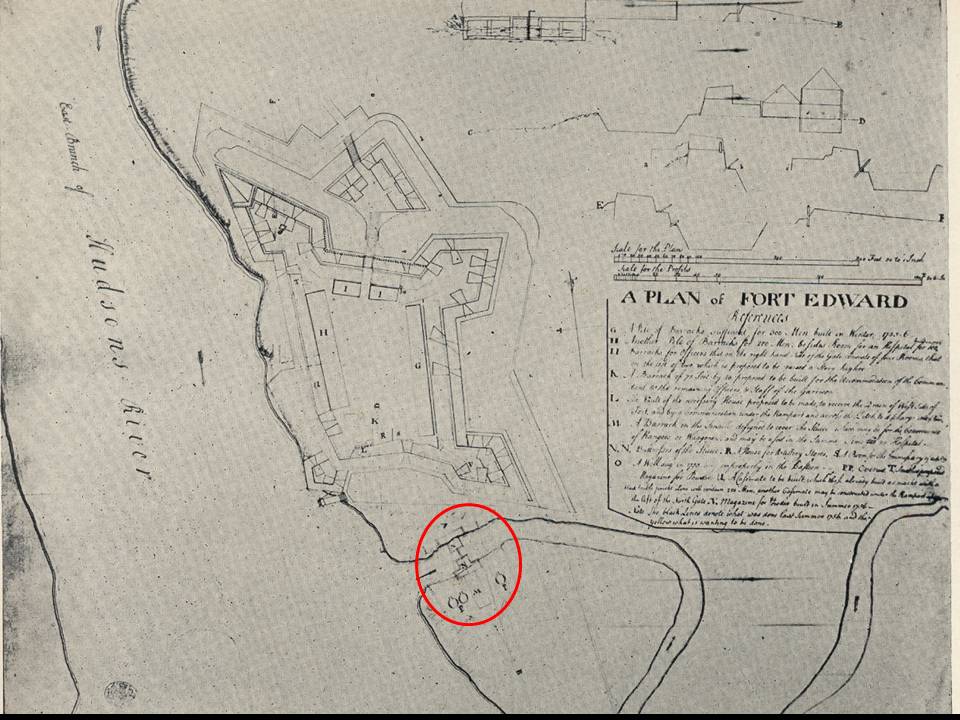
Period map showing location of sutler's complex. Island just to west of river.

Period map showing location of sutler’s complex. Island just to west of river.

My association with this important ground, so fundamental to the formation of our nation, began in 7th or 8th grade. Four of us would ride our banana seat bikes down to Rogers Island one summer in the early 1970s, sneaking smokes, getting away from our parents and siblings, and just dig holes in the ground with our moms’ gardening tools. I recall digging a hole as deep as my arm would allow, a tunnel straight down, a criminal activity in the eyes of any competent archeologist. Thankfully, we never found anything.

A dozen years later, in 1986, I would return as a volunteer crew member on an archaeological dig searching for General Gates’ American headquarters at the Saratoga National Battlefield Park. Here I would encounter David for the first time. I remember him asking me, after my first two weeks as a newbie, if I would ever consider going into anthropology/archaeology as a career. I think I was flattered, but I had just wrapped up my undergraduate work and was sending resumes out for teaching.

I followed him though, in 1991, to return to this Island. I had gotten hired at my high school alma mater 3 miles up the river and now had the opportunity to professionally learn what secrets the Island held. In 1992, David felt confident enough in my abilities to give me the reigns of the search for the elusive smallpox hospital at the southern end of the Island. We found it after three years of digging in the summer of 1994. 800 people died here. It was the only smallpox hospital from this era ever discovered in North America. I began to write.

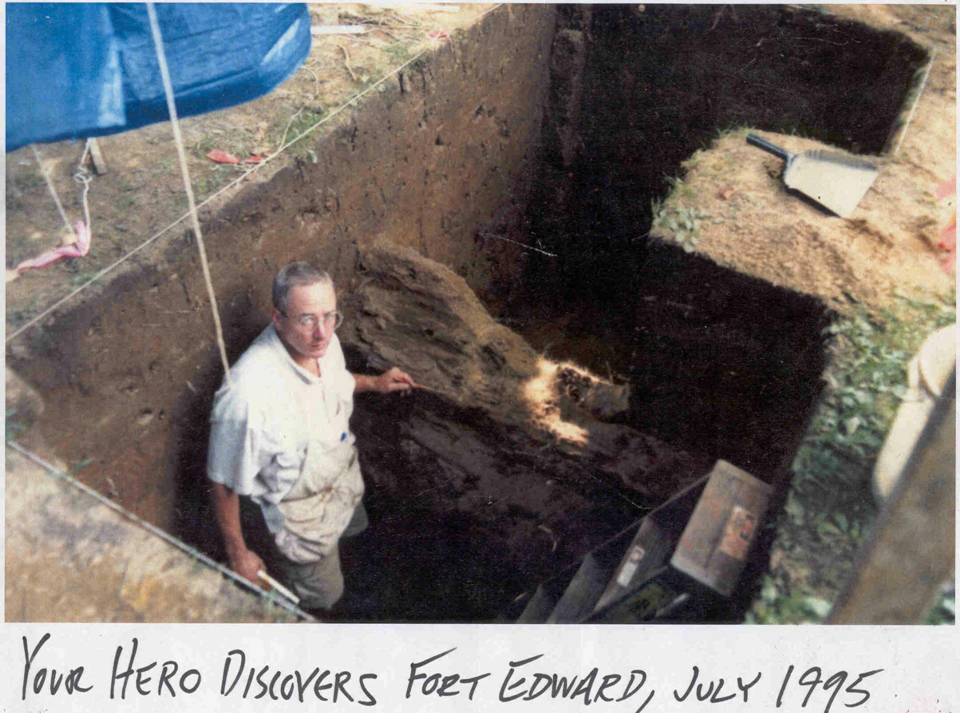
hero discovers ft edIn 1995 and 1996 we professionally dug at the site of Fort Edward, no easy feat considering that today twelve houses are built upon it. At one point we were excavating a bastion (corner) in the basement of a house! We opened up a pit in a front lawn, properly protected and barricaded, but the paper boy still managed to stumble into it. I found the West Curtain wall with Johns F and K, Mark, Brad and Susan and Hans. And one hot summer day took a stroll down the riverbank to stumble upon the sutlers house.

From 1997 to 2000 I worked at the parade ground of Fort William Henry, the one where the final siege takes place in Coopers Last of the Mohicans. We found the charred remains of the East and West barracks, the exact footprint of the original fort.

In 2001 we returned to the sutlers’ complex just south of Fort Edward. I directed the digs here for many many summers,

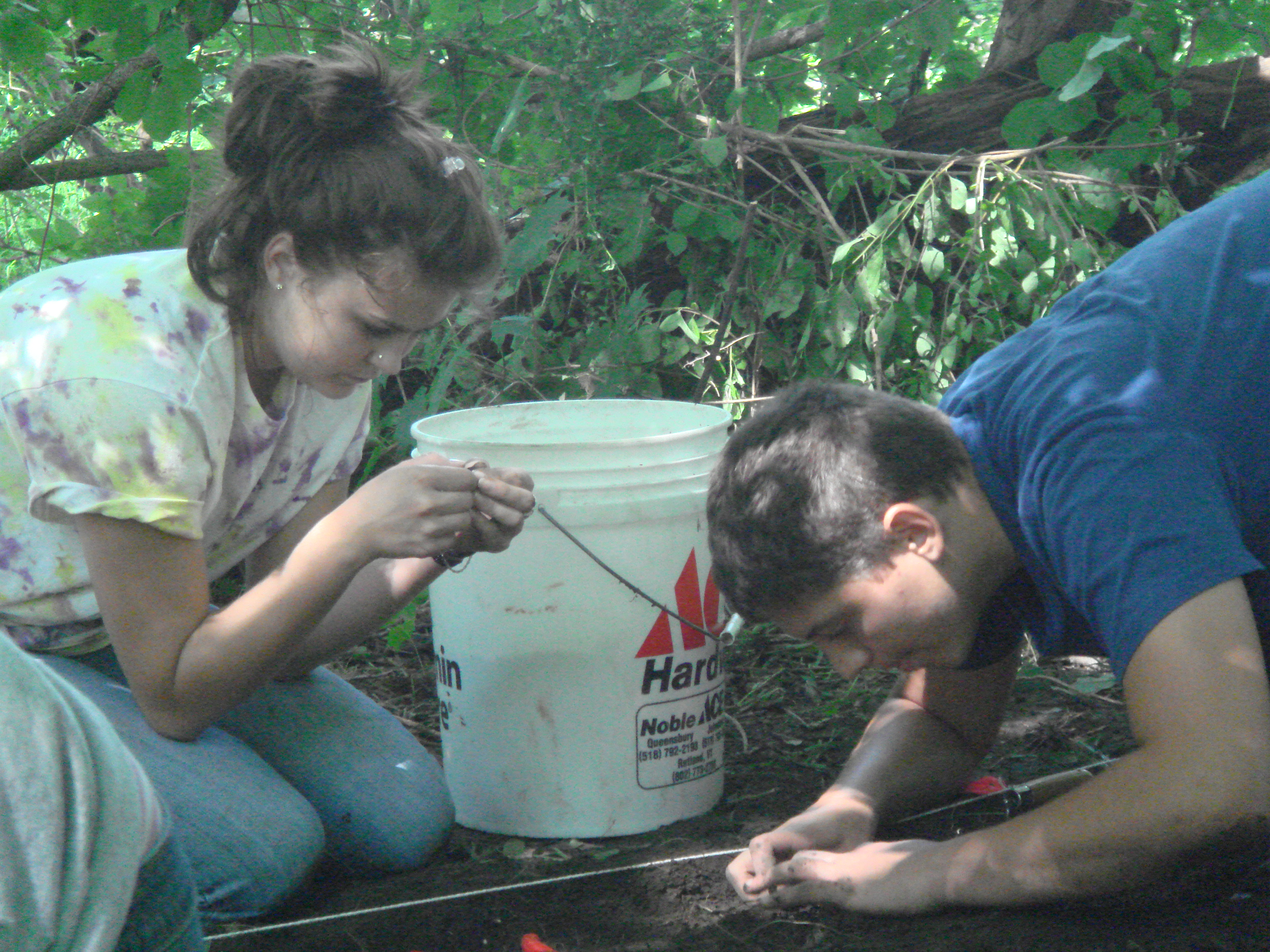
Our high school kids learning how to think, placing the artifacts at hand in the context of a major world war that was partially fought in their own backyard.

Our high school kids learning how to think, placing the artifacts at hand in the context of a major world war that was partially fought in their own backyard.

and later returned with high school students to teach them how to professionally draft a research question, study primary source maps, diaries and other documents, and begin to look for clues, and only then to dig properly, mapping all  the artifacts and features as they emerge. They learned how to dig, yes, but more, they learned how to think.

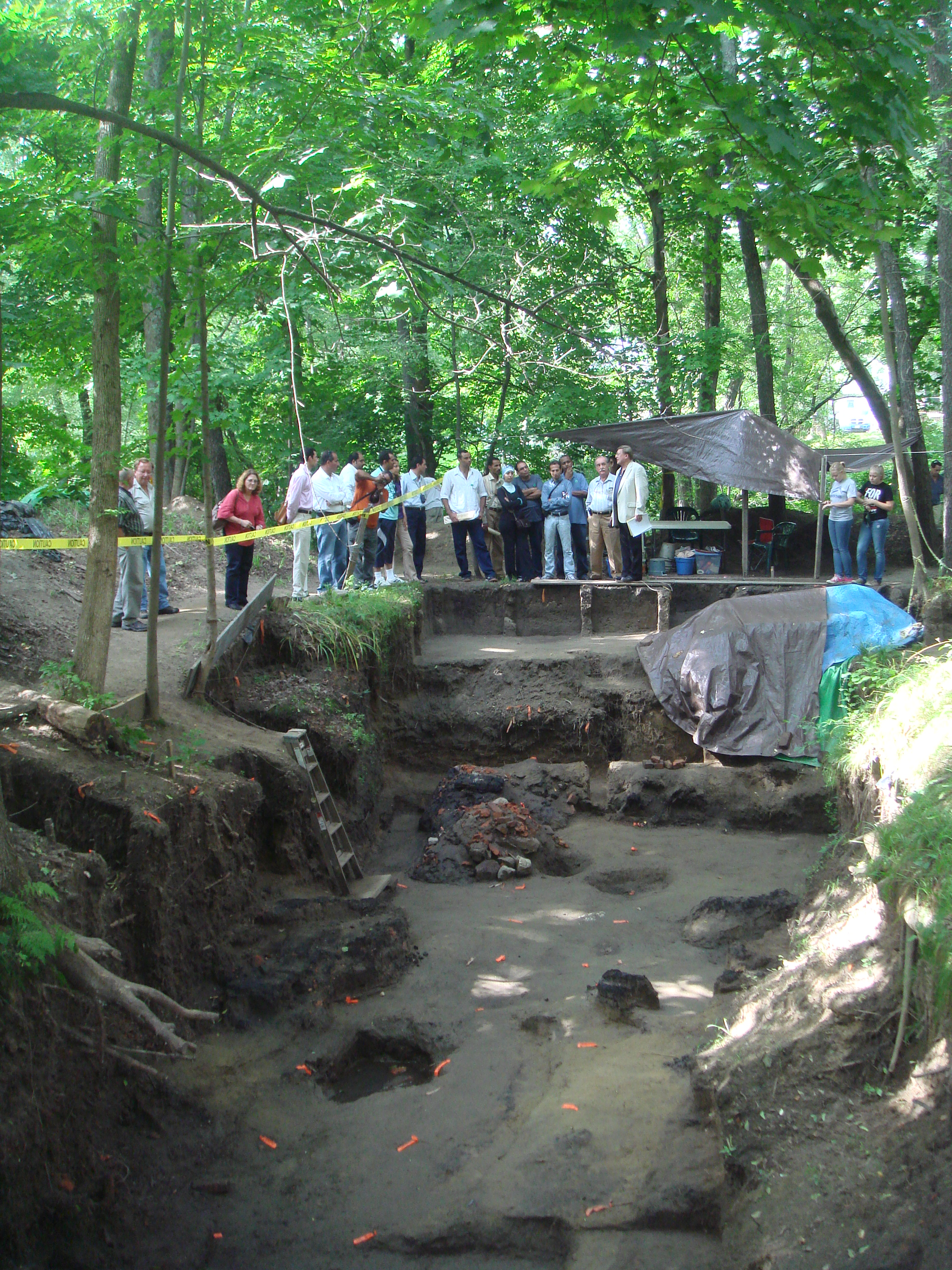
Egyptian Archaeologists visit the sutlers site, 2009. My baby. They were impressed. Proud daddy.

Egyptian Archaeologists visit the sutlers site, 2009. My baby. They were impressed.

Lots of times when everyone would leave I would just sit at the sit alone  for an hour or so. Just sit in the stillness and wonderment of this place. Just something I have always felt a need to do. It’s like the place has some kind of power over me. It’s my baby. When we are digging, we are touching objects that have been lost for over two hundred sixty years. I am the first to touch this bayonet, this coin, this tobacco pipe, this bottle since it was last handled. Thus the anticipation of touching these three intact, upright bottles.

My house building activities have kept the project at arm’s length, but the excitement is still there and rekindled. If you want to learn more, there are several books out by David Starbuck. I’m in this one quite a bit. After today, I joked to him yesterday, he may have to update it.

POSTSCRIPT: I was given the honor of extracting the three bottles. We also found three additional ones behind them. The Egyptian archaeologists would have been proud- my personal King Tut’s tomb moment. The bottles were all complete, two thirds of them totally intact.

The Bottles. Unbroken. Filled? King Tut's tomb moment. "The tension mounts..."

The Bottles. Unbroken. Filled? King Tut’s tomb moment. “The tension mounts…”

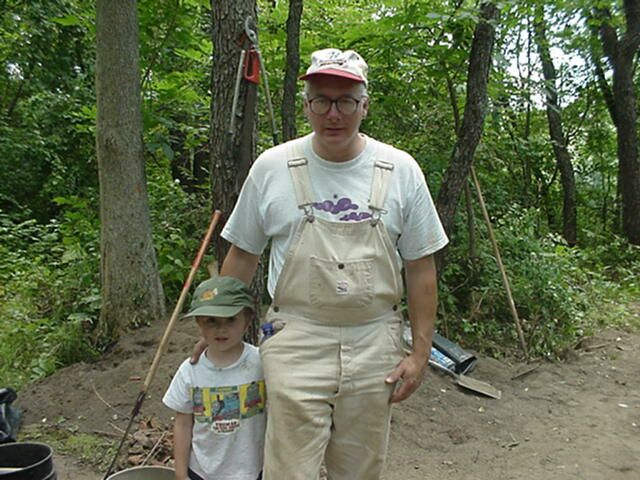
My son Ned and I, 2002, the sutler's site, Fort Edward.

My son Ned and I, 2002, the sutler’s site, Fort Edward.

Son Ned and I at the sutler's site. Thursday morning, August 8, 2013

Son Ned and I at the sutler’s site. Thursday morning, August 8, 2013

.

Read Full Post »

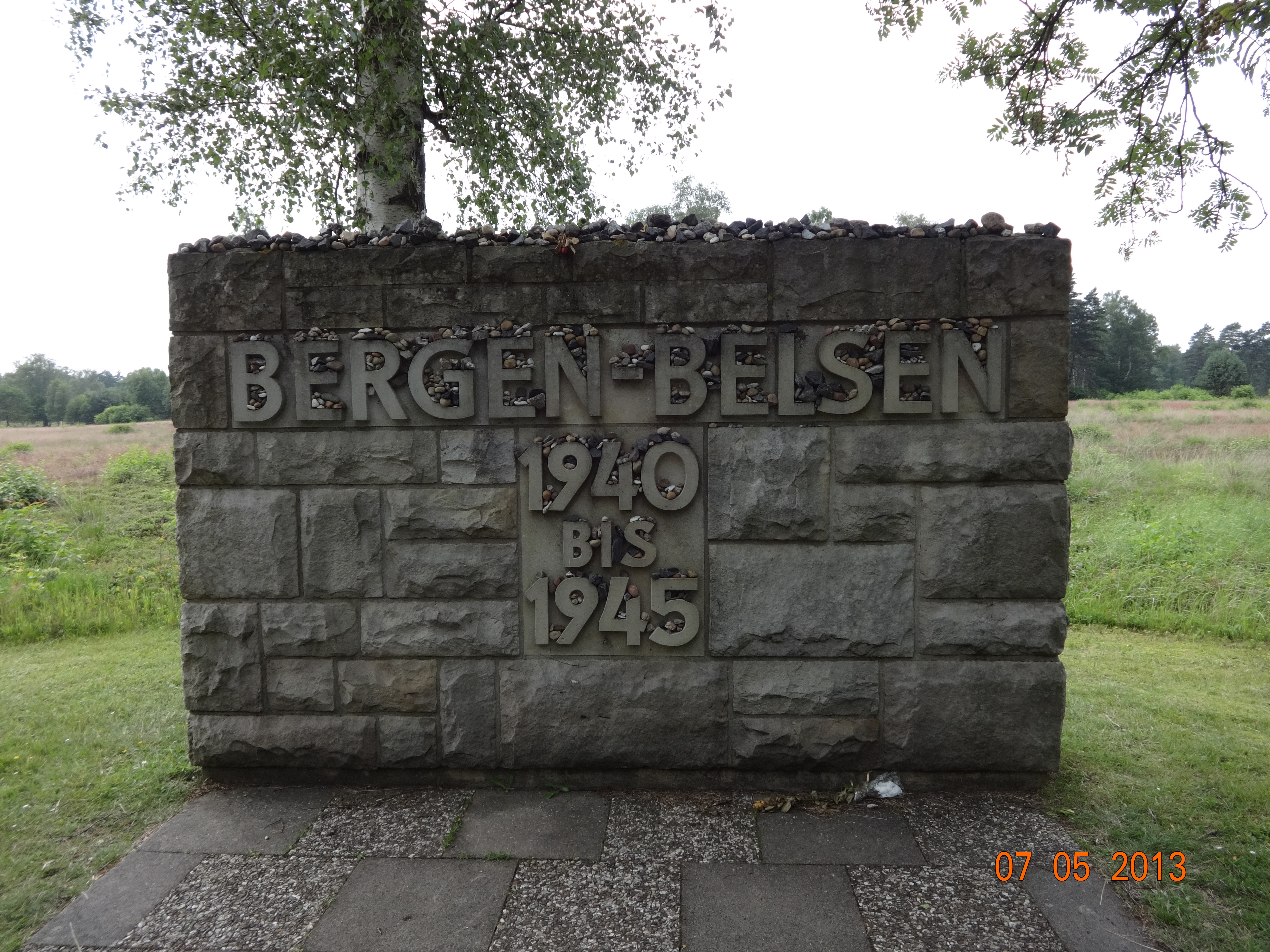
Bergen Belsen on July 5, 2013.

Bergen Belsen on July 5, 2013.

I am in Europe on a study tour of the Holocaust with 25 fellow educators of the United States. I am typing this as the morning breaks in the heart of Berlin, Germany. I had hoped to be able to get on-line and write more frequently but that is just not possible. There is too much to do while we are here visiting these authentic sites. But it is time to stop and reflect on some of the things that I have seen and experienced.

Our itinerary includes stops in Germany, the Czech Republic, and Poland. The power of visiting these sites after studying them so long can not be overstated.

Bergen-Belsen. For me, visiting this place after studying it in depth in relation to the exchange camps that were here was a powerful experience. Readers of the blog know of the stories of many of the survivors of Bergen Belsen who were in the exchange camp and their liberation on April 13, 1945 at Farsleben. Two days ago I got the back story of the exhibition panels you see here, that feature the photographs and the work that our project has uncovered.

In brief context: 120,000 prisoners passed through Bergen Belsen, and not all of them Jewish. 52,000 died here, perhaps 30,000 of them were Jewish. Belsen actually began as a POW camp- 20,000 Russians died here in the winter of 1941-42. In 1943, Himmler (the head of the SS) ordered that an exchange camp be set up for Jews who might possess foreign certificates or visas to emigrate, perhaps to use to bargain for German families interned abroad. 14,000 people went through the exchange camp. In November, 1944, thousands of women, and some children, including the Frank sisters, arrived from Auschwitz, to be “housed” near the exchange camp. What they received, in their miserable condition, were 18 oversized old tents which promptly blew down during a winter storm shortly after their arrival. With the arrival also of brutal SS administrators and guards, conditions deteriorated rapidly as the winter of 1944-45 turned into spring. The camp system began collapsing with the advance of the Red Army in the east and the British and Americans in the West. By the time the British arrived on April 15th at the camp gates, over 50,000 prisoners were suffering from extreme malnutrition, typhus, typhoid fever, and dysentery. Nearly ten thousand corpses lay about as the crematorium had long since broken down. Hundreds died on the day of liberation.

I'm here. Finally.  Jerrilyn Miller photo.

I’m here. Finally. Jerrilyn Miller photo.

So here I am. The bus guides swiftly through the beautiful German countryside. A night in the picturesque town of Celle the evening before has us well rested. The fields and forests bid us peaceful feelings as we move with our rendezvous with the past. It feels as if as we move we are stepping back in time.

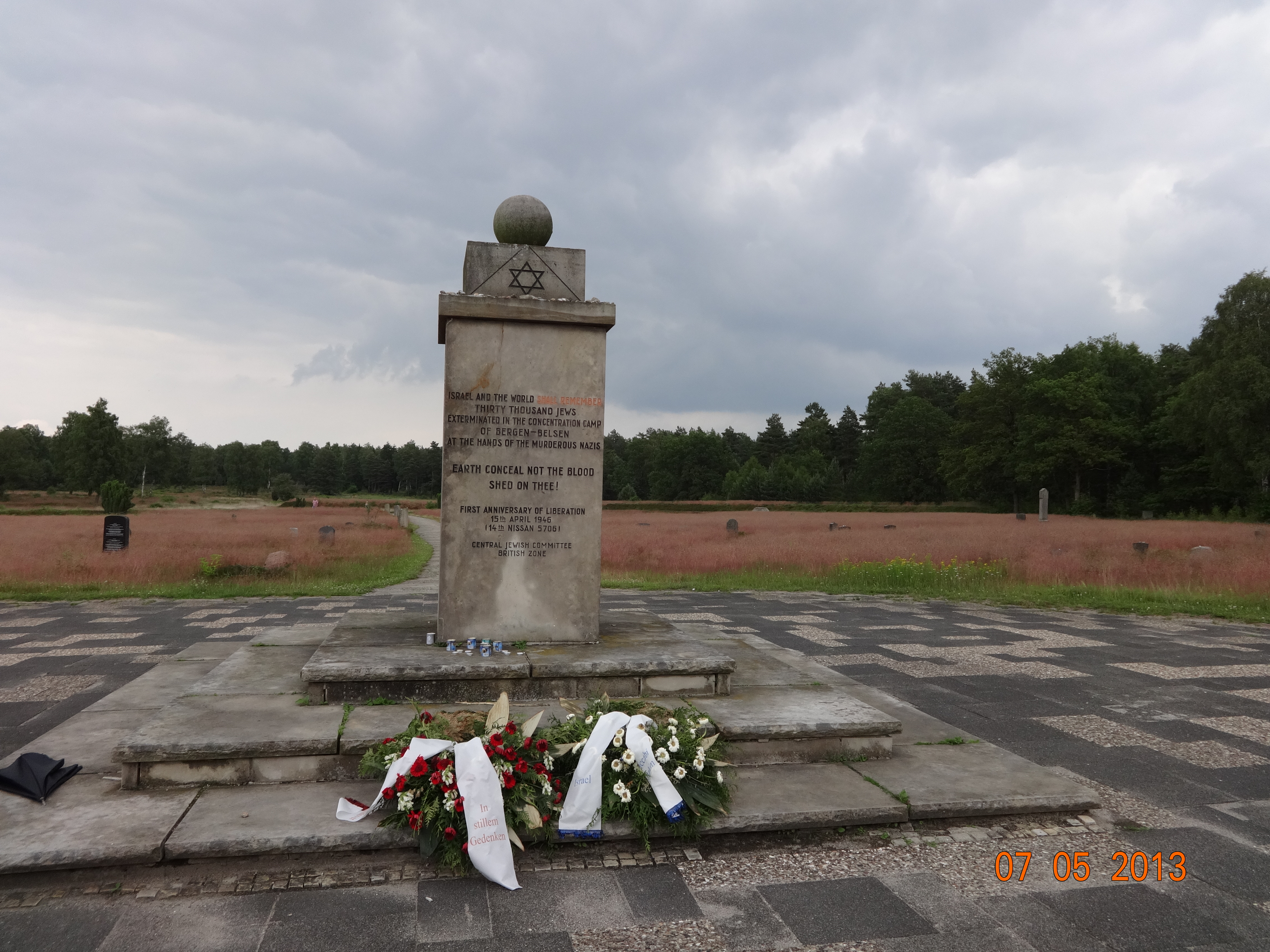
Memorial site, Bergen Belsen.

Memorial site, Bergen Belsen.

We see the road signs for the memorial and I think many of us on the bus draw a collective breath as it turns into the parking lot of Gedenkstatte (Memorial) Bergen Belsen. It is surrounded by trees. We are the only persons, besides staff, who are here. As we disembark off the bus, Tif ties an Israeli flag around her neck so it drapes like a cape. It is quiet. But the birds are singing.

Now I remember that in 2007 I was beginning my first communications with Christian and Bernd, then staff members at the Memorial. They were excited about the opening of their new exhibition hall and education center. Two years later they would fly over, with the historian Thomas, to take part in our 2009 reunion. So now I am here for the first time to see them again.

We meet the staff, who are still preparing for us. I’m listed on the program at lunchtime for a talk about the exchange camps and how the project is incorporated into the exhibition. Bernd enters the room and greets me warmly.

After an introduction to the history of the site, we  watch the silent movies shot by the British beginning the second day after the liberation. Perhaps you’ve seen the photos or the films. Belsen, in 1945, was the last stop, the terminus of the Holocaust, as one historian has described it. It was a scene of horror. If you see a photo of a soldier wearing a mask, maneuvering a bulldozer to push corpses into an open pit, that was Bergen Belsen. Just over a month later, the British commander ordered the lice infested, typhus ridden barracks put to the torch.
So now we are on the grounds of the former camp. As we exit the exhibition memorial hall, we are confronted with a long narrow corridor of concrete that we must pass through, reinforcing the fact that we are moving from present to past. And now we are here.DSC00432
To some visitors, there is nothing here, just inviting walkways with interpretive signage and some markers. Woods, and open fields. But on closer inspection, we see the outlines of the past in the ruins. We walk to barracks ten of the exchange camp. You can see the outline at the woodline. Some of the foundation stones are marked with the names of those who passed through them. We retrace the steps from the barracks to the latrine, now many meters away off a footpath in the enveloping woods. Nature reclaims. Out of the corner of my eye, down the long narrow strip mowed to infinity where a fenceline once ran, I see a large deer guide out of the woods, pause and look my way, and vanish just as soon as it appeared. Is it obscene to find in this place now a feeling of inner peace, to find beauty in the stillness of a grey afternoon? Maybe so. But I feel it.
Back inside, Bernd is talking to our group at the Exhibit where the evacuation transports from the exchange camps are outlined with the photographs of Major Benjamin and Dr. Gross. He explains that between April 6 and 9th, 6700 men, women and children were evacuated on three transports. The “lucky” train was liberated by the Americans on April 13. Friday. One train did make it to the destination of Theresienstadt, where the occupants were liberated the last day of the war. On April 23rd, the third train was liberated by the Red Army at Trobitz, across the Elbe.

 Bernd Horstmann, Custodian of the Book of Names,  Matthew Rozell, History Teacher, July 5, 2013. Bergen Belsen, Evacuation transports exhibit.

Bernd Horstmann, Custodian of the Book of Names, Matthew Rozell, History Teacher, July 5, 2013. Bergen Belsen, Evacuation transports exhibit.

Bernd explains that as the exhibition was being planned, his colleague Christian discovered the photographs that I had been given by the Dr. Gross to place on my website. It altered their vision of the exhibition and he described their excitement as the corroborated the testimony of the soldiers with the photographs. Yes, this is the Farsleben transport. Yes, this is the transport that the Americans called “The Train Near Magdeburg”. My fellow teachers ask questions, and learn more about the exchange camp. They are putting faces to the victims when they see the pictures. I am happy to share this experience with them. I am here, and I am seeing it for the first time with them. They are part of this experience, at our first major stop on the trip. Later, on the bus, some are excited to see the Benjamin photo in the official Bergen Belsen guidebook. In my being caught up in the presence of the moment, I neglected to purchase one for myself, but there it is. I was not even aware of it.
Back out to the camp. The solemn monuments marking the mass graves. 1000 Tote. One thousand DSC00490dead. 2500 Tote. Two thousand five hundred dead. And on and on, elevated mass graves. On to the commemoration room. Candles are lit, stones are placed, the prayers are recited in Hebrew and English, led by Pauline, the only other New Yorker on the trip with me. We are all moved. I think of Carrol Walsh, the tank commander who led me to this story, the liberator who did not want to be called a hero, or even a liberator. His own memorial service is today, half a world away, but I am here in this place to remember him as well. It is altogether fitting and proper. And perhaps it is also something destined to be.

This evening we depart from Hannover to Berlin. It is pretty crazy and unsettling at the Friday evening platform. 27 people have to run for the train, as the track has changed, with hundreds of others. Our original seats are taken, so we have to find other due to a mixup. But we do not lose anyone, and as I settle in next to a kind stranger, made welcome, I notice our station stops along the way- Brunswick. Magdeburg. We are roughly following the route of the train, and the 30th Infantry Division in 1945. What take us 35 minutes to cover, takes 6 nights and 7 days in April 1945.
Today was also something destined to be, the culmination of something incredible I am still trying to figure it all out- but this trip is helping me to place in proper context the elements of the greatest crime in the history of the world. As we leave this place of obscene beauty and peace, I think of  the I think of  the survivor’s words:

Remember Me.

Remember. Bergen Belsen, July 5, 2013.

Remember. Bergen Belsen, July 5, 2013.

Read Full Post »

My boys. Thanks to my friend Chris Carola at the AP and Senator Little’s office for recognizing them while they were still with us.

2 NY vets of Edson’s Raiders recall WWII battles

By CHRIS CAROLA

— May. 26 3:38 PM EDT

In this Wednesday, May 22, 2013 photo, World War II veterans Bob Addison, left, and Jerry West pose for a photo, in Glens Falls, N.Y. Addison and West share more than a longtime friendship. They share some of the same memories of bloody battles fought on Pacific islands while serving with an elite Marine Corps unit that was the forerunnner of today's U.S. Special Forces. Living just miles apart, the two men are among the last surviving members of the original Marine Raider battalions that were the first American ground troops to attack Japanese-held territory. (AP Photo/Mike Groll)

In this Wednesday, May 22, 2013 photo, World War II veterans Bob Addison, left, and Jerry West pose for a photo, in Glens Falls, N.Y. Addison and West share more than a longtime friendship. They share some of the same memories of bloody battles fought on Pacific islands while serving with an elite Marine Corps unit that was the forerunnner of today’s U.S. Special Forces. Living just miles apart, the two men are among the last surviving members of the original Marine Raider battalions that were the first American ground troops to attack Japanese-held territory. (AP Photo/Mike Groll)

Gerald West held the laminated sheet of paper fellow World War II combat veteran Robert Addison pulled from an old briefcase and perused the 300-plus names listed under the words, “Lest We Forget.”

“I knew quite a few of those guys,” said West, 93, who made the short drive to Addison’s home 45 miles north of Albany recently to reminisce about their wartime service with the legendary Edson’s Raiders, an elite Marine Corps unit that was the forerunnner of today’s U.S. Special Forces.

The document Addison keeps among his wartime mementos and literature lists the names of members of the 1st Marine Raider Battalion who died while fighting the Japanese in the South Pacific. Addison and West are among the dwindling number of Edson’s Raiders still alive. Out of an original roster of about 900 men, fewer than 150 are believed to survive, according to Bruce Burlingham, historian for U.S. Marine Raider Association.

Dubbed Edson’s Raiders after their colorful, red-haired commander, Col. Merritt “Red Mike” Edson, the unit was the first U.S. ground force to attack Japan-held territory after Pearl Harbor. Landing on Tulagi in the Solomon Islands in August 1942, they beat the larger 1st Marine Division’s arrival on nearby Guadalcanal by an hour.

https://i0.wp.com/tsealey.net/thegunny/gfx/raiders.jpgThe 1st and 2nd Raider battalions, formed just days apart in February 1942, were the first commando-style units in the American military, predating the creation of the U.S. Army Rangers by four months. Trained in jungle warfare and hand-to-hand combat, the Raiders’ leatherneck pride paired with a pirate’s attitude was reflected in their distinctive battalion patch: a white death’s head skull in a red diamond, set against a blue background with five white stars representing the Southern Cross constellation.

Addison, an Alliance, Ohio, native, and West, who grew up outside Glens Falls, both fought at Tulagi and later on Guadalcanal, where Edson’s Raiders earned their vaunted place in American military lore for anchoring the thinly stretched Marine defenses that decimated Japanese forces during successive nighttime assaults in September 1942.

Fighting from positions separated by a few hundred yards along high ground near the island’s airfield, Addison and West helped defend what became known as Bloody Ridge _ but that the Marines called “Edson’s Ridge.” They wouldn’t learn until much later that the fight was considered a turning point that started the U.S. on its island-hopping road to victory in the Pacific.

“In combat, you only know what’s going on in your little world,” West said.

Edson was awarded the Medal of Honor for his front-line leadership during the battle, during which his Raiders suffered more than 250 killed and wounded. Bigger, bloodier battles awaited, but Edson’s Ridge and the Raiders hold a special place among leathernecks of all generations, according to Beth Crumley, a historian with the U.S. Marine Corps History Division.

“Anybody who has taken an interest in the history of the corps, they’re going to know the story about Edson and they’re going to know about the Raiders and know about the Battle of Edson’s Ridge,” she said.

After the Raiders’ next campaign on the island of New Georgia in the summer of 1943, Addison and West were sent back to the U.S. Addison was attending college as part of an officers program, and West was in Guam preparing for the invasion of Japan when the war ended.

They went their separate ways and didn’t get reacquainted until the early 1960s, when Addison moved to Glens Falls to become athletic director at a new community college. He ran into West at a Sears store where West was working, and they’ve remained close friends ever since.

“They were America’s first elite force unit and showed future units like the U.S. Army Special Forces what could be done with a handful of determined, well-trained, well-armed troops against a determined enemy,” said Robert A. Buerlein, co-author of “Our Kind of War: Illustrated Saga of the U.S. Marine Raiders of World War II.

http://bigstory.ap.org/article/2-ny-vets-edsons-raiders-recall-wwii-battles

********************************************

Gerry West and Bob Addison, U.S. Marine “Edson’s Raiders” World War II veterans, honored in Albany

By Betty Little
Posted by Betty Little on Tuesday, May 21st, 2013
Gerry West and Bob Addison, World War II veterans who served in the same elite U.S. Marines unit and have remained lifelong friends, were inducted into the New York State Senate Veterans Hall of Fame at a ceremony in Albany today.

Gerry West and Bob Addison, World War II veterans who served in the same elite U.S. Marines unit and have remained lifelong friends, were inducted into the New York State Senate Veterans Hall of Fame at a ceremony in Albany today.

Senator Betty Little nominated Addison of Glens Falls and West of Fort Edward.

“These two soldiers were among the first Americans to engage the Japanese in combat less than a year after Pearl Harbor,” said Senator Little.  “They were specially selected and trained to serve in the First Marine Raider Battalion, called Edson’s Raiders, and fought in critical and victorious battles on Guadalcanal.

“After the war, they returned home, started families and careers, but never lost touch and remained lifelong friends.  They are among the few remaining Edson’s Raiders and their bond is unique.  It was a wonderful honor for me to have them here today, along with their family and friends, to share their story and see them receive this well-deserved recognition.”

West and Addison were suggested to Senator Little by Hudson Falls history teacher Matthew Rozell.  Rozell is in the process of writing a series of articles on World War II, based on class archives of interviews, for the Washington County Historical Society Journal.  The following are excerpts from a part of the series entitled “Recording the Voices of World War II – From Pearl Harbor to Tokyo Bay”:

On September 14th, 1942, first light at Guadalcanal revealed over a thousand Japanese dead on the ridge.  Outnumbered five to one, for two nights the Raiders held on against Japanese shelling by sea and Imperial troops, and the battle became legendary in Marine Corps history.

            West recalls: “Most of us just refer to it as Bloody Ridge.  We had 50% casualties that night…two men in our battalion received the Congressional Medal of Honor and there were thirteen Navy Crosses awarded to men in our battalion just for that one battle, which is unheard of.”

            Suppressed from the public at the time, more than 7,000 U.S. Marines, soldiers and sailors would die in the six month Guadalcanal campaign.  Japanese losses were much higher.

            Bob Addison: “They called it Hell Island, the Japanese, because they had to live out in the jungles…They had lost over 26,000 men.”

            Only a handful of the original Marine Raiders are left.  Addison and West survived to return home, marry, and raise children.  Seventy one years later, their friendship endures.

The New York State Veterans’ Hall of Fame was created to honor and recognize outstanding veterans from the Empire State who have distinguished themselves both in military and civilian life.  The Hall of Fame can be accessed online at www.nysenate.gov/honoring-our-veterans .

Read Full Post »

Two Toronto Holocaust survivors meet their liberators 65 years later
Two survivors of a death train out of Bergen-Belsen concentration camp finally link up with American soldiers who freed them in 1945.

A WWII-era booklet still possessed by Leslie Meisels documents his liberation as a young boy from a train destined for a death camp. Meisels, who eventually ended in Toronto, met a few of the surviving soldiers who freed him and 2,500 prisoners on the train.

A WWII-era booklet still possessed by Leslie Meisels documents his liberation as a young boy from a train destined for a death camp. Meisels, who eventually ended in Toronto, met a few of the surviving soldiers who freed him and 2,500 prisoners on the train.

Leslie Meisels is 86.

Leslie Meisels turned 68 last month.

Every April, since he was 18, Meisels has celebrated his rebirth. Sixty-eight years ago he was on the cusp of death, packed into a cattle car in a freight train with some 2,500 other skeletal Jewish prisoners. He weighed only 75 pounds.

Then a miracle. That train, which had set off from a concentration camp, was liberated by 12 shocked American soldiers in two tanks and an army jeep near Farsleben, Germany.

Up until then, the American GIs had assumed the gruesome stories they had heard about German death camps were just Allied propaganda devised to make them fight harder. But as they unlocked the boxcar doors, they witnessed humanity’s true capacity for evil.

They called it the death train. For Meisels, it was a train of life.

This past week marked the 68th anniversary of V-E Day, the end of the Second World War in Europe. It’s a good moment to tell the story of that train from Bergen-Belsen.

I heard about it last month in an email from a history teacher in upstate New York. He put me in touch with Meisels and Paul Arato: two Holocaust survivors from Hungary who in 1956 escaped their homeland, by then under Communist rule, and settled in North York.

Their stories are remarkably parallel. They grew up in nearby towns in eastern Hungary, they were both imprisoned by the Nazis in 1944, and they were sent first to Austrian farms as slave labourers and then to the Bergen-Belsen concentration camp in northern Germany.

Have you ever seen the horrifying Holocaust photos of dead, naked bodies being pushed by a bulldozer into open pits? That was Bergen-Belsen. Some 70,000 people were murdered there, including Anne Frank. They weren’t killed in gas chambers, like at Auschwitz. Instead the Nazis used starvation, sadism and disease here.

Meisels remembers mostly the hunger. They were given only watery turnip soup and a piece of bread each day. In four months, he lost 100 pounds.

Arato, just 6 then, remembers the rattling cold and twice-daily roll calls that often lasted hours. He and his older brother Oscar had to hold their mother upright, she was so weak from typhus. One day a boy in their line smiled because it was his birthday. As his “present,” an SS guard shot him dead. It was Oscar’s birthday the next day.

The horror is ungraspable.

By April 1945, the Nazis were retreating as both the Allied and Soviet armies advanced. One morning, both Meisels and Arato were awakened by guards and told to march. “We dragged our bodies over five kilometres,” says Meisels, “back to the train.”

Trains in Nazi Germany usually led to death. This one was no different. It was destined for another concentration camp in Czechoslovakia, but the guards also had orders to execute passengers. Meisels remembers one afternoon when all males 12 and older were ordered out of the packed boxcars and lined up in front of machine guns. They stood there two hours before being herded back into the putrid cars.

Over six days, the train progressed only 135 kilometres.

Arato remembers peering through between the wooden boxcar slats and seeing the SS guards drop their weapons and start running. Then he glimpsed a tank with a star on it.

The door slid open shortly and they were greeted by stunned American soldiers.

“It was hard for us to believe what we were actually seeing,” says one of those soldiers, Frank Towers, on the phone from Brooker, Fla. “We weren’t prepared for it. We were there to fight a war. We weren’t humanitarians. We didn’t know what to do.”

Says Meisels: “We cried, ‘Oh God, we are going to be free. We are going to be human beings again.’ ”

Towers, who was serving in the 30th Infantry Division, spent a day those taken off the train to convalescence homes and a hospital nearby before he had to push on with his battalion.

Meisels and Arato spent five months recovering in Germany before they could finally return to Hungary to search for the rest of their families. Eleven years later, they escaped Hungary and started their lives for a second time: getting married, building careers, having children, then grandchildren. Decades went by.

Then, a few years ago, their paths crossed at a business meeting. Arato, since retired, was an industrial designer. Meisels ran a family company making plastic moulds. At the end of the meeting, the topic of the Holocaust was raised. They discovered, to their shock, they had both been on that train from Bergen-Belsen.

Around the same time, that high school history teacher in New York named Matt Rozell stumbled upon the story.

To bring Second World War history alive, he’d instructed his Grade 10 students to interview their grandparents about the war. One summer, he visited one of his students’ grandfather: Carrol Walsh, a veteran turned New York State Supreme Court judge.

“After two hours, when the interview was ending, his daughter elbowed him and told him to tell me about the train,” Rozell says.

He learned Walsh had been in one of those tanks that chased away the SS soldiers and liberated the train.

Rozell posted the story on his website, Teaching History Matters, and a few years later a survivor from that train contacted him from Australia. Since then, 240 more have been located.

In 2007, Rozell hosted his first symposium on the train, bringing together survivors and liberators. Arato’s son came across a story about the reunion on the Internet by chance.

Arato told Meisels about it, and two years later they both traveled down to Hudson Falls, N.Y., for the second symposium. There they met Walsh and Towers.

That moment was a second liberation for Arato, now 74.

“A blanket was pulled from me,” he says. “I was always very lonesome. I didn’t share my stories with anybody. I grew up and spent all my years being angry. This meant I don’t have to be angry anymore.”

His wife, Rona, has just published a book about his story called The Last Train: A Holocaust Story.

Meisels visits schools around Toronto to speak about the Holocaust every week.

His message? “Hatred is something we have to fight against. When you hear a derogatory comment, say out loud that it is not right. When you are silent, you are not neutral. You are supporting the oppressor.”

He and Towers went to Washington, D.C. last month to celebrate the 20th anniversary of the Holocaust Museum there. Towers, now 96, is the last living U.S. veteran who liberated that train. Walsh died last December.

“We hugged,” Meisels says. “Whenever we are together, I am so overwhelmed by gratitude and joy.”

Truth can be more horrifying and wonderful than fiction. Every life is precious.

CLICK HERE FOR THE STORY OF ANOTHER TORONTO RESIDENT WHO FOUND HERSELF IN THE 1945 PHOTOGRAPHS


by Catherine Porter 

http://www.thestar.com/news/gta/2013/05/10/two_toronto_holocaust_survivors_meet_their_liberators_65_years_later_porter.html

Read Full Post »

  Monday, April 29, 2013
Frank this morning at the Museum - P. Fredlake

Frank this morning at the Museum – P. Fredlake

Today is the anniversary of the liberation of Dachau. I also got this photo from Peter Fredlake, the director of National Outreach for Teacher Initiatives at the USHMM which he took this morning in Washington.  Big day for Frank!

WASHINGTON (AP) — Elderly survivors of the Holocaust and the veterans who helped liberate them are gathering for what could be their last big reunion at the U.S. Holocaust Memorial Museum.

Some 1,000 survivors and World War II vets are coming together with President Bill Clinton and Elie Wiesel, a Holocaust activist and writer, on Monday when the museum marks its 20th anniversary. Organizers chose not to wait for the 25th milestone because many survivors and vets may not be alive in another five years.

Clinton and Nobel Peace Prize laureate Wiesel, who both dedicated the museum at its opening in 1993, will deliver keynote speeches. On Sunday night, the museum presented its highest honor to World War II veterans who ended the Holocaust. Susan Eisenhower accepted the award on behalf of her grandfather, U.S. Gen. Dwight D. Eisenhower, and all veterans of the era.

The museum also launched a campaign to raise $540 million by 2018 to keep the memory of the Holocaust alive and to combat anti-Semitism, Holocaust denial and contemporary genocide. It has already secured gifts totaling $258.7 million. The campaign will double the size of the museum’s endowment by its 25th anniversary. Also, a $15 million gift from Holocaust survivors David and Fela Shapell will help build a new Collections and Conservation Center.

Museum Director Sara Bloomfield said organizers wanted to show Holocaust survivors, veterans and rescuers the effort will continue to honor the memory of 6 million murdered Jews, in part by saving lives and preventing genocide in the future.

“We felt it was important, while that generation is still with us in fairly substantial numbers, to bring them together,” Bloomfield said, “to not only honor them, but in their presence make a commitment to them that not only this institution but the people we reach will carry forward this legacy.”

The museum continues collecting objects, photographs and other evidence of the Holocaust from survivors, veterans and archives located as far away as China and Argentina. Curators expect the collection to double in size over the next decade.

This week, the museum is opening a special, long-term exhibit titled “Some Were Neighbors: Collaboration and Complicity During the Holocaust.” It includes interviews with perpetrators that have never been shown before, as well as details of mass killings in the former Soviet Union that were only uncovered in more recent years.

Curator Susan Bachrach said the exhibit and its research challenge the idea that the Holocaust was primarily about Hitler and other Nazi leaders. Surveys at the museum show that’s what most visitors believe.

“That’s very comforting to people, because it puts distance between the visitors and who was involved,” Bachrach said.

So, the museum set out to look at ordinary people who looked on and were complicit in the killing and persecution of millions of Jews through greed, a desire for career advancement, peer pressure or other factors. It examines influences “beyond hatred and anti-Semitism,” Bachrach said.

Focusing only on fanatical Nazis would be a serious misunderstanding of the Holocaust, Bloomfield said.

“The Holocaust wouldn’t have been possible, first of all, without enormous indifference throughout Germany and German-occupied Europe, but also thousands of people who were, say, just doing their jobs,” she said, such as a tax official who collected special taxes levied against Jews.

In an opening film, some survivors recall being turned over to Nazi authorities in front of witnesses who did nothing. “The whole town was assembled … looking at the Jews leaving,” one survivor recalls.

Steven Fenves was a boy at the time. He recalled how in 1944, Hungary, allied with Nazi Germany, forced his family out of their apartment. The family was deported to Auschwitz, where Fenves’ mother was gassed.

“One of the nastiest memories I have is going on that journey and people were lined up, up the stairs, up to the door of the apartment, waiting to ransack whatever we left behind, cursing at us, yelling at us, spitting at us as we left,” he said in an interview with the museum.

The museum located images of bystanders looking on as Jews were detained, humiliated and taken away.

Non-Jews were also punished for violating German policies against the mixing of ethnic groups. For the first time, the museum is showing striking, rare footage of a ritualistic shaming of a Polish girl and a German boy for having a relationship. They are marched through the streets of a town in Poland, where the film was located in an attic. Dozens of people look on as Nazi officers cut the hair of the two teenagers. They are forced to look at their nearly bald heads in a mirror before their hair is burned.

“It’s hard not to focus on the cruelty that’s being perpetrated on this young couple,” Bachrach said. “But what we really want people to look at … is all the other people who are standing around watching this.”

Other items displayed include dozens of bullets excavated from the site of a mass grave in former Soviet territory and registration cards from city offices in Western and Southern Europe labeling people with a “J” for Jew.

The federally funded museum’s theme for its 20th anniversary is “Never Again: What You Do Matters.” The museum devotes part of its work and research to stopping current and preventing future genocides. A study released by the museum last month found that the longer the current conflict in Syria continues, the greater the danger that mass sectarian violence results in genocide.

Much more is still being learned about the Holocaust, as well, Bloomfield said. The museum is compiling an encyclopedia of all incarceration sites throughout Europe. When the project began, scholars expected to list 10,000 such sites. Now the number stands at 42,000.

The museum opened in 1993 as a living memorial to the Holocaust to inspire people worldwide to prevent genocide. A presidential commission called for such a museum in 1979. Since opening, it has counted more than 30 million visitors. The museum also provides resources for survivors. It has partnered with Ancestry.com to begin making the museum’s 170 million documents searchable online through the World Memory Project.

Read Full Post »

As the museum turns 20, officials understand that the demise of those who survived the prison camps as children means looking backward in a different way.

30th ID Colors, Capitol Rotunda, April 11, 2013

30th ID Colors, Capitol Rotunda, April 11, 2013

Tonight is the Nation Tribute Dinner. Frank, Leslie and Elisabeth are there- two survivors and their actual liberator. Tomorrow they get interviewed near the 30th Infantry Division Flag, recently installed in the main foyer of the Museum as a liberating division. About time. I nearly cried when I saw it paraded into the Capitol Rotunda for the Days of Remembrance  commemoration this year. First time! I really think the project helped get the 30th on the recognition radar screen…here is a good article, found on USA Today.

WASHINGTON — The adult survivors of the Holocaust are mostly gone now, and those who survived as children — and were old enough at the time to remember their ordeals — are now in their 70s and 80s.

It won’t be long before no eyewitnesses remain.

That’s why, as the U.S. Holocaust Memorial Museum marks its 20th anniversary Monday with more than 750 survivors, museum officials are calling it one of the last large gatherings of those who managed to escape Hitler’s death machine.

For those who have dedicated themselves to teaching future generations about the Holocaust and its victims, the demise of the survivors means looking backward in a different way — a way that no longer includes people looking others straight in the face and recounting what they saw and what they lived.

You can read all the documentation of the Holocaust in the world, said Diane Saltzman, director of survivor affairs at the U.S. Holocaust Memorial Museum, “but hearing somebody’s voice, sitting across the table or across the room from a human being, there’s no true substitute.”

Jonathan Sarna, professor of American Jewish history at Brandeis University, wants his classes to understand this.

“I tell my students annually that they have a special responsibility,” he said. “They are the last generation that will be able to say that they personally knew survivors of the Holocaust. It is a big change, just like it was when the last Civil War veteran passed from the scene.”

The Holocaust, now “perceived history,” will become “received” history, Sarna said. The challenge is that it doesn’t recede from memory.

Holocaust educators take heart in the many institutions and younger people committed to ensuring that future generations will know about the 6 million Jews who died; of the concentration camps, gas chambers and crematoria set up to carry out Hitler’s “Final Solution”; and of the 5 million Roma (Gypsies), gay people and others murdered because the Nazis deemed them, like the Jews, unworthy of life.

That’s the mission of the U.S. Holocaust Memorial Museum, said Saltzman, which has hosted some 35 million visitors since it opened just off the National Mall in 1993. The institution is full of audio and video testimony from survivors, artifacts from their lives before and after they were sent to concentration camps, and films and diaries that document the genocide.

“The museum stands as that eyewitness going forward,” Saltzman said. “We are the repository of all that evidence, and all of those memories.”

From the Washington museum to Jerusalem’s Yad Vashem to smaller museums around the world, these institutions preserve history that will soon no longer be passed on firsthand. So, too, does Holocaust literature, from Anne Frank’s famous diary to Night, by survivor and Nobel laureate Elie Wiesel, who will give the keynote speech at the Washington museum’s anniversary Monday, alongside former president Bill Clinton.

The Shoah Foundation, based at the University of Southern California, has videotaped testimony from more than 51,000 survivors since film director Steven Spielberg started the project in 1994, when there were about 350,000 Holocaust survivors worldwide.

Curriculum programs in schools introduce children in the U.S. and elsewhere to the Holocaust, and these programs will continue, even when survivors aren’t part of them anymore.

Norman Frajman, 83, thinks of that day. He was 10 years old when World War II began, and has sharp memories of life in the Warsaw Ghetto and of the Majdanek death camp in eastern Poland, where his mother and younger sister died. All told, he lost 126 members of his immediate and extended family.

“I probably wouldn’t remember what I had for breakfast, but I remember all that happened to me during the carnage,” said Frajman, who now lives in Boynton Beach, Fla., and has been sharing his testimony with schoolchildren for more than 30 years.

But not with young children. “The atrocities are indescribable. I can’t address anyone at the elementary school level,” he said. “It’s too graphic.”

For all the graphic details available from survivors, and primary and secondary texts and film, Holocaust denial still thrives on the Internet and in many parts of the world where anti-Semitism has strong roots.

Even in the presence of Holocaust survivors, there are people who insist the genocide never happened, Sarna said. The hope, when there are no more survivors, is that the museums and the video archives will make it “impossible for most people to accept the word of the deniers.”

In the meantime, as long as he is able, Frajman will tell his story and teach about the Holocaust in hopes of preventing another one. “Yesterday it was directed against the Jews. Tomorrow it could be against Christians, the next day against Muslims — unless people heed and listen,” he said.

But he is optimistic that his words and those of other survivors will resonate long after he is gone.

“Judging by today’s young people that I encounter when I go to schools to speak, we are in for a better tomorrow,” Frajman said. “They listen. They are very perceptive. They take it to heart.”

Read Full Post »

Thanks to Alan Smason for a nice article. I have added some clarifying remarks in brackets for posterity and additional accuracy.

Soldiers, survivors converge in Louisville

April 19, 2013

By ALAN SMASON, Exclusive to the CCJN

Frank Towers remembers the day through the haze of 68 years, a footnote at the end of World War II. Matt Rozell was never there, but through his efforts and those of his students, he can dictate with amazing accuracy what happened in Farsleben, Germany those many years ago. Yet to the five Holocaust survivors who met with Towers and Rozell at a World War II reunion this past weekend in Louisville, KY, it was a day they will never forget. It was the day American forces gave them something they thought they would never see again: freedom!

30th Division U.S. Army Infantry Veterans executive secretary Frank Towers, center, welcomes Gideon Kornblum, left, and Kurt Bronner. (Photo by Alan Smason)

At 95 years, Towers is the last of the 30th Division of the United States Army Infantry members who can say he was there and had personal contact with this almost forgotten chapter of history. His testimony shows he was assigned the duty of dealing with what the Nazis regarded as human refuge on April 14, the day after the survivors, crammed into tiny freight cars, starving and in some cases dying, had been freed from their captors by members of the Tank Destroyer Batallion 743 [note: 743rd Tank Battalion. 823rd Tank Destroyer battalion assisted later in the day.]assigned to Tower’s 30th Division named for Andrew Jackson and fondly referred to as “Old Hickory.”

Rozell, a high school teacher in Hudson Falls, NY, is the conduit by which Towers and the remaining 30th Division members have connected to the Holocaust survivors, all now septgenarians or octogenarians, from the first of three trains sent out from Bergen-Belsen concentration camp on April 6. It is through his “Teaching History Matters” website set up decades ago and fueled as part of his commitment to teaching his students the lessons of World War II that he has become heralded as an authority on an event that took place years before he was born.

It is through his efforts and the resources he and his students have placed on the Internet that reunions where veterans can meet with survivors have been possible. More than 200 survivors of what Towers calls “the death train” have been identified and contacted through Rozell’s networking efforts.The five survivors who traveled to Louisville to spend time with their families touring the Louisville Slugger plant and other city sites are part of a vast network of Holocaust train survivors now living throughout the United States, Canada, Israel, Europe and as far away as Australia. The manifest of the names of all those loaded on the train is now listed on Rozell’s site and linked with the United States Holocaust Museum and Yad Vashem in Jerusalem.

This year two train survivors, Ariel University emeritus math professor Gideon Kornblum from Jerusalem and retired graphics printer Kurt Bronner from Los Angeles, were new to the gathering. They joined with retired Duke University medical professor Dr. George Somjen from Durham, NC; Brooklyn College physics professor Micha Tomkiewicz from Brooklyn, NY; and Bruria Bodek Falik from Woodstock, NY, all of whom have attended reunions with the remaining veterans beginning in 2008 and continuing ever since.

Bergen-Belsen concentration camp survivors (from left) Micha Tomkiewicz, Bruria Falik and Kurt Bronner. (Photo by Alan Smason)

In every case these Holocaust survivors brought their wives, children and grandchildren with them to meet and socialize with the children and grandchildren of the men they consider the liberators of their families.

This year only 12 veterans were in attendance. Their number was lessened in December with the passing away in Florida of Carrol Walsh, a retired New York State Supreme Court judge, who was one of the two tank commanders that captured the train in question.

It was through Walsh’s grandson, a student in Rozell’s history class more than a decade ago, that Rozell first learned of what occurred on that date. Beginning in 2001, he heard first-hand in a series of interviews with Walsh how he and fellow tank commander George Gross happened onto the train and its human cargo.

Rozell explained how the train got there. On April 6 the Bergen-Belsen commander, fearing the approach of the Soviet Army [note: the British Army] and not wanting to let the world know of the savagery of the Third Reich and its “Final Solution,” dispatched three separate trains crammed full with prisoners to Theresienstadt concentration camp, also known by the name of its garrison city, Terezin. Of the three trains sent out that date [note: not all three trains were dispatched on same day], the first with 2,500 aboard encountered a series of mishaps that made it fall into the hands of the Americans on April 13. A second train with 1,700 prisoners aboard, using information it gleaned from the first train, eventually made it to Terezin on April 20, where most of its inhabitants were liberated on May 8 by the Soviet Army. The third train with 2,400 souls aboard also was liberated by Soviet troops on April 23 at Trobitz.

With laser pointer in hand, former 1st Lt. Frank Towers prepares to show audience members where the train was liberated at Farsleben. (Photo by Alan Smason)

Walsh and Gross were on a scouting mission along with members of the 119th regiment, having been dispatched from the recently captured town of Hillersleben by Major Clarence Benjamin. Benjamin had come upon several Jews who had escaped the train while it lay in wait. They had told him of the train’s existence and he instructed Walsh and Gross to accompany him.

Despite its holding a full head of steam, the train commanded by SS Captain Hugo Schlegel and its complement of a dozen guards or SS troops were contemplating orders from the German command. In front of them were the Allied forces, while behind them the Soviet troops were advancing. The orders were chilling. Either blow up the train there with explosives found in one of the freight cars or advance the train to the Elbe River, blow up a bridge there and plunge the train into the waters below, killing all aboard including the guards.

The train was standing at a spot so remote it was originally considered as Magdeburg by the World War II veterans who first began to tell their stories. Walsh and Gross saw several Jewish prisoners milling about, but when they pressed their tanks into service, the German guards threw their rifles down, ran away or disrobed, attempting to evade capture by donning the clothes of their captives. It was in vain, though, because their much better physical condition gave them away almost immediately.

Emeritus mathematics professor Gideon Kornblum traveled from Jerusalem to be a part of the reunion of the veterans and survivors. (Photo by Alan Smason)

Gross placed his tank in front of the train, while Walsh went back to the headquarters to alert them to their finding. With their Nazi captors away or arrested, the train’s doors were flung open and the wretched survivors  began to slowly vacate the compartments to which they had been confined.

“These freight cars were much smaller than the ones we see on our normal railroads, about half to two-thirds the size of our freight cars,” Towers recounted. “These freight cars were left over and remodeled after World War I and became known as ’40 and 8s.’ They could easily hold 40 men or eight horses, thus the nomenclature.”

“These cars that they encountered contained 75 to 80 men, women and children,” Towers continued. “They’d been in these cars for six days, stopping at night to get their daily ration, which basically was a kettle of water with some potato skins or lentils. That was their ration for six days.”

When Walsh returned with backup troops, they came face to face with the horrors of the Holocaust, none of which they had seen in their march towards the heart of Germany.

Kurt Bronner, at his first reunion of the 30th Division of the U.S. Army Infantry, gives his thanks to the veterans, (Photo by Alan Smason)

“They had very little sanitary facilities. They were dirty, stinking, flea-infested and lice-infested and put into these cattle cars,” Towers recalled. “When they opened the doors of these cars, many of the victims just fell out to the ground. Some of our men just had to turn and throw up; the stench was so bad. This was inhumane. This was what the Germans were giving them: nothing. They were treated lower than animals.”

Rozell concurred, but gave an interesting sidenote. The German guards had radios and had informed the prisoners of the death less than 24 hours before of President Franklin D. Roosevelt in Warm Springs, GA. Many of the U.S. soldiers were so busy fighting battles that they first found out about his death through the freed Holocaust survivors. [note: the reporter may have heard this from someone, but it was not me. I indicated what the soldiers told me- that the column was stopped and they were notified by their own commanders. Shocked, they went on to liberate the train the next day.] The prisoners were fearful at first because the Germans had told them the Americans would shoot them when they found them.

“There was one soldier, an individual I hear many soldiers talk about,” Rozell remembered. “Apparently, he came down from the hill and he said in Yiddish ‘I’m a Jew. I’m Jewish.’ He was from Brooklyn and I’ve heard it from at least a half-dozen people because it does make an impression.”

When 1st Lt. Towers was ordered to the train the following day he had several concerns. “The first thing we wanted to do was get these people medical care,” Towers stated.

“We were sort of in the middle of a no man’s land. We had to get these people out of there,” he noted. “So it fell in my lap to get transportation to get those people out of there and to remove them back to a previous town that had been liberated the day before at Hillersleben.”

Sadly, 30 of the victims on the train had already died of organ failure or starvation and were buried immediately at Farsleben, according to Towers.  Over the course of the next two weeks, nearly another two dozen weakened survivors contracted typhus and died. They were buried in a cemetery in Hillersleben, some five miles away. One of these was Somjen’s father.[note: the number is over 100.]

Little did Towers know, but the interaction he had with transporting the victims of the Holocaust was to be short-lived. Within a few days of arranging their transportation and care by private citizens and for the sick to a nearby German field hospital, he and other segments of the 30th Division were moving out to fight the Germans in what turned out to be their final assault at Magdeburg. Within days the war was over for Towers and the entire 30th Division.

For the survivors they had liberated, most of whom were Hungarian Jews, there were many years of living in displaced persons camps, moving back to their hometowns to attempt to find parents or loved ones and, eventually, emigration to more welcoming countries as Communism gripped the Slavic states.

For Kornblum, who was only five at the end of the war and who was then an orphan, much of the story of his past was brought to life at Yad Vashem, the Holocaust memorial and museum in Jerusalem, near where he now resides with his wife Annette. Although several previous attendees had come in from European cities or like Falik had lived in Israel for a time, Kornblum is the first resident of the Jewish state to travel expressly [note: others have travelled to the USA to reunions from Israel] to a 30th Division reunion.

“Originally people gave me the impression that I was aboard the train headed for Tobitz. I was very happy to learn that I was in the so-called Magdeburg train liberated near Farsleben,” Kornblum confessed. He remembers some childhood memories such as celebrating Shabbat with his grandfather on Friday evenings in addition to the slaying of his mother at the hands of the Nazis and the death of his father at Bergen-Belsen. “But I have very little recollection,” he admitted.

Bronner, who was 18 at the time of liberation, had far more vivid memories of that day, even though he spoke no English at that time. “The first  words in English I ever learned was (sic) ‘One only,’” he said. “That was when I went to the bathroom and I closed the door. Having the privacy to be by myself: that was freedom!”

Rozell first became aware of the impact his website was making in 2006, when he was contacted via email by an elderly [note: a grandmother, but not my idea of elderly] woman in Australia who was only seven at the time of the liberation of the train. She was amazed at the images displayed on the site captured on the day of her liberation by Benjamin and Gross. Thus began countless emails and telephone calls to many excited survivors with Rozell’s website as their focus.

When Rozell contacted the archivist at the Bergen-Belsen concentration camp, he received more material, such as the manifest list of passengers, which enabled him to do outreach with other survivors, who now were scattered across the globe. Rozell, Tomkiewicz and his wife [note: Rozell, Towers and Varda Wiesskopf] have now contacted approximately 240 survivors, all 18 years or under at the time of their liberation [note: a few were older].

Rozell has held several reunions with his high school class in Hudson Falls and has had Towers and Walsh meet with the survivors of the train, beginning in 2007. He has had oral histories recorded on video and transcribed for insertion on his website. Since 2008 the 30th Division members, led by executive secretary Towers, have invited the Holocaust train survivors to be included in their reunion activities as guests. The veterans and their families have joined with the Holocaust victims and their families to ensure that this small event at the end of World War II will always be remembered.

Crescent City Jewish News

Read Full Post »

I just got home from a Yom Hashoah event, Holocaust Remembrance, that was pretty intense.

Three American candles.You know that when folks come up after you speak and squeeze your hands that you have made a favorable impression. Teachers in the audience come up to say they feel inspired.

But  they know that it is not about me.

I let the liberator and the survivor do the talking (see link below), then spoke about our obligations as the new witnesses to carry on the story.

Of course the event is about those who perished. But we must listen while we can to the survivors and become the new witnesses.

For those of you who came out, I re-post the narrative here-scroll down to the bottom for the NPR story, in 3 parts, from You Tube.   To those of you who may be curious, do it. You don’t even have to watch, just turn it up and listen. Set aside a few moments of time to recall, together, the moment of liberation and the aftermath.

But also remember that if we let the liberator’s final message go by the wayside [part 3], then we have learned nothing. Our kids, our students deserve better. Trust me, if you are an educator, or an educational administrator {my emphasis} puzzled with how to get kids to DO ANYTHING for you, they will respond for you with this, if presented correctly.

And as a final aside, the three candles pictured above, Red, White, and Blue, are for

Major Clarence Benjamin,

Dr. (SGT) George C. Gross, tank commander,

and Judge (SGT) Carrol S. Walsh, tank commander.

I kept alive their stories tonight.

Thanks to survivor Bruria Falik for thinking of this, in addition to the six candles for the millions lost and the candle for the 2nd generation. It was my honor to explain their significance. To those of you who offered your support and feedback, in person or on line, thank you. It is what I kind of need sometimes to know that I am making a difference.

Feel free to leave response!

MR

April 7, 2013

Read Full Post »

Holocaust Remembrance Day Schedule

Jewish Federation of Ulster County
Sunday, April 7, 2013

PROGRAM
Please enter quietly, take a card, light a candle, and then take a seat

Music composed by MARJORIE BERMAN and sung by the WJC YOUTH CHOIR

 Welcome by HARRIET MILLER, President of Ulster County Jewish Federation and
BRURIA FALIK, member of the Board of the Ulster County Jewish Federation

 Lighting of the 6 Memorial candles

Poem: I am a survivor, written BY SANDY FALK, and read by DANNY FALK, children of Bruria Falik

RABBI JONATHAN KLIGER leads the Kaddish

Candle lighting honoring the memory of liberators MAJOR CLARENCE BENJAMIN,
TANK COMMANDER GEORGE C. GROSS, and JUDGE CARROL WALSH

 JULIA INDICHOVA will read a Memorial Poem

RUTH HIRSCH will speak briefly

Survivors will briefly share their experiences

MATTHEW ROZELL will present “Honoring the Hours of Liberation and Defeating the Legacy of Hitler”

MR. ROZELL is responsible for reuniting Holocaust survivors of the Bergen Belsen concentration camp with the actual American solders who liberated them from a train transport in the closing days of World War II. To date, over 240 survivors have been located around the world, and ten reunions have been held since 2007 with the soldiers who freed them.

Mr. Rozell and his students were named ABC World News “Person of the Week” in September, 2009. He is also a Teaching Fellow of the United States Holocaust Memorial Museum, and has spoken on behalf of their educational programs. The museum maintains a national corps of skilled secondary teachers who serve as leaders in Holocaust education.

Matthew Rozell is also a history teacher from Hudson Falls, NY, and the 2012 recipient of the National Society of the Daughters of the American Revolution Founders’ Medal for Education. For the past twenty years he has worked with high school students in preserving the narrative history of the World War II generation. Mr. Rozell was recently selected to travel to Germany, the Czech Republic and Poland for three weeks this summer to study the Holocaust with the Holocaust and Jewish Resistance Teachers’ Program. His work can be seen at teachinghistorymatters.wordpress.com.

Refreshments will be served following the program.

Read Full Post »

« Newer Posts - Older Posts »