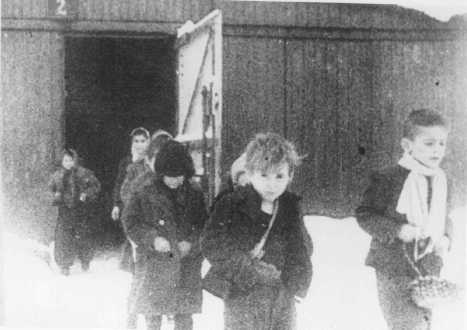
As we enter April 2025, the eightieth anniversary of liberation, more and more posts are rightly being generated on social media regarding it. Yad Vashem, World Holocaust Center, Jerusalem, earlier in the week posted a liberation photo on Facebook titled, “French soldiers meeting Jewish people who survived near Vaihingen, Germany, April 1945.” Their description:
“In the final months of the war, concentration camps were gradually liberated one after another. For the liberating forces, it was a glorious moment of triumph. But for the survivors — those who endured the horrors — the relief at war’s end was overshadowed by immeasurable pain and loss.
Freedom had arrived — but for many, it came too late.”
I shared it on my Facebook page, with my own take on their description.
Well, some decided they had to take me to task in the comments, the gist of which was that in pointing out the traumatic effects on liberating soldiers, I was disrespecting the experiences of the people they saved.
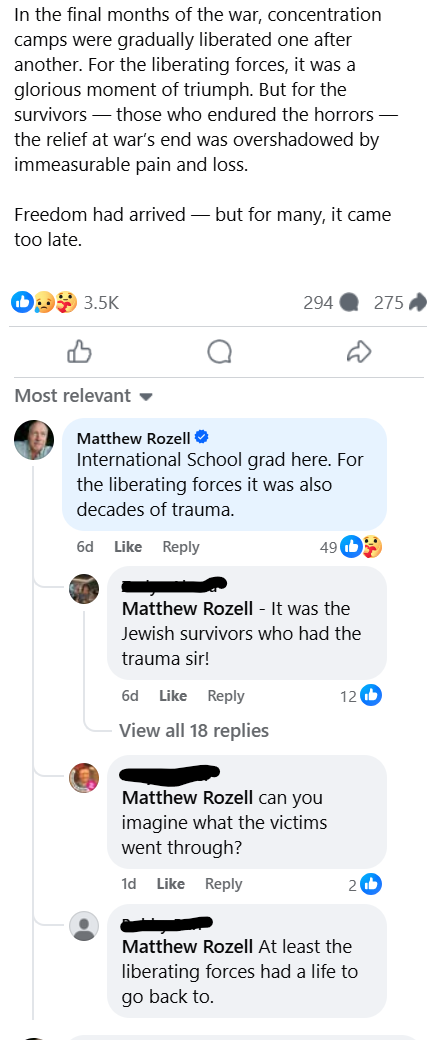
I recognize the trauma—I have been honored to know literally dozens of Holocaust survivors—and I have studied for nineteen days at their International School in Jerusalem, as well as experienced several weeks of touring the authentic sites of mass murder and suffering in this greatest crime in the history of the world with top notch scholars and historians and fellow teachers. Also, having been a USHMM Teacher Fellow, I felt pretty well informed enough to add my comment there, just that for the liberating forces, far from being a glorious moment of triumph, it was decades of trauma as well.
I don’t dispute any of their comments, but I think they were making assumptions, so I clarified, “Just as liberation was not the ‘happy end of the story’ for Jewish survivors, it did not end for the soldiers either. And no one is here to ‘compare pain’.”
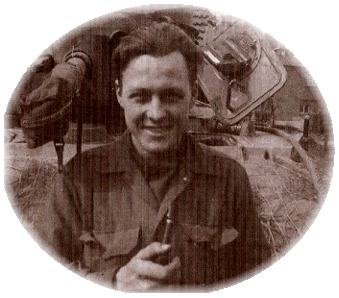
And that is one of the tenets of Holocaust education. No one can suppose they know what the Holocaust survivors went through, except them, and that is why memoirs are so important. But to talk to the liberating forces, decades later, was also important. Walter Gantz told me, “Matt, for forty years, when our group (95th Medical Gas Battalion) met at reunions, we NEVER talked of Hillersleben. And my parents never knew I cried myself to sleep at night, when I got back.”
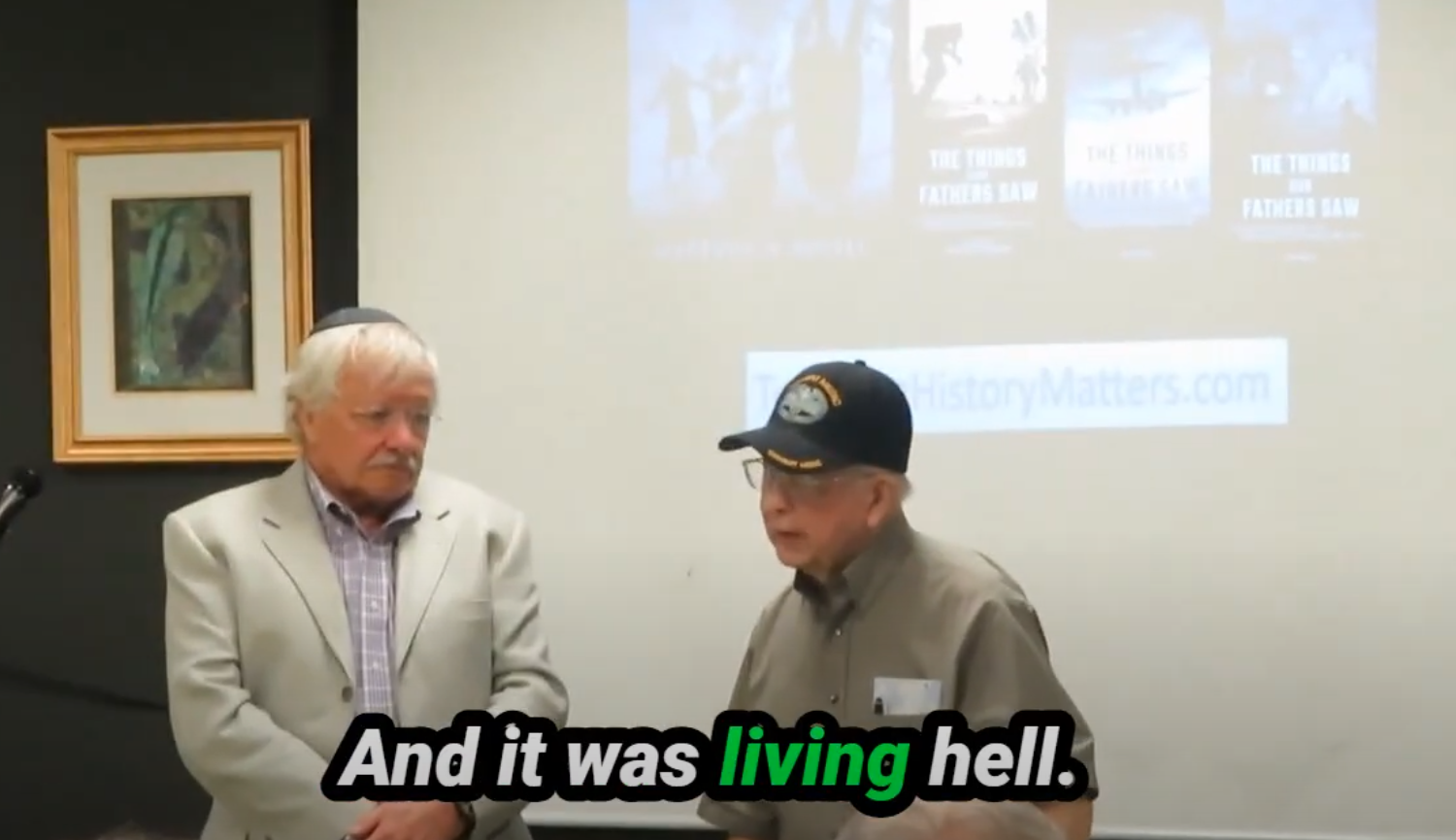
I found this video I took at a college in New Jersey where Walter got to meet one of the children he helped to save for the first time, and his take on his visit to Bergen Belsen. The trauma was still apparent after almost 75 years.
That’s all I was trying to say. So now I’ll let Walter tell you. It’s a 3 minute clip. [Only 8 people in the world have watched it thus far. I hope you can, in his memory.]
And I will end with the closing of my book, A Train Near Magdeburg:
A schoolkid once asked a survivor I know if anything good came out of the Holocaust. The survivor thought a minute, because it was an important question, and replied, ‘Yes. My rescuers.’
And here is where the story of the ‘Train Near Magdeburg’ will end, for now.
When we talk about the Holocaust, the sheer magnitude of it, there is no happy ending. For every single one of the approximately two-thousand five-hundred persons on the train who was set free, another two-thousand five-hundred persons perished in the Holocaust, most long before the Americans set foot upon the continent. And yet, at the end of the day, if we can say that somehow the soldiers and survivors in this book taught us something, perhaps the meaning is echoed in that three-word response.
I have found that in some educational circles the role of the American liberator is presented almost as an afterthought, and I would have to agree that when one is drawn into the unfathomable study of the Holocaust, liberation perhaps figures as a literal nano-episode.
They were not rescuers, in the formal sense of the word—that title is reserved for those without weapons, who risked their lives and usually the lives of their families by hiding Jews or some such noble action—but the nobility of the would-be rescuers who had weapons, the ones still fighting and being killed, the ones wholly unprepared for the catastrophes that played out before them on an hourly basis in April 1945 deserves a larger place in our national examination of the essence of what, indeed, ‘greatness’ is all about.
And here, I hope that the lesson is also one of humility; as they themselves stated in this book, it’s not about hero worship, or glorifying the liberator as some kind of savior. Many of the liberating soldiers would resist this, to the point of rejecting the term ‘liberator’— “It all sounds so exalted, so glamorous,” said one. But they will all accept the term ‘eyewitness.’
Eyewitnesses to the greatest crime in the history of the world; young men who ‘kept the faith’ of their fallen comrades, their country, and to humanity; witnesses who did something about what they saw.







 Teaching History Matters