Feeds:
Posts
Comments

Posts Tagged ‘Holocaust Survivors’

World War II infantry veteran Carrol Walsh, top, hugs Holocaust survivor Paul Arato at a reunion in Queensbury, N.Y., on Tuesday, Sept. 22, 2009. Walsh’s unit liberated a Nazi train carrying 2,500 Jewish prisoners, including Arato, from the Bergen-Belsen concentration camp in Germany during the war’s waning days. (AP Photo/Tim Roske)

I am reposting this today to honor both of the men below. Paul Arato passed away this week in Toronto, Canada and his memorial service is today. Carrol Walsh, his liberator, died in Dec. at his home in Florida and his memorial service was last Friday in New York.

Paul and Rona would also check in annually for dinner with the Walsh family when they passed through our town. The last time I saw both of them together was in 2011 at one of these dinners in a local restaurant. They sat together and laughed and joked like old pals. Paul told the story of how he arrived in Detroit after the war as an eager late teen anxious to find work designing fast cars in the automobile industry and was driven to the bridge in Canada by law enforcement and pointed to the bridge to Canada, as he did not have the proper documentation. Picturing the scene in his mind, Carrol would laughed outloud and slapped his knee. Both men were so happy to have found each other.

Rest on, friends.

Holocaust Survivors Reunite With US Veterans

NY high school reunites Holocaust survivors liberated from Nazi death train by US soldiers

By CHRIS CAROLA

The Associated Press

HUDSON FALLS, N.Y.

The Holocaust survivor was 6 on that spring day in 1945 when he last saw the U.S. Army soldiers outside Magdeburg, Germany.

Paul Arato was among 2,500 starving and sickly Jewish prisoners from the Bergen-Belsen concentration camp, their train abandoned by its crew and Nazi guards as Allied forces advanced. Two U.S. Army tanks on a scouting patrol — one of them commanded by Carrol Walsh, then 24 — came upon the stopped boxcars.

Arato, now 71, and Walsh, 88, met again this week.

“Please give me a hug. You saved my life,” Arato told Walsh in an emotional reunion of concentration camp survivors and some of the veterans of the 30th Infantry Division who liberated them.

Arato, an industrial designer from Toronto, and Walsh, a retired state Supreme Court judge from Hudson Falls, came together for a Hudson Falls High School history symposium inspired by history teacher Matthew Rozell’s original World War II project in 2007.

“You were all kids on that train,” Walsh told the survivors, most of them in their early 70s, as they and their families greeted the veteran. “I was an old man. I was 24 years old!”

Those arriving early for Wednesday’s opening session gathered Tuesday night for an impromptu reunion before having dinner surrounded by the faux Adirondack decor of the nearly deserted indoor water park. Four of the five Nazi train survivors at the dinner had never met Walsh.

Walsh’s tank patrol discovered the desperate Bergen-Belsen survivors on April 13 — hundreds of emaciated Jewish prisoners who had been herded aboard one of three trains leaving the camp a week earlier to keep them from being liberated by advancing Allied forces.

Walsh’s patrol stayed for a time, handing out candy to some of the children, then moved on after reporting their discovery. Frank Towers, a 27-year-old first lieutenant in the 30th Division, led a convoy that took the newly liberated prisoners to a German town where they were given food and shelter.

For weeks, the men of the 30th had heard of Nazi atrocities against Jews and dismissed the stories as propaganda, Towers said. That all changed when they encountered the train.

“Then we believed,” said Towers, 93, of Brooker, Fla.

This week’s reunion is the fourth since 2007, when Walsh was joined by three of the train survivors at Hudson Falls High. History teacher Rozell’s World War II project included an Internet posting of Walsh’s account of the train liberation.

An Associated Press report of that first reunion prompted more survivors to come forward, some from as far away as Israel, Rozell said. In all, he has confirmed that more than 60 survivors are still living and has been in contact with about two dozen of them.

Nine survivors of the Nazi death train are participating in this symposium, along with Walsh, Towers and four other veterans of the 30th who fought in Germany. Rozell said this week’s gathering is likely to be the last such event of its scope, given the advanced ages of the veterans and survivors.

For Arato, Tuesday night’s reunion with Walsh brought back a flood of memories. He recalled getting candy from one of the soldiers and a handgun to play with.

“I remember it was a Tootsie Roll,” he said. “The gun wasn’t loaded.”

Arato fretted over one detail. He recalled seeing a Jeep along with the American tanks, but fellow survivor Fred Spiegel of Howell, N.J., didn’t remember seeing a third vehicle. Later, Walsh said his patrol consisted of two tanks — and a Jeep.

“There WAS a Jeep,” Arato said, a smile breaking out on his face. “I remembered it right.”

———

On the Net:

Hudson Falls High School World War II Living History Project: http://www.hfcsd.org/ww2

http://www.huffingtonpost.com/wires/2009/09/23/holocaust-survivors-reuni_0_ws_296673.html

http://www.ynetnews.com/articles/0,7340,L-3781062,00.html

Read Full Post »

American Cemetery overlooking Omaha Beach, the primary landing zone for Americans during the D-Day invasion June 6, 1944. (U.S. Air Force Photo)Today one of my former students emailed me to visit saying that she had a surprise for me. She brought me a present- sand from the beach at Omaha in Normandy.

This was originally posted four Junes ago, I re-post here now.

I came into school today, on a Saturday, to start packing up my room for a move to another room.

But it is the 6th of June.

Instead I am getting nothing done, mesmerized by the scenes, live from Normandy, of the 65th anniversary celebration.

The President is there and so are 250 American veterans of the battle for Normandy,  including one of my good  friends, Buster Simmons, of the 30th Infantry Division. The Greatest Generations Foundation sponsored his visit with 9 other vets and college kids. Now I’m looking for him in the sea of faces.

My son Ned and I watched him last night as a “Person of the Week” on ABC World News in a story I contributed to. If you view the clip, you can see the photograph I provided ABC with, taken by Major Clarence Benjamin, of the liberation of the train. This is the photo that Buster uses when he speaks to high school classes to tell this story.

I am hopeful that we can get Buster to come to our high school for the  liberator-survivor reunion in September.

It was twenty five years ago, on this anniversary, that I wrote an essay in the local newspaper expressing my appreciation for the veterans of World War II. And as I begin to sort through and pack up 20+ years of memories in this room, three things are becoming clear: 1) my love for these men and women and what they did only increases as time passes; 2) the rest of my career will be focused on the promotion of narrative history in the classroom, linking students, veterans and survivors together; and 3) I won’t be getting any packing done this day.

Take a minute to watch Buster in the clip and take his optimism about the future of our nation to heart. Especially if -“you’re an American.”

Read Full Post »

By OMAR RICARDO AQUIJE- Glens Falls Post Star

HUDSON FALLS —Fred Spiegel was asked if he felt resentment toward the Nazis.

“Yes, to the Nazis, but not the Germans,” Spiegel said.

The question came from a student at Hudson Falls High School, at which Spiegel was invited Friday to discuss his life during the Holocaust.

On April 13, 1945, a train traveled across Germany, carrying 2,500 Jews en route to a concentration camp.

Spiegel was among them. He was 13.

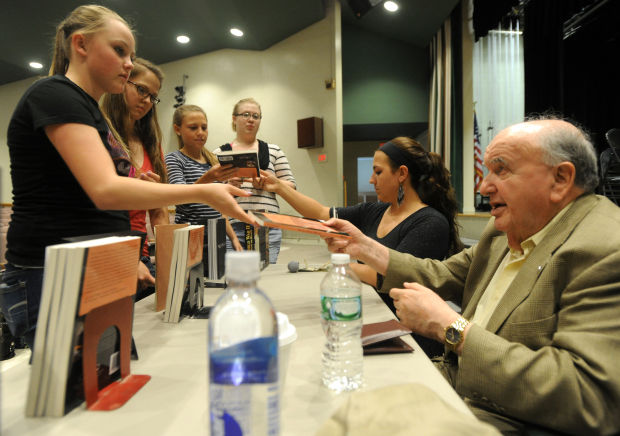
Holocaust survivor Fred Spiegel sells and autographs copies of his book, "Once the Acacias Bloomed," for students at Hudson Falls High School on Friday, May 24. Spiegel, who was liberated by U.S. troops as a young boy during World War II, spoke about his experiences and answered students' questions. (Jason McKibben -

Holocaust survivor Fred Spiegel sells and autographs copies of his book, “Once the Acacias Bloomed,” for students at Hudson Falls High School on Friday, May 24. Spiegel, who was liberated by U.S. troops as a young boy during World War II, spoke about his experiences and answered students’ questions. (Jason McKibben –

Spiegel, 81, visits schools to talk about how he survived. He brings copies of his book, “Once The Acacias Bloomed,” which explains his life as a Nazi prisoner.

Most of the schools he visits are in New Jersey, where he lives. The farthest he travels is Hudson Falls, a school he visited a few times in recent years, a school he included in his book because it was here an important moment in his life occurred.

“They invited me,” Spiegel said of his reason for returning to Hudson Falls. “How can I say no?”

During Friday’s presentation, Spiegel often said he was lucky to be alive.

Other trains carrying Jewish prisoners made it to their destination. His did not.

His train suddenly stopped near Magdeburg. Spiegel said the train’s engineer and Nazi soldiers fled for fear of capture. U.S. troops was cutting across Germany.

Then, a few U.S. soldiers on tanks found the train and freed the captives. The soldiers included Carroll Walsh, of the 743rd Tank Battalion.

Spiegel was later reunited with his family. It was 65 years later when the unexpected happened: He was invited to Hudson Falls to meet others who were prisoners on the train.

He also got to meet some of the liberators, including Walsh, who was living in Hudson Falls at the time.

Matt Rozell, a Hudson Falls history teacher, organized the reunion. He met Walsh in 2001. He interviewed the former soldier, and learned about the train near Magdeburg.

Walsh died in December. He was 91 and a former state judge.

Spiegel, a native of Germany, said people have shown more interest in the Holocaust over the years.

During Friday’s visit to Hudson Falls, he spoke to about 30 sophomores. Some of them had copies of Spiegel’s book. Others bought the book after the presentation.

Armand Ryther, a student, approached Spiegel to shake his hand.

“I find it very interesting that he could survive what he did,” Ryther said.

Ryther said he read Spiegel’s book.

Jamie Hughes, a fellow sophomore, said it was interesting to hear about Spiegel’s experiences.

“I think it’s really amazing that he would want to share his experiences with everybody,” she said.

Tara Sano, a Hudson Falls history teacher, said the event was planned near Memorial Day so students can reflect on the efforts of veterans.

“My hope is that when you are taking your three-day weekend, you think about why you have a three-day weekend,” she told students at the start of the presentation.

http://poststar.com/news/local/article_00a9219c-c648-11e2-ae69-001a4bcf887a.html

See Fred meet his liberator for the first time.

Read Full Post »

  Monday, April 29, 2013
Frank this morning at the Museum - P. Fredlake

Frank this morning at the Museum – P. Fredlake

Today is the anniversary of the liberation of Dachau. I also got this photo from Peter Fredlake, the director of National Outreach for Teacher Initiatives at the USHMM which he took this morning in Washington.  Big day for Frank!

WASHINGTON (AP) — Elderly survivors of the Holocaust and the veterans who helped liberate them are gathering for what could be their last big reunion at the U.S. Holocaust Memorial Museum.

Some 1,000 survivors and World War II vets are coming together with President Bill Clinton and Elie Wiesel, a Holocaust activist and writer, on Monday when the museum marks its 20th anniversary. Organizers chose not to wait for the 25th milestone because many survivors and vets may not be alive in another five years.

Clinton and Nobel Peace Prize laureate Wiesel, who both dedicated the museum at its opening in 1993, will deliver keynote speeches. On Sunday night, the museum presented its highest honor to World War II veterans who ended the Holocaust. Susan Eisenhower accepted the award on behalf of her grandfather, U.S. Gen. Dwight D. Eisenhower, and all veterans of the era.

The museum also launched a campaign to raise $540 million by 2018 to keep the memory of the Holocaust alive and to combat anti-Semitism, Holocaust denial and contemporary genocide. It has already secured gifts totaling $258.7 million. The campaign will double the size of the museum’s endowment by its 25th anniversary. Also, a $15 million gift from Holocaust survivors David and Fela Shapell will help build a new Collections and Conservation Center.

Museum Director Sara Bloomfield said organizers wanted to show Holocaust survivors, veterans and rescuers the effort will continue to honor the memory of 6 million murdered Jews, in part by saving lives and preventing genocide in the future.

“We felt it was important, while that generation is still with us in fairly substantial numbers, to bring them together,” Bloomfield said, “to not only honor them, but in their presence make a commitment to them that not only this institution but the people we reach will carry forward this legacy.”

The museum continues collecting objects, photographs and other evidence of the Holocaust from survivors, veterans and archives located as far away as China and Argentina. Curators expect the collection to double in size over the next decade.

This week, the museum is opening a special, long-term exhibit titled “Some Were Neighbors: Collaboration and Complicity During the Holocaust.” It includes interviews with perpetrators that have never been shown before, as well as details of mass killings in the former Soviet Union that were only uncovered in more recent years.

Curator Susan Bachrach said the exhibit and its research challenge the idea that the Holocaust was primarily about Hitler and other Nazi leaders. Surveys at the museum show that’s what most visitors believe.

“That’s very comforting to people, because it puts distance between the visitors and who was involved,” Bachrach said.

So, the museum set out to look at ordinary people who looked on and were complicit in the killing and persecution of millions of Jews through greed, a desire for career advancement, peer pressure or other factors. It examines influences “beyond hatred and anti-Semitism,” Bachrach said.

Focusing only on fanatical Nazis would be a serious misunderstanding of the Holocaust, Bloomfield said.

“The Holocaust wouldn’t have been possible, first of all, without enormous indifference throughout Germany and German-occupied Europe, but also thousands of people who were, say, just doing their jobs,” she said, such as a tax official who collected special taxes levied against Jews.

In an opening film, some survivors recall being turned over to Nazi authorities in front of witnesses who did nothing. “The whole town was assembled … looking at the Jews leaving,” one survivor recalls.

Steven Fenves was a boy at the time. He recalled how in 1944, Hungary, allied with Nazi Germany, forced his family out of their apartment. The family was deported to Auschwitz, where Fenves’ mother was gassed.

“One of the nastiest memories I have is going on that journey and people were lined up, up the stairs, up to the door of the apartment, waiting to ransack whatever we left behind, cursing at us, yelling at us, spitting at us as we left,” he said in an interview with the museum.

The museum located images of bystanders looking on as Jews were detained, humiliated and taken away.

Non-Jews were also punished for violating German policies against the mixing of ethnic groups. For the first time, the museum is showing striking, rare footage of a ritualistic shaming of a Polish girl and a German boy for having a relationship. They are marched through the streets of a town in Poland, where the film was located in an attic. Dozens of people look on as Nazi officers cut the hair of the two teenagers. They are forced to look at their nearly bald heads in a mirror before their hair is burned.

“It’s hard not to focus on the cruelty that’s being perpetrated on this young couple,” Bachrach said. “But what we really want people to look at … is all the other people who are standing around watching this.”

Other items displayed include dozens of bullets excavated from the site of a mass grave in former Soviet territory and registration cards from city offices in Western and Southern Europe labeling people with a “J” for Jew.

The federally funded museum’s theme for its 20th anniversary is “Never Again: What You Do Matters.” The museum devotes part of its work and research to stopping current and preventing future genocides. A study released by the museum last month found that the longer the current conflict in Syria continues, the greater the danger that mass sectarian violence results in genocide.

Much more is still being learned about the Holocaust, as well, Bloomfield said. The museum is compiling an encyclopedia of all incarceration sites throughout Europe. When the project began, scholars expected to list 10,000 such sites. Now the number stands at 42,000.

The museum opened in 1993 as a living memorial to the Holocaust to inspire people worldwide to prevent genocide. A presidential commission called for such a museum in 1979. Since opening, it has counted more than 30 million visitors. The museum also provides resources for survivors. It has partnered with Ancestry.com to begin making the museum’s 170 million documents searchable online through the World Memory Project.

Read Full Post »

As the museum turns 20, officials understand that the demise of those who survived the prison camps as children means looking backward in a different way.

30th ID Colors, Capitol Rotunda, April 11, 2013

30th ID Colors, Capitol Rotunda, April 11, 2013

Tonight is the Nation Tribute Dinner. Frank, Leslie and Elisabeth are there- two survivors and their actual liberator. Tomorrow they get interviewed near the 30th Infantry Division Flag, recently installed in the main foyer of the Museum as a liberating division. About time. I nearly cried when I saw it paraded into the Capitol Rotunda for the Days of Remembrance  commemoration this year. First time! I really think the project helped get the 30th on the recognition radar screen…here is a good article, found on USA Today.

WASHINGTON — The adult survivors of the Holocaust are mostly gone now, and those who survived as children — and were old enough at the time to remember their ordeals — are now in their 70s and 80s.

It won’t be long before no eyewitnesses remain.

That’s why, as the U.S. Holocaust Memorial Museum marks its 20th anniversary Monday with more than 750 survivors, museum officials are calling it one of the last large gatherings of those who managed to escape Hitler’s death machine.

For those who have dedicated themselves to teaching future generations about the Holocaust and its victims, the demise of the survivors means looking backward in a different way — a way that no longer includes people looking others straight in the face and recounting what they saw and what they lived.

You can read all the documentation of the Holocaust in the world, said Diane Saltzman, director of survivor affairs at the U.S. Holocaust Memorial Museum, “but hearing somebody’s voice, sitting across the table or across the room from a human being, there’s no true substitute.”

Jonathan Sarna, professor of American Jewish history at Brandeis University, wants his classes to understand this.

“I tell my students annually that they have a special responsibility,” he said. “They are the last generation that will be able to say that they personally knew survivors of the Holocaust. It is a big change, just like it was when the last Civil War veteran passed from the scene.”

The Holocaust, now “perceived history,” will become “received” history, Sarna said. The challenge is that it doesn’t recede from memory.

Holocaust educators take heart in the many institutions and younger people committed to ensuring that future generations will know about the 6 million Jews who died; of the concentration camps, gas chambers and crematoria set up to carry out Hitler’s “Final Solution”; and of the 5 million Roma (Gypsies), gay people and others murdered because the Nazis deemed them, like the Jews, unworthy of life.

That’s the mission of the U.S. Holocaust Memorial Museum, said Saltzman, which has hosted some 35 million visitors since it opened just off the National Mall in 1993. The institution is full of audio and video testimony from survivors, artifacts from their lives before and after they were sent to concentration camps, and films and diaries that document the genocide.

“The museum stands as that eyewitness going forward,” Saltzman said. “We are the repository of all that evidence, and all of those memories.”

From the Washington museum to Jerusalem’s Yad Vashem to smaller museums around the world, these institutions preserve history that will soon no longer be passed on firsthand. So, too, does Holocaust literature, from Anne Frank’s famous diary to Night, by survivor and Nobel laureate Elie Wiesel, who will give the keynote speech at the Washington museum’s anniversary Monday, alongside former president Bill Clinton.

The Shoah Foundation, based at the University of Southern California, has videotaped testimony from more than 51,000 survivors since film director Steven Spielberg started the project in 1994, when there were about 350,000 Holocaust survivors worldwide.

Curriculum programs in schools introduce children in the U.S. and elsewhere to the Holocaust, and these programs will continue, even when survivors aren’t part of them anymore.

Norman Frajman, 83, thinks of that day. He was 10 years old when World War II began, and has sharp memories of life in the Warsaw Ghetto and of the Majdanek death camp in eastern Poland, where his mother and younger sister died. All told, he lost 126 members of his immediate and extended family.

“I probably wouldn’t remember what I had for breakfast, but I remember all that happened to me during the carnage,” said Frajman, who now lives in Boynton Beach, Fla., and has been sharing his testimony with schoolchildren for more than 30 years.

But not with young children. “The atrocities are indescribable. I can’t address anyone at the elementary school level,” he said. “It’s too graphic.”

For all the graphic details available from survivors, and primary and secondary texts and film, Holocaust denial still thrives on the Internet and in many parts of the world where anti-Semitism has strong roots.

Even in the presence of Holocaust survivors, there are people who insist the genocide never happened, Sarna said. The hope, when there are no more survivors, is that the museums and the video archives will make it “impossible for most people to accept the word of the deniers.”

In the meantime, as long as he is able, Frajman will tell his story and teach about the Holocaust in hopes of preventing another one. “Yesterday it was directed against the Jews. Tomorrow it could be against Christians, the next day against Muslims — unless people heed and listen,” he said.

But he is optimistic that his words and those of other survivors will resonate long after he is gone.

“Judging by today’s young people that I encounter when I go to schools to speak, we are in for a better tomorrow,” Frajman said. “They listen. They are very perceptive. They take it to heart.”

Read Full Post »

Woodstock event remembers Holocaust

WOODSTOCK, N.Y. — A Yom Hashoah event that will remember the Holocaust will take place April 7 at 3 p.m. at the Woodstock Jewish Congregation, 1682 Glasco Turnpike, Woodstock NY, 12498.

Synagogue Main Number (845) 679-2218
Email info@wjcshul.org
Persons of all faiths are welcome.

The Yom Hashoah  observance will include a candlelight memorial service, followed by an address by Matthew Rozell titled “Honoring the Hour of Liberation and Defeating the Legacy of Hitler.” Rozell is the founder of a project that has reunited survivors from the Bergen-Belsen concentration camp with the U.S. soldiers who liberated them from a train transport during the closing days of World War II. To date, with the help of Varda Weisskopf and Frank Towers, more than 240 survivors worldwide have been located, and 10 reunions have taken place since 2007. Rozell is also a teaching fellow at the United States Holocaust Memorial Museum and has spoken on behalf of its educational programs. His work can be seen at teachinghistorymatters.wordpress.com.

The ABC News video can be seen here.

Read Full Post »

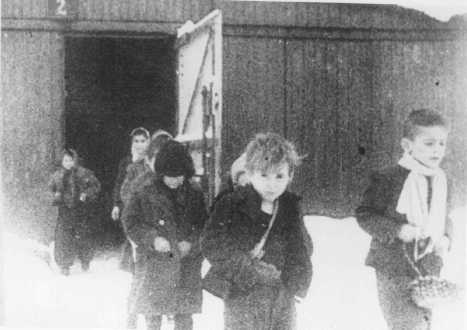
Soon after liberation, surviving children of the Auschwitz camp walk out of the children’s barracks. Poland, after January 27, 1945. — United States Holocaust Memorial Museum

Soon after liberation, surviving children of the Auschwitz camp walk out of the children’s barracks. Poland, after January 27, 1945. — United States Holocaust Memorial Museum

Today is International Holocaust Remembrance Day, the day Soviet troops over ran Auschwitz in 1945. This week I received a note from an Israeli survivor friend, shortly after the passing of one of her liberators, Carrol Walsh. Sara lost over 60 of her family there- and her immediate family was saved only because the day they arrived at Auschwitz, the death machinations were working at full capacity and her transport was rerouted to Belsen. She was liberated on 13 April on the evacuation transport near Farsleben, known here as the Train Near Magdeburg…

In her letter she asks important questions of me. I have responded the best that I could, below.

Dear Matthew,

 We were very sad to hear that Carrol Walsh passed away. Only lately did I get to know him, and he risked his life in order to save ours. It is a pity we did not get to meet more.

I can’t express in words the loving feelings for the young tank commander that for sure always had a smile on his face, and never stopped smiling after we met- 65 years after the victory. I am sure Carrol Walsh made the best out of his life; I was fulfilled to know him and his beautiful family.

I read about his profession in the years of his life. It was interesting to see how much meeting with us affected him.

I thank you for your unusual courage to initiate the exciting meeting [reunion].

I suppose you were very excited for the event you had initiated. Did the idea come in different parts? I am trying to understand the development of your thinking.
When you first wrote to me about the meeting [invitation to the proposed reunion], it was on the day we were released- the 13th of April. I got home after meeting my brothers and celebrating the release [liberation]day. I couldn’t relax, I immediately told all my brothers. I was so happy, as if it was happening again.

The meeting completed a missing part in the picture for me, after all the horrifying things we went through we couldn’t even dream of a miracle like that coming out of the blue.

I cannot go back more to the extermination camps and escort groups because I don’t have the physical nor mental power to do that anymore.

There are questions that bother me.

Are you able to answer them?

Why shouldn’t the world forget and let this be over?  

A. So, some people do want to forget. Others will say that it did not happen. For those reasons, it must never be forgotten. This is the biggest crime in the history of the world.

As Walsh states, how could humanity have stood by and let that happen?

Does my work, the hard work I do, do anything against the forgetting?

A.The most impressionable minds in the world are those of the youth. It is they who the Nazis “educated”; it made it easier for the crimes to be committed. This is why they must hear now.

The work that you, and I do, has an impression. I hope to continue this work after you must slow down. Please remember that.


You are a historian, should the memory be kept?

A.The memory must be kept. As educators it is our duty to keep it alive. We must fight those who trivialize or denigrate its importance.

Is there a proper way to keep the memory?

A.There is no one way except to be open to the discussion of humanity and how humans could do this to one another. We must also bear in mind however, that the soldiers who helped the suffering to new life bore their own pains in doing so, yet also made a choice to redeem humanity. Some did not sleep soundly for years.

I think this is so, and also must not be forgotten. The war brought out the most evil in the world. But I think it also revealed some goodness in the form of the soldiers who liberated or otherwise cared for the victims.

Who should be documenting everything, the “victim” or the “aggressor”?

A.The aggressor fades from memory. New generations asks questions. It is true that some are bothered by the questions. But the young will always be curious and want to know- is this a stain on the German people? I know some Germans today who work very hard to keep the memory alive, as you also do.

The victims give the testimony. This is all they can do. But it is the evidence of the crime, and one that new generations must work with. That is why your work is so important.

Who is in charge of making the conclusions?

A.I would say that institutions such as the United States Holocaust Memorial Museum and Yad Vashem are the world leaders in this area. I have been trained, well, I should hope, by the USHMM. I do not know enough about the German institutions but I hope to raise enough funds to travel to the camps and study there this summer.

Read Full Post »

Matthew Rozell, 30th Infantry Veterans of WWII, Holocaust survivors at Mighty Eighth Air Force Museum, March 2, 2012.

Matthew Rozell, 30th Infantry Veterans of WWII, Holocaust survivors at Mighty Eighth Air Force Museum, March 2, 2012.

Frank Towers’ invitation to soldiers, survivors, interested parties and their families to come to Louisville in the spring. The soldiers have convened annually since the end of World War II; since 2008, thanks to the project, the 30th Infantry Division has hosted Holocaust survivors and their families as well for very emotional, uplifting, and fun times. Email for details.

*********************************************************************************************************

Don’t forget the dates!!       April 11 – 12 – 13, 2013

Don’t forget to make your Hotel Reservation

and Registration!!

Hotel Crowne Plaza,  Louisville, KY

*********************************************************************************************************

Dear Fellow 30 Division Members and Friends:

I hope you all enjoyed your holiday and that the New Year holds only good things for you and your family.

Now that the holidays are over it is time to focus on making your reservations for the Reunion.  Included are the Pre-Registration Form and the Reservation Form and the information to make your hotel reservations. Please do it NOW.

We have a great program planned and will include a trip to the Louisville Slugger Factory and Museum, a professional photographer that will take a picture of you and/or your family (so bring your medals and ribbons to show off).  We will also have one of Louisville’s noteworthy news casters, Ken Schulz, MC our banquet on Saturday evening.  Our entertainment will include a local bagpiper as well as others.

Why come to Louisville?

Louisville, is a city of urban neighborhoods that have been revitalized, and some of our best known shopping areas are the Bardstown Road and Frankfort Avenue corridors with their small shops and plentiful locally owned restaurants.  The homes and buildings in the Old Louisville neighborhood is one of the largest historic preservation districts featuring Victorian architecture in the U.S.  The Downtown area has had significant renovations over the last few years with the construction of the YUM! Center which is home court for our Louisville Cardinals men’s and women’s basketball teams.  The Center, along with Waterfront Park and Fourth Street Live, have attracted new housing, shops and restaurants breathing new life into the area.

Louisville has museums to interest everyone..  Home to the Frazier International History Museum; The Muhammad Ali Center; The Louisville Science Center; The Kentucky Museum of Art and Craft and many, many more.

Our hotel, the Crowne Plaza, is locally owned and operated.  It is near the airport and offers free shuttle service from the airport to the hotel.  The Crowne Plaza also offers many amenities including indoor/outdoor pool, fitness center, boutique shop, 24 hours business center, complimentary Wi-Fi, and more.

You can see Louisville is the place to be, so much so that Louisville was named “The Top U.S. Travel Destination for 2013” by Lonely Planet’s, the world’s leading travel publisher.

We are looking forward to having you here and sharing some of our history and hospitality with you, and most of all, to meet many of your former friends and colleagues.

Best Regards,

Bill Vaughan. President

30th Infantry Division Veterans of WWII

*********************************************************************************************************

Taps – 2012

(Last 6 Months)

ADAMS, Cleveland L. 30 MP Plat. 7/30/12 Stockbridge, GA

ADKINSON, Bruce 743 TkBn B 6/17/12 Beverly, MA

DUMEY JR, (DuMay) Leon 120-G 11/23/12 Cape Girardeau, MOM

FARKAS, Louis 119-I 12/ /12 Colton, OR

HOGUE, Donald W. 117 K 6/12/12 Montevallo, AL

HOUCK, Arthur T. 120-K 6/16/12 Hampstead, MD

LAZINGER, Sol 117-B 6/13/12 Philadelphia, PA

MAXEY, James C. 120 CN 6/ 29 /12 Tullahoma, TN

MILLER, Edmund L. 120-H 9/07/12 Pewamo, MI

PITRUZZELLO, Joseph S. 119-L 5/02/08* Alexander City, AL

PRUITT, Frank H. 120-2BnHq 12/10/12 Spartanburg, SC

PULVER, Murray S. 120-B 9/21/12 Peoria, AZ

STANFORD, Arna V. Widow 8/18/10* Williamsburg, VA

STECKLER, William 105 Engr. B 9/09/12 Palm Harbor, FL

SULLIVAN, Thomas “Jack” 118 FA 8/07/12 Savannah, GA

TURNER, Woodrow W. 117-F 8/15/12 Littleton, CO

UBBES, Jean M 743 TkBn-B 7/28/12 Kalamazoo, MI

VOORHIS, Thomas K. 120-K 8/06/12 Manteca, CA

WALSH, Carrol S. 743 TkBn-D 12/17/12 Sarasota, FL

YOUNG SR., James E. 120 6/26/12 Butler, PA

Those with an asterisk (*) were received too late for a prior publication.

Our Most Sincere Condolences to the Families of These Lost Heroes

*********************************************************************************************************

As most of you already know, men of the 743rd Tk. Bn., and  30th Infantry Division, liberated over 2.500 victims of the Holocaust from Bergen-Belsen on 13 April 1945.

We will be honored to have some of these Survivors join with us again at Louisville.  Two of them have never been with us before, so they will give a resume of their life history, so be sure to come to hear these stories that have never been told before.

One of these Survivors will be coming all of the way from Jerusalem, Israel, joining with other members of his family, to meet his Liberators for the first time.  The other Survivor will be coming from San Diego, CA with his daughter, also to meet for the very first time with some of his liberators.

To make it clear, each of you veterans were “Liberators” of this group of victims.  Although you may not have had any personal hands-on experience with them at the time of their liberation, You were doing your job which was supporting the action in the local vicinity of this tremendous discovery and the release of these frail humans to Freedom.

Join with us on this occasion to meet these Survivors that you helped to liberate 68 years ago !!

This will be an Historic event !!  68 years to the date of their Liberation !!!


Read Full Post »

Just when you think that maybe things are “quieting down”,  an email comes in your inbox again.

At Thanksgiving Time.

Can’t wait to speak to Kurt. In the meantime, read below. He has to be around the 230th survivor of the train to make our acquaintance…good work Frank and Varda! Frank, you never cease to amaze me, at 95 yrs young, you are doing laps around me! So now I can share with the students, and fellow survivors and soldiers!

In the words of survivor Dr. Micha Tomkiewitz, “welcome to the family!”

—–Original Message—–
From: Kurt Bronner

Survivors Kurt Bronner and his lovely wife. Thanks to Frank and Varda W. for finding them- “welcome to the family”

Sent: Thursday, November 22, 2012 2:31 PM
To: Rozell Matt
Subject: Thanks

Dear Matt…This last week I have been in touch with Frank Towers and Varda W….They found me on the list on survivors of the deathtrain..I have seen movies and stories…Its like my past has been opened up…On this day of Thanksgiving I would like to wish you a happy peaceful Year and thank you for opening up a chapter of many survivors on that train…I live in Los Angeles and the Burbank school system has had a similar program and I have been talking to students in junior and high schools…Have 100s of letters from the students…Teachers like you are in my Golden book..Thank you for your groundbreaking efforts…with my best to You and your family with my love, Kurt Bronner

Teaching tolerance

April 08, 2000

by Irma Lemus, Burbank Leader

MEDIA DISTRICT NORTH — Fifty-five years have passed, but Kurt Bronner can still vividly recall his mother being beaten by a Nazi soldier as he watched helplessly through a barbed wire fence. It was the last time Bronner, now 74, ever saw his mother.

The Encino resident revisited the horrific nine months he spent at Bergen-Belsen, a concentration camp in northern Germany, Friday during a presentation to Burbank High School students.

The event was part of the Burbank Human Relations Council’s Holocaust remembrance program, held every April and May to coincide with Burbank’s Interfaith Days of Remembrance. About 25 Holocaust survivors and liberators are involved in the program, speaking at area schools about the human toll of hate and bigotry run amok

“If you remember anything from today, remember that hate exists and you, as future leaders, must stop the Holocaust from happening again,” Bronner, a Hungarian native, told the students.

“People think that it can’t happen here, but I remember my father once told me that it couldn’t happen in Hungary and it did,” said Bronner, who was removed from his home along with his family at the age of 17.

Don Duplechein, who served in the U.S. Army’s 567th Ambulance Company during World War II, also spoke to students Friday. He described the scene as he and about 30 other troops arrived at the Nazis’ Dachau death camp at the end of the war.

“You couldn’t believe it. When we arrived we saw people begging for food with lice all over their heads. We knew we had to feed and bathe these people,” Duplechein said.

To a small group of students who gathered after the presentation, Bronner spoke in more detail about his experiences in the concentration camp.

“A lot of people think that children were held at the camps, but the truth is that in a lot of the camps the children were killed and the only ones allowed to live were young people and adults,” he said.

Danny Screws, 17-year-old Burbank junior, said it was difficult to believe that nobody was willing to act to stop what was happening.

“I asked him [Bronner] how the government could let the people be treated that way. He told me that, although they were from Hungary, they were still Jews. I think that was wrong,” Screws said.

Bronner described traveling to the concentration camp by train with hundreds of people piled into a single boxcar, barely able to move or breathe . He talked about the horrible living conditions at the camps where thousands of people died from starvation and disease.

“I remember trying to find my father’s body as he was put on a horse-drawn carriage. I couldn’t find him to say goodbye because of all the bodies piled up,” said Bronner, whose father died at Bergen-Belsen.

Bronner was asked if he hated the Nazis for what they did to his family.

“You know, a student once asked me what I would do if the people that killed my parents walked through the door. I told the student that killing the person wouldn’t bring my parents back and it would make me a killer. You have to forgive, but never forget,” he said.

Read Full Post »

Here is the interview that I did with NYSUT last week.

A staff member who is maybe thinking of leaving the profession wrote me a nice card about a month ago. In a follow up conversation she told me she saw me as a “beacon”- her word- for other teachers. That’s fairly heavy stuff to hear.

I feel  responsibility to add some extra comments below for the benefit of  teachers in general, and anyone else who is interested.

http://itswhatwedo.nysut.org/

Photo credit: Kris Dressen.

The reporter was competent, engaged and interested, but she had her deadline and we ran out of time.

I did not have a chance to tell her about the medic. I’ll include it below and will be passing it on to her. Kind of like the “moral of the story”, especially when you realize what it means for the soldiers.

I hope it serves as a reminder to teachers that what we all do every day makes a difference.

Here is the postscript to the story.

 *********************************************************************************

An important epilogue to the NYSUT story.

I know that some of you have been following the unfolding of the train liberation and reunions.  The part that is not mentioned in the article  is a phone call I got last Oct. from an 88 year old man in Scranton, PA who found me- and really wanted to be put in touch with the survivors.

You see, he had been a twenty something Army medic in 1945 when ordered to move out to the abandoned German Air Force hospital grounds at Hilersleben, immediately after the tank commanders came across that “death train” and Frank Towers evacuated the occupants to get them out of the battle zone.

Blessed – or maybe cursed – with a terrific memory, he can vividly recall the screams and overall sense of dread permeating the hospital, where he and his fellow medics wore a daily uniform of surgical masks, gloves and rubber aprons.

He remembers scooping handfuls of lice out of patients’ hair and administering countless needles, and the time he had to carry the body of a little girl to a tent serving as a makeshift morgue.

For six nonstop weeks after the liberation they confronted the horror and the evil. Well over 100 Holocaust victims, now his patients, died after they were freed by our troops. No one had trained Walter for this, and  for all these years he has lived with the guilt, the nightmares, and the trauma.

For 60 years he and his wartime buddies met after the war. Walter told me and some of our kids that in recounting their war stories, not one of them ever brought up that place called Hilersleben.

Those guys must have suffered from PTSD. And like many soldiers, his generation just did not talk about that.

Now he calls me at school, to chat, laugh, to let me know which of our survivors has contacted him, and to tell me he wants to meet me.

********************************************

Wait a minute-rewind- How did that happen?

I mean, Why did HE, find ME?

That all happened WAY before I was born.

I think about this, every single day.
Is there a reason I put on this earth? How do I make sense of my responsibility as a human being?

Did those soldiers have to put themselves in harm’s way, in many respects scarring themselves for life,  to care for “the brutalized and wretched” whom they did not even know?

******************************

What I offer to other teachers:
I’m an educator and so are you. As persons who spend most of our waking hours with young people, I can only postulate that we are in the “business” of molding human beings- which of course is not really a business at all. Like the soldiers thrust into that situation, ultimately we are caretakers of humanity.   It is an overwhelming responsibility, but it is not just a job.
It’s a mission.

Those soldiers made choices, confronted evil, sacrificed a ton, and saved humanity– Carrol, George, Frank, and Walter (“the Babe”)- and in doing so, I know they saved me, too. It sounds cliché, simplistic, Pollyanna, whatever- but it’s true.

You do your best to make a difference.

Lots of times you think you lose.

But here’s the real crazy part- most of the time you probably win.

Like these soldiers, sometimes you don’t know you have won until years later.

It’s just what we do.

Read Full Post »

« Newer Posts - Older Posts »