Feeds:
Posts
Comments

Posts Tagged ‘history education’

Gerald West
Born: 1919
Served: U.S. Marines 1940-1957
U.S. Army 1957-1962
Residence: Fort Edward, New York
Nominated by Matthew Rozell, History teacher

Robert Addison
Born: 1922
Served: U.S. Marines 1942-1946; 1950-51
Residence: Glens Falls, New York
Nominated by Matthew Rozell, History teacher

Photo Credit: Robert H. Miller Gerry West and Bob Addison, Spring, 2011.

Photo Credit: Robert H. Miller
Gerry West and Bob Addison, Spring, 2011.

On May 21, 2013, local World War II veterans Gerald West and Robert Addison will be honored in a ceremony for the New York State Senate Veterans’ Hall of Fame. They were nominated by Senator Betty Little at the suggestion of Hudson Falls history teacher Matthew Rozell, whose students had interviewed these men several times.

Mr. Rozell is in the process of writing a series of articles on World War II for the Washington County Historical Society Journal utilizing the class archives of interviews. The following narrative is condensed from the upcoming Fall release of the Journal, which will publish Part II  (of 4) in the Pacific series entitled “Recording the Voices of World War II-From Pearl Harbor to Tokyo Bay.”

******************************************************************

 In this installment of an ongoing series, my students and I have pieced together narrative voices of local residents and their friends that show the enthusiasm for the war effort.  Maybe more importantly, their recollections amplify other points essential to an understanding of World War II, but often overlooked.  In the study of this war, we are tempted to both teach and learn the history as if the way things turned out was somehow preordained − as if, from the outset, it was a foregone conclusion the Allies would win the war.  Because we know how events turned out, we read the history with a sense of inevitability (as several historians have pointed out[1]).  Nothing could be further from the truth.

By talking to persons who lived through these troubled times, my students and I gained insight into the urgent, uncertain, confused way many events actually unfolded.   We confronted particularly – through the stories of local men and women − the nation’s unpreparedness in the first years of the Pacific War, beginning with the initial limited response to the Japanese attacks at Pearl Harbor, Wake Island, Guam, and the Philippines.  While military planners in Washington debated, numbers of local men would fight to survive in vicious jungle fighting.  Indeed, it was the incredible actions of these men, against overwhelming odds, which would shape events and force policymakers in Washington, D. C., to take notice.

******************************************************************

 Six months after Pearl Harbor, American naval forces won a decisive engagement at the Battle of Midway (June 4−7, 1942) At this time, advance elements of General Alexander Vandegrift’s 1st Marine Division were gathering in New Zealand, with no American offensive action planned until early 1943.  However, soon after Midway, intelligence showed a Japanese air base under construction at Guadalcanal in the Solomon Islands.  If finished, the Japanese noose encircling Australia would be complete and any Allied counteroffensive very difficult.  A U. S. amphibious landing was needed immediately, and on a scale not attempted since the World War I Allied debacle at Gallipoli (1915) − and with much less time to plan.  “I could not believe it,” General Vandegrift would later say of this plan.[2]

Vandegrift had within his command a special unit, under formation only since February 1942, the “1st Marine Raider Battalion,” which would play a key role in the ultimate U. S. success at Guadalcanal.  Schooled by veterans of Marine operations of the 1920s and 1930s in Central America and China, 900 specially selected young men formed a lightly-armed, mobile commando unit able to operate in sub-equatorial jungle − the vanguard for larger troop landings to follow.  Named “Edson’s Raiders” after their Colonel “Red Mike” Edson, the unit would earn combat honors unparalleled in Marine Corps history[3] in 18 weeks of violent engagements at Guadalcanal.

Of the 900 original Raiders, two local veterans interviewed by our class belonged to this elite group and currently reside in  Senator Little’s 45th Senate District.

Gerry West (R) shown training with Marine Gunner Angus H. Goss(L). When Japanese holed up in caves, the demolition platoon attached TNT charges to ends of poles and fashioned the techniques needed to root out the remaining defenders on the island of Tulagi in the first American ground offensive against Japanese troops in WW II. Department of Defense Photo (USMC) 55268

Gerry West (R) shown training with Marine Gunner Angus H. Goss (L). When Japanese holed up in caves, the demolition platoon attached TNT charges to ends of poles and fashioned the techniques needed to root out the remaining defenders on the island of Tulagi in the first American ground offensive against Japanese troops in WW II. Department of Defense Photo (USMC) 55268

Gerry West grew up in Fort Anne, and like many other during the Depression, decided to enlist in the Marine Corps following high school, and would remain in the military until 1962. In fact, he was already a Marine when he heard the news of Pearl Harbor. “I’ll never forget it. I was sitting in a barracks in Quantico, Virginia. I had the duty that weekend, and there were about ten of us there listening to the Washington Redskins football game which had just started…and something like 1:05 they broke in with the announcement saying that the Japanese had attacked Pearl Harbor.” Robert Addison of Glens Falls, originally from Ohio, spent 29 years as Athletic Director of Adirondack Community College.  He also recalls the day: “The Japanese bombed Pearl Harbor on my nineteenth birthday. A month later I found myself in the Marine Corps in a time compressed boot camp…When I was just about ready to finish boot camp, they were filling up and forming this Raider battalion.”

Addison made the cut and was interviewed by a Marine captain who told him the Raiders would be the cream of the Marine Corps, but also warned their mission would likely be “first in and last out.”[4]  Addison accepted the challenge and was assigned to a mortar squad in the fledgling Raiders.  More training followed.  Some days they marched, fully equipped, dozens of miles in the day, only to turn around and re-navigate the same terrain, in the dark, through swamps and across rivers.

Bob Addison: “When we got into the Raider Battalion, then we really got into the force.  On a Saturday morning, we would go on a 22-mile, full-pack, forced march − you know, in the morning − and then they give us liberty in the afternoon . . . And Edson was known for getting people in good physical condition.  He was the type of guy you would follow him anyplace, because what he would do when we were on these forced marches, he would stop and watch everybody go by, and he would walkie-talkie [to the head of the column], and they would hold up, and he would start [jogging past the men] double-time up [to the head of the column] . . .  When we came in, at the barracks, he would stand there and watch every man go by and give compliments to us − you know, “good job, good job.” That’s the type of leader he was.  Everybody practically worshipped him.  He was quite a leader.”[5]

The Raiders embarked on a cross-country train journey and were then, for two weeks, carried by reconverted World War I destroyers across the South Pacific to Samoa. There, in conditions of hot, muggy weather and frequent rain, training continued with cross-country hikes in a mountain terrain of steep ridges and slippery trails, often at night.  Sometimes pushed from 5:00 A. M. until 10:00 or 12:00 P. M., the men survived on skimpy rations, while also completing a training schedule that included practice landings in inflatable boats, Judo, bayonet combat, first aid, stalking, and demolition.[6]

Eight months after Pearl Harbor to the day, the Marines landed in combat. To secure Guadalcanal, the Raiders were assigned to take the neighboring island of Tulagi, where they would be up against the best of the Japanese combat forces, the Rikusentai  or Japanese “Special Naval Landing Forces.”  Coming in on Higgins Boats in the morning hours of August 7, 1942, the Raiders would clash for three days in vicious fighting, encountering hitherto-unknown Japanese cave bunkers plus their enemies’ sniper actions, night-fighting, and willingness to fight to the death.  The Raiders then conducted raids on Japanese camps on Guadalcanal, as enemy forces ere being reinforced at night, every night, while the US Navy left the scene.

From Addison scrapbook. Bob is at far left. ((Derek Pruitt/Post Star.)

From Addison scrapbook. Bob is at far left. ((Derek Pruitt/Post Star.)

Addison was trained as a mortar man and West was a demotions expert and tapped as a machine-gunner in the critical battles at Guadalcanal, where the Japanese were developing an airfield to support their attack on Australia. The Marines captured the airfield and the Raiders pulled back to high ground overlooking it to defend it. If the Ridge fell, Guadalcanal would fall; and if the ‘Canal fell, Australia might be next. A vicious battle for the high ground would ensue.

West recalls: “They did not get through us, if they had gotten through, they would’ve had the airstrip back. Most of us just refer to it as Bloody Ridge. We had 50% casualties that night…”

On September 14th, 1942, first light at Guadalcanal revealed over a thousand Japanese dead on the ridge.  Outnumbered five to one, for two nights the Raiders held on against Japanese shelling by sea and Imperial troops, and the battle has become legendary in Marine Corps history.

Battle of Edson's Ridge Painting by USMC artist who was at Guadalcanal.

Battle of Edson’s Ridge Painting by USMC artist who was at Guadalcanal.

West continues: “It was probably the decisive battle of the whole campaign. In the Battle of Bloody Ridge, just to give you an idea, two men in our battalion received the Congressional Medal of Honor and there were thirteen Navy Crosses awarded to men in our battalion just for that one battle, which is unheard of.”

Suppressed from the public at the time, more than 7000 U.S. Marines, soldiers and sailors would die in the six month Guadalcanal campaign. Japanese losses were much higher. By the time the last starving and dispirited Japanese troops left in Feb. 1943, further Japanese expansion into the South Pacific was halted.

Bob Addison: “They called it Hell Island, the Japanese, because they had to live out in the jungles… They had lost over 26,000 men. A lot of them died of starvation and diseases… When they left, they left 26,000 behind.”

Only a handful of the original Marine Raiders are left. Addison and West survived to return home, marry, and raise children. Seventy one years later, their friendship endures.

Condensed from the forthcoming Washington County Historical Society Journal.

The Washington County Historical Society Journal is an annual 96 page print publication of the WCHS. The Journal seeks to publish new research into any aspect of the County’s history, and this includes reminiscences and interesting unpublished source materials. All members of the WCHS receive it; for membership information, please visit their website at www.wchs-ny.org.

For more information contact Mr. Rozell at his website, http://teachinghistorymatters.com


[1] William Manchester, Goodbye, Darkness: A Memoir of the Pacific War (Boston: Little Brown, 1987) p. 167.

[2] Geoffrey C. Ward & Ken Burns, The War: An Intimate History (NYC: Knopf, 2007) pp. 47−49.

[3] Among them, 24 U. S. Navy ships would be named in honor of individual members of the Battalion before the war was over.  See Col. Joseph H. Alexander, Edson’s Raiders: The First Marine Raider Battalion in World War II (Annapolis: Naval Institute Press, 2000) p. 49.

[4] Alexander, op.cit., p. 32.

[5] Merritt “Red Mike” Edson was born just over the border from Washington Co. in Rutland, VT, in 1897. Retiring as a USMC Brigadier General, he returned to Vermont and became the first Commissioner of the Vermont State Police.

[6] Alexander, pp. 60−63.

************************************************************

From YNN News…
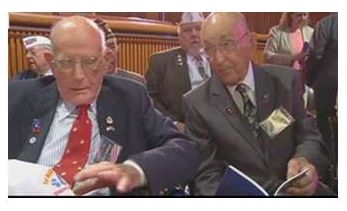
Bob and Jerry 5-21-13. YNN News, Albany, NY

Bob and Jerry 5-21-13. YNN News, Albany, NY

ALBANY, N.Y. — The souls who carry heavy memories from war were thanked in Albany on Tuesday for bearing the burden of our freedom.

World War II Veteran and Newburgh resident Warren Craig described, “We got hit 57 times. And I ended up jumping into the ocean at 12 o’clock at night, swimming with the sharks and the enemy.”

Craig enlisted when he was 17-years-old.

Fifty-four men and women have been added to the New York State Senate Veterans’ Hall of Fame for what they’ve done and kept doing over the years.

Senator Greg Ball explained, “Their heart never took the uniform off. And they continue to serve for the rest of their life.”

These men and women’s lives would then never be the same. Among them are Capt. Gerry West and Sgt. Robert Addison, who both served in the United States Marine Corp. during World War II. The two were part of the Edson’s Raiders, the original 900 members of a commando unit, and survived the battles of the Pacific Theater after Pearl Harbor.

“The bloody ridge on Guadalcanal. We were both there. It brings back a lot of memories,” said Addison, who now lives in Glens Falls.

West said, “The bad battles, like Bloody Ridge. You never forget something like that. We still talk about it and things we never forget.”

West resides in Fort Edward now.

“We’ve known each other for 71 years. Since February of ’42, so what would that be? 71 years,” he confirmed.

Now neighbors in the North Country, the two Edson’s Raiders are still right by each others’ side.

“Well, I just live down the road from him, so we’ve kept in touch all the time,” said Addison.

These legacies are once again being remembered and passed onto the younger generation.

“I grab a hold of fellas that don’t know what to do and take them with me, to get them started,” said Craig. “There’s so much opportunity out there.”

Troy native Daniel Honsinger, a veteran of the Vietnam War, said, “God bless America, that’s all.”

For more information on the Veterans’ Hall of Fame, visit www.nysenate.gov .

Read Full Post »

Two Toronto Holocaust survivors meet their liberators 65 years later
Two survivors of a death train out of Bergen-Belsen concentration camp finally link up with American soldiers who freed them in 1945.

A WWII-era booklet still possessed by Leslie Meisels documents his liberation as a young boy from a train destined for a death camp. Meisels, who eventually ended in Toronto, met a few of the surviving soldiers who freed him and 2,500 prisoners on the train.

A WWII-era booklet still possessed by Leslie Meisels documents his liberation as a young boy from a train destined for a death camp. Meisels, who eventually ended in Toronto, met a few of the surviving soldiers who freed him and 2,500 prisoners on the train.

Leslie Meisels is 86.

Leslie Meisels turned 68 last month.

Every April, since he was 18, Meisels has celebrated his rebirth. Sixty-eight years ago he was on the cusp of death, packed into a cattle car in a freight train with some 2,500 other skeletal Jewish prisoners. He weighed only 75 pounds.

Then a miracle. That train, which had set off from a concentration camp, was liberated by 12 shocked American soldiers in two tanks and an army jeep near Farsleben, Germany.

Up until then, the American GIs had assumed the gruesome stories they had heard about German death camps were just Allied propaganda devised to make them fight harder. But as they unlocked the boxcar doors, they witnessed humanity’s true capacity for evil.

They called it the death train. For Meisels, it was a train of life.

This past week marked the 68th anniversary of V-E Day, the end of the Second World War in Europe. It’s a good moment to tell the story of that train from Bergen-Belsen.

I heard about it last month in an email from a history teacher in upstate New York. He put me in touch with Meisels and Paul Arato: two Holocaust survivors from Hungary who in 1956 escaped their homeland, by then under Communist rule, and settled in North York.

Their stories are remarkably parallel. They grew up in nearby towns in eastern Hungary, they were both imprisoned by the Nazis in 1944, and they were sent first to Austrian farms as slave labourers and then to the Bergen-Belsen concentration camp in northern Germany.

Have you ever seen the horrifying Holocaust photos of dead, naked bodies being pushed by a bulldozer into open pits? That was Bergen-Belsen. Some 70,000 people were murdered there, including Anne Frank. They weren’t killed in gas chambers, like at Auschwitz. Instead the Nazis used starvation, sadism and disease here.

Meisels remembers mostly the hunger. They were given only watery turnip soup and a piece of bread each day. In four months, he lost 100 pounds.

Arato, just 6 then, remembers the rattling cold and twice-daily roll calls that often lasted hours. He and his older brother Oscar had to hold their mother upright, she was so weak from typhus. One day a boy in their line smiled because it was his birthday. As his “present,” an SS guard shot him dead. It was Oscar’s birthday the next day.

The horror is ungraspable.

By April 1945, the Nazis were retreating as both the Allied and Soviet armies advanced. One morning, both Meisels and Arato were awakened by guards and told to march. “We dragged our bodies over five kilometres,” says Meisels, “back to the train.”

Trains in Nazi Germany usually led to death. This one was no different. It was destined for another concentration camp in Czechoslovakia, but the guards also had orders to execute passengers. Meisels remembers one afternoon when all males 12 and older were ordered out of the packed boxcars and lined up in front of machine guns. They stood there two hours before being herded back into the putrid cars.

Over six days, the train progressed only 135 kilometres.

Arato remembers peering through between the wooden boxcar slats and seeing the SS guards drop their weapons and start running. Then he glimpsed a tank with a star on it.

The door slid open shortly and they were greeted by stunned American soldiers.

“It was hard for us to believe what we were actually seeing,” says one of those soldiers, Frank Towers, on the phone from Brooker, Fla. “We weren’t prepared for it. We were there to fight a war. We weren’t humanitarians. We didn’t know what to do.”

Says Meisels: “We cried, ‘Oh God, we are going to be free. We are going to be human beings again.’ ”

Towers, who was serving in the 30th Infantry Division, spent a day those taken off the train to convalescence homes and a hospital nearby before he had to push on with his battalion.

Meisels and Arato spent five months recovering in Germany before they could finally return to Hungary to search for the rest of their families. Eleven years later, they escaped Hungary and started their lives for a second time: getting married, building careers, having children, then grandchildren. Decades went by.

Then, a few years ago, their paths crossed at a business meeting. Arato, since retired, was an industrial designer. Meisels ran a family company making plastic moulds. At the end of the meeting, the topic of the Holocaust was raised. They discovered, to their shock, they had both been on that train from Bergen-Belsen.

Around the same time, that high school history teacher in New York named Matt Rozell stumbled upon the story.

To bring Second World War history alive, he’d instructed his Grade 10 students to interview their grandparents about the war. One summer, he visited one of his students’ grandfather: Carrol Walsh, a veteran turned New York State Supreme Court judge.

“After two hours, when the interview was ending, his daughter elbowed him and told him to tell me about the train,” Rozell says.

He learned Walsh had been in one of those tanks that chased away the SS soldiers and liberated the train.

Rozell posted the story on his website, Teaching History Matters, and a few years later a survivor from that train contacted him from Australia. Since then, 240 more have been located.

In 2007, Rozell hosted his first symposium on the train, bringing together survivors and liberators. Arato’s son came across a story about the reunion on the Internet by chance.

Arato told Meisels about it, and two years later they both traveled down to Hudson Falls, N.Y., for the second symposium. There they met Walsh and Towers.

That moment was a second liberation for Arato, now 74.

“A blanket was pulled from me,” he says. “I was always very lonesome. I didn’t share my stories with anybody. I grew up and spent all my years being angry. This meant I don’t have to be angry anymore.”

His wife, Rona, has just published a book about his story called The Last Train: A Holocaust Story.

Meisels visits schools around Toronto to speak about the Holocaust every week.

His message? “Hatred is something we have to fight against. When you hear a derogatory comment, say out loud that it is not right. When you are silent, you are not neutral. You are supporting the oppressor.”

He and Towers went to Washington, D.C. last month to celebrate the 20th anniversary of the Holocaust Museum there. Towers, now 96, is the last living U.S. veteran who liberated that train. Walsh died last December.

“We hugged,” Meisels says. “Whenever we are together, I am so overwhelmed by gratitude and joy.”

Truth can be more horrifying and wonderful than fiction. Every life is precious.

CLICK HERE FOR THE STORY OF ANOTHER TORONTO RESIDENT WHO FOUND HERSELF IN THE 1945 PHOTOGRAPHS


by Catherine Porter 

http://www.thestar.com/news/gta/2013/05/10/two_toronto_holocaust_survivors_meet_their_liberators_65_years_later_porter.html

Read Full Post »

I don’t know Leo but when I saw the headline I thought they were writing about my friends on this site. God Bless, Mr. Hymas.
By Julie Muhlstein, Herald Columnist

Students crowded around the speaker as his talk ended at Everett Community College. They lingered, asking if they could take pictures and posing with him to capture the moment.tudents crowded around the speaker as his talk ended at Everett Community College. They lingered, asking if they could take pictures and posing with him to capture the moment.

Leo Hymas is no hip-hop artist or reality TV star. At 87, the U.S. Army veteran is a keeper of history and a bearer of truth.

“Those who say it didn’t happen are wrong,” said Hymas, who spoke Wednesday as part of the college’s Holocaust Survivor Forums.

He lives on Whidbey Island with his wife, Amy, and is a speaker with the Washington State Holocaust Education Resource Center.

His audience was rapt, hanging on every word, as Hymas shared memories with Joyce Walker’s Humanities 150D class. This is the 14th year Walker has presented the Holocaust series, which is open to the public. Most speakers have been Holocaust survivors, or lost ancestors during Nazi Germany’s systematic murder of 6 million Jews.

Hymas is not Jewish. His Holocaust story is from the point of view of an American soldier during World War II, a 19-year-old fresh off his family’s Utah dairy farm.

He was with the 97th Infantry Division, H Company, part of Gen. George Patton’s Third Army. In the spring of 1945, they marched through a nearly defeated Germany. “We fought our way across Germany, village to village — sometimes man to man,” Hymas said.

They were preparing to attack Weimar, a picturesque German town, when they came upon a wire enclosure. Hymas recalls the fence, topped by barbed wire mounted on electric insulators. There was a brick building with a tall chimney, and a guard tower. The guards were gone.

The place was Buchenwald, a concentration camp near Weimar. What the liberation forces found there is seared in Hymas’ memory.

“I have seen hundreds and hundreds of naked, rotting bodies stacked like cord wood,” he said. “The smell, I cannot describe. It was burning human flesh.”

There was no fighting. “Suddenly, our fighting force became a humanitarian force,” Hymas said. “You’ve seen the pictures. The people were so emaciated, just skin and bones.

“An order came to touch nothing, but help if you can,” he said. Three generals came to the death camp with their staffs — Dwight Eisenhower, Omar Bradley and Patton. Hymas said troops had nicknamed Patton “Old Blood and Guts — his guts, our blood.”

From camp survivors, Hymas heard horror stories of torture, of subsisting on a half-cup of turnip soup mixed with sawdust each day, and of dogs trained to go for the throat.

The Allied forces made townspeople from Weimar carry bodies from the camp to a common grave. “They told us, ‘I’m not a Nazi,'” Hymas said.

Kathleen Bergin is the speakers bureau coordinator for the Seattle-based Washington State Holocaust Education Resource Center. While most speakers are Jewish, she said, “Leo offers another perspective. He is one of our most prolific speakers.”

He also is among a dwindling number of people still alive to tell what they saw of the Holocaust firsthand.

“The survivors are elderly, and the liberators tend to be even more so,” Bergin said. “We do have videotaped accounts, but a big part of Holocaust education is preparing for when there aren’t survivors. We have to make this real to kids. When there’s not proof of it standing right in front of them, it’s a challenge.”

Hymas was awarded a Bronze Star Medal for valor. He said he helped capture 91 Germans, “most sent to Nuremberg for war crimes.”

Near the end of his talk, he asked for volunteers. Audience members Terry Myer and Cory Palmieri came forward. First, they held up a Nazi banner, bright red with a huge swastika on it.

“It’s a symbol of the worst evil we have record of,” Hymas said, then asked the volunteers to “wad it up and throw it on the floor.” They then held up a 48-star American flag, “the flag I fought for, and my dear friends died for,” Hymas said. “I hope you love and respect it.”

Retired from an aerospace industry career, he makes time to tell as many people as he can about what hate can do.

“I know what I saw. I am a witness. Now that I have told you, you are witnesses, too,” he told the students. “I’m hoping to influence people like you, so that it can never, ever happen again.”

http://www.heraldnet.com/article/20130510/NEWS01/705109903/1056/comm0615

Read Full Post »

Thanks to Alan Smason for a nice article. I have added some clarifying remarks in brackets for posterity and additional accuracy.

Soldiers, survivors converge in Louisville

April 19, 2013

By ALAN SMASON, Exclusive to the CCJN

Frank Towers remembers the day through the haze of 68 years, a footnote at the end of World War II. Matt Rozell was never there, but through his efforts and those of his students, he can dictate with amazing accuracy what happened in Farsleben, Germany those many years ago. Yet to the five Holocaust survivors who met with Towers and Rozell at a World War II reunion this past weekend in Louisville, KY, it was a day they will never forget. It was the day American forces gave them something they thought they would never see again: freedom!

30th Division U.S. Army Infantry Veterans executive secretary Frank Towers, center, welcomes Gideon Kornblum, left, and Kurt Bronner. (Photo by Alan Smason)

At 95 years, Towers is the last of the 30th Division of the United States Army Infantry members who can say he was there and had personal contact with this almost forgotten chapter of history. His testimony shows he was assigned the duty of dealing with what the Nazis regarded as human refuge on April 14, the day after the survivors, crammed into tiny freight cars, starving and in some cases dying, had been freed from their captors by members of the Tank Destroyer Batallion 743 [note: 743rd Tank Battalion. 823rd Tank Destroyer battalion assisted later in the day.]assigned to Tower’s 30th Division named for Andrew Jackson and fondly referred to as “Old Hickory.”

Rozell, a high school teacher in Hudson Falls, NY, is the conduit by which Towers and the remaining 30th Division members have connected to the Holocaust survivors, all now septgenarians or octogenarians, from the first of three trains sent out from Bergen-Belsen concentration camp on April 6. It is through his “Teaching History Matters” website set up decades ago and fueled as part of his commitment to teaching his students the lessons of World War II that he has become heralded as an authority on an event that took place years before he was born.

It is through his efforts and the resources he and his students have placed on the Internet that reunions where veterans can meet with survivors have been possible. More than 200 survivors of what Towers calls “the death train” have been identified and contacted through Rozell’s networking efforts.The five survivors who traveled to Louisville to spend time with their families touring the Louisville Slugger plant and other city sites are part of a vast network of Holocaust train survivors now living throughout the United States, Canada, Israel, Europe and as far away as Australia. The manifest of the names of all those loaded on the train is now listed on Rozell’s site and linked with the United States Holocaust Museum and Yad Vashem in Jerusalem.

This year two train survivors, Ariel University emeritus math professor Gideon Kornblum from Jerusalem and retired graphics printer Kurt Bronner from Los Angeles, were new to the gathering. They joined with retired Duke University medical professor Dr. George Somjen from Durham, NC; Brooklyn College physics professor Micha Tomkiewicz from Brooklyn, NY; and Bruria Bodek Falik from Woodstock, NY, all of whom have attended reunions with the remaining veterans beginning in 2008 and continuing ever since.

Bergen-Belsen concentration camp survivors (from left) Micha Tomkiewicz, Bruria Falik and Kurt Bronner. (Photo by Alan Smason)

In every case these Holocaust survivors brought their wives, children and grandchildren with them to meet and socialize with the children and grandchildren of the men they consider the liberators of their families.

This year only 12 veterans were in attendance. Their number was lessened in December with the passing away in Florida of Carrol Walsh, a retired New York State Supreme Court judge, who was one of the two tank commanders that captured the train in question.

It was through Walsh’s grandson, a student in Rozell’s history class more than a decade ago, that Rozell first learned of what occurred on that date. Beginning in 2001, he heard first-hand in a series of interviews with Walsh how he and fellow tank commander George Gross happened onto the train and its human cargo.

Rozell explained how the train got there. On April 6 the Bergen-Belsen commander, fearing the approach of the Soviet Army [note: the British Army] and not wanting to let the world know of the savagery of the Third Reich and its “Final Solution,” dispatched three separate trains crammed full with prisoners to Theresienstadt concentration camp, also known by the name of its garrison city, Terezin. Of the three trains sent out that date [note: not all three trains were dispatched on same day], the first with 2,500 aboard encountered a series of mishaps that made it fall into the hands of the Americans on April 13. A second train with 1,700 prisoners aboard, using information it gleaned from the first train, eventually made it to Terezin on April 20, where most of its inhabitants were liberated on May 8 by the Soviet Army. The third train with 2,400 souls aboard also was liberated by Soviet troops on April 23 at Trobitz.

With laser pointer in hand, former 1st Lt. Frank Towers prepares to show audience members where the train was liberated at Farsleben. (Photo by Alan Smason)

Walsh and Gross were on a scouting mission along with members of the 119th regiment, having been dispatched from the recently captured town of Hillersleben by Major Clarence Benjamin. Benjamin had come upon several Jews who had escaped the train while it lay in wait. They had told him of the train’s existence and he instructed Walsh and Gross to accompany him.

Despite its holding a full head of steam, the train commanded by SS Captain Hugo Schlegel and its complement of a dozen guards or SS troops were contemplating orders from the German command. In front of them were the Allied forces, while behind them the Soviet troops were advancing. The orders were chilling. Either blow up the train there with explosives found in one of the freight cars or advance the train to the Elbe River, blow up a bridge there and plunge the train into the waters below, killing all aboard including the guards.

The train was standing at a spot so remote it was originally considered as Magdeburg by the World War II veterans who first began to tell their stories. Walsh and Gross saw several Jewish prisoners milling about, but when they pressed their tanks into service, the German guards threw their rifles down, ran away or disrobed, attempting to evade capture by donning the clothes of their captives. It was in vain, though, because their much better physical condition gave them away almost immediately.

Emeritus mathematics professor Gideon Kornblum traveled from Jerusalem to be a part of the reunion of the veterans and survivors. (Photo by Alan Smason)

Gross placed his tank in front of the train, while Walsh went back to the headquarters to alert them to their finding. With their Nazi captors away or arrested, the train’s doors were flung open and the wretched survivors  began to slowly vacate the compartments to which they had been confined.

“These freight cars were much smaller than the ones we see on our normal railroads, about half to two-thirds the size of our freight cars,” Towers recounted. “These freight cars were left over and remodeled after World War I and became known as ’40 and 8s.’ They could easily hold 40 men or eight horses, thus the nomenclature.”

“These cars that they encountered contained 75 to 80 men, women and children,” Towers continued. “They’d been in these cars for six days, stopping at night to get their daily ration, which basically was a kettle of water with some potato skins or lentils. That was their ration for six days.”

When Walsh returned with backup troops, they came face to face with the horrors of the Holocaust, none of which they had seen in their march towards the heart of Germany.

Kurt Bronner, at his first reunion of the 30th Division of the U.S. Army Infantry, gives his thanks to the veterans, (Photo by Alan Smason)

“They had very little sanitary facilities. They were dirty, stinking, flea-infested and lice-infested and put into these cattle cars,” Towers recalled. “When they opened the doors of these cars, many of the victims just fell out to the ground. Some of our men just had to turn and throw up; the stench was so bad. This was inhumane. This was what the Germans were giving them: nothing. They were treated lower than animals.”

Rozell concurred, but gave an interesting sidenote. The German guards had radios and had informed the prisoners of the death less than 24 hours before of President Franklin D. Roosevelt in Warm Springs, GA. Many of the U.S. soldiers were so busy fighting battles that they first found out about his death through the freed Holocaust survivors. [note: the reporter may have heard this from someone, but it was not me. I indicated what the soldiers told me- that the column was stopped and they were notified by their own commanders. Shocked, they went on to liberate the train the next day.] The prisoners were fearful at first because the Germans had told them the Americans would shoot them when they found them.

“There was one soldier, an individual I hear many soldiers talk about,” Rozell remembered. “Apparently, he came down from the hill and he said in Yiddish ‘I’m a Jew. I’m Jewish.’ He was from Brooklyn and I’ve heard it from at least a half-dozen people because it does make an impression.”

When 1st Lt. Towers was ordered to the train the following day he had several concerns. “The first thing we wanted to do was get these people medical care,” Towers stated.

“We were sort of in the middle of a no man’s land. We had to get these people out of there,” he noted. “So it fell in my lap to get transportation to get those people out of there and to remove them back to a previous town that had been liberated the day before at Hillersleben.”

Sadly, 30 of the victims on the train had already died of organ failure or starvation and were buried immediately at Farsleben, according to Towers.  Over the course of the next two weeks, nearly another two dozen weakened survivors contracted typhus and died. They were buried in a cemetery in Hillersleben, some five miles away. One of these was Somjen’s father.[note: the number is over 100.]

Little did Towers know, but the interaction he had with transporting the victims of the Holocaust was to be short-lived. Within a few days of arranging their transportation and care by private citizens and for the sick to a nearby German field hospital, he and other segments of the 30th Division were moving out to fight the Germans in what turned out to be their final assault at Magdeburg. Within days the war was over for Towers and the entire 30th Division.

For the survivors they had liberated, most of whom were Hungarian Jews, there were many years of living in displaced persons camps, moving back to their hometowns to attempt to find parents or loved ones and, eventually, emigration to more welcoming countries as Communism gripped the Slavic states.

For Kornblum, who was only five at the end of the war and who was then an orphan, much of the story of his past was brought to life at Yad Vashem, the Holocaust memorial and museum in Jerusalem, near where he now resides with his wife Annette. Although several previous attendees had come in from European cities or like Falik had lived in Israel for a time, Kornblum is the first resident of the Jewish state to travel expressly [note: others have travelled to the USA to reunions from Israel] to a 30th Division reunion.

“Originally people gave me the impression that I was aboard the train headed for Tobitz. I was very happy to learn that I was in the so-called Magdeburg train liberated near Farsleben,” Kornblum confessed. He remembers some childhood memories such as celebrating Shabbat with his grandfather on Friday evenings in addition to the slaying of his mother at the hands of the Nazis and the death of his father at Bergen-Belsen. “But I have very little recollection,” he admitted.

Bronner, who was 18 at the time of liberation, had far more vivid memories of that day, even though he spoke no English at that time. “The first  words in English I ever learned was (sic) ‘One only,’” he said. “That was when I went to the bathroom and I closed the door. Having the privacy to be by myself: that was freedom!”

Rozell first became aware of the impact his website was making in 2006, when he was contacted via email by an elderly [note: a grandmother, but not my idea of elderly] woman in Australia who was only seven at the time of the liberation of the train. She was amazed at the images displayed on the site captured on the day of her liberation by Benjamin and Gross. Thus began countless emails and telephone calls to many excited survivors with Rozell’s website as their focus.

When Rozell contacted the archivist at the Bergen-Belsen concentration camp, he received more material, such as the manifest list of passengers, which enabled him to do outreach with other survivors, who now were scattered across the globe. Rozell, Tomkiewicz and his wife [note: Rozell, Towers and Varda Wiesskopf] have now contacted approximately 240 survivors, all 18 years or under at the time of their liberation [note: a few were older].

Rozell has held several reunions with his high school class in Hudson Falls and has had Towers and Walsh meet with the survivors of the train, beginning in 2007. He has had oral histories recorded on video and transcribed for insertion on his website. Since 2008 the 30th Division members, led by executive secretary Towers, have invited the Holocaust train survivors to be included in their reunion activities as guests. The veterans and their families have joined with the Holocaust victims and their families to ensure that this small event at the end of World War II will always be remembered.

Crescent City Jewish News

Read Full Post »

Today is the 68th anniversary of the liberation of the train. We’ll have 80 for the final banquet tonight.

I am here in Louisville, KY at the reunion of 12 WW2 soldiers of the 30th Infantry Division and 5 Holocaust survivors who were given new life by these guys 68 years ago. And lots of 2nd generation and 3rd generation-sons and daughters, children and grandchildren, many here meeting their liberators for the first time.

In many ways it is a spiritual event.

Frank gave the introduction and described his role in transporting the prisoners from the train to safety. I spoke on how there were too many random “quirks of fate” to attribute this present gathering to coincidence. Had my wishes come true, and had I never returned to my hometown as I had hoped when I left it for college, the room would have been half empty. I would have never interviewed the tank commander who told me his story. None of these survivors would have known the rest of the story, so to speak; perhaps the soldiers too-

John D. thanked me afterward, describing his time carrying his rifle across Europe as a combat infantryman nearly seventy years ago. He told me now he knows, after meeting the survivors that he helped to liberate, what the true meaning of FREEDOM is, and what he fought for. He thanked me, a teacher. I resisted. He insisted. That about blew me away.

There was more to come.

Kurt and Gideon, “new” survivors, gave testimony for the first time to their liberators. Emotional. True freedom. Kurt remarked that he felt it when the Americans uttered “One Only” as nearly two dozen survivors were shown a clean room after liberation and proceed to attempt to occupy it. To be able to close the door when entering a bathroom, alone.

Eve, Kurt’s daughter, remarked through tears how she knew emotions would overwhelm, but she carried on and read fellow 2nd Generation survivor Sandy’s poem “I am a Survivor”.

She spoke of how difficult it was to grow up, with her two loving parents, knowing what they had been through-how do you, as a teen,  issue the normal teenage complaints when your parents had had it so much worse when they were your age? She ends beaming at her audience through wet eyes, the soldiers of World War II and their families who are returning the love in spades over this weekend.

Later I was very moved at Friday dinner when Gideon’s daughter gathered the children and others in the front, after calling our attention, and thanking God for these soldiers coming into their lives on April 13, 1945 and again now. Candles were lit, prayers were said, and Shabbat was ushered in, and we broke bread together, Gentile and Jew, survivor and soldier, sharing laughter and tears.

More later. For now would like to leave you with an account of the liberation by survivor Aliza Vitis-Shomron, who was recently featured in an AP article about the Warsaw Ghetto uprising. She, too, was a teen in the spring of 1945…

***************************************************

In Bergen Belsen

It is spring outside. The news we get from the older German soldiers who treat us humanely is that the end is approaching. Beyond the fence of the Dutch camp there is an open field. The wind brings in a horrible smell from there. In the distance we can see circles of smoke rising, and dark figures busy round the fire. What are they carrying? They are corpses for which there is no room in the crematorium, they are burning them on the ground one by one. Their ashes mingle with the soil, the rain creates human mud.

“All are of the dust, and all turn to dust again” – said the Lord.

Maybe that is God’s will – if He exists at all.

Human beings: beautiful, with black eyes, blue eyes; writers, teachers, students, disappointed lovers, proud, cowardly, selling fish on the market, fathers and mothers and those who had not yet tasted love. “The Chosen Jewish People” burnt like dung in the field.

At the beginning of 1945 the winter was hard. What may have saved us from starvation and death were the Red Cross parcels that arrived in March.

At the beginning of spring 1945 the cannons thundered. We felt that the end for the Germans was near, and there were many indications that it was so. The main one was that they stopped giving us food. Every day we stood at the fence along the main road, waiting for the soup which came late, often only in the evening.

Evacuation from Bergen-Belsen

Allied planes fly above us making a dull sound and there is nothing to stop them. A few days ago there was an air battle between English and German planes, right above the camp. I hid with the others under the bunks, not that I was afraid, but a shrewd thought was on my mind: Now, just before liberation and the end of the war, I could be killed by an allied bullet or bomb…

I am sure there is no God, only chance rules my life. There is no one to pray to, no one to beg – maybe my lucky star that has protected me until now will continue to do so… Will I manage to survive? A sweet feeling of revenge fills me as I realize that our murderers are also suffering and being killed! My strength        has waned, my feet are swollen from hunger, I have become apathetic to my surroundings.

On the 8th [7th] April, an unexpected order came to prepare for evacuation. We heard the thunder of cannons in the distance, they said that the city of Hanover was in the hands of the allied armies. And they are approaching the little town of Celle. Evacuation? Where? To the gas chambers?

There was a terrible smell in the air. I was hardened, cynical, no longer capable of feeling anything. After the terrible murders in Block Ten, adjacent to us, nothing could move me. I remembered I had to survive to tell the world about my friends. I hugged my mother and sister. They mustn’t separate us!

Mother consults uncle Leon Melamed. Aunt Irena, practical as usual, is already packing the most important things. “There is nothing we can do,” she says with typical decisiveness. “We have no choice. There is no point in staying in a camp that is no longer getting supplies of food. We’ll starve before they come to liberate us.” We agree with her. We get into a long line, men, women and the children who are with us, hundreds of Jews from various blocks.

The people’s faces mainly express uncertainty and acceptance of the situation. We again pass by the piles of skeletons, new ones every day. In the huge concentration camp on the other side of the road we see shadowy figures moving.

Mother and I take the few remaining clothes, the notes I have written in the camp and on the Aryan side, and a passport photo of father. We have no personal documents, nothing reminiscent of our previous life. Mother has only a silver fruit knife that she took with us when we went to the “selektzia” in Warsaw. My legs won’t carry me. We have to go eight kilometers to the railway station in Celle. The road seems endless, the body is weak and not used to moving. Every step calls for an inhuman effort. We crawl along slowly.

Gavriela is carrying her five-year-old brother on her back. Her face is red with the effort. The child has no strength left, he is apathetic. Their mother walks beside them and slaps him gently on his face. Her legs are also swollen from hunger. I walk on. I can’t help them, I have no strength left.

Suddenly a man walks up to me. I recognize him: It is my neighbor, from the next bunk. Without a word he puts his arms under my armpits and drags me along. I lean on him with all the weight of my body. I didn’t get to know him, although we “lived next door”; and now he is helping me!

Who can understand the depths of good and evil in the hearts of men! This small deed, the hand held out in support at a critical moment, imbued me with hope and strength to continue on my own.

People begin to drop their belongings. We also stop every fifteen minutes and sadly throw down a few things. At the end of the march my backpack only holds a little food and two or three items of underclothes.

This experience has affected my life-long attitude to things. Losing things or parting with them means nothing to me, causes me no sorrow. They certainly have no value in themselves, only if they are connected to some precious memory.

My legs are swollen and hurt. I can’t feel them any longer. I long to sit down, to rest, to close my eyes and disappear… I struggle constantly against this urge. Mother is dragging herself along, but walks erect, as always. Mirka walks along well. Suddenly we see railway carriages. Surprisingly, they are normal “pullmans”, not freight cars. The exhausted people lie down on the platform. At the station we are given a little food and water. The journey has begun.

The most precious turnips

We traveled by train for eight days. The train moved little, it remained standing a great deal. The frontline was everywhere and chaos all around us. German families flee with their belongings in all directions in carts and on foot. Have they been encircled? What a cheerful thought! Our leaders and various oracles, experts in solving riddles and interpreting rumors, say that the Germans want to use us as hostages. Besides our group, hundreds of Dutch, Greek and Hungarian Jews are with us on the train, all supposed to be exchanged, from the special camps in Bergen-Belsen. In the meantime the most important thing is to get hold of food.

During one of the stops I saw people jumping from the train and rolling down. I also wanted to do so, but my sister was quicker and out already. I joined her. We rolled down the high embankment to a wonderful pile of animal feed, yellow turnips. I filled up my dress feverishly, grabbing as much as I could carry and hop – climbed back. But at the moment when all the children and youth began climbing up, guards on the roof of the train opened fire on us. The Germans were apparently surprised and reacted late. I ran and lost my sister. I didn’t see a thing, but I was determined to get the turnips into the carriage. The bullets whistled around us, but I didn’t drop the turnips. I didn’t even look back to see who fell and who survived. Only on reaching the top, under cover, did I look back in great fear, in search of Mirka. She stood up next to me, trembling but smiling. We had food for the rest of the journey.

The danger is not over yet…

After a six-day journey we approached the frontline. We realized that we were apparently traveling southeast. The “experts” say that we are approaching a large city in central Germany, Magdeburg, on the banks of the Elbe.

One day the officer commanding the military escort called our representatives. He was well-mannered and received them politely. Hela Schüpper wrote in her book: “The commander took off his military cap and turned to the Jews in fear: ‘Ladies and gentlemen, the end of the war is near. What shall we do?’

Engineer Solovieczyk advised him to surrender to the Allies and put up a white flag on the roof of the train.” Our representatives came back and described the amazing meeting excitedly: The German asked the Jews for advice! Maybe he’ll also ask them for help? That’s a good sign.

In the night the whole escort team fled, using the locomotive. What will happen now, to us? We were alone. Slowly, people started leaving the carriages, the train was standing in the middle of a field. I also got off, with my faithful friend Tusia (Rina Altbecker). We saw a small pond not far away, and “our people” were catching little fish there. Those among them with initiative found a tin, made a fire and cooked the fish. We joined in, glad to share the job.

We breathe fresh air, the sky is clear, it is spring. Although we are weak, exhausted by hunger, hope is reflected in all the faces. Of course, there are also some “ravens”, prophesying that the Germans will not give up as long as they can harm us, but who listens to them? Mother is also pessimistic.

Visiting a village

Mirka and I join the stream of people going to the nearby village of Ferstleben [Farsleben]. The village houses are pretty, clean, surrounded by gardens with fruit trees. We entered a garden in fulllbloom. I knocked on the door of the house. A woman wearing a big apron came out. Her face expressed amazement at the two figures facing her. Evidently we looked like ghosts.

“Kartofel, Kartofel, bitte,” (Potatoes, potatoes, please) I whispered. At that moment the woman started to scream. I didn’t understand a word. She pushed us out. I ran to the trees and began to shake them, so the blossoms fell off the branches. A large stone flew at me. We ran away.

That was the first and last time I asked for food. I felt ashamed. Mirka and I decided not to tell mother about it.

The fate of the certificates

That night we were right in the frontline. We spent the night lying under the carriages. We did not dare flee from there, there was nowhere to go. To hide in the German village? They’ll chase us away like dogs and hand us over to the authorities. We had no choice but to remain in the carriages and underneath them. Whatever happens to the others will also happen to us. Cannon shells flew above us with a terrifying noise. They may have aimed at the train… It was a miracle that we survived till the next morning.

Before dawn the locomotive returned with our escort. People who got out of the carriages in the morning were amazed to see lots of pieces of paper floating on the small pond. They looked strange, and they had not been there on the previous day. When they went to look at them, they were devastated: these were our certificates and other papers protecting us! So we did have such papers. It wasn’t just a deception by the Germans!

{After the war the mystery was solved: as I wrote, at the end of 1944 a group of two thousand Hungarian Jews from Budapest came to Bergen-Belsen, on their way to Switzerland. Our leaders gave them a list of our names, and they passed it on to the Swiss and Jewish institutions in Palestine, trying to save Jews. Apparently it was only then that they sent us the certificates; now at the end of the war, the Germans found them useless.}

But the Germans escorting us had a different plan for getting rid of us. They didn’t want to let the birds in their hands escape, even though the Allies had already encircled them on all sides.

Liberation

Suddenly someone ran from carriage to carriage, screaming in terror: “The Germans want to drown the train in the river Elbe. Save yourselves!”

At the height of the panic, when we heard shots in the distance, we ran outside. People burst out of the carriages. Suddenly someone shouted:

“The Americans are coming!”

To our great surprise, a tank came slowly down the hill opposite, followed by another one. I ran towards the tank, laughing hysterically. It stopped. I embraced the wheels, kissed the iron plates.

The amazed soldier who came out called his friends and they immediately started throwing chocolate to us. They smiled in embarrassment and didn’t know what to do. We had won the war!

It was the 13th April 1945.

Read Full Post »

Marc Silver

National Geographic News

Published April 8, 2013

 Note: This is from National Geographic. As the nations commemorates Holocaust Remembrance Week, I’ll be flying to Louisville for the annual 30th Infantry Division Veterans of World war II reunion to take part in the reuniting of 5 survivors with the division that liberated them. The 30th will also be honored with a flag in the annual national ceremony at the Capitol Rotunda. In April 2010 I was honored to be in attendance at the Rotunda ceremony with 121 liberators and dozens of survivors.

I will post more about these events later. In the meantime, if you have not read the news below, it is a staggering development.

The map of the Third Reich is being dramatically redrawn.

Thirteen years ago, when he started digging into the past to document the number and nature of Nazi-era ghettos and camps, scholar Geoffrey Megargee expected to identify perhaps 7,000 sites. He vastly underestimated his task. More than 42,200 sites will be named in the planned seven-volume encyclopedia that he is editing: The United States Holocaust Memorial Museum Encyclopedia of Camps and Ghettos, 1933-1945.

This week is Holocaust remembrance week in the United States, with an official ceremony at the U.S. Capitol Rotunda on April 11 at 11 a.m. For the latest insights into the Nazi era, we spoke with Megargee and Martin Dean, editor of volume two of the encyclopedia: Ghettos in German-Occupied Eastern Europe.

“To document this on a map and see how the Holocaust affected every single community throughout Europe makes quite clear the scope of the Nazi regime’s murder campaign,” says Dean.

Investigating the Sites

To be included in the encyclopedia, a site had to have housed at least 20 people and have been in existence for at least a month. In addition, it had to have been identified on a map—not the easiest thing to do when some towns in question have changed their names several times since  World War II ended.

The scholars drew upon past research and interviews with survivors but also sought records that have “disappeared into archives in a dozen different countries,” says Megargee. Many of the archives were behind the Iron Curtain until the 1990s, off limits to outside scholars. Even now some are restricted.

The sites include the extermination camps where gas chambers were built for “the final solution” of murdering the Jewish people. But that’s only part of the project’s scope.

“We’re not just looking at sites directly involved with the Holocaust,” says Megargee, “but [also] with the entire range of persecutory facilities that the Nazis and their allies ran.”

Forced Laborers Everywhere

Each listing has a careful yet hair-raising description of the site, drawing from records as well as survivor testimony. Many of the encyclopedia entries were forced labor camps.

“Think of what life was like in Germany,” Megargee says. “There were foreign forced laborers in every conceivable kind of business: farms, factories, retail shops, hospitals, railroads. You couldn’t go anywhere in Germany without encountering people being held against their will and forced to work. Their rights were being violated.”

And it would have been no secret to German citizens that these laborers were in their midst. “Even in a large city, you know who lives in your neighborhood—and who doesn’t,” Megargee says. “And you could see barracks where these forced laborers lived.”

Workers thought to be shirking their duties were sent to work education camps. They faced up to eight weeks of very hard labor along with beatings and possibly solitary confinement. If there was evidence of a change in behavior, the worker could go back to the forced labor camp. If not, he or she might be sent to a concentration camp.

The Work Education Camp Watenstedt-Salzgitter, established “in some woods just to the northeast of Hallendorf” in Germany, could hold about 800 female prisoners and 1,000 males at a time. The Encyclopedia entry mentions 492 documented deaths there in 1942 attributed to “weak heart” or “shot while trying to escape.” A survivor of the camp recalls an SS man “who beat the prisoners on their way to breakfast.” (There were Jewish inmates at this camp, but in most forced labor and work education camps in Germany, the internees were typically non-Jewish Europeans.)

Staggering Death Rate

Megargee says some of the categories of sites he found were “particularly surprising or horrible.” The so-called Care Facilities for Foreign Women and Their Children were essentially holding pens for female workers, typically from Eastern Europe, who had become pregnant. At an earlier stage in the Nazi regime, these women would have been sent home to have the child. After 1943, they were sent to the Care Facilities, where “the baby was either aborted or, after birth, would be killed by slow starvation,” says Megargee.

European Jews were first confined to ghettos. When the ghettos were shut down, most Jews were killed; only a few were selected for work and sent to forced labor and concentration camps, where they again were periodically selected to continue working or to be killed. The death rate for European Jews in the camps and ghettos was a “staggering” 90 percent, compared with 10 percent for the foreign workers held in German forced labor camps, Dean notes.

The Encyclopedia of Camps and Ghettos pays tribute to those many millions imprisoned and slaughtered by the Nazis by its memorialization of all the site names. On its pages a reader will find camps that few people have heard of, like the work camp at St. Martin’s Cemetery in Poznan, Poland, where Jews had to excavate Polish graves to look for gold teeth, jewelry, or brass, and even smash up the headstones for the Nazi war effort. And there are the infamous names etched in the world’s memory, like Auschwitz-Birkenau with its gas chambers.

“This is giving recognition to all of the thousands of places where people suffered and died,” says Martin, “that would otherwise fade from people’s consciousness.”

http://news.nationalgeographic.com/news/2013/04/130408-encyclopedia-labor-camps-nazi-holocaust-memorial-museum-holocaust-remembrance-week/

Read Full Post »

I just got home from a Yom Hashoah event, Holocaust Remembrance, that was pretty intense.

Three American candles.You know that when folks come up after you speak and squeeze your hands that you have made a favorable impression. Teachers in the audience come up to say they feel inspired.

But  they know that it is not about me.

I let the liberator and the survivor do the talking (see link below), then spoke about our obligations as the new witnesses to carry on the story.

Of course the event is about those who perished. But we must listen while we can to the survivors and become the new witnesses.

For those of you who came out, I re-post the narrative here-scroll down to the bottom for the NPR story, in 3 parts, from You Tube.   To those of you who may be curious, do it. You don’t even have to watch, just turn it up and listen. Set aside a few moments of time to recall, together, the moment of liberation and the aftermath.

But also remember that if we let the liberator’s final message go by the wayside [part 3], then we have learned nothing. Our kids, our students deserve better. Trust me, if you are an educator, or an educational administrator {my emphasis} puzzled with how to get kids to DO ANYTHING for you, they will respond for you with this, if presented correctly.

And as a final aside, the three candles pictured above, Red, White, and Blue, are for

Major Clarence Benjamin,

Dr. (SGT) George C. Gross, tank commander,

and Judge (SGT) Carrol S. Walsh, tank commander.

I kept alive their stories tonight.

Thanks to survivor Bruria Falik for thinking of this, in addition to the six candles for the millions lost and the candle for the 2nd generation. It was my honor to explain their significance. To those of you who offered your support and feedback, in person or on line, thank you. It is what I kind of need sometimes to know that I am making a difference.

Feel free to leave response!

MR

April 7, 2013

Read Full Post »

USS Thresher Sinking: Impacts of Deadliest Submarine Disaster In U.S. History Remembered 50 Years Later

By David Sharp 04/05/13 02:47 AM ET EDT Associated Press

Note: Another somber anniversary. My friend Ted, a Cold War submariner, is in New Hampshire today to attend a reunion and also the ceremonies, to pay his respects.

KITTERY, Maine — The first sign of trouble for the USS Thresher was a garbled message about a “minor difficulty” after the nuclear-powered submarine descended to about 1,000 feet on what was supposed to be a routine test dive off Cape Cod.

Minutes later, the crew of a rescue ship made out the ominous words “exceeding test depth” and listened as the sub disintegrated under the crushing pressure of the sea. Just like that, the Thresher was gone, along with 129 men.

Fifty years ago, the deadliest submarine disaster in U.S. history delivered a blow to national pride during the Cold War and became the impetus for safety improvements. To this day, some designers and maintenance personnel listen to an audio recording of a submarine disintegrating to underscore the importance of safety.

“We can never, ever let that happen again,” said Vice Adm. Kevin McCoy, an engineer and former submariner who now serves as commander of the Naval Sea Systems Command in Washington, D.C.

This weekend, hundreds who lost loved ones when the Thresher sank will gather at memorial events in Portsmouth, N.H., and Kittery, Maine.

Built at Portsmouth Naval Shipyard in Kittery, and based in Groton, Conn., the first-in-class Thresher was the world’s most advanced fast attack submarine when it was commissioned in 1961.

Featuring a cigar-shaped hull and nuclear propulsion, the 278-foot-long submarine could travel underwater for unlimited distances. It could dive deeper than earlier submarines, enduring pressure at unforgiving depths. It was designed to be quieter, to avoid detection.

On April 10, 1963, the submarine already had undergone initial sea trials and was back in the ocean about 220 miles off Cape Cod, Mass., for deep-dive testing. Some submariners are baffled by the initial message about a minor difficulty because it’s believed a brazed joint on an interior pipe had burst – a problem anything but minor.

The Navy believes sea water sprayed onto an electrical panel, shorting it out and causing an emergency shutdown of the nuclear reactor.

The submarine alerted the USS Skylark, a rescue ship trailing it, that it was attempting to surface by emptying its ballast tanks. But that system failed, and the sub descended below crush depth.

Understanding their dire situation, Navy crew members and civilian technicians would have scrambled to close valves to try to stem the flooding, struggled with a ballast system disabled by ice, and worked to restore propulsion by restarting the reactor, a 20-minute process.

Their deaths would have been instant because of the force of the violent implosion. The sub’s remnants came to a rest on the ocean floor at a depth of 8,500 feet.

There was nothing the divers on the Skylark could do.

“It’s one of those times when there’s silence,” recalled Danny Miller, one of the Skylark divers, now 70 and living in Farmington, Mo. “You don’t know what to say. You don’t know how to feel. You just know something tragic has happened.”

The Thresher wreckage covers a mile of ocean floor, according to University of Rhode Island oceanographer Robert Ballard, who used his 1985 discovery of RMS Titanic as a Cold War cover for the fact that he had surveyed the Thresher on the same mission.

“It was like someone put the submarine in a shredding machine,” Ballard said in a recent interview. “It was breathtaking. There were only a couple of parts that looked like a submarine.”

Word of the disaster spread quickly.

Paul O’Connor, now a union president at Portsmouth Naval Shipyard, remembers seeing the bulletin on TV. He was 6. Barbara Currier, whose husband, Paul, was a civilian worker on the Thresher, was shopping with her daughters when she heard the news on the radio in a store.

What followed was a blur of activity for families. Navy officers in dress whites showed up on doorsteps. Friends and neighbors brought food.

After the submarine was declared sunk, President John F. Kennedy ordered the nation’s flags lowered to half-staff. International leaders sent condolences.

“The men, they were heroes. Most of them were doing what they wanted to do for their country to keep the country safe,” said Currier, 86, who never remarried and still lives in the same house in Exeter, N.H. “They were pushing things to the limit.”

For the families, the silver lining is that subs are now safer. The Navy accelerated safety improvements and created a program called “SUBSAFE,” an extensive series of design modifications, training and other improvements.

People involved in the SUBSAFE program are required to watch a documentary about the Thresher that ends with an actual underwater recording featuring the eerie sounds of metal creaking and bending as a U.S. Navy submarine breaks apart with the loss of all hands.

“Every job we do, we need to have in the back of our minds that we have the lives of the sailors in our hands. It’s that critical and it’s that literal,” said O’Connor, president of the Metal Trades Council.

Hundreds of family and friends of the Thresher’s crew, along with sailors who previously served on the submarine, will gather Saturday for a memorial service in Portsmouth, N.H. A day later, neighboring Kittery will dedicate a flagpole that stretches 129 feet high in remembrance of the number of lives lost.

Because of their tender ages, and the lack of a body or proper grave site, children like Vivian Lindstrom, who lost her father, Samuel Dabruzzi, a Navy electronics technician, were unable to grieve properly.

Thanks to the reunions, they at least know they’re not alone, said Lindstrom, of Glenwood City, Wis.

“We’ve experienced the same things, felt the same things,” she said. “We feel like family. We call ourselves the Thresher family.”

Read Full Post »

Woodstock event remembers Holocaust

WOODSTOCK, N.Y. — A Yom Hashoah event that will remember the Holocaust will take place April 7 at 3 p.m. at the Woodstock Jewish Congregation, 1682 Glasco Turnpike, Woodstock NY, 12498.

Synagogue Main Number (845) 679-2218
Email info@wjcshul.org
Persons of all faiths are welcome.

The Yom Hashoah  observance will include a candlelight memorial service, followed by an address by Matthew Rozell titled “Honoring the Hour of Liberation and Defeating the Legacy of Hitler.” Rozell is the founder of a project that has reunited survivors from the Bergen-Belsen concentration camp with the U.S. soldiers who liberated them from a train transport during the closing days of World War II. To date, with the help of Varda Weisskopf and Frank Towers, more than 240 survivors worldwide have been located, and 10 reunions have taken place since 2007. Rozell is also a teaching fellow at the United States Holocaust Memorial Museum and has spoken on behalf of its educational programs. His work can be seen at teachinghistorymatters.wordpress.com.

The ABC News video can be seen here.

Read Full Post »

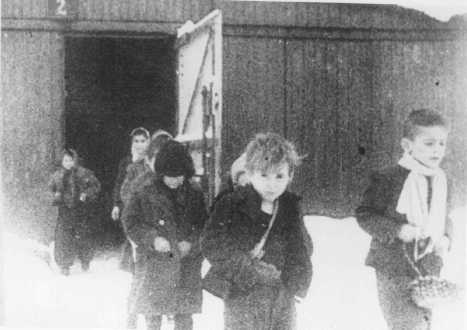
Soon after liberation, surviving children of the Auschwitz camp walk out of the children’s barracks. Poland, after January 27, 1945. — United States Holocaust Memorial Museum

Soon after liberation, surviving children of the Auschwitz camp walk out of the children’s barracks. Poland, after January 27, 1945. — United States Holocaust Memorial Museum

Today is International Holocaust Remembrance Day, the day Soviet troops over ran Auschwitz in 1945. This week I received a note from an Israeli survivor friend, shortly after the passing of one of her liberators, Carrol Walsh. Sara lost over 60 of her family there- and her immediate family was saved only because the day they arrived at Auschwitz, the death machinations were working at full capacity and her transport was rerouted to Belsen. She was liberated on 13 April on the evacuation transport near Farsleben, known here as the Train Near Magdeburg…

In her letter she asks important questions of me. I have responded the best that I could, below.

Dear Matthew,

 We were very sad to hear that Carrol Walsh passed away. Only lately did I get to know him, and he risked his life in order to save ours. It is a pity we did not get to meet more.

I can’t express in words the loving feelings for the young tank commander that for sure always had a smile on his face, and never stopped smiling after we met- 65 years after the victory. I am sure Carrol Walsh made the best out of his life; I was fulfilled to know him and his beautiful family.

I read about his profession in the years of his life. It was interesting to see how much meeting with us affected him.

I thank you for your unusual courage to initiate the exciting meeting [reunion].

I suppose you were very excited for the event you had initiated. Did the idea come in different parts? I am trying to understand the development of your thinking.
When you first wrote to me about the meeting [invitation to the proposed reunion], it was on the day we were released- the 13th of April. I got home after meeting my brothers and celebrating the release [liberation]day. I couldn’t relax, I immediately told all my brothers. I was so happy, as if it was happening again.

The meeting completed a missing part in the picture for me, after all the horrifying things we went through we couldn’t even dream of a miracle like that coming out of the blue.

I cannot go back more to the extermination camps and escort groups because I don’t have the physical nor mental power to do that anymore.

There are questions that bother me.

Are you able to answer them?

Why shouldn’t the world forget and let this be over?  

A. So, some people do want to forget. Others will say that it did not happen. For those reasons, it must never be forgotten. This is the biggest crime in the history of the world.

As Walsh states, how could humanity have stood by and let that happen?

Does my work, the hard work I do, do anything against the forgetting?

A.The most impressionable minds in the world are those of the youth. It is they who the Nazis “educated”; it made it easier for the crimes to be committed. This is why they must hear now.

The work that you, and I do, has an impression. I hope to continue this work after you must slow down. Please remember that.


You are a historian, should the memory be kept?

A.The memory must be kept. As educators it is our duty to keep it alive. We must fight those who trivialize or denigrate its importance.

Is there a proper way to keep the memory?

A.There is no one way except to be open to the discussion of humanity and how humans could do this to one another. We must also bear in mind however, that the soldiers who helped the suffering to new life bore their own pains in doing so, yet also made a choice to redeem humanity. Some did not sleep soundly for years.

I think this is so, and also must not be forgotten. The war brought out the most evil in the world. But I think it also revealed some goodness in the form of the soldiers who liberated or otherwise cared for the victims.

Who should be documenting everything, the “victim” or the “aggressor”?

A.The aggressor fades from memory. New generations asks questions. It is true that some are bothered by the questions. But the young will always be curious and want to know- is this a stain on the German people? I know some Germans today who work very hard to keep the memory alive, as you also do.

The victims give the testimony. This is all they can do. But it is the evidence of the crime, and one that new generations must work with. That is why your work is so important.

Who is in charge of making the conclusions?

A.I would say that institutions such as the United States Holocaust Memorial Museum and Yad Vashem are the world leaders in this area. I have been trained, well, I should hope, by the USHMM. I do not know enough about the German institutions but I hope to raise enough funds to travel to the camps and study there this summer.

Read Full Post »

« Newer Posts - Older Posts »