Feeds:
Posts
Comments

Posts Tagged ‘history education’

Traveling compadres Tim, Scott, and Alan in front of our hotel next to the Presidential Palace, Warsaw, Poland, summer 2013.

Traveling compadres Tim, Scott, and Alan in front of our hotel next to the Presidential Palace, Warsaw, Poland, summer 2013. Out for a nightcap and to discuss our shared day.

I am stealing another post from my friend Scott. We traveled together for three weeks this summer on our roller coaster Holocaust tour, and he continued on. Here is a great post with great pictures. Wish I was there with you buddy, but you make it come alive for me and my readers. Great pics, too. Learned a lot. Safe travels. MR


WWII – The Nazis

01 Tuesday Oct 2013

During the 11 day tour of WWI and WWII, we stopped at some important and significant locations to Hitler and the Nazis.  I think it is important to look into the history and development of the Nazis if we want to further understand how this much hate can manifest in a  major government.  If you have been following the news out of Greece and their political party known as Golden Dawn (whose symbol resembles the swastika), I don’t think we are that far away from this still happening.

One stop that marked Hitler’s rise was the site of his Beer Hall Putsch in 1923.  Hitler tried to rally some fellow drinkers from a beer hall in Munich to overthrow the Bavaria State Government.  It failed.  Here is the room he gathered supporters:

Image


This was a great place to be.  However, if you took a moment to think about what happened here, you had to pause.  I think this is a great example of resilience, though, to see people using this space for good things today.

We also stopped in Nuremberg and visited Zeppelin Field – the site of the large Nazi rallies of the late 1930′s you have seen in documentaries and films.  In the 1970′s, the German government passed a law forbidding the destruction of important Nazi buildings.  However, seeing Zeppelin Field it is clear that they are not doing much to preserve these sites.

Image


The podium you see down there is the one Hitler stood on.  You can see this area has become a parking lot and it is also the route of a road race so you can see the racetrack walls on the right.  The field in front of you, blocked by trees, is where Nazi’s rallied.  Here is a close up of the sides:Image

Here is the podium straight on:Image

Image


When I was up there on the podium, I turned around and imagined Hitler walking through the doors behind the podium to the place I was standing – it was a little creepy.  Image

I am impressed and disgusted by the amount of energy and money and resources and humanity spent on this hateful man and his message.  But this field was full of people who supported him.  In the museum nearby, there are videos of older German ladies who recall as young children all the excitement when Hitler came to town.  They told of going home and getting ladders so they could see him when his parade passed by.  And they told the camera this – years later mind you – with smiles on their faces and laughter in their voices.  I did not sense a bit of shame of their role (though they WERE children) in what Germany did during WWII and leading up to.  This was a something that stuck with me.

The Museum I talk about was in the largest building the Nazis were building in Nuremberg.  It was never finished, but the building remains:

Image


To give you a better idea of its size, here is what it looks like inside – that is a motorcoach full sized bus below:

Image


Again, you can kind of see the disrepair this building is in.  It does house a pretty good museum on the history of Nazism and its place in Nuremberg history, but most of the building is crumbling.

Another place we went to was what we call The Eagle’s Nest up in the German Alps overlooking Austria.  This house was a gift to Hitler by the Nazi Party on his 50th Birthday.  We took our bus to the bottom of the mountain is sits upon and then had to take another bus, driven by special drivers to near the top.  This is how we saw the house at this point:ImageImage

Notice the tunnel in the picture above – this was the way to the elevator:Image


From here, we took an elevator up to the house.  The same elevator Hitler took.  Again – creepy.  It felt though like most people here were doing the touristy thing – like we were – rather than once again comprehending the historical significance of this man and this movement.  I couldn’t wait to get off the elevator.

At the house, it was beautiful.  It was much smaller than I had imagined.

Image


Here are some pics from inside.  They turned the living room area into a restaurant now:ImageImage

Here is the signature fireplace:

Image


Hitler must have stood right here on days like this (which was pretty cold up here in the mountains) warming his hands.  I had to get out of here  – so I went outside and enjoyed some spectacular views.  Notice the fresh snow on the surrounding mountaintops:

ImageImage

But no matter how impressive the view was, the reason for this place never escaped my mind.  When we got back down to the bottom of the mountain, we went through some Nazi bunkers that were built here as well:

Image


Inside were these tunnels and rooms:

ImageImageImage


In one room, they made into a memorial for Holocaust victims and names were being read 24/7.  Here is the room and the walls which were covered in graffiti I think encouraged by the museum people:

ImageImage


And this leads us to the details of the Nazi atrocities.  If you have been reading my blog, I have been to 8 or 9 concentration camps already.  I went to another one on this tour – the first camp – known as Dachau.  Here is the train platform and the main building the Jews (and political prisoners, POWs, etc.) went through:Image

The now all too familiar “Work will set you free” sign”

Image


The fence and guard towers:

ImageImage


The area where victims were gathered each day:

Image


The main lane with the barracks outlines and bunks inside:

ImageImageImageImageImage


The gas chamber:

Image


The old crematorium:

Image


When that wasn’t enough, the new crematorium:

Image


Image


You all know what happened here and the horrible thing the Nazis did.  If you want to know more, read my first 12 or so blogs.

There are some symbols of remembrance here, like this sculpture:

Image


And this synagogue:

Image


But this is a horrible place.  My group, many of whom had never been to a camp, where visibly shaken and moved.  That is why it was good that we visited the Court House that housed the Nuremberg Trials after WWII and saw the punishment of those responsible for this.

Here are the gates to the court house:

Image


This is a functioning court house today and the court room that housed the trial is still being used as well.  Here is a pic of what the outside looked like after WWII:Image

The court room today:

Image


Luckily we were there on a Saturday, so we could sit in here all we wanted.  They had little video monitors that you could use to watch parts of the trials.  It was great to sit there and watch, through logic and reason and rules and respect, these Nazis get convicted.  I could have watched this all day.  I could have watched this for a week.  I think I will have to watch the movies again when I get home, but this made me happy being here.

Finally, we visited a German cemetery:Image

Notice the markers in the ground – they represent two Nazis for two German soldiers were in every hole.  Standing there, I could not bring myself to forgive these people.  I almost felt like they did not deserve this burial and respect.  Just then, out of the fog, came our friends – reminding us of the message from the bridge that perhaps it was time to heal.

Image

http://scottdurham.wordpress.com/


Read Full Post »

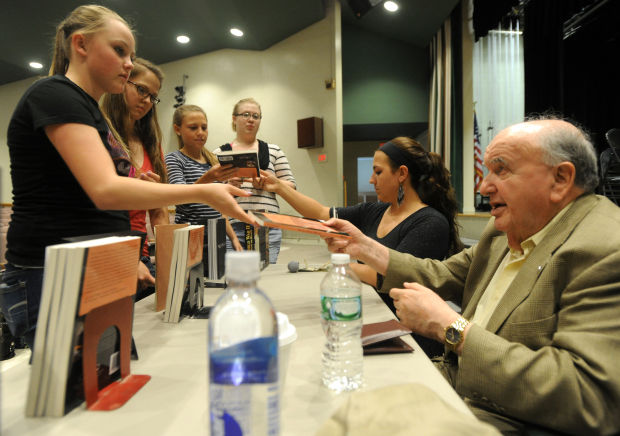
Francis Curry, WWII Medal of Honor, with students.

Francis Curry, WWII Medal of Honor, with students.

FOUR years ago today the most incredible week concluded with former soldiers and the Holocaust survivors they saved watching this newscast together in cocktail lounge of the Georgian Resort in Lake George along with teachers and students from Hudson Falls High School. Thank you Tara, Mary, Lisa, Rene, and all the staff. And to ABC World News for recognizing the importance of the occasion, and to the United States Holocaust Memorial Museum and the Bergen Belsen Memorial for their attendance and support.

A teacher’s job is to toss pebbles. Several of the participants are gone now, but the ripples here became huge, and no one will forget what they meant, where they came from, or what they have led to.

Watch a story about how a teacher fellow from the Museum reunited Jewish prisoners with U.S. Army soldiers who liberated them from a train near Magdeburg, Germany, on April 13, 1945.

Read Full Post »

I met Leslie Meisels exactly four years ago today, when he and  Ariela Rojek and Paul Arato drove all the way down from Toronto, Canada to meet their actual liberators.

Leslie is one of the most gracious men I have ever met; I am honored to have him as one of my friends and am proud to be in on what he calls the latest miracle of his life.

I wrote to a reporter/columnist in Toronto, Canada, several months back to comment on a story that she had written, and she then had the opportunity to interview several of my survivor friends in the community who had been liberated on the Train Near Magdeburg. She struck up a friendship with Leslie, and this ebook resulted.

A sample:

When I first reached Leslie Meisels on the phone one afternoon in late April and asked for an interview, he told me to hold on a minute — he needed to get his day planner.

I thought he was joking.

Leslie is 86. What could he possibly be doing to fill up a day planner?

A lot, it turns out.

He has a wife, two daughters, four grandchildren. He is an active member of the North York Philatelic Society and a committee member of Circle of Care, an organization that provides services for Holocaust survivors. And he is a regular speaker with the Holocaust Education Centre’s survivor speakers bureau. This spring there were weeks when he addressed four different groups of students about his experience during World War II.

This was one of those weeks. He squeezed me in. I wanted to talk to him about the Holocaust and, more precisely, about his liberation from the Nazi murderers by a dozen surprised American soldiers who found Leslie and about 2,500 other captives near the end of the war, packed in cattle cars on a German train.

An email from an American teacher had tipped me off to the fact that a number of Toronto Holocaust survivors had recently been reunited with their liberators.

Leslie was one of them.

Of course, you can’t talk about liberation without talking first about enslavement. So, sitting on the couch of the neat, spacious penthouse condominium he shares with his wife, Eva, in Thornhill, Leslie started proudly with his family history in eastern Hungary.

Then came his carefree childhood. Then the introduction of anti-Semitic laws, the ghetto, the trains, the months of slave labour and the horrors of the Bergen-Belsen concentration camp, where more than 70,000 prisoners — most of them Jews — were killed.

Our interview lasted more than three hours, fueled by many cups of coffee and servings of fresh cheese palacsintas (crêpes) whipped up by Eva.

I noticed Leslie’s hands while we spoke. They are enormous — each finger twice as thick as mine, the palms like dinner plates. They are a working man’s hands, without any of the dirt. Everything about Leslie is immaculate — his neatly clipped and cleaned fingernails, his ironed pants and pressed dress shirt with a silver pen poking from its breast pocket, his freshly shaven face. His stories of being treated like a rabid dog were cast in relief by the careful pride he took in his appearance. There is an Old World elegance about him.

But the thing that struck me most about Leslie was his cheeky humour. His brown eyes narrowed and sparkled repeatedly as he took a “side step” to tell me about the girl he was “necking” with while a slave labourer or a refugee. Despite the horrors he endured, or perhaps because of them, Leslie maintained his champagne spirit.

Near the end of the interview, a question bubbled in my mind: what did you take with you? The Nazis had invaded Hungary in 1944. They ordered all the Jews in Leslie’s and other towns to first leave their homes, and then to leave town altogether on a train we now know was headed towards slavery or murder. What would you take if you could carry only a small bag or pillowcase to hold your belongings?

“Underwear,” Leslie responded, “and my stamp collection.”

I wrote that down and moved on. There were a lot of overpowering details in Leslie’s stories, and I still needed to hear about the reunion. But the stamps snagged my attention. There was a boyish innocence about them.

What happened to those stamps, I asked him over the phone a couple days later.

He responded: “I still have them. My mother sewed them into the lining of my jacket.”

Imagine that! Most Jews had all their clothing and belongings stripped away upon entering the concentration camps. You can see their boot brushes, ceramic pots and dolls piled up behind glass cases in the Auschwitz-Birkenau State Museum in Poland. That Leslie managed to keep his jacket was surprising enough. But that fragile pieces of paper survived the horrendous conditions — well,that seemed miraculous.

I drove back to their condominium for a third interview, this one in Leslie and Eva’s little office. I asked to see some of those stamps.

So Leslie pulled out his master list — a two-page typewritten list of all the stamp albums he has. There are dozens and dozens. He found one with his early Hungarian stamps and pulled it down from the shelf. Inside he’d arranged thousands of stamps in neat rows.

When I expressed surprise at the number of stamps he had, he smiled and opened a drawer in his desk.

“A crazy stamp collector saves all the stamps he comes across,” he said, pulling out a Tupperware container brimming with stamps. “When there are many, many, many, he bundles them up . . . and stores them away. I have millions of stamps.”

Leslie’s wife calls herself a “stamp widow.” She says he spends hours with his stamps a day. He loves them still, like he did when he started his collection 78 years ago. He loves the precision of arranging them. He loves the challenge of collecting a full set of stamps. He loves their colours and their stories. Every stamp, he says, depicts a story of a place, a historic moment or figure, a cause. “You can learn about the world through stamps,” he said.

As we flipped through his collection and he began to tell me the rest of his story, I could see snatches of it reflected in his stamps.

It is the tale not just of an idyllic childhood followed by the horrors of the Holocaust, but also that of a man who lived under Communism, escaped, lived for two years in a refugee camp, arrived in North America with nothing and then built up his life for a second time. Just as every stamp embodies a public story, a bit of history, Leslie’s stamps also tell the story of his life, its joys and deep sorrows, its disasters and its miracles.

************************************************

He is giving his 25th lecture on the Holocaust since April.

“Put yourself in my shoes,” he says to the Cardinal Carter Catholic High School students. “I think you are between 16 and 18, right? You can feel what I felt when I experienced those horrors.”

“They have to know,” Leslie says. “Otherwise, it will be forgotten and could be repeated.”

He talks for just over an hour, pausing only twice for a sip of water.

The stories pour out of him — of the deaf village elder who was strung up by his wrists to a cattle car, of the SS guards with their dogs who laughed at the sight of him naked with his grandmother and mother, of the hunger. He stirs in life lessons — like how his woodworking knowledge saved his life in Bergen-Belsen. “You are the same age as I was,” he says. “Never think you are studying for your teachers or your parents. Whatever you are putting in your head, you never know how it will serve you in life.”

But Leslie’s descriptions are muted at times. He clutters his sentences with clauses and chooses math over graphic detail to describe some horrors. The train crowding, for instance, affords each person a “square foot.” He mentions the bucket but doesn’t fill in the details of how that meant people were forced to defecate in their pants. He is old-school; talk like that seems degrading. Or perhaps the pungent details are too dangerous for him, scratching away the protective layers on his memories.

A girl in a powder-blue sweatshirt in the second-last row appears to have fallen asleep.

Is he getting through to them? Like most Holocaust survivors,

Leslie won’t be around to recount these stories for much longer. That inescapable truth adds an urgency to his message. Who then will bear witness?

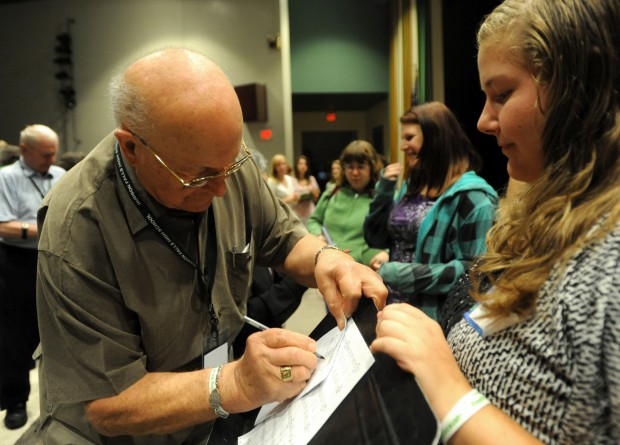
Holocaust survivor Leslie Meisels, left, signs a program for Hudson Falls senior Taylor Bump during Wednesday's "Remembering the Holocaust, Repairing the World" event. Meisels, who currently lives in Toronto, stressed the importance of relaying his experience to young people "so they remember and fight against discrimination, hatred and injustice." Jason McKibben Glens Falls Post Star

Holocaust survivor Leslie Meisels, left, signs a program for Hudson Falls senior Taylor Bump during Wednesday’s “Remembering the Holocaust, Repairing the World” event. Meisels, who currently lives in Toronto, stressed the importance of relaying his experience to young people “so they remember and fight against discrimination, hatred and injustice.”
Jason McKibben Glens Falls Post Star

He finishes his talk and asks for questions. The girl in the powder- blue sweatshirt from the back asks two. The second one is: “If you could go back, would you change any decisions you made?” She was listening, just with her eyes closed. Holocaust educator Ruth Ekstein says she often sees that — “the most fidgety kids you want to strangle, they are absorbing the most.” The content is so painful, it forces people to scratch and shuffle, or to close their eyes.

“Never allow this to happen to someone in the future, if you see an injustice,” Leslie tells the group. “Never just look at each other as equals. Treat each other as equals.”

************************************************

The last miracle

In 2001, Matt Rozell went to the home of one of his students in Hudson Falls, N.Y. Rozell is a high school history teacher there. He regularly assigned his Grade 10 students to interview the veterans in their family about World War II as a way to bring history alive.

That summer, he decided he would do the interviewing himself.

The veteran was retired New York State Supreme Court Justice Carrol Walsh Jr.

After two hours, when the interview was ending, Walsh’s daughter elbowed him and said, “Did you mention the train at all?”

“What?” Walsh said.

“The train.”

So Rozell asked to hear about this train, whatever it was.

Walsh told him about the beautiful, sunny day in April 1945, when after 10 months of fighting their way through France, Belgium,and Holland, and into Germany, his tank and his buddy George Gross’s tank were pulled out of the battalion to check out an abandoned train. An army scout had come across some Finnish prisoners of war in bad condition who reported they had escaped ,the train and that it was packed with prisoners.

Rozell posted the moving interview, as well as Gross’s astonishing photos from that day, on the school’s oral history website, where it sat quietly for four years.

That is, until a grandmother from Australia contacted him to ,say she had been a little girl on that train. The next month he got another email, and another, and another.

In September 2007, Rozell hosted the first reunion of Walsh and three survivors from that train. An Associated Press reporter wrote a story about the day-long event which was published around the world.

Paul Arato’s son Daniel read the story on the Internet. Arato was the 5-year-old boy who witnessed the birthday “present” of a bullet to the head in the Bergen-Belsen roll call. He was also a ,Hungarian Jew who grew up not far from Leslie. He, too, escaped Hungary in 1956 and resettled in Canada. An industrial designer, he was a work associate of Leslie. At the end of a business meeting, the topic of the Holocaust somehow came up. They discovered, to their shock, that they had both been on that train from Bergen-

Belsen. Paul, in turn, told Leslie about the Hudson Falls reunion.

Two years later, they both ventured down to Hudson Falls for a second reunion — a three-day symposium that brought together nine survivors and seven soldiers, including two of their liberators

— Frank Towers and Carrol Walsh.

On the drive down, Leslie was very excited. The initial meeting, over dinner, was spectacular.

“No words can explain the feeling of shaking hands, hugging, laughing and crying with the people who gave me back my life on April 13,” he says. “I never ever imagined that would happen.”

He calls the veterans “angels of my life.” They, in turn, said they were just doing their job.

Leslie and Walsh became close friends. They talked regularly on the phone. They spent some time together in Florida, before Walsh died last winter at the age of 91.

Leslie calls that friendship the last miracle of his life.

Leslie’s 17-year-old granddaughter, Jessica, visited Auschwitz last spring while participating in the two-week educational trip March of the Living. She left behind a small, hand-written sign that said: “I am marching in honour of my grandparents Eva and Leslie Meisels. As well as a soldier, Carrol Walsh.”

******************************************

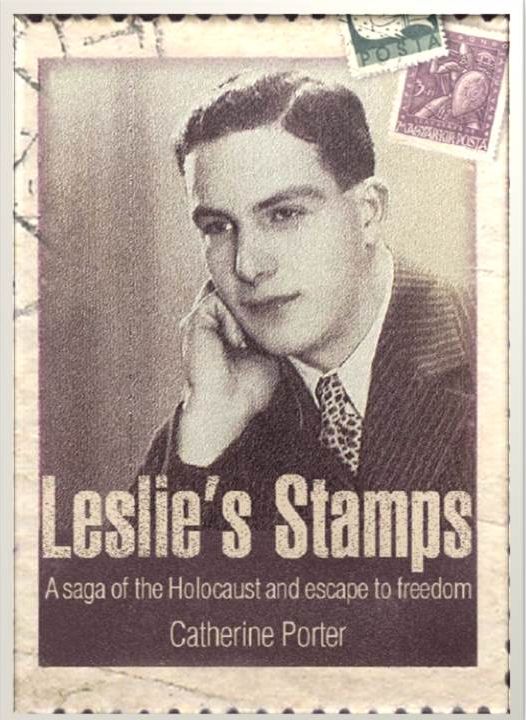
Leslie's StampsLeslie’s Stamps: A Saga of the Holocaust and Escape to Freedom

He had an idyllic childhood in a small Hungarian town where, it seemed, there was no animosity between the Christian majority and Jews like him. But with the rise of Hitler and the Nazis, everything changed for Leslie Meisels, who ended up in Bergen-Belsen concentration camp with his family. Through his wartime ordeals, Leslie carried his stamp collection, started when he was 8, in the lining of his jacket. In Leslie’s Stamps: A Saga of the Holocaust and Escape to Freedom, award-winning Toronto Star columnist Catherine Porter tells the dramatic story of Leslie’s life through his stamps. It is a tale of love, courage and the power of the human spirit.

Leslie’s Stamps: A Saga of the Holocaust and Escape to Freedom is available for $2.99 at http://starstore.ca/collections/star-dispatches-ereads/products/leslies-stamps and itunes.com/stardispatches.

Read Full Post »

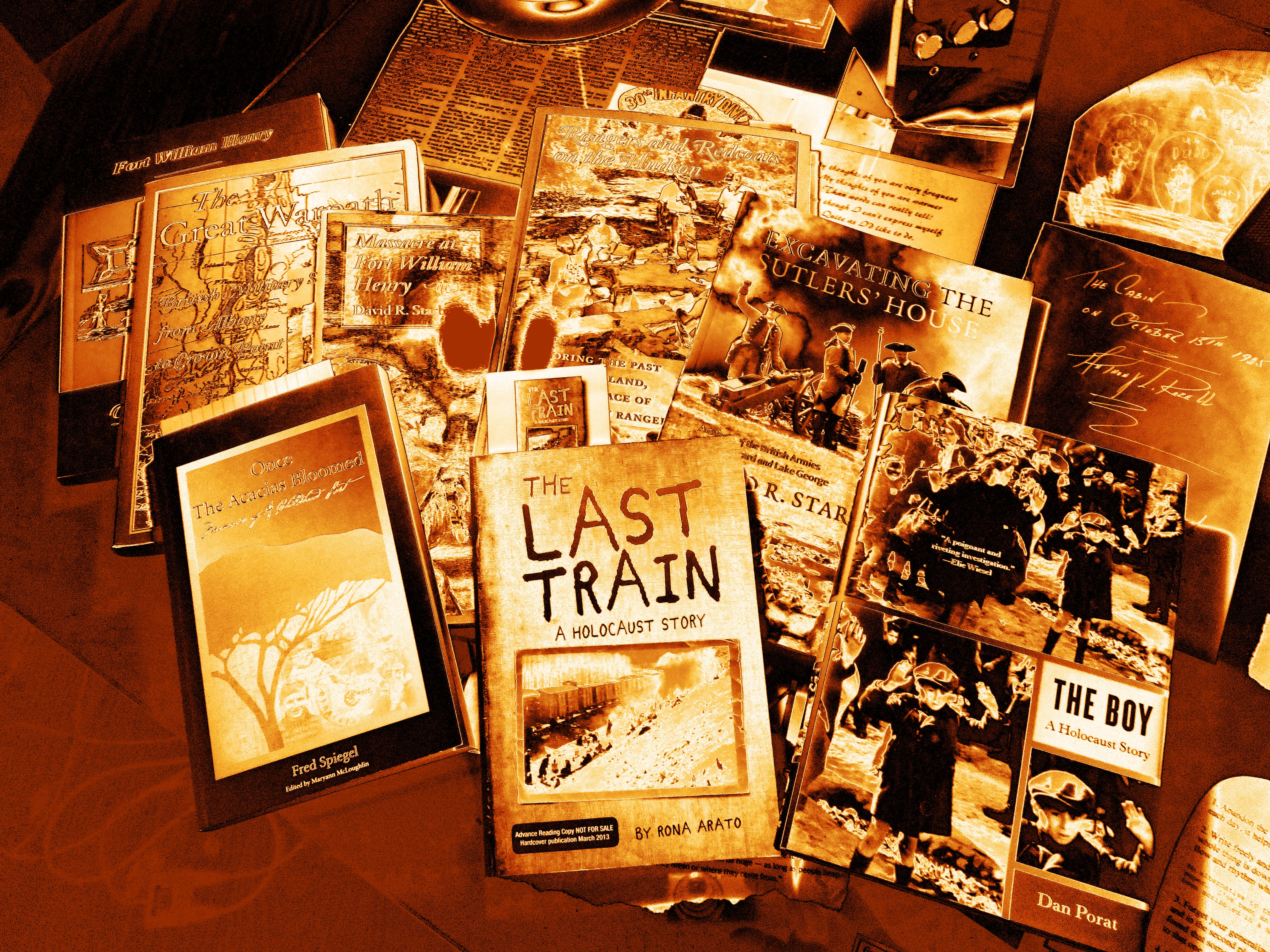
My son, brother, and I were up at our camp retreat in the Adirondacks, begun by our dad 36 years ago.  Just six miles away is one of the most famous forts in colonial America. After breakfast, for fun, we thought we might see if it was possible to re-visit the fort, having heard that a few things had changed since our last time there.

the books.

the books.

Sure enough, there was now a new entryway, complete with an admission booth. I pulled the truck up to it, and inquired whether we might proceed to the bookstore, which had always stocked a fair amount of titles, where one could peruse the stock, before deciding whether today would be the day to pay the full admission to check on any updates in the exhibits inside.

Not today. Not anymore. No  money up front, no visit to the bookstore.

Having served on an authentic historical site as a board member, I understand the desperate need to raise funds, but I did not have the $52.50 in my pocket that morning. We had not planned to spend the entire day there.

As the nice woman shrugged and turned us away, my brother said, “you should have told them who you are”.

Ha. He was having fun with me, and joking, of course. But it kind of brought forth  a sense of wonderment about my experiences this summer the authentic historical sites I visited all over the world.

I thought some about it. The bookstore that I had wanted to visit this morning stocked titles that featured my work as a history teacher and avocational archaeologist. I’m actually written about in some of the books.

I remembered I had a similar experience at our first major stop on the Holocaust Resistance  tour in Europe a few weeks back. As twenty five educators toured the site, all of my colleagues chose to give up part of their lunch hour for a private introduction by a key staff member who took the time to explain my role in helping that museum/memorial site create a special exhibition on the evacuation transports that left that concentration camp in April 1945.  As we boarded the bus at the end of the day, someone opened the Bergen Belsen official guidebook they had purchased in the bookstore (which in my excitement I had overlooked)- and there was the Benjamin photo, and summary of my work.

Later in the tour at another authentic site, concentration camp Ravensbruck in Germany, after an intense day I spied a different title and pulled it off the shelf, and showed it to another colleague. It’s the story of a survivor that I know, and this book probably would not have been written had it not been for the efforts that I had made in my teaching career.

The following week in Poland, the same thing happened to me with another title. I was able to open the book and point to my name in the credits and acknowledgments, and show where my work made a significant impact for the author and his thesis.
Pretentious bragging? I really, really hope not.   In fact I wrote this post weeks ago, not at all anxious to share, but as I process what has happened this summer, I figure stunned realization is more like it .

To visit authentic historical sites, some halfway around the world where I have never been before, and see the impact of this passion on others, is something both profound and humbling. I feel it has been transformative at some base level, yet I have not even completed my own book yet (it just keeps changing in my head- and believe me, it is up there). So it goes up to be added to the archive of happenings that occasionally knock me on the head.

In the end, getting turned away from the bookstore didn’t matter at all, except maybe to kindle a flame… though it is always a thrill to hold the book in your hands, and thumb to the page with your name on it.

Read Full Post »

Matthew Rozell rediscovers and rekindles interest in sutler site, 1996.

Matthew Rozell rediscovers and rekindles interest in sutler site, 1996.

Today I am going to get a special phone call from an archaeologist whom I have known and worked for for thirty years. David wants me to be present for the removal of three intact 18th century olive green glass spirits bottles from a French and Indian War sutling house, or trading post, just outside of the British fort on the banks of the Hudson River near Rogers Island. Two intact bayonets were discovered here earlier in the week, but more exciting for us is the fact that we now think that we have found the elusive 4th wall of this building, which burned to the ground a few years into its existence. We have been searching for it for twelve summers.

Excavations began here in 2001, with me and digger Johnny Kosek and Mark Van Valkenburg. I had stumbled upon it during a pensive walk in the woods near our fort excavations in the summer of 1996. I had found a looters’ hole in the ground, spadefuls of earth littered with fragments of the very same bottle glass fragments from the period. On the ground I spied what looked like a shiny silver dime partially covered by the sand. A heavy rain had uncovered what the looters had wanted- a Spanish silver coin from 1748. Remember Hawkeye of the Last of the Mohicans? He would have drawn a dram or two here.

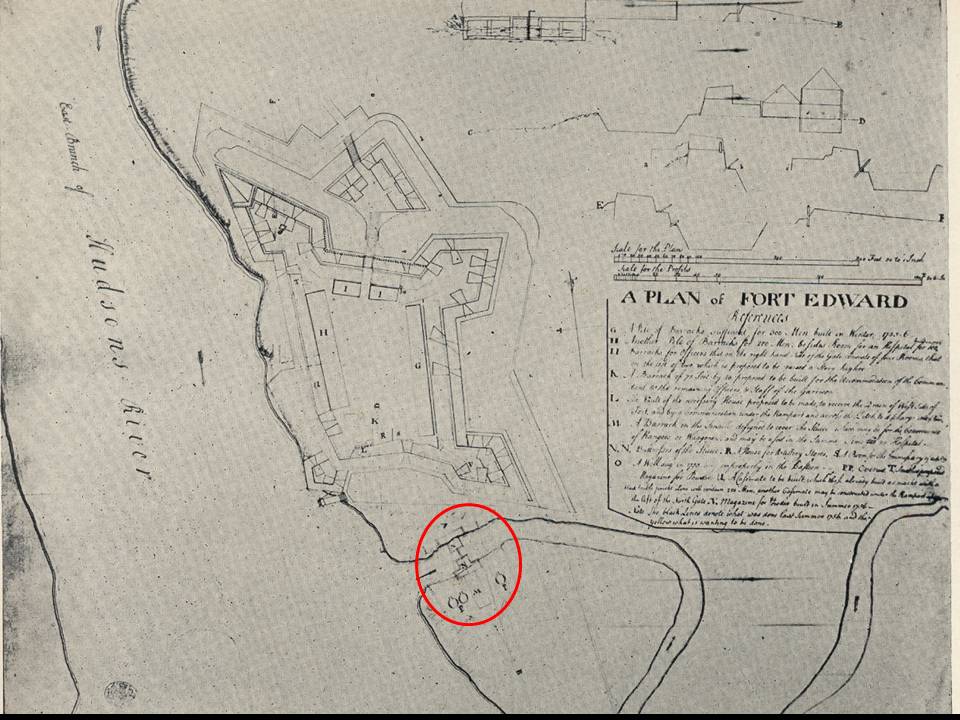
Period map showing location of sutler's complex. Island just to west of river.

Period map showing location of sutler’s complex. Island just to west of river.

My association with this important ground, so fundamental to the formation of our nation, began in 7th or 8th grade. Four of us would ride our banana seat bikes down to Rogers Island one summer in the early 1970s, sneaking smokes, getting away from our parents and siblings, and just dig holes in the ground with our moms’ gardening tools. I recall digging a hole as deep as my arm would allow, a tunnel straight down, a criminal activity in the eyes of any competent archeologist. Thankfully, we never found anything.

A dozen years later, in 1986, I would return as a volunteer crew member on an archaeological dig searching for General Gates’ American headquarters at the Saratoga National Battlefield Park. Here I would encounter David for the first time. I remember him asking me, after my first two weeks as a newbie, if I would ever consider going into anthropology/archaeology as a career. I think I was flattered, but I had just wrapped up my undergraduate work and was sending resumes out for teaching.

I followed him though, in 1991, to return to this Island. I had gotten hired at my high school alma mater 3 miles up the river and now had the opportunity to professionally learn what secrets the Island held. In 1992, David felt confident enough in my abilities to give me the reigns of the search for the elusive smallpox hospital at the southern end of the Island. We found it after three years of digging in the summer of 1994. 800 people died here. It was the only smallpox hospital from this era ever discovered in North America. I began to write.

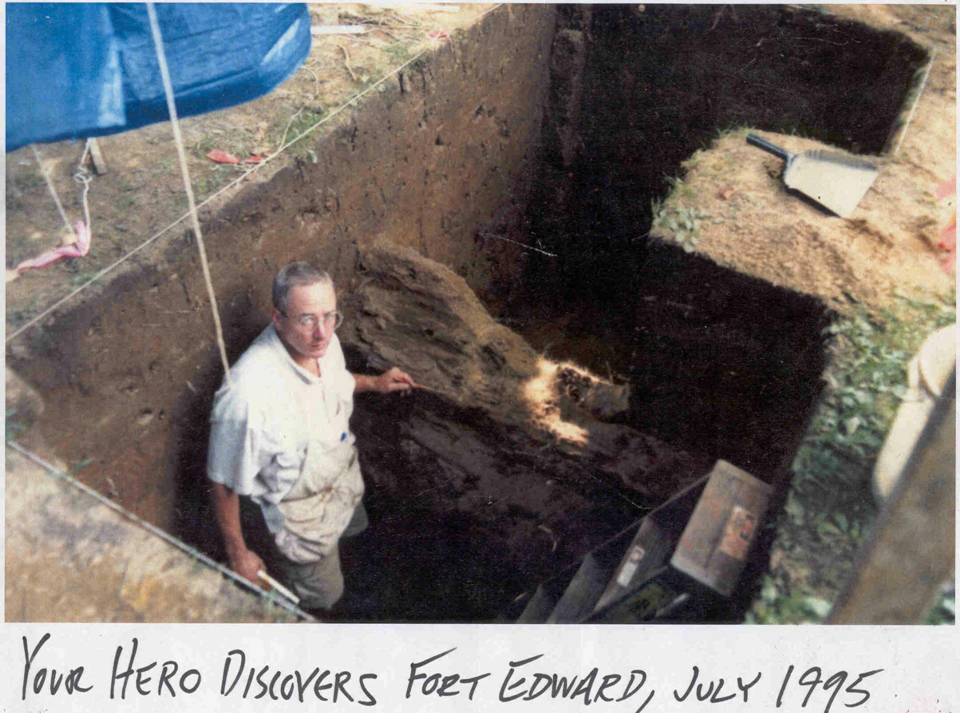
hero discovers ft edIn 1995 and 1996 we professionally dug at the site of Fort Edward, no easy feat considering that today twelve houses are built upon it. At one point we were excavating a bastion (corner) in the basement of a house! We opened up a pit in a front lawn, properly protected and barricaded, but the paper boy still managed to stumble into it. I found the West Curtain wall with Johns F and K, Mark, Brad and Susan and Hans. And one hot summer day took a stroll down the riverbank to stumble upon the sutlers house.

From 1997 to 2000 I worked at the parade ground of Fort William Henry, the one where the final siege takes place in Coopers Last of the Mohicans. We found the charred remains of the East and West barracks, the exact footprint of the original fort.

In 2001 we returned to the sutlers’ complex just south of Fort Edward. I directed the digs here for many many summers,

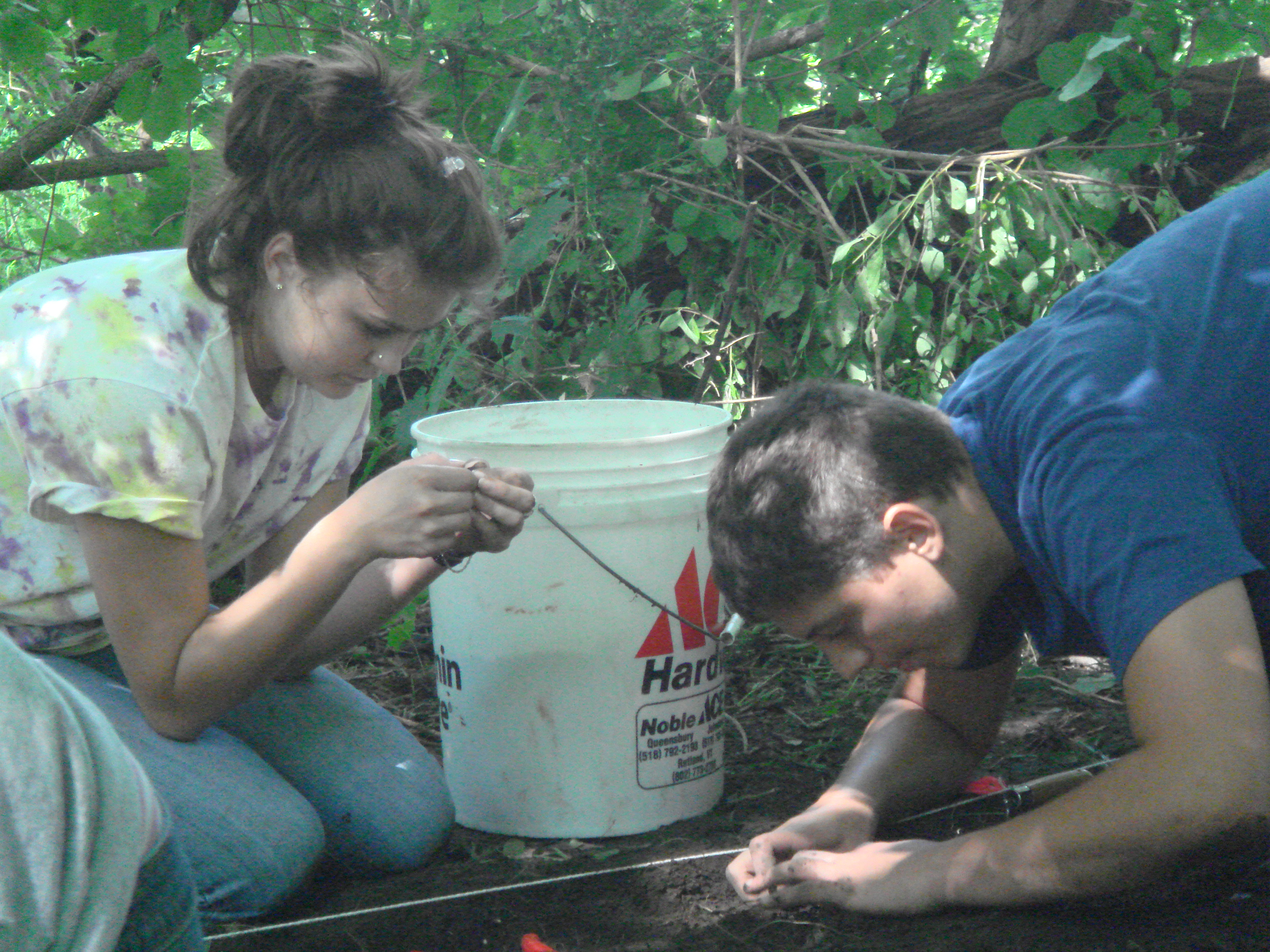
Our high school kids learning how to think, placing the artifacts at hand in the context of a major world war that was partially fought in their own backyard.

Our high school kids learning how to think, placing the artifacts at hand in the context of a major world war that was partially fought in their own backyard.

and later returned with high school students to teach them how to professionally draft a research question, study primary source maps, diaries and other documents, and begin to look for clues, and only then to dig properly, mapping all  the artifacts and features as they emerge. They learned how to dig, yes, but more, they learned how to think.

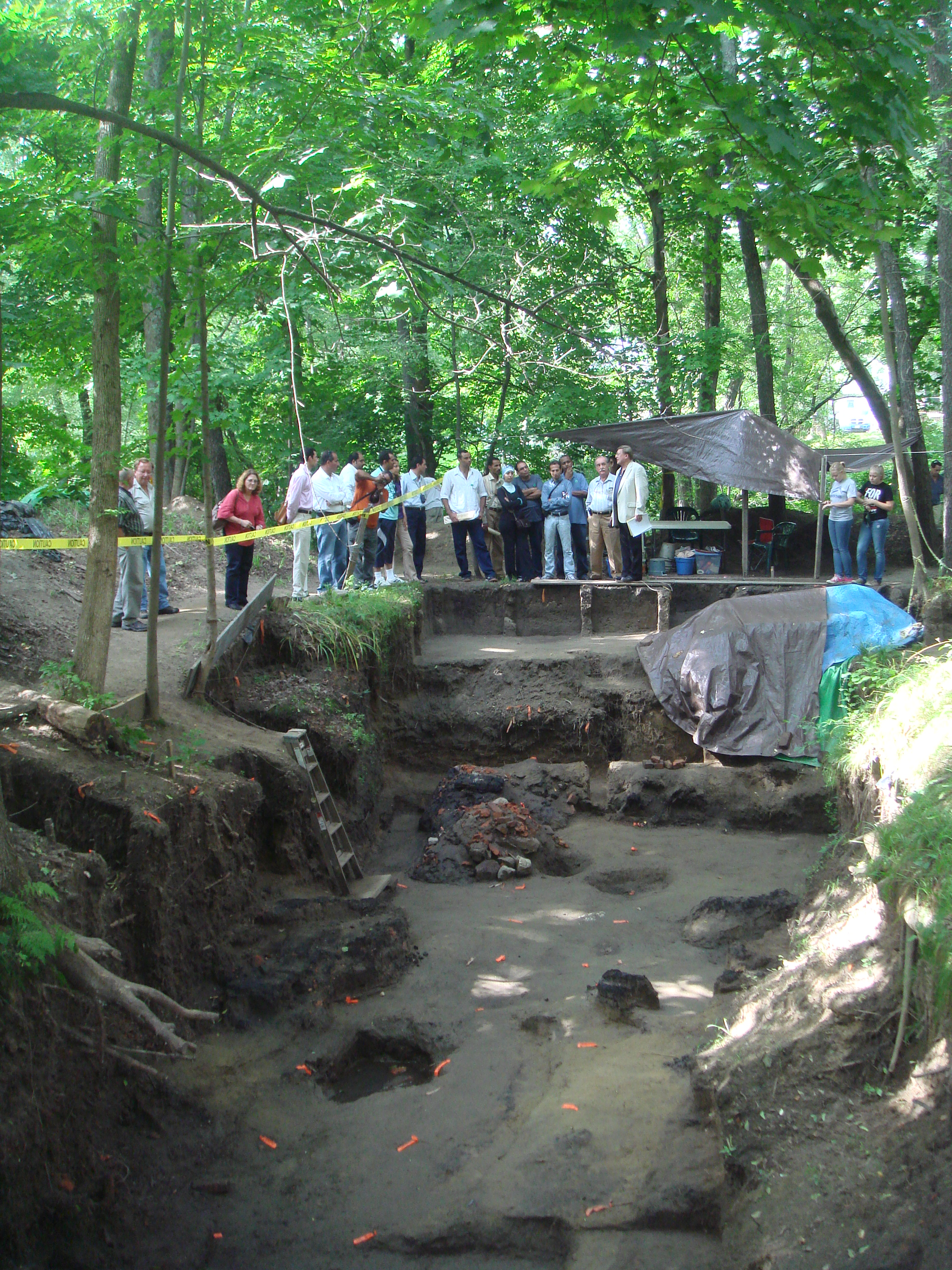
Egyptian Archaeologists visit the sutlers site, 2009. My baby. They were impressed. Proud daddy.

Egyptian Archaeologists visit the sutlers site, 2009. My baby. They were impressed.

Lots of times when everyone would leave I would just sit at the sit alone  for an hour or so. Just sit in the stillness and wonderment of this place. Just something I have always felt a need to do. It’s like the place has some kind of power over me. It’s my baby. When we are digging, we are touching objects that have been lost for over two hundred sixty years. I am the first to touch this bayonet, this coin, this tobacco pipe, this bottle since it was last handled. Thus the anticipation of touching these three intact, upright bottles.

My house building activities have kept the project at arm’s length, but the excitement is still there and rekindled. If you want to learn more, there are several books out by David Starbuck. I’m in this one quite a bit. After today, I joked to him yesterday, he may have to update it.

POSTSCRIPT: I was given the honor of extracting the three bottles. We also found three additional ones behind them. The Egyptian archaeologists would have been proud- my personal King Tut’s tomb moment. The bottles were all complete, two thirds of them totally intact.

The Bottles. Unbroken. Filled? King Tut's tomb moment. "The tension mounts..."

The Bottles. Unbroken. Filled? King Tut’s tomb moment. “The tension mounts…”

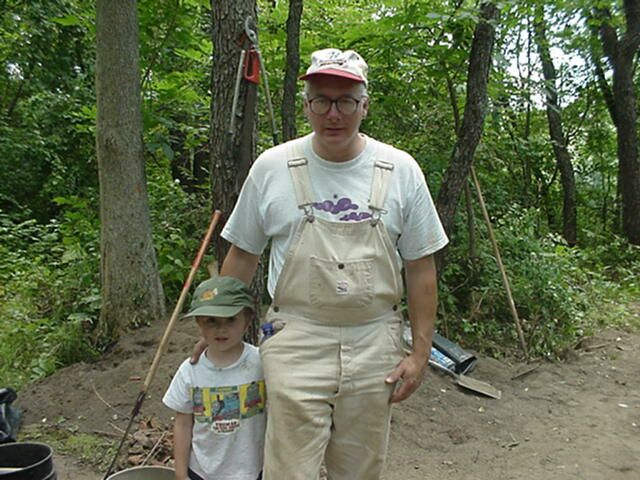
My son Ned and I, 2002, the sutler's site, Fort Edward.

My son Ned and I, 2002, the sutler’s site, Fort Edward.

Son Ned and I at the sutler's site. Thursday morning, August 8, 2013

Son Ned and I at the sutler’s site. Thursday morning, August 8, 2013

.

Read Full Post »

World War II infantry veteran Carrol Walsh, top, hugs Holocaust survivor Paul Arato at a reunion in Queensbury, N.Y., on Tuesday, Sept. 22, 2009. Walsh’s unit liberated a Nazi train carrying 2,500 Jewish prisoners, including Arato, from the Bergen-Belsen concentration camp in Germany during the war’s waning days. (AP Photo/Tim Roske)

I am reposting this today to honor both of the men below. Paul Arato passed away this week in Toronto, Canada and his memorial service is today. Carrol Walsh, his liberator, died in Dec. at his home in Florida and his memorial service was last Friday in New York.

Paul and Rona would also check in annually for dinner with the Walsh family when they passed through our town. The last time I saw both of them together was in 2011 at one of these dinners in a local restaurant. They sat together and laughed and joked like old pals. Paul told the story of how he arrived in Detroit after the war as an eager late teen anxious to find work designing fast cars in the automobile industry and was driven to the bridge in Canada by law enforcement and pointed to the bridge to Canada, as he did not have the proper documentation. Picturing the scene in his mind, Carrol would laughed outloud and slapped his knee. Both men were so happy to have found each other.

Rest on, friends.

Holocaust Survivors Reunite With US Veterans

NY high school reunites Holocaust survivors liberated from Nazi death train by US soldiers

By CHRIS CAROLA

The Associated Press

HUDSON FALLS, N.Y.

The Holocaust survivor was 6 on that spring day in 1945 when he last saw the U.S. Army soldiers outside Magdeburg, Germany.

Paul Arato was among 2,500 starving and sickly Jewish prisoners from the Bergen-Belsen concentration camp, their train abandoned by its crew and Nazi guards as Allied forces advanced. Two U.S. Army tanks on a scouting patrol — one of them commanded by Carrol Walsh, then 24 — came upon the stopped boxcars.

Arato, now 71, and Walsh, 88, met again this week.

“Please give me a hug. You saved my life,” Arato told Walsh in an emotional reunion of concentration camp survivors and some of the veterans of the 30th Infantry Division who liberated them.

Arato, an industrial designer from Toronto, and Walsh, a retired state Supreme Court judge from Hudson Falls, came together for a Hudson Falls High School history symposium inspired by history teacher Matthew Rozell’s original World War II project in 2007.

“You were all kids on that train,” Walsh told the survivors, most of them in their early 70s, as they and their families greeted the veteran. “I was an old man. I was 24 years old!”

Those arriving early for Wednesday’s opening session gathered Tuesday night for an impromptu reunion before having dinner surrounded by the faux Adirondack decor of the nearly deserted indoor water park. Four of the five Nazi train survivors at the dinner had never met Walsh.

Walsh’s tank patrol discovered the desperate Bergen-Belsen survivors on April 13 — hundreds of emaciated Jewish prisoners who had been herded aboard one of three trains leaving the camp a week earlier to keep them from being liberated by advancing Allied forces.

Walsh’s patrol stayed for a time, handing out candy to some of the children, then moved on after reporting their discovery. Frank Towers, a 27-year-old first lieutenant in the 30th Division, led a convoy that took the newly liberated prisoners to a German town where they were given food and shelter.

For weeks, the men of the 30th had heard of Nazi atrocities against Jews and dismissed the stories as propaganda, Towers said. That all changed when they encountered the train.

“Then we believed,” said Towers, 93, of Brooker, Fla.

This week’s reunion is the fourth since 2007, when Walsh was joined by three of the train survivors at Hudson Falls High. History teacher Rozell’s World War II project included an Internet posting of Walsh’s account of the train liberation.

An Associated Press report of that first reunion prompted more survivors to come forward, some from as far away as Israel, Rozell said. In all, he has confirmed that more than 60 survivors are still living and has been in contact with about two dozen of them.

Nine survivors of the Nazi death train are participating in this symposium, along with Walsh, Towers and four other veterans of the 30th who fought in Germany. Rozell said this week’s gathering is likely to be the last such event of its scope, given the advanced ages of the veterans and survivors.

For Arato, Tuesday night’s reunion with Walsh brought back a flood of memories. He recalled getting candy from one of the soldiers and a handgun to play with.

“I remember it was a Tootsie Roll,” he said. “The gun wasn’t loaded.”

Arato fretted over one detail. He recalled seeing a Jeep along with the American tanks, but fellow survivor Fred Spiegel of Howell, N.J., didn’t remember seeing a third vehicle. Later, Walsh said his patrol consisted of two tanks — and a Jeep.

“There WAS a Jeep,” Arato said, a smile breaking out on his face. “I remembered it right.”

———

On the Net:

Hudson Falls High School World War II Living History Project: http://www.hfcsd.org/ww2

http://www.huffingtonpost.com/wires/2009/09/23/holocaust-survivors-reuni_0_ws_296673.html

http://www.ynetnews.com/articles/0,7340,L-3781062,00.html

Read Full Post »

This is from last evening’s PBS NewsHour. Book is on my summer reading list. April 1945 a focus of my studies.

‘Bad to the Very End’: Author Reflects on the Long, Deadly Road to WWII Victory

In honor of the 69th anniversary of D-Day, Ray Suarez talks to historian Rick Atkinson about his new book, “The Guns at Last Light,” which chronicles the brutal fight for victory at the end of World War II.

JEFFREY BROWN: Finally tonight, we mark June 6, D-Day.

Ray is back with book conversation he recorded recently about World War II.

RAY SUAREZ: The war that had a hand in cementing U.S. status as a superpower and created the map of the modern world ended almost 70 years ago.

You could fill a library with books about the Second World War, yet historians still find new things to say and new ways to say it.

Award-winning author and historian Rick Atkinson has just completed the third book in his “Liberation Trilogy,” “The Guns at Last Light: The War in Western Europe, 1944-1945.” And he joins me now.

And, Rick, if nothing else, this book is a reminder that, with D-Day, there was still some of the worst fighting of the war left to go.

RICK ATKINSON, author, “The Guns at Last Light”: That’s certainly true, Ray.

I think the horror of it is difficult to imagine 70 years later. And it continues really after D-Day, almost to the last gunshot. There were almost 11,000 Americans killed in Germany in April 1945, the last full month of the war in Europe. And that’s nearly as many as died in June 1944, the month of invasion.

So the bloodletting continued right to the end. The notion that many Americans have that it was bad on the beaches, and then something bad happened during the Battle of the Bulge in December 1944, and then it was kind of sweeping into Germany and the war was essentially over is actually quite incorrect. It was bad to the very end, almost to May 8, 1945, when the war in Europe ended.

RAY SUAREZ: Terrible, ferocious, deadly fighting through Northern France, through Holland and Belgium, and finally into the German homeland.

Then you bring us to one British officer who says, “Why don’t the silly bastards give up?”

What was the German calculation in those last months, when it was clear they could no longer militarily prevail?

RICK ATKINSON: Well, there are several things at play.

Part of it is terror. Hitler had a police state of the first order. And those who showed any sign of being weak-kneed faced prison or often summary execution. That prevented a lot of people who knew that the war was not going to turn out well for Germany from giving up.

In other cases, you have to say that 80 million Germans tended in large measure to be true believers, that they believed in the fuhrer almost to the bitter end. You would see parades, for example, on Hitler’s birthday, April 20, 1945, in Berlin — this is 10 days before he kills himself — of young girls, young boys who are too young to go into the military carrying flags and singing patriotic songs, people cheering along the streets of a badly battered Berlin at that point.

So, the German psyche was such that they’d been heavily influenced by propaganda. And they were just generally disinclined to give up.

RAY SUAREZ: Rick, you also remind us that the war got deadlier as it went on, because both sides were innovating, inventing new ways of killing the other side practically until the last day of the war.

RICK ATKINSON: That’s true, Ray. The lethality increases as the war goes along, and it — it’s extraordinary how brutal it is.

We Americans, for example, invented something called the POZIT Fuse. That was the code name. There was a little radar sensor in the nose of an artillery shell, and it could, by emanating radar signals, determine when a passing plane or when an approaching target was just within the kill radius of the burst, and detonate that shell.

It was used for the first time in the Battle of the Bulge in December 1944. The Germans called it pure manslaughter. It was part and parcel of a generation of weapons that came along, napalm used for the first time around this time. The Germans had invented the V-1 and V-2 flying bombs and then a ballistic missile, the V-2, with terrifying results, most of them launched against London or Antwerp with devastating results to civilians.

RAY SUAREZ: We have in the final weeks and months of the war some moments where it’s hard to tell where moral authority existed, if such a thing any longer existed.

How could you tell concentration camp inmates not to rise up and kill their captors who were trying to surrender and act like normal soldiers? How could you put trial Americans who, sickened by the slaughter, would just turn and around pop these guys with their sidearms as they tried to surrender? It got nasty, brutal, and frightening in those final weeks.

RICK ATKINSON: This is true.

And it’s not just the final weeks, actually. There’s killing of prisoners that begins early in the liberation of Europe by American, British, Canadian soldiers, and, of course, by the Germans. It intensifies during that last 11 months from Normandy on.

But when you get to the camp liberation phase, particularly in April 1945, for example, at Dachau, American soldiers coming into this camp, tens of thousands of emaciated, horribly treated prisoners, and thousands of bodies lying around, and there were soldiers that went on a rampage. There were at least a couple dozen S.S. guards who had surrendered, had been taken into custody who were murdered, probably more than that.

This is at the same time that there are liberated inmates rampaging, tearing literally some camp guards limb from limb. There was an investigation. The investigators found that, yes, there had been prisoners murdered by American soldiers. Nothing was ever done of it. No one really had the stomach to prosecute American soldiers under these circumstances.

This is just one example of many, though, of the barbarity that war unleashes with — inside otherwise good soldiers.

RAY SUAREZ: I want to continue this conversation with you online.

The book is “The Guns at Last Light.”

Rick Atkinson, thanks a lot.

RICK ATKINSON: Thank you, Ray.

http://www.pbs.org/newshour/bb/military/jan-june13/atkinson_06-06.html


Read Full Post »

American Cemetery overlooking Omaha Beach, the primary landing zone for Americans during the D-Day invasion June 6, 1944. (U.S. Air Force Photo)Today one of my former students emailed me to visit saying that she had a surprise for me. She brought me a present- sand from the beach at Omaha in Normandy.

This was originally posted four Junes ago, I re-post here now.

I came into school today, on a Saturday, to start packing up my room for a move to another room.

But it is the 6th of June.

Instead I am getting nothing done, mesmerized by the scenes, live from Normandy, of the 65th anniversary celebration.

The President is there and so are 250 American veterans of the battle for Normandy,  including one of my good  friends, Buster Simmons, of the 30th Infantry Division. The Greatest Generations Foundation sponsored his visit with 9 other vets and college kids. Now I’m looking for him in the sea of faces.

My son Ned and I watched him last night as a “Person of the Week” on ABC World News in a story I contributed to. If you view the clip, you can see the photograph I provided ABC with, taken by Major Clarence Benjamin, of the liberation of the train. This is the photo that Buster uses when he speaks to high school classes to tell this story.

I am hopeful that we can get Buster to come to our high school for the  liberator-survivor reunion in September.

It was twenty five years ago, on this anniversary, that I wrote an essay in the local newspaper expressing my appreciation for the veterans of World War II. And as I begin to sort through and pack up 20+ years of memories in this room, three things are becoming clear: 1) my love for these men and women and what they did only increases as time passes; 2) the rest of my career will be focused on the promotion of narrative history in the classroom, linking students, veterans and survivors together; and 3) I won’t be getting any packing done this day.

Take a minute to watch Buster in the clip and take his optimism about the future of our nation to heart. Especially if -“you’re an American.”

Read Full Post »

My boys. Thanks to my friend Chris Carola at the AP and Senator Little’s office for recognizing them while they were still with us.

2 NY vets of Edson’s Raiders recall WWII battles

By CHRIS CAROLA

— May. 26 3:38 PM EDT

In this Wednesday, May 22, 2013 photo, World War II veterans Bob Addison, left, and Jerry West pose for a photo, in Glens Falls, N.Y. Addison and West share more than a longtime friendship. They share some of the same memories of bloody battles fought on Pacific islands while serving with an elite Marine Corps unit that was the forerunnner of today's U.S. Special Forces. Living just miles apart, the two men are among the last surviving members of the original Marine Raider battalions that were the first American ground troops to attack Japanese-held territory. (AP Photo/Mike Groll)

In this Wednesday, May 22, 2013 photo, World War II veterans Bob Addison, left, and Jerry West pose for a photo, in Glens Falls, N.Y. Addison and West share more than a longtime friendship. They share some of the same memories of bloody battles fought on Pacific islands while serving with an elite Marine Corps unit that was the forerunnner of today’s U.S. Special Forces. Living just miles apart, the two men are among the last surviving members of the original Marine Raider battalions that were the first American ground troops to attack Japanese-held territory. (AP Photo/Mike Groll)

Gerald West held the laminated sheet of paper fellow World War II combat veteran Robert Addison pulled from an old briefcase and perused the 300-plus names listed under the words, “Lest We Forget.”

“I knew quite a few of those guys,” said West, 93, who made the short drive to Addison’s home 45 miles north of Albany recently to reminisce about their wartime service with the legendary Edson’s Raiders, an elite Marine Corps unit that was the forerunnner of today’s U.S. Special Forces.

The document Addison keeps among his wartime mementos and literature lists the names of members of the 1st Marine Raider Battalion who died while fighting the Japanese in the South Pacific. Addison and West are among the dwindling number of Edson’s Raiders still alive. Out of an original roster of about 900 men, fewer than 150 are believed to survive, according to Bruce Burlingham, historian for U.S. Marine Raider Association.

Dubbed Edson’s Raiders after their colorful, red-haired commander, Col. Merritt “Red Mike” Edson, the unit was the first U.S. ground force to attack Japan-held territory after Pearl Harbor. Landing on Tulagi in the Solomon Islands in August 1942, they beat the larger 1st Marine Division’s arrival on nearby Guadalcanal by an hour.

https://i0.wp.com/tsealey.net/thegunny/gfx/raiders.jpgThe 1st and 2nd Raider battalions, formed just days apart in February 1942, were the first commando-style units in the American military, predating the creation of the U.S. Army Rangers by four months. Trained in jungle warfare and hand-to-hand combat, the Raiders’ leatherneck pride paired with a pirate’s attitude was reflected in their distinctive battalion patch: a white death’s head skull in a red diamond, set against a blue background with five white stars representing the Southern Cross constellation.
Addison, an Alliance, Ohio, native, and West, who grew up outside Glens Falls, both fought at Tulagi and later on Guadalcanal, where Edson’s Raiders earned their vaunted place in American military lore for anchoring the thinly stretched Marine defenses that decimated Japanese forces during successive nighttime assaults in September 1942.

Fighting from positions separated by a few hundred yards along high ground near the island’s airfield, Addison and West helped defend what became known as Bloody Ridge _ but that the Marines called “Edson’s Ridge.” They wouldn’t learn until much later that the fight was considered a turning point that started the U.S. on its island-hopping road to victory in the Pacific.

“In combat, you only know what’s going on in your little world,” West said.

Edson was awarded the Medal of Honor for his front-line leadership during the battle, during which his Raiders suffered more than 250 killed and wounded. Bigger, bloodier battles awaited, but Edson’s Ridge and the Raiders hold a special place among leathernecks of all generations, according to Beth Crumley, a historian with the U.S. Marine Corps History Division.

“Anybody who has taken an interest in the history of the corps, they’re going to know the story about Edson and they’re going to know about the Raiders and know about the Battle of Edson’s Ridge,” she said.

After the Raiders’ next campaign on the island of New Georgia in the summer of 1943, Addison and West were sent back to the U.S. Addison was attending college as part of an officers program, and West was in Guam preparing for the invasion of Japan when the war ended.

They went their separate ways and didn’t get reacquainted until the early 1960s, when Addison moved to Glens Falls to become athletic director at a new community college. He ran into West at a Sears store where West was working, and they’ve remained close friends ever since.

“They were America’s first elite force unit and showed future units like the U.S. Army Special Forces what could be done with a handful of determined, well-trained, well-armed troops against a determined enemy,” said Robert A. Buerlein, co-author of “Our Kind of War: Illustrated Saga of the U.S. Marine Raiders of World War II.

http://bigstory.ap.org/article/2-ny-vets-edsons-raiders-recall-wwii-battles

********************************************

Gerry West and Bob Addison, U.S. Marine “Edson’s Raiders” World War II veterans, honored in Albany

By Betty Little
Posted by Betty Little on Tuesday, May 21st, 2013
Gerry West and Bob Addison, World War II veterans who served in the same elite U.S. Marines unit and have remained lifelong friends, were inducted into the New York State Senate Veterans Hall of Fame at a ceremony in Albany today.

Gerry West and Bob Addison, World War II veterans who served in the same elite U.S. Marines unit and have remained lifelong friends, were inducted into the New York State Senate Veterans Hall of Fame at a ceremony in Albany today.

Senator Betty Little nominated Addison of Glens Falls and West of Fort Edward.

“These two soldiers were among the first Americans to engage the Japanese in combat less than a year after Pearl Harbor,” said Senator Little.  “They were specially selected and trained to serve in the First Marine Raider Battalion, called Edson’s Raiders, and fought in critical and victorious battles on Guadalcanal.

“After the war, they returned home, started families and careers, but never lost touch and remained lifelong friends.  They are among the few remaining Edson’s Raiders and their bond is unique.  It was a wonderful honor for me to have them here today, along with their family and friends, to share their story and see them receive this well-deserved recognition.”

West and Addison were suggested to Senator Little by Hudson Falls history teacher Matthew Rozell.  Rozell is in the process of writing a series of articles on World War II, based on class archives of interviews, for the Washington County Historical Society Journal.  The following are excerpts from a part of the series entitled “Recording the Voices of World War II – From Pearl Harbor to Tokyo Bay”:

On September 14th, 1942, first light at Guadalcanal revealed over a thousand Japanese dead on the ridge.  Outnumbered five to one, for two nights the Raiders held on against Japanese shelling by sea and Imperial troops, and the battle became legendary in Marine Corps history.

            West recalls: “Most of us just refer to it as Bloody Ridge.  We had 50% casualties that night…two men in our battalion received the Congressional Medal of Honor and there were thirteen Navy Crosses awarded to men in our battalion just for that one battle, which is unheard of.”

            Suppressed from the public at the time, more than 7,000 U.S. Marines, soldiers and sailors would die in the six month Guadalcanal campaign.  Japanese losses were much higher.

            Bob Addison: “They called it Hell Island, the Japanese, because they had to live out in the jungles…They had lost over 26,000 men.”

            Only a handful of the original Marine Raiders are left.  Addison and West survived to return home, marry, and raise children.  Seventy one years later, their friendship endures.

The New York State Veterans’ Hall of Fame was created to honor and recognize outstanding veterans from the Empire State who have distinguished themselves both in military and civilian life.  The Hall of Fame can be accessed online at www.nysenate.gov/honoring-our-veterans .

Read Full Post »

By OMAR RICARDO AQUIJE- Glens Falls Post Star

HUDSON FALLS —Fred Spiegel was asked if he felt resentment toward the Nazis.

“Yes, to the Nazis, but not the Germans,” Spiegel said.

The question came from a student at Hudson Falls High School, at which Spiegel was invited Friday to discuss his life during the Holocaust.

On April 13, 1945, a train traveled across Germany, carrying 2,500 Jews en route to a concentration camp.

Spiegel was among them. He was 13.

Holocaust survivor Fred Spiegel sells and autographs copies of his book, "Once the Acacias Bloomed," for students at Hudson Falls High School on Friday, May 24. Spiegel, who was liberated by U.S. troops as a young boy during World War II, spoke about his experiences and answered students' questions. (Jason McKibben -

Holocaust survivor Fred Spiegel sells and autographs copies of his book, “Once the Acacias Bloomed,” for students at Hudson Falls High School on Friday, May 24. Spiegel, who was liberated by U.S. troops as a young boy during World War II, spoke about his experiences and answered students’ questions. (Jason McKibben –

Spiegel, 81, visits schools to talk about how he survived. He brings copies of his book, “Once The Acacias Bloomed,” which explains his life as a Nazi prisoner.

Most of the schools he visits are in New Jersey, where he lives. The farthest he travels is Hudson Falls, a school he visited a few times in recent years, a school he included in his book because it was here an important moment in his life occurred.

“They invited me,” Spiegel said of his reason for returning to Hudson Falls. “How can I say no?”

During Friday’s presentation, Spiegel often said he was lucky to be alive.

Other trains carrying Jewish prisoners made it to their destination. His did not.

His train suddenly stopped near Magdeburg. Spiegel said the train’s engineer and Nazi soldiers fled for fear of capture. U.S. troops was cutting across Germany.

Then, a few U.S. soldiers on tanks found the train and freed the captives. The soldiers included Carroll Walsh, of the 743rd Tank Battalion.

Spiegel was later reunited with his family. It was 65 years later when the unexpected happened: He was invited to Hudson Falls to meet others who were prisoners on the train.

He also got to meet some of the liberators, including Walsh, who was living in Hudson Falls at the time.

Matt Rozell, a Hudson Falls history teacher, organized the reunion. He met Walsh in 2001. He interviewed the former soldier, and learned about the train near Magdeburg.

Walsh died in December. He was 91 and a former state judge.

Spiegel, a native of Germany, said people have shown more interest in the Holocaust over the years.

During Friday’s visit to Hudson Falls, he spoke to about 30 sophomores. Some of them had copies of Spiegel’s book. Others bought the book after the presentation.

Armand Ryther, a student, approached Spiegel to shake his hand.

“I find it very interesting that he could survive what he did,” Ryther said.

Ryther said he read Spiegel’s book.

Jamie Hughes, a fellow sophomore, said it was interesting to hear about Spiegel’s experiences.

“I think it’s really amazing that he would want to share his experiences with everybody,” she said.

Tara Sano, a Hudson Falls history teacher, said the event was planned near Memorial Day so students can reflect on the efforts of veterans.

“My hope is that when you are taking your three-day weekend, you think about why you have a three-day weekend,” she told students at the start of the presentation.

http://poststar.com/news/local/article_00a9219c-c648-11e2-ae69-001a4bcf887a.html

See Fred meet his liberator for the first time.

Read Full Post »

« Newer Posts - Older Posts »