Feeds:
Posts
Comments

Posts Tagged ‘Bergen Belsen’

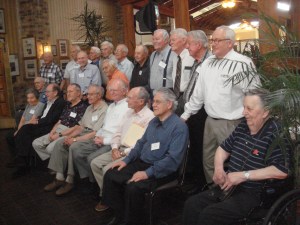
Liberators and Holocaust Survivors Reunited-World War II Living History ProjectSurvivors, (seated) 30th Infantry Division, Matthew Rozell. 3-27-09.

Survivors, (seated) 30th Infantry Division, Matthew Rozell. 3-27-09.

‘They were our angels’

Reunion sparks memories of Nazi prisoners’ train trip to freedom

By Schuyler Kropf, The Charleston Post and Courier

Saturday, March 28, 2009

They were teenaged G.I.s, happy that World War II was winding down and that they’d survived. But the story of what happened that April morning in 1945 still lingers.

It involved a train shuffling 2,500 Jews from one death camp to another as the Nazis tried to hide their crimes. But with American units approaching, the German guards had no choice but to strip off their uniforms and flee, abandoning their human cargo near a forest.

Luckily for 5-year-old Dutch Jew John Fransman, and the other riders of the liberation train, the U.S. Army showed up a few hours later. He remembers his mother’s body language changing when the soldiers came into view.

“It was transmitted that this was good, that we were being rescued,” said Fransman, now 64, of London.

For decades the tale of the liberation train was a forgotten chapter of World War II. But Friday in North Charleston, surviving members of the

Army’s 30th Infantry Division returned for a reunion that brought the story back.

Most of the U.S. troops who were there for the train rescue, near Magdeburg in northeastern Germany, have died. But seven of the train’s riders – who in 1945 were teens and children assigned to the Bergen-Belsen concentration camp – have come in from all over the world.

Hungarian-born Jews Stephen Barry, 84, and Robert Spitz, 79, both lived in Budapest before the war and were sent to Bergen-Belsen, later surviving the train ride. But they’d never met before Friday, with Spitz coming in from Raleigh, N.C., and Barry from Boca Raton, Fla. “Ten minutes ago,” Spitz said of their new friendship.

Much of the train story came to light only in the last few years, including after history teacher Matthew Rozell of Hudson Falls, N.Y., got his students involved in World War II histories, sparking an Internet flurry of interest among survivors, soldiers and family members.

As the tale goes, the month of April 1945 was marked by a general collapse in Germany. The Nazis began shuffling prisoners around in movements that seemingly had no clear destinations. But on the fifth or sixth day of travel for the Bergen-Belsen prisoners, all movement stopped, with the train parked alongside a wooded ravine and the German guards in distress. The emaciated prisoners, many sick with typhoid and infested by “10 million lice” Spitz said, stood by waiting for something to happen.

Barry remembers German SS troops on horseback trying to push everyone out of the cars, movements that were physically impossible for some. The troops finally gave up and rode off, only to return an hour later – a signal Barry took to mean they were surrounded. Hours later, units of the American 30th Infantry began moving in.

“They were our angels,” said Ariela Rojek, 75, a train rider who emigrated to Canada after the war. She remembers the strange looks on the faces of war-hardened G.I.s who weren’t used to seeing atrocities against civilians. “They weren’t prepared,” she said.

One American who remembers the refugees was Frank Towers, a 26-year-old Army lieutenant whose job included rounding up dozens of trucks and finding beds for the survivors in nearby villages.

Until then, he didn’t fully appreciate the anti-German soldier propaganda he’d seen. “The German people weren’t these kinds of monsters,” he’d thought before finding the train riders.

For the survivors, rescue marked the start of a long road of recovery, searching for relatives and starting new lives. But Barry still remembers one moment after his rescue when he sat by a campfire wearing a German SS soldier’s coat that he’d found to keep warm. An American G.I. came up to him, pulled out a pocket knife and cut the SS emblems off the jacket, dropping them in the fire.

“He didn’t say a word, but he didn’t have to,” Barry recalled, as the reality of his new life of freedom set in.
Copyright © 1995 – 2009 Evening Post Publishing Co.

NOTE: This newspaper did a fine article and has some video which you may be able to view here.

LINK TO ASSOCIATED PRESS ARTICLE/PHOTOGRAPHS

LINK TO LOCAL NEWS VIDEO/STORY

Read Full Post »

By Blanca Gonzalez
STAFF WRITER

San Diego Tribune

February 18, 2009

George C. Gross was known locally as a scholar who inspired high school and college students to care about Chaucer, Keats and other academic pursuits.

Throughout the world, others knew him as a symbol of American liberators who played a role in the lives of Holocaust camp survivors.

Dr. Gross died of anemia Feb. 1 at his home in Spring Valley. He was 86.

More than half a century after World War II ended, Dr. Gross was asked to tell his story to Matthew Rozell, a Hudson Falls, N.Y., high school teacher who coordinates a World War II living history project and Web site. Rozell had heard about Dr. Gross from another veteran involved in the project.

In a narrative posted on the project Web site, Dr. Gross told of being among the first U.S. servicemen to come across about 2,500 people the Nazis had stuffed into a string of boxcars.

It was April 1945 and World War II was coming to an end in Europe. Dr. Gross was a sergeant commanding a light tank moving toward Magdeburg, Germany, as part of a tank battalion in the 30th Infantry Division of the U.S. Army. The battalion had just finished a grueling three weeks of fighting across Germany when it came across some emaciated Finnish soldiers who had escaped from a nearby train full of starving prisoners.

Dr. Gross and fellow sergeant Carrol Walsh accompanied the battalion major to a small train station where they discovered a mass of people, some sitting or lying outside the train and others still in the boxcars. It is believed their German guards ran away as the U.S. tanks rumbled in.

The train contained Jewish prisoners who had been taken from Bergen-Belsen and forced into the cramped boxcars. Dr. Gross, Walsh and the major greeted survivors and took pictures of them, capturing their surprise and joy.

“I was assigned to stay overnight with the train,” Dr. Gross wrote years later, “to let any stray German soldiers know that it was part of the free world and not to be bothered again. I was honored to shake the hands of the large numbers (of survivors) who spontaneously lined up to introduce themselves and greet me in a ritual that seemed to satisfy their need to declare their return to honored membership in the free society of humanity.

“The heroism that day was all with the prisoners on the train,” Dr. Gross wrote. “What stamina and regenerative spirit those brave people showed. I have one picture of several girls, specter-thin, hollow-cheeked, with enormous eyes that had seen much evil and terror, and yet with smiles to break one’s heart.”

His pictures were posted on the history Web site and sparked reunions and phone calls between survivors from around the world and between Dr. Gross and Walsh, a retired judge living in Hudson Falls.

Rozell said Dr. Gross was a very humble and gracious person. “He came from a generation that didn’t really trumpet their accomplishments,” he said.

Local friends and colleagues lauded Dr. Gross as a gentleman and a scholar who was fascinated by the language of Keats and Chaucer and enjoyed sharing that love with students.

Larry Durbin, a Grossmont High School graduate who became a close friend, said the class of 1958 made Dr. Gross an honorary classmate. “He was a pretty special guy. Chaucer’s English was very difficult to read and hard to listen to … but there he was, probably 36 or 37 years old, standing up in front of a class of 17-and 18-year-olds and getting them to be enthralled with Chaucer. At nearly every (class) reunion someone will start reciting ‘The Knight’s Tale’ (from Geoffrey Chaucer’s “The Canterbury Tales”) we learned in his class,” Durbin said.

“He was a sensitive, caring, warm guy and everybody liked him.”

Dr. Gross, who had boxed in the Army, served as adviser of the high school’s boxing club.

After teaching at Grossmont for about 10 years, Dr. Gross joined the San Diego State faculty in 1961. He was associate dean for faculty and dean of faculty affairs from 1970 to 1981 before returning to the classroom. He retired in 1985 but remained active on campus with the SDSU Honors Council.

Dr. Gross is remembered on campus as one of the great chairmen of the English and Comparative Literature department, said current Chairman Bill Nerricio. “Tales of his generosity and intellect still shadow the corridors of our department. His skills as a master teacher, gifted scholar and top-shelf administrator are a hard act to follow.”

George C. Gross was born May 14, 1922, in Wilmington to Ada Bachmann and Henry Gross. He graduated from Hoover High School and married his high school sweetheart, the former Marlo Mumma, in 1940. She died in 2006.

He earned his bachelor’s and master’s degrees in English literature from San Diego State and received his doctorate from the University of Southern California in the early 1960s.

Dr. Gross is survived by two sons, Tim of Lakeside and John of Spring Valley; a granddaughter; and two sisters, Hazel Lemmons of San Diego and Betty Desport of Texas.

A memorial service will be held at 10 a.m. March 7 at SDSU Aztec Center, Casa Real. Reservations can be made with Leslie Herrman at lherrman@mail.sdsu.edu or (619) 594-6337.

Donations may be made to the Campanile Foundation for the George C. Gross Memorial Fund benefiting the Department of English and Comparative Literature and Holocaust Studies, in the Department of History* or to the George Gross Memorial Scholarship at Grossmont High School.

*For those interested in donating a memorial gift, checks can be made out to The Campanile Foundation. Please note that donors should designate one of these options:

1) Designate the Department of English and Comparative Literature
2) Designate Holocaust Studies in the Department of History
3) Designate the “Memorial Fund” (60% English / 40% Holocaust Studies)

Checks can be mailed to:

SDSU, College of Arts & Letters
c/o Trina Hester
George C. Gross Memorial Fund
Arts and Letters, room 600
5500 Campanile Drive
San Diego, CA 92182-6060

You can also drop them off with staff in the Dean’s Development office, Arts and Letters 600. If someone wishes to use their credit card, please call Trina Hester at 619.594.1562.

Read Full Post »

30th-patchThe next Annual Reunion of the 30th Infantry Division Veterans of WWII will be held on 26 – 29 March 2009, in Charleston, SC, at the Ramada Inn Charleston, located at 7401 Northwoods Blvd. just off of the #526 Expressway, in No. Charleston.

Hotel Reservation can be made at any time by calling: 1-843-572-2200

Program 2009

Ramada Inn, Charleston

Charleston, SC

26 – 29 March 2009

Wednesday 25 March

Early Registration 1:00 P.M. – 5:00 P.M.

Lobby

Thursday 26 March

Registration 9:00 A.M. – ?

Beauregard Room

Lunch On Own

Hospitality 1:00 P.M. – 6:30 P.M. Beauregard Room

Reception 7:00 P.M. – 8:30 P.M.

Beauregard Room

Hospitality 8:30 P.M. – 11:00 P.M.

Friday 27 March

Breakfast 6:30 A.M. – 8:30 A.M.

At your leisure in Atrium Restaurant

Memorial Service 10:00 A.M. – 11:30 A.M.

Laure/Caroline Room

Lunch in Hotel 12:00 Noon – 1:30 P.M.

Holocaust Survivors Presentation (more details to follow)

2:00 P.M. – 5:00 P.M.

Laure Room

Hospitality 4:30 P.M. – 6:30 P.M.

Beauregard Room

Dinner 7:00 P.M. – 8:30 P.M.

Armand Room

Hospitality 8:45 P.M. – 11:00 P.M.

Beauregard Room

Saturday 28 March 2009

Breakfast 6:30 A.M. – 8:30 A.M.

At your leisure in Atrium Restaurant

Business Mtg. 10:00 A.M. – 12:00 Noon

Laure Room

Lunch in Hotel 12:00 Noon– 1:30 P.M.

Holocaust Survivors Presentation (more details to follow)

2:00 P.M. – 4:30 P.M

Laure Room

Hospitality 1:00 P.M. – 5:00 P.M.

Beauregard Room

Banquet 7:00 P.M. – 9:30 P.M.

Armand Room

Dinner

Speaker

Raffle

Sunday 29 March 2008

Departures FINIS!!

Breakfast 6:30 A.M. – 8:30 A.M.

At your leisure in Atrium Restaurant

Rates are $79.00 per room, and include Free Hot Buffet Breakfast for 2 persons.

Complimentary Airport Shuttle to & from Hotel.

Contact:

Carolyn Ware, Reunion Chairperson at: 1-843-899-7082 or cware@co.berkeley.sc.us

Or

Frank W. Towers, President at: 1-352-485-1173 or towersfw@windstream.net

Read Full Post »

Hello friends,

You may be aware that a new friend in the Netherlands recently acquired this unsigned narrative by a Polish survivor who was liberated on the train from Belsen by the Americans. The narrative was written in English shortly after liberation in 1945 (as you can see from the letterhead, on the German commandant’s stationary) at Hillersleben, Germany, where the Americans billeted them to recuperate. This past week we were gina-rappaport-9-21-2007able to help identify the author, Gina Rappaport by following leads in Israel.

The author’s family is very excited, and would like me to share the five page document with the people at the Museum and Bergen Belsen Memorial. The transcript was typed by one of my students.

Matthew Rozell

“I begin the story of my sad experiences in this terrible war as follows:

The First of December [September] 1939. The war broke out. It was a terrible day for all people of Poland. After several days of battle the first German troops occupied Cracow. It was a fatal moment in my life. I was eighteen years old.

Until this day I did not know the meaning of fear, I was never afraid. I was standing near the window in my own room and looking down, my face was pale and tears were flowing down on my cheeks. I felt that now is the beginning of a new, bad life.

Just the second day of the German occupation all buildings were covered with orders and instructions. Everything was forbidden, we did not know what to do. All Jews of Poland were obliged to give up their foreign money and gold. After several days all Jews were obliged to leave their nice lodgings and move in the ugliest rooms of the town. After two weeks took place registration from people to work from 16-60.

Every day the German soldiers took people from the street to clean the town. All Jews were obliged to wear signs. In December was a search of all Jewish dwellings. The SS men took gold, money, and silver. Every man and every woman were compelled to take off all their underclothing. They searched very exactly. In the meantime they took away the nice furniture and nice clothing. The all goods of Jewish (people) shops were taken away and carried to Germany.

Every day were new instructions. Beside this every day were searches affected in different houses. It was forbidden for Jews to have food cards, and we were forced to buy everything at the dearest prices. If somebody of the German soldiers observed the buying of food on the part of Jews, we were punished. It was the preface of our bad life. And so things went until the 15 of August.

On that day a great part of Jews were compelled to leave Cracow for several nearby little towns and villages. I and my family left Cracow for Tarnow. We arrived Tarnow at the 16 of August. The first day in a strange town was terrible. I was awfully sorry. New troubles, new German orders and dispositions. What could we do?

We were without dwelling, without hot food. At last we got a little room on the third floor in the [sic] attick. We had lost everything because my father was abroad. My mother was ill. I was forced to earn our daily bread. I worked 10 hours a day. I taught girls and boys languages and literature. I liked to do it.
My sister worked very hard too. She found work in a German factory. We suffered very much. The German took young boys to other towns and there they were forced to work of munition. They never returned home.

In the meantime they took all the intellectual people such as physicians, lawyers, ingenieurs (engineers) and sent them to Auschwitz and other concentration camps. Two weeks afterwards the families of these people received advice telling them about their fathers’, brothers’, and sisters’ deaths. Every day they took new people and sent away. Every day was a searching conducted in another house. We suffered and suffered without interruption.

We changed our dwellings. The winter approached. Now we had new sorrow. We had no wood, no coal. We were frozen the whole winter. We caught a cold very often.

1941

With the beginning of the year 1941 began the great tragedy of our nation. One day we heard a firing in the street. What happened? Nobody knew. Everyone was afraid to look through the window. After some hours i went down and the streets were full of blood. I went to search for my sister. Where is she? Perhaps dead. At last she returned home. I was happy she was alive. When she entered the room I couldn’t recognize her, she looked pale and full of fear. She couldn’t speak and did not want to describe what she had seen.

Every few days this story repeated itself.

On the 10 of June everybody from 12-60 was obliged to register at the working office. The German ordered that every one working with them should be allowed to remain at his place. The people were very irritated. The all streets were full of poor people hurrying to find work.

I was a teacher as i mentioned before. What could I do now? Where to look for work? What could I do with my mother and grandmother? They were not able to do anything. What i felt in this day was impossible to describe.

At last i found work in a factory. My luck was that my sister had found work, too, and we were able to help our family.

The night of the 10 of June. Nobody was sleeping in the whole town. The Jewish office registered the whole night under the control of the SS groups. They were obliged to make a list of people who were unable to work.

Five o’clock in the morning…. I was with my sister in the room. The mother and grand-mother were hidden in our [sic] attick. Suddenly we heard a knock at the door. At the doors were standing two SS men with revolvers in their hands.

The first asked “Why have you not answered at once?”
I couldn’t answer.
After a moment he asked “Where is your family?”
“Nobody is at home” I answered.
The SS man: “Where is your mother hidden? If you will not tell me at once I will shoot you.”
I repeated harshly “I don’t know.”
He got very angry and told me once more: “I will shoot you both at once.”
We had known their methods very well, and we were ready every minute.
He searched in our dwelling but he couldn’t find my mother. After several minutes they went away.

On this day perhaps 20 men visited our houses and every one of them wanted to take my mother but nobody could find her. On this day they killed in the streets 10,000 people and 15,000 were sent away to [sic] Belzec. From this village nobody returned.

This action lasted 8 days with two interruptions. During the free-time the grave diggers were obliged to bury the dead people.

Now the whole people were forced to move in one place, where they made a “ghetto”. After three months was a new action. In the meantime the SS men leaders killed everyday several persons. One of them couldn’t eat without shooting before. Before every meal he wanted to see blood.

On the 15 of September was a beginning of a new action. Every one of us received a sign on his work-card. There were two kinds of signs: 1) The first meant to live, 2) the second meant to die. I and my sister received signs to live. Our mother was hidden in a cellar.
On the 16 of September at 6 o’clock in the morning I was standing and waiting. I waited, for what? What could I expect? I was standing on a great square and the Nazi SS police started to make a selection of all old persons and children, putting them apart, whilst all young and valid persons were also put in a separate place.

Subsequently the children and old persons were shot before our eyes.

Now they took from the remaining young persons every tenth person standing in the turn and shot them too. I was lucky enough to be the eighth person and was thus saved from death from a pure [sic] coindidence.

I had no news from my mother whom I had left hidden in the cellar of my house. I was anxious lest my mother should be brought on the square and shot. We had to wait standing on the square until 7 o’clock in the evening without getting any food, closely guarded by Nazi barbarian soldiers. At 7 o’clock in the evening they brought in mothers having small babies and shot all the babies in the presence of their mothers. At 9 o’clock in the evening they allowed us to go home, where I had a great joy to find my family alive. It was a miracle.

After these scenes had taken place all Jews had to leave their homes and go to new lodgings in the ghetto, where they had to be all concentrated. A barbed wire had to be put around the ghetto and no Jew was allowed to come out of this place. So our martyrdom continued: every day being sadder than the foregoing.

After two months of this ghetto life a new action took place, as a result of which 13 thousand people were murdered and 2 thousand people remained on in the ghetto. It was a miracle that the members of my family remained alive. After this took place, the German declared that no Jew would be allowed to remain alive, and I then decided to take up Aryan papers. One day in November I left my family with the purpose of finding work outside the ghetto with the idea of returning later to take them with me.

I left at 10 o’clock at night. I was accompanied by a young Pole who took me to Lemberg, where we arrived on the evening of the next day at ten o’clock. I had to stay over for a night in a farm while the young Pole went to see what possibilities there were for me. He came back next day at seven o’clock in the morning and he informed me that other Jews having obtained Aryan papers were in the district and they were trying to do something for me.

These people had obtained responsible posts in several factories as Aryans, and they helped me as much as they could. I got a job in a German office as typist. Nobody knew that I was a Jewess. After a few days the owner of the factory told me he wanted to court me as he liked my looks, and I had to run away from him.

I had to change my papers and my name so that he couldn’t find me. I altered my papers and I said that I was married. I then took up work in another factory where I could work without being disturbed.

One night I was sitting at home. I heard somebody knock at the door. It was the German police. I was asked for my papers, showed the, to them. And after examining them they told me I was a Jewess. I was asked to accompany them to the Gestapo. I refused to go saying that I preferred to die on the spot rather than go to the Gestapo. We talked for one hour and I was obliged to accompany them. In the street they took away from me all my valuables, my watch, my money and told me to leave Lemberg immediately. I was left alone in a solitary street. I couldn’t find a bed for the night. I had to change again my papers. I was tired out. I wanted to commit suicide. Next day I found a new home and I had many new troubles.

Coming in one day I was told by the land-lady that the policemen looked for me during the day. I left the house and I went to the place where i received the correspondence from my mother, in which she was telling that we had received foreign naturalization papers which would allow us to go to Palestine. I packed my things and returned home immediately.

When I returned home my mother was in one ghetto and my sister in the other. I had to hide in a cellar because if the German discovered that i had false Aryan papers I could be shot. I kept in hiding in this place for about two months.

Being now of foreign nationality we had to present ourselves regularly to the Gestapo. At one day they informed us that we would be sent to Palestine to be exchanged with German prisoners. On the next day the German police came at our house at 3 o’clock in the night and told us to pack up our things and go to the station. They told us we would go directly to Palestine.

Instead of Palestine they carried us in a prison in the town of Cracow; we were conducted in one of the prison cells where there were already 26 persons. It was a very dark place. We were very depressed and disappointed. We knew already what the Germans were capable of but it was new sadism on their part. The only food they give us was a tiny piece of bread and watery soup. At night we slept on the floor and we heard people crying because they were being beaten. We heard also a good deal of firing. We had always the impression that they will come to take us.

Then they informed us that we were interned and that we should have to wait. We waited and waited. In the day time we could observe how they were making sadistic gymnastics with the people. This made a very bad impression on us.

One day a SS man came suddenly in our cell saying that we have all false papers, and he kept smiling sardonically. Every day we had a new story. Another time they came and told us we were leaving in 5 minutes for Palestine. They took us then to station and put us in the train. We traveled 2 days and we arrived the concentrations camp Belsen Bergen where we had to live for about two years. This was Palestine.

We were lodged in old, damp wooden barracks. Three hundred people in one barrack. It was a terrible life. The only hot food they give us was a watery soup, besides a tiny piece of bread and ridiculously small piece of cheese. A great deal of people were very sick. We pass a very cold winter without wood and without clothing. We were hungry all the time and badly treated by the German. We had to stand up in all weathers for the” call-off”, which was a very tiring thing to do.

Beyond the barbed wires of our camp we observed there was another concentrations camp where other people were obliged to work. They worked very hard. We heard firing at night. We heard also the crying of the people who were beaten. Every day there was 500 deaths in the other camp. We were happy that because we were of foreign nationality we were not beaten. We heard that many people was dying of typhus. We learned that there was a big crematorium in the camp where people were burned. We had such a terrible life for two years. Every few days they told us that we would go home.

And one day after two years they told us to pack up our things and go to the station, and they put us in the train which traveled for a unknown destination. We were seven days in the train traveling very slowly, when we were liberated by the American Army on the 13 of April. It was the luckiest day of my life. At that moment I was bathing in the river when I saw the first American soldier from afar, what a joy. I couldn’t believe my eyes. I was sure it was a dream, but still it was true.

A few minutes before the American soldiers arrived we were told that we should have to go on foot over the Elbe River. But the American Army saved us from a sure death, which we will never forget.

I was also sad this day because I remembered how many people of value had died and couldn’t see the liberation, and the fall of the barbarian, Hitler. I shall never forget what I owe to the American Army. I hope I will be able to estimate its right value, what the Americans have done for us. Now, after five years of suffering I shall know to appreciate the more my liberty.”
Read Full Post »

survivor-narrative

A new friend in the Netherlands recently acquired this unsigned narrative by a Polish survivor who was liberated on the train by the Americans. This woman was eighteen when the war began, it looks like from Cracow, and the narrative was written shortly after liberation (as you can see from the letterhead, on the German commandant’s stationary) at Hillersleben. We are looking for the writer to release it to her. It is five pages long.

For more information or if you can help, send me an email.

Read Full Post »

stars-and-stripes-4-14-451 Stars and Stripes, April 14, 1945.

I have only two or three copies of Stars and Stripes in my collection. I went through them the other day with my students- can you believe the date on this one? The train was liberated the day before and of course the last major battle for the 30th/743rd was to be at Magdeburg.

Got an email from a survivor two days before Thanksgiving.

Last year began with 4 survivors and two liberators. Today we are at over 40 survivors and at least 3 liberators from that fateful day of April 13th, 1945.

(See below.) Thanksgiving indeed!

Matt


Dear Mr. Rozell:

I recently read your article about Carrol Walsh and the train project and I was stunned. I too am a survivor of that train. I was six years old at the time of liberation and remember the American soldiers who gave us freedom, candy and our lives.

All the best,

Paul A.

Toronto

Read Full Post »

I took this photo at the WW2 Memorial in Washington DC. when I was there for my United States Holocaust Memorial Museum Teacher fellowship. The 30th Infantry Division is meeting again in Charleston, SC at the end of March. It will be good to see these “old soldiers” again. I’m sure many survivors will join us. Contact me for more information.

Read Full Post »

former-hospital-hillersleben

(Christian Wolpers photo.)

This account is taken from 1st Lt. Frank Towers’ recollection:

“First of importance was getting food, water and medical assistance to these victims.Our 105th Medical Battalion was called upon to survey this group and give immediate attention to those most in need.The 823rd Tank Destroyer Battalion Commander, Lt. Col. Dettmer immediately contacted the Burgomaster of Farsleben, and without any hesitation, ordered the Burgomaster to order his citizens to gather up all of the food, clothing, soap and sanitary supplies, to help the situation that these victims found themselves in. Secondly, they were ordered to offer them any housing facilities that were available, particularly for the elderly and those families with children

The German people caused these victims to be in the situation in which they were found, so therefore it was felt that it was their responsibility to rectify what they had done to them over the past five years.

At first they rebelled at these orders, but upon the threat of execution of the Burgomaster, and with a pistol held to his head, the citizens of Farsleben complied and went about the task which they had been ordered to do.

At this time the Burgomaster began to cooperate, and told his citizens to take some of these Jews into their homes and give them some comfort, which they did, very grudgingly. This was the first taste of “Home” for many of them after some months or years of inhuman incarceration.

Sincemy duties as a Liaison Officer were at a minimum at this point, I was placed in charge of procuring sufficient vehicles on which these 2,500 Jewish victims could be loaded, and to relocate them to Hillersleben, about 10 km distant.

It must be noted here that in most cases, it was not possible to drive directly from “point A to point B” which may in fact be only 5 – 10 km.With bridges on all main roads either bombed or deliberately blown up by the retreating German army, it required navigating over many secondary and unimproved farm roads to find a suitable route to get from “point A to point B”, which in some cases was 25 – 30 km.

Having driven over these roads for the previous few days, I was relatively familiar with these deviations, and was thus chosen for this job.

After loading up these Jewish victims on our trucks and navigating the convoy over a devious route, we arrived at the designated site in Hillersleben, where their custody was turned over to the American Military Government for further processing.

Initially, they were deloused!Their bodies and clothing were totally infested with lice, so they were heavily dusted with DDT, stripped of their clothing, which was burned, given a shower, then re-supplied with adequate clothing, which had been furnished by the people of Farsleben.

Settled in to their new surroundings, here they were given appropriate medical care according to their needs, and fed with adequate but rationed food, and they were eventually processed for repatriation to their homelands.”

Thankful voices from past: Bergen-Belsen concentration camp survivors make contact with WWII medic Walter Gantz

Read Full Post »

Survivor Micha and his wife Louise recently returned from a trip to Bergen Belsen, Farsleben and Hilersleben. In 2006 Micha contacted me and has since met me and his fellow survivors and liberators many times, being one of our featured speakers for the first reunion here at the school. I’m including some photos above, and some of Louise’s notes below.

“…turns out the concrete underpass visible in some of George’s photos (above) helps with a positive [identification] of exactly where the front of the train was…

Christian W also indicated that the presence of the individuals with papers on the three trains wasn’t a random thing — it might have been a strategic move to separate prisoners who still had some potential value from the unfortunate souls being sent from the other camps at the end of the war. As I understand it, there is some evidence that Himmler decided to move all his “valuable” human pawns who could be exchanged for German POWs to a single more “secure” (?) location as it became clear that the Germans were going to lose the war soon, and he wanted these individuals handy to support negotiations for trades and deals. The [Bergen Belsen] Memorial even presents the routes the various trains took — the Farsleben train was the first and ran into difficulties moving south because of damage to major bridges. As a result, the other two trains took different paths.”


Read Full Post »

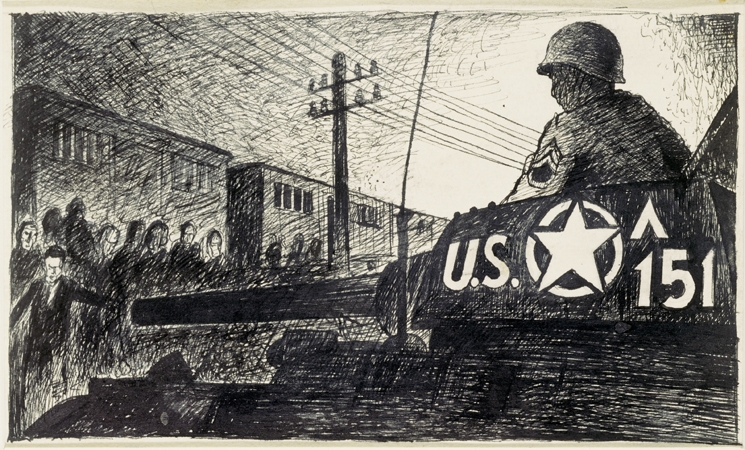
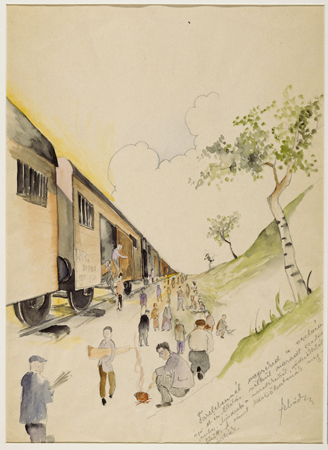
In recent correspondence with Christian Wolpers of the Bergen Belsen Memorial in Germany, he brought my attention to “the drawings of the Hungarian artist Ervin Abadi ,who was also on the train and made some watercolour drawings of the train, , the village of Zielitz (the rear end of the train was closer to Zielitz than to Farsleben, so some of the liberated say that they were liberated near Zielitz), Magdeburg and Bergen-Belsen.” Here are two of them.

Read Full Post »

« Newer Posts - Older Posts »