Feeds:
Posts
Comments

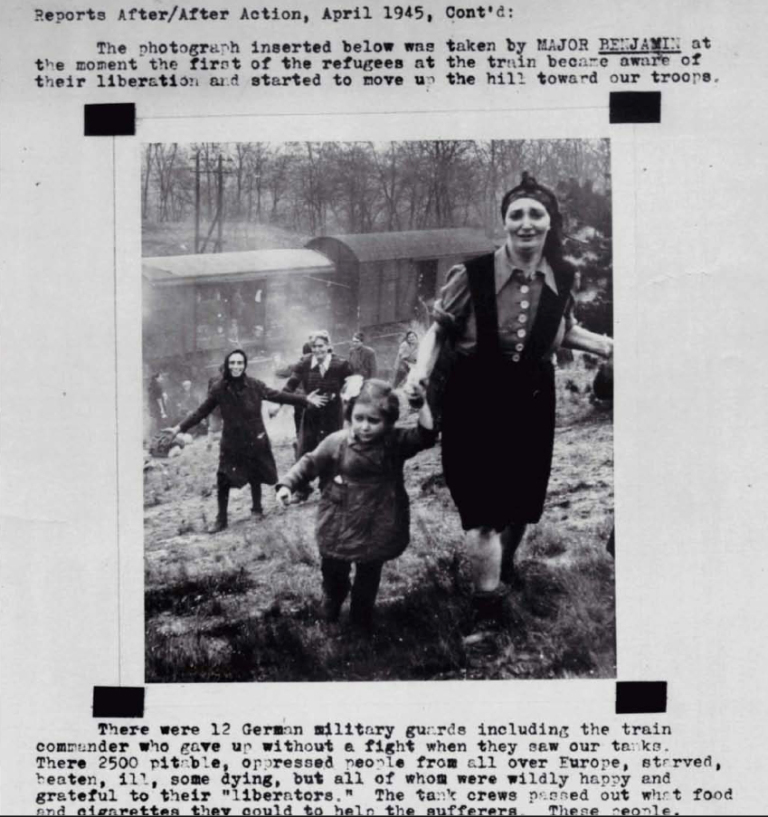
On this day the Train Near Magdeburg, pictured above in the 743rd Tank Battalion’s After Action Report following the 4-13-1945 liberation near the Elbe River, was just beginning its week-long final journey from the horrors of the Bergen-Belsen concentration camp.

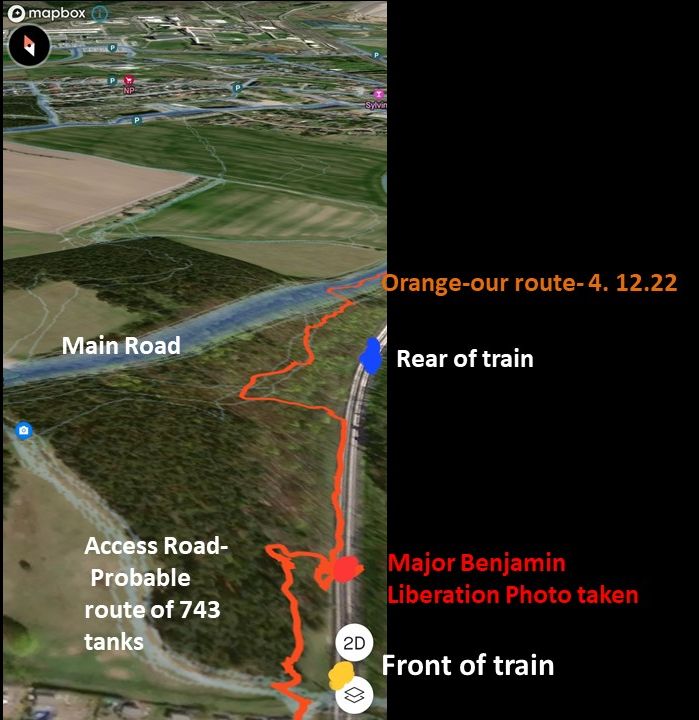
Finding the route of the tankers of the 743, 77 years from the moment they discovered the train and took the now famous liberation photo.

I think back to twenty-one summers ago, when I sat down to record the memories of a then 80-year-old tank commander, Carrol Walsh, who had fought from Normandy, into Germany, back into Belgium for the Battle of the Bulge, and then back across Hitler’s Western Wall, who almost forgot to tell me the story of the train fifty-six years before. About his rejection of the mantle of “LIBERATOR”, but his acceptance of being a WITNESS, of being a symbol of the army that did something about what they saw.

I think today about George Gross, the other tank commander that day who had the camera and the photographs to prove that 2500 souls on their way to being murdered were in fact REAL, that the event DID happen, and that the Holocaust would never be forgotten. Of his years recounting the girls on that train, the children, and speaking to them and meeting the ones who could make the pilgrimage to meet him.

I think about Frank Towers, the lieutenant charged with getting these poor people out of harm’s way, as a new battle for the city of Magdeburg was about to unfold. The same Frank who excitedly beat a path to my door sixty-one years later to explain his role, and who went on with train survivor’s daughter Varda Weisskopf and I to track down over 275 survivors of that train all those years later, organizing over 11 reunions on 3 continents over 10 years.

I think today about the medic Walter Gantz, who suffered nightmares for decades after treating the victims on the train for six weeks after liberation, some literally dying on him, his trauma evident sixty-six years later in recalling carrying in his arms a sixty-pound fifteen-year-old girl’s body down the stairs in the middle of the night to a makeshift tent morgue. Of his call to my classroom to introduce himself, telling these thoughts to my high school seniors, and the salving of his scars in getting to speak to the former young people he saved so many decades later.

I think about all the beloved survivors and their families―such loving people who broke down, cried, laughed, danced with their liberators and fellow American WWII soldiers―so many whom I hold close in my heart forever.

I think about the words of one of them every year, an annual email that would arrive on this day from Leslie Meisels, recalling with his survivor “twins” the anniversary of their “re -birth”, their good fortune and gratitude for their liberating heroes, the miracles of survival and liberation, and the miracle of meeting them again.

And I wonder again why God put me on this path to bring a bit of healing to the world.

I have wondered, ‘why me’, over and over.

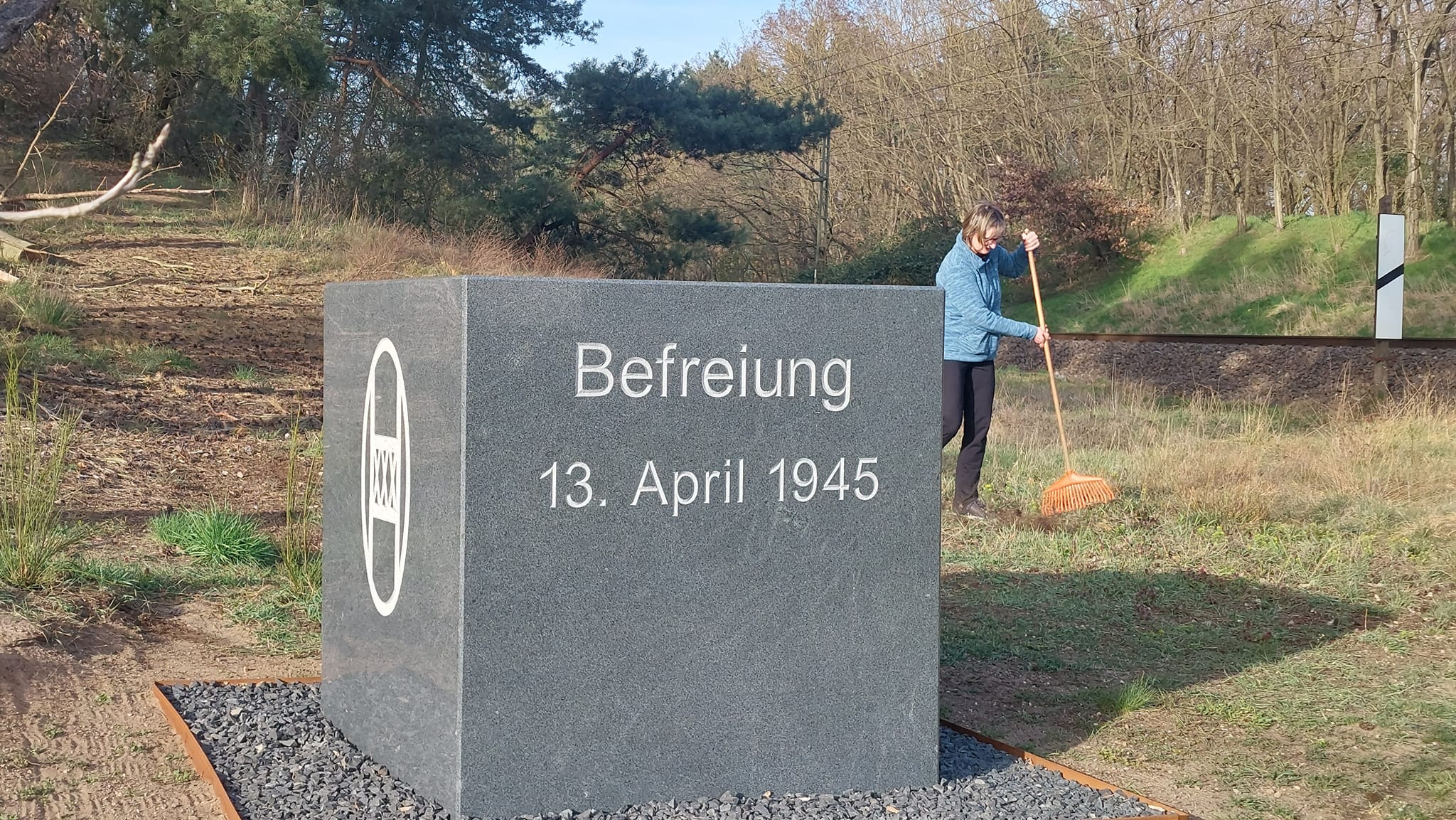
So we planned a trip to the proposed 75th anniversary of liberation ceremony with survivors, 2nd and 3rd Generation survivors and liberating soldiers’ families. Funds were raised and a monument created. The pandemic hit, the event was postponed, and in the meantime, several survivor friends have passed. One wonders what it all means, from time to time. But German high schoolers and their teacher and others have gotten involved in the project to honor the survivors, and have been fortunate enough to meet some very special ones. And now, 77 years on, we are here to remember and record the events of today, the dedication of the monument, and commemorate the memory of what happened, in the company of perhaps 50 community members and leaders who made this happen, as well as the local former students who did much of the work uncovering what transpired in their own backyard, and some of the 2nd Generation survivors from Israel.

As I string these thoughts together, I’m especially moved by these German students and their teacher, so focused now on learning more about what transpired in their country, in their own backyard―not out of a sense of atonement for the deeds of generations past―no one can atone for those crimes, and frankly that is not their ‘job’―but simply out of LOVE.

LOVE. And HOPE. And maybe even FAITH.

And I still see these young adults as some sort of new symbol, the newest witnesses, at once comforting and profound and at once a source of light, of life, and yes, maybe re-birth―to me, especially in this form of a girl [who is now actually our film crew’s liaison and translator!] and her teenage friends planting new seeds, literally, at this site where people expired with the words “SALVATION” and “FREEDOM” on their lips, and I see from afar the honoring of the goodness that radiated from the deeds of those American soldiers, really not so long ago.


Johanna, 4.12.22.

My name is Johanna, I am [20] years old and from Wolmirstedt near Farsleben. I have always taken a huge interest in history, but other than the important happenings and times you get taught at school, I would rather be told the unknown stories, the events that, in the grand scheme of things seemed so unimportant, but still impacted numerous people deeply, moved them enormously and, unfortunately, are forgotten about way too often.
When I first heard the story of the train, I thought to myself: “This cannot actually have happened so close to my home, otherwise we would have surely heard about it before. How could this remarkable story have been forgotten?”

1945 this day. George C Gross.

So, I joined the project group of the story of the “Stranded Train”, and what started out as wanting to learn more  about what had actually happened on  April 13, 1945 and also seizing the opportunity to speak English more often, soon turned into this mission that I just could not let go… I suddenly found myself doing more and more research, about people who were a part of these events all those years ago and almost naturally , the stories of the survivors,  those who liberated them, and those who took them into their homes after this train had stopped right on their  doorstep, all became a part of my life.


DAY 2. WE.FOUND.THE.TRAIN.

We got to Magdeburg this afternoon, checked in to the lovely hotel, strolled down to the Elbe River a block away. The current was swift on this lovely April day, probably not unlike the spring of 1945 when American GIs met up with their Red Army counterparts on the 25th April 1945 following the climactic, destructive Battle for Magdeburg by the 30th Infantry Division and the 743rd Tank Battalion only two days after the train liberation; this , after all, was the Army objective, and the reason the Jewish victims had to be moved out of harm’s way.

77 years ago at the moment I type this, the not-yet-liberated Holocaust victims witnessed the most awesome carpet bombing of Magdeburg in preparation for the April 15th attack. The earth shook as they looked skyward; one train survivor mentioned that they shouted with joy, not caring if they themselves were killed in the attack by an errant bomb.

At 4 pm we were met at the hotel by Johanna M., a German 20 yr. old who, as a high school student, was inspired by the story of the train and its liberation—literally in her own backyard. With flawless English, she guided us to the site of the liberation. [Her teacher, Karin P., had started Johanna and her classmates on this odyssey to learn as much as they could, organizing events with survivors and others, after teacher Karin was directed to my book by local historian Daniel K. and his father. (Our mutual friend Ron Chaulet was a major force in organizing the local Stranded Train Committee’, after convincing enough folks that this was important and perhaps needed a monument to honor the survivors who were liberated-and many then perished here—as well as to the liberating soldiers.)]

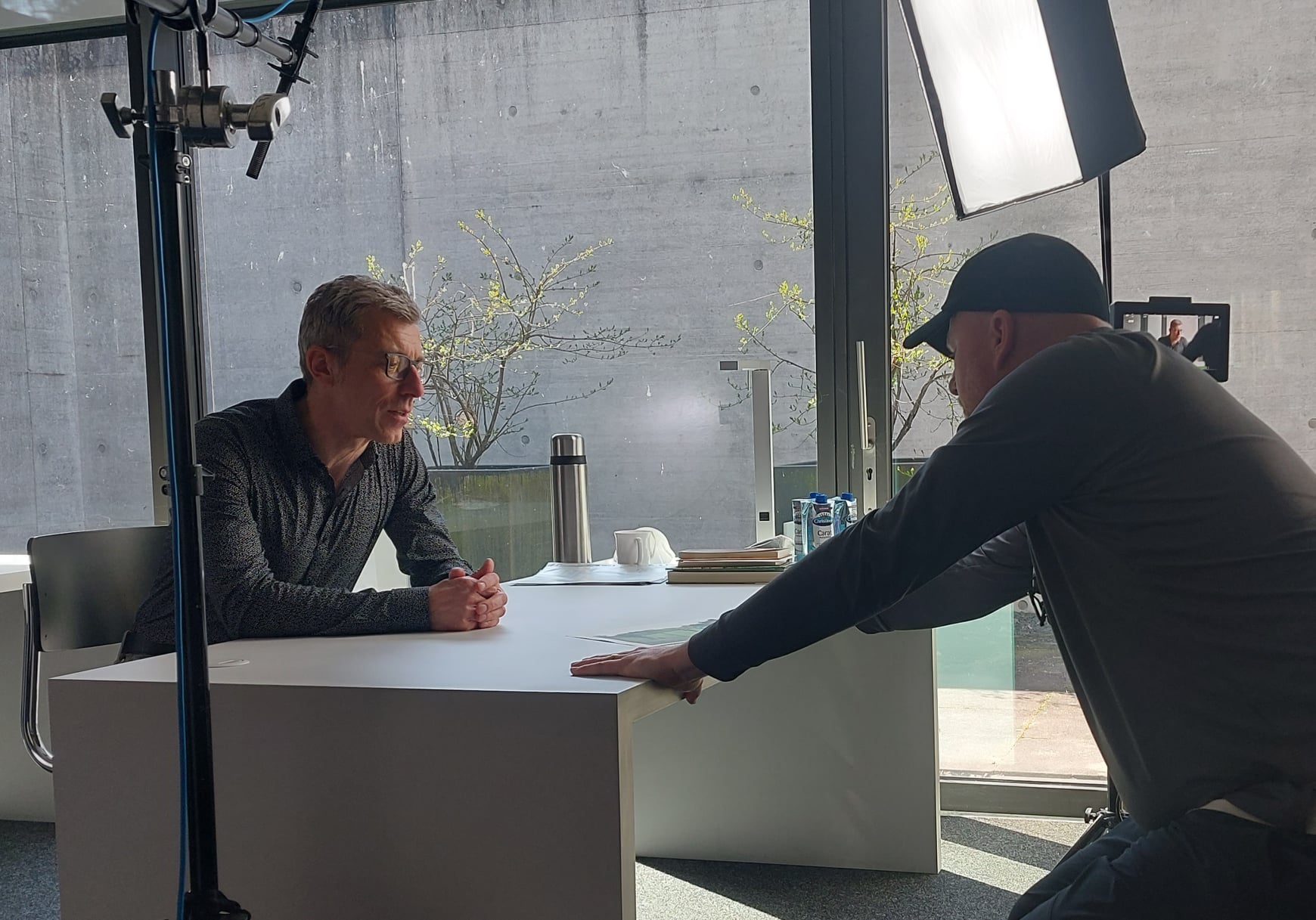
Well. We drove to the liberation site, about 20 minutes away, rural, but not-too-far outside the ‘big city’. The monument was placed two years ago, ceremonies for the 75th anniversary postponed. Now, here we were. The team of Mike Edwards, director, Joe and Josh, expert videographers and photographers, and Johanna and I compared the April 13 & 14,1945 liberation photographs with the April 12, 2022 topography.

Trains whizzed by as we walked the tracks and hillside for a half mile and back, stopping to look at the 1945 pics, wondering if we could find the actual site of the now famous Major Benjamin photo. It was hard, but on the way back to where we can see in the 1945 photos the hillside and first railroad cars, we ‘thought’ we had found it. (Sometimes you have to walk in the footsteps of the direction the American GIs came from!)

And just then, a railroad transport of industrial cars came by, in the same southernly direction of the Train Near Magdeburg’s route. We had found the site of the famous photo, the only place where the topography really lined up, and now in the film footage we shot, the knolls visible behind the trains matched, without a doubt.

One of the photos taken by George C. Gross. The rest are here.

Filming where the famous Clarence Benjamin photo was taken, 4.12.22.
After action report with the photo taken by Major Benjamin, 4.13.1945.

Major Benjamin, George Gross, and Carrol Walsh were smiling down on us. We celebrated by going out to dinner in Johanna’s hometown.

Today is the [smaller, post Covid] 77th anniversary ceremony; in the next few days we will speak with her teacher Karin P. (and I can’t wait—teacher to teacher, you know), her classmates, these German kids who recognize that ‘What You Do Matters’. As Bergen Belsen historian Bernd Horstmann told us yesterday, in his view, an almost 80 year old [cosmic] circle is closing, and on many levels, which Mike and I will explore in the film.

We will also speak with other local eyewitnesses. Thanks for reading.

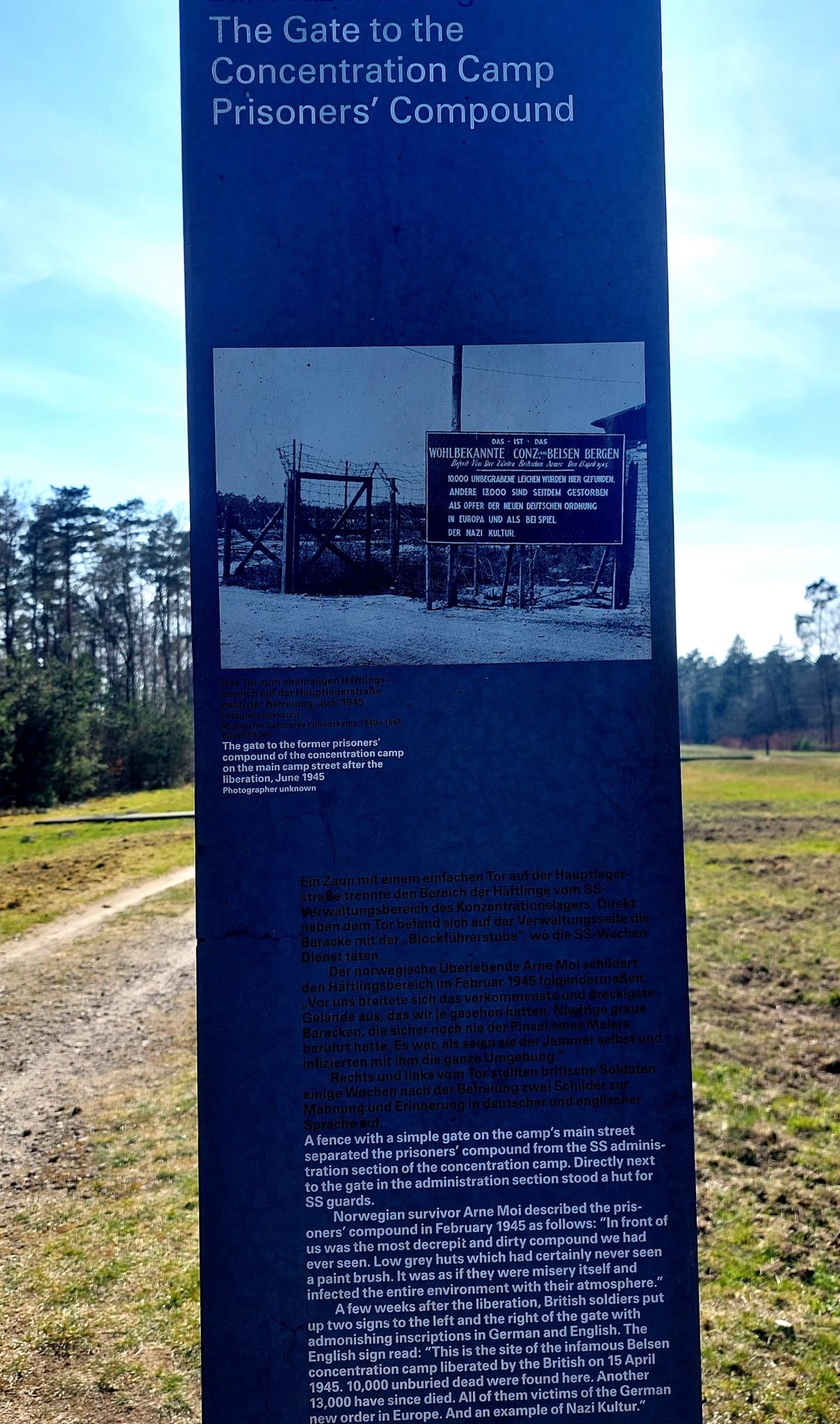
AT BERGEN BELSEN.

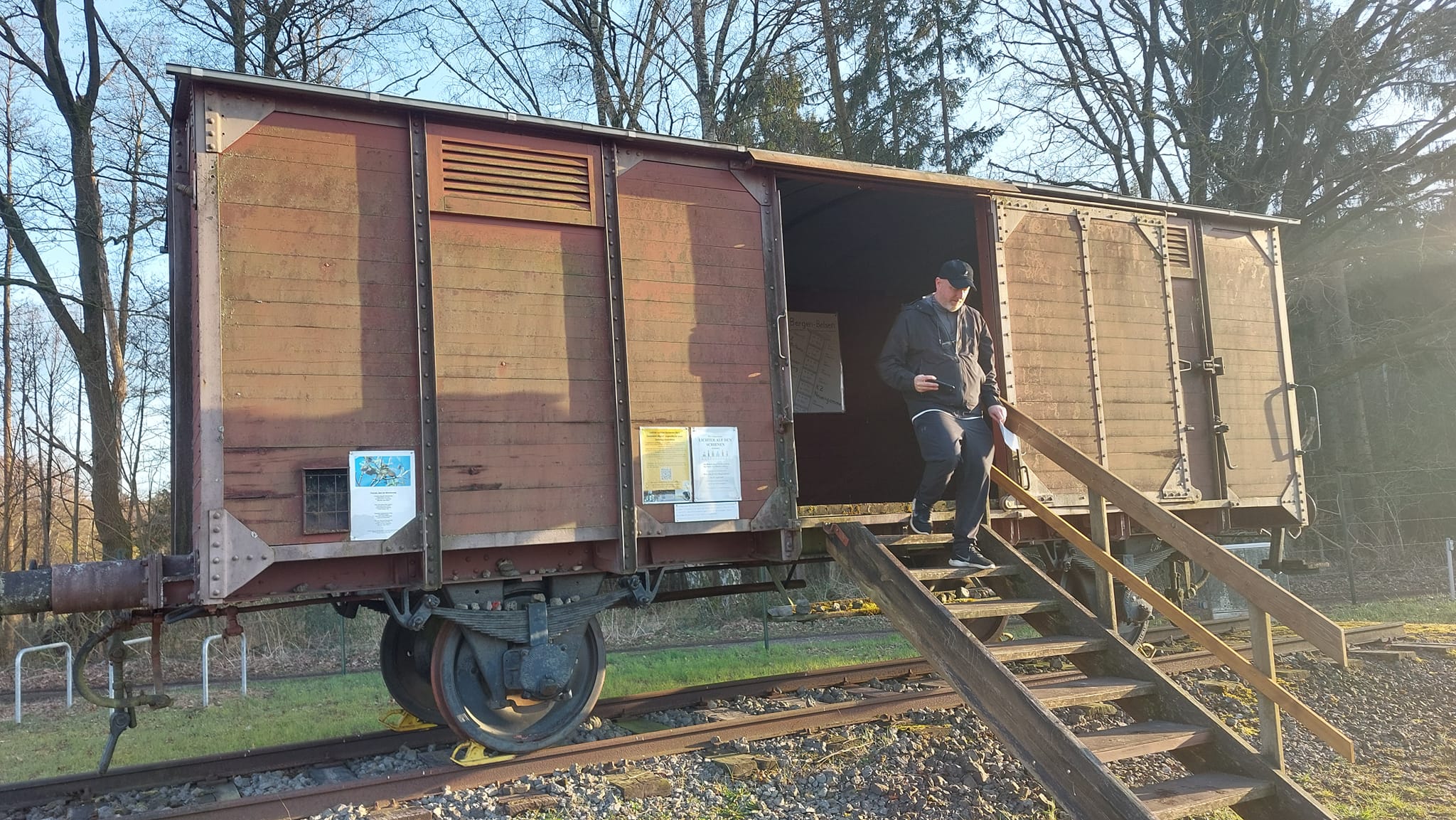
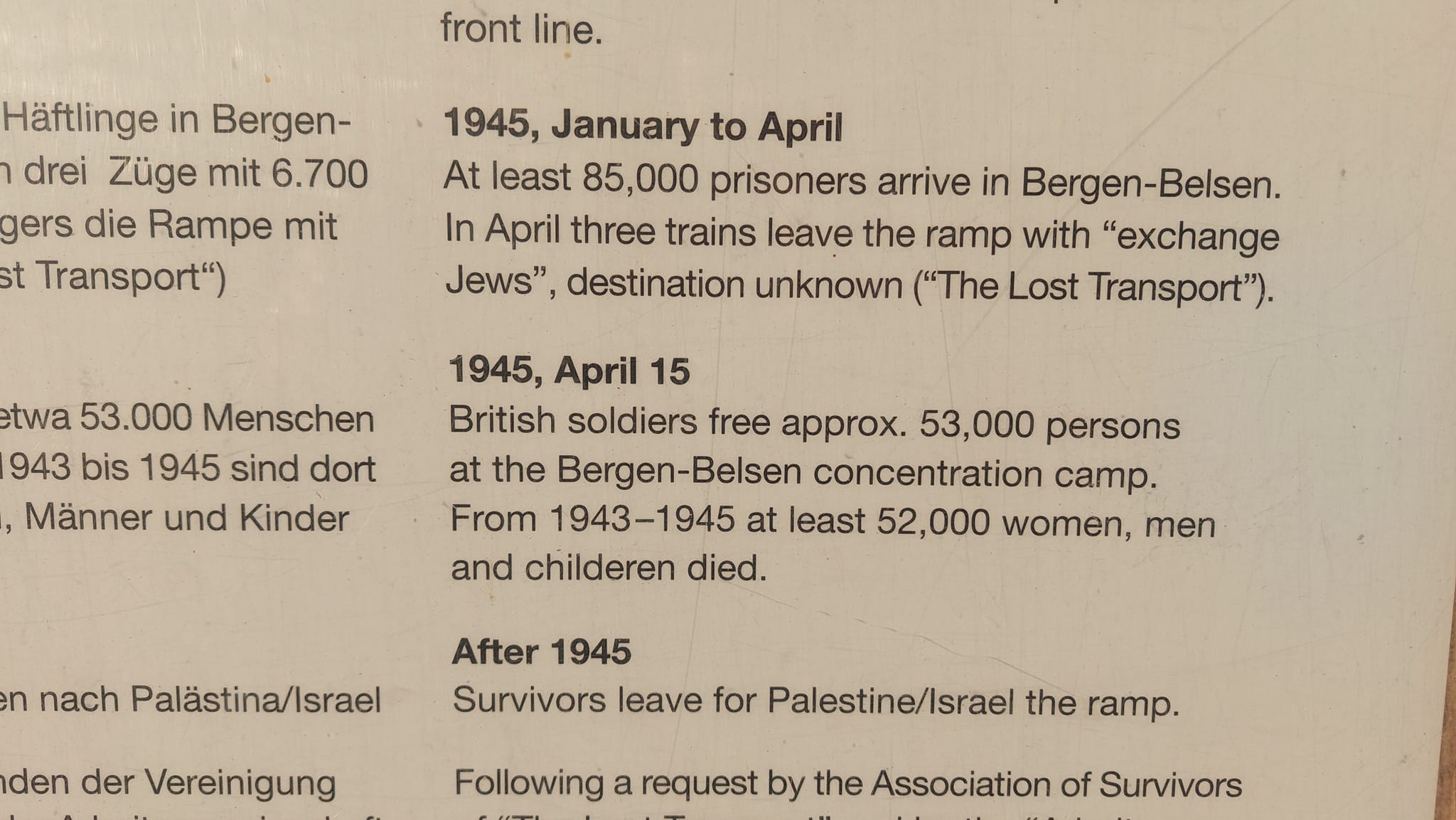
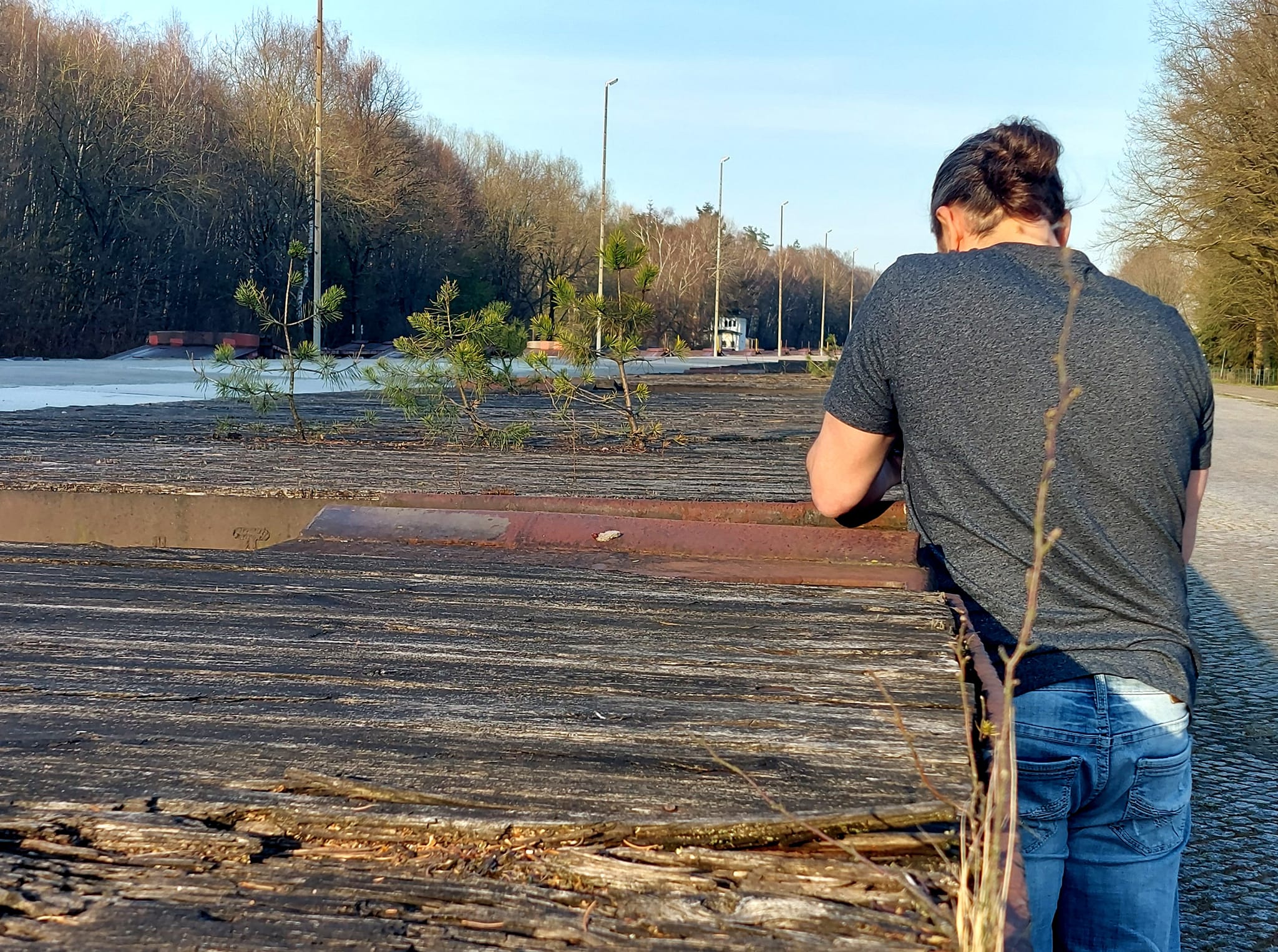
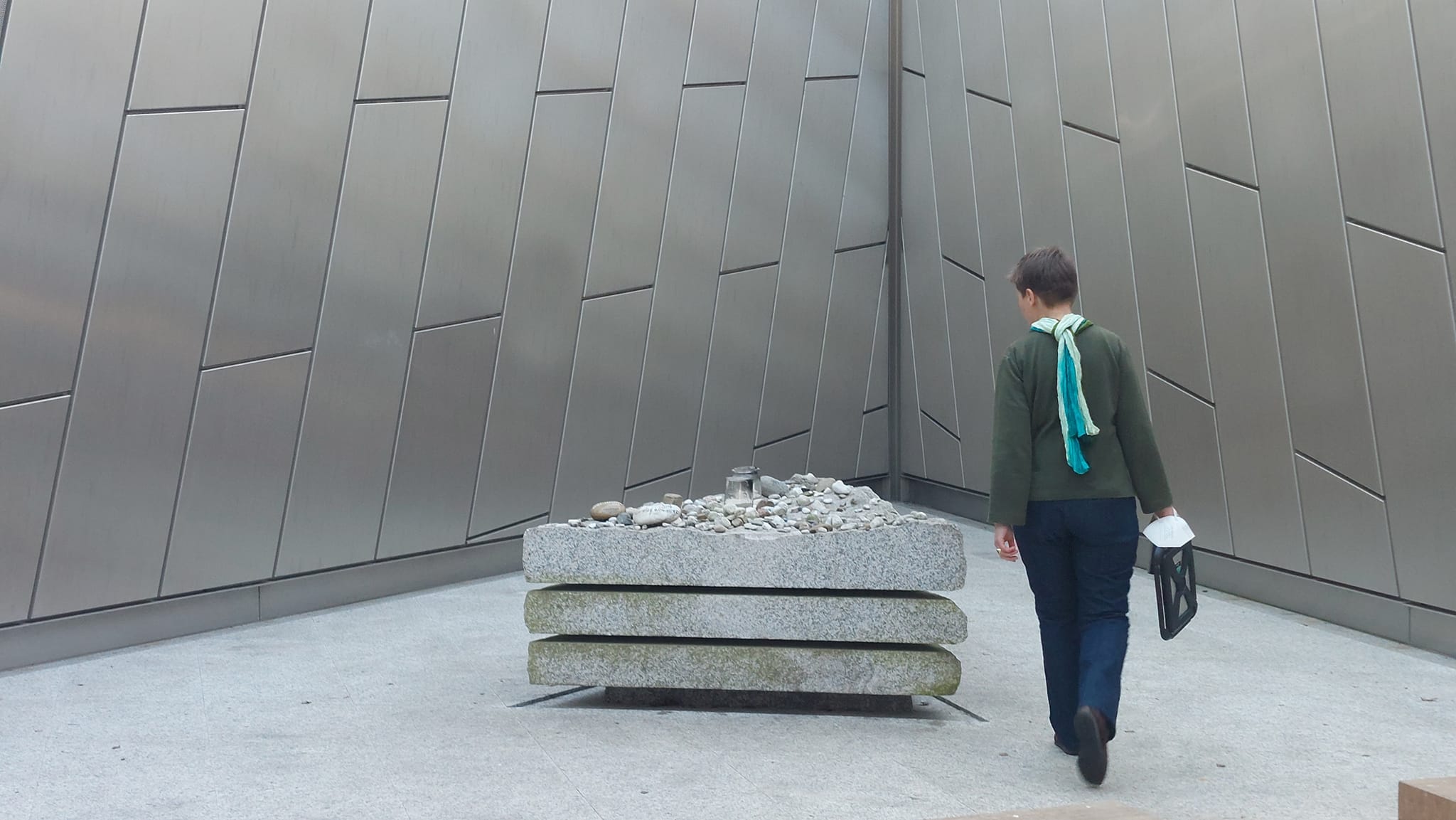
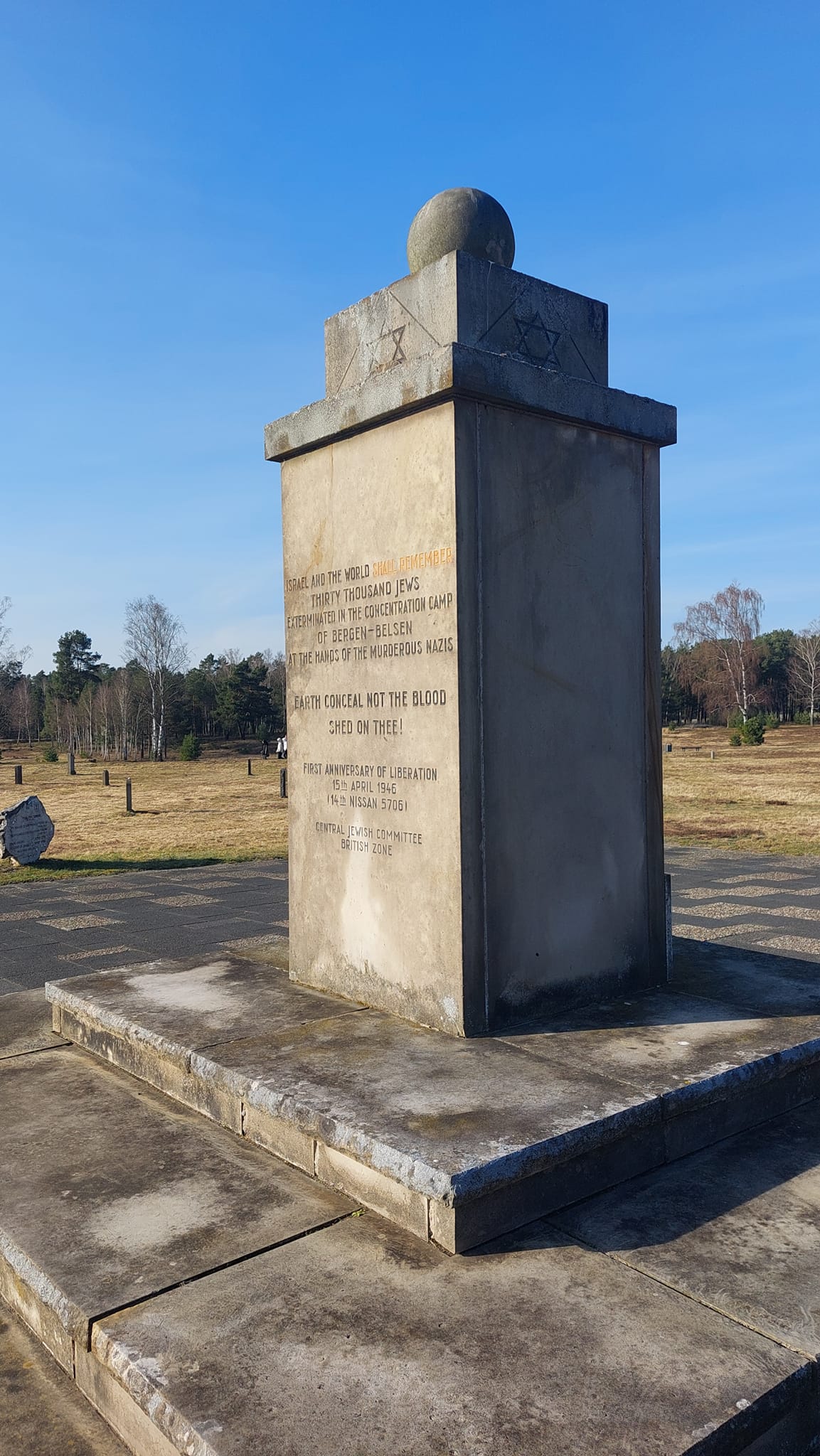
After 36 hours of travel and lost luggage, I arrived at Celle, Germany, joining film director Mike Edwards and crew members Joel and Josh. Six hours later we were on our way to Bergen Belsen to get an interview with staff and tour the grounds and railway ramp for footage for the upcoming film ‘A Train Near Magdeburg.’ I will post some photos and descriptions; it was a beautiful April day, in fact the same week that the transport was loaded and evacuated.

So much respect for German historians and friends Bernd Horstmann and Stephanie Billib. Being the historian when your subjects are the ‘good guys’ is easy. They do the tough work here, and gave great interviews, providing context for what happened in the overall camp system, and that last spring of horrors in 1945. On to the liberation site for the 77th anniversary at Farsleben.

I’ve just returned from a homecoming of sorts, and truth be told, I’m kind of wiped out. Yes, the emotion that is summoned when recalling my old friends, now gone, liberating solders and noble survivors alike, is powerful enough to carry me away every time, but lately in a manner that conjures up joy as well as sorrow at the loss. The memory of the lives they rebuilt after the war, the recounting of the trauma that both survivor and soldier contended with brings forth the memory of one tanker, who landed on D-Day, who told a student audience at my high school, “I’m listed in the program as a liberating soldier, but I can tell you that I am a survivor, too”, another victim of the war himself. It was probably the first time in over 60 years that he had spoken about it publicly.

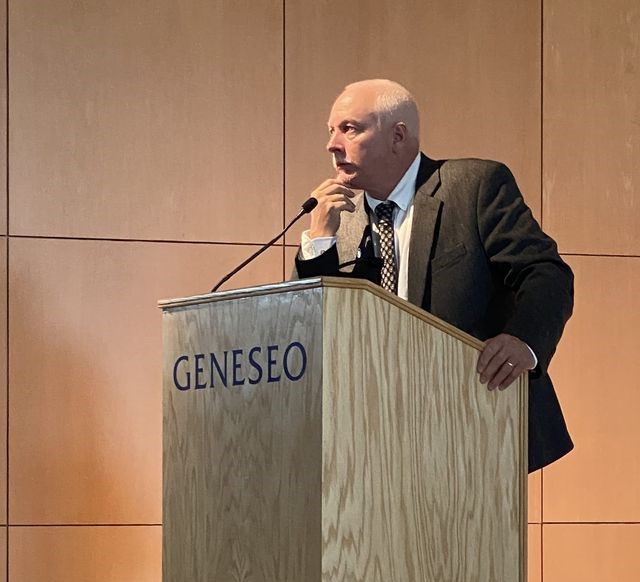
Speaking at SUNY Geneseo, 4.6.22, the 77th anniversary of the day that the transport left Bergen-Belsen.

In my talk this week, I introduced new audiences, staff, students, and public alike, to them, and I think in this way I kept them, my old friends now passed, alive. I know I will never stop talking about them, what they went through, but more importantly, why they opened up with their stories in the end, what they wanted the world to remember, maybe really in most cases now, to really learn and be moved to action by for the first time. “The best lecture I have ever attended”, was a comment I heard from a top school official afterwards as she warmly took my hand; I noted others in the crowd welling up as I spoke from the heart, but I managed to complete the mission, not a real easy thing to do when you are feeling it too, though maybe on a more personal loss level. I guess I feel like I am channeling a major part of what defined my old friends, a message, a connection that will live on as long as I can summon the spirit to speak of them.


As we move into a new era, it is important to have the toolbox that our survivors and soldiers testimony can help us navigate with. And, given the images now beamed to us nightly from a ‘civilized’ place not so far away, it’s important to remember not to become desensitized to the horror as it unfolds, but to become educated and commit ourselves to more than just ‘Never Again’.

Humanity turned away 75 plus years ago, but our soldiers, survivors themselves, committed themselves to humanitarian action, even outside of the mission. And I hope that lesson came forth, as I brought to the center stage my old friends, and introduced them to a new generation.


I’m off to Germany in less than 12 hours, to visit Bergen Belsen again, and then the site of the liberation of the train-for the first time-and meet with German historians, students, and witnesses. I’m lying if I state that I did not have some butterflies before my recent talk at SUNY Geneseo, my old school, and I would be lying if I said I did not have them now. But it is not about me- though by now, 21 years after the first interview, I think maybe this force is continuing to channel the cosmos through me, perhaps long overdue, and made possible by donors who share the spirit of remembrance, and the spirit of Tikkun Olam: Repairing the World.

Stay tuned.

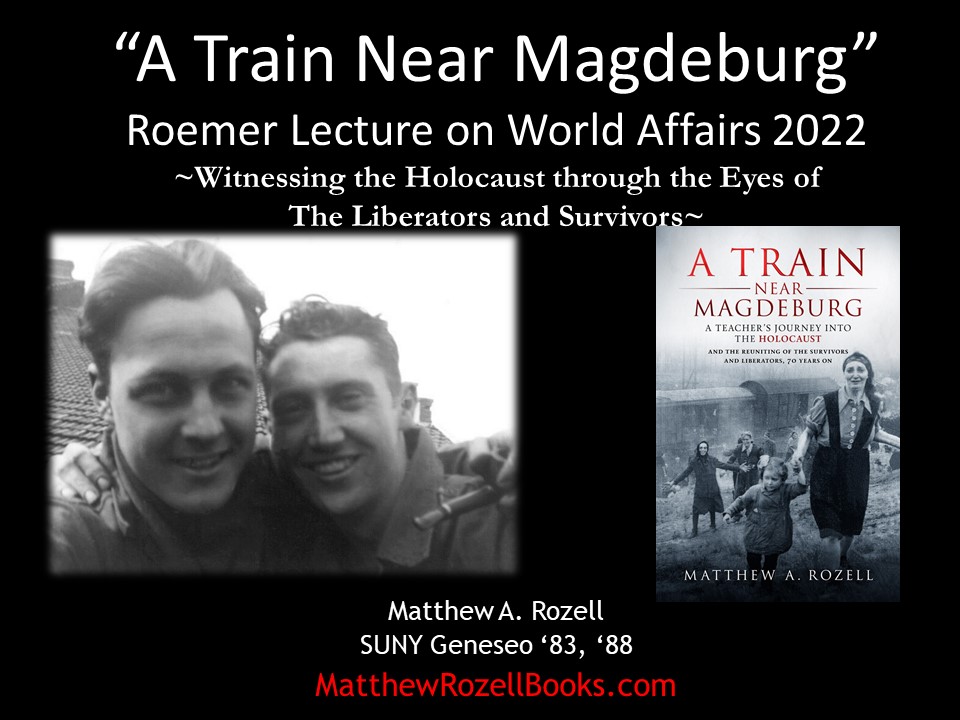
Wed. April 6, SUNY GENESEO, Kenneth Roemer Lecture, Doty Recital Hall 205. 2.30 PM. Free.

Tomorrow I am heading to address my college alma mater for its annual Roemer Lecture on World Affairs, followed by a President’s Reception at SUNY GENESEO, south of Rochester, NY.

I was actually invited for Spring 2020, but you can guess what happened. The next year, the campus was not yet fully open, and I did not relish doing a remote gig. I wanted to return; after all, I met my best friends in life here, including my future wife. We were married here, and I almost settled here, except for a pesky detail-for the life of me, I could not find a job teaching history anywhere in western New York.

I did my student teaching practice under the tutelage of Dr. Wayne Mahood, and Dr. John Herlihy and his teacher wife Myra at Geneseo & Livonia High Schools; all were huge influence on me, mentored me, encouraged me when somedays it felt hopeless. But I had one thing going for me, I really knew my history. In fact, I had loaded up on so many undergrad history courses that I had to go back after my BA to get my education credits and student teaching in.

But I could not find that elusive job; I remember coming in SECOND for the open Geneseo High social studies position (a board member told me!) competing against other 80 applicants.

Crushed, I turned my sights back towards home after doing a stint at the local summer school. I was hired by Principal John Christopher for grades 7,8,9 three weeks before school started in 1986, up on the third floor of St. Mary’s Academy in Glens Falls, then just a shell of its former glory, though I recall it with fondness. The high school closed two years later, I think; I had by then moved on to my high school alma mater, Hudson Falls High School, where I would spend the remainder of my 30+ year career.

But then, the magic that we created at HFHS is the reason for my being invited this week to address the college body, staff and students. The cosmos beckoned in my work at home, and abroad, but now I am returning with the story that I hope will be judged inspirational-though unfortunately it seems the topic is always relevant.

Just because I retired from the classroom doesn’t mean that I’m not still an educator, and education is the key. Maybe I’ll see you there. Next stop, Germany. More later.

Roemer Lecture on WWII Liberation

Educator and author Matthew Rozell ’83, ’88 MS, will deliver the annual Kenneth Roemer Lecture on World Affairs at SUNY Geneseo. His talk, “Liberation, 1945: An American GI Response to the Holocaust During WWII,” will take place at 2:30 p.m. on Wednesday, April 6, in the Doty Recital Hall. The event is free and open to the public. Please note that masks are required in all buildings on campus.

On April 13, 1945, three weeks before the end of World War II in Europe, two tank commanders of the 743rd Tank Battalion of the U.S. Ninth Army overran a train transport near Magdeburg, Germany, filled with 2,500 Jewish concentration camp victims, many of them children. One of the tank commanders had a Kodak Brownie camera and recorded the rescue. The dozen snapshots taken that day were stored a shoebox in the back of a closet for over 60 years until brought to light by a high school oral history project interviewing WWII soldiers. 

Rozell is an award-winning history teacher, author, speaker, and blogger on World War II and the Holocaust. He taught at Hudson Falls (NY) High School for thirty years. In 2009, he and his class helped to reunite more than 275 Holocaust survivors with their American soldier-liberators and were featured as an ABC World News Person of the Week. The work was later released as his 2016 book, A Train Near Magdeburg, which is in production for a major documentary film, and was recently featured on C-SPAN’s Book TV.

Rozell’s teaching has also been featured by the CBS Evening News, NBC Learn, the Israeli Broadcast Authority, the United States Holocaust Memorial Museum, and New York State United Teachers. His multi-volume oral history book series of World War II, The Things Our Fathers Saw, has sold over a half-million copies in various formats.

The Kenneth Roemer Lecture on World Affairs is a memorial to Roemer’s longstanding interest in global issues. Spencer J. Roemer, emeritus director of admissions at Geneseo and member of the Geneseo Foundation Board of Directors, endowed the series in his brother’s name.

ACROSS THE RHINE.

Preview here. Available at Amazon, or direct from author.

I’ve been kinda bad about posting since I retired, but forgive me, I’ve been busy creating books. So now I’m announcing my latest book, Across The Rhine: The Things Our Fathers Saw—The Untold Stories of the World War II Generation-Volume VII. It actually made its first appearance on the shelves around Veterans Day, and I am happy to share it with you here now. At 360 pages and including over a dozen veterans, it is my longest book to date in the regular series and one that my editor calls her favorite.

The book is another example of these brave men and women who saved the world not so long ago, and I think it is important that these lessons not be lost to history, now that they have passed. People seem to like it; I know it was a bit emotional for me connecting with these veterans, spending hours upon hours dissecting their stories, researching and contextualizing their personal experiences, which is something I always trained my advanced course students to do. It is quite a journey to navigate, and I think I did these guys right, in the end.

Some I met and interviewed on several occasions; others, I got to know by returning again and again to their recorded testimony, which they willingly shared for posterity. The backbone of the book turned out to be the story of a Mohawk Nation paratrooper in the 504th PIR of the 82nd Airborne, who jumped into Market Garden, then into the nightmare of the Battle of the Bulge, and thence ‘across the Rhine’. Just an amazing story or survival, resilience, and at his essence, humility and humanity.

One guy I knew well enough to interview several times was one of the first men into Dachau, with the 42nd Rainbow Division, a natural-born jokester who was utterly shocked to his core.

Richard Marowitz Hitler’s Hat

The next day, his I&R unit was tasked with searching Hitler’s Munich apartment and found his English housekeeper, as well as Hitler’s top hat, which sat in the bottom of his service duffel for 50 years before he fished it out to tell his story to the high school age kids, always finishing with how, as a 19-yr old Jewish kid from Brooklyn, he fantasized about Hitler seeing him try it on, and then blowing his brains out in the Führerbunker that day, April 30, 1945, back in Berlin.

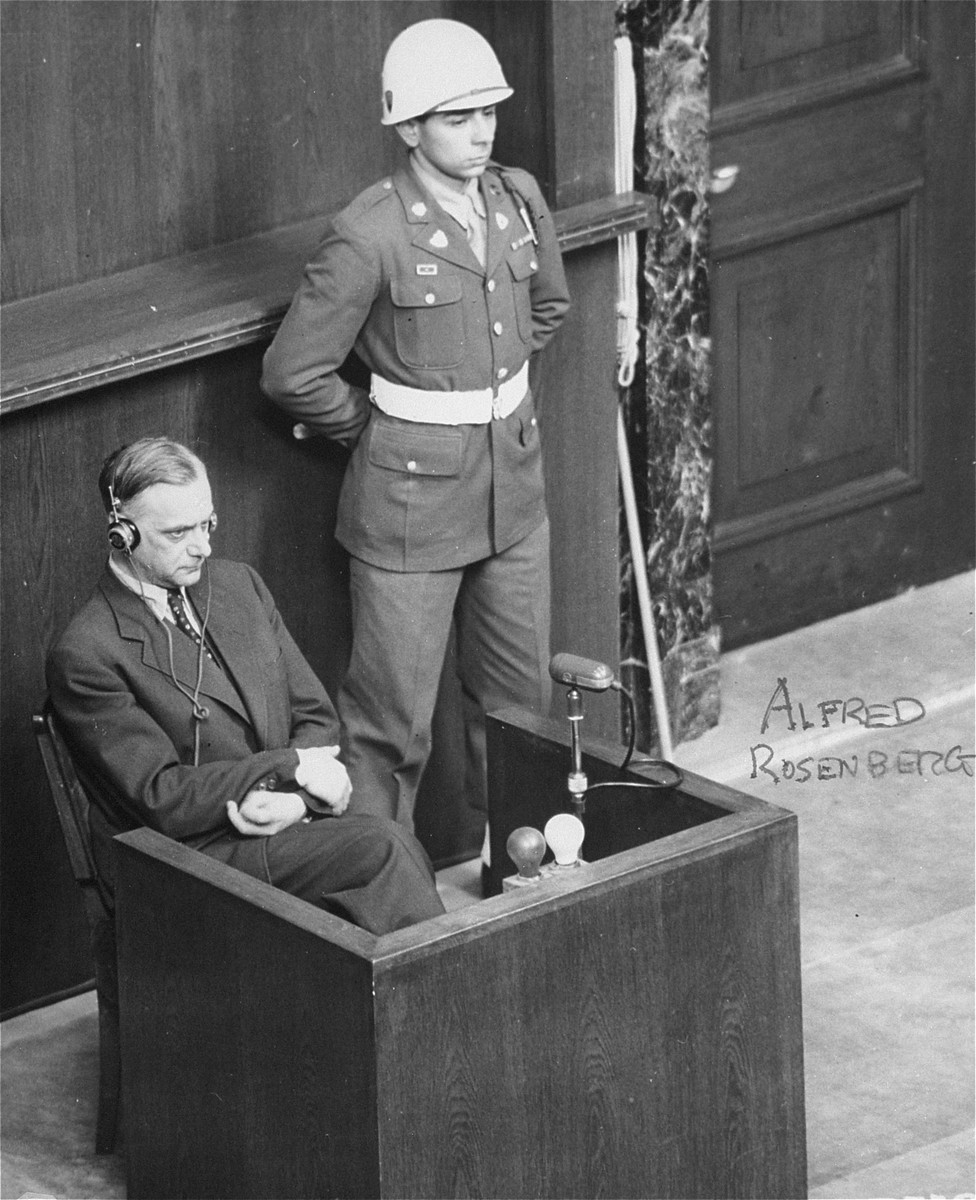
Former Nazi Party ideologist Alfred Rosenberg in the witness box at the International Military Tribunal war crimes trial at Nuremberg. Behind him is Leo DiPalma. USHMM.

I have guys who were itching to come home after the war ended, only to find they did not have enough ‘points’, and became eyewitnesses to history as guards at the International Military Tribunal at Nuremburg after the war- the war crimes trials. One later returned to the scene of judgment with his daughter, and became moved to tell his story of interacting with some of the most notorious villains of the 20th century.

Richard Marowitz, Al Cohen, Doug Vink. HFHS library, 2000. The last chapter features them in interactive conversation with students and staff at the school. Lots of comic relief, all good.

You can preview the newest book at the links above. For now, here are some of the early reviews. If you did get a chance to read it, please consider leaving feedback at my website or at Amazon, above.

BLURB

In ‘Across The Rhine’, you will begin to liberate a continent with our veterans as they scale the cliffs at Pointe Du Hoc overlooking Omaha Beach.

You will jump with the 504th Parachute Infantry Regiment to capture bridgeheads in the Netherlands, and re-group to slug it out in the freezing Ardennes Forest in the winter of 1944-45.

The mission will then push you over the Siegfried Line and all the way to Germany’s most formidable western natural defense, the swift and swollen quarter-mile wide Rhine River.

As spring 1945 arrives, you will be with our GIs as they arrive at the gates of Dachau and have their very souls shaken as they become eyewitnesses to the greatest crime in the history of the world—the Holocaust; the Nuremberg War Crimes trials will then bring you face to face with the architects of terror, the most notorious war criminals of the twentieth century.

[Front Cover: “Crossing the Rhine under enemy fire at St. Goar, March, 1945. 89th Infantry Division.” US Army, Office of War Information. Public Domain Photographs, National Archives.]

EARLY REVIEWS

During my military service (1972 to 1998)I had the honor of serving in Berlin. During that time Rudolf Hess was still being held in prison. It was interesting to read about the Nurnberg trials and the testimonies of those soldiers who stood guard through the procedures. Highly recommend all books in this series. Time well invested.

The book was the result of face to face interviews with the men who fought in WWII. It, and all the rest of the series are well done and should be given to our children to read for the history of the war. Excellent resources.

Another fantastic read. I thought “The Bulge and Beyond “ was the best of this series but this book tops them all. It’s a fantastic read and I highly recommend it.

I own all 7 volumes of The Things Our Fathers Saw. I found each one to be a book that I could not put down until I had finished it. I am very grateful that you had the foresight to capture these stories while WWII veterans were still with us. So many are gone–my Dad has been gone 10 years. I only know one locally and he is 94. Thanks for saving this history.

I’m so excited for my dad to read this. He absolutely loves this author and the way the books are written. I hope he makes a volume VIII!

Rest assured, I started Volume 8, On To Tokyo, last month and have about 1/4 of it done, with a Fathers Day deadline. It is going to be another amazing journey.

Today is the 80th anniversary of the intentionality of the Holocaust. This meeting lasted 90 minutes. I visited a few years back.


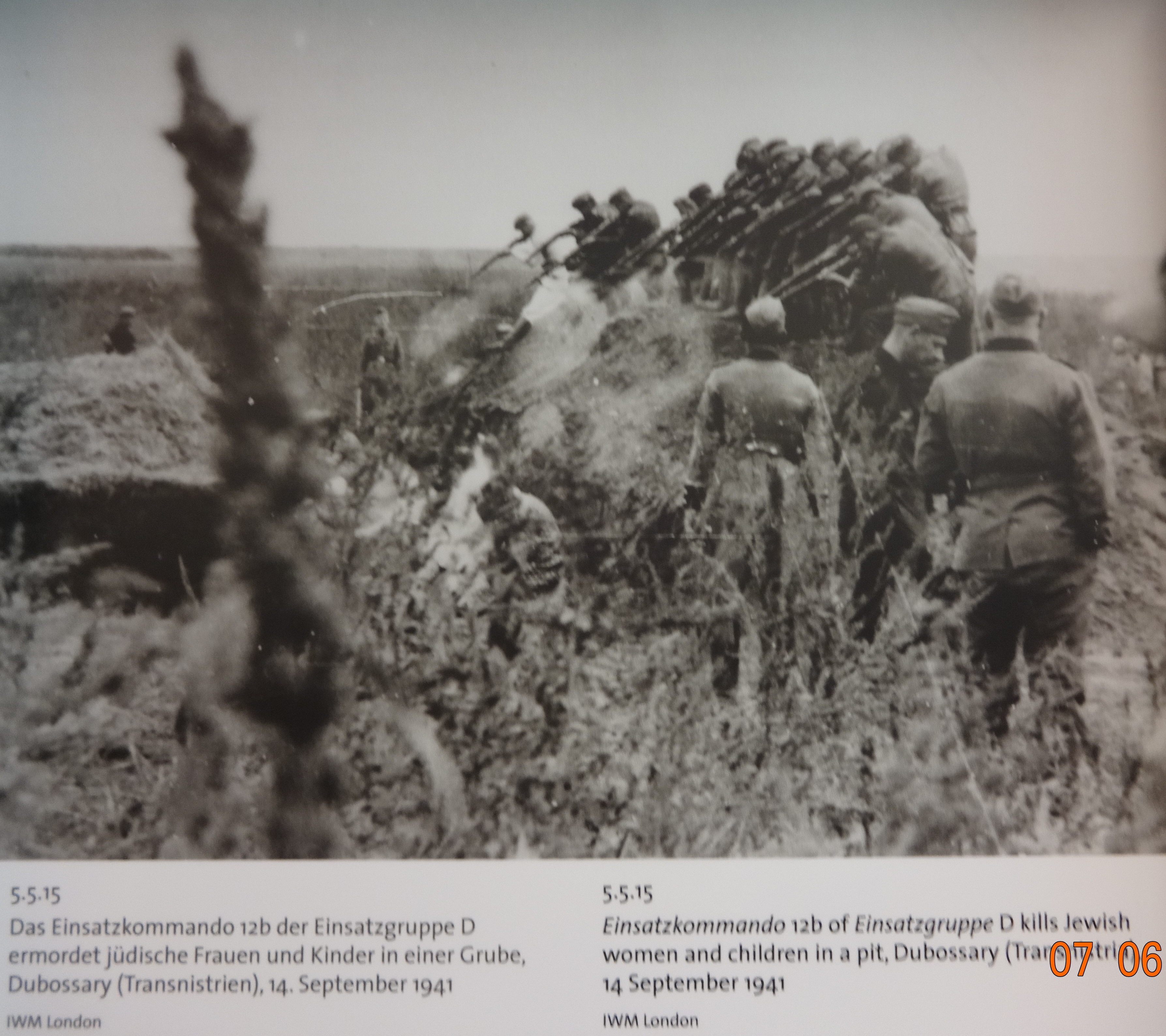
“Einsatzkommando 12b of  Einsatzgruppe D kills Jewish women and children in a pit, Dubossary,  Moldova/Transnistria, 14 Sept. 1941.” Imperial War Museum.
“Einsatzkommando 12b of Einsatzgruppe D kills Jewish women and children in a pit, Dubossary, Moldova/Transnistria, 14 Sept. 1941.” Imperial War Museum.

A photograph for you to see. I tend to stay away from displaying more graphic images on this blog, but a year ago on this day I was confronted with it, and many others, at the Wannsee Villa outside of Berlin, where the intentionality of the planning of the Holocaust hits you square in the face, as the photograph on the wall above does.

And it is worth noting the date. Eleven weeks after the start of Operation Barbarossa. You see, now that the Soviet Union has been invaded, there are millions more Jews in the path of the genocidal war machine. The Holocaust here was carried out by soldiers with bullets. Entire villages and districts. Over 1.5 million victims. The dirty work gets done, but given the headaches and the bottlenecks, “there has to be a better way”.

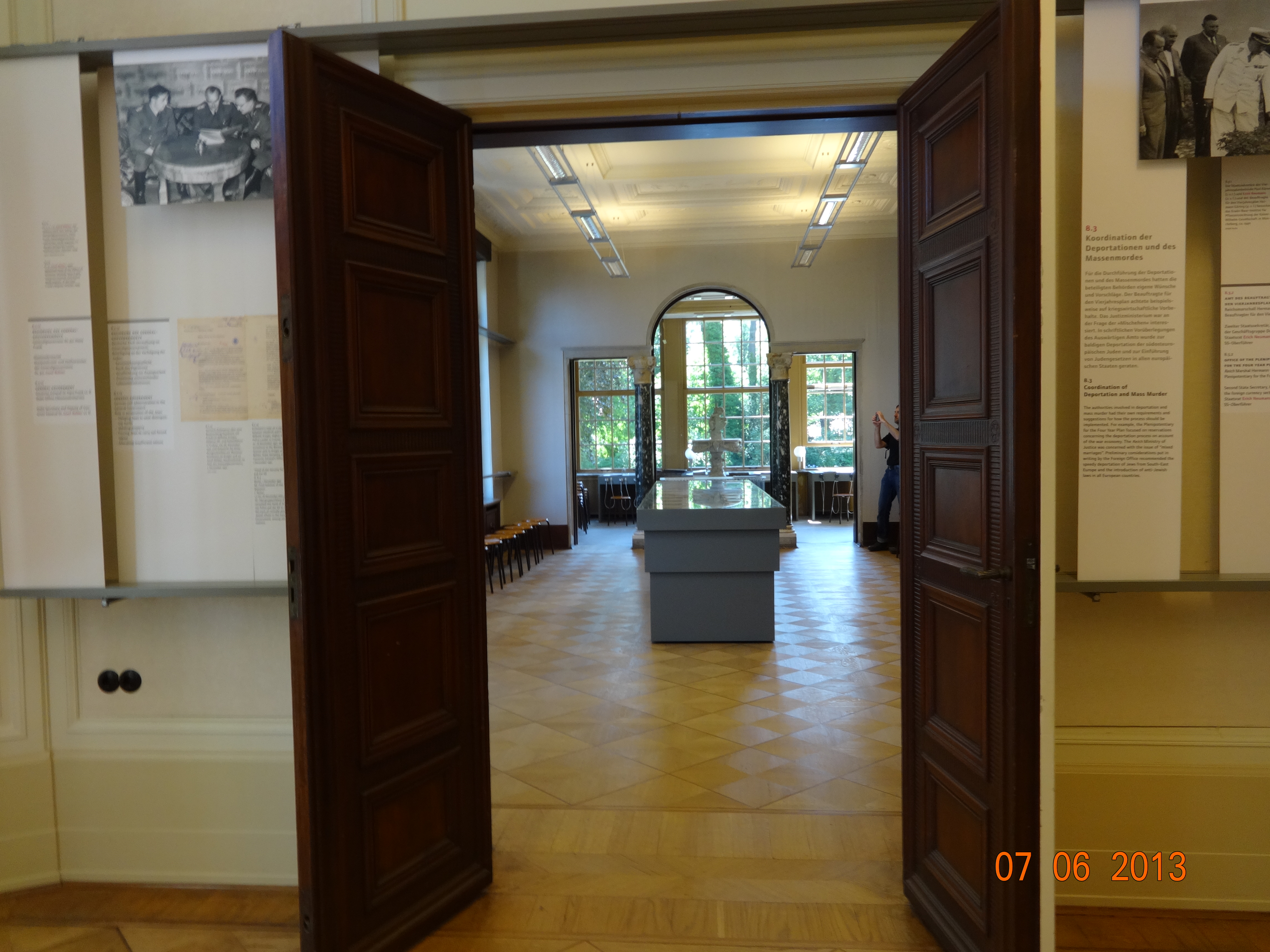
Wannsee Villa, July 6, 2013.

Which brings us to this lovely site. At the Villa outside of Berlin, on 20 January 1942, 15 German military and government heads meet for a day to discuss the Jewish problem in euphemisms. As scholars have noted, the Wannsee Conference was not called to decide the fate of European Jews, but to clarify all points regarding their demise.

From the USHMM: “The “Final Solution” was the code name for the systematic, deliberate, physical annihilation of the European Jews. At some still undetermined time in 1941, Hitler authorized this European-wide scheme for mass murder.”

The display where the "table" around which discussions were held at the villa.
The display where the “table” around which discussions were held at the villa.

“At the time of the Wannsee Conference, most participants were already aware that the National Socialist regime had engaged in mass murder of Jews and other civilians in the German-occupied areas of the Soviet Union and in Serbia. Some had learned of the actions of the Einsatzgruppen and other police and military units, which were already slaughtering tens of thousands of Jews in the German-occupied Soviet Union. Others were aware that units of the German Army and the SS and police were killing Jews in Serbia. None of the officials present at the meeting objected to the Final Solution policy that SS General Reinhard Heydrich announced.”

A number's man, Heydrich was.
A number’s man, Heydrich was.

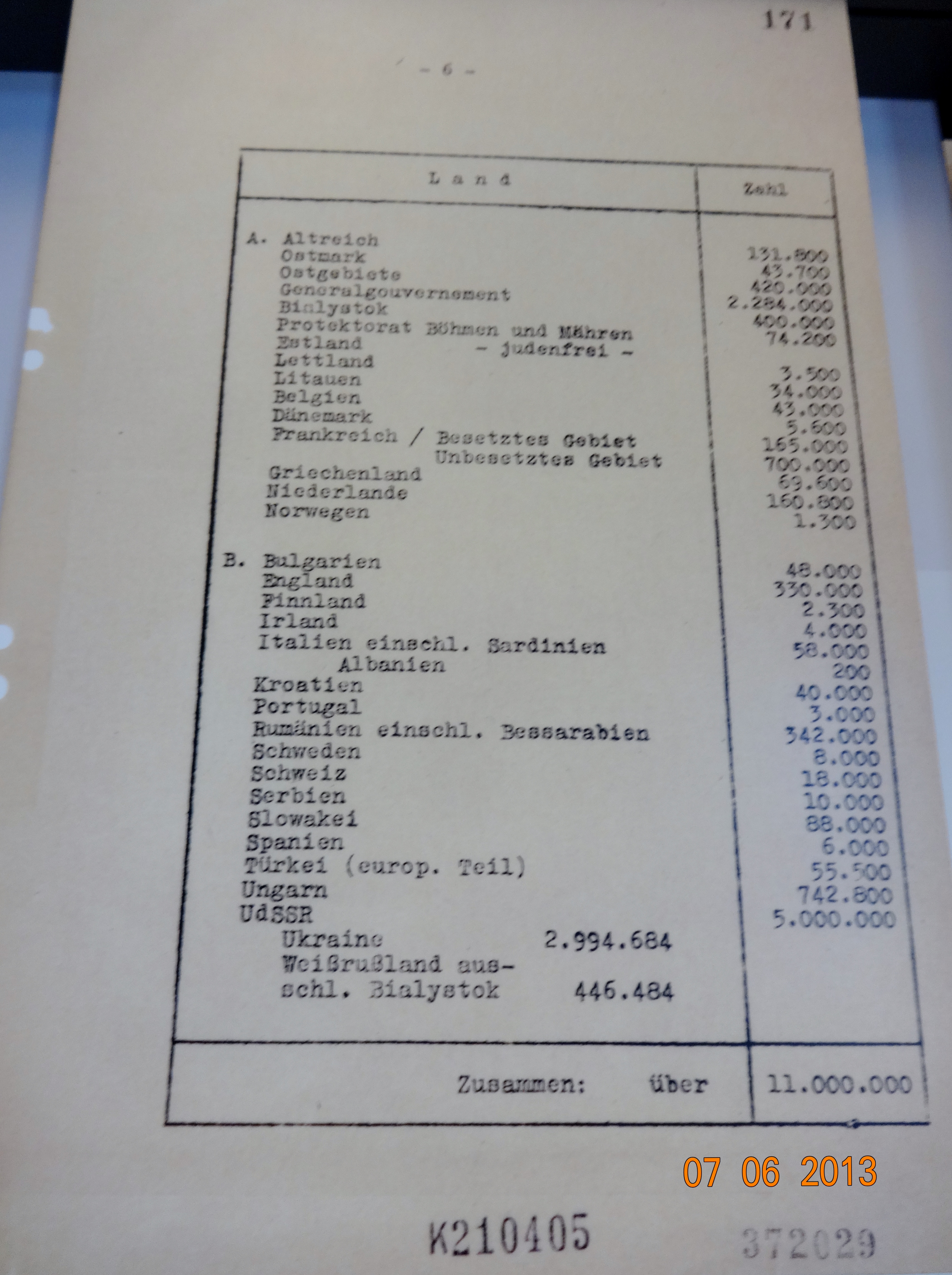
“Heydrich indicated that approximately 11,000,000 Jews in Europe would fall under the provisions of the “Final Solution.” In this figure, he included not only Jews residing in Axis-controlled Europe, but also the Jewish populations of the United Kingdom, and the neutral nations (Switzerland, Ireland, Sweden, Spain, Portugal, and European Turkey).

Heydrich announced that “during the course of the Final Solution, the Jews will be deployed under appropriate supervision at a suitable form of labor deployment in the East. In large labor columns, separated by gender, able-bodied Jews will be brought to those regions to build roads, whereby a large number will doubtlessly be lost through natural reduction. Any final remnant that survives will doubtless consist of the elements most capable of resistance. They must be dealt with appropriately, since, representing the fruit of natural selection, they are to be regarded as the core of a new Jewish revival.” (my emphasis)

Nice place to plan and coordinate mass murder of millions.

For the actual meeting minutes, click here.

NYT: 80 Years Ago the Nazis Planned the ‘Final Solution.’ It Took 90 Minutes.
As Germany observes the anniversary of the Wannsee Conference, witnesses of the Nazi era are dying and antisemitism is resurgent in Europe and the United States.

Today marks a watershed moment in the history of the Holocaust, one I knew little about until my advanced studies.

Over 33,000 people were murdered, by hand, at close range, at the edge of a ravine.

In two days.

Did you learn about this in school? Why was it not widely known? The killers came from all over Germany, ‘ordinary men’, the bulk of whom went on to live out their days unaccountable for their crimes. Perhaps some are still walking among us.

So I’ll share these two posts that came up in my social media feed this morning. The first is from the organization. ‘Yahad – In Unum is the leading research organization investigating the mass executions of more than 2 million Jews and tens of thousands Roma/Gypsy people in Eastern Europe between 1941 and 1944.’ Important, literally groundbreaking work. Check Father out.

The second is from Yad Vashem in Jerusalem (where I studied for three incredible weeks!), Israel’s Holocaust Martyrs’ and Heroes’ Remembrance Authority and World Holocaust Remembrance Center, ‘the ultimate source for Holocaust education, remembrance, documentation, and research. From the Mount of Remembrance in Jerusalem, Yad Vashem’s approach incorporates meaningful educational initiatives, groundbreaking research, and inspirational exhibits,’ one of which is in the link.

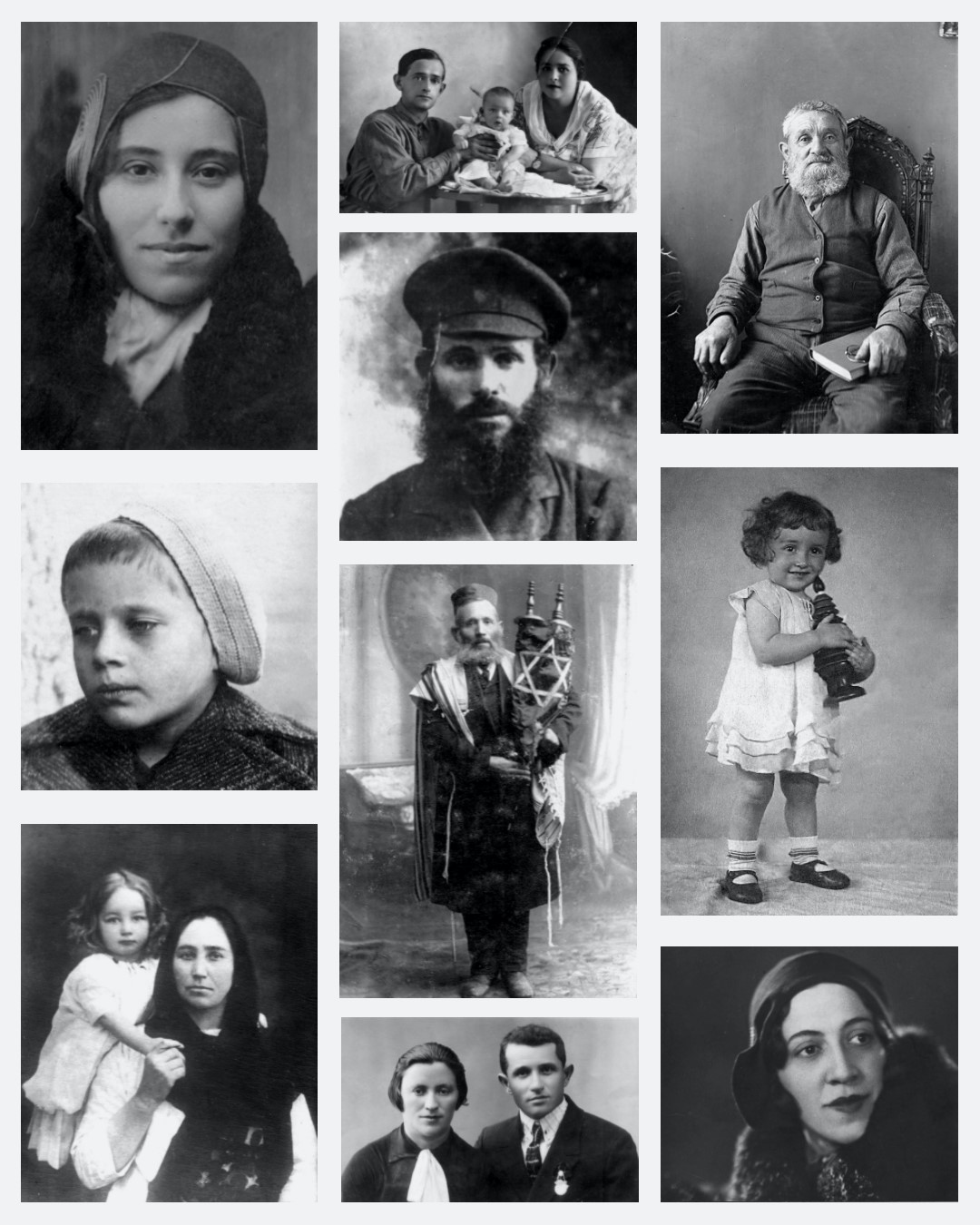
Study the faces. Never forget.


80 long years have passed since the 29th and 30th September 1941. Commemorating the Babi Yar massacre is not about remembering a number, however great it may be.
It is about remembering that more than 30,000 women, children, men, grandparents were taken from their homes, were forced to move to an unknown destination, a destination that would become their Babi Yar grave, simply because they were born Jewish.

The Ravine at Babi-Yar. September, 1941.


They were shot by German gunmen from all over Germany. And then thousands of neighbors watched, most of them passive, as their Jewish neighbors left the building forever.
80 years have passed. The memory was suppressed during the Soviet era, the bodies were burned by the Germans to erase forever the evidence of the crimes committed.
Finally, a memorial is being built after so many years of absence. It will probably be the first large memorial located near a mass grave.
Mass graves do not usually serve as memorials. The victims are killed, the pits are filled and silence falls.
This memorial is an act of justice for these women, children, adults shot because they were Jews. One by one we find the sacred names of each of them.
Today, over 150 German criminals at Babi Yar have been identified. Tens of thousands of Jewish victims are being identified.
A man-made mass crime machine is made up of human beings. Every German, every Ukrainian is fully responsible for having taken part in the Nazi criminal machine.
Babi Yar also represents a reminder that other mass murders have been perpetrated, by ISIS in broad daylight in Syria, in Iraq, by Boko Haram in Nigeria, by others in the Mail, in Niger.
Babi Yar is also a signal: sooner or later, where you kill, throw bodies into pits, we will come back. The names of the victims will be found and sanctified. The names of the perpetrators will not be drowned in silence.

-Father Patrick Desbois, Yahad – In Unum


Marking 80 years to the Murder of the Jews at Babi Yar >> https://bit.ly/3kGVRSh

On 29-30 September 1941, approximately 33,771 Jewish men, women and children from Kiev and the surrounding areas were murdered at Babi Yar by Einsatzgruppe C soldiers with the assistance of local collaborators. Jews who managed to escape the massacre in September but were discovered in the ensuing months, were also brought to Babi Yar and murdered.

80 photos and stories of the Jews murdered at Babi Yar are now online in a special exhibit just launched on the Yad Vashem website.

The photos were submitted to Yad Vashem together with Pages of Testimony containing the names and brief biographical information of the victims. Each Page is a mute testament to the persecution of an entire Jewish community: Rabbis, teachers and pupils, traders and artisans, philosophers and scientists- and in many cases entire families.

In this moving exhibit we can see the faces and explore the stories of 80 of the Jewish men, women and children who were murdered 80 years ago at a ravine called Babi Yar. Explore the exhibit here >> https://bit.ly/3kGVRSh

In my hometown of Hudson Falls, New York, atop the hill overlooking the majestic Hudson River, there is a monument commemorating the liberation by U.S. forces of the horribly persecuted victims of the Holocaust, and a tree planted in memory of this 1945 World War II action, now 76 years past. It seems like a long time, but it was really just an eyeblink ago.

The Holocaust started with words. Hateful words led to hateful actions. Neighbors knew, and looked away. Did you know that by the end of World War II, 44,000 concentration camps, ghettos, and detention centers had been established by what had been considered one of the most highly cultured and advance nations in Europe? The 12-year era of Hitler and the Nazis, malevolent, criminal, and corrupt, excused and sanctioned immoral and murderous behavior. It harbored and nurtured the darkest impulses of mankind. In my talks I always prod audiences by asking how many people were killed by Hitler with his own hands. The answer is, he had a lot for help. From the murder squads of the ordinary reservist police battalions, civil servants in ‘real’ life, trained to kill families with one shot to the back of the neck each, to the good folks operating the railroads of the Reichsbahn, delivering boxcars of tortured human beings to their final destinations. The numbers people who ran the figures and devised the schedules to annihilation. The neighbors who drew the curtains as the persecuted paraded down the street, or worse, jeered and spat upon those going to their deaths.

Last week, a member of the community and his partner were attacked in broad daylight on one of the most beautiful streets in our town. The abuse was repeated this week in front of their house, more drive-by threats and harassment. He posted in a community group:

“We need your help. We are, for the first time in our lives, being harassed. On June 28, an individual attempted to hit my car head on, on Pearl St. I was at a full stop. He aimed for my car, as he passed he shouted “You f–k–g fa—t!) I was taken aback let’s say. Never have I experienced this before, especially in my beautiful Hudson Falls.”

The follow-up comments were heartwarming and reassuring of love and promises to help catch the perpetrator and bring him out from under the rock where he nurtures his insecurities. For me though, the larger issue goes beyond bringing the perp to justice. It’s that people need to know that the persecuted have allies. That our friendsthough I have only met them once, when they opened their beautiful gardens to my daughter’s high school class for their prom picturesare not alone, because an attack on them is an attack on the community. Though I don’t live in my hometown at the moment, I take this attack personally.

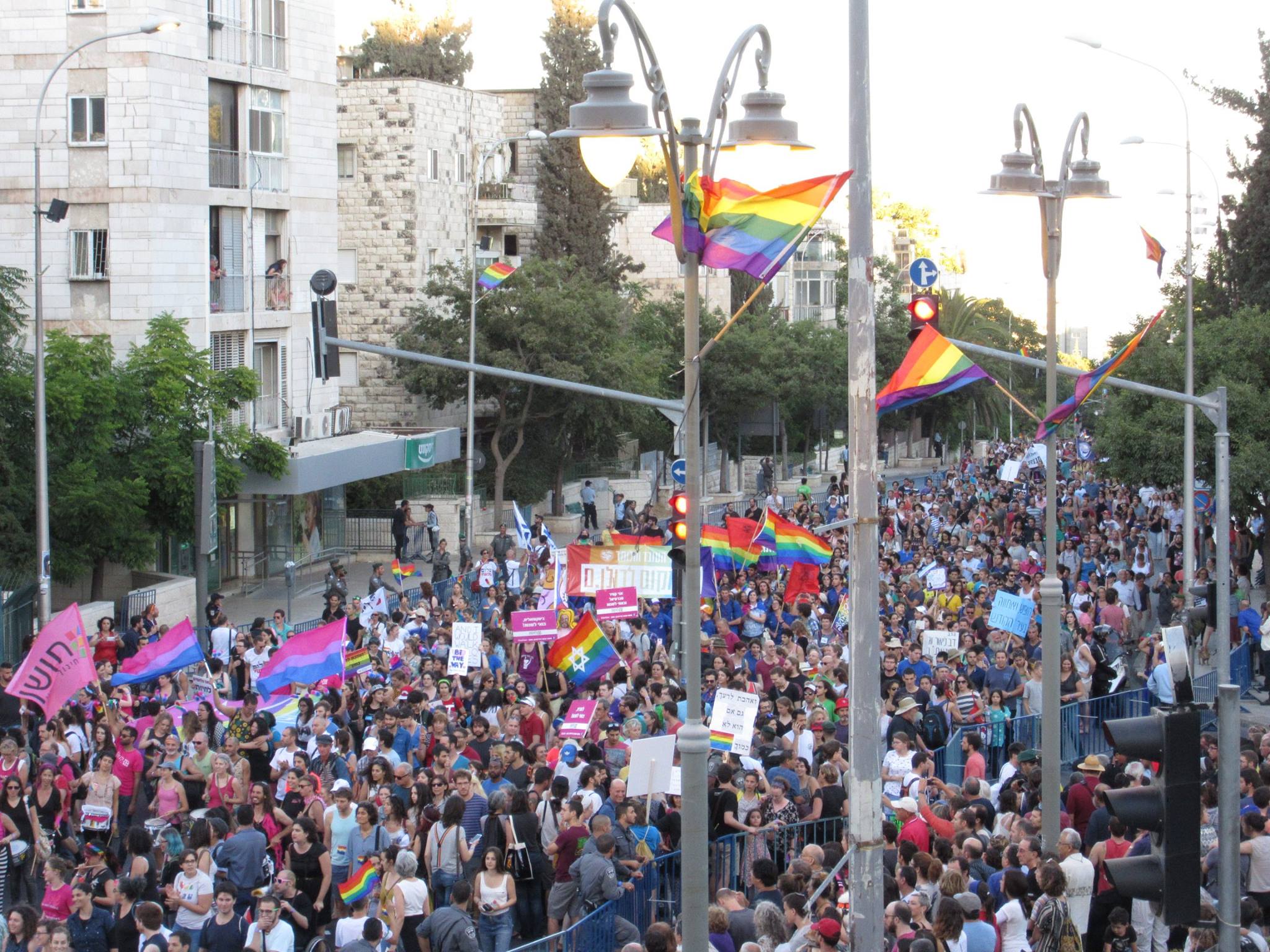
I’ll conclude by stating that I spend a lot of time trying to educate on the difficulties of Holocaust comparisons and pointing out the false equivalencies. There are a ton of them, which I won’t go into here, but suffice it to say that I’ve spent weeks at a time studying the Holocaust at the feet of master teachers [and survivors!] at world-renowned institutions and authentic sites of mass murder. Frankly, those deep immersion dives into this study of the millennia-long causes and motivations often sparks more questions than answers, but occasionally, deep, deep revelations are possible. I’ll close with this one that concludes my 2016 book, A Train Near Magdeburg. I really did not know how that book was going to end, but a Pride parade through the streets of the City of God, Jerusalem, just brought my study of the Holocaust all full circle.

I’ll leave that essay below if you are interested. In the meantime, I’m promoting an effort in solidarity to stand against this attack on our neighbors and by extension, all of us. I’d like to see their street, and all of our hometown, really, adorned with the colors of solidarity, so I’m working with a neighbor to make them available for free if you want to show your support, for the rest of the flag season. Details here. Thanks for reading.

Jerusalem, July 21, 2016.


I reached some of my final revelations in the summer of 2016 as the writing of this book drew to a close while I was studying in Jerusalem at Yad Vashem, Israel’s Holocaust Martyrs’ and Heroes’ Remembrance Authority. My fellow educators and I heard from dozens of excellent scholars and presenters in the field of the history of Judaism, Christianity, and Islam, of antisemitism through the ages, and learned from the nuanced dissections what we thought we knew about the Holocaust.

One of our final lectures was from Dr. Yehuda Bauer, who at age 90 I consider to be the godfather of Holocaust historians. Sitting six feet away from me was a man who narrowly escaped the Holocaust himself, coming with his family in 1939 to the Palestine Mandate before the window closed. He became active in the resistance to British rule, and later fought in Israel’s War for Independence. Early in his career he was challenged to study the Holocaust when few others were doing it. He mastered many languages, and it was he, after years of research, who concluded that the Holocaust was a watershed event in human history.

Today, sitting in his presence, and listening to him, I got the feeling that I was listening to a philosopher, one who also had been milking cows on a kibbutz for the past 41 years.

So the question came, as it always does—

What is the overarching lesson that we should take away from the study of the Holocaust?

To paraphrase his answer, he simply said, ‘There is no lesson, except not to repeat it. The Shoah is used, all the time, for various agendas and causes…okay, fine. But there is no lesson.’

And I think I get it. When we talk about the Holocaust, its sheer magnitude and ‘unprecedentedness’ denies us the comfort of walking away with an overarching ‘lesson.’ ‘Bullying gone wild’ it was not. Instead, he continued, ‘Maybe the real question to ask yourself, and ask your students, is this—What do you want the world to be? And then, maybe it is time to introduce them to the study of the Holocaust, because maybe the Shoah is the exact opposite of what they envision for their world, unprecedented in scope and sequence—but it happened, which means it can happen again.’

*

When we got back to the hotel to pack our bags and have a final evening to ourselves, we found out that for a few hours, we could not even cross the street to go back out—our hotel was now right on the route of one of the largest ‘gay pride’ parades in the world, right through Jerusalem. Security was tight; last year, a religious maniac stabbed six, and one teenage girl died here. But standing on the second-story hotel balcony, I could hear Dr. Bauer’s words echoing in my ears, reminding us that democracy is not only very fragile, it is hardly even out of the cradle in the backdrop of world history. But what sets democracy apart from every other experiment in history, in its pure form and in theory, is its defense of minorities. It doesn’t exist yet, but maybe this form of government needs to be protected, and nourished. And maybe this is what the soldiers were fighting for. The world does not have to be united, and, in fact, it never has been and never will be. We argue and we disagree all of the time. That is as it is, and as it should be. At the end of the day, we either kill each other, or we live, and let live.

We decide.

I had never seen a so-called ‘gay pride’ event before, so as I watched, there was another revelation. For over an hour, my fellow educators and I witnessed miles and miles of this parade of young and old, of men and women, smiling and cheering and singing; I’m quite sure that many participants, and maybe even most, were, in fact, heterosexual. And for me, this experience became a metaphor for our common experience here in Jerusalem—from that hotel balcony, we were witnessing what simply was a massive celebration of life. In studying the Holocaust together, we have plumbed the depths of the abyss that humanity is capable of, but not because of a fascination with evil and death; rather, it is because of the opposite, because of our commitment to humanity. For me also there is this burgeoning sense of righteousness in promoting the men who made a difference with their sacrifices in slaying the Nazi beast. And these American soldiers who encountered the Holocaust were not some kind of super-action heroes who arrived on the scene to save the day, just in the nick of time. As you have read, there was no plan, and they had no idea. What matters more is what they did when they encountered this trauma deep in a war zone with people still shooting at them, and later committing themselves in their sunset years to reaching out to others, so that, in Dr. Bauer’s words, the formally ‘unprecedented’ watershed event is not repeated. And maybe it’s time for a good long look at the world we live in today.

I have been on a journey that has consumed half the career that I never even set out to have. I have been joined by many along the way, and I thank the reader for also sharing it with me; that afternoon in Jerusalem, I parted with my educator friends with a final word in our closing discussion:

We are the new witnesses. We bear an awesome responsibility when we become aware, when we teach, when we communicate with others; now, more than ever, what we do matters, especially in entering this world of the Holocaust—because there is no past, and it is never over.

The tunnel can lead to the light.

You decide.

On this day the Train Near Magdeburg, pictured above in the 743rd Tank Battalion’s After Action Report following the 4-13-1945 liberation near the Elbe River, was just beginning its week-long final journey from the horrors of the Bergen-Belsen concentration camp.

I think back to nineteen summers ago, when I sat down to record the memories of an 80-year-old tank commander, Carrol Walsh, who had fought from Normandy, into Germany, back into Belgium for the Battle of the Bulge, and then back across Hitler’s Western Wall, who almost forgot to tell me the story of the train fifty-six years before. About his rejection of the mantle of “LIBERATOR”, but his acceptance of being a WITNESS, of being a symbol of the army that did something about what they saw.

I think today about George Gross, the other tank commander that day who had the camera and the photographs to prove that 2500 souls on their way to being murdered were in fact REAL, that the event DID happen, and that the Holocaust would never be forgotten. Of his years recounting the girls on that train, the children, and speaking to them and meeting the ones who could make the pilgrimage to meet him.

I think about Frank Towers, the lieutenant charged with getting these poor people out of harm’s way, as a new battle for the city of Magdeburg was about to unfold. The same Frank who excitedly beat a path to my door sixty-one years later to explain his role, and who went on with train survivor’s daughter Varda Weisskopf and I to track down over 275 survivors of that train all those years later, organizing over 11 reunions on 3 continents over 10 years.

I think today about the medic Walter Gantz, who suffered nightmares for decades after treating the victims on the train for six weeks after liberation, some literally dying on him, his trauma evident sixty-six years later in recalling carrying in his arms a sixty-pound fifteen-year-old girl’s body down the stairs in the middle of the night to a makeshift tent morgue. Of his call to my classroom to introduce himself, telling these thoughts to my high school seniors, and the salving of his scars in getting to speak to the former young people he saved so many decades later.

I think about all the beloved survivors and their families―such loving people who broke down, cried, laughed, danced with their liberators and fellow American WWII soldiers―so many whom I hold close in my heart forever.

I think about the words of one of them every year, an annual email that would arrive on this day from Leslie Meisels, recalling with his survivor “twins” the anniversary of their “re -birth”, their good fortune and gratitude for their liberating heroes, the miracles of survival and liberation, and the miracle of meeting them again.

And I wonder again why God put me on this path to bring a bit of healing to the world.

I have asked Him, ‘why me’, over and over.

So we planned a trip to the proposed 75th anniversary of liberation ceremony with survivors, 2nd and 3rd Generation survivors and liberating soldiers’ families. Funds were raised and a monument created. The pandemic hit, the event was postponed, and in the meantime, several survivor friends have passed. One wonders what it all means, from time to time. But German high schoolers and their teacher and others have gotten involved in the project to honor the survivors, and have been fortunate enough to meet some very special ones. Our film project is back on track, the monument has been laid, and I have published a Young Adult version of the story.

But as I string these thoughts together, I’m reminded of the notes I got in my email inbox so early on the morning of the 75th anniversary from Germany at the liberation site, and again today on the 76th, so I think also about these German students so focused now on learning more about what transpired in their country, in their own backyard―not out of a sense of atonement for the deeds of generations past―no one can atone for those crimes, and frankly that is not their ‘job’―but simply out of LOVE.

LOVE. And HOPE. And maybe even FAITH.

And I still see these young adults as some sort of new symbol, the newest witnesses, at once comforting and profound and at once a source of light, of life, and yes maybe re-birth.

Last year I could not witness the planned re-unification of the saved and the saviors, the healing touches passing in the land where the crimes were perpetrated, but in reading these narratives and seeing these photographs I am renewed by witnessing a new generation arising out of the utter destruction, the evil, and the hatred of 75 plus years ago― in this form of a girl and her teenage friends planting new seeds, literally, at this site where people expired with the words “SALVATION” and “FREEDOM” on their lips, and I see from afar the honoring of the goodness that radiated from the deeds of those American soldiers, really not so long ago.
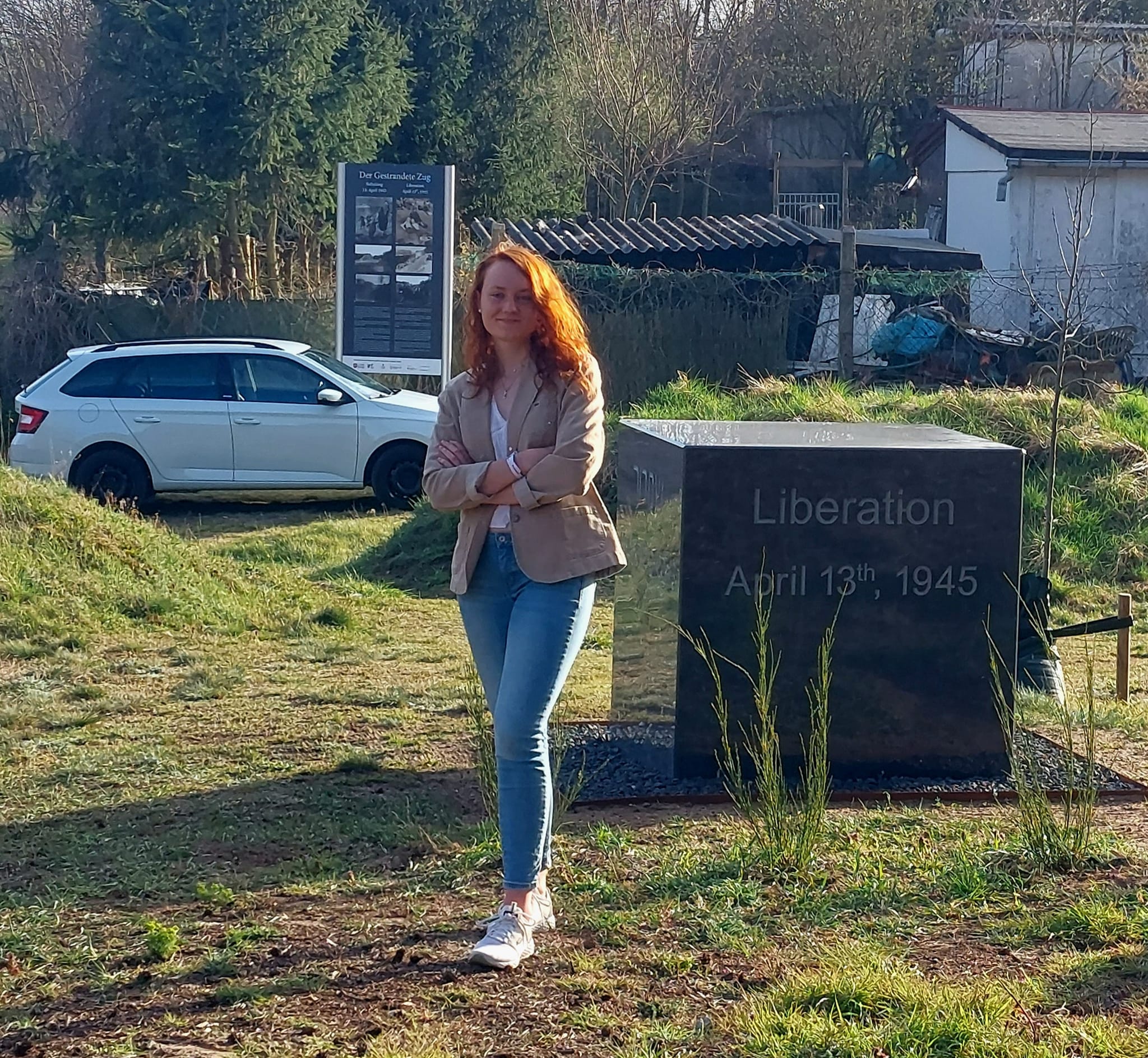


My name is Johanna, I am 19 years old and from Wolmirstedt near Farsleben. I have always taken a huge interest in history, but other than the important happenings and times you get taught at school, I would rather be told the unknown stories, the events that, in the grand scheme of things seemed so unimportant, but still impacted numerous people deeply, moved them enormously and, unfortunately, are forgotten about way too often.
When I first heard the story of the train, I thought to myself: “This cannot actually have happened so close to my home, otherwise we would have surely heard about it before. How could this remarkable story have been forgotten?”
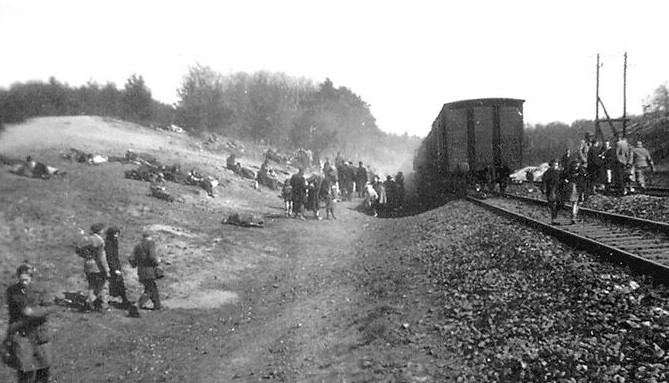
1945 this day . The hill behind Johanna and the stone is visible. people were dead or dying there. George C Gross

So, I joined the project group of the story of the “Stranded Train”, and what started out as wanting to learn more  about what had actually happened on  April 13, 1945 and also seizing the opportunity to speak English more often, soon turned into this mission that I just could not let go… I suddenly found myself doing more and more research, about people who were a part of these events all those years ago and almost naturally , the stories of the survivors,  those who liberated them, and those who took them into their homes after this train had stopped right on their  doorstep, all became a part of my life.

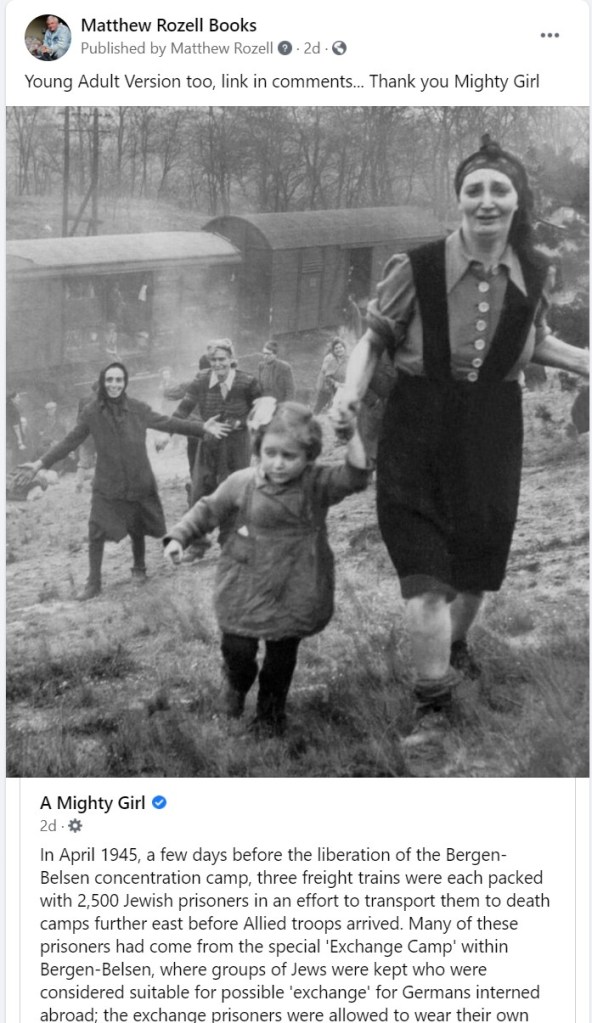
SCREENSHOT OF ‘A MIGHTY GIRL’ POST. CLICK TO READ ORIGINAL. [THEY ACTUALLY READ THE BOOK…]
RECENT UPDATES: A recent write-up on A Train Near Magdeburg was posted by “A Mighty Girl” on their FB page, with 2.5 M followers. I was impressed, they actually read the book, and continue to empower girls and young women, featured especially in the Young Adult version of the book.

Our film plans were sidelined, along with the rest of life, but now are back on track. Seeking sponsorship at all levels, especially corporate, for our PBS distributor-accepted film. Details on benefits and how to help are here (OPENS AS PDF). Thank you if you have given in the past, and be assured that it will happen!

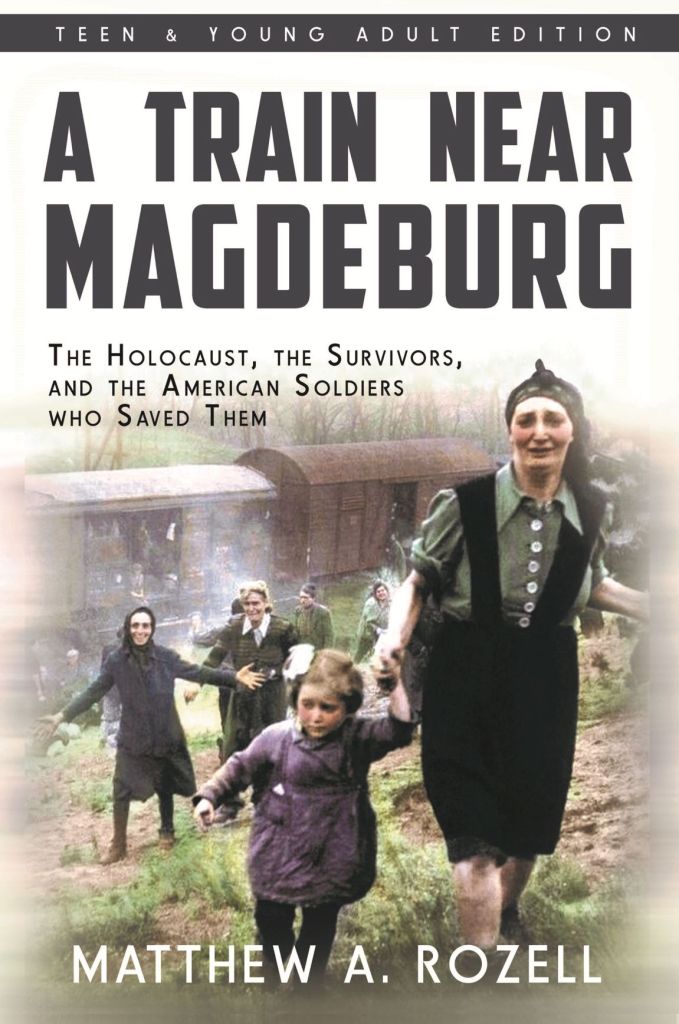
The Young Adult version of our book is here, if you would like to check it out.

The Young Adult version is here.