Feeds:
Posts
Comments

Woodstock event remembers Holocaust

WOODSTOCK, N.Y. — A Yom Hashoah event that will remember the Holocaust will take place April 7 at 3 p.m. at the Woodstock Jewish Congregation, 1682 Glasco Turnpike, Woodstock NY, 12498.

Synagogue Main Number (845) 679-2218
Email info@wjcshul.org
Persons of all faiths are welcome.

The Yom Hashoah  observance will include a candlelight memorial service, followed by an address by Matthew Rozell titled “Honoring the Hour of Liberation and Defeating the Legacy of Hitler.” Rozell is the founder of a project that has reunited survivors from the Bergen-Belsen concentration camp with the U.S. soldiers who liberated them from a train transport during the closing days of World War II. To date, with the help of Varda Weisskopf and Frank Towers, more than 240 survivors worldwide have been located, and 10 reunions have taken place since 2007. Rozell is also a teaching fellow at the United States Holocaust Memorial Museum and has spoken on behalf of its educational programs. His work can be seen at teachinghistorymatters.wordpress.com.

The ABC News video can be seen here.

So I am going to the Stations of the Cross at our local church. I have never gone before.  It is Friday evening and there are about a dozen worshipers in attendance and my family is going to lead the procession. In fact, we are the procession.

My daughter and son flank me with candles and I have the heavy cross. We stand before each station as my wife is at the lectern reading the text for the parishioners to follow and respond to. At the cue of the organ, we move on.

Somewhere along the way the candles go out, first with Mary and then with Ned. Kind of symbolic given what comes next.

Laura reads the text from the proscribed booklet, beautifully.  I’m trying to follow along but frankly am kind of distracted by the candles going out and my aching feet. Maybe they are supposed to hurt, maybe that’s the point. To reflect on all this suffering, and then death.

But flanked by my children I am jolted back with the utterance from the lectern: something near the tenth station about how somebody in the storyline has to practice Christianity in secret, “…because of the Jews.”

It’s 2013. This is the church that reared me. At the lectern where I eulogized my  father, my wife reads the proscribed text: because of the Jews. After the service I check the booklet- yep, it’s there, she read it like she was supposed to. Imprimatur.

*             *             *             *             *             *             *             *

Though my father would go to the Stations during Lent, this is our first time. To tell you the truth, I’m left a bit devastated. On the ride home, I can’t help but think back to the pogroms that would occur on Good Friday, where houses are torched and people are beat up and killed after church service. Jews. How innocent people who knew that to be on the streets this day was to be a target, instead had to “lay low” on that day. Since childhood I perceived being born on Good Friday as a badge of honor of sorts-so why now I am reflecting on people murdered by angry mobs on that day, throughout history?

*             *             *             *             *             *             *             *

Sometimes I feel the eyebrows arching behind my back for my interest in studying and teaching the Holocaust.

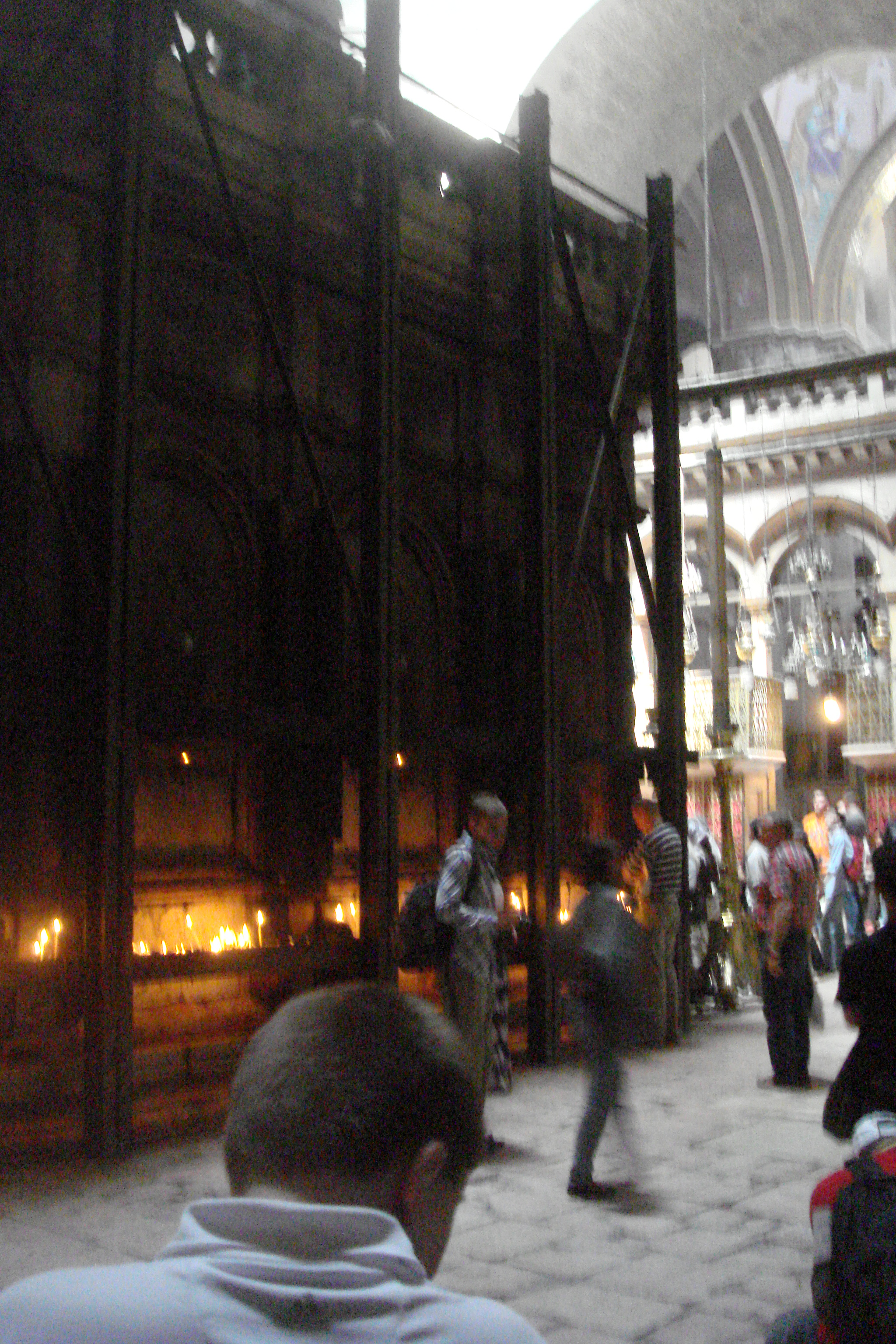
Son at Western Wall, Jerusalem.

Son at Western Wall, Jerusalem.

First, the obvious. People I don’t know have railed against me on the Internet, implying that traumatized liberator soldiers are liars. The Jews are lying again. That the survivors are pictures of health. That I should educate myself.

Then, the more subtle. I’m not Jewish.  People I do know perpetuate stereotypes about Jews and money, Jews and finance- well, if I was Jewish, very likely at some point in time I would have been forbidden from practicing the trade of my choice. If an angry mob was going to burn down my business and drive me out of my home, my village, maybe I’d go into a more “portable” means of sustaining my family, too.

But also sometimes I think I’m regarded with curiosity by some people in the Jewish community. Some people wonder why I am so dedicated to this mission. Some do not understand why a non-Jew takes the interest to do what I have done, but to me it is simple.

Son at Christ's Tomb, Jerusalem.

Son at Christ’s Tomb, Jerusalem.

I’m a human being.

It was a Jewish catastrophe, but also an unprecedented tragedy for the entire human race. We all have to deal with it and sort it out. Being an educator, it naturally follows that there are significant lessons here.

I also think I am justified in arguing that these lessons are urgent.

Following the Sabbath, the Jewish mother goes to claim her Jewish son, so many years ago. In 2013, my birthday falls on Easter.

I’ll  think about this- meditating on the photos here that I took myself-that maybe it’s time to set aside what keeps us apart. We’ll light the candles again.

And as we begin Passover/Holy Week, I’ll end on this note: “Whether discovered in the story of a nation making the journey from Abraham’s early successes to the Israelites’ slavery and subsequent redemption, or in the story of one who lives, dies and is born again, we must all celebrate that life holds more possibility and potential than we first imagine — that there is reason for hope, and that in celebrating triumphs of hope from the past, we can unleash new stories of hope in the present and in the future.”1

last trainOn the Occasion of the Release of Rona Arato’s The Last Train

My name is Matthew Rozell and I have the good fortune to call Paul and Rona Arato my friends.

I congratulate Paul and Rona on the launch of the new book, The Last Train. In my role as a teacher I sat down with an animated veteran of World War II a dozen summers ago. He was a tank commander and he had many stories to tell. Rocking back and forth, smiling, and with a twinkle in his eye, he recounted the events of 2 generations past. He told of many close calls and occasions when he was sure he was about to die. He talked about his friends and the bonds that were forged under combat, and the fellow soldiers that he lost. He remembered all of their names.

I would have been twenty-four. I would have been in combat for nine months. That is a long time to survive. To survive nine months was to survive a hundred years. I could not even remember my former life…I was a fugitive from the law of averages, as it was. 

Towards the end of my visit with him in the summer of 2001, his daughter, who was standing in the background, asked her father if I had been told about “the train”. No, Carrol Walsh, or “Red” as he was known by his soldier friends, for his fiery hair and the Irish temperament that accompanied it, he had not told me about the train. So he began:

Well, late in the war, again that nice, beautiful April day.  We were shooting like crazy across the top of Germany and Major Benjamin of the 743rd {Tank Battalion} was kind of out ahead scouting a little bit… he came back to the battalion and he pulled my tank and George Gross’s tank [fellow tank commander] out.  He told us to go with him.  So we did.

We came to a place where there was a long train of boxcars. … I can remember pulling up alongside the train of boxcars, Gross and I, and Major Benjamin. As it turned out, it was a train full of concentration camp victims, prisoners, who were being transported from one of their camps… I think they had been in Belsen, on their way to another camp…

 So there they were. All of these people, men, women, children, jam-packed in those boxcars, I couldn’t believe my eyes. And there they were! So, now they knew they were free, they were liberated. That was a nice, nice thing. I was there for a while that afternoon. You know, you got to feed these people. Give them water. They are in bad shape. Major Benjamin took some pictures, and George Gross took some pictures too…

I contacted George Gross, who gave me copies of the photographs that he and Major Benjamin took, some of which you see in this book. Dr. Gross also gave us a moving narrative that you will also find on our school website, along with dozens of other oral histories that the students and I collected.

Four years went by after they were placed online in 2002… Nothing happened. Then, out of the blue I heard from a grandmother who had been a seven year old girl on that train. She was utterly shocked to see photographs of the last transport she was ever on, and photographs of the day of her liberation. I am sure that Paul had similar feelings. And now the question Paul must have asked himself- do I really want to go there?

Thank heavens that he did.

Paul sent me the email described in Rona’s book four Thanksgivings ago. Little did he know how his life would be enriched, though I am certain that some of the horrors of his family’s experience in the Holocaust would be relived in the writing of this book, and as Paul told our high school kids, are relived in some fashion each day.

When I say enriched- that is not really the right word. I’m sure that for those who have witnessed Paul’s relationship with his liberators, we are witnessing a higher power at work.  It is the power of love that has transcended space and time, the same love that his beautiful mother showered on the children and the protectiveness of his older brother Oscar, revealed in Rona’s book.

Paul met his liberators on several occasions, but developed a particularly close bond with Red and his family. The last time I saw them together, we were at an intimate dinner gathering with Red and his family, Paul and Rona, and another survivor and her extend family.

I did not say much. I just wanted to watch and listen.

Paul and Red were seated together. Though Carrol was not feeling up to par, he roared with laughter as Paul told of flying to the USA at a tender age following his family’s move to Canada-Paul was going to design cars in Detroit, you see-and being picked up by law enforcement at the Detroit airport and driven to the bridge to Canada and bid farewell, as he had neglected the proper papers to emigrate. How Red got a kick out of that story.

But there was something else there, something that I will never be able to share, or that our families will never be quite able to touch, though Rona certainly comes the closest in her book. That was the bond between soldier and survivor, the unspoken love and joy at having been reconnected after so many years. Frank Towers, the lieutenant in the book, knows of this too.

Paul knows now that there are no coincidences. I think we all do.

On December 15th, 2012, I called Carrol in Florida where he was ailing. I did not want to admit it to myself, but my old friend was dying. We both knew it was our last conversation, but he was making jokes to the end. I fumbled a bit, and told him that the weather had been extremely cold up here in the North-ever since the Battle of the Bulge, freezing in subzero temperatures in his tank, he had hated the cold- and with fatigue in his voice he chuckled and said that “he hoped it was cold in the place where I am going”. Two days later after bidding his family goodbye, he slipped away peacefully.

World War II brought out the worst in humanity, and the Holocaust was the greatest crime in the history of the world. Carrol told us that he did not go to war to save the world- but that he had an obligation and he just wanted to get it over with. Survival would be a nice fringe benefit. Indeed, the liberation of the train was almost an afterthought for him.

But the actions of these soldiers, who after all had battles to fight and were still being shot at- to stop, and to take direct action so that hundreds and hundreds of sick and starving people were taken care of-that also speaks volumes of how the goodness of mankind manifested itself, and triumphed, in the cauldron of evil. We recognize as well the British and Canadian troops who would be traumatized at the liberation of Bergen Belsen two days after Paul and Oscar and their mom were freed from the train by the Americans. Sixty thousand sick and starving people greeted those soldiers, and eight hundred died the day of liberation. Thousands more would follow. The trauma is real, and it is felt by both survivor and soldier.

I send my well wishes to the survivor community in Toronto, where I have several additional friends who were also honored to forge a special bond with the soldiers who freed them from the train. Each has their own personal story, which I and my students have an obligation to keep with us as we have become the new witnesses.  I again congratulate Rona on the difficult job of writing this book. She too has added to our body of evidence of the greatest crime in the history of the world, but more importantly, she is keeping the word alive for the next generations of humanity-the obligation to never forget.

Matthew Rozell

Hudson Falls, New York

March 5th, 2013

Get the book here

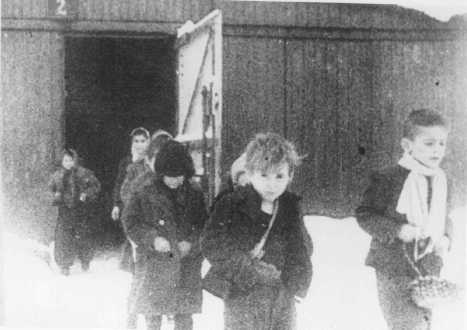
Soon after liberation, surviving children of the Auschwitz camp walk out of the children’s barracks. Poland, after January 27, 1945. — United States Holocaust Memorial Museum

Soon after liberation, surviving children of the Auschwitz camp walk out of the children’s barracks. Poland, after January 27, 1945. — United States Holocaust Memorial Museum

Today is International Holocaust Remembrance Day, the day Soviet troops over ran Auschwitz in 1945. This week I received a note from an Israeli survivor friend, shortly after the passing of one of her liberators, Carrol Walsh. Sara lost over 60 of her family there- and her immediate family was saved only because the day they arrived at Auschwitz, the death machinations were working at full capacity and her transport was rerouted to Belsen. She was liberated on 13 April on the evacuation transport near Farsleben, known here as the Train Near Magdeburg…

In her letter she asks important questions of me. I have responded the best that I could, below.

Dear Matthew,

 We were very sad to hear that Carrol Walsh passed away. Only lately did I get to know him, and he risked his life in order to save ours. It is a pity we did not get to meet more.

I can’t express in words the loving feelings for the young tank commander that for sure always had a smile on his face, and never stopped smiling after we met- 65 years after the victory. I am sure Carrol Walsh made the best out of his life; I was fulfilled to know him and his beautiful family.

I read about his profession in the years of his life. It was interesting to see how much meeting with us affected him.

I thank you for your unusual courage to initiate the exciting meeting [reunion].

I suppose you were very excited for the event you had initiated. Did the idea come in different parts? I am trying to understand the development of your thinking.
When you first wrote to me about the meeting [invitation to the proposed reunion], it was on the day we were released- the 13th of April. I got home after meeting my brothers and celebrating the release [liberation]day. I couldn’t relax, I immediately told all my brothers. I was so happy, as if it was happening again.

The meeting completed a missing part in the picture for me, after all the horrifying things we went through we couldn’t even dream of a miracle like that coming out of the blue.

I cannot go back more to the extermination camps and escort groups because I don’t have the physical nor mental power to do that anymore.

There are questions that bother me.

Are you able to answer them?

Why shouldn’t the world forget and let this be over?  

A. So, some people do want to forget. Others will say that it did not happen. For those reasons, it must never be forgotten. This is the biggest crime in the history of the world.

As Walsh states, how could humanity have stood by and let that happen?

Does my work, the hard work I do, do anything against the forgetting?

A.The most impressionable minds in the world are those of the youth. It is they who the Nazis “educated”; it made it easier for the crimes to be committed. This is why they must hear now.

The work that you, and I do, has an impression. I hope to continue this work after you must slow down. Please remember that.


You are a historian, should the memory be kept?

A.The memory must be kept. As educators it is our duty to keep it alive. We must fight those who trivialize or denigrate its importance.

Is there a proper way to keep the memory?

A.There is no one way except to be open to the discussion of humanity and how humans could do this to one another. We must also bear in mind however, that the soldiers who helped the suffering to new life bore their own pains in doing so, yet also made a choice to redeem humanity. Some did not sleep soundly for years.

I think this is so, and also must not be forgotten. The war brought out the most evil in the world. But I think it also revealed some goodness in the form of the soldiers who liberated or otherwise cared for the victims.

Who should be documenting everything, the “victim” or the “aggressor”?

A.The aggressor fades from memory. New generations asks questions. It is true that some are bothered by the questions. But the young will always be curious and want to know- is this a stain on the German people? I know some Germans today who work very hard to keep the memory alive, as you also do.

The victims give the testimony. This is all they can do. But it is the evidence of the crime, and one that new generations must work with. That is why your work is so important.

Who is in charge of making the conclusions?

A.I would say that institutions such as the United States Holocaust Memorial Museum and Yad Vashem are the world leaders in this area. I have been trained, well, I should hope, by the USHMM. I do not know enough about the German institutions but I hope to raise enough funds to travel to the camps and study there this summer.

I made this video tribute a few years ago for my students. When it ends, they always sit in silence. The speech at the beginning was to striking sanitation workers in Memphis the night before he was killed.

Even though his birthday was last week, we stop and recall today.

For the sake of humanity.

You may enjoy. Five minutes of your time. Click the little gear for HD viewing.

Good also for kids to see to begin the conversation.

Peace and every good wish.

West Ham send message to racist fans with Holocaust ceremony

Auschwitz survivor will lead pre-match ritual following anti-Semitic chants at Tottenham

Darren Richman /The Independent

Friday, 18 January 2013

West Ham will commemorate Holocaust Memorial Day today at Upton Park with a reminder to sections of their support that anti-Semitic chanting is unacceptable. The club have invited the Football Association chairman, David Bernstein, the Mayor of Newham and Holocaust survivor Zigi Shipper to attend the match against Queen’s Park Rangers and mark the occasion by lighting candles before kick-off. Lord Sacks, the Chief Rabbi, has written a piece in the programme emphasising the fact that sport can be a force for good in helping erase all forms of prejudice.

West Ham’s decision to honour the victims of the Holocaust in this manner is particularly admirable given the events that marred their trip to Tottenham in November. A vocal minority of fans engaged in abusive chanting and made hissing sounds to emulate the gas chambers. Shipper feels that education is the key.

“A lot of these people don’t know any Jewish people,” he said. “They don’t really know what a Jew is. They don’t realise the full scale of what happened. Six million Jews were murdered along with Gypsies, homosexuals and the physically and mentally handicapped. All just because of who they were.

“I have gone to many matches but never heard anything like that which was heard at White Hart Lane. I know for certain that I would have left the ground immediately if I’d been there. When I got off the boat and arrived in this country as a boy, I never imagined anything like that would happen.”

Shipper, 83, was sent to Auschwitz concentration camp in his teens and witnessed countless horrors. “I saw women and babies shot dead,” he said. “Every day I ask myself how human beings could possibly behave that way and then sit down with their wife and children. How could they eat dinner? How could they listen to music?”

Shipper settled in London shortly after the war and started his own stationery company, which is still active today. Most of his time now, however, is spent educating young people.

He said: “I travel round the country visiting schools and universities and share my story. It is important that people understand what millions of us went through. I don’t want the Holocaust to be forgotten because there is always the danger of history repeating itself.”

Of recent racist incidents in football, including Milan’s decision to walk off during a game, he said: “Is walking off letting the racists win? It’s hard to say but I would probably have done the same.”

Shipper has already been involved in spreading his word to football: he addressed the England squad before they departed for Euro 2012.

“I have met Prime Ministers and the Queen but being asked to speak to the players was the greatest honour of my life,” Shipper said. “All I kept thinking was that it’s not bad for a little Polish immigrant who came to this country with nothing more than the clothes he was wearing.”

http://www.independent.co.uk/sport/football/premier-league/west-ham-send-message-to-racist-fans-with-holocaust-ceremony-8458299.html#

Matthew Rozell, 30th Infantry Veterans of WWII, Holocaust survivors at Mighty Eighth Air Force Museum, March 2, 2012.

Matthew Rozell, 30th Infantry Veterans of WWII, Holocaust survivors at Mighty Eighth Air Force Museum, March 2, 2012.

Frank Towers’ invitation to soldiers, survivors, interested parties and their families to come to Louisville in the spring. The soldiers have convened annually since the end of World War II; since 2008, thanks to the project, the 30th Infantry Division has hosted Holocaust survivors and their families as well for very emotional, uplifting, and fun times. Email for details.

*********************************************************************************************************

Don’t forget the dates!!       April 11 – 12 – 13, 2013

Don’t forget to make your Hotel Reservation

and Registration!!

Hotel Crowne Plaza,  Louisville, KY

*********************************************************************************************************

Dear Fellow 30 Division Members and Friends:

I hope you all enjoyed your holiday and that the New Year holds only good things for you and your family.

Now that the holidays are over it is time to focus on making your reservations for the Reunion.  Included are the Pre-Registration Form and the Reservation Form and the information to make your hotel reservations. Please do it NOW.

We have a great program planned and will include a trip to the Louisville Slugger Factory and Museum, a professional photographer that will take a picture of you and/or your family (so bring your medals and ribbons to show off).  We will also have one of Louisville’s noteworthy news casters, Ken Schulz, MC our banquet on Saturday evening.  Our entertainment will include a local bagpiper as well as others.

Why come to Louisville?

Louisville, is a city of urban neighborhoods that have been revitalized, and some of our best known shopping areas are the Bardstown Road and Frankfort Avenue corridors with their small shops and plentiful locally owned restaurants.  The homes and buildings in the Old Louisville neighborhood is one of the largest historic preservation districts featuring Victorian architecture in the U.S.  The Downtown area has had significant renovations over the last few years with the construction of the YUM! Center which is home court for our Louisville Cardinals men’s and women’s basketball teams.  The Center, along with Waterfront Park and Fourth Street Live, have attracted new housing, shops and restaurants breathing new life into the area.

Louisville has museums to interest everyone..  Home to the Frazier International History Museum; The Muhammad Ali Center; The Louisville Science Center; The Kentucky Museum of Art and Craft and many, many more.

Our hotel, the Crowne Plaza, is locally owned and operated.  It is near the airport and offers free shuttle service from the airport to the hotel.  The Crowne Plaza also offers many amenities including indoor/outdoor pool, fitness center, boutique shop, 24 hours business center, complimentary Wi-Fi, and more.

You can see Louisville is the place to be, so much so that Louisville was named “The Top U.S. Travel Destination for 2013” by Lonely Planet’s, the world’s leading travel publisher.

We are looking forward to having you here and sharing some of our history and hospitality with you, and most of all, to meet many of your former friends and colleagues.

Best Regards,

Bill Vaughan. President

30th Infantry Division Veterans of WWII

*********************************************************************************************************

Taps – 2012

(Last 6 Months)

ADAMS, Cleveland L. 30 MP Plat. 7/30/12 Stockbridge, GA

ADKINSON, Bruce 743 TkBn B 6/17/12 Beverly, MA

DUMEY JR, (DuMay) Leon 120-G 11/23/12 Cape Girardeau, MOM

FARKAS, Louis 119-I 12/ /12 Colton, OR

HOGUE, Donald W. 117 K 6/12/12 Montevallo, AL

HOUCK, Arthur T. 120-K 6/16/12 Hampstead, MD

LAZINGER, Sol 117-B 6/13/12 Philadelphia, PA

MAXEY, James C. 120 CN 6/ 29 /12 Tullahoma, TN

MILLER, Edmund L. 120-H 9/07/12 Pewamo, MI

PITRUZZELLO, Joseph S. 119-L 5/02/08* Alexander City, AL

PRUITT, Frank H. 120-2BnHq 12/10/12 Spartanburg, SC

PULVER, Murray S. 120-B 9/21/12 Peoria, AZ

STANFORD, Arna V. Widow 8/18/10* Williamsburg, VA

STECKLER, William 105 Engr. B 9/09/12 Palm Harbor, FL

SULLIVAN, Thomas “Jack” 118 FA 8/07/12 Savannah, GA

TURNER, Woodrow W. 117-F 8/15/12 Littleton, CO

UBBES, Jean M 743 TkBn-B 7/28/12 Kalamazoo, MI

VOORHIS, Thomas K. 120-K 8/06/12 Manteca, CA

WALSH, Carrol S. 743 TkBn-D 12/17/12 Sarasota, FL

YOUNG SR., James E. 120 6/26/12 Butler, PA

Those with an asterisk (*) were received too late for a prior publication.

Our Most Sincere Condolences to the Families of These Lost Heroes

*********************************************************************************************************

As most of you already know, men of the 743rd Tk. Bn., and  30th Infantry Division, liberated over 2.500 victims of the Holocaust from Bergen-Belsen on 13 April 1945.

We will be honored to have some of these Survivors join with us again at Louisville.  Two of them have never been with us before, so they will give a resume of their life history, so be sure to come to hear these stories that have never been told before.

One of these Survivors will be coming all of the way from Jerusalem, Israel, joining with other members of his family, to meet his Liberators for the first time.  The other Survivor will be coming from San Diego, CA with his daughter, also to meet for the very first time with some of his liberators.

To make it clear, each of you veterans were “Liberators” of this group of victims.  Although you may not have had any personal hands-on experience with them at the time of their liberation, You were doing your job which was supporting the action in the local vicinity of this tremendous discovery and the release of these frail humans to Freedom.

Join with us on this occasion to meet these Survivors that you helped to liberate 68 years ago !!

This will be an Historic event !!  68 years to the date of their Liberation !!!


A funny thing happened on the day that schools all over the US were supposed to be attacked again, and the world was scheduled to end.

Nothing.

Never mind the fact that on Friday, Dec. 21, many districts nationwide closed and a lot of schools locally and elsewhere saw significantly high rates of absenteeism. Some parents refused to send their kids to school; other kids, being kids, milked it and began vacation a day early.

As a teacher, I’ve been through this before. In the beginning, it was the horror of Columbine. The following week, one could cut the tension in the schools with a knife. And on the first anniversary, I remember the hype being even worse. The stress levels were off the charts. More than a dozen years later, I’m also now a parent with school age children.

Following the latest horrific school tragedy, a well-meaning teacher in Florida coined the phrase “our 9/11 for schoolteachers”- google it if you like-as he looked ahead to returning to the classroom following the shooting. And true to the pattern established after Columbine, each passing day in the schools saw the tension levels ratcheted up. By Friday many schools even had an armed presence in the hallways. Outside my own classroom a kid accidentally dropped his books –a couple of my students flinched automatically and then shot glances at one another. But I don’t think anyone laughed.

When a student “joked” that he heard we were all going to die Friday, the marker got capped, that day’s lesson went out the window and a new one began. I turned one of their desks around, pulled out the chair, and sat down. We clarified the lockdown procedure; I explained my expectations; they listened. Then the questions came.

Thus we began the “national conversation”. And it was not about gun control.

It was about fear control.

I did not psychoanalyze or attempt to explain the inexplicable. I listened to the concerns, but gently steered the conversation back to the elephant in the school hallways- the unadulterated undercurrent of anxiety and fear pulsing through the building.

I told them that if a couple designated school safety officers with concealed carry permits might make people feel better, maybe a paradigm shift should be part of the discussion. But let’s consider first how we got here.

I told them that in preparing my own lessons, and thinking and writing about them at my blog, I constantly am exploring what it truly means to be an American. The actions of the perpetrator do not define us. After catastrophes, as a people Americans are consistent in exhibiting an outflowing of love, compassion, concern and “the demonstration of wish and good intentions”- a term once used by a friend, a Holocaust survivor, to describe the reaction of the American soldiers who found him in his pitiful state. This national inclination to want to help others who are suffering makes me proud, but there is another reaction that needs to be brought up.

Everyone wants to help. To me, though, there is something a bit discomforting about a nationally known TV doctor attempting to comfort a grieving child in Newtown. Whether or not the star sanctioned it, it was transformed into a photo op. I found it unsettling when another daytime television megastar softly pitched questions to a sobbing child about his dead brother. A promotional soundbite let me know that “coming up, the All New Dr. “X” show will be on the ground in Newtown.”

It was incessant, and we ate it all up. It made us sick, yet we came back for more. We posted links on Facebook. Our kids were bombarded with this, and it would just a matter of time before the “did you hear” rumors circulated. Every school chief information officer in this nation had the door pounded in that week, I will guarantee. Parents demand action and criticize policy. The “how safe are your schools” surveys begin. And it all trickles down.

It seems today that our fears are fueled exponentially by our desire for information and the media’s accommodation of our needs. Fear and death sells, and rules the day. For some reason we seem to be drawn to it.

So we steered the discussion back. As a teacher, I do not accept the notion of “our 9/11 for school teachers”, just as a parent I chose not to be subjected to the incessant media broadcasts of terror and anxiety in the days following the attack. We can’t control others, but we can control how we react. But if, as a nation, we decide we want to send our kids to reverse prisons every day, then we have made our choice.

The day after our conversation, on Friday, December 21st, one of the students who did venture back into school  commented that she felt better, felt safer. Maybe it was the two officers patrolling the halls.

But maybe our classroom conversation had something to do with it as well.

Friday the 13th.

This account comes to me from a survivor’s son who lives in Hungary. He had read of Carrol Walsh’s passing on the internet and contacted me. It is Carrol who is commanding one of these tanks. Sgt. George Gross commanded the other, and took photographs.

I just came across this website . My father was on this train.
He passed away twenty years ago, in April 1992.

Here is an excerpt from his memoirs about his liberation day.
—————————————————-

Translation from my father’s Memoirs pp. 302-304.
————————————————-

The day of April 13 1945 was a Friday and a sunny and windy day. In the morning, the SS opened the doors of the freight cars, after they had argued with each other whether they should kill us with their submachine guns. But the US troops were too close.

——————————————————————-

Perhaps it was an older SS man who prevented our execution. Later that day, a Jewish woman, who had been his lover in the camp, saved him from becoming a prisoner of war or worse. She got him civilian clothes, I do not know how. The same woman became the lover of an American soldier later.
——————————————————————

Several hundred people wrapped in rags streamed through the open doors, if they could be called people at all. We were all mere skeletons.

The train was idling in a deepening, so I climbed uphill, across a road and to a field. I was pulling out potatoes planted on the field, when a motorcycle approached. It was a motorcycle with a side-car. There was an elegant SS or Nazi leader in the front: I could not decide, since he was wearing a mixture of uniform and civilian clothes. It must have been his wife sitting behind him and his child in the side-car. He pulled over and offered me a cigarette. I told him I did not smoke, so he closed his silver-looking cigarette-case and started the engine.
He seemed to hesitate about the direction he should take.

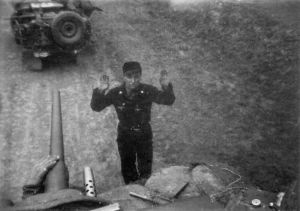
Prisoner taken. Photo by tank commander George C Gross, April, 1945.

Prisoner taken. Photo by tank commander George C Gross, April, 1945.

Then two small American tanks arrived. I was standing in the middle of the road, and noticed that the American soldier leaning out of the turret of one of the tanks aimed his gun at me.
The tank came closer and closer, and the soldier lowered his submachine gun. I must have looked terrible, so he did not take me for an enemy. I was lucky he had not shot me from the distance, since my small coat and boots vaguely resembled a military uniform. Lice were crawling all over my clothes and skin.

The few hundred former inhabitants of the concentration camp surrounded the tanks right away. Suddenly somebody remembered that the SS guarding us were still in the carriages. The SS were caught quickly, and lined up. The “intrepid” SS were trembling so heavily that their pants were flapping.

The first thing a Jewish woman asked from the soldier leaning out from the tank was money, and she received a dollar bill. She must have established her future with this dollar.

My attention was drawn to something else: in the rear of the tank there was a box of canned food. I climbed under the tank, emerged at its end, and pulled out a can. It turned out that I stole a can of oranges. This was my luck. I ate the potatoes charred in the can with the oranges, and probably this combination saved my life. Everyone who ate meat or anything greasy died within hours or within one or two days at the latest.

I felt fever in my body, undressed completely naked in front of staring women, and went into the ice-cold water of the lake next to the railroad. People warned me not to do this, but I went into the water, felt good, felt that I got rid of the lice and the burning heat of the fever. When I put on my rags again, I felt the fever ever stronger.

I asked an American soldier to sign the photo of my fiancee (I still have this photo). To my surprise, he signed the name Churchill. I thought he was joking. But he reassured me that his name was really Churchill.

(Once I read about a father named Churchill, who went to see his son’s grave in Vietnam during that war. The report mentioned that the father had been a soldier in World War II. He must have been my Churchill)

In the evening, there were news that we should flee, because the Germans pushed back the Americans. The Germans would massacre us for sure, the women had pulled out material for parachutes from a carriage in order to make clothes.

I was already so weak that I did not care whether the returning Germans would kill me: I stayed in one of the carriages, and fell asleep.

On Saturday, April 14, German peasant [horse-drawn] carts came for us by some order, so I was carried to Hillersleben. I dragged myself to the first floor of the first building, it looked like an office building, lay down under the sink of the bathroom, and fell asleep.

I am sure the American soldiers had no idea who we were and what we went through.

Class Act
Historic Reuniter
By Nancy Cooper
Photography by Erica Miller
Volume 147, Number 1, January/February 2013, Page 7

How does a young man from a small town with no experience in Holocaust education become a well-regarded figure in World War II and Holocaust history nationwide?

Matthew Rozell 12-12 American Spirit magazine

Not purposely posed. Erica Miller photo. Click the photo to see what I mean…. Only thing missing from 1992 is Dad.

The answer is part of the story of the remarkable career of Matthew Rozell, history teacher at Hudson Falls High School in New York. Following in the footsteps of his father, who was a history teacher in a nearby town, Rozell has taught at his alma mater for the past 25 years.

When Rozell emphasizes to his students the importance of tracking down primary sources, he has a dramatic way of proving his point. Through such primary research, he and his students have been able to identify and reunite Holocaust survivors with the U.S. soldiers who freed them.

Rozell’s instrumental role in such a historic reunion began in 2001 when he sat with Carrol “Red” Walsh, tank commander, U.S. Army 743rd Tank Battalion, to listen to some of his World War II tales. After nearly two hours of conversation, Walsh was reminded by his daughter to “tell [Rozell] about the train.” That prompt was a catalyst to a bigger story.

Walsh related that in April 13, 1945, his tank division saw something unexpected near Magdeburg, Germany: freight train cars alone on a track. When he drove his tank alongside the train, he could see that the cars were filled with Jewish men, women and children—more than 2,000 of them.

Intrigued by the story, Rozell searched for photographs of the liberation, which he posted on his school’s website in 2002. It wasn’t until four years later that Rozell received an e-mail from a grandmother in Australia who had been a 7-year-old girl on that train. She said that as soon as saw the photographs, she fell out of her chair: This was the day of her liberation in 1945.

From then on, “Almost every time I opened my e-mail inbox, there would be another message from a survivor, somebody that I wasn’t aware of before,” Rozell says. “These people weren’t aware of each other for the most part before finding the site.”

With the help of liberator Frank Towers and a survivor’s daughter, Varda Weisskopf of Israel, Rozell and his students went on to reunite nearly 225 Holocaust survivors with their American liberators. Rozell organized 10 reunions: One took place in Israel and three happened at his school. Students recorded the individuals’ interviews as part of a World War II Living History Project (www.hfcsd.org/ww2). Learn more at https://teachinghistorymatters.wordpress.com.{clarification: there have been at least 10 reunions since Rozell began the project; however he did not organize the ones occurring off campus but rather participated in or otherwise helped to facilitate them.}

Students have said of Rozell and the project: “He puts history right in front of your eyes. Never could I have gotten the experience of meeting such inspiring people who learned to love after the ultimate form of prejudice was thrust upon them. A message of acceptance not only reached the little town of Hudson Falls, but the entire world.”

“It’s life-altering,” said another. “And because we’ve heard these stories, it’s our job to make sure it won’t happen again.”

The powerful lesson hasn’t been limited to his students at Hudson Falls. In 2008 Rozell was awarded a Museum Teacher Fellowship at the U.S. Holocaust Memorial Museum for his work in Holocaust education. The Tennessee Holocaust Commission has created workshops based on his work. On September 25, 2009, Rozell and his students were named ABC World News “Persons of the Week.” His project was also the subject of the U.S. Holocaust Memorial Museum documentary “Honoring Liberation,” which debuted at the Holocaust Days of Remembrance in Washington, D.C., in April 2010.

To keep his teaching methods fresh, Rozell says, “I listen to the kids and adjust all the time. Some days you do not know the impact you have, but I can look to the dozens of kids who have gone into history education as a feather in my cap of sorts.”

He advises today’s youth not to take the sacrifices of the past for granted: “Talk to older Americans who served their nation.”

-American Spirit Magazine, Jan.Feb. 2013. National Society Daughters of the American Revolution.