Feeds:
Posts
Comments

DSC01140One of the things that came up in my talk last night was the question of what does one do in the classroom to use the Holocaust as a jumping point to address current world or national issues. In other words, what is the purpose of teaching the Holocaust?

Another question that always comes up, and came up last night as well, is how can people deny that the Holocaust ever took place?

These are very good questions and ones that I have wrestled with for some time, myself. I guess in formulating my response, I would have to consider my experiences, and relate one to the other.

1. When you really, really study and think about the Holocaust, as I have, the more it becomes clear that the subject is so expansive, there is so much that you do not know. I consider myself fairly well informed and educated on the subject, but as I stated in a previous post, KNOWLEDGE is not the same as UNDERSTANDING. So I guess I will defer to the survivor I know, asked the same question by a student, after giving his testimony to young people: “There will be always be those who deny or minimize the extent of the Holocaust. How can one even begin to understand the magnitude of the crime?”

It IS quite unbelievable, in a sense.

Which begs the question: How could the enormity of this watershed event, the greatest crime committed in the history of the world, happen?

The answer, simple but again in a general sense, too true. Mass ignorance is not an excuse. People knew.

In reality, few people gave a damn. Political leaders had more important priorities. Ordinary people went about their business.

2. Now the extrapolation*. Today in many schools the Holocaust is simplistically packaged up and sold to promote the cause du jour, whatever it may be, from bullying in the schoolyard to consequences of gun control. We boil down the causes to bullying gone wild, or handing over our guns, saying “See? This is what happens”.

Here is the eye opener for many educators out there.

The cause of the Holocaust was not a simple issue of “intolerance”.

Jewish and gentile communities lived side by side and interacted for hundreds of years. Men, women, and little children were not “bullied” to death. They were murdered on an industrial scale.

3. The only lesson I will promote in the classroom is to outline the enormity of the complexity, to go beyond just advocating “tolerance” and “diversity training” to make an attempt of a systematic examination of the abrogation of personal moral responsibility in the face of  an agenda that was made quite clear from the outset.

So what does this look like? Let’s take a quick look.

a. Mein Kampf was published in 1925. And Hitler never killed a single person in anger by his own hand. There is a reason why, in touring our national Holocaust museum, you will find few references in the exhibits to Hitler alone.

b. Mass murder didn’t just “happen”. There were a lot of logistical problems that had to be overcome. Statisticians, bankers, businessmen, engineers and  architects, mechanics and clerks sold the tabulating machines, arranged the train schedules, drew up the gas chambers, tested the crematoria, installed the hardware, and pushed the paper that meant life or death. Teachers taught lessons handed down by the state, doctors and nurses learned how to kill. Lawyers and judges perverted the notion of justice. Town cops and public servants with families back home were drafted into extermination brigades and became murderers of women and children. The few who refused to pull the trigger were not punished severely.

As I was packing up to leave, a doctor friend who attended my talk stopped me and told me that what I was doing was important, if only as a reminder, I suppose. She stated that in a recent public information event on the Affordable Care Act, someone rose and exclaimed with passion that the those without health insurance should be allowed to die. All around her, the statement was greeted with an outpouring of applause.

I’ll refrain from analogies-but, what, then, was it that she took away from the lecture?

Maybe it was the point that there are no simple explanations or lessons, that that there were no monsters, that to label a perpetrator as a monster is to strip him/her of our common link- humanity- which perversely, somehow absolves him, the nonhuman, of responsibility.

Maybe we are not so far removed, after all.

As I was leaving, in a quiet tone, she said:

The veneer is very thin.”

*If you are an educator looking for more guidance, here is a  a short video I made for the teaching of the Holocaust, according to USHMM guidelines.

A Backwards Journey into the Holocaust

Matthew Rozell, a history teacher at Hudson Falls High School whose project has reunited hundreds of Holocaust survivors with the American soldiers who liberated them, will speak at a gathering of the NYS Archeological Association, Adirondack Chapter, on Friday evening, October 18, 2013.

Bernd Horstmann, Custodian of the Book of Names, Matthew Rozell, History Teacher, July 5, 2013. Bergen Belsen, Evacuation transports exhibit, based in part on Rozell's work.

Bernd Horstmann, Custodian of the Book of Names, Matthew Rozell, History Teacher, July 5, 2013. Bergen Belsen, Evacuation transports exhibit, based in part on Rozell’s work.

Mr. Rozell has been recognized as ABC World News Person of the Week, the Organization of American Historians Tachau Teacher of the Year, and the NYS DAR American History Teacher of the Year. He is also the recipient of the Washington County Historical Society Cronkite Award, the Glen at Hiland Meadows President’s Award, and most recently, the NSDAR Medal of Education Award and the SUNY Geneseo Alumni Association Educator of the Year Award for 2013.

Rozell will take his listeners on a lecture and photo tour to the authentic sites of the Holocaust, retracing the path of the survivors who are now his friends, beginning with their liberation and traveling backwards in time.  His three week odyssey was made with 23 other educators this past summer and was funded by the Holocaust and Jewish Resistance Teachers’ Program,  the 30th Infantry Division Veterans of World War II, Holocaust survivors, and many other supporters and friends. Rozell is having an article published in a prominent Holocaust education journal this spring.

The program begins promptly at 7:30pm at the Rogers Island Visitors Center, 11 Rogers Island Drive, Fort Edward New York, and is free to the public.

Belzec, Poland. Letter from a survivor to me, the site where she lost her mother. Nearly 70 years later I would have the honor of introducing her to her own liberators.

Belzec, Poland. Letter from a survivor to me, the site where she lost her mother. Nearly 70 years later I would have the honor of introducing her to her own liberators.

Traveling compadres Tim, Scott, and Alan in front of our hotel next to the Presidential Palace, Warsaw, Poland, summer 2013.

Traveling compadres Tim, Scott, and Alan in front of our hotel next to the Presidential Palace, Warsaw, Poland, summer 2013. Out for a nightcap and to discuss our shared day.

I am stealing another post from my friend Scott. We traveled together for three weeks this summer on our roller coaster Holocaust tour, and he continued on. Here is a great post with great pictures. Wish I was there with you buddy, but you make it come alive for me and my readers. Great pics, too. Learned a lot. Safe travels. MR


WWII – The Nazis

01 Tuesday Oct 2013

During the 11 day tour of WWI and WWII, we stopped at some important and significant locations to Hitler and the Nazis.  I think it is important to look into the history and development of the Nazis if we want to further understand how this much hate can manifest in a  major government.  If you have been following the news out of Greece and their political party known as Golden Dawn (whose symbol resembles the swastika), I don’t think we are that far away from this still happening.

One stop that marked Hitler’s rise was the site of his Beer Hall Putsch in 1923.  Hitler tried to rally some fellow drinkers from a beer hall in Munich to overthrow the Bavaria State Government.  It failed.  Here is the room he gathered supporters:

Image


This was a great place to be.  However, if you took a moment to think about what happened here, you had to pause.  I think this is a great example of resilience, though, to see people using this space for good things today.

We also stopped in Nuremberg and visited Zeppelin Field – the site of the large Nazi rallies of the late 1930′s you have seen in documentaries and films.  In the 1970′s, the German government passed a law forbidding the destruction of important Nazi buildings.  However, seeing Zeppelin Field it is clear that they are not doing much to preserve these sites.

Image


The podium you see down there is the one Hitler stood on.  You can see this area has become a parking lot and it is also the route of a road race so you can see the racetrack walls on the right.  The field in front of you, blocked by trees, is where Nazi’s rallied.  Here is a close up of the sides:Image

Here is the podium straight on:Image

Image


When I was up there on the podium, I turned around and imagined Hitler walking through the doors behind the podium to the place I was standing – it was a little creepy.  Image

I am impressed and disgusted by the amount of energy and money and resources and humanity spent on this hateful man and his message.  But this field was full of people who supported him.  In the museum nearby, there are videos of older German ladies who recall as young children all the excitement when Hitler came to town.  They told of going home and getting ladders so they could see him when his parade passed by.  And they told the camera this – years later mind you – with smiles on their faces and laughter in their voices.  I did not sense a bit of shame of their role (though they WERE children) in what Germany did during WWII and leading up to.  This was a something that stuck with me.

The Museum I talk about was in the largest building the Nazis were building in Nuremberg.  It was never finished, but the building remains:

Image


To give you a better idea of its size, here is what it looks like inside – that is a motorcoach full sized bus below:

Image


Again, you can kind of see the disrepair this building is in.  It does house a pretty good museum on the history of Nazism and its place in Nuremberg history, but most of the building is crumbling.

Another place we went to was what we call The Eagle’s Nest up in the German Alps overlooking Austria.  This house was a gift to Hitler by the Nazi Party on his 50th Birthday.  We took our bus to the bottom of the mountain is sits upon and then had to take another bus, driven by special drivers to near the top.  This is how we saw the house at this point:ImageImage

Notice the tunnel in the picture above – this was the way to the elevator:Image


From here, we took an elevator up to the house.  The same elevator Hitler took.  Again – creepy.  It felt though like most people here were doing the touristy thing – like we were – rather than once again comprehending the historical significance of this man and this movement.  I couldn’t wait to get off the elevator.

At the house, it was beautiful.  It was much smaller than I had imagined.

Image


Here are some pics from inside.  They turned the living room area into a restaurant now:ImageImage

Here is the signature fireplace:

Image


Hitler must have stood right here on days like this (which was pretty cold up here in the mountains) warming his hands.  I had to get out of here  – so I went outside and enjoyed some spectacular views.  Notice the fresh snow on the surrounding mountaintops:

ImageImage

But no matter how impressive the view was, the reason for this place never escaped my mind.  When we got back down to the bottom of the mountain, we went through some Nazi bunkers that were built here as well:

Image


Inside were these tunnels and rooms:

ImageImageImage


In one room, they made into a memorial for Holocaust victims and names were being read 24/7.  Here is the room and the walls which were covered in graffiti I think encouraged by the museum people:

ImageImage


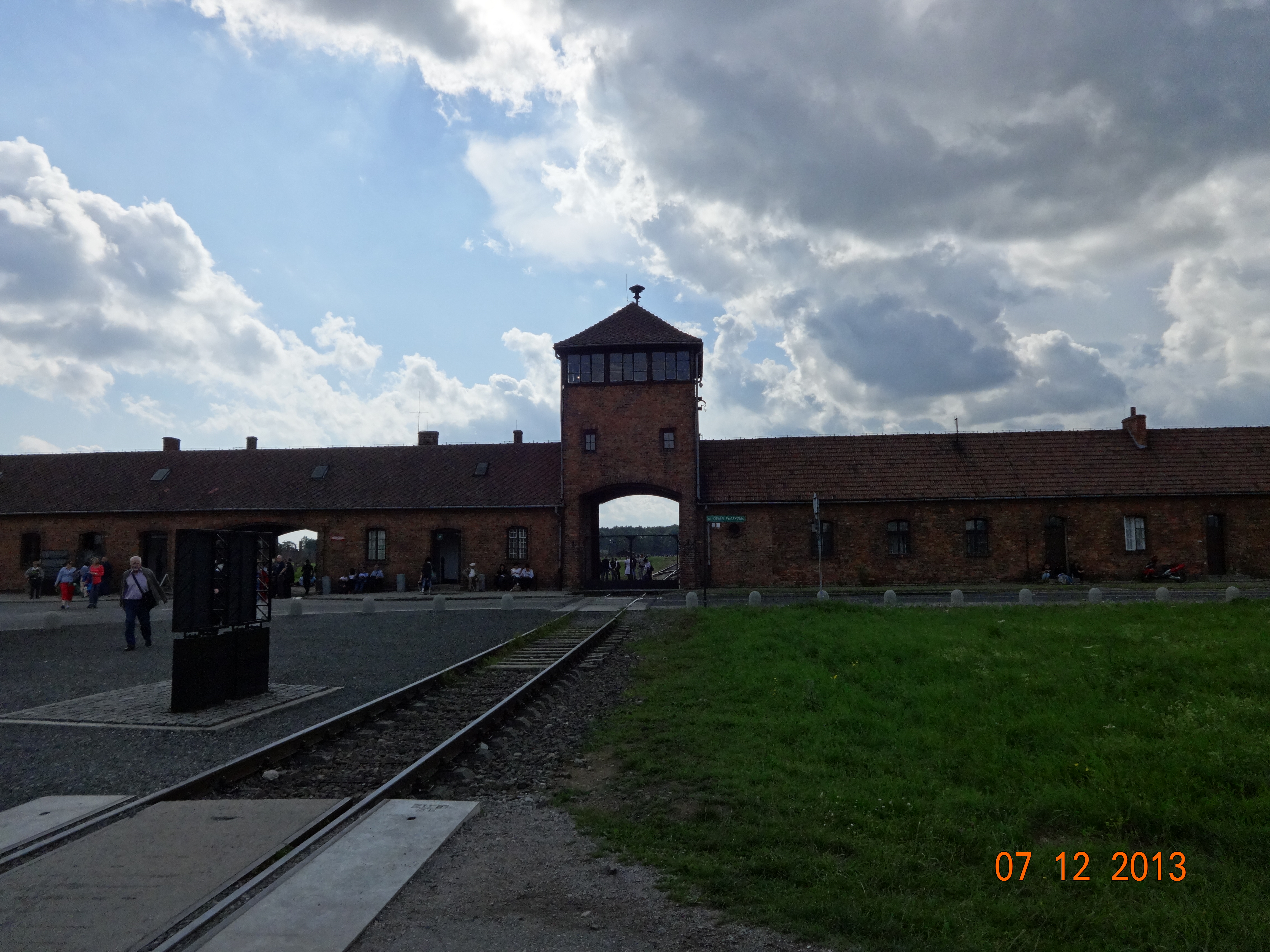
And this leads us to the details of the Nazi atrocities.  If you have been reading my blog, I have been to 8 or 9 concentration camps already.  I went to another one on this tour – the first camp – known as Dachau.  Here is the train platform and the main building the Jews (and political prisoners, POWs, etc.) went through:Image

The now all too familiar “Work will set you free” sign”

Image


The fence and guard towers:

ImageImage


The area where victims were gathered each day:

Image


The main lane with the barracks outlines and bunks inside:

ImageImageImageImageImage


The gas chamber:

Image


The old crematorium:

Image


When that wasn’t enough, the new crematorium:

Image


Image


You all know what happened here and the horrible thing the Nazis did.  If you want to know more, read my first 12 or so blogs.

There are some symbols of remembrance here, like this sculpture:

Image


And this synagogue:

Image


But this is a horrible place.  My group, many of whom had never been to a camp, where visibly shaken and moved.  That is why it was good that we visited the Court House that housed the Nuremberg Trials after WWII and saw the punishment of those responsible for this.

Here are the gates to the court house:

Image


This is a functioning court house today and the court room that housed the trial is still being used as well.  Here is a pic of what the outside looked like after WWII:Image

The court room today:

Image


Luckily we were there on a Saturday, so we could sit in here all we wanted.  They had little video monitors that you could use to watch parts of the trials.  It was great to sit there and watch, through logic and reason and rules and respect, these Nazis get convicted.  I could have watched this all day.  I could have watched this for a week.  I think I will have to watch the movies again when I get home, but this made me happy being here.

Finally, we visited a German cemetery:Image

Notice the markers in the ground – they represent two Nazis for two German soldiers were in every hole.  Standing there, I could not bring myself to forgive these people.  I almost felt like they did not deserve this burial and respect.  Just then, out of the fog, came our friends – reminding us of the message from the bridge that perhaps it was time to heal.

Image

http://scottdurham.wordpress.com/


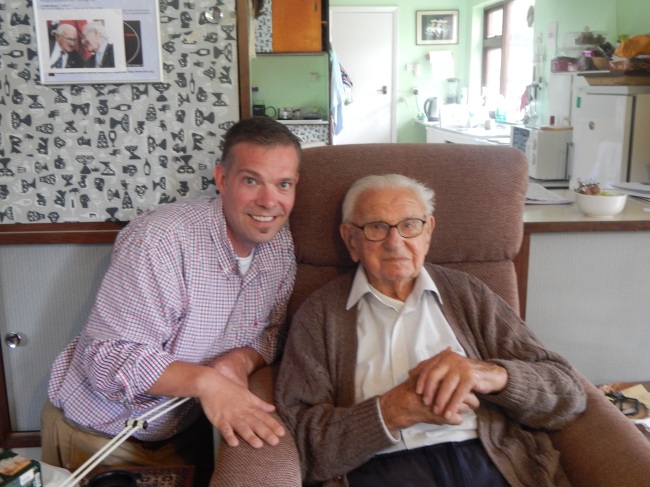
I am sharing this post by my friend and traveling companion Scott Durham, whom I spent a good deal of time with for three weeks on my summer trip this summer. We hung out on the back of the bus and were always up for exploring the towns after hours and discussing and processing our sometimes heavy days with our Holocaust tour work. Scott is still traveling in Europe. One thing I admired about him was his propensity to utter “why not?” Here he is below with one of the most well known rescuers, whose name is synonymous with the Kindertransports. 

Image

London – Sir Nicholas Winton

05 Thursday Sep 2013

On the morning of Aug. 24, 2013 I walked to the Paddington Train Station in London and hopped a train to Maidenhead.  Once arriving in Maidenhead, I asked a woman if there was a bakery in the little town.  There I bought a fresh Apple Cake to go with some fine British Tea I purchased the day before.  I then flagged down a cab and headed to the home of Sir Nicholas Winton.

There is a good chance you have never heard of him.  He was born in 1909 (yep – that makes him 104 this year) and in 1938, at the age of 29, he was on his way to ski in the Alps when a friend asked him to help him in Prague.  Winton went to Prague and saw first hand the plight of the Jews there and begin to figure out ways to get Jewish Children from Prague into British homes.  He set up shop in a hotel/cafe right on Wenceslas Square.  A plaque is there today commemorating his work:ImageImageImage

During the next few months, Winton was able to help rescue 669 children who were then re-settled in Britain.  Most of the parents were murdered in Auschwitz-Birkenau.

Then, Winton went on with his life.  In the 1980′s, his wife found the scrapbook that included all the names and travel plans, etc. of what became known as the Kindertransport.  A local television station invited Winton to a taping of a program about his work.  There, he was surprised to meet some of the grown children he helped save.  But the saved children were surprised too.  Before the scrapbook was found, they had never heard of Nicholas Winton either.  They had thought their parents were just smart enough to find a way to get them out before the Nazis invaded.  They never knew that people like Winton had helped save their lives.

I dare you to watch about a minute and a half of the video below and keep your eyes dry.  Watch starting at about 1:28 and go thru 3:00 (or watch the whole thing):

There is a new documentary about his work that came out this past year or so.  Here is the trailer:

So I was in the living room of this man’s house.  His daughter, Barbara, was there with us and she was instrumental in helping make this meeting happen.  I handed over my poor excuse of a gift (the tea and Apple Cake) and shook Sir Winton’s hand.  He is kind of tired of talking about his work back 70 years ago, so I tried not focus on that.  But somehow we started talking about an article recently written by one of the kids Winton saved named Joe Schlesinger.  The article is called “You Do Know, Right, The World Is Getting Better,” and you can find it here:

http://www.cbc.ca/news/world/story/2013/07/18/f-vp-schlesinger-wonderful-world.html

Winton wasn’t so sure if Schlesinger was right.  By the way, I hate calling him Winton.  I want to call him Nick or Nicky (and he made me feel so at home I feel I could).  But then part of me wants to call him Sir Winton.  I am not sure.

But anyways, Nicky remembered his parents time and about how much more difficult things were.  However, he remembered that people still did things for each other.  He told me about how they would put hay over the cobblestone streets if there was a sick person on the street to help dampen the sound of the horses and carts.

But today he sensed that we might have let the opportunity, with all the technology and wealth of the world, to create a utopia for everyone pass us by.

I asked him how we could maybe still create that utopia.  He talked about how people should live by a standard code of ethics.  He sees too many of our leaders and even every day people not doing so.  What is in the code of ethics, I asked: compromise, love, honor, goodness, decency, kindness, honesty, hard work, among others.  Winton thinks that this way of living transcends politics, generations, religions, etc.  I happen to agree.

It wasn’t until a few days later that I almost felt that Sir Nicholas Winton had challenged me to help teach this to our young people.  I am not sure if he intended to do this, but once again, he has helped inspire someone (me) to be a better person.  But he is so sharp of mind that I am pretty sure he meant to do this.

One thing that him and his daughter share is an overwhelming humbleness.  They both, while proud of what Winton has done and continues to do, acted like it still wasn’t that big of a deal.  In fact, Winton gives most of the credit for the Kindertransport to his colleagues Trevor Chadwick and Doreen Warriner.

I asked him how, in the end, people could be proud of their lives and he said just knowing, “that you did no harm.”  Wow.  Winton continued to help people throughout his life and I asked him why he continued to do it.  He said, “because I enjoy it.”

After a few hours and a few cups of coffee, I stood up to let the Wintons get on with their day.  But I was smiling for another week.  In fact, when I get a chance to tell people about my journey, this is always a highlight.  In fact, Winton’s name came up a lot one night in Bruges, Belgium (but that blog has yet to be written).

My visit with Sir Nicholas Winton was beyond pleasant.  But he has challenged and inspired me to do more.  Whether he knows it or not, Nicholas Winton is STILL making the world a better place, not necessarily for WHAT he did, but more so for simply WHO he is.


Keep tossing pebbles.

Francis Curry, WWII Medal of Honor, with students.

Francis Curry, WWII Medal of Honor, with students.

FOUR years ago today the most incredible week concluded with former soldiers and the Holocaust survivors they saved watching this newscast together in cocktail lounge of the Georgian Resort in Lake George along with teachers and students from Hudson Falls High School. Thank you Tara, Mary, Lisa, Rene, and all the staff. And to ABC World News for recognizing the importance of the occasion, and to the United States Holocaust Memorial Museum and the Bergen Belsen Memorial for their attendance and support.

A teacher’s job is to toss pebbles. Several of the participants are gone now, but the ripples here became huge, and no one will forget what they meant, where they came from, or what they have led to.

Watch a story about how a teacher fellow from the Museum reunited Jewish prisoners with U.S. Army soldiers who liberated them from a train near Magdeburg, Germany, on April 13, 1945.

Stamps and Miracles.

I met Leslie Meisels exactly four years ago today, when he and  Ariela Rojek and Paul Arato drove all the way down from Toronto, Canada to meet their actual liberators.

Leslie is one of the most gracious men I have ever met; I am honored to have him as one of my friends and am proud to be in on what he calls the latest miracle of his life.

I wrote to a reporter/columnist in Toronto, Canada, several months back to comment on a story that she had written, and she then had the opportunity to interview several of my survivor friends in the community who had been liberated on the Train Near Magdeburg. She struck up a friendship with Leslie, and this ebook resulted.

A sample:

When I first reached Leslie Meisels on the phone one afternoon in late April and asked for an interview, he told me to hold on a minute — he needed to get his day planner.

I thought he was joking.

Leslie is 86. What could he possibly be doing to fill up a day planner?

A lot, it turns out.

He has a wife, two daughters, four grandchildren. He is an active member of the North York Philatelic Society and a committee member of Circle of Care, an organization that provides services for Holocaust survivors. And he is a regular speaker with the Holocaust Education Centre’s survivor speakers bureau. This spring there were weeks when he addressed four different groups of students about his experience during World War II.

This was one of those weeks. He squeezed me in. I wanted to talk to him about the Holocaust and, more precisely, about his liberation from the Nazi murderers by a dozen surprised American soldiers who found Leslie and about 2,500 other captives near the end of the war, packed in cattle cars on a German train.

An email from an American teacher had tipped me off to the fact that a number of Toronto Holocaust survivors had recently been reunited with their liberators.

Leslie was one of them.

Of course, you can’t talk about liberation without talking first about enslavement. So, sitting on the couch of the neat, spacious penthouse condominium he shares with his wife, Eva, in Thornhill, Leslie started proudly with his family history in eastern Hungary.

Then came his carefree childhood. Then the introduction of anti-Semitic laws, the ghetto, the trains, the months of slave labour and the horrors of the Bergen-Belsen concentration camp, where more than 70,000 prisoners — most of them Jews — were killed.

Our interview lasted more than three hours, fueled by many cups of coffee and servings of fresh cheese palacsintas (crêpes) whipped up by Eva.

I noticed Leslie’s hands while we spoke. They are enormous — each finger twice as thick as mine, the palms like dinner plates. They are a working man’s hands, without any of the dirt. Everything about Leslie is immaculate — his neatly clipped and cleaned fingernails, his ironed pants and pressed dress shirt with a silver pen poking from its breast pocket, his freshly shaven face. His stories of being treated like a rabid dog were cast in relief by the careful pride he took in his appearance. There is an Old World elegance about him.

But the thing that struck me most about Leslie was his cheeky humour. His brown eyes narrowed and sparkled repeatedly as he took a “side step” to tell me about the girl he was “necking” with while a slave labourer or a refugee. Despite the horrors he endured, or perhaps because of them, Leslie maintained his champagne spirit.

Near the end of the interview, a question bubbled in my mind: what did you take with you? The Nazis had invaded Hungary in 1944. They ordered all the Jews in Leslie’s and other towns to first leave their homes, and then to leave town altogether on a train we now know was headed towards slavery or murder. What would you take if you could carry only a small bag or pillowcase to hold your belongings?

“Underwear,” Leslie responded, “and my stamp collection.”

I wrote that down and moved on. There were a lot of overpowering details in Leslie’s stories, and I still needed to hear about the reunion. But the stamps snagged my attention. There was a boyish innocence about them.

What happened to those stamps, I asked him over the phone a couple days later.

He responded: “I still have them. My mother sewed them into the lining of my jacket.”

Imagine that! Most Jews had all their clothing and belongings stripped away upon entering the concentration camps. You can see their boot brushes, ceramic pots and dolls piled up behind glass cases in the Auschwitz-Birkenau State Museum in Poland. That Leslie managed to keep his jacket was surprising enough. But that fragile pieces of paper survived the horrendous conditions — well,that seemed miraculous.

I drove back to their condominium for a third interview, this one in Leslie and Eva’s little office. I asked to see some of those stamps.

So Leslie pulled out his master list — a two-page typewritten list of all the stamp albums he has. There are dozens and dozens. He found one with his early Hungarian stamps and pulled it down from the shelf. Inside he’d arranged thousands of stamps in neat rows.

When I expressed surprise at the number of stamps he had, he smiled and opened a drawer in his desk.

“A crazy stamp collector saves all the stamps he comes across,” he said, pulling out a Tupperware container brimming with stamps. “When there are many, many, many, he bundles them up . . . and stores them away. I have millions of stamps.”

Leslie’s wife calls herself a “stamp widow.” She says he spends hours with his stamps a day. He loves them still, like he did when he started his collection 78 years ago. He loves the precision of arranging them. He loves the challenge of collecting a full set of stamps. He loves their colours and their stories. Every stamp, he says, depicts a story of a place, a historic moment or figure, a cause. “You can learn about the world through stamps,” he said.

As we flipped through his collection and he began to tell me the rest of his story, I could see snatches of it reflected in his stamps.

It is the tale not just of an idyllic childhood followed by the horrors of the Holocaust, but also that of a man who lived under Communism, escaped, lived for two years in a refugee camp, arrived in North America with nothing and then built up his life for a second time. Just as every stamp embodies a public story, a bit of history, Leslie’s stamps also tell the story of his life, its joys and deep sorrows, its disasters and its miracles.

************************************************

He is giving his 25th lecture on the Holocaust since April.

“Put yourself in my shoes,” he says to the Cardinal Carter Catholic High School students. “I think you are between 16 and 18, right? You can feel what I felt when I experienced those horrors.”

“They have to know,” Leslie says. “Otherwise, it will be forgotten and could be repeated.”

He talks for just over an hour, pausing only twice for a sip of water.

The stories pour out of him — of the deaf village elder who was strung up by his wrists to a cattle car, of the SS guards with their dogs who laughed at the sight of him naked with his grandmother and mother, of the hunger. He stirs in life lessons — like how his woodworking knowledge saved his life in Bergen-Belsen. “You are the same age as I was,” he says. “Never think you are studying for your teachers or your parents. Whatever you are putting in your head, you never know how it will serve you in life.”

But Leslie’s descriptions are muted at times. He clutters his sentences with clauses and chooses math over graphic detail to describe some horrors. The train crowding, for instance, affords each person a “square foot.” He mentions the bucket but doesn’t fill in the details of how that meant people were forced to defecate in their pants. He is old-school; talk like that seems degrading. Or perhaps the pungent details are too dangerous for him, scratching away the protective layers on his memories.

A girl in a powder-blue sweatshirt in the second-last row appears to have fallen asleep.

Is he getting through to them? Like most Holocaust survivors,

Leslie won’t be around to recount these stories for much longer. That inescapable truth adds an urgency to his message. Who then will bear witness?

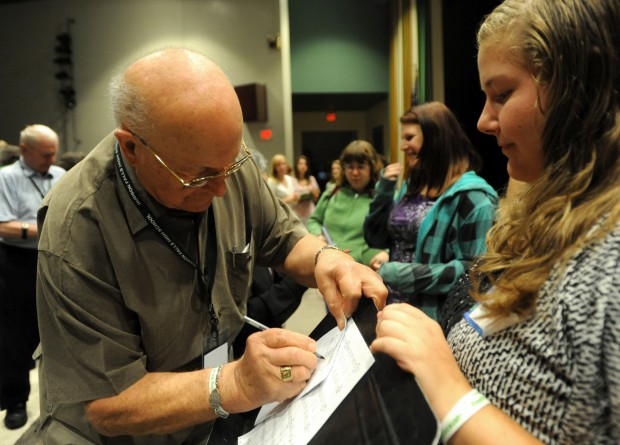
Holocaust survivor Leslie Meisels, left, signs a program for Hudson Falls senior Taylor Bump during Wednesday's "Remembering the Holocaust, Repairing the World" event. Meisels, who currently lives in Toronto, stressed the importance of relaying his experience to young people "so they remember and fight against discrimination, hatred and injustice." Jason McKibben Glens Falls Post Star

Holocaust survivor Leslie Meisels, left, signs a program for Hudson Falls senior Taylor Bump during Wednesday’s “Remembering the Holocaust, Repairing the World” event. Meisels, who currently lives in Toronto, stressed the importance of relaying his experience to young people “so they remember and fight against discrimination, hatred and injustice.”
Jason McKibben Glens Falls Post Star

He finishes his talk and asks for questions. The girl in the powder- blue sweatshirt from the back asks two. The second one is: “If you could go back, would you change any decisions you made?” She was listening, just with her eyes closed. Holocaust educator Ruth Ekstein says she often sees that — “the most fidgety kids you want to strangle, they are absorbing the most.” The content is so painful, it forces people to scratch and shuffle, or to close their eyes.

“Never allow this to happen to someone in the future, if you see an injustice,” Leslie tells the group. “Never just look at each other as equals. Treat each other as equals.”

************************************************

The last miracle

In 2001, Matt Rozell went to the home of one of his students in Hudson Falls, N.Y. Rozell is a high school history teacher there. He regularly assigned his Grade 10 students to interview the veterans in their family about World War II as a way to bring history alive.

That summer, he decided he would do the interviewing himself.

The veteran was retired New York State Supreme Court Justice Carrol Walsh Jr.

After two hours, when the interview was ending, Walsh’s daughter elbowed him and said, “Did you mention the train at all?”

“What?” Walsh said.

“The train.”

So Rozell asked to hear about this train, whatever it was.

Walsh told him about the beautiful, sunny day in April 1945, when after 10 months of fighting their way through France, Belgium,and Holland, and into Germany, his tank and his buddy George Gross’s tank were pulled out of the battalion to check out an abandoned train. An army scout had come across some Finnish prisoners of war in bad condition who reported they had escaped ,the train and that it was packed with prisoners.

Rozell posted the moving interview, as well as Gross’s astonishing photos from that day, on the school’s oral history website, where it sat quietly for four years.

That is, until a grandmother from Australia contacted him to ,say she had been a little girl on that train. The next month he got another email, and another, and another.

In September 2007, Rozell hosted the first reunion of Walsh and three survivors from that train. An Associated Press reporter wrote a story about the day-long event which was published around the world.

Paul Arato’s son Daniel read the story on the Internet. Arato was the 5-year-old boy who witnessed the birthday “present” of a bullet to the head in the Bergen-Belsen roll call. He was also a ,Hungarian Jew who grew up not far from Leslie. He, too, escaped Hungary in 1956 and resettled in Canada. An industrial designer, he was a work associate of Leslie. At the end of a business meeting, the topic of the Holocaust somehow came up. They discovered, to their shock, that they had both been on that train from Bergen-

Belsen. Paul, in turn, told Leslie about the Hudson Falls reunion.

Two years later, they both ventured down to Hudson Falls for a second reunion — a three-day symposium that brought together nine survivors and seven soldiers, including two of their liberators

— Frank Towers and Carrol Walsh.

On the drive down, Leslie was very excited. The initial meeting, over dinner, was spectacular.

“No words can explain the feeling of shaking hands, hugging, laughing and crying with the people who gave me back my life on April 13,” he says. “I never ever imagined that would happen.”

He calls the veterans “angels of my life.” They, in turn, said they were just doing their job.

Leslie and Walsh became close friends. They talked regularly on the phone. They spent some time together in Florida, before Walsh died last winter at the age of 91.

Leslie calls that friendship the last miracle of his life.

Leslie’s 17-year-old granddaughter, Jessica, visited Auschwitz last spring while participating in the two-week educational trip March of the Living. She left behind a small, hand-written sign that said: “I am marching in honour of my grandparents Eva and Leslie Meisels. As well as a soldier, Carrol Walsh.”

******************************************

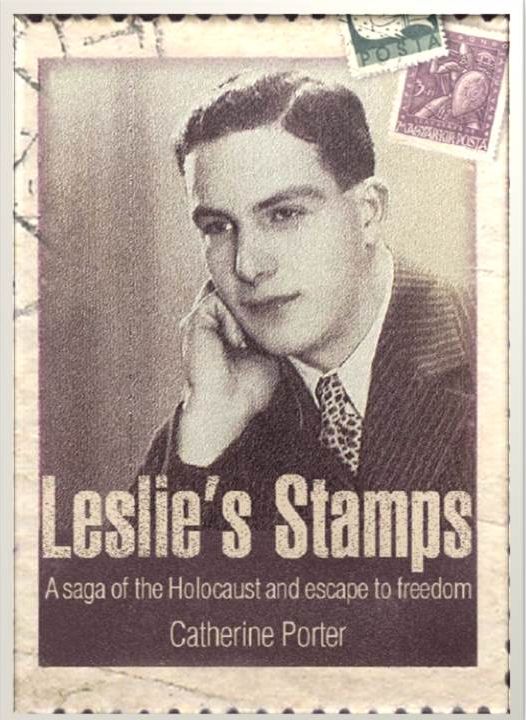
Leslie's StampsLeslie’s Stamps: A Saga of the Holocaust and Escape to Freedom

He had an idyllic childhood in a small Hungarian town where, it seemed, there was no animosity between the Christian majority and Jews like him. But with the rise of Hitler and the Nazis, everything changed for Leslie Meisels, who ended up in Bergen-Belsen concentration camp with his family. Through his wartime ordeals, Leslie carried his stamp collection, started when he was 8, in the lining of his jacket. In Leslie’s Stamps: A Saga of the Holocaust and Escape to Freedom, award-winning Toronto Star columnist Catherine Porter tells the dramatic story of Leslie’s life through his stamps. It is a tale of love, courage and the power of the human spirit.
Leslie’s Stamps: A Saga of the Holocaust and Escape to Freedom is available for $2.99 at http://starstore.ca/collections/star-dispatches-ereads/products/leslies-stamps and itunes.com/stardispatches.

A beautiful September Tuesday morning. I’m repeating this story today. God Bless.

Ten years after 9/11, a photo provides some peace


A colleague sent me this article, that has parallels to what is unfolding on this website. You may be aware that the photographs taken by the American soldiers in 1945 that appear on this website have changed lives around the world as they are being discovered by survivors and their families, who are reconnecting with the men who saved them 65 years ago. This photo has its own healing story.

And think about it.

There are no coincidences.

Thanks to Todd Earl for the link.

By Jesse Solomon, CNN

New York (CNN) — Judson Box has never known exactly how his son, Gary, died on September 11, 2001. But an unexpected find nine years later has given him a glimpse into his son’s final hours.

Gary, then 35, had been working as a firefighter in Brooklyn for roughly five years when the terrorists attacked. He did not speak to his father the day of the attack and his body was never recovered, leaving the circumstances of his death a mystery.

On September 11, 2009, Gary’s sister, Christine, was visiting the Tribute Center when an employee asked her if she was looking for someone specifically. She mentioned her brother Gary, and the employee showed her to a picture of a firefighter in the Brooklyn Battery Tunnel that had a caption bearing Gary’s name.

But it was not Gary. It was a photo of Brian Bilcher, another member of Gary’s fire squad who also perished on 9/11.

The discovery compelled Gary’s father to dig deeper, clinging to the possibility that there could be a similar picture of his son out there.

Box scoured photo archives of the National 9/11 Museum and the memorial’s website, which allows users to upload photos from 9/11 directly to the site.

After searching one night for more than five hours, Box went to sleep, physically and emotionally exhausted. The next morning, his wife, Helen, called him into the living room as he was eating breakfast.

She showed him a photo of a firefighter running through the Brooklyn Battery Tunnel toward the Towers alongside cars stuck in traffic.

This time, it was Gary.

“I was out of out control, emotionally,” Box said. “Thanking God, being so happy that I had something to see.”

Eager for more answers, Box contacted the National 9/11 Museum and Memorial in an attempt to track down the photographer. Several months later, the museum gave him the e-mail address of Erik Troelson, a Danish businessman who was stranded in the tunnel on his way to a meeting when he snapped the picture of Gary.

Having entered the tunnel before the first plane hit, Troelson was unaware of the tragedy that was taking place outside.

“Suddenly, the girl in the car in front of us got out crying,” he said. “Then we turned on the radio and heard the events as they unfolded.”

Soon after, firetrucks started racing through the tunnel, but a car with blown-out tires jammed traffic, he said.

“Some of the bigger trucks got stuck, so the guys started walking briskly past us,” Troelson said. “Gary Box was one of the guys.”

Box and Troelson corresponded via e-mail for months, with Troelson doing his best to recall the day’s timeline of events.

On Tuesday, the National 9/11 Museum and Memorial foundation arranged for a surprise rendezvous between the men at their annual fundraiser.

They shared an emotional moment onstage. Afterward, they spoke at length, with Box expressing his gratitude.

“I think I said about 300 times thank you and God bless you, that’s all I could say,” Box said. “I think I told him I love you, and I don’t tell anybody that.”

Nine years after September 11, Box said he still feels the pain of that day. He doesn’t have the means to make large donations to the museum, but has sought to promote their cause through his story.

“We need that in this country because too many people forget,” Box said of the museum.

“I wish everybody could get what I got.”

Find this article at:

http://www.cnn.com/2010/US/09/10/september.11.photo/index.html?iref=allsearch

guns at last lightI’m recovering from a foot injury and it has given me time to finish Rick Atkinson’s latest release, The Guns at Last Light: The War in Western Europe, 1944-1945 in his Liberation Trilogy. With school around the corner, I am excited to be teaching a couple dozen seniors once again about World War II, and in the springtime, the Holocaust.

I’m happy with Mr. Atkinson’s coverage of the heroics of the 30th Infantry Division-he even made a research pilgrimage to Hill 314 in Mortain, where elements of the 30th held off against a Hitler-ordered panzer counterattack for 6 days, saving the Allied breakout in Normandy in August 1944. 

If you are a follower of this site, you will know that that division is dear to my heart, not because of any blood relations who fought in it, but because they named me an honorary member of their Veterans of World War II Association for my work in the classroom and in uncovering and reuniting the story of the liberation of the concentration camp train at Farsleben, Germany on Friday, April 13, 1945.

So you can imagine my excitement when I ran across this passage last evening from page 599 of Rick’s book. He writes about some of the chaos that unfolded as POWs, slave laborers, and concentration camps were liberated in Germany:

“Instead, starvation, revenge, indiscipline, and chaos often created what Allied officers called a “liberation complex.” SHAEF [Supreme Headquarters Allied Expeditionary Forces ] had presumed that refugees “would be tractable, grateful, and powerless after their domination for from two to five years as the objects of German slave policies.” As an Army assessment concluded, “They were none of these things.… Newly liberated persons looted, robbed, murdered, and in some cases destroyed their own shelter.” Freed laborers plundered houses in the Ruhr, burning furniture for cook fires and discarding slave rags to dress in business suits, pajamas, and evening clothes ransacked from German wardrobes. Ravenous ex-prisoners licked flour off the floor of a Farsleben bakery. In Osnabrück, “rampageous” Russian slaves died after swilling V-2 rocket fuel discovered in a storage yard. Others smashed wine barrels and liquor bottles in a Hanover cellar, drinking so heavily from a sloshing, six-inch-deep pool of alcohol on the floor that several collapsed in a stupor and drowned before U.S. MPs could close the entrance.”

So I did a double take: Ravenous ex-prisoners licked flour off the floor of a Farsleben bakery. I checked his notes-page 801, sure enough, 30th Division G-2 report. I know I have read this before in my research of primary source documentation, originally sent to me by Frank Towers, one of the liberators.  Here it is.

30th Division Medical Detachment Diary & Log

Of course, the backstory surrounding the document above is the story that I have to tell- the soldiers of the 30th Infantry Division and the attached 743rd Tank Battalion, the Holocaust survivors whom they stumbled upon, liberated, and were reunited with 62 years later at our high school and subsequent events.  I’ll probably share the Benjamin photo with Mr. Atkinson on his FB page. 

Anyway, I recommend the book to any of my followers interested in the history of World War II in the European theater, and am really pumped to teach some very excited and motivated students this year, including the grandson of the tank commander who was sent to investigate the train.

This is how you “do” history, and how the teaching of history can sometimes take on a life of its own. So cool to be a part of it, and to read something in a best seller and be able to grasp the incredible backstory that awaits to be told.

Books.

My son, brother, and I were up at our camp retreat in the Adirondacks, begun by our dad 36 years ago.  Just six miles away is one of the most famous forts in colonial America. After breakfast, for fun, we thought we might see if it was possible to re-visit the fort, having heard that a few things had changed since our last time there.

the books.

the books.

Sure enough, there was now a new entryway, complete with an admission booth. I pulled the truck up to it, and inquired whether we might proceed to the bookstore, which had always stocked a fair amount of titles, where one could peruse the stock, before deciding whether today would be the day to pay the full admission to check on any updates in the exhibits inside.

Not today. Not anymore. No  money up front, no visit to the bookstore.

Having served on an authentic historical site as a board member, I understand the desperate need to raise funds, but I did not have the $52.50 in my pocket that morning. We had not planned to spend the entire day there.

As the nice woman shrugged and turned us away, my brother said, “you should have told them who you are”.

Ha. He was having fun with me, and joking, of course. But it kind of brought forth  a sense of wonderment about my experiences this summer the authentic historical sites I visited all over the world.

I thought some about it. The bookstore that I had wanted to visit this morning stocked titles that featured my work as a history teacher and avocational archaeologist. I’m actually written about in some of the books.

I remembered I had a similar experience at our first major stop on the Holocaust Resistance  tour in Europe a few weeks back. As twenty five educators toured the site, all of my colleagues chose to give up part of their lunch hour for a private introduction by a key staff member who took the time to explain my role in helping that museum/memorial site create a special exhibition on the evacuation transports that left that concentration camp in April 1945.  As we boarded the bus at the end of the day, someone opened the Bergen Belsen official guidebook they had purchased in the bookstore (which in my excitement I had overlooked)- and there was the Benjamin photo, and summary of my work.

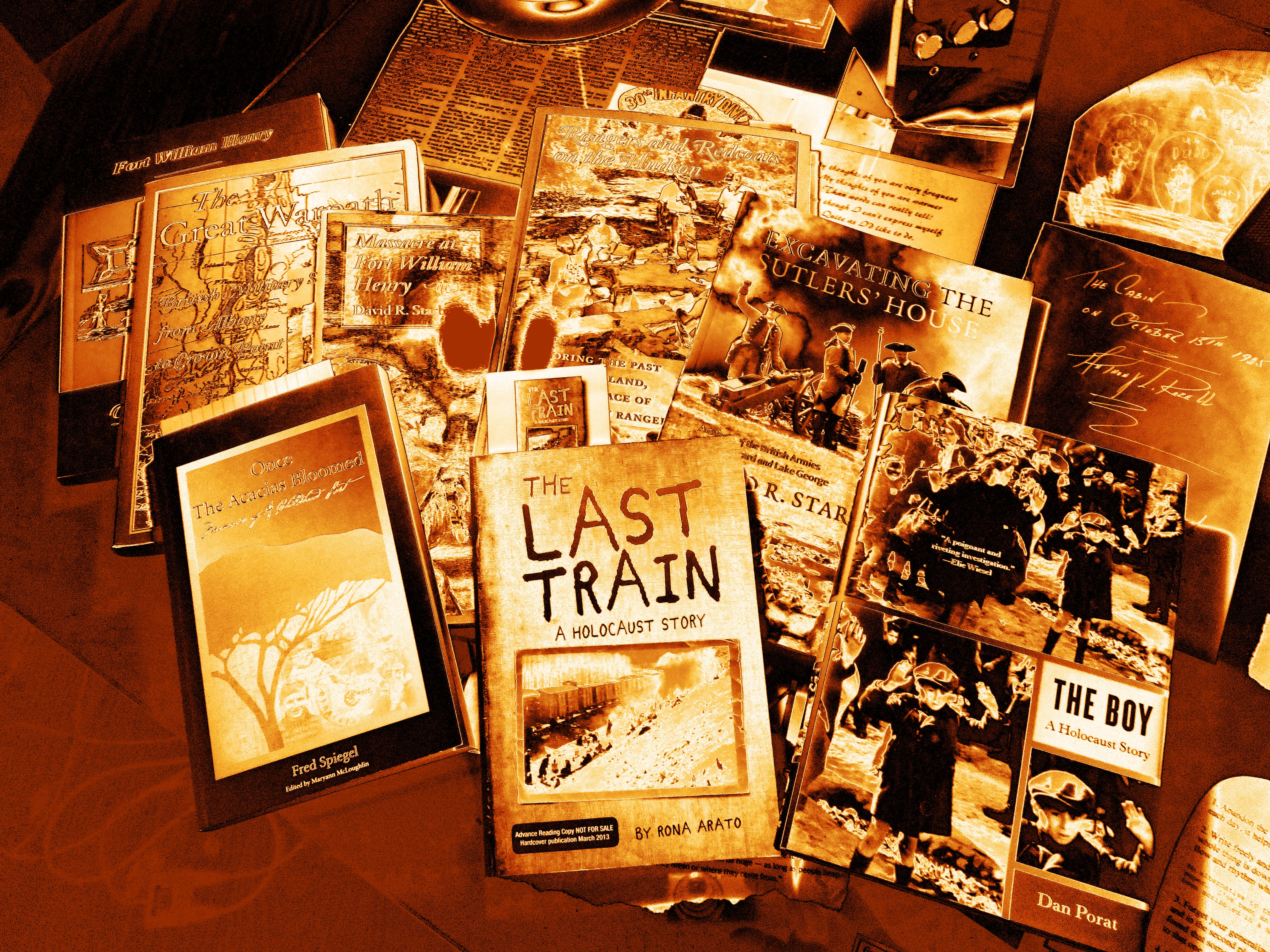
Later in the tour at another authentic site, concentration camp Ravensbruck in Germany, after an intense day I spied a different title and pulled it off the shelf, and showed it to another colleague. It’s the story of a survivor that I know, and this book probably would not have been written had it not been for the efforts that I had made in my teaching career.

The following week in Poland, the same thing happened to me with another title. I was able to open the book and point to my name in the credits and acknowledgments, and show where my work made a significant impact for the author and his thesis.
Pretentious bragging? I really, really hope not.   In fact I wrote this post weeks ago, not at all anxious to share, but as I process what has happened this summer, I figure stunned realization is more like it .

To visit authentic historical sites, some halfway around the world where I have never been before, and see the impact of this passion on others, is something both profound and humbling. I feel it has been transformative at some base level, yet I have not even completed my own book yet (it just keeps changing in my head- and believe me, it is up there). So it goes up to be added to the archive of happenings that occasionally knock me on the head.

In the end, getting turned away from the bookstore didn’t matter at all, except maybe to kindle a flame… though it is always a thrill to hold the book in your hands, and thumb to the page with your name on it.

Bottles.

Matthew Rozell rediscovers and rekindles interest in sutler site, 1996.

Matthew Rozell rediscovers and rekindles interest in sutler site, 1996.

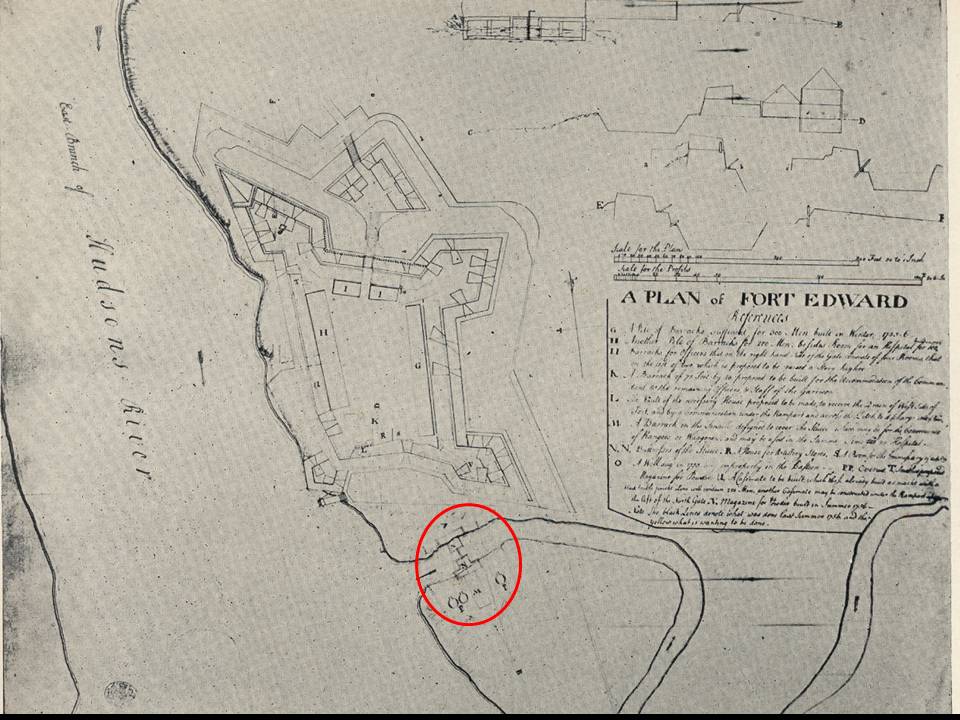
Today I am going to get a special phone call from an archaeologist whom I have known and worked for for thirty years. David wants me to be present for the removal of three intact 18th century olive green glass spirits bottles from a French and Indian War sutling house, or trading post, just outside of the British fort on the banks of the Hudson River near Rogers Island. Two intact bayonets were discovered here earlier in the week, but more exciting for us is the fact that we now think that we have found the elusive 4th wall of this building, which burned to the ground a few years into its existence. We have been searching for it for twelve summers.

Excavations began here in 2001, with me and digger Johnny Kosek and Mark Van Valkenburg. I had stumbled upon it during a pensive walk in the woods near our fort excavations in the summer of 1996. I had found a looters’ hole in the ground, spadefuls of earth littered with fragments of the very same bottle glass fragments from the period. On the ground I spied what looked like a shiny silver dime partially covered by the sand. A heavy rain had uncovered what the looters had wanted- a Spanish silver coin from 1748. Remember Hawkeye of the Last of the Mohicans? He would have drawn a dram or two here.

Period map showing location of sutler's complex. Island just to west of river.

Period map showing location of sutler’s complex. Island just to west of river.

My association with this important ground, so fundamental to the formation of our nation, began in 7th or 8th grade. Four of us would ride our banana seat bikes down to Rogers Island one summer in the early 1970s, sneaking smokes, getting away from our parents and siblings, and just dig holes in the ground with our moms’ gardening tools. I recall digging a hole as deep as my arm would allow, a tunnel straight down, a criminal activity in the eyes of any competent archeologist. Thankfully, we never found anything.

A dozen years later, in 1986, I would return as a volunteer crew member on an archaeological dig searching for General Gates’ American headquarters at the Saratoga National Battlefield Park. Here I would encounter David for the first time. I remember him asking me, after my first two weeks as a newbie, if I would ever consider going into anthropology/archaeology as a career. I think I was flattered, but I had just wrapped up my undergraduate work and was sending resumes out for teaching.

I followed him though, in 1991, to return to this Island. I had gotten hired at my high school alma mater 3 miles up the river and now had the opportunity to professionally learn what secrets the Island held. In 1992, David felt confident enough in my abilities to give me the reigns of the search for the elusive smallpox hospital at the southern end of the Island. We found it after three years of digging in the summer of 1994. 800 people died here. It was the only smallpox hospital from this era ever discovered in North America. I began to write.

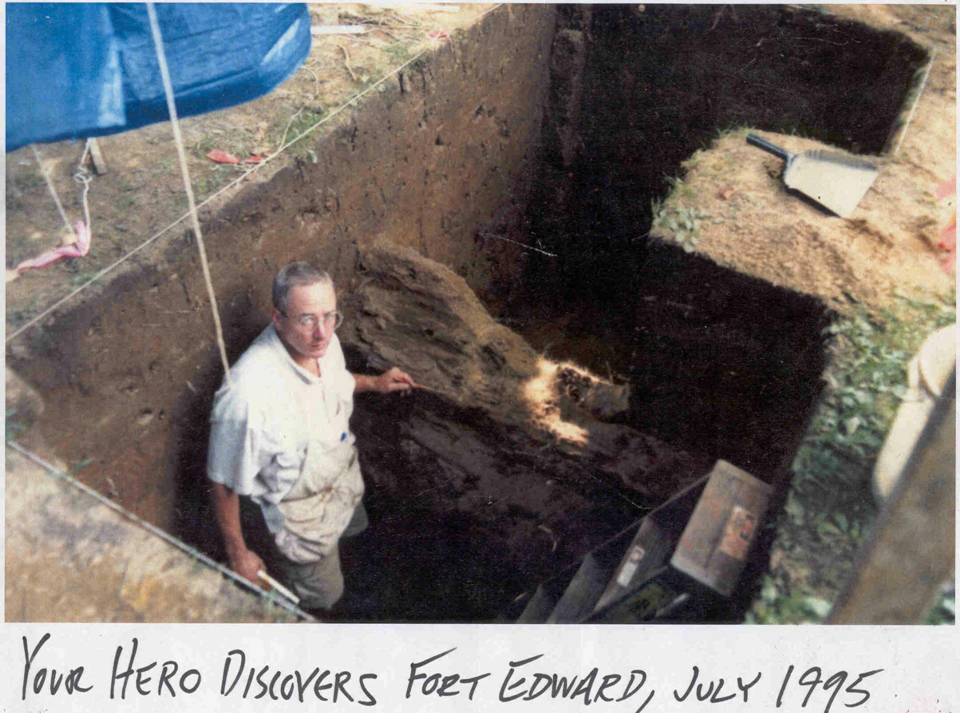
hero discovers ft edIn 1995 and 1996 we professionally dug at the site of Fort Edward, no easy feat considering that today twelve houses are built upon it. At one point we were excavating a bastion (corner) in the basement of a house! We opened up a pit in a front lawn, properly protected and barricaded, but the paper boy still managed to stumble into it. I found the West Curtain wall with Johns F and K, Mark, Brad and Susan and Hans. And one hot summer day took a stroll down the riverbank to stumble upon the sutlers house.

From 1997 to 2000 I worked at the parade ground of Fort William Henry, the one where the final siege takes place in Coopers Last of the Mohicans. We found the charred remains of the East and West barracks, the exact footprint of the original fort.

In 2001 we returned to the sutlers’ complex just south of Fort Edward. I directed the digs here for many many summers,

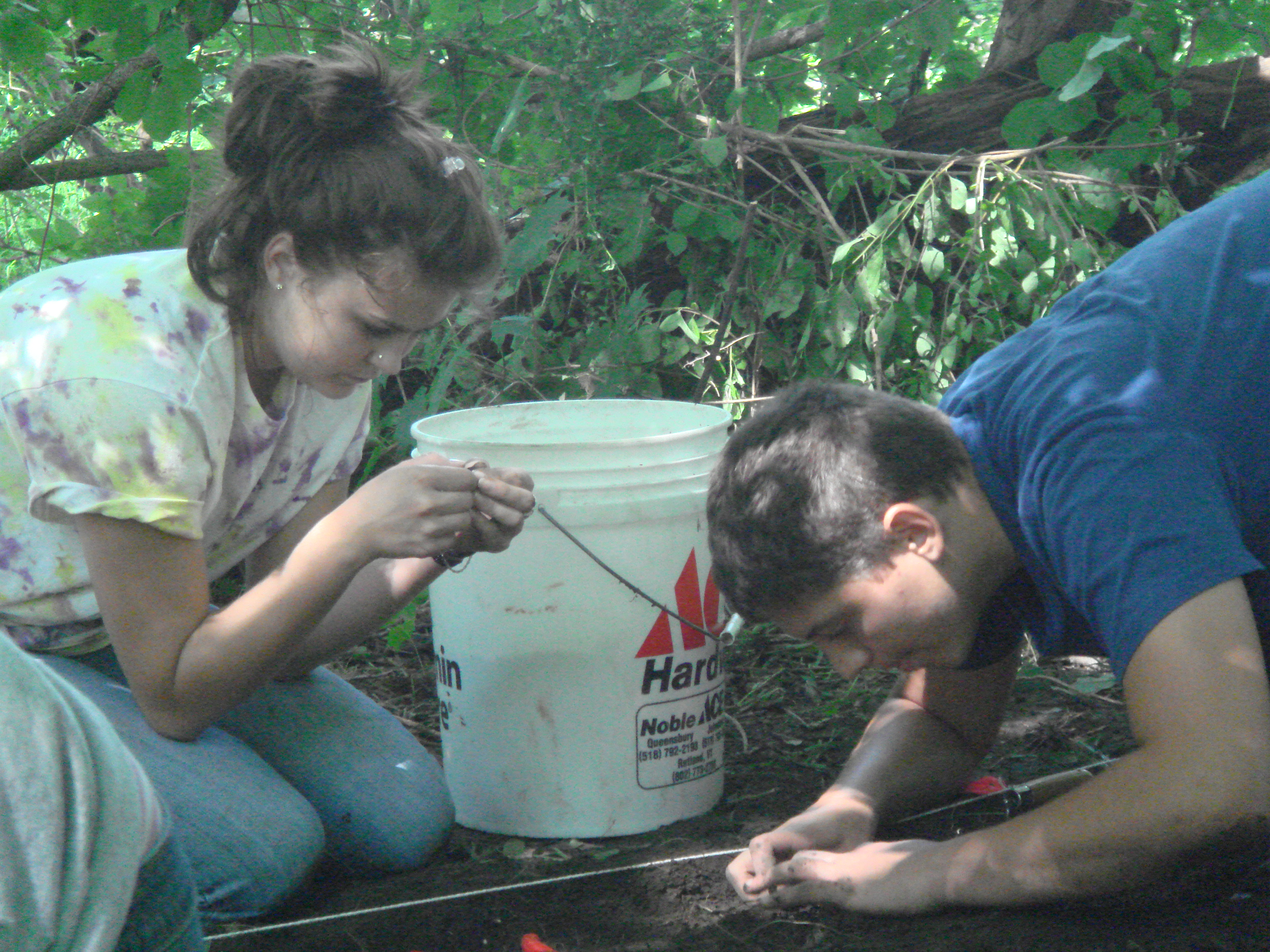
Our high school kids learning how to think, placing the artifacts at hand in the context of a major world war that was partially fought in their own backyard.

Our high school kids learning how to think, placing the artifacts at hand in the context of a major world war that was partially fought in their own backyard.

and later returned with high school students to teach them how to professionally draft a research question, study primary source maps, diaries and other documents, and begin to look for clues, and only then to dig properly, mapping all  the artifacts and features as they emerge. They learned how to dig, yes, but more, they learned how to think.

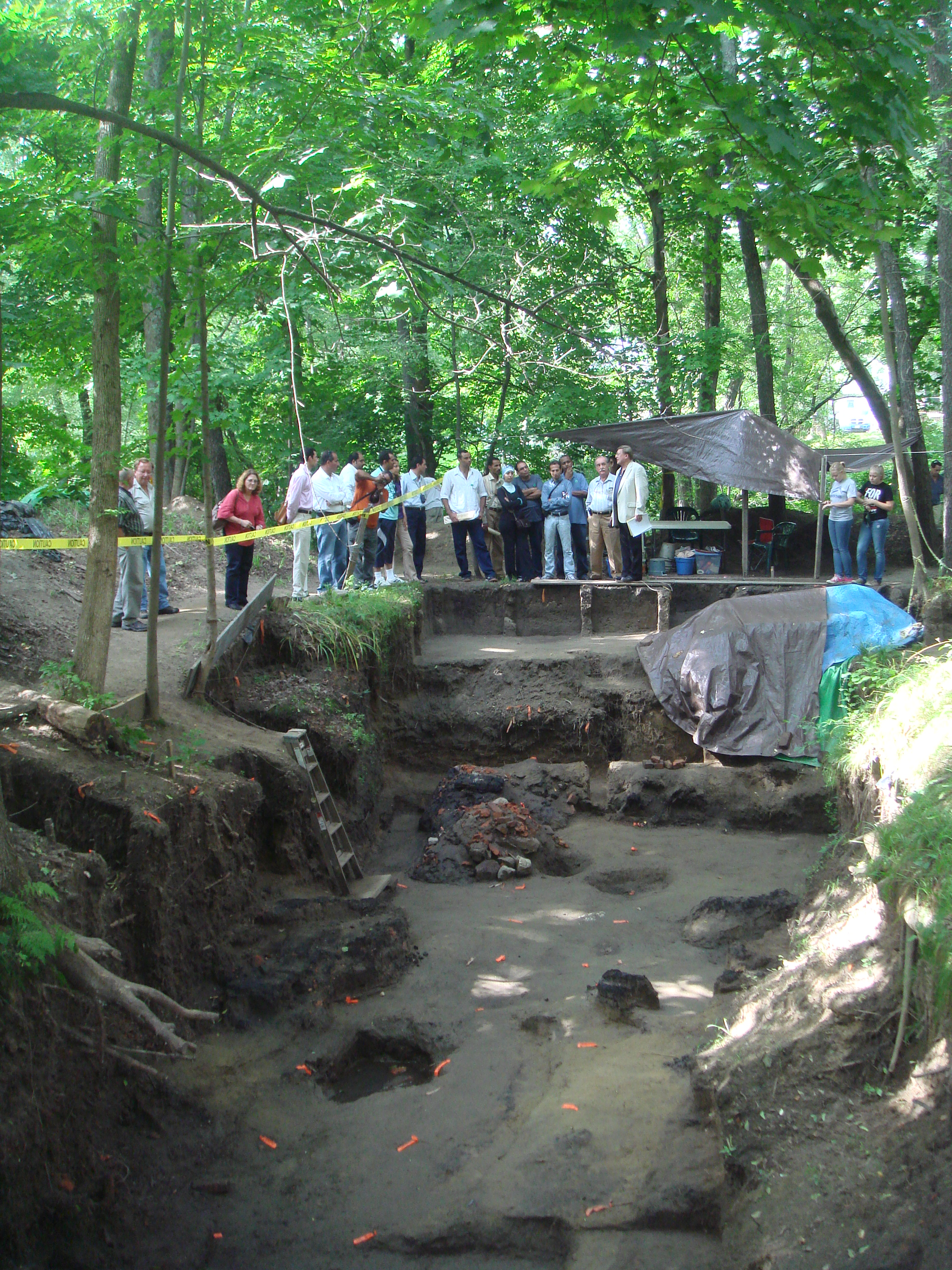
Egyptian Archaeologists visit the sutlers site, 2009. My baby. They were impressed. Proud daddy.

Egyptian Archaeologists visit the sutlers site, 2009. My baby. They were impressed.

Lots of times when everyone would leave I would just sit at the sit alone  for an hour or so. Just sit in the stillness and wonderment of this place. Just something I have always felt a need to do. It’s like the place has some kind of power over me. It’s my baby. When we are digging, we are touching objects that have been lost for over two hundred sixty years. I am the first to touch this bayonet, this coin, this tobacco pipe, this bottle since it was last handled. Thus the anticipation of touching these three intact, upright bottles.

My house building activities have kept the project at arm’s length, but the excitement is still there and rekindled. If you want to learn more, there are several books out by David Starbuck. I’m in this one quite a bit. After today, I joked to him yesterday, he may have to update it.

POSTSCRIPT: I was given the honor of extracting the three bottles. We also found three additional ones behind them. The Egyptian archaeologists would have been proud- my personal King Tut’s tomb moment. The bottles were all complete, two thirds of them totally intact.

The Bottles. Unbroken. Filled? King Tut's tomb moment. "The tension mounts..."

The Bottles. Unbroken. Filled? King Tut’s tomb moment. “The tension mounts…”

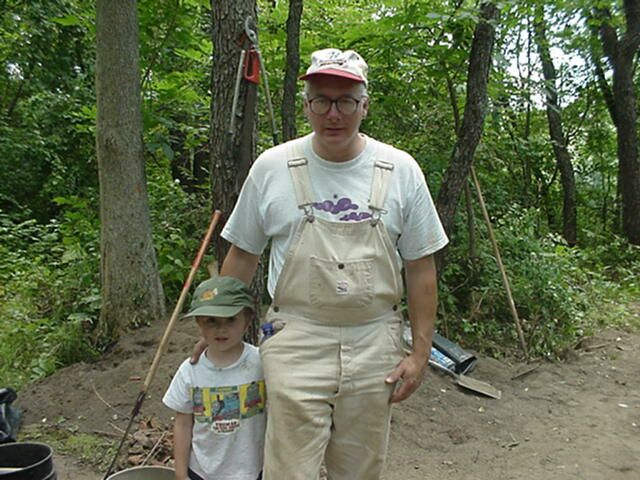
My son Ned and I, 2002, the sutler's site, Fort Edward.

My son Ned and I, 2002, the sutler’s site, Fort Edward.

Son Ned and I at the sutler's site. Thursday morning, August 8, 2013

Son Ned and I at the sutler’s site. Thursday morning, August 8, 2013

.