Feeds:
Posts
Comments

Never Again is Now.

Last night we were all jolted out of our comfortable lives with the news of the attacks in Paris by what appears to be, once again, the handiwork of radical Islamists. I felt distress as the waves of Twitter updates came cascading in from Europe. Distress at the live updates, the storming of the Bataclan Theatre, the rising body counts, the survivor descriptions of what was unfolding, the young people being murdered on a Friday night out.  I felt distress at sitting on the couch in a warm comfortable home reading the updates. But what can one do?

So I sat there, maybe like you, feeling helpless. Maybe feeling guilty as well, for at times lately it seems as if I am rushing through my life with no time or appreciation for the little things, which, in truth, are the only things that matter.

Saturday morning now. After getting more updates on the latest crimes against humanity in Europe, I think back to an email I got this week from a producer of an about to be released film that features some of my work as a Holocaust/World War II educator, and as a “connector” between Holocaust survivors and their American soldier-liberators. He says ‘thank you’ for my help, my input and my interview, and that the documentary is ready for viewing with a private code, before its world premiere on Nov. 19th.

But I’ve been in documentaries before, and I’m busy, so I had put it off. Until just now, when I watched it for the first time.

And the light bulb just went off, like the kid in the class who finally gets the ‘big picture’. Like the 90 year old liberator to whom I  had introduced  people he saved 62 years ago, and to whom I taught about the Holocaust-for the first time in his life– who proclaimed excitedly “Yes! Yes! Now I know what I fought for!” And although on some level I have always ‘gotten it’, I see more clearly that this is what I am teaching for, and speaking for, and writing about-that this is what I am here to do-“to prevent one of history’s darkest chapters from repeating.”

***

We were at the last reunion of the 30th Infantry Veterans of World War II in Nashville, where I met Evelyn Marcus, the daughter of survivors and whose mom was liberated on the Train near Magdeburg in 1945. Raised in the Netherlands, she emigrated to the USA about a dozen years ago, due in large part to a rising wave of antisemitism sweeping that country, and Europe. And now she confronts it, after meeting her mother’s actual American liberators, and returns to the Netherlands for a deeper understanding of what is happening. And she is determined to make a difference.

And so am I. It’s what we do to honor the lives stolen, and to remember that we are all part of humanity and each one of us has a responsibility, and a role to play. I hope you have an opportunity to see the film. Maybe it’s time to ‘get it’ that ‘never again is now’.

*

FRANK, EVELYN

My name is Evelyn Markus. I am a Jew. I was born and raised in the Netherlands where my family history goes back more than 400 years. I grew up in the 60s and 70s in the world’s most liberal city –Amsterdam, where I enjoyed life with my long-time partner, Rosa. But 15 years ago, things started to change.

 We noticed and personally experienced rising anti-Semitism sweeping across Europe. As second-generation Holocaust survivors, we sensed a familiar evil on the horizon. In 2004, we decided to leave Europe for the United States, the nation that liberated my family from the horrors of the Holocaust.

 70 years later, I now understand the need to fight for freedom and the importance of acting on principles. America has molded my mission -–to tell the world, through my story —that Never Again Is Now.

FRANK


Watch the trailer.

NAIS

http://www.neveragainisnowfilm.com/#open


The film premieres on TheBlaze TV  on Thursday, Nov. 19 at 8PM. It will be released later to larger outlets, like Amazon.

Some quotes:

“If we bear all this suffering and if there are still Jews left, when it is over, then Jews, instead of being doomed, will be held up as an example.” 

Anne Frank

“Never in our training were we taught to be a humanitarian.  We were taught to be soldiers.”

Frank Towers

“It really is an incredible thing and I think about it all the time. I think it’s really important to keep the memory and the history alive.”

Matt Rozell

“My message was to make up for what Hitler destroyed. That was my function in life.”

Rosa Zeegers

“Life in the Netherlands if you are Jewish and you’re not ashamed oyour Jewishness is a predicament”

Ayaan Hirsi Ali

“The Jews were killed for the simple fact that they were Jews, and that made a very deep impression on me.”

Rabbi Raphael Evers

“These are the final struggles of a lost fight. Jewish life in Holland is almost non-existent.  In that regard, Hitler won.”

Leon de Winter

“At the end of the day for my children, if they want to live a Jewish life, I would honestly not advise them to stay in Europe.”

David Beesemer

“If you feel what happens, the horror of it, and you feel the pain of individuals it’s so much more important than if you just know facts.”

Jessica Durlacher

“I think if you have an opportunity to speak for those who are voiceless, who might be victims, I think it’s a responsibility.”

Qanta Ahmed


In a video interview with LookTV, Matthew Rozell describes his new book in preparation for his upcoming lecture at the Hyde Museum, Sunday, November 15, 2015.

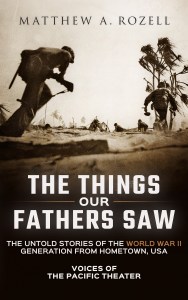
The Things Our Fathers Saw - Front CoverAt the height of World War II, LOOK Magazine profiled Glens Falls and surrounding communities for a series of articles portraying them as “Hometown, USA”, the wholesome, patriotic model of life on the home front. Decades later, history teacher Matthew Rozell and his students tracked downed over thirty survivors who fought the war in the Pacific, from Pearl Harbor to the surrender at Tokyo Bay.  In the his new book, The Things Our Fathers Saw, first-person accounts of combat, brotherhood, captivity and redemption are presented for the first time.  Mr. Rozell will discuss his book and the aftermath of the war that left no American community unscathed- the stories that the magazine could not tell, from the perspective of a vanishing generation speaking to America today.

Book signing will follow the lecture.

LINK TO EVENT: http://www.hydecollection.org/events_and_programs/Coming_Home_Reflections_on_the_70th_Anniversary_of_the_End_of_WWII_545.htm

http://www.looktvonline.com/matt-rozell-the-things-our-fathers-saw/


The New Witnesses.

I have just returned from an invitation to participate in Toronto’s Neuberger Holocaust Education Centre’s Holocaust Education Week, spending some time with maybe a thousand high school kids at the Cardinal Newman Catholic High School. I had  a morning and an afternoon session.

image (1)

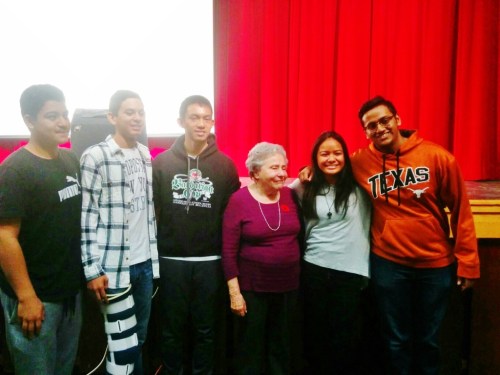
Holocaust survivor Ariela Rojek and her young admirers at Blessed Cardinal Newman Catholic High School.

I had an hour in the morning and I ended early so that they could come up and meet Ariela, my  “adoptive mother”. You see, a few years back, I connected her and several Toronto area survivors with their actual American liberators. Yesterday, at a family gathering at her daughter’s house, she brought out the scrapbook and showed me the pictures of her parents and family who did not survive the Holocaust, and even the original letter that her father wrote on the eve of his transfer from prison to Auschwitz-where he would be murdered, along with her grandfather and uncle. Ariela’s mother, only 36, both of her grandmothers, her other grandfather and two aunts were murdered at Belzec.


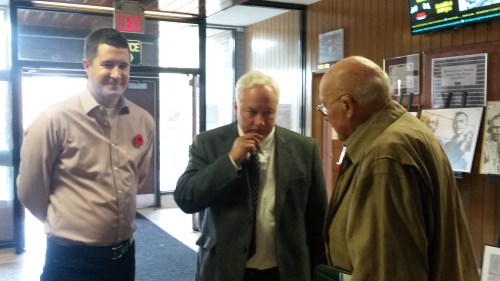
With Mark Celinscak, York University professor and author of the new book, "Distance from the Belsen Heap: Allied Forces and the Liberation of a Nazi Concentration Camp", and survivor Leslie Meisels before our afternoon talk.

With Mark Celinscak, Trent University professor and author of the new book, “Distance from the Belsen Heap: Allied Forces and the Liberation of a Nazi Concentration Camp”, and survivor Leslie Meisels before our afternoon talk.

Toronto talk descriptionIn the afternoon, I was with my good friend Leslie Meisels, an experienced speaker who told the kids about his Holocaust journey, and the miracles in his life that led he and I to be on the same stage together. Leslie was from Hungary, and liberated on the same day as Ariela, on the same train, and by the same soldiers. I did my bit and turned it over to him, and relayed questions from the students to him.

Now when you are teaching it is true that many times you have no idea of whether or not you are getting through to the kids. Some may have a bored expression as you hammer the message home, eyes not meeting yours, or looking like this is the last place they want to be. But in the end, you know, it behooves us as educators to give them space, and maybe time, to process. (And I did include a brief “debriefing guide” for teachers to use if they wanted to, after the presentation.)

But it was the outpouring of love for the survivors who were with me today, that really made my trip, and my efforts worth it.

Holocaust survivor Leslie Meisels with Blessed Cardinal Newman Catholic High School students  where they learned about reuniting Holocaust survivors with their American liberators. Photo by Joan Shapero.

Holocaust survivor Leslie Meisels with Blessed Cardinal Newman Catholic High School students where they learned about reuniting Holocaust survivors with their American liberators.

Leslie and Ariela are family, and a new group of students became witnesses to the greatest crime in history, and one that the world allowed to unfold. In the end my message was to simply amplify the lessons these survivors, and liberators, have inspired through their example- that we are all part of the family of mankind and that in living out our lives, we have the responsibility to make a difference- and that one person can make a change that will ripple onward for generations to come.


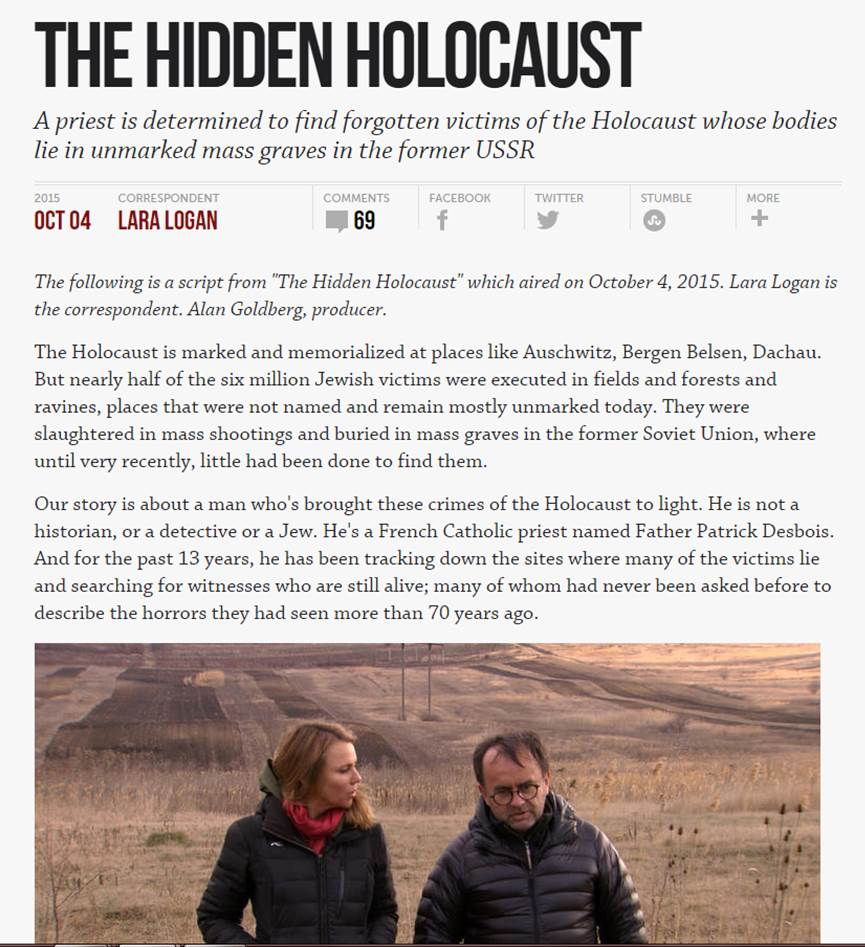
This is an important story which aired on Oct. 4th on CBS 60 Minutes. I’ve known about Father Dubois for quite some time and we do have mutual friends/acquaintances. His book,  The Holocaust by Bullets, can be ordered here. I’m glad that his important work is having such an impact, and being recognized as groundbreaking. Remember, we are only 75 years after the events… As I am at work on my own book about the Holocaust, I find myself admiring a kindred spirit, in a sense. I’m not Jewish, but Catholic like him, but that is hardly relevant, except to call attention to what happened from the perspective of a non-Jew. For deniers, it won’t make a difference-but as we study, and interview, we become witnesses, too. 

He can’t mark the mass graves that he finds, and sadly I already knew what to expect when I reached the comments section of the article. And I am told that Father Dubois has received death threats at his residence in Paris.

hidden holocaust

“The Holocaust is marked and memorialized at places like Auschwitz, Bergen Belsen, Dachau. But nearly half of the six million Jewish victims were executed in fields and forests and ravines, places that were not named and remain mostly unmarked today. They were slaughtered in mass shootings and buried in mass graves in the former Soviet Union, where until very recently, little had been done to find them.

Our story is about a man who’s brought these crimes of the Holocaust to light. He is not a historian, or a detective or a Jew. He’s a French Catholic priest named Father Patrick Desbois. And for the past 13 years, he has been tracking down the sites where many of the victims lie and searching for witnesses who are still alive; many of whom had never been asked before to describe the horrors they had seen more than 70 years ago.”

Lara Logan: So what you’re learning here is completely unrecorded?

Father Desbois: Yeah, if we didn’t come, we’ll never know they killed Jews. These Jews would have never been counted as dead, never known, and the mass grave is totally unknown.

Gheorghe brought us down this road where, he said, all the Jewish families from the village were taken. He told us the day of the shooting he was tending to cows nearby. Now 70 years later, we watched as he traced the victims steps to the edge of the ravine.

Read the transcript and view the report: http://www.cbsnews.com/news/hidden-holocaust-60-minutes/

http://www.yahadinunum.org/

Rleated article: Voices of ghosts: Remembering the Holocaust’s mass killings
‘I have lived with the Holocaust my entire life — and I still don’t understand how this could have happened’

Pearl Harbor survivor was quick to share memories

OCTOBER 04, 2015 2:00 PM • BILL TOSCANO

Editor’s note: Every life has a story. In this column, we pay tribute to people who have died recently.

I wrote about Mr. Ross and his passing a few weeks ago. This article appeared in the Post Star yesterday as he was being laid to rest. The reporter had contacted me for comment. And just so folks are aware, I asked him not to mention my recent book unless it was okay with Mr. Ross’ family. Rest easy, Barney. You made a lot of people happy in this life.

Barney Ross by Erin Coker, Courtesy Post-Star

Barney Ross by Erin Coker, Courtesy Post-Star

There’s a footnote at the bottom of Page 21 of Matthew Rozell’s recently published “The Things Our Fathers Saw” that sums up the late Barney Ross perfectly.
“In his remembrances, Mr. Ross’ voice began to break up recalling his friends who had passed before him. Barney brought smiles through the tears as he reminded my students that, ‘I may get emotional, but I’m still a tough guy.’ “
Rozell and his students at Hudson Falls High School were among many who heard Ross’ first-hand story of the attack on Pearl Harbor, the Pacific War and the signing of the surrender in Tokyo Bay.
Over the years, he had to think a little harder and sometimes needed prompting, but once the Whitehall native started telling his story, the memory and emotion took over.
Gerald A. “Barney” Ross, 94, died Thursday, Aug. 27, at Indian River Rehabilitation and Nursing Center in Granville, and with him died another memory of the attack that brought the U.S. into World War II. Ross, a lifelong resident of Whitehall, was one of an estimated 2,000 to 2,500 survivors remaining out of 60,000 who were at Pearl Harbor on that day of infamy.
Ross was a 1940 graduate of Whitehall High School and played on the 1939 unbeaten, untied, unscored-upon team. He was a hunter, fisherman and lifelong communicant of Our Lady of Angels Roman Catholic Church.
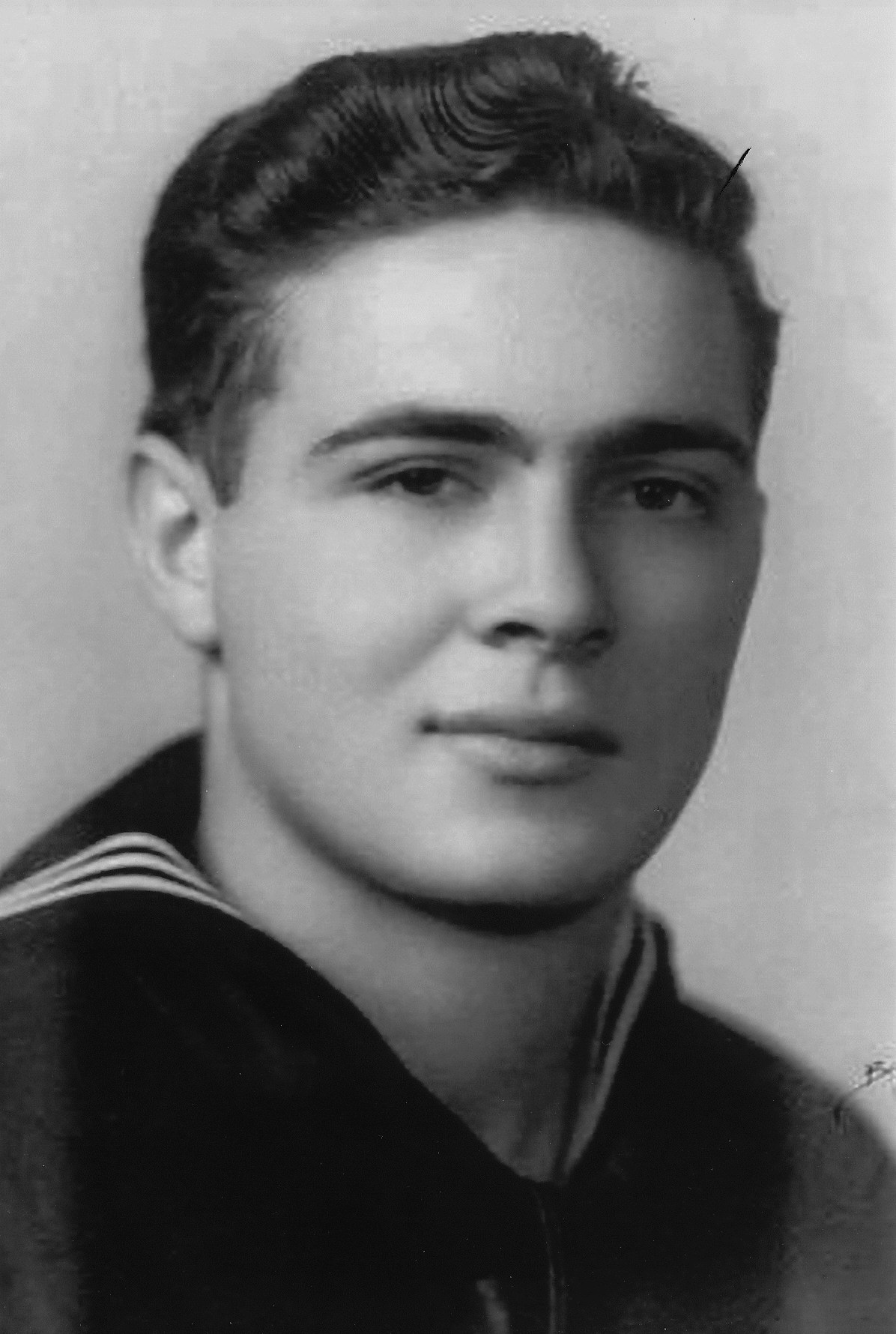
Following graduation, Ross enlisted in the U.S. Navy in August 1940. He served on the USS Blue during the Japanese attack on Pearl Harbor on Dec. 7, 1941.
Ross met Alice Marie Doyle at a USO dance in Philadelphia, and they were married in 1946. He operated Ross’s Restaurant in Whitehall and was later employed as a machine operator at Decora Industries in Fort Edward, retiring after many years of service.
Indelible memories
Gerald An electrician’s mate aboard the USS Blue, Ross found himself in the destroyer’s magazine during the battle, feeding ammunition to an anti-aircraft gun on the top deck.
“I’d get a shell, put that in the hoist,” Ross said in one of his many interviews. “And I’d get a powder and put that in the hoist. That way, I was feeding the gun. … I feel that we did our job.”
He had been in the harbor on the USS Blue when the Japanese planes dove out of the sky and dropped their bombs, and when the enemy submarines simultaneously sent torpedoes into American ships, in the surprise attack on America’s Pacific fleet.
“When the Japanese attacked, I was on the deck waiting for a boat to take me to a church service,” Ross said. “We saw a plane dive toward the USS Utah, then within minutes, it was the worst devastation you could ever imagine — the USS Arizona was blown up and the USS Oklahoma was turned over on its belly.”
Over the past seven weeks, at least five other survivors of the attack have died, including Joe Langdell, who at 100 was the oldest survivor of the USS Arizona. Eight men who served on the Arizona during the attack remain alive.
Ray Chavez, who at 103 years old is believed to be the oldest living survivor of the attack, recently threw out the first pitch at a San Diego Padres game.
In all, 2,000 to 2,500 of the 60,000 survivors are thought to still be alive, according to USS Arizona Memorial officials. More than 2,400 Americans died during the attack, including 68 civilians. Most — 1,177 — were killed when the Arizona exploded and caught fire.
‘A real nice man’
Rozell said he had not been in touch with Ross recently, but the man left a deep impression on him.
“He came across as a real nice man — down to earth, with a great warmth for the students he met in my classroom. A man who loved his town, his family and the entire region. But having survived the shock of Pearl Harbor, he always left us with a warning: ‘Be vigilant.’ That was in 1988 [1998].”

Ross was one of the first of many veterans to visit Rozell’s classroom. He is the first veteran quoted in “The Things Our Fathers Saw.”
“As a nation, we were sleeping; it is a terrible thing to say, but we just …” Ross is quoted as saying.
“I was just standing there waiting for a motor launch to take me to a bigger ship to go to Mass, to go to church! We had no inkling, no inkling whatsoever,” he added.
“We were sitting there like sitting ducks! Here are men, if you can visualize, men struggling to get out of the ships. A lot of them were sleeping in because they had the day off. It was a horrible thing! This fleet was coming to blow us off the face of the earth.”
Paying respects
Ross is survived by his wife and his three sons, Gerald F. Ross and his wife, Patricia, of Hartford, Dennis A. Ross and his wife, Angella Gibbons, of Marshfield, Vermont, and Christopher D. Ross of Whitehall.
Ross lived at Indian River Nursing Home in Granville for the past six years, and his wife still lives there.
A Mass of Christian burial was celebrated Saturday at St. Mary’s Roman Catholic Church in Granville.
Rite of Committal will be celebrated at 1 p.m. Monday at Gerald B. H. Solomon Saratoga National Cemetery in Schuylerville with full military honors.

http://poststar.com/lifestyles/columns/local/epitaph/pearl-harbor-survivor-was-quick-to-share-memories/article_f37b8284-0a58-5d8f-b5c5-8576e20dd2bc.html

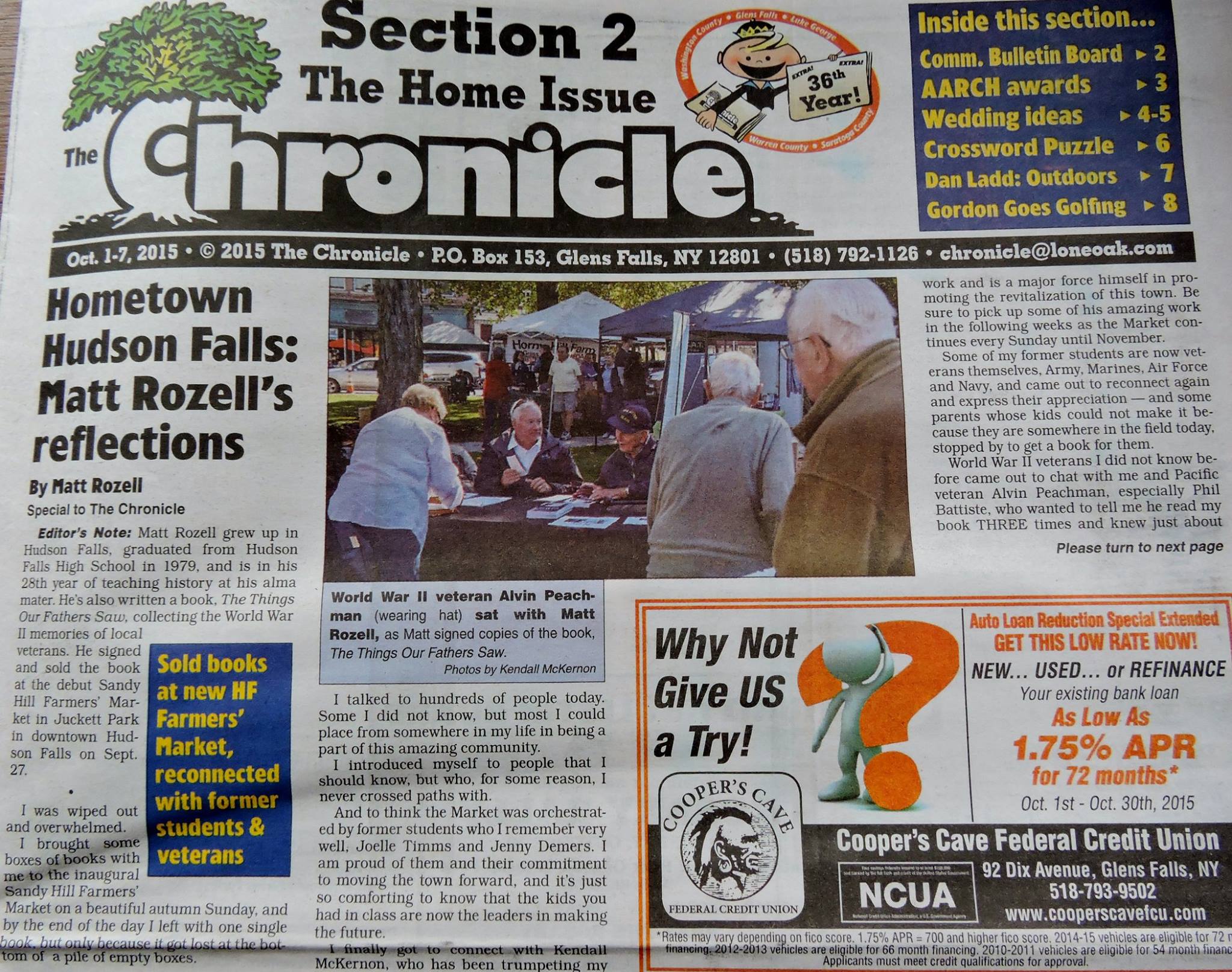
My post last week made the rounds, was read about 500 times, and was published in its entirety by the Chronicle newspaper in Glens Falls. And I meant every word.

Chronicle

The book is doing quite well. If you have read it and would like to help push it to the next level, please stop by and leave a review at my Amazon site.

Today Mr. Peachman and I will be back out at the Sandy Hill Farmers’ Market from 10 to 1. Come on out and see us!

001


Upcoming events are also listed below:

Sunday, Oct. 11 (weather permitting)
10am-1pm
Hudson Falls, NY
Sandy Hill Farmers Market
Juckett Park, Hudson Falls, NY 12839

October 16, 2015- For Teachers- REGISTER TODAY
Saratoga Springs, NY
39th Annual Civics & Law-Related Education Conference
New York State Bar Association
Law, Youth and Citizenship Program
Human Rights Challenges: Past and Present
“American GIs and Human Rights Violations: Combat Soldiers Confront the Holocaust”

www.nysba.org/LYC39Registration

Nov. 5, 2015
Toronto, Canada
Lecture/Presentation
“Through the Eyes of Liberators: History Comes to Life”
UJA Federation of Greater Toronto
Sarah and Chaim Neuberger Holocaust Education Centre
Holocaust Education Week

November 8, 2015
11-3 pm
Glens Falls, NY
The Chronicle Book Fair
Queensbury Hotel
88 Ridge St, Glens Falls, NY 12801

Sunday, November 15
2 pm
Glens Falls, NY
Book Talk/Signing
“Coming Home: Reflections on the 70th Anniversary the End of World War II”
The Hyde Collection
Warren St. Glens Falls, NY 12801

I brought copies of my recently published book with me to the inaugural Sandy Hill Farmers’ Market on a beautiful autumn Sunday, not knowing what I was in for.

I was wiped out and overwhelmed.

I wound up talking to hundreds of people.  Some I did not know, but most I could place from somewhere in my life in being a part of this amazing community. I introduced myself to people that I should know, but who for some reason, I never crossed paths with. And to think the Market was orchestrated by former students who I remember very well, Joelle Timms and Jenny Demers. I am proud of them and their commitment to moving the town forward-and it’s just so comforting to know that the kids you had in class are now the leaders in making the future.

Matt Rozell at the Sandy Hill Farmers' Market. 9-26-2015. Portrait by Kendall McKernon.

Matt Rozell at the Sandy Hill Farmers’ Market. 9-27-2015. Grading papers before the rush. Portrait by Kendall McKernon.

I finally got to connect with Kendall McKernon, who has been trumpeting my work and is a major force himself in promoting the revitalization of this town. Be sure to pick up some of his amazing work in the following weeks as the Market continues every Sunday until November.

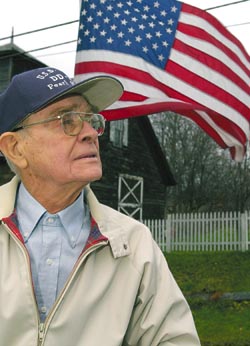
Some of my former students are now veterans themselves, Army, Marines, Air Force, and Navy, and came out to reconnect again and express their appreciation—and some parents whose kids could not make it because they are somewhere in the field today, stopped by to get a book for them. World War II veterans I did not know before came out to chat with me and Pacific veteran Alvin Peachman, especially Phil Battiste, who wanted to tell me he read my book THREE times and knew just about everyone featured in the book! I asked him if I got it right—he told me I was on top of my game. Phil told me he knew my late father very well and could place him and his family in the childhood house they lived in near him on the corner, during the Great Depression.

My best hometown friend’s mom came out to get a book and reminded me that I escorted her down the aisle at his wedding to his bride 32 Septembers ago- and Dolores was just was beaming with pride. Later, the still lovely bride stood in line patiently to get a book and reminded me that we need to see each other soon! My preschool teacher from 50 years ago came out to say hi, and I joked with a woman whose face I could just about place, and when she said that she was one of my former teachers, I immediately recited her first, last, and married name. I knew this because she was one of my first crushes and she married the year she had me in her elementary class. I told her she was still beautiful. She picked up two books.

My cousin, whom I have not seen in years, stopped by, picking up books for the family. She filled me in on her genealogy research and sent her son to get coffee for me, and restocked the books that Alvin and I signed, and helped keep us organized as a line began to form. My wife stopped in after Mass, and ran to the truck to get more books. My parents’ friends were there. Mom and Dad passed on ten and fifteen years ago, and seeing people I remember fondly from my own days of being raised right here brings my folks right back to the forefront of memory with a warm bath of affection and love that today was impossible to overlook.

Then, there was the girl (woman! mother!) who told me she is in her 7th year teaching at a nearby school, with her own sister teaching in an adjoining classroom! I remembered S. as being very happy and fun in class, and congratulated her on becoming a teacher, because I even in high school I could sense that she would  make the world a better place just by the sheer force of her ‘good will to others’ presence. I wish I paid a little more attention to the little one who was with her, but she kind of struck me when she volunteered that I was the reason she was a teacher. We had never had that kind of conversation in the classroom—but that is the way it works, and I am lucky enough to hear this later in life, rather than eavesdropping at my wake! Just a few weeks ago, a young man from my first year of trying to survive as a teacher came out to my first book talk and raised his hand when I called for a show of hands of former students in the room. I could not place him right at that moment, but later, when he told me his first name, I could spell ‘Ehren’ correctly as if it was 28 years ago. He teaches history in Albany, and told me I was the reason for that…

But of all the wonderful blasts from the past, tugging at my subconscious was the presence of the young woman who was standing back and watching me sign a book for her friend (one of my former students, now a combat Marine veteran of the Iraq war, with whom I was chatting away and really enjoying getting to know again). She was quiet, in the background, but smiling as T. and I talked, and just kind of gazing at me in a special way. I knew that I knew her, but just couldn’t place it—so I finally asked her. And it all came flooding back, when she spoke her first name. Half a lifetime away, at an immensely difficult time in her life, I had reached out to her and taken her under my wing while she struggled through and worked to regain some balance as a sixteen year old. We did not speak of it, but before she left she stepped forward because she said she had to give me a hug.

When I see my brother, who lives in Alaska, once a year, when it is time to part, he puts his arms around me and squeezes me hard, in silence. So it is. I did a lot of hugs today, but she got the hardest squeeze, in silence. Bless you, C. So it seems that ‘Repairing the World’ has turned out to be a theme in my life’s work, and in most teachers I know, but in truth, it starts at home, and it works both ways. Bless everyone who has played a part of and enriched my life in so many different ways.

I write about the feeling I have for my hometown in the introduction of the book. I have been moved and shaped in so many ways by the veterans, by the people who came out today, and the hometown folks who could not make it. I hope the book is but a small token of my appreciation, and if you read the book, you will see it is my attempt to give back, but also pay it forward for the younger crowd who step up and make the vision real.

Mr. Peachman had a great day, and was on the receiving end of many hugs himself. He knew just about everyone who saw him, and held his own court in the temple of the Hudson Falls Farmers’ Market. Thank you Joelle for asking me, and Jenny, who did so much, and all the others with a vision for this small town on the Hudson that we all call home, no matter how far we have wandered. So I remember the words:

I cannot forget where it is that I come from.

A small town.

Matt Rozell and Alvin Peachman at the Sandy Hill Farmers' Market. 9-27--2015. Portrait by Kendall McKernon.

Matthew Rozell and veteran Alvin Peachman, 9-27–2015. Photo by Kendall McKernon.

It was six years ago this evening, we shared a meal on the eve of Shabbat, after watching ourselves on a national broadcast that reached millions. Why does it seem, so long ago?

Maybe because it all seems so unbelievable- that out of the darkness of the past, on a day when the sun dawned clearly and was warming the Earth in its mid-April morning ascent, a low rumble was heard by  hushed and huddled groupings of tormented humanity as they strained to hope for friends amidst their lurking murderers. As the metallic clanking grew louder, over the horizon broke the earthly angels, two Sherman light tanks and an American Jeep with the emblem of the white star. A cry broke out. They realized they were saved, and the American major snapped a photograph at the exact moment the overjoyed survivors realized it.

And out of the past on a warm September day, we brought them all together again. Who would have believed that 62 years later, a high school in a quiet, rural part of the world would  bring the soldier-liberators and the rescued survivors together from the US, Canada, Israel and elsewhere? All because I couldn’t let go of a good narrative history, and pursued the story behind the photographs that proved it really happened?

And think about the risk you run, inviting hundreds of octogenarians to come to a high school for half a week to mingle with thousands of high school and middle schoolers? Talk about sweating bullets. What if they are uncomfortable? Cranky? Complaining? What if the kids I can’t control are rude? And what if one of these “old” folks, who I don’t even know, dies on our watch? I would lie awake at night wondering if I was out of my mind.

But the miracle came to be-for the two dozen or so elders who could come, tears flowed, wine spilled, and our “new grandparents” danced with young teenagers who adored them, but only after the risk was accepted, with the enthusiastic help of Mary Murray, Tara Winchell-Sano, and Lisa Hogan, Rene Roberge and others. Have a look at the videos, and feel the love. We created ripples, and tripped the wires of the cosmos, and the reverberations are still echoing. To date, with Varda Weisskopf’s and Frank Towers’ help, the list is at 275 survivors whom we have found. And how many generations has it effected?

This is the subject of my second book, due out this next summer. In the meantime, I am working on a shorter work of what I have learned in teaching the lessons of the Holocaust. So take a look at the videos, and remember the words of the liberator:

“Here we are! We have arrived!”

History’s True Warning

How our misunderstanding of the Holocaust offers moral cover for the geopolitical disasters of our time.

This article appears originally in Slate. Timothy Snyder is the Housum Professor of History at Yale University. His most recent book is Black Earth: The Holocaust as History and Warning.  It provides a look at what the author perceives to be the “mis-uses” of history and the dangers of simple or standard interpretations of the historical narrative. While I would agree that “the Holocaust was largely over by the time Americans soldiers landed on Normandy”, tell that to the half million Hungarian Jews who were being murdered during the summer of 1944. The war ended the Holocaust. Nor am I sure about the analogies. I think one has to read the book to assess this following argument, and I am currently doing so.


Kiev, June 23, 1941. Grushki district. Kiev, Ukraine. Photo by RIA Novosti archive via Wikimedia Commons

By Timothy Snyder

The cantor is a vivid presence in any Jewish congregation, responsible for song, often a man with an outgoing personality and a sense of social engagement. Such a cantor was Eleazar Bernstein, who lived with his wife Martha and their three children in the southwestern German city of Zweibrücken in the 1930s. Among other good deeds, Bernstein would visit Jews in the local prison to lift their spirits. There he befriended a guard, a police captain named Kurt Trimborn, with whom he would play chess.

On the night of Nov. 9, 1938, Germans destroyed hundreds of synagogues, including Bernstein’s. On the day after this national pogrom, the infamous Kristallnacht, Bernstein was arrested, along with thousands of other Jewish men throughout Germany, all bound for concentration camps. His neighbors looted his apartment, broke his windows, and stole his furniture. Bernstein’s two sons were too small to understand. Coming home to find a wreck, they amused themselves by throwing things through the gaping window frames. Martha made her way across the rioting city to find her husband’s police captain friend and ask for help. Trimborn told Martha to pack, released Eleazar, and escorted the family across the French border. The car was so full of suitcases that the children had to lie flat on top of them in the back seat.

Four decades later, from America, Bernstein sent Trimborn a letter. The two little boys had grown up to become engineers. His daughter was a teacher. There were grandchildren. All of this thanks to Trimborn.

The letter was written after Trimborn’s conviction for mass murder.

Since destroying states was one cause of the Holocaust, the Holocaust should not be used as a reason to destroy states.
Not long after helping the Bernstein family, Trimborn joined the German security police. He was trained for a special task force, an Einsatzgruppe, which was sent behind the invading German army to the Soviet Union. When Trimborn joined his Einsatzgruppe in occupied Soviet Ukraine in October 1941, its men were already murdering entire communities of Jews. That December, as the Red Army halted the German advance and the Americans joined the war after Pearl Harbor, Hitler proclaimed that the Jews were responsible for Germany’s predicament. In 1942, Trimborn personally ordered that hundreds of Jews be murdered, and carried out neck shots himself. One day he herded 214 children from an orphanage into a gas van—a truck refitted so that its exhaust fumes were pumped into the hold rather than into the atmosphere. The children screamed and pounded the walls as they were asphyxiated.

One lesson we have learned from the Holocaust is to emulate the rescuers. It is right and good to work against the current, as did Trimborn in 1938, to resist the oppression of groups by helping individuals. But this was not enough to stop a Holocaust in 1941; it was not even enough to stop Trimborn from participating in that Holocaust. We have further lessons to learn. We know that we should resist anti-Semitism. But we overlook that the program of eradicating Jews required sending men such as Trimborn to destroy neighboring states. The SS was not a special state institution but a racial one, grounded in a biological understanding of the world. Its task was to destroy states so that a racial struggle could unfold.

When Trimborn saved the Bernstein family, Germany was just beginning to undo European states. When Germany absorbed Austria in 1938, Jews were humiliated. When Germany dismantled Czechoslovakia in 1938 and 1939, Jews were depatriated. After Germany allied with the Soviet Union in 1939, each power invaded Poland with the aim of annihilating the Polish political nation; the Soviet Union also destroyed the three Baltic States of Lithuania, Latvia, and Estonia, separating Jews from their property and traditional legal protections.

Already in 1939, during the invasion of Poland, Germany sent Einsatzgruppen behind its army, to kill Polish political elites. In June 1941, when Germany invaded the Soviet Union, Nazis identified the Soviet political class (quite falsely) as the Jews. Einsatzgruppen commanders blamed Jews for the evils of Soviet rule, inviting local people to clear themselves of their own past collaboration with the Soviets by turning on their Jewish neighbors. Germans and locals joined together in the anti-Semitic lie that Jews were responsible for communism. In a war with no rules, German troops blamed Jews for the partisan response they feared and killed them. In a land without laws, German policemen were willing to shoot Jews, thousands at a time, people who were accused of no crime.

When Trimborn arrived in Ukraine, just three years after he had saved the Bernstein family, German leaders had learned how statelessness enabled the dark politics of mass murder. Far from Zweibrücken and quiet nights of playing chess, Trimborn would kill, again and again. And so the Holocaust began. Jews who lived before the war in places that became stateless had about a 1-in-20 chance of surviving. Elsewhere in places under German control, even in Germany itself, the probability was more like 1-in-2. The entirety of the killing would take place in a zone of Eastern Europe where the Germans brought anarchy.

Seeing the Holocaust as an encounter of general anti-Semitism and local statelessness helps us to make sense of the two great geopolitical disasters of our century: the American invasion of Iraq in 2003 and the Russian invasion of Ukraine in 2014. In part because Americans misunderstood the Holocaust as the oppression of a minority by an authoritarian state within its own boundaries, they could believe in 2003 that regime change by force of arms in Iraq would automatically bring positive consequences. By the early 21st century, we had convinced ourselves that the Holocaust was caused by an authoritarian regime acting against a minority within its own borders, which in the main it wasn’t, and that we acted to stop it, which with a few minor exceptions we didn’t. The Holocaust was the mass murder of Jews beyond the borders of prewar Germany, in a zone from which conventional political institutions had been removed, and the Holocaust was largely over by the time Americans soldiers landed on Normandy. American troops liberated none of the major killing sites of the Holocaust, and saw none of the thousands of death pits in the East. The American trials at concentration camps reattributed prewar citizenship to the Jewish victims, helping us overlook that the eliminations of citizenship—usually by the destruction of states of which Jews had been citizens—were what permitted mass murder. A large body of scholarship on ethnic cleansing and genocide concludes that mass killing generally takes place during civil wars or regime changes. Nazi Germany deliberately destroyed states and then steered the consequences toward Jews. Destroying states without such malign intentions creates the space for the kind of disaster that continues to unfold in the Middle East: in its civil wars, religious totalitarianism, and refugee crisis.

There are many differences between the American invasion of Iraq and the Russian invasion of Ukraine, but also one clear similarity: In both cases, the Holocaust was used as moral cover. Russians quite rightly remember that the Red Army bore the brunt of the German attack in 1941 and did liberate the Nazi killing zones. But they prefer not to recall that the Soviet Union helped Nazi Germany begin the war in 1939, jointly destroying four East European states and bringing the European order to an end. When Germany betrayed its Soviet ally and attacked the USSR in 1941, spreading anarchy, Soviet citizens joined the Germans as collaborators, tens of thousands of them taking direct part in the shooting. Unnervingly, Russia justified its March 2014 attack on Ukraine by claiming that its neighbor wasn’t a real state, its president invoking the Molotov–Ribbentrop pact of 1939 as normal diplomacy. Since Russia chose to send its troops to Ukraine, claiming absurdly that it meant to combat fascists and save Jews, its war has killed at least 8,000 people and almost certainly far more, driven 2 million people from their homes, and called into question the European legal order. The deliberate creation of a lawless zone in the Donbas has predictably led to kidnappings, executions of prisoners, and other abuses of human rights. The last time a European country invaded another and annexed its territory was the Second World War. European integration was meant to strengthen European states, and thus prevent the political collapse of the 1930s from happening again. The collapse of the European project could mean a return to the bad old days of old-fashioned power politics.

We cannot know the exact scenario that might follow if the trend of state destruction proceeds. What we can say is this: Since destroying states was one cause of the Holocaust, the Holocaust should not be used as a reason to destroy states. When institutions are broken, few of us would behave better than the Europeans of Hitler’s era. Hitler seduced Germans by the vision of a world with no rules, where states would crumble and all was permitted. In 1938, while playing chess, Trimborn was a friend. In 1942, in a zone of anarchy, he was a murderer. One of Bernstein’s children lives today in California in a house full of chess sets. Trimborn’s children, until they met Bernstein’s children, were unaware that their father had once known the rules.

Timothy Snyder is the Housum Professor of History at Yale University. His most recent book is Black Earth: The Holocaust as History and Warning. This article originally appears in Slate at this link: http://www.slate.com/articles/news_and_politics/history/2015/09/holocaust_history_misunderstood_it_has_provided_moral_cover_for_the_wars.single.html

‘To Make it Known’

Veterans book

History teacher and author Matt Rozell, right, talks with World War II veteran and former history teacher Alvin Peachman at a book signing Sept. 11 on LaBarge Street in Hudson Falls. Peachman is one of several veterans featured in ‘The Things Our Fathers Saw.’ Ashleigh Abreu photo.

YOU CAN ORDER THE BOOK HERE

September 22, 2015 7:00 am •  by RHONDA TRILLER

HUDSON FALLS | Matt Rozell remembers the moment he realized his life’s work.

It was 1984, and as the nation marked the 40th anniversary of the D-Day invasion, President Ronald Reagan spoke at Normandy.

“Let us show them by our actions that we understand what they died for,” he said of the Americans who fought in World War II, during an iconic speech.

That year, “The Good War: An Oral History of World War Two” by Studs Terkel was published. In it, Terkel looked at the war from a historical perspective, told through some 120 interviews with the men who fought, as well as nurses, entertainers and bureaucrats. Terkel was awarded the 1985 Pulitzer Prize in nonfiction for the work.

“It was the first historical piece on World War II entirely told by regular people,” Rozell said, recalling the 600-page book was “this thick,” holding his thumb and index finger inches apart.

The book raised an interesting question about war, Rozell said.

“The war was put on a pedestal — it should be, especially now that so few of the men are left — but is any war good?” he said. “It was a fascinating book.”

“That’s when I woke up and that’s when my teaching career began,” Rozell said. “I think that’s when it finally dawned on me how important World War II was in history and in the fabric of our own country here, let alone the world.”

Rozell did, in fact, become a teacher — history, of course — at his alma mater, Hudson Falls High School.

But as important, he has devoted his life since to telling the stories of World War II veterans.

This summer, Rozell independently published “The Things Our Fathers Saw: The Untold Stories of the World War II Generation from Hometown USA.”

“I’ve thought about it for 20 years,” he said. “I was at that point, I had to get it out of me.”

The book recounts the war in the Pacific Theater, told from interviews and, in some cases, journal entries, of men from the Glens Falls area.

“The Things Our Fathers Saw” works through the war, beginning with the bombing of Pearl Harbor, following some of the men from enlistment, through battles and being taken prisoners of war. He includes lectures from veterans visiting his classroom, photographs and maps.

“It’s a war that, outside of Pearl Harbor and the dropping of atomic bombs, very few people have an understanding of what happened in the Pacific Theater,” Rozell said.

At a recent book signing, Rozell sat next to Alvin Peachman, 93, one of the veterans featured in the book.

Peachman is a longtime Hudson Falls resident and retired history teacher, who had Rozell as a student.

His classes were much different than Rozell’s, though.

“I don’t remember any teachers talking about their own experiences,” Peachman said, adding that he didn’t talk much about his service until years later. “Everybody wanted to learn about Adolf Hitler.”

Rozell studied history at SUNY Geneseo, but didn’t realize how much of a gap in knowledge the American public suffered until he started interviewing veterans and chronicling their stories.

“My interest was what Al Peachman was talking about when I was in school — Adolf Hitler this and Adolf Hitler that,” Rozell said.

“When you call for World War II stories and these people are talking about things you don’t know a thing about, you realize you have so much more to learn,” he said. “It’s the experience of a lot of Americans, I think.”

Rozell now teaches a separate course at Hudson Falls High School focused on World War II. The class is so popular, some students can’t get in.

Vinny Murphy, a senior, is among the lucky ones this semester. He wanted to take the class after attending a Rozell-organized assembly as a middle-schooler.
“For him to be a teacher and have an interest and want to share that with the students is very refreshing,” Murphy said. “He wants to teach us and remember this stuff and really take it to heart and make sure stuff like this never happens again.”

Until Rozell, Peachman said, the men who served in the Pacific got little recognition.

“We always fell second to Europe, although we did almost all the fighting in the Pacific,” he said.

As World War II veterans age — two of the men featured in Rozell’s book died in the past few weeks — Rozell is feeling a sense of urgency.

“I really wanted to get it out while some of the guys are still alive,” he said.

The book is a culmination of efforts that began years ago, when Rozell started inviting World War II veterans into his classroom in the early 1990s.

“It was really a two-fold thing: I need to make history alive for my kids; it’s their grandparents, their aunts, their uncles, in some cases, their actual parents who were involved in the war; and take that person’s story and find out more how this person fits into the big picture of the war, the big overall standard history, but at the same time realize that you as the interviewer, or the person talking to the adult, you are actually creating a new piece of history, which is really exciting,” Rozell said.

Students’ interest grew even more when, in 2001, Rozell initiated a living history project, A Train Near Madgeburg, in which he and his students reunited Holocaust survivors and the American soldiers who liberated them from a death train in April 1945.

“I think for most teachers … that’s why you teach, to bring history alive and, boy, did that ever do it for them,” Rozell said.

Rozell and his students were named People of the Week in September 2009 by Diane Sawyer on “ABC World News” for their work on the project.

The liberation is the subject of Rozell’s next book, which is tentatively scheduled for release in the summer of 2016.

“My story is to make it known,” Rozell said. “It’s their story; it’s in their words.

“I need to do it before everybody is gone.”

http://poststar.com/news/local/rozell-recounts-war-through-veterans-eyes/article_2ce81fd2-6d9c-55f2-8087-74e85834f741.html

History teacher and author Matthew Rozell has several speaking engagements lined up throughout the area, including:

Sunday: 9 a.m. to 1 p.m., Sandy Hill Farmers Market, Juckett Park, Hudson Falls

Oct. 16: 7 a.m. to 3:30 p.m., 39th annual Civics & Law-Related Education Conference, Saratoga Springs Holiday Inn

Oct. 21: 7 p.m., book signing/reading, Chapman Historical Museum, 348 Glen St., Glens Falls

Nov. 8: 11 a.m. to 3 p.m., The Chronicle Autumn Leaves Book Fair, Queensbury Hotel, 88 Ridge St., Glens Falls

Nov. 15: 2 p.m., book signing and talk, The Hyde Collection, 161 Warren St., Glens Falls