Feeds:
Posts
Comments

I’m in the City of God now, Jerusalem. The last time I was here was in 2011, with Frank Towers, his son Frank Jr., my ten-year-old son, and Varda Weisskopf, a Holocaust survivor’s daughter.

Varda Weisskopf, liberator Frank Towers, Matthew Rozell at Yad Vashem, May, 2011.

Survivor’s daughter and reunion organizer Varda Weisskopf, liberator Frank Towers, Matthew Rozell at Yad Vashem, May, 2011.


Why am I here? I am studying at Yad Vashem, Israel’s Holocaust Martyrs’ and Heroes’ Remembrance Authority, for 19 days with 29 other educators from all over the world. And although we just started, one of the early takeaways is, think about what the world lost.

“I often wonder what this world would be like, if those 6 million had never perished.” Frank Towers, 30th Infantry Division, Liberator

We talk about the story of human beings. Of the ‘choiceless choices’, in the ghettos and the camps. About the will to live, about what it means to have nothing, from the perspective of the survivors. Maybe also the ”survivors’ guilt”, but also the victory over Hitler and Nazi ideology, as seen in the 2nd and 3rd generations of Holocaust survivors alive and flourishing today.

Matt Rozell, survivor Bruria's son, Frank Towers, two survivors Bruria Falik (of Woodstock, NY) and her sister at Israel's Holocaust memorial in Jerusalem, Yad Vashem.

Matt Rozell, survivor Bruria’s son Dan F., Frank Towers, two survivors Bruria Falik (of Woodstock, NY) and her sister at Israel’s Holocaust memorial in Jerusalem, Yad Vashem.

I am learning so much, and I am eager to learn more. But yesterday I learned that Frank Towers, Sr., age 99, passed away peacefully with his family by his side in Florida, on July 4th, 2016. Independence Day.

*

Frank was born on June 13, 1917. Think about that for a minute. John F. Kennedy also came into the world, less than a month before Frank. ‘Buffalo Bill’ Cody left the world. American involvement in WWI was just getting underway, and Frank’s future 30th Infantry Divison was formally activated. Gandhi was tromping around India, investigating the poor conditions of local farmers. The Russian Revolution was just getting started. American suffragettes that summer were arrested for picketing the White House for the right to vote for women.

So into this world came Frank W. Towers. And Frank Towers came into my life after he had already lived a good, long one, in September, 2007, shortly after he turned 90. But he had more things to do before the Almighty called him home.

He did not know me, and I did not know him-I have never even been to Florida, where he lived. But, from the news he learned of a reunion that we had recently done at our high school. He read about how I had reunited World War II tank commanders  from the US Army 743rd Tank Battalion and 30th Infantry Division with the children of the Holocaust who he also had helped to liberate. And Frank said to himself, “Wait, I know about this. I was there, too.”

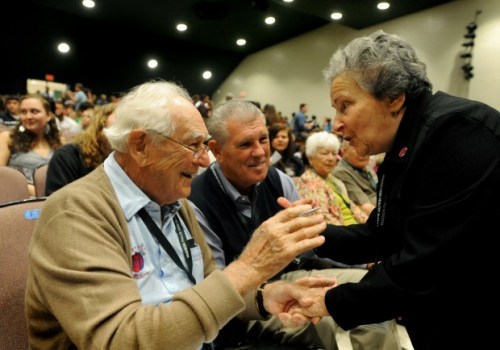
Frank reached out to me and we began a fruitful partnership in trying to locate more of the survivors who were on that train. He invited me, and the survivors, to the 30th Infantry Division Veterans of World War II reunions that they held annually down south. And these were powerfully moving events, to see the soldiers touched by the gestures of the survivors; and for the survivors to laugh and cry with their liberators was a gift that they, their children and grandchildren, will never forget. We also held additional reunions at our school, for the sake of making students the new witnesses to what happened during the Holocaust.

Holocaust survivor Ariela Rojek, right, was 11 years old in 1945 when she and 2,500 other concentration camp prisoners aboard a train near Magdeburg, Germany, were liberated by American forces including 1st Lt. Frank Towers, left with his son Frank Towers Jr., center. "You gave me my second life," Rojek told Towers Wednesday, Sept. 21, 2011, at Hudson Falls High School during an event reuniting soldiers and survivors. Jason McKibben Glens Falls Post Star

Holocaust survivor Ariela Rojek, right, was 11 years old in 1945 when she and 2,500 other concentration camp prisoners aboard a train near Magdeburg, Germany, were liberated by American forces including 1st Lt. Frank Towers, left with his son Frank Towers Jr., center. “You gave me my second life,” Rojek told Towers Wednesday, Sept. 21, 2011, at Hudson Falls High School during an event reuniting soldiers and survivors. [Jason McKibben Glens Falls Post Star]

*

Today in class I was given the opportunity to speak in an open forum, ostensibly to comment on my thoughts about our collective, moving experience in being guided through the museum by our program leader Ephraim. He knew I had just lost Frank, and I think he knew that I needed to talk about it.

So I began. I told the group that I had been to Yad Vashem before, and that it was because of something very special in my life. In 2011, I was accompanying a then 94-year-old American liberator, who had just met over 500 people who were alive  because of the liberators’ intervention and efforts at the ‘Train Near Magdeburg’ on April 13, 1945. Over 50 survivors were present, and later, Frank, his son, my son, Varda, and some survivors had a personal tour of Yad Vashem.

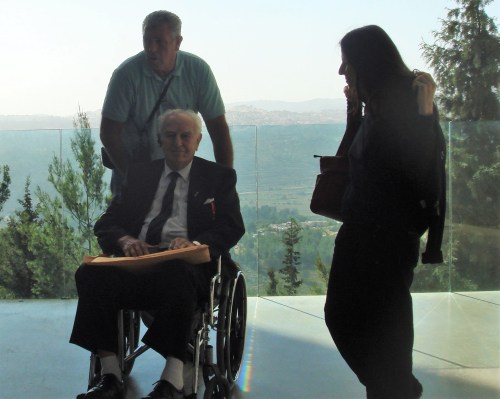
Frank W. Towers, Yad Vashem, 2011.

Frank W. Towers, Yad Vashem, 2011.

The museum is designed almost as a triangular tunnel, from which, as you move from prewar Jewish life to increasing persecution and eventual mass murder, gets purposely more bottlenecked and constricting and troubling as you move through the wings of increasing destruction. But in the course of this harrowing encounter with the past, always you draw nearer to an opening, a triangular apex of light that gets bigger, as you pass through time. And I tell the group that for me, the image I so recall, was the image of Frank and survivor’s daughter Varda, in the light and in the opening. It is highly likely that Varda would not be alive today, had it not been for Frank and the soldiers of the 30th Infantry Division and the 743rd Tank Battalion. So now she gave him a great gift, to be able to come to Jerusalem, the City of God, and see the fruits of victory, six and a half decades later-the hundreds of children and grandchildren he met and shook hands with. And I got to witness it all.

And then I paused, and told them that the world had lost Frank Towers only 36 hours before. And here I was, six thousand miles away, and unable to go to his services in Florida. Instead I am here at Yad Vashem, sitting in a classroom, pouring out my heart. And it hurts.

But this is not a lament. As I speak, the reason why I can’t go to Frank now crystallizes and becomes clarified for me. You see, led by Frank, the veterans of World War II have paved the way many times for me to travel abroad to study the Holocaust. Think about that. The American soldiers who encountered the Holocaust as young men in 1945, open their wallets to send a teacher to study, so that this history is not lost to upcoming generations. Of course, the survivor community has also been very generous in this regard, but the soldiers, led by Frank Towers, are so grateful, that the Holocaust-and their sacrifices in slaying the beast-will never be forgotten.

So, I’m at Yad Vashem studying the Holocaust when Frank passes for a reason-this is right where he would want me to be. And as I close with my new teacher friends, after a very long and emotionally charged day, I remind them that we all bear a collective responsibility as teachers to carry on doing what we do when we teach, especially in teaching the subject of the Holocaust:

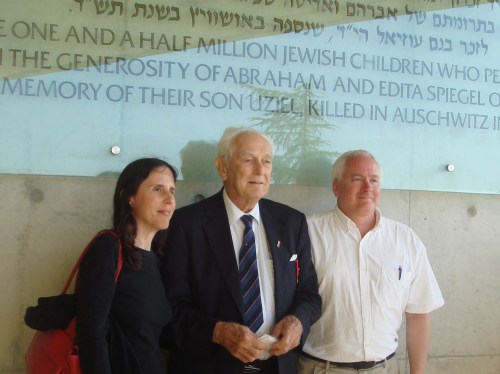
Frank Jr, Frank, Varda. Yad Vashem, 2011

Frank Jr, Frank, Varda. Yad Vashem, 2011

We are creating human beings. We are cultivating humanity. There is no past, and it is never over. There is hope amidst all the darkness in the world. The tunnel will lead to the light.

This is the transformation that I feel, when I look at the photo of Frank here at Yad Vashem. I’m grateful for the words that I see as the backdrop for this sharing time in the classroom today:

Blessed are the hearts that can bend; they shall never be broken. -Albert Camus

That’s a tall order, today. Godspeed, Frank Towers.  Candles on almost all the continents are lit for you. The short newscasts below are a part of the legacy, of the last liberator.

NBC News w/ Ann Curry

ABC News w/ Diane Sawyer

USHMM Video

I am in Israel now to embark upon two and a half weeks of study at Yad Vashem, the Israeli Holocaust Martyrs’ and Heroes’ Remembrance Authority. I am humbled. But I was here before, in 2011, with liberator Frank Towers as he was recognized for his efforts 70 years ago, on behalf of American liberators everywhere. Here in Israel he met with statesmen and the head of the IDF, as well as over 50 survivors and their families who were liberated on April 13, 1945, an event that Frank had a direct hand in.

Varda Weisskopf, liberator Frank Towers, Matthew Rozell at Yad Vashem, May, 2011.

Varda Weisskopf, liberator Frank Towers, Matthew Rozell at Yad Vashem, May, 2011.

It’s a long story, but my work as a teacher has been here, too. In the background, note the Benjamin photo at the 2015 70th anniversary state ceremonies.

"The anguish of the liberation and return to life". Note the Benjamin photograph on the banner. Yad Vashem, 2015.

“The anguish of the liberation and return to life”. Note the Benjamin photograph on the banner. Yad Vashem, April 2015.

The short version of the story:

Fifteen summers ago I sat down to listen to an old gentleman in a rocking chair. A  war weary tank commander in 1945, he told me stories of his World War II experiences and then led me to his fellow tank commander, who showed me a picture that their major had taken on April 13, 1945. You see, those two were there, and their two tanks had liberated a concentration camp transport deep in the heart of war-torn Germany.

It would be the first time in decades that this picture had seen the light of day. And because of its discovery, and what we would do with it, thousands of lives were about to change.

Yad Vashem contacted me in December 2014 to inquire about using the Major Benjamin photo. I immediately sent them a copy. My friend Varda in Israel writes, ‘[The photograph above was taken] during the main ceremony at  the Holocaust Remembrance Day at Yad Vashem. This photo shows the President of Israel Reuven Rivlin make his speech. You can see your photo there at the middle (banner) and I now think it was there throughout all the ceremony.’

Below, a post from the time of the event in April, 2015..


My good friend in Israel let me know that the April 15th  commemoration of the Holocaust at Yad Vashem in Israel was a moving event and sent me the link to the video of the ceremony marking the 70th anniversary of the liberation. While the  narrative  behind the Major Benjamin photograph was not a focus, the photo that which now seems to be becoming a cornerstone of the history of Holocaust liberation is all throughout the ceremony, and especially at 8:31. One of my friends, a survivor who had been a six-year old boy on this transport that Major Benjamin photographed at the moment his jeep arrived at the train, notes,

The photograph wouldn’t be there if not for your effort. It was presiding on 1.5 hrs of national ceremony in the presence of Israel’s president, prime minister, the entire government, the top army guys, survivors, chief rabbis and was nationally broadcast. You have a direct hand in this.

Me, a lowly teacher, whose work for an evening is presiding as the backdrop for presidents and prime ministers. I am proud and hope that the story is told over and over, and that it serves the memory of the victims, the survivors, and the liberators well. I just can’t believe sometimes this path I have been down, since the day over a dozen years ago when I took the time to listen to a war veteran, and began to backtrack his story.  There are other forces at work here, I think… and there is a cosmic force that reverberates in you when you teach the Holocaust from the heart.

Teachers out there, you all know the power of what we do. I hope this serves as an affirmation.


*************************************************************

Matthew Rozell is a United States Holocaust Memorial Museum Teacher Fellow and teaches history at his alma mater in upstate New York. His work has resulted in the reuniting of 275 Holocaust survivors and the American soldiers who freed them.

His first book, ‘The Things Our Fathers Saw’, was released to coincide with the 70th anniversary of the end of World War II. His second book,  is on the power of  teaching, remembering the Holocaust, the Benjamin photograph and this ‘Train Near Magdeburg’. 


Victory, 1945. Watercolor, Ervin Abadi. Train Near Magdeburg survivor. Hillersleben, Germany, May 1945.

Victory, 1945. Watercolor, Ervin Abadi. Train Near Magdeburg survivor. Hillersleben, Germany, May 1945.

I am in Israel now, getting ready to study at the International School for Holocaust Studies for several weeks. On Thursday, back in Washington DC, USHMM Chief Acquisitions Curator Judy Cohen met with a person who contacted me over a year ago with a question about some artwork that her grandfather had brought back from World War II, serving in the 95th Medical Gas Treatment Battalion, helping out with Holocaust survivors at the captured Luftwaffe base at Hillersleben, Germany. Chriss Brown wanted to know more about the artist, and I think because she had typed his information into a search engine, found me through this website. I immediately recognized the artist’s hand, and I told her that he was on the Train Near Magdeburg, and also sent her more information about him. Later in life, the artist stated,

“Let these drawings serve as proof of my everlasting gratitude towards those to whom I owe my life. … To the soldiers of the United States Army, particularly to our immediate liberators, those soldiers of the 9th regiment [sic] who first entered the village of Zilitz and gave us bread, milk, chocolate, and cigarettes….”

The United States Holocaust Memorial Museum was pretty thrilled about the acquisition, and received the donation from Chriss and her family with gratitude.

Good in the world. Amidst all the evil and darkness forces at work, it is here today. And we are reminded that it saved the world 70 yrs. ago.

*


You can read the serendipitous backstory/role I had in it all, here:

Seventy Years: ‘If his name is mentioned, a person lives forever.’

and here:

Seventy Years: The American Angels of Hillersleben.

and read more about it in my upcoming book.

Here are some pics about the acquisition, from this past Thursday, June 30th.

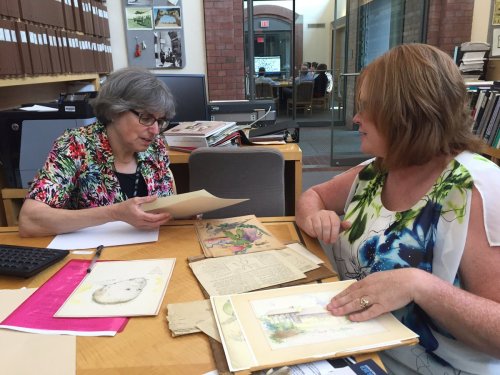
Chriss Brown when she first started showing Mr. Abadi's drawings to USHMM curator Judith Cohen. #USHMMCurators

Chriss Brown when she first started showing Mr. Abadi’s drawings to USHMM curator Judith Cohen. #USHMMCurators

Art by Hungarian survivor Ervin Abadi made for US GI Donald W. Rust after liberation. #USHMM Curators

Art by Hungarian survivor Ervin Abadi made for US GI Donald W. Rust after liberation. #USHMM Curators

75 years ago, on June 22, 1941, the largest invasion in history got underway. The United States of America was not even in the war yet. Three million men in three major German army groups got underway, followed closely behind by mobile killing units. Twenty-seven million Soviet people would be killed in World War II, leaving in the former Soviet Union a huge collective void that certainly shaped the rest of the 20th century and beyond. It also marked a turning point in the history of the greatest crime in the history of the world.What is relatively unknown by many who think they know about the Holocaust, is that the Holocaust took an especially dark turn, in a Europe consumed in darkness. Due to the poor infrastructure, Jewish victims could not be shipped en masse to centralized murder centers like Auschwitz. Nor were the mass murder camps fully functional at this stage. Rather, it fell to the murderers to kill men, women and children in their own hometowns and villages, in ditches, witnessed by their neighbors. The bodies would be covered over and the killerss would move on to the next town. More than two million people would be murdered at very close range by the Einsatzgruppen, these mobile German execution squads.

Last October, an important story aired on Oct. 4th on CBS 60 Minutes. I’ve known about Father Dubois for quite some time; his book,  The Holocaust by Bullets, can be ordered here. I’m glad that his work is having such an impact, and being recognized as groundbreaking. Remember, we are only 75 years after the events… As I am at work on my own book about the Holocaust, I find myself admiring a kindred spirit, in the sense that I’m not Jewish, but Catholic like him. Maybe that is hardly relevant, except to call attention to what happened from the perspective of a non-Jew. For deniers, it won’t make a difference-but as we study, and interview, we become witnesses, too.

And that is why the work  is so important. You can click on the map at the bottom and then click on just one of the red dots to see what I mean. You will find out what happened in that small village or town, and even meet the people who saw the horror unfold. And you can spend a day on this page, easily.

His team can’t mark the mass graves that they find-they will be looted- and sadly I already knew what to expect when I reached the comments section of the article on the CBS News web page. And I am told that Father Dubois has received death threats at his residence in Paris.

So think about that, too.

hidden holocaust

“The Holocaust is marked and memorialized at places like Auschwitz, Bergen Belsen, Dachau. But nearly half of the six million Jewish victims were executed in fields and forests and ravines, places that were not named and remain mostly unmarked today. They were slaughtered in mass shootings and buried in mass graves in the former Soviet Union, where until very recently, little had been done to find them.

Our story is about a man who’s brought these crimes of the Holocaust to light. He is not a historian, or a detective or a Jew. He’s a French Catholic priest named Father Patrick Desbois. And for the past 13 years, he has been tracking down the sites where many of the victims lie and searching for witnesses who are still alive; many of whom had never been asked before to describe the horrors they had seen more than 70 years ago.”

Lara Logan: So what you’re learning here is completely unrecorded?

Father Desbois: Yeah, if we didn’t come, we’ll never know they killed Jews. These Jews would have never been counted as dead, never known, and the mass grave is totally unknown.

Gheorghe brought us down this road where, he said, all the Jewish families from the village were taken. He told us the day of the shooting he was tending to cows nearby. Now 70 years later, we watched as he traced the victims steps to the edge of the ravine. 

yahadmap

See the full report, here.   http://www.yahadinunum.org/

Read the transcript and view the report: http://www.cbsnews.com/news/hidden-holocaust-60-minutes/


Related article: Voices of ghosts: Remembering the Holocaust’s mass killings
‘I have lived with the Holocaust my entire life — and I still don’t understand how this could have happened’

Maybe Karma.

Thirty years ago next month I began my career teaching history in a summer school, getting my foot in the door. Shortly thereafter I wound up back at my own high school, just eight years after telling my parents I was leaving my hometown for good (I had also told my history teacher father that I certainly was NOT going to be an educator like him and my school-nurse mom). Now I was living in their garage, no less, commuting up the main street to my old high school in my dad’s  hand-me-down car. Karma can be interesting.

So there I was, a rookie newbie history teacher shuffling from class to class with with no classroom to call my own, pushing a cart like an unknown peddler through the crowded halls of my alma mater. There were times when I was sure I was going to leave the profession in those early days. (Maybe in some of the later ones too.) But I kept plugging, through the rough days and good. I didn’t quit.

New York State Education Department Building. Photo by Matt H. Wade at Wikipedia, CC-BY-SA-3.0

New York State Education Department Building. Photo by Matt H. Wade at Wikipedia, CC-BY-SA-3.0

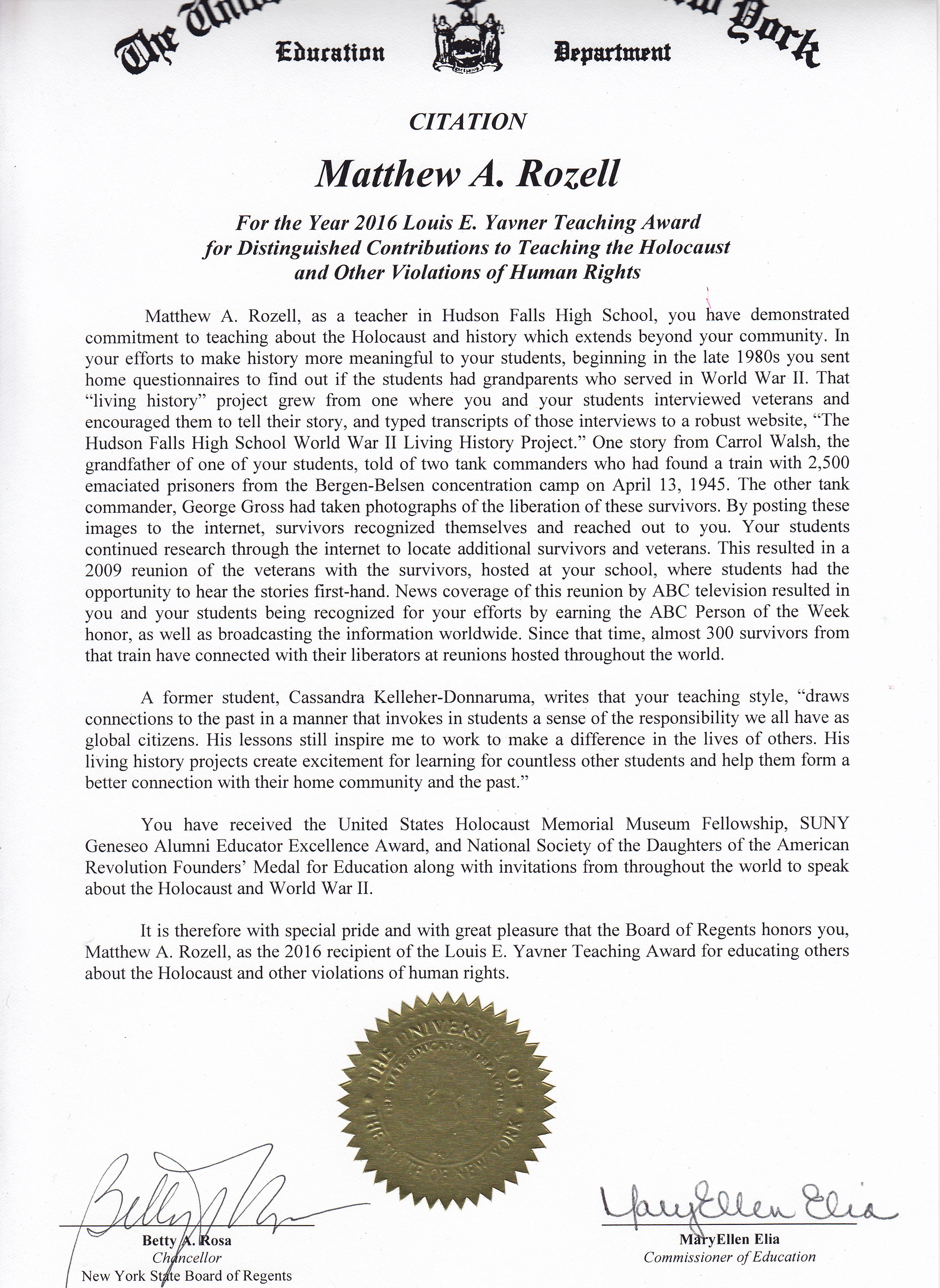
This week I was called to Albany to be honored by the New York State Education Department Board of Regents, and the Commissioner of Education herself. It is close to the highest honor that a teacher in this state can have, to get a standing ovation from the movers and shakers in the field, to sit at their table and be able to thank them for the recognition and to explain why you think that your career path was somehow ordained by forces beyond your control. To the Louis E. Yavner Award Committee, thank you for counting me as worthy.

IMG_0013

Commisioner Elia's (L) tweet. Chancellor Rosa, asked me to sit in her chair and address the Regents at their meeting, May 17. 2016.

Commissioner Elia’s (L) tweet. Chancellor Rosa, asked me to sit in her chair and address the Regents at their meeting, May 17. 2016.

Sometimes you lie awake and wonder if it has been worth it. I guess I don’t really need an award to tell me that it has, but it feels nice, and I hope that other teachers know that they make the same difference everyday.

Sometimes karma is not such a bitch, after all.

Video of acceptance speech below.

New York State United Teachers article here.

New York State Legislature recognition below.


So, it is the sixth of June again.

American Cemetery overlooking Omaha Beach, the primary landing zone for Americans during the D-Day invasion June 6, 1944. (U.S. Air Force Photo)The ocean pounds the advance of sand amidst the relics of a different age, the hulking remnants of the tide of battle. The surf rolls in and kisses the beach, as the last participants mix on the hallowed bluff above with the politicians who have gathered from all over the world.

Thirty-two years ago I watched as the American president honored  the fallen, and the living, at the cemetery for the fortieth anniversary. Just out of college, something stirred inside me. Something was awoken.

I began by writing letters to the newspaper. I began to interview D-Day veterans and others. I began to collect stories- not relics, prizes, or artifacts. I really had little interest in captured Nazi flags or samurai swords.

I wanted to talk to the men who were there.

The fiftieth anniversary came next with great pomp and more reflection. It graced the covers of the major newsweeklies. “Saving Private Ryan” stirred the consciousness of a new generation, and reflections of the old. And I learned so much more of the war beyond the beachhead. That there were so many beachheads.

The sixtieth anniversary came around. Students on their bi-annual trips to France would bring me back their photographs and the requisite grains of white sand from Omaha Beach. Teenagers had their emotions  a bit tempered, I think. I would go on to introduce them to so many who were there. When they themselves were teenagers.

So now it is the seventy-second. On the 65th, I wrote about a friend who is no longer here for the 72nd,  and the 75th will bring fewer who were there back to Normandy.

*****************************************

Today I would like to introduce you to a survivor of D Day who is still with us.

I first met Bill Gast at a reunion of 30th Infantry Division and 743rd Tank Battalion soldiers at a reunion in March 2008, in which I  was present with several Holocaust survivors who were meeting their liberating soldiers for the first time. Later, Bill came to my high school to speak to students. I think the experience of sharing, and meeting the Holocaust survivors whom the 743rd came upon and liberated, affected him deeply.

Unlike many who may be physically able, Bill has no intention of going back to the sands of Omaha for this anniversary. As he explained to our students in 2009,

“I’m listed [in the event program] as a liberator- however, I am also a survivor of World War II, having landed on Omaha Beach in Normandy, France on D-day and fighting through to the end when the Germans surrendered, May the 7th, 1945.”

“Pictures.

Video games.

Movies.

Words.

They simply do not covey the feeling of fear.

The shock.

The stench.

The noise.

The horror, and the tragedy.

The injured.

The suffering.

The dying, and the dead.”

https://www.youtube.com/watch?v=GmKNYMaa_sU


*****************************************

D-Day: the view from a tank on Omaha Beach

Washington (AFP) – From inside his tank, the young soldier could see “practically nothing” on Omaha Beach.

Seventy years later, William Gast still wonders whether he rolled over his comrades sheltering from German gunfire that day.

Gast was 19 years old the morning of June 6, 1944. “We came in at H-10, that was 10 minutes before the designated hour.”

He cannot recall why he and his fellow soldiers arrived early, but he has other memories that have never left him.

As part of Company A, 743rd Tank Battalion, 1st Army, Gast remembers the training beforehand in Britain, when he rehearsed driving the Sherman tank onto the landing craft. And then floating in the English Channel.

“Another night we went out and we didn’t come back. That was it.”

Gast got to know the captain of the landing craft that would ferry his tank to the beaches of Normandy.

The skipper promised he would get them close enough that they would not be submerged in water, like so many tanks were that day.

He kept his word.

Another tank unit at Omaha Beach was less fortunate, with 27 of 32 tanks launched at sea five kilometers (three miles) from the coast sinking before they could reach land, despite being outfitted with a flotation screens.

“The order was given to go, we started our engines up, they lowered the ramp,” said Gast.

Amid German shrapnel and sea spray, he “could feel the tracks spinning.”

At last, the tank tracks took hold on the sandy sea bottom and he drove up the beach.


– Like throwing marbles at a car –

Down below in the driver’s seat, Gast tried to steer the tank with the aid of a small, manual periscope.

“You can imagine how much we could see, practically nothing,” he said.

The radios inside the tank were so unreliable that his commander would tell Gast which way to turn by kicking him on the left or right shoulder.

The difficulty in seeing the way ahead has left Gast with a gnawing sense that he may have run over the bodies of American soldiers on the beach.

“The saddest part about the whole thing is, not being able to see, I may have run over some of my own people.

“And if I did, I don’t even know it. I can’t ever get that out of my mind, you know?”

Bill Gast awarded the Silver Star.

Bill Gast awarded the Silver Star.

Corporal Gast heard machine gun bullets hitting the side of the tank, “like throwing marbles at a car — that’s what it sounded like.”

“And there were shells that exploded right beside me. You could feel the tank shake.”

For Gast, it was a day of fear and terror, and following orders without reflection.

“I can’t tell much about what happened, I was scared to death to start with,” he said.

“It was just like putting it on automatic, you just did what you had to do, did what you were told to do.”

By noon, close to 19,000 American soldiers who landed at Omaha were still pinned down on the beach.

– High school sweetheart –

Carefully laid plans had unraveled as the beach became a killing zone, with troops mowed down under a fusillade of German machine gun, artillery and mortar fire.

Small teams of US troops eventually managed to break through on the bluffs between German positions, with the help of combat engineers blowing up obstacles.

The losses were staggering: more than 2,000 dead, wounded and missing on Omaha beach. The exact toll is still unknown. Of the 15 tanks in Gast’s Company A, only five survived without damage.

Gast, from Lancaster, Pennsylvania, earned the Silver Star and the Purple Heart during his combat tour, and went on to marry his high school sweetheart.

Now 89 years old, he recently was awarded France’s Legion d’Honneur at a small ceremony for World War II veterans at the French embassy in Washington.

The short, soft spoken man stood up to receive the medal and shook hands with a French diplomat. But he has no plans to return to Normandy for the 70th anniversary of the D-Day landings.

His son, Bill, said his father did not want to relive that day: “It’s important we don’t forget, but you try to hide things somewhere.”

Mr. & Mrs. Gast, Holocaust Survivors-American Soldiers reunion, 2009.

Mr. & Mrs. Gast, Holocaust Survivors-American Soldiers reunion, 2009.

*****************************************

How soon we forget. Or perhaps, we were never told. That is understandable, given what they saw.

But, it happened. Many of the boys never came home.

And that, dear reader, is why we can’t afford to forget.

You can read the reviews, but my favorite commentary on my first book was not written or published. A dear friend told me that one of her close relatives read the book, and that she had cried all the way through it. She finally realized what her father had seen, and gone through, and the friends that he had lost.

And it helped her make sense of her own life.

Just because the shooting stopped, it did not mean that the war ended. In many ways, it still lives on. And I hope that this book takes a step in the healing process. The book is a catharsis, for both the veterans and their families. But more importantly, it’s a way to honor and remember those who did not return home. The veterans are leaving us, and it is up to us to remember. For own own sakes, as much as theirs.

You can get the book here at Amazon, in print and electronic format. For signed copies, you can go here.

I have more books on the way, if you care to sign up for advance notification.

Thanks for taking the time to stop by, and for being one of those who appreciates that Memorial Day as more than just the de facto start of summer. Hit a ‘SHARE’ button below if you think someone else will appreciate it.

Matthew Rozell

Author, teacher of young people, and blogger on things that matter.


Here in the United States, Memorial Day will be upon us soon.

In researching for my upcoming book on the liberation of the train, I are reminded of the sacrifices of the soldiers, again and again. Right now I’m revisiting a horrific incident that occurred just across Hitler’s “West Wall”, the so-called Dragon’s Teeth that formed the three-mile deep defensive fortifications that our troops had to cross to enter German soil.  Resistance was stiff; on a cold and rainy day before Thanksgiving, 1944, several tanks of the 743rd Tank Battalion’s ‘D’ Company were wiped out in a muddy apple orchard a few miles across the border.

boller envelope

Letter to Marvin Boller postmarked 5 days after his death. It remains unopened in a museum in Belgium. Thanks to Vincent Heggen, the curator.

In 2012, I was alerted to the existence of an unopened WWII era letter in a memorial museum in Belgium. The envelope was postmarked Nov. 27, 1944, and addressed from the USA to PFC Marvin K. Boller, D Co., 743rd Tank Battalion. It was also stamped ‘DECEASED’. I wrote to Carrol Walsh, a liberator of the train near Magdeburg and a fellow member of Company D, and asked if he knew Boller; I also sent him this image of the envelope. He wrote back:

‘Hi Matt, I was stunned when I read your message. I remember Boller very well and remember when he got killed.  I believe it was just before Thanksgiving 1944 when a big German tank wiped out four tanks of the first platoon of Co. D of the 743rd. Every member of every crew of every one of the four tanks was killed.  I seem to remember packages arriving for some of these guys after they had been killed.  I used to tease Boller, who was an older man, because he wanted to vote for Tom Dewey and I was big for my pal, FDR.  Boy what a memory you stirred up.  I knew all the guys that got killed in that engagement.’

Walsh and others would survive and go on to liberate Holocaust survivors on April 13th, 1945.

So here is a tribute to Marvin Boller, and all who fell. His body was returned to the United States. Rest on.

Riverside Cemetery, Oshkosh, Winnebago County, Wisconsin, USA. Credit: J M Schumann


MARVIN K. BOLLER

PFC, 743 TANK BN WORLD WAR II

Birth: Oct. 9, 1908
Death: Nov. 22, 1944

More can also be seen here.

Lisette Lamon was a Holocaust survivor liberated on the train near Magdeburg on April 13, 1945, and later in life a psychotherapist at White Plains Hospital outside of New York City, a pioneer in the treatment of trauma back in the days when the field was in its infancy. She had experienced it herself. She was from the Netherlands, and lost her first husband Benjamin ‘Benno’ Soep at the Mauthausen slave labor concentration camp in Austria in 1941 (she appears on the manifest list: Soep-Lamon Lisette DOB 14.05.1920 Amsterdam).

This article originally appeared in the New York Times on Mother’s Day, May 12, 1979, back when I was a young buck itching to graduate high school and go out into the unknown world. Of course I did not see this article then, but the people she was with on that train and the soldiers who liberated them would go on to change my life. I wonder if at the time my own mother, relaxing in her silk robe on Sunday afternoons with the NYT as she frequently did in her respite from the workweek, read this letter… It was presented to me by fellow survivor Elisabeth Seaman, whose mother had been in contact with Ms. Lamon (Ms. Lamon passed in 1982).

Here’s to all mothers, a beautiful anecdote that will no doubt make it into my upcoming book. Happy Mother’s Day, indeed.

It was a beautiful, balmy morning in April 1945, when I entered Major Adams’ makeshift office in Farsleben, a small town in Germany, to offer my services as an interpreter.  It made me feel good that I could show, in a small way, the gratitude I felt for the 9th American Army, which had liberated us as we were being transported from Bergen-Belsen concentration camp.

Orders found by the Americans in the German officer’s car directed that the train was to be stopped on the bridge crossing the Elbe River at Magdeburg, then the bridge was to be blown up, also destroying the train and its cargo all at once. The deadline was noon, Friday the 13th, and at 11 A.M. we were liberated!

Victory, 1945. Watercolor, Ervin Abadi. Train near Magdeburg survivor. Hillersleben, Germany, May 1945.

Victory, 1945. Watercolor, Ervin Abadi. Train Near Magdeburg survivor. Hillersleben, Germany, May 1945. Credit Chriss Brown.

With the liberation had come the disquieting news that President Roosevelt had died, and while I was airing concern that the new President, Harry Truman, (a man unknown to us) could continue the war, a sergeant suddenly said, “Hey, you speak pretty good English. I am sure the major would like to have you serve as his interpreter.”

Major Adams had not been told of my coming so he was startled when he saw me. No wonder! There stood a young woman as thin as a skeleton, dressed in a two-piece suit full of holes. The suit had been in the bottom of my rucksack for 20 months, saved for the day we might be liberated, but the rats in Bergen-Belsen must have been as hungry as we were and had found an earlier use for my suit. For nine days we had been on the train, and this was the only clean clothing I owned.

Major Adams quickly recovered from his initial shock and seemed delighted after I explained why I had come. He asked how his men had treated us, and I heaped glowing praise on the American soldiers who had shared their food so generously with the starving prisoners. Then he took me outside to meet the “notables” of the German population, and with glee I translated orders given to them by the American commander. The irony of the reversal of roles was not lost on me nor the recipients; I was now delivering orders to those who had been ordering me around for so long! The Germans were obsequious, profusely claiming they never wanted Hitler or agreed with his policies and hoped the war would soon be over.

When asked to come back the next day, I was delighted but hesitated, wondering if it would be appropriate to ask a favor. Major Adams picked up on my hesitation, so I asked him to help me contact my family in America. We had emigrated to the U.S. in 1939, but after six months I returned to Holland to join my fiancé who was in the Dutch army. My parents knew that eight months after we were married my husband was taken as a hostage and sent to Mauthausen concentration camp where he was killed in 1941, but they did not know if I was alive, not having heard from me in more than two years.

Major Adams gave me a kind glance and said “Give me a few lines in your handwriting, written in English, and I will ask my parents to forward it to them.” When he saw the address on the note he looked at me, his mouth open in total amazement, and then he started to laugh – his parents and my parents lived in the same apartment building in New York City!

And so it was on Mother’s Day that his mother brought to my mother my message:

“I am alive!”

Retyped by my student Caitlin Coutant ’16. Click here to learn more about my upcoming book on this subject. Feel free to ‘SHARE”, below!


April 30 1945 Headlines. Hangs in my classroom.

April 30 1945 Headlines. Hangs in my classroom.

Today, April 29th, is the anniversary of the liberation of Dachau, 71 years on.

Today, if it is brought up at all, some of us might respond with a vacant stare. More might shrug and turn away. I suppose that is to be expected. But you know me. I just think that as a nation, sometimes we allow things to slip from memory at our peril.

It was real, and it happened. And it was American GIs who overran this camp and many others in the closing days of World War II.

The men of the 42nd and 45th Infantry Division arrived independently of each other, here, in southern Germany, at Dachau, on this day. A concentration camp, they were told. Their noses gave them a hint of what they were about to uncover, miles before the camp appeared in sight.

Read the headlines, above. Note the subarticle:

Boxcars of Dead at Dachau. 32,000 captives freed.

American soldiers view the bodies in one of the open railcars of the Dachau death train. USHMM

American soldiers view the bodies in one of the open railcars of the Dachau death train. USHMM

And so after some resistance, into the camp they entered. Life changing events were about to unfold for the American soldier.

***

For me, it’s not about hero worship, or glorifying the liberator or any World War II soldier by placing him on a pedestal. Our time with them is now limited, but many of the liberating soldiers I know push back at this, to the point of rejecting the term, “liberator”- “It all sounds so exalted, so glamorous” said one. But they will all accept the term, “eyewitness”.

Witnesses to the greatest crime in the history of the world.

So instead I think it is about honoring their experiences, their shock, the horror, the puking and the crying, the rage-and then, the American GIs recognizing that something had to be done. And they did suffer for it, for trying to do the right thing. Many tried to help by offering food to starving prisoners who just were not ready to handle it, only to see them drop dead. Or having to manhandle these emaciated victims who were tearing away at each other as food was being offered.

Some guys never got over it. How could you?

I have learned so much over the past few years from these guys, just through the way that they carried themselves and tried to cope with what they witnessed. In my World War II studies and Holocaust class, we discuss these issues at length. I’m so lucky to be able to teach it.

Last year, I was privileged to teach a lesson to my high school seniors for NBC Learn, which was shared with other districts across the nation. Later, I stumbled upon this piece by the late author Tony Hays, who writes about his liberator father and his own encounter with the past. Thanks to the Get It Write folks; the original link is at the bottom.

***

Dachau Will Always Be With Us

by Tony Hays

This is not so much a post about writing as one about a writer’s education, about one of those experiences that molds us, shapes us into storytellers. I read yesterday the story of Joseph Corbsie, whose father, a World War II veteran, left him with a special legacy from the war, from the hideous Nazi concentration camp at Dachau. I feel a particular kinship with Mr. Corbsie.

My father, Robert Hays, was the son of an alcoholic tenant farmer in rural west Tennessee. If the appellation “dirt poor” fit anyone, it fit my grandfather’s family. Daddy served in the Civilian Conservation Corps during the 30s. He and my mother, who was in the woman’s equivalent of the CCC, working as a nurse’s aide at Western State Mental Hospital in Bolivar, Tennessee, met on a blind date in early 1940 and married in September of that year.

But just over a year later, Pearl Harbor happened. America was in the war. My father was among the first of those drafted in 1942. I won’t bore you with the details, but he participated in the North African, Salerno, Anzio, and southern France invasions, saved by the luck of the draw from Normandy. But they slogged through France and on to Germany. On April 29, 1945, Allied troops liberated the Dachau concentration camp. I don’t know whether he entered Dachau that day or the next, but that he was there within hours of the liberation is beyond dispute. A few months later, after more than three years overseas, he came home.

In later years, he would talk occasionally about the war, providing anecdotes that showed the chaos and random chance of battle. He spoke of driving through Kasserine Pass in North Africa just hours before the Germans killed thousands of Allied troops in a stunning attack. He spoke of a friend, defending his position from a foxhole, who was thought dead after an artillery shell landed right next to him. When the dust cleared, the friend was buried up to his neck in dirt, but did not have a scratch on him. He spoke often of Anzio, where he was wounded, and of the massive German air assaults on those soldiers clinging to that tiny sliver of beach along the Italian coast.

But he never spoke of Dachau.

The bodies of former prisoners are piled in the crematorium mortuary in the newly liberated Dachau concentration camp. Dachau, Germany, April 29, 1945.

The bodies of former prisoners are piled in the crematorium mortuary in the newly liberated Dachau concentration camp. Dachau, Germany, April 29, 1945. USHMM.


Ever.

When he died in 1981, we found a photo in his wallet. An old sepia-toned shot like others he had taken during the war, pictures that he kept in an old brown bag. But this one was different.

It showed a pile of naked bodies. Well, really more skeletons than not, with their skin stretched pitifully over their bones. On the back, as had been his habit, was typed simply “Dachau.”

I was confused. Why would he keep this one photo in his wallet all of those years? Especially a photo of a place and event that he never spoke about. It obviously had some deeper meaning for him than the other photographs. If it had been a shot of the building he was in when he was wounded (hit by an artillery shell), I could have seen that. A reminder of his closest brush with death. Yeah, I could buy that. But this macabre photo? That, I couldn’t see.

So, for the next fifteen years, I remained puzzled.

Until the fall of 1996. I was working in Poland, and I had some time off. I took an overnight bus from Katowice, Poland to Munich. It was an interesting trip all in itself. We sat in a line of buses at midnight on the Polish/German border, waiting for our turn to cross, next to a cemetery, as if in some Cold War spy movie. I remember passing Nuremburg and thinking that my father had been there at the end of the war. And then there was Munich.

I spent a day or two wandering through the streets, drinking beer in the Marienplatz. I’m a historical novelist, so the short trip out to Dachau was a no-brainer. Of course it was as much my father’s connection with it as anything else that spurred the visit. But I’m not sure that I was completely aware of that at the time.

Dachau literally sits just on the outskirts of the Munich metropolitan area. I looked at the sign on the train station with a sadness, wondering for how many people that had been one of the last things they saw. It was only later that I discovered there had been another depot for those passengers.

The Dachau Memorial is a place of deep emotion. In the camp proper, mostly all that are left are the foundations of the barracks. One has been reconstructed to give an idea of how horrible life must have been. The camp was originally intended to hold 6,000 inmates; when the Allies liberated Dachau in 1945, they found 30,000. The museum and exhibits are primarily in the old maintenance building. I looked with awe at life size photos of prisoners machine gunned, their hands torn to ribbons from the barbed wire they had tried to climb in a futile attempt at escape.

I followed the visitors (I can’t call them tourists) north to where you crossed over into the crematorium area. It was there that the full brunt of what had taken place at Dachau really hit me. A simple brick complex, it seemed so peaceful on the fall day that I stood before it. But as I read the plaques and consulted my guidebook, as I stepped through the door and actually saw the “shower” rooms where the prisoners were gassed, as I stared into the open doors of the ovens, I felt a rage unlike any I had ever known consume me.
Covering my eyes, embarrassed at the tears, I slipped back outside. It took more than a few minutes to regain my composure. I thought then that I understood why my father kept that photo close to him for so long. It was a reminder of what one group of people had done to another group of fellow humans. The obscenity of it had overwhelmed him as it had me.

That night, I went to the famous Hofbrauhaus in Munich, to wash the images of the ovens away with some beer. I hadn’t been there long when an elderly American couple sat at the table. They were from Florida, a pleasant couple. He had been a young lieutenant in the American army on the push into Munich. In fact, it had been his pleasure to liberate the Hofbrauhaus from the Germans.

Of course, I asked the question. “Were you at Dachau?”

He didn’t answer for several seconds, tears glistening in the corners of his eyes as his wife’s hand covered his and squeezed. Finally, he nodded, reached into a back pocket and pulled out his wallet.

With a flick of his wrist, a photo, just as wrinkled, just as bent, as the one my father had carried landed on the table. It wasn’t the same scene, but one just like it.

Here was my chance, the opportunity to ask the question I had never been able to ask my father. I pulled the photo from my own wallet and lay it next to his. “Why? Why have you carried it so long? To remind you of the horror of Dachau, of what had been done here?”

His face carried the faintest of smiles as he shook his head. “No, son, to remind us of the horrors that we are capable of, to remind us not to go down that road again.”

The difference was subtle, but in that moment, I learned two lessons invaluable to a writer, subtle differences are important, and when you want to know the truth, go to the source.

As I sit here now and look at that same photograph, I realize that it was my father’s legacy to me, of Dachau. Joe Corbsie’s father left him something more tangible, a reminder of the same thing for the same reason, but more forcefully stated — a tiny box of human ash from the ovens.

Now, nearly 70 years after that day in 1945, Dachau is still with us, and I hope the legacy left by our fathers always will be.

The late Tony Hays.