Feeds:
Posts
Comments


April 17, 1945, was a Sunday. It was three days after the liberation of the train near Magdeburg, near the Elbe River, just miles from Berlin. War weary GIs had their first encounters with the conditions at the train. They would never forget what they saw.

April 17th. (1945)

Dear Chaplain;-

Haven’t written you in many months now, its funny how a few moments are so hard to find in which to write a letter way past due; it’s much easier to keep putting it off the way I’ve done. I’ll try to make up for it in this letter.

Today I saw a sight that’s impossible to describe, however I’ll try. Between 2400 and 3000 German refugees were overran by my division during our last operation; most of them were, or had been, inmates of concentration camps, their crimes the usual ones, – Jewish parentage, political differences with der Fuhrer, lack of sympathy for the SS, or just plain bad luck. Not one of these hundreds could walk one mile and survive; they had been packed on a train whose normal capacity was perhaps four or five hundred, and had been left there days without food.

Our division military government unit took charge of them, and immediately saw what a huge job it was going to be, so they sent out a call for help. Several of our officers went out to help them organize the camp they were setting up for them. The situation was extremely ticklish we soon learned; no one could smoke as it started a riot when the refugees saw the cigarette, and we couldn’t give the kiddies anything or they would have been trampled to death in the rush that would result when anything resembling food was displayed. The only nourishment they were capable of eating was soup; now the army doesn’t issue any of the Heinz’s 57 varieties, so we watered down C-ration[s] and it served quite well.  It was necessary to use force to make the people stay in line in order to serve them. They had no will power left, only the characteristics of beasts.

A few weeks of decent food will change them into a semblance of normal human beings; with God willing the plague of disease that was already underway, will be diverted; but I’m wondering what the affect of their ordeal they have been through, will be on their minds; most will carry scars for the rest of their days for the beatings that they were given. No other single thing had convinced me as this experience has that Germany isn’t fit to survive as a nation. I’ll never forget today.

I was going to write mother tonight but thought better of it. I’ll be in a better frame of mind tomorrow. I’m only a few dozen miles from Berlin right now, and its hard to realize the end is in sight. I’m always glad to receive your scandal sheet. You perhaps missed your calling, as your editorial abilities are quite plain.

As ever,

Charles.

March 11th, 2009

Dear Mr. Rozell: My father-in-law was 1st. Lt. Charles M. Kincaid. He was a Liaison Officer with the 30th. Division Artillery.  He was honored with an Air Medal in the battle of Mortain and a Bronze Medal in the battle of St. Lo.  In the battle of Mortain he won his Air Medal by calling in artillery adjustments while flying in a Piper L-4 over 4 panzer divisions on August 9, 1944.

He rarely wrote home. He did write home to his minister about one event that evidently really caused him to stop and think. Attached is a copy of that letter that his sister transcribed – making copies for others to read.  The letter describes the Farsleben train and his experience there.

I need to thank you for your website and work. You and your students work enabled me to connect the letter with the actual historical event. It further enabled me to show my children the pictures and to make their grandfather’s experience real, not just an old letter – that this event so affected him that he needed to tell his minister before he told his mother.

Thank you,
Mark A.

On April 15th, 1945, soldiers of the 11th Armoured Division of the British army arrived and liberated 60,000 prisoners of Bergen Belsen concentration camp.  A scene of horror confronted them– thousands of unburied corpses and Holocaust survivors in various stages of starvation and sickness; eight hundred would die on the day of their liberation, and 13,000 more in the following month of May even as the war finally ended.  

The transport liberated on April 13th by the Americans near the Elbe River had left this camp  seven days before. 

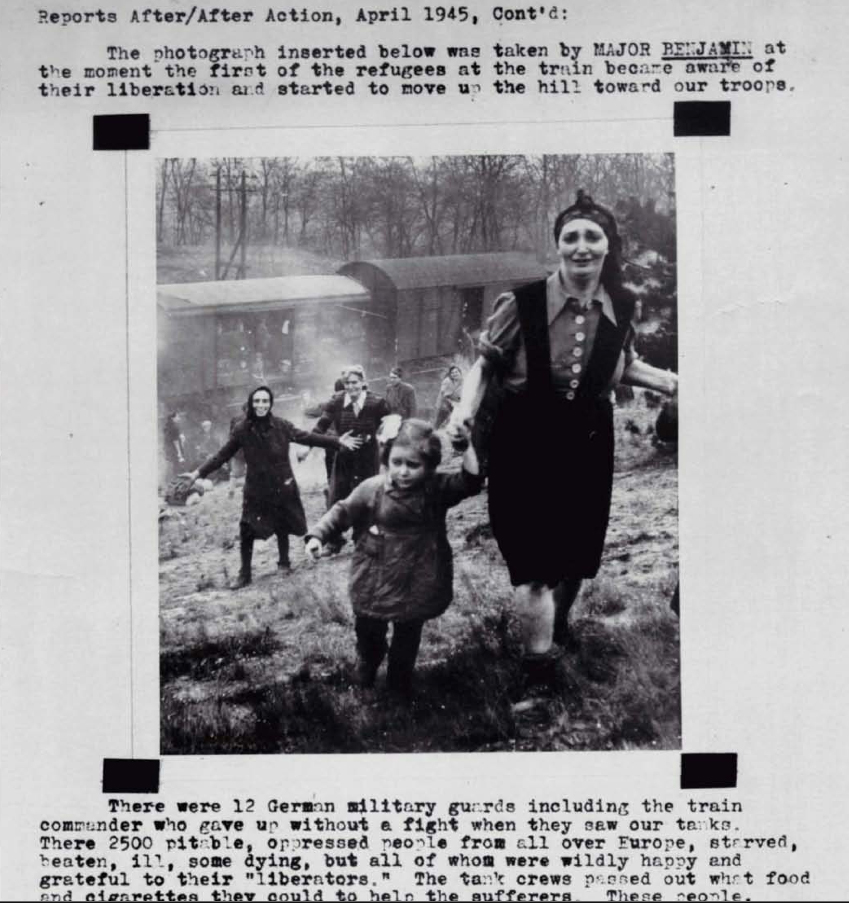
743rd S-3 After Action journal report- the moment of liberation

The logbook for the 105th Medical Battalion of the 30th Infantry Division was kept by T/4 Sgt. Wilson Rice, who interjected colorful personal commentaries when typing up his reports.

April 13th, 1945

At Letzlingen, Germany, we pulled off of the road to wait.  Here Major Lowell, Major Huff and Tommy met us.  They had gone back to Brunswick to see about getting the soldiers of ours out of the German hospitals, and to see some other hospitals.  Col. Treherne also met us there.  While we were parked here the forward command post came along.  I went out to one of the trucks to talk to some of the fellows from headquarters. They had a German on the truck and he was most unhappy.  He was one of the few who ran before he was captured, and before he was caught, he tore off all of his markings and insignia off of his uniform.  Nasty little Nazi.  They couldn’t find a place to get rid of him, so Paul Huff and I put him on the hood of our jeep and took him into town to the PW [prisoner of war] cage.  On our way back, we passed another walking down the road, but we were in a hurry.  He was smiling and just as happy about the whole thing.  We just merely pointed the direction, and everybody went merrily on their way about their business.

*

When Major Lowell, Major Huff and Cardwell left this area, I went with them.  Farther on down the road, when the convoy was halted again, Major Marsh from the Military Government drove up to Col. Treherne’s jeep.  He told him about a train of civilians that were prisoners of the Germans.  Our jeep pulled out from the convoy and went to Farsleben, Germany, where the train was located.

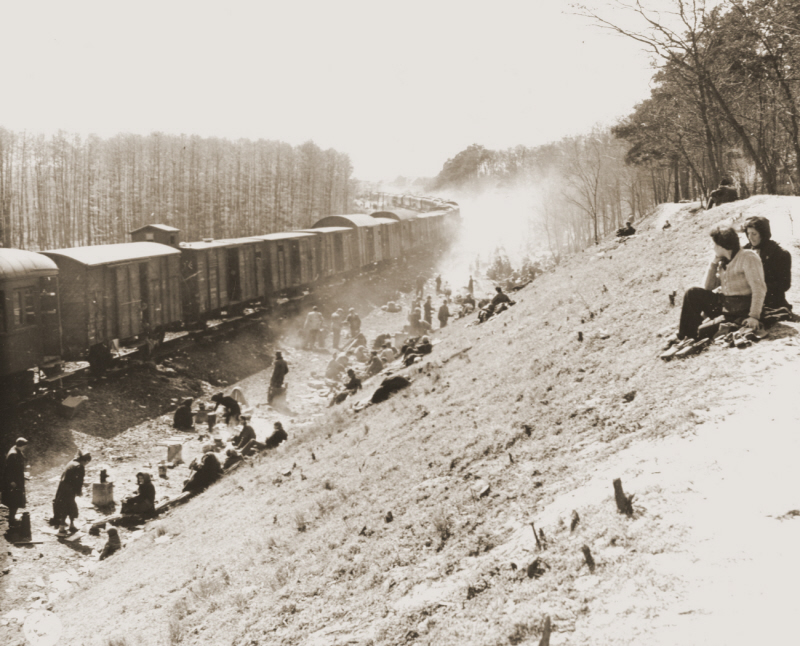
Also in this town was the command post of the 823rd Tank Destroyer Battalion, and we stopped there to pick up Capt. Baranov, the 823rd Bn. Surgeon.  He took us down there, and it was something that you’ve read about, but couldn’t believe.  They were people that looked of being very refined and cultured.  It is said that among the people, was the French Consul to Germany.  Some great minds were among these people. There were two doctors that were members of the train, and they were caring for the people the best they could without any equipment.  Capt. Baranov’s men came up with a few drugs bandages, etc. to use until they could get more.  It was about the same as nothing, but it was to go to the women and children first.  About 75% of the members of this train were Jews so the drugs etc., were given to the two doctors and the Rabbi for distribution.  Major Lowell and Major Huff told them to get all of the contagious and seriously sick to be segregated into cars by themselves.  These cars that they were traveling in were boxcars.  Sanitation was terrible and the people had been traveling in them for eight days and nights, without food or water.  Most of the sickness was due to malnutrition.  There were only two typhus cases.

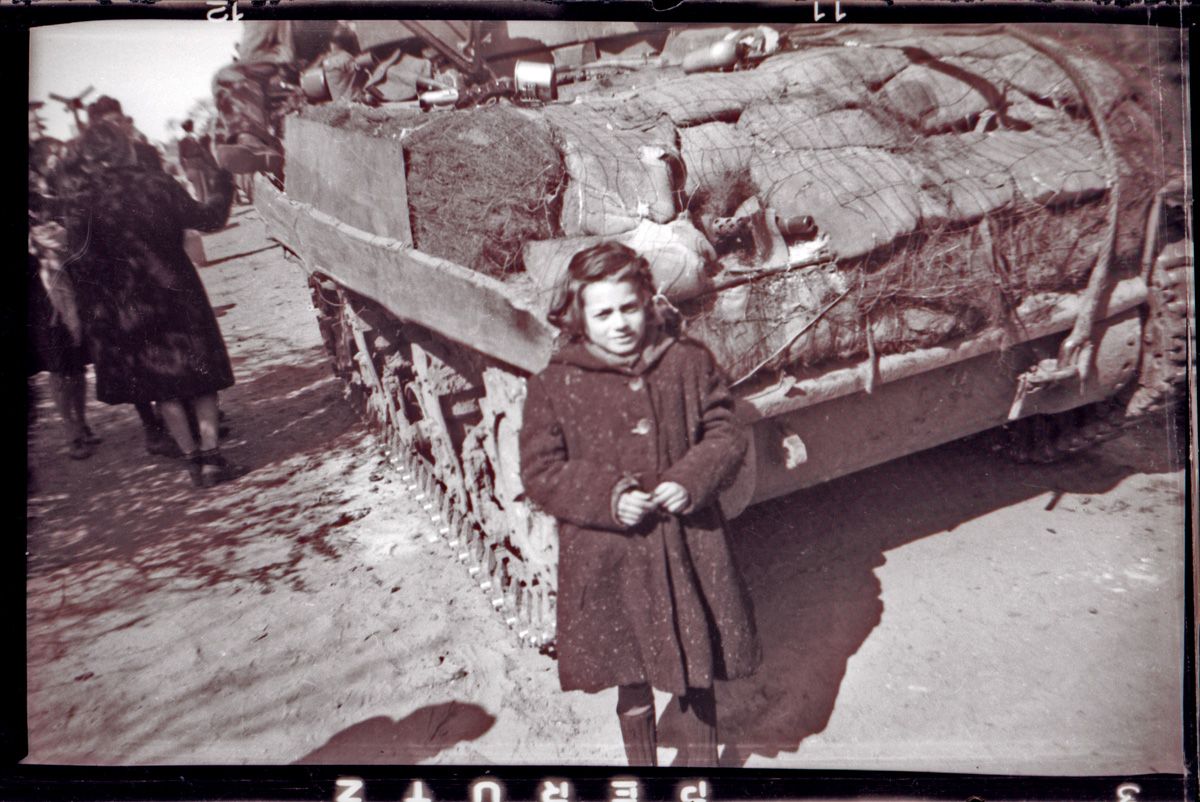
Liberated Girl as photographed by SGT. George C. Gross, Sat. morning, April 14th, 1945. Farsleben, Germany.

As all of the business was being transacted, a beautiful little girl, about eight years of age, came up to my side.  She was very sweet and her complexion was very clear.  I looked at her, smiled and patted her on the head, and she smiled back.  As Tommy and I were standing there, I soon felt a little hand slip through my arm.  As I looked around, a big lump came in my throat.

As we were leaving, a man came up to our jeep.  He was one of the American citizens and was from Detroit, Mich.  He was taken prisoner two years ago in Warsaw, and his family is still now in Detroit.  He was a sick man, but there was nothing we could do for him, as we were not prepared for such things.  Military Government is taking care of things as fast as they can.  This is what I mean when I say that warfare such as this, was not planned for by the Army.  Things are going too fast.  This man told us about the 33 American citizens.  He went on to say that he knew our circumstances, knew we had to take care of the troops first, knew that everything possible will be done for them as fast as possible, and went on to say,  “We know how busy you guys are, what you will do for us, maybe one week maybe two weeks, but even if nothing else is done, there is one thing we truly and dearly thank you for, and that is for our Liberty”  There was a break in this man’s voice, and I knew how he felt.  There was a lump in my throat.

BOOK HERE

72 years ago this very morning, Lt. Frank W. Towers of the 30th Infantry Division arrived to take the survivors of the train liberated the previous day out of harm’s way. What he saw stayed with him for the rest of his life. In 2007, he contacted me after reading about our first reunion. Later, he made it his life’s mission to track down as many of the survivors that he could, serving as the master of ceremonies for many joyful, and tearful, reunions to follow.

Saturday morning, April 14th, 1945, Farsleben, Germany.

As the 30th Division’s liaison officer, I was told about the train initially by my counterpart, Lt. Floyd Mitchell, who was the liaison officer from the 743rd Tank Battalion, and as he was going back to his headquarters, he asked me if I would like to go with him to see it. I agreed to accompany him, and this was my first encounter with ‘The Holocaust’, to witness all that we had heard about through the ‘propaganda’ [we had been told] in previous months—to see it with my own eyes, that our own Allied ‘propaganda’, was in fact true.
The main roads in some places were impassable, so the trip from Farsleben to Hillersleben was mostly over narrow back roads and dirt farm roads, in order to get to the destination in the shortest time. Due to artillery shelling and too much recent rain they were full of muddy pot holes, and the vehicles had to travel very slowly, or cause breakdowns of the vehicles. The drivers were very well aware of the hazards of driving over this type of roads, as they had done so many times before. Fortunately, during these days it did not rain any more. As I acquired the vehicles for the convoy, some were covered, and some were not, but to these people, it did not matter. Rain or shine, they were on the way to freedom, and although hungry, dehydrated and in frail health, they felt that they were going to a better place than they had seen in many months. They were happy in knowing that they were going to a place where they could get food, sleeping space and health assistance.
As best I recall, we started moving these people in the afternoon, and we continued until dark, which at that time was not until after 10:00 PM, so we halted operations until daylight the next morning, and continued on into the day until all were removed from Farsleben. I am not sure just who was involved in assisting the loading of the people at Farsleben, perhaps by some of the troops from our Engineer Battalion and some of the men of the American Military Government and Red Cross personnel, who also helped in unloading the people, orienting them as to where they were to go to get showers and new clothing, then feeding them and assigning them to appropriate quarters. Then their processing began as to who they were, where they had come from, their birthplace, and their hoped for destination. All of this of course took several weeks before they were all processed and shipped to their destinations.

Later, Frank would travel the world, meeting the children whom he had a hand in saving, and their children, and grandchildren. In the NBC News broadcast below, here he was in the Netherlands just a few years back, with ‘new branches on the Tree of Life’. Frank Towers passed on July 4th, 2016, at the age of 99.


From our great friend, survivor Leslie Meisels, to his fellow survivors and his liberators. He sends a version every year on the anniversary of the liberation of the Train near Magdeburg, for the first time he is not able to address it to Frank Towers, who passed at the age of 99 on July 4th this past year. Liberators Carrol Walsh and George Gross previously passed in 2012, and 2009, respectively. Read more, here

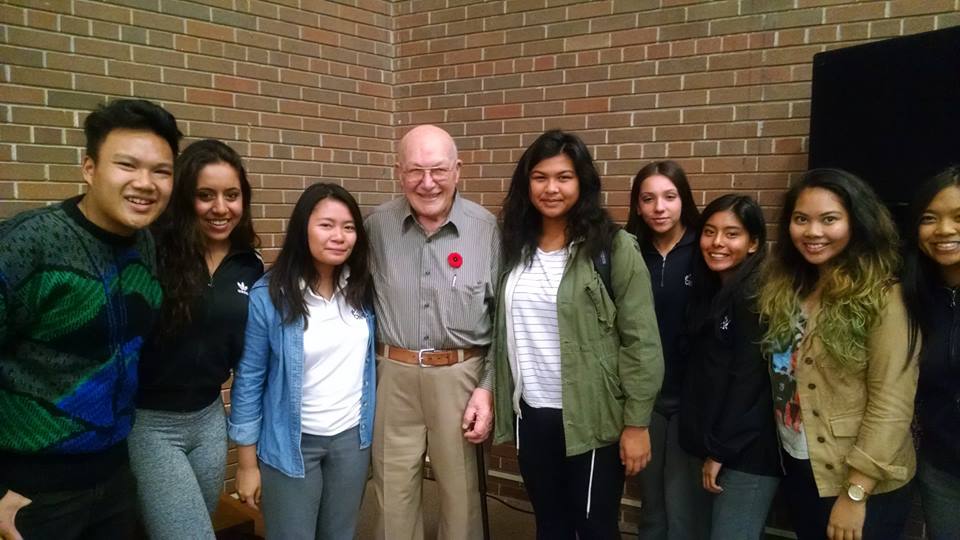
Holocaust survivor Leslie Meisels with Blessed Cardinal Newman Catholic High School students where they learned about reuniting Holocaust survivors with their American liberators, 11-7-2015. Photo by Joan Shapero.

April 13, 2017
Hello again to all of you ‘my twins’ on our 72nd birthday!

This’ birthday’ wish goes with a heavy heart because the loved, respected and admired by all of us—liberator Frank Towers—the last living liberator of those whom we met at the 2009 symposium – has left us. While he is not with us anymore, the memory and gratefulness for him and all our other ‘angels of our life’ remain with us to the end of our lives, and with our children’s (who were not to be born!) our grandchildren’s, and all future generations to follow, for the fight and sacrifice they did by destroying the Nazi tyranny, and with that, they gave us back our lives.

For all of you who are still around, I hope my good wishes find you in good health, both physical and mental.

It is a blessing to be alive and being able to think back of that ‘special birthday’ of ours, April 13th 1945.

With my original Birthday on Feb.20th I turned 90 years old. My children grandchildren and friends made it a non-ending celebration. To be honest I enjoyed it very much. I never knew that being 90 years old means so much joy.

I am still continuing strongly with Holocaust education and make the same message clear all the time; that government-sponsored and organized hatred is what brought on the Holocaust, and the silence of the majority allowed it to happen. Therefore, urge anybody who listens—never let hatred be part of their life, and never stay silent when they hear, see, or experience any prejudice or discrimination.

Also remind anybody what George Santayana said—“Those who cannot remember the past are condemned to repeat it.”  To remember we must, and we do.

Again all my best wishes and happy 72nd birthday to all of you!

My best regards to all.

Leslie Meisels

Hold that thought.

Only a few weeks back, I was teaching a lesson to my 12th graders on the German invasion of the USSR in the second half of 1941. We were at December 6th, 1941, and the dramatic launching of Marshal Zhukov’s counteroffensive outside of Moscow, to be followed the next day by the Japanese attack on Pearl Harbor that drew us into the war, when the phone rang in the back of the classroom. It could have been one of the school secretaries calling to let me know that a student needed to be excused, so I told the seniors it was probably the President calling again,  so ‘Hold that thought’, and I dashed to the back of the room.

Now, my classroom has enjoyed an outside line for a while, ever since the American soldiers and the Holocaust survivors began to find me and this website. I have fielded calls from all over the world, from survivors and their families and even major news organizations and museums. So I picked up the phone, and was met by a familiar voice with a delightful cadence and greeting: “Matt Rozell, God bless you!”

Walter Gantz, March 14, 2016. Credit: Mike Edwards, 5 Stones Group.

Walter Gantz, March 14, 2016.
Credit: Mike Edwards, 5 Stones Group.

It was Walter, the 92 year old former medic who had taken care of the sick and dying Holocaust survivors at Hillersleben in 1945 after the liberation of the train. He was calling to praise my recent book, which I had sent to him, telling me that he had read it in three or four sittings and needed to read it again, and again. He thanked me over and over for remembering him, and the medics and soldiers and officers of the 95th Medical Battalion, who raced to save as many as they could. I told the kids later that Walter had told me that at their WWII reunions, these medics never spoke about Hillersleben. It was just too traumatic.

I turned the speakerphone on and the kids got to listen in. I passed the book around the room as he spoke, the chapter called ‘The Medics’ marked on the page with Walter’s photograph. As we talked, I noticed that one of the senior girls in the class was very moved by the conversation, which struck us out of the blue, just as did Walter’s initial call to me five years ago. He closed by wishing us all well, a blessing to our families as well.

We did some good in the world, here in this classroom, and in keeping the good deeds of Walter and the medics of the 95th Medical Battalion alive. Here’s to Walter and all of the old soldiers and survivors we have been blessed to connect with, and here is to the kids, who want to KNOW. Here is to the magic that ushers forth from the universe when a teacher connects with his students to trip the wires of the cosmos, again and again. We did not just teach history here; we made it. These are the thoughts that I think I will hold on to, when my time in this room is up.


*

Excerpt from CHAPTER EIGHTEEN
The Medics

A few weeks following the last school reunion in 2011, I got a phone call in my classroom from a man in Scranton, Pennsylvania. To this day, I do not know how he found me. After four years of not hearing from any other American soldier who had something to do with this ‘Train near Magdeburg’, I had come to the conclusion that it was now all over. Walter Gantz proved me wrong, and not only did he play an important role, he knew of several others who were also still alive to share their experiences at the convalescent base/camp at Hillersleben.

Walter was part of the 95th Medical Gas Treatment Battalion, trained extensively to treat chemical warfare casualties. When no gas was deployed by the enemy in combat, Walter and his outfit stepped right into the role of treating other casualties of the battlefield. He recalled surveying the train at Farsleben, and the memories of treating the victims over the next seven weeks haunted him right up until his contact with me. I spoke with Walter several times on the phone, and we exchanged letters; I also put him in contact with at least four of the survivors of the train, two of whom would go on to meet him in Scranton to speak at a Holocaust symposium. At my suggestion, Walter was interviewed by a film crew in 2016.

Walter ‘Babe’ Gantz

Basically, there were four medical battalions—the 92nd, 93rd, 94th, and 95th. We were the ‘baby battalion’. We were extensively trained in chemical warfare. In fact, that was our top priority, in case they used chemical agents and that was it. We were a sophisticated outfit. In fact, Colonel Bill Hurteau, our commander, he said we were the cream of the crop [chuckles]. Maybe he was right, I don’t know.

I was part of a so-called ‘advance party’. There were about 10 or 12 of us from the 95th and as you know the train was discovered on the 13th of April of ’45. Our advance party was at Farsleben on the 14th, or the next day—the situation was beyond description. These people were emaciated and like they say, ‘living skeletons’; most of them could hardly walk. [Shakes head] It was a horrible sight. Some people say there were sixteen that passed away on the train. Other reports say thirty, so I would say thirty. They were buried down the knoll adjacent to the train.

When we left the 95th on detached service [to investigate the train, we went with] Captain Deutsch, who was one of the surgeons… He was numb. He didn’t say anything, just that we were ‘on a special assignment’. That was the extent of it, until we got to Farsleben and we went down to the train itself. That was a nightmare… God Almighty! [Shakes head] Boy… [Pauses]… Unbelievable. That’s the only word I can think of, unbelievable…You know, you’re seeing these people in person, and yet you just couldn’t comprehend that these things happened in this world that people would be so inhuman to other human beings. It was tough. You felt helpless, really.

[The initial scene] was chaotic. Most of the survivors were just wandering around and you have to remember these people, they were treated worse than animals. They were starved and like I said, it was very chaotic. They were looting the homes and I can understand. They were getting fur coats and dresses. In fact, I remember there was one woman, I think she had three different dresses on. It was tough but … A lot of them were lice-infested. God, I’ve seen so many lice, unbelievable. You could grab quite a handful, really. A lot of these people we had to clip their hair. There were so many unsanitary conditions. These people were in rags. In most cases, we had to burn their clothes. Fortunately, we had a means of setting up showers. There was a nearby pond and we had generators because we were a sophisticated unit, as I said. We would give these people showers or wash them down.

How do you settle all these people? We’re talking like twenty-four hundred people, and how do you feed them? That was one of the biggest problems we had, but fortunately, we found several ‘food dumps’ as we called them, and we were fortunate in getting a lot. Actually, we took over a dairy farm, and we were provided with beef, and pork, and milk for those who could sustain milk. You have to remember a lot of these people couldn’t eat whole food because if they did, if they were to gorge for themselves, they would die. We had to feed them intravenously and that was one of my jobs. I have to say, I was a sharpshooter when it came to injections. It was difficult. We had so many.

We talk about nightmares and flashbacks. I never had any nightmares where I would scream, but there are two so-called flashbacks I remember and they stayed with me for many, many years. [In the first] I could see myself climbing these stairs and all of a sudden, I’m inserting a needle into this elderly gentleman’s arm. Of course, you have to remember, they were skin and bones. The veins would roll and he was screaming, really screaming. That had to be very painful, because they were skin and bones—to try to find a vein; it was easy to overshoot a vein. It was heart wrenching to hear those people sobbing and actually screaming because a lot of them thought they were still at Bergen–Belsen, really.

[In the second] incident, I used to work a twelve-hour shift, from eight in the evening to eight in the morning. In the wee hours of the morning, this young girl died. For some reason, I wrapped her up in a blanket and I carried her down the stairs and I was crying.

We had a war tent that was used as a makeshift morgue. I placed her in there. I wonder why I would do that; I must have liked her for some reason. I didn’t have to do that, because we had a team that took care of those who died, and placed them in the morgue.

I spent seven weeks with these people. Most of us spent seven weeks and during our so-called watch, 106 people died… God, it was tough. [This girl] was actually fifteen years old. Her name was Eva and you might say, ‘How was it possible that he could carry her?’ She probably weighed 60 pounds, maybe. I thought about that many times, and I must have been attracted to her for some reason. That haunted me, really. It really haunted me.

I must admit I shed a lot of tears and I prayed. I prayed that they would pass on, that they would find peace and for those who survived, that their health would be restored—and dignity. Dignity is so important in life—dignity, that was the main thing. It was difficult.

The full narrative is available here.


My second book, the one on the death train and my journey as a teacher in discovering and retracing the miracles in reuniting Holocaust survivors with their American soldier liberators, has had mostly positive reviews at Amazon. Then recently someone posted how he found himself resenting that I had clumsily inserted my own experiences into an otherwise tremendous story. (Fair enough—but ‘resentment’?) That, coupled with a resurgence of antisemitism and the other stuff that bad dreams are made of sends a certain chill up this writer’s—this historian’s—spine.

Now if one really read, and ‘got’ the point of my second book, it’s about miracles and goodness and common human decency and humanity; about a triumph of the power of good and love over evil, against crazy odds; about the lessons and the values which we should hold firm to in a world filled with pain and destruction, deception and deceit. But some days it is hard to see the good, and the world lately frankly leaves me feeling rather adrift; I wonder if it all is pointless.

And then, out of the blue, comes the quiet reminder…

Later this week I got an email from a new fan in Salt Lake City, Utah. We have never met or heard of each other until he bought my books at Amazon. He loved them, and then felt compelled to reach out to me (which I invite—it’s matthew@teachinghistorymatters.com). He wrote that as he neared the end of the book, he realized that his wife was from the area where I live and write about.
We went back and forth. Later on a whim he reached up on the bookshelf in his basement office and dusted off his wife’s high school yearbook. He opened it up, and sent me this:

mom-yrbk-1975

IT’S MY MOM.

Vintage 1975, autographing his wife’s graduating yearbook… turns out my mom was the school nurse teacher at his wife’s school, now nearly a continent away. Kim was heading out west after graduation, and my mother was going to head there to visit her brother and his family in California that summer. Neither I nor my siblings have ever seen this photo before; I can tell by her expression that Mom is laughing with the photographer and is insisting that he get the shot over with!

So now, on a dark day, my mother is speaking to me. She was taken from us since just before the Holocaust survivors I write about found me in 2006 and entered my life and the lives of the soldiers who freed them in such a profound way. My mother reaches out  to remind me that there is still good in the world.

Maybe that reviewer could care less, but my mom will always be a part of the story—MY story. Thanks, William, for sending it to me. And thanks Ma, for being there for me again.

Yesterday, the United States Holocaust Memorial Museum felt compelled to issue the following statement:

Today, the Museum issued the following statement:

The Museum is acutely aware of the consequences to the millions of Jews who were unable to flee Nazism, as noted in our November 2015 statement on the Syrian refugee crisis. The Museum continues to have grave concern about the global refugee crisis and our response to it. During the 1930s and 1940s, the United States, along with the rest of the world, generally refused to admit Jewish refugees from Nazism due to antisemitic and xenophobic attitudes, harsh economic conditions, and national security fears.

In our view, there are many legitimate refugees fleeing the Assad regime’s sustained campaign of crimes against humanity and the genocidal acts perpetrated by ISIS against the Yazidis, Christians, and other religious minorities. American policy should fully address national security concerns while protecting legitimate refugees whatever their national or religious identity.

A living memorial to the Holocaust, the United States Holocaust Memorial Museum inspires citizens and leaders worldwide to confront hatred, prevent genocide, and promote human dignity. Its far-reaching educational programs and global impact are made possible by generous donors. For more information, visit ushmm.org.

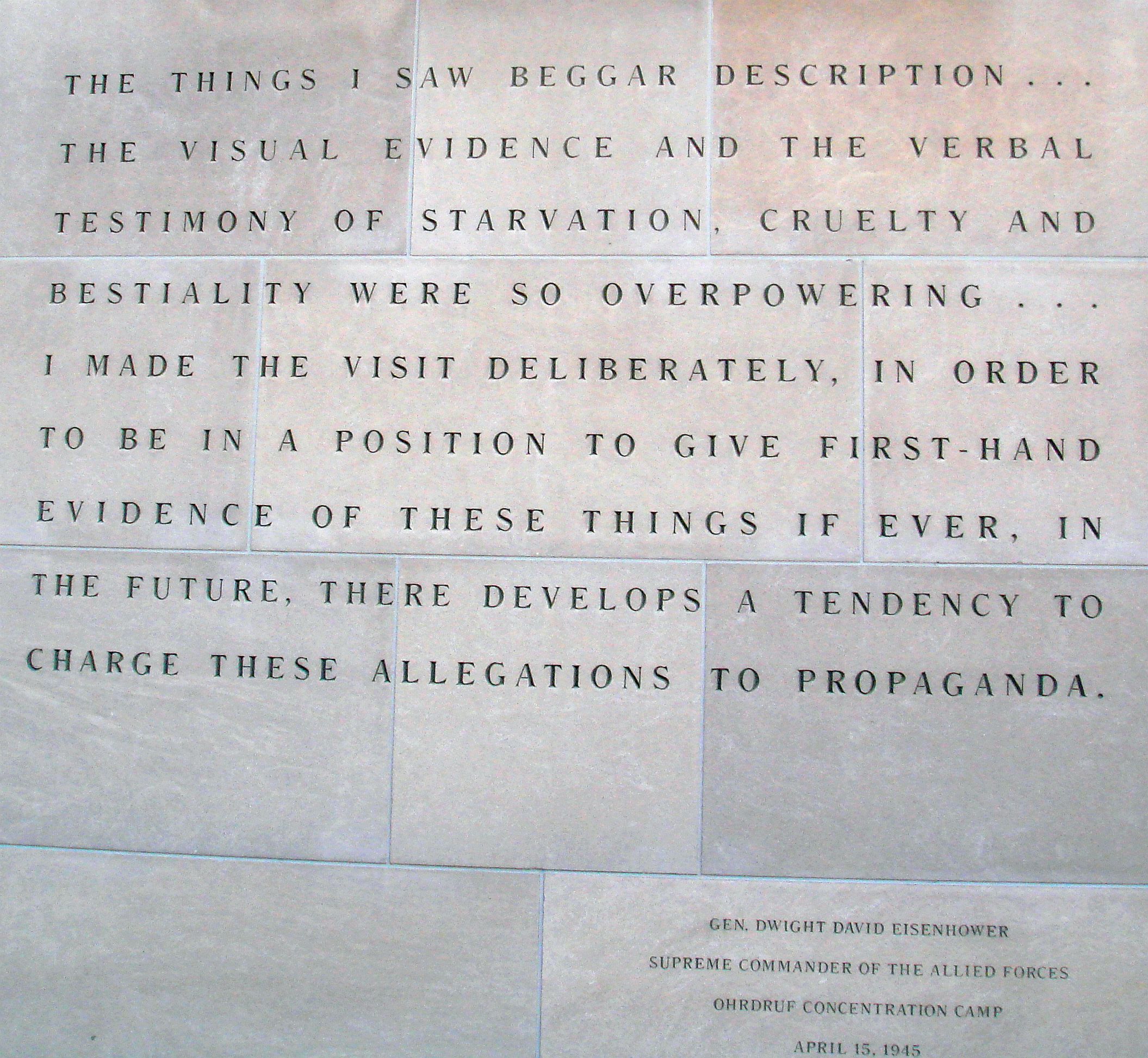
eisenhower at ushmm

January 30th, 1933. Adolf Hitler comes to power in Germany. Friday, January 27th,  was International Holocaust Remembrance Day, and the anniversary of the liberation of Auschwitz. The Museum is compelled to clarify exactly what the Holocaust is all about.


On the day of his appointment as German chancellor, Adolf Hitler greets a crowd of enthusiastic Germans from a window in the Chancellery building. Berlin, Germany, January 30, 1933. —Bayerische Staatsbibliothek via USHMM

JANUARY 30, 2017

UNITED STATES HOLOCAUST MEMORIAL MUSEUM STATEMENT ON INTERNATIONAL HOLOCAUST REMEMBRANCE DAY

WASHINGTON, DC – The Holocaust was the systematic, state-sponsored murder of six million Jews by Nazi Germany and its collaborators. Nazi ideology cast the world as a racial struggle, and the singular focus on the total destruction of every Jewish person was at its racist core. Millions of other innocent civilians were persecuted and murdered by the Nazis, but the elimination of Jews was central to Nazi policy. As Elie Wiesel said, “Not all victims were Jews, but all Jews were victims.”

The Holocaust teaches us profound truths about human societies and our capacity for evil. An accurate understanding of this history is critical if we are to learn its lessons and honor its victims.

A living memorial to the Holocaust, the United States Holocaust Memorial Museum inspires citizens and leaders worldwide to confront hatred, prevent genocide, and promote human dignity. Its far-reaching education programs and global impact are made possible by generous donors. Learn more at ushmm.org.


Soon after liberation, surviving children of the Auschwitz camp walk out of the children’s barracks. Poland, after January 27, 1945.

United States Holocaust Memorial Museum

I study this photograph,

and so it begins.

Seventy-two Years Later.

The war comes to a devastating conclusion.

The discoveries unfold:

Eyewitness encounters with the most horrific crime in the history of the world.

Battle-hardened tough guys cry.

They stomp their feet in rage, and get sick,

but the lost are lost.

The Survivors ‘carry on’.

The Soldiers ‘carry on’.

Some will be lost for the rest of their lives.

Now, it is Seventy-plus Years.

But it is not over,

because ‘closure’ is a myth,

and seven decades is but a blur.

The barracks door opens slowly. New tracks form in the snow

but how is life supposed to go on?

And now for the rest of humanity-

Just what have we learned,

Or have we just allowed ourselves to forget?

Is it even important, for us to stop and think

about snowflakes on little boys?

*****

-m.a.rozell-

See the Altantic’s photo essay here.

*************************************************************

Matthew Rozell teaches history at his alma mater in Hudson Falls, New York. His second book,  A Train Near Magdeburg, is on teaching and remembering the Holocaust.

Seventy-two years ago, it began. Hitler’s last gamble would claim more American lives than any battle in U.S. History. Frank Currey was there, and on a cold winter day in December, saved five men and killed scores of Germans single handedly. Frank was in the 30th Infantry Division, which liberated the Train Near Magdeburg; he came to our school.

The morning of December 16, 1944. A lonely outpost on the Belgian frontier.

In subzero temperatures, the last German counteroffensive of World War II had begun. Nineteen thousand American lives would be lost in the Battle of the Bulge. “Hell came in like a freight train. I heard an explosion and went back to where my friend was. His legs were blown off-he bled to death in my arms.” The average age of the American “replacement” soldier? 19.

Of the sixteen million American men and women who served in WWII, four and a quarter hundred thousand died on the field of conflict. In 2015, on the downward bell curve slope, nearly 500 veterans of World War II quietly slip away every day. The national memory of the war that did more than any other event in the last century to shape the history of the American nation is dying with them. The Germans threw 250,000 well trained troops and tanks against a lightly defended line on the Ardennes frontier in Belgium and Luxembourg, which created a pocket or “bulge” in the Allied offensive line, the objective being to drive to the port of Antwerp to split the American and British advance and force a separate peace with the Western Allies. What ensued was the bloodiest battle in American history. It saddens me that it comes as a shock to many Americans today that the “Battle of the Bulge” didn’t originate as a weight-loss term.

On a personal note, I have had the privilege of interviewing many of the veterans of this battle. In the high school where I teach, I have been inviting veterans to my classroom to share their experiences with our students. As their numbers dwindled, I smartened up, bought a camera, and began to record their stories. And for the past decade, I have been sending kids out into the field to record the stories of World War II before this generation fades altogether. These men and women have helped to spark students’ interest in finding out more about our nation’s past and the role of the individual in shaping it. In our books we have worked to weave the stories of our community’s sacrifices into the fabric of our national history. And that, to me, is what teaching history should be all about. After all, if we allow ourselves to forget about the teenager who bled to death in his buddy’s arms, if we overlook the sacrifices it took to make this nation strong and proud, we may as well forget everything else. I shudder for this country when I see what we have all forgotten, so soon. But if you are taking the time to read this post I suppose I am preaching to the saved.

I will close with the account of a nineteen year old infantryman who in fact survived the battle and the war, and who I was able to introduce to many Hudson Falls students on more than one occasion. Sixty-nine years ago this December, a day began that would forever change his life.  Frank is now the only living Medal of Honor recipient from World War II left in New York State and New England.

In the winter of 1944, nineteen year old Private First Class Currey’s infantry squad was fighting the Germans in the Belgian town of Malmédy to help contain the German counteroffensive in the Battle of the Bulge. Before dawn on December 21, Currey’s unit was defending a strong point when a sudden German armored advance overran American antitank guns and caused a general withdrawal. Currey and five other soldiers—the oldest was twenty-one—were cut off and surrounded by several German tanks and a large number of infantrymen. They began a daylong effort to survive.

Francis Currey MOH and Ned Rozell March 2010-Ned is friends with the last WWII Medal of Honor recipient in NY and NE, Frances Currey. Yes, the special edition GI Joe he signed for Ned is 19 yr. old Frank!

Francis Currey MOH and Ned Rozell March 2010-Ned is friends with the last WWII Medal of Honor recipient in NY and NE, Frances Currey. Yes, the special edition GI Joe he signed for Ned is 19 yr. old Frank!

The six GIs withdrew into an abandoned factory, where they found a bazooka left behind by American troops. Currey knew how to operate one, thanks to his time in Officer Candidate School, but this one had no ammunition. From the window of the factory, he saw that an abandoned half-track across the street contained rockets. Under intense enemy fire, he ran to the half-track, loaded the bazooka, and fired at the nearest tank. By what he would later call a miracle, the rocket hit the exact spot where the turret joined the chassis and disabled the vehicle.

Moving to another position, Currey saw three Germans in the doorway of an enemy-held house and shot all of them with his Browning Automatic Rifle. He then picked up the bazooka again and advanced, alone, to within fifty yards of the house. He fired a shot that collapsed one of its walls, scattering the remaining German soldiers inside. From this forward position, he saw five more GIs who had been cut off during the American withdrawal and were now under fire from three nearby German tanks. With antitank grenades he’d collected from the half-track, he forced the crews to abandon the tanks. Next, finding a machine gun whose crew had been killed, he opened fire on the retreating Germans, allowing the five trapped Americans to escape.

Deprived of tanks and with heavy infantry casualties, the enemy was forced to withdraw. Through his extensive knowledge of weapons and by his heroic and repeated braving of murderous enemy fire, Currey was greatly responsible for inflicting heavy losses in men and material on the enemy, for rescuing 5 comrades, 2 of whom were wounded, and for stemming an attack which threatened to flank his battalion’s position.

At nightfall, as Currey and his squad, including the two seriously wounded men, tried to find their way back to the American lines, they came across an abandoned Army jeep fitted out with stretcher mounts. They loaded the wounded onto it, and Currey, perched on the jeep’s spare wheel with a Browning automatic rifle in his hand, rode shotgun back to the American lines.

After the war in Europe had officially ended, Major General Leland Hobbs made the presentation on July 27, 1945, at a division parade in France.

source material Medal of Honor: Portraits of Valor Beyond the Call of Duty by Peter Collier.


Frank signs autographs at our school.