Feeds:
Posts
Comments

Archive for the ‘Uncategorized’ Category

March 5, 1945: The U.S. Ninth Army reaches the Rhine River south of Düsseldorf, Germany.

By Travis Loller, Associated Press Writer NASHVILLE, Tenn. Posted 3/5/2010 7:50 PM ET

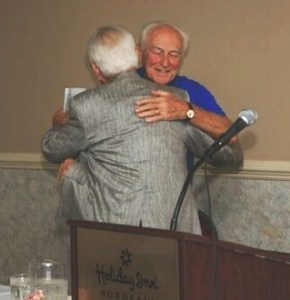
— Nearly 65 years ago a group of American soldiers advancing through Germany came upon a train loaded with 2,500 starving Jewish prisoners. For Frank Towers, who was serving as the liaison officer in the 30th Infantry Division, the day he organized a convoy to take those people to freedom was just another day in the war. But several years ago, some of the Holocaust survivors, who were only children at the time, began contacting their liberators through the Internet. That was the beginning of a new focus at the 30th Infantry Division’s annual reunion, with survivors joining the veterans and telling their stories. At this year’s reunion in Nashville, Towers is reuniting with four of the people he rescued from that train. “We had read in Stars and Stripes about Jewish slave labor camps, but this was the first group we encountered,” the 92-year-old said in an interview at the reunion on Friday. “It was really beyond our imagination that any sector of the human race could do to these people what had happened.” Micha Tomkiewicz is now 70 and a professor of Physics and Environmental Studies at Brooklyn College in New York City. He was only five on April 13, 1945, when he was liberated. His memories of the Bergen-Belsen concentration camp, where he had been held until the Nazis tried to evacuate him and the others to prevent their liberation, are few. One memory is of the rats, he said, and the time he woke up the whole barracks screaming that they were eating him. Although he knew he had been liberated by the American Army, he said, “throughout my life, they were always an abstract concept. Now suddenly they’ve got shape, voice, life.” “I just wanted to find the opportunity to really, really thank these guys,” he said. George Somjen, now 80 and a retired professor of Neurophysiology at Duke University, was 15 at the liberation, and remembers it better. “We were, of course, terribly happy,” he said, “but in that extremely emaciated state (I had lost 30 to 40 percent of my body weight), one has a very limited emotional scale. One doesn’t feel much except, ‘I am hungry.’ ‘I am thirsty.’ ‘I hurt.”‘ “For many years I never thought about this,” he said. Then, a few years ago he read a newspaper article that featured a fellow survivor and came to hear of the reunions. On Friday, while giving a presentation on his experiences, he recalled a 1997 trip to Germany where he revisited the town of Hillersleben, where the Americans first housed the survivors after they were taken from the train. His voice cracked as he told the group that his father, who had been with him on the train, died there, several days after the liberation. Tomkiewicz, Somjen and the other survivors would likely never have met their liberators if it hadn’t been for a high school history project. Several years ago, Hudson Falls (N.Y.) High School history teacher Matthew Rozell asked his students to collect the oral histories of local WWII veterans. Since those stories and pictures first went on the Internet, about 100 survivors who were on the train near Magdeburg and now live all over the world have contacted him and Towers. “It’s immensely satisfying to know that 65 years ago I had some part to play in the liberation … of these people and in setting them up on the road to a new life,” Towers said.

Read Full Post »

Wonderful Victory.

A note from liberator Frank Towers:

Hi Matt:  Attaching the latest revised list of our Holocaust Survivors.  It is almost unbelievable to learn that there are so many of them still surviving – most of course we do not know where.

By my calculation, there were about 425 children on that train. Statistically about half of them are deceased thru malnutrition, disease effects from their incarceration and normal attrition, bringing the total survivors to about 200+.  Would you believe that we now have “over 100 names” on this list now, and it continues to grow!!!

I have been in contact with Varda in Israel, and she has been working 24/7 looking for these people, and she has come up with a bunch of them, and most have been verified from my Farsleben Train List.

And a wonderful communication from Israel:

Hello, Matthew,
My name is Lily Cohen and I was a little girl who was on that train coming from Bergen-Belsen.  My name was Lili Kazimierski-Shein and I was an orphan, probably about 5 or 6 years old.  at that time.  I don’t know my birth day, or year.
I am so moved to find this research, as most of my early life appeared to be “erased” somehow by the Holocaust, and only now am I able to take small steps into what was my past to piece together fragments of memories.  I remember the train.  I remember the hill, I remember a German soldier running away, and I remember a woman who was trying to take care of me dying at my side.
I come to the US and would be very touched to come to a reunion.  My life has turned into a really wonderful victory over Hitler’s attempt to obliterate the Jewish race.  Tonight I made dinner for 10 people in my home in Tel Aviv – 6 of whom came from me!!!
I send gratitude to you,

Lily

How did I hear of you?  Varda  called me last evening, having found my name in a book by Hilda Hoopert called “Hand In Hand With Tommy.”  Since it only mentioned my first name and the kibbutz where I was raised, she called the kibbutz!  Amazing how things can come together when there are people dedicated to finding out “the rest of the story.” Thank you for your dedication.
Please feel free to quote me on your weblog.  It would be an honor, and might even lead me to more pieces of the mosaic of my early life.  It would be good to be contacted directly, so you can include my e-mail and even my phone number here in Israel if you like.
I would very much like to talk to the other girl whose story is so similar to mine.  You are so kind to consider the sensitive nature of our feelings.
I do so look forward to meeting you some day soon.
Shalom,
Lily

POSTSCRIPT:

Hi Matt,

Thank you again. Since last Tuesday when I got Varda’s call I am on a different time zone. on one hand I carry on with my life, on the other I can not wait to get on the computer to see if there is anything from you or Frank. For so many years I didn’t talk about my childhood even with my children, deep deep down I had the feeling that something was probably very wrong with me, something you should be ashamed of, if all this happened to me. I have open my mouth only ten years ago to tell my granddaughters.  You see, among all the amazing stories that you hear, my story is unbelievable. I don’t think that – at least- in Bergen Belzen it was a child from a very young age of two years old until the age of five or six that was completely alone without anybody from his family, all the other children were with parents, Mum, aunt. I, must thank all the anonymous women who took care of me all that horrible years. I don’t remember their faces but I know they were exist and saved my life.
You are really doing a holy work and I do hope to meet you some day.

Read Full Post »

Holiday Inn Opryland/Airport is the Place

March 4 – 7 is the Time

The Prez Sez:

As your  President and Editor, I hope that you have had a Very Merry Christmas or a Happy Hanukkah, with your families, and I hope that you all will have a Wonderful, Happy, Healthy and Fulfilling Year in the year 2010 to come. At this stage in the game, we all must count our blessings and be thankful for what we have.

I am delighted to note that as of this writing, we have 52 persons registered for our next Reunion in March. This is very exciting to know that so many of our members are planning ahead and making plans to be together with us for this memorable event. Among our participants, we already have a commitment from 4 of our Holocaust Survivors, who plan to be with us to tell their stories and to become acquainted with their Liberators, and meeting others of their peers for the first time. I am sure that there will be others joining us as time goes on. If we can have 100 or more at this reunion, it will tell us that we surviving “Old Hickorymen” still have a lot of spirit within us, and determination to join with the crowd as often as the opportunity presents itself.

If you have not been to one of our Reunions, you just do not know what you are missing in the way of Friendship and Camaraderie, that we all knew way back 65 years ago. It has grown even better ! Don’t miss out on this one !!

Frank W. Towers, President

DRAFT COPY

(Subject to Change)

Program 2010

Holiday Inn Select, Opryland/Airport

4 March – 7 March 2010

Wednesday                              3 March

Early Registration                                         1:00 P.M.  –  5:00 P.M.

Hospitality                                                      1:00 P.M.  –  5:00 P.M.

Dinner on Own                                              5:00 P.M.  –  7:00 P.M.

Manager’s Reception (Free)             5:30 P.M.  –  6:30 P.M.

Hospitality                                                      7:00 P.M.  –         ??

Thursday                               4 March

Registration                                                   9:00 A.M. –  12:00 Noon

Lunch on Own                                            12:00 Noon –   1:00 P.M.

Registration                                                   1:00 P.M.  –    5:00 P.M.

Reception in Atrium                                     6:00 P.M.  –   7:30 P.M.

Hospitality                                                      7:30 P.M.  –  10;00 P.M.

Friday                                     5 March

Breakfast       (Whenever you wish)            6:30 A.M.  –    8:30 A. M.

Memorial Service                                          9:30 A.M.       10:30 A.M.

Open Time for Visiting / Interviews            10:30 A.M.     12:00 Noon

Lunch at Hotel                                               12:00 P.M   –     1:30 P.M.

Holocaust Survivors Presentation                  2:00 P.M.  –                 5:00 P.M.

Hospitality                                                         5:00P.M.  –    6:00 P.M.

Dinner                                                               6:00 P.M.  –    7:30 P.M.

Hospitality                                                         7:30 P.M.  –   10:00 P.M.

Saturday                                6 March

Breakfast       (Whenever you wish)               6:30 A.M.  –    8:30 A.M

General Meeting                                                9:00 A.M.     12:00 Noon

Lunch at Hotel                                                  12:30 P.M.       1:30 P.M.

Hospitality                                                          1:30 P.M.         6:00 P.M

Holocaust Survivors Presentation Cont’d       1:30 P.M.        5:00 P.M..

Banquet                                                                7:00 P.M.        9:00 P.M.

Hospitality                                                             9:00 P.M.      11.00 P.M.

Sunday                                   7 March

Breakfast  (Whenever you wish)                        6:30 A.M. – 8:30 A.M.

Departures :    Airport shuttle as scheduled . Be sure to schedule your departure with the Hotel Concierge on Friday or Saturday!!

Read Full Post »

{As part of the conclusion to my USHMM Teacher Fellowship project, I  am posting the unfolding nature of the discovery of the camps as Allied troops closed in from the East and the West, sixty-five years to the day that the discovery/event occurred.}

February 15, 1945

After the liberation of the Flossenbürg concentration camp, two U.S. army infantrymen examine a pile of shoes belonging to victims of the camp. Flossenbürg, Germany, May 1945.After the liberation of the Flossenbürg concentration camp, two U.S. army infantrymen examine a pile of shoes belonging to victims of the camp. Flossenbürg, Germany, May 1945. USHMM

After the liberation of the Flossenbürg concentration camp, two U.S. army infantrymen examine a pile of shoes belonging to victims of the camp. Flossenbürg, Germany, May 1945.USHMM.

The Red Army overruns and liberates a slave labor camp at Neusalz, Poland. On January 26th, one thousand Jewish women interned there are set on a month and a half forced march to the concentration camp at Flossenbürg, 200 miles away in south east Germany near the Czech border.  Most of these women do not make it to Flossenbürg; most are beaten to death or shot.

Source(s): Weber, Louis. The Holocaust Chronicle. Publications International Ltd., 2007. http://www.holocaustchronicle.org/staticPages/594.html

The United States Holocaust Memorial Museum   http://www.ushmm.org/wlc/article.php?lang=en&ModuleId=10005537

Read Full Post »

{As part of the conclusion to my USHMM Teacher Fellowship project, I  am posting the unfolding nature of the discovery of the camps as Allied troops closed in from the East and the West, sixty-five years to the day that the discovery/event occurred.}

from the United States Holocaust Memorial Museum-

 February 8, 1945

 As Soviet forces approach the camp, the SS orders the evacuation of Gross-Rosen. The SS forces more than 40,000 prisoners on death marches to camps in the interior of Germany. Members of the SS kill any prisoner too weak or ill to continue the march. Thousands die during the evacuations, many from the lack of food or water.

It is estimated that of the 120,000 prisoners who passed through the Gross-Rosen camp system, 40,000 died either in Gross-Rosen or during the evacuation of the camp.


GROSS-ROSEN CAMP ESTABLISHED
August 2, 1940

SS authorities establish the Gross-Rosen concentration camp, initially as a subcamp for men, as part of the Sachsenhausen camp system. The camp is built near the city of Striega, just south of the town Gross-Rosen (Pol., Rogoznica) in Lower Silesia. The SS transfers about 100 prisoners, mostly Germans and Poles, to the site to begin the construction of the camp. An SS-owned company, German Earth and Stone Works, takes over the quarry at Gross-Rosen and forces concentration camp prisoners to mine granite.

RECLASSIFICATION OF GROSS-ROSEN
May 1, 1941

The SS Economic-Administrative Main Office reorganizes the Gross-Rosen camp as an independent concentration camp, removing it from the Sachsenhausen camp system.

EXECUTION OF SOVIET POWS
October 1, 1941

The SS transfers the first group of Soviet prisoners of war (POWs) to Gross-Rosen for execution. About 20 Soviet POWs from the prisoner-of-war camp in Neuhammer are shot in front of the crematoria at Gross-Rosen. During this month, the SS transfers about 3,000 Soviet POWs to Gross-Rosen for execution. In the Commissar Order, Hitler ordered the summary execution of Soviet political commissars and other officials. The German army turned tens of thousands of Soviet prisoners of war over to the SS for execution.

PRISONERS SELECTED FOR “EUTHANASIA”
December 12, 1941

The SS Inspectorate of Concentration Camps sends evaluation forms to Gross-Rosen for the screening of prisoners. SS doctors in Gross-Rosen use the forms to recommend the killing of almost 300 ill or weak prisoners in Gross-Rosen. About half of the prisoners are later transferred to the Euthanasia killing center at Bernburg and gassed. The others either die in the camp or recover before the SS can arrange the transfer to Bernburg. The systematic killing of ill or weak prisoners is part of an operation codenamed 14f13, carried out by personnel from the Euthanasia Program in conjunction with the SS Inspectorate of Concentration Camps. During the Gross-Rosen camp’s existence, SS doctors also use injections to the heart to kill weak or ill prisoners in the camp hospital.

TYPHUS EPIDEMIC
January 17, 1942

SS camp authorities order the quarantine of the Gross-Rosen camp due to a typhus epidemic, halting all work in the camp. They allow no prisoners to leave or enter the camp. The SS will lift the quarantine after about a month. More than 1,000 prisoners die during this outbreak of typhus in the camp.

SCHINDLER FACTORY BECOMES SUBCAMP
October 21, 1944

German industrialist Oskar Schindler moves his Jewish work force from the Plaszow concentration camp in Poland to a factory in Bruennlitz (in the Sudeten region of Czechoslovakia). The new camp attached to the factory in Bruennlitz becomes a subcamp of Gross-Rosen. Schindler saves over 1,000 Jews employed in his factory by claiming that they are essential to wartime production. They will remain under Schindler’s care until liberation in May 1945.

REPORT ON PRISONER STATISTICS
January 15, 1945

SS camp officials report that there are more than 75,000 prisoners in the Gross-Rosen concentration camp, including more than 25,000 women. As forced labor from concentration camp prisoners grew more important in the production of armaments for the German war economy, Gross-Rosen became the center of a vast network of more than 100 subcamps spread across Lower Silesia.

SOURCE: The United States Holocaust Memorial Museum

http://www.ushmm.org/wlc/media_cm.php?lang=en&ModuleId=10005454&MediaId=133

Read Full Post »

Liberation. 65 Years on.

Soon after liberation, surviving children of the Auschwitz camp walk out of the children’s barracks. Poland, after January 27, 1945. — United States Holocaust Memorial Museum

I study this photograph

And so it begins, 2010-

‘~The Year of the Liberator~’.

The-Train-to-Life-an article by a leading Orthodox magazine on how our project is affecting lives.

The White House

Office of the Press Secretary

For Immediate Release
January 27, 2011

Statement by the President on International Holocaust Remembrance Day

“I join people here at home, in Israel, and around the world in commemorating International Holocaust Remembrance Day, as we mark one of the darkest, most destructive periods in human history.

To remember is a choice, and today we remember the innocent victims of the Nazis’ murderous hate – six million Jews and millions of other people. We are reminded to remain ever-vigilant against the possibility of genocide, and to ensure that ‘Never Again’ is not just a phrase but a principled cause. And we resolve to stand up against prejudice, stereotyping, and violence – including the scourge of anti-Semitism – around the globe.

At the same time, we remember the ordinary people who courageously and heroically expressed the very best of the human capacity for compassion and justice by risking their lives to save their fellow human beings during the Holocaust. They demonstrated that in the midst of evil, human beings can perform remarkable acts of decency and dignity.

Finally, on Holocaust Remembrance Day, we remember the survivors and the profound faith and courage they have embodied to build lives of purpose and meaning. In doing so, they are defying those who tried to kill them, and teaching us that love and life can vanquish hate and death. Let us honor them, and those we lost, by building a more peaceful, just and tolerant world.”

Yes. Honor the memory of those who passed, those who survived, and those who rescued. But do also remember that to liberate was also a choice.


Read Full Post »

Don’t be a bystander.

“Don’t be a bystander.”  -quote from conference, Mr. Rozell. World News video, with Mr. Rozell’s message to students, taken from the last day of the conference.


Read Full Post »

He’ll tell his story at a Hanukkah celebration

By Maggie Fitzroy
Story updated at 11:03 PM on Friday, Dec. 11, 2009

They were bone thin, sick and weak, packed standing up so tightly into train cars that they couldn’t move.

When American soldiers opened the doors, those who could stumbled out.

The 2,500 men, women and children had been on the train for six days, and before that they were imprisoned at Bergen-Belsen concentration camp in Germany.

They were dirty, starving and dehydrated. Some were dead.

“We’d heard stories about the mistreatment of Jews, about them being tortured and being put to death,” said Frank Towers, who as a young Army first lieutenant helped rescue the Jews from the Nazi death train at the end of World War II.

“But we dismissed what we thought was propaganda,” said Towers, now 92, who will be a guest speaker and help light the menorah at the Chabad at the Beaches Hanukkah celebration Monday night at Hampton Inn in Jacksonville Beach.

“We didn’t believe one group of human beings could do that to another group of human beings,” he said. “It wasn’t until we saw this trainload of Jews that we believed.”

Rabbi Nochum Kurinsky said he invited Towers, who is Catholic, to the Hanukkah event because “he’s a guy who’s a real hero.”

Towers, who lives in Brooker, near Gainesville, speaks about his war experiences around the country and the world. He said he’s honored to tell his story at the Beaches.

“There are thousands of people alive today who are descendents of those Holocaust survivors,” Kurinsky said. “We owe him a debt of gratitude.”

Towers, who fought at the Battle of Normandy, who took refuge in foxholes and who watched friends die in bombings and battles, said it’s important to tell the story of how he and other soldiers rescued Jews from a train in April 1945.

“The train story is a small part of my service,” he said this week as he recalled those days so many years ago. “But it’s a tragedy that should never be forgotten.”

Towers joined the National Guard in 1940 in Vermont, where he lived at the time. In 1941, he was sent to Camp Blanding in southwest Clay County for training, and when Japan bombed Pearl Harbor Dec. 7 of that year, he knew he would become an Army soldier “for the duration.”

He went for further training at several bases around the country and became a commissioned officer. In 1943, he married his girlfriend, Mary, was promoted to first lieutenant, assigned to the 30th Infantry Division then stationed in Indiana.

In February 1944, his entire 120th Regiment joined one of the largest convoys to ever cross the Atlantic Ocean, bound for England. On June 6, D-Day, he said they knew it was “the day and the real thing” when they heard the roar of planes overhead.

Towers’ division was not part of the first invasion of Normandy, but they saw the “horrible and frightening sight” of “the carnage that befell their predecessors” when they landed first on Utah Beach, then Omaha Beach, Towers said.

They fought the enemy as they chased them, moving forward each day, eating C and K rations of canned and concentrated food. They scrounged for more food from “liberated” farms and were constantly on guard against booby trap bombs left by the Germans.

They moved 25 to 50 miles a day, keeping the Germans on the run across Northern France, Belgium and the Netherlands, fighting snipers along the way.

They helped capture Aachen, the first city in Germany to be taken, and moving east, arrived at the city of Magdeburg, by the Elbe River, in April 1945. That river was the demarcation line between American and Russian troops, Towers said. Berlin was 75 miles to the northeast but they had orders to stop at the river.

Discovering the prisoners

That’s when they learned the 743rd Tank Battalion had discovered a train that was stalled on tracks nearby in the small town of Farsleben. When they found the Jewish prisoners, they learned that they had been loaded into the boxcars in Bergen-Belsen, and were en route to Thersienstadt in Poland, where they would be killed as part of “the Final Solution.”

The train had run into Russian-occupied territory then reversed direction to avoid detection. After heading toward Farsleben, the engineers learned the Americans were there. And stopped, Towers said.

“The train commander didn’t know what to do, so they were sitting on the track.”

They had orders to take the train to a wrecked bridge in Magdeburg that crossed the Elbe River, “and were told to drive the train onto the bridge and into the water,” Towers said.

But the engineers realized they too would die, “so they were disputing what to do when we found them.”

Towers said he knew more about the back roads in the area than anyone else, so he was assigned to round up as many trucks as he could to transport the Jews to the nearby town of Hillersleben, which had just been liberated by the Americans. There was an abandoned hospital there, and American medical personnel began arriving.

The prisoners had been stacked in the train cars like wood, so crowded they had no room to move around, Towers said. During their six-day odyssey around Germany, their only bathroom facility was a bucket in the corner of each car. “Since they couldn’t move, they had to let it run down their legs,” he said. “The stench was unbearable.”

Every night, they were taken out of the cars and given bowls of soup made from turnip or potato peelings, leftovers from soup served to the Germans.

When the Americans first arrived, many of the Jews were afraid to come out of the train because they didn’t know what worse fate might be in store for them, Towers said. As they moved forward to get out, the dead fell to the floor “and there wasn’t anything anyone could do.”

At the time, Towers said he and the other soldiers were “hardened” to what they saw because they had seen so much death and suffering across Europe among their own troops, German soldiers and civilians.

“Death was not anything new to us,” he said.

Helping the survivors

The 105th Medical Battalion arrived to help the survivors, and the citizens of Farsleben were ordered to bring food to the train site, which they did “reluctantly,” Towers said.

Towers led three truck convoys full of Jews to Hillersleben and turned them over to the U.S. military government there.

The Jews were so full of lice and fleas that all of their clothing had to burned. They showered, and the people of Hillersleben brought them food and new clothes “reluctantly.”

Towers said he didn’t understand German, but he could see what was going on “at the point of the rifles” the American leaders pointed at the heads of the mayors of the towns.

The citizens of those towns “did not appreciate having to give up their food and clothing to this pile of Jewish trash,” he said. “They weren’t smiling about it.”

In the following days, and years, Towers said he never thought any more about the Jewish prisoners he’d helped rescue. The war was ending in Europe, and he was getting ready to go to the Pacific to fight the Japanese. The bombing of Hiroshima and Nagasaki ended that prospect, and after serving three more years in Europe after the war, Towers went home to Mary and a new home in Brooker, where they’ve lived since.

Remembering the horror

Towers said for years he couldn’t talk about the war. He was depressed, in denial and probably suffered from post traumatic stress syndrome. He opened a grocery store and raised a family.

Then in 1974, he visited Normandy, where he found many buddies’ graves. He broke down and cried, a flood of emotion breaking through, and he began to talk. He said he hasn’t stopped talking since.

Several years ago, he found a Web site, created by a history teacher in New York, that told the story of the train near Magdeburg, with photos. He got in touch with the teacher, Matthew Rozell, and they have communicated since, and attended reunions where Towers has met some train survivors.

The ones still living were children at the time, he said. There are possibly 600 still alive today, and he’s been in touch with about 60, who live around the world – in Israel, the United States, Canada, Chile, Australia, New Zealand, Germany and The Netherlands. Many are highly educated professionals, doctors, college professors and artists.

One, Sara Atzmon, who was 7 years old in 1945, is a well-known artist and sculptor living in Israel. At a reunion in New York in September, she gave Towers a painting depicting the train story to hang in the Camp Blanding Museum, where Towers volunteers once a week.

“We don’t ever want to forget what happened to the Jews,” Towers said. As the war was ending, the Germans tried “to hide evidence” of what they’d done in the concentration camps, and he said the people he helped rescue were destined for the gas chambers.

“I feel happy and proud that I had a small part to play at giving them a second chance at life,” he said.

The Hanukkah party and menorah lighting are open to the public, with a fun and food fair beginning at 4:30 p.m., followed by the menorah lighting at 6 p.m. and Towers’ talk at 6:30.

Kurinsky said he’s heard Holocaust survivor accounts before, but not one from an American soldier.

He said Towers’ story is particularly appropriate for Hanukkah.

“Hanukkah is a holiday for celebrating life, victory, and religious freedom,” Kurinsky said. “America is about religious tolerance, and here’s somebody who really epitomizes what Hanukkah’s all about.”

Frank Towers meeting students at our school.

http://jacksonville.com/community/shorelines/2009-12-12/story/man_who_helped_saved_2_500_jews_during_the_holocaust_will_spe_0

Read Full Post »

Quotes from American Soldiers/Holocaust Survivors Reunion   9/22-26/09

Compiled by Mrs. Hales, English teacher, Hudson Falls High School.

You are free to share or use this page, provided the following conditions are met:

  • Attribution — You must attribute the work. That means you need to credit me, even if you are a student working on a last minute paper for your history teacher at 2am, searching for that killer quote. Your teacher will be impressed; otherwise, he or she will go online and find the quote the same way you did, and let you have it for stealing. So I’ll make it easy: Rozell, Matthew. Quotes from the American Soldiers/Holocaust Survivors Reunion, Hudson Falls High School, New York, USA;   9/22-9/26/2009. World War II Living History Project/Teaching History Matters https://teachinghistorymatters.wordpress.com. Accessed (you fill in the blank with a date here).
  • Noncommercial — You may not use this work for commercial purposes. Please don’t try to make money off of our  educational project.
  • No Derivative Works — You may not alter, transform, or build upon this work. If you want to copy it for use on your website, fine, but it must be copied in its entirety and duly credited with the reciprocal link.

Credit Matthew Rozell and World War II Living History Project/Teaching History Matters. .. If re-posting  include the link, https://teachinghistorymatters.wordpress.com.

  • “How could we [the world] have stood by and let that happen to them?  We owe them.”   Carrol Walsh, 743rd Tank Battalion, Liberator
  • “I often wonder what this world would be like if those 6 million had never perished.”  Frank Towers, 30th Infantry Division, Liberator
  • “Against all odds I am standing here before you.”  Steven Barry, Holocaust Survivor, (Hungary, Florida)
  • “I tell my story so that they might tell the next generation.”  Sara Atzmon, Holocaust Survivor, artist, (Hungary, Israel)
  • “Love gives us wings to soar above it all.”  Sara Atzmon, Holocaust Survivor, artist, (Hungary, Israel)
  • “Hatred is something we must fight against.”  Leslie Meisels, Holocaust Survivor, (Hungary, Toronto)
  • “Silence helps the oppressors.” Leslie Meisels, Holocaust Survivor, (Hungary, Toronto)
  • “I tell my story so that it won’t become your future.”  Leslie Meisels, Holocaust Survivor, (Hungary, Toronto)
  • “We cannot be lax at all.  We must keep the faith.  We must tell others.”  Buster Simmons, Chaplain, 30th Infantry Division Veterans of WWII.
  • “I’m listed as a liberator, but I’m a survivor of WWII.”  William Gast, 743rd Tank Battalion
  • “We keep the faith.”  Motto of the 743rd Tank Battalion
  • “Freedom is not free; there is a high price tag attached.”  William Gast, 743rd Tank Battalion
  • “We must ever be thankful [for our freedom].  We must NEVER take freedom for granted.”  William Gast, 743rd Tank Battalion
  • “After they gave us back our lives, we needed to live each day.”  Paul Arato, Holocaust Survivor, (Hungary;  Toronto, Canada)
  • “I live some of the horrors of 65 years ago everyday.”  Paul Arato, Holocaust Survivor, (Hungary;  Toronto, Canada)
  • “You have the power to heal the world.”  Lev Raphael, son of Holocaust survivors
  • “Don’t be a bystander.”  Mr. Rozell, see below.

Credit Matthew Rozell and World War II Living History Project/Teaching History Matters. .. If re-posting  include the link, https://teachinghistorymatters.wordpress.com.

Read Full Post »

I’m a teacher.

This blog is about the Power of Teaching.

If you decide to spend a few moments here, you will see what I mean…

Start by studying the photograph below.

I mean, click on it to enlarge, really look at it.

Study the faces.

Imagine being the man behind the lens…

Matthew Rozell

Enter a caption

You may be here to find out more about the photograph that shows the moment of liberation. Watch the ABC News clip below about how I was first shown it by US Army veterans of World War II, the story they told me, and what I did afterwards, and the consequences of those actions.

[My new book on this will be out this July. You can put in a pre-order notice, above- GET THE BOOK HERE]

It is nothing short of a miracle.

Then again, in the words of one survivor, there are no coincidences.

Feel free to contact me or re-post this website.

Sign up for amazing updates on the upper right.

Do you know that nearly 250 survivors of this train transport have now had contact with their actual American liberators? It’s true. There are 10 other photos of the liberation that day on this site, and many folks have been identified.

Feel free to explore. Thanks for stopping by.

Matt

During our second Holocaust survivor/American soldier reunion, we reached out to a student audience of 1500 kids over three days. Just before the final farewell  banquet  the ABC piece below aired, and the soldiers, survivors, teachers and students watched it together in a restaurant lounge.

Not a dry eye!

Matthew Rozell

Official ABC site and video

THE STORY BEHIND THE PHOTOGRAPH

Read Full Post »

« Newer Posts - Older Posts »