Feeds:
Posts
Comments

Archive for the ‘Uncategorized’ Category

~Matthew Rozell, a history teacher whose project reunited hundreds of Holocaust survivors with the American soldiers who liberated them, takes a backwards journey to the authentic sites of the Holocaust, retracing the path of the survivors who are now his friends.~


A year ago I took one of the most transformative journeys of my life, with 24 fellow educators, to study the Holocaust and the Jewish resistance to it, in Washington, DC, Germany, the Czech Republic, and Poland. I kept an extensive diary and took tons of photographs. And contrary to many assumptions, it was a journey that led to profound understandings about life, not death.  For the next several days, I have decided to go back and retrace my steps and try to process what unfolded for me.


***************************

July 12.

After the tour of Auschwitz I, we have lunch on the bus in the parking lot, then drive the three kilometers through town to Birkenau.

There it is. The entry tower. The iconic symbol of evil.

787

Main entrance to the Auschwitz-Birkenau extermination camp. USHMM

Main entrance to Auschwitz-Birkenau . USHMM

We follow the guide up the stairs in the tower. From here we can see the sheer vastness of the camp.

696


Women's Barracks. Auschwitz II.

Women’s Barracks. Auschwitz II.

Dozens of long narrow women’s barracks, brick, still stand, albeit some braced with wood on the gable ends to keep them from toppling until they can be re-pointed. A. indicates that historic preservation here is a major concern.
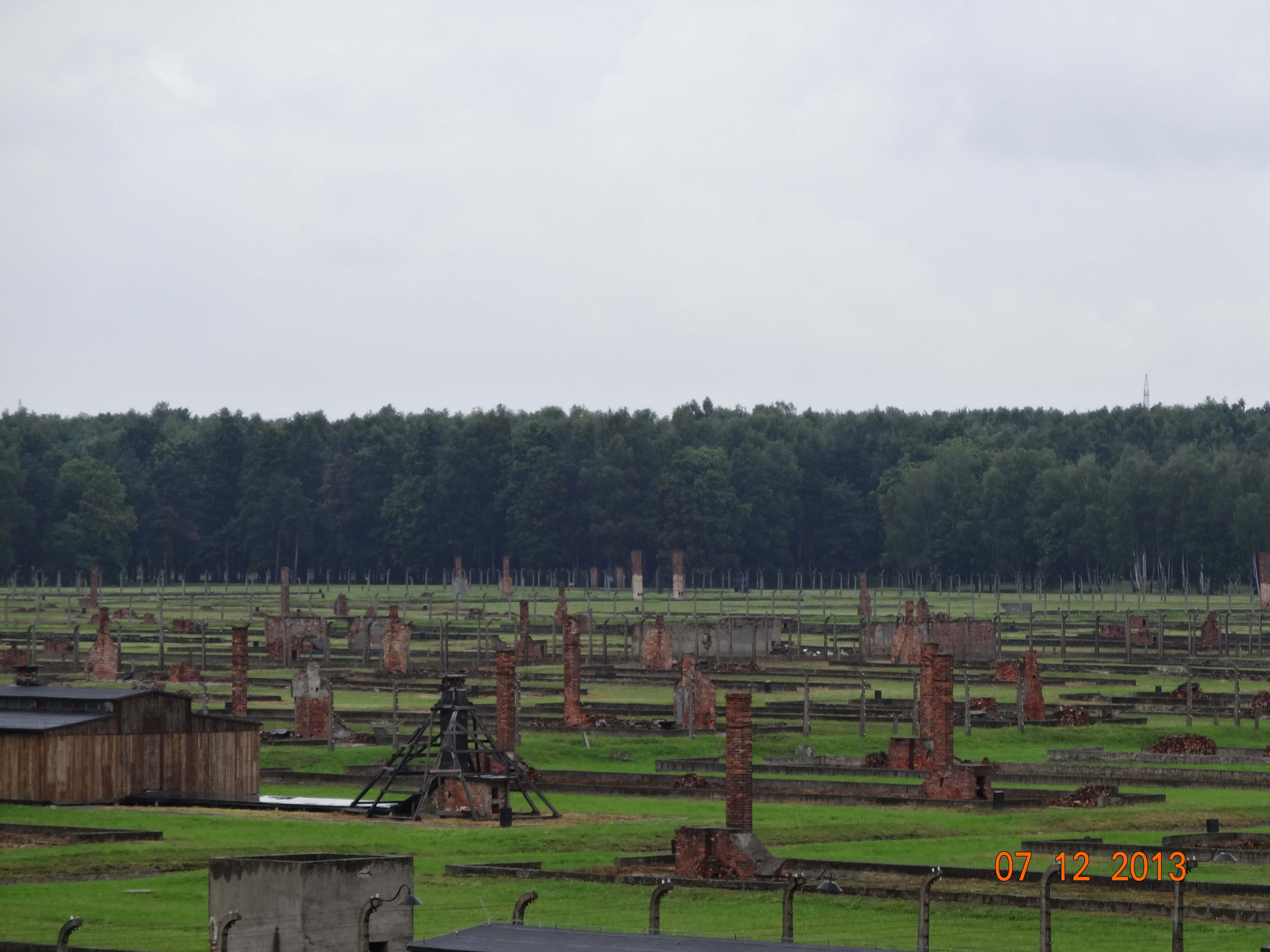
 

Vastness

Vastness

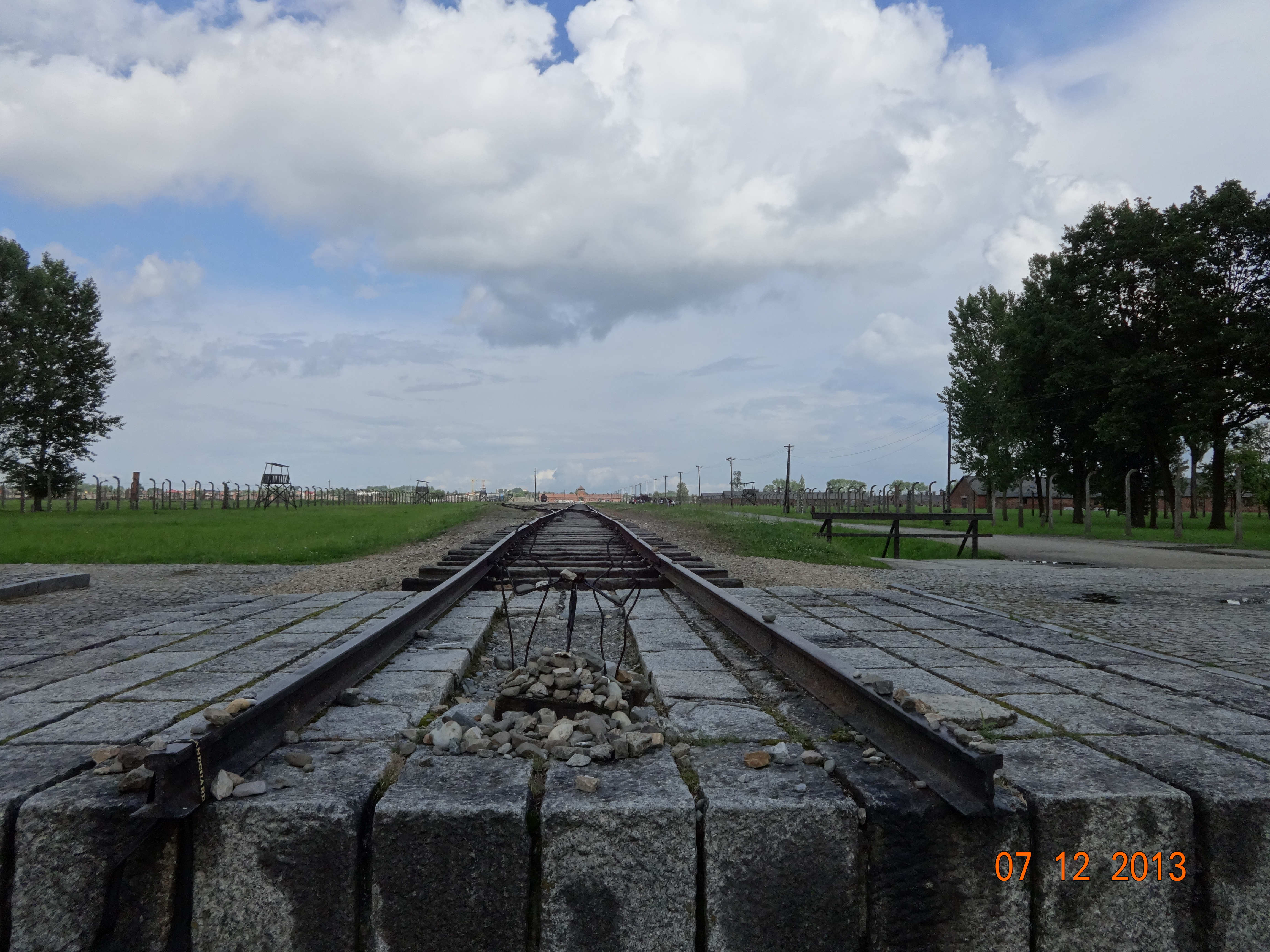
The rest of the camp is many square kilometers of row upon row of foundations and brick chimney stubs, surrounded by the menacing curved and tapered concrete concrete posts dotted with white insulators and strung with miles of parallel lines of barbed wire. In the summer of 1944, when hundreds of thousands of Hungarian families were deported here, the rail lines came right into the camp.

View of the Ramp at Auschwitz-Birkenau Showing the SS Selection of Hungarian Jews USHMM.

View of the Ramp at Auschwitz-Birkenau Showing the SS Selection of Hungarian Jews. USHMM.

View of the Ramp at Auschwitz-Birkenau Showing the SS Selection of Hungarian Jews, USHMM.

View of the Ramp at Auschwitz-Birkenau Showing the SS Selection of Hungarian Jews, USHMM.

Following the German invasion of Hungary in March 1944, over 400,000 Hungarian Jews  were deported and murdered at Auschwitz.


The Walk.

The Walk.

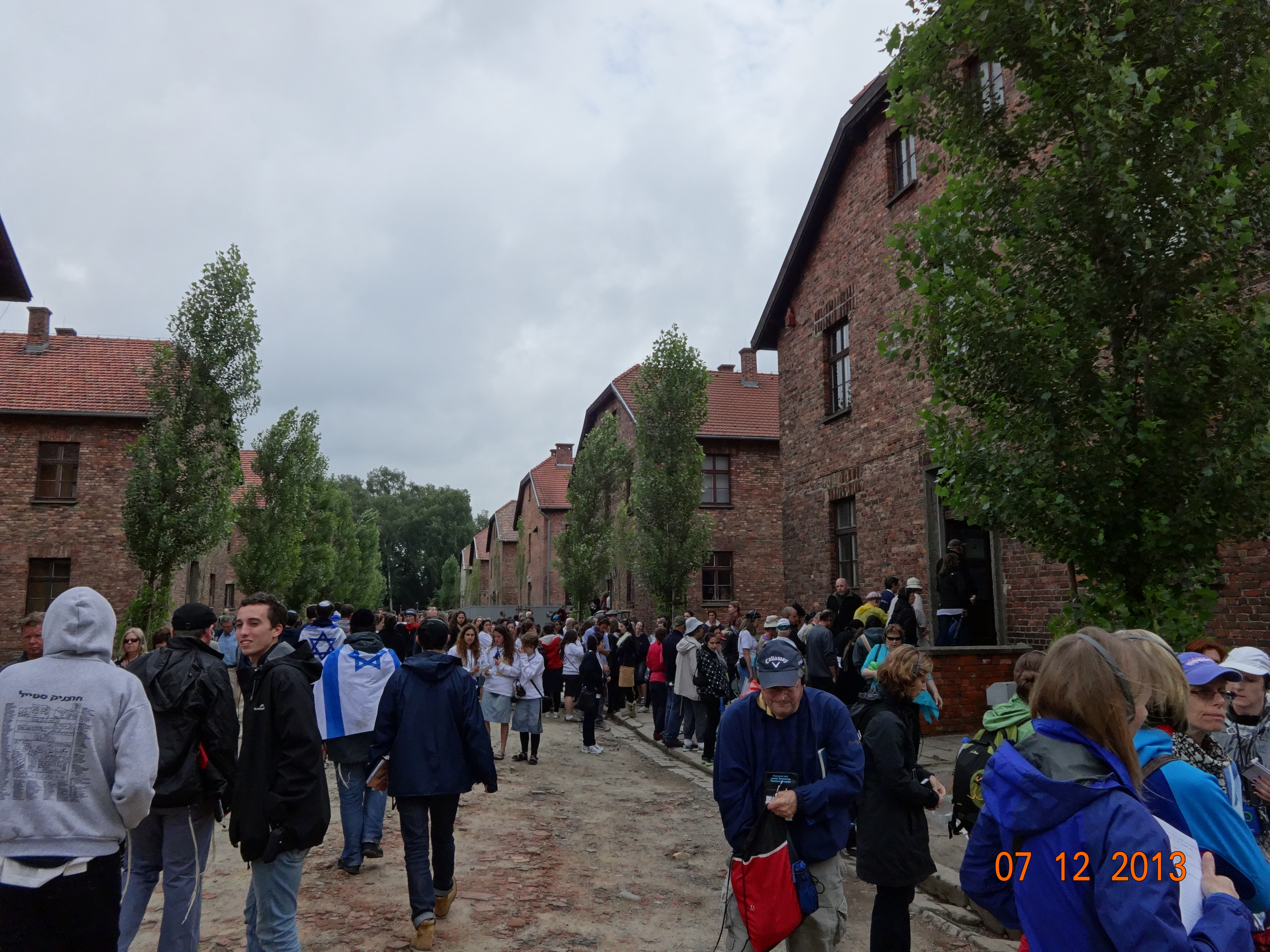
Our guide leads us along the path through the camp that leads to the gas chamber and crematorium. We walk in in silence along the roadway, the only sound the crunching of brick fragments and gravel underfoot.

Selected.

Selected.

The Walk.

The Walk.

707

It appears to have been paved with brick, slave labor, though in some spots it is hard to tell anymore. No one speaks, and on and on we walk. Two minutes. Five minutes. Ten minutes. Fifteen minutes. I’ve been on battlefields that are smaller than this site.


Flower ring as we make final approach to the chambers tucked into the wooded area nearby.

Flower ring as we make final approach to the chambers tucked into the wooded area nearby.

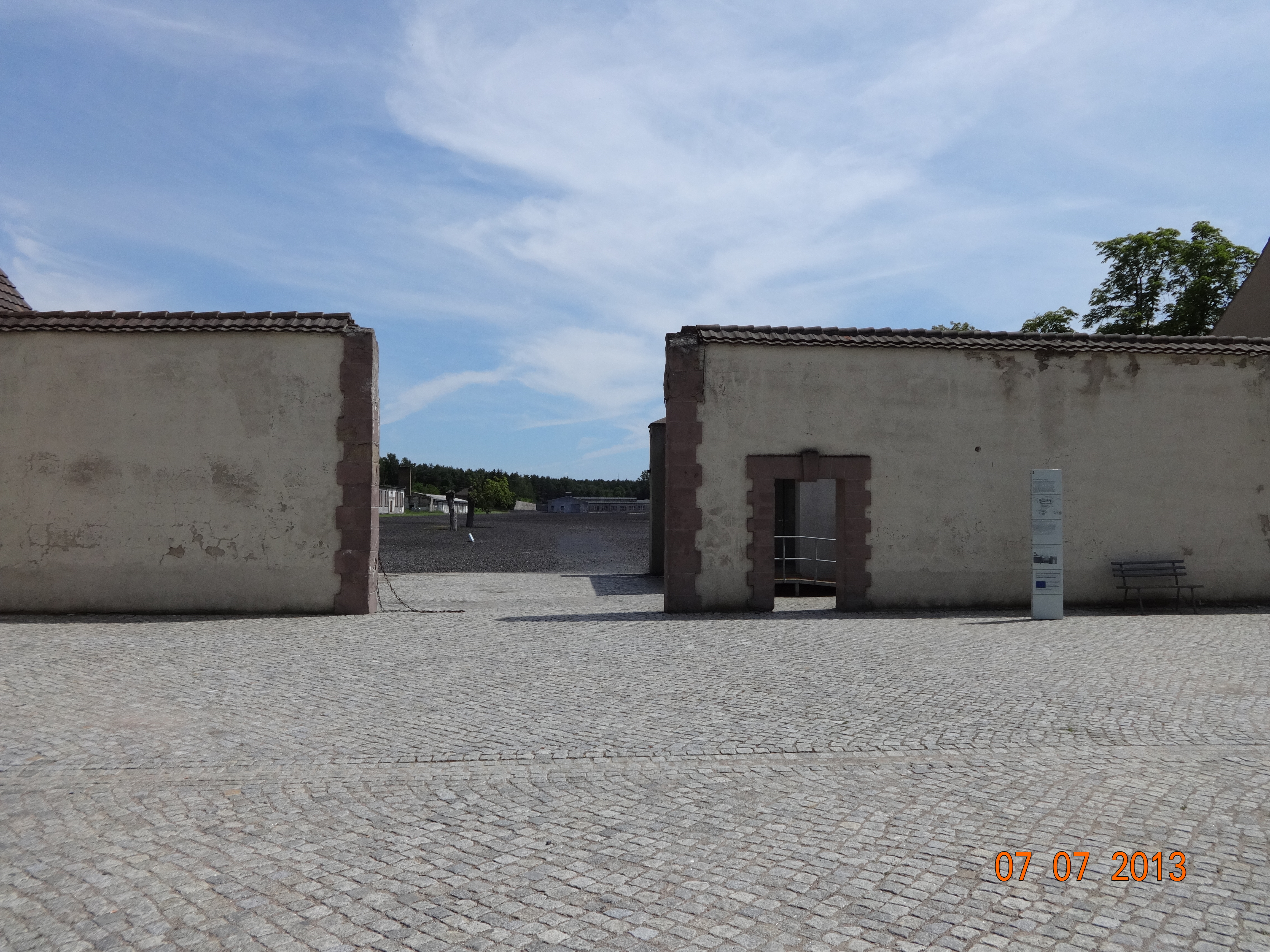
Finally we reach the end of the camp where the kitchens stood. A round concrete ring rises out of the earth, maybe 6 feet in diameter. Someone finally speaks and asks A. what it was. A giant flowerpot. She tells us also that they were placed near the entrances of the gas chambers. Flowers at the gas chambers.

Waiting. For what we do not know.

Waiting. For what they do not know. Exhausted from deportation and “travel”. We now know who they were. Yad Vashem.

We turn left, and keep walking past interpretative signage. It seems like we are walking outside of camp perimeter. But we are not. Beautiful woods appear and we are walking on the edge of the woods with the camp to our left. We stop near another sign and rest for a moment, allowing the others to catch up. Then our guide calls our attention to the photo on the sign, showing Hungarian mothers and children doing the same thing we are doing. Halting and resting.  And a short path through the woods will take us to the ruins of the gas chamber/crematorium Number Five.

They waited here. Some days, in the summer of 1944, for hours.

They waited here. Some days, in the summer of 1944, for hours.

We are resting at the spot they rested at, 20 minutes after walking, immediately after disembarking of overcrowded transports that had been traveling for days. Here they waited, anxiously, as their turn to approach the chamber would come. But the victims of the transport ahead of them had to be removed from the chamber first. Some days in the summer of 1944 these victims were backed up for hours.

I pick up a rock from the path and carry it with me past the ruins. At the ashfield there is more signage and a memorial asking visitors not to walk through the field. I place my stone on the memorial, looking down to watch where I step. But it is probably a futile gesture-this whole place is an ashyard, a graveyard.


The secret sonderKommando photos. Where the bodies were burned in open air.

The secret sonderkommando photos. Where the bodies were burned in open air.

“So many Hungarian Jews were killed in the Auschwitz camps during that period that the crematoria were incapable of consuming all the bodies, and open pits for the purpose were dug.”

728

We turn again, and walk past the remains of crematorium Number Four. To the disinfection center for those selected to be worked to death. Again, a system. Disrobing. Wading through disinfectant. Shower. Uniform thrown at you, mismatched clogs or shoes.


E’s mother spent two years here. Her grandmother and the little ones were selected upon arrival. Her mom’s beloved sister was murdered in the quarry after slipping while carrying a large pot of soup in the ice and snow with three other girls. Today is a hard day. I want to comfort her, to carry her pack for her. I feel helpless. There is nothing I can do.

778

At the Soviet memorial constructed near the two destroyed gas chamber/crematoria at the end, we have a remembrance ceremony. Kaddish is recited in Hebrew. I read it aloud in English. With tears, E. tells us that she feels her grandmother smiling down on this extraordinary group of dedicated teachers. A lump rises, again. I swallow hard and try to blink back the wetness I feel welling in my eyes. Damn, I almost made it. Glad for the sunglasses, even though there is no sun.
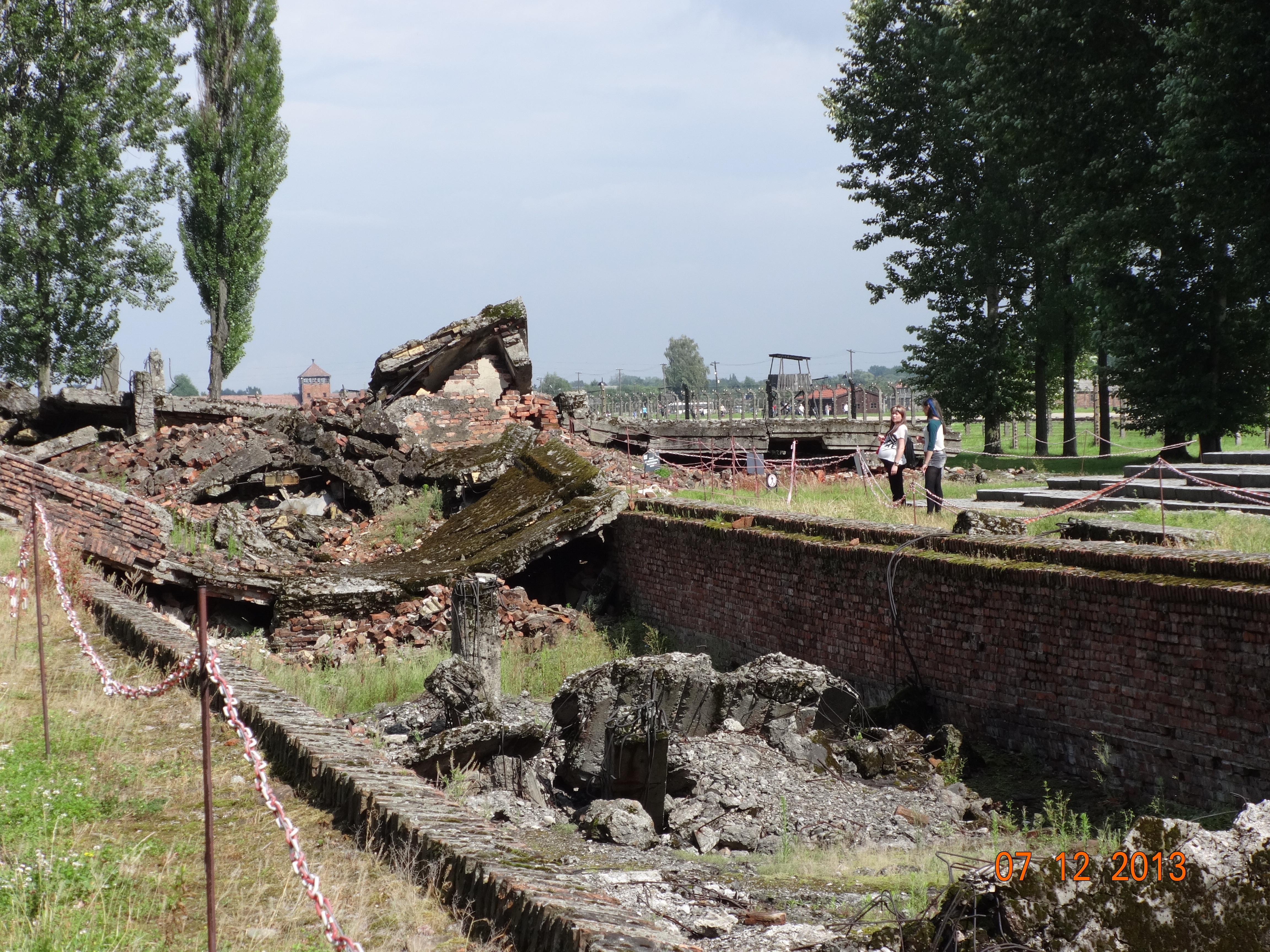
770

775


772

776


“A Warning to Humanity.”

We light candles, turn our backs, and walk out, which provides another twenty-minute stretch of personal reflection. We have toured the epicenter of evil. We have been here, we try to process-but we just cannot. We need the individuals to speak to us. And like E’s family, they do.
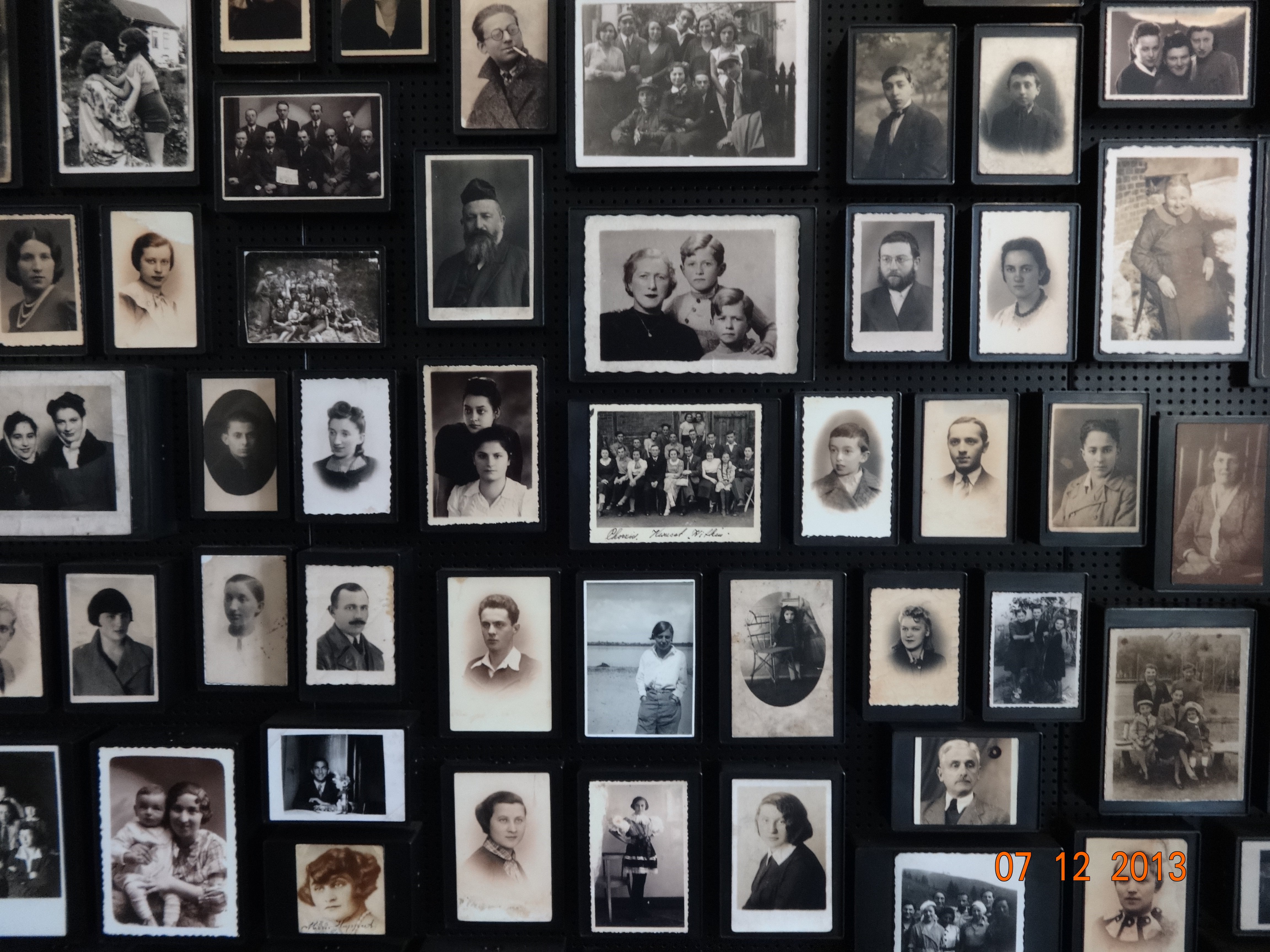
 

738


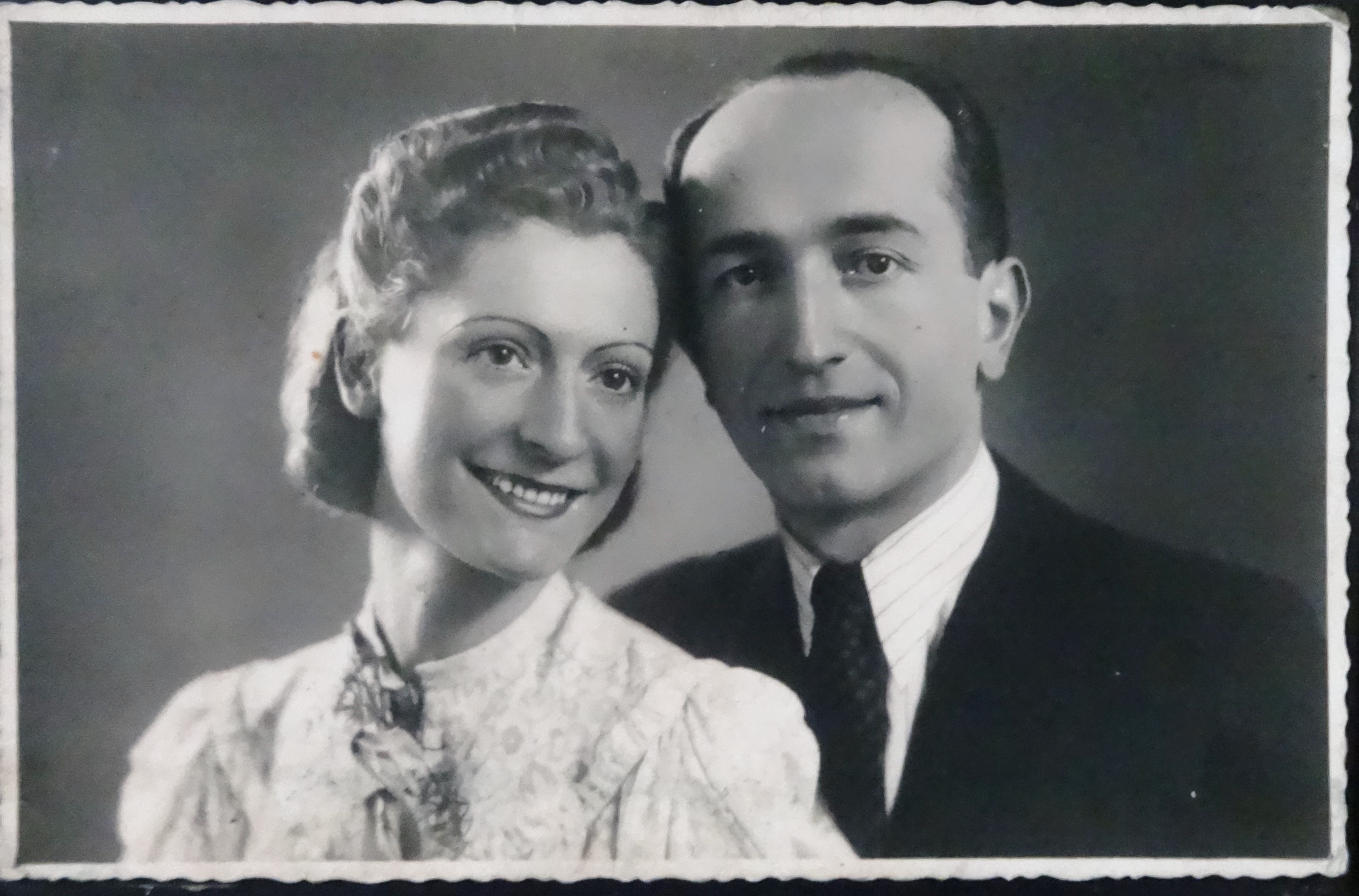
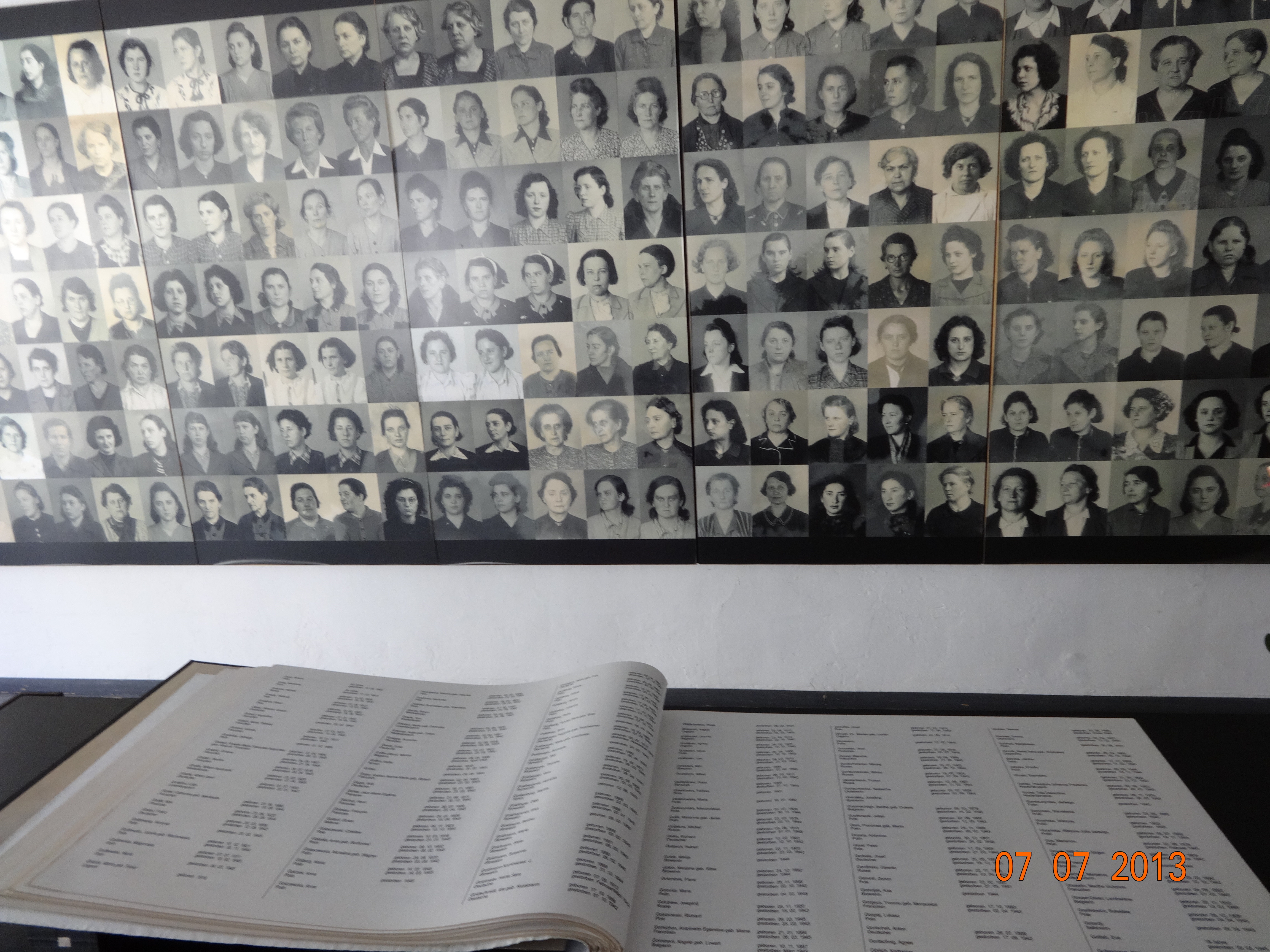
At the close of the disinfection center exhibit there are hundreds of photographs that had been discovered years after the camp was abandoned by the Germans. Pictures of loved ones who perished here.

For me, like the personal home movies of pre-war life for the victims at the exhibit at Auschwitz I, this is what has the most meaning. So I will leave you for now with a few close ups.

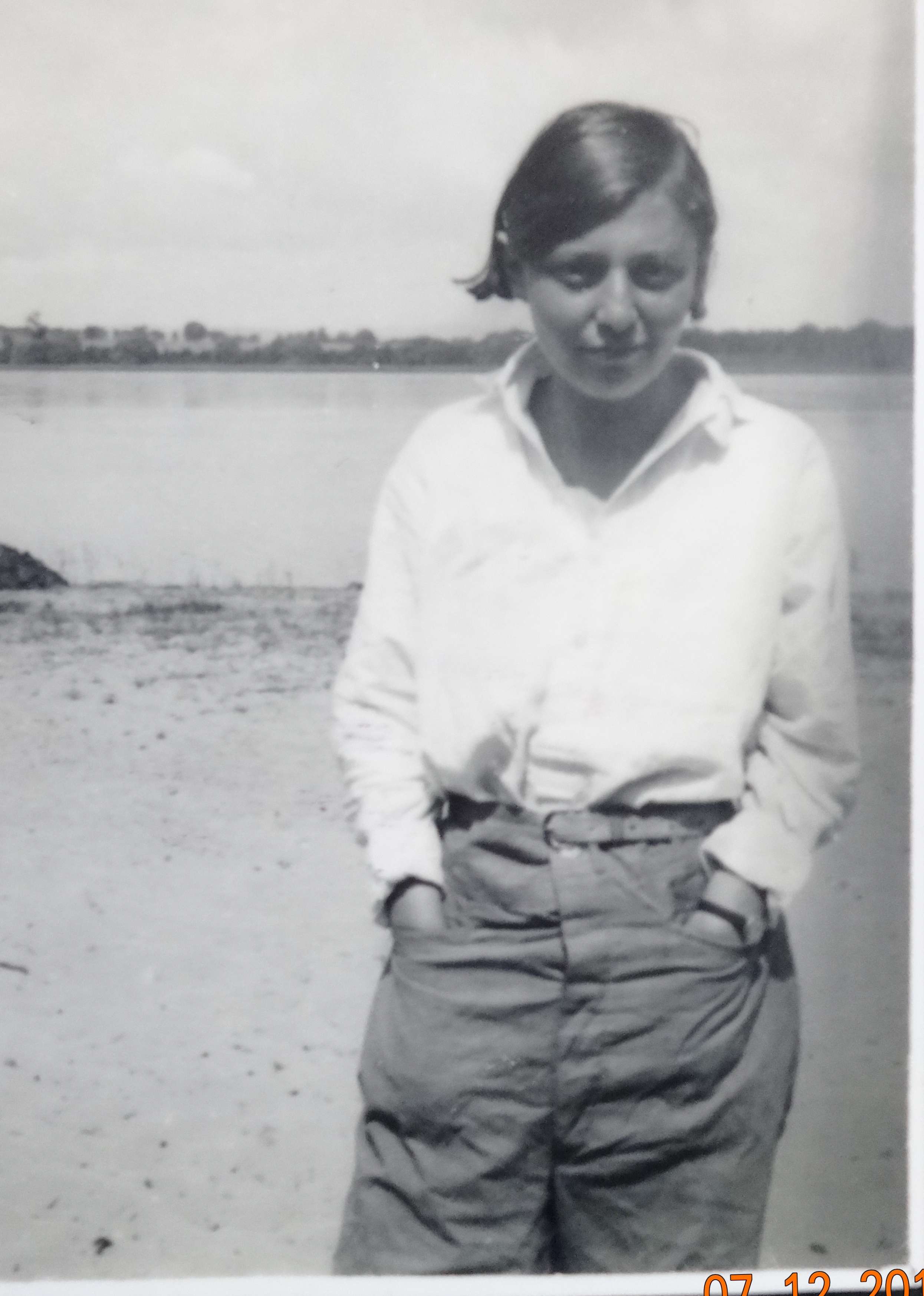
744

743

741

742

To Life.

To Life.

To Life.


Read Full Post »


~Matthew Rozell, a history teacher whose project reunited hundreds of Holocaust survivors with the American soldiers who liberated them, takes a backwards journey to the authentic sites of the Holocaust, retracing the path of the survivors who are now his friends.~


A year ago I took one of the most transformative journeys of my life, with 24 fellow educators, to study the Holocaust and the Jewish resistance to it, in Washington, DC, Germany, the Czech Republic, and Poland. I kept an extensive diary and took tons of photographs. And contrary to many assumptions, it was a journey that led to profound understandings about life, not death.  For the next several days, I have decided to go back and retrace my steps and try to process what unfolded for me.


****************************

July 12.

So the day that many of us approach with a bit of apprehension is finally here. We are on the bus from our hotel in Cracow to Auschwitz, about 40 miles to the west south west.

Yesterday we arrived in Crakow from Prague, taking the night train on a sleeper car.

790

Rolling southward one of our tour leaders points out an impressive large building on the top of a hill that looks like a five star hotel. Built after the German invasion in 1939, it was a rest and relaxation villa for Wehrmacht officers rotating off the Russian front to unwind for a bit, as industrialized mass murder was unfolding every single day less than an hour away.


Hocker Album- Dr. Josef Mengele, Rudolf Höss, Josef Kramer, and an unidentified officer. —USHMM

Hocker Album- Dr. Josef Mengele, Rudolf Höss, Josef Kramer, and an unidentified officer. —USHMM.

So, to introduce some of the major players:

I don’t make it a habit to showcase the perpetrators on this site, but in this one incredible photograph, taken at Auschwitz, you can see some of them above. Hoss was hung at Auschwitz  following his trial after the war. Kramer was executed by the British after his stint presiding of the horrors of Belsen after his transfer there. Of course, smiling Dr. Mengele escaped to Argentina and died in a drowning accident in the late 1970s.The pictures in this photo album surfaced only a few years ago and were studied by my friend archivist Rebecca Erbelding at the United States Holocaust Memorial Museum. You can read more at the weblink above if you like.

On to the tour.


638

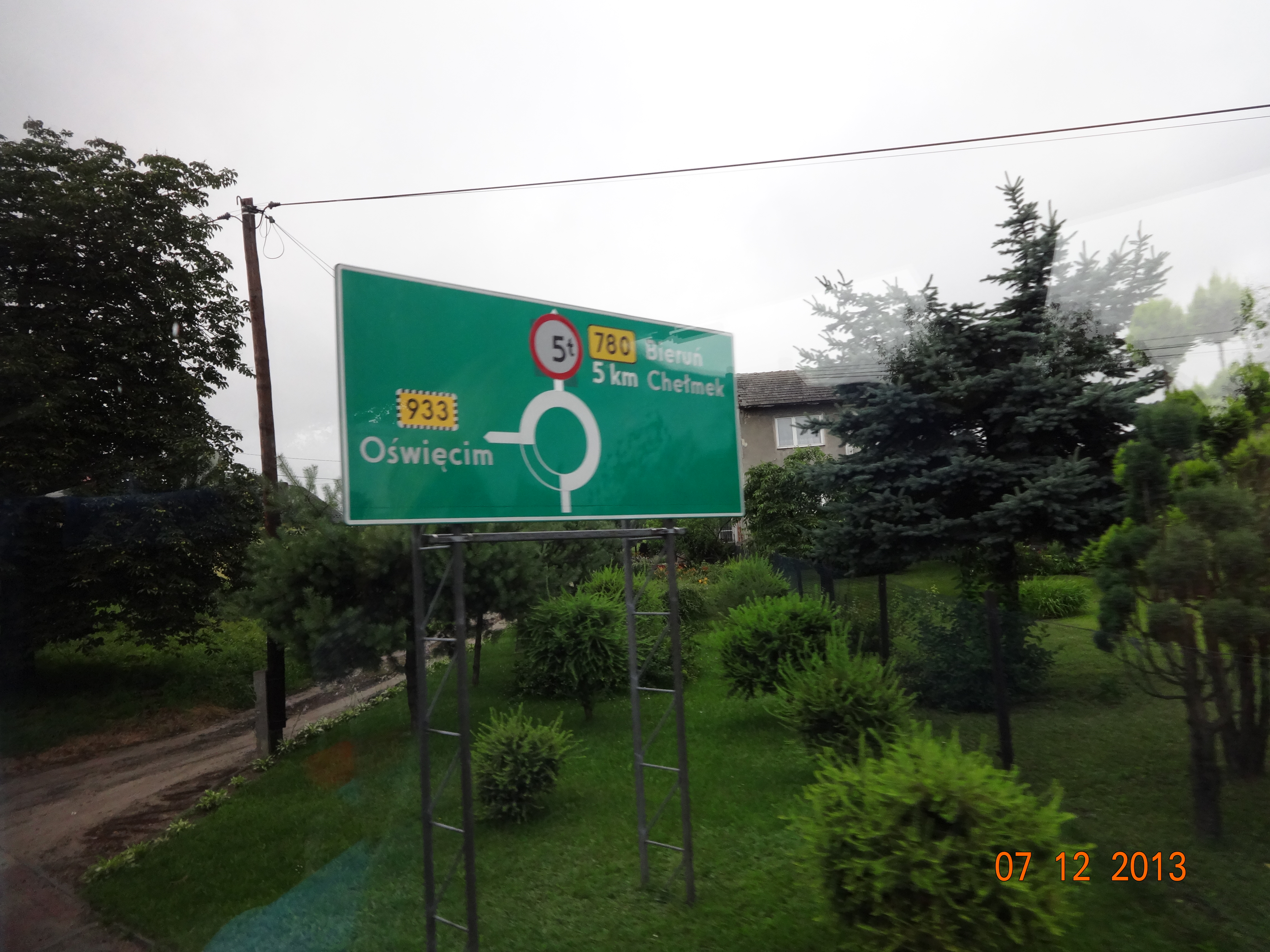
Soon we see the road signs for Oswiecim, the small Polish town at a railroad hub that has become one of the most visited tourist sites in Poland. Most of the world knows it by its German name-Auschwitz.

The bus lumbers into the overcrowded parking lot and docks in the slot. The driver kills the engine. And it begins to rain as our other leader, E.,  relates the story of her mother’s family, the idyllic childhood in this beautiful prewar country, a young teen when the nation is invaded, the oldest of four children. No one on the bus makes a sound. It is now raining very hard.


643

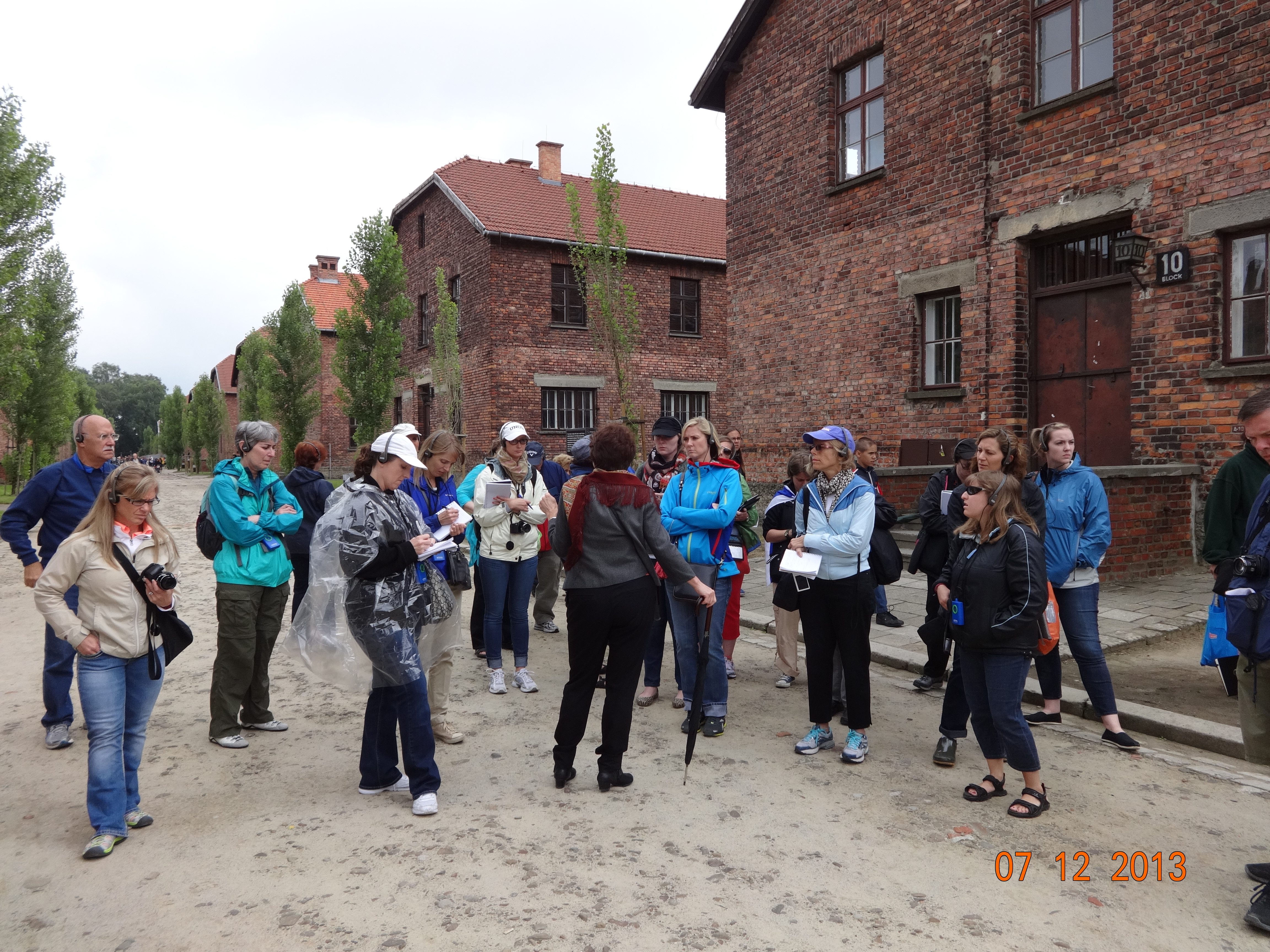
What is this place? Our guide A. is a top notch scholar, and she leads us on a day long tour that is hard to put into words.

660

We begin at Auschwitz I, the first camp. This place is centrally located, a railway hub dating back to the turn of the century.

678

The first prisoners, after it is converted from a Polish military facility, are Soviet POWs and Polish prisoners and other “security risks” who will be worked to death slowly expanding this camp, and the much larger Auschwitz II-Birkenau. She walks us through the exhibits and the displays at the various blocks. Block 4 is the “Extermination Exhibit”. We think about the words, the language. Extermination- as if the victims were vermin. Over 1,100,000 were killed here, most of them Jews.

The Hub. The tentacles during the Holocaust.

The Hub. The tentacles during the Holocaust.

We see the map with the spiderlike rail lines radiating inward to Auschwitz like tentacles, from northern Poland, from Germany, Hungary, as far south as Greece and as west as Paris and the Netherlands. In the summer of 1944, tens of thousands were murdered here, per day.


This place is ALWAYS crowded.

This place is ALWAYS crowded.


We see again the large scale terra cotta model of the process, which the German engineers had perfected  at Auschwitz II-Birkenau- the arrival of the transports, the undressing rooms with signs admonishing bewildered people to hang their belongings carefully and to remember the number of the wall pegs where they left them for quick retrieval later. The shower rooms that could fit in some cases entire transports, which were in fact the hermetically sealed gas chambers. The Germans above with their gas masks, waiting for the proper temperature to be reached through body heat, just the right humidity to be achieved before dropping in the pellets so the gas released would work more effectively. The anguished death throes of the thousands of naked figurines assault our senses. The process is not complete until the corpses are carried out by the sondercommando slaves, defiled for any gold fillings, the hair shorn from the women, the bodies then burned in the open air behind or cremated in the ovens.

676

But the tour is now just beginning.  Minutes before, we were looking at a terra cotta model. And now in Block 5 we will be presented with the evidence. This is an exhibition, after all. Exhibit A is about to slap us in the face. Hard. It is a room, 50 feet long, with nothing but human hair piled several feet back and as many feet tall. My heart skips a beat.

What are my eyes perceiving? Now we see a photo of stacks of bale bags, carefully labeled, packed and stacked, awaiting shipment back to the Reich for use in various products for the German war effort. Slippers for submariners so they can walk quietly aboard ship to evade Allied sonar. Stuffing for the seats of German pilots.

We shuffle on in silence with hundreds of others past the spectacles, the pots and pans, the suitcases carefully labelled by their owners with chalk on the orders of the perpetrators, again, for “quick retrieval”. And the shoes. Sorted. Case after case of women’s shoes. Men’s footwear. And then the children’s shoes.

665

Our knowledgeable guide takes us into Block 27, the new exhibit on the Shoah. This is a temporary relief of sorts as now we see faces, film and stills, of pre war Jewish life, projected on the walls. We hear songs and voices.

Book of Names. people cry again.

Book of Life. people cry again.

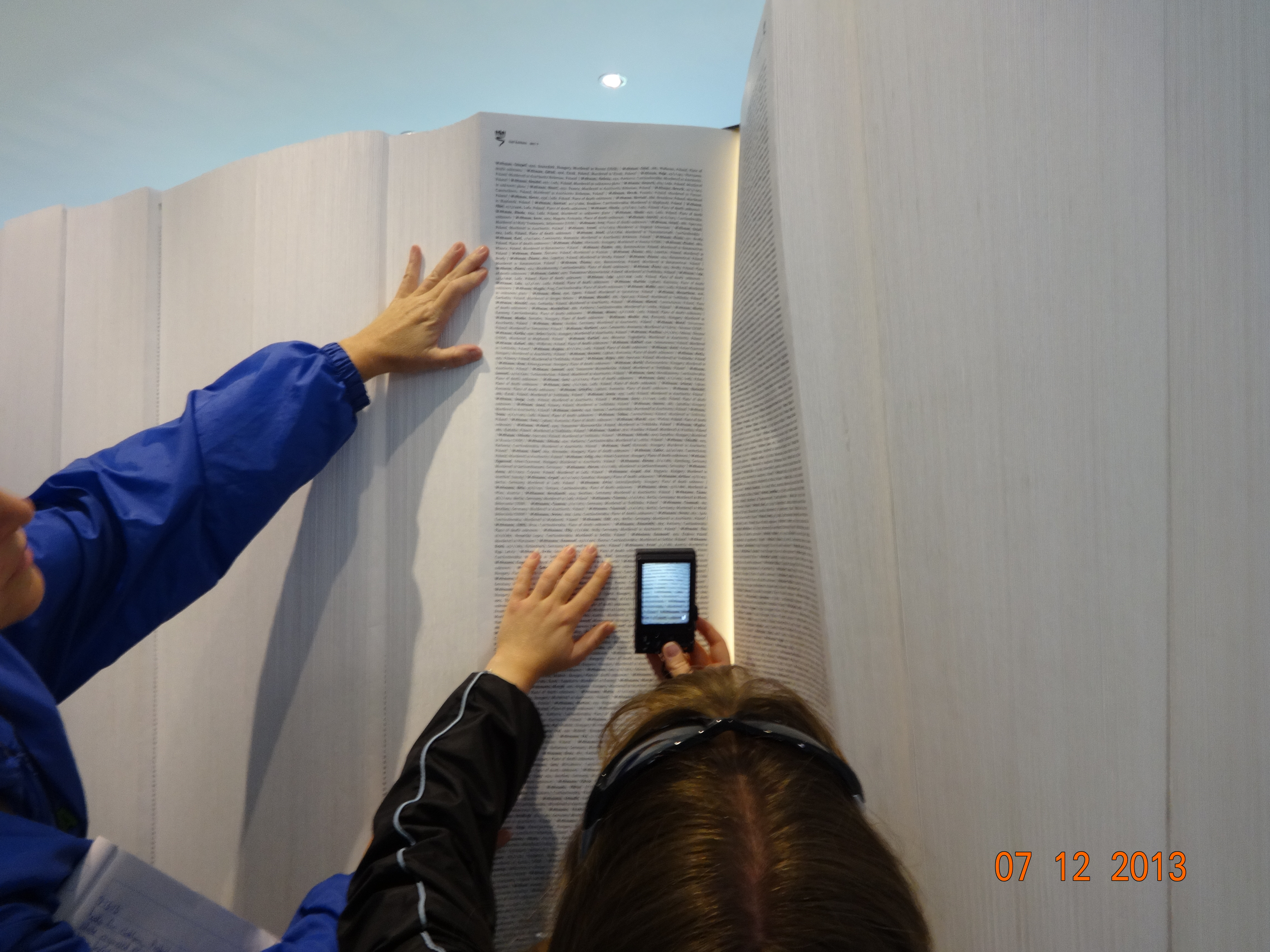
At the end is the Book of Life, containing four million names compiled thus far. A moving moment when E. and others in our tight knit group find entire pages with the names and dates of family members murdered during the Holocaust.

657


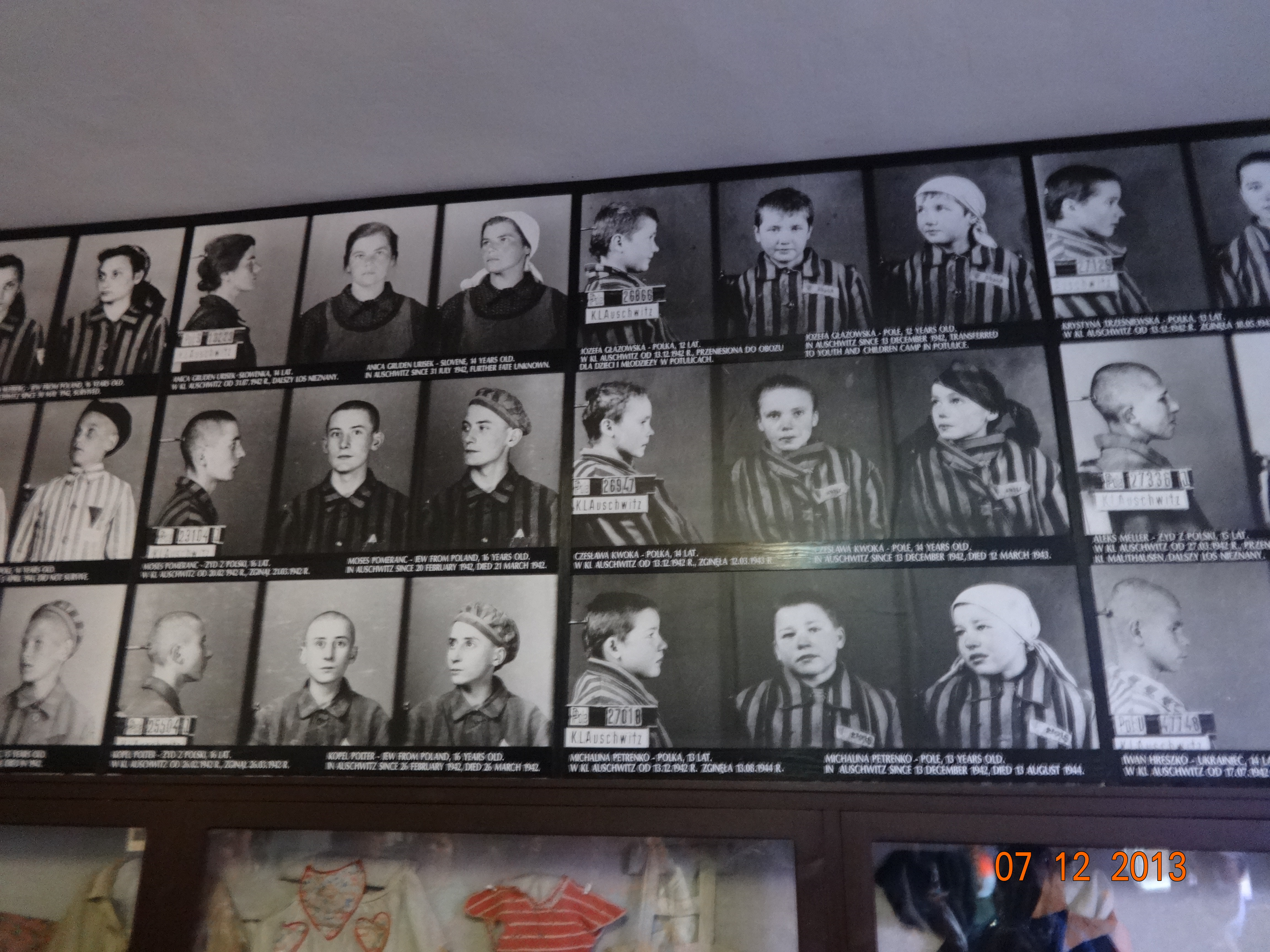
Girls. Shorn, beaten,  and photographed.

Girls and boys. Shorn, beaten, and photographed.


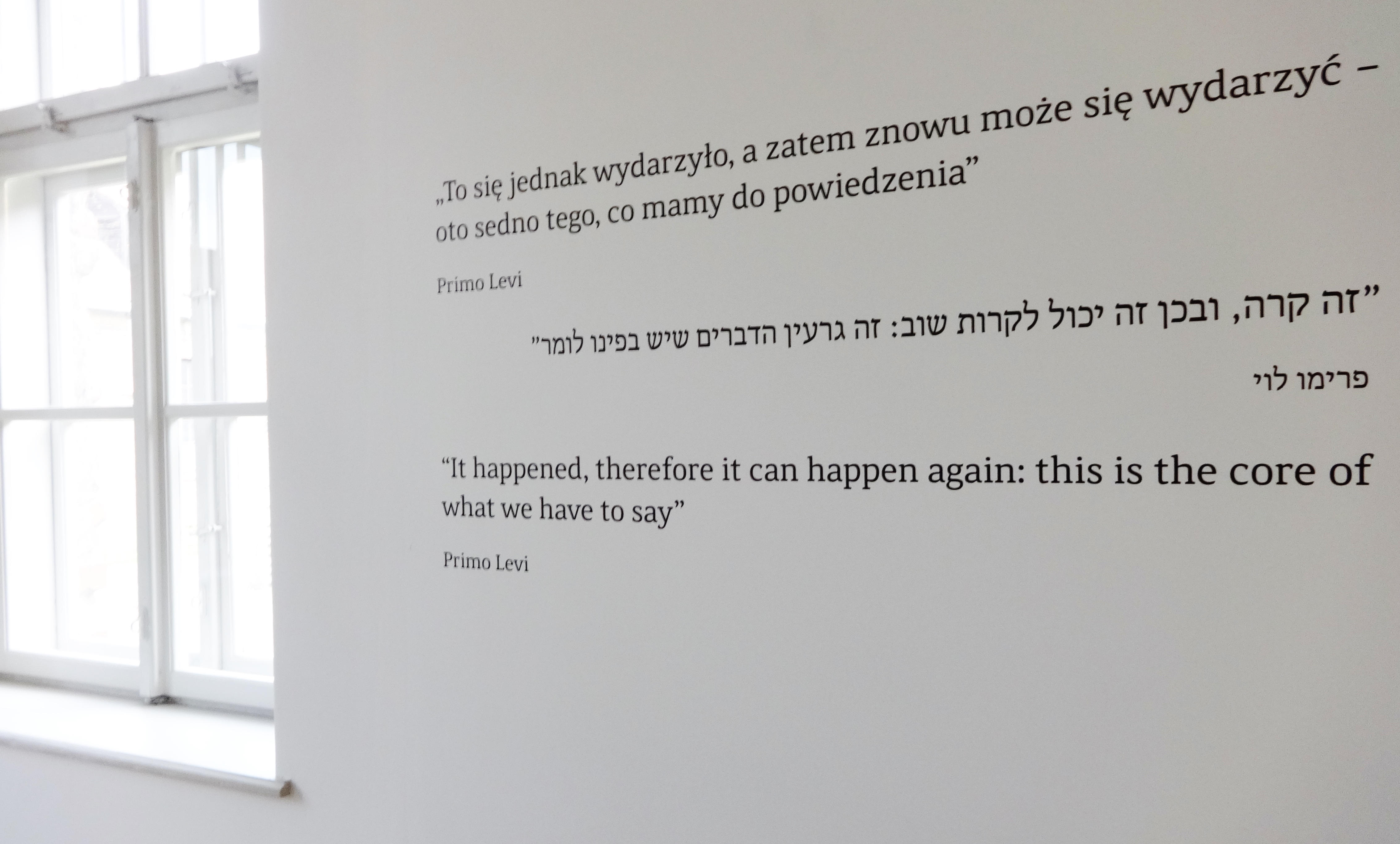
This is the Core.

This is the Core.


And now it is on to Auschwitz II-Birkenau.


Read Full Post »

~Matthew Rozell, a history teacher whose project reunited hundreds of Holocaust survivors with the American soldiers who liberated them, takes a backwards journey to the authentic sites of the Holocaust, retracing the path of the survivors who are now his friends.~


A year ago I took one of the most transformative journeys of my life, with 24 fellow educators, to study the Holocaust and the Jewish resistance to it, in Washington, DC, Germany, the Czech Republic, and Poland. I kept an extensive diary and took tons of photographs. And contrary to many assumptions, it was a journey that led to profound understandings about life, not death.  For the next several days, I have decided to go back and retrace my steps and try to process what unfolded for me.

****************************

July 11.

At the lull in Prague while waiting for our transport to the train station for our journey East into Poland, I had a conversation with one of our tour leaders, Stephen F.

It seems to me that our study seminar, which is taking us to these authentic sites and involves intense discussions in the evening after emotionally charged days, is not necessarily just about how to teach the Holocaust and the Jewish resistance to it, but also about teaching one how to think, how to look at things differently. But if you are not grounded and well versed in these multifaceted events and happenings, you are not doing anyone who is in your charge any favors. So that is what we are doing on this trip. He grabbed my arm, and said, emphatically, yes, yes, YOU GET IT. Encountering the events at the very sites where they unfolded. And then thinking about them. Very hard.

At one point after dinner, our other tour leader, Elaine C., wanted to know how we were going to incorporate various aspects of what we were studying into our teaching. This is the constant theme. These teachers are definitely NOT on vacation. I was not afraid to answer with a firm “I don’t have any idea”.  I don’t think many of us did, but it sure was one more thing to think about.

Because I am still trying to make sense of this parade of unfathomables. I discuss with roommate Tim B. in the evenings. We bounce these things off each other. We are all in this together.

There are right ways, and certainly wrong ways, for a teacher to approach the subject in the classroom. Incorporating narrative should be a no brainer. Testimony is crucial to making the history visceral. We talk about these issues. But in a real sense we ourselves are traveling back in time. We ourselves are also becoming some sort of witnesses, to the greatest crime in the history of the earth, and the watershed event for all humanity. And this carries some pretty heavy responsibilities, as one of my readers recently wrote me.

In my previous post on Ravensbruck, I had typed that the Warsaw Ghetto Uprising was in 1944, when I knew it was in 1943. The Polish uprising against the German occupiers was in 1944, when the Red Army approached on the opposite side of the river. He let me have it:

you wrote: <<after the Warsaw ghetto uprising in 1944…>>
it is not so long,Only 70 years passed and I must read with horrors
compromising errors, even from someone who write so extesively….
71 passed and some well intentioned man made error in the publication read by so many people. What will happened in the next 29 years ? One hundred year will be passed , when only some 200 Warsaw young Jews from Warsaw ghetto population of 50 000 decided to fight.
How many errors, will be commited , How many distorsion of History be made by good people.
So many words for so little mistakes. Why make aproblem with 1944 ?
But for me who survived those two Warsaw uprising one in 1943 and one in 1944 , is not a small matter. Those Warsaw Jews fighted with no hope.The Soviet front long way.
The WarsawPoles fighted, beacouse enormous Soviet army was acros the river Wisla who divided Warsaw it self….
I made many orthographic and taping errors.
Please look at the facts , and not at the spealing mistakes.

Now believe me, I hear from a lot of folks, some of whom are out to do battle with me for silly reasons. But he was certainly in the right, and I could not agree with him more! It is a BIG deal! The date DOES matter (though nowhere in the post was I specifically confusing the 1943  Warsaw Ghetto Uprising with the Warsaw Uprising of the following year). Of course I wrote him back, and corrected my oversight. Teaching history DOES matter- and my mantra has always been that as teachers, first and foremost, we have an obligation to lay it out correctly. And so now we are on way to Poland, and of course Warsaw, but first, to Krakow.

***************************

Night train to the East.

Speeding along the tracks. Night train to the East. Hours of clacking and swaying. A little unsettling.


We arrive in Krakow, Poland, in the morning. The German Army arrived on Sept. 6, 1939.

The castle on the Vistula.

The Castle on the Vistula.


Krakow is a lovely and vibrant little city of 850,000, currently in revival after the fall of communism 20 years ago. Wawel Castle in the heart of the town on the Vistula River became the seat of the German General Government for the administration of the  Polish Occupied Territories under Hans Frank. The guy’s name sends shivers down my spine. After the war and after his trial at Nuremburg he was executed. His son, Nicholas Frank, lectures widely to high school students in Germany and elsewhere.

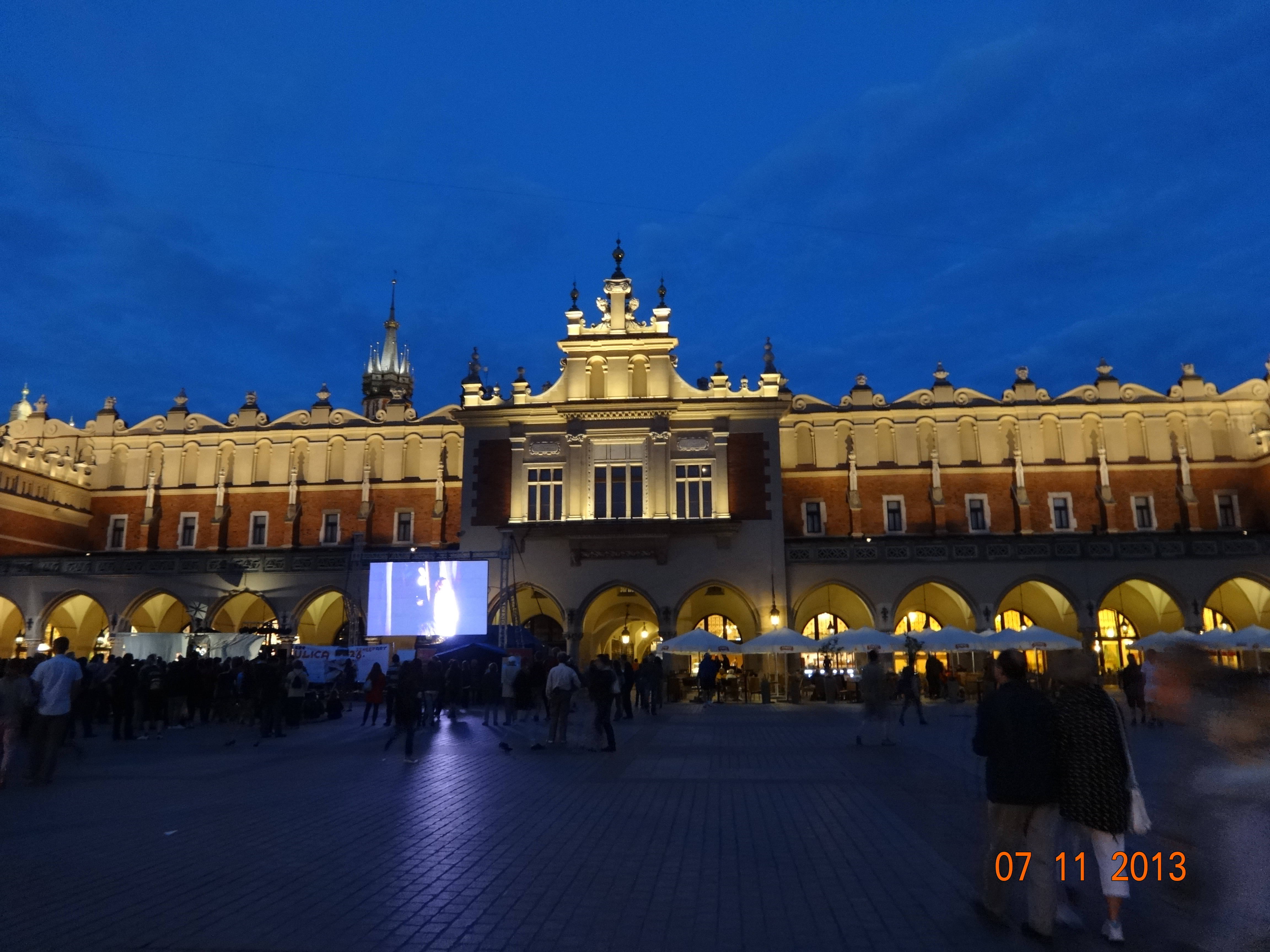
Resurgence in Kracow. Lovely.

Resurgence in Krakow. Lovely.


St. Mary's Basilica, Kracow. Seat of the Archbishop. Pope John Paul II's home church.

St. Mary’s Basilica, Krakow. Seat of the Archbishop. Pope John Paul II’s home church.


St. Mary's Basilica, Kracow. During the occupation.

St. Mary’s Basilica, Krakow. During the occupation.

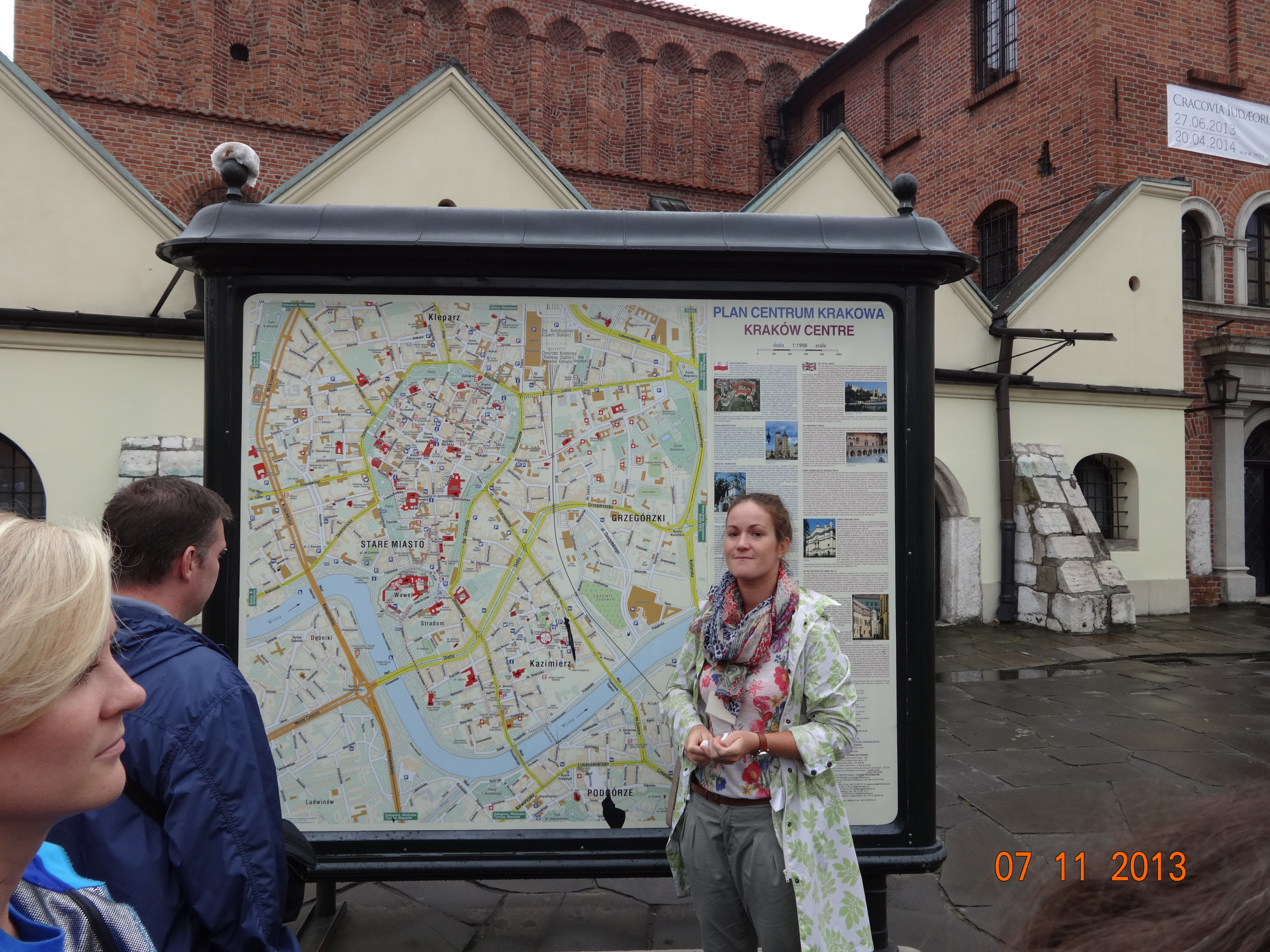
Old Town, in the Jewish Quarter.

Old Town, in the Jewish Quarter, before the Old Synagogue.

We tour Kazimierz, the Old Town, and the Jewish Quarter. The Jewish presence was strong from the 13th century.Our knowledgeable guide Gusia takes us to the oldest synagogue in Poland. It survives following the liquidation of the ghetto because the Germans use some of the buildings, for example, as stables.

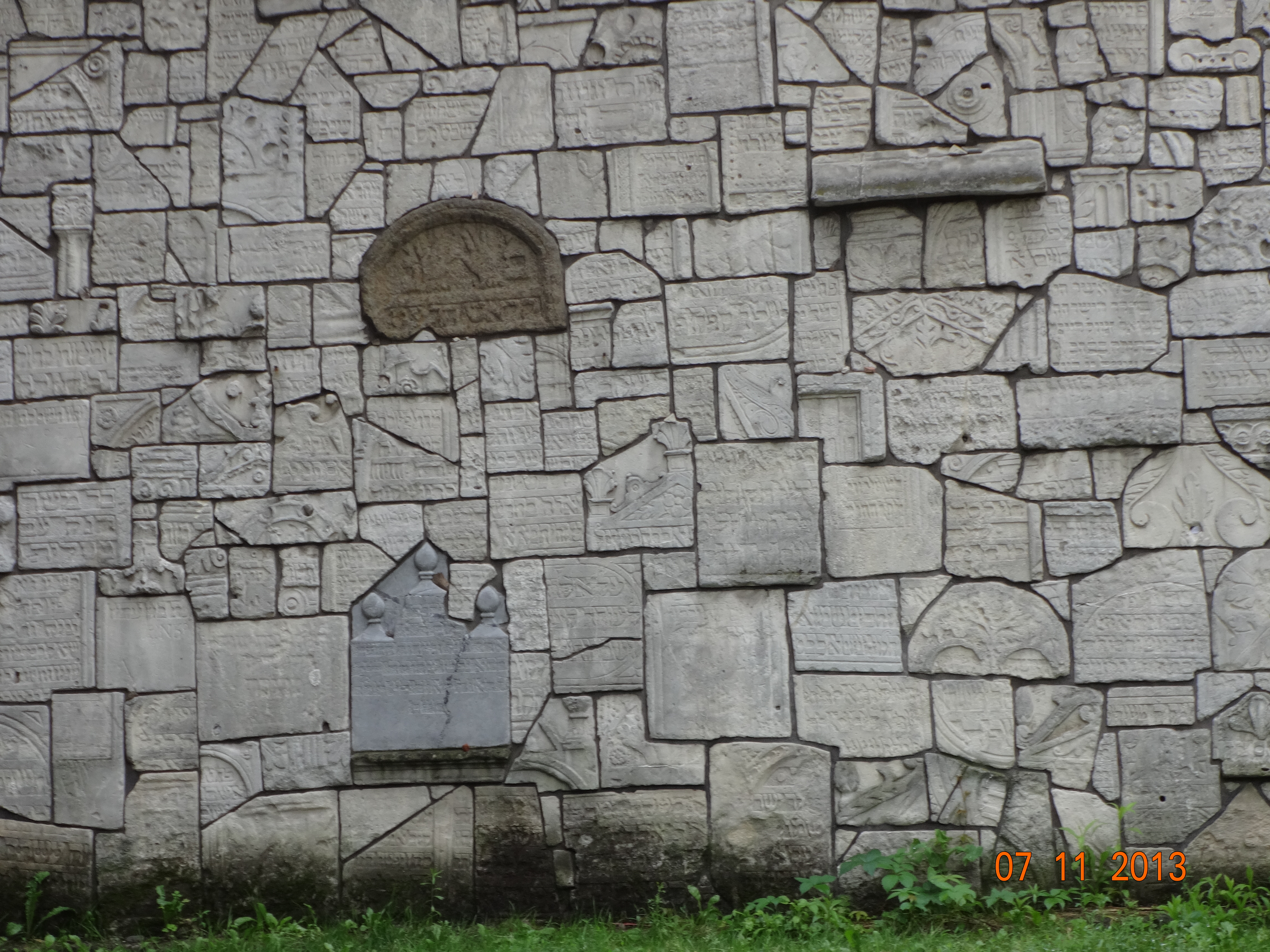
Restored Jewish Cemetery. Remuh.

Restored Jewish Cemetery. Remuh.


Restored Jewish Cemetery. Remuh. Wall constructed with gravestones destroyed by the Nazis.

Restored Jewish Cemetery. Remuh. Wall constructed with gravestones destroyed by the Nazis.


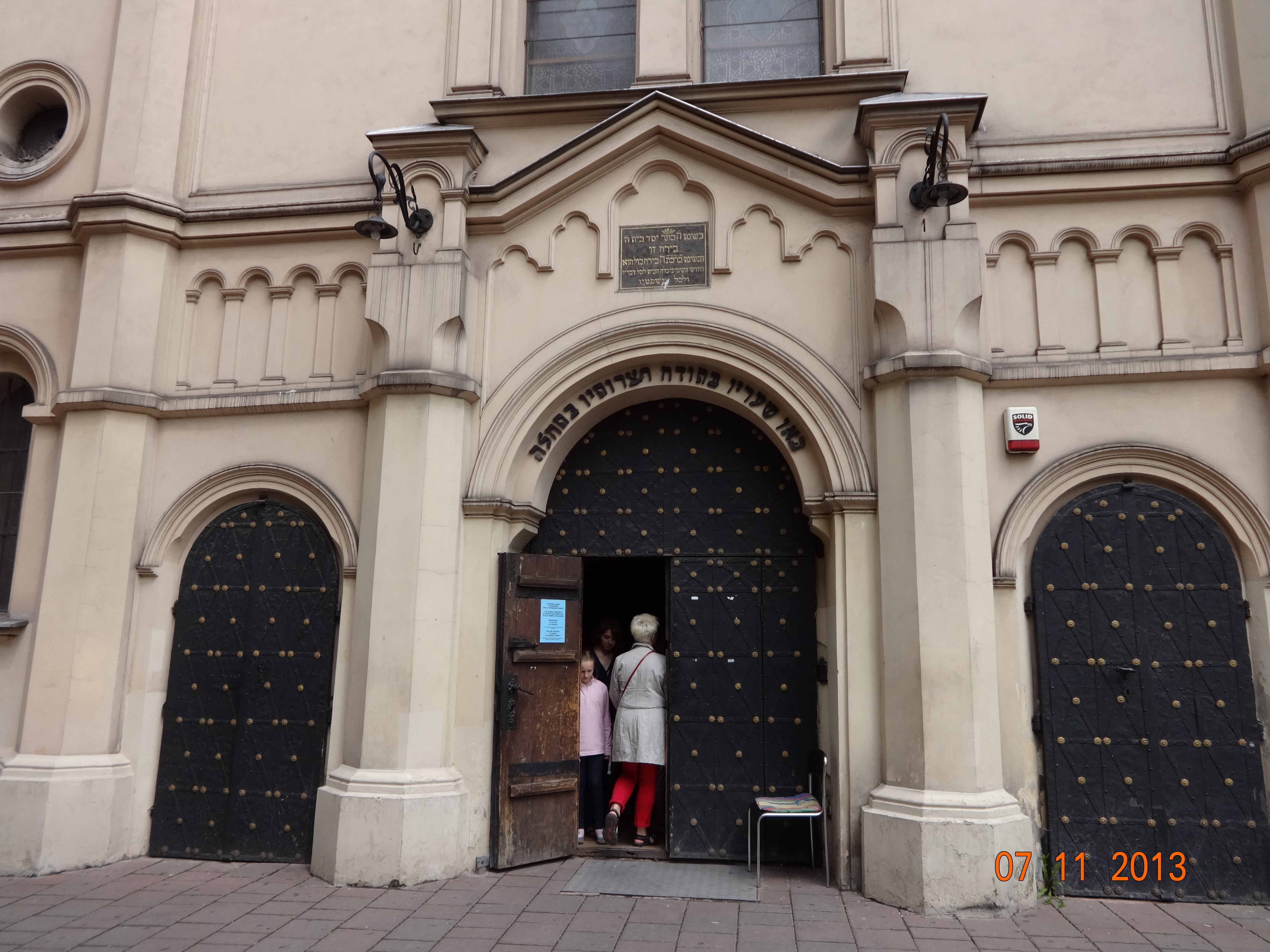
Tempel Synagogue

Tempel Synagogue


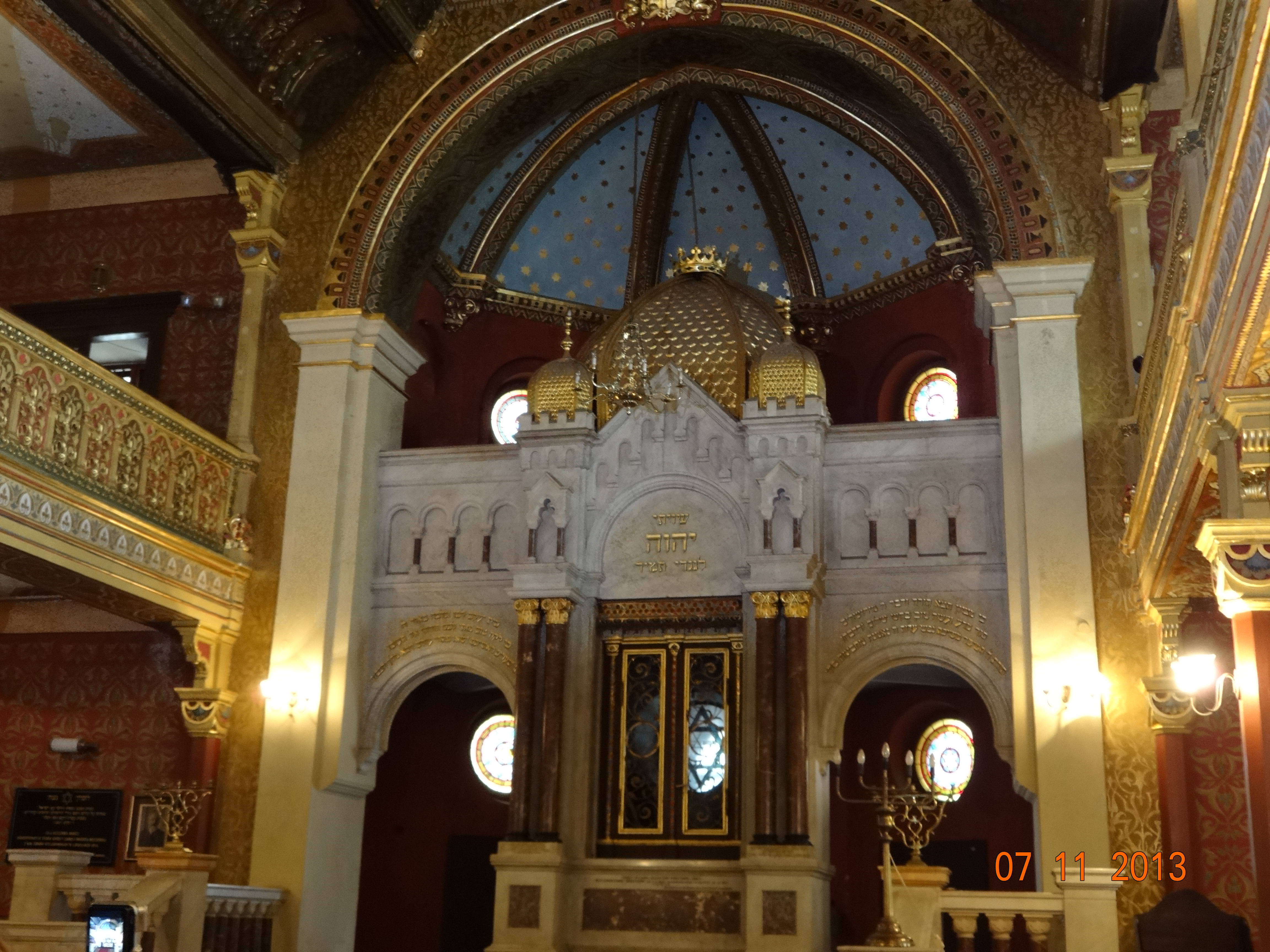
Tempel Synagogue, interior.

Tempel Synagogue, interior. Germans used it as a stable.


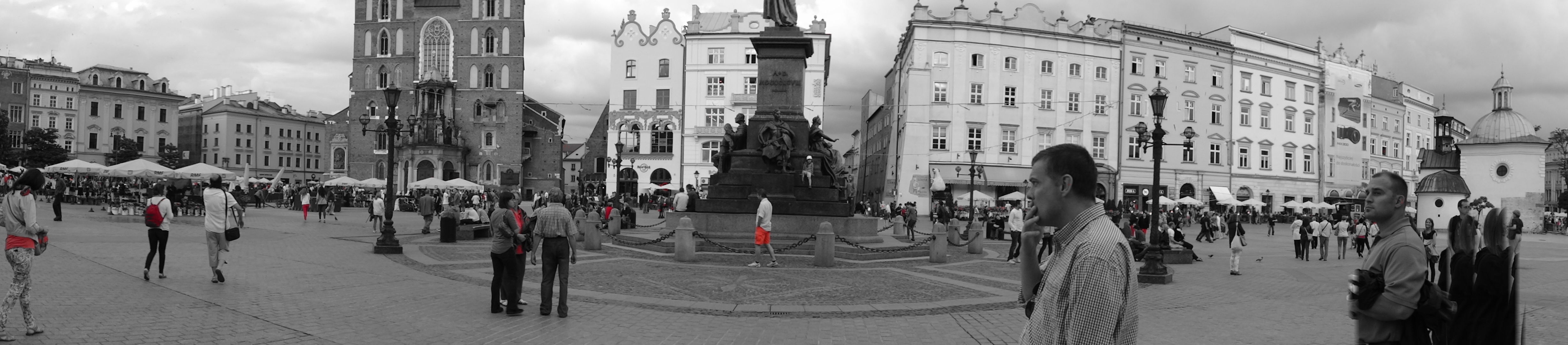
St Mary's Square, with fellow travelers Scott and Tim.

St Mary’s Square, with fellow travelers Scott and Tim.

We will be here for a couple days. Rest up tonight. For tomorrow, the tour continues. The day that many of us approach with a bit of apprehension will be finally here. We heading to Auschwitz, 50 miles to the west south west.


Read Full Post »

A year ago I took one of the most transformative journeys of my life, with 24 fellow educators, to study the Holocaust and the Jewish resistance to it, in Washington, DC, Germany, the Czech Republic, and Poland. I kept an extensive diary and took tons of photographs. And contrary to many assumptions, it was a journey that led to profound understandings about life, not death.  For the next several days, I have decided to go back and retrace my steps and try to process what unfolded for me. Not weighty tomes, but maybe a picture and a note from the diary.

****************************

July 10. Life goes on. But stop and wonder.

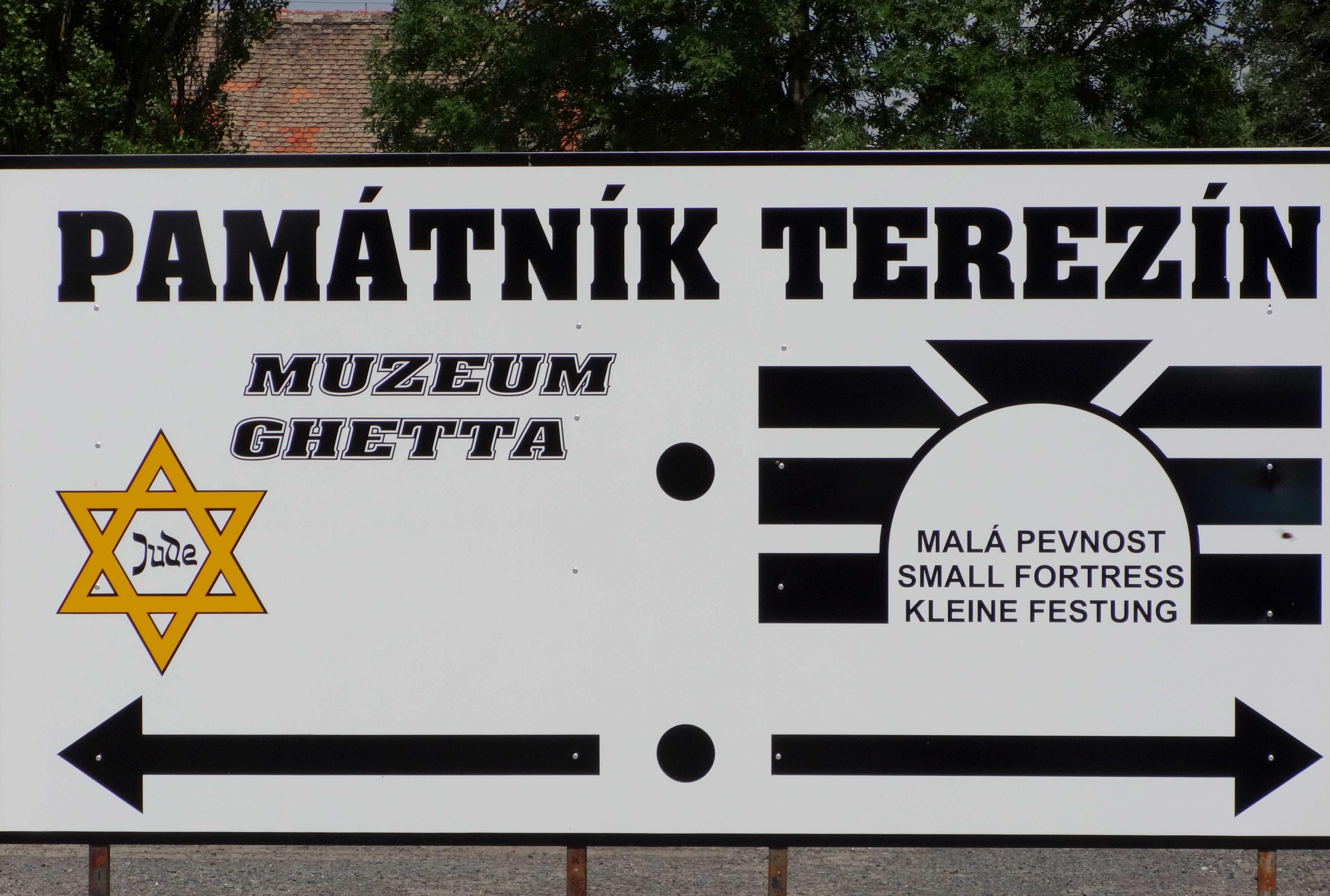
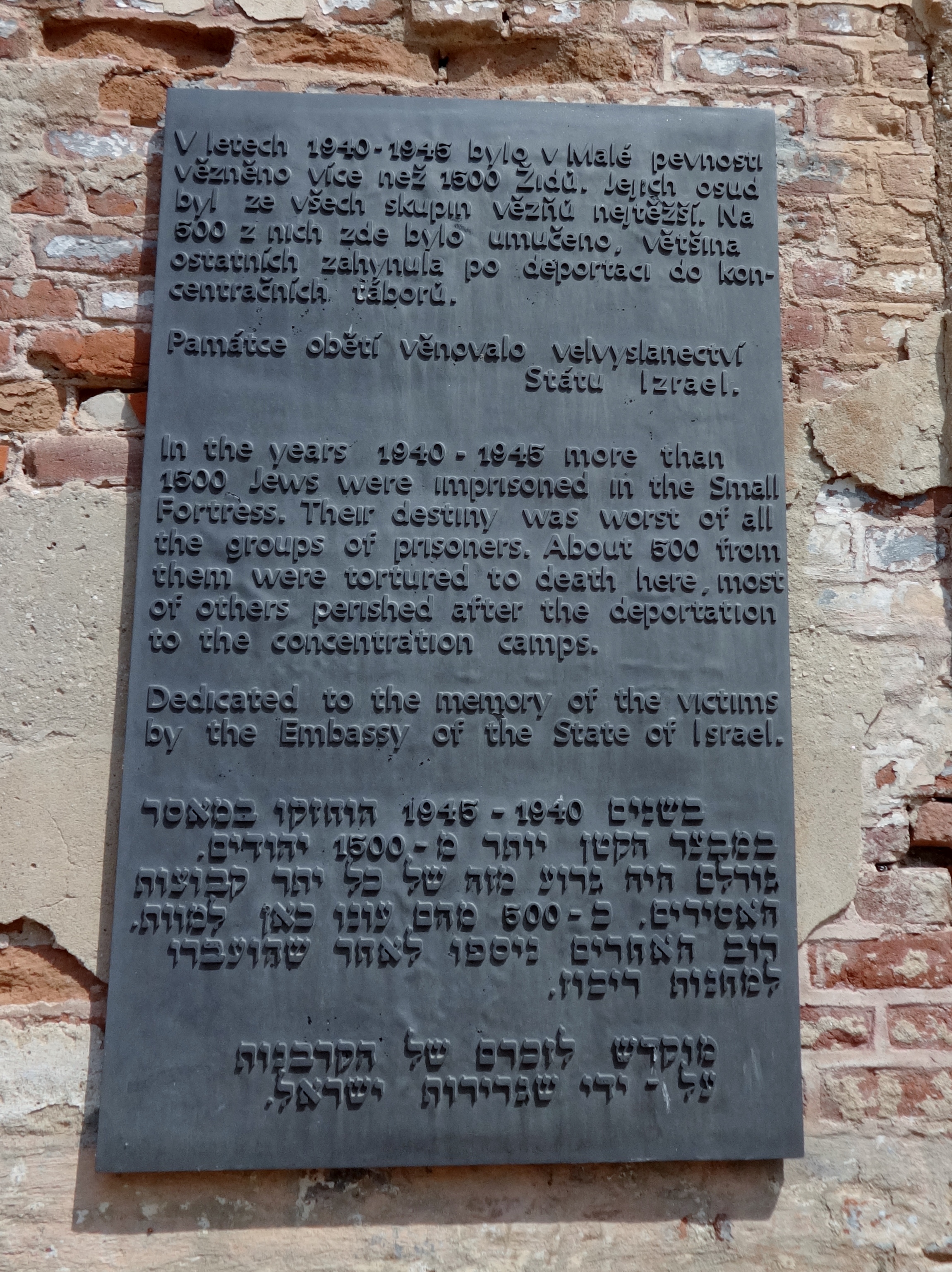
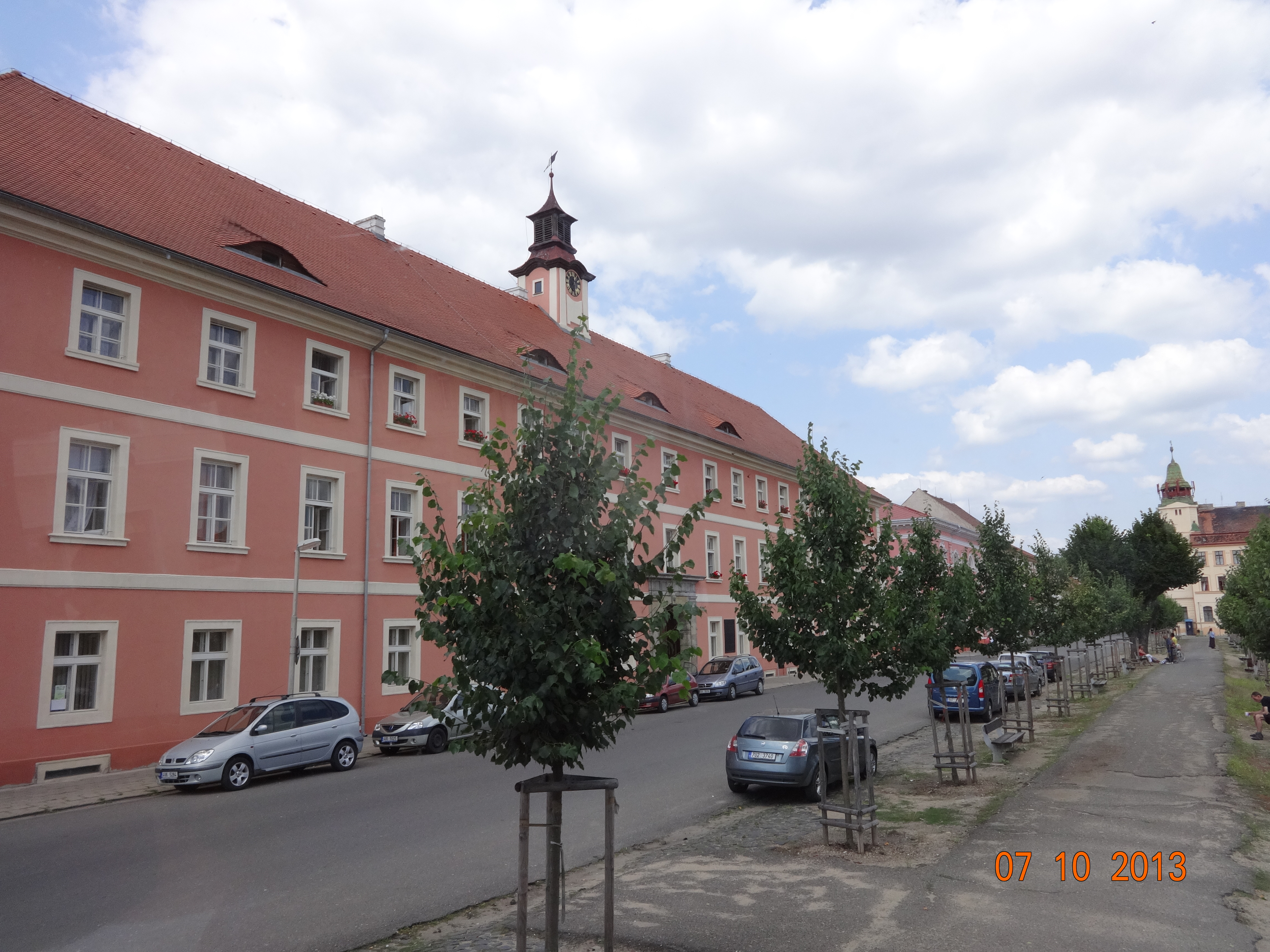
Now the tour continues to Terezin, or Theresienstadt. Forty miles north west of Prague and originally built in the late 18th century as a fortification and garrison town by Emperor Joseph II and named after his mother, Empress Maria Theresa. I will be at the site where the “Train Near Magdeburg” was destined to arrive-but never did, thanks to the US Army. But why there?

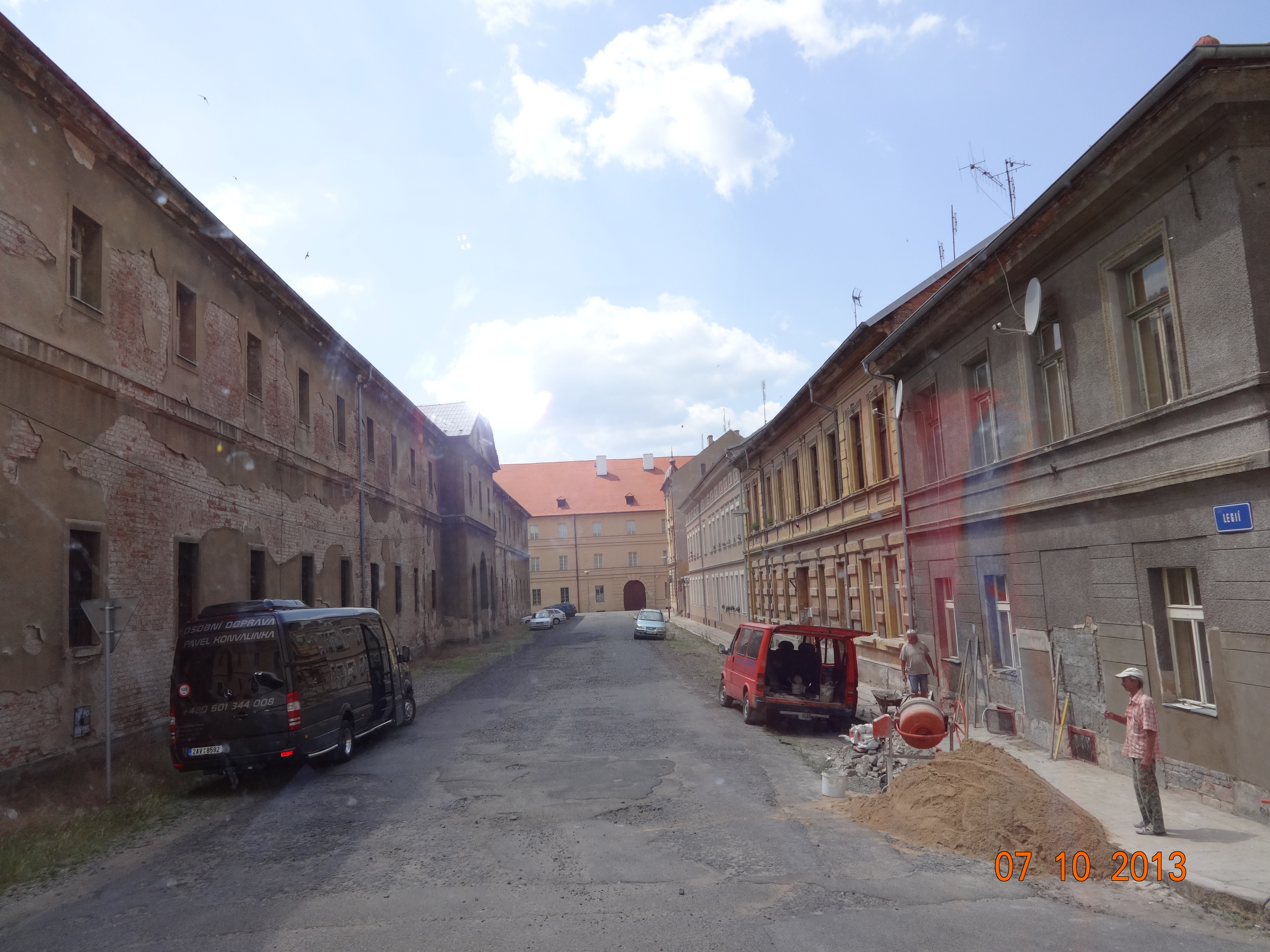
Terezin. Garrison town and later ghetto, and Small Fortress, later prison.

Terezin. Garrison town and later ghetto, and Small Fortress, later prison.

In the closing days of the war, as the Reich collapsed in the East, and began to be rolled up in the West, Theresienstadt was the destination of the three transports hastily evacuated from Bergen Belsen. As stated earlier, only one train made it there, but we have never heard of what happened to the occupants. It is known that as thousands of prisoners from other camps flooded into  Theresienstadt in the last month or so of the war, typhus and other epidemics broke out .

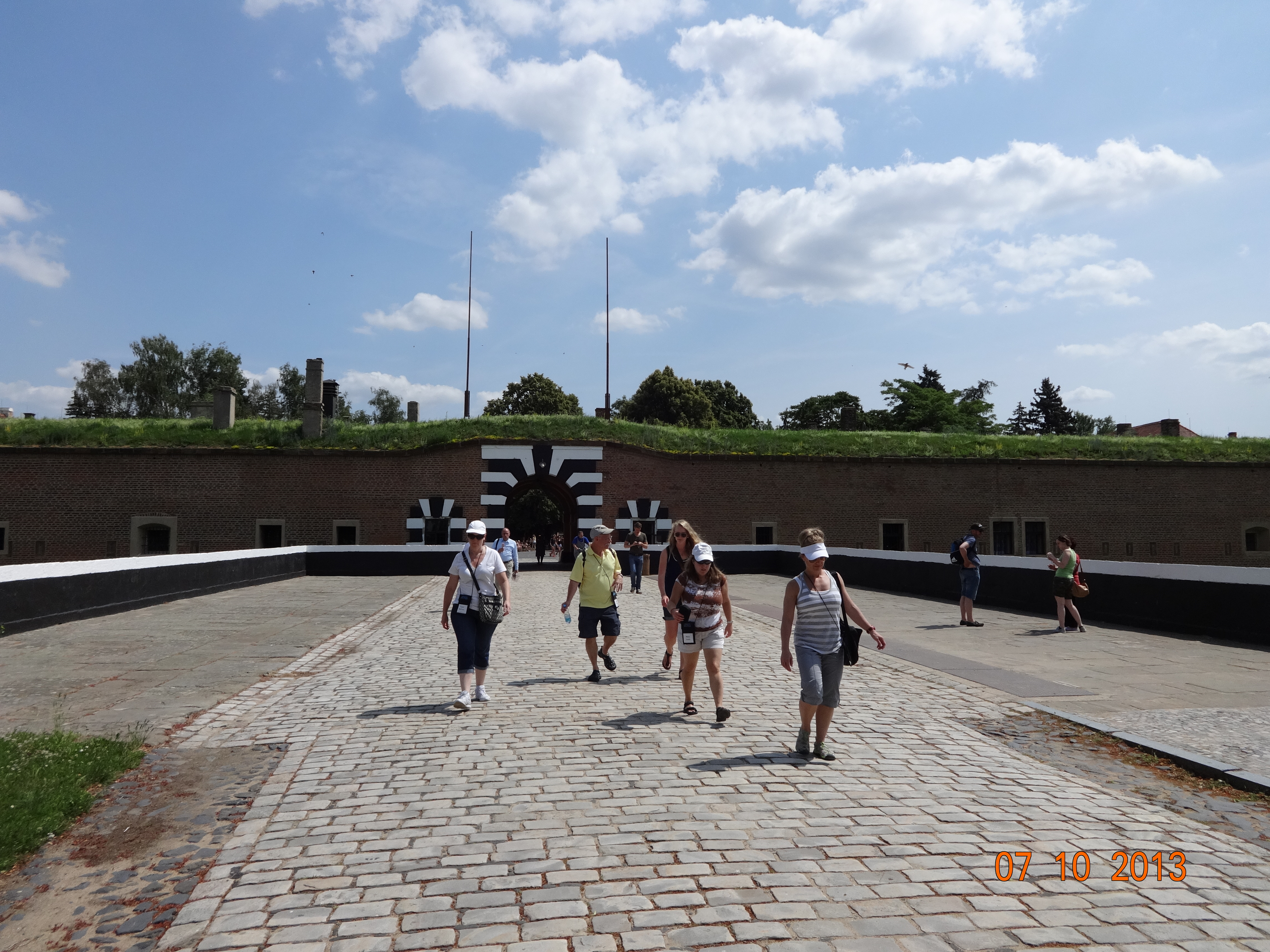
First we toured the Small Fortress, later the prison.

552

Small Fortress in background.

Small Fortress in background.


545

Inside the Small Fortress.

Inside the Small Fortress.


Inside the Small Fortress. That horrible sign again.

Inside the Small Fortress. That horrible sign again.


terezin gate


Inside the Small Fortress. The place is crumbling.

Inside the Small Fortress. The place is crumbling.


Inside the Small Fortress. Prison. No the two toned wall color is not on purpose. Evidence of recent floods. Note also cell doors.

Inside the Small Fortress. Prison. No, the two toned wall color is not on purpose. Evidence of recent floods. Note also cell doors.


Inside the Small Fortress. Gavrilo Princip, whose shots ushered in WW!, died here in Cell 1 in 1918.

Inside the Small Fortress. Gavrilo Princip, whose shots ushered in WWI, died here in Cell 1 in 1918.


Inside the Small Fortress. Barracks where many succumbed. Again note high water mark.

Inside the Small Fortress. Barracks where many succumbed. Again note high water mark.


Outside the Small Fortress.

Outside the Small Fortress.

And now, we move onto the former garrison town which became the ghetto.

Ghetto at Theresienstadt.

Ghetto at Theresienstadt.

From the USHMM:

“The Theresienstadt “camp-ghetto” existed for three and a half years, between November 24, 1941 and May 9, 1945. During its existence, Theresienstadt served three purposes:

1) First, Theresienstadt served as a transit camp for Czech Jews whom the Germans deported to killing centers, concentration camps, and forced-labor camps in German-occupied Poland, Belorussia, and the Baltic States.

2) Second, it was a ghetto-labor camp to which the SS deported and then incarcerated certain categories of German, Austrian, and Czech Jews, based on their age, disability as a result of past military service, or domestic celebrity in the arts and other cultural life. To mislead about or conceal the physical annihilation of the Jews deported from the Greater German Reich, the Nazi regime employed the general fiction, primarily inside Germany, that the deported Jews would be deployed at productive labor in the East. Since it seemed implausible that elderly Jews could be used for forced labor, the Nazis used Theresienstadt to hide the nature of the deportations.

3) Third, Theresienstadt served as a holding pen for Jews in the above-mentioned groups. It was expected that that poor conditions there would hasten the deaths of many deportees, until the SS and police could deport the survivors to killing centers in the East.”

Dutch Jews in the Theresienstadt

Hundreds of thousands of people from all over Europe were deported here between 1942 and 1945. Most were shipped East to their deaths, though many also died in the wretched conditions here, so crematoria were established.

And let’s not forget the famous “Red Cross” visit and propaganda show: “The Fuhrer Gives the Jews a City”:

“Theresienstadt served an important propaganda function for the Germans. The publicly stated purpose for the deportation of the Jews from Germany was their “resettlement to the east,” where they would be compelled to perform forced labor. Since it seemed implausible that elderly Jews could be used for forced labor, the Nazis used the Theresienstadt ghetto to hide the nature of the deportations. In Nazi propaganda, Theresienstadt was cynically described as a “spa town” where elderly German Jews could “retire” in safety. The deportations to Theresienstadt were, however, part of the Nazi strategy of deception. The ghetto was in reality a collection center for deportations to ghettos and killing centers in Nazi-occupied eastern Europe.
Ghetto at Theresienstadt.

Ghetto at Theresienstadt.

Succumbing to pressure following the deportation of Danish Jews to Theresienstadt, the Germans permitted the International Red Cross to visit in June 1944. It was all an elaborate hoax. The Germans intensified deportations from the ghetto shortly before the visit, and the ghetto itself was “beautified.” Gardens were planted, houses painted, and barracks renovated. The Nazis staged social and cultural events for the visiting dignitaries. Once the visit was over, the Germans resumed deportations from Theresienstadt, which did not end until October 1944.”

Smiling children during the propaganda visit. Most were sent on to their deaths afterwards. USHMM.

Smiling children during the propaganda visit. Most were sent on to their deaths afterwards. USHMM.

Fifteen thousand children passed through Theresienstadt. 90 percent were murdered.


Crematoria building and burials, memorial.

Crematoria building and burials, memorial.


On May 5th, the Fuhrer dead nearly a week, the Soviets approaching, the guards left. On may 8th, the last day of the War, the Red Army arrived.

We light candles. So we wind up our day, like all visits, with a group prayer for the dead and with solitary reflection for the living. We quietly make our way back to Prague, where life goes on.

People hurry about their business on the streets.

569

572

But step lightly, lest your stride be interrupted, so that you must pause and look down. Then you may see the brass “stumble stone” embedded in the sidewalk with the engraving noting the former occupant of the dwelling here was deported to his/her death.

Prague. Stumble stone. Which is not stone at all, but will make you wonder.

Prague. Stumble stone. Which is not stone at all, but will make you wonder.

Life goes on. But stop and wonder.

What was, what is, and what might have been.


Read Full Post »

A year ago I took one of the most transformative journeys of my life, with 24 fellow educators, to study the Holocaust and the Jewish resistance to it, in Washington, DC, Germany, the Czech Republic, and Poland. I kept an extensive diary and took tons of photographs. And contrary to many assumptions, it was a journey that led to profound understandings about life, not death.  For the next several days, I have decided to go back and retrace my steps and try to process what unfolded for me. Not weighty tomes, but maybe a picture and a note from the diary.

****************************

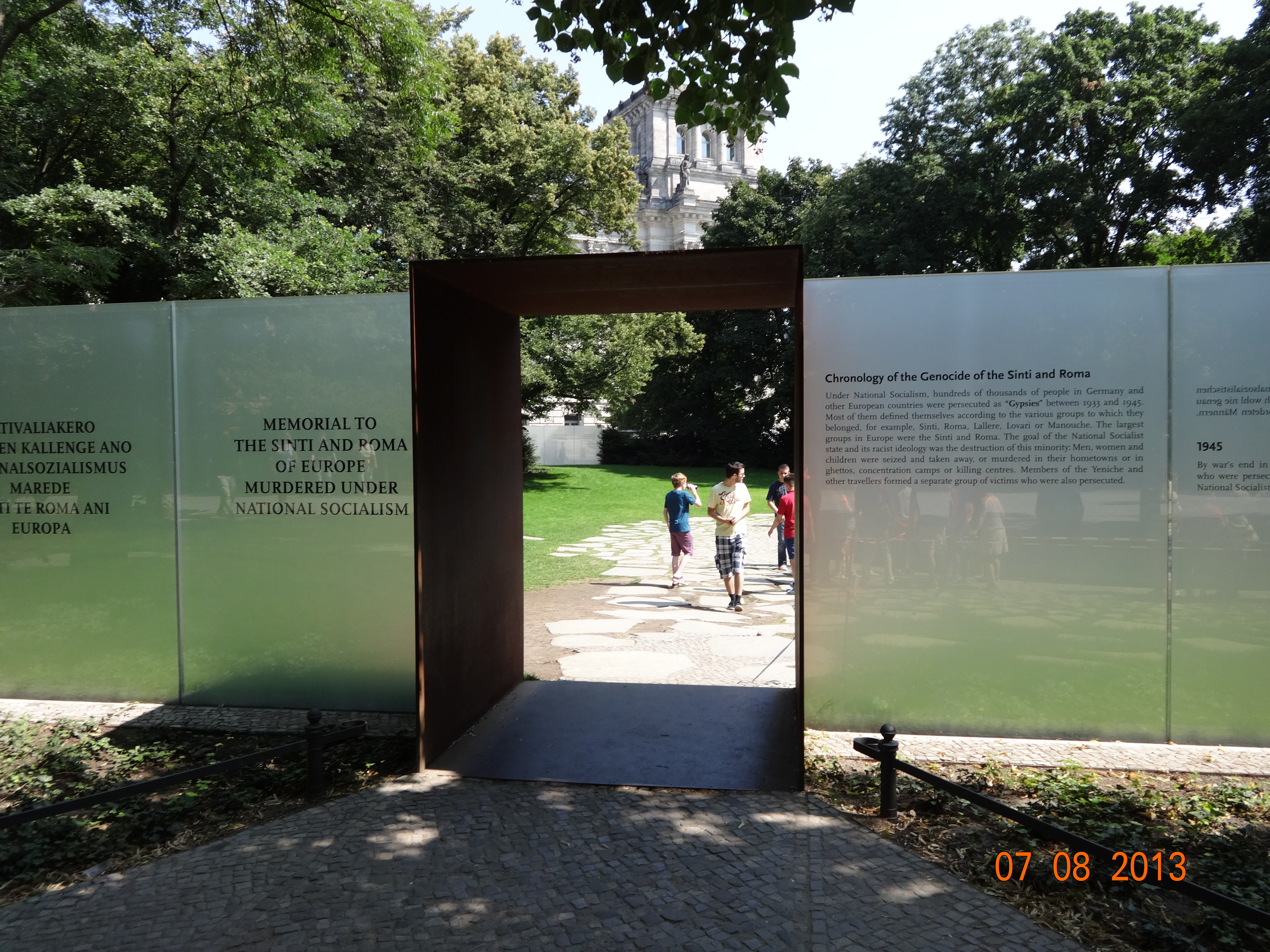
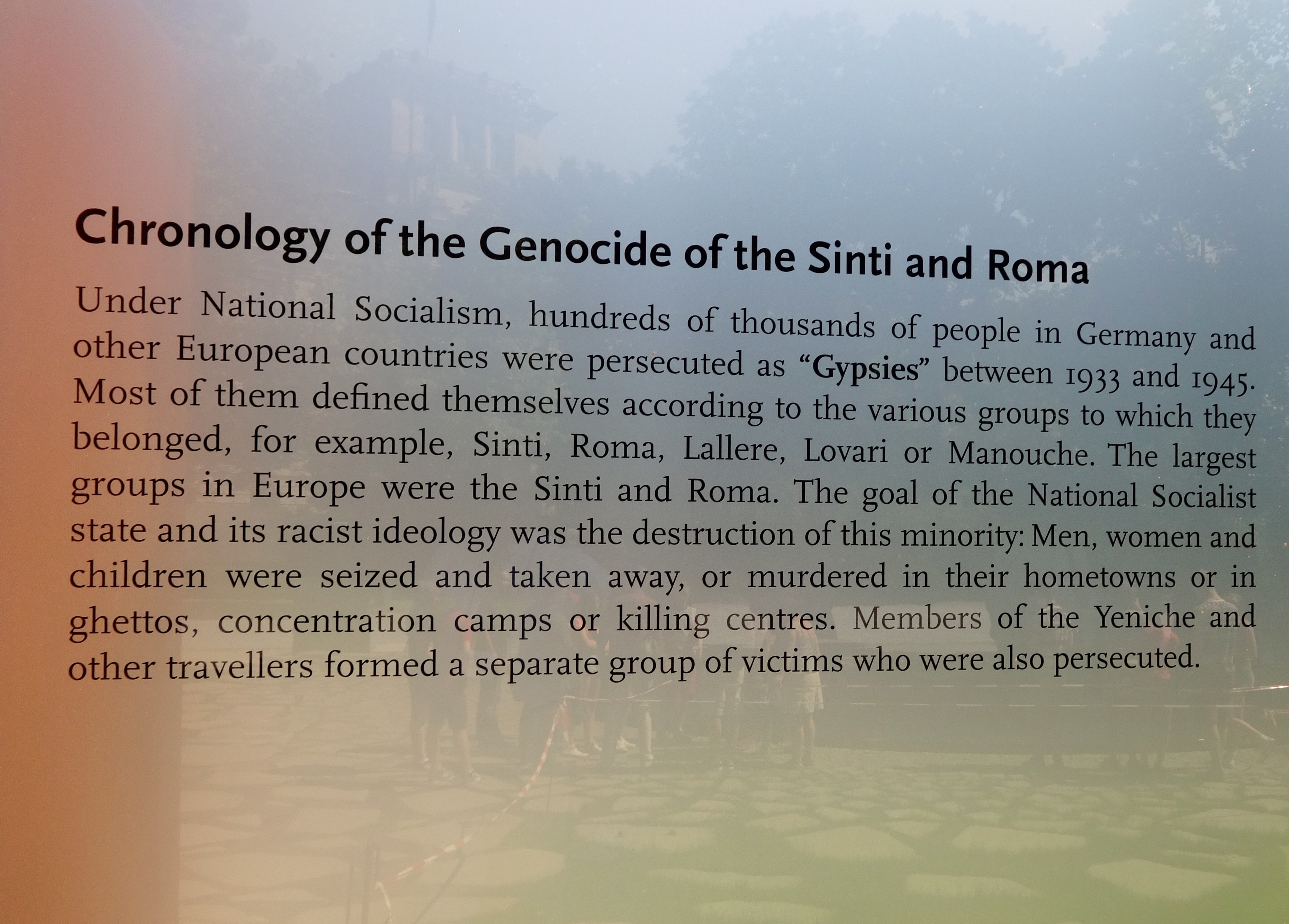
July 8 and 9. Day began with packing- we are leaving Berlin for Prague at midday. This morning we went to Tiergartenstrasse 4, for the exhibit, discussed in a previous post. After a stop at the US Embassy we went to the Holocaust memorial for the Roma and Sinti, in the shadow of the Reichstag.

Holocaust memorial for the Roma and Sinti. Berlin.

Holocaust memorial for the Roma and Sinti. Berlin.

Holocaust memorial for the Roma and Sinti. Berlin.

Holocaust memorial for the Roma and Sinti. Berlin.

In the reflection of the sign above, you can see the slabs representing destroyed communities through Europe.

At the train station, we begin our journey to the south, the Czech Republic. The train meanders past Magdeburg again, and alongside the Elbe River, passes through the Sudetenland.

Sudetenland by Alan Bush.

Sudetenland by Alan Bush.

Sudetenland, shortly after the sell out at the Munich Conference in 1938.

Sudetenland, shortly after the sell out at the Munich Conference in 1938. Some excited. Some not.

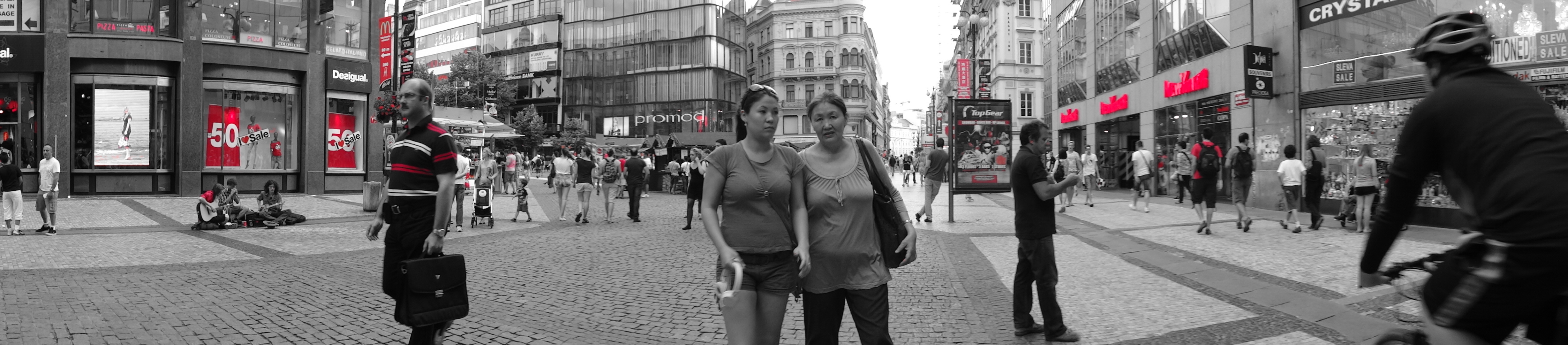
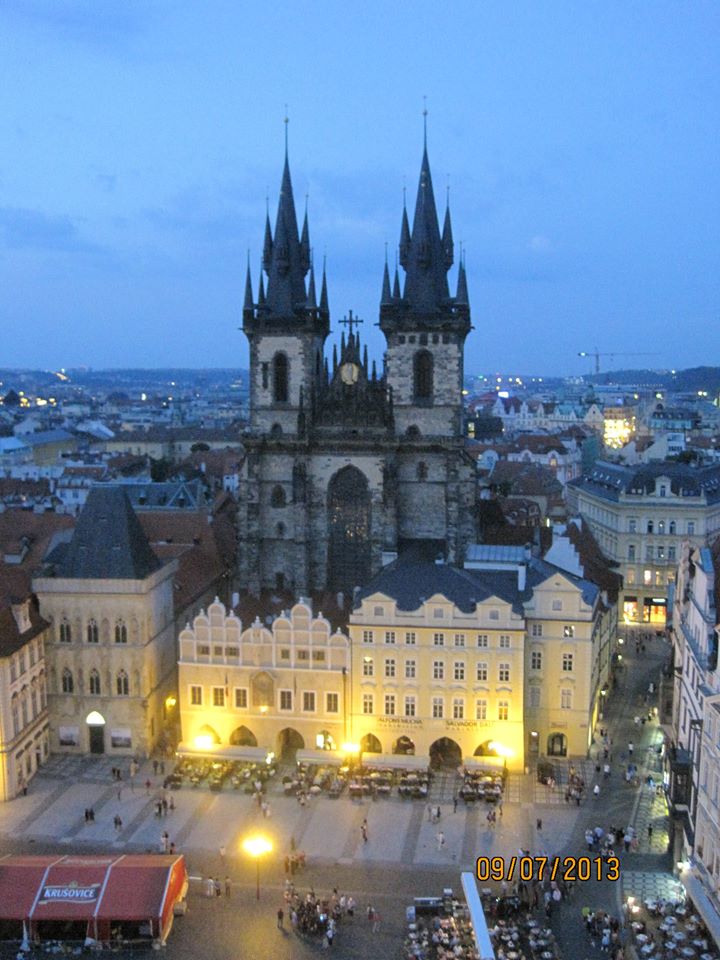
Then we reach Prague, have a tour of the city.

Prague.

Prague.


Adolf Hitler reviews troops at Prague castle

Hitler was here on March 15, 1939, and the flags came out after full annexation.

Review in Prague.

Review in Prague. During the war.


Prague by Alan Bush.

Prague by Alan Bush.

The was one of the last cities liberated by the Allies-the Red Army- and it is important to note that it was relatively unscathed by bombing during the war. However, there is a lot of Holocaust history to be encountered. But first, to the Jewish synagogues, and burial grounds, that attested to the hundreds year old vibrant presence.

509


We were not here long enough to do extensive touring, but it is a beautiful city and highly recommended for any would-be European traveler. There are some fascinating tours and here is an interesting article on the assassination of Reinhard Heydrich, in his capacity as the “Deputy Reich Protector of Bohemia and Moravia”, whom we met in a previous post at the Wannsee Villa. I would have like to have toured that site.
Now the tour continues to Terezin, or Theresienstadt. I will be at the site where the “Train Near Magdeburg” was destined to arrive-but never did, thanks to the US Army. But why there? We will see.

Read Full Post »

A year ago I took one of the most transformative journeys of my life, with 24 fellow educators, to study the Holocaust and the Jewish resistance to it, in Washington, DC, Germany, the Czech Republic, and Poland. I kept an extensive diary and took tons of photographs. And contrary to many assumptions, it was a journey that led to profound understandings about life, not death.  For the next several days, I have decided to go back and retrace my steps and try to process what unfolded for me. Not weighty tomes, but maybe a picture and a note from the diary.

************

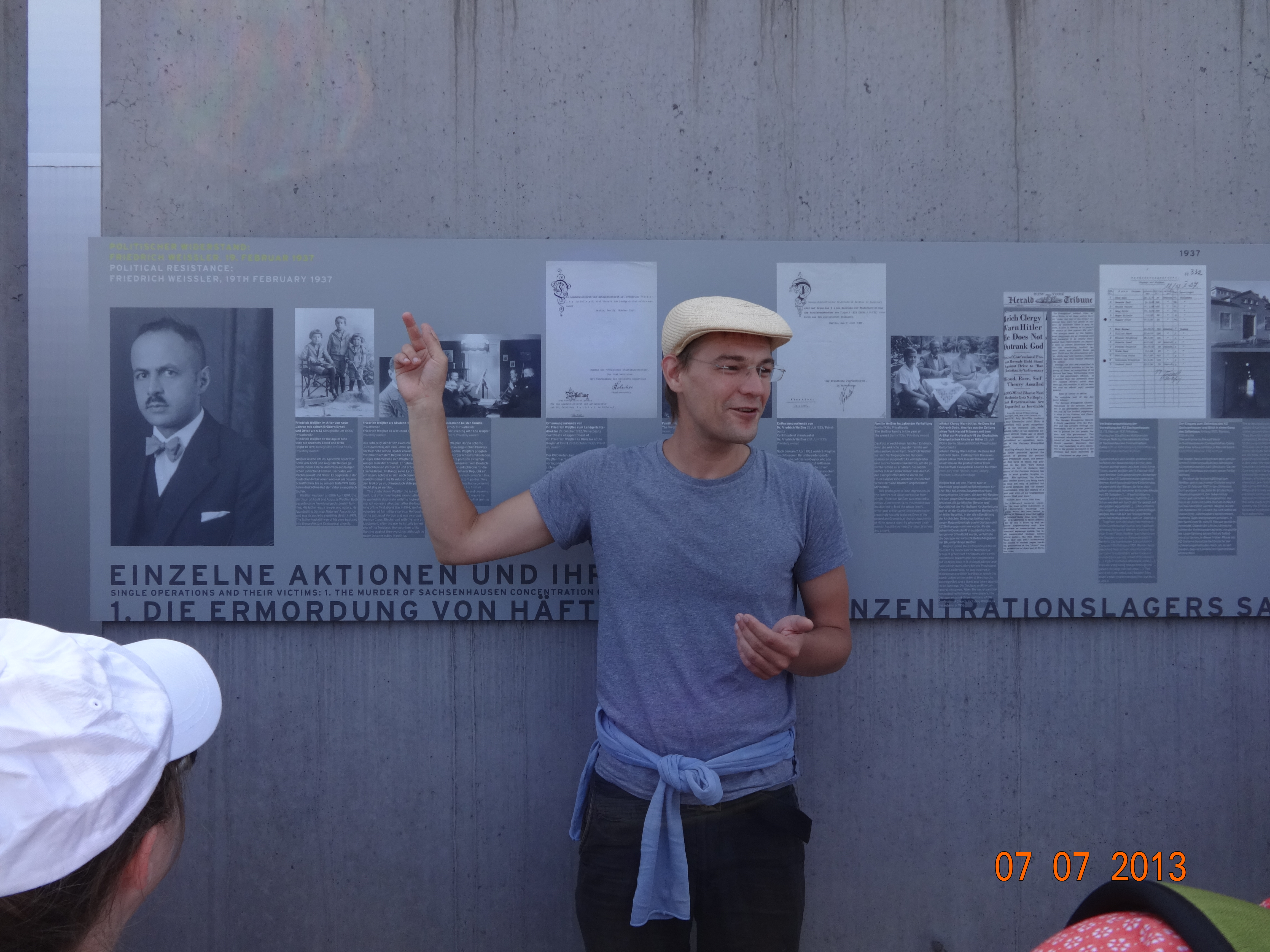
We followed our visit to Ravensbruck with a visit to Sachsenhausen, though Sachsenhausen was known earlier by the name of the nearby town as Oranienburg,  the model SS camp built between 1936 and 1938, an SS military training facility. Here also was the headquarters for the Inspectorate of Concentration Camps, the closest to the center of power, about 40 km outside Berlin.

Classroom at Sachenhausen.

Classroom at Sachsenhausen.


Our historian/guide at Sachsenhausen, Martin S.

Our historian/guide at Sachsenhausen, Martin S.

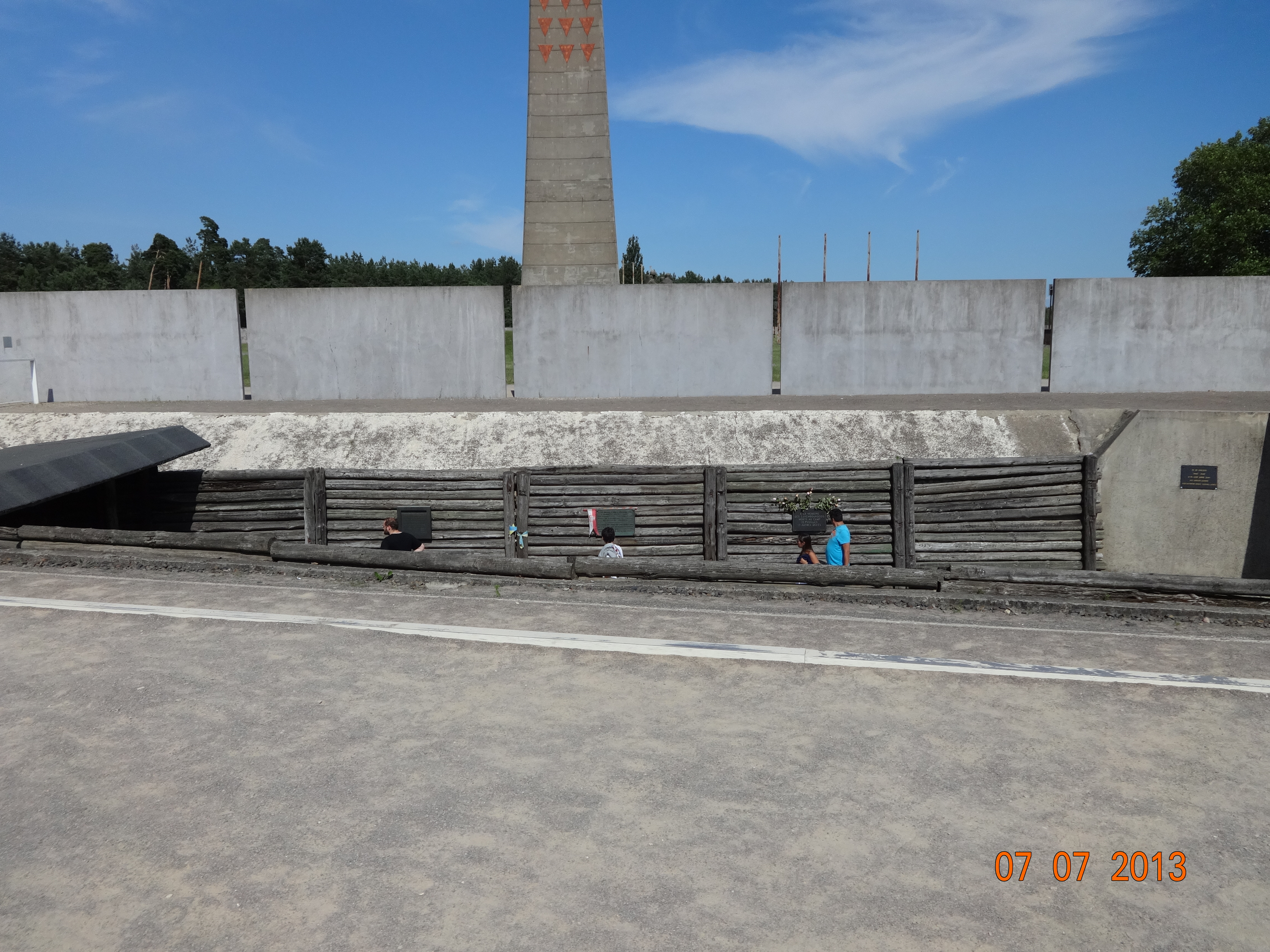
We have another passionate young German historian-Martin S. In March 1933, Oranienburg became one of the first KZ-Konzentrationslager, or concentration camp. Due to its proximity to the capital of the Reich, local political opponents were held here. As a simple matter of natural progression, the Gestapo would also shoot political prisoners here in the “shooting pit.”

The shooting pit at Sachsenhausen.

The shooting pit at Sachsenhausen.

After the invasion of the USSR, Sachsenhausen was used to murder Soviet POWs as well. In the infamous”neck shot facility”, over 10,000 were murdered in ten weeks in 1941.

Shooting barracks at Sachsenhausen, for Soviet POWs.

Shooting barracks at Sachsenhausen, for Soviet POWs.


Here, crematoria were developed, and vast shipments of stolen property from the East were later unloaded and warehoused. A brick factory was opened, making bricks for “GERMANIA” to be used in the new Reich construction in Berlin. Life expectancy there was six to eight weeks.

Here, also, scientists and engineers tested gassing vans and facilities. Doctors experimented on live subjects. Always testing. And as we know, major corporations had their hands in it as well, profiting from the slave labor that left the camp each day and were paraded through the surrounding community.

After 1936, authorities toned down the visibility/profile of the camp, due to the sinister application of state policy. But again, nearly 200,000 persons passed through the camp gates. Is it hiding in plain sight?

431

Or do we, as neighbors, simply turn away?

And, nearly eighty years on, why do American educators spend a good chunk of their “vacation” absorbing such new knowledge?

The persons on this trip know why.


Read Full Post »

Ravensbruck.

Ravensbruck.

A year ago I took one of the most transformative journeys of my life, with 24 fellow educators, to study the Holocaust and the Jewish resistance to it, in Washington, DC, Germany, the Czech Republic, and Poland. I kept an extensive diary and took tons of photographs. And contrary to many assumptions, it was a journey that led to profound understandings about life, not death.  For the next several days, I have decided to go back and retrace my steps and try to process what unfolded for me. Not weighty tomes, but maybe a picture and a note from the diary.

****************************************

We have visited a lot of sites in Germany since Bergen Belsen-in Berlin, the Wannsee Villa, where preliminary plans for the “Final Solution ” were signed off on after a one day conference, the Memorial to the Murdered Jews of Europe in the heart of the city, the Reichsbahn train platform, Track 17, where the Jews of Berlin were deported almost everyday for nearly two and a half years. We also visited Ravensbruck and Sachenhausen.

Ravensbruck.

Ravensbruck.

Ravensbruck is a couple of hours north of Berlin, in the former East Germany. It is notable for many reasons, probably first that it was a camp for women, and also a training faculty for SS camp guards-3500 women guards were trained here, and about 500 were in service. 130,000 women prisoners passed through here, and towards the end of the war, another 20,000 men.  No barracks are standing today, the houses for the SS leadership remain just outside the camp wall, where they lived with their families. Each day the camp gates would open and thousands of prisoners would stream out into the community for their slave labor assignments. Kind of hard to hide it from the kids. I suppose the attitude was that it was difficult, distasteful work, but the kids had to realized that it had to be done for the wonderful world that they were creating for the children’s future.

Immediately after the war the barracks were dismantled and given to refugees who had fled the Eastern

Matthias H our guide. Photo by Alan Bush.

Matthias H our guide. Photo by Alan Bush.

Reich as it collapsed. Some are still used as houses today. The SS women guard barracks is used as a youth hostel education center today. They have a program where survivors interact with the kids for about 4 days, and sleep here at night. Our guide is the historian Matthias H. at the Gedenkstatte (Memorial). He appears to be in his early 40s and is passionate and knowledgeable, as are all of the German historians I have met thus far. Here are some of his observations that strike me the most:

In his opinion, the majority of Germans supported the master race theory. What disturbs him today is that in his opinion, few Germans today seem conscious of this. It is a very complex topic. The historians talk about the mass crimes, and in Matthias’ words, they work on thin ice. The responses range from some people wanted to know more- after all, many of them learned nothing about it from their teachers, many of whom were bystanders or even perpetrators. Some quietly deny the extent-but I have found that as you study it, you learn how vast and almost unbelievable it is in scope. Others, are tired of the topic- “yes, it happened, so what, enough…”

For Matthias, herein lies the greatest danger. It is important to have the past in front of you- NOT in the back of one’s mind, as one moves forward. The lesson may be simply how to “behave” , not just for Germans but for everyone.

Ravensbruck. Prisoners' gate on left, SS on right.

Ravensbruck. Prisoners’ gate on left, SS on right.

He walks us through the main camp entrance, where thousands of prisoners would pass everyday, explaining that for years he would avoid the single door entrance that the SS guards used-until one day a survivor he was leading on a tour walked through it, to symbolize her victory at this place.

He notes a few additional stories. Survivors corroborate that when new SS female guard recruits would come for training, initially they do not know how to deal with the new job. Industries wanting slave labor must send their own guard recruits, too.  They are not kind, but they do not seem possessed with the will to carry out this abhorrent work. Former prisoners would say that always within about two weeks new staff would have overcome the “cognitive dissonance” that would allow them to do their job without compassion. They become “hardened” and “get over it”.

Book of Names. Faces.

Book of Names. Faces.

Ravensbruck was built for 3000 prisoners. At its height it held 35,000. 30,000 were killed here. In the beginning the SS does  NOT want women with children in the camp. But as more and more territory is overrun, the camp swells. After the Warsaw Ghetto uprising in 1943, there are hundreds of pregnant women. Some are forced to abort; as numbers well, women give birth and the babies are taken to a “hospital” where they slowly starve to death. The crematorium works nonstop. Ash piles are created and dumped into the nearby lake as the Russians close in. When the camp is overrun by the Red Army, 2000 women and 2000 men, mostly too infirm to be death marched out of the camp, are found, but not before the Germans had installed a small operating gas chamber, where 5000 Hungarian women were murdered in 1944.

I think that the following story resonated the most with me as an educator of young people.

The butcher’s son delivered fresh cuts of meat nearly daily to the SS mess hall, which still stands. Late in life, the old man tells Matthias of his feeling as a young teen-going through the camp gates to deliver the meat, seeing the emaciated and foul smelling prisoners, and believing fully all he has been taught- that these people are indeed subhuman, vermin to be eliminated. It’s true. Just look at them. Just smell them. Disgusting. Everyday it is the same. They even march through the town to the labor sites. Best to keep a distance from them.

It’s the same until one cold morning when a new transport of women arrive-stripped naked, healthy, humiliated, shivering, crying, shocked, trying to cover themselves in the plaza. Now it is his turn for a shock. These are not subhuman, but girls his age and older, in distress.

And they are naked. He has probably never even seen his mother or sister undressed before. And it is at this moment that he realizes that his teachers and the adults in his life are wrong- that what he is witnessing is a crime. And now perhaps sixty years later he unburdens himself.

Finally, a survivor, Annika, recounts that the Scandinavian Red Cross appeared in the weeks before liberation and in the presence of these new people, the women stroke their hair (as it is growing in again after being shorn off) trying to make themselves presentable. As she is evacuated over the Danish border, something strange happens. People are crying at her miserable condition. At every stop, they crowd around tearfully, and want to help… What is this? Traveling through the towns in Germany, she recounts, no one cried. No one helped. To date, says Matthias, no former German perpetrator has shown remorse for his/her wartime behavior.

The bystanders probably included most of the victims’ neighbors and acquaintances, and certainly most of the townspeople where the crimes were perpetrated,  of thinking age.

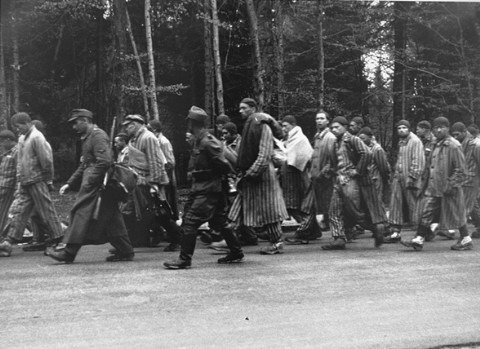
Prisoners on a death march from Dachau move towards the south along the Noerdliche Muenchner street in Gruenwald. German civilians secretly photographed several death marches from the Dachau concentration camp as the prisoners moved slowly through the Bavarian towns of Gruenwald, Wolfratshausen, and Herbertshausen. Few civilians gave aid to the prisoners on the death marches. Germany, April 29, 1945.  — KZ Gedenkstaette Dachau. USHMM

Prisoners on a death march from Dachau move towards the south along the Noerdliche Muenchner street in Gruenwald. German civilians secretly photographed several death marches from the Dachau concentration camp as the prisoners moved slowly through the Bavarian towns of Gruenwald, Wolfratshausen, and Herbertshausen. Few civilians gave aid to the prisoners on the death marches. Germany, April 29, 1945. — KZ Gedenkstaette Dachau. USHMM

But they all knew.

That for me is one of the axioms that will come out on this trip. But, suspending judgment- we were not there ourselves and placed in that position-we have a lot to think about.

But we must think about this too-Hitler never murdered anyone by himself.

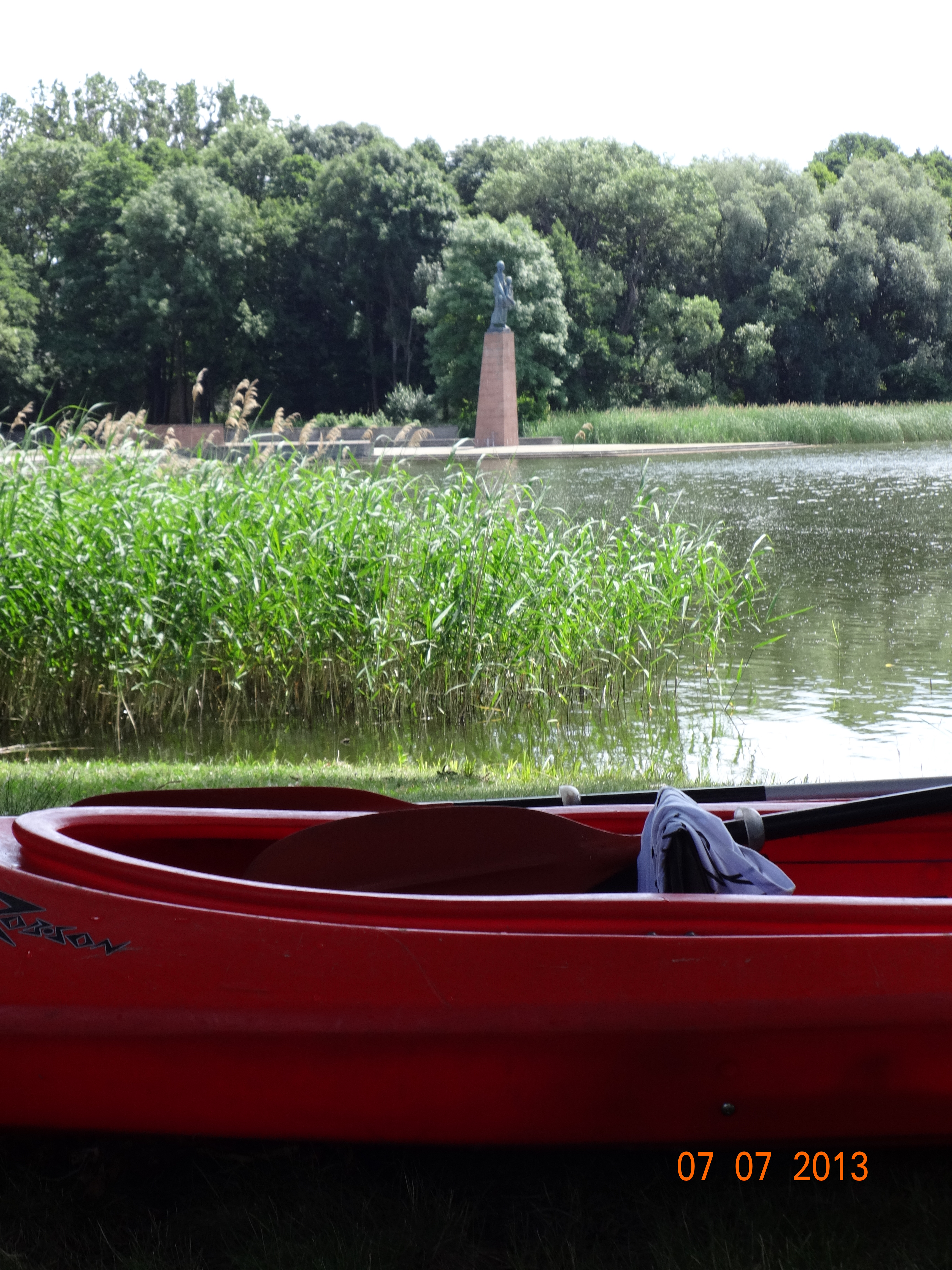
The lake at Ravensbruck, where ashes were dumped.

The lake at Ravensbruck, where ashes were dumped.

Read Full Post »

A year ago I took one of the most transformative journeys of my life, with 24 fellow educators, to study the Holocaust and the Jewish resistance to it, in Washington, DC, Germany, the Czech Republic, and Poland. I kept an extensive diary and took tons of photographs. And contrary to many assumptions, it was a journey that led to profound understandings about life, not death.  For the next several days, I have decided to go back and retrace my steps and try to process what unfolded for me. Not weighty tomes, but maybe a picture and a note from the diary.

*********************************************************************

Track 17. All aboard. Now.

Track 17. All aboard. Now.

Our state of the art bus brings us to a place seemingly on the edge of nowhere in Berlin. There is no train station that we can see. Just tracks that end abruptly and loading platforms, one spur of rails below, but no train.

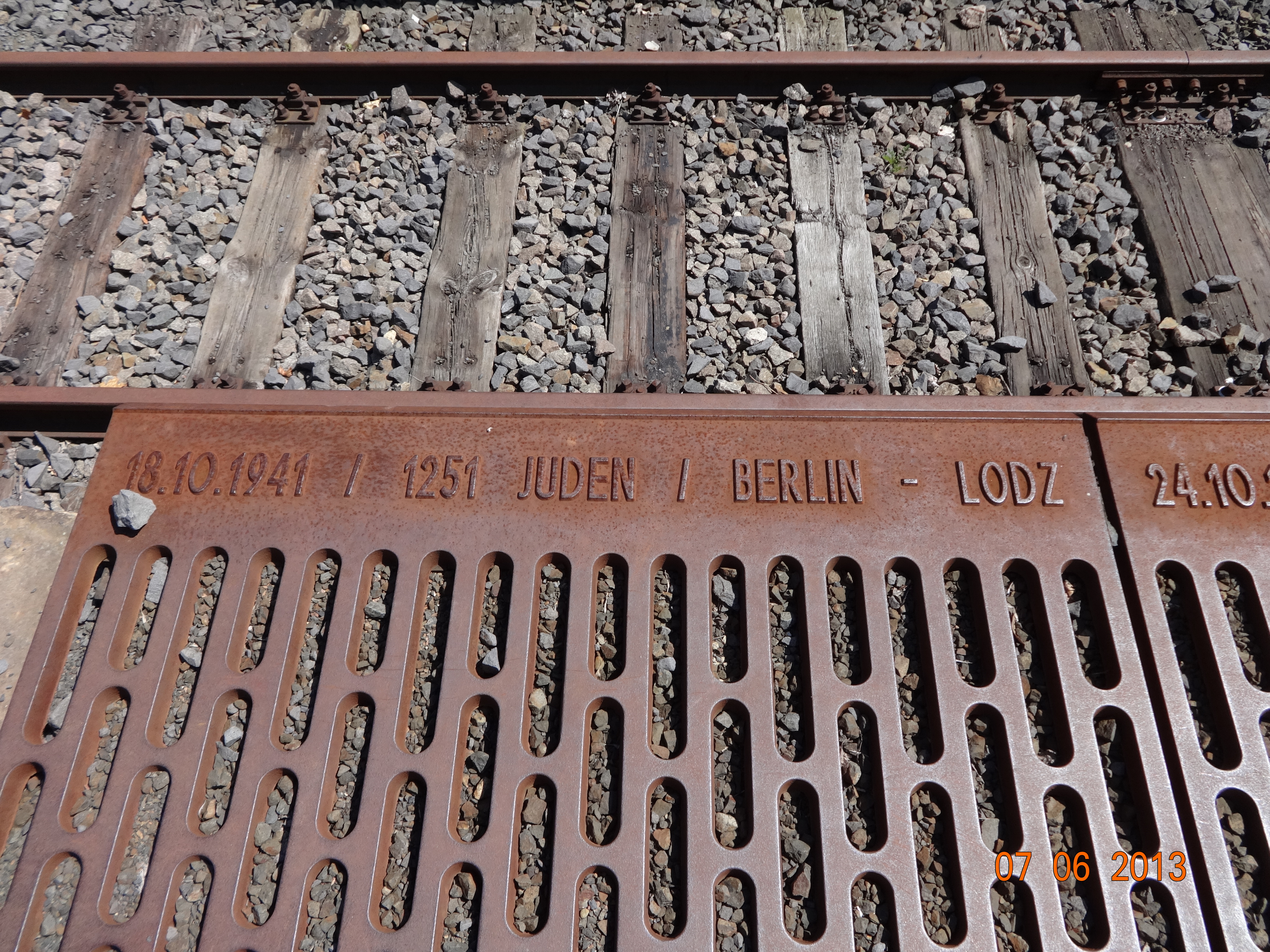
The you notice the stepping grates.

You look down:

Oct. 18, 1941. 1251 Jews. Destination: Lodz Ghetto.

Oct. 18, 1941. 1251 Jews. Destination: Lodz Ghetto.

What does this mean? On that day, the first of the mass deportations from Berlin, 1251 people were rounded up and sent to board the trains of the Reichsbahn. “The police and SS had assembled the people for this transport in a collection camp for Jews, which was located in the synagogue in Levetzowstraße in Berlin’s Moabit district. They then chased most of the men, women and children to Grunewald by foot. Until March 1945, about 180 further transports from Berlin to the ghettos followed; from August 1942, transports were also directly headed for extermination camps.” (Source: Gleis 17 Memorial – Berlin Grunewald)

282


“At first, the special trains consisted of passenger cars, yet from 1942 on, the Reichsbahn increasingly began using cattle cars for the deportations.”


Now, tell me, who is going to pay for all of this? After all, there is a war on. Well, who do you think?

“The conveyance of the Jews was billed to the Jewish community: 4 pfennigs were charged per kilometer for adults and 2 pfennigs for children above the age of four.”  The Jewish community of Berlin is essentially forced to buy tickets to its annihilation.

March 27th, 1945. The last transport out of Berlin. Theresienstadt is the only destination. Note that for later.

March 27th, 1945. The last transport out of Berlin. Theresienstadt is the only destination. Note that for later.

As we prepare to board the bus to our final stop for today, July 6, I pause by myself. It is a beautiful  summer day. A breeze ripples gently, the trees reclaiming the site shimmer and whisper.  And then the whistle blows. Nearby, an unseen train is passing, the click on the tracks steadily growing louder, then trailing off slowly in the wind.

283

No, you cannot be forgotten.

*********************************************************************

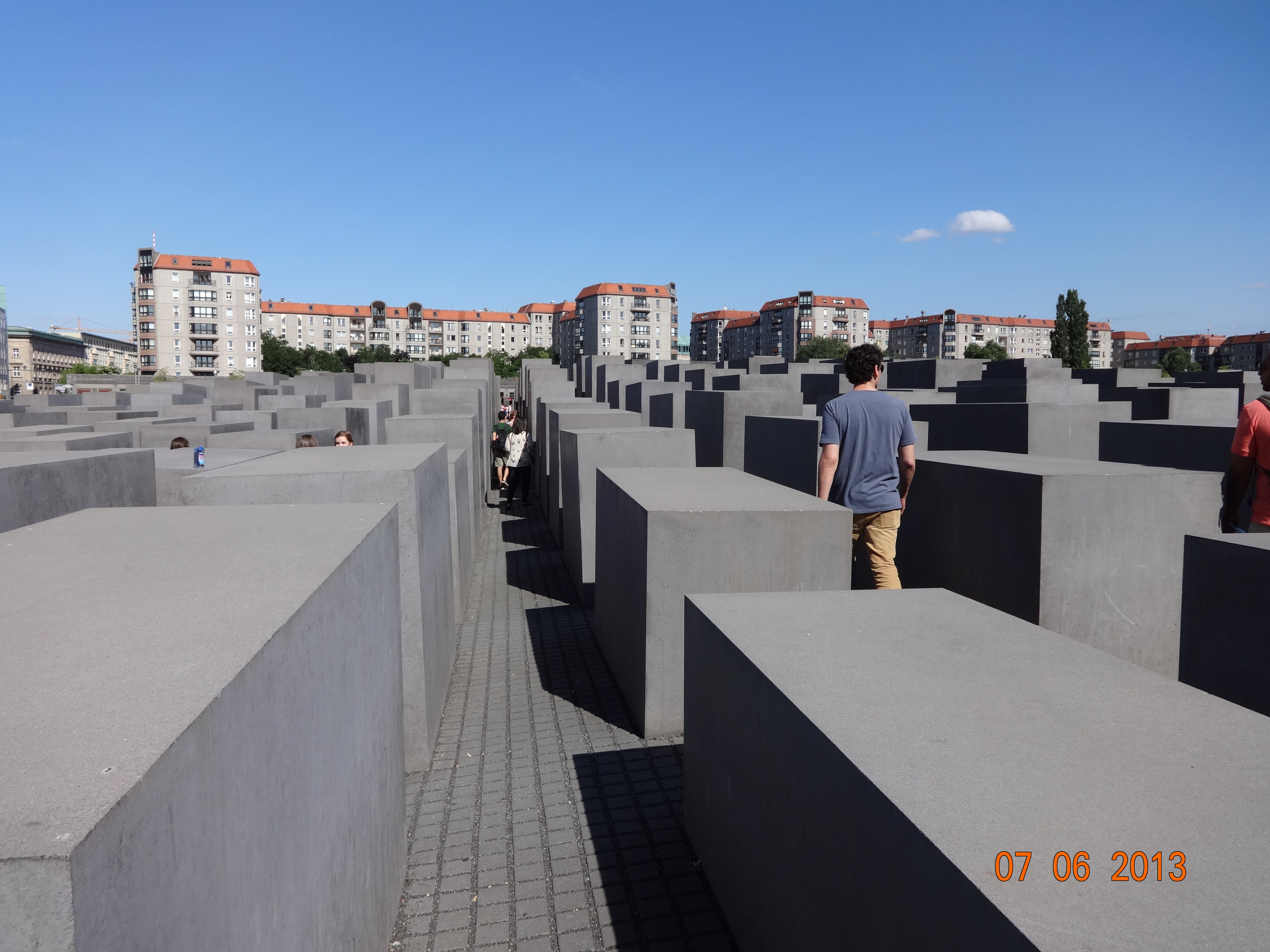
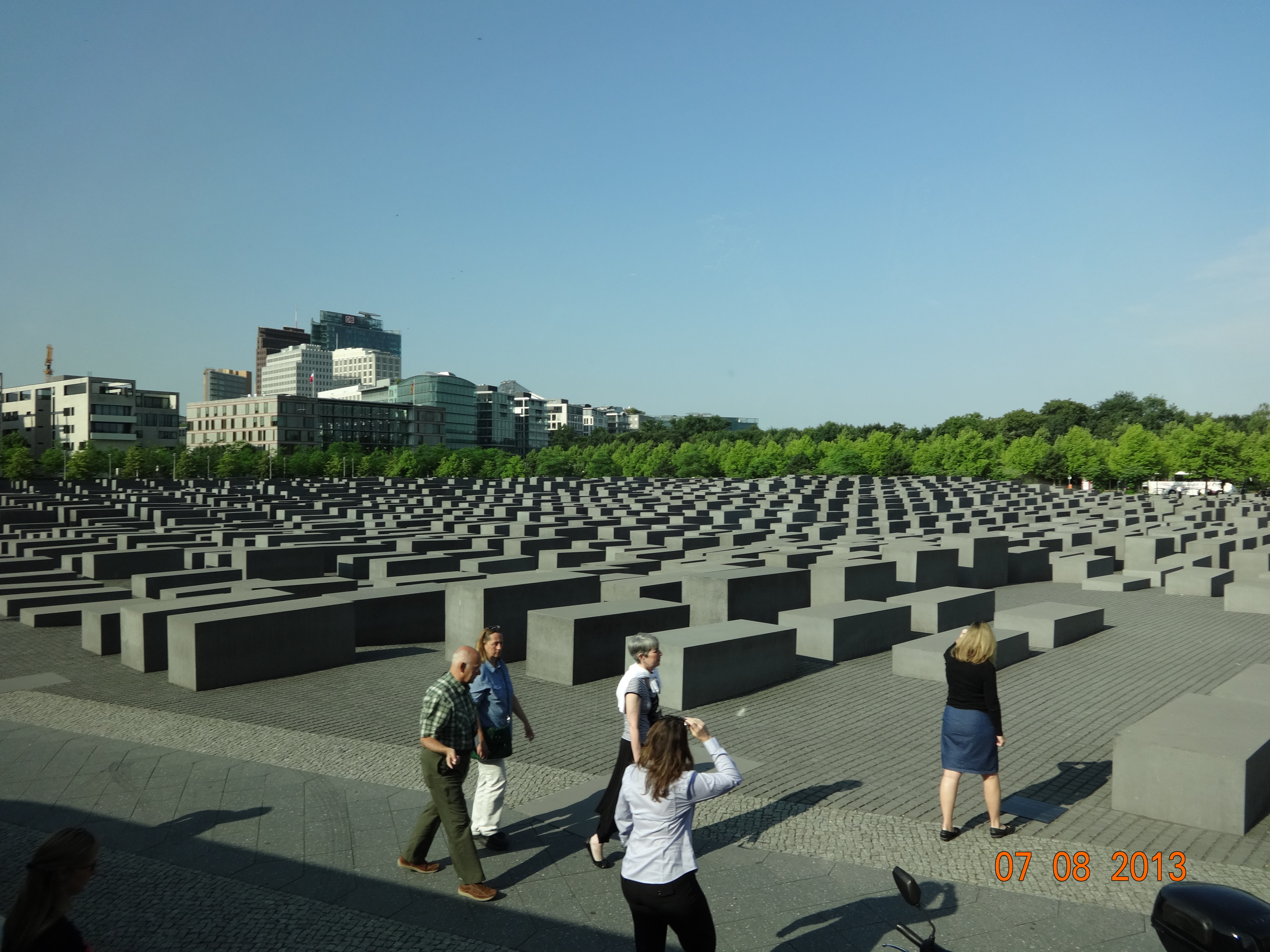
Memorial to the Murdered Jews of Europe.

Memorial to the Murdered Jews of Europe. Heart of Berlin.


Memorial to the Murdered Jews of Europe. Heart of Berlin.

Memorial to the Murdered Jews of Europe. Heart of Berlin.

Memorial to the Murdered Jews of Europe.

Memorial to the Murdered Jews of Europe.


It is not a maze, but you feel you are lost. The walking surface is uneven. Which way do you turn? Where are you going? Now go below, into the subground museum/memorial.

Letting the images tell the story now.

Deportation. Memorial to the Murdered Jews of Europe.

Deportation. Memorial to the Murdered Jews of Europe.


And just where do these photographs come from?


351 352


Deportation. Memorial to the Murdered Jews of Europe.

Deportation. Memorial to the Murdered Jews of Europe.

361


Read Full Post »

A year ago I took one of the most transformative journeys of my life, with 24 fellow educators, to study the Holocaust and the Jewish resistance to it, in Washington, DC, Germany, the Czech Republic, and Poland. I kept an extensive diary and took tons of photographs. And contrary to many assumptions, it was a journey that led to profound understandings about life, not death.  For the next several days, I have decided to go back and retrace my steps and try to process what unfolded for me. Not weighty tomes, but maybe a picture and a note from the diary.

**********************************************************************

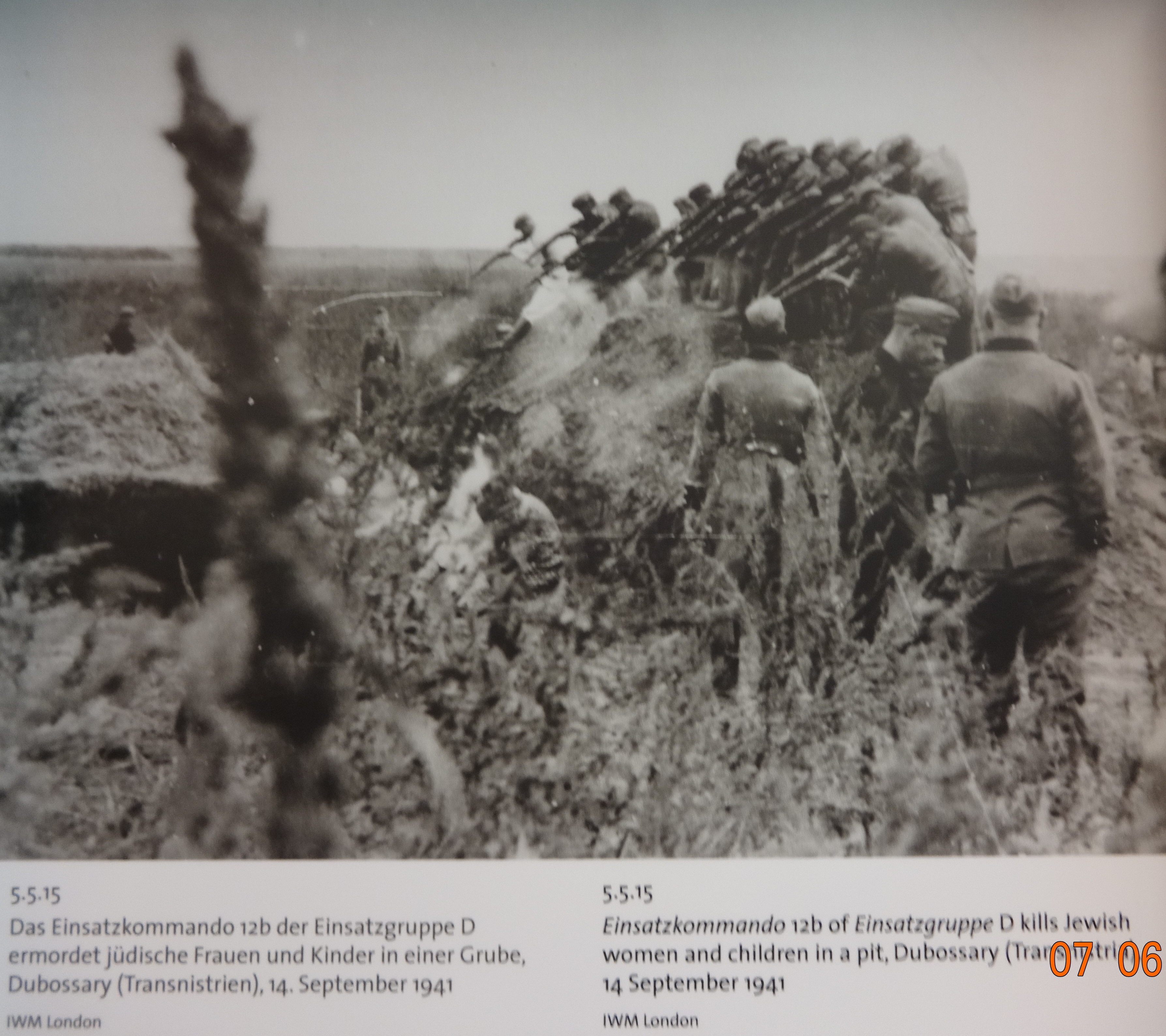
“Einsatzkommando 12b of  Einsatzgruppe D kills Jewish women and children in a pit, Dubossary,  Moldova/Transnistria, 14 Sept. 1941.” Imperial War Museum.

“Einsatzkommando 12b of Einsatzgruppe D kills Jewish women and children in a pit, Dubossary, Moldova/Transnistria, 14 Sept. 1941.” Imperial War Museum.

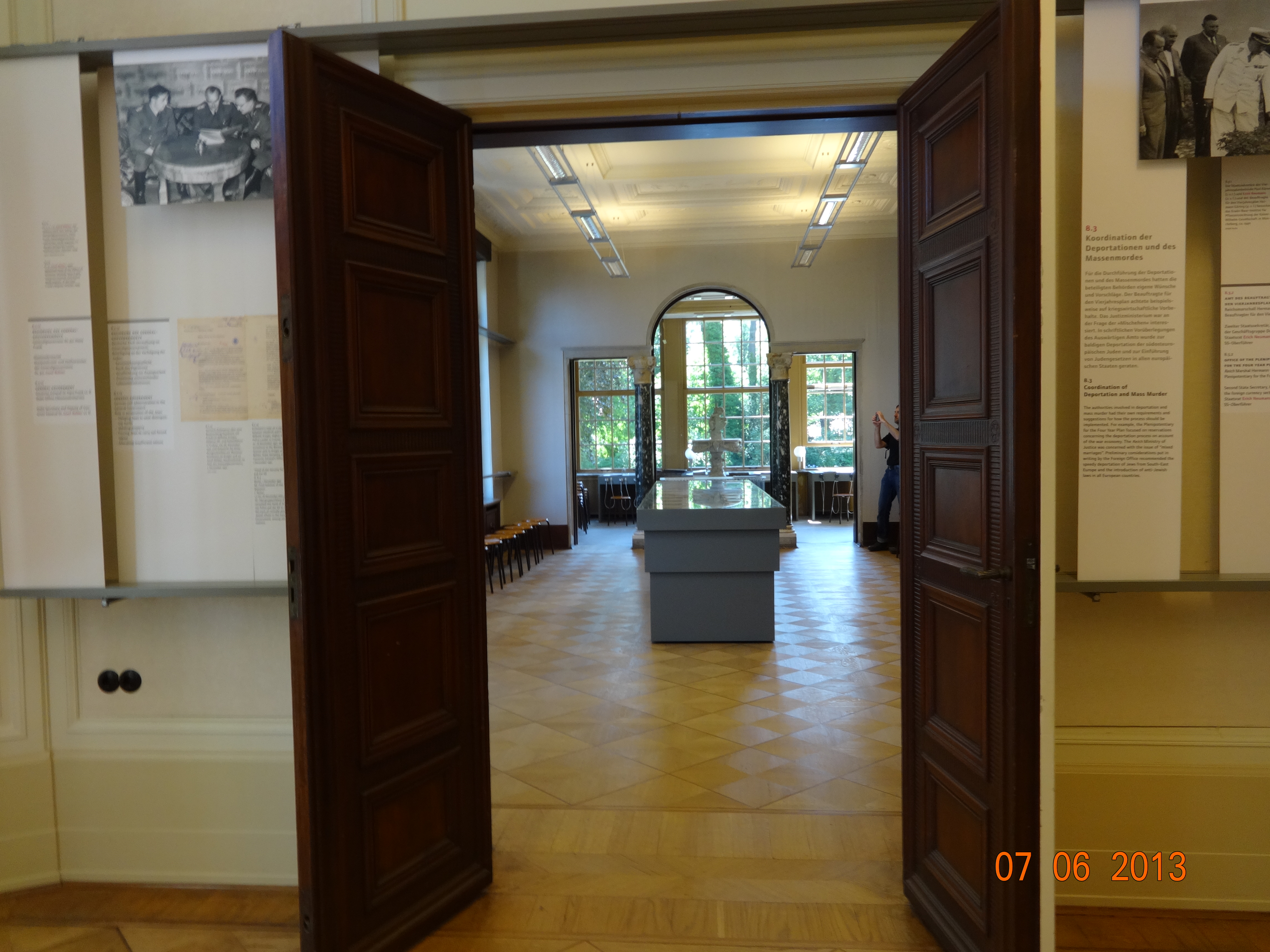
A photograph for you to see. I tend to stay away from displaying more graphic images on this blog, but a year ago on this day I was confronted with it, and many others, at the Wannsee Villa outside of Berlin, where the intentionality of the planning of the Holocaust hits you square in the face, as the photograph on the wall above does.

And it is worth noting the date. Eleven weeks after the start of Operation Barbarossa. You see, now that the Soviet Union has been invaded, there are millions more Jews in the path of the genocidal war machine. The Holocaust here was carried out by soldiers with bullets. Entire villages and districts. Over 1.5 million victims. The dirty work gets done, but given the headaches and the bottlenecks, “there has to be a better way”.

Wannsee Villa, July 6, 2013.

Wannsee Villa, July 6, 2013.

Which brings us to this lovely site. At the Villa outside of Berlin, on 20 January 1942, 15 German military and government heads meet for a day to discuss the Jewish problem in euphemisms. As scholars have noted, the Wannsee Conference was not called to decide the fate of European Jews, but to clarify all points regarding their demise.

From the USHMM: “The “Final Solution” was the code name for the systematic, deliberate, physical annihilation of the European Jews. At some still undetermined time in 1941, Hitler authorized this European-wide scheme for mass murder.”


The display where the "table" around which discussions were held at the villa.

The display where the “table” around which discussions were held at the villa.

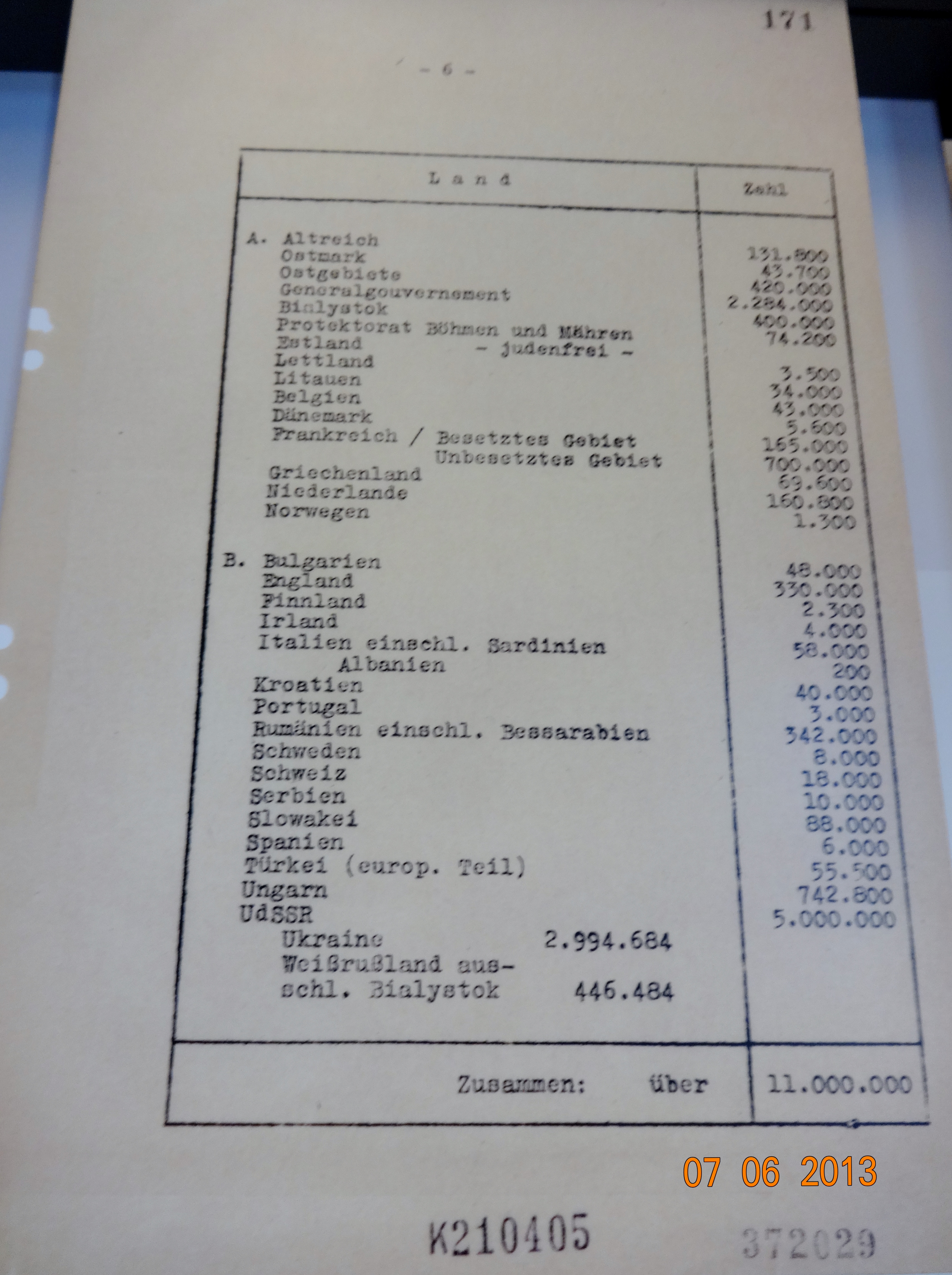
“At the time of the Wannsee Conference, most participants were already aware that the National Socialist regime had engaged in mass murder of Jews and other civilians in the German-occupied areas of the Soviet Union and in Serbia. Some had learned of the actions of the Einsatzgruppen and other police and military units, which were already slaughtering tens of thousands of Jews in the German-occupied Soviet Union. Others were aware that units of the German Army and the SS and police were killing Jews in Serbia. None of the officials present at the meeting objected to the Final Solution policy that SS General Reinhard Heydrich announced.”

A number's man, Heydrich was.

A number’s man, Heydrich was.

“Heydrich indicated that approximately 11,000,000 Jews in Europe would fall under the provisions of the “Final Solution.” In this figure, he included not only Jews residing in Axis-controlled Europe, but also the Jewish populations of the United Kingdom, and the neutral nations (Switzerland, Ireland, Sweden, Spain, Portugal, and European Turkey).

Heydrich announced that “during the course of the Final Solution, the Jews will be deployed under appropriate supervision at a suitable form of labor deployment in the East. In large labor columns, separated by gender, able-bodied Jews will be brought to those regions to build roads, whereby a large number will doubtlessly be lost through natural reduction. Any final remnant that survives will doubtless consist of the elements most capable of resistance. They must be dealt with appropriately, since, representing the fruit of natural selection, they are to be regarded as the core of a new Jewish revival.” (my emphasis)

Nice place to plan and coordinate mass murder of millions.

Nice place to plan and coordinate mass murder of millions.

For a good short essay on the conference, click here. For the actual meeting minutes, click here.

Now we are off to Track 17 in Berlin, to be followed by a visit to the Memorial to the Murdered Jews of Europe.

Read Full Post »

A year ago I took one of the most transformative journeys of my life, with 24 fellow educators, to study the Holocaust and the Jewish resistance to it, in Washington, DC, Germany, the Czech Republic, and Poland. I kept an extensive diary and took tons of photographs. For the next several days, I have decided to go back and retrace my steps and try to process what unfolded for me. Not weighty tomes, but maybe a picture and a note from the diary.

Berlin. We arrived here late in the evening on the 5th from Hannover by rail, and set up headquarters in the Marriott Berlin, which is very nice, for a few days. On the 6th we ventured out by our tour bus to several places of note. Below I will show you the photos I took, and the World War II era context, and help you connect the dots.

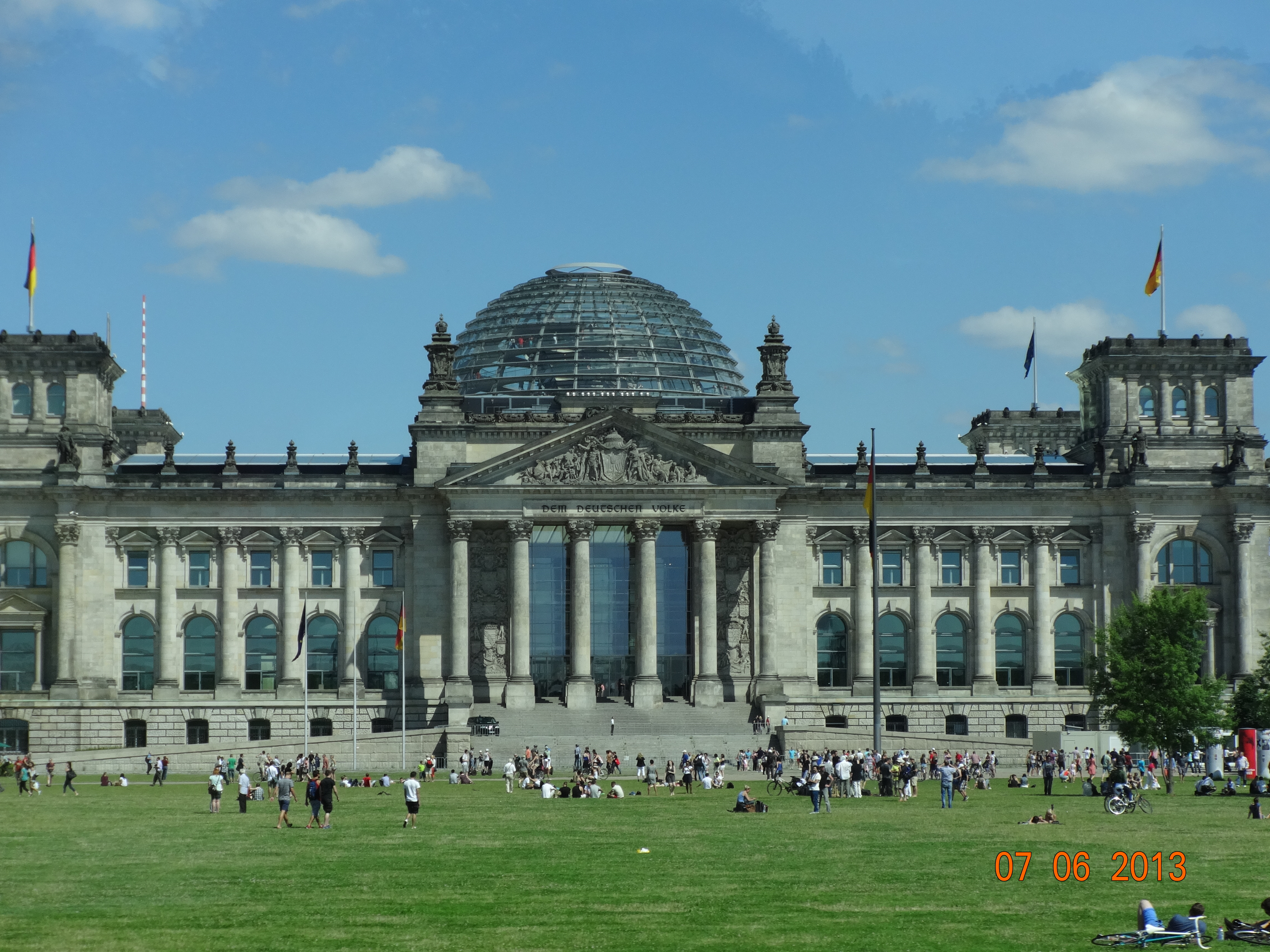
The Reichstag.

The Reichstag.

The Reichstag with its transparent dome, so citizens today can literally look down and see what their legislators are up to. Hmmmm.

The Reichstag in 1945.

The Reichstag in 1945.

Brandenburg Gate.

Brandenburg Gate. Tourists.

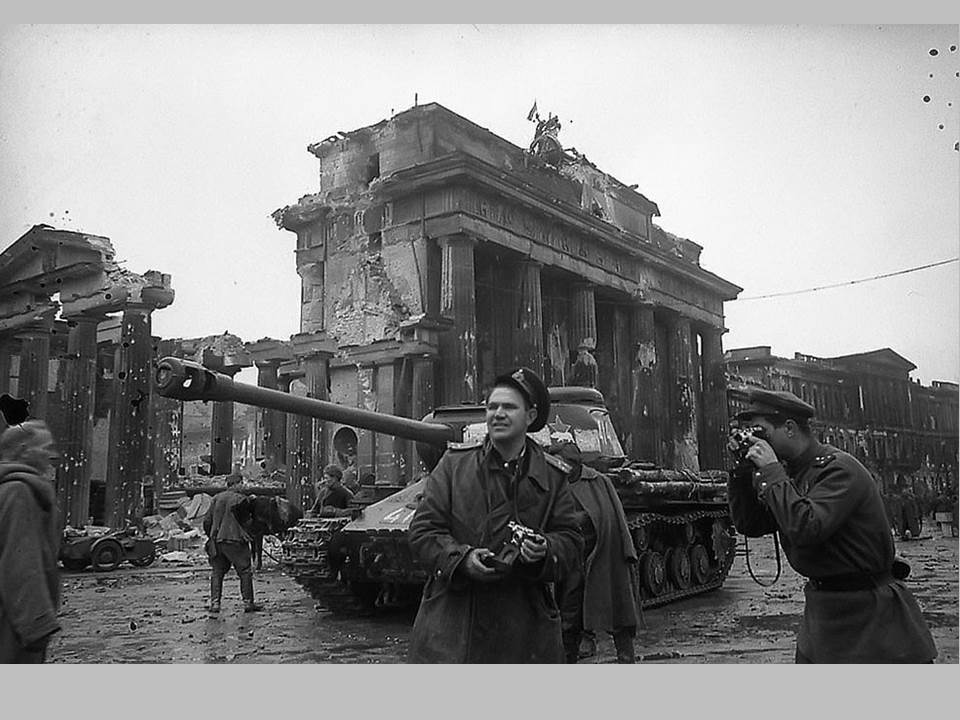
Brandenburg Gate, 1945. Tourists. Of the Soviet persuasion.

Brandenburg Gate, 1945. Tourists. Of the Soviet persuasion.

162Above is the stadium built for the 1936 Berlin Summer Olympics. Still in use today.

stadium 1936Inside during the Games in 1936. Kinda makes you think a lot about how Hitler and the Nazi party came to power. Don’t forget, no one is forcing these good citizens to make the salute. Exhibit A: The power of nationalism, and charisma.

Olympic Stadium from the tower.

Olympic Stadium from the tower.

i know that guy...

I know that guy…and so much for painting with too broad a brush.

181

reviewing stands outside the stadium proper.

reviewing stands outside the stadium proper.


Read Full Post »

« Newer Posts - Older Posts »