Feeds:
Posts
Comments

Archive for the ‘Uncategorized’ Category

“How did I get here?”

 This is a good a time as any to announce that I am going to be launching my first book this spring, tentatively titled ‘The Twilight of Living Memory: Reflections From the World War II Generation of Hometown, USA’.

The opening line right now is:

I hope you’ll never have to tell a story like this when you get to be eighty-seven. I hope you’ll never have to do it.

It’s a collection of narratives-oral histories, really-woven around the story of the most cataclysmic war in humanity. You might not think so, but we were all affected by it, even the generations born way later.

So here is a recent post from my younger brother. He’s a solo skier but he always comes back with good stories. Not everyone will come home from war shattered. but they will be trying to make sense for the rest of their lives. And maybe that is a part of what we are here for. The things this guy saw will ripple through the generations, and not just his lifetime. I’ve seen it so many times.This is why I go to Nashville to these reunions 75 years after the war, and this is why in reading my brother’s take on things I know I have to get my own book out of my head and into people’s hands.

*****

I loaded my skis and took my seat in the gondola. I’d have the ride to myself, another perk of midweek skiing. Hell, I’ll kick my feet up and take a few moments to express my patriotism with an American Spirit… But just before the doors closed, a man racked his skis next to mine and entered the cabin. I wondered why he didn’t just take the next empty gondola, but my question would be answered quickly.

1000 YD STAREHis eyes demanded my attention. Big. The whites showing all the way around the iris. “Crazy eyes.” And those eyes darted side to side, unable to fixate on any point for more than two seconds. Stillness had left him long ago. We talked, because that’s what you do during a 13 minute gondola ride with a stranger. Really, he talked and I listened because that’s how these interactions have taken place all my life. He had been in the service, moving back to the area for his medical issues. Several times in the telling of his story he just stopped mid-sentence, explaining how his brain “just blanks out” now. His wife and he were having issues and she now lived an hour away with his two young daughters (the same ages as my kids). In short, the dude was shattered. And our ride up the mountain was enough to tell me that there was no glue that would ever put all the pieces back in place.

I moved on with my day, but obviously this guy stayed with me. What really struck me is that this is the 3rd such conversation I’ve had with vets around my age on gondola rides over the past year. (A helo pilot, taking a ski day while on leave from Afghanistan, immediately started sharing grisly tales of his missions with no prompting from me.) Each man struck me as caught in a powerful current, a current that they sensed was wanting to pull them under for good.

I don’t know why so many people tell me their stories over the years. I can just tell you that I consider it an honor. As best as I can figure, these men spoke to me because that wanted to process their own stories, they wanted to come up with some narrative that would help them makes sense of how their lives were unfolding, a narrative that would provide an answer for their unrelenting question of “how did I get here?”

Pick up a copy of Dr. Drew Rozell’s latest book, Let It Go,  and read his other musings, at www.verycoollife.com.

Tom Lea_-2000YardStare

Peleliu, Sept. 1944. My forthcoming book is based in part on narratives from this battle. Combat artist Tom Lea’s painting, ‘The Two Thousand Yard Stare.’

Read Full Post »

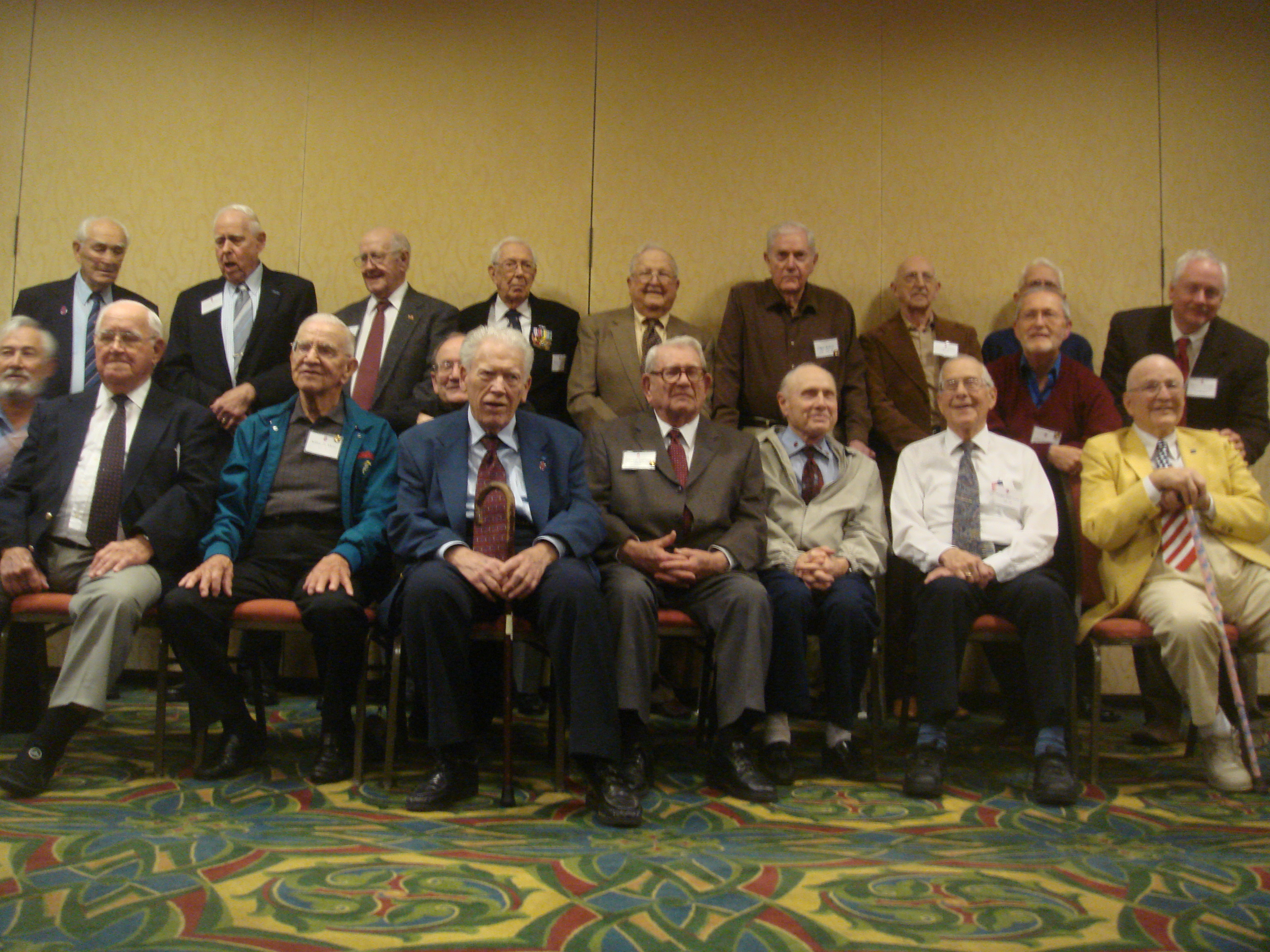
Received from Frank Towers,97 yr old Sec/Treasurer of the 30th Infantry Division Veterans of World War II.  I am going to be there. I hope to see all you survivors there, Holocaust and World War II,  for this last hurrah…love these guys. It will be the 70th anniversary of the liberation of the “Train Near Magdeburg”. In the pic below are soldiers and Holocaust survivors, and yours truly, in Nashville from 2010.

#30th Infantry Division, Survivors, M. Rozell

Nashville is Next!
And sadly to say, it will be the LAST Reunion of the“30th Infantry Division Veterans of WWII”….

30th Infantry Division Veterans of WWII
National Reunion April 15 – 18, 2015
Holiday Inn- Nashville-Opryland/Airport
Nashville, TN

The time has come when all good things must come to an end. We have had some great times in the past few years, but time and age is taking a toll on our membership, and the numbers are dwindling faster than we would like. Our Executive Committee has decided, that since our numbers of attendees has dropped off, it is becoming a financial burden to continue having reunions without adequate financial support. It takes a great deal of work on the part of the Exec. Sec-Treas. and the Reunion Chairman, Mrs. Nancy-Lee Pitts and Family, to prepare all of the necessary paper work, contract, preparing a program and the process of cleaning up and winding down from the Reunion. At our age, this is becoming a burden and almost prohibitive, so, very sadly, we must call it Adieu !!

So, all we ask is that as many of you who are able, Please come to this Reunion, to have a good time and enjoy the company of each other, and make this a memorable reunion.

This may be the last opportunity that you will have to see and visit with “old buddies”, whom you have known for the past many years.

Remember, Nashville was the site of the very first Reunion of the 30th Division Veterans in 1947, and it is quite appropriate that we should have the last one at this same site.

Come One and Come All, and make this a Big Blast, for the last time.

We will be looking forward to seeing ALL of you.


Old Hickory Re-Enactors

As usual, many, many thanks go to all of the guys who were representing the Old Hickory Re-Enactors, by Posting the Colors at each event as required, tending the bar in a most efficient manner, and best of all, their Artifacts, Weapons and other Memorabilia which is always a big hit with everyone. If you have not visited their displays, you are missing a lot ! We need to give these guys a big hand for what they do for us.


Holocaust Survivors

We cordially invite all of the Holocaust Survivors from the Farsleben Train, to join with us for this special event. If you have not been with us before, please do not pass up this opportunity to meet your Liberators. This will be the last time that you will have an opportunity to meet them, as we will not be having these Reunions any longer, so this will be your last chance. Many of you have been with us before, and we hope to see you all again. Kosher food will be available for all of those who require this.

Weferlingen – Walbeck – Grasleben

On 10 April 1945, Brunswick, Germany was captured by the 30th Infantry Division, with the next objective being Magdeburg.

The following day 11 April 1945, proceeding on towards Magdeburg, the town of Hillersleben was attacked and captured with little or no major battle. At the edge of the town, there was a large German Luftwaffe Airbase and an Armaments Research Center. This base was composed of several operations buildings, several 2 story block barracks, and several private homes for the officers and a small hospital.
Continuing to press on towards Magdeburg, during the 12th of April, the 120th Regiment over-ran the village of Walbeck, and the 117th Regiment over-ran the village of Grasleben, and in between these two villages, was another small village, “Weferlingen”, which was liberated by the 120th Regiment. [Ed. note: On 13 April the train at Farsleben was discovered.]

No mention was ever made in the journals of these regiments, about the capture of these villages, nor was any mention made of them in the 30th Division History Book or either of the Regimental History Books. Only from the Journal of the 30th Military Government, was this action discovered recently. (2012)
At Weferlingen, the site of a former potash mine was discovered – a mine operated by Jewish and D.P slave laborers, under the direction of their Nazi slave-masters. This mine had been enlarged and deepened, from its original size as a potash mine, and was in operation of fabricating submarine engines, airplane engines and rocket engines. It was deep and well protected from American bombing attacks.
This “camp” was named “ Camp Gazelle” by the Germans, and it was a sub-camp of Buchenwald, and when discovered, consisted of 421 (political prisoners), slave laborers. As any of these laborers became ill or otherwise incapacitated, they were sent back to Buchenwald, and fresh laborers were sent to the camp to take their place and to keep the labor force consistent with their needs. All of these prisoners were found in very poor physical condition, due to malnutrition because of being underfed, and overworked for 12-15 hours per day. Almost all of them required immediate medical attention.

Arrangements were made with the Burgomasters of Walbeck and Grasleben to furnish adequate food for these people. Our own 105th Medical Battalion personnel furnished them with immediate needs of medical supplies.
They were almost immediately sent back to the American Military Government and the American Red Cross, then located at Hillersleben, Germany, for appropriate processing and repatriation back to their homelands wherever possible.
It was on the basis of the liberation of this “CAMP” that the 30th Infantry Division was given the distinction of being named a “Liberating Unit” by the Center for Military History and the U.S. Holocaust Memorial Museum in Washington, DC, thereby allowing our Colors to be displayed in the lobby of the US. Holocaust Memorial Museum. This is to honor the men of the 30th Infantry Division who had a part to play in the liberation of numerous Jewish slave laborers of the Holocaust.
This was actually the very first viewing that any man of the 30th Infantry Division had of the “supposed” propaganda of the “Torture of the Jews by the Nazis”, later to be known as “The Holocaust” .These liberating soldiers had no training as humanitarians- they were trained to be soldiers, fighting a war against Nazi aggression and really did not know what they had on their hands, nor the scope of this captivity of the Jews. -Frank Towers

Taps – 2014

ADKINSON, BRUCE 743 TkBn-C Garden City, NJ
BERKEL, John J. 119-I 5/26/14 Belleville, IL
BIGOS, Adolph J. 119 Tom’s River, NJ
BURLEIGH, James 117 Golden, CO
CONLEY SR., Leo J 119 Framingham, MA
COX, Henry G. 117-F 8/17/10* Loris, SC
COX, Joe M. 117-D 5/20/14 Bluff City, TN
DEAN JR., Preston A. 531 AAA Hq
ERICKSON, Mervin L. 119-K Windom, MN
FLOYD, Thomas A. 119-G 9/30/13* Forney,
GIACCHETTI, Hugo J. 119 E Chicago, IL
GRAPKOSKI, Walter E. 119-G 11/23/11* Danbury, CT
HOFFMAN, STANLEY 120-B 1/19/14 Princeton, NJ
HOLLOWELL JR, Ernest L. 105 Med D
HOUTEKIER, Louis 119 G 7/15/14 Big Rapids, MI
IACONO, George D. 197 FA Svc, 9/30/11 St. Petersburg,
JORDAN, Joseph S. 105 Med. BN A 7/26/12 Wilmington, NC
KEATING, Hubert M. 113 FA/A 6/06/13* Paducha, KY
LEY, Charles E. 120
MARKHAM, Cameron L. 117 1BnHq 5/15/14 Charleston, WV
MARSIGLIA, Joseph M. 119 Hq. 12/.03/14 Algonquin, IL
MARZILLI, Rocco D. 30 QM Co. 10/27/13 Waterbury, CT
MC MICHAEL, Roscoe 105 Med. Bn 10/08/13* Newnan, GA
MITCHELL, Kenneth 120 C
NOWLAND, Maland C. 30th Recon E. Vassalboro, ME
ORTIZ, Oscar A 105 Med B San Francisco, CA                                                                 OWENS, Livis 120-C
PARKER, Kanneth 120 B
POLAND, Claude E. 120-G 4/49/14 Columbus, IN
RINELLA, Donald. 105 Med Bn. C 5/11/14 Truckee, CA
SMALL, George 120-A 12/19/13 Augusta, MI
SUPER, Seymour 119-A Boynton Beach, FL
WAUGH, Wilford D. 120-I Buffalo, OK
WHITE, Carlton L. 120-K 1/29/12* Elizabeth City, NC
WILEY, A.P. 120-M 6/24/14 Dallas, TX
WYATT, Nell (Wid) W 2/06/14 Waynesville, NC


Read Full Post »

I wrote this narrative. It begins and ends with Randy. Jessie found his body.

A 16 year old from our small town finds the 18 yr old from our small town at Pearl Harbor. Taken at USS Oklahoma Memorial, Pearl Harbor, 3-27-2013. Note Arizona Memorial in background.

Read Full Post »

A timely email…

I’m reprising some words of wisdom, on teaching, on what would have been my late father’s 83rd birthday.

From: Philip M.  Sent: Sunday, December 02, 2012 6:26 PM

Subject: Your Dad

I just wanted to take a moment to send you an e mail. I was in your Dad’s classes from 1977- 1978 at Glens Falls HS, He was a teacher who inspired learning.

He was my favorite teacher along with Mr Cubbins, I went on to teach French, Spanish, Social Studies, Economics, Government, World History, and many other classes…

Also I was able to earn a pension after many years from the US Army at the Rank of Major. Without good teachers, I never would have accomplished anything.

My Dad was a teacher also and he passed away 10 4 2004. Sincerely, Philip M.

++++++++++++++++++++++++++++++++++++++++++++++++++++++++++++++++++++++++++++

Today, Dec. 4th, would have been my dad Tony Rozell’s 81st birthday. He passed away in 2000. Phil’s email above was a reminder. Good timing, Phil! From  father to son! About the time you had my dad in the classroom I was trying to figure out how to get away from him, and this town!

A couple Dad stories.
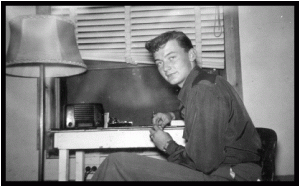
tonewritin2Dad (Tony) entered the Air Force at the outbreak of the Korean Conflict and quickly rose through the ranks. He was a superior clerk and administrator who served in the war zone and saw death and destruction near the 38th parallel. There is one story Dad used to relate that I really like. In the early days of his service, he was singled out for abuse by a mean-spirited corporal who particularly delighted in bullying the 88 lb. runt from Hudson Falls. Years later, after Tony had proven his abilities and achieved the rank of Tech. Staff Sergeant, this same corporal came to his office to receive his orders. He avoided Dad’s eyes as Dad handed them to him, and Tony asked quietly if the corporal remembered him. The former bully’s eyes darted around the room and back to his feet, as he nervously replied, “No, sir!” With that, Dad nodded and bid his former tormenter farewell without the dressing down he so richly deserved. He could have shipped the guy to Timbuktu.

Dad had a large impact on a great many lives outside of the immediate family, and was a great influence on me as a teacher, though I never saw him teach myself. I do recall early in my teaching career going into his school with him to get some materials and encountering three boys kicking a crushed milk carton back and forth in a stairwell. I wondered how my father (the teacher) was going to handle this- would they be sent to the office? Reprimanded? Told to pick up the milk carton and exit the building promptly? I think they were wondering this, too, when Dad just jumped in the middle and began to kick it around with them…

He rarely had discipline problems because he loved the students more than he loved the authority and power he had over them. He was never sour or burned out. He always came home from school humming to himself and generally in an upbeat mood. I can remember him saying on many occasions how much he loved his career “because the kids are always different-no two are ever alike.”

Before he retired in the early 1990s, the Glens Falls Post Star ran a feature article on DaRozells profile Feb. 3, 1992d and I as teachers. I think Dad hit it right on the head when he said, “Teaching is not a matter of how smart you are, it’s a matter of personality…If you know your subject and you’re fair, it doesn’t make any difference what you teach.”

++++++++++++++++++++++++++++++++++++++++++++++++++++++++++
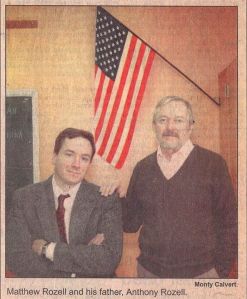
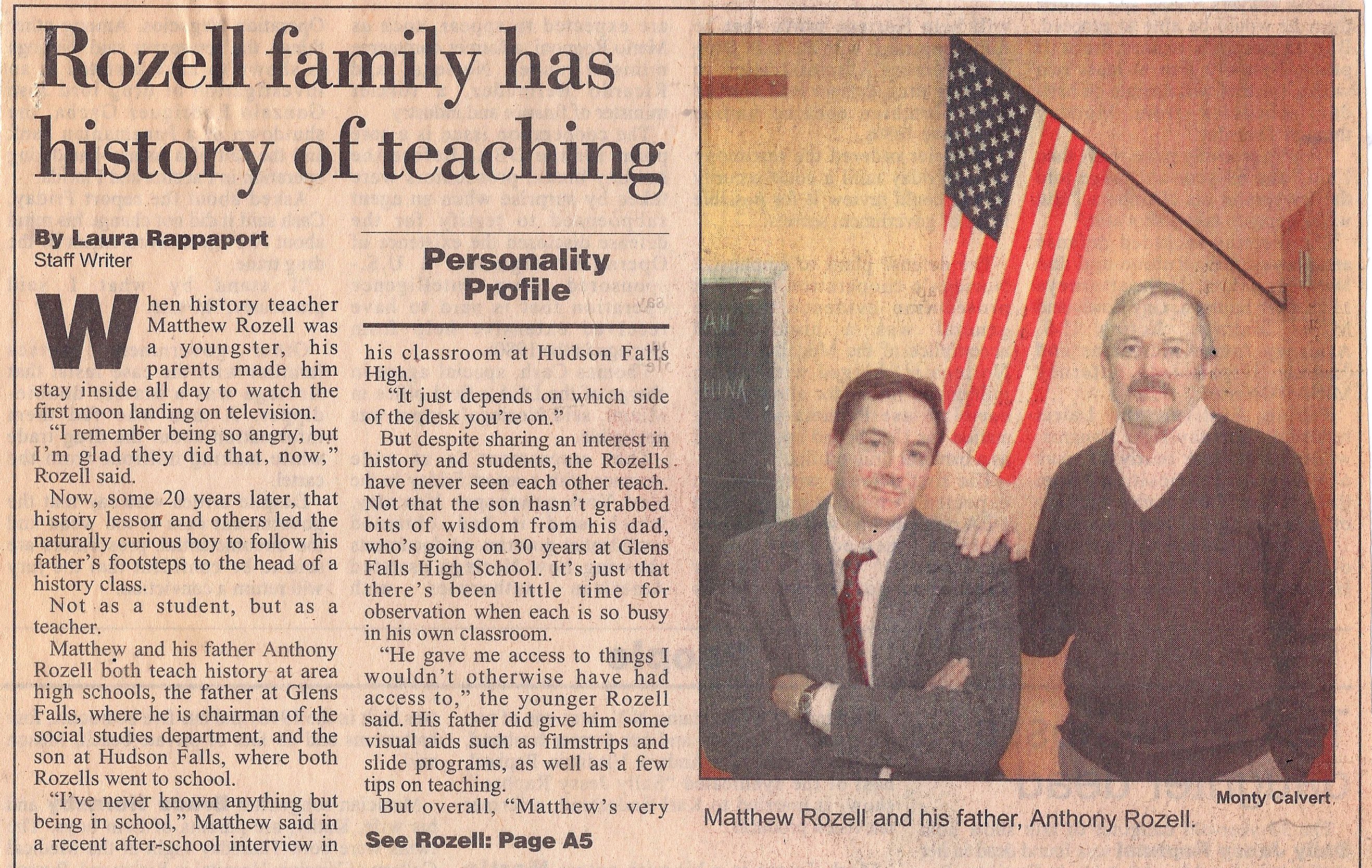
Feb 3, 1992 Glens Falls Post Star story. Captain and the Kid.

Rozell Family has “history” of teaching

By Laura Rappaport, Staff Writer

February 3, 1992

When history teacher Matthew Rozell was a youngster, his parents made him stay inside all day to watch the first moon landing on television.

“I remember being so angry, but I’m glad they did that, now,” Rozell said.

Now, some 20 years later, that history lesson and others led the naturally curious boy to follow his father’s footsteps to the head of a history class. Not as a student, but as a teacher.

Matthew and his father Anthony Rozell both teach history at area high schools, the father at Glens Falls, where he is chairman of the social studies department; and the son at Hudson Falls, where both Rozells went to school.

“I’ve never known anything but being in school,” Matthew said in a recent after-school interview in his classroom at Hudson Falls High, “It just depends on which side of the desk you’re on.”

But despite sharing an interest in history and students, the Rozells have never seen each other teach. Not that the son hasn’t grabbed bits of wisdom from his dad, who’s going on 30 years at Glens Falls High School. It’s just that there’s been little time for observation when each is so busy in his own classroom.

“He gave me access to things I wouldn’t otherwise have had access to,” the younger Rozell said. His father did give him some visual aids such as filmstrips and slide programs, as well as a few tips on teaching. But overall, “Matthew’s very independent,” his father said. Maybe so, but the younger Rozell credits his parents with kindling his interest in history by exposing him and his four siblings to it. On trips to Boston and New York City the family would visit the major museums and historical sites. “I was always very interested in what I saw,” said Matthew Rozell, adding that he usually had more questions than his brother and sisters. Also, with a father who teaches summer school, (Anthony taught summers in Hudson Falls for 21 years) it was hard to get away from school subjects – even for a few months. On summer afternoons or evenings, the father might play tapes or show slides of what he was working on in school. “It wasn’t like he would sit and make us watch it,” said Matthew. “I wasn’t enthralled, but at the same time I was exposed to it.” And his parents made sure their kids paid attention to important world events, like the historic moon landing. “He gave me money to go to the newsstand” for the momentous, occasions, Matthew said.

The elder Rozell is also a collector who hangs onto magazine and newspaper articles about the big stories of the day. His classroom bulletin boards at Glens Falls are covered with yellowing newspaper pages.

Contemplating retirement at the end of the next school year, the senior Rozell said he fell into teaching “out of the blue” in 1958 when there was a lack of teachers in the state. He had wanted to be a minister and started his education at St. Joseph’s Catholic Seminary in Yonkers. He already had almost all of the necessary graduate credits in history and was offered a chance to take a few more credits to become certified and guaranteed a teaching job. “I could not help but do that,” he recalled. “Once I got into it, everything fell into place, and 1’ve enjoyed it ever since.”

His son, now 30, followed a tougher path: jobs were scarce when he finished his teaching degree at State University of New York at Geneseo in 1985. He looked for work in the western part of the state, and even had the opportunity to run a restaurant or become a chef. But Matthew Rozell felt he shouldn’t throw away his education. “I spent too much money on my education to just give it up,” he said.

Failing to find a job in western New York, the young Rozell came home to Hudson Falls and stayed with his parents. He finally landed his present job – with a little help from dad,.- midway into the 1987 school year after a year at St. Mary’s Academy. He was the third teacher the class had that year, and it was a tough assignment. “When I first came here I was more interested in survival,” he acknowledged. “It’s like throwing a piece of meat to the wolves.” The more experienced Rozell helped his son through some of the rough spots in the beginning, and Matthew Rozell turns to his father less now, in his fifth year teaching.

Father and son are close, but they don’t spend a lot of time talking about education and lesson plans. The teachers’ wives may actually have been brought closer together by sharing similar work – in the South Glens Falls Central School District, Matthew observed. His wife Laura teaches special education at South Glens Falls, while his mother, Mary, is the school nurse teacher there. The two women have become very close, and usually go to staff meetings together, according to Matthew.

“They like to wear the same outfits on those days and see if anyone will notice,” he said.

Anthony Rozell looked back on his own long career in education and ahead to the future his son will face in the classroom. “A teacher today has access to so much material,” he said. “I didn’t have one iota of a film strip or a tape … I

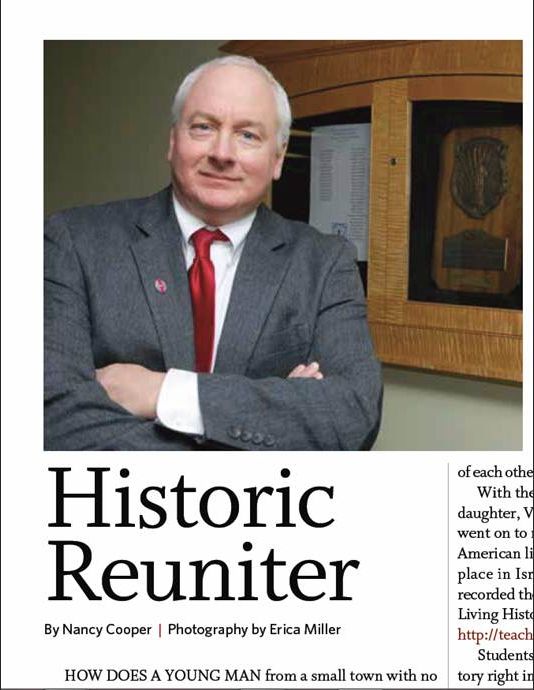
21 years on. Article for release Feb. 2013. Dad is gone but spirit is raging. Erica Miller photo.

just had to drum it into their heads,” Kids are different today, too, the father noted. More come to school with problems at home that can interfere with their studies. The students he gets the most joy from are those who bring with them a good attitude toward learning and toward life. “The ones you have that are happy people, smiling people, polite people, those are the ones you never forget,” he said. And those are usually students whose families take an interest in their learning and well-being. . “They know that they belong,” he said. “Their parents are really caretakers. That’s nice.”

And in the final analysis, said Anthony Rozell, there’s not a lot a father can really teach a son about the profession or art of teaching.

“A teacher finds, eventually, their own niche, their own method,” he said. “Teaching is not a matter of how smart you are, it’s a matter of personality …. If you’re strong and , fair, it doesn’t make any difference what you teach.”

++++++++++++++++++++++++++++++++++++++++++++++++++++++++++++++++++++++++++++++++++++

The Old Man was tickled when this letter to the editor appeared in the Post Star shortly thereafter…
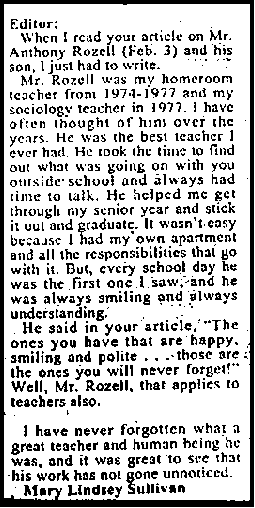
I just had to write

Read Full Post »


Tomorrow is Thanksgiving day. Today I stumbled across a holiday greeting I received from Holocaust survivor Ernest Kan a while back. It was about being thankful, simply appreciating what you have.  So it reminded me to share Ern’s story (which I recorded) at a gathering of former American soldiers and Holocaust survivors.

It was Ern’s turn to speak. He came to the front of the room to address “his” soldiers:

My odyssey began in Riga, Latvia where the Germans occupied our apartment on the first of July, 1941. Shortly thereafter we were put into the Riga ghetto. During the partial liquidation of the ghetto on November 30 and Dec 9. 1941, my mother was murdered with 27,000 other Jews in the forest of Rumbula.

The ghetto was finally liquidated in 1943.  My dad was shipped to Auschwitz where he perished, and I was put into the concentration camp Kaiserwald near Riga. With the approach of the Soviet army in 1944, Kaiserwald was evacuated by ship and we were shipped to Stutthof concentration camp, after about a month to Polte in Magdeburg where I was liberated.

I was 19 years old at the time of imprisonment, and held captive altogether 44 months.

photo

The main gate through which the prisoners entered the factory every day for shifts of 12-14 hours. Source: Lev Raphael, Polte-Fabrik slave labor camp, http://www.levraphael.com/sg_poltefabrik.html.

The name of the factory was Polte; it was the largest ammunition factory in Germany. Conditions were very bad. They had 30,000 slaves working there in shifts. It manufactured heavy artillery shells, big coastal artillery shells about 30 inches long. And we had to work in 12 hour shifts.

They brought us there from a concentration camp Stutthof, near Danzig, by freight train, it took about two nights, and we got there we didn’t know where we wound up, we were assigned to bunks in a barracks, and it was about a mile to walk from the factory and back.

And that is where I was liberated in April 1945 by the 743rd US Tank Battalion, the 30th Infantry Division.

After an air raid by the United States [Army] Air Force, the camp was evacuated and they marched us southward, because the south was still unoccupied by Allied forces. So they assembled the prisoners and marched them out of the camp, and we had to move a large wagon with spoke wheels, they had no more horses to pull the wagon, we were pulling and shoving the wagon with all the luggage and personal belongings of the guards.

So as when we passed that factory, Polte, me and three other guys, we ran into the open gate, the factory was already disabled-there was no more electricity, no water, no nothing, it couldn’t function anymore- it had been made unoperational by air raids. So we ran and we hid, we changed our striped uniforms and we put on German overalls we found in a locker so we looked more or less human again, but we had no hair, the hair was shaved off.

And we hid in an attic above the office …we stayed there one night, and in the morning four SS guards with drawn guns found us and said “Out you swines, hands up!” and marched us to the courtyard of the Polte factory, they had about 100 or so lined up with their hands up, and they came with little lorries, little trucks, that took groups of 10 away and returned within five to eight minutes empty for the next batch-so we knew they took them to the forest to shoot them and come for the next.

And I thought that was the end of us, I was standing with my hands up and I said to the guy to my left, “this is it, we made it up until now” -and lo and behold, an air raid started! The United States [Army] Air Force, low flying bombers came, you could see the pilot’s eyes -that’s how low- they dropped the bomb load, [the guards] chased us in the adjacent air raid shelter, all the guys were at the wall in the air raid, they posted a guard in front of that door and as we walked in he said “I’m innocent, I never did you any harm.” He was an old, old man, older than me today. So when I heard that, there was already music in my ears all of a sudden, I had never heard that from any guard to say something like that.

So they locked the door and put a padlock on the outside. And you could hear the bombs falling and the smoke seeping through and it was chaos, we were singing inside and we were happy, praying the bombs should hit us and get us out of our misery, because by that point we were finished.

So I leaned against the door and the door gives, so I don’t know to this very day whether the air pressure from falling bombs blew the lock off, it was a big padlock, or if the guard posted outside opened it up and took it away. At any rate the door was open, we all ran out scattered left, right and the four of us hid in an elevator shaft up above where the wheel is, and we waited until the air raid stopped and after about an hour we sent one guy out to reconnoiter what was happening, it was dead quiet. We didn’t know who was where and what was going on. So after about half an hour he came back with a big vat of soup, and he said [Ern stops-long pause. He composes himself, and speaks slowly]:

“Boys-we are free-the Americans are here!”

That is a moment I can never forget.

The soup was lentil soup, it was delicious, I ate and ate until I threw up-we hadn’t eaten in so many days, and I then I saw the first American in a Jeep.

I had never seen an American, he looked like a Martian to me with different weaponry and a Jeep. And he says to me, “Hands up! You are German?” I said, “No, I am a Jewish prisoner from the local concentration camp” but by my haggard appearance he could see that I was certainly not an enemy. I was about 75 pounds at that point and it so happened that when I found the overalls in the German locker, I put on a belt I found there and it had a swastika locket which I didn’t realize, I put on the belt not to lose my pants and he saw the swastika on it and he assumed I was a German in overalls, so I told him I was from the local camp.

It so happened that he was a Jewish GI and he embraced me and he said “You are free now, you can go wherever you want” and he gave me a  an army issued prayer book, and a mezuzah, that is something like sort of an amulet that some people wear, it contains some proverbs from the Deuteronomy inside, and he said “Go!”

In the heat of the moment I was unable to ask him where he came from, what his name was, and it bothers to this day that I could never express my gratitude to this one man, but all these guys here are my liberators and they represent this first American I ever saw and he gave us back our life and our freedom and I will never forget it.

There are no words to express my gratitude for what they have done for us and never in my vaguest dreams would I have thought to be here  65 years after the war is over and meet these guys again, that is unbelievable, it is a moment, an unforgettable moment in my life.

RECORDED IN MARCH 2008.

Read Full Post »

This originally appeared at the Huffington Post website for Veterans Day.  Maybe it is appropriate to share for Thanksgiving.

The author contacted me in 2007 when news of our first reunion went viral  in the Associated Press. Later, in 2009, he was invited to a gathering of the soldiers who saved his father and other survivors on this train here at our high school. His talk to our gathering can be seen below, published here for the first time.

Praise for the American Soldiers Who Saved My Father From a Death Train

By Lev Raphael

 In early April 1945, my father was packed into a train with 2500 other prisoners from Bergen-Belsen as the Nazis insanely tried to keep British and American troops from rescuing them. The train was made up of 45 cars with their doors sealed shut; the crowding was horrific and of course there was no food or water.

 In the chaos of war, this hellish train wandered for a week and finally stopped at Farsleben, a tiny town not far from the Elbe, sixteen kilometers from Magdeburg, the site of one of Germany’s largest munitions plants. German communications had collapsed and the commander couldn’t get clearance to move across the Elbe, so he ended up decamping ahead of the American troops he knew were coming. When two American tanks appeared on April 13th, the remaining guards escaped.

 Frank W. Towers, a 1st Lieutenant of the 30th Infantry Division, reported that the stench when the locked cattle cars were opened “was almost unbearable, and many of the men had to rush away and vomit. We had heard of the cruel treatment which the Nazis had been handing out to Jews and political opponents of the Nazi regime, whom they had enslaved, but we thought it was propaganda and exaggerated. As we went along [in Germany] it became more apparent that this barbaric savagery was actually true.”

 The troops that had found this train were racing to the Elbe because it was the last barrier to their advance across Germany, and now they had a totally unexpected burden of some twenty-five hundred prisoners to house and provide for. The answer was about nine miles to the west. American troops had just captured several hundred Germans at the Wehrmacht base and proving ground in Hillersleben where tests had been conducted for giant railway guns manufactured by Krupp.

 It was an ironic place for Jews to be sheltered, cared for, and brought back to life. But then what place in Germany wouldn’t have been an ironic location?

 This verdant military setting with its clean, heated quarters for officers and soldiers was a virtual paradise for people who had been treated like animals for years. That’s where my parents met and fell in love. My mother was in Hillersleben because she had escaped from a slave labor camp in Magdeburg and been brought there by American troops now using it as a temporary Displaced Persons camp.

 She and my father had each lost everything in what would come to be called the Holocaust: home, families, countries. So there wasn’t any time to play any pre-war games. “Do you like me?” he asked. She did, and as my father tersely put it years later, from that moment on “She was mine and I was hers.” My mother moved in with him that night, beginning their fifty-four years together.

 Frank Towers, who is 97, is the last surviving soldier who rescued the prisoners on that train, who saved my father from almost certain death and brought about his encounter with my mother. I’ve had the honor of meeting Frank and shaking his hand, and I’ve written about him in my memoir My Germany, but on this Veteran’s Day, with the survivors of the Holocaust and their saviors dwindling faster and faster, it’s more important than ever to thank him in public, and praise the memory of those other “train heroes” who are no longer alive.

The account in this blog is excerpted from My Germany: A Jewish Writer Returns to the World His Parents Escaped.

 http://www.huffingtonpost.com/lev-raphael/veterans-day-praise-for-t_b_6124862.html

 ***************************************************

Five years ago this fall, we put on quite a show at our high school.  High school kids listening to, meeting, sharing, laughing, crying, even dancing  with octogenarian U.S. soldiers and Holocaust survivors. Here, Raphael shares his remarks with the soldiers, survivors, and students about growing up in a survivor household, and his coming to terms with Germany.


Read Full Post »

Veterans’ Day is here. My state teachers union, one of the largest in the nation, spotlighted me and I think did a decent story on why I think studying history matters, and highlighted my promotion of the transformative power of narrative history on young people. The lesson was on the history of Veterans’ Day, and the sacrifices that some of our veterans made.

I think I channeled to the kids what was important about veterans and Veterans’ Day.

But just to be clear to any followers or readers, I find a recent phenomena a bit unsettling-a collective rush to say to our veterans those five words, “thank you for your service.” And in a certain context, it is my understanding that a lot of veterans feel this way also. We mean well. But it seems to me like a lot of times we give ourselves a pass, when we say or write those words.

I’m guessing you know, that for every American who chooses to sign on to our military, there are over 100 who chose not to?

But, no judgments there. I had no burning desire to enlist after high school, so I did not “serve” in our armed forces.  Maybe I was lucky I had other options or opportunities.

Or maybe I chose to do something else.

And I feel good. In many ways I “serve” my fellow man every time I step through the schoolhouse door. I have spent more of my life in my classroom than any other single place in the world.

Sure, they pay me for it. But I’d like to think that it has been more than just a way to make a living.

I like putting a face on what we have been through as a nation-and it’s my job to encourage my students to be involved, to step up, to serve others.

raking-in-rain

It’s raining, and we are raking leaves- on Veterans Day. For veterans.

But actually, it’s my responsibility as a member of the human race.

So why do we write, “thank you for your service”? Appreciation, sure, but just what are we thanking our veterans for? If we answer “freedom”, or “putting themselves in harm’s way for us” while we go about our Very Important Lives, what does that mean?

Now ask the real questions:

1. What are WE all doing to ensure our nation’s well being?

2. Outside of complaining on Facebook, are WE active in our participation in the decisions that send our troops into harm’s way?

3. Is the most recent war, the LONGEST in America’s history, even remotely tangible to most Americans, outside of the tax bills?

4. If we wanted to really express our thanks, don’t you think WE would also pay a little attention or make a bit more noise about how our government looks after them when their service is over?

That’s why “thank you for your service” rings a bit hollow for me when posted, uttered, printed and broadcast over and over, ad infinitum. Let’s be honest. What most of us really mean is “thank you for the stuff I’d rather not pay attention to so I can get on with my life”.


Maybe we should honor them by just taking time to listen, and paying a little bit of attention,  more than one day a year.


Read Full Post »

Veterans Day: Hudson Falls teacher’s stories unite veterans with survivors

Author: Liza Frenette
Source: NYSUT Communications

veterans day

Caption: Photo of Matt Rozell by Andrew Watson.

History teacher Matt Rozell knows where he will be on Veterans Day. He’ll be in same place he is every year: working with students to help veterans. This year, he and 28 of his Hudson Falls high school students will be out raking leaves and doing yard work at the homes of veterans.

In his world, the one he shares with students, veterans are held in the highest regard.

“These soldiers, and what they’ve gone through for our country…” he said, trailing off. Rozell, a member of the Hudson Falls Teachers Association, was standing in the school entryway in front of a new display called The Veterans Wall. It is filled with photographs and stories of veterans from World War II through the wars in Iraq and Afghanistan.

Their mission was protection. Rozell’s mission has been to make sure students know what that protection cost and what it preserved. In a metal filing cabinet in Rozell’s living history classroom there are 200 written student interviews with World War II veterans. Each folder includes the interview, positions papers, fact checks, photographs, letters and other primary sources.

[Hudson Falls Teachers Association member Matt Rozell on the history of Veterans Day and keeping history alive through the “power of the narrative story.”]

That’s 200 stories now documented; important pieces of history, of personal lives that intersected and collided with the deadliest war in history. These veterans became part of the Allies Forces in a brutal war from 1939 to 1945 – a war involving most nations of the world, the Holocaust, nuclear bombing, and sobering losses. According to the World War II Museum, there were 15 million combat deaths; 25 million wounded; and 45 million civilian deaths.

The front wall of Rozell’s classroom is covered with the front pages of actual newspapers chronicling stages of the war as it stormed across the world: “France Joins Britain in War on Germany;” “Roosevelt is Dead; Truman Sworn In;” “Germans Take Oslo: Sweden Gets Warning;” “Reich Scraps Versailles Pact.”

But it is on the last wall where the stories uncovered by Rozell and his students are the most personal. Here, there is a map of the world. In certain sections, it is dense with colored pushpins that students insert for tracking survivors.

The pins represent people: Jewish people who were rescued by American soldiers in Germany on a train from Bergen Belsen concentration camp, destined to be killed at the end of the war. The pins also represent the soldiers who saved them and the soldiers’ families.

“There were 2,500 Jews inside,” said the soft-spoken Rozell, whose blue eyes fill with tears telling the story. Some were already dead; all were emaciated. It was April 13, 1945. They were covered with lice. Some had typhus.

“It was at the point in the war when everything was collapsing under the Third Reich,” Rozell said. “Their final order was to murder everyone on the train.” German soldiers were to drive the train onto a bridge and blow up the bridge. But first, they ordered the men and boys off the train.

“They were going to machine gun them,” Rozell said.

Then the Americans, en route to a nearby battle, crested the hill in their tanks. They stayed 24 hours to guard the train, and then other soldiers came in to help transport the survivors.

In the last 10 years, 275 rescuers and survivors have been reunited through Rozell, the web site he created,https://teachinghistorymatters.com/tag/matthew-rozell/, and veteran Frank Towers, now 97. Towers was a soldier with the 30th Infantry Division who was charged with relocating the train survivors to a safe place for medical care and treatment the day after the rescue.

“His job was to move people out of harm’s way. He had trucks. It took all day,” Rozell said.

Towers, 97 has now met children of those train survivors, “people who would not exist if Americans hadn’t liberated the train,” Rozell said.

Rozell’s  determination to have his students experience the meaning of the closing days of WWII drew the attention not only of families and survivors, but also of the media. He and his students have been featured on NBC Learn as part of “Lessons of the Holocaust” (http://www.youtube.com/watch?v=koQCU9Rhys0.

In September 2009 ABC World News with Diane Sawyer named them as “Persons of the Week.”

Rozell also works with the Holocaust Museum in Washington, D.C.

His story of action in the classroom began years ago when he had students first start interviewing veterans and videotaping them. Then they would transcribe them and type them up.  “This was before the internet,” he said.

In the mid 90s he began putting the stories online.  Rozell also conducted interviews, and one of them was with the grandfather of one of his students, a WWII veteran. He set up a video camera and the pair talked for two hours. A retired state Supreme Court justice, Carrol Walsh had been in combat in a tank.

“He hated it. Once he was trapped for three days,” Rozell said.

As the interview was winding down, Rozell recalls, Judge Walsh’s daughter stepped in and said “Did you tell him about the train?”

Walsh was one the soldiers who came across the train full of imprisoned Jewish people as they were driving their tanks. He told Rozell how they found the people on the train and scared off the German soldiers guarding it.

liberation

Next, Walsh directed Rozell to George Gross, a fellow tank commander who had taken photographs that day from the tank. More recently, Gross had written a narrative about his part in the liberation of the train.

Rozell eventually interviewed him by speakerphone in a class interview.

Rozell posted the transcripts of the interviews with Walsh and Gross – now deceased – on the school web site under a WWII history project.

The site got hits, but it more or less languished for about four years.

Then the trickle started. A grandmother from Australia who had been a little girl on the train contacted Rozell. Then a doctor in London, a scientist in Brooklyn and a retired airline executive in New Jersey found him through his site. They were all survivors from the train.

Rozell decided to host a reunion for them in 2007 at the school, and of course Walsh was invited.

“Judge Walsh – the only soldier there – met them with a laugh, and said ‘Long time, no see!'” Rozell recalls.

The Associated Press picked up the story about the reunion, and the school’s web site got so many hits it crashed the system. Rozell heard from 60 more people who were on that train.


The AP story is how veteran Frank Towers found out about the story. He contacted Rozell and they worked together. Since then there have been over 10 reunions – three of them in Hudson Falls,one in Israel, and many organized by Towers. Besides Israel and New York, they’ve been held in North and South Carolina  Tennessee, and Florida. With the help of survivors daughter Varda Weisskopf in Israel, they have brought survivors and their descendants together with American soldiers and their descendants. Their homes are now in places such as Great Britain, Canada, Israel, America, and Australia.

In 2011, Rozell and his son were given a gift of attending one of the reunions in Israel. There, he met 65 people who were on the train.

“The survivors [and soldiers] chipped in and bought a ticket for me and my son,” he said, still awestruck about the event three years later. “I’ve never been in the Middle East.”

NBC News recently heralded Towers’ quest to reunite survivors in http://www.nbcnews.com/watch/ann-curry-reports/children-from-death-train-reunited-346382403757.

In the video, a young girl cries, trying to express how much it means to her to meet the man who liberated her grandfather on the train.

Rozell, a graduate of SUNY Geneseo, is in his 29th year of teaching history. He says his journey is about “the power of teaching.”

“We can use the power of history to get kids involved, engaged and more empowered themselves,” he said.

The Washington County Historical Society has published some of the student stories in the file cabinet, giving both students and veterans, a voice.

http://www.nysut.org/news/2014/november/veterans-day-using-the-power-of-story-to-make-history-come-alive-for-hudson-falls-students

Thanks, Liza, Andrew and Leslie for visiting our school and seeing the power for yourselves.

Read Full Post »

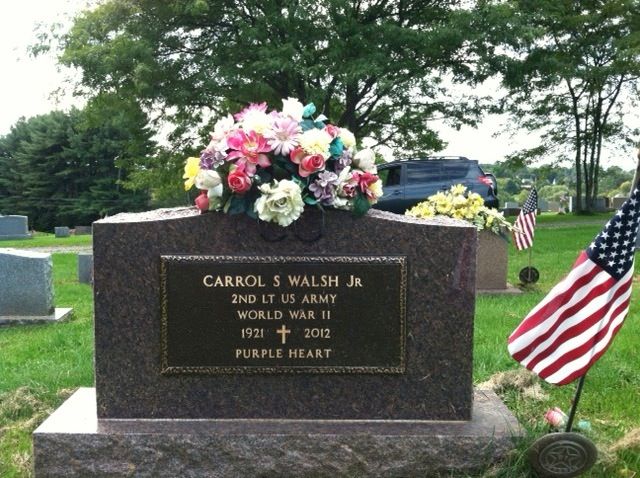
Carrol S Walsh Jr. At rest in Johnstown, NY. Photo by Elizabeth Connolly.

Carrol S Walsh Jr. At rest in Johnstown, NY. Photo by Elizabeth Connolly.

Thirteen summers ago, I sat down for an interview with an amazing man. What he would relate to me, and what I would do with it, would go on to change both of our lives.  A seemingly small incident would be recalled almost as an aside in the wider context of World War II, but then would go on to reverberate through time, and space, creating ripples in the cosmos that grew into waves. Big waves that would carry me, and many others, to places we had never thought possible.

You see, on Friday, April 13th, 1945, twenty-five hundred lives were saved as advance elements of the U.S. Army 743rd Tank Battalion, 823rd Tank Destroyer Battalion, and  30th Infantry Division stumbled across the crime of the century, perhaps of all time.

A train transport stopped at a railroad siding. Open boxcars, sealed boxcars, shabby passenger cars, engine. Some people wandering about, others too ill to move. Sick and emaciated human beings.  Women. Men. Children. SS bands roaming the countryside. Orders to execute. A bridge over the River Elbe ahead to be blown to smithereens. With the transport, and the people on it.

The soldiers told me their stories.  In the course of collecting their narratives, we found others who played their parts and rescued those people.

I listened. We wrote. We recorded, and I posted. Then, the wires began tripping. Seven Septembers ago, we put together the first of many reunions between these soldiers and the child survivors of the Holocaust they rescued.

“Joyful” does not do it justice. What do you say to the men who saved you and your family when you were a child?

Carrol smiles, grips their arms in greeting, and laughs, “Long time, no see!” Sixty-two years, that’s all. On April 13th, 1945, the war weary, “seen-it-all” twenty-four year old second lieutenant is in for the shock of his life.

***************************************************

Five years ago this week, we put on quite a show at our high school.  High school kids listening to, meeting, sharing, laughing, crying, even dancing  with octogenarian U.S. soldiers and Holocaust survivors. ABC World News called my classroom and told me they were on their way up from NYC headquarters to film us. You can see Carrol, and listen to fellow tank commander George Gross’ narrative from our interviews, and hear fellow soldier Frank Towers describe his role in the liberation.

The last evening together, soldiers and survivors from all over the world watched the broadcast together, and we said our prayer of thanksgiving. Hundreds of students became the witnesses for the generations to come.

And so it comes full circle. Nearly ten percent of the passenger list has been found, over 60 years later. Profound things keep happening.

***************************************************

We lost Carrol less than two years ago, George earlier. So I write this week to remember, and remind myself of what a legacy, and gift, they left us. While it may have been a tiny part of  very productive lives (a New York State Supreme Court justice, and English literature professor, respectively), for the rest of my days I will think of the times I got to talk to them, and smile.

And think about their own words: “What are we going to do with all these people?”

Indeed. Just look at the generations that sprang forth, because of what our soldiers stopped to do, in a shooting war. In complex, fluid situations, there are no easy answers, but don’t you think that there is a very important lesson here?

It was not part of the mission. But maybe as a society we should break down and examine the values that made the mission change, if even as a “sideline”.

Sometimes it just feels good to feel proud.

But temper pride with the wisdom of the retired New York State Supreme Court justice:

“No.

They don’t owe us anything. Not a thing.

We owe them~

For what the world allowed to happen to them.”


Read Full Post »

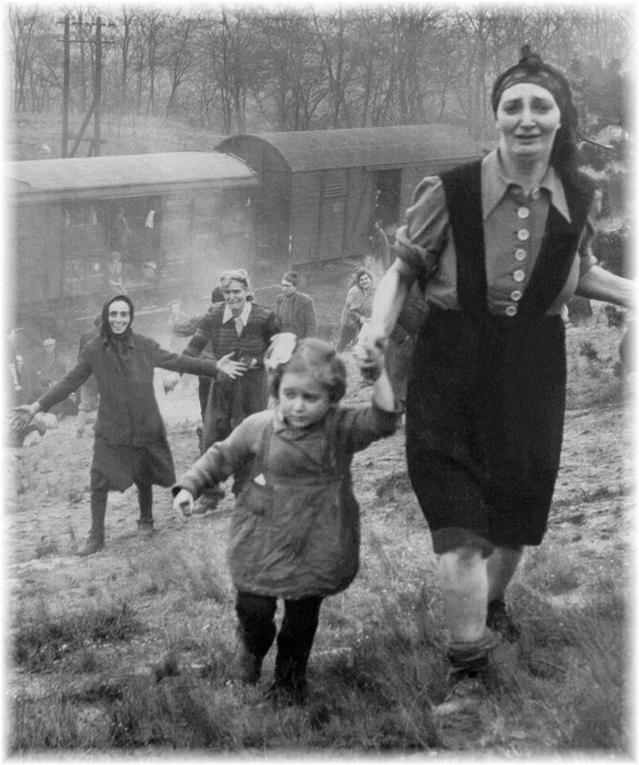
the story behind the photograph.

~the real story behind the iconic photograph~

A high school history teacher sits down with a World War II veteran to record his experiences. Out of the conversation comes the inspiration for a series of events that changes many lives and helps to “repair the world”.

Friday, April 13th, 1945.                              Moment of Liberation.  Farsleben, Germany CREDIT: U.S. Army,     Major Clarence Benjamin, 743rd Tank Battalion.

Friday, April 13th, 1945.
Moment of Liberation.
Farsleben, Germany
CREDIT: U.S. Army, Major Clarence Benjamin, 743rd Tank Battalion.

I’ve said for years, since I was first privately shown it by the American tank commanders whom I interviewed in 2001,  that this photo would be destined to become one of the iconic photographs  of the twentieth century.

Now it looks as if many people agree with me-since being discovered at my website, it’s now apparently been labeled as one of the 40 Of The Most Powerful Photographs Ever Taken “A moving collection of iconic photographs from the last 100 years that demonstrate the heartbreak of loss, the tremendous power of loyalty, and the triumph of the human spirit.” Look at it.

What a story is behind it.

And an even greater story is unfolding now, across time and space, through tragedy and triumph.

We are tripping the wires of the cosmos.

The short version of this story is that American soldiers saved 2500 helpless human beings from probable death. They ended a horrific episode endured by these people and gave them new life. I know two of the three Army officers who were present when the photograph was taken.  And as a history teacher, I worked to reunite them with hundreds of child survivors who were liberated by them on that day.

Can you even imagine what unfolded as they re-met each other after 65, 70 years?

Here, we tell their stories.


********************************************************

Throughout the past decade or so I have worked very hard to bring the story of the American soldiers and the Holocaust to light. I did my private own interview with tank commander Carrol Walsh in July 2001.  Walsh mentioned the train, almost as an afterthought following two hours of conversation (ABC video here), when prompted by his daughter, and directed me to  George C. Gross, the other tank commander present who had  taken additional photographs of the train liberation. He gave me his blessings, his pictures, and his beautiful narrative of the incident, which I posted to my school oral history website in 2002. There it sat for four years, and then we heard from our first survivor in Australia, a grandmother who had been a little girl on the train. I organized reunions and today we have had over a dozen of them, with the first occurring at our high school, mixing students with the survivors ans soldiers from all over the world.

Today, with the help of liberator Frank Towers and survivor’s daughter Varda Weisskopf of Israel we have tracked down nearly 275 survivors who have been very moved to discover the American soldiers who freed them,  fellow survivors and later, even some of the medics who nursed them back to health. I’ve created this blog to chronicle the unfolding of this story. You can get started, here. If you would like to subscribe for updates, there is a button to the right of this page.

********************************************************

~The George C. Gross photos~

We have not yet found the mother and daughter in the photo here, though we have an idea of who they are. But we have found many others who do recognize themselves in Dr. Gross’ photos. You see, Dr. Gross had a small Kodak Brownie camera that his wife sent to him in combat. You can view them here with his narrative of them. They had never been seen outside of family and friends.

What makes these photos so special is that they reveal the moments of liberation. Still, it is important to be  clear that most existing photos of the Holocaust, and Jewish prisoners and trains, are the horrifying images  of victims being transported or offloaded at death camps to be murdered. So this photo is a rarity, and should not be considered an exemplar of the real horror that unfolded; rather, perhaps it derives its power as a testament to the power of the good, and the evil, men are capable of.

Matthew Rozell

In the words of a recent Israel documentary,

Trains in the Holocaust usually carried people to the last stop of their lives. The train of which Matt Rozell heard was a different one. It was going from death to life.

Holocaust survivor Ariela Rojek, right, was 11 years old in 1945 when she and 2,500 other concentration camp prisoners aboard a train near Magdeburg, Germany, were liberated by American forces including 1st Lt. Frank Towers, left with his son Frank Towers Jr., center. “You gave me my second life,” Rojek told Towers Wednesday, Sept. 21, 2011, at Hudson Falls High School during an event reuniting soldiers and survivors.
Jason McKibben Glens Falls Post Star

Read Full Post »

« Newer Posts - Older Posts »