Feeds:
Posts
Comments

Archive for the ‘Uncategorized’ Category

My good friend in Israel let me know that the April 15th  commemoration of the Holocaust at Yad Vashem in Israel was a moving event and sent me the link to the video of the ceremony marking the 70th anniversary of the liberation. While my work at piecing together the  narrative and the story behind the Major Benjamin photograph was not detailed, the photo which now seems to be becoming a cornerstone of the history of Holocaust liberation is all throughout the ceremony and especially at 8:31. One of my friends, a survivor who had been a six year old boy on this transport that Major Benjamin photographed at the moment his jeep arrived at the train, notes,

image.png

The photograph wouldn’t be there if not for your effort. It was presiding on 1.5 hrs of national ceremony in the presence of Israel’s president, prime minister, the entire government, the top army guys, survivors, chief rabbis and was nationally broadcast. You have a direct hand in this.

Me, a lowly teacher, whose work for an evening is presiding over presidents and prime ministers. I am proud and hope that the story is told over and over, and that it serves the memory of the victims, the survivors, and the liberators well. I just can’t believe sometimes this path I have been down, since the day 14 years ago when I took the time to listen to a war veteran, and began to backtrack his story.  There are other forces at work here, I think… and there is a cosmic force that reverberates in you when you teach the Holocaust from the heart.

Teachers out there, you all know the power of what we do. I hope this serves as an affirmation.

*************************************************************

Matthew Rozell is a United States Holocaust Memorial Museum Teacher Fellow and teaches history at his alma mater in upstate New York. His work has resulted in the reuniting of 275 Holocaust survivors and the American soldiers who freed them.

His first book, ‘The Things Our Fathers Saw’, is being released to coincide with the 70th anniversary of the end of World War II. His second book, in progress, is on the power of  teaching, remembering the Holocaust, the Benjamin photograph and this “Train Near Magdeburg’. He can be reached at marozell at gmail dot com.

Read Full Post »

30th Infantry Division Veterans of World War II, Nashville Tennessee, April 2015, 70th anniversary of the end of WWII. Credit: Larry S Powell.

30th Infantry Division Veterans of World War II, Nashville Tennessee, April 2015, 70th anniversary of the end of WWII. Credit: Larry S Powell.

The poet Yaakov Barzilai was on the ‘Train Near Magdeburg’. Originally composed in Hebrew, a  translation has been provided by fellow survivor Micha Tomkiewicz. He has agreed to share his poem on the 70th anniversary of the liberation. ’11:55′  refers to the author’s recollection of the time of the day of the liberation of the train transport; ‘five minutes before the bitter end’.

Dedicated to Frank Towers and 30th Infantry Division soldiers, US liberators of the death train from Bergen-Belsen on April 13, 1945


At Eleven fifty-five.

Return to the Place of Liberation, April 13, 1945, after 65 years.


The train stopped under the hill, huffing and puffing, as though it reached the end of the road.

An old locomotive pulling deteriorating train cars that became obsolete long ago, not even fit for carrying horses.

To an approaching visitor, the experience was of a factory of awful smell – really stinking.

Two thousand four hundred stinking cattle heading for slaughter were shoved to the train cars.

The butterflies into the surrounding air were blinded by the poisonous stench.

The train moved for five days back and forth between Bergen-Belsen and nowhere.

On the sixth day, a new morning came to shine over our heads.

Suddenly the heavy car doors were opened.

Living and dead overflowed into the surrounding green meadow.

Was it a dream or a delayed awakening of God?

When we identified the symbols of the American army, we ran to the top of the hill as though bitten by an army of scorpions, to kiss the treads of the tanks and to hug the soldiers with overflowing love.

Somebody cried: “Don’t believe it, it is a dream”. When we pinched ourselves; we felt the pain – it was real.

Mama climbed to the top of the hill. She stood in the middle of the field of flowers and prayed an almost a silent prayer from the heart.

Only few words escaped to the blowing wind:

‘Soon…Now…..To the chimneys of death…I gave new life….to my children…. and this day… my grandchildren were born… to a good life.

Amen and Amen’.

Yaakov Barzilai.

‘Yaakov Barzilai is an esteemed Israeli poet; he is also a survivor of The Shoah. Born in Hungary in 1933, the year Hitler came to power in Germany he shares, in poetry and prose, a child’s memories of the horrors that befell the Jewish people. He tells of acts of great humanity and others of exceptional, he recounts tales of transportation and eventual rescue. He speaks of losses – family, potential and describes the eventual triumph of man over inhumanity.’ [www.cduniverse.com/productinfo.asp?pid=8756081] 

בְּאַחַת עֶשְׂרֵה חֲמִשִּׁים וְחָמֵשׁ


שִׁיבָה לִמְקוֹם הַשִּׁחְרוּר בִּ 13 בְּאַפְּרִיל 1945

                     כַּעֲבֹר 65 שָׁנָה

הָרַכֶּבֶת עָצְרָה מִתַּחַת לַגִּבְעָה

נוֹשֶׁפֶת וְנוֹהֶמֶת

כְּמִי שֶׁהִגִּיעַ לְסוֹף דַּרְכּוֹ

קַטָּר זָקֵן גָּרַר קְרוֹנוֹת יְשָׁנִים

שֶׁאָבַד עֲלֵיהֶם כֶּלַח,

לֹא רְאוּיִים אֲפִלּוּ לִמְגוּרֵי סוּסִים.

מִי שֶׁהִזְדַּמֵּן לַסְּבִיבָה

הֶאֱמִין שֶׁנִּקְלַע לְבֵית חֲרֹשֶׁת לְסֵרָחוֹן

אַלְפַּיִם אַרְבַּע מֵאוֹת רָאשֵׁי בָּקָר מַסְרִיחִים

שֶׁנּוֹעֲדוּ לִשְׁחִיטָה

נִדְחְסוּ לַקְּרוֹנוֹת

כָּל הַפַּרְפַּרִים בַּסְּבִיבָה הִתְעַוְרוּ

מִסֵּרָחוֹן מַדְמִיעַ.

חֲמִשָּׁה יָמִים נָסְעָה הָרַכֶּבֶת הָלוֹךְ וַחֲזֹר

בֵּין בֶּרְגֶן-בֶּלְזֶן לְשׁוּם מָקוֹם

בַּיּוֹם הַשִּׁשִּׁי, בֹּקֶר חָדָשׁ זָרַח מֵעָלֵינוּ.

בְּבַת אַחַת נִפְתְחוּ הַדְּלָתוֹת הַכְּבֵדוֹת שֶׁל הַקְּרוֹנוֹת

חַיִּים וּמֵתִים נִשְׁפְּכוּ בְּיַחַד

אֶל הַיָּרֹק הַמִּשְׁתּוֹלֵל בַּשָּׂדוֹת.


הַאִם הָיָה זֶה חֲלוֹם

אוֹ הַצָּתָה מְאֻחֶרֶת שֶׁל אֱלֹהִים?

כְּשֶׁזִּהִינוּ אֶת סֵמֶל הַצָּבָא הַאָמֶרִיקָאִי,

כִּנְשׁוּכֵי עַקְרָב שָׁעֲטְנוּ בְּמַעֲלֵה הַגִּבְעָה

לְנַשֵּׁק אֶת שַׁרְשְׁרָאוֹת הַטַּנְקִים

וְלַחֲנֹק אֶת הַחַיָּלִים מֵרֹב אַהֲבָה.

מִישֶׁהוּ צָעַק: “אַל תַּאֲמִינוּ זֶה רַק חֲלוֹם”

וּכְשֶׁצָּבַטְנוּ אֶת עָצַמְנוּ

כָּאָב לָנוּ בֶּאֱמֶת.

גַּם אִמָּא טִפְּסָה אֶל גִּבְעַת הַנִּצָּחוֹן

הִיא עָמְדָה בְּתוֹךְ שָׂדֶה שֶׁל פְּרָחִים וְהִתְפַּלְּלָה

מִתּוֹךְ הַתְּפִלָּה הַחֲרִישִׁית שֶׁנֶּאֶמְרָה בַּלֵּב

רַק מִלִּים בּוֹדְדוֹת הִסְתַנְנוּ אֶל אֲוִיר הָעוֹלָם:

” וְכָאן… וְעַכְשָׁו… עַל פַּסֵי הָרַכֶּבֶת…

קָרוֹב… לַאֲרֻבּוֹת הַמָּוֶת…נָתַתִּי…

חַיִּים חֲדָשִׁים…לִילָדַי… וְהַיּוֹם הַזֶּה…

נוֹלְדוּ גַּם נְכָדַי… לְחַיִּים טוֹבִים…

אָמֵן… וְאָמֵן…                                                                     יעקב ברזילי

Read Full Post »

APRIL 19, 2015, 3:09 P.M. E.D.T.

BUDAPEST, Hungary — Hungarian Holocaust survivors rescued 70 years ago from a train taking them from one concentration camp to another on Sunday paid tribute to the American soldiers who helped liberate them.

Julia Kadar, who organized a commemorative meeting in Budapest, was among those who spoke via Skype with Lt. Frank Towers, who was in Nashville, Tennessee. He had been the liaison officer of the 30th Infantry Division which liberated the train near the German village of Farsleben on April 13, 1945.

“We thank the heroic American soldiers for being able to live meaningful, useful lives — we are grateful for being able to grow old,” said Kadar, who was 6 at the time.

About 2,500 Jewish prisoners, including 560 children, were being taken from the Bergen-Belsen camp in Germany to the Theresienstadt camp in Czechoslovakia when they were rescued.

Colleen Bell, the U.S. Ambassador to Hungary, highlighted the “indelible imprints” made over the years by those who Towers helped to freedom.

“This is my reward,” Towers said. “They were nobody. They had nothing and they have risen up from the ashes and have become doctors and lawyers, engineers, all high-level professional people.”

Laszlo Ungvari, 7 when he was freed and who helped Towers compile a list of the Hungarian survivors, bought a cup from an American military mess kit to Sunday’s remembrance, a memento found then by his grandfather in Hillersleben, the German town where those rescued from the train were initially taken.

The metallic cup, which had belonged to a U.S. soldier from Nebraska, was etched with the names of the locations where the soldier had been, including London and Holland.

“The names and places on the cup are like a historical exhibit,” said Ungvari, a retired computer expert who spent four months in the Bergen-Belsen camp. “It’s been a penholder on my desk for decades.”

Ungvari ‘s father died of typhus a few days after their rescue and his mother didn’t speak about the Holocaust until a few years before her death a few years ago, though the family kept their Jewish identity.

Sunday’s meeting was attended by 20 Holocaust survivors rescued from the train and dozens of their descendants and relatives. About 550,000 Hungarian Jews were killed in the Holocaust.

Today, there are an estimated 100,000 Jews in Hungary, the largest Jewish community in Central Europe, and the number of Jewish festivals, schools and synagogues is growing.

Still, many are concerned about anti-Semitism and the success of the far-right Jobbik party, which won 20 percent of the votes in last year’s parliamentary elections and has become a serious challenger to Prime Minister Viktor Orban’s Fidesz party.

“Nearly half of the Holocaust survivors here rejected being photographed” during the meeting, said Kadar, a retired psychologist and university professor. “They are afraid … and were worried about appearing in front of a camera.”

___

Johnny Clark in Nashville contributed to this report.

http://www.nytimes.com/aponline/2015/04/19/world/europe/ap-eu-hungary-us-holocaust.html?_r=0

Read Full Post »

"The anguish of the liberation and return to life". Note the Benjamin photograph on the banner.

“The anguish of the liberation and return to life”. Note the Benjamin photograph on the banner. From the Yad Vashem website.

Fourteen summers ago I sat down to listen to an old gentleman in a rocking chair. A  war weary tank commander in 1945, he told me stories of his World War II experiences and then showed me a picture that his major had taken on April 13, 1945. You see, he was there. It would be the first time in decades that this picture had seen the light of day. And because of its discovery, and what we would do with it, thousands of lives were about to change.

Yad Vashem, the Holocaust Authority in Israel, contacted me in December 2014 to inquire about using the Major Benjamin photo. I did immediately send them a high resolution copy. My friend in Israel writes, ‘[The photograph above was taken] during the main ceremony at  the Holocaust Remembrance Day at Yad Vashem. This photo shows the President of Israel Reuven Rivlin make his speech. You can see your photo there at the middle (banner) and I now think it was there throughout all the ceremony.’

I hope that whoever was present or sees this photograph will visit our website to learn the powerful story behind this amazing photograph in the context of the 70th anniversary of the liberation. No wonder the survivors of the train refer to April 13th as the day they were reborn. Below is the proper information.

Matthew Rozell

From Yad Vashem:

Holocaust Martyrs’ and Heroes’ Remembrance Day (Yom Hashoah in Hebrew) is a national day of commemoration in Israel, on which the six million Jews murdered in the Holocaust are memorialized. It is a solemn day, beginning at sunset on the 27th of the month of Nisan and ending the following evening, according to the traditional Jewish custom of marking a day. Places of entertainment are closed and memorial ceremonies are held throughout the country. The central ceremonies, in the evening and the following morning, are held at Yad Vashem and are broadcast on the television. Marking the start of the day-in the presence of the President of the State of Israel and the Prime Minister, dignitaries, survivors, children of survivors and their families, gather together with the general public to take part in the memorial ceremony at Yad Vashem in which six torches, representing the six million murdered Jews, are lit. The following morning, the ceremony at Yad Vashem begins with the sounding of a siren for two minutes throughout the entire country. For the duration of the sounding, work is halted, people walking in the streets stop, cars pull off to the side of the road and everybody stands at silent attention in reverence to the victims of the Holocaust. Afterward, the focus of the ceremony at Yad Vashem is the laying of wreaths at the foot of the six torches, by dignitaries and the representatives of survivor groups and institutions. Other sites of remembrance in Israel, such as the Ghetto Fighters’ Kibbutz and Kibbutz Yad Mordechai, also host memorial ceremonies, as do schools, military bases, municipalities and places of work. Throughout the day, both the television and radio broadcast programs about the Holocaust. In recent years, other countries and Jewish communities have adopted Yom Hashoah, the 27th of Nisan, to mark their own day of memorial for the victims of the Holocaust.

Holocaust Martyrs’ and Heroes’ Remembrance Day 2015 will be on Thursday, 16 April. The State opening ceremony will be held at Yad Vashem on Wednesday 15 April at 20:00.

Read Full Post »

Update from Nashville: At the 30th Infantry Veterans of WW2 70th anniversary reunion.

Today’s events began with the posting of the colors and a moving memorial service for the veterans of the 30th Infantry Division and 743rd Tank Battalion who have moved on. Missing many, especially for me Buster Simmons, who would offer up a prayer at this gathering in his capacity as chaplain. Rest on,old soldier.

94 year old veteran Marion Sanford comes up to me and grips my hand. I have not seen him in 2 years, but he is the same to me as he always was. As a reconnaissance man for the 30th Infantry Division, he tells me how much he saw and how much now in retrospect meeting the survivors and their families has meant to him. He saw many terrible things overseas, which he felt he had to leave out of his 2012 book, ‘Old Hickory Recon’. Don’t think for a minute that a soldier understood why a friend might be killed and the fickle hand of fate spared another. In what way can this be justified? Survivors’ guilt was not just for the Holocaust survivors to experience. But this ‘small’ incident, the liberation of the train near Magdeburg, seems to have altered his perspective and the perspective of many of the soldiers I have met at these reunions. It seems to have enhanced and  added to ‘man’s search for meaning’, in a sense, as far as the soldiers go.

0417151104-00

Posting the colors. MC Frank Towers in the background. Frank will be 98 in June.

 ***

After lunch, moving talks today by survivors George Somjen (Hungary), Elisabeth Seaman (Netherlands), Micha Tomkeiwitz (Poland) . To their liberators they recounted the events that they remembered and  more importantly, the impact that the liberation and the meeting of their liberators meant not only for them and their families, but also  the world.

Later, the amazing reflections of the 2nd generation ‘Train near Magdeburg’ survivors who are with us for the first time: Evelyn Marcus, formerly of the Netherlands, Orly Beigel of Mexico, and Marc Boyman of Canada. April 13th, the liberation date, for their families was a date always remembered and celebrated; a time to remember how the American soldiers loved life, and loved people, and treated the survivors with such tenderness, empathy, and respect, in marked contrast to the soldiers from another Allied nation who moved in to replace the Americans as the terms of the peace settlement were adjusted.


L-R: Peggy Wonder, 2nd G; Evelyn Markus, 2nd G; Frank Towers, liberator; Orly Beigel, 2nd G; Micha Tomkeiwicz, Elisabeth Seaman. Missing: Marc Boyman, 2nd G; George Somjen.

L-R: Marc Boyman, 2nd G; Peggy Wonder, 2nd G; Evelyn Markus, 2nd G; Frank Towers, liberator; Orly Beigel, 2nd G; Micha Tomkeiwicz, Elisabeth Seaman, Matthew Rozell Missing: George Somjen. Photo credit: Patti Jordan. 4-17-15.

I heard today so many vignettes of hope and promise for the future of mankind. And this, I witnessed with my own eyes. This gathering, this whole trip is an affirmation of the goodness of mankind, a meditation on the profound difference  that  one’s actions can make, and the confirmation that teaching history really does matter.

Orly Beigel’s mother, far left, 1945. Commonly mislabeled as ‘Buchenwald Survivors Entering Israel, 1945’. No. These girls ( L-Jetty (Jetta) Halpern and R-Magda Werber, together with Jetty’s older sister Golda Katz-Halpern, not pictured) pulled into the station at Guard d’Lion, Paris in France with much fanfare several weeks after liberation; there was a celebration as they arrived, so they thought that a celebrity must be on board. The war was over. In a rare instance, the survivors were the ones being celebrated.


Read Full Post »

Yom HaShoah ceremony and service, Jewish Federation of greater Rochester, New York, April 15, 2015. 700 folks come out on a midweek night. From an audience member: ‘The most beautiful, inspirational Yom HaShoah service I have ever been to.’

It was indeed a moving service and I was honored to have a part in it.

We stop and we pause, to reflect and remember.

Key take-aways from my presentation:


  1. The American Army was involved in a shooting war. More soldiers would die in the days to come. But they stopped. They helped these people. And some carried the trauma with them for the rest of their lives.
  2. People need heroes. But few of the liberators would like to be remembered this way. Maybe we should all take a moment to think about our own obligation to humanity.
  3. For every one person who was liberated on this ‘Train Near Magdeburg, nearly 2500 persons, keep close the reality that another 2500 perished in the Holocaust.
  4. Finally, the voices of the eyewitnesses need to always be with us. We need to keep them close. Or forget at our peril.

***

Carrol Walsh, liberator: Our lives were joined at that moment on April 13, 1945, and now we meet face to face and recall together that moment when my tank reached the train.

Steve Barry, survivor:There is no other army in this world that would stop and help 2500 lice-ridden, emaciated Jews, to save them. What army would stop, except the American army?

Steve Barry: Mounted SS troops came around, rode by the train, and started to yell ‘Raus, Raus, get out of the train!  Get out of the cars!’  And we saw them putting up machine gun nests. So obviously, even at that last moment, they were still trying to murder us.

Carrol Walsh: I had no idea who they were, where they had come from, where they were going – nothing. No idea. All I knew: here’s a train with these boxcars and people jammed in those boxcars. No idea. No, I had no idea.

Steve Barry: Very shortly after that we saw the first American GIs.  Well, actually there were two tanks.  I still get tears in my eyes. Right now I have tears in my eyes and I always will when I think about it.  That’s when we knew we were safe.

Letter  from Carrol Walsh to Steve Barry, 2008: ‘You are always expressing gratitude to me, the 743rd Tank Battalion and the 30th Infantry Division. But I do not believe gratitude is deserved because we were doing what we, and the whole world, should have been doing- rescuing and protecting innocent people from being killed, murdered by vicious criminals. You do not owe us. We owe you.  We can never repay you and the Jewish people of Europe for what was stolen from you: your homes, your possessions, your businesses, your money, your art, your family life, your families, your childhood, your dreams, and all your lives.’

Steve Barry:  Is this a beautiful person?

Carrol Walsh:  I think, I cannot believe today, as I look back on those, on those years and on what was happening, I cannot believe that the… world almost ignored those people and what was happening. I cannot believe it. How could we have all stood by and have let that happen? We owe those people a great deal. We owe those people everything. They do not owe us anything. We owe them for what we allowed to happen to them. That is how I feel.


Read Full Post »

I’m speaking this evening in Rochester, NY. You should be able the watch the ceremony beginning at 7pm EST at this feed:


Through the Eyes of Liberators: History Comes to Life

Yom HaShoah, Holocaust Remembrance 2015


Matthew A. Rozell will be keynote speaker at this year’s Yom HaShoah program, providing fascinating insights in his many years connecting Holocaust survivors with their liberators – soldiers of WWII.


The Federation’s Center for Holocaust Awareness and Information (CHAI) presents our annual commemoration of victims and survivors of the Shoah, this year entitled “Through the Eyes of Liberators: History Comes to Life,” on Wednesday, April 15, 2015 at 7 pm at the Jewish Community Center.


Rozell, a teacher of history at Hudson Falls (NY) High School has provided students with life-changing experiences that have underscored his driving missions — to promote history and Holocaust education as something vital and alive and to foster a curiosity and attention to the suffering of others that leads to passionate involvement.


Rozell is recognized as a leader in World War II and Holocaust history. He and his students have personally interviewed more than 200 WWII veterans and have published many stories that would have otherwise been lost. He has been instrumental in reuniting over 275 Holocaust survivors with several American soldiers who liberated them from a train in Nazi Germany on April 13, 1945 and nursed them back to health. Rozell has organized or helped facilitate powerful reunions, witnessed by thousands of students.
Matthew A. RozellIn 2008, Rozell was awarded a Museum Teacher Fellowship at the United States Holocaust Memorial Museum for his work in Holocaust education; he has also been the subject of a documentary, “Honoring Liberation,” produced by the museum. His work has also been modeled in educational programs across the nation. In 2009, Rozell and his students were named ABC World News “Persons of the Week” by Diane Sawyer.
Learn more at his website,TeachingHistoryMatters.com.
Photo above: Moment of Liberation. Credit: Major Clarence L. Benjamin, 743rd Tank Battalion

Read Full Post »

April 17th. (1945)

Dear Chaplain;-

Haven’t written you in many months now, its funny how a few moments are so hard to find in which to write a letter way past due; it’s much easier to keep putting it off the way I’ve done. I’ll try to make up for it in this letter.

Today I saw a sight that’s impossible to describe, however I’ll try. Between 2400 and 3000 German refugees were overran by my division during our last operation; most of them were, or had been, inmates of concentration camps, their crimes the usual ones, – Jewish parentage, political differences with der Fuhrer, lack of sympathy for the SS, or just plain bad luck. Not one of these hundreds could walk one mile and survive; they had been packed on a train whose normal capacity was perhaps four or five hundred, and had been left there days without food.

Our division military government unit took charge of them, and immediately saw what a huge job it was going to be, so they sent out a call for help. Several of our officers went out to help them organize the camp they were setting up for them. The situation was extremely ticklish we soon learned; no one could smoke as it started a riot when the refugees saw the cigarette, and we couldn’t give the kiddies anything or they would have been trampled to death in the rush that would result when anything resembling food was displayed. The only nourishment they were capable of eating was soup; now the army doesn’t issue any of the Heinz’s 57 varieties, so we watered down C-ration[s] and it served quite well.  It was necessary to use force to make the people stay in line in order to serve them. They had no will power left, only the characteristics of beasts.

A few weeks of decent food will change them into a semblance of normal human beings; with God willing the plague of disease that was already underway, will be diverted; but I’m wondering what the affect of their ordeal they have been through, will be on their minds; most will carry scars for the rest of their days for the beatings that they were given. No other single thing had convinced me as this experience has that Germany isn’t fit to survive as a nation. I’ll never forget today.

I was going to write mother tonight but thought better of it. I’ll be in a better frame of mind tomorrow. I’m only a few dozen miles from Berlin right now, and its hard to realize the end is in sight. I’m always glad to receive your scandal sheet. You perhaps missed your calling, as your editorial abilities are quite plain.

As ever,

Charles.

March 11th, 2009

Dear Mr. Rozell:

My father-in-law was 1st. Lt. Charles M. Kincaid. He was a Liason Officer with the 30th. Division Artillery.  He was honored with an Air Medal in the battle of Mortain and a Bronze Medal in the battle of St. Lo.  In the battle of Mortain he won his Air Medal by calling in artillery adjustments while flying in a Piper L-4 over 4 panzer divisions on August 9, 1944.

first-lt-chuck-kincaid-sept-1944He rarely wrote home. He did write home to his minister about one event that evidently really caused him to stop and think. Attached is a copy of that letter that his sister transcribed – making copies for others to read.  The letter describes the Farsleben train and his experience there.
I need to thank you for your website and work. You and your students work enabled me to connect the letter with the actual historical event. It further enabled me to show my children the pictures and to make their Grandfather’s experience real, not just an old letter – that this event so affected him that he needed to tell his minister before he told his mother.

Thank you,
Mark A.

Read Full Post »

Friday the 13th. Today is the 70th anniversary, to the day.

This account comes to me from a survivor’s son who lives in Hungary. He had read of Carrol Walsh’s passing on the internet and contacted me. It is Carrol who is commanding one of these tanks. Sgt. George Gross commanded the other, and took photographs.

I just came across this website . My father was on this train.
He passed away twenty years ago, in April 1992.

Here is an excerpt from his memoirs about his liberation day.
—————————————————-

Translation from my father’s Memoirs pp. 302-304.
————————————————-

The day of April 13 1945 was a Friday and a sunny and windy day. In the morning, the SS opened the doors of the freight cars, after they had argued with each other whether they should kill us with their submachine guns. But the US troops were too close.

——————————————————————-

Perhaps it was an older SS man who prevented our execution. Later that day, a Jewish woman, who had been his lover in the camp, saved him from becoming a prisoner of war or worse. She got him civilian clothes, I do not know how. The same woman became the lover of an American soldier later.
——————————————————————

Several hundred people wrapped in rags streamed through the open doors, if they could be called people at all. We were all mere skeletons.

The train was idling in a deepening, so I climbed uphill, across a road and to a field. I was pulling out potatoes planted on the field, when a motorcycle approached. It was a motorcycle with a side-car. There was an elegant SS or Nazi leader in the front: I could not decide, since he was wearing a mixture of uniform and civilian clothes. It must have been his wife sitting behind him and his child in the side-car. He pulled over and offered me a cigarette. I told him I did not smoke, so he closed his silver-looking cigarette-case and started the engine.
He seemed to hesitate about the direction he should take.

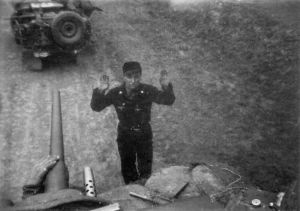
Prisoner taken. Photo by tank commander George C Gross, April, 1945.

Prisoner taken. Photo by tank commander George C Gross, April, 1945.

Then two small American tanks arrived. I was standing in the middle of the road, and noticed that the American soldier leaning out of the turret of one of the tanks aimed his gun at me.
The tank came closer and closer, and the soldier lowered his submachine gun. I must have looked terrible, so he did not take me for an enemy. I was lucky he had not shot me from the distance, since my small coat and boots vaguely resembled a military uniform. Lice were crawling all over my clothes and skin.

The few hundred former inhabitants of the concentration camp surrounded the tanks right away. Suddenly somebody remembered that the SS guarding us were still in the carriages. The SS were caught quickly, and lined up. The “intrepid” SS were trembling so heavily that their pants were flapping.

The first thing a Jewish woman asked from the soldier leaning out from the tank was money, and she received a dollar bill. She must have established her future with this dollar.

My attention was drawn to something else: in the rear of the tank there was a box of canned food. I climbed under the tank, emerged at its end, and pulled out a can. It turned out that I stole a can of oranges. This was my luck. I ate the potatoes charred in the can with the oranges, and probably this combination saved my life. Everyone who ate meat or anything greasy died within hours or within one or two days at the latest.

I felt fever in my body, undressed completely naked in front of staring women, and went into the ice-cold water of the lake next to the railroad. People warned me not to do this, but I went into the water, felt good, felt that I got rid of the lice and the burning heat of the fever. When I put on my rags again, I felt the fever ever stronger.

I asked an American soldier to sign the photo of my fiancee (I still have this photo). To my surprise, he signed the name Churchill. I thought he was joking. But he reassured me that his name was really Churchill.

(Once I read about a father named Churchill, who went to see his son’s grave in Vietnam during that war. The report mentioned that the father had been a soldier in World War II. He must have been my Churchill)

In the evening, there were news that we should flee, because the Germans pushed back the Americans. The Germans would massacre us for sure, the women had pulled out material for parachutes from a carriage in order to make clothes.

I was already so weak that I did not care whether the returning Germans would kill me: I stayed in one of the carriages, and fell asleep.

On Saturday, April 14, German peasant [horse-drawn] carts came for us by some order, so I was carried to Hillersleben. I dragged myself to the first floor of the first building, it looked like an office building, lay down under the sink of the bathroom, and fell asleep.

I am sure the American soldiers had no idea who we were and what we went through.

*******************************

First published in 2013. I am off to the last survivors/liberators reunion in Nashville Tennessee, this weekend.

Read Full Post »

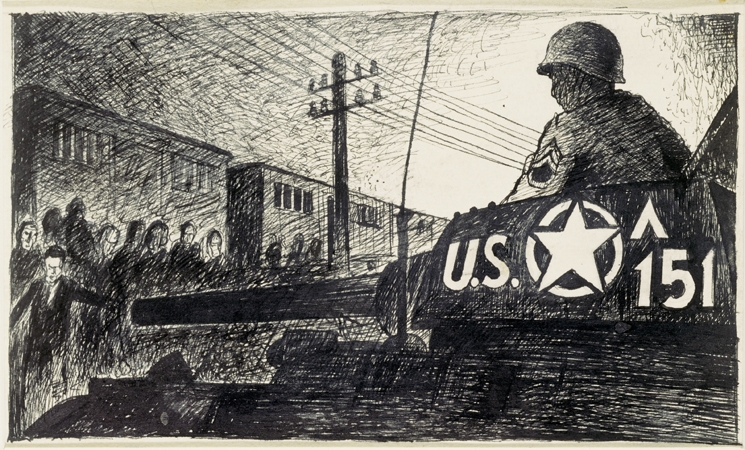
Liberation, April 13th, 1945. Drawing by survivor Ervin Abadi. USHMM.

Liberation, April 13th, 1945. Drawing by survivor Ervin Abadi. USHMM.

DEAR MR. ROZELL–I READ TODAY WITH GREAT INTEREST THE AP ARTICLE ABOUT THE TRAIN AND YOUR PROJECT…

MY MOTHER, SISTER AND I WERE ON THAT TRAIN . I WOULD LIKE TO SHARE WITH YOU SOME OF MY MEMORIES.

THE FIRST SIGHT I HAD OF THE AMERICANS FROM INSIDE THE TRAIN WAS OF AN EMPTY VEHICLE SUCH AS WE HAD NEVER SEEN BEFORE—IT HAD A GREAT WHITE STAR ON IT, AND SOMEONE-FAMILIAR WITH THAT STAR SAID:” THE AMERICANS ARE HERE” .

NOW I KNOW THAT IT WAS A JEEP—AND IT MUST HAVE BEEN ON A RECONNAISSANCE MISSION, AND IT WAS EMPTY MAYBE, BECAUSE THE SOLDIERS TOOK COVER, SEEING THE TRAIN.

I WILL FOREVER SEE THE WHITE STAR AND THAT AMAZING JEEP IN MY HEART—

SOON, THE SOLDIERS CAME AND TOLD US SADLY THAT FRANKLIN DELANO ROOSEVELT HAD DIED THE DAY BEFORE ON APR 12.. THEY TOLD US, THAT IT WAS FRIDAY, APR 13, 1945—WE DID NOT KNOW THE MONTHS AND THE DAYS ANYMORE, LOST COUNT OF TIME IN BERGEN BELSEN.LONG BEFORE.

THE SOLDIERS CAME, AND WERE GENTLE AND GAVE US FOOD. FOR 2 DAYS WE SLEPT ON THE HILLSIDE—AND THEN WE WERE BILLETED INTO ABANDONED GERMAN HOMES IN A TOWN CALLED HILLERSLEBEN JUST OUTSIDE OF MAGDEBURG.

D.D.T. HAS A VERY BAD REPUTATION TODAY—- BUT I WILL FOREVER THINK OF THE D.D.T WITH A GREAT DEAL OF AFFECTION. WE WERE LINED UP, SPRAYED WITH DDT THAT KILLED THE MILLIONS OF LICE THAT INFESTED US. THE AMERICANS BURNED OUR RAGS AND GOD KNOWS FROM WHERE GAVE US CLEAN CLOTHES.

AS I WAS A CHILD I FANTASIZED THAT THE SOLDIERS WERE ANGELS, WITH THEIR WINGS HIDDEN UNDER THEIR UNIFORM SHIRTS.

TODAY I KNOW THAT THIS WAS NO FANTASY. IN THAT PLACE, AND AT THAT TIME THE AMERICAN SOLDIERS WERE ANGELS INDEED.I WAS 10, MY SISTER WAS 8. WE WERE HUNGARIAN JEWS.I, TOO HAVE MANY QUESTIONS FOR YOU, AND WILL CALL YOU SOON…

-I JUST CAN NOT BELIEVE THIS IS HAPPENING —THE AP ARTICLE —YOUR PROJECT—–62 YEARS LATER—

WILL YOU BE SO KIND TO FORWARD MY “TRAIN” LETTER TO MR WALSH AND MR GROSS. PLEASE TELL THEM THAT I LOVE THEM AND THAT IS NOT AN OVERSTATEMENT—

SO MUCH THANKS TO YOU, DARLING MATT

SINCERELY YOURS WITH MANY THANKS FOR YOUR PROJECT

AGNES B.

**********

a lovely reminder of the power of this project, one of many sent to me by survivors on September 15th, 2007.

Read Full Post »

« Newer Posts - Older Posts »