"for the sake of humanity"… A small town American high school history project changes lives worldwide. These are the observations of a veteran teacher- on the Power of Teaching, the importance of the study of History, and especially the lessons we must learn, and teach, on the Holocaust. Click on "Holocaust Survivors, Liberators Reunited" tab above to begin.
World War II · 351st Bomb Group · B-17 · July 29, 1944
The Ripples Go Forth: A Message Across Eighty Years
By Matthew Rozell
March 30, 2026
It started, as so many things do now, with a Facebook message out of the blue. A stranger’s name in my inbox, but then a few lines that stopped me cold.
Her name was Eileen Kaynan. She had been searching for her uncle online — the way people do today, typing a name into a search bar, half-expecting nothing — when the internet handed her something extraordinary. A photograph.
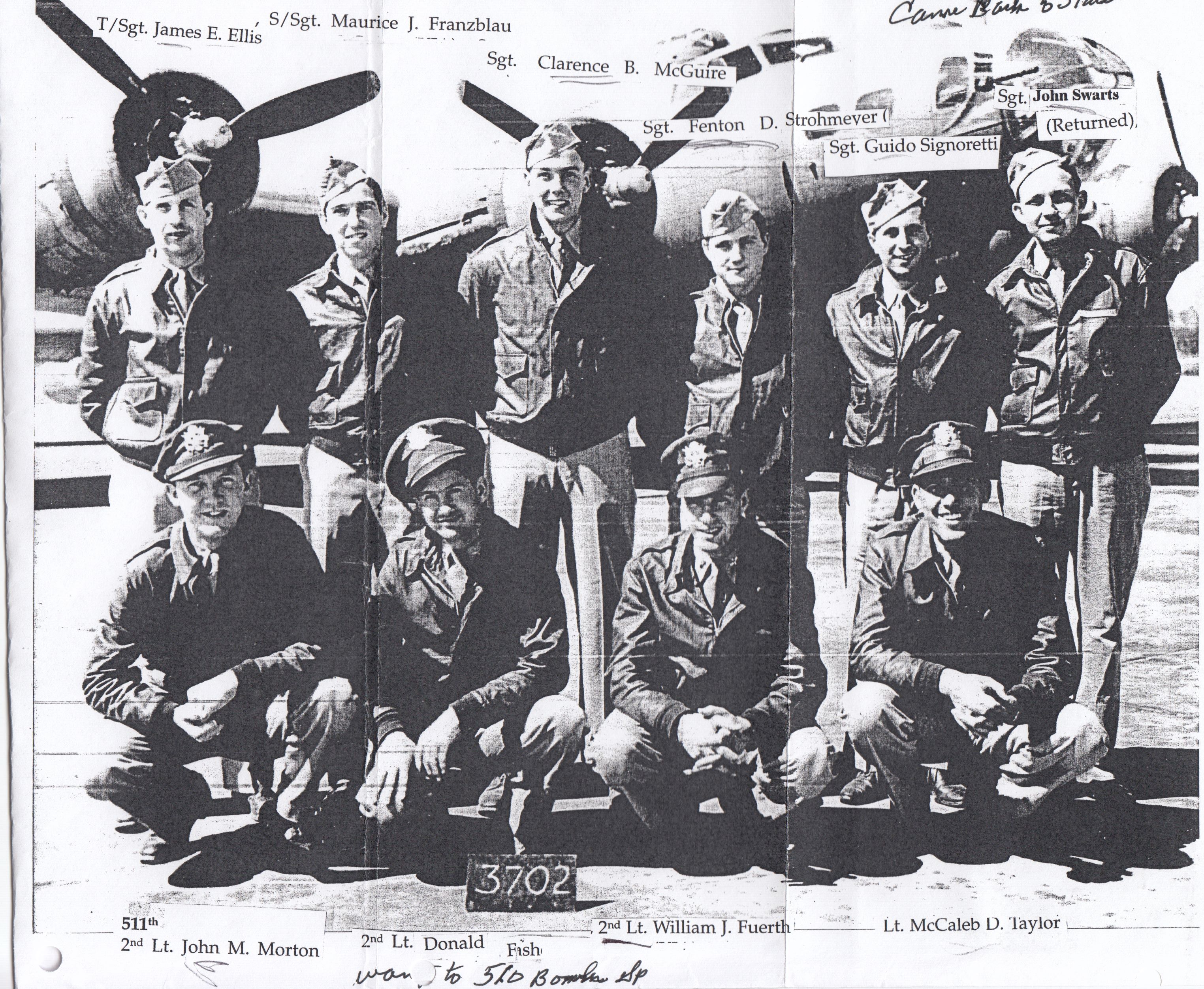
The same photograph that had hung in her grandmother’s living room for as long as she could remember. Ten young men in front of a B-17 Flying Fortress. And there, labeled now in someone else’s handwriting, was her uncle: Sgt. Guido Signoretti.
I just recently bought the book The Things Our Fathers Saw, Vol. 2. I became aware of it when I did a Google Search of my Uncle's name. He was one of the aircrew that Clarence McGuire and John Swarts were part of. His name was Guido Signoretti. Imagine my surprise to see the same photo of the aircrew that hung in my Grandmother's living room all the while I was growing up.
My Mother — Guido's sister — is 91 and I shared the information with her. We had been contacted by the Army a few years ago to provide DNA to aid in their search to identify remains.
His story is one of the reasons I served in the United States Navy. We should never forget them.
— Eileen Kaynan, March 19, 2026
Read that again. Ninety-one years old. The Army, still searching, still trying to identify remains. And a niece who joined the Navy — eighty years later — partly because of a young man she never met, whose photograph watched over the family home like a quiet vigil.
I had to sit with that for a while.
The Photo That Haunted Two Houses
When I wrote the introduction to The Things Our Fathers Saw, Volume II, I described the crew photo that had followed me through childhood. It hung somewhere in the background of memory — ten men, young, smiling, someone’s hand having placed a small cross over the head of one of them, Clarence McGuire, my father’s cousin. Dead at twenty, on his sixth mission over Germany, July 29, 1944. Clarence’s grieving mother probably drew that cross, in our household picture, that I stared at in wonderment as a young boy and teen. Just look at the smile on him, the tallest one in the back row.
What I never knew — what I couldn’t have known — was that the very same photograph was hanging in another home, in New Jersey, watched over by another grieving mother. Guido Signoretti’s mother. Standing near in the back row to Clarence in that picture. Friends, it turns out. Close ones. And look at the smile on him!
Two families. Two homes. One photograph, reproduced and carried and kept. And for more than eight decades, no connection between them.
Until Eileen typed her uncle’s name into a search bar.
Who Was Guido Signoretti?
Born December 18, 1921, in Leonia, New Jersey. The family later moved to Dumont, NJ, around 1939. His sister — Eileen’s mother, now 91 — was born when their mother was 40 years old, meaning she was only about nine years old when Guido was killed. She has outlived all of her siblings. She is the last one left who remembers him from those years.
Eileen told me she has digitized letters Guido sent home during his training stateside, before he shipped out to England. Letters from a young man who didn’t yet know what was coming. Letters that a family kept, carefully, for eighty years.
The Army contacted the family in recent years requesting DNA — still working, still trying to bring people home.
John Swarts Remembered Him, Too
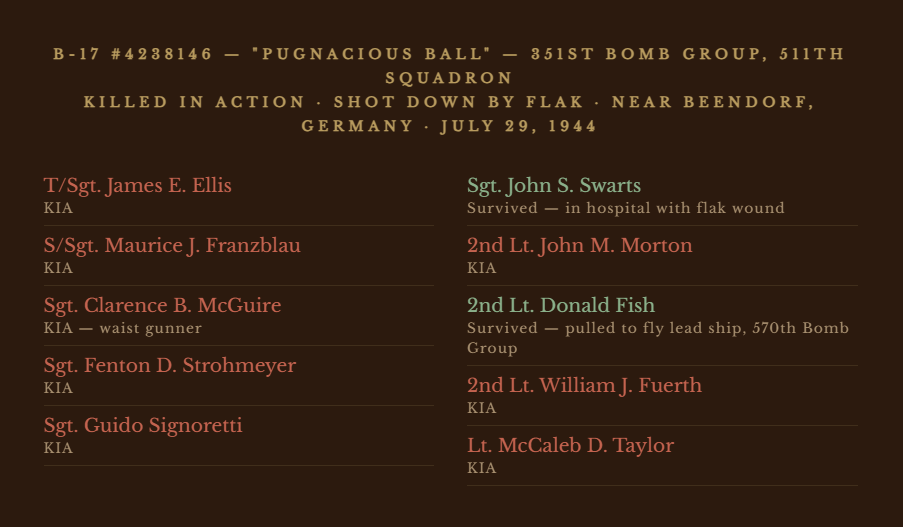
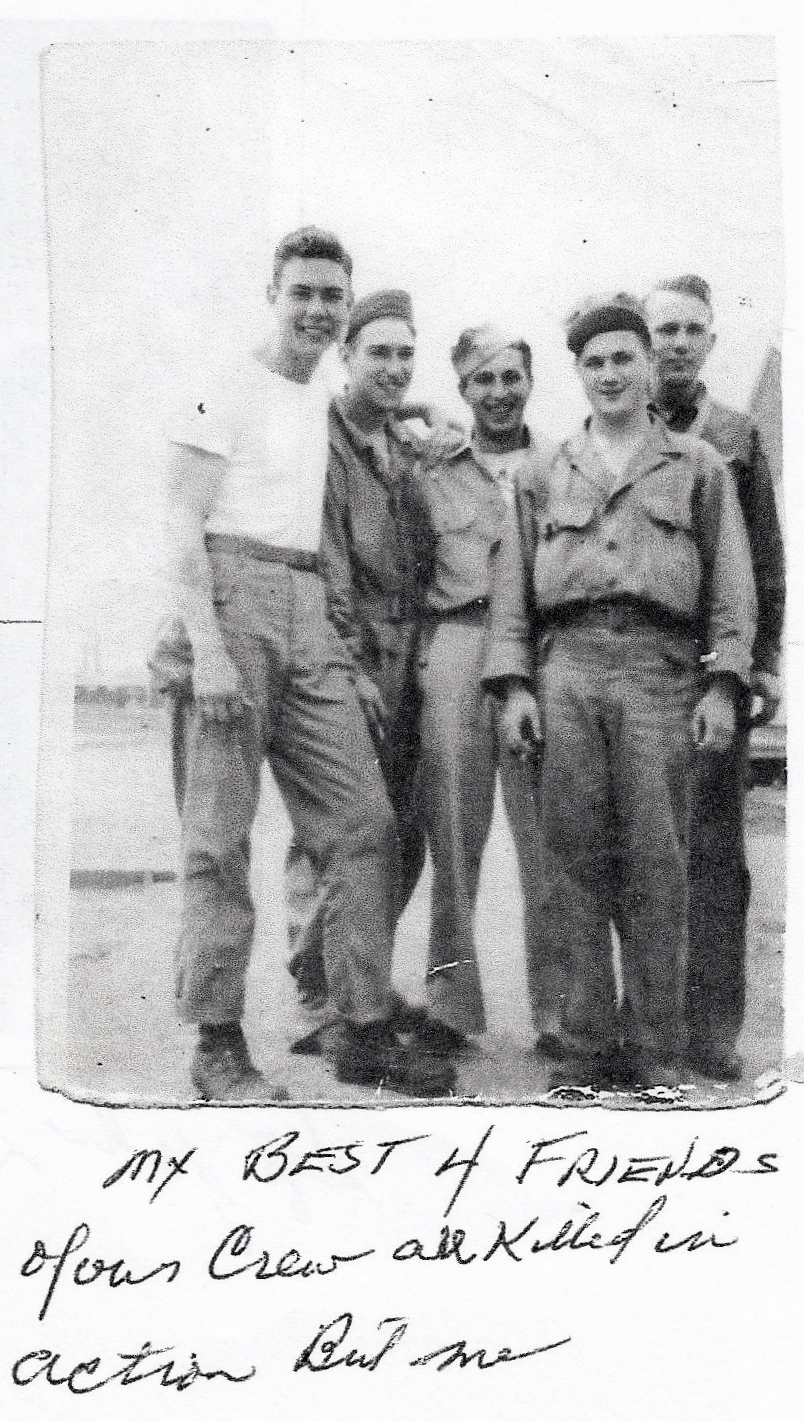
When I finally tracked down John Swarts — the tail gunner, the one who survived because flak had burned his eyelid two days before and put him in the hospital — he sent me photographs and scrapbook pages. Among them was a picture of five young men, standing together, candid and grinning. On the back, John had written in his own hand: “My Best 4 Friends of our crew, all killed in action but me.”
Left to right: Clarence McGuire. Maurice Franzblau. Guido Signoretti. Fenton Strohmeyer. John Swarts.
Guido is there, right in the middle of John’s best friends. He is in the photo that opens the book. He is named, placed, remembered — by a man who by then had lived ninety-three years and still called July 29, 1944 the worst day of his life.
When Eileen’s message arrived and I told her about John’s photograph, the caption, the handwriting — all killed in action but me — she had no idea until she opened the first page of my book. She had never seen that image in her life, and neither had his little sister. A photo of her uncle, captioned by a grieving friend, sitting in a scrapbook in Missouri, now Florida, for eighty years. She was seeing it for the first time.
Does It Bring Closure?
I’ve been turning this question over since her message arrived.
I don’t think history works that way — not cleanly, not finally. Eileen’s 91-year-old mother studied the labeled crew photograph “pretty hard,” Eileen told me. She was nine years old when her brother died. She has spent a lifetime with a fragment of that story, knowing only what a child could piece together from siblings and letters and a photograph on a wall.
To learn, now, that her brother was one of John Swarts’ best friends, that he stood in the middle of a picture captioned with grief and love, that a historian’s cousin and her brother were crewmates, perhaps friends, killed on the same mission on the same plane — that the photograph that watched over one family’s living room was the same one that haunted another family’s memory — I don’t know that “closure” is the right word for what that does.
Maybe it’s more like: recognition. The feeling that someone’s life, however brief, left marks that lasted. That the people who loved him were not alone in remembering, that across eight decades and two family lines who never knew each other — that the weight of that July morning in 1944 was being carried by more people than anyone realized.
✦ ✦ ✦
I wrote in the epilogue to that book: The ripples go forth. But they also come back. I meant it about John Swarts calling me out of the blue in 2017. About my students leaving memorial pebbles at a grave, about the way history, if you let it, keeps moving through time and finding new people to touch.
I didn’t know then that the ripples were still traveling. That a woman in New Jersey would type her uncle’s name into a search bar seventy-three years after the plane came down, and find her way to a book, and find her way to me, and that I would find my way back to her — and that together we would find Guido Signoretti standing in the middle of a photograph, surrounded by friends, remembered.
Eileen wrote to me: We should never forget them.
She is right. And the extraordinary thing — the thing that still moves me, sitting here at this keyboard — is that forgetting has proven harder than anyone might have feared. These men keep finding ways to be remembered. Through books. Through search engines. Through families that kept photographs on walls. Through a daughter who joined the Navy because of an uncle she never met.
“I get a little emotional. I’m almost 93; I hope to see them all again in heaven.” — John S. Swarts, tail gunner, B-17 “Pugnacious Ball”
John Stanley Lee Swarts, passed away at the age of 97, March 27, 2022, at his home in Summerfield, Florida. (Is it a coincidence that I wrote this remembrance on the anniversary of the weekend of his passing? I think not.) The last of the crew, plagued with guilt for years, standing on the tarmac July 29, 1944, waiting for his plane and his friends to return. But the ripples return. The wonders don’t stop. They just keep going.The story is not finished.
Eileen Kaynan has generously offered to share letters and photographs of her uncle Guido Signoretti, which I hope to present here in a future post. If you have any connection to the 351st Bomb Group, 511th Squadron, or to any of the crew of B-17 #4238146, please reach out. I have tagged them all by name in this post.
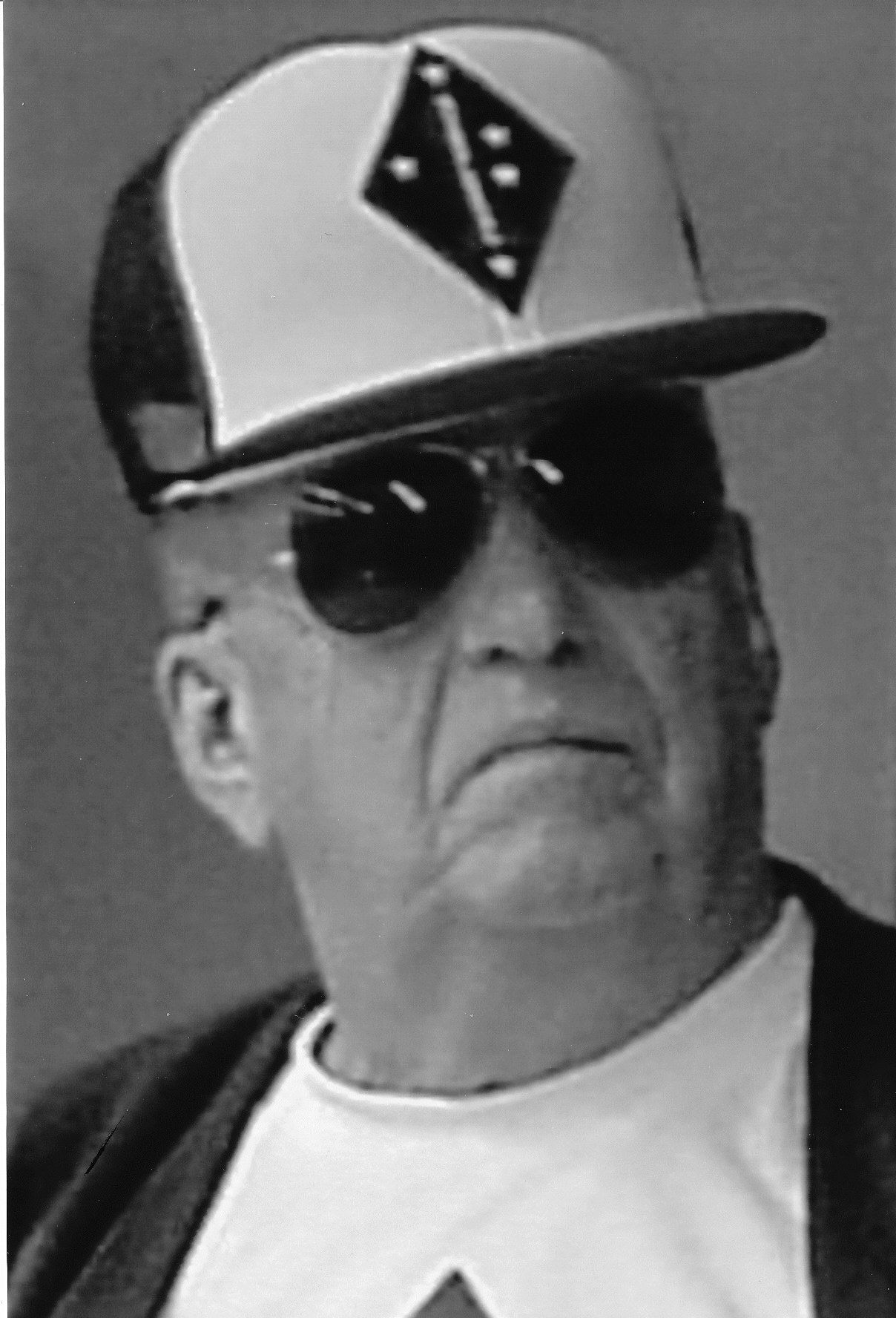
Jimmy used to come to my classroom with his bride of 65+ years, Mary. She would joke with him, and us, and call him by his high school nickname, “But”. Maybe it was “Butt”, I don’t know, but they had fun playing around with each other in front of 17 and 18 year olds.
The two of them, and Danny Lawler, another First Marine Division veteran of really hard fighting at Peleliu and Okinawa, came to my room for an afternoon. Later, I came home to an email from one of my senior girls, telling me how meaningful meeting Jimmy and Mary and Danny was to her and her classmates.
Jimmy, of course was blind and hard of hearing. Mary had to yell at him, he would crack a grin under the dark glasses and flirt with her. The high school girls loved it.
You see, Jimmy Butterfield got struck not once but twice in the head by enemy fire at Okinawa on May 19, 1945. He was evacuated first to Guam, then to Hawaii and later stateside for over 18 months and as many for reconstructive surgery. It was clear early on, though, that he would never see again.
To everyone but Jimmy.
When he eventually was ‘informed’, he told us that he instructed his high school sweetheart to leave him be. Not to get attached to him, a blind man.
Well, she told us what she thought of that. They ran a small mom and pop store back in Glens Falls together until they retired.
Mary passed in the fall of 2013. Jimmy died at home the following spring. What obstacles they overcame together. Below, from Vol. 1, they recount how Jimmy learned, weeks after the battle, that he would never see again.
Jimmy: I didn’t know, until they told me there [in the hospital in Hawaii].
So here’s the climax. Every morning there was inspection with the doctors. So the doctor came around that morning. He said, ‘How are you, Jim?’
I said, ‘Fine.’ He said, ‘You need anything?’ I said, ‘Nope, I’m doing fine.’ He says, ‘Well, are you used to the idea?’ I said, ‘Used to what idea?’
He said, ‘That you’re not going to see again.’
Well, you could hear a pin drop. I said, ‘I don’t think I heard you, Doc.’ He said, ‘You’re not going to see again.’ I said, ‘What?’ He said, ‘Didn’t they tell you in Guam?’
I said, ‘No! But it’s a good thing that [first] doctor isn’t here, because I’d kill him!’ I got so mad! I couldn’t really grab the idea. I’m not going to see again? … What the hell did I know about blindness? Nothing!
I said, ‘How about operations?’
He said, ‘You’ve got nothing to work with, Jimmy.’
So a pat on the shoulder, and he just walks away. The nurse comes over and says, ‘The doctor wants you to take this pill.’ I said, ‘You know what the doctor can do with that pill?’
Mary: Don’t say it.
Jim: I’m not going to, Mary.
So I had a hard… two months, I guess. I kept mostly to myself. I wouldn’t talk to people. I tried to figure out what the hell I was going to do when I got home. How was I going to tell my mother this? You know what I mean?
So they come around and said, ‘You’ve got a phone call.’ So I went in to where the phone was. They were calling me from home. They got the message, see…
This one here was on the phone [points to Mary].
I said, ‘Looks like things have changed, kiddo.’
She said, ‘No, we’ll discuss this when you get home.’ She was already bossing me around. [Laughter] But that’s how I found out, and that’s how it happened. And after a while, I just started to live with it.
There are not days—even today—I go to bed and I wish I could see. So much I miss. I miss watching a nice girl walking down the street. I miss seeing my daughter, my wife. I even miss looking at Danny. [Laughter]
Mary: But you see, I’m only seventeen to you now. That’s a good thing.
Jim: Since we got in the conversation, when I dream, and I do dream, everything is real. Everything I knew before, I see it as it was then, not today. My wife and daughter would never get old in my eyes. When I dream of Mary, she’s still seventeen years old.
Mary: But you never saw your daughter.
Jim: I dream about my daughter. Mary’s caught me doing this. We lost our daughter a year and a half ago. But I sit right up in bed and I’m trying to push away that little cloud of fog in front of her, but I can’t quite make her out.
Mary says, ‘What are you doing?’ I say, ‘Just dreaming.’
Jim Butterfield was nineteen years old at the Battle of Okinawa. In the final push at the Shuri Line that cost him his eyesight, the Marines lost over 3,000 men and the U. S. Army even more. When the island was declared secure near the end of June, in Lawler’s K/3/5, only 26 Peleliu veterans who had landed with the company had survived Okinawa. It had been the bloodiest campaign of the Pacific, with over 12,500 Americans killed or missing and nearly three times that number wounded. For the Japanese, no accurate counts are possible, but perhaps 110,000 were killed.
25 or 30 years ago, during a symposium with Pacific veterans in the Hudson Falls High School library, I overheard local Pacific veterans discussing among themselves during a break about a kid, Randy Holmes, from Hudson Falls who was killed at Pearl Harbor on Dec. 7, 1941. I asked them more, and snuck down to the ‘vault’, and dug out the 1942 yearbook. His classmates had dedicated it to him as he had left school early to join the Navy. He was killed on the Oklahoma. Yesterday, his finally identified remains were interred at Arlington 83 years later. Trishna Begam, local Albany anchor and reporter, knew of my connections to WW2 and HF, and told me after getting a press release from the navy, and found Randy’s great niece. Then she took the time to come up to Moss St. Cemetery to interview me, and Randy’s great-niece, also in the story below, contacted me. Though my lifelong mission was to bring him back to HF to lay next to his parents, Arlington will do! I am glad he is remembered, but my students and I never forgot. No one called him Harry, by their way. He was Randy to his friends and family in our hometown of Hudson Falls. He opens and closes my first [2015] book.
Pearl Harbor sailor from Hudson Falls buried in Arlington National Cemetery.
HUDSON FALLS, N.Y. (NEWS10) — The remains of a local Navy sailor who died 82 years ago were laid to rest at Arlington National Cemetery Thursday afternoon. The U.S. Navy says Harry R. Holmes was aboard the USS Oklahoma during the attack on Pearl Harbor. His local connection is still cemented in his hometown of Hudson Falls and well documented by retired high school history teacher Matthew Rozell.
At the Moss Street Cemetery in Hudson Falls, Rozell showed NEWS10 the marker that sits in place for the hometown hero who was almost lost to time.
Rozell explained, “His grave is right here. He left school early. He would’ve graduated with the class of 1942.”
The young sailor died in action at Pearl Harbor. “My big question was ‘Where is his body? Where is he?’” Rozell wondered for years.
The Navy answered that this year. According to Capt. Jeff Druade, the director of the Navy Casualty Office, Project Oklahoma was started in 2015 to identify service members lost on the Oklahoma during the attack. Three hundred eighty-eight service members were unaccounted for — among them Fireman 3rd Class Harry Randolph Holmes. On December 7, 1941, Holmes was aboard the USS Oklahoma when Japanese torpedoes hit the hull and capsized the battleship in less than 12 minutes. His remains were identified eight decades later through DNA profiling.
“He was loved. He had a mother, father who are over there behind us. And they were never able to bring their son back,” Rozell added.
Letter reveals what soldier who inspired ‘Saving Private Ryan’ left at Normandy This October, 82 years after his death, his country was determined not to forget the young sailor’s sacrifice. He was brought to his final resting place at Arlington National Cemetery.
“A young boy at 19 years old, set foot out to protect our country,” said Rachael Bubbs, a great niece to Holmes.
Bubbs was present, along with her father, to honor her great uncle’s bravery and service. Through DNA profiling and matching samples with surviving family members, the Navy tracked down Bubbs in Florida.
“He was buried in the Punch Bowl for so many years, but now he’s going to one of the greatest cemeteries,” she said. “When everything was presented to me, it was an honor to be truly connected back to that true piece of history.”
It’s history that’s been etched into the stone in his hometown. Rozell explained, “It’s an important moment in the North Country because he was one of the first killed in WWII from New York. He was only 19. He didn’t get to graduate with his classmates.”
Those classmates knew Holmes by his middle name, Randy, as Rozell would learn from members of the class of 1942. “Listening to his friends, WWII vets, all gone now, they are no longer with us — it was Randy, Randy, Randy. H Randolph Holmes.”
They helped keep his life of service alive. “I dug through the archives, found the yearbook. That’s when I saw the picture of him taken in the backyard of his family home in Hudson Falls.
It’s the only photo of Holmes from a full page from the high school yearbook. He was known as a popular student with a sterling character. Bubbs said, “He went to war for our country, to fight for it. Pearl Harbor is the start of where we are today.”
His country ensuring that Holmes is revered for the generations to follow.
Project Oklahoma has individually identified 356 crew members of the Oklahoma through DNA and matched with surviving family members.
I recently finished my 10th book in The Things Our Fathers Saw series. It covers a pretty much unknown aspect of American involvement in World War II, the China/Burma/India arena of the war.
In the writing of this series, I have been approached by people, generally children of combatants, and sometimes in slightly indignant fashion, wanting to know ‘why there is no CBI Theater’ focus in my books, as if I considered these men and women who served in that arena somehow less worthy of recognition and study. The ordinary unfortunate explanation was simply that comparatively few Americans served there, a complex and confusing pocket of activity that technically is not even classified a ‘theater’ of operations in the sense of, let’s say, the European or Pacific Theaters. It did not have a unified combat command per se; there weren’t any conventional U.S. infantry divisions slogging it out in China, Burma, or India—most of the ground fighting was done by British, Indian, and Chinese troops. Only about a percent and a half of Americans in uniform during World War II were engaged here, most in supporting roles; less than 3,000 U.S. ground troop volunteers made up legendary long-range fighting forces known as Merrill’s Marauders and others, who were pushed to the brink of extinction after just five months of combat.
Yet I found some amazing stories, from a nurse who was just one of two accompanying Claire Chennault’s famed mercenary ‘Flying Tigers’ taking out Japanese bombers over China and Burma, to the men who flew dangerous high altitude cargo missions from India to China over the Himalayas, to the Marauders on the ground and the fighter pilots who supported them from the sky. It clocked in at 362 pages of narrative oral history, and I hope it closes this gap in the knowledge of World War II; the last Marauder died just as I began writing it in January. You can get it at my direct store above in the SHOP MY BOOKS tab, or look it up at that behemoth, Amazon. The TOC is pasted below. Thanks for reading and your support.
In VOLUME 10 of The Things Our Fathers Saw® series,‘Over The Hump/China, Burma, India’, we will visit with the veterans of most overlooked theater of World War II as they prepare to fly over and march through the most inhospitable terrain on the planet, from the Himalaya Mountains to the jungles and mountains of Burma, battling elite Japanese forces, sickness and tropical disease. Ride with the cargo pilots as they are buffeted by 200 MPH+ winds over some of the highest mountains in the world; join fighter pilots taking to the skies to attack Japanese bombers and other aircraft as the enemy tries to disrupt the flow of supplies from India to China. Accompany the long range American penetration forces as they go deep into the heart of enemy held territory to stem the Japanese onslaught. Gain a better understanding of why these forgotten men need to be remembered and celebrated today.
AUTHOR’S NOTE INTRODUCTION COMMUNISTS AND NATIONALISTS WORLD WAR II BEGINS IN ASIA ‘VINEGAR JOE’ STILWELL ‘WE GOT A HELL OF A BEATING’ THE AVG STATIONMASTER ‘WE WRECKED A LOT OF PLANES’ NO REPLACEMENTS CHENNAULT’S EARLY WARNING SYSTEM THE BURMA SALWEEN GORGE MISSION CONDITIONS OTHER MISSIONS ‘I WENT AROUND THE WORLD’ THE MARINES BOOZE FOR SPARE PARTS THE SLIT TRENCH ENCOUNTER HOME THE FLYING TIGERS NURSE ‘I FELT LIKE ALICE IN WONDERLAND’ A ‘FOREIGN DEVIL’ GETTING BACK TO CHINA ‘THESE KIDS, THEY’RE GOING TO FIGHT?’ SPENDING TIME WITH CHENNAULT WAR THE WARNING SYSTEM MARRIED WITH A BLACK EYE ‘WHEN THEY CAME BACK, THEY WERE MEN’ ‘THAT’S WHEN I LOST HIM’ HOME ‘WOMEN DIDN’T TALK ABOUT THOSE THINGS’ THE CARGO PILOT THE LIFELINE OF CHINA HAZARDOUS DUTY MEDALS THE COMMUNIST CHINESE THE GRAND PIANO THE CHINESE PEOPLE GOING HOME THE HOSPITAL SHIP THE RESERVES KEEPING IN TOUCH CIVILIAN LIFE THE B-24 RADIOMAN SHIPPING OUT TO INDIA MISSIONS WEIGHTLESS ANOXIA DETACHED SERVICE COMING HOME THE B-29 RADARMAN THE B-29S RADAR MISSIONS SINGAPORE BOMBING JAPAN ‘WE LOST OUR PILOT’ A SECRET WEAPON AFTER THE WAR THE ACE PILOT TRAINING INDIA FIRST KILL ‘I BELIEVE I’M GOING TO GET KILLED TOMORROW’ PURPLE HEART ‘PETE, DON’T SHOOT!’ 87 MISSIONS THE CHINESE WAR’S END JAPAN OCCUPATION DUTY THE THUNDERBOLT PILOT THE TEST CALLED UP PILOT TRAINING THE THUNDERBOLT TO THE CBI BURMA MARAUDERS’ SUPPORT THE NATIVE PEOPLE WAR’S END HOME ‘THEY WERE SOLDIERS’ THE VIRGINIA FARMBOY ‘I LIED LIKE A RUG’ FORCED MARCHES AT HIGH SPEED STILWELL’S GOALS WINNING SUPPORT OF THE INDIGENOUS PEOPLES INSPIRED TO LEARN THE HEAVY WEAPONS COMMANDER ‘I’M NOT ASKING YOU’ ‘A MINIMUM OF 90% CASUALTIES’ LIVING CONDITIONS THE IMPERIAL MARINES FIGHT AT WALAWBUM WOUNDED HOME ‘GENERAL STILWELL JUST LAUGHED’ GOING BACK ‘YOU VOLUNTEERED FOR THIS MISSION’ ‘I’LL TAKE CARE OF IT’ REUNIONS THE ENGINEER DEPRESSION DAYS ‘YOU’LL GO WHERE I TELL YOU TO GO’ INDIA COMBAT TEAMS THE RIVER CROSSING ‘WE WERE THROUGH’ THE END OF THE WAR ‘HE BELONGS TO ME’ SOUVENIRS STILL ALIVE THE 4-F VOLUNTEER UNIT ‘GALAHAD’ ‘EVERYBODY WAS A MARAUDER’ THE NATIVES GENERAL MERRILL ‘WE HAD NO DANCING GIRLS’ GOING HOME OBSERVATIONS THE RADIO WIZARD ‘I WANTED TO DO MY PART’ THE ‘SONG OF INDIA’ MULES SHOOTING ‘THEY WOULD GO WILD’ MARCHING PAST THE HOSPITAL FOOD AND SICKNESS ON THE MOVE HOME LAST WORDS THE IMMIGRANT ‘YOU BECOME A FATALIST’ POINT MAN ‘WE DIDN’T GET DECORATED’ ‘KILLED IN ACTION’ THE CHIEF THE LEDO ROAD ‘A VERY TOUGH THING’ HOME THE COMBAT CAMERAMAN I DEPRESSION DAYS BECOMING A CAMERAMAN ‘WE NEED THE FIVE DOLLARS’ ‘THE WAR WAS ON TOP OF US’ ‘I WON WORLD WAR II’ GOING OVERSEAS THE VOLUNTEER ‘YOU HAVE TO STAY HOME AND FARM’ ‘YOU’RE THE SON OF A GUN THAT WENT AWOL’ IN THE BRIG ‘MY GOD, A TORPEDO!” PICKING UP THE DEAD ‘ONE DAY THE SALVATION CAME’ ‘MY SQUAD LEADER WAS A CONVICTED FELON’ ‘POOREST GODDAM EXCUSE FOR A MULE SKINNER’ THE LETTER ‘WE CAN DISAPPEAR IN THE JUNGLE’ COMBAT WOUNDED ‘I CAN SAVE THAT LEG’ THE NISEI INTERPRETER ‘THE MEN WHO ALTERED MY LIFE’ RECONNECTING WITH TRUCK ‘I DON’T KNOW WHAT A HERO IS’ THE COMBAT CAMERAMAN II GETTING TO INDIA GETTING TO STILWELL’S HEADQUARTERS THE CHINESE NEWSREEL WONG GOING AWOL TRAVERSING THE MOUNTAINS ‘I’M NO DAMNED VOLUNTEER’ ‘THE MOST IMPORTANT THING IN THIS OUTFIT’ HIT BY A C-47 AIR DROP ‘I HAD NEVER CRIED IN MY LIFE’ “YOU’RE THE GUY I’VE BEEN LOOKING FOR’ THE LAST WORD
Just finished my 10th book in the Things Our Fathers Saw series, on the CBI theater of the war. I wrote this at the end, thinking about my time with the veterans of World War II.
“It is my earnest hope, and indeed the hope of all mankind, that from this solemn occasion a better world shall emerge out of the blood and carnage of the past—a world founded upon faith and understanding, a world dedicated to the dignity of man and the fulfillment of his most cherished wish for freedom, tolerance, and justice.”
—Remarks By General Douglas MacArthur, Surrender Ceremony Ending The War With Japan And World War II, September 2, 1945
“Can’t we just let go of this war? My father spent four years in, [and] my uncles four years; they NEVER talked about it! Long dead soldiers, long ago war!”
-American commenter on one of the author’s social media posts, highlighting the series, The Things Our Fathers Saw, September 2024
Was it really that long ago?
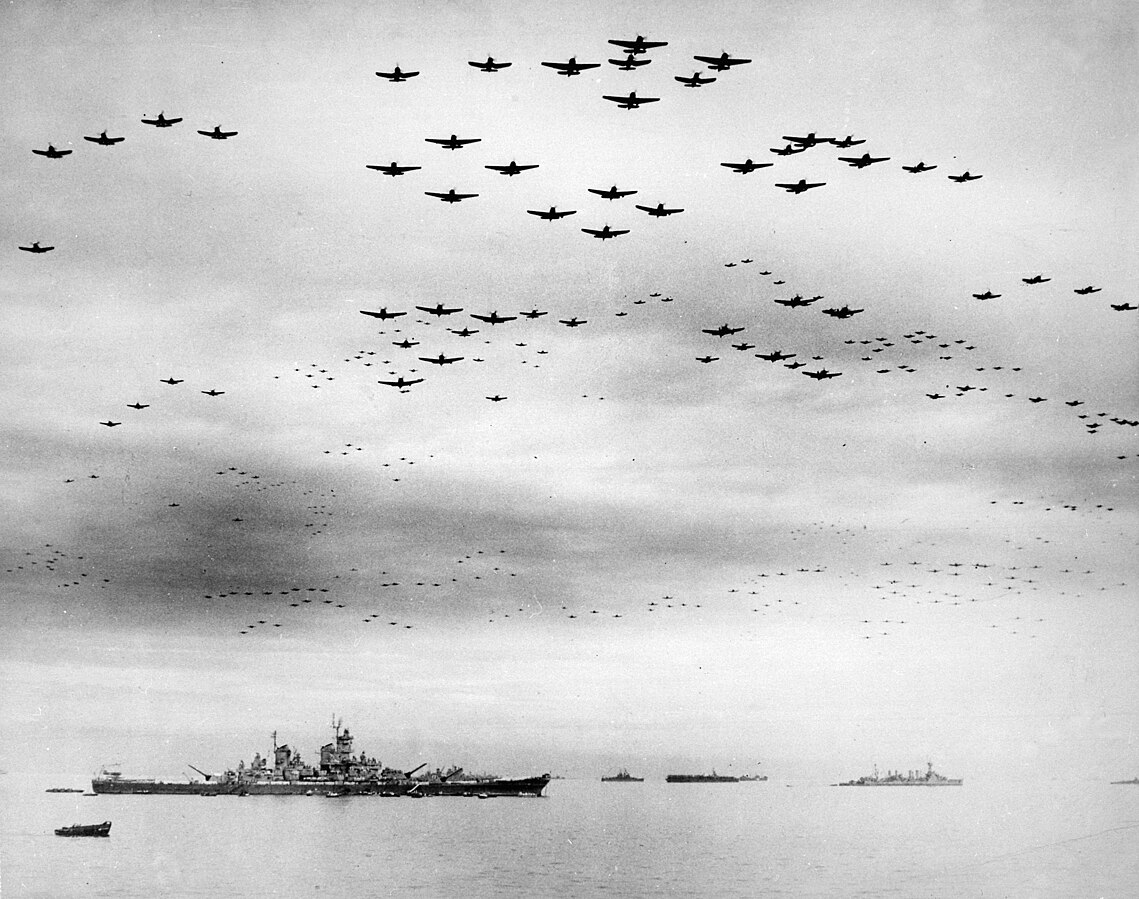
Seventy-nine years ago last month, Admiral ‘Bull’ Halsey’s flagship USS Missouri was in Tokyo Bay awaiting the arrival of the Japanese delegation with General MacArthur and Admiral Nimitz aboard, positioned near the spot where Commodore Matthew C. Perry had anchored his ‘Black Ships’ on his first visit to Japan in 1853. On display aboard the battleship that morning was the flag that flew on December 7, 1941, over Hickam Field at Pearl Harbor, and the 31-starred Old Glory standard of Perry’s flagship from nearly a century before, now accompanied by hundreds of American warships. The Japanese delegation was escorted promptly aboard at 9:00 a.m., and at MacArthur’s invitation, signed the terms of surrender. As if on cue, four hundred gleaming B-29 bombers roared slowly by in the skies overhead, escorted by fifteen hundred fighters.[i]
Surrender ceremonies, 2,000 plane flyover, USS MISSOURI left foreground. National Archives. Public domain.
In the United States and Europe, it was six years to the day that the bloodiest conflict in human history had begun; after those six years of savage fighting, the devastation was unprecedented and incalculable. Between sixty and eighty-five million people—the exact figure will never be known—would be dead. Overseas, the victors would be forced to deal with rubble-choked cities and tens of millions of people on the move, their every step dogged with desperation, famine, and moral confusion. American servicemen, battle-hardened but weary, would be forced to deal with the collapse of civilization and brutally confronted with the evidence of industrial-scale genocide. Old empires were torn asunder, new ones were on the ascent. The Chinese Communists were victorious in China before the end of the decade; the British and other colonial powers began shedding their colonies in South Asia and elsewhere. In 1952, American occupation ended, lasting nearly twice as long as the war with America itself.
Now, the ‘American Century’ was well underway. American power and leadership of the free world was unparalleled and unprecedented. The Marshall Plan literally saved Europe. Enemies became allies. Former allies became adversaries. The Atomic Age began. And the United States of America rebuilt, reconstructed, and remodeled Japan. Of course, this ‘American Century’ was not free from hubris, error, and tragic mistakes, but all of this is part of the legacy that shapes us to this day.
In regards to the end of World War II, I can recall, in the early 1980s as a young history teacher in training, observing a veteran teacher describing the end of the war with Japan by making an analogy to his eighth graders:
‘It’s like two brothers who had a fight. The winner picks up the loser, dusts him off, and they go on as brothers and friends.’
Overlooked, perhaps, were the eight million Chinese civilians and millions of others in Asia slaughtered by Japanese troops in their imperial lust for conquest, the Allied prisoners of war brutalized and worked to death or executed in slave labor camps, the Allied seamen shot while foundering in the water at the explicit orders of the Japanese Imperial Navy, to say nothing of the deceitfulness of Pearl Harbor. I’m sure my twenty minutes observing the teacher in action left out what he hopefully covered in class; he must have known World War II veterans, just as I did. And these are things I suppose you learn later in life, as I did—but only because I wanted to know as much as I could learn. I was born sixteen years after the killing stopped, but ripples of that war have never ended.
If you are a reader of this series, you know how I got our veterans involved once I found my footing in my own classroom. My fascination with World War II began with the comic books of my 1970s pre-teen days, Sgt. Rock and Easy Company bursting off the pages in the bedroom I shared with my younger brothers at 2 Main Street. As a newly minted college grad a decade later, I was drawn to the spectacle of our veterans returning to the beaches of Normandy on the black-and-white TV in my apartment for the fortieth anniversary of D-Day. I was reading the only oral history compilation I was aware of, Studs Terkel’s euphemistically titled 1984 release, The Good War: An Oral History of World War II, over and over. I studied that book, planting the seed for my own debut in the classroom. And in retrospect, I think I reached out to my students asking them if they knew anyone in World War II, yes, as a way to engage them in the lessons at hand, but also to satisfy my own selfish curiosity: just what ‘resources’—really national treasures—did we have in our own backyard, surrounding our high school? I was going to find out. Man, was I going to find out!
Of course they ‘never talked’ about it! Why would they bring ‘The War’ up with their wives, their sons, their daughters? And frankly, most of the civilians they returned home to and surrounded themselves with at work, in the community, and even in their own families, weren’t really all that interested in hearing about it. It was time to get on with life.
But then those guys headed back to the Normandy beachheads, now approaching retirement age, most in their early sixties, if that (about my age right now) …
Somebody was now listening! Somebody gave a damn! And maybe the old soldier could talk about that kid who was shot and lingered on for a while in the far-off jungles of Burma, the country boy far from home who was proud to be a soldier, the eighteen-year-old who wondered now if he was going to die. The combat photographer David Quaid spoke to his interviewers until he was too exhausted to go on. But somebody was interested, and he had things to say—things to get off his chest—before he would no longer be able to say them; like David, a lot of the guys I knew opened up like a pressurized firehose after all those years of silence. It was frankly cathartic, and maybe now they could ‘let go of this war.’
Should we?
I didn’t respond to the commenter in the thread, but another person added,
“I understand, but if there is no conversation, nothing gets shared—nothing gets learned! May your family all rest in peace!”
I know in my heart that opening up to others, even complete strangers, but especially to the young, finally brought our veterans peace.
[i] Dower, John W. Embracing Defeat: Japan in the Wake of World War II. New York, W. W. Norton & Company. 1999. P. 43.
Liberation site, 13 April 2024. Photo by Daniel Keweloh. Note the visitation remembrance stones on the memorial.
April, 1945. Testimony of 17 year old Hungarian survivor Irene Bleier.
“In front of the cattle car, we could see German civilians from the two nearby towns running in opposite directions on the main road, trying to escape from the approaching US forces. With dulled sense, we glimpsed towards them. Several SS guards stayed with us. Some of them asked for—and received—civilian clothes from our people.
The next morning we dug up recently planted potatoes we found, made a fire, and cooked them. They tasted delicious. I again started walking towards the small pond, but then Jolan excitedly hollered to me: ‘Hey you, come back fast, the US Army has arrived!’
As much as my faint condition would allow me, I hurried to the scene of the miracle to welcome them, this being the big moment we so yearned for. Two angel-like American soldiers stood there beside their magic jeep. My sister and I looked on enchanted as they took captive the several SS cowards who stayed in their shameful and disgraceful uniforms. The SS henchmen held up their hands while one of the Americans stood opposite them with a pointed weapon. Then, the second US soldier searched their pockets.
Standing there and looking up at our liberators, I waited to sense some kind of emotion on this miraculous occasion—but no. Reality did not penetrate my consciousness. My senses were incapable of experiencing any signs of emotion; I had no tears of joy that appeared, nor even the slightest smile. My senses were left stiff, in the aftermath of extended suffering. We are liberated, but only outwardly. Our mind still remained under great pressure, as heavy, dark clouds obscured our world of comprehension. It will take a good many years to be free completely. When that time comes, if ever, we will be able to feel wholly liberated and shake off the shackles of bondage and imperceptible suffering. The majority of our group was so feeble that they stayed inside the crowded cattle cars. Some ventured to the nearby small towns for provisions. The following day, early in the afternoon, the US Army arrived with a big army truck. They brought us a delicious hot meal, potato goulash with veal meat. Never before in my life, or after, did I eat as tasty a meal as this. I just looked on as those US soldiers of valor took care of our group of two thousand, going from cattle car to cattle car so patiently. After suffering so long from inhuman treatment, I felt a great distinction to be treated with human kindness by those American soldiers. It was like being born again.
With their kind devotion toward us they sowed back into our souls the sparks and seeds of human hopes and feelings. By Sunday morning, my sister Jolan and I plucked up some courage and crawled out of the cattle cars to look around at the nearby town of Farsleben. We were pleasantly surprised to discover that US soldiers were already patrolling the locality. Some of our fellow Jews were also around and about. The local population either locked themselves in their homes or escaped. None of them ventured to welcome the new liberators.”
Today I am thinking of all my survivor families and friends, including those of the soldiers, who have now all pretty much left us. Last April on this day, I spoke to cadets at the USMA at West Point, officers in training about to go out into the world, about the actions of their forebearers across the generations at a place called Farsleben, Germany, honored to be there with the commanding general at my table.
Mike, Laura, Lee, and I then flew to Israel for a multi-day tour, interviewing a dozen or so survivors of the train and their families, thanks to our friend Varda W.
In June, the film crew made it up to Hudson Falls and the homestead to get more interviews.
In July, we discovered the lost footage of the train liberation shot on April 14, 1945 by the US Signal Corps. The discovery went ‘viral’ and has been viewed hundreds of thousands, if not millions of times.
In October, we toured the United States Holocaust Memorial Museum and interviewed historians and archivists who watched the story unfold, and gave their input for the film. We also talked to the United States’ Special Envoy for Holocaust Issues at the State Department. We know they appreciated this story, and we appreciate their interest and commitment, as it to no less than 60 communications to navigate and set up our interview.
Leaving Washington the afternoon of October 7, it became clear over the next few weeks that things had changed. The sheer horror and scale of the massacre and violence was dumbfounding as its scope became clear, on an unprecedented scale, since the Holocaust. The calculated evil that rolled through that morning and almost immediately elicited support in some cities in the west remains profoundly disturbing.
But today, as the world goes about its destructive business, a quiet ceremony took place at the liberation site in Farsleben, Germany, with committed locals and 2nd Gen survivors. My friend from Hillersleben Daniel K. took some photos. A beautiful April day, liberation day and today.
I spoke to attentive 10th graders this week, bringing them the message of what the soldiers did. We remember.
We hope to return next year for the 80th anniversary with the completed film, for more people to learn from, when the liberation anniversary appropriately falls on Passover.
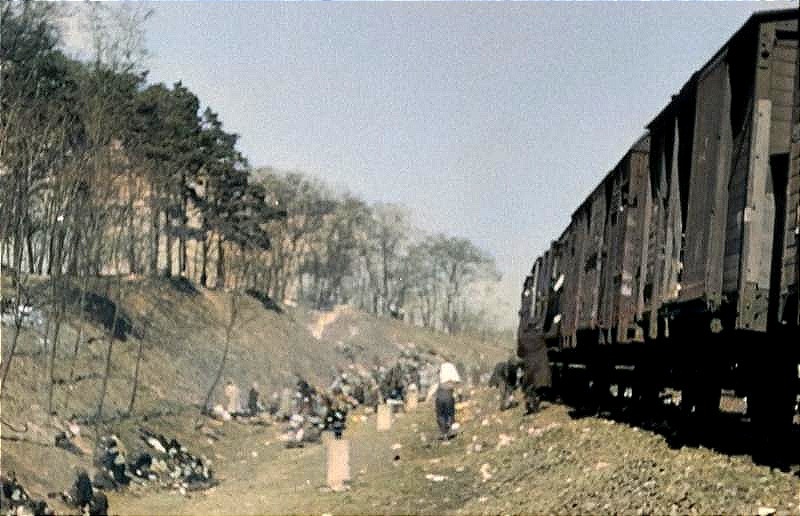
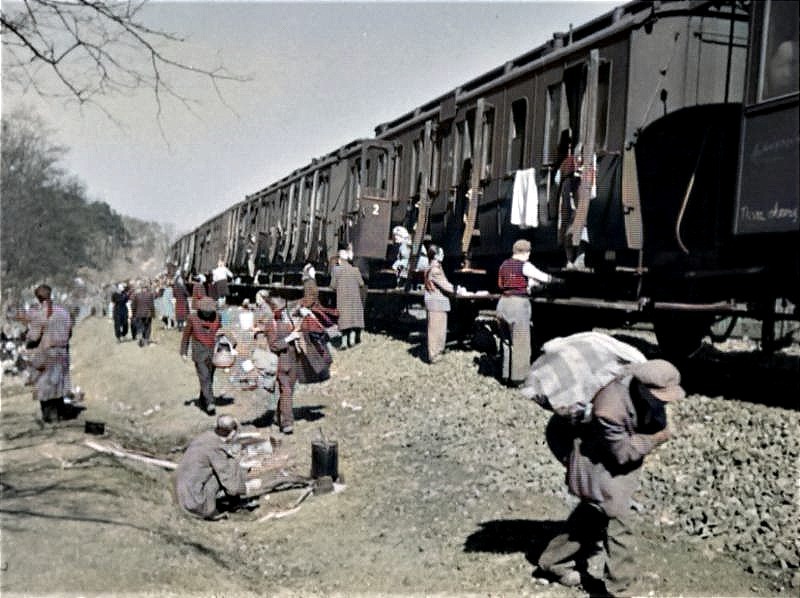
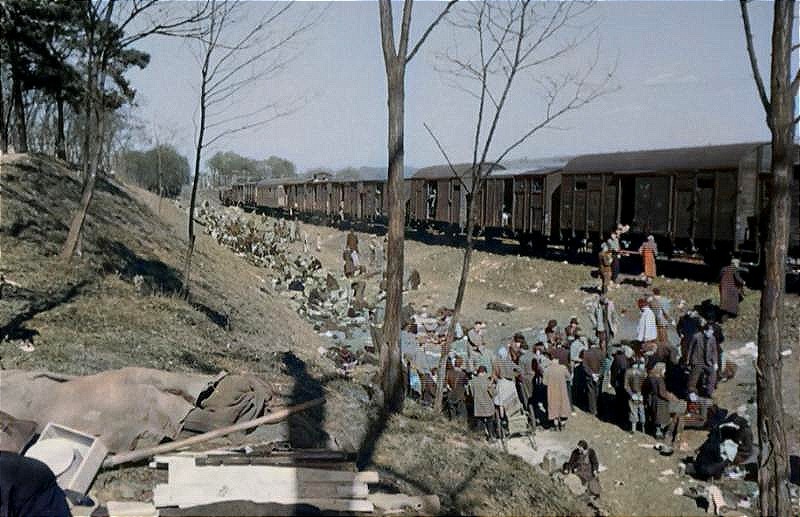
Newly discovered US Army footage of the Train Near Magdeburg surfaces after 78 years.
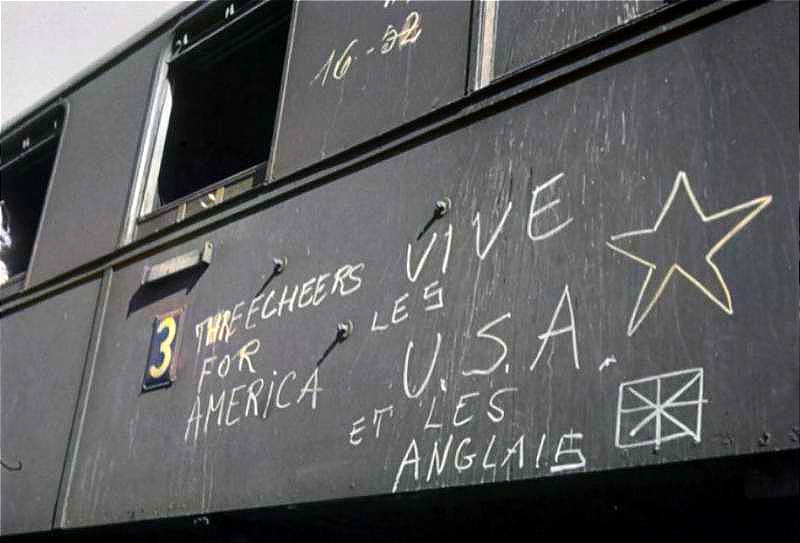
‘Three Cheers For America.’ Note numbers on car, Car #16 out of 52. Colorized still from newly discovered film.
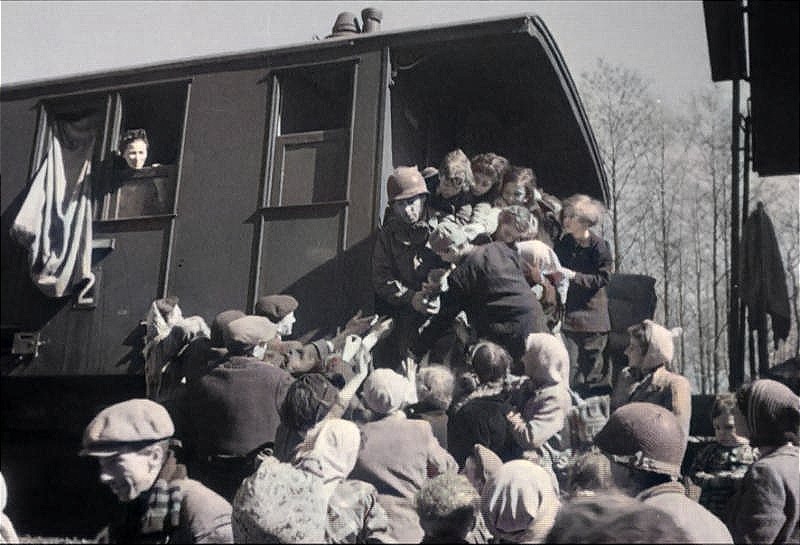
American soldier handing out food, backing up as starving people swarm him. Colorized still from newly discovered film.
If you are coming to this website cold, as a public high school history teacher, 22 summers ago I sat down with an 80 year old WWII veteran, initially reluctant to tell his story, and almost forgetting to tell this part of it, but eventually, the following came out.
In the closing days of the war, fighting across central Germany, he and another tank commander came across a train stalled by the tracks with desperate people milling about. They were 2500 Holocaust victims from Bergen-Belsen. And they needed immediate help. Their major and one of the tank commanders had a camera. After my interviews with them, they gave me permission to place the photos on the school website.
Farsleben train, moment of liberation, Friday the 13th of April,1945. Two American tank commanders and their major in a jeep liberate the train. Major Benjamin snaps the photo.
Four years ticked by. Then I heard from a grandmother in Australia who had been a seven-year old girl on the train. Others followed. I was able to re-unite the liberators with the people and the families they saved as young men. Over eleven reunions on three continents took place. So now, twenty-two years after our initial interview, this footage of the event appears in my life.
Another miracle in a story of miracles. And this one is HUGE.
A contact in Germany, Susanne at the museum in Wolmirstedt near the Farsleben, Germany liberation site outside of the city of Magdeburg on the Elbe River, recently emailed to say that she had seen part of a German documentary that included footage of people milling about a long train transport, and US Army soldiers helping, dispensing food and the like. She wondered if it was our train. Having been to the liberation site in person, and studying this story for decades, I was sure from the five seconds or so of a liberated train I watched that it was indeed our train.
Our team led by Mike Edwards inquired at the National Archives and just four weeks later, they sent the following footage to us. Of course, it had been filmed by the US Army Signal Corps in the aftermath of the Friday the 13th of April 1945 liberation, when our tankers of the 743rd came upon the train.
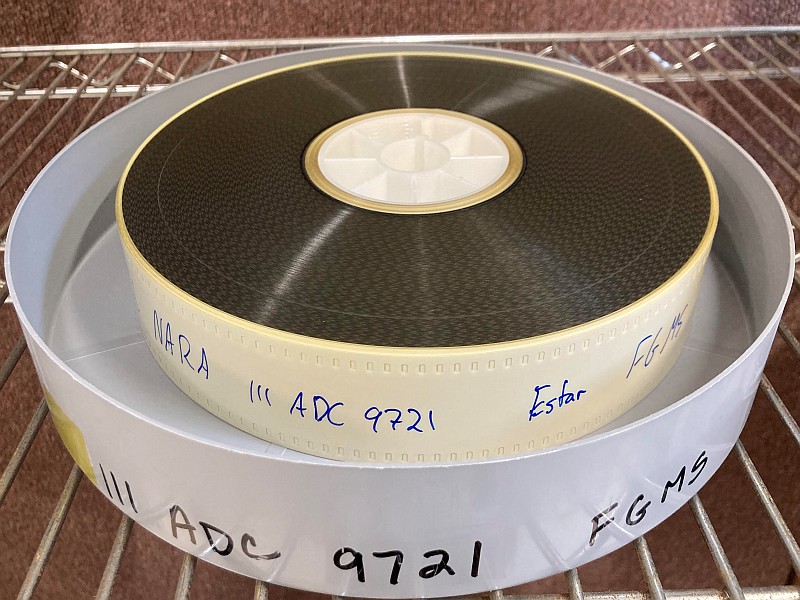
Newly discovered US Army footage of Farsleben train, April 1945. National Archives, public domain.NARA photo of film reel can.
US SIGNAL CORPS footage reel dated 4.17.1945, in the immediate aftermath of the train’s liberation by the 743 Tank Battalion and 30th Infantry Division. No sound. From NARA: “Summary: Numerous scenes, freed Jewish prisoners in groups along railroad tracks. Their expressions furnish a clue to the suffering they endured. Individual shots: Men, women, and children, some of them in various stages of emaciation. Flashes of US soldiers distributing food. The group surrounding the soldiers push forward to receive meager bits of food. LS, village being shelled by German artillery from across the Elbe River.”
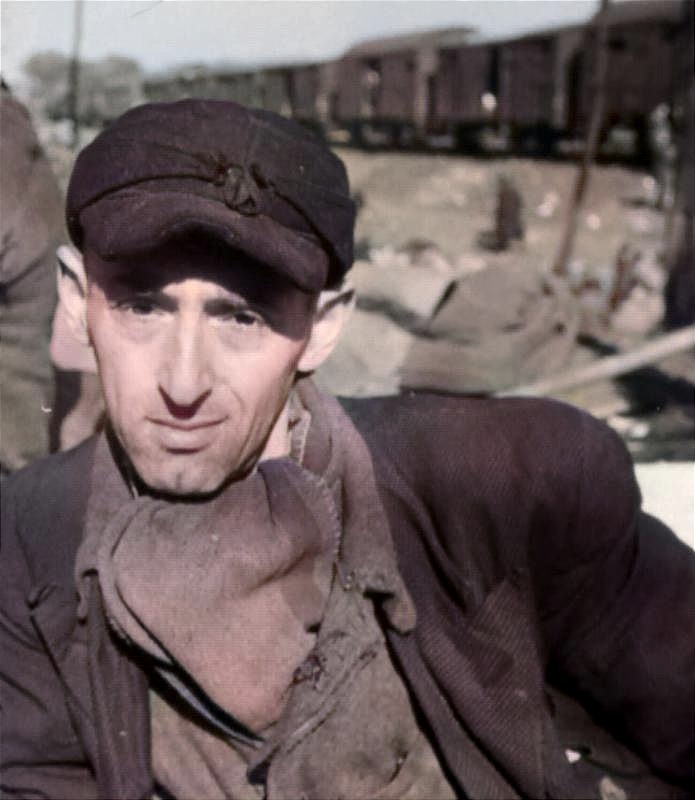
My best guess is that it was taken on Saturday 4.14.45, given the other US Signal Corps photographs from that day. What is fantastic is that this footage gives us a better perspective on liberation and its aftermath. Poignant and moving scenes: men crushing lice in their clothing. Families sprawled out, resting in the mid-April sunshine. Crowds swarming a soldier distributing food, bring to mind the Chuck Kincaid letter dated April 17, in which he expresses shock and horror at what he was seeing. A father holding his young daughter up so she can witness, and also put her hand out with the others. People in obvious distress, some likely very sick, some so exhausted they can hardly make an expression for the cameraman. The unsmiling little boy in hat, looking into the camera. The European script writing, numbering the cars, 52 of them, on the side of one of the cars; my guess is that it was done at Bergen-Belsen as they loaded the cars. And, of course, the beautiful American soldiers, trying to distribute food. Just who are they?
Red Walsh and George Gross and their tanks had departed for the final battle by the time of the Signal Corps arrival. Frank Towers was there, in and out that day, and medic Walter Gantz remembered being there that day.
I have been asked how I feel about this, surfacing 22 years to the day of my original interview with Red Walsh. With many of the stills, we have an entirely new portfolio of pictures to go through. We have already made one positive identification: the family of poet Yaakov Barzilai writes to confirm that he is visible in the footage, along with Yaakov’s mother and sister.
Top to bottom, in circle: Yaakov Barzilai, his sister Yehudit, his mother Iren, seated.Yaakov and author this spring in Israel.
So if you are a person who follows my blog from the early days, you know that not just is this an astounding development, but also one that confirms again that the past still has secrets to reveal, that in contextualizing the photos and film into the story of the Train Near Magdeburg, more healing is already taking place in our mission to ‘repair the world’. [And if you can see yourself, your family, or recognize any of the people, reach out to me here in the comments, or drop a line to matthew@matthewrozellbooks.com.]
A boy after liberation.
So, how does this make me FEEL? Frankly, it is immensely gratifying, though even without this footage, this is an incredible story. But to actually see the newly discovered film is another nail in the coffin of Holocaust denial. The soldiers didn’t lie. They WITNESSED it with their own eyes, and suffered the consequences themselves.
I cannot say that I am entirely shocked or stunned at this amazing development, because, as I told my wife, this is larger than any of us. We are part of a cosmic, maybe holy process, a process of the unfolding of the ‘so many miracles’ of this story. I’m sad that my four soldier friends mentioned above and all my survivor friends who have also now passed, are not with us to see it, to comment on it, to share in it with me and the living survivors and their families. But I am grateful to be able to live it now, and I am proud that those twenty-two years ago I had the audacity to want to have a conversation with a reluctant World War II veteran, and the curiosity to pause and take note of what he revealed upon his daughter’s prompting, to begin what would become this never-ending journey to help heal the world, and now with a team dedicated to telling this story to the world on film. It is with an undying sense of Wonder that we get to witness yet again the Power of LOVE transcending Time and Space. Of the GOOD countering the evil.
Seventy-eight years vanishes in an instant. This project is a portal, evidenced many times over. So I’m proud of it, but also humbled by it. And I’m humbled by all the people all over the world who have also come believe in it, and champion the message, and healing the world with their own love and compassion. This is larger than all of us.
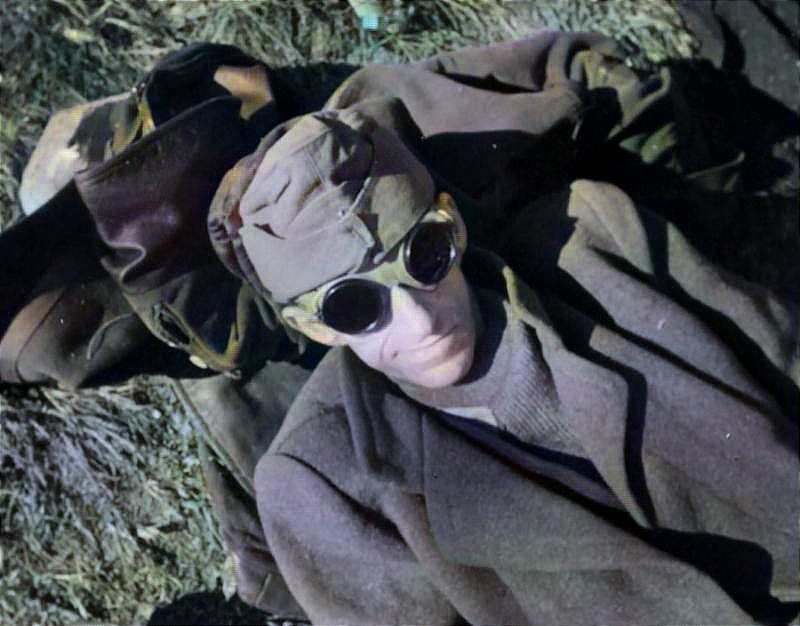
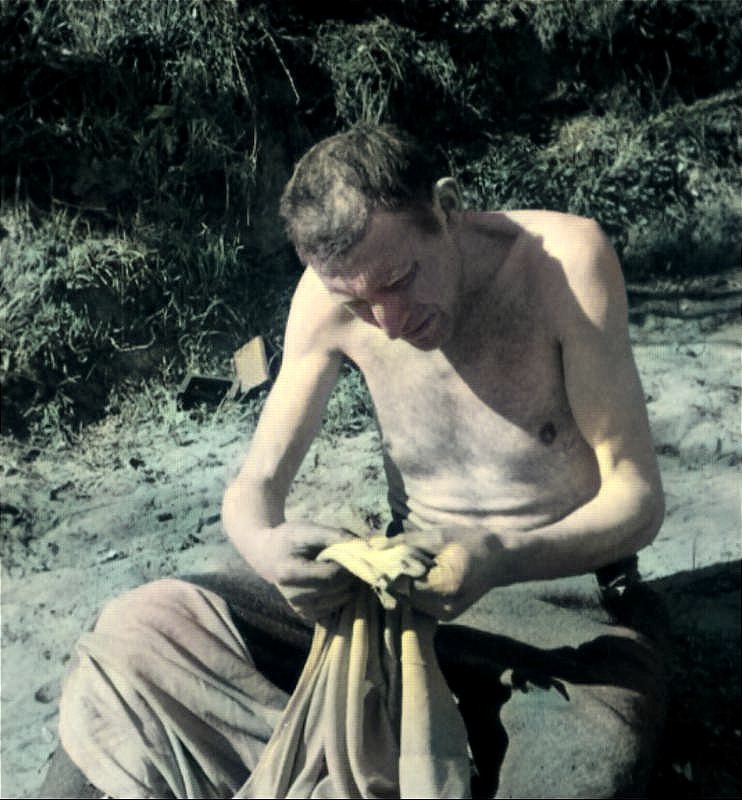
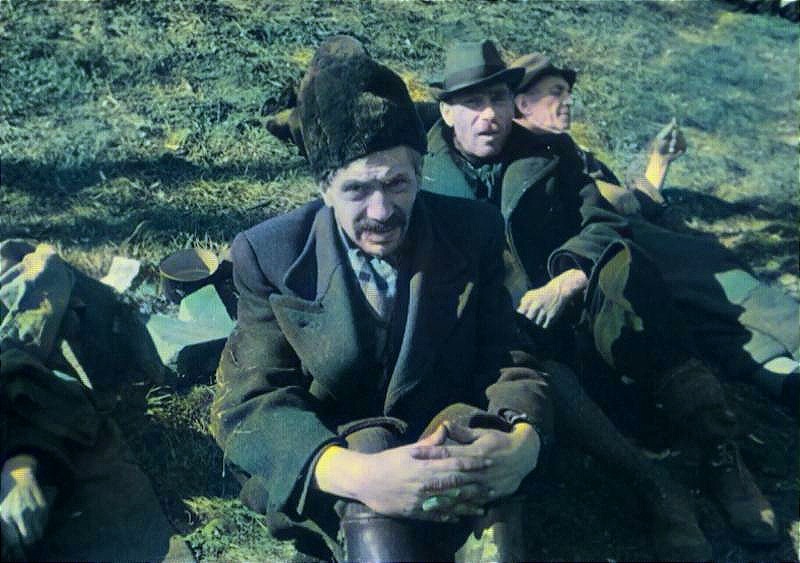
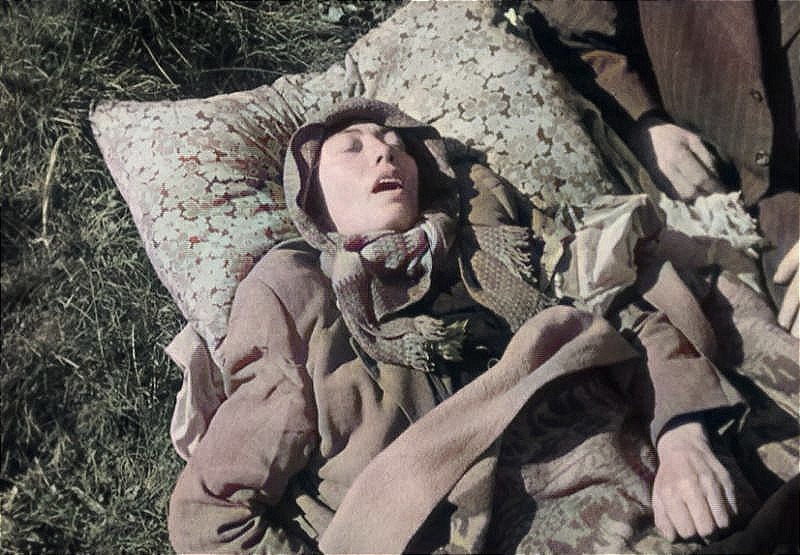
Below you will find a gallery of stills of the train and the people captured on that film 78 years ago, which I derived/created this weekend from the public domain film, and also added some color to, to highlight the scenes. [Tap the thumbnails for the information icon with my labels/captions; please write for permission if you wish to use any of them.] And don’t forget to write or comment below if you recognize someone!
Tuesday morning, June 6, 1944. Omaha Beach. National Archives.
So, it is the sixth of June again.
The ocean pounds the advance of sand amidst the relics of a different age, the hulking remnants of the tide of battle. The surf rolls in and kisses the beach, as the last participants mix on the hallowed bluff above with the politicians who have gathered from all over the world.
Thirty-nine years ago I watched as the American president honored the fallen, and the living, at the cemetery for the fortieth anniversary. Just out of college, something stirred inside me. Something was awoken.
Those thirty-nine years have passed. I began by writing letters to the newspaper. I began to interview D-Day veterans and others. I began to collect stories- not relics, prizes, or artifacts. I really had little interest in captured Nazi flags or samurai swords.
I wanted to talk to the men who were there.
The fiftieth anniversary came next with great pomp and more reflection. It graced the covers of the major newsweeklies. “Saving Private Ryan” would soon stir the consciousness of a new generation, and the reflections of the old. And I learned so much more of the war beyond the beachhead. That there were so many beachheads.
The sixtieth anniversary came around. Students on their bi-annual trips to France would bring me back their photographs and the requisite grains of white sand from Omaha Beach. Teenagers had their emotions a bit tempered, I think. I would go on to introduce them to so many who were there, when they themselves were teenagers.
So now it is the seventy-ninth. On the 65th, I wrote about a friend, Buster Simmonds, a combat medic who is no longer with us. Another time, I featured a D-Day veteran, Bill Gast, a 743rd tanker who made it from surf to beach and beyond.
And it is the subject of the fifth oral history in my World War II series, ‘The Things Our Fathers Saw: D-Day and Beyond’. Featured in it is one of our frequent classroom visitors, Tony Leone, a Coast Guard veteran of D-Day aboard an LST. And as I was working on his narrative this past March, footage of his ACTUAL SHIP, LST 27, was discovered, loading up for D-Day [click the photo below, it is only a minute long].
Tony left us in 2010. I’ll leave you with the book excerpt below. And remember to pause for a moment this day, June 6th, to think about what they did, 79 years ago.
Excerpt from ‘The Things Our Fathers Saw: D-Day and Beyond, by Matthew A. Rozell
He sits behind a student desk, wearing a medal presented to him by the French government that he also wears to Mass every Sunday. ‘I wear it with pride to pay homage to those fellows who burned alive next to me. I made it and they didn’t. It still bothers me.’
He rests on his walking cane and leans forward as he speaks. He is animated—he motions with his hands to emphasize his points. A prolific author and newspaper letter writer, Anthony’s mission is to educate the public about what his generation of Americans went through: ‘It would be at least 25 years after World War II before I could begin to think about the experiences of that time. They were buried deep in my subconscious and remained there so that my mind and body could heal.’
Anthony F.J. Leone
The Invasion of Normandy
I got assigned to USS LST 27. I said to myself, ‘What the heck is an LST?’ We boarded in Norfolk, Virginia. I carried my sea bag, along with the rest of the graduates of boot camp, up this long gangway. This was the biggest vessel I had ever seen in my life! If you had it up here on Lake George, it was 327 feet long, imagine that, and 50 feet wide. That’s a big ship.
‘LST’ stands for ‘Landing Ship, Tanks’. What we did is to carry small boats. We sent the small boats in first loaded with troops and vital supplies, then we came in right up to the beachhead with the LSTs and opened the bow doors and dropped the ramps. But on D-Day, not even the small boats could get in among the obstacles, and there were mines all over the place. They were killing our soldiers like sheep to the slaughter.
*
We left Norfolk in March of 1944 and landed in Africa. We had gone through bad air raids by the Germans in the Mediterranean and U-boat attacks but we survived. One ship was hit and set afire, a ship carrying lumber, and incidentally the crews couldn’t get the fire out; it was in the stern of our convoy. We got attacked by the Luftwaffe, JU-88s and Dornier torpedo bombers.
We reached Africa without further incident and then we sailed for England. We landed in Swansea, Wales, and we got liberty [after] we unloaded an LCT from the ship. An LCT is a long, wide, flat-box sort of landing craft where the ramp drops down and the conning tower is in the back, and we had one topside. We carried it piggyback; what we did was fill the starboard bilge tanks with water and then chop the cables holding the LCT on, onto these greased wooden skids. By severing the cables, the thing would slam into the water with a big splash. We got rid of that thing because there were some heavy seas and we were top heavy. These were the craft that what would land the men, later on.
About the end of May, about a week before D-Day, we went to Southampton, and then to Falmouth, to become part of the back-up force for the D-Day landings. We took on units from the 175th Infantry, which belonged to the 29th Division. Everything was frozen in place, we couldn’t move. The area was sealed off, we couldn’t go on liberty, we couldn’t visit the British girls, which was quite a sacrifice in those days, since they were all over the Yanks. We were like the invention of sliced bread; the British girls couldn’t get enough of the Yanks. [Laughs] We had a lot of money I guess, and we showed up the British service men pretty bad. The American troops over there, their behavior was abominable. The British treated them really good, but the Americans were spoiled had a lot of money, and… well, it’s the same old story.
They sealed us off, and on the 4th and 5th of June we were ready to go. We headed toward ‘Piccadilly Circus’, that was the code name of the circle in the middle of the Channel that we were supposed rendezvous at, from there the flotillas would go towards the English beachheads [in Normandy] and we would go towards the American beachheads, Omaha Beach and Utah Beach.
We went out to the sea on the 5th, and it was really stormy. Eisenhower was really blown away by [the weather]. So, they waited, and I guess a British meteorologist saw a break, a window in the weather. Eisenhower had decided to go for it, he had his fingers crossed, he had a letter ready apologizing for the loss of lives and withdraw from the continent in case it failed.[1] So, we went, the first units moved up from British ports of Southampton, London, Plymouth and Portland. We were the second, the backup force from Falmouth.
The Americans had gotten off the beach by late June 6th. Of course, [before that], the Germans had mowed them down like a wheat field. As I said before, there were German privates just sitting there with machine guns, just killing Americans and crying as they were doing it, ‘Please go back, I don’t want to kill no more!’ [Repeats this line in German]. At one point, General Bradley was going to pull them off, take all the people at Omaha Beach and bring them over to Utah. Utah was a pretty successful landing—there, casualties were [far less].
By the time we got to the [Omaha] beachhead the next day, it was a mess. We came in with the LSTs. We had already launched our LCVPs [on June 6] which brought in the troops, the ‘Landing Craft Vehicle-Personnel’, that is, a Higgins Boat. It was invented by Andrew Higgins, a boat builder from the United States. Then it was time for us to come in and unload the tanks.
It was now June 7th; all you saw was a layer of white smoke on the beach. The [US Army] Rangers had gotten in behind the Germans, but when we [first arrived there with the big ship], it was still hot, there were still mines all over the place, hedgehogs and stakes driven in the ground with Teller mines sitting on them. At high tide when you came in you couldn’t see them. Our LCVPs had to negotiate between them, this was impossible at high tide, you had to wait until the tide was way out, then the soldiers had to walk almost half a mile over bare land, no foliage or anything.
As we came in, it was pretty hard to negotiate because the mined obstacles were still all over the place and there were pieces of human bodies floating all over. The American soldiers had the life belts on that you activate, and they inflated because they had a CO2 cartridge. But because the guys had heavy packs on, it would up-end them and drown them because they couldn’t get loose. We saw a lot of soldiers floating that way. Their life belts worked alright, but they killed them. Their bodies floated to and fro all day long.
After we saw that, we were not too enthusiastic about going in and hitting the beach—we said, ‘If this is happening out here, what is going to happen there?’ Even though it was a couple days later, we were all armed to the teeth. We had our clothing well-impregnated with chemicals to withstand a gas attack, and when your body got out of it, that stuff would drive you crazy.
We proceeded in. Now up in our conning tower, our officers had barricaded themselves behind a pile of mattresses up in the bridge, not that they were ‘chicken’, they were just being smart about the whole thing, they didn’t want to get hit with shrapnel.
We had that on and we were all ready to go over, life jackets and helmets, I was manning the 20mm gun and all of a sudden, the public address system crackled. I heard the damnedest noise, that scared me more than the enemy, really, when it first came on [singing], ‘Mairzy doats and dozy doats And liddle lamzy divey/ A kiddley divey too/ Wouldn’t you?’. It was the voice of our skipper, and he was dead drunk. [Laughs] Now understand that he was a very solemn-looking individual, dark, so dark that at night we couldn’t see him, so we called him ‘The Shadow’—when he walked on the bridge, all you would see was the glow of his cigarette. He would let it burn to his lips and then spit it out, he was [tough as nails]. So here is this guy who is fearless, and as we were going in, he is singing ‘Mairzy Doats’[2] I would have chosen a different tune really, but everyone burst out laughing, so it was a morale builder in a sense. It told us the captain was human after all, and he was just as much afraid as we were!
So we went in and hit the beach, started up the ventilator fans as we had big tubes coming out of the tank deck to suck the exhaust fumes out—and incidentally, both their vehicles were burning oil, don’t know why, poor maintenance. They got them going and the trucks were towing—this was the 175th Heavy Tank Company, it was part of the 29th Division—they started to move out when the brake seized on the 57mm anti-tank cannon carriage they were towing in the back of the lead truck. Marion Burroughs, a friend of mine who was driving it later told me, ‘God that saved my life, that brake locking up like that, it never happened before in all my years of working with it.’ That’s the way things happen, you know. He motioned for the other truck to go back around him—it was an army wrecker, used for picking up tanks or wrecked vehicles. It went around and both of the vehicles went out, the wrecker hit a mine just coming off the ramp. They had it taped off where it was safe you know, I still think they went ‘off the tape’, the taped-off lanes to distinguish between the mined and unmined areas… It blew up and there were bodies all over the place and the trucks were filled with Chesterfield and Old Gold cigarettes, I remember vividly; ‘Lucky Strike had gone to war’ with gold packaging—they had taken the green out of the cigarette wrapper to save the cadmium that was green, I think—well, I remember those cigarettes just went all over the place, bazooka shells, the thing was loaded with ammo and gasoline and it went up, a flaming cauldron—it was like a blast furnace! These poor guys were screaming and they were pinned to the frame and you could see the rubber of the tires all turning to liquid and dripping. And their screams! It seemed like they screamed long after life left their bodies. I still hear them sometimes. If you ever hear a person screaming in agony when they were being burned alive… [looks down, shakes head]
We went out to see what we could do. I reached down and a piece of shrapnel came through the top of my helmet, punched it open, and broke some skin. I didn’t realize it until later, when the thing fell off my head and landed on the deck. You couldn’t get near the fire because the flames were so hot. A couple of individuals did rescue somebody, and I went out again to get another helmet. They were all over the place, like coconuts. I saw one with netting on it, and I went to get it and ‘zing-zing-zing’ [gestures quickly, tapping the air in succession three times], there were little bursts of sand right in front of it, some German probably anticipated my move and said, ‘well, this guy’s not going to get his helmet.’
One of our officers, a deck officer, a little fellow named Serge, went out and dragged somebody back to the ship. Now they had always made fun of Serge because of his size; he was puny, like another Don Knotts, all nervous and such. They all used to pick on him, like making him stand on a table because he was Jewish, things like that; that was World War II, you know. A colored steward would have to stand on the back of the bus—even though he survived a lot of battles, he had to stand on the back of the bus in Norfolk, Virginia. This is what World War II was really like.
He went out in the surf, the crazy [son of a gun, and rescued some guys], and he got back, I think he got the Silver Star or something for it. He was ten-foot-tall in our eyes after that. Finally, we closed the damn bow door; we lifted the ramp—it takes ages for that thing to come up on chains—and we closed the bow. We waited for the fires to subside and the flames went down, and we went out. We hated to see what was still out there. Things were still hot, fires were still burning, everything was gone—it was just bones sitting there, grinning skeletons.
[Later] on Utah Beach on June 19, a big storm stirred up a lot of mines. As we were coming in our lookout yelled, ‘Stop engines! Wreckage in the water, dead ahead!’ We slowed and stopped. Apparently, there was an LCT that had been hit earlier and it was laying there. Had we gone another 25 or 30 feet, we would have been impaled, practically stuck on the thing—so we couldn’t move. We reversed and motioned for the LST in line behind us to go around us. When they went around us, and as they made that move alongside, they blew right in half; they struck a mine. Now try to picture a huge structure like an LST, 327 feet long, welded steel, 50 feet wide, blowing in two, [lifting out of the water and straight up into the air]. The crew aboard it had a motley assortment of pets. They had pigeons, and chickens—what the hell would you have a chicken onboard for?—chickens, and dogs and cats; this was strictly forbidden, but they let them get away with it. Just before, we had been waving to the guys and laughing at the animals. We were the ‘Suicide Navy’, they called us. A very apropos title.
There were medical teams assigned to all the landing ships, like the LSTs, and they were composed of one or two naval doctors and a team of corpsmen. We had a surgical operating station in the back of the tank section, it was a complete operating room and they operated on the wounded there. At times we’d go back to eat, and we’d set our trays down in the dining room. They’d operate on the tables there, and our trays would slide in the blood—well, you don’t feel much like eating after that.
That is what I had to live with every day. The wounded, the dying, the death, it became a way of life. That’s bad, that’s real bad. When I got discharged from the service, I got a 100 percent disability because I was a basket case. I had to get some shock treatment, once or twice. I spent ten years at the VA hospital in out-patient treatment, I’m still going there in Albany. But I would do it all over again, because it was a cause. A cause célèbre, you might say. It’s nothing like what’s going on today.
War itself should be abolished, it should be outlawed. There can’t conceivably be any winners, [with these nuclear weapons]. For me it was bad enough to see men die all the time. I’d hate to see, right now today, a dog die—if a dog got hit by a car, I’d die, I’d feel badly. But now think about seeing human beings die, and then you get used to it, to endure you have to say to yourself, ‘This is a way of life, I have to live with it’. That crew became my family for two years, the only home I had. The medal presented to [us veterans by France] is the most beautiful medal I’ve ever seen, and I wear it with honor every Sunday. The priest doesn’t like the medal because to him it speaks of violence and war, but this is the biggest argument against war there is. For kids to even think of settling arguments with violence and war, that just shouldn’t be considered, because it is a foolish move. The innocent die.
[1]he had a letter ready-Eisenhower had hastily drafted a letter accepting responsibility in the event of a colossal failure at the Normandy landings: “Our landings in the Cherbourg-Havre area have failed to gain a satisfactory foothold and I have withdrawn the troops. My decision to attack at this time and place was based upon the best information available. The troops, the air and the Navy did all that Bravery and devotion to duty could do. If any blame or fault attaches to the attempt it is mine alone.” National Archives.
[2]Mairzy Doats-A silly novelty song that hit #1 in the US pop charts in March 1944. As others have noted, the amusing sheet music lyrics sung by Mr. Leone are revealed in the song’s bridge, “If the words sound queer and funny to your ear/ A little bit jumbled and jivey/ Sing ‘Mares eat oats and does eat oats/ And little lambs eat ivy/ A kid’ll eat ivy too/ Wouldn’t you?”.
From the Portsmouth D-Day Story Museum: “The number of people killed in the fighting is not known exactly. Accurate record keeping was very difficult under the circumstances. Books often give a figure of 2,500 Allied dead for D-Day. However, research by the US National D-Day Memorial Foundation has uncovered a more accurate figure of 4,414 Allied personnel killed on D-Day. These include 2,501 from the USA, 1,449 British dead, 391 Canadians and 73 from other Allied countries. Total German losses on D-Day (not just deaths, but also wounded and prisoners of war) are estimated as being between 4,000 and 9,000. Over 100,000 Allied and German troops were killed during the whole of the Battle of Normandy, as well as around 20,000 French civilians, many as a result of Allied bombing.”
I’ve been kinda bad about posting since I retired, but forgive me, I’ve been busy creating books. So now I’m announcing my latest book, Across The Rhine: The Things Our Fathers Saw—The Untold Stories of the World War II Generation-Volume VII. It actually made its first appearance on the shelves around Veterans Day, and I am happy to share it with you here now. At 360 pages and including over a dozen veterans, it is my longest book to date in the regular series and one that my editor calls her favorite.
The book is another example of these brave men and women who saved the world not so long ago, and I think it is important that these lessons not be lost to history, now that they have passed. People seem to like it; I know it was a bit emotional for me connecting with these veterans, spending hours upon hours dissecting their stories, researching and contextualizing their personal experiences, which is something I always trained my advanced course students to do. It is quite a journey to navigate, and I think I did these guys right, in the end.
Some I met and interviewed on several occasions; others, I got to know by returning again and again to their recorded testimony, which they willingly shared for posterity. The backbone of the book turned out to be the story of a Mohawk Nation paratrooper in the 504th PIR of the 82nd Airborne, who jumped into Market Garden, then into the nightmare of the Battle of the Bulge, and thence ‘across the Rhine’. Just an amazing story or survival, resilience, and at his essence, humility and humanity.
One guy I knew well enough to interview several times was one of the first men into Dachau, with the 42nd Rainbow Division, a natural-born jokester who was utterly shocked to his core.
Richard Marowitz Hitler’s Hat
The next day, his I&R unit was tasked with searching Hitler’s Munich apartment and found his English housekeeper, as well as Hitler’s top hat, which sat in the bottom of his service duffel for 50 years before he fished it out to tell his story to the high school age kids, always finishing with how, as a 19-yr old Jewish kid from Brooklyn, he fantasized about Hitler seeing him try it on, and then blowing his brains out in the Führerbunker that day, April 30, 1945, back in Berlin.
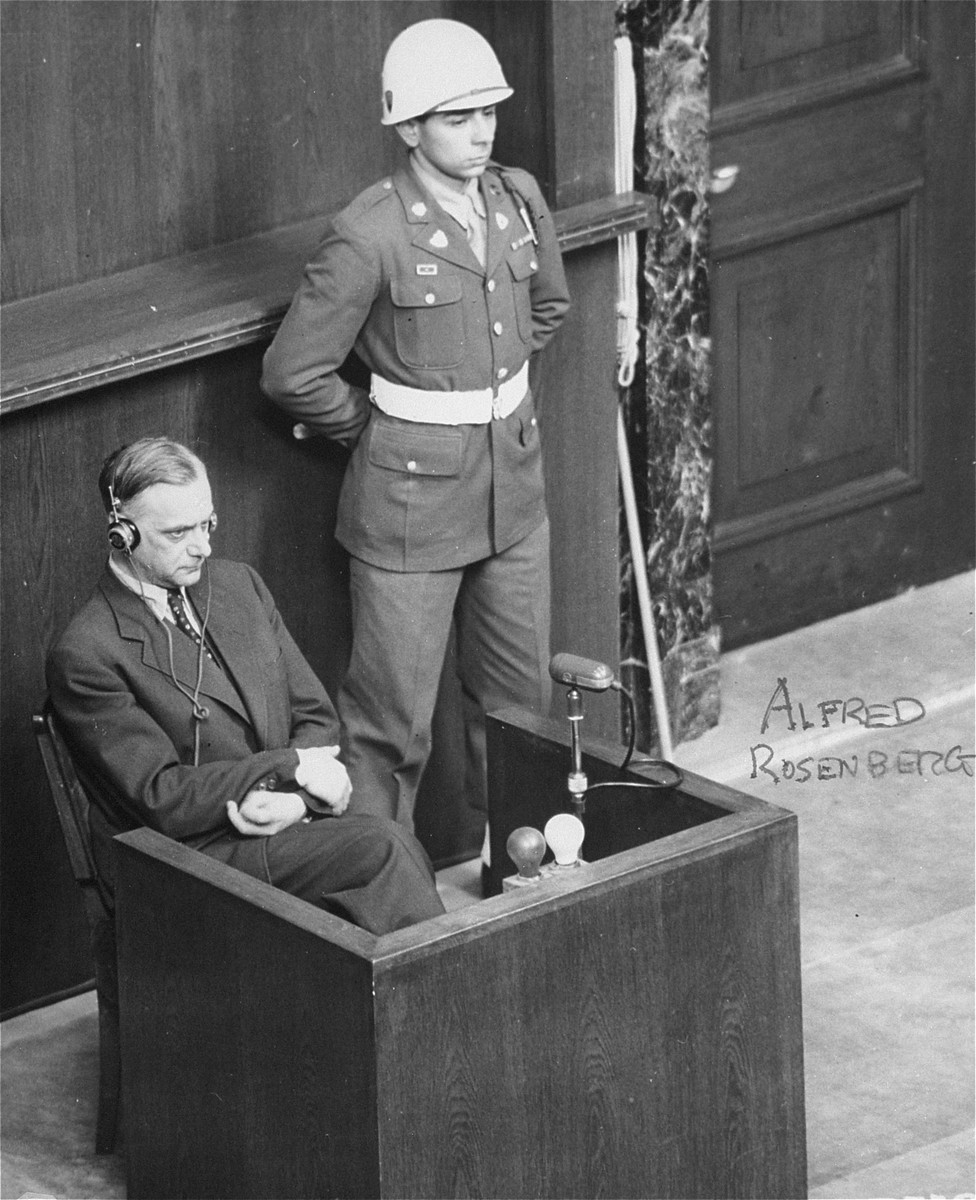
Former Nazi Party ideologist Alfred Rosenberg in the witness box at the International Military Tribunal war crimes trial at Nuremberg. Behind him is Leo DiPalma. USHMM.
I have guys who were itching to come home after the war ended, only to find they did not have enough ‘points’, and became eyewitnesses to history as guards at the International Military Tribunal at Nuremburg after the war- the war crimes trials. One later returned to the scene of judgment with his daughter, and became moved to tell his story of interacting with some of the most notorious villains of the 20th century.
Richard Marowitz, Al Cohen, Doug Vink. HFHS library, 2000. The last chapter features them in interactive conversation with students and staff at the school. Lots of comic relief, all good.
You can preview the newest book at the links above. For now, here are some of the early reviews. If you did get a chance to read it, please consider leaving feedback at my website or at Amazon, above.
BLURB
In ‘Across The Rhine’, you will begin to liberate a continent with our veterans as they scale the cliffs at Pointe Du Hoc overlooking Omaha Beach.
You will jump with the 504th Parachute Infantry Regiment to capture bridgeheads in the Netherlands, and re-group to slug it out in the freezing Ardennes Forest in the winter of 1944-45.
The mission will then push you over the Siegfried Line and all the way to Germany’s most formidable western natural defense, the swift and swollen quarter-mile wide Rhine River.
As spring 1945 arrives, you will be with our GIs as they arrive at the gates of Dachau and have their very souls shaken as they become eyewitnesses to the greatest crime in the history of the world—the Holocaust; the Nuremberg War Crimes trials will then bring you face to face with the architects of terror, the most notorious war criminals of the twentieth century.
[Front Cover: “Crossing the Rhine under enemy fire at St. Goar, March, 1945. 89th Infantry Division.” US Army, Office of War Information. Public Domain Photographs, National Archives.]
EARLY REVIEWS
During my military service (1972 to 1998)I had the honor of serving in Berlin. During that time Rudolf Hesswas still being held in prison. It was interesting to read about the Nurnberg trials and the testimonies of those soldiers who stood guard through the procedures. Highly recommend all books in this series. Time well invested.
The book was the result of face to face interviews with the men who fought in WWII. It, and all the rest of the series are well done and should be given to our children to read for the history of the war. Excellent resources.
Another fantastic read. I thought “The Bulge and Beyond “ was the best of this series but this book tops them all. It’s a fantastic read and I highly recommend it.
I own all 7 volumes of The Things Our Fathers Saw. I found each one to be a book that I could not put down until I had finished it. I am very grateful that you had the foresight to capture these stories while WWII veterans were still with us. So many are gone–my Dad has been gone 10 years. I only know one locally and he is 94. Thanks for saving this history.
I’m so excited for my dad to read this. He absolutely loves this author and the way the books are written. I hope he makes a volume VIII!
Rest assured, I started Volume 8, On To Tokyo, last month and have about 1/4 of it done, with a Fathers Day deadline. It is going to be another amazing journey.
























 Teaching History Matters