Feeds:
Posts
Comments

Posts Tagged ‘narrative history’


Excerpt from the new book “The Things Our Fathers Saw” and Joe Minder’s prisoner of war dairy, dated 70 years ago this weekend, on the day he tasted freedom.

[In mid-August] On the radio the Japanese Emperor Hirohito spoke to his people and said, ‘The time has come when we must bear the unbearable.’ It was the first time they had heard his voice. Shaken prison camp commandants awaited word of whether or not to carry out the “kill-all” order within their camps.

Joe Minder recorded his observations as the prisoners dared to hope that their redemption was near.


Joseph Minder 1941.

Joseph Minder 1941.


Upcoming events page: http://matthewrozell.com/author-appearances/

Order the signed book directly: http://matthewrozell.com/order-the-things-our-fathers-saw/

Order paperback or ebook from Amazon:

******


Read Full Post »

001

Mr. Peachman and author, at debut book signing, Aug. 8, 2015. Mary Rozell photo.

As the book  ‘The Things Our Fathers Saw ‘ went to press, I was contacted by the Japan’s largest news wire service, “with over 50 million subscribers worldwide, publishing articles in Japanese, English, Chinese and in Korean…” They wanted a veteran’s “reflections as we approach the 70th anniversary of the double bombings of Hiroshima and Nagasaki” (which he offers in the book, Chapter 13, ‘The Kamikazes’). So, seventy years after the war, Mr. Peachman got to address the Japanese people. The story is below. I called him to ask him how it went.

Mr. Peachman: “It was very nice, the reporter was happy to speak to me. I told her, ‘I hope you have an hour or two.’ We had many things in common- I had traveled to Japan several times after the war, and we knew of the same places. I told her, you can’t say that you feel the same as you did, 70 years later. During World War II, the Japanese would fight to the death. I honestly felt that the bomb was necessary to end the war, though I feel that President Roosevelt made a mistake by demanding unconditional surrender. And I have questions about how and when the bomb was used. But make no mistake, the coming land invasion of Japan would have been a bloodbath.”

Mr. Peachman and author, at debut book signing, Aug. 8, 2015. Article in Japanese in foreground. Mary Rozell photo.

Mr. Peachman and author, at debut book signing, Aug. 8, 2015. Article in Japanese in foreground. Mary Rozell photo.

NEXT LOCAL AUTHOR APPEARANCE/EVENT:
• BOOK SIGNING AND TALK-Sunday, August 23, 7:00 pm:
The Glen at Hiland Meadows, 39 Longview Drive, Queensbury, NY 12804

From the Kyodo Japanese News Service :
Thank you so very much for all of your help and for putting us in touch with Mr. Peachman. As I explained to you both it was part of a series of short interviews conducted with people from around the world on the subject of views on the atomic bomb.
In addition to Mr. Peachman, whose comments we wrote about, we also spoke with a third generation Japanese American in LA, a former factory worker in Beijing, a female university student in Seoul, a high school teacher in Hong Kong who was involved in the protest movements, a former office worker in Germany, a Professor Emeritus from Israel, a young Iranian whose parent was a writer and a former preacher from Scotland.
We are so appreciative of our conversation with Mr. Peachman and because of the importance of what he said, he was mentioned at the top. Please see the Japanese article with the mark indicating the part where he spoke.
In Summary: we simply explained that many in the U.S. believe that the atomic bomb was necessary to help save lives and that Mr. Peachman was aboard a ship off Okinawa when it was attacked by Kamikaze planes. He lost some of his crew mates and upon hearing the news that the bomb was dropped was relieved because he did not think that he would have survived another encounter with the Japanese. Although he is saddened by the deaths that occurred in Hiroshima he did believe that it did save lives.
I hope this is helpful to you and please pass along our appreciation to Mr. Peachman and we also thank you so much for putting us in touch with him.
Please see the attached file.
Best regards,
S. M.

*************************************************************

Matthew Rozell’s career as a history teacher is now spanning four decades. Over the course of the past 20 years, he and his students conducted hundreds of interviews with the World War II generation. One such interview led to the reuniting of a train transport of Holocaust survivors with their American liberators, over 60 years later. He is currently working on a trilogy of narrative histories based on these interviews.

His first book, a narrative of World War II in the Pacific as told through the previously unpublished recollections of over 30 veterans, was released in August. It is available here.  His second book, in progress, is on the power of  teaching, remembering the Holocaust, and the real story behind the  iconic photo of the “Train Near Magdeburg’. He can be reached at his Facebook page at Author Matthew Rozell or by commenting below.

Read Full Post »

How my 93 yr. old history teacher, who survived a deadly kamikaze attack in the spring of 1945, got to address the Japanese people on the eve of the 70th anniversary of the end of WW II.

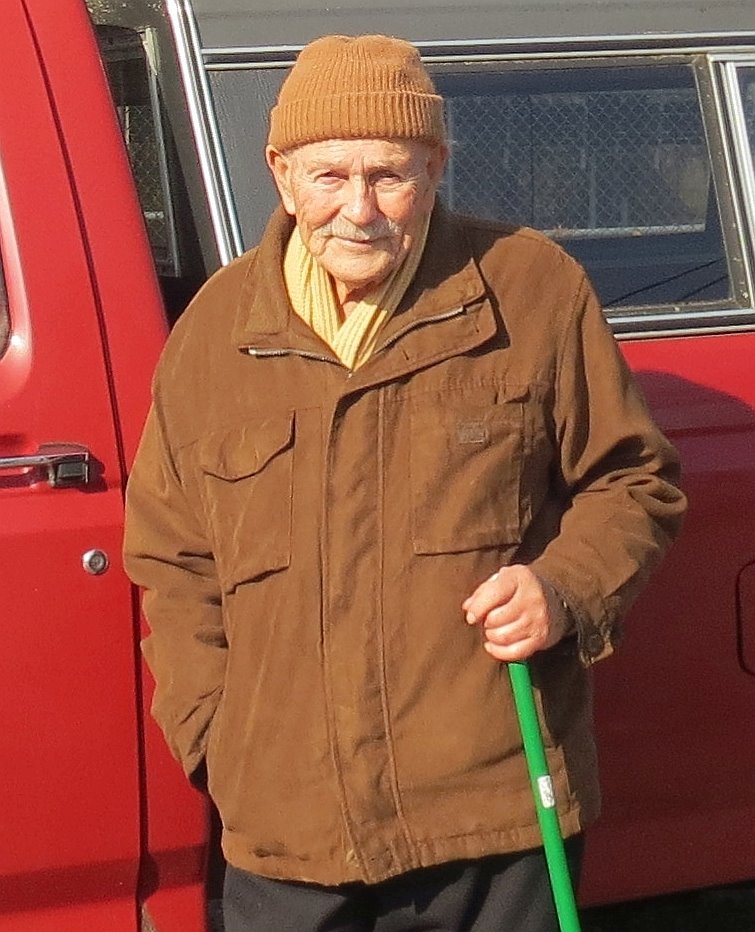
Mr. Alvin Peachman, Nov. 2014, out for his daily walk. Photo by Mike Nicholson, HFHS Class of 1979.

Mr. Alvin Peachman, Nov. 2014, out for his daily walk. Photo by Mike Nicholson, HFHS Class of 1979.

Be sure to come out and see us at the first author event- yes, Mr. Peachman will be there, too. He has TWO chapters in the book.

August 8th, 1-4 pm
The Village Booksmith.
223 Main St, Hudson Falls, NY 12839
(518) 747-3261

As the book  ‘The Things Our Fathers Saw ‘ went to press, I was contacted by the Japan’s largest news wire service, “with over 50 million subscribers worldwide, publishing articles in Japanese, English, Chinese and in Korean…” They wanted a veteran’s “reflections as we approach the 70th anniversary of the double bombings of Hiroshima and Nagasaki” (which he offers in the book, Chapter 13, ‘The Kamikazes’). So, seventy years after the war, Mr. Peachman got to address the Japanese people. The story is not out yet, but I just called him to ask him how it went.

Mr. Peachman: “It was very nice, the reporter was happy to speak to me. I told her, ‘I hope you have an hour or two.’ We had many things in common- I had traveled to Japan several times after the war, and we knew of the same places. I told her, you can’t say that you feel the same as you did, 70 years later. During World War II, the Japanese would fight to the death. I honestly felt that the bomb was necessary to end the war, though I feel that President Roosevelt made a mistake by demanding unconditional surrender. And I have questions about how and when the bomb was used. But make no mistake, the coming land invasion of Japan would have been a bloodbath.”

From the book:

 ‘I Lost Many Friends’


Matthew Rozell: So what did you think about the atomic bomb?

Best thing that ever happened to us. If it wouldn’t have been for the atomic bomb, I think we would have had a catastrophic amount of men killed, and probably the elimination of the Japanese nation as a whole. It would have been a terrible thing to conquer. I think it did a great deal in helping to save a million or two men, as well as the Japanese. I believe Harry Truman was a wonderful president in that regard; he really did a great favor to us. But I do not understand why we had to wait so long to figure things out! We shouldn’t have gone into Okinawa if we knew we had the atomic bomb because in Okinawa, we had 50,000 casualties! Our whole division was hit, except for the Wilmarth, as I told you. Two hundred and fifty ships were hit at Okinawa by kamikazes. The day we got hit, 26 ships got hit, and six were sunk to the bottom! I believe the Japanese had over 500 aircraft against us that day, suicide aircraft. Have you ever been startled by a partridge suddenly trying to fly into you? It is really a scary thing! Although you weren’t thinking of it at the time, it was a scary thing that these people would give up their lives like that. It was the most Navy lives lost in one battle. I lost many friends.

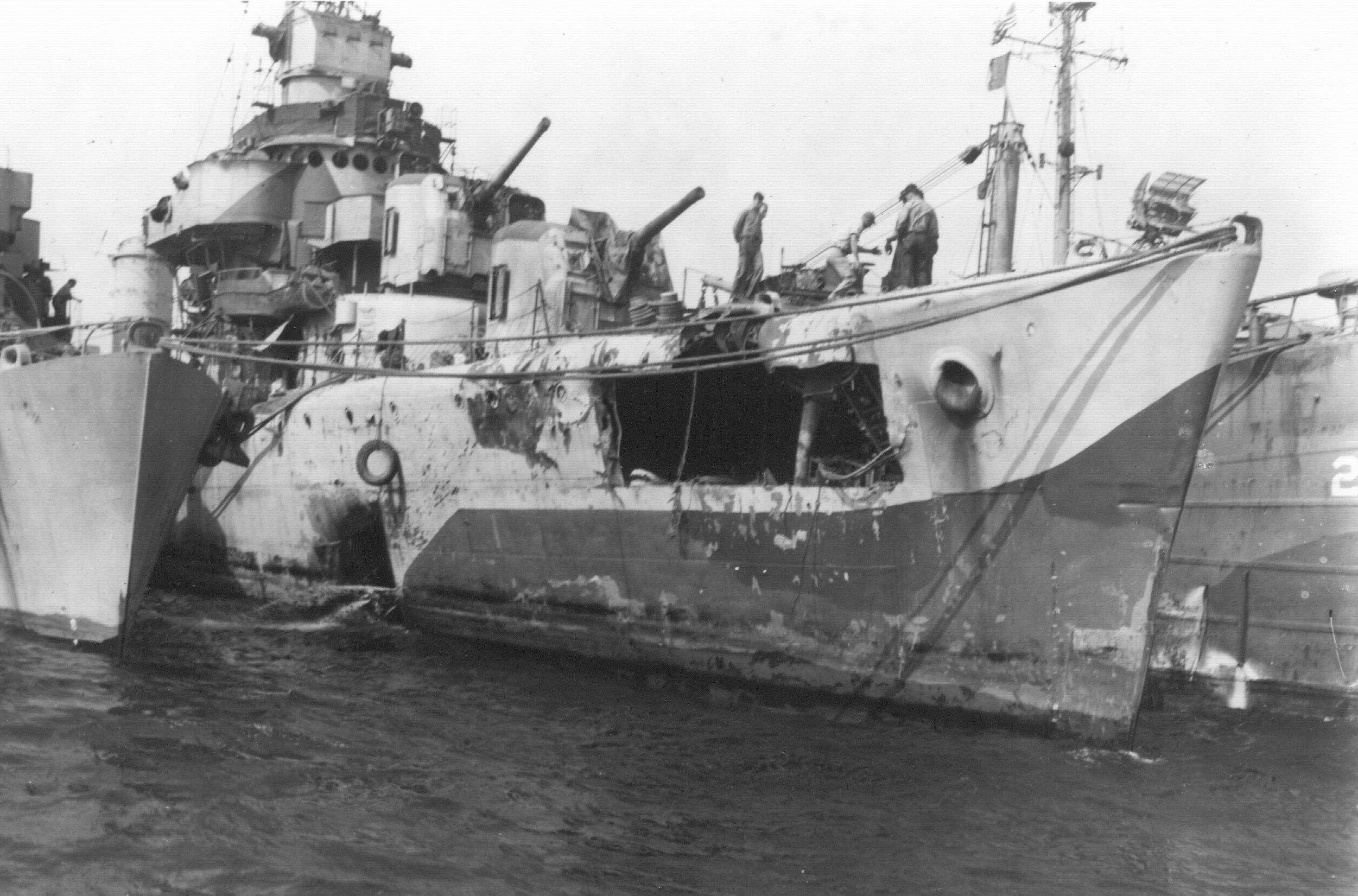
Destroyer Escort USS WITTER undergoing repairs following kamikaze attack. Alvin Peachman collection.

Destroyer Escort USS WITTER undergoing repairs
following kamikaze attack. Alvin Peachman collection.

As the land battle for Okinawa raged toward its crescendo with the fury of a storm, the kamikaze attacks would claim over 15,000 American casualties for the Navy alone.

Read Full Post »

We are about a week out from the launch of my first book, The Things Our Fathers Saw.  It clocks in at 286 print pages, and none of it is filler. Over 30 veteran stories are featured. The angle is new and unlike any other WW2 title out there. I am pretty excited. You get some butterflies, too; you are throwing yourself out to the world and you are going to be judged every time someone picks it up. So, why do it? I’d like to tell you what the experience of writing a first book has meant to me.

First off, I have been planning to write this book for well over a decade. Why?

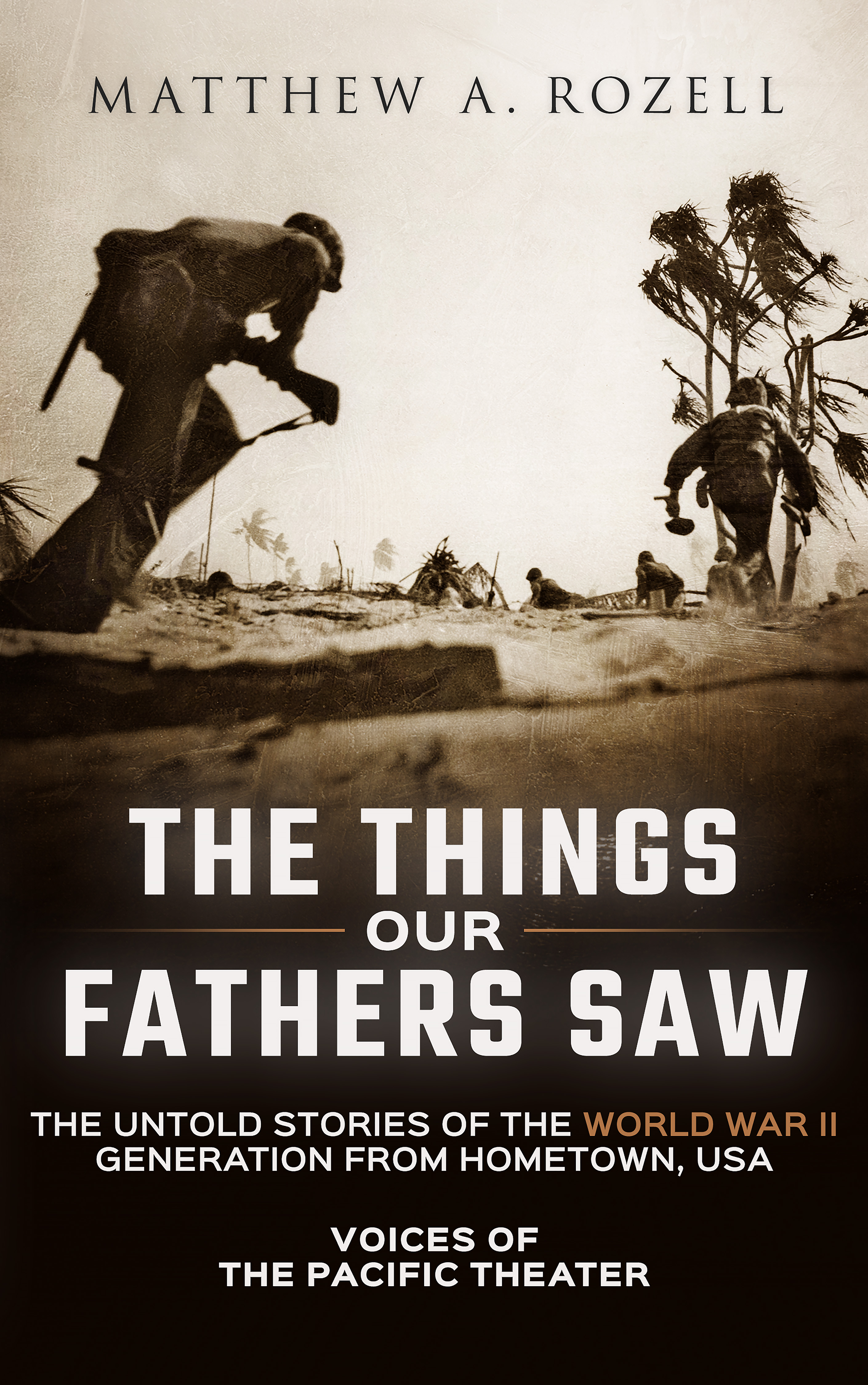
The Things Our Fathers Saw - Front Cover

Besides the fact that it has been a major portion of my life’s work, I’ll offer up the other cliché that it is ‘a story that needs to be told’. Though I didn’t wake up one day and decide to write a book. The stories have bouncing around in my head for years.  I’ve shared them over and over again in my classes. The men and women who told them to me and to our young people are gone, or sadly won’t be with us forever. And I’m not taking the stories with me when it’s my turn to go. This is my legacy, this is their legacy, and more importantly, if you are an American, it is your legacy too.

And I don’t care how much you know about World War II, or the Pacific War. You WILL learn something new in this book. Not because I am a genius or an expert, but because I thought that I was pretty well-versed on this history, but I learned  A LOT myself in the research and writing of it. And if you are a bit hazy on the subject, or maybe were a wee bit disinterested in it when in school (if you were taught it in the first place), you are about to be blown away-by the writing, I hope, but especially the history.

*

Here is why I did NOT write the book. It was not about the money, and any author who writes for money, well, that is a book you probably do not want to read. I did not set forth to cash in, or write for “personal gain”. I think my brother said it best, simply, when he told me it is just something that you have to do.

That said, the book did not write itself. It has been in the works on a daily basis for nearly a year now. I’ve gotten up at 1:00 in the morning and worked to 4 or 5 AM, slipping back into the sack for a power nap before charging off again to school. Somedays, it killed me.

The past month, since school got out, I have been glued to this chair. The manuscript that I have been working on has been updated and revised 41 times since final exams wrapped up. I’ve gone back and forth with my beta editors and my mapmaker, Susan Winchell-Sweeney, on at least a weekly basis since April. I spent my school vacations studying, researching, editing and transposing a never-before-published prisoner of war diary, and cross-referencing and tracking down confirmations for the stories that appear in my book.

And I have found out that some super best-selling authors on similar topics should have done a little bit more of this type of homework.

So what you are going to get, is my best.

***

Some people looked at me curiously when I said I was going to publish independently-mostly people who are caught up in traditional publishing. ‘Self-publishing’ gets a bad rap, gets ‘poo-pooed’-and there is a LOT of dreck and drivel out there. But for me, and for my brothers who are also writers, we just don’t want to deal with the gatekeepers at this time (my brother lost the rights to his first book, watched it go out of print, and had to buy the rights back when the opportunity arose). This allows us the independence to produce the work that we have envisioned in our heads with total control. That is not to say that you don’t seek help in the form of editing, the title, the book layout and design (I even had a contest of sorts on Facebook to refine and select the final cover design, with feedback from hundreds). But I’m told that the first thing a traditional publisher is going to ask today is, ‘how will YOU (the author) market this book?’ What is your following, and where is your brand? Voilà. Woodchuck Hollow Press came into the world.
014

Final edits coming to you from the Woodchuck Hollow Studios.

Marketing? That is a whole other venture, the business side, I suppose. Personal gain did not figure into the motivation for doing this, but obviously I have incurred expense (that cover cost us a small fortune, but worth it, thanks to Damon Freeman at Damonza.com), and in investing so much of my time, I chose to forgo other opportunities to supplement the family income. I don’t know how to explain it, it is just something that I had to do (though that walk-in closet that I started for my wife last summer still is not done-but we are still married!). If a major publisher or bookseller shows interest, we can talk. But we are not going to lose sleep worrying over the numbers. The woodchucks will handle it.

Built-from-scratch cabinet doors for inside walk-in closet. By scratch means I cut the trees for it. Kinda like building a book. On to the next set.

Built-from-scratch cabinet doors for inside walk-in closet. ‘By scratch’ means I cut the trees for it. Kinda like building a book. On to the next set.

Stay tuned for more details. It will be available on Amazon in print and ebook format, and signed copies will be available via my website (http://matthewrozell.com/) or at local events I may be invited to do. Thanks for following this blog, and you can get more frequent updates if you are on Facebook by following/liking the AuthorMatthewRozell page.

Any others out there who want to share the experience of writing a book? Comments on my comments? Now if you will excuse me, I have to go out and deal with that pesky woodpecker who keeps hammering away at my house. Have a great day!

Read Full Post »

April 15th 1945                                                                                                                   Somewhere in Germany

You will probably be wondering who I am and what business I have, writing to you.- I am one of the millions of soldiers of the United States Army, who is fighting for all the oppressed peoples of the world and hopes to have reestablished decency and honor to all mankind, with the defeat of Hitlerism.

*****

My friend Varda in Israel sent me a copy of this letter she recently received from the widow of  Mr. Shmuel ‘Tommy’ Huppert of Israel. In it, an American soldier is taking the time to write to the husband of a Holocaust survivor to let him know that his wife and young son (Tommy) have been liberated, and that they have survived the horrors of the Holocaust and the carnage of ‘Hitlerism’.

Young Tommy and his mother, Mrs. Hilde Huppert,  were liberated at Farsleben on the transport from Bergen Belsen on April 13th, 1945. They managed to get to Palestine shortly after liberation, bringing with them many, many orphaned children, including my friend Lily Cohen.  Hilde’s manuscript, Hand in Hand with Tommy, was one of the first Holocaust memoirs completed after the war and a cathartic way for her to attempt to come to terms with what had happened.

It took years to be properly published, as it was originally rejected because it was ‘too soon after the war’. Later, at 93 years of age, Hilde was asked if there was anything specific she wished to convey to American readers of her book. She replied, ‘Tell them I will never forget those American GIs who liberated us from the Germans…I can still recall their amazed faces in that dusty jeep and the U.S. Army symbol. I remember kissing one of them, and I want the American people to know that I am grateful to them.’


READ ALL ABOUT IT IN MY BOOK HERE


One of the soldiers, on the Sunday following the Friday liberation, took the time to send this note on her behalf to her husband in Palestine. It now resides in the collection at Yad Vashem, Israel’s Holocaust Remembrance Authority.

4-15-45 Gartner to Huppert 1

April 15th 1945                                                                                                                      Somewhere in Germany

Dear Mr. Huppert,

You will probably be wondering who I am and what business I have, writing to you.- I am one of the millions of soldiers of the United States Army, who is fighting for all the oppressed peoples of the world and hopes to have reestablished decency and honor to all mankind, with the defeat of Hitlerism.

Two days ago, it was the priviledge (sic) of our unit, to be able to liberate a trainload full of people of all nations imaginable, who were being transferred from a concentration camp near Hannover, to some other place. Our advances were so swift, that the SS guards, left this particular train where it was and took off.

That is how I became acquainted with your wife, Mrs. Hilde Huppert, who asked me to drop you this note, saying, that both she and your son Tommy, are both healthy and well and now being well taken care of by our military governmental authorities. In actual fact, your wife wrote a message for you on a piece of paper in pencil, which she asked me to convey to you. Unfortunately, however, the penciled lines faded in my pocket, and I can no longer read what was written on it. The contents of the message, though, was to let you know that your wife and son are both safe and sound.

I am sure that your wife will soon be able to get into contact with you directly through the Red Cross, and I hope that in a none too distant future, your family will once more be peacefully united.

Sincerely yours,

Cpl. Frank Gartner

Fluent in many languages, Gartner was the translator for the 743rd Tank Battalion’s commander, Col. Duncan. He was originally from Estonia, and resided in Los Angeles, California.

BOOK HERE

If anyone knows more about Frank Gartner, please contact me at matthew @ teachinghistorymatters.com.. 

Transcribed by Alanna Belanger’15 and Alexis Winney ’15.

Read Full Post »

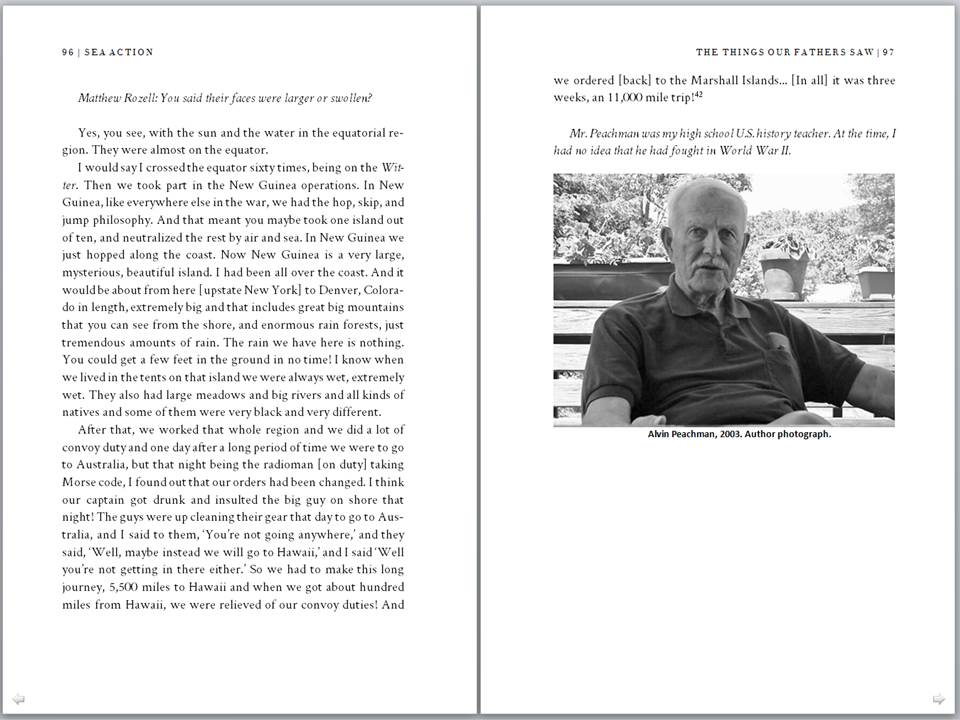
In 2003, I set out to interview a retiree living on the quiet boulevard leading up to our high school. I sat on his backporch with him for a few hours on a late spring afternoon. Born in 1922, he was in the Navy, serving as a radioman on a destroyer escort, and he seemed to be everywhere in the Pacific during World War II. Like John A. Leary, he also spent a great deal of time supporting the Marines, and saw his first action in the South Pacific in the reduction of the massive Japanese base at Rabaul on New Britain.

Mr. Peachman turned 93 this past March. He was my high school history teacher.


Alvin Peachman

From “The Things Our Fathers Saw” by Matthew Rozell.

From “The Things Our Fathers Saw” by Matthew Rozell.


You can view a book preview at the Amazon site. Available in digital and paperback format. Book can also be purchased at http://matthewrozell.com/order-the-things-our-fathers-saw/

*************************************************************


 Book Description: At the height of World War II, LOOK Magazine profiled an upstate New York community for a series of articles portraying it as the wholesome, patriotic model of life on the home front. Seventy years later, a high school history teacher and his students track down over two dozen veterans residing around ‘Hometown, USA’ who fought the war in the Pacific, from Pearl Harbor to the surrender at Tokyo Bay. They resurrect firsthand accounts of combat and brotherhood, of captivity and redemption, and the aftermath of a war that left no community unscathed. Here are the stories that the magazine could not tell, from a special generation of Americans speaking to the youth of America today.  270 pages.

About the Author: Matthew Rozell’s teaching career is now spanning 4 decades, beginning as a quiet kid returning to teach in his own hometown to being recognized as a national History Teacher of the Year and as a recipient of a national Medal for History Education. Rozell is a United States Holocaust Memorial Museum Teacher Fellow, has had his lessons filmed for NBC Learn, and has even been chosen as the ABC World News Person of the Week. He is also a recipient of several state and local awards for history education. He writes on the power of teaching and the importance of the study of history at his website,teachinghistorymatters.com.

He can be reached at marozell at gmail dot com.

Read Full Post »

My good friend in Israel let me know that the April 15th  commemoration of the Holocaust at Yad Vashem in Israel was a moving event and sent me the link to the video of the ceremony marking the 70th anniversary of the liberation. While my work at piecing together the  narrative and the story behind the Major Benjamin photograph was not detailed, the photo which now seems to be becoming a cornerstone of the history of Holocaust liberation is all throughout the ceremony and especially at 8:31. One of my friends, a survivor who had been a six year old boy on this transport that Major Benjamin photographed at the moment his jeep arrived at the train, notes,

image.png

The photograph wouldn’t be there if not for your effort. It was presiding on 1.5 hrs of national ceremony in the presence of Israel’s president, prime minister, the entire government, the top army guys, survivors, chief rabbis and was nationally broadcast. You have a direct hand in this.

Me, a lowly teacher, whose work for an evening is presiding over presidents and prime ministers. I am proud and hope that the story is told over and over, and that it serves the memory of the victims, the survivors, and the liberators well. I just can’t believe sometimes this path I have been down, since the day 14 years ago when I took the time to listen to a war veteran, and began to backtrack his story.  There are other forces at work here, I think… and there is a cosmic force that reverberates in you when you teach the Holocaust from the heart.

Teachers out there, you all know the power of what we do. I hope this serves as an affirmation.

*************************************************************

Matthew Rozell is a United States Holocaust Memorial Museum Teacher Fellow and teaches history at his alma mater in upstate New York. His work has resulted in the reuniting of 275 Holocaust survivors and the American soldiers who freed them.

His first book, ‘The Things Our Fathers Saw’, is being released to coincide with the 70th anniversary of the end of World War II. His second book, in progress, is on the power of  teaching, remembering the Holocaust, the Benjamin photograph and this “Train Near Magdeburg’. He can be reached at marozell at gmail dot com.

Read Full Post »

"The anguish of the liberation and return to life". Note the Benjamin photograph on the banner.

“The anguish of the liberation and return to life”. Note the Benjamin photograph on the banner. From the Yad Vashem website.

Fourteen summers ago I sat down to listen to an old gentleman in a rocking chair. A  war weary tank commander in 1945, he told me stories of his World War II experiences and then showed me a picture that his major had taken on April 13, 1945. You see, he was there. It would be the first time in decades that this picture had seen the light of day. And because of its discovery, and what we would do with it, thousands of lives were about to change.

Yad Vashem, the Holocaust Authority in Israel, contacted me in December 2014 to inquire about using the Major Benjamin photo. I did immediately send them a high resolution copy. My friend in Israel writes, ‘[The photograph above was taken] during the main ceremony at  the Holocaust Remembrance Day at Yad Vashem. This photo shows the President of Israel Reuven Rivlin make his speech. You can see your photo there at the middle (banner) and I now think it was there throughout all the ceremony.’

I hope that whoever was present or sees this photograph will visit our website to learn the powerful story behind this amazing photograph in the context of the 70th anniversary of the liberation. No wonder the survivors of the train refer to April 13th as the day they were reborn. Below is the proper information.

Matthew Rozell

From Yad Vashem:

Holocaust Martyrs’ and Heroes’ Remembrance Day (Yom Hashoah in Hebrew) is a national day of commemoration in Israel, on which the six million Jews murdered in the Holocaust are memorialized. It is a solemn day, beginning at sunset on the 27th of the month of Nisan and ending the following evening, according to the traditional Jewish custom of marking a day. Places of entertainment are closed and memorial ceremonies are held throughout the country. The central ceremonies, in the evening and the following morning, are held at Yad Vashem and are broadcast on the television. Marking the start of the day-in the presence of the President of the State of Israel and the Prime Minister, dignitaries, survivors, children of survivors and their families, gather together with the general public to take part in the memorial ceremony at Yad Vashem in which six torches, representing the six million murdered Jews, are lit. The following morning, the ceremony at Yad Vashem begins with the sounding of a siren for two minutes throughout the entire country. For the duration of the sounding, work is halted, people walking in the streets stop, cars pull off to the side of the road and everybody stands at silent attention in reverence to the victims of the Holocaust. Afterward, the focus of the ceremony at Yad Vashem is the laying of wreaths at the foot of the six torches, by dignitaries and the representatives of survivor groups and institutions. Other sites of remembrance in Israel, such as the Ghetto Fighters’ Kibbutz and Kibbutz Yad Mordechai, also host memorial ceremonies, as do schools, military bases, municipalities and places of work. Throughout the day, both the television and radio broadcast programs about the Holocaust. In recent years, other countries and Jewish communities have adopted Yom Hashoah, the 27th of Nisan, to mark their own day of memorial for the victims of the Holocaust.

Holocaust Martyrs’ and Heroes’ Remembrance Day 2015 will be on Thursday, 16 April. The State opening ceremony will be held at Yad Vashem on Wednesday 15 April at 20:00.

Read Full Post »

Update from Nashville: At the 30th Infantry Veterans of WW2 70th anniversary reunion.

Today’s events began with the posting of the colors and a moving memorial service for the veterans of the 30th Infantry Division and 743rd Tank Battalion who have moved on. Missing many, especially for me Buster Simmons, who would offer up a prayer at this gathering in his capacity as chaplain. Rest on,old soldier.

94 year old veteran Marion Sanford comes up to me and grips my hand. I have not seen him in 2 years, but he is the same to me as he always was. As a reconnaissance man for the 30th Infantry Division, he tells me how much he saw and how much now in retrospect meeting the survivors and their families has meant to him. He saw many terrible things overseas, which he felt he had to leave out of his 2012 book, ‘Old Hickory Recon’. Don’t think for a minute that a soldier understood why a friend might be killed and the fickle hand of fate spared another. In what way can this be justified? Survivors’ guilt was not just for the Holocaust survivors to experience. But this ‘small’ incident, the liberation of the train near Magdeburg, seems to have altered his perspective and the perspective of many of the soldiers I have met at these reunions. It seems to have enhanced and  added to ‘man’s search for meaning’, in a sense, as far as the soldiers go.

0417151104-00

Posting the colors. MC Frank Towers in the background. Frank will be 98 in June.

 ***

After lunch, moving talks today by survivors George Somjen (Hungary), Elisabeth Seaman (Netherlands), Micha Tomkeiwitz (Poland) . To their liberators they recounted the events that they remembered and  more importantly, the impact that the liberation and the meeting of their liberators meant not only for them and their families, but also  the world.

Later, the amazing reflections of the 2nd generation ‘Train near Magdeburg’ survivors who are with us for the first time: Evelyn Marcus, formerly of the Netherlands, Orly Beigel of Mexico, and Marc Boyman of Canada. April 13th, the liberation date, for their families was a date always remembered and celebrated; a time to remember how the American soldiers loved life, and loved people, and treated the survivors with such tenderness, empathy, and respect, in marked contrast to the soldiers from another Allied nation who moved in to replace the Americans as the terms of the peace settlement were adjusted.


L-R: Peggy Wonder, 2nd G; Evelyn Markus, 2nd G; Frank Towers, liberator; Orly Beigel, 2nd G; Micha Tomkeiwicz, Elisabeth Seaman. Missing: Marc Boyman, 2nd G; George Somjen.

L-R: Marc Boyman, 2nd G; Peggy Wonder, 2nd G; Evelyn Markus, 2nd G; Frank Towers, liberator; Orly Beigel, 2nd G; Micha Tomkeiwicz, Elisabeth Seaman, Matthew Rozell Missing: George Somjen. Photo credit: Patti Jordan. 4-17-15.

I heard today so many vignettes of hope and promise for the future of mankind. And this, I witnessed with my own eyes. This gathering, this whole trip is an affirmation of the goodness of mankind, a meditation on the profound difference  that  one’s actions can make, and the confirmation that teaching history really does matter.

Orly Beigel’s mother, far left, 1945. Commonly mislabeled as ‘Buchenwald Survivors Entering Israel, 1945’. No. These girls ( L-Jetty (Jetta) Halpern and R-Magda Werber, together with Jetty’s older sister Golda Katz-Halpern, not pictured) pulled into the station at Guard d’Lion, Paris in France with much fanfare several weeks after liberation; there was a celebration as they arrived, so they thought that a celebrity must be on board. The war was over. In a rare instance, the survivors were the ones being celebrated.


Read Full Post »

Yom HaShoah ceremony and service, Jewish Federation of greater Rochester, New York, April 15, 2015. 700 folks come out on a midweek night. From an audience member: ‘The most beautiful, inspirational Yom HaShoah service I have ever been to.’

It was indeed a moving service and I was honored to have a part in it.

We stop and we pause, to reflect and remember.

Key take-aways from my presentation:


  1. The American Army was involved in a shooting war. More soldiers would die in the days to come. But they stopped. They helped these people. And some carried the trauma with them for the rest of their lives.
  2. People need heroes. But few of the liberators would like to be remembered this way. Maybe we should all take a moment to think about our own obligation to humanity.
  3. For every one person who was liberated on this ‘Train Near Magdeburg, nearly 2500 persons, keep close the reality that another 2500 perished in the Holocaust.
  4. Finally, the voices of the eyewitnesses need to always be with us. We need to keep them close. Or forget at our peril.

***

Carrol Walsh, liberator: Our lives were joined at that moment on April 13, 1945, and now we meet face to face and recall together that moment when my tank reached the train.

Steve Barry, survivor:There is no other army in this world that would stop and help 2500 lice-ridden, emaciated Jews, to save them. What army would stop, except the American army?

Steve Barry: Mounted SS troops came around, rode by the train, and started to yell ‘Raus, Raus, get out of the train!  Get out of the cars!’  And we saw them putting up machine gun nests. So obviously, even at that last moment, they were still trying to murder us.

Carrol Walsh: I had no idea who they were, where they had come from, where they were going – nothing. No idea. All I knew: here’s a train with these boxcars and people jammed in those boxcars. No idea. No, I had no idea.

Steve Barry: Very shortly after that we saw the first American GIs.  Well, actually there were two tanks.  I still get tears in my eyes. Right now I have tears in my eyes and I always will when I think about it.  That’s when we knew we were safe.

Letter  from Carrol Walsh to Steve Barry, 2008: ‘You are always expressing gratitude to me, the 743rd Tank Battalion and the 30th Infantry Division. But I do not believe gratitude is deserved because we were doing what we, and the whole world, should have been doing- rescuing and protecting innocent people from being killed, murdered by vicious criminals. You do not owe us. We owe you.  We can never repay you and the Jewish people of Europe for what was stolen from you: your homes, your possessions, your businesses, your money, your art, your family life, your families, your childhood, your dreams, and all your lives.’

Steve Barry:  Is this a beautiful person?

Carrol Walsh:  I think, I cannot believe today, as I look back on those, on those years and on what was happening, I cannot believe that the… world almost ignored those people and what was happening. I cannot believe it. How could we have all stood by and have let that happen? We owe those people a great deal. We owe those people everything. They do not owe us anything. We owe them for what we allowed to happen to them. That is how I feel.


Read Full Post »

« Newer Posts - Older Posts »