Feeds:
Posts
Comments

Posts Tagged ‘Liberators’

PRISM SPR. 2014 I’ve had an article published in the Spring 2014 edition of PRISM: An Interdisciplinary Journal for Holocaust Educators, an “internationally renowned, annual, peer-reviewed journal” published by the Azrieli Graduate School of Jewish Education of Yeshiva University of New York, reaching readers in 35 countries and in all 50 American states. It is important to me to set the record straight and allow others the opportunity to read how this  history unfolded.

“In preserving and investigating the history, in interviewing liberators and Holocaust survivors, and in working with museums and memorial sites, Mr. Rozell and his students are also creating new knowledge, the highest form of academic achievement. Most importantly, in studying about the Holocaust, he and his students are also helping to rescue the evidence that can help stem the rising and dangerous tide of denial before it is too late.”

You can read the full edition here. The article appears on page 94. Obviously space did not allow for the full story to be told but that will come out in the book, so if it appears that a supporter, survivor or liberator friend has been left out, that is not the  real case. As always, thanks for your support, and thanks to editor Dr. Karen Shawn for recognizing the significance and the potential.

Read Full Post »

Matthew Rozell, 30th Infantry Veterans of WWII, Holocaust survivors at Mighty Eighth Air Force Museum, March 2, 2012.

Matthew Rozell, 30th Infantry Veterans of WWII, Holocaust survivors at Mighty Eighth Air Force Museum, March 2, 2012.

Have you ever been to a reunion of folks who have been annually meeting one another, every year, for nearly 70 years?

Where the main participants had their youths forged in the steel of battle, and come together annually to remind themselves of what it was all about?

I have been honored and privileged to attend six such reunions with the veterans of the 30th Infantry Division of World War II.

To sit with these men, and their wives and family members and hear their stories, and chuckle as they josh with each other, or to shed a tear at the memorial service for the ones who were lost, is an incredible experience.

What has made it even more profound, over the last few years, has been the inclusion of the Holocaust survivors that they saved, and their extended families who would not be here today, if not for their efforts, at these gatherings. And add a Medal of Honor recipient, one of the few surviving from World War II, for good measure.

Worthwhile? I had a 94 year old veteran grab me by the arm a couple years back, and he said to me, after listening to me and the survivors of the Holocaust speak, “Now I know what I fought for.”

This year, the reunion is unfolding as I write this in Savannah, Georgia, with the gracious hosts Carol Thompson and Jack Sullivan and his wife Stella, the children of one of the soldiers who served in the 118th Artillery.  Unfortunately I am snowed in up north, digging out under 18 inches. I’ve included my greetings to the gathering below as they meet on the 69th anniversary of the end of World War II. Next year is the 70th and I really hope that they meet again and that I can be there. As the letter indicates, they helped to send me to Europe this summer as well. Here is a PDF of what I saw.

Matthew Rozell

February 14, 2014

AND HERE IS MY REUNION GREETINGS MESSAGE AND PICS

Read Full Post »

A Conversation with Rona Arato, author of THE LAST TRAIN: A HOLOCAUST STORY

By Sharon Salluzzo

In The Last Train, Rona Arato deftly tells her husband Paul’s remembrances of his life between April 1944 and November 1945. Paul was five years old when he, his ten-year-old brother, Oscar, and their mother (his father had already been taken away to a work camp) were taken from their home and forced into a ghetto, put in boxcars and taken to a farm in Austria, and finally to Bergen Belsen Concentration Camp. In April 1945, Paul and his family were again put in boxcars. American soldiers, who were in combat at the time, liberated the train near Farsleben, Germany. The physical and psychological horrors endured by Paul make a very strong impact. Rona lets the events carry the book.

But the story doesn’t end there. In September 2009, Hudson Falls, NY history teacher, Matt Rozell, held a Holocaust Symposium and a reunion for the train survivors and the soldiers who liberated the train. They spoke with students, and with one another. It was a time of great emotion, constantly moving between sorrow and joy. I am so glad that Rona included Paul’s remarks to the students in her book. I was fortunate to be in the audience at the symposium, and I will never forget listening to Paul as he spoke. I grew up having seen a photograph that Paul waited sixty years to see. My father was one of the U.S. soldiers who liberated the train. I sat next to Rona at dinner that last night of the reunion. She said she wanted to write Paul’s story. Four years later it has now been published. I am delighted to share a conversation I recently had with her.

Sharon: What kind of preparation did you have to do in order to write THE LAST TRAIN?

Rona: I often tell people that when I married Paul, I married the Holocaust. While it was at the symposium at Hudson Falls High School that I became determined to write Paul’s story, I have been accumulating information and background since our marriage. To get a better understanding of his background, I interviewed Holocaust survivors for Steven Spielberg’s Survivors of the Shoa Visual History Foundation between 1994 and 1998. Paul had applied for family reparations after the War, and I read the outlines. Occasionally, he would tell me some of his experiences. In the late 1970s or early 80s, he and I visited Karcag, Hungary, Paul’s hometown. It was still under Communist control and very much the way it was when Paul lived there. The roads were mud. Some of the people were still pumping their water from the community well. I was able to get a feeling for his life and what they had been through. Writing this book was an emotional journey but also a fascinating journey. I heard the testimony of other train survivors during the symposium. One of them, Leslie Meisels, had worked with Paul for years before they discovered they were both on that train. Isn’t that an amazing coincidence? Of course I was doing research through books and online websites right up to publication. In fact, I had to call my editor and say “Stop the presses!” as I discovered a key fact. We had thought that these Hungarian Jews were rounded up and sent off by Nazi SS guards. Paul and I learned that it was actually Hungarian Gendarmes under SS troops who were sent by Adolf Eichmann. Paul said to me, “No wonder I could understand them. They were speaking Hungarian.” The end papers of the book are a copy of the transport page from the Bergen Belsen Memorial in Germany. The United States Holocaust Memorial Museum checked facts for me. And my editor was wonderful in telling me where I needed to fill in background information.

Sharon: Paul has his sixth birthday during this time. How do you get into the mind of a six-year-old boy who is held in a Nazi Concentration Camp?

Rona: While Paul’s childhood in Hungary and mine in the United States were very different, the timeframe was the same. It was easy for me to go back to what it was like growing up in the 1940s. I have a good imagination and can close my eyes and remember what it felt like to be that age. In addition, my grandchildren are young, and I am able to observe them and their reactions to situations.

Sharon: There are a number of photographs, including Paul’s parents as a young married couple, and Paul’s nursery school picture. How were these preserved?

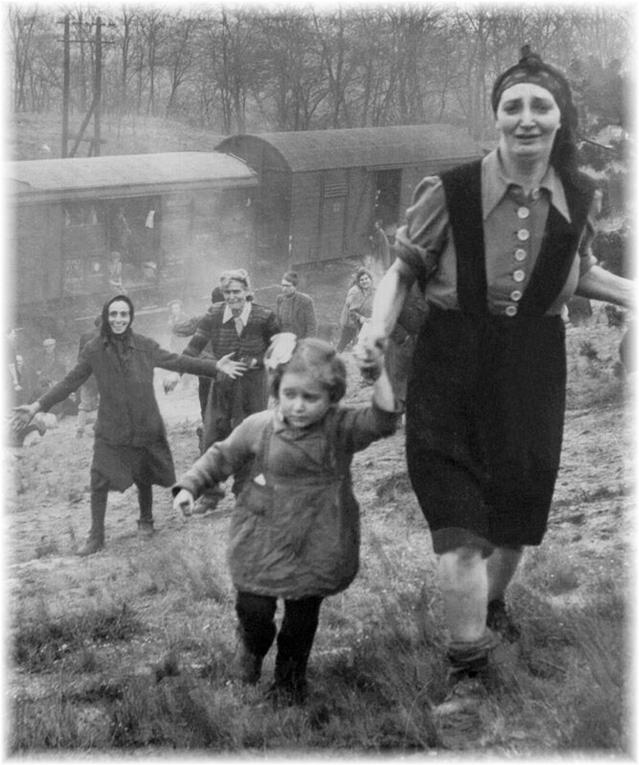
Rona: Their house in Hungary was bombed, so there were no pictures left there after the war. Some photos were sent to Paul’s uncle in Cleveland. After the war, almost every town made a Yizkor book – Yizkor is the Hebrew word for memorial. These books chronicle the history of the town, the Jews who lived there before the war and list those who did not return. Paul’s nursery school picture comes from the Karcag book. When Paul and I visited Karcag, we photographed the water pump and the Synagogue. Some of the photos in the book were taken by the soldiers on the days the train and the camp were liberated. Did you know that the photograph of the woman and her daughter emerging from the death train is now on a list of the 40 most iconic Jewish pictures?

Sharon: That is amazing, Rona, because until a few years ago, it was known to only the soldiers who liberated the train. My Dad kept it in his top dresser drawer. When he told his story to (history teacher) Matt Rozell, Matt put it on his website. The Internet has been a powerful tool in spreading this story.

moment-of-liberation1.jpg

Rona: That was how we learned about the work Matt Rozell was doing. My son read an article on the Internet about the train and sent it to me. I gave it to Paul who recognized it as the train he had been on. We contacted Matt who said he was organizing a symposium at Hudson Falls High School. It was there that Paul and your Dad (Carrol Walsh) met. I included that wonderful picture of Paul and your Dad embracing right after Paul said, “Give me a hug. You saved my life!”

Sharon: Not only is it a great picture of Paul and Dad, but it captures the feeling of all the survivors who had spent a lifetime searching for the soldiers who saved them.

Sharon: How did you approach the actual writing and selection of words and language?

Rona: I wrote the story in English, not Hungarian, but I wrote in a way they might have spoken. I tried to use the vernacular of the time. We don’t have a record of their exact words but we do know how they would have spoken, and what they were feeling at the time. When I have included Hungarian or Yiddish words, I have included explanations for them. Writers always need to listen to how people speak.

Sharon: THE LAST TRAIN recounts historical events for which you have created dialogue between characters. How would you classify this book?

Rona: I would call it creative nonfiction, or fictionalized nonfiction. The events that happened to Paul are all true. Occasionally, I needed a bridge between incidents or to show the passage of time. When I created a scene, I discussed it with Paul for authenticity. For example, I included a scene in which Paul sights the return of the storks, and has a conversation with his mother. I needed something to create a sense of time and place, and what they were feeling in the absence of Paul’s father. When Paul told me there were storks that returned every spring, I knew I had found the bridge I needed. My intention was to recreate the history. To bring the reader along, the writer needs to show the drama of the events.

Sharon: There are many heart-stopping scenes: when Paul is confronted, nose-to-snout with the ferocious German Shepherd dogs; when he is separated from his mother and brother at the train station; when he sneaks through Bergen Belsen to visit his uncle; and, of course, when the SS guard shoots the boy standing next to Paul.

Rona: I was not going to include that last event. I thought it was too strong for my audience. I was telling my editor about it, and he insisted that I include it. He said it was important to tell exactly what happened.

Sharon: What did Paul think of the way you portray him?

Rona: When he first read it he said, “You are making me look like a bratty little kid.” I responded, “Well, you were!” But what I actually meant by that is he acted like a typical 5 or 6 year-old in that he was terrified. But his own distinctive personality also shows through where he was both feisty and stubborn. These were important traits to have.

Sharon: Why did you include the reunion in the book?

Rona: The reunion was approximately 60 years after their liberation. It was, without a doubt, one of the most amazing shared experiences of my life. The powerful feelings shared by the soldiers and survivors radiated to their families and to the students at the high school. They were reunited because a high school history teacher interviewed a soldier and the information was put on his website. For the survivors and soldiers to share this experience with the students is so important. These students will share what they heard with their children. They are the ones who will pass along what happened. It was a life changing experience for everyone involved.

Sharon: What has surprised you most about the publication of THE LAST TRAIN?

Rona: That the audience goes beyond middle school and high school. Their parents and other adults are reading the book and responding.

Sharon: What would you like to see children and adults take away from this book?

Rona: This is a universal story of survival. I want my readers to see how this family and their extended family took care of each other and watched over each other. Paul’s mother was suffering with typhus and her young sons literally propped her up at roll call so the soldiers would not see how ill she was. Oscar became a father figure for Paul. He told Paul to stand up straight and not to cry. In the camps you don’t break down. I want my readers to be able to say, “Thank God I have the right to show my emotions. It’s okay to be a kid.”

Sharon: Thank you for speaking with me today. Paul’s family returned to Hungary, but life changed tremendously. He eventually came to Canada. Is there another book here?

Rona: There very well could be! It was not easy getting out of Communist Hungary.

The Last Train offers so much in terms of discussion points. It makes a huge impact in its 142 pages. It would be a great introduction to a study of the Holocaust for high school students. It is also accessible for 10 year-year-olds. Adults will truly understand the importance of both parts of this story. Of course there are the general topics of World War II and the Holocaust but there are also topics of bullying, physical and psychological fears, strength and courage, mother-child relationship, sibling relationship, family and friendship, defining a hero, the impact of a photograph, and hope. It is a story of captivity and deliverance; a story of new-found friendships, deep respect and a sense of inner peace discovered sixty years beyond the events of World War II.

WATCH PAUL ARATO SPEAK TO STUDENTS FOR THE FIRST TIME

Rona’s presentation on THE LAST TRAIN includes a Power Point display including original photographs. It is suitable for children nine and up as well as adults. For more information about Rona Arato, her books and her presentations, visit www.ronaarato.com.

To book Rona for a visit, go to www.childrenslit.com/bookingservice/arato-rona

If, after reading The Last Train, you would like more information about the train to Magdeburg and the Hudson Falls High School symposium, please go to Matt Rozell’s site: https://teachinghistorymatters.com/. By the way, train survivors are still contacting Matt from all around the world. Frank Towers, the lieutenant who oversaw the liberation, has made it his life’s work to locate any remaining survivors. To date, about 350 have been found.

found at http://www.clcd.com/features/th_Rona_Arato_Final.php

Read Full Post »

Numbers dwindling, WWII veterans continue poignant reunions, renewing bonds forged in battle

Article by: DAN SEWELL , Associated Press
NOTE: I was reading this article in my hometown paper yesterday. Frank Towers is mentioned halfway in. Then I remembered some time ago the AP contacted me looking for info on WW2 reunions, and I gave them Frank’s contact info. So yes this is another cut and paste update, but I did have something to do with the article! That’s 1st Lt. Frank Towers- the guy charged with shuffling dazed Holocaust survivors to food and shelter, April, 1945…. He’s 96, planning another reunion in Savannah in Feb. I’ve been to his last 6 reunions. There is nothing like getting up at 6am for breakfast with a table of these guys.

DAYTON, Ohio — Paul Young rarely talked about his service during World War II — about the B-25 bomber he piloted, about his 57 missions, about the dangers he faced or the fears he overcame.

“Some things you just don’t talk about,” he said.

But Susan Frymier had a hunch that if she could journey from Fort Wayne, Ind., with her 92-year-old dad for a reunion of his comrades in the 57th Bomb wing, he would open up.

She was right: On a private tour at the National Museum of the U.S. Air Force near Dayton, amid fellow veterans of flights over southern Europe and Germany, Young rattled off vivid details of his plane, crewmates, training and some of his most harrowing missions.

“Dad, you can’t remember what you ate yesterday, but you remember everything about World War II,” his daughter said, beaming.

When Young came home from the war, more than 70 years ago, there were 16 million veterans like him — young soldiers, sailors and Marines who returned to work, raise families, build lives. Over the decades, children grew up, married, had children of their own; careers were built and faded into retirement; love affairs followed the path from the altar to the homestead and often, sadly, to the graveyard.

Through it all, the veterans would occasionally get together to remember the greatest formative experience of their lives. But as the years wore on, there were fewer and fewer of them. According to the Department of Veteran Affairs, just a little over 1 million remain. The ones who remain are in their 80s and 90s, and many are infirm or fragile.

So the reunions, when they are held, are more sparsely attended — yearly reminders of the passing of the Greatest Generation.

—When veterans of the Battle of the Bulge gathered in Kansas City this summer, only 40 came, according to organizers, down from 63 last year and 350 in 2004.

—Of the 80 members of Doolittle’s Raiders who set out on their daring attack on Japan in 1942, 73 survived. Seventy-one years later, only four remain; they decided this year’s April reunion in Fort Walton Beach, Fla., would be their last, though they met Saturday for a final toast in honor of those who have gone before them.

—A half-century ago, when retired Army First Lt. Frank Towers went to his first reunion of the 30th Infantry Division — soldiers who landed at the beaches of Normandy and fought across France and Germany — he was surrounded by 1,000 other veterans.

“Now if I get 50, I’m lucky,” said Towers, who is working on plans for a reunion next February in Savannah, Ga. “Age has taken its toll on us. A lot of our members have passed away, and many of them who are left are in health situations where they can’t travel.”

So why persist?

“It’s a matter of camaraderie,” Towers said. “We spent basically a year or more together through hell or high water. We became a band of brothers. We can relate to each other in ways we can’t relate to (anyone else). You weren’t there. These guys were there. They know the horrors we went through.”

___

As many as 11,000 people served in the 57th Bomb Wing that flew missions over German-held Europe from North Africa and the island of Corsica during most of the war. Hundreds survive, according to wing historians and reunion organizers. Only nine veterans made it to this fall’s event.

George Williams, 90, recalled earlier reunions with his comrades, “having a great time yukking it up and talking about things.” No one else from his squadron came to this one.

“All of a sudden, it’s lonesome,” said Williams, a native of Visalia, Calif., who moved after his wife’s death to Springfield, Mo., where his son lives. “All of the people you ran around with are on the wrong side of the grass. You wonder why you’re so lucky.”

But in a Holiday Inn hospitality suite with patriotic bunting, bowls of pretzels and chips with soft drinks at their tables, the stories flowed easily.

Williams remembered the tension of his first mission, his hand ready at the tag that would release him to bail out if necessary. It went without incident, and upon their return to base, a flight surgeon measured out two ounces of whiskey for each crewman. “Sixty-nine to go,” he said then, because 70 missions was considered the tour of duty. Sometimes on later missions, he would pour the two ounces into a beer bottle to save up for a night when he needed numbing.

Robert Crouse, of Clinton, Tenn., is 89 years old, but he remembers as if it happened yesterday the time a shell blew out the cockpit windshield (“you could stick your head through it”), disabling much of the control panel. Another plane escorted the bomber, its pilot calling out altitude and air speed as Crouse’s plane limped back to base, riddled with holes.

Young recalled flying a damaged plane back to base, hearing his tail gunner’s panicked yells as Plexiglass shattered over him. “You could feel the plane vibrate; you fly through the smoke, you smell the smoke and you hear the flak hitting the plane like hail on a tin roof.”

Not all the memories are bad ones. There was the late-war mission when they hit a spaghetti factory instead of the intended target (“Spaghetti was flying everywhere,” recalled Crouse, chuckling). There was Williams’ first Thanksgiving meal overseas: a Spam turkey, spiced and baked to perfection by an innovative cook.

“I still love Spam,” he said.

Then there was R&R in Rome, hosted by the Red Cross. Young men not long removed from high school toured the Colosseum and other historic sites they had read about. They visited the Vatican; some met Pope Pius XII. Williams got a papal blessing of a rosary for his engineer’s fiancee.

“It was pretty good,” Williams said of his war experience, “except when they were shooting at us.”

___

Some of the veterans fear that their service will be forgotten after they are gone. Crouse and others have written memoirs, and many of the reunion groups now have websites, magazines and other publications in which they recount their stories.

“You just hope that the young people appreciate it,” said Young. “That it was very important, if you wanted to continue the freedom that we have.”

Their children remember. Some are joining them at the reunions; others keep coming after their fathers are gone.

At this year’s reunion, Bob Marino led a memorial service and read the names of 42 members of the 57th Bomb Wing who died in the past year. A bugler played “Taps.”

Marino, 72, a retired IRS attorney and Air Force veteran from Basking Ridge, N.J., helped organize the gathering. His Brooklyn-native father, Capt. Benjamin Marino, died in 1967 and left numerous photos from the war, and Marino set about trying to identify and organize them. To learn more about his father’s experiences, he corresponded with other veterans — including Joseph Heller, who was inspired by his wartime experiences with the 57th to write his classic novel “Catch-22.”

“He never talked about any of this,” Marino said, turning the pages on a massive scrapbook as veterans dropped by to look at the photos. “Once in a while, something came out. I wish I had sat down and talked to him about it.”

This was precisely the gift Susan Frymier received at the reunion in Dayton.

She watched as the father who had long avoided talking about the war proudly pulled from his wallet a well-worn, black-and-white snapshot of the plane he piloted, nicknamed “Heaven Can Wait” with a scantily clad, shapely female painted near the cockpit.

She listened as he described German anti-aircraft artillery fire zeroing in on his plane. “I had to get out of there. All the flak … they were awfully close.” He described “red-lining” a landing, running the engines beyond safe speed. His voice suddenly choked.

“Oh, Dad!” said his daughter, and she hugged him tightly.

Read Full Post »

guns at last lightI’m recovering from a foot injury and it has given me time to finish Rick Atkinson’s latest release, The Guns at Last Light: The War in Western Europe, 1944-1945 in his Liberation Trilogy. With school around the corner, I am excited to be teaching a couple dozen seniors once again about World War II, and in the springtime, the Holocaust.

I’m happy with Mr. Atkinson’s coverage of the heroics of the 30th Infantry Division-he even made a research pilgrimage to Hill 314 in Mortain, where elements of the 30th held off against a Hitler-ordered panzer counterattack for 6 days, saving the Allied breakout in Normandy in August 1944. 

If you are a follower of this site, you will know that that division is dear to my heart, not because of any blood relations who fought in it, but because they named me an honorary member of their Veterans of World War II Association for my work in the classroom and in uncovering and reuniting the story of the liberation of the concentration camp train at Farsleben, Germany on Friday, April 13, 1945.

So you can imagine my excitement when I ran across this passage last evening from page 599 of Rick’s book. He writes about some of the chaos that unfolded as POWs, slave laborers, and concentration camps were liberated in Germany:

“Instead, starvation, revenge, indiscipline, and chaos often created what Allied officers called a “liberation complex.” SHAEF [Supreme Headquarters Allied Expeditionary Forces ] had presumed that refugees “would be tractable, grateful, and powerless after their domination for from two to five years as the objects of German slave policies.” As an Army assessment concluded, “They were none of these things.… Newly liberated persons looted, robbed, murdered, and in some cases destroyed their own shelter.” Freed laborers plundered houses in the Ruhr, burning furniture for cook fires and discarding slave rags to dress in business suits, pajamas, and evening clothes ransacked from German wardrobes. Ravenous ex-prisoners licked flour off the floor of a Farsleben bakery. In Osnabrück, “rampageous” Russian slaves died after swilling V-2 rocket fuel discovered in a storage yard. Others smashed wine barrels and liquor bottles in a Hanover cellar, drinking so heavily from a sloshing, six-inch-deep pool of alcohol on the floor that several collapsed in a stupor and drowned before U.S. MPs could close the entrance.”

So I did a double take: Ravenous ex-prisoners licked flour off the floor of a Farsleben bakery. I checked his notes-page 801, sure enough, 30th Division G-2 report. I know I have read this before in my research of primary source documentation, originally sent to me by Frank Towers, one of the liberators.  Here it is.

30th Division Medical Detachment Diary & Log

Of course, the backstory surrounding the document above is the story that I have to tell- the soldiers of the 30th Infantry Division and the attached 743rd Tank Battalion, the Holocaust survivors whom they stumbled upon, liberated, and were reunited with 62 years later at our high school and subsequent events.  I’ll probably share the Benjamin photo with Mr. Atkinson on his FB page. 

Anyway, I recommend the book to any of my followers interested in the history of World War II in the European theater, and am really pumped to teach some very excited and motivated students this year, including the grandson of the tank commander who was sent to investigate the train.

This is how you “do” history, and how the teaching of history can sometimes take on a life of its own. So cool to be a part of it, and to read something in a best seller and be able to grasp the incredible backstory that awaits to be told.

Read Full Post »

World War II infantry veteran Carrol Walsh, top, hugs Holocaust survivor Paul Arato at a reunion in Queensbury, N.Y., on Tuesday, Sept. 22, 2009. Walsh’s unit liberated a Nazi train carrying 2,500 Jewish prisoners, including Arato, from the Bergen-Belsen concentration camp in Germany during the war’s waning days. (AP Photo/Tim Roske)

I am reposting this today to honor both of the men below. Paul Arato passed away this week in Toronto, Canada and his memorial service is today. Carrol Walsh, his liberator, died in Dec. at his home in Florida and his memorial service was last Friday in New York.

Paul and Rona would also check in annually for dinner with the Walsh family when they passed through our town. The last time I saw both of them together was in 2011 at one of these dinners in a local restaurant. They sat together and laughed and joked like old pals. Paul told the story of how he arrived in Detroit after the war as an eager late teen anxious to find work designing fast cars in the automobile industry and was driven to the bridge in Canada by law enforcement and pointed to the bridge to Canada, as he did not have the proper documentation. Picturing the scene in his mind, Carrol would laughed outloud and slapped his knee. Both men were so happy to have found each other.

Rest on, friends.

Holocaust Survivors Reunite With US Veterans

NY high school reunites Holocaust survivors liberated from Nazi death train by US soldiers

By CHRIS CAROLA

The Associated Press

HUDSON FALLS, N.Y.

The Holocaust survivor was 6 on that spring day in 1945 when he last saw the U.S. Army soldiers outside Magdeburg, Germany.

Paul Arato was among 2,500 starving and sickly Jewish prisoners from the Bergen-Belsen concentration camp, their train abandoned by its crew and Nazi guards as Allied forces advanced. Two U.S. Army tanks on a scouting patrol — one of them commanded by Carrol Walsh, then 24 — came upon the stopped boxcars.

Arato, now 71, and Walsh, 88, met again this week.

“Please give me a hug. You saved my life,” Arato told Walsh in an emotional reunion of concentration camp survivors and some of the veterans of the 30th Infantry Division who liberated them.

Arato, an industrial designer from Toronto, and Walsh, a retired state Supreme Court judge from Hudson Falls, came together for a Hudson Falls High School history symposium inspired by history teacher Matthew Rozell’s original World War II project in 2007.

“You were all kids on that train,” Walsh told the survivors, most of them in their early 70s, as they and their families greeted the veteran. “I was an old man. I was 24 years old!”

Those arriving early for Wednesday’s opening session gathered Tuesday night for an impromptu reunion before having dinner surrounded by the faux Adirondack decor of the nearly deserted indoor water park. Four of the five Nazi train survivors at the dinner had never met Walsh.

Walsh’s tank patrol discovered the desperate Bergen-Belsen survivors on April 13 — hundreds of emaciated Jewish prisoners who had been herded aboard one of three trains leaving the camp a week earlier to keep them from being liberated by advancing Allied forces.

Walsh’s patrol stayed for a time, handing out candy to some of the children, then moved on after reporting their discovery. Frank Towers, a 27-year-old first lieutenant in the 30th Division, led a convoy that took the newly liberated prisoners to a German town where they were given food and shelter.

For weeks, the men of the 30th had heard of Nazi atrocities against Jews and dismissed the stories as propaganda, Towers said. That all changed when they encountered the train.

“Then we believed,” said Towers, 93, of Brooker, Fla.

This week’s reunion is the fourth since 2007, when Walsh was joined by three of the train survivors at Hudson Falls High. History teacher Rozell’s World War II project included an Internet posting of Walsh’s account of the train liberation.

An Associated Press report of that first reunion prompted more survivors to come forward, some from as far away as Israel, Rozell said. In all, he has confirmed that more than 60 survivors are still living and has been in contact with about two dozen of them.

Nine survivors of the Nazi death train are participating in this symposium, along with Walsh, Towers and four other veterans of the 30th who fought in Germany. Rozell said this week’s gathering is likely to be the last such event of its scope, given the advanced ages of the veterans and survivors.

For Arato, Tuesday night’s reunion with Walsh brought back a flood of memories. He recalled getting candy from one of the soldiers and a handgun to play with.

“I remember it was a Tootsie Roll,” he said. “The gun wasn’t loaded.”

Arato fretted over one detail. He recalled seeing a Jeep along with the American tanks, but fellow survivor Fred Spiegel of Howell, N.J., didn’t remember seeing a third vehicle. Later, Walsh said his patrol consisted of two tanks — and a Jeep.

“There WAS a Jeep,” Arato said, a smile breaking out on his face. “I remembered it right.”

———

On the Net:

Hudson Falls High School World War II Living History Project: http://www.hfcsd.org/ww2

http://www.huffingtonpost.com/wires/2009/09/23/holocaust-survivors-reuni_0_ws_296673.html

http://www.ynetnews.com/articles/0,7340,L-3781062,00.html

Read Full Post »

This is from last evening’s PBS NewsHour. Book is on my summer reading list. April 1945 a focus of my studies.

‘Bad to the Very End’: Author Reflects on the Long, Deadly Road to WWII Victory

In honor of the 69th anniversary of D-Day, Ray Suarez talks to historian Rick Atkinson about his new book, “The Guns at Last Light,” which chronicles the brutal fight for victory at the end of World War II.

JEFFREY BROWN: Finally tonight, we mark June 6, D-Day.

Ray is back with book conversation he recorded recently about World War II.

RAY SUAREZ: The war that had a hand in cementing U.S. status as a superpower and created the map of the modern world ended almost 70 years ago.

You could fill a library with books about the Second World War, yet historians still find new things to say and new ways to say it.

Award-winning author and historian Rick Atkinson has just completed the third book in his “Liberation Trilogy,” “The Guns at Last Light: The War in Western Europe, 1944-1945.” And he joins me now.

And, Rick, if nothing else, this book is a reminder that, with D-Day, there was still some of the worst fighting of the war left to go.

RICK ATKINSON, author, “The Guns at Last Light”: That’s certainly true, Ray.

I think the horror of it is difficult to imagine 70 years later. And it continues really after D-Day, almost to the last gunshot. There were almost 11,000 Americans killed in Germany in April 1945, the last full month of the war in Europe. And that’s nearly as many as died in June 1944, the month of invasion.

So the bloodletting continued right to the end. The notion that many Americans have that it was bad on the beaches, and then something bad happened during the Battle of the Bulge in December 1944, and then it was kind of sweeping into Germany and the war was essentially over is actually quite incorrect. It was bad to the very end, almost to May 8, 1945, when the war in Europe ended.

RAY SUAREZ: Terrible, ferocious, deadly fighting through Northern France, through Holland and Belgium, and finally into the German homeland.

Then you bring us to one British officer who says, “Why don’t the silly bastards give up?”

What was the German calculation in those last months, when it was clear they could no longer militarily prevail?

RICK ATKINSON: Well, there are several things at play.

Part of it is terror. Hitler had a police state of the first order. And those who showed any sign of being weak-kneed faced prison or often summary execution. That prevented a lot of people who knew that the war was not going to turn out well for Germany from giving up.

In other cases, you have to say that 80 million Germans tended in large measure to be true believers, that they believed in the fuhrer almost to the bitter end. You would see parades, for example, on Hitler’s birthday, April 20, 1945, in Berlin — this is 10 days before he kills himself — of young girls, young boys who are too young to go into the military carrying flags and singing patriotic songs, people cheering along the streets of a badly battered Berlin at that point.

So, the German psyche was such that they’d been heavily influenced by propaganda. And they were just generally disinclined to give up.

RAY SUAREZ: Rick, you also remind us that the war got deadlier as it went on, because both sides were innovating, inventing new ways of killing the other side practically until the last day of the war.

RICK ATKINSON: That’s true, Ray. The lethality increases as the war goes along, and it — it’s extraordinary how brutal it is.

We Americans, for example, invented something called the POZIT Fuse. That was the code name. There was a little radar sensor in the nose of an artillery shell, and it could, by emanating radar signals, determine when a passing plane or when an approaching target was just within the kill radius of the burst, and detonate that shell.

It was used for the first time in the Battle of the Bulge in December 1944. The Germans called it pure manslaughter. It was part and parcel of a generation of weapons that came along, napalm used for the first time around this time. The Germans had invented the V-1 and V-2 flying bombs and then a ballistic missile, the V-2, with terrifying results, most of them launched against London or Antwerp with devastating results to civilians.

RAY SUAREZ: We have in the final weeks and months of the war some moments where it’s hard to tell where moral authority existed, if such a thing any longer existed.

How could you tell concentration camp inmates not to rise up and kill their captors who were trying to surrender and act like normal soldiers? How could you put trial Americans who, sickened by the slaughter, would just turn and around pop these guys with their sidearms as they tried to surrender? It got nasty, brutal, and frightening in those final weeks.

RICK ATKINSON: This is true.

And it’s not just the final weeks, actually. There’s killing of prisoners that begins early in the liberation of Europe by American, British, Canadian soldiers, and, of course, by the Germans. It intensifies during that last 11 months from Normandy on.

But when you get to the camp liberation phase, particularly in April 1945, for example, at Dachau, American soldiers coming into this camp, tens of thousands of emaciated, horribly treated prisoners, and thousands of bodies lying around, and there were soldiers that went on a rampage. There were at least a couple dozen S.S. guards who had surrendered, had been taken into custody who were murdered, probably more than that.

This is at the same time that there are liberated inmates rampaging, tearing literally some camp guards limb from limb. There was an investigation. The investigators found that, yes, there had been prisoners murdered by American soldiers. Nothing was ever done of it. No one really had the stomach to prosecute American soldiers under these circumstances.

This is just one example of many, though, of the barbarity that war unleashes with — inside otherwise good soldiers.

RAY SUAREZ: I want to continue this conversation with you online.

The book is “The Guns at Last Light.”

Rick Atkinson, thanks a lot.

RICK ATKINSON: Thank you, Ray.

http://www.pbs.org/newshour/bb/military/jan-june13/atkinson_06-06.html


Read Full Post »

American Cemetery overlooking Omaha Beach, the primary landing zone for Americans during the D-Day invasion June 6, 1944. (U.S. Air Force Photo)Today one of my former students emailed me to visit saying that she had a surprise for me. She brought me a present- sand from the beach at Omaha in Normandy.

This was originally posted four Junes ago, I re-post here now.

I came into school today, on a Saturday, to start packing up my room for a move to another room.

But it is the 6th of June.

Instead I am getting nothing done, mesmerized by the scenes, live from Normandy, of the 65th anniversary celebration.

The President is there and so are 250 American veterans of the battle for Normandy,  including one of my good  friends, Buster Simmons, of the 30th Infantry Division. The Greatest Generations Foundation sponsored his visit with 9 other vets and college kids. Now I’m looking for him in the sea of faces.

My son Ned and I watched him last night as a “Person of the Week” on ABC World News in a story I contributed to. If you view the clip, you can see the photograph I provided ABC with, taken by Major Clarence Benjamin, of the liberation of the train. This is the photo that Buster uses when he speaks to high school classes to tell this story.

I am hopeful that we can get Buster to come to our high school for the  liberator-survivor reunion in September.

It was twenty five years ago, on this anniversary, that I wrote an essay in the local newspaper expressing my appreciation for the veterans of World War II. And as I begin to sort through and pack up 20+ years of memories in this room, three things are becoming clear: 1) my love for these men and women and what they did only increases as time passes; 2) the rest of my career will be focused on the promotion of narrative history in the classroom, linking students, veterans and survivors together; and 3) I won’t be getting any packing done this day.

Take a minute to watch Buster in the clip and take his optimism about the future of our nation to heart. Especially if -“you’re an American.”

Read Full Post »

By OMAR RICARDO AQUIJE- Glens Falls Post Star

HUDSON FALLS —Fred Spiegel was asked if he felt resentment toward the Nazis.

“Yes, to the Nazis, but not the Germans,” Spiegel said.

The question came from a student at Hudson Falls High School, at which Spiegel was invited Friday to discuss his life during the Holocaust.

On April 13, 1945, a train traveled across Germany, carrying 2,500 Jews en route to a concentration camp.

Spiegel was among them. He was 13.

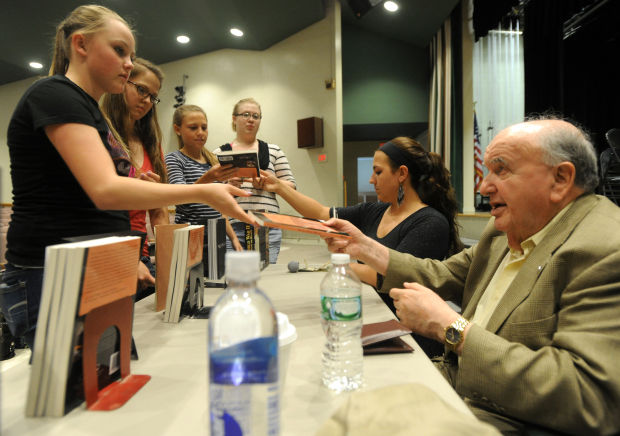
Holocaust survivor Fred Spiegel sells and autographs copies of his book, "Once the Acacias Bloomed," for students at Hudson Falls High School on Friday, May 24. Spiegel, who was liberated by U.S. troops as a young boy during World War II, spoke about his experiences and answered students' questions. (Jason McKibben -

Holocaust survivor Fred Spiegel sells and autographs copies of his book, “Once the Acacias Bloomed,” for students at Hudson Falls High School on Friday, May 24. Spiegel, who was liberated by U.S. troops as a young boy during World War II, spoke about his experiences and answered students’ questions. (Jason McKibben –

Spiegel, 81, visits schools to talk about how he survived. He brings copies of his book, “Once The Acacias Bloomed,” which explains his life as a Nazi prisoner.

Most of the schools he visits are in New Jersey, where he lives. The farthest he travels is Hudson Falls, a school he visited a few times in recent years, a school he included in his book because it was here an important moment in his life occurred.

“They invited me,” Spiegel said of his reason for returning to Hudson Falls. “How can I say no?”

During Friday’s presentation, Spiegel often said he was lucky to be alive.

Other trains carrying Jewish prisoners made it to their destination. His did not.

His train suddenly stopped near Magdeburg. Spiegel said the train’s engineer and Nazi soldiers fled for fear of capture. U.S. troops was cutting across Germany.

Then, a few U.S. soldiers on tanks found the train and freed the captives. The soldiers included Carroll Walsh, of the 743rd Tank Battalion.

Spiegel was later reunited with his family. It was 65 years later when the unexpected happened: He was invited to Hudson Falls to meet others who were prisoners on the train.

He also got to meet some of the liberators, including Walsh, who was living in Hudson Falls at the time.

Matt Rozell, a Hudson Falls history teacher, organized the reunion. He met Walsh in 2001. He interviewed the former soldier, and learned about the train near Magdeburg.

Walsh died in December. He was 91 and a former state judge.

Spiegel, a native of Germany, said people have shown more interest in the Holocaust over the years.

During Friday’s visit to Hudson Falls, he spoke to about 30 sophomores. Some of them had copies of Spiegel’s book. Others bought the book after the presentation.

Armand Ryther, a student, approached Spiegel to shake his hand.

“I find it very interesting that he could survive what he did,” Ryther said.

Ryther said he read Spiegel’s book.

Jamie Hughes, a fellow sophomore, said it was interesting to hear about Spiegel’s experiences.

“I think it’s really amazing that he would want to share his experiences with everybody,” she said.

Tara Sano, a Hudson Falls history teacher, said the event was planned near Memorial Day so students can reflect on the efforts of veterans.

“My hope is that when you are taking your three-day weekend, you think about why you have a three-day weekend,” she told students at the start of the presentation.

http://poststar.com/news/local/article_00a9219c-c648-11e2-ae69-001a4bcf887a.html

See Fred meet his liberator for the first time.

Read Full Post »

Two Toronto Holocaust survivors meet their liberators 65 years later
Two survivors of a death train out of Bergen-Belsen concentration camp finally link up with American soldiers who freed them in 1945.

A WWII-era booklet still possessed by Leslie Meisels documents his liberation as a young boy from a train destined for a death camp. Meisels, who eventually ended in Toronto, met a few of the surviving soldiers who freed him and 2,500 prisoners on the train.

A WWII-era booklet still possessed by Leslie Meisels documents his liberation as a young boy from a train destined for a death camp. Meisels, who eventually ended in Toronto, met a few of the surviving soldiers who freed him and 2,500 prisoners on the train.

Leslie Meisels is 86.

Leslie Meisels turned 68 last month.

Every April, since he was 18, Meisels has celebrated his rebirth. Sixty-eight years ago he was on the cusp of death, packed into a cattle car in a freight train with some 2,500 other skeletal Jewish prisoners. He weighed only 75 pounds.

Then a miracle. That train, which had set off from a concentration camp, was liberated by 12 shocked American soldiers in two tanks and an army jeep near Farsleben, Germany.

Up until then, the American GIs had assumed the gruesome stories they had heard about German death camps were just Allied propaganda devised to make them fight harder. But as they unlocked the boxcar doors, they witnessed humanity’s true capacity for evil.

They called it the death train. For Meisels, it was a train of life.

This past week marked the 68th anniversary of V-E Day, the end of the Second World War in Europe. It’s a good moment to tell the story of that train from Bergen-Belsen.

I heard about it last month in an email from a history teacher in upstate New York. He put me in touch with Meisels and Paul Arato: two Holocaust survivors from Hungary who in 1956 escaped their homeland, by then under Communist rule, and settled in North York.

Their stories are remarkably parallel. They grew up in nearby towns in eastern Hungary, they were both imprisoned by the Nazis in 1944, and they were sent first to Austrian farms as slave labourers and then to the Bergen-Belsen concentration camp in northern Germany.

Have you ever seen the horrifying Holocaust photos of dead, naked bodies being pushed by a bulldozer into open pits? That was Bergen-Belsen. Some 70,000 people were murdered there, including Anne Frank. They weren’t killed in gas chambers, like at Auschwitz. Instead the Nazis used starvation, sadism and disease here.

Meisels remembers mostly the hunger. They were given only watery turnip soup and a piece of bread each day. In four months, he lost 100 pounds.

Arato, just 6 then, remembers the rattling cold and twice-daily roll calls that often lasted hours. He and his older brother Oscar had to hold their mother upright, she was so weak from typhus. One day a boy in their line smiled because it was his birthday. As his “present,” an SS guard shot him dead. It was Oscar’s birthday the next day.

The horror is ungraspable.

By April 1945, the Nazis were retreating as both the Allied and Soviet armies advanced. One morning, both Meisels and Arato were awakened by guards and told to march. “We dragged our bodies over five kilometres,” says Meisels, “back to the train.”

Trains in Nazi Germany usually led to death. This one was no different. It was destined for another concentration camp in Czechoslovakia, but the guards also had orders to execute passengers. Meisels remembers one afternoon when all males 12 and older were ordered out of the packed boxcars and lined up in front of machine guns. They stood there two hours before being herded back into the putrid cars.

Over six days, the train progressed only 135 kilometres.

Arato remembers peering through between the wooden boxcar slats and seeing the SS guards drop their weapons and start running. Then he glimpsed a tank with a star on it.

The door slid open shortly and they were greeted by stunned American soldiers.

“It was hard for us to believe what we were actually seeing,” says one of those soldiers, Frank Towers, on the phone from Brooker, Fla. “We weren’t prepared for it. We were there to fight a war. We weren’t humanitarians. We didn’t know what to do.”

Says Meisels: “We cried, ‘Oh God, we are going to be free. We are going to be human beings again.’ ”

Towers, who was serving in the 30th Infantry Division, spent a day those taken off the train to convalescence homes and a hospital nearby before he had to push on with his battalion.

Meisels and Arato spent five months recovering in Germany before they could finally return to Hungary to search for the rest of their families. Eleven years later, they escaped Hungary and started their lives for a second time: getting married, building careers, having children, then grandchildren. Decades went by.

Then, a few years ago, their paths crossed at a business meeting. Arato, since retired, was an industrial designer. Meisels ran a family company making plastic moulds. At the end of the meeting, the topic of the Holocaust was raised. They discovered, to their shock, they had both been on that train from Bergen-Belsen.

Around the same time, that high school history teacher in New York named Matt Rozell stumbled upon the story.

To bring Second World War history alive, he’d instructed his Grade 10 students to interview their grandparents about the war. One summer, he visited one of his students’ grandfather: Carrol Walsh, a veteran turned New York State Supreme Court judge.

“After two hours, when the interview was ending, his daughter elbowed him and told him to tell me about the train,” Rozell says.

He learned Walsh had been in one of those tanks that chased away the SS soldiers and liberated the train.

Rozell posted the story on his website, Teaching History Matters, and a few years later a survivor from that train contacted him from Australia. Since then, 240 more have been located.

In 2007, Rozell hosted his first symposium on the train, bringing together survivors and liberators. Arato’s son came across a story about the reunion on the Internet by chance.

Arato told Meisels about it, and two years later they both traveled down to Hudson Falls, N.Y., for the second symposium. There they met Walsh and Towers.

That moment was a second liberation for Arato, now 74.

“A blanket was pulled from me,” he says. “I was always very lonesome. I didn’t share my stories with anybody. I grew up and spent all my years being angry. This meant I don’t have to be angry anymore.”

His wife, Rona, has just published a book about his story called The Last Train: A Holocaust Story.

Meisels visits schools around Toronto to speak about the Holocaust every week.

His message? “Hatred is something we have to fight against. When you hear a derogatory comment, say out loud that it is not right. When you are silent, you are not neutral. You are supporting the oppressor.”

He and Towers went to Washington, D.C. last month to celebrate the 20th anniversary of the Holocaust Museum there. Towers, now 96, is the last living U.S. veteran who liberated that train. Walsh died last December.

“We hugged,” Meisels says. “Whenever we are together, I am so overwhelmed by gratitude and joy.”

Truth can be more horrifying and wonderful than fiction. Every life is precious.

CLICK HERE FOR THE STORY OF ANOTHER TORONTO RESIDENT WHO FOUND HERSELF IN THE 1945 PHOTOGRAPHS


by Catherine Porter 

http://www.thestar.com/news/gta/2013/05/10/two_toronto_holocaust_survivors_meet_their_liberators_65_years_later_porter.html

Read Full Post »

« Newer Posts - Older Posts »