Feeds:
Posts
Comments

Posts Tagged ‘Holocaust Education’

Today is the 68th anniversary of the liberation of the train. We’ll have 80 for the final banquet tonight.

I am here in Louisville, KY at the reunion of 12 WW2 soldiers of the 30th Infantry Division and 5 Holocaust survivors who were given new life by these guys 68 years ago. And lots of 2nd generation and 3rd generation-sons and daughters, children and grandchildren, many here meeting their liberators for the first time.

In many ways it is a spiritual event.

Frank gave the introduction and described his role in transporting the prisoners from the train to safety. I spoke on how there were too many random “quirks of fate” to attribute this present gathering to coincidence. Had my wishes come true, and had I never returned to my hometown as I had hoped when I left it for college, the room would have been half empty. I would have never interviewed the tank commander who told me his story. None of these survivors would have known the rest of the story, so to speak; perhaps the soldiers too-

John D. thanked me afterward, describing his time carrying his rifle across Europe as a combat infantryman nearly seventy years ago. He told me now he knows, after meeting the survivors that he helped to liberate, what the true meaning of FREEDOM is, and what he fought for. He thanked me, a teacher. I resisted. He insisted. That about blew me away.

There was more to come.

Kurt and Gideon, “new” survivors, gave testimony for the first time to their liberators. Emotional. True freedom. Kurt remarked that he felt it when the Americans uttered “One Only” as nearly two dozen survivors were shown a clean room after liberation and proceed to attempt to occupy it. To be able to close the door when entering a bathroom, alone.

Eve, Kurt’s daughter, remarked through tears how she knew emotions would overwhelm, but she carried on and read fellow 2nd Generation survivor Sandy’s poem “I am a Survivor”.

She spoke of how difficult it was to grow up, with her two loving parents, knowing what they had been through-how do you, as a teen,  issue the normal teenage complaints when your parents had had it so much worse when they were your age? She ends beaming at her audience through wet eyes, the soldiers of World War II and their families who are returning the love in spades over this weekend.

Later I was very moved at Friday dinner when Gideon’s daughter gathered the children and others in the front, after calling our attention, and thanking God for these soldiers coming into their lives on April 13, 1945 and again now. Candles were lit, prayers were said, and Shabbat was ushered in, and we broke bread together, Gentile and Jew, survivor and soldier, sharing laughter and tears.

More later. For now would like to leave you with an account of the liberation by survivor Aliza Vitis-Shomron, who was recently featured in an AP article about the Warsaw Ghetto uprising. She, too, was a teen in the spring of 1945…

***************************************************

In Bergen Belsen

It is spring outside. The news we get from the older German soldiers who treat us humanely is that the end is approaching. Beyond the fence of the Dutch camp there is an open field. The wind brings in a horrible smell from there. In the distance we can see circles of smoke rising, and dark figures busy round the fire. What are they carrying? They are corpses for which there is no room in the crematorium, they are burning them on the ground one by one. Their ashes mingle with the soil, the rain creates human mud.

“All are of the dust, and all turn to dust again” – said the Lord.

Maybe that is God’s will – if He exists at all.

Human beings: beautiful, with black eyes, blue eyes; writers, teachers, students, disappointed lovers, proud, cowardly, selling fish on the market, fathers and mothers and those who had not yet tasted love. “The Chosen Jewish People” burnt like dung in the field.

At the beginning of 1945 the winter was hard. What may have saved us from starvation and death were the Red Cross parcels that arrived in March.

At the beginning of spring 1945 the cannons thundered. We felt that the end for the Germans was near, and there were many indications that it was so. The main one was that they stopped giving us food. Every day we stood at the fence along the main road, waiting for the soup which came late, often only in the evening.

Evacuation from Bergen-Belsen

Allied planes fly above us making a dull sound and there is nothing to stop them. A few days ago there was an air battle between English and German planes, right above the camp. I hid with the others under the bunks, not that I was afraid, but a shrewd thought was on my mind: Now, just before liberation and the end of the war, I could be killed by an allied bullet or bomb…

I am sure there is no God, only chance rules my life. There is no one to pray to, no one to beg – maybe my lucky star that has protected me until now will continue to do so… Will I manage to survive? A sweet feeling of revenge fills me as I realize that our murderers are also suffering and being killed! My strength        has waned, my feet are swollen from hunger, I have become apathetic to my surroundings.

On the 8th [7th] April, an unexpected order came to prepare for evacuation. We heard the thunder of cannons in the distance, they said that the city of Hanover was in the hands of the allied armies. And they are approaching the little town of Celle. Evacuation? Where? To the gas chambers?

There was a terrible smell in the air. I was hardened, cynical, no longer capable of feeling anything. After the terrible murders in Block Ten, adjacent to us, nothing could move me. I remembered I had to survive to tell the world about my friends. I hugged my mother and sister. They mustn’t separate us!

Mother consults uncle Leon Melamed. Aunt Irena, practical as usual, is already packing the most important things. “There is nothing we can do,” she says with typical decisiveness. “We have no choice. There is no point in staying in a camp that is no longer getting supplies of food. We’ll starve before they come to liberate us.” We agree with her. We get into a long line, men, women and the children who are with us, hundreds of Jews from various blocks.

The people’s faces mainly express uncertainty and acceptance of the situation. We again pass by the piles of skeletons, new ones every day. In the huge concentration camp on the other side of the road we see shadowy figures moving.

Mother and I take the few remaining clothes, the notes I have written in the camp and on the Aryan side, and a passport photo of father. We have no personal documents, nothing reminiscent of our previous life. Mother has only a silver fruit knife that she took with us when we went to the “selektzia” in Warsaw. My legs won’t carry me. We have to go eight kilometers to the railway station in Celle. The road seems endless, the body is weak and not used to moving. Every step calls for an inhuman effort. We crawl along slowly.

Gavriela is carrying her five-year-old brother on her back. Her face is red with the effort. The child has no strength left, he is apathetic. Their mother walks beside them and slaps him gently on his face. Her legs are also swollen from hunger. I walk on. I can’t help them, I have no strength left.

Suddenly a man walks up to me. I recognize him: It is my neighbor, from the next bunk. Without a word he puts his arms under my armpits and drags me along. I lean on him with all the weight of my body. I didn’t get to know him, although we “lived next door”; and now he is helping me!

Who can understand the depths of good and evil in the hearts of men! This small deed, the hand held out in support at a critical moment, imbued me with hope and strength to continue on my own.

People begin to drop their belongings. We also stop every fifteen minutes and sadly throw down a few things. At the end of the march my backpack only holds a little food and two or three items of underclothes.

This experience has affected my life-long attitude to things. Losing things or parting with them means nothing to me, causes me no sorrow. They certainly have no value in themselves, only if they are connected to some precious memory.

My legs are swollen and hurt. I can’t feel them any longer. I long to sit down, to rest, to close my eyes and disappear… I struggle constantly against this urge. Mother is dragging herself along, but walks erect, as always. Mirka walks along well. Suddenly we see railway carriages. Surprisingly, they are normal “pullmans”, not freight cars. The exhausted people lie down on the platform. At the station we are given a little food and water. The journey has begun.

The most precious turnips

We traveled by train for eight days. The train moved little, it remained standing a great deal. The frontline was everywhere and chaos all around us. German families flee with their belongings in all directions in carts and on foot. Have they been encircled? What a cheerful thought! Our leaders and various oracles, experts in solving riddles and interpreting rumors, say that the Germans want to use us as hostages. Besides our group, hundreds of Dutch, Greek and Hungarian Jews are with us on the train, all supposed to be exchanged, from the special camps in Bergen-Belsen. In the meantime the most important thing is to get hold of food.

During one of the stops I saw people jumping from the train and rolling down. I also wanted to do so, but my sister was quicker and out already. I joined her. We rolled down the high embankment to a wonderful pile of animal feed, yellow turnips. I filled up my dress feverishly, grabbing as much as I could carry and hop – climbed back. But at the moment when all the children and youth began climbing up, guards on the roof of the train opened fire on us. The Germans were apparently surprised and reacted late. I ran and lost my sister. I didn’t see a thing, but I was determined to get the turnips into the carriage. The bullets whistled around us, but I didn’t drop the turnips. I didn’t even look back to see who fell and who survived. Only on reaching the top, under cover, did I look back in great fear, in search of Mirka. She stood up next to me, trembling but smiling. We had food for the rest of the journey.

The danger is not over yet…

After a six-day journey we approached the frontline. We realized that we were apparently traveling southeast. The “experts” say that we are approaching a large city in central Germany, Magdeburg, on the banks of the Elbe.

One day the officer commanding the military escort called our representatives. He was well-mannered and received them politely. Hela Schüpper wrote in her book: “The commander took off his military cap and turned to the Jews in fear: ‘Ladies and gentlemen, the end of the war is near. What shall we do?’

Engineer Solovieczyk advised him to surrender to the Allies and put up a white flag on the roof of the train.” Our representatives came back and described the amazing meeting excitedly: The German asked the Jews for advice! Maybe he’ll also ask them for help? That’s a good sign.

In the night the whole escort team fled, using the locomotive. What will happen now, to us? We were alone. Slowly, people started leaving the carriages, the train was standing in the middle of a field. I also got off, with my faithful friend Tusia (Rina Altbecker). We saw a small pond not far away, and “our people” were catching little fish there. Those among them with initiative found a tin, made a fire and cooked the fish. We joined in, glad to share the job.

We breathe fresh air, the sky is clear, it is spring. Although we are weak, exhausted by hunger, hope is reflected in all the faces. Of course, there are also some “ravens”, prophesying that the Germans will not give up as long as they can harm us, but who listens to them? Mother is also pessimistic.

Visiting a village

Mirka and I join the stream of people going to the nearby village of Ferstleben [Farsleben]. The village houses are pretty, clean, surrounded by gardens with fruit trees. We entered a garden in fulllbloom. I knocked on the door of the house. A woman wearing a big apron came out. Her face expressed amazement at the two figures facing her. Evidently we looked like ghosts.

“Kartofel, Kartofel, bitte,” (Potatoes, potatoes, please) I whispered. At that moment the woman started to scream. I didn’t understand a word. She pushed us out. I ran to the trees and began to shake them, so the blossoms fell off the branches. A large stone flew at me. We ran away.

That was the first and last time I asked for food. I felt ashamed. Mirka and I decided not to tell mother about it.

The fate of the certificates

That night we were right in the frontline. We spent the night lying under the carriages. We did not dare flee from there, there was nowhere to go. To hide in the German village? They’ll chase us away like dogs and hand us over to the authorities. We had no choice but to remain in the carriages and underneath them. Whatever happens to the others will also happen to us. Cannon shells flew above us with a terrifying noise. They may have aimed at the train… It was a miracle that we survived till the next morning.

Before dawn the locomotive returned with our escort. People who got out of the carriages in the morning were amazed to see lots of pieces of paper floating on the small pond. They looked strange, and they had not been there on the previous day. When they went to look at them, they were devastated: these were our certificates and other papers protecting us! So we did have such papers. It wasn’t just a deception by the Germans!

{After the war the mystery was solved: as I wrote, at the end of 1944 a group of two thousand Hungarian Jews from Budapest came to Bergen-Belsen, on their way to Switzerland. Our leaders gave them a list of our names, and they passed it on to the Swiss and Jewish institutions in Palestine, trying to save Jews. Apparently it was only then that they sent us the certificates; now at the end of the war, the Germans found them useless.}

But the Germans escorting us had a different plan for getting rid of us. They didn’t want to let the birds in their hands escape, even though the Allies had already encircled them on all sides.

Liberation

Suddenly someone ran from carriage to carriage, screaming in terror: “The Germans want to drown the train in the river Elbe. Save yourselves!”

At the height of the panic, when we heard shots in the distance, we ran outside. People burst out of the carriages. Suddenly someone shouted:

“The Americans are coming!”

To our great surprise, a tank came slowly down the hill opposite, followed by another one. I ran towards the tank, laughing hysterically. It stopped. I embraced the wheels, kissed the iron plates.

The amazed soldier who came out called his friends and they immediately started throwing chocolate to us. They smiled in embarrassment and didn’t know what to do. We had won the war!

It was the 13th April 1945.

Read Full Post »

Marc Silver

National Geographic News

Published April 8, 2013

 Note: This is from National Geographic. As the nations commemorates Holocaust Remembrance Week, I’ll be flying to Louisville for the annual 30th Infantry Division Veterans of World war II reunion to take part in the reuniting of 5 survivors with the division that liberated them. The 30th will also be honored with a flag in the annual national ceremony at the Capitol Rotunda. In April 2010 I was honored to be in attendance at the Rotunda ceremony with 121 liberators and dozens of survivors.

I will post more about these events later. In the meantime, if you have not read the news below, it is a staggering development.

The map of the Third Reich is being dramatically redrawn.

Thirteen years ago, when he started digging into the past to document the number and nature of Nazi-era ghettos and camps, scholar Geoffrey Megargee expected to identify perhaps 7,000 sites. He vastly underestimated his task. More than 42,200 sites will be named in the planned seven-volume encyclopedia that he is editing: The United States Holocaust Memorial Museum Encyclopedia of Camps and Ghettos, 1933-1945.

This week is Holocaust remembrance week in the United States, with an official ceremony at the U.S. Capitol Rotunda on April 11 at 11 a.m. For the latest insights into the Nazi era, we spoke with Megargee and Martin Dean, editor of volume two of the encyclopedia: Ghettos in German-Occupied Eastern Europe.

“To document this on a map and see how the Holocaust affected every single community throughout Europe makes quite clear the scope of the Nazi regime’s murder campaign,” says Dean.

Investigating the Sites

To be included in the encyclopedia, a site had to have housed at least 20 people and have been in existence for at least a month. In addition, it had to have been identified on a map—not the easiest thing to do when some towns in question have changed their names several times since  World War II ended.

The scholars drew upon past research and interviews with survivors but also sought records that have “disappeared into archives in a dozen different countries,” says Megargee. Many of the archives were behind the Iron Curtain until the 1990s, off limits to outside scholars. Even now some are restricted.

The sites include the extermination camps where gas chambers were built for “the final solution” of murdering the Jewish people. But that’s only part of the project’s scope.

“We’re not just looking at sites directly involved with the Holocaust,” says Megargee, “but [also] with the entire range of persecutory facilities that the Nazis and their allies ran.”

Forced Laborers Everywhere

Each listing has a careful yet hair-raising description of the site, drawing from records as well as survivor testimony. Many of the encyclopedia entries were forced labor camps.

“Think of what life was like in Germany,” Megargee says. “There were foreign forced laborers in every conceivable kind of business: farms, factories, retail shops, hospitals, railroads. You couldn’t go anywhere in Germany without encountering people being held against their will and forced to work. Their rights were being violated.”

And it would have been no secret to German citizens that these laborers were in their midst. “Even in a large city, you know who lives in your neighborhood—and who doesn’t,” Megargee says. “And you could see barracks where these forced laborers lived.”

Workers thought to be shirking their duties were sent to work education camps. They faced up to eight weeks of very hard labor along with beatings and possibly solitary confinement. If there was evidence of a change in behavior, the worker could go back to the forced labor camp. If not, he or she might be sent to a concentration camp.

The Work Education Camp Watenstedt-Salzgitter, established “in some woods just to the northeast of Hallendorf” in Germany, could hold about 800 female prisoners and 1,000 males at a time. The Encyclopedia entry mentions 492 documented deaths there in 1942 attributed to “weak heart” or “shot while trying to escape.” A survivor of the camp recalls an SS man “who beat the prisoners on their way to breakfast.” (There were Jewish inmates at this camp, but in most forced labor and work education camps in Germany, the internees were typically non-Jewish Europeans.)

Staggering Death Rate

Megargee says some of the categories of sites he found were “particularly surprising or horrible.” The so-called Care Facilities for Foreign Women and Their Children were essentially holding pens for female workers, typically from Eastern Europe, who had become pregnant. At an earlier stage in the Nazi regime, these women would have been sent home to have the child. After 1943, they were sent to the Care Facilities, where “the baby was either aborted or, after birth, would be killed by slow starvation,” says Megargee.

European Jews were first confined to ghettos. When the ghettos were shut down, most Jews were killed; only a few were selected for work and sent to forced labor and concentration camps, where they again were periodically selected to continue working or to be killed. The death rate for European Jews in the camps and ghettos was a “staggering” 90 percent, compared with 10 percent for the foreign workers held in German forced labor camps, Dean notes.

The Encyclopedia of Camps and Ghettos pays tribute to those many millions imprisoned and slaughtered by the Nazis by its memorialization of all the site names. On its pages a reader will find camps that few people have heard of, like the work camp at St. Martin’s Cemetery in Poznan, Poland, where Jews had to excavate Polish graves to look for gold teeth, jewelry, or brass, and even smash up the headstones for the Nazi war effort. And there are the infamous names etched in the world’s memory, like Auschwitz-Birkenau with its gas chambers.

“This is giving recognition to all of the thousands of places where people suffered and died,” says Martin, “that would otherwise fade from people’s consciousness.”

http://news.nationalgeographic.com/news/2013/04/130408-encyclopedia-labor-camps-nazi-holocaust-memorial-museum-holocaust-remembrance-week/

Read Full Post »

Holocaust Remembrance Day Schedule

Jewish Federation of Ulster County
Sunday, April 7, 2013

PROGRAM
Please enter quietly, take a card, light a candle, and then take a seat

Music composed by MARJORIE BERMAN and sung by the WJC YOUTH CHOIR

 Welcome by HARRIET MILLER, President of Ulster County Jewish Federation and
BRURIA FALIK, member of the Board of the Ulster County Jewish Federation

 Lighting of the 6 Memorial candles

Poem: I am a survivor, written BY SANDY FALK, and read by DANNY FALK, children of Bruria Falik

RABBI JONATHAN KLIGER leads the Kaddish

Candle lighting honoring the memory of liberators MAJOR CLARENCE BENJAMIN,
TANK COMMANDER GEORGE C. GROSS, and JUDGE CARROL WALSH

 JULIA INDICHOVA will read a Memorial Poem

RUTH HIRSCH will speak briefly

Survivors will briefly share their experiences

MATTHEW ROZELL will present “Honoring the Hours of Liberation and Defeating the Legacy of Hitler”

MR. ROZELL is responsible for reuniting Holocaust survivors of the Bergen Belsen concentration camp with the actual American solders who liberated them from a train transport in the closing days of World War II. To date, over 240 survivors have been located around the world, and ten reunions have been held since 2007 with the soldiers who freed them.

Mr. Rozell and his students were named ABC World News “Person of the Week” in September, 2009. He is also a Teaching Fellow of the United States Holocaust Memorial Museum, and has spoken on behalf of their educational programs. The museum maintains a national corps of skilled secondary teachers who serve as leaders in Holocaust education.

Matthew Rozell is also a history teacher from Hudson Falls, NY, and the 2012 recipient of the National Society of the Daughters of the American Revolution Founders’ Medal for Education. For the past twenty years he has worked with high school students in preserving the narrative history of the World War II generation. Mr. Rozell was recently selected to travel to Germany, the Czech Republic and Poland for three weeks this summer to study the Holocaust with the Holocaust and Jewish Resistance Teachers’ Program. His work can be seen at teachinghistorymatters.wordpress.com.

Refreshments will be served following the program.

Read Full Post »

Woodstock event remembers Holocaust

WOODSTOCK, N.Y. — A Yom Hashoah event that will remember the Holocaust will take place April 7 at 3 p.m. at the Woodstock Jewish Congregation, 1682 Glasco Turnpike, Woodstock NY, 12498.

Synagogue Main Number (845) 679-2218
Email info@wjcshul.org
Persons of all faiths are welcome.

The Yom Hashoah  observance will include a candlelight memorial service, followed by an address by Matthew Rozell titled “Honoring the Hour of Liberation and Defeating the Legacy of Hitler.” Rozell is the founder of a project that has reunited survivors from the Bergen-Belsen concentration camp with the U.S. soldiers who liberated them from a train transport during the closing days of World War II. To date, with the help of Varda Weisskopf and Frank Towers, more than 240 survivors worldwide have been located, and 10 reunions have taken place since 2007. Rozell is also a teaching fellow at the United States Holocaust Memorial Museum and has spoken on behalf of its educational programs. His work can be seen at teachinghistorymatters.wordpress.com.

The ABC News video can be seen here.

Read Full Post »

West Ham send message to racist fans with Holocaust ceremony

Auschwitz survivor will lead pre-match ritual following anti-Semitic chants at Tottenham

Darren Richman /The Independent

Friday, 18 January 2013

West Ham will commemorate Holocaust Memorial Day today at Upton Park with a reminder to sections of their support that anti-Semitic chanting is unacceptable. The club have invited the Football Association chairman, David Bernstein, the Mayor of Newham and Holocaust survivor Zigi Shipper to attend the match against Queen’s Park Rangers and mark the occasion by lighting candles before kick-off. Lord Sacks, the Chief Rabbi, has written a piece in the programme emphasising the fact that sport can be a force for good in helping erase all forms of prejudice.

West Ham’s decision to honour the victims of the Holocaust in this manner is particularly admirable given the events that marred their trip to Tottenham in November. A vocal minority of fans engaged in abusive chanting and made hissing sounds to emulate the gas chambers. Shipper feels that education is the key.

“A lot of these people don’t know any Jewish people,” he said. “They don’t really know what a Jew is. They don’t realise the full scale of what happened. Six million Jews were murdered along with Gypsies, homosexuals and the physically and mentally handicapped. All just because of who they were.

“I have gone to many matches but never heard anything like that which was heard at White Hart Lane. I know for certain that I would have left the ground immediately if I’d been there. When I got off the boat and arrived in this country as a boy, I never imagined anything like that would happen.”

Shipper, 83, was sent to Auschwitz concentration camp in his teens and witnessed countless horrors. “I saw women and babies shot dead,” he said. “Every day I ask myself how human beings could possibly behave that way and then sit down with their wife and children. How could they eat dinner? How could they listen to music?”

Shipper settled in London shortly after the war and started his own stationery company, which is still active today. Most of his time now, however, is spent educating young people.

He said: “I travel round the country visiting schools and universities and share my story. It is important that people understand what millions of us went through. I don’t want the Holocaust to be forgotten because there is always the danger of history repeating itself.”

Of recent racist incidents in football, including Milan’s decision to walk off during a game, he said: “Is walking off letting the racists win? It’s hard to say but I would probably have done the same.”

Shipper has already been involved in spreading his word to football: he addressed the England squad before they departed for Euro 2012.

“I have met Prime Ministers and the Queen but being asked to speak to the players was the greatest honour of my life,” Shipper said. “All I kept thinking was that it’s not bad for a little Polish immigrant who came to this country with nothing more than the clothes he was wearing.”

http://www.independent.co.uk/sport/football/premier-league/west-ham-send-message-to-racist-fans-with-holocaust-ceremony-8458299.html#

Read Full Post »

Matthew Rozell, 30th Infantry Veterans of WWII, Holocaust survivors at Mighty Eighth Air Force Museum, March 2, 2012.

Matthew Rozell, 30th Infantry Veterans of WWII, Holocaust survivors at Mighty Eighth Air Force Museum, March 2, 2012.

Frank Towers’ invitation to soldiers, survivors, interested parties and their families to come to Louisville in the spring. The soldiers have convened annually since the end of World War II; since 2008, thanks to the project, the 30th Infantry Division has hosted Holocaust survivors and their families as well for very emotional, uplifting, and fun times. Email for details.

*********************************************************************************************************

Don’t forget the dates!!       April 11 – 12 – 13, 2013

Don’t forget to make your Hotel Reservation

and Registration!!

Hotel Crowne Plaza,  Louisville, KY

*********************************************************************************************************

Dear Fellow 30 Division Members and Friends:

I hope you all enjoyed your holiday and that the New Year holds only good things for you and your family.

Now that the holidays are over it is time to focus on making your reservations for the Reunion.  Included are the Pre-Registration Form and the Reservation Form and the information to make your hotel reservations. Please do it NOW.

We have a great program planned and will include a trip to the Louisville Slugger Factory and Museum, a professional photographer that will take a picture of you and/or your family (so bring your medals and ribbons to show off).  We will also have one of Louisville’s noteworthy news casters, Ken Schulz, MC our banquet on Saturday evening.  Our entertainment will include a local bagpiper as well as others.

Why come to Louisville?

Louisville, is a city of urban neighborhoods that have been revitalized, and some of our best known shopping areas are the Bardstown Road and Frankfort Avenue corridors with their small shops and plentiful locally owned restaurants.  The homes and buildings in the Old Louisville neighborhood is one of the largest historic preservation districts featuring Victorian architecture in the U.S.  The Downtown area has had significant renovations over the last few years with the construction of the YUM! Center which is home court for our Louisville Cardinals men’s and women’s basketball teams.  The Center, along with Waterfront Park and Fourth Street Live, have attracted new housing, shops and restaurants breathing new life into the area.

Louisville has museums to interest everyone..  Home to the Frazier International History Museum; The Muhammad Ali Center; The Louisville Science Center; The Kentucky Museum of Art and Craft and many, many more.

Our hotel, the Crowne Plaza, is locally owned and operated.  It is near the airport and offers free shuttle service from the airport to the hotel.  The Crowne Plaza also offers many amenities including indoor/outdoor pool, fitness center, boutique shop, 24 hours business center, complimentary Wi-Fi, and more.

You can see Louisville is the place to be, so much so that Louisville was named “The Top U.S. Travel Destination for 2013” by Lonely Planet’s, the world’s leading travel publisher.

We are looking forward to having you here and sharing some of our history and hospitality with you, and most of all, to meet many of your former friends and colleagues.

Best Regards,

Bill Vaughan. President

30th Infantry Division Veterans of WWII

*********************************************************************************************************

Taps – 2012

(Last 6 Months)

ADAMS, Cleveland L. 30 MP Plat. 7/30/12 Stockbridge, GA

ADKINSON, Bruce 743 TkBn B 6/17/12 Beverly, MA

DUMEY JR, (DuMay) Leon 120-G 11/23/12 Cape Girardeau, MOM

FARKAS, Louis 119-I 12/ /12 Colton, OR

HOGUE, Donald W. 117 K 6/12/12 Montevallo, AL

HOUCK, Arthur T. 120-K 6/16/12 Hampstead, MD

LAZINGER, Sol 117-B 6/13/12 Philadelphia, PA

MAXEY, James C. 120 CN 6/ 29 /12 Tullahoma, TN

MILLER, Edmund L. 120-H 9/07/12 Pewamo, MI

PITRUZZELLO, Joseph S. 119-L 5/02/08* Alexander City, AL

PRUITT, Frank H. 120-2BnHq 12/10/12 Spartanburg, SC

PULVER, Murray S. 120-B 9/21/12 Peoria, AZ

STANFORD, Arna V. Widow 8/18/10* Williamsburg, VA

STECKLER, William 105 Engr. B 9/09/12 Palm Harbor, FL

SULLIVAN, Thomas “Jack” 118 FA 8/07/12 Savannah, GA

TURNER, Woodrow W. 117-F 8/15/12 Littleton, CO

UBBES, Jean M 743 TkBn-B 7/28/12 Kalamazoo, MI

VOORHIS, Thomas K. 120-K 8/06/12 Manteca, CA

WALSH, Carrol S. 743 TkBn-D 12/17/12 Sarasota, FL

YOUNG SR., James E. 120 6/26/12 Butler, PA

Those with an asterisk (*) were received too late for a prior publication.

Our Most Sincere Condolences to the Families of These Lost Heroes

*********************************************************************************************************

As most of you already know, men of the 743rd Tk. Bn., and  30th Infantry Division, liberated over 2.500 victims of the Holocaust from Bergen-Belsen on 13 April 1945.

We will be honored to have some of these Survivors join with us again at Louisville.  Two of them have never been with us before, so they will give a resume of their life history, so be sure to come to hear these stories that have never been told before.

One of these Survivors will be coming all of the way from Jerusalem, Israel, joining with other members of his family, to meet his Liberators for the first time.  The other Survivor will be coming from San Diego, CA with his daughter, also to meet for the very first time with some of his liberators.

To make it clear, each of you veterans were “Liberators” of this group of victims.  Although you may not have had any personal hands-on experience with them at the time of their liberation, You were doing your job which was supporting the action in the local vicinity of this tremendous discovery and the release of these frail humans to Freedom.

Join with us on this occasion to meet these Survivors that you helped to liberate 68 years ago !!

This will be an Historic event !!  68 years to the date of their Liberation !!!


Read Full Post »

Friday the 13th.

This account comes to me from a survivor’s son who lives in Hungary. He had read of Carrol Walsh’s passing on the internet and contacted me. It is Carrol who is commanding one of these tanks. Sgt. George Gross commanded the other, and took photographs.

I just came across this website . My father was on this train.
He passed away twenty years ago, in April 1992.

Here is an excerpt from his memoirs about his liberation day.
—————————————————-

Translation from my father’s Memoirs pp. 302-304.
————————————————-

The day of April 13 1945 was a Friday and a sunny and windy day. In the morning, the SS opened the doors of the freight cars, after they had argued with each other whether they should kill us with their submachine guns. But the US troops were too close.

——————————————————————-

Perhaps it was an older SS man who prevented our execution. Later that day, a Jewish woman, who had been his lover in the camp, saved him from becoming a prisoner of war or worse. She got him civilian clothes, I do not know how. The same woman became the lover of an American soldier later.
——————————————————————

Several hundred people wrapped in rags streamed through the open doors, if they could be called people at all. We were all mere skeletons.

The train was idling in a deepening, so I climbed uphill, across a road and to a field. I was pulling out potatoes planted on the field, when a motorcycle approached. It was a motorcycle with a side-car. There was an elegant SS or Nazi leader in the front: I could not decide, since he was wearing a mixture of uniform and civilian clothes. It must have been his wife sitting behind him and his child in the side-car. He pulled over and offered me a cigarette. I told him I did not smoke, so he closed his silver-looking cigarette-case and started the engine.
He seemed to hesitate about the direction he should take.

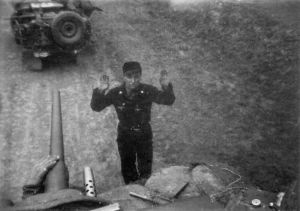
Prisoner taken. Photo by tank commander George C Gross, April, 1945.

Prisoner taken. Photo by tank commander George C Gross, April, 1945.

Then two small American tanks arrived. I was standing in the middle of the road, and noticed that the American soldier leaning out of the turret of one of the tanks aimed his gun at me.
The tank came closer and closer, and the soldier lowered his submachine gun. I must have looked terrible, so he did not take me for an enemy. I was lucky he had not shot me from the distance, since my small coat and boots vaguely resembled a military uniform. Lice were crawling all over my clothes and skin.

The few hundred former inhabitants of the concentration camp surrounded the tanks right away. Suddenly somebody remembered that the SS guarding us were still in the carriages. The SS were caught quickly, and lined up. The “intrepid” SS were trembling so heavily that their pants were flapping.

The first thing a Jewish woman asked from the soldier leaning out from the tank was money, and she received a dollar bill. She must have established her future with this dollar.

My attention was drawn to something else: in the rear of the tank there was a box of canned food. I climbed under the tank, emerged at its end, and pulled out a can. It turned out that I stole a can of oranges. This was my luck. I ate the potatoes charred in the can with the oranges, and probably this combination saved my life. Everyone who ate meat or anything greasy died within hours or within one or two days at the latest.

I felt fever in my body, undressed completely naked in front of staring women, and went into the ice-cold water of the lake next to the railroad. People warned me not to do this, but I went into the water, felt good, felt that I got rid of the lice and the burning heat of the fever. When I put on my rags again, I felt the fever ever stronger.

I asked an American soldier to sign the photo of my fiancee (I still have this photo). To my surprise, he signed the name Churchill. I thought he was joking. But he reassured me that his name was really Churchill.

(Once I read about a father named Churchill, who went to see his son’s grave in Vietnam during that war. The report mentioned that the father had been a soldier in World War II. He must have been my Churchill)

In the evening, there were news that we should flee, because the Germans pushed back the Americans. The Germans would massacre us for sure, the women had pulled out material for parachutes from a carriage in order to make clothes.

I was already so weak that I did not care whether the returning Germans would kill me: I stayed in one of the carriages, and fell asleep.

On Saturday, April 14, German peasant [horse-drawn] carts came for us by some order, so I was carried to Hillersleben. I dragged myself to the first floor of the first building, it looked like an office building, lay down under the sink of the bathroom, and fell asleep.

I am sure the American soldiers had no idea who we were and what we went through.

Read Full Post »

Whitwell, Tennessee.

Not much cultural diversity. 50% free and reduced lunch. Industry supporting then devastating the community, then leaving town. Home of the Tigers… sound familiar, Hudson Falls?

Last fall Hudson Falls kids and I had the pleasure of getting to know Joe Fab, the major moving force behind the film  Paper Clips, when he came to our town to speak.On Tuesday morning this week, a few educators and I  loaded into  cars for a pleasant drive from Nashville to Whitwell, to visit the middle school where it all began, and their Children’s Holocaust Memorial, a cattle car from Germany that was used to carry human beings to the killing centers.

The middle school is in  a new building that also houses a special Holocaust Memorial library, which is thought to be the largest single collection in the state, many volumes donated by survivors and congregations worldwide. Every letter they ever received is archived there, including the negative ones that arrived with the paper clips twisted into swastikas. Imagine. Middle school kids not picking and choosing what to save, but archiving like historians for the future.

Linda Hooper, the former principal, greeted the nine of us, and gave us a private talk about the impact of the project and the unbelievable ripple effect it has had on people’s lives across the world. Sandy Roberts told us how the project unfolded in her after school class, when a child raised his hand to say, “Mrs. Roberts, excuse me, but I don’t know what six million is.” Because they took the time to investigate together, students and parents reflected together in a meaningful way on the impact of learning about the Holocaust on their lives. And that is how this project was born.

Before we move to criticize the project as just another counting activity, the collecting and counting of objects to symbolize human life, come to Whitwell and meet the people. Read the letters from the survivors who send in a paper clip, or dozens, and reach out to these children who have touched them enough to tell their families’ stories.

No one can fathom six million plus. But read the letters to feel for yourself individual stories of the millions who were lost. Come to Whitwell and see for yourself the power of a small community excited about learning, and its impact on the world, because they wanted to care about other human beings.

Read Full Post »


Israeli educational psychologist Haim Ginott writes about a letter that teachers would receive from their principal each year:

I am a survivor of a concentration camp. My eyes saw what no person should witness: gas chambers built by learned engineers. Children poisoned by educated physicians. Infants killed by trained nurses. Women and babies shot by high school and college graduates.

So, I am suspicious of education.

My request is this:  Help your children become human. Your efforts must never produce learned monsters, skilled psychopaths or educated Eichmanns. Reading, writing, and arithmetic are important only if they serve to make our children more human.

This has become the mission statement and educational philosophy of some Holocaust education institutions and it really sums up what my mission as  a teacher is all about. But please note  below that I did not intend it that way. At all.

Today I will be a special guest for the Tennessee Days of Remembrance Ceremony at the State Capitol in Nashville with legislative members, the governor and the lieutenant governor. This evening I will give my first address to fellow Holocaust educators.

How does a kid from a small town with no experience in Holocaust education go on to add a new chapters to the stories of thousands of persons’ lives? To become a regarded figure in Holocaust and History education circles, nationwide?

The honest answer is, I just don’t know.

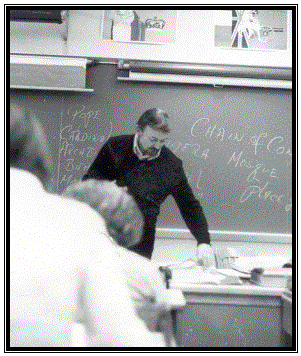
My dad in the classroom. Around the time that I puffed out my chest and claimed I certainly would not be a teacher.

But it happened. This from a kid who distinctly remembers the purposeful slight given to his dad. Dad was a history teacher in Glens Falls, the next town over. He was good, and he loved the students. Everyday he came home happy and sometimes even humming a tune. Who delivered the purposeful slight? His first born son.

Our relationship,  as I grew into the teenage years, was a bit strained. So when he asked me, as a junior or senior,  in the car riding home from school one day down Main Street, the MAIN STREET of the town that produced him, what I would like to do someday after I graduated from high school, I told him, “I don’t know, but I won’t be in HUDSON FALLS anymore, and I SURE WON’T BE A TEACHER…..”- the desired effect was achieved by the angry teen, the wound deep, the twist of the knife distinct…

Yet there I was, eight years later, living in the room out back of the family homestead on that Main Street, fending my way on the other side of the desk in the classroom of my alma mater, and not just any classroom- a history classroom, teaching the exact same subject as the old man…

What if I had never come home, as planned? What if I had not gone back to school for a teaching certificate, after graduating with that “unmarketable” history degree? What if I had landed that job in the college town I called my new home, instead if coming in 2nd for it? I would have never met the tank commanders. Then, what if Walsh’s daughter had not said, after two exhausting hours of combat tales, just as we were about to turn the camera off,   “Dad, did you tell Mr. Rozell about the train?

Things happen for a reason. I think there are no coincidences.

In the words of a former  principal of mine, we are here “to make human beings out of them” (not that they were not before, but you get his point-the exact same point of the speaker noted above.)

I am suspicious of those who will dictate to me from ” on high” what I should be doing in the classroom. Perhaps Dr.  Ginott would have agreed.


Read Full Post »

I interviewed a Holocaust refugee and another liberator on Friday last… rolled into one! A special man. A German Jew whose father was mortally injured on Kristalnacht, Henry Birnbrey was sponsored and got out of Germany as a young teen and was given special permission from FDR to join the Army-previously classified “enemy alien” for his German birth- and stumbled upon the train as a forward artillery spotter scouting positions in the lead up to the final battle at Magdeburg.  Henry was in the 531st AAA of the 30th Infantry Division- Survivor Steve Barry mentions forward artillery spotters in his memoirs- and Henry was one of them. Much of what follows is his testimony as given to the Breman Museum in Atlanta, Georgia, interspersed with his memories as privately published in  his war memoirs.

I was born in Dortmund, Germany in 1923. During 1937 and 1938 my parents made applications for me to emigrate to Palestine, New Zealand and the USA. The USA visa came in first and an emergency visa was issued to me the week Hitler invaded Austria, as the various agencies feared that this invasion would be followed by war.

I left Germany on March 31, 1938, leaving my parents behind. In the meanwhile, my father had already been arrested. He was accused of having made statements against the government. He was released with the promise to abandon his business and livelihood. Consequently, we lived without income during the years 1937 and 1938. After I left Germany, my father was picked up again on Kristallnacht (November 9, 1938) and he died a couple of months later from the wounds received when he was picked up and arrested. My mother died a few months later. The death certificate of my father stated the cause of death as “heart failure” and only in 1999 did I finally locate the documents that verified what happened in 1938, but too late to entitle me to compensation, which had been denied because their records showed a natural death.

The Birmingham Section of the council of Jewish Women sponsored my immigration to the US, and the social services were provided by the Jewish Children Service here in Atlanta. I moved to Atlanta in January 1939. In Birmingham and Atlanta I lived in foster homes.

I supported myself by working in a clothing store, later managing a shoe store, and in 1942 I went to work for a local accountant. In 1943 I joined the US Army. In 1944 I was with the Normandy invasion forces. During my service in the army, but towards the end of the war, I came across  a train of cattle cars full of Jewish concentration camp survivors and people who did not survive. We opened the cars and were shocked to see the condition of the occupants of these cattle cars. During this same week as we were advancing toward the Oder River, we passed ditches full of corpses of concentration camp inmates who had been marched to the West to escape the Russian advance. Around April 1945, I became a counter intelligence agent and interrogated German POWs and citizens.

After the war, I found out that most of my family had perished in the concentration camps. My mother was one of ten children, and out of that family, two first cousins survived. These cousins had made aliyah in 1937. My father was one of three brothers and again, two first cousins survived. One had made aliyah to Israel in 1938 and the other one survived behind the Iron Curtain. The rest of the family perished. I found documents in the Berlin archive that showed when these people were born and when they died. What I was not prepared for was the detail of information which included the place they were assembled, the number of the transport which took them to the concentration camp and all sort of sordid details.

Henry continues: During World War II, I wanted to get to our hometown but I could not because the British Army was over there and we were a little bit south of there, but my experience as a soldier I think is worth mentioning. First of all, we were in the neighborhood of Magdeburg on reconnaissance. And we had, we had this horrible odor. We didn’t know what was happening. And it turned out to be one of the freight trains full of Jews being shipped from one concentration camp to another. And therefore I was able to personally witness this terrible inhumanity that was taking place. And all of these were my fellow Jews and brothers and everything else. They were almost, they had been reduced to such a non-human state it was impossible to communicate with them. I mean, all we could do is to try to get them food and ask for help. There was nothing we could do. These people were half dead, half crazy. I mean they’d been locked in these cars, were lying on the floor. It was just a horrible thing to witness, and something I’ll never forget as long as I live.

http://www.thebreman.org

And from Henry’s memoirs…. skeptics note again a liberator describing “walking skeletons” ….We moved on to the Braunschweig (Brunswick) area. Here, along the highway, we encountered ditches full of dead concentration camp prisoners who had been marched from one camp to another and were shot before they had a chance to be liberated.
…In April of 1945 while on reconnaissance near Magdeburg we encountered a horrible odor. As we got closer we discovered an abandoned train of cattle cars. When we opened the cars they were filled with half dead and dead Jews being transported from the Bergen-Belsen concentration camp to another camp. The sub-human conditions to which these people were subjected to had reduced them to a very sorry state. We did not know how long they had been in those cars, they looked like walking skeletons and could barely speak. Unfortunately we had no food to share with them, which gave us a very helpless feeling. When headquarters was notified, someone evacuated all German civilians from a nearby village, Hillersleben and turned this village into a hospital. Unfortunately we could not stay around to learn more, to speak to and encourage these people or perform other deeds of human kindness…I was reminded of the words of the prophet Ezekiel-”He took me down in the spirit of G-d and set me down in the valley. It was full of bones.”

…and this is where I (MR) am trying to put the pieces of the story together….


Read Full Post »

« Newer Posts - Older Posts »