Feeds:
Posts
Comments

Posts Tagged ‘history’

During the first Nuremberg Trial, American guards maintain constant surveillance over the major Nazi war criminals in the prison attached to the Palace of Justice. Nuremberg, Germany, November 1945. NARA, public domain, via USHMM. I interviewed the third guard on the left side.

My wife and I went to see the 2025 film Nuremberg yesterday, starring, among others, Russell Crowe as Hermann Goering and Rami Malek as the psychiatrist assigned to him. Overall, while unfamiliar with the story of Lt. Col. Douglas Kelley, I felt the film was generally well done from the aspect of a Holocaust and World War II educator. I felt that, for the most part, the portrayal of chief prosecutor was well done, particularly from the angle of setting precedent for holding war criminals accountable for their individual actions. This was the first time in the history of the world that this had been attempted; leaders of a nation—military commanders, government officials, and propagandists—were held personally responsible for crimes against peace, war crimes, and crimes against humanity, destroying the defense of “I was only following orders.” It created the legal foundation for modern human rights.

The International Military Tribunals debuted in Nuremberg for a reason, which was well brought out in the film. It was the central rallying point for the massive Nazi displays of power in the early days of the Reich—see Leni Riefenstahl’s 1934-35 classic documentary, Triumph of the Will, which I would show to my seniors despite its almost two hour run time— and the sinister 1935 Nuremberg Laws that defined ‘Jewishness’ and codified antisemitism, beginning with stripping German Jews of their civil rights.

What a lot of folks who may be familiar with the Nuremberg trial portrayed here may not actually be aware of is that it was only the first of several trials. Prosecutor Robert H. Jackson set the tone early on.

Documenting the truth of Nazi crimes was the signature achievement. The trials produced an enormous body of evidence—captured documents, films, photographs, eyewitness testimony, and first-hand accounts from perpetrators. The authentic films of the camps upon liberation were included in this movie, and while hard to watch, just like in 1945-46, it showcased that the Holocaust one of the most documented crimes in world history, countering future denial with overwhelming proof.

The trials also set a moral example after a global catastrophe. Rather than executing Nazi leaders summarily—as some Allied leaders wanted—the Allies insisted on a lawful trial. This demonstrated that justice would not be simply vengeance, that the rule of law was stronger than dictatorship, and even the worst crimes deserved legal scrutiny.

To be sure, Hollywood took some liberties. The scenes portraying Jackson as being outwitted by Goering on the stand, and in which the psychiatrist Kelley hands over confidential notes to a gorgeous reporter in an intoxicated state were outright fabrications, to be sure. Others have criticized it for showing the humanity of the chief perpetrators, but I do not have much of a problem with that. For if we hold that they were all monsters, we are just letting humanity off the hook for the next time, as I have written about before, and while I speak for myself, many professionals in Holocaust education circles are in agreement.

But let’s not forget about the everyday GIs who found themselves at Nuremburg. In Volume 7, Across the Rhine, I introduce at least two of the guards to you, in their own words.


The Courtroom Sentinel

Leo DiPalma was the son of Italian immigrants who grew up in the western part of Massachusetts in the Great Depression. Like many young high schoolers at the time, he was shocked at the news of Pearl Harbor, and ready to serve when his number was called three years later at the age of eighteen. He gained combat experience as an infantryman with the 79th Division, crossing the Rhine in 1945 before being tasked with a new assignment in the 1st Division—standing guard, at the tender age of nineteen, over some of the most notorious war criminals of the 20th century.

I pulled guard duty in the cell block [at Nuremberg]. The cell block was sort of a center, like a star, and all these blocks went off this way [gestures several radial corridors with hand]. Well one of these blocks had the 21 bigwigs, Hermann Goering and Ribbentrop and Hess and all those guys. I was a staff sergeant at the time. I pulled guard on Albert Speer’s cell, and Rudolf Hess. Then after that I was there for a short while, I became sergeant of the guard. I took my regular duties every other day for 24 hours. Luckily, I was asked to go up into the courtroom. I pulled guard with the courtroom guard at one of the visitor doors. After that, I was asked to go up onto the witness stand. That was very interesting, because from where we stood, we weren’t too far from the interpreters. If they were speaking German, and you could pick out [the English translations], you know, so you could know what’s going on, that was very, very interesting. I actually had, at that time, the latter part of the 21 original prisoners, like von Schirach, and Raeder, and Donitz, and Sauckel, right around that area there. I was moving up real fast. I stayed there until July of ’46.

‘Goering and I, We Didn’t get Along’

I had a lot of contact [with these prisoners]. Goering, he was the highest-ranking German soldier there. He expected to be treated like he was a high-ranking officer. The rest of them, believe it or not, they used to bow down to him, let him go first and stuff like that. He and I didn’t get along when I took over sergeant of the guard.

One of my duties was, during a recess, when I opened the door, I stood at parade rest right in the docket where he was right in the corner. I’m sure you’ve seen pictures of it. He would turn to me, and he asked me for some water. ‘Vasser, bitte.’ Okay. I go down to the Lyster bag, which was chlorinated, and I’d get him a little cup of water, and I’d bring it up to him. And he’d take a sip and he’d go, ‘Bah, Americanich.’ You know? He’d hand it back to me. Now there was no way of getting rid of the water; I used to have to walk down to the men’s room on this side to get rid of the water and walk back up.

Mr. DiPalma later recalled that fed up with Goering’s antics, he once met Goering’s demands by replacing the contents of the cup with water from the toilet instead of the tap, which Goering found better than the chlorinated version. ‘I guess I felt it was my little contribution to the war effort,’ he added.

In the meantime, you know, I think he was just doing it on purpose, just getting rid of me. I think one of the things was that he didn’t want to do any talking, didn’t know if maybe I spoke German or stuff like that. I could understand a little bit. But what he didn’t know is, we had some German-speaking GIs right there, and they picked up some stuff on him anyway.

Another time, at night when court was over, one of my duties as the sergeant of the guard was to run the elevator. The elevator was located behind a docket in one of the panels. The elevator carried six people: three prisoners, two guards, and myself, made it [one guard to one prisoner], going up or going down. Well at night, we had to get out of there and run and get our trucks to get back to our billet. Everybody would step back, and there’s big confusion in the docket. [The Germans] let [Goering] go right through, you know. Well, one night, I grabbed ahold of Field Marshal Keitel, he was standing right there. I said, ‘Come on, get in, get in.’ And I dragged him in like that. He was indignant; he was going to let Goering get [in first]. I pulled somebody else in, and somebody else, and I left him, left Goering standing there, you know. I think that was one of the reasons why he would send me for water every day, he was getting back at me.

Another time everybody in the docket was stepping over one another, letting him get out first; they were going to lunch. He didn’t want to cross the hallway where spectators were, he wanted to walk right across—he didn’t want anybody to look at him. So this Captain Gilbert told us, ‘Put him last.’ Okay, so we put him last. Don’t let him stand inside of the doorway. He would wait until everybody went by so he [would have to] walk straight across. Well, I pushed him out there one time, we carried a club, poked him in the back, you know. He turned around and he swung at me, and he hit me on the arm, so I gave him an awful belt in the kidneys. He never said a word to me [after that]. He didn’t like me; I know he didn’t like me. I had a couple confrontations with him, but other than Goering, the rest of them were all pretty good.

Albert Speer, many of them spoke English. I never heard Goering speak English. Albert Speer, he was Hitler’s architect, if you remember correctly. I always felt sorry for him. He was the architect, but he kind of got, I think, using the right word here, sucked into being a Nazi, and he turned out to be a Nazi. Of course, this was all for glory, I guess, for himself. I think Hitler just used him. He was a very calm-speaking individual. Always spoke to the guards. He was quite an artist. He never did me, but some of the other guys that pulled guard on some of these cell blocks, on his cell, he used to draw pencil sketches of them, and they were good. Very, very good. Imagine something like that’s worth a buck today. I don’t have that.

Let’s see, Streicher, he was a pain in the neck, complained all the time. Terrible, terrible. Going back just a little bit, when I pulled guard on the cell block, imagine standing there for an hour and watching the guy sleep through a little hole in the door, you know, it’s awful monotonous. The guys used to talk to one another, and the other guys would get to laughing. Some of them [prisoners] didn’t get much sleep at night. You kind of had to keep it down; when I was sergeant of the guard, sometimes you used to hear hollering down there, so I had to go down there and tell the guys to knock it off. Have you ever seen the old German pfennig? It’s their penny. It’s about as big as our half dollar. Well, one of the things they used to do at night, this wing had a terrazzo floor. These guys would roll these pennies down the terrazzo floor, and it sounded like a freight train coming down through there! [Laughs] I’m surprised that a lot of the German prisoners could stay awake in the courtroom the next day.

Another night, I was in the guard office, and I had a cot there, I was laying there. I could hear some screaming. I said, ‘Oh my God!’ I went down there and the guard at Streicher’s door, out of monotony, had taken a piece of paper and folded it, and he had ripped a little man out of it, so that when you opened it up, it was a man with just legs and arms like that and the head. And from off his uniform somewhere, he had tied a piece of string [tied to the neck of the effigy]. You had the light on just outside of the cell, and he’s swinging the thing in front of the light, and it’s [silhouetting] on the wall, a man hanging. [Chuckles] Jeez. I really don’t blame him for trying to get through the hours, standing there.

Let’s see, von Schirach, I pulled guard on the witness stand with him. He was head of the Hitler Youth. One day, there was quite a confrontation between him and Chief Justice Jackson. Of course, we could understand him. And he spoke decent English now, but most of his replies were in German. But through the interpreter, we could hear what was going on. They were arguing back and forth about the duties of the Hitler Youth. Well, they called a recess shortly after that, and he turned to me. I was on his left side. He turned to me, and he said, ‘But the Hitler Youth is nothing more than your Boy Scouts.’

I said, ‘Really?’ He doesn’t realize that I was a frontline soldier.

I said, ‘I fought your Hitler Youth!’ He never said a word [after that]. We found Hitler Youth that could take apart our BAR, our M1s, or any of our equipment. So they weren’t Boy Scouts like he wanted to portray them.

The rest of them were all just no problems, really. No problems. Alfred Jodl, he was a signer of the surrender terms. He didn’t talk to anybody. Him and Keitel, they weren’t Nazis, but they originally were Wehrmacht soldiers, and they were good soldiers. But of course, they turned into Nazis afterwards, you know?

*

I came home in July, yeah, about three months before the trial ended. [I was not present when Goering committed suicide]; I think [he died] the beginning of October, as I recall.  Everybody was trying to get their autographs. In fact, I have their autographs. All but Hess. Every time you’d ask Hess for his autograph, he spoke good English, because he spent quite a bit of time in England, he said, ‘after the trials.’

Well, you know what our favorite saying was? ‘You won’t be here after the trials.’


Nuremberg’s message endures:
No one, no matter how powerful, is above the law—and the world will remember.

Read Full Post »

June 6, 1944
Amsterdam
 
‘This is D-Day,’ the BBC announced at 12 o’clock. This is the day. The invasion has begun!
Is this really the beginning of the long-awaited liberation? The liberation we’ve all talked so much about, which still seems too good, too much of a fairy tale ever to come true?…
The best part of the invasion is that I have the feeling that friends are on the way. Those terrible Germans have oppressed and threatened us for so long that the thought of friends and salvation means everything to us!
 
― Anne Frank, diary entry,
six days before her 15th birthday


Forty-one years ago today, I tuned in to a small black and white TV in a ramshackle white clapboard farmhouse I shared with three or four other guys my age. I was 23, a recent college graduate with a seemingly useless history degree, working in the back of a kitchen of a high end restaurant in my college town. I wasn’t sure still what my direction was, but I had a knack for churning out long history papers running forty or fifty pages in length, and a passion for World War II, especially D-Day. Well, I reluctantly turned to teaching—I had student loans to pay—but I grew into another passion, sharing my love of history, and engaging veterans with students, creating an oral history project which has now reached ten books and counting, as well as an upcoming film series.

But today, June 6, 2024, it is now the 80th anniversary, and my mind is focused on how my life has turned out. I realize that I am the age of many of the veterans were when forty years ago, I watched as the American president honored the fallen, and the living, at the cemetery for the fortieth anniversary. Just out of college, something stirred inside me. Something was awoken.

Those forty years have passed. I began by writing letters to the newspaper. I began to interview D-Day veterans and others. I began to collect stories—not relics, prizes, or artifacts. I really had little interest in captured Nazi flags or samurai swords.

I wanted to talk to the men who were there.

The fiftieth anniversary came next with great pomp and more reflection. It graced the covers of the major newsweeklies. ‘Saving Private Ryan’ would soon stir the consciousness of a new generation, and the reflections of the old. And I learned so much more of the war beyond the beachhead. That there were so many beachheads.

The sixtieth anniversary came around. Students on their annual trips to France would bring me back their photographs and the requisite grains of white sand from Omaha Beach. Teenagers had their emotions a bit tempered, I think. I would go on to introduce them to so many who were there, when they themselves were teenagers.

Normandy American Cemetery, Spring 2022. Photo by Mike Edwards.

While filming for our 2025 documentary series A Train Near Magdeburg, two years ago I finally had the chance to set foot on Omaha Beach with an excellent guide who was insistent that we arrive early in the morning to catch the tide as it began to roll in. It was an astounding thing, to witness the 10 to 12 foot rise in the course of only a few hours. Imagine the men struggling to find their footing, pinned down by murderous fire. The 743rd Tank Battalion, liberators of the Train Near Magdeburg ten months later in the heart of Nazi Germany, was one of five tank battalions that took part in those initial landings, planned for H-Hour in support of the 29th Infantry Division in specially outfitted duplex drive ‘swimming’ amphibious Sherman tanks, powered by propellers in water and tracks on land and equipped with inflatable canvas flotation screens.

Bill Gast awarded the Silver Star.

Bill Gast was one of those tank drivers. I first met Bill at a reunion of 30th Infantry Division and 743rd Tank Battalion soldiers at a reunion in March 2008, in which I was present with several Holocaust survivors who were meeting their liberating soldiers for the first time. Later, Bill came to my high school to speak to students. I think the experience of sharing, and meeting the Holocaust survivors whom the 743rd came upon and liberated, affected him deeply. It was really the first time that he opened up, several hundred students as his primary witnesses. Unlike many who were physically able, Bill had no intention of going back to the sands of Omaha for any anniversary. As he explained to our students in 2009,

“I’m listed [in the event program] as a liberator- however, I am also a survivor of World War II, having landed on Omaha Beach in Normandy, France on D-day and fighting through to the end when the Germans surrendered, May the 7th, 1945.”

“Pictures.

Video games.

Movies.

Words.

They simply do not covey the feeling of fear.

The shock.

The stench.

The noise.

The horror, and the tragedy.

The injured.

The suffering.

The dying, and the dead…

Freedom is not free; there is a high price tag attached.”

Video tribute by Mike Edwards, Director, A Train Near Magdeburg.

Bill left us in 2018 at the age of 94. Against many odds, today nearly 200 surviving D-Day veterans gather, most probably for the last time, to honor the fallen from the nations engaged in storming ‘Fortress Europe’.

Today, the ocean laps at the lateral thirty-five-mile advance of sand littered with relics of a different time, the hulking remnants of the tide of battle. The surf rolls in and kisses the beach as the last participants mix on the hallowed bluff above with the politicians who have gathered from all over the world. In 1984, President Reagan asked, “Why? Why did you do it? What impelled you to put aside the instinct for self-preservation and risk your lives to take these cliffs? What inspired all the men of the armies that met here?

He continued: “These are the champions who helped free a continent. These are the heroes who helped end a war…We look at you, and somehow, we know the answer. It was faith and belief; it was loyalty and love.”[1]


Wayne Robinson, the chronicler of the 743rd’s travails and exploits during the war, wrote this in 1945 at war’s end:

“The story of D-Day is the story of all who. were there—jeep drivers, truckdrivers, halftrack crews, supply and communications men as well as the tankers. Many—too many—of the stories were posthumous.

The Presidential Unit Citation was awarded the Battalion for the day’s fighting. There were the D.S.C.s won, and a galaxy of Silver Stars and Bronze Stars. But the Battalion was not thinking of glory as it fought its way through Exit D-1 toward Vierville-Sur-Mer. Glory is a tainted angel to tankers who have just had to run their steel treads over the bodies of fallen Gls because there was no other way to advance over sand cluttered with American dead and wounded. ‘If there was any sign of life at all, I tried to avoid them’, one tank driver said. ‘But buttoned up, looking through the scope, it was hard to see. You just had to run over them.’

In war there is no easy way. The grinding tracks of the Battalion’s tanks trailed blood through the ·sand, rolling inland off the beach. The whole war in France, Belgium, Holland and Germany was ahead of them.”[2]

And for the men of the 743rd’s Dog Company, ahead there would be this train, a long shabby string of boxcars and shabby passenger cars, spectral creatures milling about, listless, sick, and fearful…


D-Day: the view from a tank on Omaha Beach

By Mathieu Rabechault May 23, 2014 6:46 AM

Washington (AFP) – From inside his tank, the young soldier could see “practically nothing” on Omaha Beach.

Seventy years later, William Gast still wonders whether he rolled over his comrades sheltering from German gunfire that day.

Gast was 19 years old the morning of June 6, 1944. “We came in at H-10, that was 10 minutes before the designated hour.”

He cannot recall why he and his fellow soldiers arrived early, but he has other memories that have never left him.

As part of Company A, 743rd Tank Battalion, 1st Army, Gast remembers the training beforehand in Britain, when he rehearsed driving the Sherman tank onto the landing craft. And then floating in the English Channel.

“Another night we went out and we didn’t come back. That was it.”

Gast got to know the captain of the landing craft that would ferry his tank to the beaches of Normandy.

The skipper promised he would get them close enough that they would not be submerged in water, like so many tanks were that day.

He kept his word.

Another tank unit at Omaha Beach was less fortunate, with 27 of 32 tanks launched at sea five kilometers (three miles) from the coast sinking before they could reach land, despite being outfitted with a flotation screens.

“The order was given to go, we started our engines up, they lowered the ramp,” said Gast.

Amid German shrapnel and sea spray, he “could feel the tracks spinning.”

At last, the tank tracks took hold on the sandy sea bottom and he drove up the beach.

– Like throwing marbles at a car –

Down below in the driver’s seat, Gast tried to steer the tank with the aid of a small, manual periscope.

“You can imagine how much we could see, practically nothing,” he said.

The radios inside the tank were so unreliable that his commander would tell Gast which way to turn by kicking him on the left or right shoulder.

The difficulty in seeing the way ahead has left Gast with a gnawing sense that he may have run over the bodies of American soldiers on the beach.

“The saddest part about the whole thing is, not being able to see, I may have run over some of my own people.

“And if I did, I don’t even know it. I can’t ever get that out of my mind, you know?”

Corporal Gast heard machine gun bullets hitting the side of the tank, “like throwing marbles at a car — that’s what it sounded like.”

“And there were shells that exploded right beside me. You could feel the tank shake.”

For Gast, it was a day of fear and terror, and following orders without reflection.

“I can’t tell much about what happened, I was scared to death to start with,” he said.

“It was just like putting it on automatic, you just did what you had to do, did what you were told to do.”

By noon, close to 19,000 American soldiers who landed at Omaha were still pinned down on the beach.

– High school sweetheart –

Carefully laid plans had unraveled as the beach became a killing zone, with troops mowed down under a fusillade of German machine gun, artillery and mortar fire.

Small teams of US troops eventually managed to break through on the bluffs between German positions, with the help of combat engineers blowing up obstacles.

The losses were staggering: more than 2,000 dead, wounded and missing on Omaha beach. The exact toll is still unknown. Of the 15 tanks in Gast’s Company A, only five survived without damage.

Gast, from Lancaster, Pennsylvania, earned the Silver Star and the Purple Heart during his combat tour, and went on to marry his high school sweetheart.

Mr. & Mrs. Gast, Holocaust Survivors-American Soldiers reunion, 2009.

Mr. & Mrs. Gast, Holocaust Survivors-American Soldiers reunion, 2009.

Now 89 years old, he recently was awarded France’s Legion d’Honneur at a small ceremony for World War II veterans at the French embassy in Washington.

The short, soft spoken man stood up to receive the medal and shook hands with a French diplomat. But he has no plans to return to Normandy for the 70th anniversary of the D-Day landings.

His son, Bill, said his father did not want to relive that day: “It’s important we don’t forget but you try to hide things somewhere.”

news.yahoo.com/d-day-view-tank-omaha-beach-104656852.html


[1] Why did you do it?-President Ronald Reagan, June 6, 1984, Omaha Beach, Normandy, France. http://www.historyplace.com/speeches/reagan-d-day.htm

[2] Robinson, Wayne; and Hamilton, Norman E., Move Out, Verify: The Combat Story of the 743rd Tank Battalion. 1945. World War Regimental Histories. United States Army.

Read Full Post »

Welcome to 2025, a momentous year for World War II remembrance and history. So glad that you can join us for these updates, the ‘octogintennial’ anniversary of the end of the war, and of the greatest crime in the history of the world, the Holocaust. 
Iwo Jima,1945. National Archives.
As we look back on this week in history, we reflect on two defining moments of World War II that occurred in March of 1945, each marked by incredible human bravery and sacrifice: the end of the Battle of Iwo Jima and the crossing of the Rhine River by U.S. forces. Both events shaped the course of history, and their stories remind us of the extraordinary courage and resilience of those who fought.
The End of the Battle of Iwo Jima
In my last post, I wrote about my friend Art LaPorte, the 17-year-old Marine who was puzzled by the flag raising on Iwo four days into the campaign, since the battle was far from over with. 80 years ago, on March 26, the Battle of Iwo Jima was declared completed, though some defenders were surrendering as late as 1949! For the U.S. Marines, after weeks of intense fighting, the toll was overwhelming. The famous photograph of the flag raising atop Mount Suribachi on Feb. 23 finally symbolized not just military triumph, but the deep human cost—nearly 7,000 American lives were lost, over 19,000 wounded, and the toll on the Japanese defenders was far worse.
***********************************************************************************************************


The Crossing of the Rhine River
Meanwhile, on the European front, U.S. forces were preparing for their own major breakthrough: crossing the Rhine River. By March 1945, Allied forces were closing in on Germany, and the crossing of this natural barrier was a decisive move toward victory. On the night of March 23, 1945, treadway rafts were launched and pontoon bridges were under construction. The stakes were high: As one writer put it, “The Rhine was more than a river. It was a sacred waterway to the Germans, the source of most of their legends and myths. And at this stage in the war, crossing the Rhine was the last barrier between the advancing Allied armies and the conquest of Germany. If the Germans could hold their beloved river, they might be able to stand off the Allies.”

The cost was also high. Albert Tarbell, a paratrooper with the 504th Parachute Infantry Regiment, 82nd Airborne Division, recalled:

“The 505th made the river crossing first, and when we got there, just as we got off the pontoon onto the dry land, we see this tank hit a mine on the road, and took this 40-ton tank and it just flipped it right over! That’s how powerful the mine was. The Germans had planted the mines, and they had put detonators in there so that after maybe the 10th of each vehicle went over, it would set it off, so you didn’t know when it was going to blow up, or where it was.

And so they said, ‘Go over on the side, go over around it, and go alongside the road.’ We had no sooner gone about 20 feet up ahead when a truck hit another mine, and it blew the guys right out. I could see one guy, he looked like he must have been sitting in the back of the truck, it looked like if you threw a hat up in the air, you know, just flopping up in the air, and the truck went way up in the air! Boy, that was awful!”

Yet as the spring progressed, it was clear that the war in Europe might end soon.

“Now, we really were [moving fast], and we started getting more prisoners giving up to us; groups, maybe platoon-sized. We started getting jeeps up there to ride in. I said, ‘God, this is the way to fight a war.’ It was walking and running, and we were riding in jeeps across this open field; there was a whole line of us, we got to the end of this open field and there was a little bit of woods, and behind the woods there was three Tiger tanks sitting there! That’s when I knew, I said, ‘Hey, this war’s winding down.’ Those guys could have had a field day with us. They could have just wiped us right out.

So we went from one town to the other. One place there was a whole company, their platoon all lined up, ready to surrender to us. And then another time we kept on going, the truck traffic kept getting heavier, and heavier, and heavier. At one point, I don’t know whether it was that same day, I think it was, or it might have been the day after, we got to this one point where it got so bad, we put outposts out to direct traffic. Zimmerman, myself, and George Height was with me again, it seems like everywhere I went he was with me, following me, so we directed traffic. ‘Vehicles to your right, walk on foot to your left.’ Those German guys were throwing their weapons away, and this and that, and oh man. And they even had a calvary ride through [to surrender], God, beautiful horses. But some of these solders were pathetic, you know, worn out, clothes worn and torn, beat up, you know, tired, battle worn.

Towards about dark, a staff car pulled up and out got, you know how you see in movies, German officers, got shiny boots on, got shiny long leather jackets on, the whole nine yards of it—that’s the way these guys were dressed. One said, in perfect English, he said, ‘Where is your general’s command post? This is the commanding general here!’

From what I gathered after, it must’ve been the commanding general of that 21st German Army that surrendered to us. They wanted to surrender to us instead of to the Russians, to get out of the path of the Russians as they were coming in.

So I said, ‘What do you want to see our general for?’
He said, ‘This is the commanding general here, we’re going back there with your general, and we’re going to regroup and fight the Russians!’

I looked at Zimmerman, then I looked at Height, and I said, ‘Well, I’ll tell you what you do, you just go right down this road here, to my right, there’s some MPs down the road, they’ll show you right where to go.’ And I think that was the commanding general of the 21st German Army! They looked like they were in pretty good shape. We laughed, but they were serious. They probably were put in prison; our general wouldn’t have had anything to do with them.”

For those who survived the final push into Germany, the crossing marked a turning point in the war in Europe. They were pushing toward the heart of Nazi Germany, with the prospect of victory finally within reach—but then they encountered the evidence of the greatest crime in the history of the world—the Holocaust. For battle hardened soldiers, it was almost too much.

The Human Cost of War

Both of these events—though separated by vast oceans—remind us today of the price of freedom. These soldiers, almost all of whom were young men just beginning their adult lives, faced insurmountable odds. Their experiences, full of courage, sacrifice, and determination, offer us powerful lessons in resilience and hope.

Read Full Post »

Welcome to 2025, a momentous year for World War II remembrance and history. So glad that you can join us for these updates, the ‘octogintennial’ anniversary of the end of the war, and of the greatest crime in the history of the world, the Holocaust.Today is special for several reasons, two of which I will outline below.

Road to St. Vith, January 24, 1945. National Archives.

On December 16, 1944, the Battle of the Bulge began as Hitler’s last ditch effort to drive a wedge between the advancing American and British forces with a quarter million man German counteroffensive following D-Day and the Normandy breakouts of the summer and fall. Today, January 25, eighty years ago, all German forces had been pushed back to their original starting points; while the fight was not over for a long shot, today marked a turning point in the war in Europe.  Nineteen thousand American boys were killed in the bloodiest US battle of WWII, over the course of six weeks, in the coldest winter in European memory. Average age, 19. 80 years?  Was it really that long ago?


USHMM via Reuters.

Also on this day in 1945, the German SS dynamited the building of gas chamber and crematorium V in Auschwitz-Birkenau to destroy the evidence of their crimes as the Red Army approached from the east. The liberation of Auschwitz, the most notorious killing center of World War II, was at hand, the eightieth anniversary of which will be commemorated on Monday, January 27; one of my good Holocaust educator friends is co-leading a delegation of 50 or so survivors for this occasion. Talli and I were there together in an emotional journey I wrote about in my book, A Train Near Magdeburg.

This gas chamber operated from April 1943 to January 1945; Zyklon B was dumped in through openings after people were inside. 1.1 million people were murdered here, in a VERY short amount of time.

So what does it all mean, eighty years on? Time marches on, but as you may have read in my books, it’s not so much ‘how soon we forget’, as it is, ‘did we take the time to listen‘ the first time around, to our teachers, to our veterans? Do we as Americans even know our history? You know, in my books, I let the veterans and survivors speak for themselves, and for their friends and family who were killed or murdered. [I’m preaching to the choir now, and that’s the last thing I want to do-but hopefully we don’t move on until we pause and say their names.] 

And I’ll leave you with an upbeat note- I went into the classroom again in December to talk about Pearl Harbor and a local kid who died there, as I discussed in my first book, The Things Our Fathers Saw, Vol. 1, Voices of the Pacific. First time since retirement, and I’m happy to report the old man still has it, and the teenagers were HUNGRY for this knowledge, just like they were when I taught them at this high school in upstate NY. I left them all with free copies of that book with 19 year old Randy Holmes remembered in it. I’ll leave you with some books mentioned in this email below for further reading, and report back soon with some updates as 2025 moves on, with the anniversaries, and with our upcoming mini-series.Exciting!

~Matthew Rozell, Author/Educator

Read Full Post »

Just finished my 10th book in the Things Our Fathers Saw series, on the CBI theater of the war. I wrote this at the end, thinking about my time with the veterans of World War II.

“It is my earnest hope, and indeed the hope of all mankind, that from this solemn occasion a better world shall emerge out of the blood and carnage of the past—a world founded upon faith and understanding, a world dedicated to the dignity of man and the fulfillment of his most cherished wish for freedom, tolerance, and justice.”

—Remarks By General Douglas MacArthur, Surrender Ceremony Ending The War With Japan And World War II, September 2, 1945

“Can’t we just let go of this war? My father spent four years in, [and] my uncles four years; they NEVER talked about it! Long dead soldiers, long ago war!”

-American commenter on one of the author’s social media posts, highlighting the series, The Things Our Fathers Saw, September 2024


Was it really that long ago?

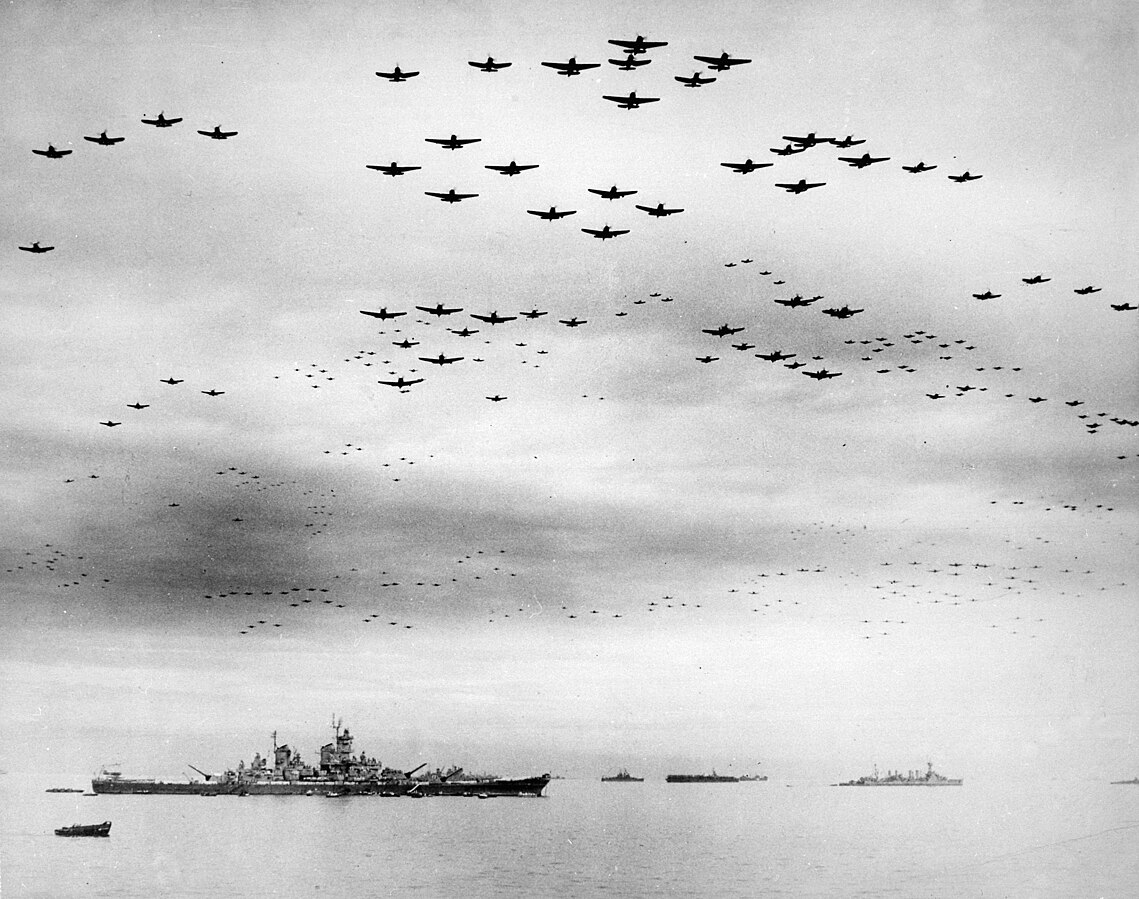
Seventy-nine years ago last month, Admiral ‘Bull’ Halsey’s flagship USS Missouri was in Tokyo Bay awaiting the arrival of the Japanese delegation with General MacArthur and Admiral Nimitz aboard, positioned near the spot where Commodore Matthew C. Perry had anchored his ‘Black Ships’ on his first visit to Japan in 1853. On display aboard the battleship that morning was the flag that flew on December 7, 1941, over Hickam Field at Pearl Harbor, and the 31-starred Old Glory standard of Perry’s flagship from nearly a century before, now accompanied by hundreds of American warships. The Japanese delegation was escorted promptly aboard at 9:00 a.m., and at MacArthur’s invitation, signed the terms of surrender. As if on cue, four hundred gleaming B-29 bombers roared slowly by in the skies overhead, escorted by fifteen hundred fighters.[i]

Surrender ceremonies, 2,000 plane flyover, USS MISSOURI left foreground.
National Archives. Public domain.

In the United States and Europe, it was six years to the day that the bloodiest conflict in human history had begun; after those six years of savage fighting, the devastation was unprecedented and incalculable. Between sixty and eighty-five million people—the exact figure will never be known—would be dead. Overseas, the victors would be forced to deal with rubble-choked cities and tens of millions of people on the move, their every step dogged with desperation, famine, and moral confusion. American servicemen, battle-hardened but weary, would be forced to deal with the collapse of civilization and brutally confronted with the evidence of industrial-scale genocide. Old empires were torn asunder, new ones were on the ascent. The Chinese Communists were victorious in China before the end of the decade; the British and other colonial powers began shedding their colonies in South Asia and elsewhere. In 1952, American occupation ended, lasting nearly twice as long as the war with America itself.

Now, the ‘American Century’ was well underway. American power and leadership of the free world was unparalleled and unprecedented. The Marshall Plan literally saved Europe. Enemies became allies. Former allies became adversaries. The Atomic Age began. And the United States of America rebuilt, reconstructed, and remodeled Japan. Of course, this ‘American Century’ was not free from hubris, error, and tragic mistakes, but all of this is part of the legacy that shapes us to this day.


In regards to the end of World War II, I can recall, in the early 1980s as a young history teacher in training, observing a veteran teacher describing the end of the war with Japan by making an analogy to his eighth graders:

‘It’s like two brothers who had a fight. The winner picks up the loser, dusts him off, and they go on as brothers and friends.’

Overlooked, perhaps, were the eight million Chinese civilians and millions of others in Asia slaughtered by Japanese troops in their imperial lust for conquest, the Allied prisoners of war brutalized and worked to death or executed in slave labor camps, the Allied seamen shot while foundering in the water at the explicit orders of the Japanese Imperial Navy, to say nothing of the deceitfulness of Pearl Harbor. I’m sure my twenty minutes observing the teacher in action left out what he hopefully covered in class; he must have known World War II veterans, just as I did. And these are things I suppose you learn later in life, as I did—but only because I wanted to know as much as I could learn. I was born sixteen years after the killing stopped, but ripples of that war have never ended.

If you are a reader of this series, you know how I got our veterans involved once I found my footing in my own classroom. My fascination with World War II began with the comic books of my 1970s pre-teen days, Sgt. Rock and Easy Company bursting off the pages in the bedroom I shared with my younger brothers at 2 Main Street. As a newly minted college grad a decade later, I was drawn to the spectacle of our veterans returning to the beaches of Normandy on the black-and-white TV in my apartment for the fortieth anniversary of D-Day. I was reading the only oral history compilation I was aware of, Studs Terkel’s euphemistically titled 1984 release, The Good War: An Oral History of World War II, over and over. I studied that book, planting the seed for my own debut in the classroom. And in retrospect, I think I reached out to my students asking them if they knew anyone in World War II, yes, as a way to engage them in the lessons at hand, but also to satisfy my own selfish curiosity: just what ‘resources’—really national treasures—did we have in our own backyard, surrounding our high school? I was going to find out. Man, was I going to find out!

Of course they ‘never talked’ about it! Why would they bring ‘The War’ up with their wives, their sons, their daughters? And frankly, most of the civilians they returned home to and surrounded themselves with at work, in the community, and even in their own families, weren’t really all that interested in hearing about it. It was time to get on with life.

But then those guys headed back to the Normandy beachheads, now approaching retirement age, most in their early sixties, if that (about my age right now) …

Somebody was now listening! Somebody gave a damn! And maybe the old soldier could talk about that kid who was shot and lingered on for a while in the far-off jungles of Burma, the country boy far from home who was proud to be a soldier, the eighteen-year-old who wondered now if he was going to die. The combat photographer David Quaid spoke to his interviewers until he was too exhausted to go on. But somebody was interested, and he had things to say—things to get off his chest—before he would no longer be able to say them; like David, a lot of the guys I knew opened up like a pressurized firehose after all those years of silence. It was frankly cathartic, and maybe now they could ‘let go of this war.’

Should we?


I didn’t respond to the commenter in the thread, but another person added,

“I understand, but if there is no conversation, nothing gets shared—nothing gets learned! May your family all rest in peace!”

I know in my heart that opening up to others, even complete strangers, but especially to the young, finally brought our veterans peace.


[i] Dower, John W. Embracing Defeat: Japan in the Wake of World War II. New York, W. W. Norton & Company. 1999. P. 43.

Read Full Post »

Liberation site, 13 April 2024. Photo by Daniel Keweloh. Note the visitation remembrance stones on the memorial.

April, 1945. Testimony of 17 year old Hungarian survivor Irene Bleier.

“In front of the cattle car, we could see German civilians from the two nearby towns running in opposite directions on the main road, trying to escape from the approaching US forces. With dulled sense, we glimpsed towards them. Several SS guards stayed with us. Some of them asked for—and received—civilian clothes from our people.

The next morning we dug up recently planted potatoes we found, made a fire, and cooked them. They tasted delicious. I again started walking towards the small pond, but then Jolan excitedly hollered to me: ‘Hey you, come back fast, the US Army has arrived!’

As much as my faint condition would allow me, I hurried to the scene of the miracle to welcome them, this being the big moment we so yearned for. Two angel-like American soldiers stood there beside their magic jeep. My sister and I looked on enchanted as they took captive the several SS cowards who stayed in their shameful and disgraceful uniforms. The SS henchmen held up their hands while one of the Americans stood opposite them with a pointed weapon. Then, the second US soldier searched their pockets.

Standing there and looking up at our liberators, I waited to sense some kind of emotion on this miraculous occasion—but no. Reality did not penetrate my consciousness. My senses were incapable of experiencing any signs of emotion; I had no tears of joy that appeared, nor even the slightest smile. My senses were left stiff, in the aftermath of extended suffering. We are liberated, but only outwardly. Our mind still remained under great pressure, as heavy, dark clouds obscured our world of comprehension. It will take a good many years to be free completely. When that time comes, if ever, we will be able to feel wholly liberated and shake off the shackles of bondage and imperceptible suffering. The majority of our group was so feeble that they stayed inside the crowded cattle cars. Some ventured to the nearby small towns for provisions. The following day, early in the afternoon, the US Army arrived with a big army truck. They brought us a delicious hot meal, potato goulash with veal meat. Never before in my life, or after, did I eat as tasty a meal as this. I just looked on as those US soldiers of valor took care of our group of two thousand, going from cattle car to cattle car so patiently. After suffering so long from inhuman treatment, I felt a great distinction to be treated with human kindness by those American soldiers. It was like being born again.

With their kind devotion toward us they sowed back into our souls the sparks and seeds of human hopes and feelings. By Sunday morning, my sister Jolan and I plucked up some courage and crawled out of the cattle cars to look around at the nearby town of Farsleben. We were pleasantly surprised to discover that US soldiers were already patrolling the locality. Some of our fellow Jews were also around and about. The local population either locked themselves in their homes or escaped. None of them ventured to welcome the new liberators.”


April 13.

Another year has gone by, since 1945, and since 2001 when I sat down with an 80 year old veteran, who would up telling me a story.

Today I am thinking of all my survivor families and friends, including those of the soldiers, who have now all pretty much left us. Last April on this day, I spoke to cadets at the USMA at West Point, officers in training about to go out into the world, about the actions of their forebearers across the generations at a place called Farsleben, Germany, honored to be there with the commanding general at my table.

Mike, Laura, Lee, and I then flew to Israel for a multi-day tour, interviewing a dozen or so survivors of the train and their families, thanks to our friend Varda W.

In June, the film crew made it up to Hudson Falls and the homestead to get more interviews.

In July, we discovered the lost footage of the train liberation shot on April 14, 1945 by the US Signal Corps. The discovery went ‘viral’ and has been viewed hundreds of thousands, if not millions of times.

In October, we toured the United States Holocaust Memorial Museum and interviewed historians and archivists who watched the story unfold, and gave their input for the film. We also talked to the United States’ Special Envoy for Holocaust Issues at the State Department. We know they appreciated this story, and we appreciate their interest and commitment, as it to no less than 60 communications to navigate and set up our interview.

Leaving Washington the afternoon of October 7, it became clear over the next few weeks that things had changed. The sheer horror and scale of the massacre and violence was dumbfounding as its scope became clear, on an unprecedented scale, since the Holocaust. The calculated evil that rolled through that morning and almost immediately elicited support in some cities in the west remains profoundly disturbing.

But today, as the world goes about its destructive business, a quiet ceremony took place at the liberation site in Farsleben, Germany, with committed locals and 2nd Gen survivors. My friend from Hillersleben Daniel K. took some photos. A beautiful April day, liberation day and today.

I spoke to attentive 10th graders this week, bringing them the message of what the soldiers did. We remember.

We hope to return next year for the 80th anniversary with the completed film, for more people to learn from, when the liberation anniversary appropriately falls on Passover.

Deliver us from evil.

Read Full Post »


George Gross, former tank commander in Company D of the 743rd Tank Battalion, died ten years ago today. In his declining years before he died, I was able to bring him much joy in introducing him to several of the children he saved. He sent me the photographs, and wanted me to tell his story.  And I brought him together again with his old Army buddy, Red Walsh.  So I am re-posting this today on the 10th anniversary of Dr. Gross’ death.
Where does the time go? He lived a good life, and at the end, got to see the results of his actions six decades before.
We are all traveling our own roads. Days like this, I like to stop and ponder what it all means. I’m glad that I had a small role to play in his life.
george-gross-1945

~George C. Gross, 1922-2009~

Yesterday my son turned 11. And at about 11 pm yesterday on the West Coast, Dr. Gross died at home with his family around him.

I just found out. More than anyone else, he is the one responsible for this website and the hundreds of lives changed because of it.

You see, he took the photo that you may not really notice in the heading above, along with 9 other photographs that forever imprint the evidence not only of man’s inhumanity to man, but of the affirmation, hope and promise of mankind. It was he who wrote the prose that led me to the survivors, and vice versa. And it was he who cultivated a deep friendship with me via his wonderful writings and telephone conversation. How amazed and happy he seemed to be to hear from all the survivors.

In the summer of 2001, I did an interview with his comrade in arms, army buddy Carrol Walsh. Judge Walsh put me in touch with Dr. Gross. If you go back through the archives you know the rest of the story. It has changed my life and the lives of my students in that we are now trying to rescue the evidence, the testimony of the Holocaust and the World War Two veterans, for the United States Holocaust Memorial Museum. And today I received in the mail a bulletin from this Museum, reaffirming the mission that Dr. Gross had everything to do with setting me on.

He came into my life during a dark time for me- we had just lost our father (who thankfully, like Dr. Gross, passed on from his own bed at home), and our mother was battling the final stages of Alzheimer’s disease, or dementia, or whatever that nightmare was called…. we began a conversation that has yielded so much fruit.

Lately, I knew he wasn’t well. I actually had looked into flights across the country before Christmas for my son and I to pay a visit, but we just couldn’t seem to swing it financially, with Christmas bills coming in and holiday fares going up. My back up plan, in my head, was to go out in February, when fares were half the cost… Well, February arrived yesterday and now it is too late, I never got to shake the hand of a man who helped reshape my own life, and the lives of so many others.

His 8×10 liberation photos are mounted in the front of my classroom, with his captions for all to see. So I see George and just one of the noteworthy products of his life, everyday. The captions that he wrote for each are mounted below each print, a testament to his humanity and to his graciousness.

I know it is selfish to feel so bad about the fact that I was not able to literally reach out and touch him. I’m just so damned disappointed.  Right now it’s another dark day for Matt, but I am comforted that he was surely welcomed by his beloved wife, parents, and maybe even my folks as well.

From his statement read at the occasion of the first reunion, September 14th, 2007.

Sincere greetings to all of you gathered at this celebration of the indomitable spirit of mankind!

Greetings first to all the admirable survivors of the train near Magdeburg, and our thanks to you for proving Hitler wrong. You did not vanish from the face of the earth as he and his evil followers planned, but rather your survived, and grew, and became successful and contributing members of free countries, and you are adding your share of free offspring to those free societies.

You have vowed that the world will never forget the horrors of the Holocaust, and you spread the message by giving interviews, visiting schools, writing memoirs, and publishing powerful books on the evil that infected Nazi Germany and threatens still to infect the world. I am enriched by the friendship of such courageous people who somehow have maintained a healthy sense of humor and a desire to serve through all the evils inflicted upon you.

Greetings also to the dedicated teacher whose efforts have brought us all together through the classes he has taught on World War 2 and the web site he maintains at the cost of hours of time not easily found in his duty as a high school teacher. I know that several of you found your quest for knowledge of your past rewarded by the interviews and pictures Matt Rozell and his classes have gathered and maintained. Selfishly, I am grateful to Mr. Rozell for leading several of you to me, bringing added joy to my retiring years.

Greetings also to all the faculty, staff, students, parents, and friends of the school at which this important gathering takes place. Thank you for your interest in the survivors of the Holocaust and their message.

And special greetings also to my old Army buddy, Judge Carrol Walsh, and his great family. Carrol fought many battles beside me, saved my life and sanity, and resuscitated my sense of humor often. We had just finished a grueling three weeks of fighting across Germany, moving twenty or more hours per day, rushing on to reach the Elbe River. Carrol and I were again side by side as we came up to the train with Major Benjamin, chased the remaining German guards away, and declared the train and its captives free members of society under the protection of the United States Army as represented by two light tanks.

Unfortunately, Carrol was soon ordered back to the column on its way to Magdeburg while, luckily for me, I was assigned to stay overnight with the train, to let any stray German soldiers know that it was part of the free world and not to be bothered again.

Carrol missed much heartbreaking and heartwarming experience as I met the people of the train. I was shocked to see the half-starved bodies of young children and their mothers and old men—all sent by the Nazis on their way to extermination.

I was honored to shake the hands of the large numbers who spontaneously lined up in orderly single file to introduce themselves and greet me in a ritual that seemed to satisfy their need to declare their return to honored membership in the free society of humanity.

I was heartbroken that I could do nothing to satisfy their need for food that night, but I was assured that other units were taking care of that and the problem of housing so many free people.

Sixty years later, I was pleased to hear that the Army did well in caring for their new colleagues in the battle for freedom. I saw many mothers protecting their little ones as best they could, and pushing them out, as proud mothers will, to be photographed. I was surprised and please by the smiles I saw on so many young faces.

Some of you have found yourselves among those pictured children, and you have proved that you still have those smiles. I was terribly upset at the proof of man’s inhumanity to man, but I was profoundly uplifted by the dignity and courage shown by you indomitable survivors. I have since been further rewarded to learn what successful, giving lives you have lived since April 13, 1945.

I wish I could be with you in person at this celebration, as I am with you in spirit. I hope you enjoy meeting each other and getting to know Matt Rozell and Carrol Walsh. I look forward to seeing again my friends whom I have met and to meeting the rest of you either in person or by E-mail. My experience at the train was rich and moving, and it has remained so, locked quietly in my heart until sixty years later, when the appearance of you survivors began to brighten up a sedate retirement.

You have blessed me, friends, and I thank you deeply. May your lives, in turn, bring you the great blessings you so richly deserve.

Fondly yours,

George C. Gross

September, 2007

Read Full Post »


April 17, 1945, was a Sunday. It was three days after the liberation of the train near Magdeburg, near the Elbe River, just miles from Berlin. War weary GIs had their first encounters with the conditions at the train. They would never forget what they saw.

April 17th. (1945)

Dear Chaplain;-

Haven’t written you in many months now, its funny how a few moments are so hard to find in which to write a letter way past due; it’s much easier to keep putting it off the way I’ve done. I’ll try to make up for it in this letter.

Today I saw a sight that’s impossible to describe, however I’ll try. Between 2400 and 3000 German refugees were overran by my division during our last operation; most of them were, or had been, inmates of concentration camps, their crimes the usual ones, – Jewish parentage, political differences with der Fuhrer, lack of sympathy for the SS, or just plain bad luck. Not one of these hundreds could walk one mile and survive; they had been packed on a train whose normal capacity was perhaps four or five hundred, and had been left there days without food.

Our division military government unit took charge of them, and immediately saw what a huge job it was going to be, so they sent out a call for help. Several of our officers went out to help them organize the camp they were setting up for them. The situation was extremely ticklish we soon learned; no one could smoke as it started a riot when the refugees saw the cigarette, and we couldn’t give the kiddies anything or they would have been trampled to death in the rush that would result when anything resembling food was displayed. The only nourishment they were capable of eating was soup; now the army doesn’t issue any of the Heinz’s 57 varieties, so we watered down C-ration[s] and it served quite well.  It was necessary to use force to make the people stay in line in order to serve them. They had no will power left, only the characteristics of beasts.

A few weeks of decent food will change them into a semblance of normal human beings; with God willing the plague of disease that was already underway, will be diverted; but I’m wondering what the affect of their ordeal they have been through, will be on their minds; most will carry scars for the rest of their days for the beatings that they were given. No other single thing had convinced me as this experience has that Germany isn’t fit to survive as a nation. I’ll never forget today.

I was going to write mother tonight but thought better of it. I’ll be in a better frame of mind tomorrow. I’m only a few dozen miles from Berlin right now, and its hard to realize the end is in sight. I’m always glad to receive your scandal sheet. You perhaps missed your calling, as your editorial abilities are quite plain.

As ever,

Charles.

March 11th, 2009

Dear Mr. Rozell: My father-in-law was 1st. Lt. Charles M. Kincaid. He was a Liaison Officer with the 30th. Division Artillery.  He was honored with an Air Medal in the battle of Mortain and a Bronze Medal in the battle of St. Lo.  In the battle of Mortain he won his Air Medal by calling in artillery adjustments while flying in a Piper L-4 over 4 panzer divisions on August 9, 1944.

He rarely wrote home. He did write home to his minister about one event that evidently really caused him to stop and think. Attached is a copy of that letter that his sister transcribed – making copies for others to read.  The letter describes the Farsleben train and his experience there.

I need to thank you for your website and work. You and your students work enabled me to connect the letter with the actual historical event. It further enabled me to show my children the pictures and to make their grandfather’s experience real, not just an old letter – that this event so affected him that he needed to tell his minister before he told his mother.

Thank you,
Mark A.

Read Full Post »

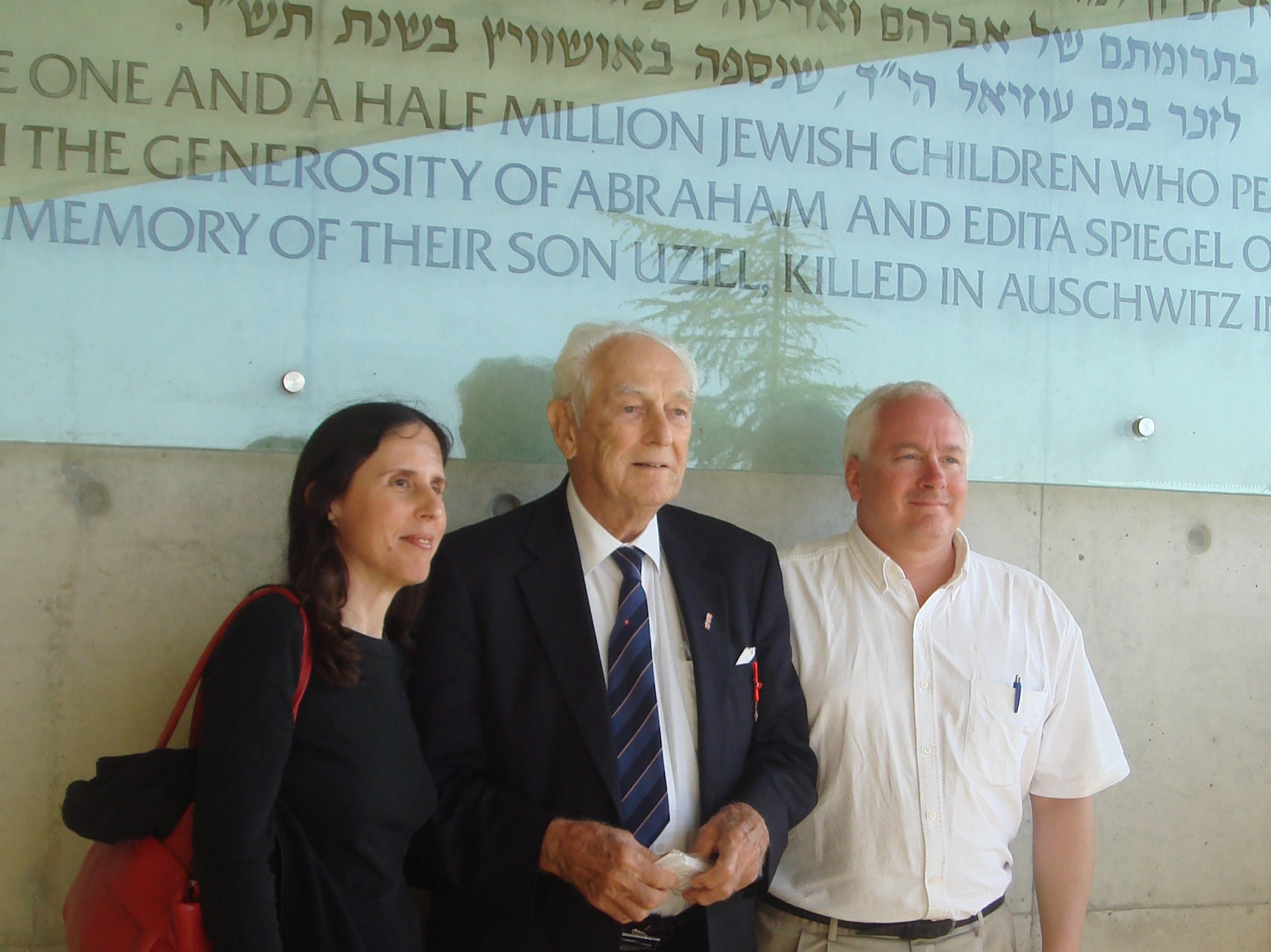
I am in Israel now to embark upon two and a half weeks of study at Yad Vashem, the Israeli Holocaust Martyrs’ and Heroes’ Remembrance Authority. I am humbled. But I was here before, in 2011, with liberator Frank Towers as he was recognized for his efforts 70 years ago, on behalf of American liberators everywhere. Here in Israel he met with statesmen and the head of the IDF, as well as over 50 survivors and their families who were liberated on April 13, 1945, an event that Frank had a direct hand in.

Varda Weisskopf, liberator Frank Towers, Matthew Rozell at Yad Vashem, May, 2011.

Varda Weisskopf, liberator Frank Towers, Matthew Rozell at Yad Vashem, May, 2011.

It’s a long story, but my work as a teacher has been here, too. In the background, note the Benjamin photo at the 2015 70th anniversary state ceremonies.

"The anguish of the liberation and return to life". Note the Benjamin photograph on the banner. Yad Vashem, 2015.

“The anguish of the liberation and return to life”. Note the Benjamin photograph on the banner. Yad Vashem, April 2015.

The short version of the story:

Fifteen summers ago I sat down to listen to an old gentleman in a rocking chair. A  war weary tank commander in 1945, he told me stories of his World War II experiences and then led me to his fellow tank commander, who showed me a picture that their major had taken on April 13, 1945. You see, those two were there, and their two tanks had liberated a concentration camp transport deep in the heart of war-torn Germany.

It would be the first time in decades that this picture had seen the light of day. And because of its discovery, and what we would do with it, thousands of lives were about to change.

Yad Vashem contacted me in December 2014 to inquire about using the Major Benjamin photo. I immediately sent them a copy. My friend Varda in Israel writes, ‘[The photograph above was taken] during the main ceremony at  the Holocaust Remembrance Day at Yad Vashem. This photo shows the President of Israel Reuven Rivlin make his speech. You can see your photo there at the middle (banner) and I now think it was there throughout all the ceremony.’

Below, a post from the time of the event in April, 2015..


My good friend in Israel let me know that the April 15th  commemoration of the Holocaust at Yad Vashem in Israel was a moving event and sent me the link to the video of the ceremony marking the 70th anniversary of the liberation. While the  narrative  behind the Major Benjamin photograph was not a focus, the photo that which now seems to be becoming a cornerstone of the history of Holocaust liberation is all throughout the ceremony, and especially at 8:31. One of my friends, a survivor who had been a six-year old boy on this transport that Major Benjamin photographed at the moment his jeep arrived at the train, notes,

The photograph wouldn’t be there if not for your effort. It was presiding on 1.5 hrs of national ceremony in the presence of Israel’s president, prime minister, the entire government, the top army guys, survivors, chief rabbis and was nationally broadcast. You have a direct hand in this.

Me, a lowly teacher, whose work for an evening is presiding as the backdrop for presidents and prime ministers. I am proud and hope that the story is told over and over, and that it serves the memory of the victims, the survivors, and the liberators well. I just can’t believe sometimes this path I have been down, since the day over a dozen years ago when I took the time to listen to a war veteran, and began to backtrack his story.  There are other forces at work here, I think… and there is a cosmic force that reverberates in you when you teach the Holocaust from the heart.

Teachers out there, you all know the power of what we do. I hope this serves as an affirmation.


*************************************************************

Matthew Rozell is a United States Holocaust Memorial Museum Teacher Fellow and teaches history at his alma mater in upstate New York. His work has resulted in the reuniting of 275 Holocaust survivors and the American soldiers who freed them.

His first book, ‘The Things Our Fathers Saw’, was released to coincide with the 70th anniversary of the end of World War II. His second book,  is on the power of  teaching, remembering the Holocaust, the Benjamin photograph and this ‘Train Near Magdeburg’. 


Read Full Post »

April 15th 1945                                                                                                                   Somewhere in Germany

You will probably be wondering who I am and what business I have, writing to you.- I am one of the millions of soldiers of the United States Army, who is fighting for all the oppressed peoples of the world and hopes to have reestablished decency and honor to all mankind, with the defeat of Hitlerism.

*****

My friend Varda in Israel sent me a copy of this letter she recently received from the widow of  Mr. Shmuel ‘Tommy’ Huppert of Israel. In it, an American soldier is taking the time to write to the husband of a Holocaust survivor to let him know that his wife and young son (Tommy) have been liberated, and that they have survived the horrors of the Holocaust and the carnage of ‘Hitlerism’.

Young Tommy and his mother, Mrs. Hilde Huppert,  were liberated at Farsleben on the transport from Bergen Belsen on April 13th, 1945. They managed to get to Palestine shortly after liberation, bringing with them many, many orphaned children, including my friend Lily Cohen.  Hilde’s manuscript, Hand in Hand with Tommy, was one of the first Holocaust memoirs completed after the war and a cathartic way for her to attempt to come to terms with what had happened.

It took years to be properly published, as it was originally rejected because it was ‘too soon after the war’. Later, at 93 years of age, Hilde was asked if there was anything specific she wished to convey to American readers of her book. She replied, ‘Tell them I will never forget those American GIs who liberated us from the Germans…I can still recall their amazed faces in that dusty jeep and the U.S. Army symbol. I remember kissing one of them, and I want the American people to know that I am grateful to them.’


READ ALL ABOUT IT IN MY BOOK HERE


One of the soldiers, on the Sunday following the Friday liberation, took the time to send this note on her behalf to her husband in Palestine. It now resides in the collection at Yad Vashem, Israel’s Holocaust Remembrance Authority.

4-15-45 Gartner to Huppert 1

April 15th 1945                                                                                                                      Somewhere in Germany

Dear Mr. Huppert,

You will probably be wondering who I am and what business I have, writing to you.- I am one of the millions of soldiers of the United States Army, who is fighting for all the oppressed peoples of the world and hopes to have reestablished decency and honor to all mankind, with the defeat of Hitlerism.

Two days ago, it was the priviledge (sic) of our unit, to be able to liberate a trainload full of people of all nations imaginable, who were being transferred from a concentration camp near Hannover, to some other place. Our advances were so swift, that the SS guards, left this particular train where it was and took off.

That is how I became acquainted with your wife, Mrs. Hilde Huppert, who asked me to drop you this note, saying, that both she and your son Tommy, are both healthy and well and now being well taken care of by our military governmental authorities. In actual fact, your wife wrote a message for you on a piece of paper in pencil, which she asked me to convey to you. Unfortunately, however, the penciled lines faded in my pocket, and I can no longer read what was written on it. The contents of the message, though, was to let you know that your wife and son are both safe and sound.

I am sure that your wife will soon be able to get into contact with you directly through the Red Cross, and I hope that in a none too distant future, your family will once more be peacefully united.

Sincerely yours,

Cpl. Frank Gartner

Fluent in many languages, Gartner was the translator for the 743rd Tank Battalion’s commander, Col. Duncan. He was originally from Estonia, and resided in Los Angeles, California.

BOOK HERE

If anyone knows more about Frank Gartner, please contact me at matthew @ teachinghistorymatters.com.. 

Transcribed by Alanna Belanger’15 and Alexis Winney ’15.

Read Full Post »

Older Posts »