Feeds:
Posts
Comments

Posts Tagged ‘Germany’

During the first Nuremberg Trial, American guards maintain constant surveillance over the major Nazi war criminals in the prison attached to the Palace of Justice. Nuremberg, Germany, November 1945. NARA, public domain, via USHMM. I interviewed the third guard on the left side.

My wife and I went to see the 2025 film Nuremberg yesterday, starring, among others, Russell Crowe as Hermann Goering and Rami Malek as the psychiatrist assigned to him. Overall, while unfamiliar with the story of Lt. Col. Douglas Kelley, I felt the film was generally well done from the aspect of a Holocaust and World War II educator. I felt that, for the most part, the portrayal of chief prosecutor was well done, particularly from the angle of setting precedent for holding war criminals accountable for their individual actions. This was the first time in the history of the world that this had been attempted; leaders of a nation—military commanders, government officials, and propagandists—were held personally responsible for crimes against peace, war crimes, and crimes against humanity, destroying the defense of “I was only following orders.” It created the legal foundation for modern human rights.

The International Military Tribunals debuted in Nuremberg for a reason, which was well brought out in the film. It was the central rallying point for the massive Nazi displays of power in the early days of the Reich—see Leni Riefenstahl’s 1934-35 classic documentary, Triumph of the Will, which I would show to my seniors despite its almost two hour run time— and the sinister 1935 Nuremberg Laws that defined ‘Jewishness’ and codified antisemitism, beginning with stripping German Jews of their civil rights.

What a lot of folks who may be familiar with the Nuremberg trial portrayed here may not actually be aware of is that it was only the first of several trials. Prosecutor Robert H. Jackson set the tone early on.

Documenting the truth of Nazi crimes was the signature achievement. The trials produced an enormous body of evidence—captured documents, films, photographs, eyewitness testimony, and first-hand accounts from perpetrators. The authentic films of the camps upon liberation were included in this movie, and while hard to watch, just like in 1945-46, it showcased that the Holocaust one of the most documented crimes in world history, countering future denial with overwhelming proof.

The trials also set a moral example after a global catastrophe. Rather than executing Nazi leaders summarily—as some Allied leaders wanted—the Allies insisted on a lawful trial. This demonstrated that justice would not be simply vengeance, that the rule of law was stronger than dictatorship, and even the worst crimes deserved legal scrutiny.

To be sure, Hollywood took some liberties. The scenes portraying Jackson as being outwitted by Goering on the stand, and in which the psychiatrist Kelley hands over confidential notes to a gorgeous reporter in an intoxicated state were outright fabrications, to be sure. Others have criticized it for showing the humanity of the chief perpetrators, but I do not have much of a problem with that. For if we hold that they were all monsters, we are just letting humanity off the hook for the next time, as I have written about before, and while I speak for myself, many professionals in Holocaust education circles are in agreement.

But let’s not forget about the everyday GIs who found themselves at Nuremburg. In Volume 7, Across the Rhine, I introduce at least two of the guards to you, in their own words.


The Courtroom Sentinel

Leo DiPalma was the son of Italian immigrants who grew up in the western part of Massachusetts in the Great Depression. Like many young high schoolers at the time, he was shocked at the news of Pearl Harbor, and ready to serve when his number was called three years later at the age of eighteen. He gained combat experience as an infantryman with the 79th Division, crossing the Rhine in 1945 before being tasked with a new assignment in the 1st Division—standing guard, at the tender age of nineteen, over some of the most notorious war criminals of the 20th century.

I pulled guard duty in the cell block [at Nuremberg]. The cell block was sort of a center, like a star, and all these blocks went off this way [gestures several radial corridors with hand]. Well one of these blocks had the 21 bigwigs, Hermann Goering and Ribbentrop and Hess and all those guys. I was a staff sergeant at the time. I pulled guard on Albert Speer’s cell, and Rudolf Hess. Then after that I was there for a short while, I became sergeant of the guard. I took my regular duties every other day for 24 hours. Luckily, I was asked to go up into the courtroom. I pulled guard with the courtroom guard at one of the visitor doors. After that, I was asked to go up onto the witness stand. That was very interesting, because from where we stood, we weren’t too far from the interpreters. If they were speaking German, and you could pick out [the English translations], you know, so you could know what’s going on, that was very, very interesting. I actually had, at that time, the latter part of the 21 original prisoners, like von Schirach, and Raeder, and Donitz, and Sauckel, right around that area there. I was moving up real fast. I stayed there until July of ’46.

‘Goering and I, We Didn’t get Along’

I had a lot of contact [with these prisoners]. Goering, he was the highest-ranking German soldier there. He expected to be treated like he was a high-ranking officer. The rest of them, believe it or not, they used to bow down to him, let him go first and stuff like that. He and I didn’t get along when I took over sergeant of the guard.

One of my duties was, during a recess, when I opened the door, I stood at parade rest right in the docket where he was right in the corner. I’m sure you’ve seen pictures of it. He would turn to me, and he asked me for some water. ‘Vasser, bitte.’ Okay. I go down to the Lyster bag, which was chlorinated, and I’d get him a little cup of water, and I’d bring it up to him. And he’d take a sip and he’d go, ‘Bah, Americanich.’ You know? He’d hand it back to me. Now there was no way of getting rid of the water; I used to have to walk down to the men’s room on this side to get rid of the water and walk back up.

Mr. DiPalma later recalled that fed up with Goering’s antics, he once met Goering’s demands by replacing the contents of the cup with water from the toilet instead of the tap, which Goering found better than the chlorinated version. ‘I guess I felt it was my little contribution to the war effort,’ he added.

In the meantime, you know, I think he was just doing it on purpose, just getting rid of me. I think one of the things was that he didn’t want to do any talking, didn’t know if maybe I spoke German or stuff like that. I could understand a little bit. But what he didn’t know is, we had some German-speaking GIs right there, and they picked up some stuff on him anyway.

Another time, at night when court was over, one of my duties as the sergeant of the guard was to run the elevator. The elevator was located behind a docket in one of the panels. The elevator carried six people: three prisoners, two guards, and myself, made it [one guard to one prisoner], going up or going down. Well at night, we had to get out of there and run and get our trucks to get back to our billet. Everybody would step back, and there’s big confusion in the docket. [The Germans] let [Goering] go right through, you know. Well, one night, I grabbed ahold of Field Marshal Keitel, he was standing right there. I said, ‘Come on, get in, get in.’ And I dragged him in like that. He was indignant; he was going to let Goering get [in first]. I pulled somebody else in, and somebody else, and I left him, left Goering standing there, you know. I think that was one of the reasons why he would send me for water every day, he was getting back at me.

Another time everybody in the docket was stepping over one another, letting him get out first; they were going to lunch. He didn’t want to cross the hallway where spectators were, he wanted to walk right across—he didn’t want anybody to look at him. So this Captain Gilbert told us, ‘Put him last.’ Okay, so we put him last. Don’t let him stand inside of the doorway. He would wait until everybody went by so he [would have to] walk straight across. Well, I pushed him out there one time, we carried a club, poked him in the back, you know. He turned around and he swung at me, and he hit me on the arm, so I gave him an awful belt in the kidneys. He never said a word to me [after that]. He didn’t like me; I know he didn’t like me. I had a couple confrontations with him, but other than Goering, the rest of them were all pretty good.

Albert Speer, many of them spoke English. I never heard Goering speak English. Albert Speer, he was Hitler’s architect, if you remember correctly. I always felt sorry for him. He was the architect, but he kind of got, I think, using the right word here, sucked into being a Nazi, and he turned out to be a Nazi. Of course, this was all for glory, I guess, for himself. I think Hitler just used him. He was a very calm-speaking individual. Always spoke to the guards. He was quite an artist. He never did me, but some of the other guys that pulled guard on some of these cell blocks, on his cell, he used to draw pencil sketches of them, and they were good. Very, very good. Imagine something like that’s worth a buck today. I don’t have that.

Let’s see, Streicher, he was a pain in the neck, complained all the time. Terrible, terrible. Going back just a little bit, when I pulled guard on the cell block, imagine standing there for an hour and watching the guy sleep through a little hole in the door, you know, it’s awful monotonous. The guys used to talk to one another, and the other guys would get to laughing. Some of them [prisoners] didn’t get much sleep at night. You kind of had to keep it down; when I was sergeant of the guard, sometimes you used to hear hollering down there, so I had to go down there and tell the guys to knock it off. Have you ever seen the old German pfennig? It’s their penny. It’s about as big as our half dollar. Well, one of the things they used to do at night, this wing had a terrazzo floor. These guys would roll these pennies down the terrazzo floor, and it sounded like a freight train coming down through there! [Laughs] I’m surprised that a lot of the German prisoners could stay awake in the courtroom the next day.

Another night, I was in the guard office, and I had a cot there, I was laying there. I could hear some screaming. I said, ‘Oh my God!’ I went down there and the guard at Streicher’s door, out of monotony, had taken a piece of paper and folded it, and he had ripped a little man out of it, so that when you opened it up, it was a man with just legs and arms like that and the head. And from off his uniform somewhere, he had tied a piece of string [tied to the neck of the effigy]. You had the light on just outside of the cell, and he’s swinging the thing in front of the light, and it’s [silhouetting] on the wall, a man hanging. [Chuckles] Jeez. I really don’t blame him for trying to get through the hours, standing there.

Let’s see, von Schirach, I pulled guard on the witness stand with him. He was head of the Hitler Youth. One day, there was quite a confrontation between him and Chief Justice Jackson. Of course, we could understand him. And he spoke decent English now, but most of his replies were in German. But through the interpreter, we could hear what was going on. They were arguing back and forth about the duties of the Hitler Youth. Well, they called a recess shortly after that, and he turned to me. I was on his left side. He turned to me, and he said, ‘But the Hitler Youth is nothing more than your Boy Scouts.’

I said, ‘Really?’ He doesn’t realize that I was a frontline soldier.

I said, ‘I fought your Hitler Youth!’ He never said a word [after that]. We found Hitler Youth that could take apart our BAR, our M1s, or any of our equipment. So they weren’t Boy Scouts like he wanted to portray them.

The rest of them were all just no problems, really. No problems. Alfred Jodl, he was a signer of the surrender terms. He didn’t talk to anybody. Him and Keitel, they weren’t Nazis, but they originally were Wehrmacht soldiers, and they were good soldiers. But of course, they turned into Nazis afterwards, you know?

*

I came home in July, yeah, about three months before the trial ended. [I was not present when Goering committed suicide]; I think [he died] the beginning of October, as I recall.  Everybody was trying to get their autographs. In fact, I have their autographs. All but Hess. Every time you’d ask Hess for his autograph, he spoke good English, because he spent quite a bit of time in England, he said, ‘after the trials.’

Well, you know what our favorite saying was? ‘You won’t be here after the trials.’


Nuremberg’s message endures:
No one, no matter how powerful, is above the law—and the world will remember.

Read Full Post »

Welcome to 2025, a momentous year for World War II remembrance and history. So glad that you can join us for these updates, the ‘octogintennial’ anniversary of the end of the war, and of the greatest crime in the history of the world, the Holocaust. 
Iwo Jima,1945. National Archives.
As we look back on this week in history, we reflect on two defining moments of World War II that occurred in March of 1945, each marked by incredible human bravery and sacrifice: the end of the Battle of Iwo Jima and the crossing of the Rhine River by U.S. forces. Both events shaped the course of history, and their stories remind us of the extraordinary courage and resilience of those who fought.
The End of the Battle of Iwo Jima
In my last post, I wrote about my friend Art LaPorte, the 17-year-old Marine who was puzzled by the flag raising on Iwo four days into the campaign, since the battle was far from over with. 80 years ago, on March 26, the Battle of Iwo Jima was declared completed, though some defenders were surrendering as late as 1949! For the U.S. Marines, after weeks of intense fighting, the toll was overwhelming. The famous photograph of the flag raising atop Mount Suribachi on Feb. 23 finally symbolized not just military triumph, but the deep human cost—nearly 7,000 American lives were lost, over 19,000 wounded, and the toll on the Japanese defenders was far worse.
***********************************************************************************************************


The Crossing of the Rhine River
Meanwhile, on the European front, U.S. forces were preparing for their own major breakthrough: crossing the Rhine River. By March 1945, Allied forces were closing in on Germany, and the crossing of this natural barrier was a decisive move toward victory. On the night of March 23, 1945, treadway rafts were launched and pontoon bridges were under construction. The stakes were high: As one writer put it, “The Rhine was more than a river. It was a sacred waterway to the Germans, the source of most of their legends and myths. And at this stage in the war, crossing the Rhine was the last barrier between the advancing Allied armies and the conquest of Germany. If the Germans could hold their beloved river, they might be able to stand off the Allies.”

The cost was also high. Albert Tarbell, a paratrooper with the 504th Parachute Infantry Regiment, 82nd Airborne Division, recalled:

“The 505th made the river crossing first, and when we got there, just as we got off the pontoon onto the dry land, we see this tank hit a mine on the road, and took this 40-ton tank and it just flipped it right over! That’s how powerful the mine was. The Germans had planted the mines, and they had put detonators in there so that after maybe the 10th of each vehicle went over, it would set it off, so you didn’t know when it was going to blow up, or where it was.

And so they said, ‘Go over on the side, go over around it, and go alongside the road.’ We had no sooner gone about 20 feet up ahead when a truck hit another mine, and it blew the guys right out. I could see one guy, he looked like he must have been sitting in the back of the truck, it looked like if you threw a hat up in the air, you know, just flopping up in the air, and the truck went way up in the air! Boy, that was awful!”

Yet as the spring progressed, it was clear that the war in Europe might end soon.

“Now, we really were [moving fast], and we started getting more prisoners giving up to us; groups, maybe platoon-sized. We started getting jeeps up there to ride in. I said, ‘God, this is the way to fight a war.’ It was walking and running, and we were riding in jeeps across this open field; there was a whole line of us, we got to the end of this open field and there was a little bit of woods, and behind the woods there was three Tiger tanks sitting there! That’s when I knew, I said, ‘Hey, this war’s winding down.’ Those guys could have had a field day with us. They could have just wiped us right out.

So we went from one town to the other. One place there was a whole company, their platoon all lined up, ready to surrender to us. And then another time we kept on going, the truck traffic kept getting heavier, and heavier, and heavier. At one point, I don’t know whether it was that same day, I think it was, or it might have been the day after, we got to this one point where it got so bad, we put outposts out to direct traffic. Zimmerman, myself, and George Height was with me again, it seems like everywhere I went he was with me, following me, so we directed traffic. ‘Vehicles to your right, walk on foot to your left.’ Those German guys were throwing their weapons away, and this and that, and oh man. And they even had a calvary ride through [to surrender], God, beautiful horses. But some of these solders were pathetic, you know, worn out, clothes worn and torn, beat up, you know, tired, battle worn.

Towards about dark, a staff car pulled up and out got, you know how you see in movies, German officers, got shiny boots on, got shiny long leather jackets on, the whole nine yards of it—that’s the way these guys were dressed. One said, in perfect English, he said, ‘Where is your general’s command post? This is the commanding general here!’

From what I gathered after, it must’ve been the commanding general of that 21st German Army that surrendered to us. They wanted to surrender to us instead of to the Russians, to get out of the path of the Russians as they were coming in.

So I said, ‘What do you want to see our general for?’
He said, ‘This is the commanding general here, we’re going back there with your general, and we’re going to regroup and fight the Russians!’

I looked at Zimmerman, then I looked at Height, and I said, ‘Well, I’ll tell you what you do, you just go right down this road here, to my right, there’s some MPs down the road, they’ll show you right where to go.’ And I think that was the commanding general of the 21st German Army! They looked like they were in pretty good shape. We laughed, but they were serious. They probably were put in prison; our general wouldn’t have had anything to do with them.”

For those who survived the final push into Germany, the crossing marked a turning point in the war in Europe. They were pushing toward the heart of Nazi Germany, with the prospect of victory finally within reach—but then they encountered the evidence of the greatest crime in the history of the world—the Holocaust. For battle hardened soldiers, it was almost too much.

The Human Cost of War

Both of these events—though separated by vast oceans—remind us today of the price of freedom. These soldiers, almost all of whom were young men just beginning their adult lives, faced insurmountable odds. Their experiences, full of courage, sacrifice, and determination, offer us powerful lessons in resilience and hope.

Read Full Post »

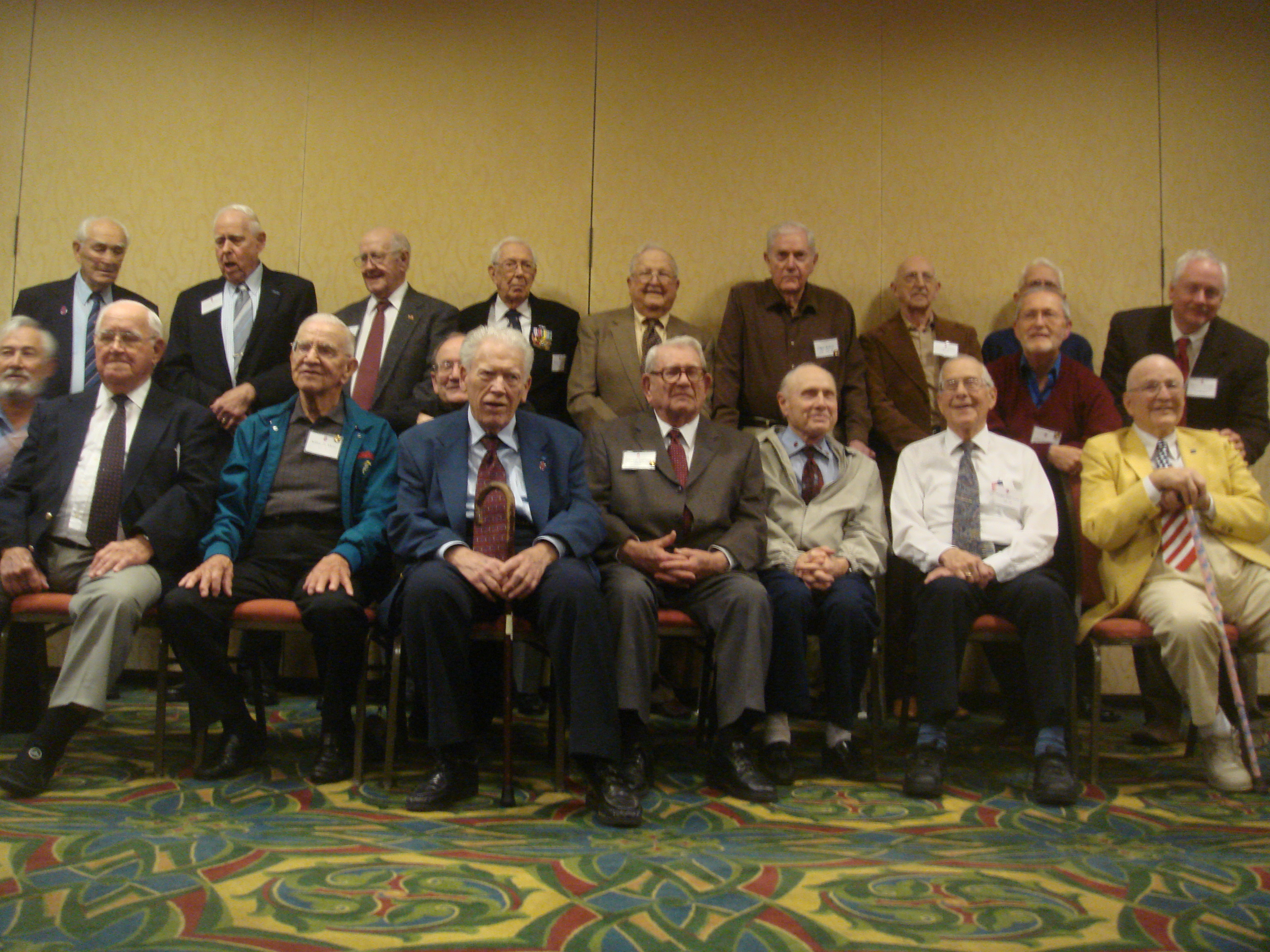
Received from Frank Towers,97 yr old Sec/Treasurer of the 30th Infantry Division Veterans of World War II.  I am going to be there. I hope to see all you survivors there, Holocaust and World War II,  for this last hurrah…love these guys. It will be the 70th anniversary of the liberation of the “Train Near Magdeburg”. In the pic below are soldiers and Holocaust survivors, and yours truly, in Nashville from 2010.

#30th Infantry Division, Survivors, M. Rozell

Nashville is Next!
And sadly to say, it will be the LAST Reunion of the“30th Infantry Division Veterans of WWII”….

30th Infantry Division Veterans of WWII
National Reunion April 15 – 18, 2015
Holiday Inn- Nashville-Opryland/Airport
Nashville, TN

The time has come when all good things must come to an end. We have had some great times in the past few years, but time and age is taking a toll on our membership, and the numbers are dwindling faster than we would like. Our Executive Committee has decided, that since our numbers of attendees has dropped off, it is becoming a financial burden to continue having reunions without adequate financial support. It takes a great deal of work on the part of the Exec. Sec-Treas. and the Reunion Chairman, Mrs. Nancy-Lee Pitts and Family, to prepare all of the necessary paper work, contract, preparing a program and the process of cleaning up and winding down from the Reunion. At our age, this is becoming a burden and almost prohibitive, so, very sadly, we must call it Adieu !!

So, all we ask is that as many of you who are able, Please come to this Reunion, to have a good time and enjoy the company of each other, and make this a memorable reunion.

This may be the last opportunity that you will have to see and visit with “old buddies”, whom you have known for the past many years.

Remember, Nashville was the site of the very first Reunion of the 30th Division Veterans in 1947, and it is quite appropriate that we should have the last one at this same site.

Come One and Come All, and make this a Big Blast, for the last time.

We will be looking forward to seeing ALL of you.


Old Hickory Re-Enactors

As usual, many, many thanks go to all of the guys who were representing the Old Hickory Re-Enactors, by Posting the Colors at each event as required, tending the bar in a most efficient manner, and best of all, their Artifacts, Weapons and other Memorabilia which is always a big hit with everyone. If you have not visited their displays, you are missing a lot ! We need to give these guys a big hand for what they do for us.


Holocaust Survivors

We cordially invite all of the Holocaust Survivors from the Farsleben Train, to join with us for this special event. If you have not been with us before, please do not pass up this opportunity to meet your Liberators. This will be the last time that you will have an opportunity to meet them, as we will not be having these Reunions any longer, so this will be your last chance. Many of you have been with us before, and we hope to see you all again. Kosher food will be available for all of those who require this.

Weferlingen – Walbeck – Grasleben

On 10 April 1945, Brunswick, Germany was captured by the 30th Infantry Division, with the next objective being Magdeburg.

The following day 11 April 1945, proceeding on towards Magdeburg, the town of Hillersleben was attacked and captured with little or no major battle. At the edge of the town, there was a large German Luftwaffe Airbase and an Armaments Research Center. This base was composed of several operations buildings, several 2 story block barracks, and several private homes for the officers and a small hospital.
Continuing to press on towards Magdeburg, during the 12th of April, the 120th Regiment over-ran the village of Walbeck, and the 117th Regiment over-ran the village of Grasleben, and in between these two villages, was another small village, “Weferlingen”, which was liberated by the 120th Regiment. [Ed. note: On 13 April the train at Farsleben was discovered.]

No mention was ever made in the journals of these regiments, about the capture of these villages, nor was any mention made of them in the 30th Division History Book or either of the Regimental History Books. Only from the Journal of the 30th Military Government, was this action discovered recently. (2012)
At Weferlingen, the site of a former potash mine was discovered – a mine operated by Jewish and D.P slave laborers, under the direction of their Nazi slave-masters. This mine had been enlarged and deepened, from its original size as a potash mine, and was in operation of fabricating submarine engines, airplane engines and rocket engines. It was deep and well protected from American bombing attacks.
This “camp” was named “ Camp Gazelle” by the Germans, and it was a sub-camp of Buchenwald, and when discovered, consisted of 421 (political prisoners), slave laborers. As any of these laborers became ill or otherwise incapacitated, they were sent back to Buchenwald, and fresh laborers were sent to the camp to take their place and to keep the labor force consistent with their needs. All of these prisoners were found in very poor physical condition, due to malnutrition because of being underfed, and overworked for 12-15 hours per day. Almost all of them required immediate medical attention.

Arrangements were made with the Burgomasters of Walbeck and Grasleben to furnish adequate food for these people. Our own 105th Medical Battalion personnel furnished them with immediate needs of medical supplies.
They were almost immediately sent back to the American Military Government and the American Red Cross, then located at Hillersleben, Germany, for appropriate processing and repatriation back to their homelands wherever possible.
It was on the basis of the liberation of this “CAMP” that the 30th Infantry Division was given the distinction of being named a “Liberating Unit” by the Center for Military History and the U.S. Holocaust Memorial Museum in Washington, DC, thereby allowing our Colors to be displayed in the lobby of the US. Holocaust Memorial Museum. This is to honor the men of the 30th Infantry Division who had a part to play in the liberation of numerous Jewish slave laborers of the Holocaust.
This was actually the very first viewing that any man of the 30th Infantry Division had of the “supposed” propaganda of the “Torture of the Jews by the Nazis”, later to be known as “The Holocaust” .These liberating soldiers had no training as humanitarians- they were trained to be soldiers, fighting a war against Nazi aggression and really did not know what they had on their hands, nor the scope of this captivity of the Jews. -Frank Towers

Taps – 2014

ADKINSON, BRUCE 743 TkBn-C Garden City, NJ
BERKEL, John J. 119-I 5/26/14 Belleville, IL
BIGOS, Adolph J. 119 Tom’s River, NJ
BURLEIGH, James 117 Golden, CO
CONLEY SR., Leo J 119 Framingham, MA
COX, Henry G. 117-F 8/17/10* Loris, SC
COX, Joe M. 117-D 5/20/14 Bluff City, TN
DEAN JR., Preston A. 531 AAA Hq
ERICKSON, Mervin L. 119-K Windom, MN
FLOYD, Thomas A. 119-G 9/30/13* Forney,
GIACCHETTI, Hugo J. 119 E Chicago, IL
GRAPKOSKI, Walter E. 119-G 11/23/11* Danbury, CT
HOFFMAN, STANLEY 120-B 1/19/14 Princeton, NJ
HOLLOWELL JR, Ernest L. 105 Med D
HOUTEKIER, Louis 119 G 7/15/14 Big Rapids, MI
IACONO, George D. 197 FA Svc, 9/30/11 St. Petersburg,
JORDAN, Joseph S. 105 Med. BN A 7/26/12 Wilmington, NC
KEATING, Hubert M. 113 FA/A 6/06/13* Paducha, KY
LEY, Charles E. 120
MARKHAM, Cameron L. 117 1BnHq 5/15/14 Charleston, WV
MARSIGLIA, Joseph M. 119 Hq. 12/.03/14 Algonquin, IL
MARZILLI, Rocco D. 30 QM Co. 10/27/13 Waterbury, CT
MC MICHAEL, Roscoe 105 Med. Bn 10/08/13* Newnan, GA
MITCHELL, Kenneth 120 C
NOWLAND, Maland C. 30th Recon E. Vassalboro, ME
ORTIZ, Oscar A 105 Med B San Francisco, CA                                                                 OWENS, Livis 120-C
PARKER, Kanneth 120 B
POLAND, Claude E. 120-G 4/49/14 Columbus, IN
RINELLA, Donald. 105 Med Bn. C 5/11/14 Truckee, CA
SMALL, George 120-A 12/19/13 Augusta, MI
SUPER, Seymour 119-A Boynton Beach, FL
WAUGH, Wilford D. 120-I Buffalo, OK
WHITE, Carlton L. 120-K 1/29/12* Elizabeth City, NC
WILEY, A.P. 120-M 6/24/14 Dallas, TX
WYATT, Nell (Wid) W 2/06/14 Waynesville, NC


Read Full Post »

This originally appeared at the Huffington Post website for Veterans Day.  Maybe it is appropriate to share for Thanksgiving.

The author contacted me in 2007 when news of our first reunion went viral  in the Associated Press. Later, in 2009, he was invited to a gathering of the soldiers who saved his father and other survivors on this train here at our high school. His talk to our gathering can be seen below, published here for the first time.

Praise for the American Soldiers Who Saved My Father From a Death Train

By Lev Raphael

 In early April 1945, my father was packed into a train with 2500 other prisoners from Bergen-Belsen as the Nazis insanely tried to keep British and American troops from rescuing them. The train was made up of 45 cars with their doors sealed shut; the crowding was horrific and of course there was no food or water.

 In the chaos of war, this hellish train wandered for a week and finally stopped at Farsleben, a tiny town not far from the Elbe, sixteen kilometers from Magdeburg, the site of one of Germany’s largest munitions plants. German communications had collapsed and the commander couldn’t get clearance to move across the Elbe, so he ended up decamping ahead of the American troops he knew were coming. When two American tanks appeared on April 13th, the remaining guards escaped.

 Frank W. Towers, a 1st Lieutenant of the 30th Infantry Division, reported that the stench when the locked cattle cars were opened “was almost unbearable, and many of the men had to rush away and vomit. We had heard of the cruel treatment which the Nazis had been handing out to Jews and political opponents of the Nazi regime, whom they had enslaved, but we thought it was propaganda and exaggerated. As we went along [in Germany] it became more apparent that this barbaric savagery was actually true.”

 The troops that had found this train were racing to the Elbe because it was the last barrier to their advance across Germany, and now they had a totally unexpected burden of some twenty-five hundred prisoners to house and provide for. The answer was about nine miles to the west. American troops had just captured several hundred Germans at the Wehrmacht base and proving ground in Hillersleben where tests had been conducted for giant railway guns manufactured by Krupp.

 It was an ironic place for Jews to be sheltered, cared for, and brought back to life. But then what place in Germany wouldn’t have been an ironic location?

 This verdant military setting with its clean, heated quarters for officers and soldiers was a virtual paradise for people who had been treated like animals for years. That’s where my parents met and fell in love. My mother was in Hillersleben because she had escaped from a slave labor camp in Magdeburg and been brought there by American troops now using it as a temporary Displaced Persons camp.

 She and my father had each lost everything in what would come to be called the Holocaust: home, families, countries. So there wasn’t any time to play any pre-war games. “Do you like me?” he asked. She did, and as my father tersely put it years later, from that moment on “She was mine and I was hers.” My mother moved in with him that night, beginning their fifty-four years together.

 Frank Towers, who is 97, is the last surviving soldier who rescued the prisoners on that train, who saved my father from almost certain death and brought about his encounter with my mother. I’ve had the honor of meeting Frank and shaking his hand, and I’ve written about him in my memoir My Germany, but on this Veteran’s Day, with the survivors of the Holocaust and their saviors dwindling faster and faster, it’s more important than ever to thank him in public, and praise the memory of those other “train heroes” who are no longer alive.

The account in this blog is excerpted from My Germany: A Jewish Writer Returns to the World His Parents Escaped.

 http://www.huffingtonpost.com/lev-raphael/veterans-day-praise-for-t_b_6124862.html

 ***************************************************

Five years ago this fall, we put on quite a show at our high school.  High school kids listening to, meeting, sharing, laughing, crying, even dancing  with octogenarian U.S. soldiers and Holocaust survivors. Here, Raphael shares his remarks with the soldiers, survivors, and students about growing up in a survivor household, and his coming to terms with Germany.


Read Full Post »