Veterans Day: Hudson Falls teacher’s stories unite veterans with survivors
Author: Liza Frenette
Source: NYSUT Communications

Caption: Photo of Matt Rozell by Andrew Watson.
Posted in Uncategorized, tagged 30th Infantry Division, 531st Anti-Aircraft Artillery, 823rd Tank Destroyer Battalion, 95th Medical Battalion, Bergen Belsen, Carrol S Walsh Jr, concentration camps, Farsleben, Frank Towers, Friday April 13th 1945, George Gross, history education, Holocaust, Holocaust Education, Holocaust Writing, humanity, Liberators, Matthew Rozell, narrative history, New York State United Teachers, NYSUT, Power of Teaching, Purposeful Life, teaching history matters, Teaching the Holocaust, Train Near Magdeburg, World War II, World War II Living History Project on November 11, 2014|
Posted in Uncategorized, tagged 30th Infantry Division, 531st Anti-Aircraft Artillery, 823rd Tank Destroyer Battalion, 95th Medical Battalion, Bergen Belsen, Carrol S Walsh Jr, concentration camps, Farsleben, Frank Towers, Friday April 13th 1945, George Gross, history education, Holocaust, Holocaust Education, Holocaust Writing, humanity, Liberators, Matthew Rozell, narrative history, Power of Teaching, Purposeful Life, teaching history matters, Teaching the Holocaust, Train Near Magdeburg, World War II, World War II Living History Project on November 10, 2014| 2 Comments »
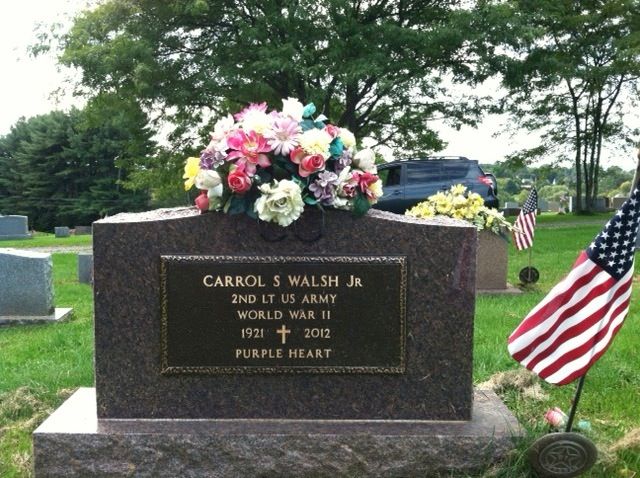
Carrol S Walsh Jr. At rest in Johnstown, NY. Photo by Elizabeth Connolly.
Thirteen summers ago, I sat down for an interview with an amazing man. What he would relate to me, and what I would do with it, would go on to change both of our lives. A seemingly small incident would be recalled almost as an aside in the wider context of World War II, but then would go on to reverberate through time, and space, creating ripples in the cosmos that grew into waves. Big waves that would carry me, and many others, to places we had never thought possible.
You see, on Friday, April 13th, 1945, twenty-five hundred lives were saved as advance elements of the U.S. Army 743rd Tank Battalion, 823rd Tank Destroyer Battalion, and 30th Infantry Division stumbled across the crime of the century, perhaps of all time.
A train transport stopped at a railroad siding. Open boxcars, sealed boxcars, shabby passenger cars, engine. Some people wandering about, others too ill to move. Sick and emaciated human beings. Women. Men. Children. SS bands roaming the countryside. Orders to execute. A bridge over the River Elbe ahead to be blown to smithereens. With the transport, and the people on it.
The soldiers told me their stories. In the course of collecting their narratives, we found others who played their parts and rescued those people.
I listened. We wrote. We recorded, and I posted. Then, the wires began tripping. Seven Septembers ago, we put together the first of many reunions between these soldiers and the child survivors of the Holocaust they rescued.
“Joyful” does not do it justice. What do you say to the men who saved you and your family when you were a child?
Carrol smiles, grips their arms in greeting, and laughs, “Long time, no see!” Sixty-two years, that’s all. On April 13th, 1945, the war weary, “seen-it-all” twenty-four year old second lieutenant is in for the shock of his life.
***************************************************
Five years ago this week, we put on quite a show at our high school. High school kids listening to, meeting, sharing, laughing, crying, even dancing with octogenarian U.S. soldiers and Holocaust survivors. ABC World News called my classroom and told me they were on their way up from NYC headquarters to film us. You can see Carrol, and listen to fellow tank commander George Gross’ narrative from our interviews, and hear fellow soldier Frank Towers describe his role in the liberation.
The last evening together, soldiers and survivors from all over the world watched the broadcast together, and we said our prayer of thanksgiving. Hundreds of students became the witnesses for the generations to come.
And so it comes full circle. Nearly ten percent of the passenger list has been found, over 60 years later. Profound things keep happening.
***************************************************
We lost Carrol less than two years ago, George earlier. So I write this week to remember, and remind myself of what a legacy, and gift, they left us. While it may have been a tiny part of very productive lives (a New York State Supreme Court justice, and English literature professor, respectively), for the rest of my days I will think of the times I got to talk to them, and smile.
And think about their own words: “What are we going to do with all these people?”
Indeed. Just look at the generations that sprang forth, because of what our soldiers stopped to do, in a shooting war. In complex, fluid situations, there are no easy answers, but don’t you think that there is a very important lesson here?
It was not part of the mission. But maybe as a society we should break down and examine the values that made the mission change, if even as a “sideline”.
Sometimes it just feels good to feel proud.
But temper pride with the wisdom of the retired New York State Supreme Court justice:
“No.
They don’t owe us anything. Not a thing.
We owe them~
For what the world allowed to happen to them.”
Posted in Uncategorized, tagged 30th Infantry Division, Bergen Belsen, concentration camps, Farsleben, Frank Towers, Friday April 13th 1945, history education, Holocaust, Holocaust Education, Holocaust Writing, humanity, Liberators, Matthew Rozell, narrative history, Power of Teaching, Purposeful Life, teaching history matters, Teaching the Holocaust, Train Near Magdeburg, World War II, World War II Living History Project on October 23, 2014|
Posted in Uncategorized, tagged 30th Infantry Division, Bergen Belsen, concentration camps, Farsleben, Frank Towers, Friday April 13th 1945, history education, Holocaust, Holocaust Education, Holocaust Writing, humanity, Liberators, Matthew Rozell, narrative history, Power of Teaching, Purposeful Life, teaching history matters, Teaching the Holocaust, Train Near Magdeburg, World War II, World War II Living History Project on October 13, 2014|
Meet my friend Frank. He’s 97. The story continues…. from the Boston Globe.
WW2 liberator reunites with Holocaust survivors
By Victoria Bedford
| Globe Correspondent October 12, 2014
“If not now, when?’’ asked Rabbi Joel Sisenwine, quoting from Hillel the Elder, a revered Jewish leader who lived at the time of King Herod. “If not me, who?”
It was Oct. 4, Yom Kippur, and Sisenwine stood before the congregation at Wellesley’s Temple Beth Elohim, introducing a very special visitor.
As Frank Towers walked up to speak, the teary-eyed congregation of 1,500 rose to give him a standing ovation.
Towers never considered himself special. Now 97, the South Boston native is living in Florida, where he spent most of his adult life as an office manager at a university data processing center. But in the early spring of 1945, in Farsleben, Germany, he was among a group of soldiers who liberated thousands of Nazi prisoners.
The rabbi invited two of those survivors, and their families, to step forward and stand beside Towers.
Yvette Namias, 92, of Peabody, did so. She was 22 in 1945 and long a prisoner at the notorious Bergen Belsen death camp before the liberation. She had never met Towers. Her family — children, grandchildren — stood around her.
Namias was joined by Charles Elbaum of Providence, a 17-year-old prisoner at the time of liberation, now surrounded by his children and grandchildren.
“Well,” Towers said to Namias after the ceremony, “I’ve spent a long time chasing you around the world.”
“He’s responsible for my family,” said Namias. “Without him, my family would not be here.”
Nothing in his life had prepared Towers for what he came upon on April 14, 1945. He was a young lieutenant in the 30th Infantry Division, a unit of the US Army National Guard, heading for Magdeburg, Germany, to fight one last major battle. In the town of Farsleben, they encountered a train that had been seized by the Army’s 743d Tank Battalion the day before. Towers was told it held 2,500 Jewish prisoners, and he was responsible for taking them to safety.
“What if you find a train loaded with Jews, what are you going to do? Nothing was ever said about anything like that.” Towers said. “If you come across a camp, like Dachau or Buchenwald, what are you going to do? We didn’t know anything about that situation.”
But the lieutenant found himself faced with a train full of death camp prisoners, 60 to 70 men, women, and children crammed into each train car, forced to stand until they collapsed from exhaustion, with a daily ration of thin potato soup, and one bucket for a bathroom. They were starved, sick, overworked, and in desperate need of medical assistance, which Towers and his men were wholly unprepared to provide.
Still, Towers and his men sprang into action, rounding up as much transportation as they could, and took the prisoners to the town of Hillersleben. There, a Red Cross unit processed the thousands of Jewish prisoners, gave them showers, provided clean clothes and dusted them with DDT, now a prohibited carcinogen, to kill lice and fleas.
Knowing that he was leaving the prisoners in good hands, Towers went on to fight a last battle, and returned to the States later in 1945. Soon, he started a family with his wife, Mary. Like many who lived through the war, he put his experiences in the rearview mirror for years, never talking much about what he had seen of the Holocaust.
“But I could tell it was eating him inside,” Mary said. “I knew that.”
Towers said his focus was just to move on. “Not much thought was given to the victims,” Towers said. “They were starting out on a new life somewhere.”
That all changed for him in 2005, when he was invited back to Magdeburg to speak about what happened 60 years before. There, he met Ernest Kahn, a survivor of Buchenwald who had been liberated by Towers’ division (“It was very emotional,’’ said Towers), and Kahn put him in touch with Matt Rozell, a high school teacher from Hudson Falls, N.Y., who was assembling an online archive of stories from the war. The two began working together to locate survivors from the train in Farsleben.
“The thing just snowballed,” Towers said. “Today we have located 275 of these children.”
Like Towers, Charles Elbaum, who was a 17-year-old prisoner when rescued from the train, rarely spoke about the Holocaust to his family. After his liberation, he went on to become a physics professor at Brown University, a husband, a father to three sons, and a grandfather to eight children. His son Dan, of Newton, and grandson Nathan met Towers at a reunion, and invited him to speak before the congregation at Temple Beth Elohim.
“Without what they did,” Dan Elbaum said, “I wouldn’t be here. Frank is the last known surviving veteran who was actually present at the liberation of the train.”
For Towers, who now travels around the world to tell his story, preserving the memory is the most important aspect of these talks.
“Dan and his family, and others just like him, he’s second-generation,” Towers said. “Many of them knew nothing about the incarceration of their parents. This second generation is entitled to know what happened, and how it happened, so that they in turn can pass it on to their children, and this will never happen again. That’s the hope in all of us.”
Posted in Uncategorized, tagged Ariela Rojek, Belzec, Farsleben, Holocaust, Holocaust Education, Holocaust Survivors, Holocaust Writing, Krakow, Montelupich, Montelupich Prison, narrative history, teaching history matters, Teaching the Holocaust, Train Near Magdeburg, USHMM on July 14, 2014| 1 Comment »
~Matthew Rozell, a history teacher whose project reunited hundreds of Holocaust survivors with the American soldiers who liberated them, takes a backwards journey to the authentic sites of the Holocaust, retracing the path of the survivors who are now his friends.~
A year ago I took one of the most transformative journeys of my life, with 24 fellow educators, to study the Holocaust and the Jewish resistance to it, in Washington, DC, Germany, the Czech Republic, and Poland. I kept an extensive diary and took tons of photographs. And contrary to many assumptions, it was a journey that led to profound understandings about life, not death. For the next several days, I have decided to go back and retrace my steps and try to process what unfolded for me.
***************************
July 13. Our last day in this beautiful, revitalized city of Krakow. And like the city, the Jewish community is also trying to revitalize. There is even a Jewish Cultural Festival coming up in Krakow. Our non-Jewish young Polish guides here have certainly been passionate about not letting the past die, as were our German historians encountered on our trip. Gusia takes us to the Jewish Community Center, and Jakub gives us a guided tour in the new Jewish Heritage Museum. He reaches 12,000 schoolchildren, doing outreach, and works with others to resurrect desecrated Jewish cemeteries. As he puts it, it is Polish heritage as well as Jewish heritage. In the 15th and 16th centuries, Poland was the center of European Jewish life. In fact, at the end of the 18th century, 75% of the world’s Jews lived in the former Galicia, once part of Poland, Ukraine and the Austria-Hungarian empire. Still, in most places in Poland there is nothing left of what was. Out of what was once millions, today only between 12,000 and 14,000 Jews call Poland home. Let’s not forget that after the war, Jewish survivors were not exactly welcomed back by their neighbors with open arms. And the Communist regime conducted its own purges of Jews as well.
All the more reason to embrace the work of Gusia and Jakub and other dedicated Poles.
Jewish Community Center, Krakow.
***************************************

July 14. Bus ride is long, from Krakow to Belzec (pronounced “Bel-zich”) Memorial site. Five hours. Imagine what it was like traveling in a packed railcar. Well, we can’t.
I carry a letter with me written by my friend, survivor Ariela, who, like many friends is supporting me in my travel here. It has been in my pocket for weeks. Ariela was 11 when she was liberated with her aunt on the train near Magdeburg, from Bergen Belsen. She too had been in the prison at Montelupich in Krakow.
A little girl.
In a political prison.

Ariela R. at the time of her liberation. Age 11. April 1945. Photograph by liberator George C. Gross.
So, I am kind of quiet as we approach the memorial site. Ariela’s mother, only 36, both of her grandmothers, her grandfather and two aunts were murdered here in 1942. Her father, other grandfather, and uncle were murdered in Auschwitz, where we were two days ago.


Belzec, Poland. Half a million people murdered on this site. Half a million. Unreal.
From the USHMM:
“In November 1941, SS and police authorities in Lublin District began construction of a killing center on the site of the former Belzec labor camp. The choice of location was dictated by good rail connections and proximity to significant Jewish populations in the Lvov, Krakow, and Lublin districts of the Generalgouvernement. The facility was finished in the late winter of 1942 as part of what later would be called Operation Reinhard (also called Aktion Reinhard), the plan implemented by the SS and Police Leader in Lublin to murder the Jews of the Generalgouvernement. Belzec began operations on March 17, 1942.”

Belzec Memorial.
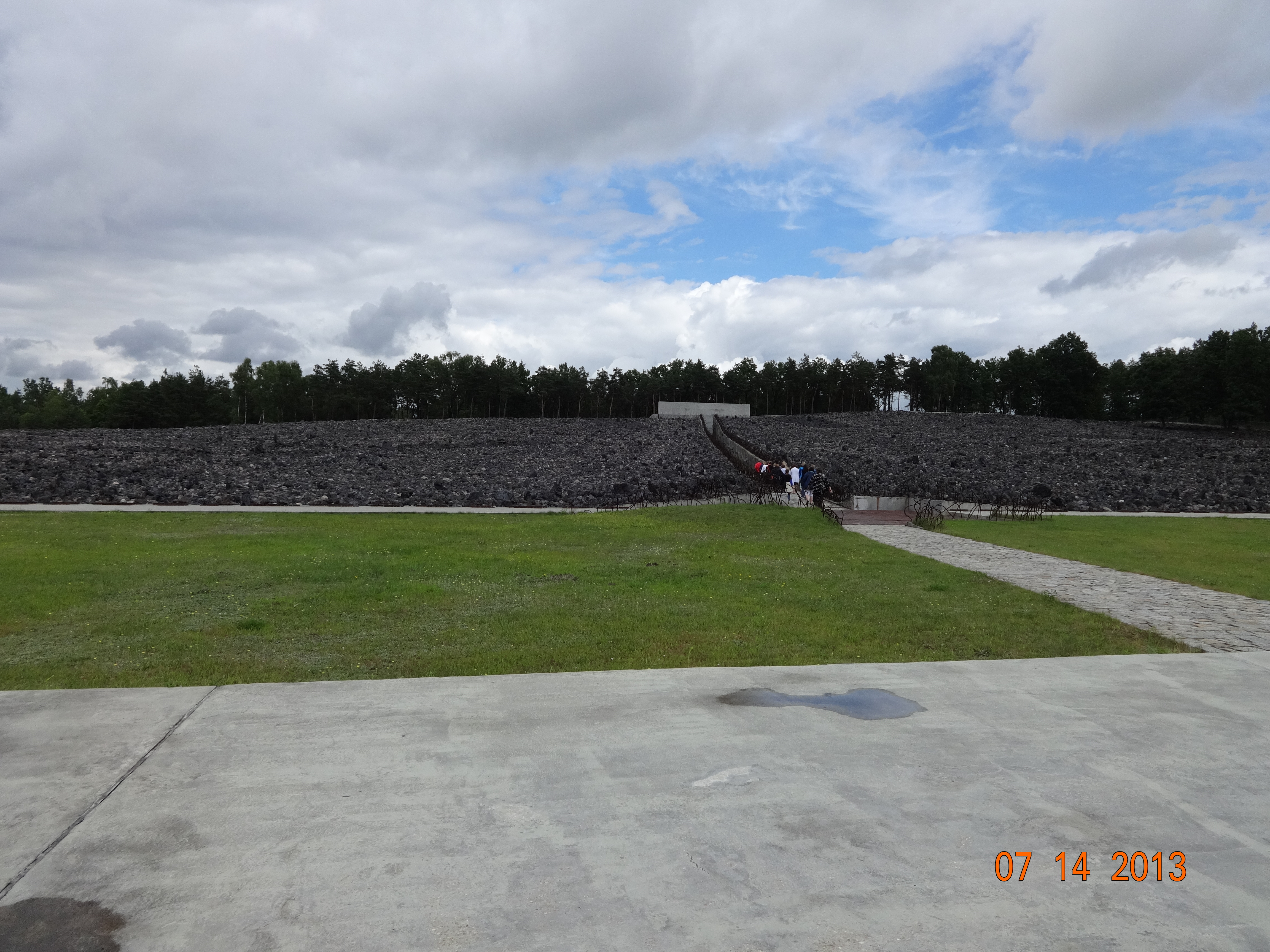
Belzec Memorial site. There was no memorial for nearly 60 years.
“Trains of 40 to 60 freight cars, with 80 to 100 people crowded into each car, arrived at the Belzec railway station. Twenty freight cars at a time were brought into the camp. Arriving Jews were ordered to disembark. German SS and police personnel announced that the Jewish deportees had arrived at a transit camp and were to hand over all valuables.”

“Initially, men were separated from women and children, though in later months, as transport arrivals became more chaotic due to increased awareness of the victims of what would happen, the Germans and the Trawniki-trained auxiliaries could not always implement this segregation. The Jews were forced to undress and run through the “tube,” which led directly into gas chambers deceptively labeled as showers. Once the chamber doors were sealed, auxiliary police guards started an engine located outside the building housing the gas chambers. Carbon monoxide was funneled into the gas chambers, killing all those inside. The process was then repeated with deportees in the next 20 freight cars. ”

Jews are forced into boxcars destined for the Belzec extermination camp. Lublin, Poland, 1942. USHMM.
“Groups of prisoners selected to remain alive as forced laborers removed bodies from the gas chambers and buried the victims in mass graves. Other prisoners were forced to sort the victims’ possessions and clean out freight cars for the next deportation. Camp staff periodically murdered these forced laborers, and replaced them with newly arrived prisoners. In October 1942, German SS and police personnel, using groups of Jewish prisoners, began to exhume the mass graves at Belzec and burn the bodies on open-air “ovens” made from rail track. The Germans also utilized a machine to crush bone fragments into powder. By late spring 1943, the camp was dismantled. During June 1943, the remaining Jewish prisoners were either shot in Belzec or deported to the Sobibor killing center to be gassed. After Belzec was dismantled, the Germans plowed over the site. Soviet forces overran the region in July 1944.”-USHMM
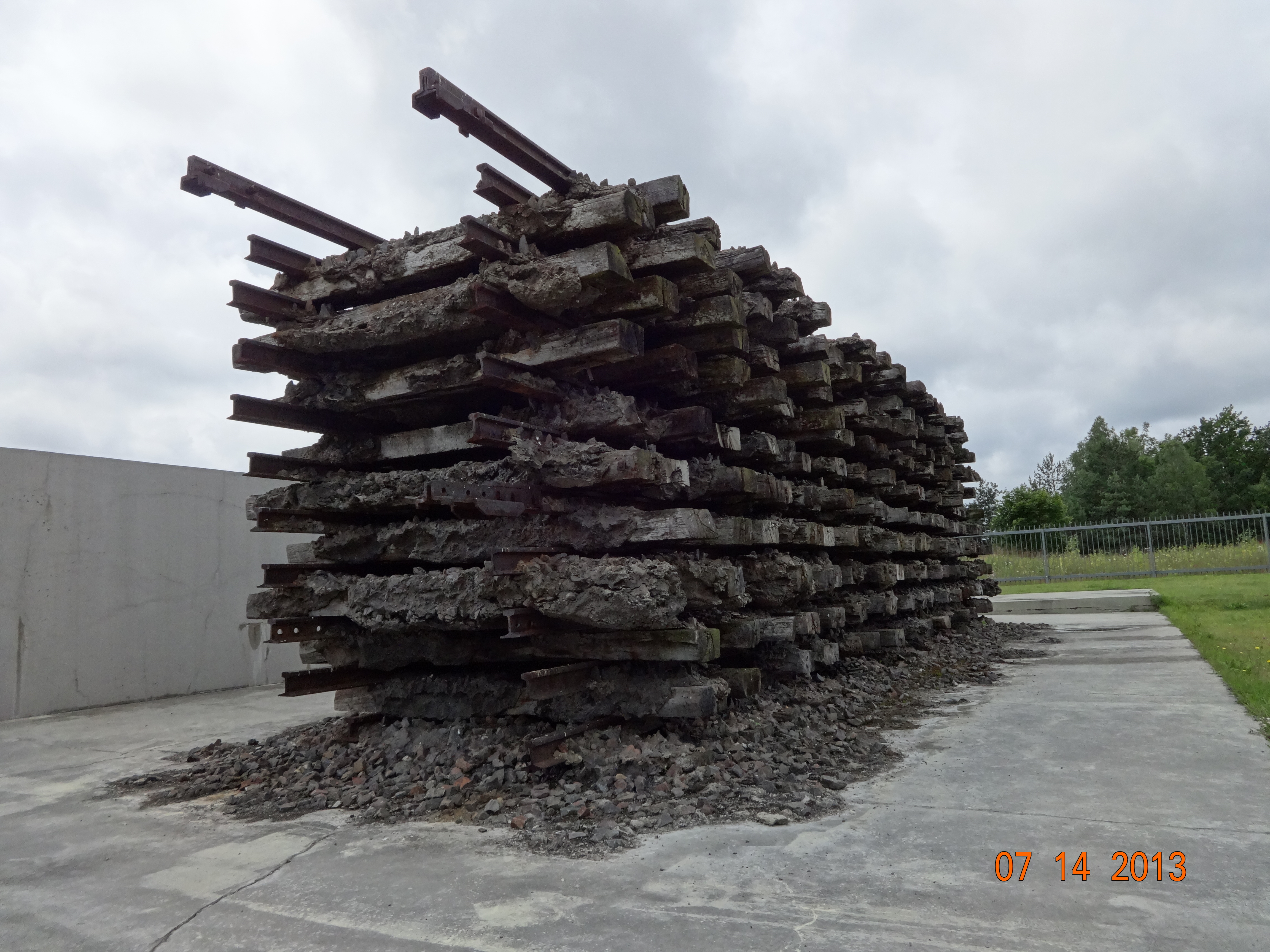
Belzec.
Open air ovens. Rail track. Machine. Bone fragments. Powder.
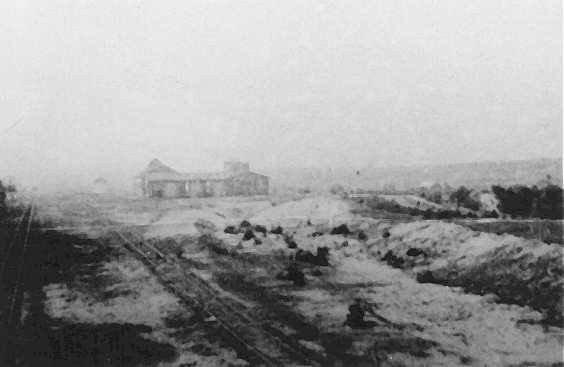
End of the Belzec killing center, c 1944. USHMM

Belzec.
The women in our group enter the memorial for a private ceremony. The seven men walk the perimeter, near the hillside. The memorial project leaders were told that during the Operation Reinhard actions, some of the locals would picnic on the hillside behind us as transports pulled in to discharge the terrified and doomed victims.
They would watch.
After the German attempt to destroy the site and hide the evidence of a half a million gassed and cremated, the site would be rifled for gold, pockmarked with shovel pits by the local population.
Surely those Jews had gold with them, when they were killed.

When Ariela came here in 1993, it had reverted to forested hillside.
I unfold the letter and step out into the volcanic type rocks imported here to build the memorial. I am setting up my own memorial.
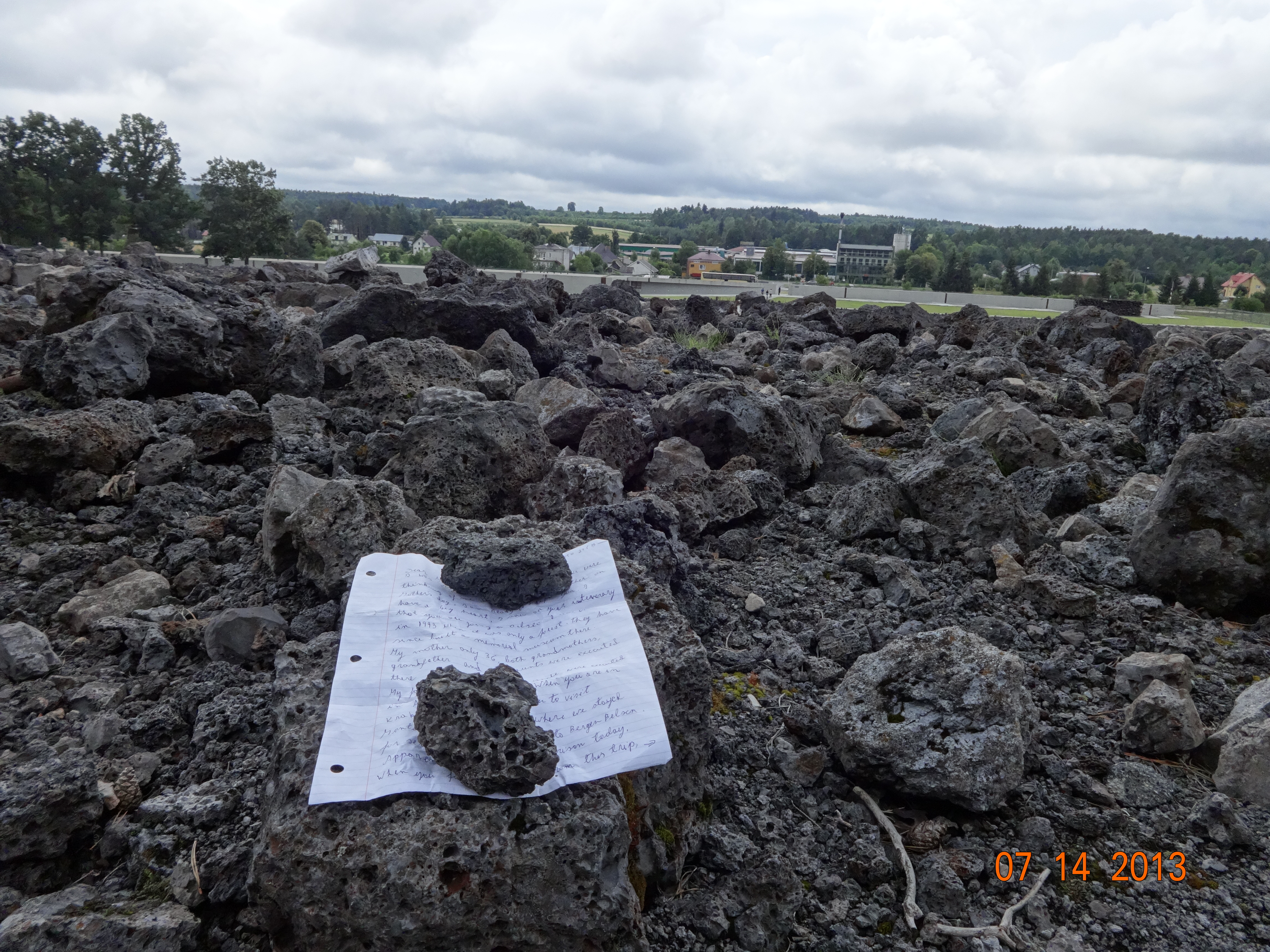
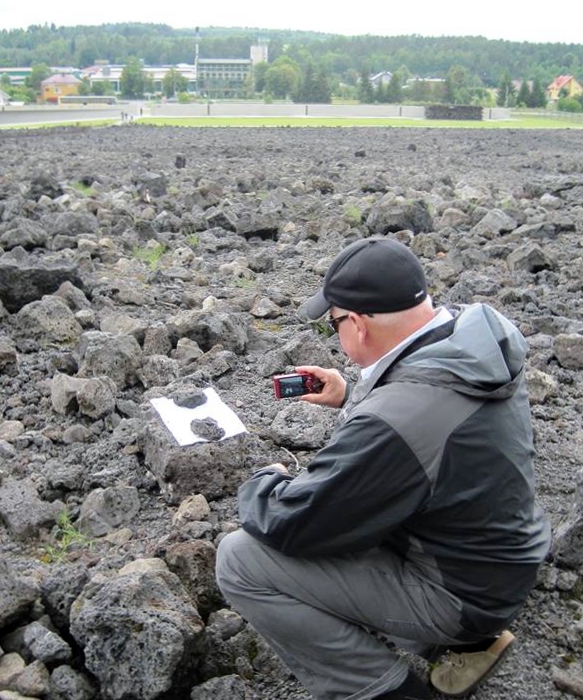
Matt Rozell at Belzec, 2013. Photo by Alan Bush.

Belzec.
After the touring of the memorial (though “touring” is the wrong word, perhaps “witnessing” is the right one), I am lost in thought. I had kept the letter to myself. Alan asks, gently, if he may see it. It gets passed around in the back of the bus on our way to the hotel in Lublin. After what we have seen today, I think it makes an important impact on all.
Later, Alan sends his photograph of me placing the letter on the memorial, to Ariela. She is touched and writes back:
I want to thank you with all my heart for what you did for me, by taking my letter and putting it on the ground where my mother’s bones are spread. When I saw the picture, I cried. It is already 71 years but my heart still has feeling, for all my family. My father asked in his last letter from jail that I should pray for him, and believe me that I do.
Ariela went on to marry and have a wonderful family. Her beloved husband, another survivor, passed a short time ago.
***
Yes, it was another tough day, but somehow I feel like we are making a difference by coming here. I come with no agenda other than to see what happened, though obviously I too feel a personal stake in it all.
*
Sometimes, when I’m working on the woodpile or resting on the tailgate of my truck, I wonder why I was chosen to connect Holocaust survivors with their “angels”. Like this little girl with her liberators. And from there, to journey back in time to uncover what happened here.

Ariela meets her liberator, tank commander Carrol “Red” Walsh, Sept. 2009, at our “reunion”.
I suppose I could have just let things be.
But I couldn’t leave things alone.

Holocaust survivor Ariela Rojek, right, was 11 years old in 1945 when she and 2,500 other concentration camp prisoners aboard a train near Magdeburg, Germany, were liberated by American forces including 1st Lt. Frank Towers, left with his son Frank Towers Jr., center. “You gave me my second life,” Rojek told Towers Wednesday, Sept. 21, 2011, at Hudson Falls High School during an event reuniting soldiers and survivors.
Photo by Jason McKibben, Glens Falls Post Star
It certainly seems that one thing builds upon another for a reason, and though we may not know that reason, it is there. Our actions reverberate across borders and through time.
It’s true.
So I’m here to make another special connection.

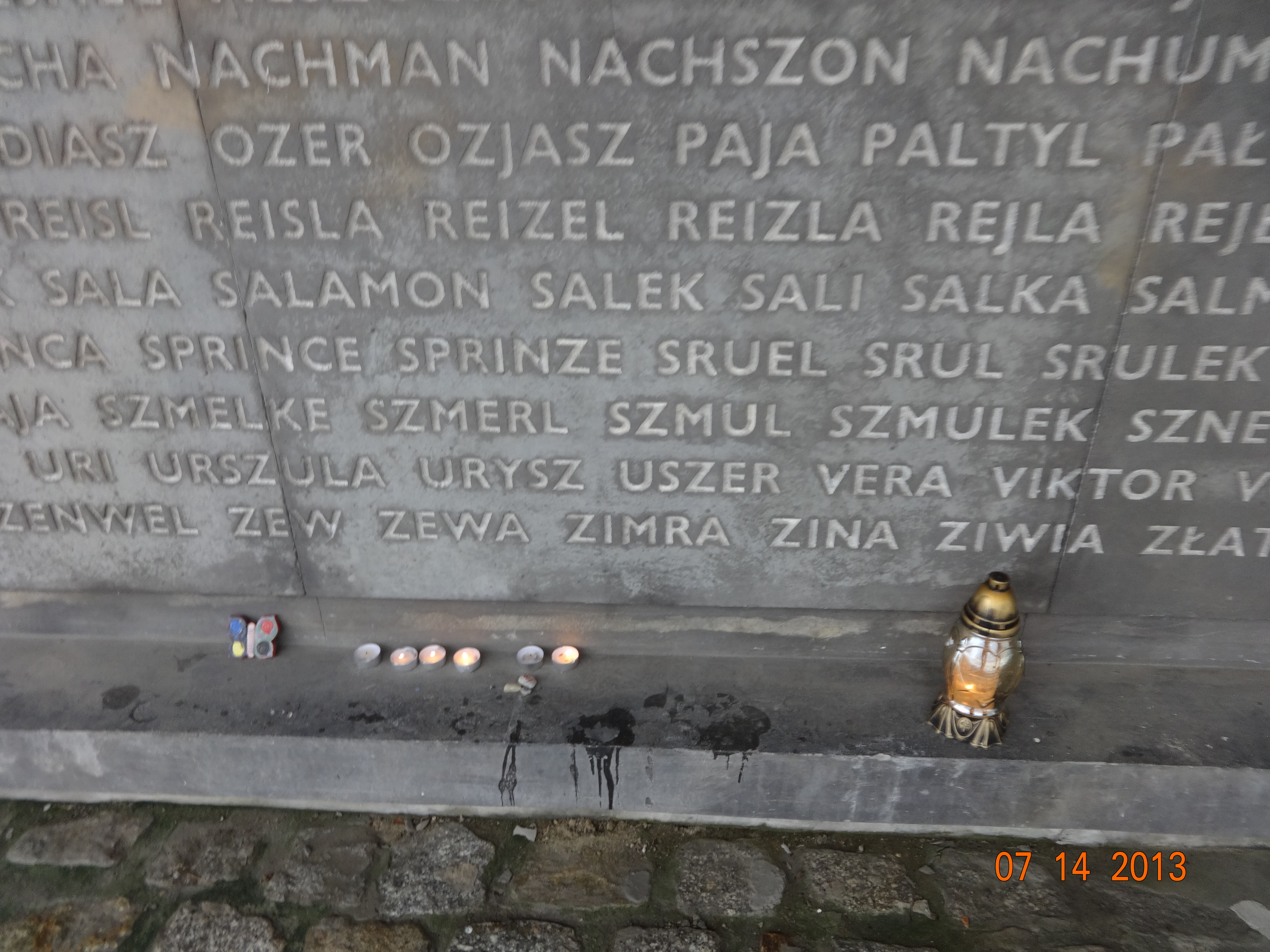
Maybe from little girl to mother.
So no one forgets.

Kisses for Grandma.
And the cycle, the mystery, the life continues.
Posted in Uncategorized, tagged Belzec, Farsleben, Holocaust, Holocaust Education, Holocaust Survivors, Holocaust Writing, Krakow, Krakow Ghetto, Montelupich, Montelupich Prison, narrative history, Oscar Schindler, Oscar Schindler's factory, Schindler's List, teaching history matters, Teaching the Holocaust, Train Near Magdeburg, USHMM on July 14, 2014|
~Matthew Rozell, a history teacher whose project reunited hundreds of Holocaust survivors with the American soldiers who liberated them, takes a backwards journey to the authentic sites of the Holocaust, retracing the path of the survivors who are now his friends.~
A year ago I took one of the most transformative journeys of my life, with 24 fellow educators, to study the Holocaust and the Jewish resistance to it, in Washington, DC, Germany, the Czech Republic, and Poland. I kept an extensive diary and took tons of photographs. And contrary to many assumptions, it was a journey that led to profound understandings about life, not death. For the next several days, I have decided to go back and retrace my steps and try to process what unfolded for me.
***************************
July 13. By now it’s probable that you have seen the film Schindler’s List. Today we visited his enamelware factory, now a museum. Part of the film was shot here.

Here is a look at some of the things inside:

Schindler factory. Stairwell leading to office.

Schindler factory. Oskar Schindler’s office. His desk, chair, wall map.
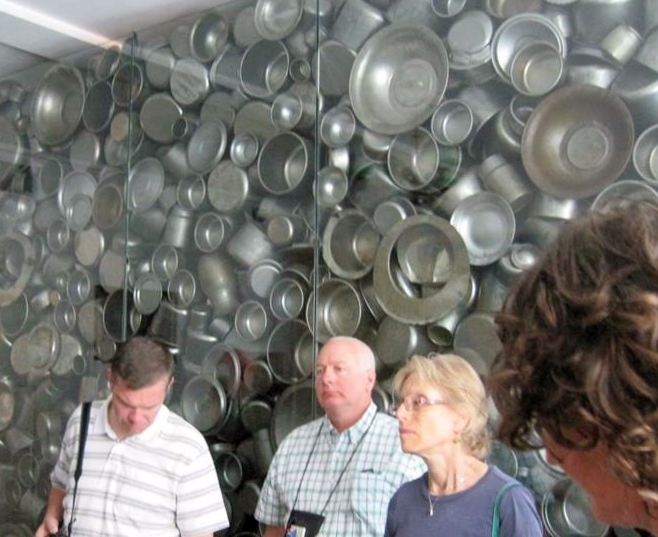
Schindler factory. Alan Bush photo.
Gusia moves us on to some of the other exhibits, explaining life in Krakow pre-war as well as life during the occupation. By 1943, when the ghetto in Krakow was liquidated, 21,000 Germans lived here.
One of the exhibits is on the Montelupich Prison, the Gestapo prison where people would be interrogated and tortured. When I see the sign, my heart skips a beat. I KNOW people who have been locked up here. So it is not ancient history, and here it is before my very eyes:

Montelupich Prison, the Gestapo prison in Krakow.
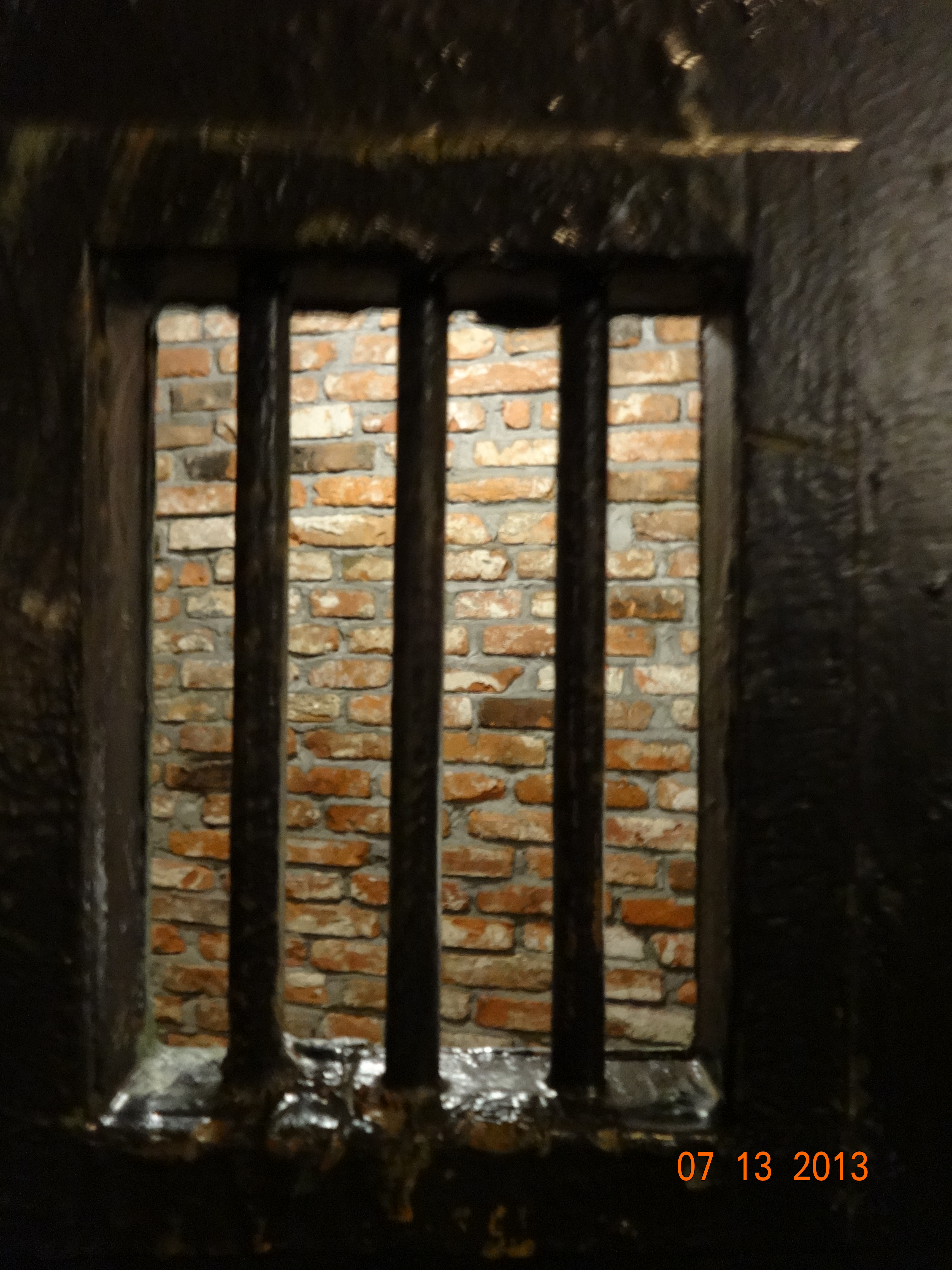
Montelupich Prison.
Our survivor Gina continues her story from the previous post:
One day in November I left my family with the purpose of finding work outside the ghetto with the idea of returning later to take them with me.
I left at 10 o’clock at night. I was accompanied by a young Pole who took me to Lemberg, where we arrived on the evening of the next day at ten o’clock. I had to stay over for a night in a farm while the young Pole went to see what possibilities there were for me. He came back next day at seven o’clock in the morning and he informed me that other Jews having obtained Aryan papers were in the district and they were trying to do something for me.
These people had obtained responsible posts in several factories as Aryans, and they helped me as much as they could. I got a job in a German office as typist. Nobody knew that I was a Jewess. After a few days the owner of the factory told me he wanted to court me as he liked my looks, and I had to run away from him.
I had to change my papers and my name so that he couldn’t find me. I altered my papers and I said that I was married. I then took up work in another factory where I could work without being disturbed.
One night I was sitting at home. I heard somebody knock at the door. It was the German police. I was asked for my papers, I showed them to them. And after examining them they told me I was a Jewess. I was asked to accompany them to the Gestapo. I refused to go saying that I preferred to die on the spot rather than go to the Gestapo. We talked for one hour and I was obliged to accompany them. In the street they took away from me all my valuables, my watch, my money and told me to leave Lemberg immediately. I was left alone in a solitary street. I couldn’t find a bed for the night. I had to change again my papers. I was tired out. I wanted to commit suicide. Next day I found a new home and I had many new troubles.
Coming in one day I was told by the land-lady that the policemen looked for me during the day. I left the house and I went to the place where I received the correspondence from my mother, in which she was telling that we had received foreign naturalization papers which would allow us to go to Palestine. I packed my things and returned home immediately.
When I returned home my mother was in one ghetto and my sister in the other. I had to hide in a cellar because if the German discovered that i had false Aryan papers I could be shot. I kept in hiding in this place for about two months.
Being now of foreign nationality we had to present ourselves regularly to the Gestapo. At one day they informed us that we would be sent to Palestine to be exchanged with German prisoners. On the next day the German police came at our house at 3 o’clock in the night and told us to pack up our things and go to the station. They told us we would go directly to Palestine.
Instead of Palestine they carried us in a prison in the town of Krakow; we were conducted in one of the prison cells where there were already 26 persons. It was a very dark place. We were very depressed and disappointed. We knew already what the Germans were capable of but it was new sadism on their part. The only food they give us was a tiny piece of bread and watery soup. At night we slept on the floor and we heard people crying because they were being beaten. We heard also a good deal of firing. We had always the impression that they will come to take us.
Then they informed us that we were interned and that we should have to wait. We waited and waited. In the day time we could observe how they were making sadistic gymnastics with the people. This made a very bad impression on us.
Gina was later sent to Bergen Belsen, where more trials awaited, and was liberated on April 13th, 1945 by the Americans who came across the evacuation transport near Farsleben, Germany.
****************************************
If you have watched Schindler’s List, you may be familiar with the scene of the liquidation of the ghetto in March, 1943, in accordance with Operation Reinhard. From the USHMM:
“The SS and police planned the liquidation of the Krakow ghetto for mid-March 1943, in accordance with the Himmler’s order in October 1942 to complete the murder of the Jews residing in the Generalgouvernement, incarcerating those few whose labor was still required in forced-labor camps.
On March 13-14, 1943, the SS and police carried out the operation, shooting some 2,000 Jews in the ghetto. The SS transferred another 2,000 Jews — those capable of work and the surviving members of the Jewish Council and the Jewish police force — to the Plaszow forced-labor camp, and the rest of the Jews, approximately 3,000, to the Auschwitz-Birkenau killing center in two transports, arriving on March 13 and March 16. At Auschwitz-Birkenau, the camp authorities selected 549 persons from the two transports (499 men and 50 women) to be registered as prisoners and murdered the others, approximately 2,450, in the gas chambers.”

Liquidation of the Krakow ghetto.
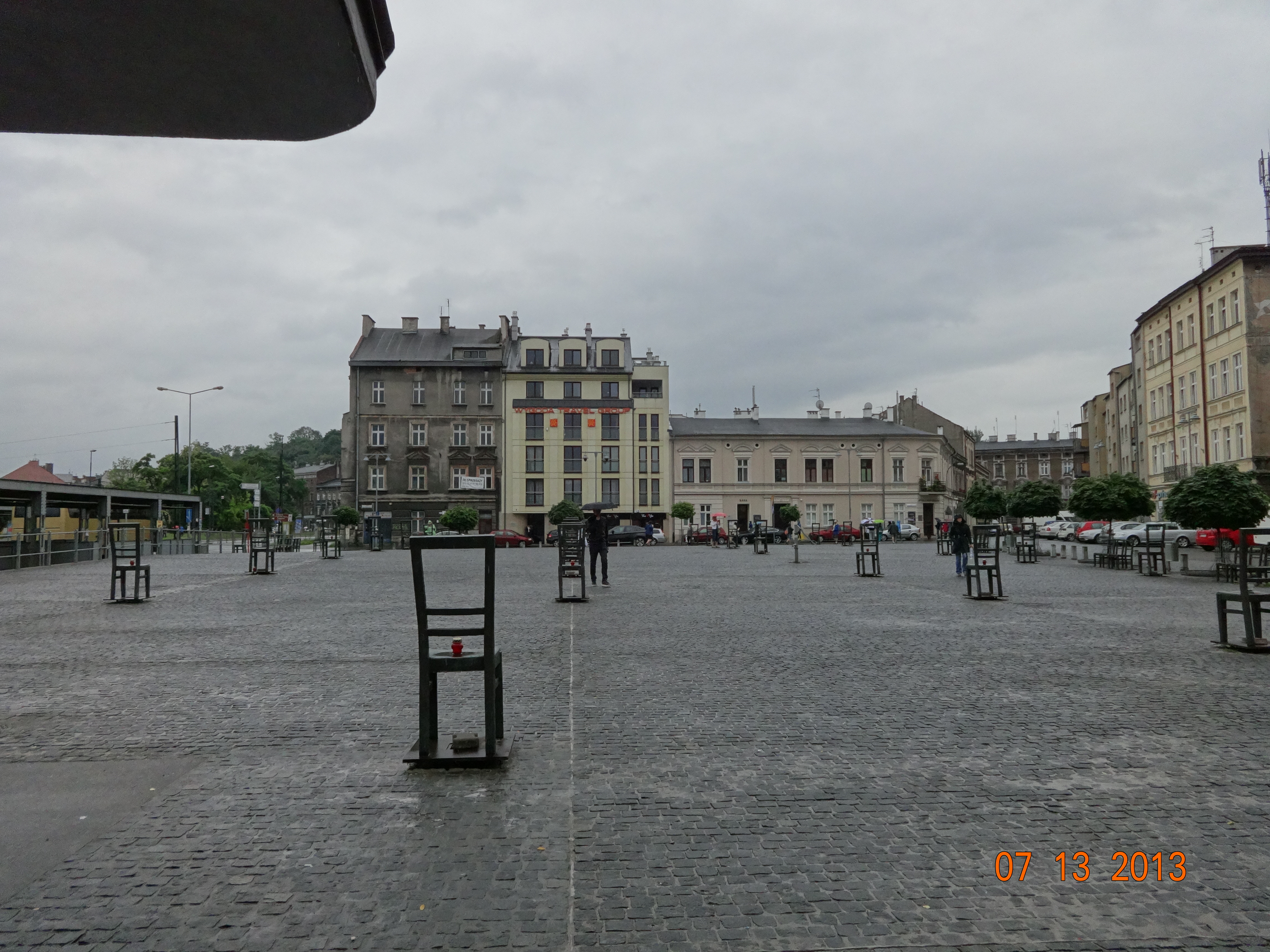
Memorial, Krakow Ghetto.

Liquidation of the Krakow ghetto.
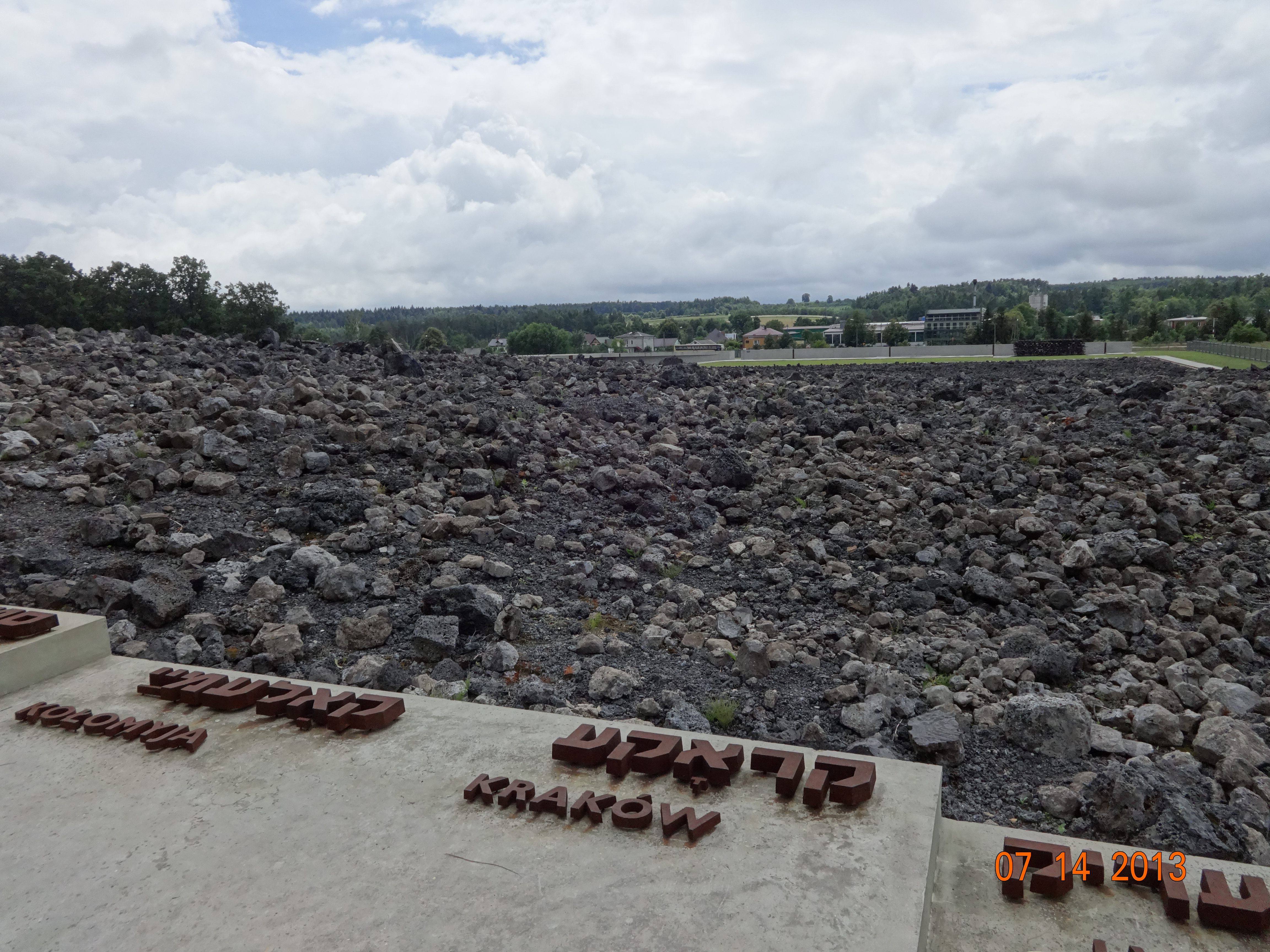
Belzec Site memorial.
So now it’s time to reflect again on where this all fits into the big picture.
Humans want resolution, closure, whatever you want to call it. Oskar Schindler was a complex man who made a difference. But he was one of the very few, and in reality there are no happy endings to this story.
Important lessons, yes. Happy endings, no.
Tomorrow we head to Belzec.
Posted in Uncategorized, tagged Belzec, Farsleben, Gina Rappaport, Holocaust, Holocaust Education, Holocaust Survivors, Holocaust Writing, Krakow, Krakow Ghetto, Martin Spett, narrative history, Oscar Schindler, Oscar Schindler's factory, Roman Polanski, Schindler's List, Tarnow, Tarnow Ghetto, teaching history matters, Teaching the Holocaust, Train Near Magdeburg, USHMM on July 13, 2014|
~Matthew Rozell, a history teacher whose project reunited hundreds of Holocaust survivors with the American soldiers who liberated them, takes a backwards journey to the authentic sites of the Holocaust, retracing the path of the survivors who are now his friends.~
A year ago I took one of the most transformative journeys of my life, with 24 fellow educators, to study the Holocaust and the Jewish resistance to it, in Washington, DC, Germany, the Czech Republic, and Poland. I kept an extensive diary and took tons of photographs. And contrary to many assumptions, it was a journey that led to profound understandings about life, not death. For the next several days, I have decided to go back and retrace my steps and try to process what unfolded for me.
***************************
July 12.
After a very intense day at Auschwitz-Birkenau, after people in our own tiny group found the names of their murdered families in the Book of Life, we had a debriefing session at the hotel. The consensus is that for one to simply have the will to live, in a place where life was not valued, is an act of defiance and resistance. For one person to care for another under such circumstances, where one is not even considered a person, is extraordinary.
People did these unspeakable acts to other people. But the “monster” myth is just that. I suppose it is one way of coping with the unthinkable. Let the perpetrators off the hook in a sense, labeling them “monsters”, not humans capable of deeply evil deeds, and move on. Don’t you think it kind of absolves them of something? They are not human, after all, so what does one expect of them?
Others may choose not to think about such things at all. I certainly do not blame them. But to me, to not think about it is to forget, and to forget is as good as saying that it did not happen. But you can’t just talk about the history, the chronology. To really try to understand, one has to know the stories of the individuals who were here. To make it real, and the same goes for all history.
***************************
1.4 million people visit here every year. That too presents its own set of challenges.
***************************
July 13.
We are back with our guide Gusia. She is taking us to the Krakow Ghetto area, which will include the Oscar Schindler factory, now a museum.
According to his autobiography, “The Pianist” director and child survivor Roman Polanski recalled as a young child, his initial feeling in the Krakow ghetto here was that “if only one could explain to them that we had done nothing wrong, the Germans would realize that it all was a gigantic misunderstanding.”
If only.
Assembly point, memorial, Krakow Ghetto.
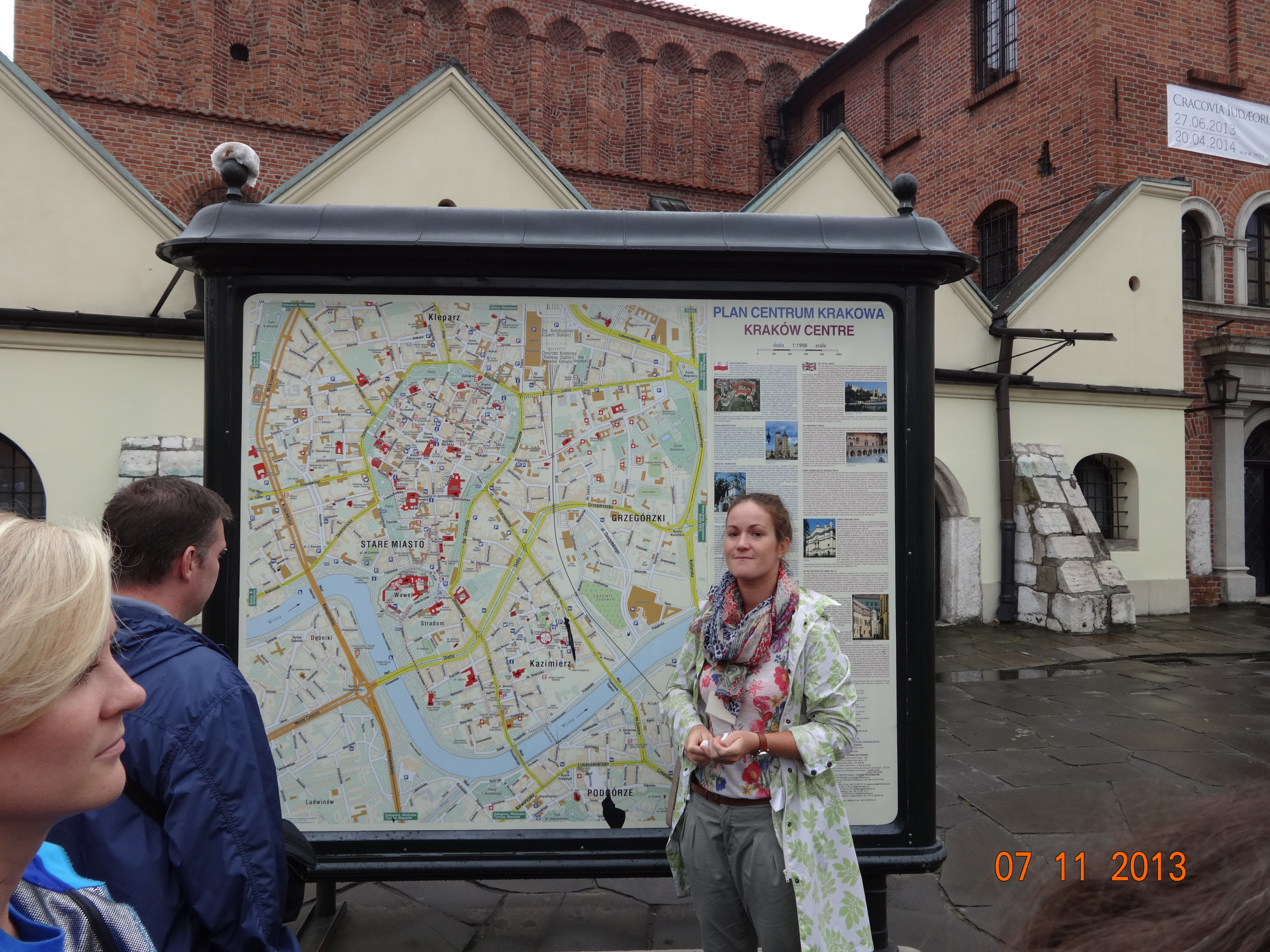
Old Town, in the Jewish Quarter. Gusia.
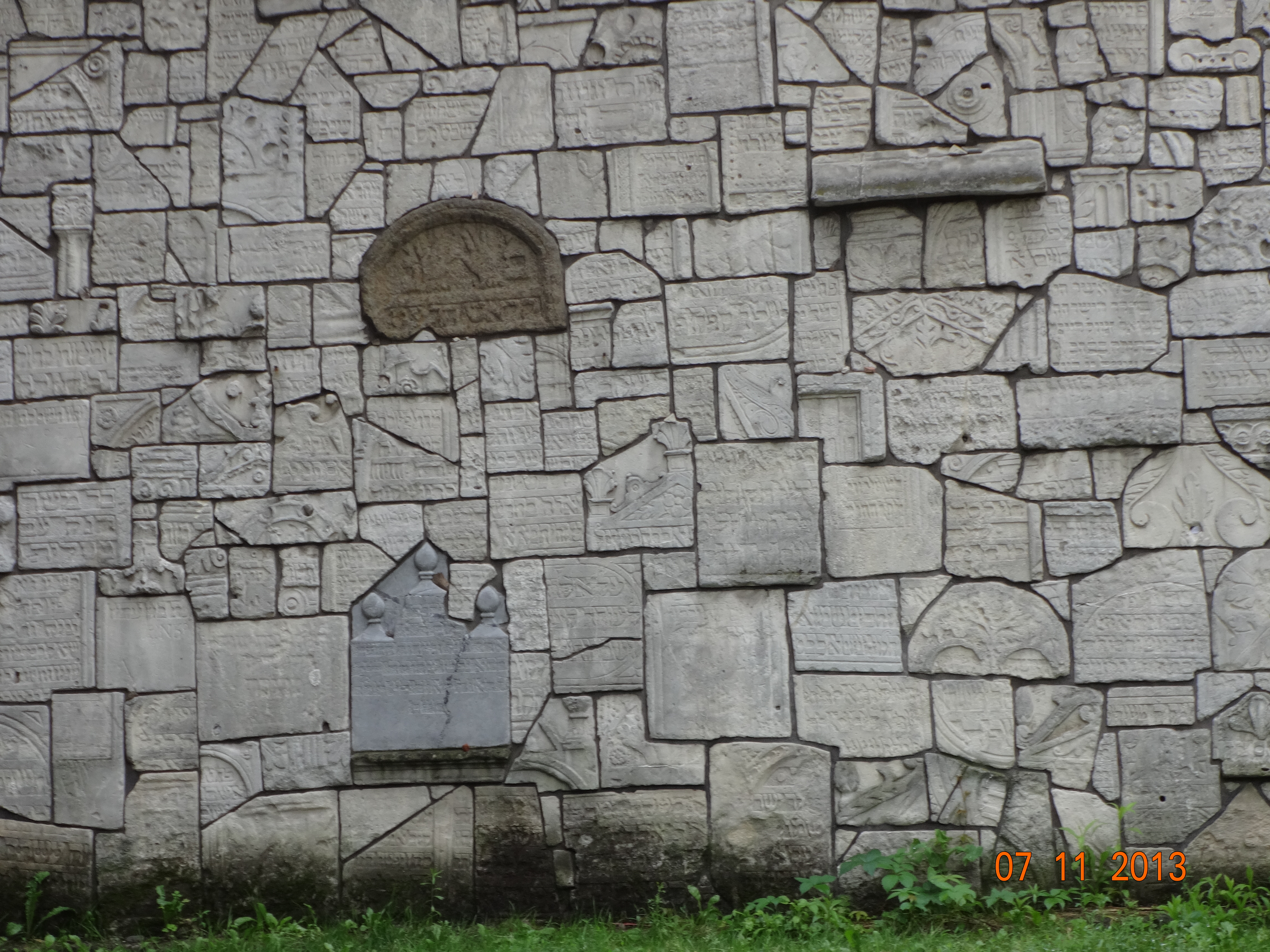
Restored Jewish Cemetery. Remuh. Wall constructed with gravestones destroyed by the Nazis.

Tempel Synagogue, interior. Restored. Used a stable by Germans. Krakow.
Now I have a story to tell, and this is where it begins, in Krakow, in 1939.
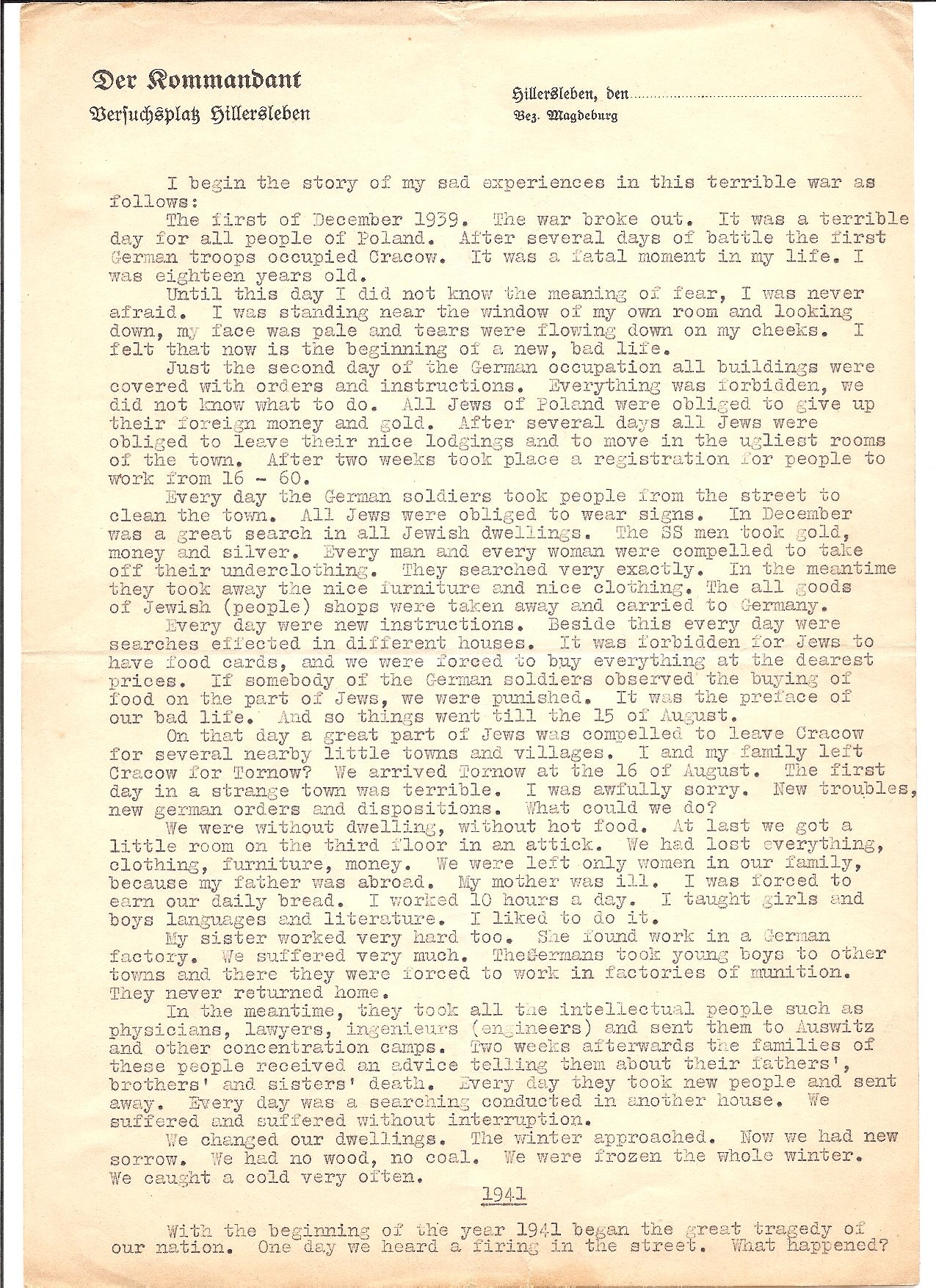
An internet search led a manuscript collector to my site. A five page typewritten document, written on the stationary and letterhead of the Nazi camp commandant at Hilersleben following the liberation of the Farsleben train in April 1945, traces the autobiographical journey of the Jewish girl from Krakow and the horrors, and miracles, that befell her. And yes, we did identify positively the author, who was still alive when the dots were connected.
I begin the story of my sad experiences in this terrible war as follows:
The First of [September] 1939. The war broke out. It was a terrible day for all people of Poland. After several days of battle the first German troops occupied Cracow. It was a fatal moment in my life. I was eighteen years old.
Until this day I did not know the meaning of fear, I was never afraid. I was standing near the window in my own room and looking down, my face was pale and tears were flowing down on my cheeks. I felt that now is the beginning of a new, bad life.
Krakow was to be one of the only cities not destroyed by the Germans, as it would become the seat of their “General Government” for the administration of the Occupied Territories in the East. It was, of course, to be “Judenrein”.
Just the second day of the German occupation all buildings were covered with orders and instructions. Everything was forbidden, we did not know what to do. All Jews of Poland were obliged to give up their foreign money and gold. After several days all Jews were obliged to leave their nice lodgings and move in the ugliest rooms of the town. After two weeks took place registration from people to work from 16-60.
Every day the German soldiers took people from the street to clean the town. All Jews were obliged to wear signs. In December was a search of all Jewish dwellings. The SS men took gold, money, and silver. Every man and every woman were compelled to take off all their underclothing. They searched very exactly. In the meantime they took away the nice furniture and nice clothing. All the goods of Jewish shops were taken away and carried to Germany.
The population was disarmed and by November, 1939, the intellectuals all arrested. From the USHMM:
“Like elsewhere in the Generalgouvernement, the German occupation authorities required Jews in Krakow city and the surrounding areas to report for forced labor (October 1939), form a Jewish Council (November 1939) identify themselves by means of a white armband with a blue Star of David to be worn on the outer clothing (December 1939), register their property (January 1940-March 1940), and to be concentrated in ghettos (September 1940-March 1941).”
Gina was sent to the nearby Tarnow Ghetto the following August:
In the meantime they took all the intellectual people such as physicians, lawyers, engineers and sent them to Auschwitz and other concentration camps. Two weeks afterwards the families of these people received advice telling them about their fathers’, brothers’, and sisters’ deaths. Every day they took new people and sent away. Every day was a searching conducted in another house. We suffered and suffered without interruption.
We changed our dwellings. The winter approached. Now we had new sorrow. We had no wood, no coal. We were frozen the whole winter. We caught a cold very often.
1941
With the beginning of the year 1941 began the great tragedy of our nation. One day we heard a firing in the street. What happened? Nobody knew. Everyone was afraid to look through the window. After some hours i went down and the streets were full of blood. I went to search for my sister. Where is she? Perhaps dead. At last she returned home. I was happy she was alive. When she entered the room I couldn’t recognize her, she looked pale and full of fear. She couldn’t speak and did not want to describe what she had seen.
Every few days this story repeated itself.
On the 10 of June everybody from 12-60 was obliged to register at the working office. The German ordered that every one working with them should be allowed to remain at his place. The people were very irritated. The all streets were full of poor people hurrying to find work.
I was a teacher as I mentioned before. What could I do now? Where to look for work? What could I do with my mother and grandmother? They were not able to do anything. What I felt in this day was impossible to describe.
At last I found work in a factory. My luck was that my sister had found work, too, and we were able to help our family.1942
A NEW AKTION
The night of the 10 of June. Nobody was sleeping in the whole town. The Jewish office registered the whole night under the control of the SS groups. They were obliged to make a list of people who were unable to work.
Five o’clock in the morning…. I was with my sister in the room. The mother and grand-mother were hidden in our attic. Suddenly we heard a knock at the door. At the doors were standing two SS men with revolvers in their hands.
The first asked “Why have you not answered at once?”
I couldn’t answer.
After a moment he asked “Where is your family?”
“Nobody is at home” I answered.
The SS man: “Where is your mother hidden? If you will not tell me at once I will shoot you.”
I repeated harshly “I don’t know.”
He got very angry and told me once more: “I will shoot you both at once.”
We had known their methods very well, and we were ready every minute.
He searched in our dwelling but he couldn’t find my mother. After several minutes they went away.
On this day perhaps 20 men visited our houses and every one of them wanted to take my mother but nobody could find her. On this day they killed in the streets 10,000 people and 15,000 were sent away to Belzec. From this village nobody returned.Belzec, Poland. Half a million people murdered on this site. Half a million.
This action lasted 8 days with two interruptions. During the free-time the grave diggers were obliged to bury the dead people.
Martin Spett, who was also liberated with Gina by the Americans at Farsleben on April 13, 1945, was 14 and recalls:
We heard the columns of Jews under German, German escort at night. It was going constantly. They were passing our house because this was already on the outskirts of the city, the cemetery, and they were marching them to the woods behind the city. And as we found out later they they were all shot over there. During the day I looked out through the shingles. My father said I shouldn’t look but, anyway, I was a kid, I was curious. And the roof was overlooking the cemetery and wagons with bodies, dead bodies, were coming in. Groups, they were bringing in groups of Jewish people that had to dig ditches, and the bodies dumped in, and after those Jews that dug the ditches, they were shot also and pushed, by another group that came in after them, into those ditches, and lime was poured over, over the bodies, and the next group covered up those ditches and dug other ditches. They brought in [pause] they brought in [pause] pregnant women, and they didn’t use any bullets. They used bayonets [pause]. The screams of the mothers that their children, they, they tore the children out of their arms [pause]. And the screams of the children I still hear. (USHMM)
Gina continues:
Now the whole people were forced to move in one place, where they made a “ghetto”. After three months was a new action. In the meantime the SS men leaders killed everyday several persons. One of them couldn’t eat without shooting before. Before every meal he wanted to see blood.
SELECTION
On the 15 of September was a beginning of a new action. Every one of us received a sign on his work-card. There were two kinds of signs: 1) The first meant to live, 2) the second meant to die. I and my sister received signs to live. Our mother was hidden in a cellar.
On the 16 of September at 6 o’clock in the morning I was standing and waiting. I waited, for what? What could I expect? I was standing on a great square and the Nazi SS police started to make a selection of all old persons and children, putting them apart, whilst all young and valid persons were also put in a separate place.
Subsequently the children and old persons were shot before our eyes.
Now they took from the remaining young persons every tenth person standing in the turn and shot them too. I was lucky enough to be the eighth person and was thus saved from death from a pure coincidence.
I had no news from my mother whom I had left hidden in the cellar of my house. I was anxious lest my mother should be brought on the square and shot. We had to wait standing on the square until 7 o’clock in the evening without getting any food, closely guarded by Nazi barbarian soldiers. At 7 o’clock in the evening they brought in mothers having small babies and shot all the babies in the presence of their mothers. At 9 o’clock in the evening they allowed us to go home, where I had a great joy to find my family alive. It was a miracle.
After these scenes had taken place all Jews had to leave their homes and go to new lodgings in the ghetto, where they had to be all concentrated. A barbed wire had to be put around the ghetto and no Jew was allowed to come out of this place. So our martyrdom continued: every day being sadder than the foregoing.
After two months of this ghetto life a new action took place, as a result of which 13 thousand people were murdered and 2 thousand people remained on in the ghetto. It was a miracle that the members of my family remained alive. After this took place, the German declared that no Jew would be allowed to remain alive, and I then decided to take up Aryan papers. One day in November I left my family with the purpose of finding work outside the ghetto with the idea of returning later to take them with me.
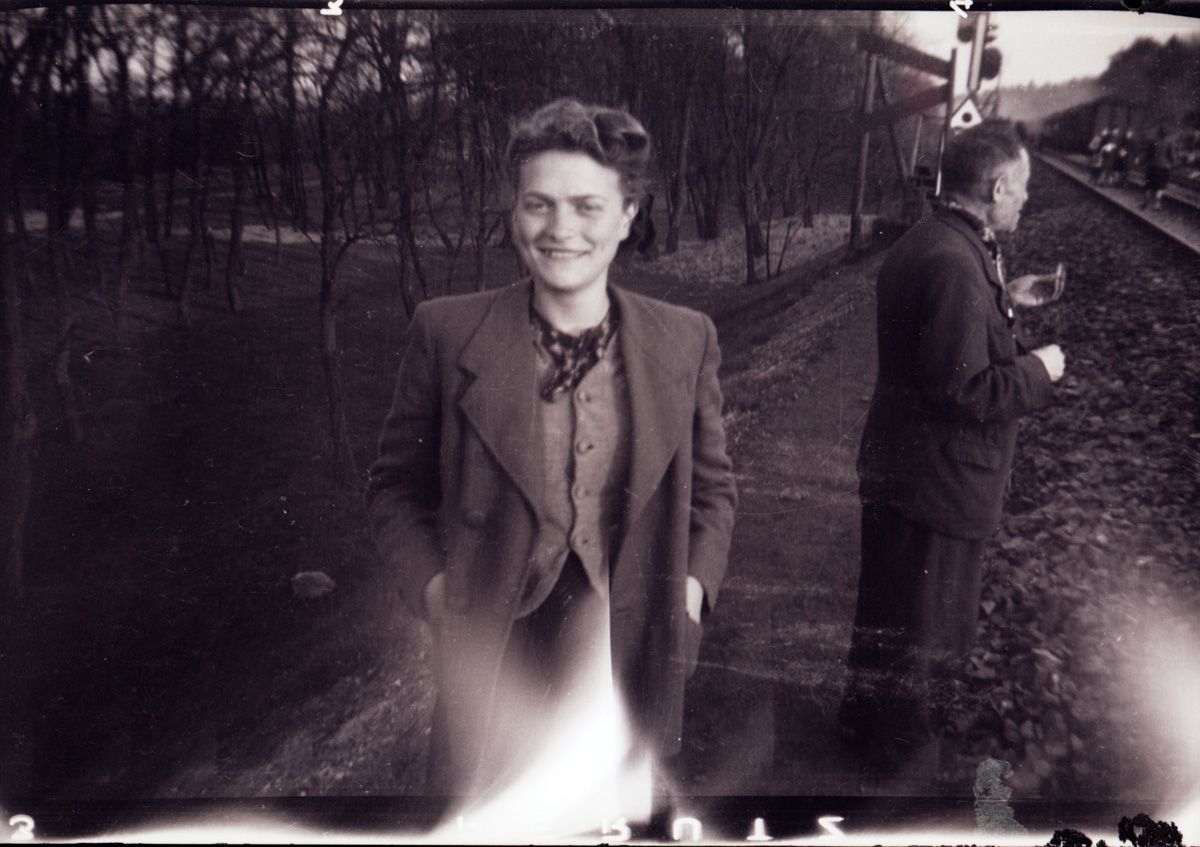
Gina as photographed by her liberator George C. Gross, Sat. morning, April 14th, 1945. Farsleben, Germany.
Gina would survive, as would Martin, and I will continue her story as I visit the sites associated with her in the next post.
From the USHMM:
“The Germans decided to destroy the Tarnow ghetto in September 1943. The surviving 10,000 Jews were deported, 7,000 of them to Auschwitz and 3,000 to the Plaszow concentration camp in Krakow. In late 1943, Tarnow was declared “free of Jews” (Judenrein). By the end of the war, the overwhelming majority of Tarnow Jews had been murdered by the Germans. Although some 700 Jews returned to the city after liberation, virtually all of them soon left to escape local antisemitism.”

Belzec, Poland. Half a million people murdered on this site.
Posted in Uncategorized, tagged 30th Infantry Division, 743rd Tank Battalion, belsen concentration camp, bergen belsen concentration camp, Bergen Belsen Memorial, concentration camps, Diane Sawyer, Farsleben, for the sake of humanity, Hillersleben, Holocaust, Holocaust denial, Holocaust Education, Holocaust Remembrance Day, Holocaust survivor-liberator reunion, humanity, Matthew Rozell, narrative history, Power of Teaching, Stephen B Barry Memorial Fellowship, Steve Barry, teaching history matters, United States Holocaust Memorial Museum, World News Tonight, World War II, World War II Living History Project on April 28, 2014|
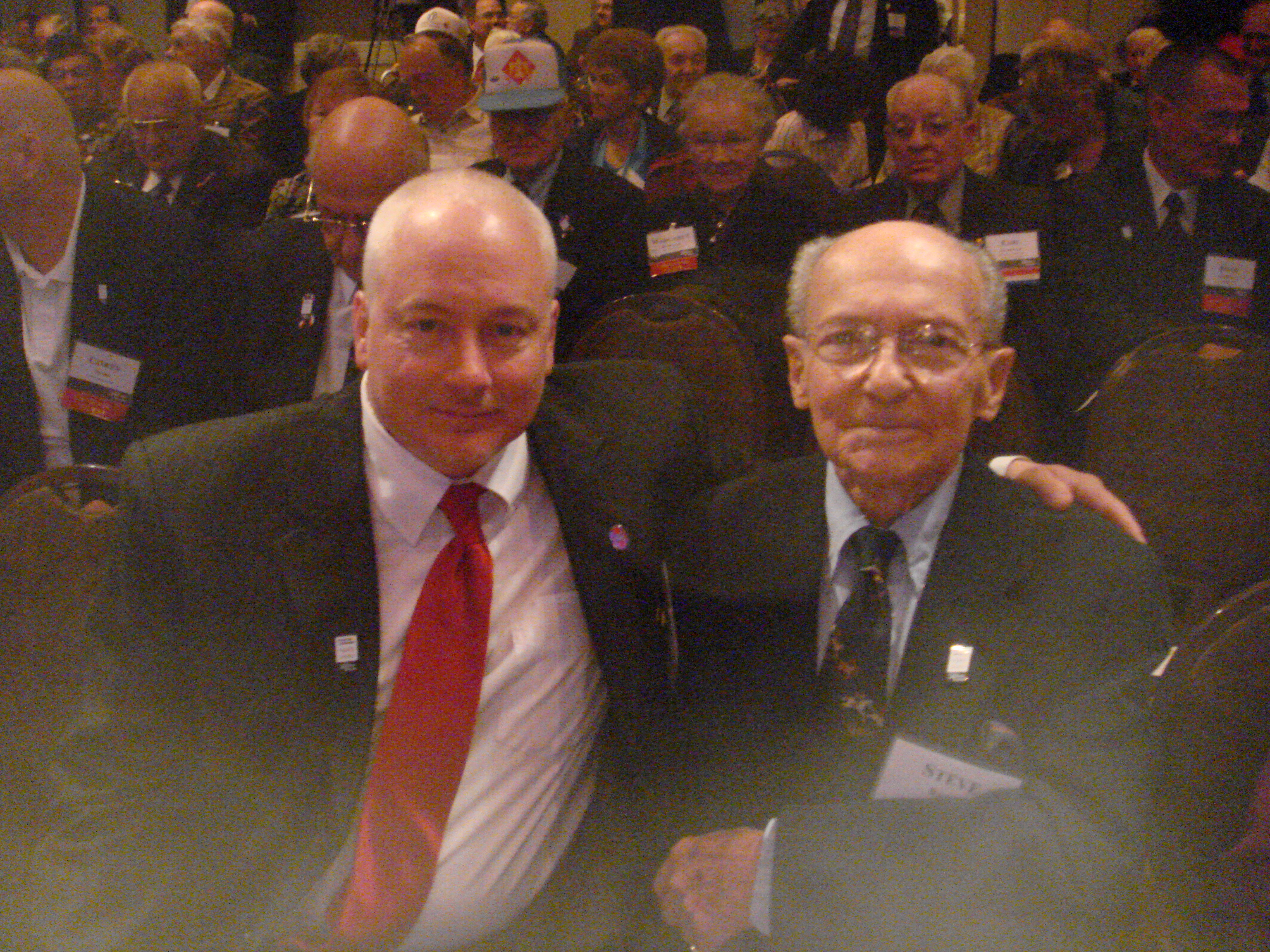
Matthew Rozell, Stephen Barry, National DOR Ceremony, Washington, DC April 2010. This photo was taken the day after the 65th anniversary of Steve’s liberation in April 1945. We had just been honored by the director of the United States Holocaust Memorial Museum before the national ceremony in the Capitol Rotunda.
So, the ripples continue. Somebody said it was like pebbles being tossed into the still water. This may sound strange, but I am keenly aware of the cosmic element. We tripped the wires of the cosmos.
~”It’s not for my sake, it’s for the sake of humanity, that they will remember”~
I got a nice email recently. My friend Steve Barry was honored Tuesday evening at the United States Holocaust Memorial Museum. Steve’s daughters wanted me to know that his family made a donation in his name and set up two fellowships for scholars at the USHMM in the Stephen B. Barry Memorial Fellowship. His girls mentioned me in their speech Tuesday night in Washington. Thanks ladies. You know he was a hero. He reached out and touched an awful lot of students in the short time that we were together.
Steve will be one of the persons who will be featured in my book. Against all the odds he survived the Holocaust and later even went on to become a US Army Ranger in the Korean War! I was pretty close to him. Right now I am wistfully looking at his homemade holiday greeting cards under my desk glass, and to my left, a foot away, are the shelves containing his Holocaust library, which was passed on to me after he passed away. He was so funny, too. He told me he nearly “choked on my bagel” a few years back when he opened his newspaper in Florida and read about me and the train he had been looking for, for so many years!
I miss the guy. You can read more about him here.

Steve’s name on the wall of donors, USHMM, unveiled April 29, 2014.
The inscription kind of says it all. He uttered these words in my very classroom on a Thursday morning to a film crew from New York City, aimed at the 1500 students that he and the other survivors and American soldier/liberators had come to address. That Friday evening of our big soldier/survivor reunion, we watched it together on national news before our final banquet.
You can see the video at the bottom-he’s the one in the preview addressing the interviewer- but the transcript is below.
ABC WORLD NEWS TONIGHT, FRIDAY, SEPTEMBER 26, 2009
Diane Sawyer: And finally tonight, our Persons of the Week. It is a story that began almost 65 years ago in the darkest days of World War II. Yet this week, a new chapter unfolded. An unforgettable reunion of Holocaust survivors, and the American troops who freed them, and all made possible by a high school history class.
Matthew Rozell: This is history coming alive.
Veteran 1, entering school with his wife: Here we are, we have arrived!
Matthew Rozell: This is walking, talking, living history. They’re (the students) shaking hands with the past…
Diane Sawyer: It was 2001 when high school history teacher Matt Rozell decided to begin an oral history project. He and his students would just interview family members in the small town of Hudson Falls, New York, to capture fading stories of World War II.
Interviewer (soldier’s daughter): Did you mention the train [to Mr. Rozell] at all before?
Carrol Walsh, former soldier: No I didn’t tell him about the train.
Diane Sawyer: The students unearthed a forgotten crossroads in history. (Gunfire, archival film footage) Near the very end of World War II, April 13th, 1945, the American 30th Infantry Division was pushing its way into central Germany.
Carrol Walsh: We came to a place where there was a long train, of boxcars.
Diane Sawyer: They found a train, holding nearly 2,500 emaciated Jewish prisoners, many just children, being moved from the Bergen-Belsen concentration camp, to another camp and certain death. Their German guards had just abandoned them, fleeing the Americans.
Carrol Walsh: A feeling of helplessness. What are we going to do with all these people?
Frank Towers, former soldier: We had never ever seen anything so, (pauses) filthy.
Diane Sawyer: The American soldiers fed the prisoners, and brought them to safety.
Stephen Barry: For 42 years I collected anything that I could to try to find any article regarding the train. It just didn’t exist!
Diane Sawyer: But Mr. Rozell’s class put their interviews with veterans up on a website, along with these photographs taken by the American soldiers.
George Gross: Just very courageous people, little girls who with big smiles on their faces, one of them with their arms out, just aware that the Americans are there. [camera pans over 1945 liberation photograph]
Diane Sawyer: Out there on the web, Holocaust survivors all around the world began to notice.
Stephen Barry: I mean, how many people have a picture of their moment of liberation forever? [camera pans over 1945 liberation photograph]
(students and veterans and survivors singing “The Star Spangled Banner”)
Diane Sawyer: A reunion of the survivors and their liberators took place this week at Hudson Falls High School.
Emily Murphy, student: When they speak to us, you can’t say that you feel how they felt. But you get the feeling, you feel like you were there.
Diane Sawyer: In an age where there are still those who deny the Holocaust ever existed, these survivors say they are the living proof.
Stephen Barry: It’s not for my sake, it’s for the sake of humanity, that they will remember.
Diane Sawyer: And so we choose history teacher Matt Rozell, his class, the Holocaust survivors of that train, and the American soldiers who kept them and their story alive. And that is World News for this Friday. I am Diane Sawyer, and from all of us at ABC News, we hope you have a great weekend.
And here is a link to the 2014 United States Days of Remembrance Capitol Ceremony. Steve’s daughters and granddaughters are in the back row!
Posted in Uncategorized, tagged 30th Infantry Division, 743rd Tank Battalion, Bergen Belsen, Farsleben, Hillersleben, history education, Holocaust, Holocaust survivor-liberator reunion, Liberators, Matthew Rozell, Passover, Power of Teaching, teaching history matters, Train Near Magdeburg on April 13, 2014| 1 Comment »
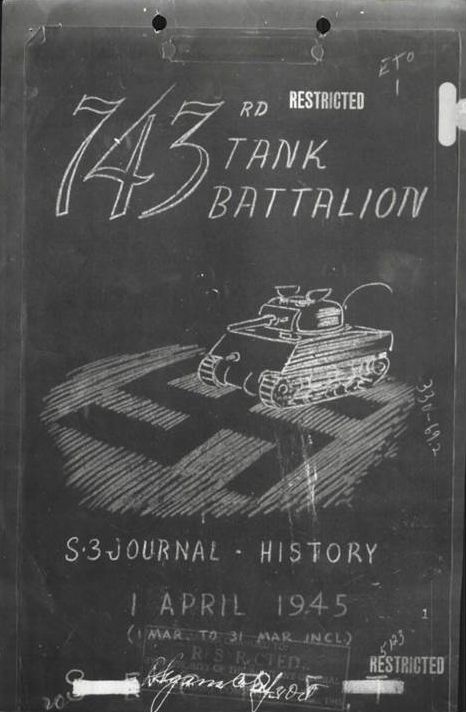
Cover of After Action Report for April 1945.
Today is the 69th anniversary of the liberation of the train near Magdeburg. How fitting it was/is falling at Passover time.
Emails and greetings are flying back and forth through the liberator/survivor network that we created. Liberator Frank Towers always sends a message on this anniversary to the survivors.
From my one of my survivor friends:
Hello to all of you ‘my twins’ on our 69th birthday and to those who fought to give back our lives. Like the years before, there are no words enough to express our thanks to them.
How appropriate is this year for us who celebrate Seder to read, as an addition to the Hagaddah, Frank Towers’ beautiful greetings remembering OUR liberation from not just slavery but certain death.
Here is the opening of my new article. You can see the rest in the previous post.
Blessings to all on this reflective occasion.
~THE TRANSPORT TO LIFE~
With the end of the war in sight, a startling encounter takes place between Jewish victims of the Holocaust and American combat troops who have survived nine months of grueling combat across Northern France, Belgium, Holland and now Germany. In 2001, interviews conducted by a high school history teacher and his class paved the way for several joyful reunions between the survivors and their American soldier liberators over sixty years later.
The photograph is striking.
Query the word “train” and Holocaust” in an image search and the results returned generally show victims being deported to killing centers.
This is the opposite.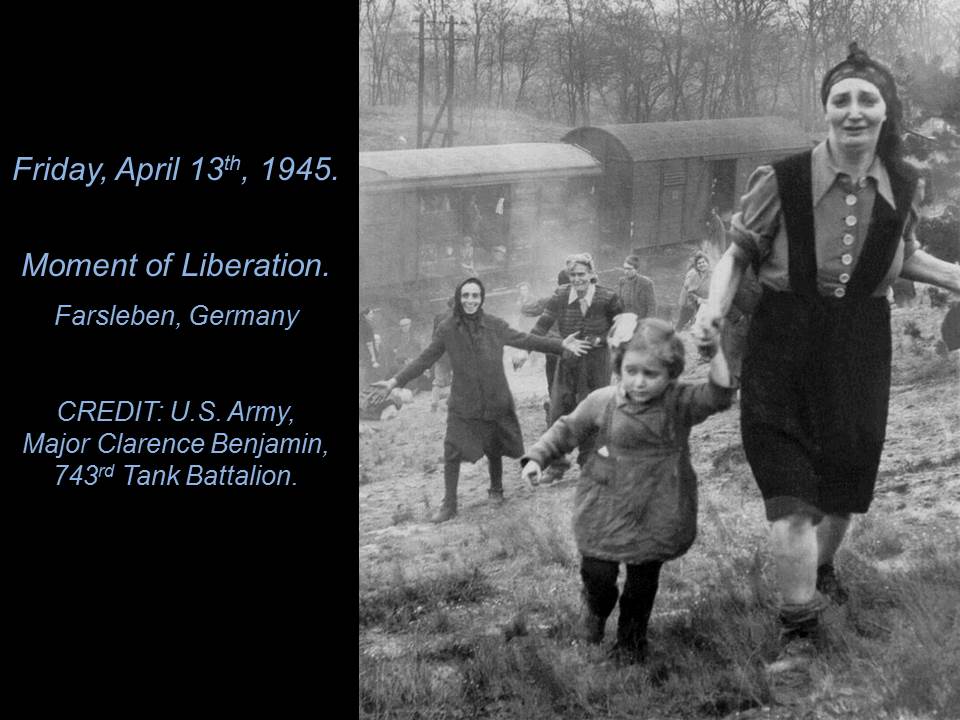
It is a cool spring morning. In the background, down the hill, are two cattle cars. At the opening of the sliding doors on one of the cars we can see a figure sitting on the edge, perhaps too weak to climb out yet soaking up some energy from the warming April sun. In front of him, a wisp of smoke seems to rise from a small makeshift fire that others have gathered around.
This is an appropriate backdrop for the drama unfolding in the foreground. Trudging up the hill toward the photographer, now only a few steps away, are a mother and her young daughter. The mother has her hair wrapped in a scarf and is clutching the hand of the girl with her right hand. Her left hand is extended outward as if in greeting; her face is turning into a half smile in a mixture of astonishment and enveloping joy, as if she is on the cusp of accepting the belief that she and her daughter have just been saved.
The little girl is shooting a sideways glance away from the camera. Her expression is one of distress- she looks terrified. On this morning in Germany in 1945, she may very well be responding to the two Sherman tanks that are now clanking up to the train, behind the photographer who is in the jeep with the white star.
Following the mother and daughter up the hill towards the soldiers are two other women. One welcomes the tanks with outstretched arms and a wide grin as she moves up the hill. The other follows behind her. She appears to be crying.
It is Friday, the 13th of April, 1945. Led by their major scouting in a jeep, Tanks 12 and 13 of the 743rd Tank Battalion of the U.S. Army have just liberated a train transport with thousands of sick and emaciated victims of the Holocaust. Major Clarence L. Benjamin snaps a photograph, which will be inserted into his official report back to headquarters.
But what have they stumbled upon? Where have these people come from?
And what do the soldiers do now?
**********************************************
Posted in Uncategorized, tagged 30th Infantry Division, 743rd Tank Battalion, Bergen Belsen Memorial, Farsleben, Hillersleben, history education, Holocaust, Holocaust Education, Holocaust survivor-liberator reunion, liberation, Liberators, Matthew Rozell, narrative history, Power of Teaching, Prism, teaching history matters, Train Near Magdeburg on April 8, 2014| 1 Comment »
 I’ve had an article published in the Spring 2014 edition of PRISM: An Interdisciplinary Journal for Holocaust Educators, an “internationally renowned, annual, peer-reviewed journal” published by the Azrieli Graduate School of Jewish Education of Yeshiva University of New York, reaching readers in 35 countries and in all 50 American states. It is important to me to set the record straight and allow others the opportunity to read how this history unfolded.
“In preserving and investigating the history, in interviewing liberators and Holocaust survivors, and in working with museums and memorial sites, Mr. Rozell and his students are also creating new knowledge, the highest form of academic achievement. Most importantly, in studying about the Holocaust, he and his students are also helping to rescue the evidence that can help stem the rising and dangerous tide of denial before it is too late.”
You can read the full edition here. The article appears on page 94. Obviously space did not allow for the full story to be told but that will come out in the book, so if it appears that a supporter, survivor or liberator friend has been left out, that is not the real case. As always, thanks for your support, and thanks to editor Dr. Karen Shawn for recognizing the significance and the potential.


 Teaching History Matters