Feeds:
Posts
Comments

Posts Tagged ‘concentration camps’

Ravensbruck.

Ravensbruck.

We have visited a lot of sites in Germany since Bergen Belsen-in Berlin, the Wannsee Villa, where preliminary plans for the “Final Solution ” were signed off on after a one day conference, the Memorial to the Murdered Jews of Europe in the heart of the city, the Reichsbahn train platform, Track 17, where the Jews of Berlin were deported almost everyday for nearly two and a half years. We also visited Ravensbruck and Sachenhausen.

Ravensbruck is a couple of hours north of Berlin, in the former East Germany. It is notable for many reasons, probably first that it was a camp for women, and also a training faculty for SS camp guards-3500 women guards were trained here, and about 500 were in service. 130,000 women prisoners passed through here, and towards the end of the war, another 20,000 men.  No barracks are standing today, the houses for the SS leadership remain just outside the camp wall, where they lived with their families. Each day the camp gates would open and thousands of prisoners would stream out into the community for their slave labor assignments. Kind of hard to hide it from the kids. I suppose the attitude was that it was difficult, distasteful work, but the kids had to realized that it had to be done for the wonderful world that they were creating for the children’s future.

Immediately after the war the barracks were dismantled and given to refugees who had fled the Eastern Reich as it collapsed. Some are still used as houses today. The SS women guard barracks is used as a youth hostel education center today. They have a program where survivors interact with the kids for about 4 days, and sleep here at night. Our guide is the historian Matthias H. at the Gedenkstatte (Memorial). He appears to be in his early 40s and is passionate and knowledgeable, as are all of the German historians I have met thus far. Here are some of his observations that strike me the most:

In his opinion, the majority of Germans supported the master race theory. What disturbs him today is that in his opinion, few Germans today seem conscious of this. It is a very complex topic. The historians talk about the mass crimes, and in Matthias’ words, they work on thin ice. The responses range from some people wanted to know more- after all, many of them learned nothing about it from their teachers, many of whom were bystanders or even perpetrators. Some quietly deny the extent-but I have found that as you study it, you learn how vast and almost unbelievable it is in scope. Others, are tired of the topic- “yes, it happened, so what, enough…”

For Matthias, herein lies the greatest danger. It is important to have the past in front of you- NOT in the back of one’s mind, as one moves forward. The lesson may be simply how to “behave” , not just for Germans but for everyone.
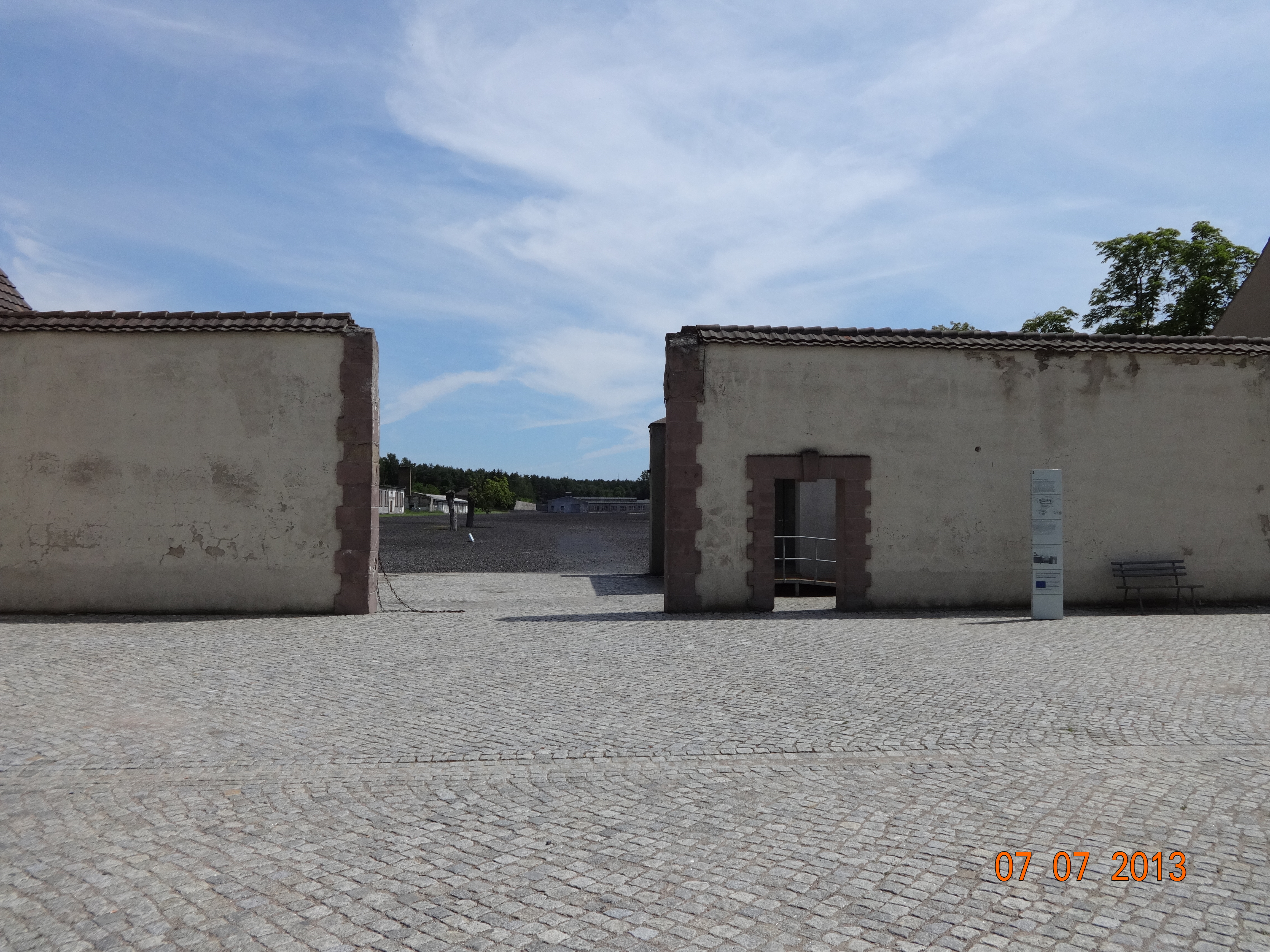
Ravensbruck. Prisoners' gate on left, SS on right.

Ravensbruck. Prisoners’ gate on left, SS on right.

He walks us through the main camp entrance, where thousands of prisoners would pass everyday, explaining that for years he would avoid the single door entrance that the SS guards used-until one day a survivor he was leading on a tour walked through it, to symbolize her victory at this place.

He notes a few additional stories. Survivors corroborate that when new SS female guard recruits would come for training, initially they do not know how to deal with the new job. Industries wanting slave labor must send their own guard recruits, too.  They are not kind, but they do not seem possessed with the will to carry out this abhorrent work. Former prisoners would say that always within about two weeks new staff would have overcome the “cognitive dissonance” that would allow them to do their job without compassion. They become “hardened” and “get over it”.

Ravensbruck was built for 3000 prisoners. At its height it held 35,000. 30,000 were killed here. In the beginning the SS does  NOT want women with children in the camp. But as more and more territory is overrun, the camp swells. After the Warsaw Ghetto uprising in 1944, there are hundreds of pregnant women. Some are forced to abort; as numbers well, women give birth and the babies are taken to a “hospital” where they slowly starve to death. The crematorium works nonstop. Ash piles are created and dumped into the nearby lake as the Russians close in. When the camp is overrun by the Red Army, 2000 women and 2000 men, mostly to infirm to be death marched out of the camp, are found, but not before the Germans had installed a small operating gas chamber, where 5000 Hungarian women were murdered in 1944.

I think that the following story resonated the most with me as an educator of young people.

The butcher’s son delivered fresh cuts of meat nearly daily to the SS mess hall, which still stands. Late in life, the old man tells Matthias of his feeling as a young teen-going through the camp gates to deliver the meat, seeing the emaciated and foul smelling prisoners, and believing fully all he has been taught- that these people are indeed subhuman, vermin to be eliminated. It’s true. Just look at them. Just smell them. Disgusting. Everyday it is the same. They even march through the town to the labor sites. Best to keep a distance from them.

It’s the same until one cold morning when a new transport of women arrive-stripped naked, healthy, humiliated, shivering, crying, shocked, trying to cover themselves in the plaza. Now it is his turn for a shock. These are not subhuman, but girls his age and older, in distress.

And they are naked. He has probably never even seen his mother or sister undressed before. And it is at this moment that he realizes that his teachers and the adults in his life are wrong- that what he is witnessing is a crime. And now perhaps sixty years later he unburdens himself.

Finally, a survivor, Annika, recounts that the Scandinavian Red Cross appeared in the weeks before liberation and in the presence of these new people, the women stroke their hair (as it is growing in again after being shorn off) trying to make themselves presentable. As she is evacuated over the Danish border, something strange happens. People are crying at her miserable condition. At every stop, they crowd around tearfully, and want to help… What is this? Traveling through the towns in Germany, she recounts, no one cried. No one helped. To date, says Matthias, no former German perpetrator has shown remorse for his/her wartime behavior.

The bystanders probably included most of the victims’ neighbors and acquaintances, and certainly most of the townspeople where the crimes were perpetrated,  of thinking age.

But they all knew.

That for me is one of the axioms that will come out on this trip. But, suspending judgement- we were not there ourselves and placed in that positon-we have a lot to think about.

But we must think about this too-Hitler never murdered anyone by himself.

The lake at Ravensbruck, where ashes were dumped.
The lake at Ravensbruck, where ashes were dumped.

Read Full Post »

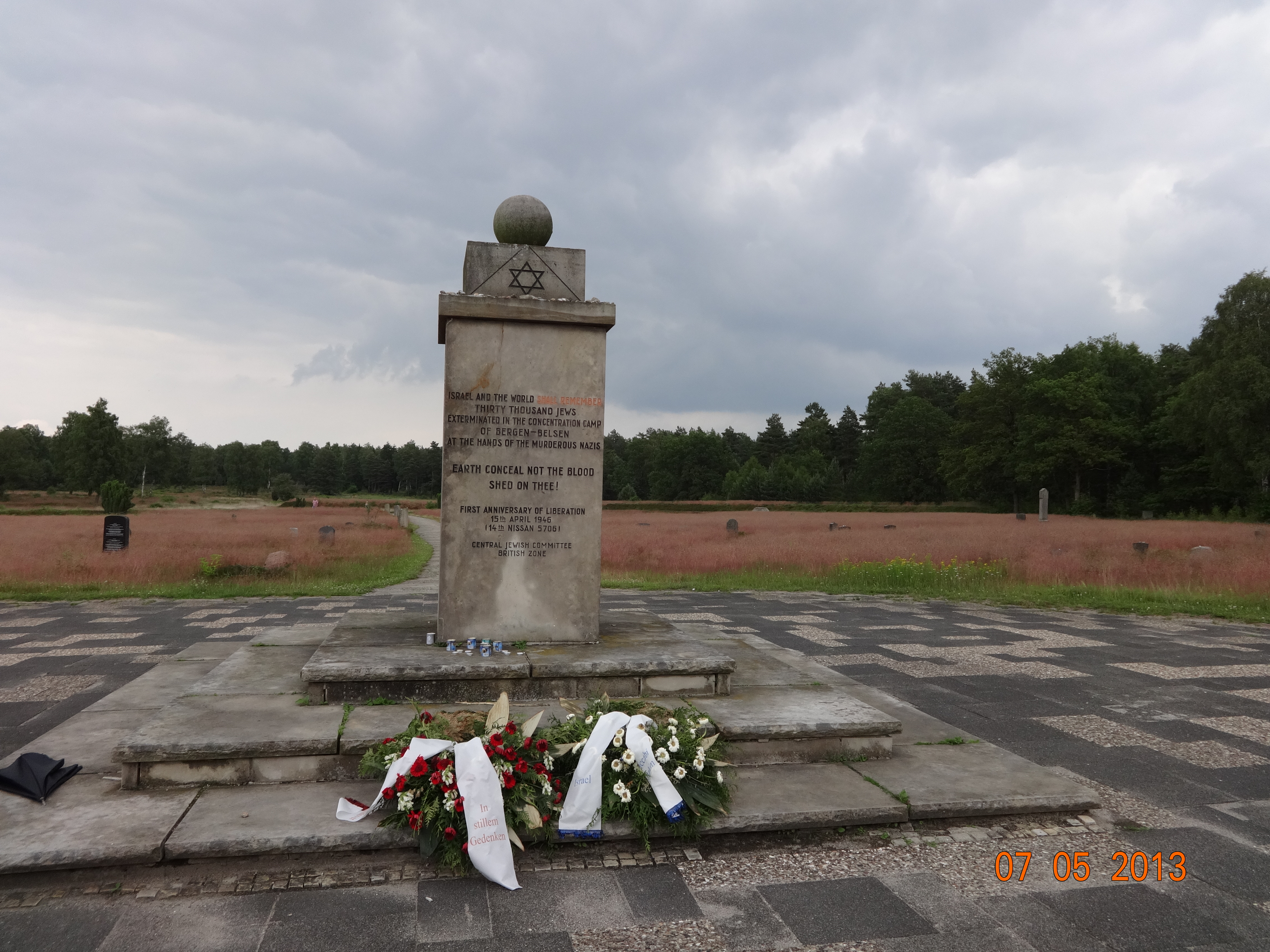
Bergen Belsen on July 5, 2013.

Bergen Belsen on July 5, 2013.

I am in Europe on a study tour of the Holocaust with 25 fellow educators of the United States. I am typing this as the morning breaks in the heart of Berlin, Germany. I had hoped to be able to get on-line and write more frequently but that is just not possible. There is too much to do while we are here visiting these authentic sites. But it is time to stop and reflect on some of the things that I have seen and experienced.

Our itinerary includes stops in Germany, the Czech Republic, and Poland. The power of visiting these sites after studying them so long can not be overstated.

Bergen-Belsen. For me, visiting this place after studying it in depth in relation to the exchange camps that were here was a powerful experience. Readers of the blog know of the stories of many of the survivors of Bergen Belsen who were in the exchange camp and their liberation on April 13, 1945 at Farsleben. Two days ago I got the back story of the exhibition panels you see here, that feature the photographs and the work that our project has uncovered.

In brief context: 120,000 prisoners passed through Bergen Belsen, and not all of them Jewish. 52,000 died here, perhaps 30,000 of them were Jewish. Belsen actually began as a POW camp- 20,000 Russians died here in the winter of 1941-42. In 1943, Himmler (the head of the SS) ordered that an exchange camp be set up for Jews who might possess foreign certificates or visas to emigrate, perhaps to use to bargain for German families interned abroad. 14,000 people went through the exchange camp. In November, 1944, thousands of women, and some children, including the Frank sisters, arrived from Auschwitz, to be “housed” near the exchange camp. What they received, in their miserable condition, were 18 oversized old tents which promptly blew down during a winter storm shortly after their arrival. With the arrival also of brutal SS administrators and guards, conditions deteriorated rapidly as the winter of 1944-45 turned into spring. The camp system began collapsing with the advance of the Red Army in the east and the British and Americans in the West. By the time the British arrived on April 15th at the camp gates, over 50,000 prisoners were suffering from extreme malnutrition, typhus, typhoid fever, and dysentery. Nearly ten thousand corpses lay about as the crematorium had long since broken down. Hundreds died on the day of liberation.

I'm here. Finally.  Jerrilyn Miller photo.

I’m here. Finally. Jerrilyn Miller photo.

So here I am. The bus guides swiftly through the beautiful German countryside. A night in the picturesque town of Celle the evening before has us well rested. The fields and forests bid us peaceful feelings as we move with our rendezvous with the past. It feels as if as we move we are stepping back in time.

Memorial site, Bergen Belsen.

Memorial site, Bergen Belsen.

We see the road signs for the memorial and I think many of us on the bus draw a collective breath as it turns into the parking lot of Gedenkstatte (Memorial) Bergen Belsen. It is surrounded by trees. We are the only persons, besides staff, who are here. As we disembark off the bus, Tif ties an Israeli flag around her neck so it drapes like a cape. It is quiet. But the birds are singing.

Now I remember that in 2007 I was beginning my first communications with Christian and Bernd, then staff members at the Memorial. They were excited about the opening of their new exhibition hall and education center. Two years later they would fly over, with the historian Thomas, to take part in our 2009 reunion. So now I am here for the first time to see them again.

We meet the staff, who are still preparing for us. I’m listed on the program at lunchtime for a talk about the exchange camps and how the project is incorporated into the exhibition. Bernd enters the room and greets me warmly.

After an introduction to the history of the site, we  watch the silent movies shot by the British beginning the second day after the liberation. Perhaps you’ve seen the photos or the films. Belsen, in 1945, was the last stop, the terminus of the Holocaust, as one historian has described it. It was a scene of horror. If you see a photo of a soldier wearing a mask, maneuvering a bulldozer to push corpses into an open pit, that was Bergen Belsen. Just over a month later, the British commander ordered the lice infested, typhus ridden barracks put to the torch.
So now we are on the grounds of the former camp. As we exit the exhibition memorial hall, we are confronted with a long narrow corridor of concrete that we must pass through, reinforcing the fact that we are moving from present to past. And now we are here.DSC00432
To some visitors, there is nothing here, just inviting walkways with interpretive signage and some markers. Woods, and open fields. But on closer inspection, we see the outlines of the past in the ruins. We walk to barracks ten of the exchange camp. You can see the outline at the woodline. Some of the foundation stones are marked with the names of those who passed through them. We retrace the steps from the barracks to the latrine, now many meters away off a footpath in the enveloping woods. Nature reclaims. Out of the corner of my eye, down the long narrow strip mowed to infinity where a fenceline once ran, I see a large deer guide out of the woods, pause and look my way, and vanish just as soon as it appeared. Is it obscene to find in this place now a feeling of inner peace, to find beauty in the stillness of a grey afternoon? Maybe so. But I feel it.
Back inside, Bernd is talking to our group at the Exhibit where the evacuation transports from the exchange camps are outlined with the photographs of Major Benjamin and Dr. Gross. He explains that between April 6 and 9th, 6700 men, women and children were evacuated on three transports. The “lucky” train was liberated by the Americans on April 13. Friday. One train did make it to the destination of Theresienstadt, where the occupants were liberated the last day of the war. On April 23rd, the third train was liberated by the Red Army at Trobitz, across the Elbe.

 Bernd Horstmann, Custodian of the Book of Names,  Matthew Rozell, History Teacher, July 5, 2013. Bergen Belsen, Evacuation transports exhibit.

Bernd Horstmann, Custodian of the Book of Names, Matthew Rozell, History Teacher, July 5, 2013. Bergen Belsen, Evacuation transports exhibit.

Bernd explains that as the exhibition was being planned, his colleague Christian discovered the photographs that I had been given by the Dr. Gross to place on my website. It altered their vision of the exhibition and he described their excitement as the corroborated the testimony of the soldiers with the photographs. Yes, this is the Farsleben transport. Yes, this is the transport that the Americans called “The Train Near Magdeburg”. My fellow teachers ask questions, and learn more about the exchange camp. They are putting faces to the victims when they see the pictures. I am happy to share this experience with them. I am here, and I am seeing it for the first time with them. They are part of this experience, at our first major stop on the trip. Later, on the bus, some are excited to see the Benjamin photo in the official Bergen Belsen guidebook. In my being caught up in the presence of the moment, I neglected to purchase one for myself, but there it is. I was not even aware of it.
Back out to the camp. The solemn monuments marking the mass graves. 1000 Tote. One thousand DSC00490dead. 2500 Tote. Two thousand five hundred dead. And on and on, elevated mass graves. On to the commemoration room. Candles are lit, stones are placed, the prayers are recited in Hebrew and English, led by Pauline, the only other New Yorker on the trip with me. We are all moved. I think of Carrol Walsh, the tank commander who led me to this story, the liberator who did not want to be called a hero, or even a liberator. His own memorial service is today, half a world away, but I am here in this place to remember him as well. It is altogether fitting and proper. And perhaps it is also something destined to be.

This evening we depart from Hannover to Berlin. It is pretty crazy and unsettling at the Friday evening platform. 27 people have to run for the train, as the track has changed, with hundreds of others. Our original seats are taken, so we have to find other due to a mixup. But we do not lose anyone, and as I settle in next to a kind stranger, made welcome, I notice our station stops along the way- Brunswick. Magdeburg. We are roughly following the route of the train, and the 30th Infantry Division in 1945. What take us 35 minutes to cover, takes 6 nights and 7 days in April 1945.
Today was also something destined to be, the culmination of something incredible I am still trying to figure it all out- but this trip is helping me to place in proper context the elements of the greatest crime in the history of the world. As we leave this place of obscene beauty and peace, I think of  the I think of  the survivor’s words:

Remember Me.

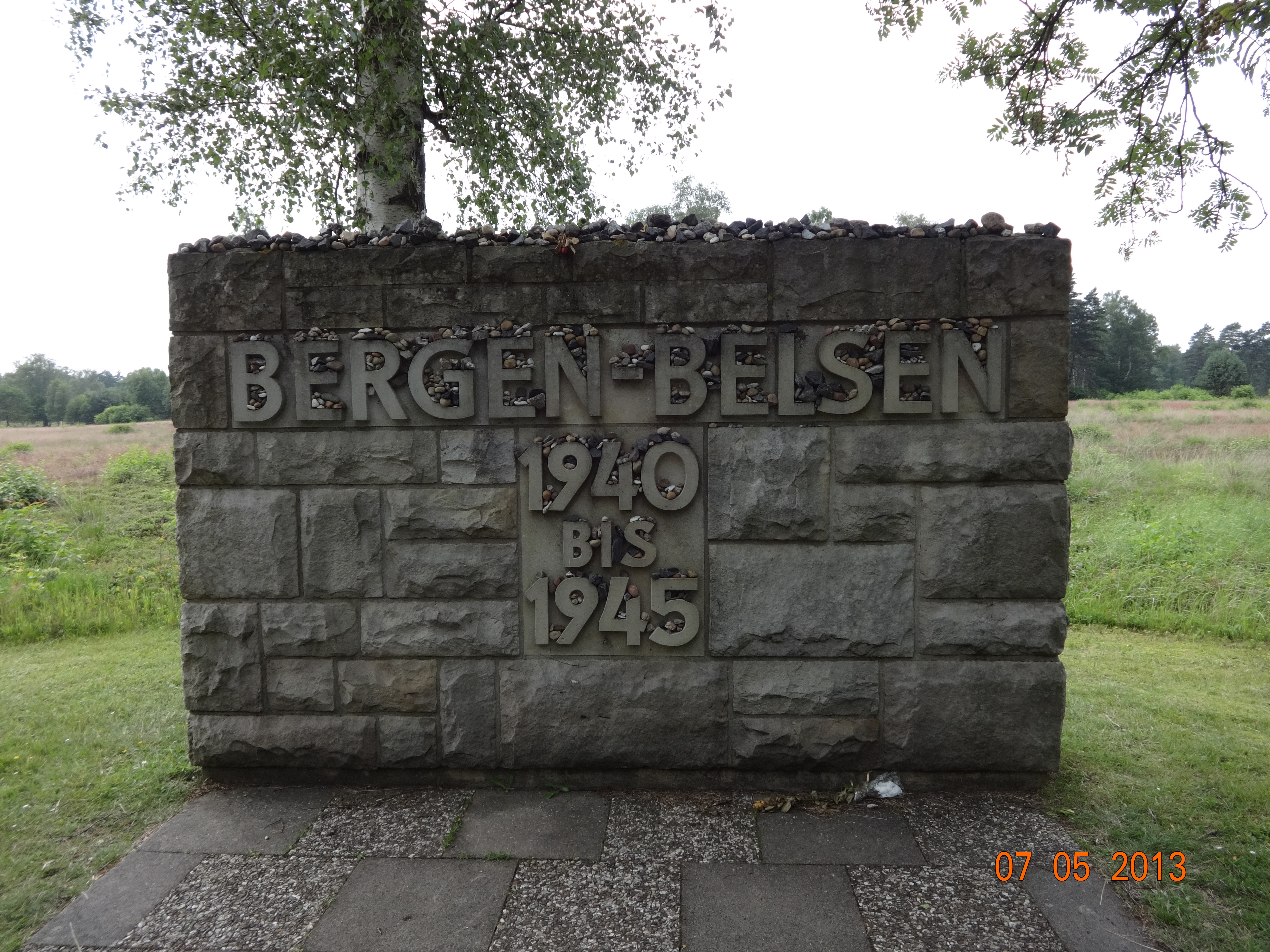
Remember. Bergen Belsen, July 5, 2013.

Remember. Bergen Belsen, July 5, 2013.

Read Full Post »

This is from last evening’s PBS NewsHour. Book is on my summer reading list. April 1945 a focus of my studies.

‘Bad to the Very End’: Author Reflects on the Long, Deadly Road to WWII Victory

In honor of the 69th anniversary of D-Day, Ray Suarez talks to historian Rick Atkinson about his new book, “The Guns at Last Light,” which chronicles the brutal fight for victory at the end of World War II.

JEFFREY BROWN: Finally tonight, we mark June 6, D-Day.

Ray is back with book conversation he recorded recently about World War II.

RAY SUAREZ: The war that had a hand in cementing U.S. status as a superpower and created the map of the modern world ended almost 70 years ago.

You could fill a library with books about the Second World War, yet historians still find new things to say and new ways to say it.

Award-winning author and historian Rick Atkinson has just completed the third book in his “Liberation Trilogy,” “The Guns at Last Light: The War in Western Europe, 1944-1945.” And he joins me now.

And, Rick, if nothing else, this book is a reminder that, with D-Day, there was still some of the worst fighting of the war left to go.

RICK ATKINSON, author, “The Guns at Last Light”: That’s certainly true, Ray.

I think the horror of it is difficult to imagine 70 years later. And it continues really after D-Day, almost to the last gunshot. There were almost 11,000 Americans killed in Germany in April 1945, the last full month of the war in Europe. And that’s nearly as many as died in June 1944, the month of invasion.

So the bloodletting continued right to the end. The notion that many Americans have that it was bad on the beaches, and then something bad happened during the Battle of the Bulge in December 1944, and then it was kind of sweeping into Germany and the war was essentially over is actually quite incorrect. It was bad to the very end, almost to May 8, 1945, when the war in Europe ended.

RAY SUAREZ: Terrible, ferocious, deadly fighting through Northern France, through Holland and Belgium, and finally into the German homeland.

Then you bring us to one British officer who says, “Why don’t the silly bastards give up?”

What was the German calculation in those last months, when it was clear they could no longer militarily prevail?

RICK ATKINSON: Well, there are several things at play.

Part of it is terror. Hitler had a police state of the first order. And those who showed any sign of being weak-kneed faced prison or often summary execution. That prevented a lot of people who knew that the war was not going to turn out well for Germany from giving up.

In other cases, you have to say that 80 million Germans tended in large measure to be true believers, that they believed in the fuhrer almost to the bitter end. You would see parades, for example, on Hitler’s birthday, April 20, 1945, in Berlin — this is 10 days before he kills himself — of young girls, young boys who are too young to go into the military carrying flags and singing patriotic songs, people cheering along the streets of a badly battered Berlin at that point.

So, the German psyche was such that they’d been heavily influenced by propaganda. And they were just generally disinclined to give up.

RAY SUAREZ: Rick, you also remind us that the war got deadlier as it went on, because both sides were innovating, inventing new ways of killing the other side practically until the last day of the war.

RICK ATKINSON: That’s true, Ray. The lethality increases as the war goes along, and it — it’s extraordinary how brutal it is.

We Americans, for example, invented something called the POZIT Fuse. That was the code name. There was a little radar sensor in the nose of an artillery shell, and it could, by emanating radar signals, determine when a passing plane or when an approaching target was just within the kill radius of the burst, and detonate that shell.

It was used for the first time in the Battle of the Bulge in December 1944. The Germans called it pure manslaughter. It was part and parcel of a generation of weapons that came along, napalm used for the first time around this time. The Germans had invented the V-1 and V-2 flying bombs and then a ballistic missile, the V-2, with terrifying results, most of them launched against London or Antwerp with devastating results to civilians.

RAY SUAREZ: We have in the final weeks and months of the war some moments where it’s hard to tell where moral authority existed, if such a thing any longer existed.

How could you tell concentration camp inmates not to rise up and kill their captors who were trying to surrender and act like normal soldiers? How could you put trial Americans who, sickened by the slaughter, would just turn and around pop these guys with their sidearms as they tried to surrender? It got nasty, brutal, and frightening in those final weeks.

RICK ATKINSON: This is true.

And it’s not just the final weeks, actually. There’s killing of prisoners that begins early in the liberation of Europe by American, British, Canadian soldiers, and, of course, by the Germans. It intensifies during that last 11 months from Normandy on.

But when you get to the camp liberation phase, particularly in April 1945, for example, at Dachau, American soldiers coming into this camp, tens of thousands of emaciated, horribly treated prisoners, and thousands of bodies lying around, and there were soldiers that went on a rampage. There were at least a couple dozen S.S. guards who had surrendered, had been taken into custody who were murdered, probably more than that.

This is at the same time that there are liberated inmates rampaging, tearing literally some camp guards limb from limb. There was an investigation. The investigators found that, yes, there had been prisoners murdered by American soldiers. Nothing was ever done of it. No one really had the stomach to prosecute American soldiers under these circumstances.

This is just one example of many, though, of the barbarity that war unleashes with — inside otherwise good soldiers.

RAY SUAREZ: I want to continue this conversation with you online.

The book is “The Guns at Last Light.”

Rick Atkinson, thanks a lot.

RICK ATKINSON: Thank you, Ray.

http://www.pbs.org/newshour/bb/military/jan-june13/atkinson_06-06.html


Read Full Post »

American Cemetery overlooking Omaha Beach, the primary landing zone for Americans during the D-Day invasion June 6, 1944. (U.S. Air Force Photo)Today one of my former students emailed me to visit saying that she had a surprise for me. She brought me a present- sand from the beach at Omaha in Normandy.

This was originally posted four Junes ago, I re-post here now.

I came into school today, on a Saturday, to start packing up my room for a move to another room.

But it is the 6th of June.

Instead I am getting nothing done, mesmerized by the scenes, live from Normandy, of the 65th anniversary celebration.

The President is there and so are 250 American veterans of the battle for Normandy,  including one of my good  friends, Buster Simmons, of the 30th Infantry Division. The Greatest Generations Foundation sponsored his visit with 9 other vets and college kids. Now I’m looking for him in the sea of faces.

My son Ned and I watched him last night as a “Person of the Week” on ABC World News in a story I contributed to. If you view the clip, you can see the photograph I provided ABC with, taken by Major Clarence Benjamin, of the liberation of the train. This is the photo that Buster uses when he speaks to high school classes to tell this story.

I am hopeful that we can get Buster to come to our high school for the  liberator-survivor reunion in September.

It was twenty five years ago, on this anniversary, that I wrote an essay in the local newspaper expressing my appreciation for the veterans of World War II. And as I begin to sort through and pack up 20+ years of memories in this room, three things are becoming clear: 1) my love for these men and women and what they did only increases as time passes; 2) the rest of my career will be focused on the promotion of narrative history in the classroom, linking students, veterans and survivors together; and 3) I won’t be getting any packing done this day.

Take a minute to watch Buster in the clip and take his optimism about the future of our nation to heart. Especially if -“you’re an American.”

Read Full Post »

By OMAR RICARDO AQUIJE- Glens Falls Post Star

HUDSON FALLS —Fred Spiegel was asked if he felt resentment toward the Nazis.

“Yes, to the Nazis, but not the Germans,” Spiegel said.

The question came from a student at Hudson Falls High School, at which Spiegel was invited Friday to discuss his life during the Holocaust.

On April 13, 1945, a train traveled across Germany, carrying 2,500 Jews en route to a concentration camp.

Spiegel was among them. He was 13.

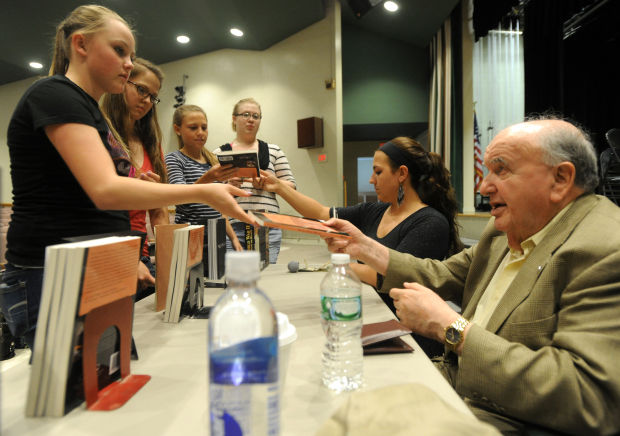
Holocaust survivor Fred Spiegel sells and autographs copies of his book, "Once the Acacias Bloomed," for students at Hudson Falls High School on Friday, May 24. Spiegel, who was liberated by U.S. troops as a young boy during World War II, spoke about his experiences and answered students' questions. (Jason McKibben -

Holocaust survivor Fred Spiegel sells and autographs copies of his book, “Once the Acacias Bloomed,” for students at Hudson Falls High School on Friday, May 24. Spiegel, who was liberated by U.S. troops as a young boy during World War II, spoke about his experiences and answered students’ questions. (Jason McKibben –

Spiegel, 81, visits schools to talk about how he survived. He brings copies of his book, “Once The Acacias Bloomed,” which explains his life as a Nazi prisoner.

Most of the schools he visits are in New Jersey, where he lives. The farthest he travels is Hudson Falls, a school he visited a few times in recent years, a school he included in his book because it was here an important moment in his life occurred.

“They invited me,” Spiegel said of his reason for returning to Hudson Falls. “How can I say no?”

During Friday’s presentation, Spiegel often said he was lucky to be alive.

Other trains carrying Jewish prisoners made it to their destination. His did not.

His train suddenly stopped near Magdeburg. Spiegel said the train’s engineer and Nazi soldiers fled for fear of capture. U.S. troops was cutting across Germany.

Then, a few U.S. soldiers on tanks found the train and freed the captives. The soldiers included Carroll Walsh, of the 743rd Tank Battalion.

Spiegel was later reunited with his family. It was 65 years later when the unexpected happened: He was invited to Hudson Falls to meet others who were prisoners on the train.

He also got to meet some of the liberators, including Walsh, who was living in Hudson Falls at the time.

Matt Rozell, a Hudson Falls history teacher, organized the reunion. He met Walsh in 2001. He interviewed the former soldier, and learned about the train near Magdeburg.

Walsh died in December. He was 91 and a former state judge.

Spiegel, a native of Germany, said people have shown more interest in the Holocaust over the years.

During Friday’s visit to Hudson Falls, he spoke to about 30 sophomores. Some of them had copies of Spiegel’s book. Others bought the book after the presentation.

Armand Ryther, a student, approached Spiegel to shake his hand.

“I find it very interesting that he could survive what he did,” Ryther said.

Ryther said he read Spiegel’s book.

Jamie Hughes, a fellow sophomore, said it was interesting to hear about Spiegel’s experiences.

“I think it’s really amazing that he would want to share his experiences with everybody,” she said.

Tara Sano, a Hudson Falls history teacher, said the event was planned near Memorial Day so students can reflect on the efforts of veterans.

“My hope is that when you are taking your three-day weekend, you think about why you have a three-day weekend,” she told students at the start of the presentation.

http://poststar.com/news/local/article_00a9219c-c648-11e2-ae69-001a4bcf887a.html

See Fred meet his liberator for the first time.

Read Full Post »

I don’t know Leo but when I saw the headline I thought they were writing about my friends on this site. God Bless, Mr. Hymas.
By Julie Muhlstein, Herald Columnist

Students crowded around the speaker as his talk ended at Everett Community College. They lingered, asking if they could take pictures and posing with him to capture the moment.tudents crowded around the speaker as his talk ended at Everett Community College. They lingered, asking if they could take pictures and posing with him to capture the moment.

Leo Hymas is no hip-hop artist or reality TV star. At 87, the U.S. Army veteran is a keeper of history and a bearer of truth.

“Those who say it didn’t happen are wrong,” said Hymas, who spoke Wednesday as part of the college’s Holocaust Survivor Forums.

He lives on Whidbey Island with his wife, Amy, and is a speaker with the Washington State Holocaust Education Resource Center.

His audience was rapt, hanging on every word, as Hymas shared memories with Joyce Walker’s Humanities 150D class. This is the 14th year Walker has presented the Holocaust series, which is open to the public. Most speakers have been Holocaust survivors, or lost ancestors during Nazi Germany’s systematic murder of 6 million Jews.

Hymas is not Jewish. His Holocaust story is from the point of view of an American soldier during World War II, a 19-year-old fresh off his family’s Utah dairy farm.

He was with the 97th Infantry Division, H Company, part of Gen. George Patton’s Third Army. In the spring of 1945, they marched through a nearly defeated Germany. “We fought our way across Germany, village to village — sometimes man to man,” Hymas said.

They were preparing to attack Weimar, a picturesque German town, when they came upon a wire enclosure. Hymas recalls the fence, topped by barbed wire mounted on electric insulators. There was a brick building with a tall chimney, and a guard tower. The guards were gone.

The place was Buchenwald, a concentration camp near Weimar. What the liberation forces found there is seared in Hymas’ memory.

“I have seen hundreds and hundreds of naked, rotting bodies stacked like cord wood,” he said. “The smell, I cannot describe. It was burning human flesh.”

There was no fighting. “Suddenly, our fighting force became a humanitarian force,” Hymas said. “You’ve seen the pictures. The people were so emaciated, just skin and bones.

“An order came to touch nothing, but help if you can,” he said. Three generals came to the death camp with their staffs — Dwight Eisenhower, Omar Bradley and Patton. Hymas said troops had nicknamed Patton “Old Blood and Guts — his guts, our blood.”

From camp survivors, Hymas heard horror stories of torture, of subsisting on a half-cup of turnip soup mixed with sawdust each day, and of dogs trained to go for the throat.

The Allied forces made townspeople from Weimar carry bodies from the camp to a common grave. “They told us, ‘I’m not a Nazi,'” Hymas said.

Kathleen Bergin is the speakers bureau coordinator for the Seattle-based Washington State Holocaust Education Resource Center. While most speakers are Jewish, she said, “Leo offers another perspective. He is one of our most prolific speakers.”

He also is among a dwindling number of people still alive to tell what they saw of the Holocaust firsthand.

“The survivors are elderly, and the liberators tend to be even more so,” Bergin said. “We do have videotaped accounts, but a big part of Holocaust education is preparing for when there aren’t survivors. We have to make this real to kids. When there’s not proof of it standing right in front of them, it’s a challenge.”

Hymas was awarded a Bronze Star Medal for valor. He said he helped capture 91 Germans, “most sent to Nuremberg for war crimes.”

Near the end of his talk, he asked for volunteers. Audience members Terry Myer and Cory Palmieri came forward. First, they held up a Nazi banner, bright red with a huge swastika on it.

“It’s a symbol of the worst evil we have record of,” Hymas said, then asked the volunteers to “wad it up and throw it on the floor.” They then held up a 48-star American flag, “the flag I fought for, and my dear friends died for,” Hymas said. “I hope you love and respect it.”

Retired from an aerospace industry career, he makes time to tell as many people as he can about what hate can do.

“I know what I saw. I am a witness. Now that I have told you, you are witnesses, too,” he told the students. “I’m hoping to influence people like you, so that it can never, ever happen again.”

http://www.heraldnet.com/article/20130510/NEWS01/705109903/1056/comm0615

Read Full Post »

eisenhower at ushmmBy BRIDGET MURPHY, Associated Press

BOSTON (AP) — Matthew Nash’s grandfather only mentioned the photographs to him once.

Twenty-five-years later, they are the subject of a new documentary on the Holocaust that Nash spent three years making after finding the pictures his grandfather took while serving as an Army medic in World War II.

Kept hidden from Nash and others in the family, the photos were not something Nash’s grandfather seemed to want to talk about with relatives. But they were something he could never forget.

Nash’s film — “16 Photographs at Ohrdruf” — tells of the first concentration camp that U.S. soldiers liberated in 1945.

The 72-minute film will have its first public screening Thursday evening at Lesley University in Cambridge, Mass., and also will be shown as part of the Boston International Film Festival on April 16 and the G.I. Film Festival in Washington in May.

The summer he was 12, Nash asked about his grandfather’s World War II service as the two were stacking wood in his grandparents’ barn in East Dorset, Vt.

“As I recall he got really quiet,” said Nash, now a 37-year-old photography professor at Lesley University. “I think he just said, ‘Yeah, we saw some really terrible things. When you get a little older, I’ll show you some pictures and you’ll understand.'”

But Donald Grant Johnson, a former Army lieutenant, died in 1991 without sharing the photos with his grandson. Family members only spoke of the pictures in whispers.

When Nash’s grandmother threatened to destroy them when the subject came up at Thanksgiving dinner in 1995, Nash and his sister felt compelled to secretly sift through their late grandfather’s belongings the following Christmas. That’s when they found an envelope marked “Holocaust” tucked away in a wooden trunk. Inside were a few letters and a series of snapshots of a war horror the 23-year-old Johnson encountered as a soldier in April 1945.

Johnson took most of the photos at Ohrdruf in Germany. Nash believes his grandfather may have treated survivors of the camp, which the Germans had formed as a sub-camp of Buchenwald.

On a personalized sheet of notepaper with “Don Johnson” printed at the top, the 65th Infantry Division Army veteran cataloged the photo collection as best he could.

“Lime Pit — effort to destroy bodies,” reads one handwritten caption. “Griddle used in (vain) attempt to incinerate bodies — note skull bottom center,” reads another. “Small stack of bodies,” says yet another.

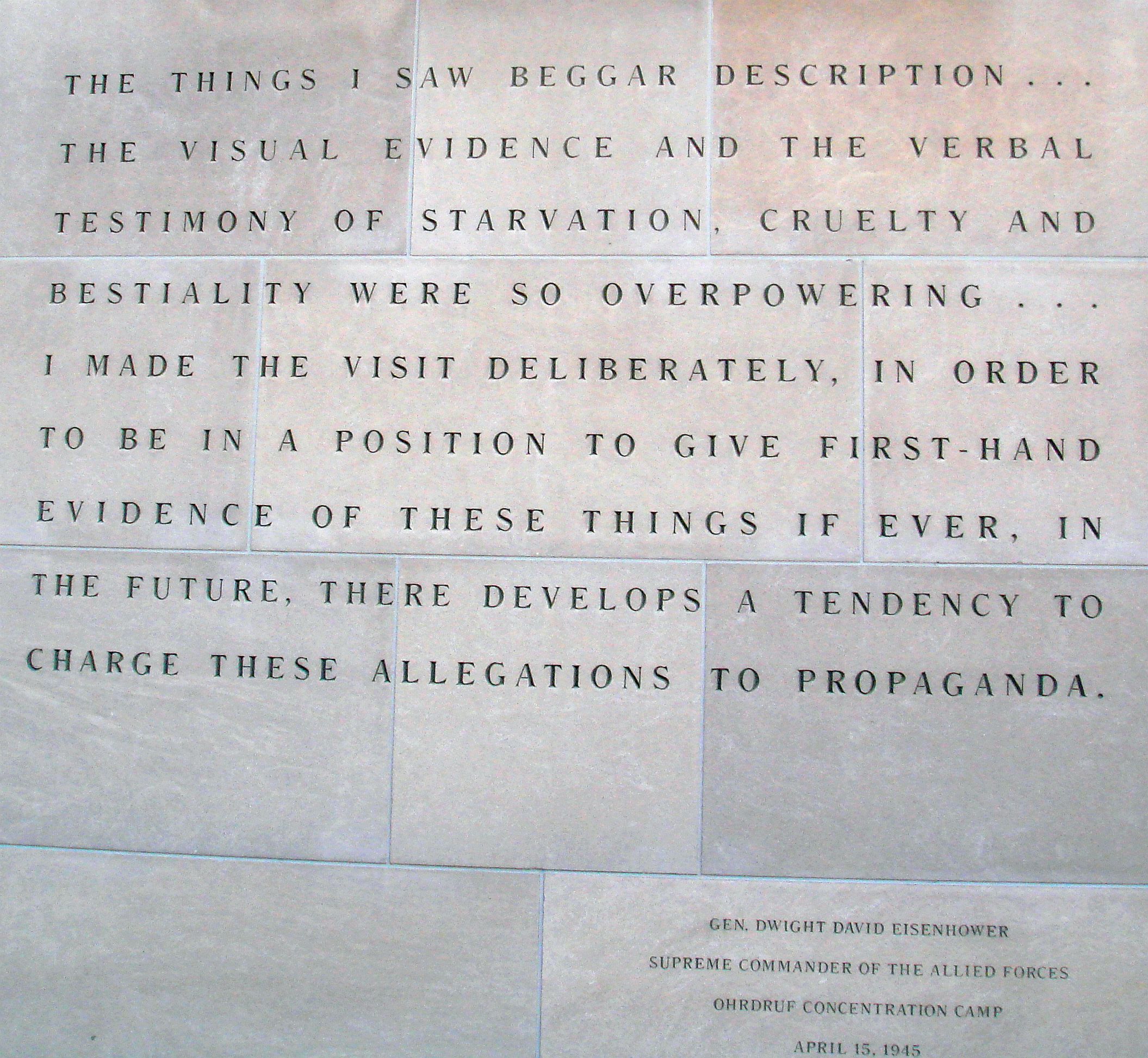
Soldiers are on the outskirts of some of Johnson’s shots, standing together to view piles of emaciated and burned corpses. Gen. Dwight D. Eisenhower wanted many witnesses to the Nazi atrocity so that reports of it couldn’t be dismissed as propaganda.

“He had as many units as possible come and see the camp,” said Geoffrey Megargee, a scholar from the U.S. Holocaust Memorial Museum who appears in Nash’s film.

Johnson likely came to Ohrdruf within a few days of its liberation. He later returned home to become a banker, National Guard soldier, and a volunteer emergency-medical technician.

Some of Johnson’s photos show survivors, including what he described as a survivor being treated by two camp doctors. The skeletal-looking man is lying on a cot, with what appears to be an open wound on his hip, as the men stand beside him. In another, a bare-chested boy of about 14 looks toward the camera, with what appears to be prisoner barracks in the background.

Nash found 19 photos in all and used 16 in his film. His research showed his grandfather may have shot a few of the photos at Mauthausen concentration camp in Austria.

The professor also discovered from letters his grandfather packed away with the pictures that he had wanted his photographs to become part of the U.S. Holocaust Memorial Museum. He said in one letter that he had visited more than one concentration camp, but Ohrdruf was engraved in his memory.

“I keep the pictures close at hand and have made a point of looking at them frequently,” Johnson wrote. “And, during my years of National Guard service, I made a point of showing them to the personnel, hoping we could prevent any such disasters from happening again.”

Johnson died two years before the museum opened, and before he sent the pictures. Nash has since given the photos to the museum for its archives, and said he’s proud to have done that for his grandfather.

Nash made the documentary with about $5,000 and the help of friends in the film business.

Among film interviewees, Nash talked to veterans who served in the same infantry division as his grandfather, including Boston resident Edwin “Bud” Waite. The 87-year-old was an infantry soldier who wasn’t part of liberating concentration camps, but visited Dachau later. He said he sees value in Nash’s film effort.

“I think it’s very important because the younger people nowadays, they don’t really understand concentration camps back in World War II,” Waite said.

Megargee, who will give a lecture before Thursday’s screening, said Nash’s film opens up a personal window into what the Allies were fighting against in World War II.

“When you can personalize the history, especially for younger kids, it helps to get them interested. It’s one thing to talk about tens of thousands of camps. It’s another thing to bring it down to the level of one American soldier,” he said.

Copyright 2013 The Associated Press.

Read Full Post »

  I am re-posting this on the anniversary of a car crash that would claim the life of Holocaust survivor and later U.S. Army Ranger, Steve Barry.

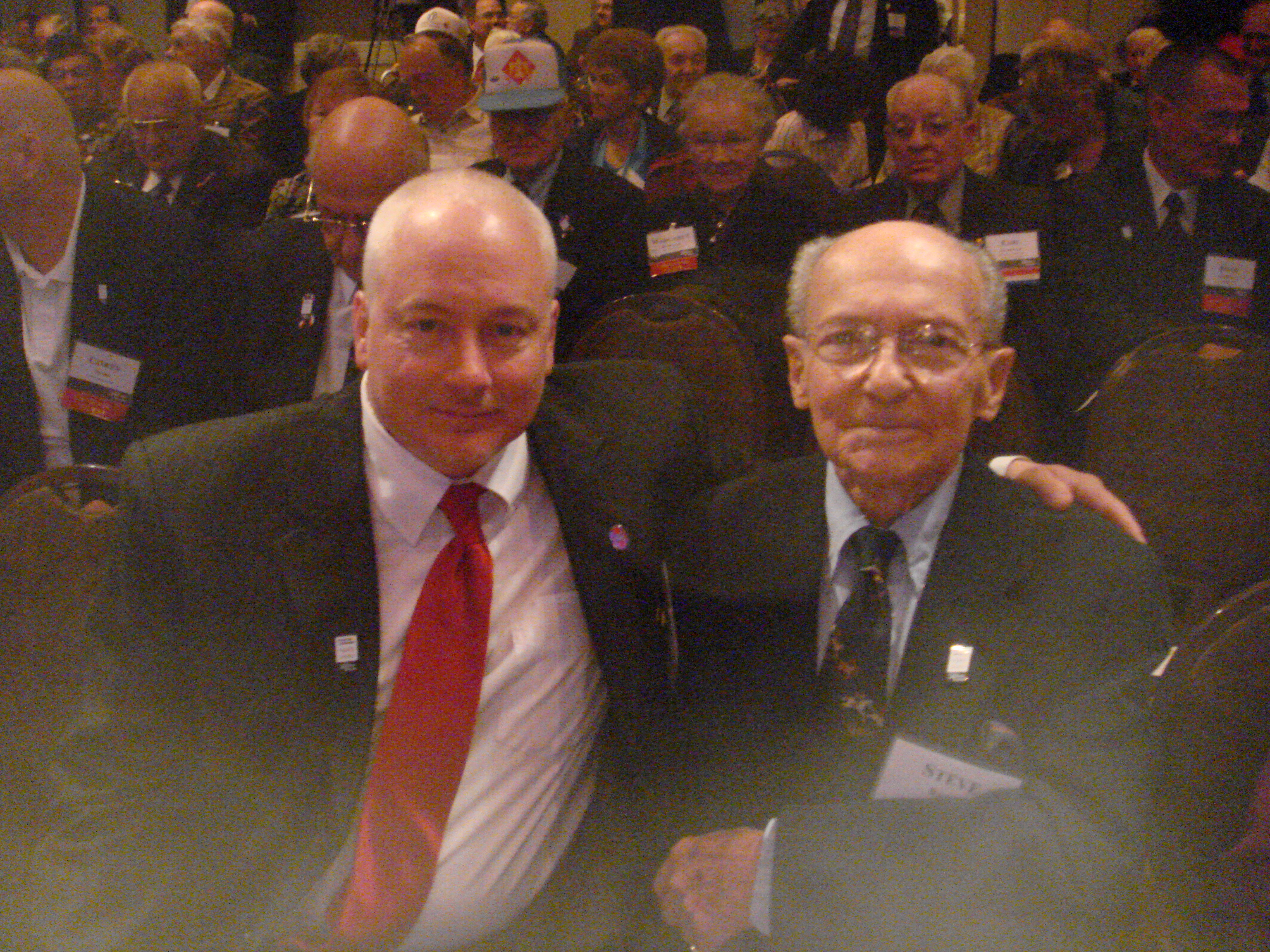
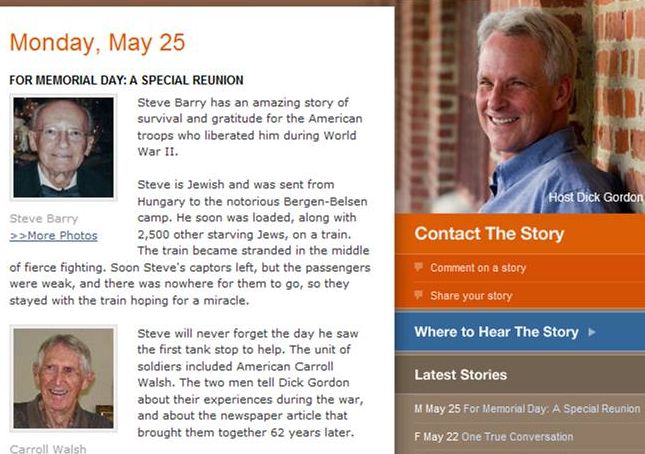
My friend on the left described himself at one point in his life as the “Happiest Korean War Draftee”. Steve was a  survivor from Hungary who beat the odds and lived through the horrors of the Holocaust after the Germans invaded that country in 1944 and did their best to kill him on several occasions. He spent his 20th birthday jammed in a boxcar destined for Bergen Belsen, witnessed people dying of starvation and disease by the thousands,  and was liberated on April 13th, 1945 at the hands of the 743rd Tank Battalion and the 30th Infantry Division of the US 9th Army, aboard the train near Magdeburg.  He emigrated to the United States in Dec. 1948 after spending years in a displaced persons camp, applied for citizenship immediately, and was drafted in 1950, only to be assigned occupation duty in a far off nation- you guessed it-Germany. He was so happy to serve his adopted country…

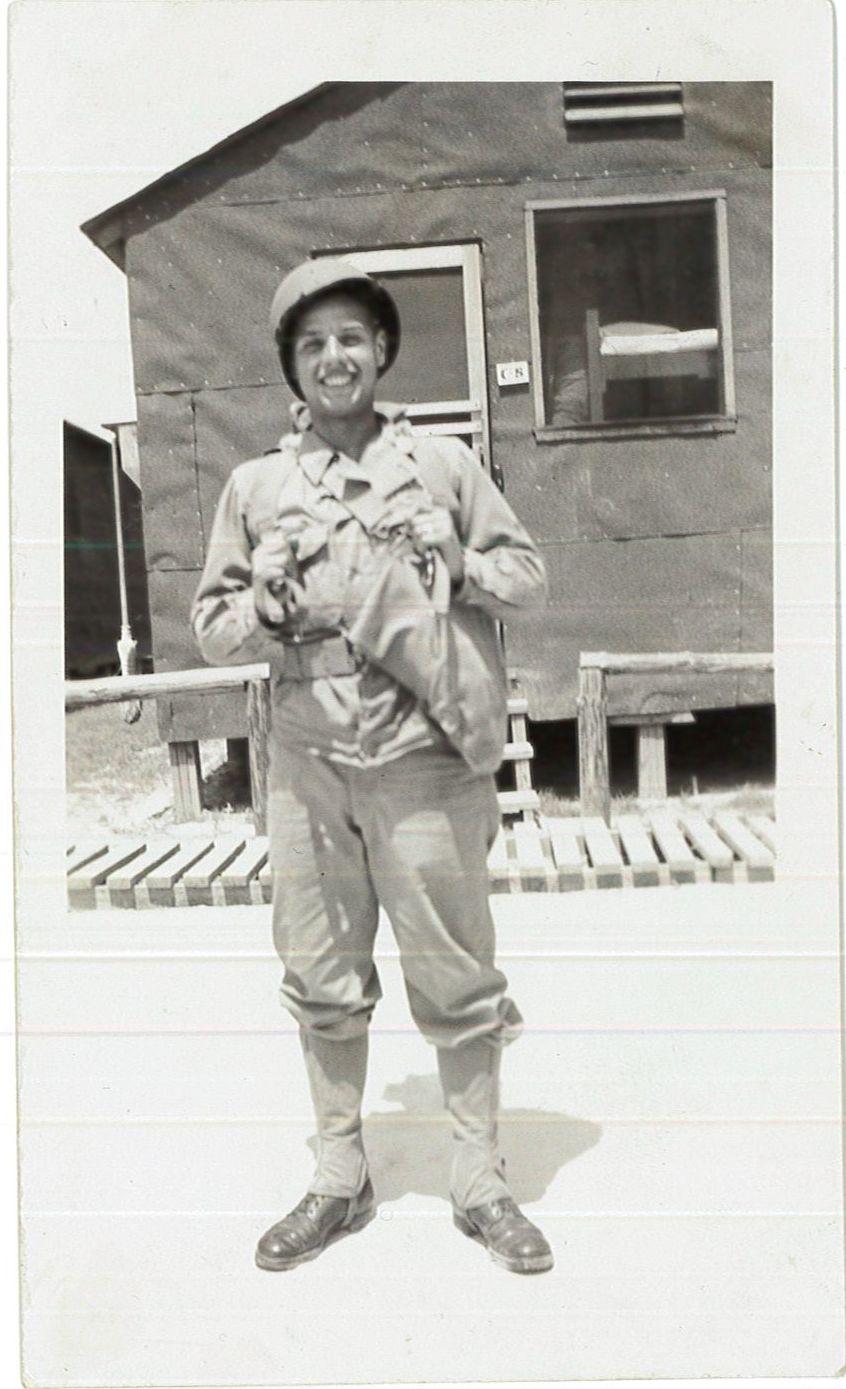
Steve passed away yesterday, January 16th, 2012, after a long and difficult ordeal from injuries sustained in an automobile accident in September. I’ll always remember his special Christmas and Easter cards that he sent to me, made personally on his computer; his funny, self depreciating humor; and above all his overwhelming happiness at being able to finally meet the men who saved him. I hope that the memories sustain his wife Stella and his children and their families, and also the friends that he made later in life and became soulmates with- soldiers Carrol Walsh and Frank Towers, the soldiers who arrived on the scene to free him and help him begin his life anew.

Matthew Rozell, Stephen Barry, National DOR Ceremony, Washington, DC April 2010. This photo was taken the day after the 65th anniversary of Steve’s liberation in April 1945. We had just been honored by the director of the United States Holocaust Memorial Museum before the national ceremony in the Capitol Rotunda.

I will leave you with a few of his words-and we will remember. Thanks, Steve, for all that you gave us, and for passing the torch to a new generation of students to carry your message forth.

An earlier post… The Holocaust Survivor and the US Army Ranger…

A fantastic national radio interview that I helped to arrange, knowing he would be the perfect speaker…

And the educational films I constructed from them.

 Stephen B. Barry, 87, of Boca Raton, Florida, passed away peacefully on January 16, 2012 following a serious car accident in late September 2011. A Holocaust survivor,who was proud to be an American, he went on to live the American dream. He is survived by his wife Stella of nearly 58 years, his children Barbara (Paul), Jamie (Jerry) and Randy and his beloved granddaughters, Amanda and Victoria and many extended family and friends. Services to be held at Beth Israel Memorial Chapel in Delray. In lieu of flowers, the family requests contributions in his memory be made to The United States Holocaust Museum.
Published in Sun-Sentinel on January 18, 2012

Read Full Post »

Dear Mr. Rozell,

Hilersleben -Luca Furnari

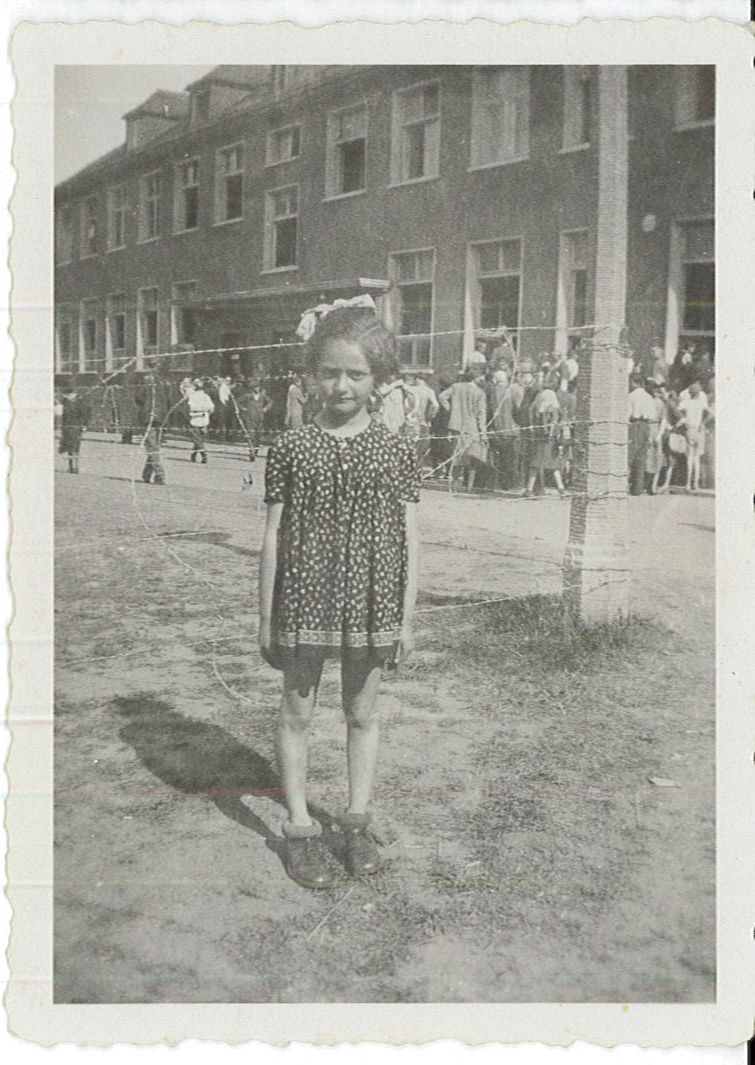
 My grandfather, Luca Furnari, is 90 years old and served in the 95th medical battalion with Mr. Gantz at Hillersleben. He has a number of photographs from this period.  For many years he has thought about trying to find a particular young girl who he helped sneak extra rations to at the DP camp and whose mother asked him to take back to the United States. He and some friends actually had a whole plan of how they were going to sneak her onto the boat back to the US, it’s a great story. Unfortunately, as you know, they were told they were going to the Pacific theatre and the plan became impossible.  Her name was Irene / Iren / Irena.  I have a photograph and have searched the manifest on your website, there are 3 possible people of approximately the right ages: Irena Gitler, Iren Roth and Iren Wittels.   I was wondering if you had come across any survivors from Hillersleben with the same name. 

Hilersleben-Irene is in the flowered dress

Also, I know my grandfather would love to be connected to any other surviving members from the US Army that were at Hillersleben.  

 My grandfather is the large picture on the left hand side.  Irene is in the flowered dress in the picture by herself and on the lap of another US soldier, whose name is Turner (?).  The picture with the baby is also Turner, and they are in the DP camp.  My grandfather’s inscription reads

Hilersleben-Turner-boy that kid sure did cry that day — until we gave her some chocolate.

“boy that kid sure did cry that day — until we gave her some chocolate”.  The picture of the building with barrels in the foreground is from Hillersleben too. It has a strange inscription from my grandfather

Hilersleben-some disorderly DPs getting a shower bath (DDT?)

“some disorderly DPs getting a shower bath”.  The one with the two girls just says “Two of the children that lived in the D.P. center we were taking care of. Cute eh hon?” (He was sending the pictures to my grandmother back in the States.)

The child Irene is the girl that my grandfather would like to try to locate. 

Soldier Turner and Irene.

Any help you can provide is MOST appreciated.

Best,
R.

Hilersleben-Two of the children that lived in the D.P. center we were taking care of. Cute eh hon?

Read Full Post »

“On April 30, 1945, Jewish-American G.I. Richard Marowitz  stormed into Hitler’s bedroom looking for anything he could bring back to headquarters.

Richard Marowitz of Albany , NY was on the scene for the liberation of Dachau. The following day he was at Hitler’s villa in Munich. Here is his story as told to Matthew Rozell and a group of students at Hudson Falls High School ten years ago.  Marowitz is a Jewish war veteran. Read the postscript to learn more about Hitler’s hat.

Richard M. Marowitz-42nd Rainbow Division-

The Liberation of Dachau

interviewed at Hudson Falls High School.

On the 29th of April 1945, my platoon was called into the command post, we were in a little village, I don’t remember the name of it, but it was probably about 25-30 miles from Dachau.  We were given new maps which showed Dachau, and we were told that the 20th Armored were already on the road to Dachau and our job was to take off and get to the tail end of the 20th Armored and be liaison between the 20th Armored and the infantry that would be coming down behind us in two and a half ton trucks, which is kind of idiotic but that’s the way the army was. The reason for that was we were having a race with the 3rd Division on one side of us, and the 45th Division on the other side of us, and they wanted the 42nd to win the race. So we took off on the road going very quickly like we usually do – if we came to a tree, the woods, or a village, we would stop and reconnoiter and find out if it was ok to go through without getting killed – and we kept getting pushed on the radio, ‘where are you,’ ‘what are your Greek coordinates,’ and ‘what’s taking so long? We are going to lose the race.’  After awhile of this kind of nonsense, Lieutenant Short stopped us and he said we to have to make a choice, either we’re going to have to step on the gas and go like hell and let surprise be on our side, or we’re going to lose the race and then everybody is going to get mad at us.  So we decided to step on the gas and go like hell, which is what we did. In the process, we ran into a whole lot of little hornet’s nests – it would have made a movie you wouldn’t have believed anyways – for example, we cut a German convoy in half that was going across a road that we were on, firing as we went through they didn’t know what happened because we weren’t supposed to be there and they were driving off the road. We did the same thing with another convoy that was going on a road in the opposite direction and parallel to ours, and we just fired on them as we went.  We came upon a village, and somebody fired on us and we went up on a small knoll next to the road and we dragged all the junk we had accumulated on the bottom of our jeeps like bazookas, mortars, etc. We fired on them and they probably thought they hit the front of the division. There’s no way they could’ve assumed it was only 28 men. Lieutenant Short stood up, honest to God, he actually said this: “Three men assault the town.” Three of us went in, Larry, myself and Howard Hughes, that’s his real name – great BAR man, Browning automatic rifle …and we claimed the first few houses, we accumulated 160, 170, 180 prisoners who looked around expecting to find more of us.  We broke up their weapons, told them to put their hands on their heads and walk back up the road.  They looked at us like were crazy; we looked back like we weren’t.   We went through another village and a German fired a panzerfaust, which is like a German bazooka, it landed on the other side of us and blew us out of the jeep. We dispatched quickly and we got back in the jeep and took off again.  These are the kinds of things that happened on the way to Dachau. 

When we got close to Dachau, you see there are a lot of smells in war, you smell the death smell all the time, but it’s usually farm animals who were rotting in the fields who were killed, rotting or whatever.  As we got closer to Dachau, we got this awful smell and we assumed it was farm animals, that we were going to pass a farm, or whatever. We finally got to the outskirts of Dachau and were pinned down.  Dachau was a favorite camp of the Germans, their first major camp, it was in Germany.  They didn’t want to give it up the other camps were walkovers.  The Germans just left them, and that was it.  But in this case at Dachau, they didn’t want to give it up too easily, there were a lot of SS guys around.  They were dropping some SS on us, and a lot of snipers – at one point an American tank came out of Dachau.  We were stuck in the ditch at that point, we stood up and realized we made a mistake when the gun came down on us – but at that instant, an American tank destroyer came up behind us and blew the tank away.  It happened to be an American tank that had been captured by the Germans and the guys in the tank destroyer knew that we didn’t have any tanks in there so therefore it had to be a captured tank.  I kissed a tank destroyer that day.     

    At that point, they told us to clean out the snipers and then proceeded to go into the camp.  At the outskirts of that camp, we went into a house – we banged on it, it was like a little small farm on the outskirts.  The door opened and there was a mother, a father, a daughter and a dog.  The mother had buckteeth, the father had buckteeth, the daughter had buckteeth, and when I looked down and saw that the dog had buckteeth, I was just hysterical.   It was the funniest sight, I was tense you know, and I could use anything at that point for a laugh.   Of course the other guys looked at me like I was nuts! Anyway, we did find some snipers – one we did away with that was firing away from a house nearby.  After we silenced him, we went up to see who it was.  He was eleven or twelve years old, one of the Hitler youth, who were actually worse than the SS.  They were just so brainwashed … we ran into a lot of those kids in their short pants. 

On the siding, you saw pictures of it in the slides, outside of the camp, adjacent to the camp, there were actually forty boxcars of bodies and

American soldiers of the U.S. 7th Army, force boys believed to be Hitler youth, to examine boxcars containing bodies of prisoners starved to death by the SS. USHMM

we found one man alive in that forty…there are some pictures of that one man, I don’t know whether he survived or not.  The prisoners were just walking skeletons, and they just dropped where they were and died.  There were piles of bodies, of bodies that had been gassed and readied for the ovens.  Some of them still lived because those boxcars were brought to Dachau to burn those bodies.  It was a total mess.  And the smell was not a farm; it was Dachau that we had smelled miles before we got there.  And yet, people in the village who were right next to the camps said they didn’t know what was going on.  People in Munich, which was actually only nine miles from Dachau, didn’t know what was going on.  Now if you want to believe that, the Brooklyn Bridge is still for sale.

    I never went back and I don’t intend to, I don’t feel like I want to.  But it is almost impossible to describe the feelings, so I’m not going to try.  But when you looked around some of these tough soldiers were throwing up and crying all over the place.  It is not possible to really describe the number of feelings you get when you walk into something like that.  Because that’s a scene that … well, first of all nobody told us about the camp!  We had no idea what a concentration camp did.  We were going to Dachau, period.  It was another village as far as we were concerned.  That’s kind of a shock to get all at one time. 

Interview recorded on May 3, 2002.

See Rich and I in a 2014 NBC LEARN video here.

POSTSCRIPT:

“On April 29, 1945, the 42nd Rainbow Division 222nd I&R platoon entered the gates of Dachau. One of many units sent to liberate the death camp, they saw first-hand the horrors of Hitler’s death machine.

The next day, 12 men of the I&R were ordered to search Adolph Hitler’s Munich apartment for military intelligence. Jewish-American G.I. Richard Marowitz, self-appointed wiseacre of the unit, stormed into Hitler’s bedroom looking for anything he could bring back to headquarters.

All he found was a black top hat.

Still angered by what he had seen at Dachau, Marowitz flew into a rage and jumped on the hat, crushing it, imagining Hitler’s head still inside. Then Marowitz, known for his comic antics even under stress, put Hitler’s crushed hat on his head and marched through the apartment with his best imitation of Charlie Chaplin doing Hitler from The Great Dictator. Tense from the day before, the I&R unit cracked up. Years later Marowitz found out that the same day he stomped Hitler’s hat, the Führer committed suicide in his bunker.

Marowitz returned home to Albany, N.Y., with the ultimate war souvenir stuffed into his duffel bag. He became a clothing manufacturer and professional magician and rarely talked about his war experiences. For the next 50 years, Hitler’s hat fittingly sat in a brown paper bag, buried at the bottom of his magic trick closet.

Following Marowitz to a Rainbow Division reunion, Hitler’s Hat interviews his I&R unit buddies to retell the story of Hitler’s hat. Daring and innovative, the documentary presents a rare mix of humor and history in an original take on World War II.”


“The Story of Hitler’s Hat”,
http://www.jeffkrulik.com/hitlershat/index.html

Read Full Post »

« Newer Posts - Older Posts »