Feeds:
Posts
Comments

Posts Tagged ‘concentration camps’

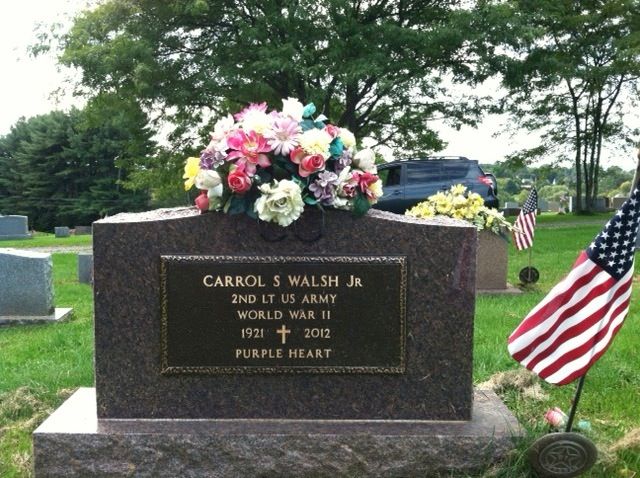
Carrol S Walsh Jr. At rest in Johnstown, NY. Photo by Elizabeth Connolly.

Carrol S Walsh Jr. At rest in Johnstown, NY. Photo by Elizabeth Connolly.

Thirteen summers ago, I sat down for an interview with an amazing man. What he would relate to me, and what I would do with it, would go on to change both of our lives.  A seemingly small incident would be recalled almost as an aside in the wider context of World War II, but then would go on to reverberate through time, and space, creating ripples in the cosmos that grew into waves. Big waves that would carry me, and many others, to places we had never thought possible.

You see, on Friday, April 13th, 1945, twenty-five hundred lives were saved as advance elements of the U.S. Army 743rd Tank Battalion, 823rd Tank Destroyer Battalion, and  30th Infantry Division stumbled across the crime of the century, perhaps of all time.

A train transport stopped at a railroad siding. Open boxcars, sealed boxcars, shabby passenger cars, engine. Some people wandering about, others too ill to move. Sick and emaciated human beings.  Women. Men. Children. SS bands roaming the countryside. Orders to execute. A bridge over the River Elbe ahead to be blown to smithereens. With the transport, and the people on it.

The soldiers told me their stories.  In the course of collecting their narratives, we found others who played their parts and rescued those people.

I listened. We wrote. We recorded, and I posted. Then, the wires began tripping. Seven Septembers ago, we put together the first of many reunions between these soldiers and the child survivors of the Holocaust they rescued.

“Joyful” does not do it justice. What do you say to the men who saved you and your family when you were a child?

Carrol smiles, grips their arms in greeting, and laughs, “Long time, no see!” Sixty-two years, that’s all. On April 13th, 1945, the war weary, “seen-it-all” twenty-four year old second lieutenant is in for the shock of his life.

***************************************************

Five years ago this week, we put on quite a show at our high school.  High school kids listening to, meeting, sharing, laughing, crying, even dancing  with octogenarian U.S. soldiers and Holocaust survivors. ABC World News called my classroom and told me they were on their way up from NYC headquarters to film us. You can see Carrol, and listen to fellow tank commander George Gross’ narrative from our interviews, and hear fellow soldier Frank Towers describe his role in the liberation.

The last evening together, soldiers and survivors from all over the world watched the broadcast together, and we said our prayer of thanksgiving. Hundreds of students became the witnesses for the generations to come.

And so it comes full circle. Nearly ten percent of the passenger list has been found, over 60 years later. Profound things keep happening.

***************************************************

We lost Carrol less than two years ago, George earlier. So I write this week to remember, and remind myself of what a legacy, and gift, they left us. While it may have been a tiny part of  very productive lives (a New York State Supreme Court justice, and English literature professor, respectively), for the rest of my days I will think of the times I got to talk to them, and smile.

And think about their own words: “What are we going to do with all these people?”

Indeed. Just look at the generations that sprang forth, because of what our soldiers stopped to do, in a shooting war. In complex, fluid situations, there are no easy answers, but don’t you think that there is a very important lesson here?

It was not part of the mission. But maybe as a society we should break down and examine the values that made the mission change, if even as a “sideline”.

Sometimes it just feels good to feel proud.

But temper pride with the wisdom of the retired New York State Supreme Court justice:

“No.

They don’t owe us anything. Not a thing.

We owe them~

For what the world allowed to happen to them.”


Read Full Post »

NBC Video about liberator Frank Towers, based on our project here at this website, and what has driven Frank since we met up in 2007.
Godspeed survivors, family members, soldier liberators.  Keep going, Frank.
Remember.
Children from Death Train Reunited
The emotional reunion of a former American soldier and the Jewish children he helped save from the Holocaust 70 years ago. Link below:
OR

Read Full Post »

Meet my friend Frank. He’s 97. The story continues…. from the Boston Globe.

WW2 liberator reunites with Holocaust survivors

By Victoria Bedford
| Globe Correspondent   October 12, 2014

“If not now, when?’’ asked Rabbi Joel Sisenwine, quoting from Hillel the Elder, a revered Jewish leader who lived at the time of King Herod. “If not me, who?”

It was Oct. 4, Yom Kippur, and Sisenwine stood before the congregation at Wellesley’s Temple Beth Elohim, introducing a very special visitor.

As Frank Towers walked up to speak, the teary-eyed congregation of 1,500 rose to give him a standing ovation.

Towers never considered himself special. Now 97, the South Boston native is living in Florida, where he spent most of his adult life as an office manager at a university data processing center. But in the early spring of 1945, in Farsleben, Germany, he was among a group of soldiers who liberated thousands of Nazi prisoners.

The rabbi invited two of those survivors, and their families, to step forward and stand beside Towers.

Yvette Namias, 92, of Peabody, did so. She was 22 in 1945 and long a prisoner at the notorious Bergen Belsen death camp before the liberation. She had never met Towers. Her family — children, grandchildren — stood around her.

Namias was joined by Charles Elbaum of Providence, a 17-year-old prisoner at the time of liberation, now surrounded by his children and grandchildren.

“Well,” Towers said to Namias after the ceremony, “I’ve spent a long time chasing you around the world.”
“He’s responsible for my family,” said Namias. “Without him, my family would not be here.”

Nothing in his life had prepared Towers for what he came upon on April 14, 1945. He was a young lieutenant in the 30th Infantry Division, a unit of the US Army National Guard, heading for Magdeburg, Germany, to fight one last major battle. In the town of Farsleben, they encountered a train that had been seized by the Army’s 743d Tank Battalion the day before. Towers was told it held 2,500 Jewish prisoners, and he was responsible for taking them to safety.

“What if you find a train loaded with Jews, what are you going to do? Nothing was ever said about anything like that.” Towers said. “If you come across a camp, like Dachau or Buchenwald, what are you going to do? We didn’t know anything about that situation.”

But the lieutenant found himself faced with a train full of death camp prisoners, 60 to 70 men, women, and children crammed into each train car, forced to stand until they collapsed from exhaustion, with a daily ration of thin potato soup, and one bucket for a bathroom. They were starved, sick, overworked, and in desperate need of medical assistance, which Towers and his men were wholly unprepared to provide.

Still, Towers and his men sprang into action, rounding up as much transportation as they could, and took the prisoners to the town of Hillersleben. There, a Red Cross unit processed the thousands of Jewish prisoners, gave them showers, provided clean clothes and dusted them with DDT, now a prohibited carcinogen, to kill lice and fleas.

Knowing that he was leaving the prisoners in good hands, Towers went on to fight a last battle, and returned to the States later in 1945. Soon, he started a family with his wife, Mary. Like many who lived through the war, he put his experiences in the rearview mirror for years, never talking much about what he had seen of the Holocaust.

“But I could tell it was eating him inside,” Mary said. “I knew that.”

Towers said his focus was just to move on. “Not much thought was given to the victims,” Towers said. “They were starting out on a new life somewhere.”

That all changed for him in 2005, when he was invited back to Magdeburg to speak about what happened 60 years before. There, he met Ernest Kahn, a survivor of Buchenwald who had been liberated by Towers’ division (“It was very emotional,’’ said Towers), and Kahn put him in touch with Matt Rozell, a high school teacher from Hudson Falls, N.Y., who was assembling an online archive of stories from the war. The two began working together to locate survivors from the train in Farsleben.

“The thing just snowballed,” Towers said. “Today we have located 275 of these children.”

Like Towers, Charles Elbaum, who was a 17-year-old prisoner when rescued from the train, rarely spoke about the Holocaust to his family. After his liberation, he went on to become a physics professor at Brown University, a husband, a father to three sons, and a grandfather to eight children. His son Dan, of Newton, and grandson Nathan met Towers at a reunion, and invited him to speak before the congregation at Temple Beth Elohim.

“Without what they did,” Dan Elbaum said, “I wouldn’t be here. Frank is the last known surviving veteran who was actually present at the liberation of the train.”

For Towers, who now travels around the world to tell his story, preserving the memory is the most important aspect of these talks.

“Dan and his family, and others just like him, he’s second-generation,” Towers said. “Many of them knew nothing about the incarceration of their parents. This second generation is entitled to know what happened, and how it happened, so that they in turn can pass it on to their children, and this will never happen again. That’s the hope in all of us.”

http://www.bostonglobe.com/metro/regionals/west/2014/10/11/liberator-reunites-with-holocaust-survivors/FGUj2uW2crSYIiQIUbdbWM/story.html


Read Full Post »

~Matthew Rozell, a history teacher whose project reunited hundreds of Holocaust survivors with the American soldiers who liberated them, takes a backwards journey to the authentic sites of the Holocaust, retracing the path of the survivors who are now his friends.~


A year ago I took one of the most transformative journeys of my life, with 24 fellow educators, to study the Holocaust and the Jewish resistance to it, in Washington, DC, Germany, the Czech Republic, and Poland. I kept an extensive diary and took tons of photographs. And contrary to many assumptions, it was a journey that led to profound understandings about life, not death.  For the next several days, I have decided to go back and retrace my steps and try to process what unfolded for me.


***************************

July 12.

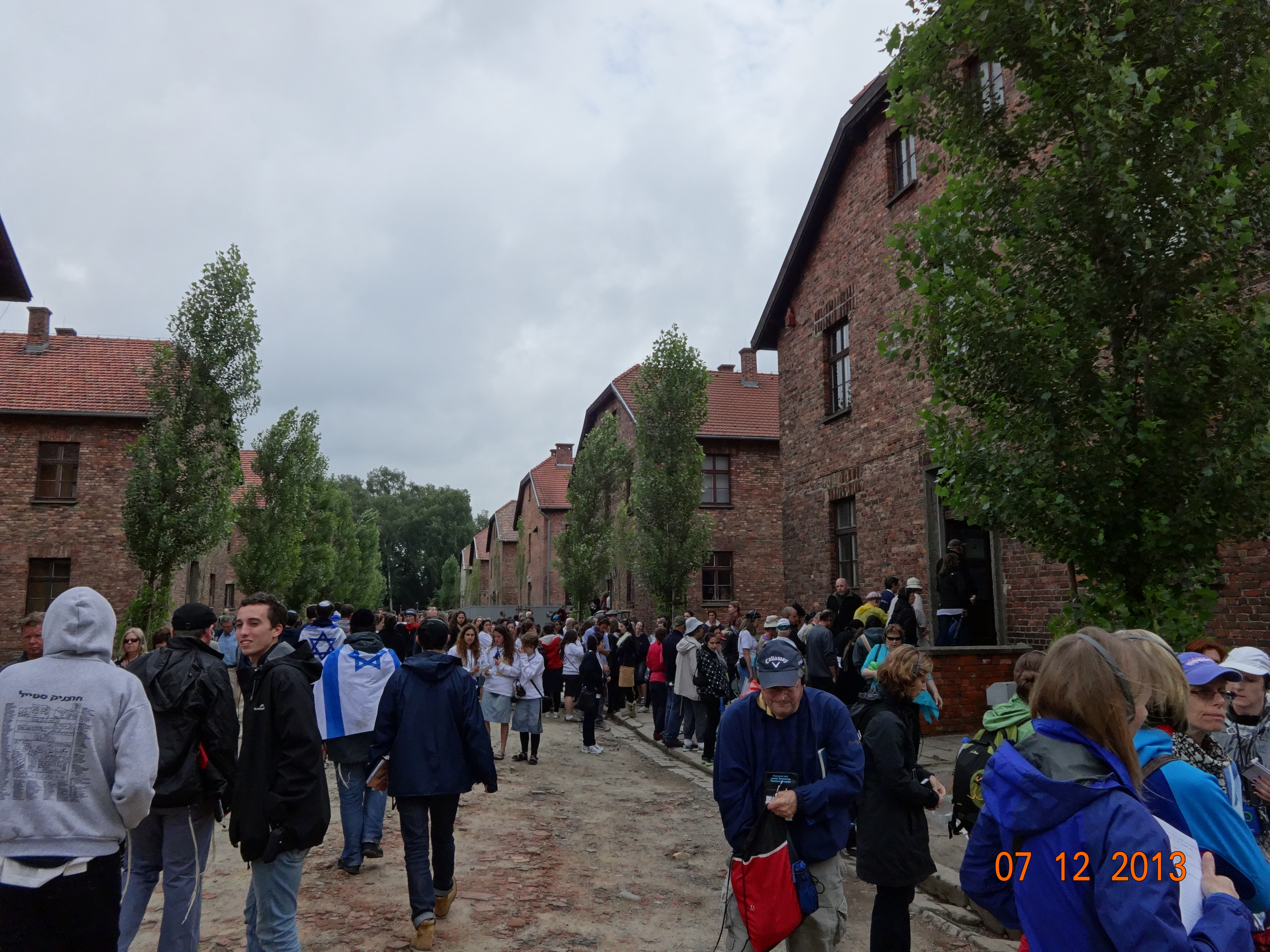
After the tour of Auschwitz I, we have lunch on the bus in the parking lot, then drive the three kilometers through town to Birkenau.

There it is. The entry tower. The iconic symbol of evil.

787

Main entrance to the Auschwitz-Birkenau extermination camp. USHMM

Main entrance to Auschwitz-Birkenau . USHMM

We follow the guide up the stairs in the tower. From here we can see the sheer vastness of the camp.

696


Women's Barracks. Auschwitz II.

Women’s Barracks. Auschwitz II.

Dozens of long narrow women’s barracks, brick, still stand, albeit some braced with wood on the gable ends to keep them from toppling until they can be re-pointed. A. indicates that historic preservation here is a major concern.


Vastness

Vastness

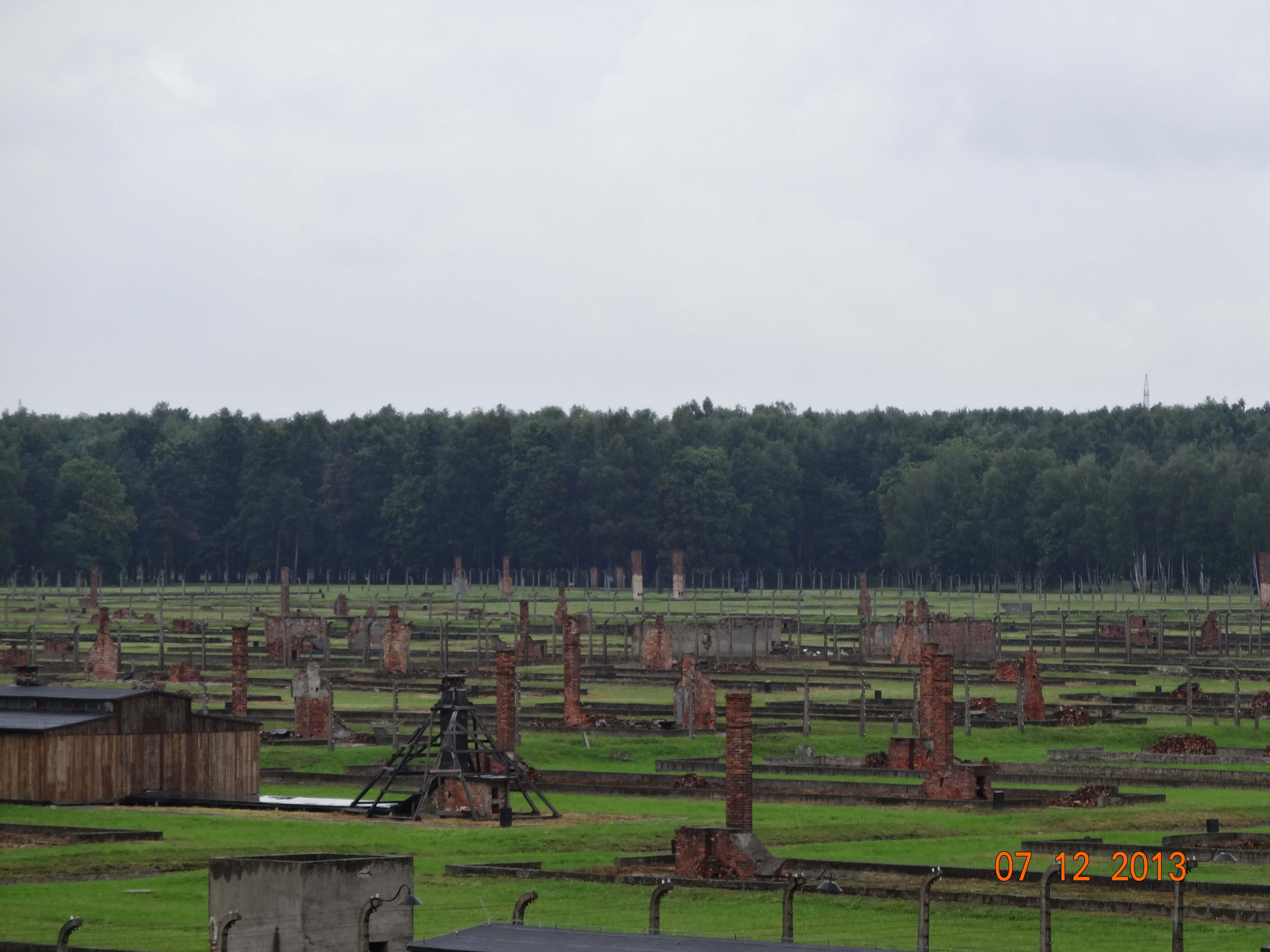
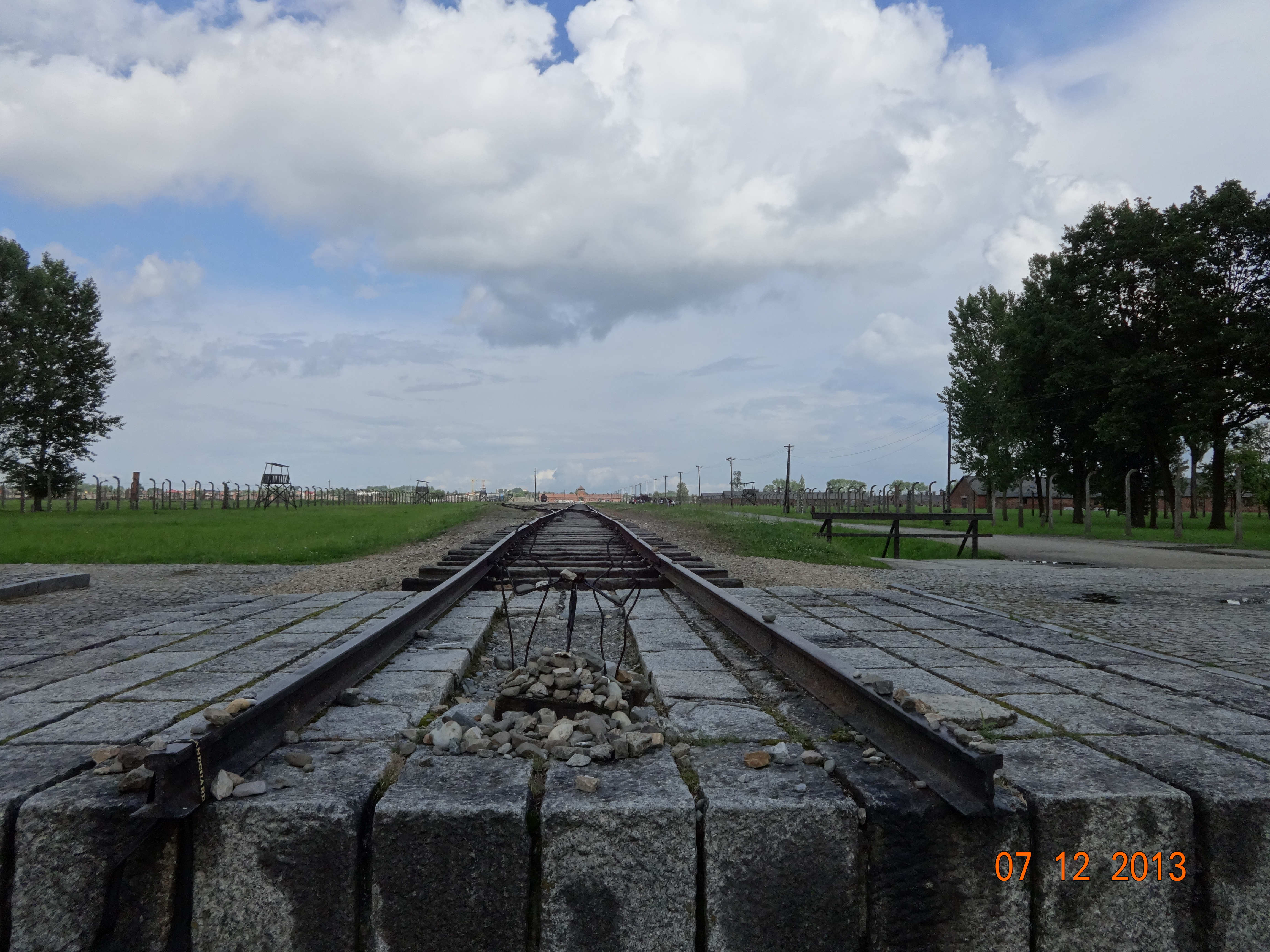
The rest of the camp is many square kilometers of row upon row of foundations and brick chimney stubs, surrounded by the menacing curved and tapered concrete concrete posts dotted with white insulators and strung with miles of parallel lines of barbed wire. In the summer of 1944, when hundreds of thousands of Hungarian families were deported here, the rail lines came right into the camp.

View of the Ramp at Auschwitz-Birkenau Showing the SS Selection of Hungarian Jews USHMM.

View of the Ramp at Auschwitz-Birkenau Showing the SS Selection of Hungarian Jews. USHMM.

View of the Ramp at Auschwitz-Birkenau Showing the SS Selection of Hungarian Jews, USHMM.

View of the Ramp at Auschwitz-Birkenau Showing the SS Selection of Hungarian Jews, USHMM.

Following the German invasion of Hungary in March 1944, over 400,000 Hungarian Jews  were deported and murdered at Auschwitz.


The Walk.

The Walk.

Our guide leads us along the path through the camp that leads to the gas chamber and crematorium. We walk in in silence along the roadway, the only sound the crunching of brick fragments and gravel underfoot.

Selected.

Selected.

The Walk.

The Walk.

707

It appears to have been paved with brick, slave labor, though in some spots it is hard to tell anymore. No one speaks, and on and on we walk. Two minutes. Five minutes. Ten minutes. Fifteen minutes. I’ve been on battlefields that are smaller than this site.


Flower ring as we make final approach to the chambers tucked into the wooded area nearby.

Flower ring as we make final approach to the chambers tucked into the wooded area nearby.

Finally we reach the end of the camp where the kitchens stood. A round concrete ring rises out of the earth, maybe 6 feet in diameter. Someone finally speaks and asks A. what it was. A giant flowerpot. She tells us also that they were placed near the entrances of the gas chambers. Flowers at the gas chambers.

Waiting. For what we do not know.

Waiting. For what they do not know. Exhausted from deportation and “travel”. We now know who they were. Yad Vashem.

We turn left, and keep walking past interpretative signage. It seems like we are walking outside of camp perimeter. But we are not. Beautiful woods appear and we are walking on the edge of the woods with the camp to our left. We stop near another sign and rest for a moment, allowing the others to catch up. Then our guide calls our attention to the photo on the sign, showing Hungarian mothers and children doing the same thing we are doing. Halting and resting.  And a short path through the woods will take us to the ruins of the gas chamber/crematorium Number Five.

They waited here. Some days, in the summer of 1944, for hours.

They waited here. Some days, in the summer of 1944, for hours.

We are resting at the spot they rested at, 20 minutes after walking, immediately after disembarking of overcrowded transports that had been traveling for days. Here they waited, anxiously, as their turn to approach the chamber would come. But the victims of the transport ahead of them had to be removed from the chamber first. Some days in the summer of 1944 these victims were backed up for hours.

I pick up a rock from the path and carry it with me past the ruins. At the ashfield there is more signage and a memorial asking visitors not to walk through the field. I place my stone on the memorial, looking down to watch where I step. But it is probably a futile gesture-this whole place is an ashyard, a graveyard.


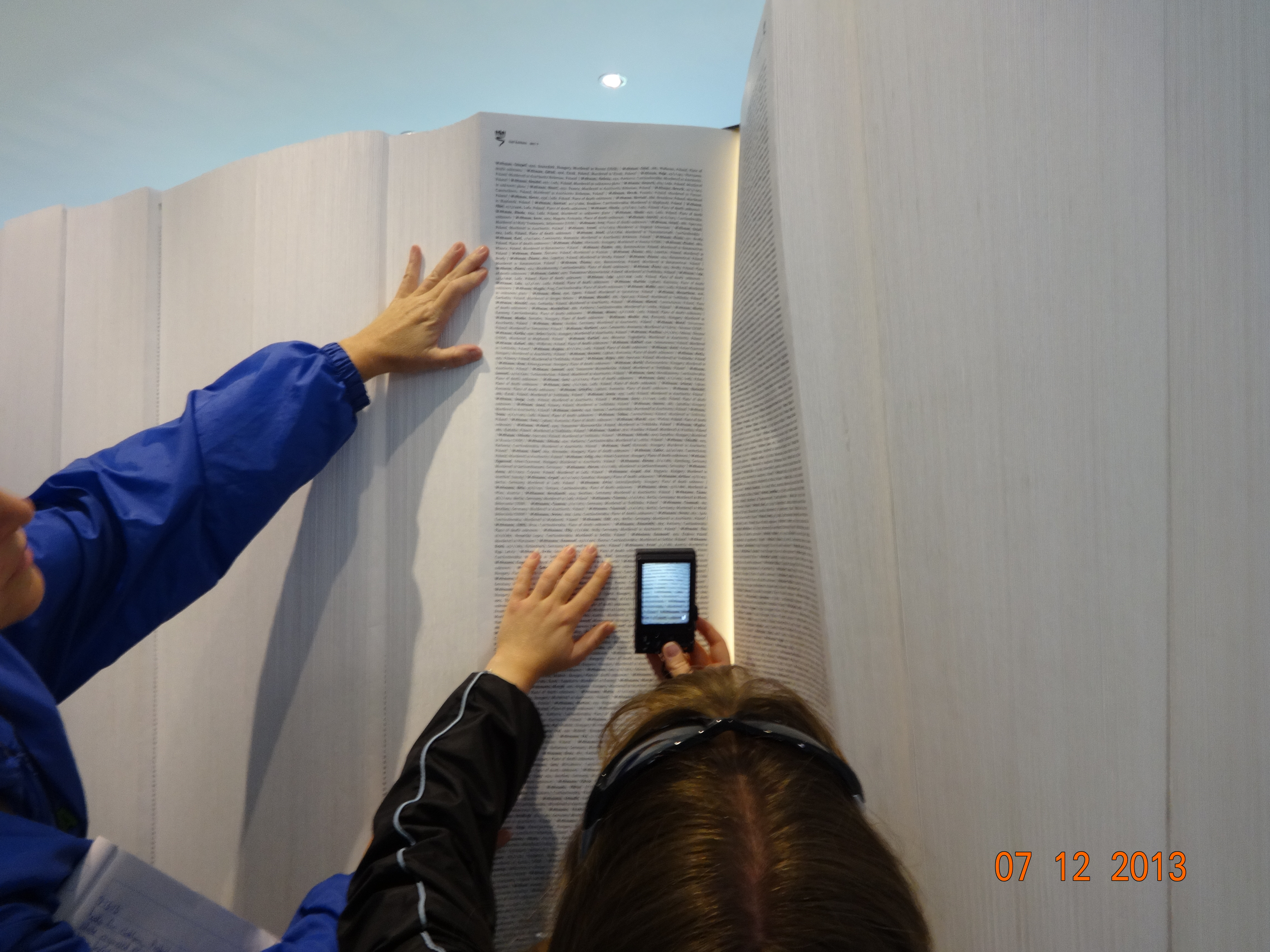
The secret sonderKommando photos. Where the bodies were burned in open air.

The secret sonderkommando photos. Where the bodies were burned in open air.

“So many Hungarian Jews were killed in the Auschwitz camps during that period that the crematoria were incapable of consuming all the bodies, and open pits for the purpose were dug.”

728

We turn again, and walk past the remains of crematorium Number Four. To the disinfection center for those selected to be worked to death. Again, a system. Disrobing. Wading through disinfectant. Shower. Uniform thrown at you, mismatched clogs or shoes.


E’s mother spent two years here. Her grandmother and the little ones were selected upon arrival. Her mom’s beloved sister was murdered in the quarry after slipping while carrying a large pot of soup in the ice and snow with three other girls. Today is a hard day. I want to comfort her, to carry her pack for her. I feel helpless. There is nothing I can do.

778

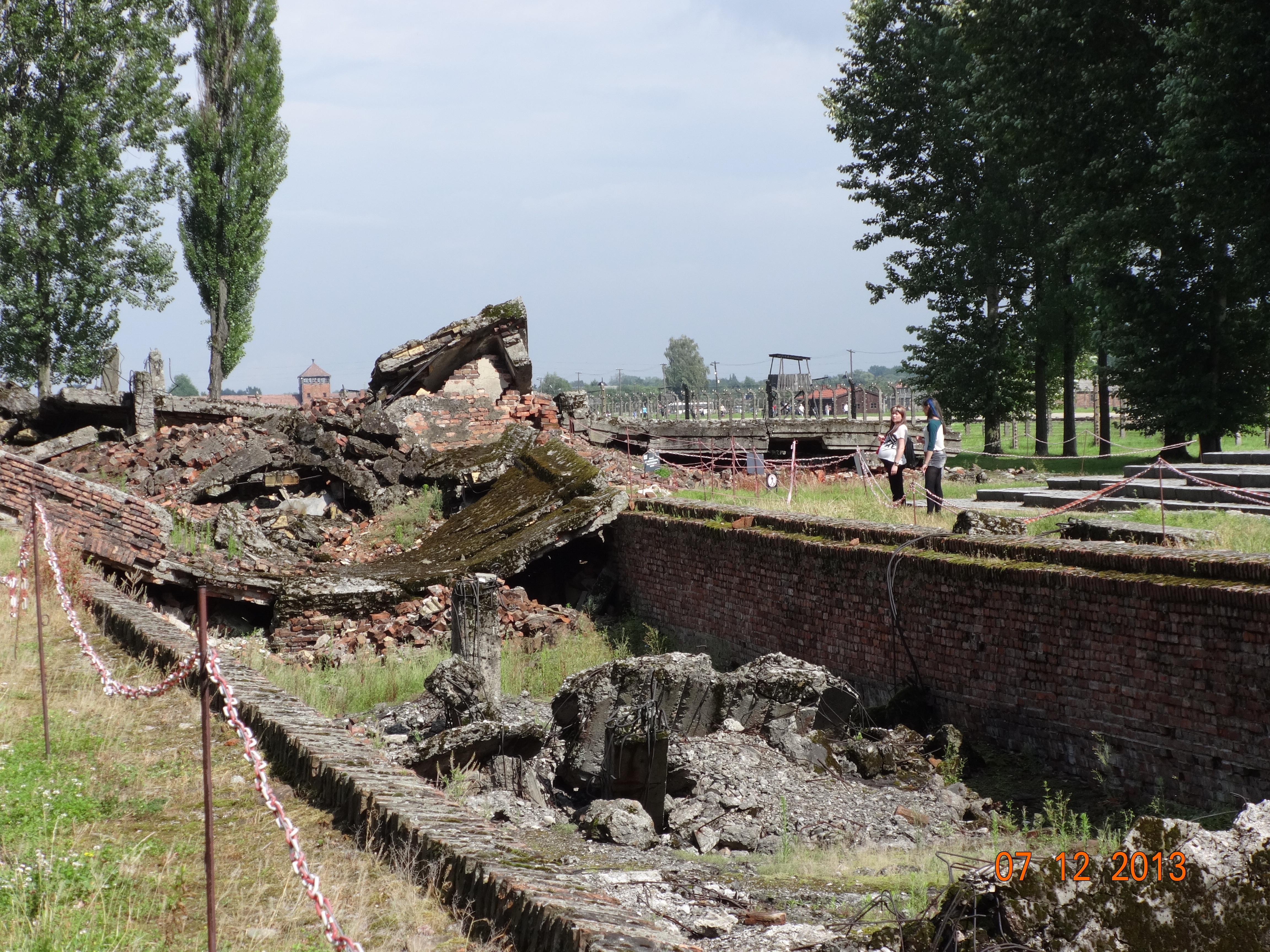
At the Soviet memorial constructed near the two destroyed gas chamber/crematoria at the end, we have a remembrance ceremony. Kaddish is recited in Hebrew. I read it aloud in English. With tears, E. tells us that she feels her grandmother smiling down on this extraordinary group of dedicated teachers. A lump rises, again. I swallow hard and try to blink back the wetness I feel welling in my eyes. Damn, I almost made it. Glad for the sunglasses, even though there is no sun.

770

775


772

776


“A Warning to Humanity.”

We light candles, turn our backs, and walk out, which provides another twenty-minute stretch of personal reflection. We have toured the epicenter of evil. We have been here, we try to process-but we just cannot. We need the individuals to speak to us. And like E’s family, they do.


738


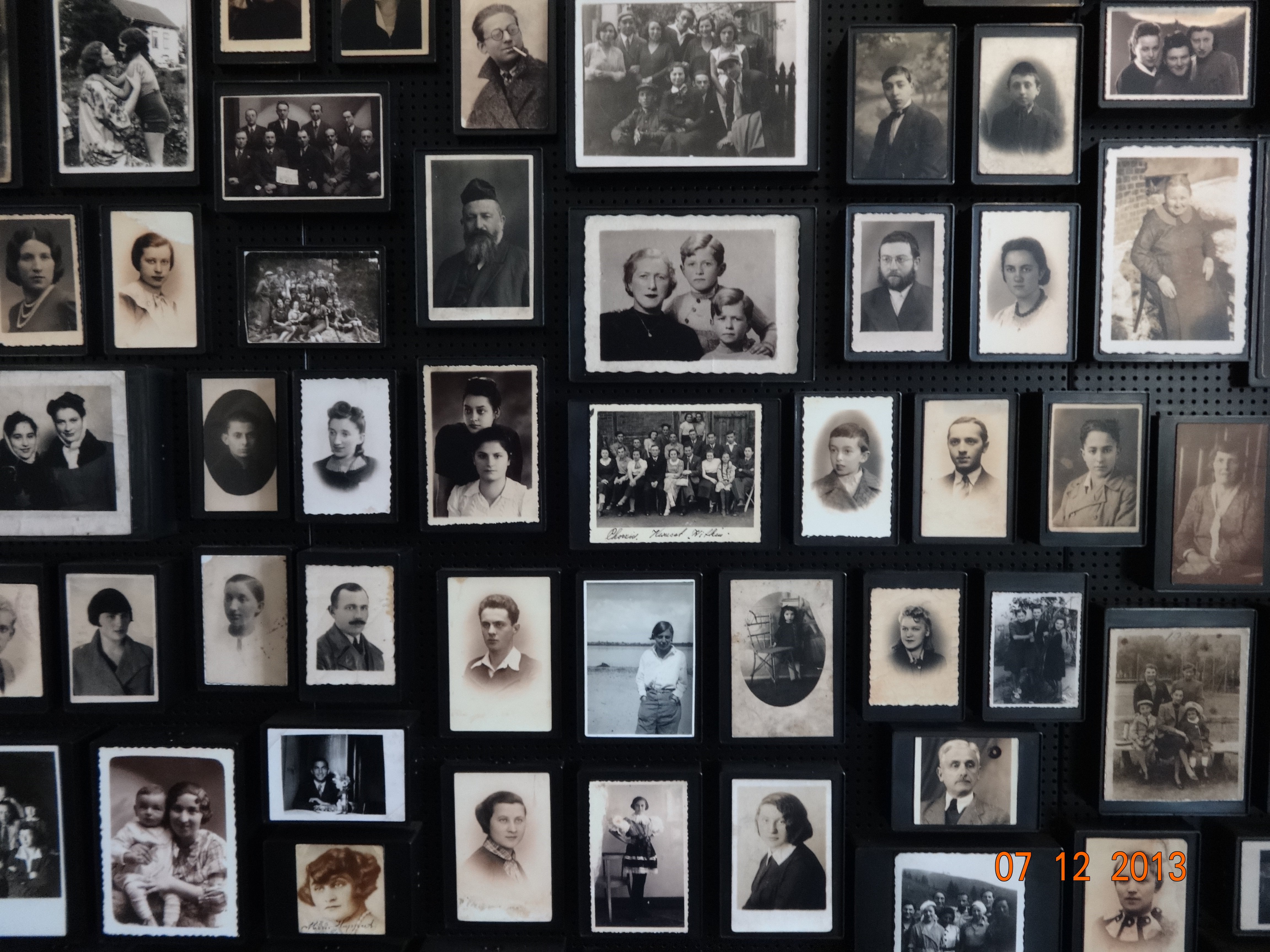
At the close of the disinfection center exhibit there are hundreds of photographs that had been discovered years after the camp was abandoned by the Germans. Pictures of loved ones who perished here.

For me, like the personal home movies of pre-war life for the victims at the exhibit at Auschwitz I, this is what has the most meaning. So I will leave you for now with a few close ups.

744

743

741

742

To Life.

To Life.

To Life.


Read Full Post »


~Matthew Rozell, a history teacher whose project reunited hundreds of Holocaust survivors with the American soldiers who liberated them, takes a backwards journey to the authentic sites of the Holocaust, retracing the path of the survivors who are now his friends.~


A year ago I took one of the most transformative journeys of my life, with 24 fellow educators, to study the Holocaust and the Jewish resistance to it, in Washington, DC, Germany, the Czech Republic, and Poland. I kept an extensive diary and took tons of photographs. And contrary to many assumptions, it was a journey that led to profound understandings about life, not death.  For the next several days, I have decided to go back and retrace my steps and try to process what unfolded for me.


****************************

July 12.

So the day that many of us approach with a bit of apprehension is finally here. We are on the bus from our hotel in Cracow to Auschwitz, about 40 miles to the west south west.

Yesterday we arrived in Crakow from Prague, taking the night train on a sleeper car.

790

Rolling southward one of our tour leaders points out an impressive large building on the top of a hill that looks like a five star hotel. Built after the German invasion in 1939, it was a rest and relaxation villa for Wehrmacht officers rotating off the Russian front to unwind for a bit, as industrialized mass murder was unfolding every single day less than an hour away.


Hocker Album- Dr. Josef Mengele, Rudolf Höss, Josef Kramer, and an unidentified officer. —USHMM

Hocker Album- Dr. Josef Mengele, Rudolf Höss, Josef Kramer, and an unidentified officer. —USHMM.

So, to introduce some of the major players:

I don’t make it a habit to showcase the perpetrators on this site, but in this one incredible photograph, taken at Auschwitz, you can see some of them above. Hoss was hung at Auschwitz  following his trial after the war. Kramer was executed by the British after his stint presiding of the horrors of Belsen after his transfer there. Of course, smiling Dr. Mengele escaped to Argentina and died in a drowning accident in the late 1970s.The pictures in this photo album surfaced only a few years ago and were studied by my friend archivist Rebecca Erbelding at the United States Holocaust Memorial Museum. You can read more at the weblink above if you like.

On to the tour.


638

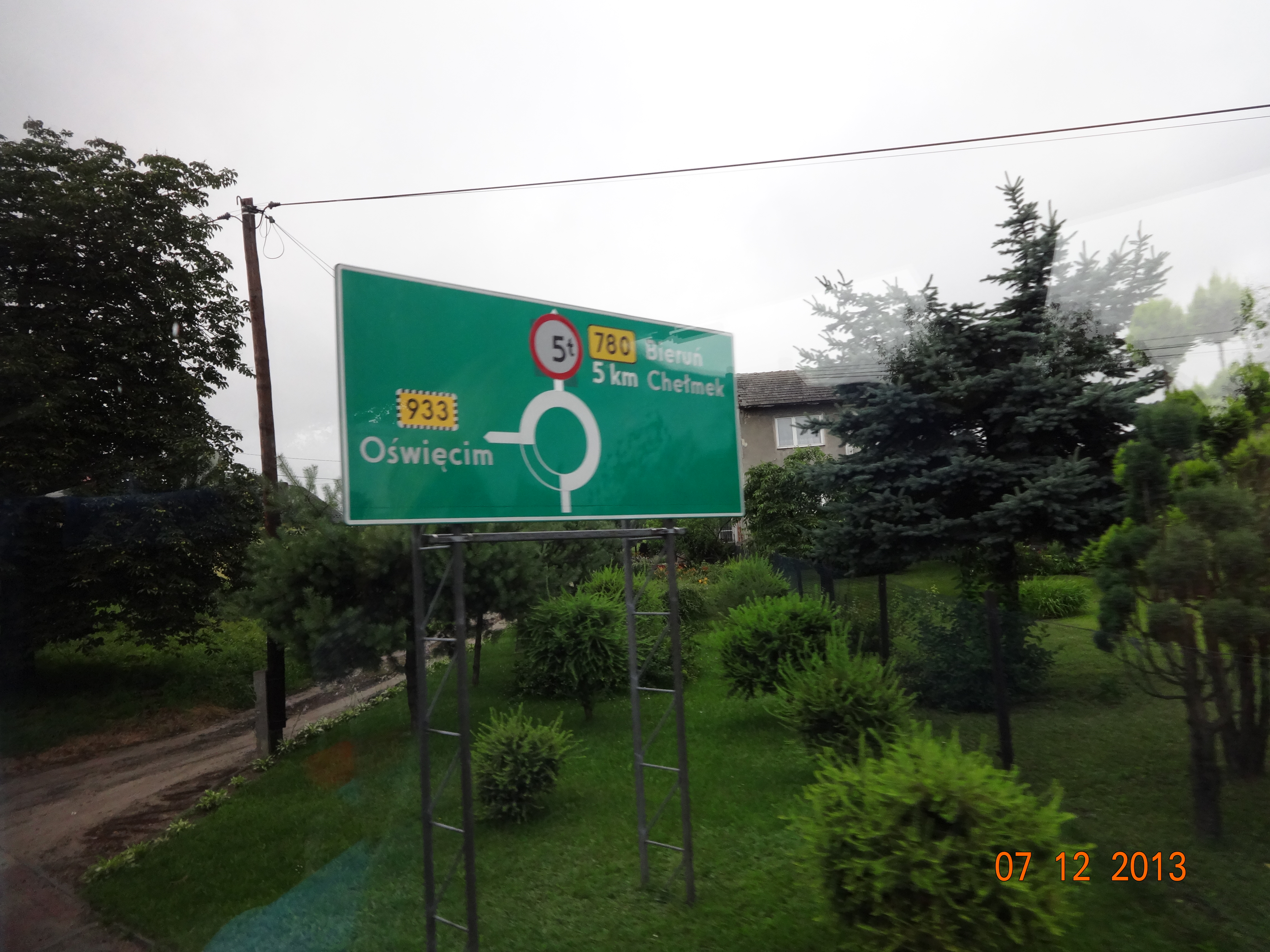
Soon we see the road signs for Oswiecim, the small Polish town at a railroad hub that has become one of the most visited tourist sites in Poland. Most of the world knows it by its German name-Auschwitz.

The bus lumbers into the overcrowded parking lot and docks in the slot. The driver kills the engine. And it begins to rain as our other leader, E.,  relates the story of her mother’s family, the idyllic childhood in this beautiful prewar country, a young teen when the nation is invaded, the oldest of four children. No one on the bus makes a sound. It is now raining very hard.


643

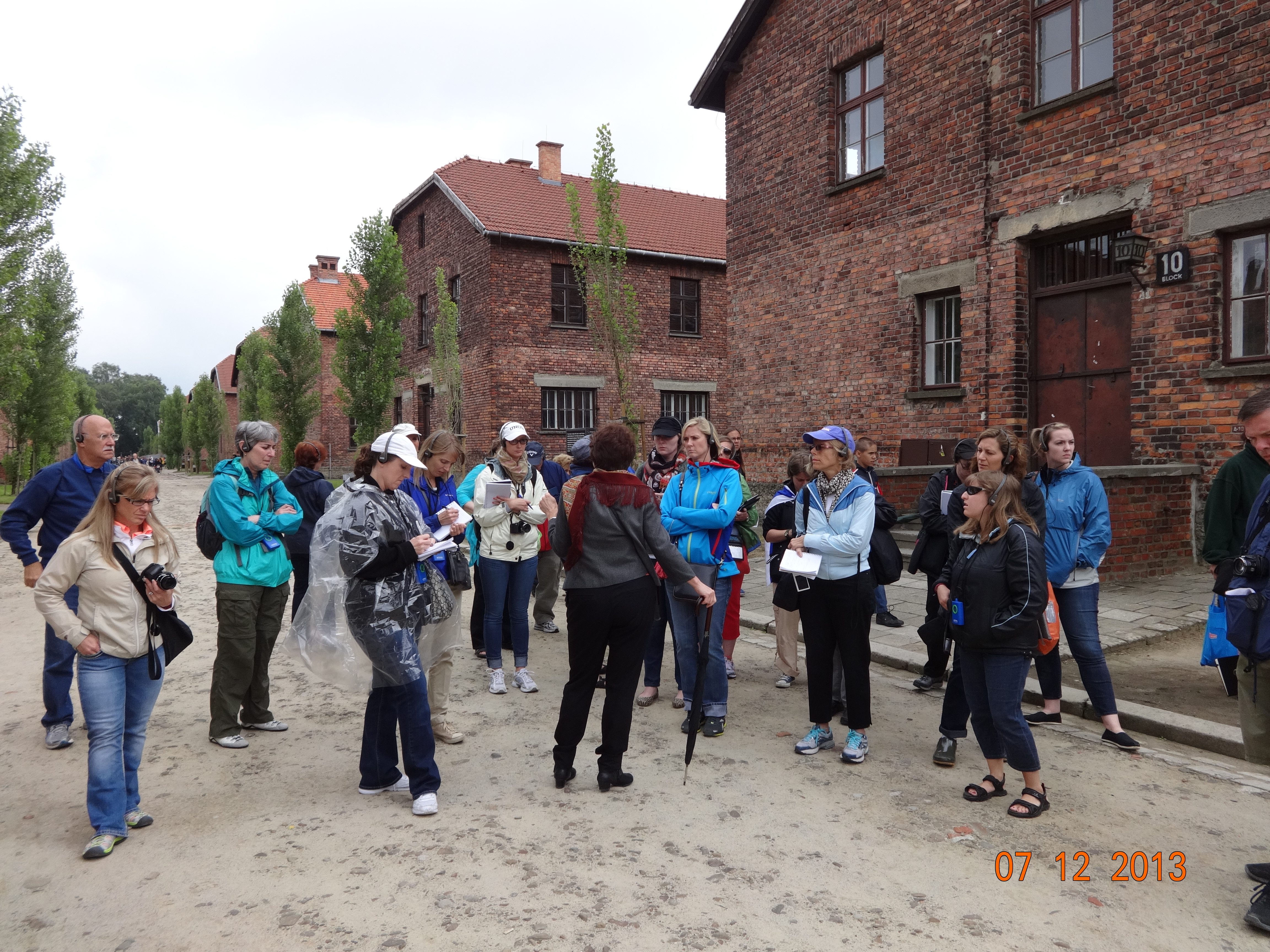
What is this place? Our guide A. is a top notch scholar, and she leads us on a day long tour that is hard to put into words.

660

We begin at Auschwitz I, the first camp. This place is centrally located, a railway hub dating back to the turn of the century.

678

The first prisoners, after it is converted from a Polish military facility, are Soviet POWs and Polish prisoners and other “security risks” who will be worked to death slowly expanding this camp, and the much larger Auschwitz II-Birkenau. She walks us through the exhibits and the displays at the various blocks. Block 4 is the “Extermination Exhibit”. We think about the words, the language. Extermination- as if the victims were vermin. Over 1,100,000 were killed here, most of them Jews.

The Hub. The tentacles during the Holocaust.

The Hub. The tentacles during the Holocaust.

We see the map with the spiderlike rail lines radiating inward to Auschwitz like tentacles, from northern Poland, from Germany, Hungary, as far south as Greece and as west as Paris and the Netherlands. In the summer of 1944, tens of thousands were murdered here, per day.


This place is ALWAYS crowded.

This place is ALWAYS crowded.


We see again the large scale terra cotta model of the process, which the German engineers had perfected  at Auschwitz II-Birkenau- the arrival of the transports, the undressing rooms with signs admonishing bewildered people to hang their belongings carefully and to remember the number of the wall pegs where they left them for quick retrieval later. The shower rooms that could fit in some cases entire transports, which were in fact the hermetically sealed gas chambers. The Germans above with their gas masks, waiting for the proper temperature to be reached through body heat, just the right humidity to be achieved before dropping in the pellets so the gas released would work more effectively. The anguished death throes of the thousands of naked figurines assault our senses. The process is not complete until the corpses are carried out by the sondercommando slaves, defiled for any gold fillings, the hair shorn from the women, the bodies then burned in the open air behind or cremated in the ovens.

676

But the tour is now just beginning.  Minutes before, we were looking at a terra cotta model. And now in Block 5 we will be presented with the evidence. This is an exhibition, after all. Exhibit A is about to slap us in the face. Hard. It is a room, 50 feet long, with nothing but human hair piled several feet back and as many feet tall. My heart skips a beat.

What are my eyes perceiving? Now we see a photo of stacks of bale bags, carefully labeled, packed and stacked, awaiting shipment back to the Reich for use in various products for the German war effort. Slippers for submariners so they can walk quietly aboard ship to evade Allied sonar. Stuffing for the seats of German pilots.

We shuffle on in silence with hundreds of others past the spectacles, the pots and pans, the suitcases carefully labelled by their owners with chalk on the orders of the perpetrators, again, for “quick retrieval”. And the shoes. Sorted. Case after case of women’s shoes. Men’s footwear. And then the children’s shoes.

665

Our knowledgeable guide takes us into Block 27, the new exhibit on the Shoah. This is a temporary relief of sorts as now we see faces, film and stills, of pre war Jewish life, projected on the walls. We hear songs and voices.

Book of Names. people cry again.

Book of Life. people cry again.

At the end is the Book of Life, containing four million names compiled thus far. A moving moment when E. and others in our tight knit group find entire pages with the names and dates of family members murdered during the Holocaust.

657


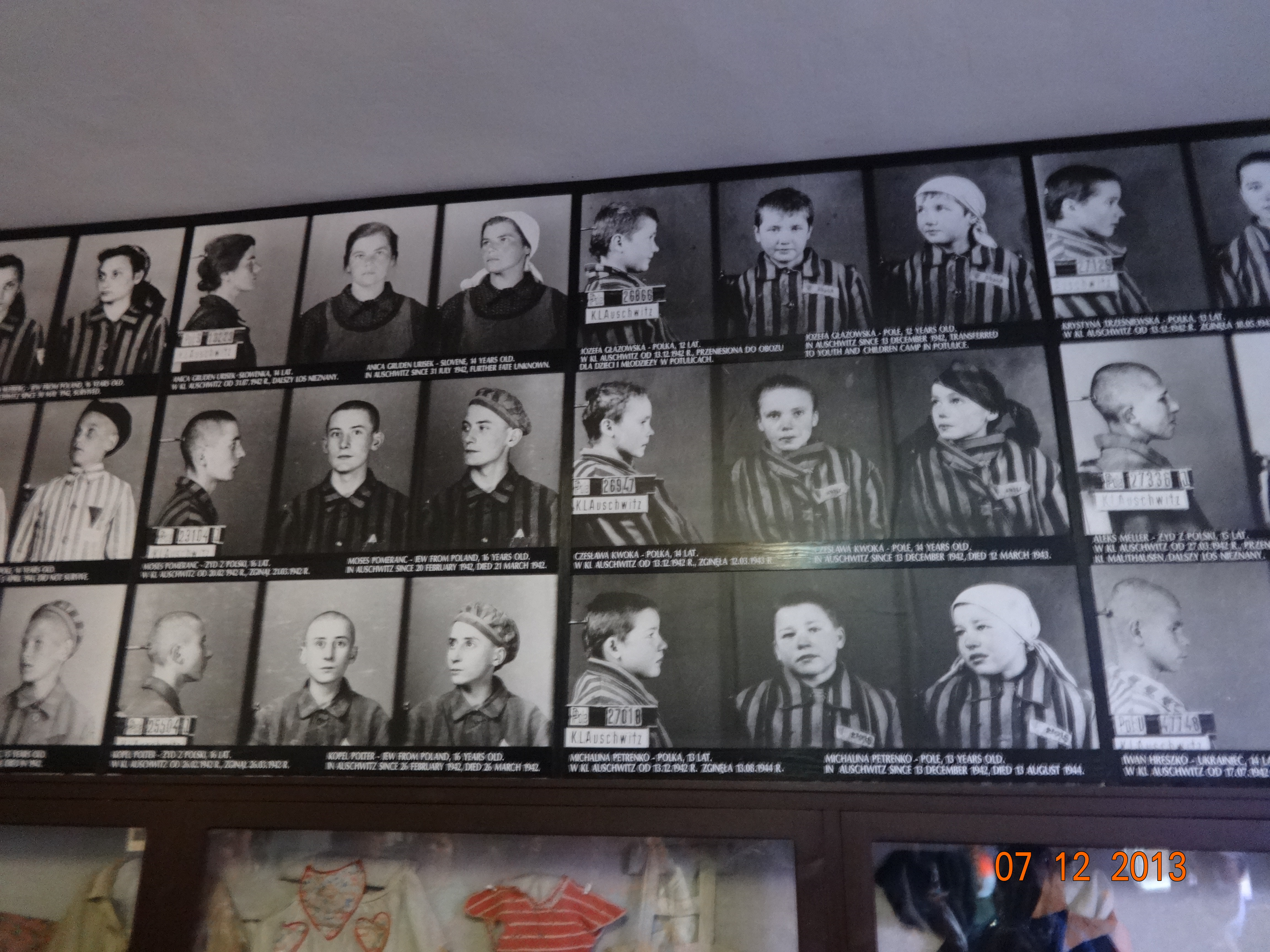
Girls. Shorn, beaten,  and photographed.

Girls and boys. Shorn, beaten, and photographed.


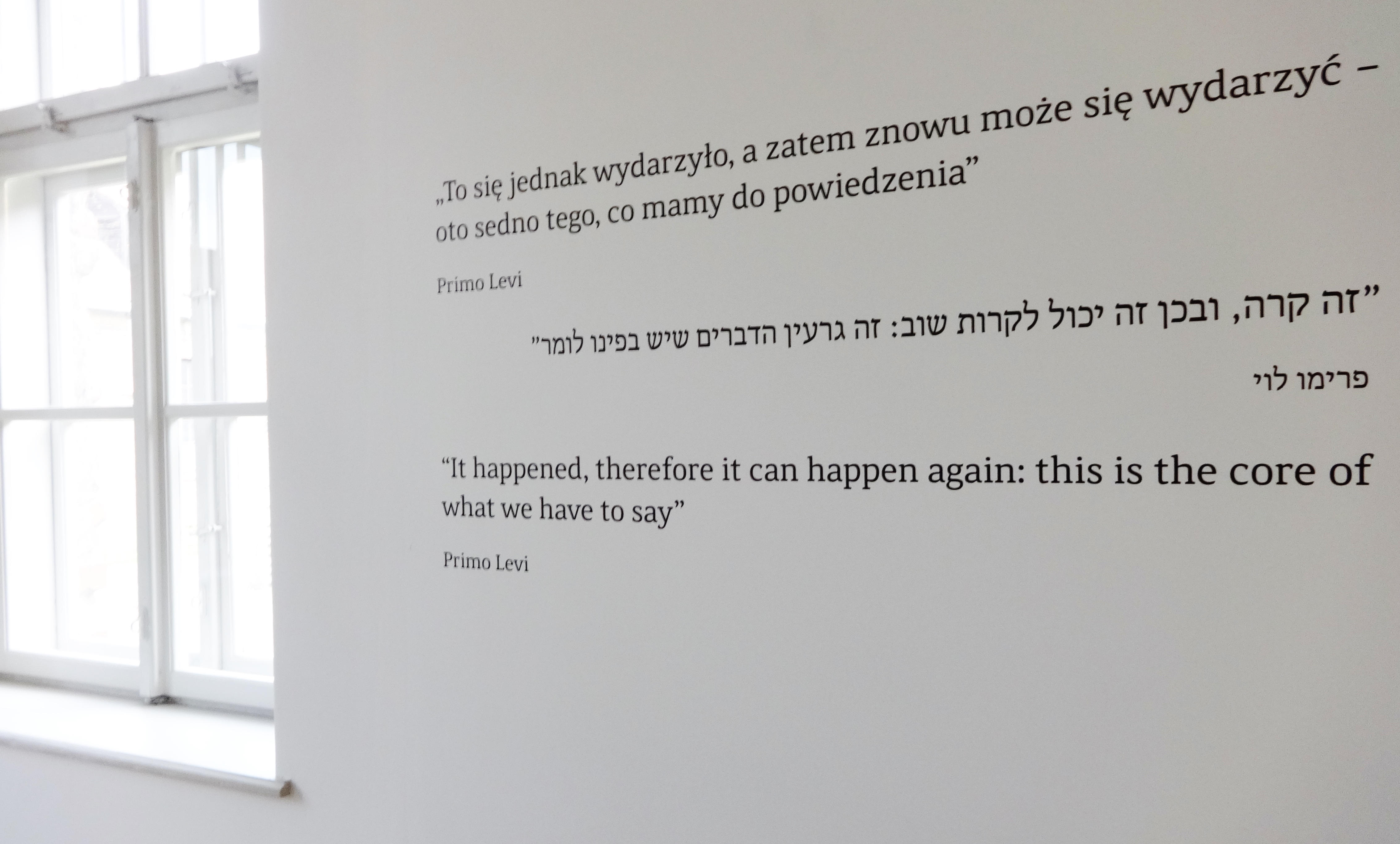
This is the Core.

This is the Core.


And now it is on to Auschwitz II-Birkenau.


Read Full Post »

A year ago I took one of the most transformative journeys of my life, with 24 fellow educators, to study the Holocaust and the Jewish resistance to it, in Washington, DC, Germany, the Czech Republic, and Poland. I kept an extensive diary and took tons of photographs. And contrary to many assumptions, it was a journey that led to profound understandings about life, not death.  For the next several days, I have decided to go back and retrace my steps and try to process what unfolded for me. Not weighty tomes, but maybe a picture and a note from the diary.

************

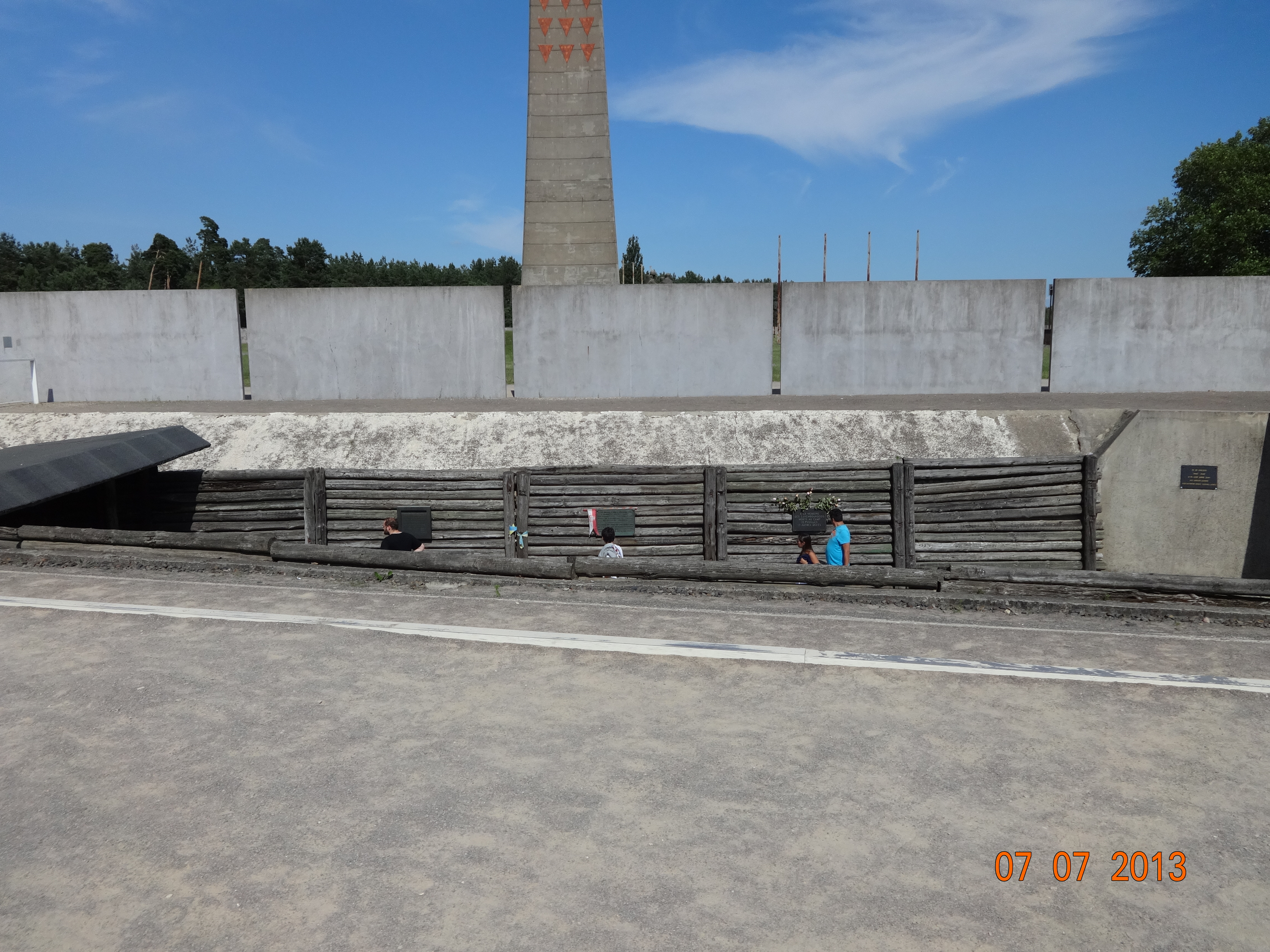
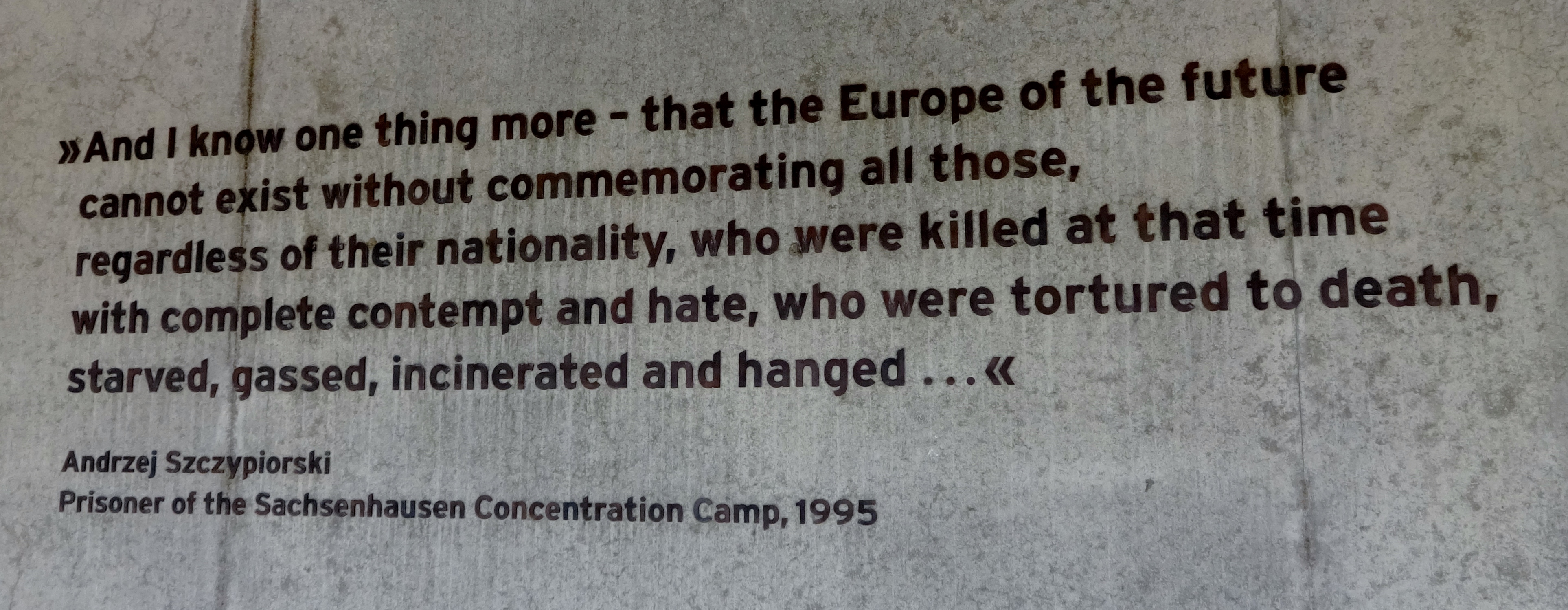
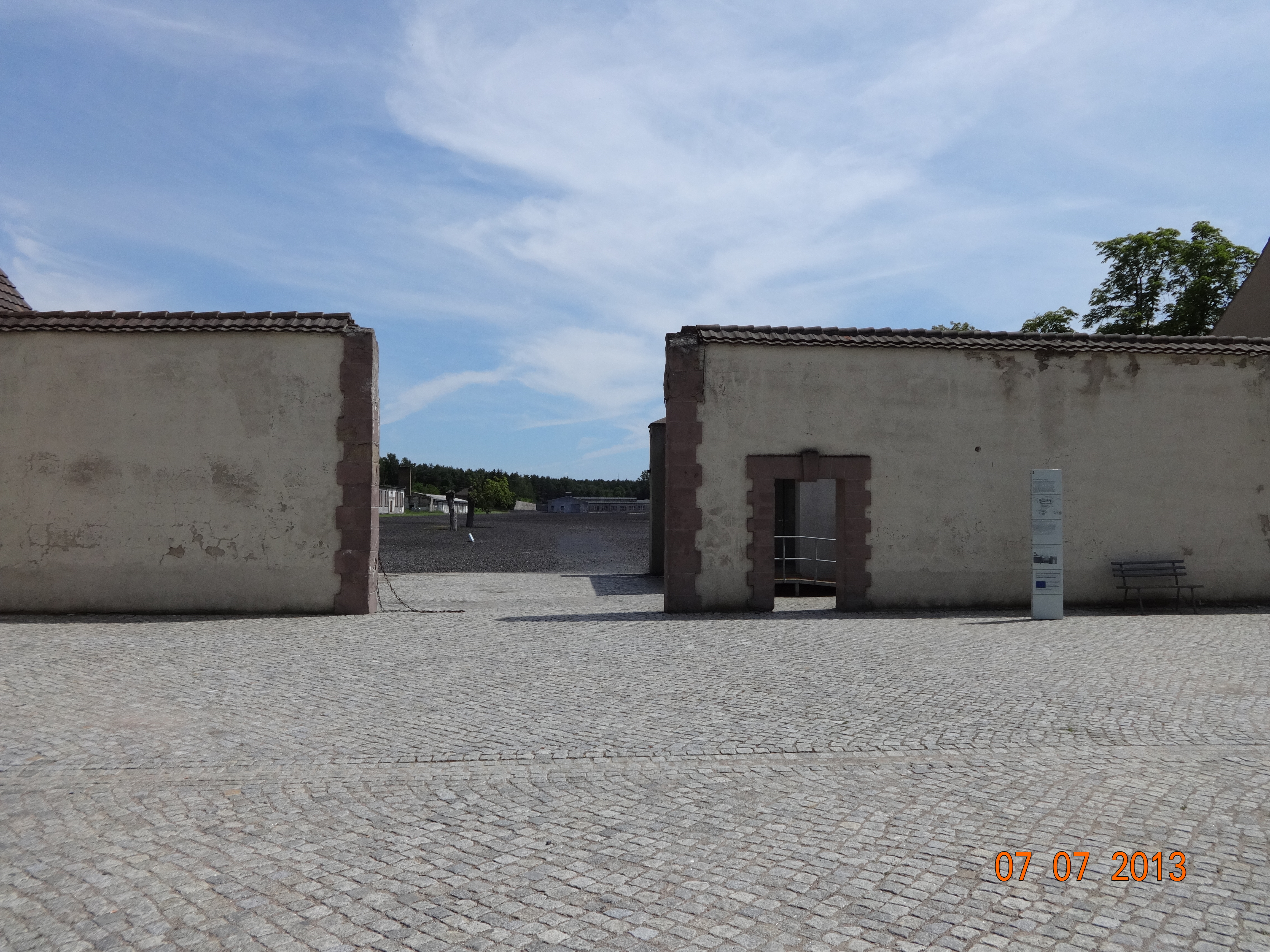
We followed our visit to Ravensbruck with a visit to Sachsenhausen, though Sachsenhausen was known earlier by the name of the nearby town as Oranienburg,  the model SS camp built between 1936 and 1938, an SS military training facility. Here also was the headquarters for the Inspectorate of Concentration Camps, the closest to the center of power, about 40 km outside Berlin.

Classroom at Sachenhausen.

Classroom at Sachsenhausen.


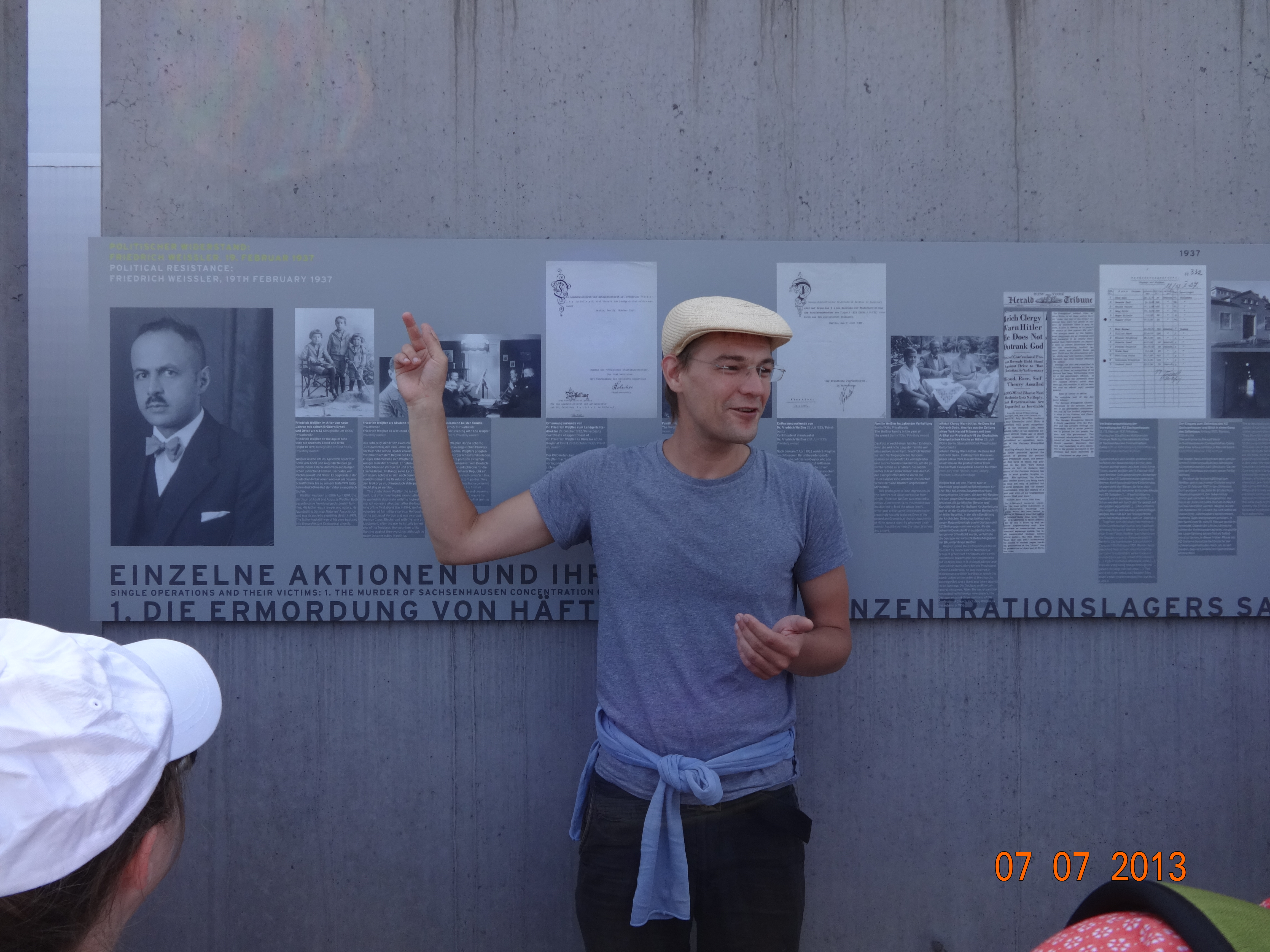
Our historian/guide at Sachsenhausen, Martin S.

Our historian/guide at Sachsenhausen, Martin S.

We have another passionate young German historian-Martin S. In March 1933, Oranienburg became one of the first KZ-Konzentrationslager, or concentration camp. Due to its proximity to the capital of the Reich, local political opponents were held here. As a simple matter of natural progression, the Gestapo would also shoot political prisoners here in the “shooting pit.”

The shooting pit at Sachsenhausen.

The shooting pit at Sachsenhausen.

After the invasion of the USSR, Sachsenhausen was used to murder Soviet POWs as well. In the infamous”neck shot facility”, over 10,000 were murdered in ten weeks in 1941.

Shooting barracks at Sachsenhausen, for Soviet POWs.

Shooting barracks at Sachsenhausen, for Soviet POWs.


Here, crematoria were developed, and vast shipments of stolen property from the East were later unloaded and warehoused. A brick factory was opened, making bricks for “GERMANIA” to be used in the new Reich construction in Berlin. Life expectancy there was six to eight weeks.

Here, also, scientists and engineers tested gassing vans and facilities. Doctors experimented on live subjects. Always testing. And as we know, major corporations had their hands in it as well, profiting from the slave labor that left the camp each day and were paraded through the surrounding community.

After 1936, authorities toned down the visibility/profile of the camp, due to the sinister application of state policy. But again, nearly 200,000 persons passed through the camp gates. Is it hiding in plain sight?

431

Or do we, as neighbors, simply turn away?

And, nearly eighty years on, why do American educators spend a good chunk of their “vacation” absorbing such new knowledge?

The persons on this trip know why.


Read Full Post »

Ravensbruck.

Ravensbruck.

A year ago I took one of the most transformative journeys of my life, with 24 fellow educators, to study the Holocaust and the Jewish resistance to it, in Washington, DC, Germany, the Czech Republic, and Poland. I kept an extensive diary and took tons of photographs. And contrary to many assumptions, it was a journey that led to profound understandings about life, not death.  For the next several days, I have decided to go back and retrace my steps and try to process what unfolded for me. Not weighty tomes, but maybe a picture and a note from the diary.

****************************************

We have visited a lot of sites in Germany since Bergen Belsen-in Berlin, the Wannsee Villa, where preliminary plans for the “Final Solution ” were signed off on after a one day conference, the Memorial to the Murdered Jews of Europe in the heart of the city, the Reichsbahn train platform, Track 17, where the Jews of Berlin were deported almost everyday for nearly two and a half years. We also visited Ravensbruck and Sachenhausen.

Ravensbruck.

Ravensbruck.

Ravensbruck is a couple of hours north of Berlin, in the former East Germany. It is notable for many reasons, probably first that it was a camp for women, and also a training faculty for SS camp guards-3500 women guards were trained here, and about 500 were in service. 130,000 women prisoners passed through here, and towards the end of the war, another 20,000 men.  No barracks are standing today, the houses for the SS leadership remain just outside the camp wall, where they lived with their families. Each day the camp gates would open and thousands of prisoners would stream out into the community for their slave labor assignments. Kind of hard to hide it from the kids. I suppose the attitude was that it was difficult, distasteful work, but the kids had to realized that it had to be done for the wonderful world that they were creating for the children’s future.

Immediately after the war the barracks were dismantled and given to refugees who had fled the Eastern

Matthias H our guide. Photo by Alan Bush.

Matthias H our guide. Photo by Alan Bush.

Reich as it collapsed. Some are still used as houses today. The SS women guard barracks is used as a youth hostel education center today. They have a program where survivors interact with the kids for about 4 days, and sleep here at night. Our guide is the historian Matthias H. at the Gedenkstatte (Memorial). He appears to be in his early 40s and is passionate and knowledgeable, as are all of the German historians I have met thus far. Here are some of his observations that strike me the most:

In his opinion, the majority of Germans supported the master race theory. What disturbs him today is that in his opinion, few Germans today seem conscious of this. It is a very complex topic. The historians talk about the mass crimes, and in Matthias’ words, they work on thin ice. The responses range from some people wanted to know more- after all, many of them learned nothing about it from their teachers, many of whom were bystanders or even perpetrators. Some quietly deny the extent-but I have found that as you study it, you learn how vast and almost unbelievable it is in scope. Others, are tired of the topic- “yes, it happened, so what, enough…”

For Matthias, herein lies the greatest danger. It is important to have the past in front of you- NOT in the back of one’s mind, as one moves forward. The lesson may be simply how to “behave” , not just for Germans but for everyone.

Ravensbruck. Prisoners' gate on left, SS on right.

Ravensbruck. Prisoners’ gate on left, SS on right.

He walks us through the main camp entrance, where thousands of prisoners would pass everyday, explaining that for years he would avoid the single door entrance that the SS guards used-until one day a survivor he was leading on a tour walked through it, to symbolize her victory at this place.

He notes a few additional stories. Survivors corroborate that when new SS female guard recruits would come for training, initially they do not know how to deal with the new job. Industries wanting slave labor must send their own guard recruits, too.  They are not kind, but they do not seem possessed with the will to carry out this abhorrent work. Former prisoners would say that always within about two weeks new staff would have overcome the “cognitive dissonance” that would allow them to do their job without compassion. They become “hardened” and “get over it”.

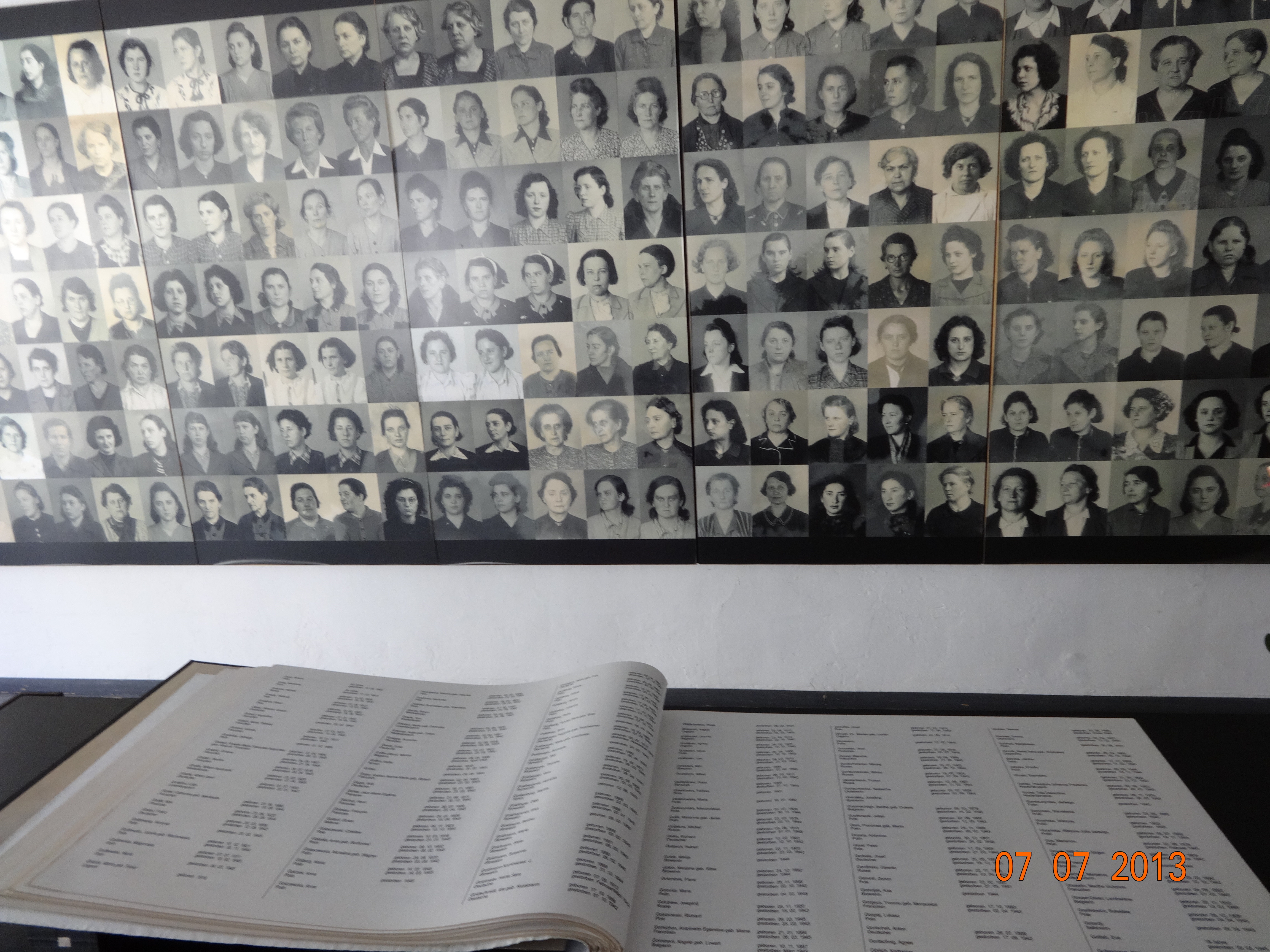
Book of Names. Faces.

Book of Names. Faces.

Ravensbruck was built for 3000 prisoners. At its height it held 35,000. 30,000 were killed here. In the beginning the SS does  NOT want women with children in the camp. But as more and more territory is overrun, the camp swells. After the Warsaw Ghetto uprising in 1943, there are hundreds of pregnant women. Some are forced to abort; as numbers well, women give birth and the babies are taken to a “hospital” where they slowly starve to death. The crematorium works nonstop. Ash piles are created and dumped into the nearby lake as the Russians close in. When the camp is overrun by the Red Army, 2000 women and 2000 men, mostly too infirm to be death marched out of the camp, are found, but not before the Germans had installed a small operating gas chamber, where 5000 Hungarian women were murdered in 1944.

I think that the following story resonated the most with me as an educator of young people.

The butcher’s son delivered fresh cuts of meat nearly daily to the SS mess hall, which still stands. Late in life, the old man tells Matthias of his feeling as a young teen-going through the camp gates to deliver the meat, seeing the emaciated and foul smelling prisoners, and believing fully all he has been taught- that these people are indeed subhuman, vermin to be eliminated. It’s true. Just look at them. Just smell them. Disgusting. Everyday it is the same. They even march through the town to the labor sites. Best to keep a distance from them.

It’s the same until one cold morning when a new transport of women arrive-stripped naked, healthy, humiliated, shivering, crying, shocked, trying to cover themselves in the plaza. Now it is his turn for a shock. These are not subhuman, but girls his age and older, in distress.

And they are naked. He has probably never even seen his mother or sister undressed before. And it is at this moment that he realizes that his teachers and the adults in his life are wrong- that what he is witnessing is a crime. And now perhaps sixty years later he unburdens himself.

Finally, a survivor, Annika, recounts that the Scandinavian Red Cross appeared in the weeks before liberation and in the presence of these new people, the women stroke their hair (as it is growing in again after being shorn off) trying to make themselves presentable. As she is evacuated over the Danish border, something strange happens. People are crying at her miserable condition. At every stop, they crowd around tearfully, and want to help… What is this? Traveling through the towns in Germany, she recounts, no one cried. No one helped. To date, says Matthias, no former German perpetrator has shown remorse for his/her wartime behavior.

The bystanders probably included most of the victims’ neighbors and acquaintances, and certainly most of the townspeople where the crimes were perpetrated,  of thinking age.

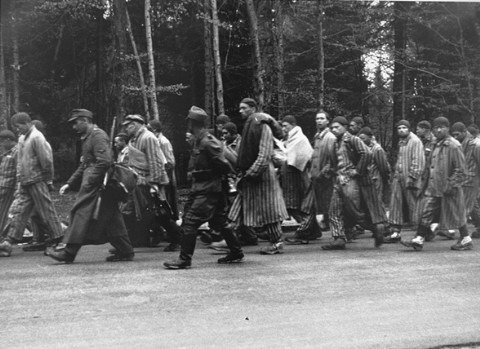
Prisoners on a death march from Dachau move towards the south along the Noerdliche Muenchner street in Gruenwald. German civilians secretly photographed several death marches from the Dachau concentration camp as the prisoners moved slowly through the Bavarian towns of Gruenwald, Wolfratshausen, and Herbertshausen. Few civilians gave aid to the prisoners on the death marches. Germany, April 29, 1945.  — KZ Gedenkstaette Dachau. USHMM

Prisoners on a death march from Dachau move towards the south along the Noerdliche Muenchner street in Gruenwald. German civilians secretly photographed several death marches from the Dachau concentration camp as the prisoners moved slowly through the Bavarian towns of Gruenwald, Wolfratshausen, and Herbertshausen. Few civilians gave aid to the prisoners on the death marches. Germany, April 29, 1945. — KZ Gedenkstaette Dachau. USHMM

But they all knew.

That for me is one of the axioms that will come out on this trip. But, suspending judgment- we were not there ourselves and placed in that position-we have a lot to think about.

But we must think about this too-Hitler never murdered anyone by himself.

The lake at Ravensbruck, where ashes were dumped.

The lake at Ravensbruck, where ashes were dumped.

Read Full Post »

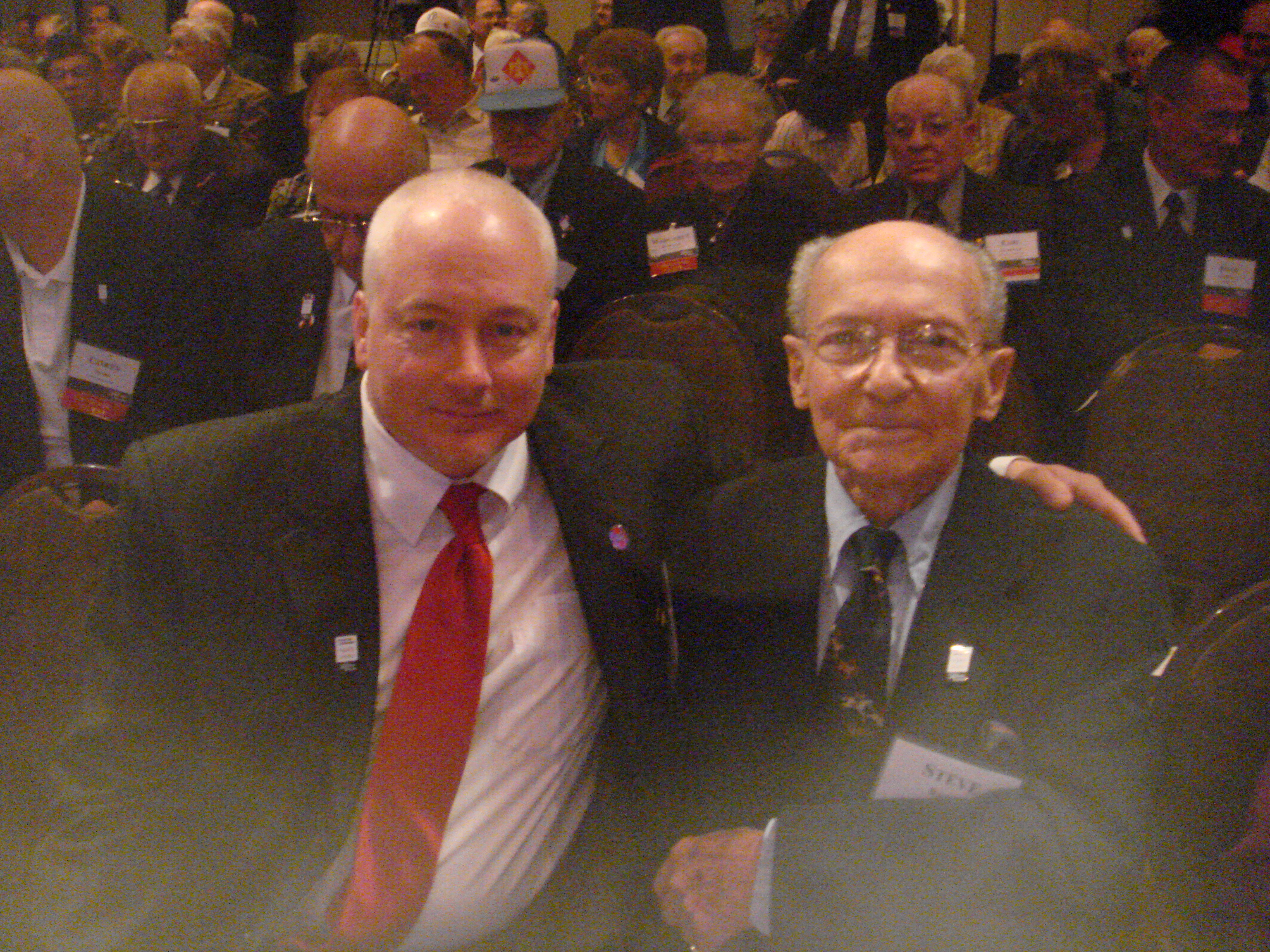
Matthew Rozell, Stephen Barry, National DOR Ceremony, Washington, DC April 2010. This photo was taken the day after the 65th anniversary of Steve's liberation in April 1945. We had just been honored by the director of the United States Holocaust Memorial Museum before the national ceremony in the Capitol Rotunda.

Matthew Rozell, Stephen Barry, National DOR Ceremony, Washington, DC April 2010. This photo was taken the day after the 65th anniversary of Steve’s liberation in April 1945. We had just been honored by the director of the United States Holocaust Memorial Museum before the national ceremony in the Capitol Rotunda.

So, the ripples continue. Somebody said it was like pebbles being tossed into the still water. This may sound strange, but I am keenly aware of the cosmic element. We tripped the wires of the cosmos.

~”It’s not for my sake, it’s for the sake of humanity, that they will remember”~

I got a nice email  recently. My friend Steve Barry was honored Tuesday evening at the United States Holocaust Memorial Museum. Steve’s daughters wanted me to know that his family made a donation in his name and set up two fellowships for scholars at the USHMM in the Stephen B. Barry Memorial Fellowship. His girls mentioned me in their speech Tuesday night in Washington. Thanks ladies. You know he was a hero. He reached out and touched an awful lot of students in the short time that we were together.

Steve will be one of the persons who will be featured in my book. Against all the odds he survived the Holocaust and later even went on to become a US Army Ranger in the Korean War! I was pretty close to him. Right now I am wistfully looking at his homemade holiday greeting cards under my desk glass, and to my left, a foot away, are the shelves containing his Holocaust library, which was passed on to me after he passed away. He was so funny, too.  He told me he nearly “choked on my bagel” a few years back when he opened his newspaper in Florida and read about me and the train he had been looking for, for so many years!

I miss the guy. You can read more about him here.


Steve's name on the wall of donors, USHMM, unveiled April 29, 2014.

Steve’s name on the wall of donors, USHMM, unveiled April 29, 2014.

The inscription kind of says it all. He uttered these words in my very classroom on a Thursday morning to a film crew from New York City, aimed at the 1500 students that he and the other survivors and American soldier/liberators had come to address. That Friday evening of our big soldier/survivor reunion, we watched it together on national news before our final banquet.

You can see the video at the bottom-he’s the one in the preview addressing the interviewer- but the transcript is below.

ABC WORLD NEWS TONIGHT, FRIDAY, SEPTEMBER 26, 2009

Diane Sawyer: And finally tonight, our Persons of the Week. It is a story that began almost 65 years ago in the darkest days of World War II. Yet this week, a new chapter unfolded. An unforgettable reunion of Holocaust survivors, and the American troops who freed them, and all made possible by a high school history class.

Matthew Rozell: This is history coming alive.
Veteran 1, entering school with his wife: Here we are, we have arrived!
Matthew Rozell: This is walking, talking, living history. They’re (the students) shaking hands with the past…

Diane Sawyer: It was 2001 when high school history teacher Matt Rozell decided to begin an oral history project. He and his students would just interview family members in the small town of Hudson Falls, New York, to capture fading stories of World War II.
Interviewer (soldier’s daughter): Did you mention the train [to Mr. Rozell] at all before?
Carrol Walsh, former soldier: No I didn’t tell him about the train.

Diane Sawyer: The students unearthed a forgotten crossroads in history. (Gunfire, archival film footage) Near the very end of World War II, April 13th, 1945, the American 30th Infantry Division was pushing its way into central Germany.
Carrol Walsh: We came to a place where there was a long train, of boxcars.

Diane Sawyer: They found a train, holding nearly 2,500 emaciated Jewish prisoners, many just children, being moved from the Bergen-Belsen concentration camp, to another camp and certain death. Their German guards had just abandoned them, fleeing the Americans.

Carrol Walsh: A feeling of helplessness. What are we going to do with all these people?
Frank Towers, former soldier: We had never ever seen anything so, (pauses) filthy.

Diane Sawyer: The American soldiers fed the prisoners, and brought them to safety.

Stephen Barry: For 42 years I collected anything that I could to try to find any article regarding the train. It just didn’t exist!

Diane Sawyer: But Mr. Rozell’s class put their interviews with veterans up on a website, along with these photographs taken by the American soldiers.

George Gross: Just very courageous people, little girls who with big smiles on their faces, one of them with their arms out, just aware that the Americans are there. [camera pans over 1945 liberation photograph]

Diane Sawyer: Out there on the web, Holocaust survivors all around the world began to notice.

Stephen Barry: I mean, how many people have a picture of their moment of liberation forever? [camera pans over 1945 liberation photograph]

(students and veterans and survivors singing “The Star Spangled Banner”)

Diane Sawyer: A reunion of the survivors and their liberators took place this week at Hudson Falls High School.

Emily Murphy, student: When they speak to us, you can’t say that you feel how they felt. But you get the feeling, you feel like you were there.

Diane Sawyer: In an age where there are still those who deny the Holocaust ever existed, these survivors say they are the living proof.

Stephen Barry: It’s not for my sake, it’s for the sake of humanity, that they will remember.

Diane Sawyer: And so we choose history teacher Matt Rozell, his class, the Holocaust survivors of that train, and the American soldiers who kept them and their story alive. And that is World News for this Friday. I am Diane Sawyer, and from all of us at ABC News, we hope you have a great weekend.

And here is a link to the 2014 United States Days of Remembrance Capitol Ceremony. Steve’s daughters and granddaughters are in the back row!


Read Full Post »

My son, brother, and I were up at our camp retreat in the Adirondacks, begun by our dad 36 years ago.  Just six miles away is one of the most famous forts in colonial America. After breakfast, for fun, we thought we might see if it was possible to re-visit the fort, having heard that a few things had changed since our last time there.

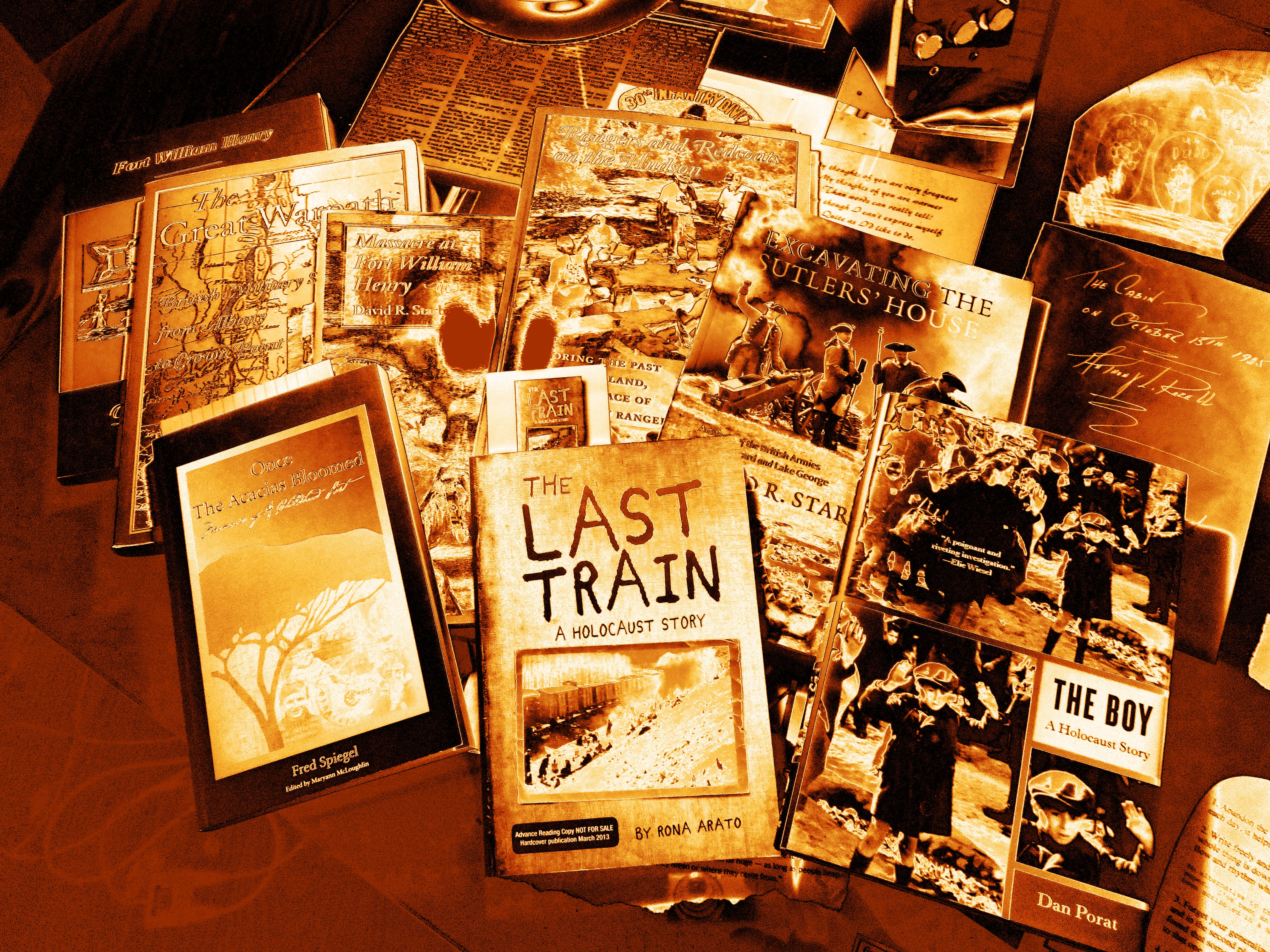
the books.

the books.

Sure enough, there was now a new entryway, complete with an admission booth. I pulled the truck up to it, and inquired whether we might proceed to the bookstore, which had always stocked a fair amount of titles, where one could peruse the stock, before deciding whether today would be the day to pay the full admission to check on any updates in the exhibits inside.

Not today. Not anymore. No  money up front, no visit to the bookstore.

Having served on an authentic historical site as a board member, I understand the desperate need to raise funds, but I did not have the $52.50 in my pocket that morning. We had not planned to spend the entire day there.

As the nice woman shrugged and turned us away, my brother said, “you should have told them who you are”.

Ha. He was having fun with me, and joking, of course. But it kind of brought forth  a sense of wonderment about my experiences this summer the authentic historical sites I visited all over the world.

I thought some about it. The bookstore that I had wanted to visit this morning stocked titles that featured my work as a history teacher and avocational archaeologist. I’m actually written about in some of the books.

I remembered I had a similar experience at our first major stop on the Holocaust Resistance  tour in Europe a few weeks back. As twenty five educators toured the site, all of my colleagues chose to give up part of their lunch hour for a private introduction by a key staff member who took the time to explain my role in helping that museum/memorial site create a special exhibition on the evacuation transports that left that concentration camp in April 1945.  As we boarded the bus at the end of the day, someone opened the Bergen Belsen official guidebook they had purchased in the bookstore (which in my excitement I had overlooked)- and there was the Benjamin photo, and summary of my work.

Later in the tour at another authentic site, concentration camp Ravensbruck in Germany, after an intense day I spied a different title and pulled it off the shelf, and showed it to another colleague. It’s the story of a survivor that I know, and this book probably would not have been written had it not been for the efforts that I had made in my teaching career.

The following week in Poland, the same thing happened to me with another title. I was able to open the book and point to my name in the credits and acknowledgments, and show where my work made a significant impact for the author and his thesis.
Pretentious bragging? I really, really hope not.   In fact I wrote this post weeks ago, not at all anxious to share, but as I process what has happened this summer, I figure stunned realization is more like it .

To visit authentic historical sites, some halfway around the world where I have never been before, and see the impact of this passion on others, is something both profound and humbling. I feel it has been transformative at some base level, yet I have not even completed my own book yet (it just keeps changing in my head- and believe me, it is up there). So it goes up to be added to the archive of happenings that occasionally knock me on the head.

In the end, getting turned away from the bookstore didn’t matter at all, except maybe to kindle a flame… though it is always a thrill to hold the book in your hands, and thumb to the page with your name on it.

Read Full Post »

World War II infantry veteran Carrol Walsh, top, hugs Holocaust survivor Paul Arato at a reunion in Queensbury, N.Y., on Tuesday, Sept. 22, 2009. Walsh’s unit liberated a Nazi train carrying 2,500 Jewish prisoners, including Arato, from the Bergen-Belsen concentration camp in Germany during the war’s waning days. (AP Photo/Tim Roske)

I am reposting this today to honor both of the men below. Paul Arato passed away this week in Toronto, Canada and his memorial service is today. Carrol Walsh, his liberator, died in Dec. at his home in Florida and his memorial service was last Friday in New York.

Paul and Rona would also check in annually for dinner with the Walsh family when they passed through our town. The last time I saw both of them together was in 2011 at one of these dinners in a local restaurant. They sat together and laughed and joked like old pals. Paul told the story of how he arrived in Detroit after the war as an eager late teen anxious to find work designing fast cars in the automobile industry and was driven to the bridge in Canada by law enforcement and pointed to the bridge to Canada, as he did not have the proper documentation. Picturing the scene in his mind, Carrol would laughed outloud and slapped his knee. Both men were so happy to have found each other.

Rest on, friends.

Holocaust Survivors Reunite With US Veterans

NY high school reunites Holocaust survivors liberated from Nazi death train by US soldiers

By CHRIS CAROLA

The Associated Press

HUDSON FALLS, N.Y.

The Holocaust survivor was 6 on that spring day in 1945 when he last saw the U.S. Army soldiers outside Magdeburg, Germany.

Paul Arato was among 2,500 starving and sickly Jewish prisoners from the Bergen-Belsen concentration camp, their train abandoned by its crew and Nazi guards as Allied forces advanced. Two U.S. Army tanks on a scouting patrol — one of them commanded by Carrol Walsh, then 24 — came upon the stopped boxcars.

Arato, now 71, and Walsh, 88, met again this week.

“Please give me a hug. You saved my life,” Arato told Walsh in an emotional reunion of concentration camp survivors and some of the veterans of the 30th Infantry Division who liberated them.

Arato, an industrial designer from Toronto, and Walsh, a retired state Supreme Court judge from Hudson Falls, came together for a Hudson Falls High School history symposium inspired by history teacher Matthew Rozell’s original World War II project in 2007.

“You were all kids on that train,” Walsh told the survivors, most of them in their early 70s, as they and their families greeted the veteran. “I was an old man. I was 24 years old!”

Those arriving early for Wednesday’s opening session gathered Tuesday night for an impromptu reunion before having dinner surrounded by the faux Adirondack decor of the nearly deserted indoor water park. Four of the five Nazi train survivors at the dinner had never met Walsh.

Walsh’s tank patrol discovered the desperate Bergen-Belsen survivors on April 13 — hundreds of emaciated Jewish prisoners who had been herded aboard one of three trains leaving the camp a week earlier to keep them from being liberated by advancing Allied forces.

Walsh’s patrol stayed for a time, handing out candy to some of the children, then moved on after reporting their discovery. Frank Towers, a 27-year-old first lieutenant in the 30th Division, led a convoy that took the newly liberated prisoners to a German town where they were given food and shelter.

For weeks, the men of the 30th had heard of Nazi atrocities against Jews and dismissed the stories as propaganda, Towers said. That all changed when they encountered the train.

“Then we believed,” said Towers, 93, of Brooker, Fla.

This week’s reunion is the fourth since 2007, when Walsh was joined by three of the train survivors at Hudson Falls High. History teacher Rozell’s World War II project included an Internet posting of Walsh’s account of the train liberation.

An Associated Press report of that first reunion prompted more survivors to come forward, some from as far away as Israel, Rozell said. In all, he has confirmed that more than 60 survivors are still living and has been in contact with about two dozen of them.

Nine survivors of the Nazi death train are participating in this symposium, along with Walsh, Towers and four other veterans of the 30th who fought in Germany. Rozell said this week’s gathering is likely to be the last such event of its scope, given the advanced ages of the veterans and survivors.

For Arato, Tuesday night’s reunion with Walsh brought back a flood of memories. He recalled getting candy from one of the soldiers and a handgun to play with.

“I remember it was a Tootsie Roll,” he said. “The gun wasn’t loaded.”

Arato fretted over one detail. He recalled seeing a Jeep along with the American tanks, but fellow survivor Fred Spiegel of Howell, N.J., didn’t remember seeing a third vehicle. Later, Walsh said his patrol consisted of two tanks — and a Jeep.

“There WAS a Jeep,” Arato said, a smile breaking out on his face. “I remembered it right.”

———

On the Net:

Hudson Falls High School World War II Living History Project: http://www.hfcsd.org/ww2

http://www.huffingtonpost.com/wires/2009/09/23/holocaust-survivors-reuni_0_ws_296673.html

http://www.ynetnews.com/articles/0,7340,L-3781062,00.html

Read Full Post »

« Newer Posts - Older Posts »