Feeds:
Posts
Comments

Posts Tagged ‘Bergen Belsen’

I interviewed a Holocaust refugee and another liberator on Friday last… rolled into one! A special man. A German Jew whose father was mortally injured on Kristalnacht, Henry Birnbrey was sponsored and got out of Germany as a young teen and was given special permission from FDR to join the Army-previously classified “enemy alien” for his German birth- and stumbled upon the train as a forward artillery spotter scouting positions in the lead up to the final battle at Magdeburg.  Henry was in the 531st AAA of the 30th Infantry Division- Survivor Steve Barry mentions forward artillery spotters in his memoirs- and Henry was one of them. Much of what follows is his testimony as given to the Breman Museum in Atlanta, Georgia, interspersed with his memories as privately published in  his war memoirs.

I was born in Dortmund, Germany in 1923. During 1937 and 1938 my parents made applications for me to emigrate to Palestine, New Zealand and the USA. The USA visa came in first and an emergency visa was issued to me the week Hitler invaded Austria, as the various agencies feared that this invasion would be followed by war.

I left Germany on March 31, 1938, leaving my parents behind. In the meanwhile, my father had already been arrested. He was accused of having made statements against the government. He was released with the promise to abandon his business and livelihood. Consequently, we lived without income during the years 1937 and 1938. After I left Germany, my father was picked up again on Kristallnacht (November 9, 1938) and he died a couple of months later from the wounds received when he was picked up and arrested. My mother died a few months later. The death certificate of my father stated the cause of death as “heart failure” and only in 1999 did I finally locate the documents that verified what happened in 1938, but too late to entitle me to compensation, which had been denied because their records showed a natural death.

The Birmingham Section of the council of Jewish Women sponsored my immigration to the US, and the social services were provided by the Jewish Children Service here in Atlanta. I moved to Atlanta in January 1939. In Birmingham and Atlanta I lived in foster homes.

I supported myself by working in a clothing store, later managing a shoe store, and in 1942 I went to work for a local accountant. In 1943 I joined the US Army. In 1944 I was with the Normandy invasion forces. During my service in the army, but towards the end of the war, I came across  a train of cattle cars full of Jewish concentration camp survivors and people who did not survive. We opened the cars and were shocked to see the condition of the occupants of these cattle cars. During this same week as we were advancing toward the Oder River, we passed ditches full of corpses of concentration camp inmates who had been marched to the West to escape the Russian advance. Around April 1945, I became a counter intelligence agent and interrogated German POWs and citizens.

After the war, I found out that most of my family had perished in the concentration camps. My mother was one of ten children, and out of that family, two first cousins survived. These cousins had made aliyah in 1937. My father was one of three brothers and again, two first cousins survived. One had made aliyah to Israel in 1938 and the other one survived behind the Iron Curtain. The rest of the family perished. I found documents in the Berlin archive that showed when these people were born and when they died. What I was not prepared for was the detail of information which included the place they were assembled, the number of the transport which took them to the concentration camp and all sort of sordid details.

Henry continues: During World War II, I wanted to get to our hometown but I could not because the British Army was over there and we were a little bit south of there, but my experience as a soldier I think is worth mentioning. First of all, we were in the neighborhood of Magdeburg on reconnaissance. And we had, we had this horrible odor. We didn’t know what was happening. And it turned out to be one of the freight trains full of Jews being shipped from one concentration camp to another. And therefore I was able to personally witness this terrible inhumanity that was taking place. And all of these were my fellow Jews and brothers and everything else. They were almost, they had been reduced to such a non-human state it was impossible to communicate with them. I mean, all we could do is to try to get them food and ask for help. There was nothing we could do. These people were half dead, half crazy. I mean they’d been locked in these cars, were lying on the floor. It was just a horrible thing to witness, and something I’ll never forget as long as I live.

http://www.thebreman.org

And from Henry’s memoirs…. skeptics note again a liberator describing “walking skeletons” ….We moved on to the Braunschweig (Brunswick) area. Here, along the highway, we encountered ditches full of dead concentration camp prisoners who had been marched from one camp to another and were shot before they had a chance to be liberated.
…In April of 1945 while on reconnaissance near Magdeburg we encountered a horrible odor. As we got closer we discovered an abandoned train of cattle cars. When we opened the cars they were filled with half dead and dead Jews being transported from the Bergen-Belsen concentration camp to another camp. The sub-human conditions to which these people were subjected to had reduced them to a very sorry state. We did not know how long they had been in those cars, they looked like walking skeletons and could barely speak. Unfortunately we had no food to share with them, which gave us a very helpless feeling. When headquarters was notified, someone evacuated all German civilians from a nearby village, Hillersleben and turned this village into a hospital. Unfortunately we could not stay around to learn more, to speak to and encourage these people or perform other deeds of human kindness…I was reminded of the words of the prophet Ezekiel-”He took me down in the spirit of G-d and set me down in the valley. It was full of bones.”

…and this is where I (MR) am trying to put the pieces of the story together….


Read Full Post »

Haunting cover image from Boder’s groundbreaking interview book.

Today I was visiting links on the Internet related to oral history projects. The description I found below intrigued me-interviews recorded in the summer of 1946.

“Voices of the Holocaust – Online repository that contains audio clips and transcripts of interviews done by Dr. David Boder of Holocaust survivors in 1946. The mission of Voices of the Holocaust project is to provide a permanent digital archive of digitized, restored, transcribed, and translated interviews with Holocaust survivors conducted by Dr. Boder in 1946, so that they can be experienced by a global audience of students, researchers, historians, and the general public.”

I went to the site at the  Paul V. Galvin Library at the Illinois Institute of Technology. I then clicked on places in Europe that Dr. Boder went to record his interviews, displaced persons camps or transit areas as survivors sorted out their lives and tried to plan their future. On the actual pages you can not only read the transcription, but also hear the actual recordings…. and he encouraged several survivors to sing for him on tape. Amazing.

Well, I saw some names that I thought I recognized from survivors I have met or from the manifest list provided by the Bergen Belsen Memorial. Sure enough, several of these survivors were liberated on our train near MagdeburgBelow I have the complete transcript, taken from the site, of a 24 year old Greek Jew who lost both of his parents upon liberation. If you go to the link, you can actually listen to his testimony from 1946! Below, I have taken the liberty of emphasizing his liberation story in bold print.

Dr. Alan Rosen recently published a book on this fascinating subject, and you can read his bio of Dr. Boder here. Dr. Rosen reports that his actual name is Mene Mizrahi.

*********************************************************************************************************************************************

David Boder: [In English] This is Spool 9-43B. The interviewee is Mr. Mizrachi and he speaks English. November the 21st 1950. Boder.
David Boder: This is Spool 43 continued. The interviewee is Señor Manis Mizrachi or Mr. Manis Mizrachi. Born in Greece, how old are you Mr. Mizrachi?
Manis Mizrachi: I am twenty-four years old.
David Boder: He’s twenty-four years old. He speaks good English and we will have his report in English. Also Mr. Mizrachi would you tell us again what is your full name where were you born?
Manis Mizrachi: My name is Mizrachi Mimi I have been born in Salonika.
David Boder: Yes. Your last name is really Mizrachi so we . . .
Manis Mizrachi: . . . Mizrachi, yes
David Boder: . . . call you in America “Minis Mizrachi.”
Manis Mizrachi: . . . Mizrachi, yes
David Boder: You were born where?
Manis Mizrachi: In Salonika, 1922.
David Boder: In 1922, yes.
Manis Mizrachi: The 17th of January.
David Boder: Yeah, and tell me, who were your parents and what was their business.
Manis Mizrachi: My parents – my father was Oscar Mizrachi and he was . . . he saled articles which he brought from every country and he was a representative of several firms.
David Boder: Ah! He was an importer?
Manis Mizrachi: importer yes.
David Boder: Yes, for instance what kind of articles was he selling?
Manis Mizrachi: He was selling clothing and paper, he brought paper and several other things what he could make.
David Boder: Now tell me how many people were in your family?
Manis Mizrachi: We’re three people.
David Boder: Yes.
Manis Mizrachi: My father, mother and me.
David Boder: You were the only son?
Manis Mizrachi: The only son.
David Boder: Yes, and now tell me where were you and what happened to your family when the Germans came to Greece?
Manis Mizrachi: Before the Germans came to Greece since my father was a freemason, we . . . were afraid for the Germans, them not to take him away from us. That for we made it up to go to Athens, the capital of Greece, since it is a very big country so we could . . .
David Boder: [speaking over each other] Big city you mean . . .
Manis Mizrachi: Big city, yes,
David Boder: So you could be better protected . . .
Manis Mizrachi: Better protected.
David Boder: Tell me what citizenship did your father have? Greece or Spanish?
Manis Mizrachi: My father was Spanish
David Boder: And your mother?
Manis Mizrachi: My mother was Turkish.
David Boder: Turkish? And you were considered what?
Manis Mizrachi: I have been considered Spanish.
David Boder: Because your father was Spanish. Have you lived in Spain?
Manis Mizrachi: Never, I have never in Spain.
David Boder: Yes, all right, and so you went to AthensManis Mizrachi: And so we went to Athens but anyhow the Germans took us because although the Consul of Spain has certifies us that we have no reason to be afraid that the Germans will take us and but for this obliged us not to leave and not to hide ourselves and so the Germans came one night at two o’clock and got us [the whole family, they beat us firstly] and afterwards they put us into the Greek jail.
David Boder: All right, now . . . Tell me this . . . [mutters] All right, tell me this: Were other Jews then arrested already and deported?
Manis Mizrachi: A lot of Jews, Spanish Jews, were arrested and [spread?] with our family together.
David Boder: Yes, and what was it a kind of a raid at that time or what?
Manis Mizrachi: It was a raid, it was a raid for whole Spanish in order not to leave them the time to hide themselves because one day before they arrested all Greek citizens, Jews of course.
David Boder: They arrested the Greeks citizens that were Jews. And now they began to arrest the Spanish citizens . . . well didn’t you show your papers from the Consul?
Manis Mizrachi: We showed our papers from the Consul but it [laughing a little] helped nothing.
David Boder: All right, so then what did they do with the family, go slowly step-by-step.
Manis Mizrachi: Then they put us in cars and brought us in the Greek jail where we were obliged to sleep down without any help . . . they give us no things to eat, nothing. We’re made whole day without any thing . . .
David Boder: [interrupting] Was the family together?
Manis Mizrachi: The family was together firstly; afterwards, they ordered us the men to go separately and the women from the other side. So we remained there in the jail about fifteen days and the first of April we were obliged to leave the jail and they put us into trains . . . of beasts.
David Boder: Why do you call it “trains of beasts?” They were . . .
Manis Mizrachi: Because they were closed trains were they are putting the [laughing a little] . . . horses and . . . the pigs
David Boder: . . . the trains with the openings? Because animals they transport . . .
Manis Mizrachi: No, they were closed but they were with wires.
David Boder: [Talking over each other] Where were the wires?
Manis Mizrachi: The wires were at the windows. Little window was there, very high, although they were afraid us not to look from what happened around and so they put us there and they locked us, the door so we couldn’t get out for any necessary . . .
David Boder: For any necessary? Were you men and women together . . .
Manis Mizrachi: We were men and women together. Sixty-four people in a wagon, it was very difficult to take air and to eat, we had nothing to eat.
David Boder: Didn’t they tell you to take your things?
Manis Mizrachi: No, they didn’t give – they gave us only some carrots and bottle of water and place . . .
David Boder: What do you mean a bottle of water for all or what?
Manis Mizrachi: It was . . . two big bottles
David Boder: Two big bottles of water.
Manis Mizrachi: . . . bottles of water.
David Boder: What do you think? How many liters was there in each one?
Manis Mizrachi: Twenty-five liters about.
David Boder: You mean twenty-five liters to the bottle?
Manis Mizrachi: Yes, and it was very hard we couldn’t have water enough because we had children with us and we couldn’t wash ourselves we were very dirty . . .
David Boder: Yes.
Manis Mizrachi: . . . and after the tenth day of traveling
David Boder: [astonished] . . . wait you mean you were ten days, ten days in the car?
Manis Mizrachi: In all we were fourteen days but after the tenth day they opened – they got out the wires so we could look outwards but we were without shaving ourselves and were like beasts.
David Boder: Now tell me what kind of toilet facilities did you have?
Manis Mizrachi: No one. Every two days they opened us the doors in order to get out things that . . . we couldn’t keep anymore in our leavings[?]
David Boder: Did you have a pocket for it?
Manis Mizrachi: No, it was in a piece of papers what they gave us specially for that.
David Boder: And women and men together in this . . .
Manis Mizrachi: Women and men together . . .
David Boder: . . . and children
Manis Mizrachi: . . . it was awful
David Boder: And so?
Manis Mizrachi: And so, until we arrived at six in the morning—six o’clock in the morning and the town of Celle which is some kilometers far from the camp, real camp of Bergen-Belsen. And so we went there, we were obliged to go—to step seven or eight kilometers.
David Boder: To walk?
Manis Mizrachi: To walk there with our grandfathers, with our fathers, sisters, sick women, with our children and however it was very difficult for us and this one who couldn’t walk he was beaten by the Germans, soldiers, by the capos . . . were the leaders.
David Boder: What is capos?
Manis Mizrachi: Capos were the leaders.
David Boder: Were they prisoners?
Manis Mizrachi: They were prisoners but who . . . somewhere . . . collaborated with the Germans together. And they beat us awfully we were not accustomed to this kind of manner and they were laughing at us when we made strange figures.
David Boder: Strange faces you mean?
Manis Mizrachi: Strange faces, yes.
David Boder: And well, and so how long did it last to walk these eight kilometers?
Manis Mizrachi: This eight kilometers took us about . . . one hour and a half.
David Boder: [after a pause] That’s very fast walking.
Manis Mizrachi: Yes! We were obliged to run.
David Boder: Well you had no things to carry
Manis Mizrachi: No things to carry, nothing.
David Boder: Well then . . .
Manis Mizrachi: Because we had some things we could keep with us but we were obliged to leave it in the way in order to go very fast because it was a Polish capo behind and he was beating you.
David Boder: A Polish capo?
Manis Mizrachi: A Polish, yes.
David Boder: All right, but you were together with your father and mother?
Manis Mizrachi: No I wasn’t even with my father, and my mother had been put in another range [?].
David Boder: Oh, your mother was put in another what?
Manis Mizrachi: In other file.
David Boder: In another file, all right. But she was marching the same way with you?
Manis Mizrachi: Yes, much in the same way.
David Boder: All right.
Manis Mizrachi: Afterwards we went to the camp they . . . were obliged to stay there for l’appel.
David Boder: What is the name of the camp?
Manis Mizrachi: The camp Bergen-Belsen.
David Boder: Yes
Manis Mizrachi: We were obliged to stay there about two hours waiting until the German come and ask our names . . .
David Boder: Yes . . .
Manis Mizrachi: . . . conforming to the list that he could have in Athens when he put us into the train
David Boder: Do you have a tattoo number?
Manis Mizrachi: No, in Bergen-Belsen there was no tattoo number.
David Boder: Yes.
Manis Mizrachi: My account number was one thousand four hundred sixty two.
David Boder: Uh-huh, all right
Manis Mizrachi: . . . It was my account number
David Boder: One thousand . . .
Manis Mizrachi: One thousand four hundred sixty two.
David Boder: ..sixty two. And so . . .
Manis Mizrachi: And so we have been put in big barrack . . .
David Boder: You with your father?
Manis Mizrachi: With my father and with my mother in separate barrack. And around us was the wires—electric . . .
David Boder: Oh, electric wires. Yes.
Manis Mizrachi: . . . have been charged. And we couldn’t go out firstly until the doctor came in order to see whether we’re ill or not.
David Boder: Yes.
Manis Mizrachi: And afterwards we could be with our mother and with every friend and so on because of our citizenship.
David Boder: Oh, because you were Spanish.
Manis Mizrachi: Spanish, yes. The only thing which we had. As Spanish people.
David Boder: Yes.
Manis Mizrachi: Of course, firstly we couldn’t eat what they gave us. It were carrots in boiled water. This was our eating. And we gave it to other brothers of us—other Jews—of Greece. And Polish people too who were with us in the camp. And we were obliged after one week to eat because we starved. And so we carried everything—everything green that we saw on the earth we took it out from there and we started to eat it without caring if it was dirty or clean.
David Boder: Uh-huh, without cooking?
Manis Mizrachi: Without cooking . . .
David Boder: Yes.
Manis Mizrachi: . . . like beasts.
David Boder: Yes.
Manis Mizrachi: And so they started to put us in this category of prisoners that starved to eat and wore closed and we had no rights to go out – to work – we were obliged to stay.
David Boder: Well, because the Spanish . . .
Manis Mizrachi: Because Spanish citizenship.
David Boder: . . . we were not supposed to work
Manis Mizrachi: We were not supposed to work but this was bad because the others who were out they were working at the transport of food, of legumes . . .
David Boder: Of vegetables.
Manis Mizrachi: Of vegetables. And they could have some profit in taking some of them. But for us it was impossible. And so we were obliged to live on only those things that we received from Germans.
David Boder: Did the Red Cross help in any way.
Manis Mizrachi: We had no help of the Red Cross. Never we got help from the Red Cross. Only our capos they had . . . many profits who unfortunately they put only for themselves and they never helped the others
David Boder: Were the capos Jews?
Manis Mizrachi: They were the Jews with us from Greece they came with us. And they started making friendship with the Polish capos, the old ones who were there and so they had a lot of . . .
David Boder: Polish Jewish?
Manis Mizrachi: Polish Jewish. I speak always from Jewish
David Boder: And so?
Manis Mizrachi: And so they made friendship with them and so they had everything for their own families. They had special room to live and they ate separately. We were not to see what they were eating, we smelled only the meat and everything else that they got . . . from the Germans.
David Boder: From the Germans?
Manis Mizrachi: From the Germans. And, unfortunately, our people—the people who didn’t want to beat and to collaborate with the Germans—starved and had only his home in back.
David Boder: Yes
Manis Mizrachi: This is all [slightly laughing].
David Boder: Well, and that was in . . . Auschwitz?
Manis Mizrachi: That was in Bergen-Belsen.
David Boder: In Bergen-Belsen . . .
Manis Mizrachi: Bergen-Belsen.
David Boder: Well . . . did you hear about . . . All right, so how long were you in Bergen-Belsen?
Manis Mizrachi: I have been there about eighteen months—one year and six months.
David Boder: And then, where were you taken from?
Manis Mizrachi: Then I have been taken—we have been put into a big train in order to be transported to Theresienstadt. In the last days—two days before the English came, the British troops came in Bergen-Belsen.
David Boder: Yes.
Manis Mizrachi: Um, this train was a big train of sixty-four wagons.
David Boder: Yes.
Manis Mizrachi: And have been put in, again in . . . beasts-cars . . .
David Boder: Cattle-wagons?
Manis Mizrachi: Cattle-wagons. Sixty-four to seventy people in a car and started of course many ‘spense [?] . . . many sick . . .
David Boder: Many sick people.
Manis Mizrachi: . . . many sick people. We started then with the Typhus.
David Boder: Oh yes.
Manis Mizrachi: It was then when I lost my two parents. Unfortunately, at the last days. I lost them—my father . . .
David Boder: What do you mean—in Bergen-Belsen?
Manis Mizrachi: In the train—the big train—they caught there Typhus
David Boder: Oh, in the train. About how many days before liberation?
Manis Mizrachi: The first died . . . at just at the same . . . at the moment of the liberation and my mother which was looking for [after] my father died ten days afterwards . . .
David Boder: After the liberation
Manis Mizrachi: And I got it too . . .
David Boder: You got it?
Manis Mizrachi: . . . because I was obliged to see . . . to look for [after] for my mother.
David Boder: You had to look for your mother, yes? And?
Manis Mizrachi: And so I got it also—”I meant thirty in one days”[?]
David Boder: What typhus was it? Ricket . . . Ricket . . . Spotted typhus?
Manis Mizrachi: Spotted typhus, yes.
David Boder: So then you lost your parents.
David Boder: [speaking over each other] .. of liberation. And you remained alone.
Manis Mizrachi: I remained quite alone without any help. Quite alone.
David Boder: All right, so where did you go then?
Manis Mizrachi: I was student and then the American troops were very kind with us—they helped us.
David Boder: Well, which camp were you freed or were you freed from the train?
Manis Mizrachi: From the train directly because it was an air attack.
David Boder: Oh, yes.
Manis Mizrachi: Attack of the air force.
David Boder: Yes.
Manis Mizrachi: British Air force.
David Boder: And so?
Manis Mizrachi: And so the machine . . . had been in damage.
David Boder: The, yes, the machine was damaged.
Manis Mizrachi: . . . was damaged.
David Boder: Yes, and the train couldn’t continue.
Manis Mizrachi: . . . couldn’t continue. And . . . we made some activity there we got prisoners, the Germans, the SS . . .
David Boder: Yes.
Manis Mizrachi: . . . and we waited until the American tanks.
David Boder: . . . came.
Manis Mizrachi: Came. Yes, it was ninth army. The ninth American army.
David Boder: Uh-huh.
Manis Mizrachi: . . . Which liberated us.
David Boder: Yes, so then you took the SS prisoners? Why didn’t you kill them?
Manis Mizrachi: [slightly laughing] We had no right to kill them . . .
David Boder: Why?
Manis Mizrachi: Because the capos—the chiefs . . .
David Boder: Yes.
Manis Mizrachi: . . . who directed this movement told us not to do anything until the American troops arrived.
David Boder: Yes
David Boder: And then what did the Americans do with them?
Manis Mizrachi: The Americans took their arms and they took them away, we don’t know what happened.
David Boder: They took them prisoners?
Manis Mizrachi: Prisoners, yes.
David Boder: All right, and then you were in the train,
Manis Mizrachi: And then . . .
David Boder: . . . where were you taken from there?
Manis Mizrachi: And at once, the officers, the American officers went to the village—the German village of Farsleben.
David Boder: Yes.
Manis Mizrachi: There. And he gave the order to every person to take us in, to take several families into his house.
David Boder: Yes.
Manis Mizrachi: And so, we got the place for some days.
David Boder: Uh-huh, and who was feeding you?
Manis Mizrachi: The Germans were obliged to feed us.
David Boder: Uh-huh.
Manis Mizrachi: They had a lot to feed us.
David Boder: And what did the Germans then say?
Manis Mizrachi: The Germans said that they never knew every- . . . something that happened to Jews and out of Germany and that they behaved something so ill with the Jews in the concentration camps that they let them starve and that they killed them. They didn’t know anything about those things. And whenever they knew, of course, they wouldn’t leave it . . . let the Germans . . .
David Boder: [finishing the thought] . . . they wouldn’t have let them do such things.
Manis Mizrachi: Yes.
David Boder: Uh-huh and then, where did you go and how did you go?
Manis Mizrachi: Then I was where, I got ill and I went at Hillersleben.
David Boder: Yes
Manis Mizrachi: Hillersleben is not far from them, some ten kilometers.
David Boder: Yes.
Manis Mizrachi: And then I meant the hospital, hospital El Melwani [?] there were three hospitals.
David Boder: Did you get typhus too?
Manis Mizrachi: I got Typhus too.
David Boder: So when they took you from the train did you have typhus already?
Manis Mizrachi: No I didn’t have.
David Boder: Oh, you didn’t have . . .
Manis Mizrachi: I was looking for [after] my mother.
David Boder: You were taking care of your mother?
Manis Mizrachi: Yes, taking care of her until she died.
David Boder: Yes.
Manis Mizrachi: Afterwards . . .
David Boder: Did you see your father dying?
Manis Mizrachi: I . . . . My father died on my hands.
David Boder: Yes.
Manis Mizrachi: I buried him with two other Jewish comrades.
David Boder: Yes.
Manis Mizrachi: . . . in Farsleben. And my mother died in Hillersleben.
David Boder: Yes.
Manis Mizrachi: They are seven kilometers away. I didn’t see my mother died – dead – because I was very ill at this moment. I was with 41.4 Centigrade . . .
David Boder: Temperature. Already with typhus?
Manis Mizrachi: With Typhus yes.
David Boder: And so when the freedom came . . . ?
Manis Mizrachi: When the freedom came, I was quite alone I remained quite alone . . .
David Boder: Did they take you to a hospital?
Manis Mizrachi: Yes.
David Boder: You were taken to a hospital?
Manis Mizrachi: I have been taken to a hospital.
David Boder: . . . and nurse to help?
Manis Mizrachi: Nurse help, German nurse. And they were not bad but they always tried to make sabotage.
David Boder: The Germans?
Manis Mizrachi: The Germans.
David Boder: In what way?
Manis Mizrachi: In what way . . . because they were throwing away the medicaments and whenever we were calling them but they didn’t come—only when the Brit- [corrects] an American soldier was present.
David Boder: . . . and then he would take . . .
Manis Mizrachi: . . . but not, they never took care of us.
David Boder: All right, and when you got well what happened then?
Manis Mizrachi: Then I took some days in order to get . . . stronger then because I couldn’t walk. I had forty-two kilograms.
David Boder: And where did you spend those days—in the hospital?
Manis Mizrachi: In the hospital.
David Boder: Yes.
Manis Mizrachi: And afterwards I have been taken by the American army and I said that I had parents in France. And that for they brought . . .
David Boder: You said that you had parents in France?
Manis Mizrachi: Yes, I had. I had.
David Boder: Relatives you mean?
Manis Mizrachi: I have relatives, yes. Relatives.
David Boder: Apart from your father and mother.
Manis Mizrachi: Relatives, yes. Relatives in France.
David Boder: And so they took you?
Manis Mizrachi: So they took me here and . . . unfortunately they had been displaced too. Deported and they didn’t come back.
David Boder: They did come back?
Manis Mizrachi: They did not come back.
David Boder: So you didn’t find relatives?
Manis Mizrachi: I did find. And I remained here.
David Boder: Yes. And for what are you working now?
Manis Mizrachi: Now I am working for the AJDC.
David Boder: For the American join . . .
Manis Mizrachi: [finishing] . . . distribution committee.
David Boder: What are you doing?
Manis Mizrachi: I am in the accounting department.
David Boder: Where did you learn English?
Manis Mizrachi: I learned English alone because I finished the German school . . .
David Boder: Where? Greece?
Manis Mizrachi: In Salonika, yes.
David Boder: You finished the German school where you learned Greek [corrects] where you learned English?
Manis Mizrachi: German. German and French and since I liked very much to learn English I learned it quite alone.
David Boder: with . . . [speaking over each other]
Manis Mizrachi: Just alone, myself.
David Boder: By which method? Shocked that haven’t got a better [ununintelligible] that you had to go to school?
Manis Mizrachi: No, I learned it quite alone. There was a friend of mine who went to the school . . . and I learned . . .
David Boder: And learned it alone. Now what do you plan to do in the future?
Manis Mizrachi: I am studying now; I am studying radio.
David Boder: Where, at the ORT?
Manis Mizrachi: No, quite alone, I am training myself.
David Boder: All right.
David Boder: You are studying radio and then you want to do what?
Manis Mizrachi: Then I hope to work in radio..
David Boder: Where?
Manis Mizrachi: I don’t know yet, perhaps I can go to the country I would be very satisfied.
David Boder: Which country?
Manis Mizrachi: I don’t know where to . . . the States? [Break in tape]
David Boder: . . . relatives in America?
Manis Mizrachi: . . . unfortunately, I have no one.
David Boder: You have no one.
Manis Mizrachi: No one.
David Boder: . . . Well this concludes Mr. .Mizrachi’s report. Taken on the- . . . on August the 12th at the offices of the American Joint Distribution Committee . . . recording of the Illinois Institute of Technology.
http://voices.iit.edu/interview?doc=mizrachiM&display=mizrachiM_en

Also note that the USHMM is looking for Mr. Mizrachi and several others who were interviewed that summer by Dr. Boder. For more information, click here.

Read Full Post »

Holocaust survivor recalls kindness of US troops

Another survivor of the train near Magdeburg appears. International Holocaust Remembrance Day, 2012. I hope she finds her way to this site so she can meet her actual liberators! Thanks for Leslie Meisels for tipping us off to the article. Aliza’s memoir of life in the Warsaw Ghetto and beyond is very moving and can be found here.

By GIL SHEFLER 01/27/2012 00:34
JERUSALEM POST

“The American soldiers didn’t know what to do and they showered us with chocolates and cigarettes.”

Aliza Vitis-Shomron on Thursday vividly recalled her brush with death on the eve of her liberation from the Nazis in 1945.

The survivor, who spoke on a panel at the Kibbutz Yad Mordechai Holocaust Museum the day before the world marks International Holocaust Remembrance Day, said a rumor had spread among the group of Jewish prisoners she was part of in Poland that they were about to be murdered.

Rather than surrendering them to the Allies closing in from the east and west, the prisoners feared their captors were planning to plunge their train into the Elbe River and drown everyone.

“Panic and fear spread quickly,” recalled the Polish-born Israeli who survived the Warsaw Ghetto and the Bergen-Belsen concentration camp in Germany. “Just as we were at the point of despair, two American tanks came rolling down a hill and saved us.”

The feeble Jewish prisoners emerged from the train and embraced the stunned soldiers of the US 30th Armored Division.

the tank commanders who freed her.

“We were crying with joy,” she said. “The American soldiers didn’t know what to do and they showered us with chocolates and cigarettes.”

Vitis-Shomron said she did not feel that she had defeated the Nazis.

“I did not triumph,” said Vitis-Shomron, an educator who has four great-grandchildren.

“What happened accompanies me, but I try to live and live well. I try to teach humanitarian values to our youths. We must never do upon others what was done to us.”

The panel Vitis-Shomron was part of at Yad Mordechai, the kibbutz named after the leader of the Warsaw Ghetto Uprising (Mordechai Anielewicz), included Simcha “Kojak” Rotem, who fought in the uprising, and former defense minister Moshe Arens.

It was one of many events held in Israel and around the world commemorating the remembrance day.

On Wednesday, Israeli Ambassador to the UN Ron Prosor, American Jewish Committee Executive Director David Harris and members of the newly formed World Forum of Russian Jewry met at United Nations headquarters to honor the memory of those killed by the Nazis.

The AJC head said the lesson learned from the murder of six million Jews required the world to prevent Iran from acquiring nuclear capabilities.

“This past September, indeed on these grounds, the notorious Holocaust denier, Iranian President Mahmoud Ahmadinejad, spoke,” Harris said. “To their credit, several UN member ambassadors walked out, but, shamefully, the majority stayed in the General Assembly hall and applauded his remarks.”

The president of the World Forum of Russian Jewry, Ukrainian businessman Alexander Levin, joined the call urging the UN to take action against the Islamic Republic.

More Holocaust memorial events are planned for Israel and around the world on Friday.

Supreme Court President Dorit Beinisch, Deputy Foreign Minister Danny Ayalon and ambassadors from more than a dozen countries including Germany, the US, Egypt and the Philippines are set to gather at the Massuah Institute for Holocaust Studies at Kibbutz Tel Yitzhak near Netanya to take part in a memorial ceremony.

The UN designated January 27, the anniversary of the liberation of Auschwitz by the Red Army, as International Holocaust Remembrance Day in 2005. It is marked by governments and organizations around the world.

Israel, however, observes its official Holocaust Remembrance Day on the 26th of Nissan, the anniversary of the Warsaw Ghetto Uprising, according to the Jewish calendar. Its selection reflects the Jewish state’s preference to emphasize Jewish resistance to the Nazis.

http://www.jpost.com/JewishWorld/JewishNews/Article.aspx?id=255355

Read Full Post »

Steve is one of my good friends and Frank is the featured liberator coming to our 2011 Reunion. Steve wishes he could be here and so do I! I miss the guy!!

If you would like to see a nice clip of Steve reuniting with one of his liberators, you can click on the link. Steve became a US Army Ranger after he was liberated by the Americans.

Read Full Post »

Another honored speaker for our Sept. 2009 and 2011 reunion…

Holocaust survivor Leslie Meisels addresses his liberators for the first time.

“Please allow me to express my utmost gratitude for the gentlemen who liberated us, those brave American soldiers, who were saying that they didn’t do anything heroic, that they just did their jobs. But in doing their job, they gave us back our lives. And for that, I thank you, from the bottom of my heart…”

In part II, Leslie gives a harrowing description of how he narrowly escaped death a few days before liberation.

Read Full Post »

It is April 13th, the 66th anniversary of the liberation. And in no small coincidence, I have been granted approval to travel to Israel with liberator Frank Towers to meet over 50 survivors of the train near Magdeburg liberated on this day in 1945.
Read below the moving narrative of Dr. George C. Gross, his remembrance of the liberation day, written 10 years ago, before he was aware of any of the survivors. He got to know quite a few before he passed on Feb. 1, 2009. Greetings to all the survivors on the day of your rebirth, and to the soldiers who, in “just doing our jobs”, saved the world.

A Train Near Magdeburg

Foreword:

Excerpt from Wayne Robinson, Move out Verify: the Combat Story of the 743rd Tank Battalion (Germany, no publisher, 1945), 162-63:

There was another sidelight to the death of fascism in Europe.  Only a few of the battalion saw it.  Those who did will never forget it.

A few miles northwest of Magdeburg there was a railroad siding in wooded ravine not far from the Elbe River. Major Clarence Benjamin in a jeep was leading a small task force of two light tanks from Dog Company on a routine job of patrolling. The unit came upon some 200 shabby looking civilians by the side of the road.  There was something immediately apparent about each one of these people, men and women, which arrested the attention. Each one of them was skeleton thin with starvation, a sickness in their faces and the way in which they stood-and there was something else.  At the sight of Americans they began laughing in joy-if it could be called laughing.  It was an outpouring of pure, near-hysterical relief.

The tankers soon found out why.  The reason was found at the railroad siding.

There they came upon a long string of grimy, ancient boxcars standing silent on the tracks.  In the banks by the tracks, as if to get some pitiful comfort from the thin April sun, a multitude of people of all shades of misery spread themselves in a sorry, despairing tableaux  [sic]. As the American uniforms were sighted, a great stir went through this strange camp. Many rushed toward the Major’s jeep and the two light tanks.

Bit by bit, as the Major found some who spoke English, the story came out.

This had been-and was-a horror train.  In these freight cars had been shipped 2500 people, jam-packed in like sardines, and they were people that had two things in common, one with the other:  They were prisoners of the German State and they were Jews.

These 2500 wretched people, starved, beaten, ill, some dying, were political prisoners who had until a few days before been held at concentration camp near Hanover.  When the Allied armies smashed through beyond the Rhine and began slicing into central Germany, the tragic2500 had been loaded into old railroad cars-as many as 68 in one filthy boxcar-and brought in a torturous journey to this railroad siding by the Elbe.  They were to be taken still deeper into Germany beyond the Elbe when German trainmen got into an argument about the route and the cars had been shunted onto the siding.  Here the tide of the Ninth Army’s rush had found them.

They found it hard to believe they were in friendly hands once more: they were fearful that the Germans would return.  They had been guarded by a large force of SS troopers, most of whom had disappeared in the night. Major Benjamin, knowing there were many German Army stragglers still in the area, left one of the light tanks there with its accompanying doughboys as a protective guard.  The Major then returned to Division headquarters to report the plight of these people.

For 24 hours, the crew of the tank remained on watch as their charges streamed about the vehicle, crying and laughing their thanks of rescue, and those who could told stories of slavery, oppression, torture, imprisonment, and death.  To hear their stories, to see before them the results of inhuman treatment lifted still another corner of the cover which, on being removed, exposed the full cruel spirit of Nazism which permitted such things to be. And this was but one of the many such stories being brought to light as Allied soldiers ripped into the secrets of Adolph Hitler’s Third Reich.

The train needed some badly needed food that night.  More, the promise of plentiful food the next day was given to them.  The commanding officer of the 823rd Tank Destroyer Battalion was seeing to it that such food would be available.  He had ordered German farmers of the surrounding towns to stay up all night, if necessary, to get food to these people.  Other Americans concerned themselves with locating living quarters to get the concentration camp victims away from the evil-smelling freight cars before more of them died and were covered by a blanket or just left lying in their last sleep beside the railroad tracks.

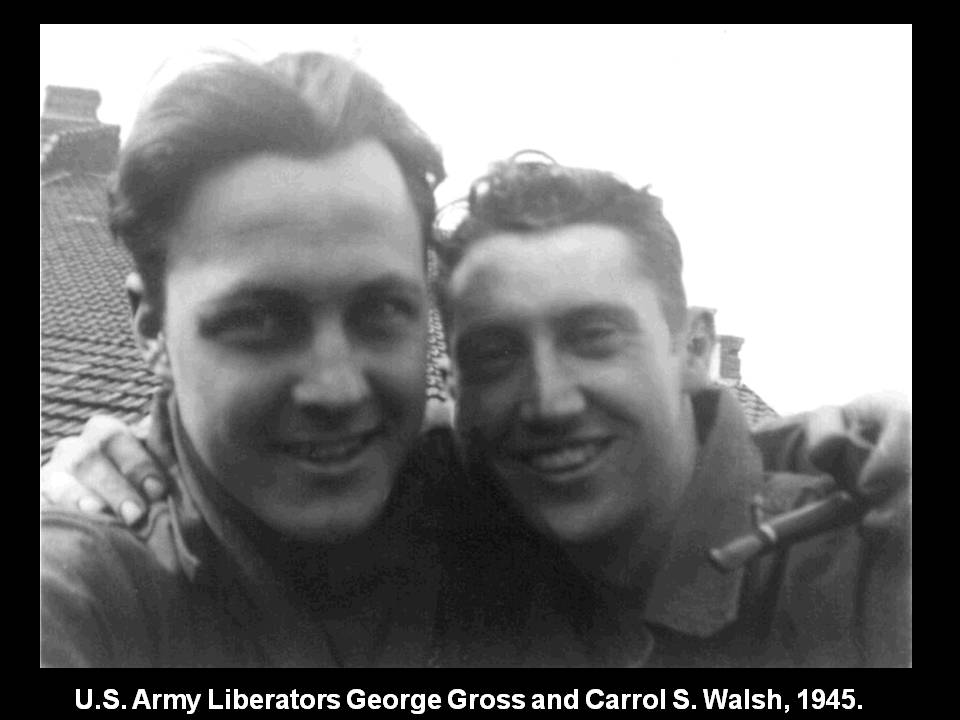
Sgt. George Gross (relayed to Matthew Rozell, March, 2002):
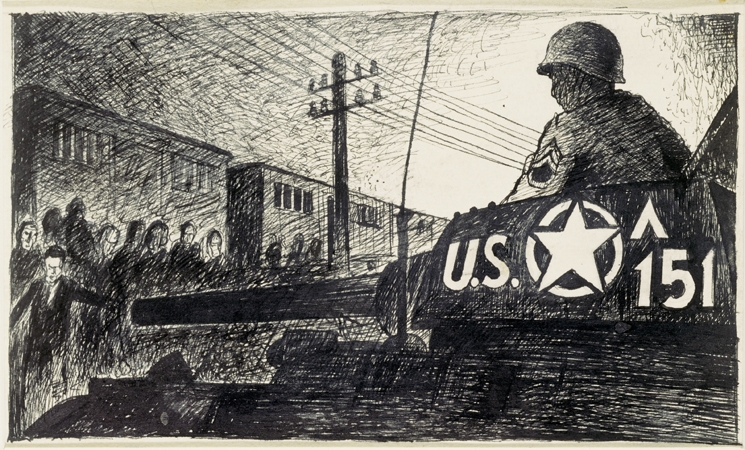
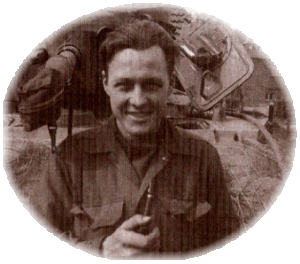
On Friday, April 13, 1945, I was commanding a light tank in a column of the 743rd Tank Battalion and the 30th Infantry Division, moving south near the Elbe River toward Magdeburg, Germany. After three weeks of non-stop advancing with the 30th from the Rhine to the Elbe as we alternated spearhead and mop-up duties with the 2nd Armored Division, we were worn out and in a somber mood because, although we knew the fighting was at last almost over, a pall had been cast upon our victories by the news of the death of President Franklin D. Roosevelt.  I had no inkling of the further grim news that morning would bring. Suddenly, I was pulled out of the column, along with my buddy Sergeant Carrol Walsh in his light tank, to accompany Major Clarence L. Benjamin of the 743rd in a scouting foray to the east of our route.  Major Benjamin had come upon some emaciated Finnish soldiers who had escaped from a train full of starving prisoners a short distance away. The major led our two tanks, each carrying several infantrymen from the 30th Infantry Division on its deck, down a narrow road until we came to a valley with a small train station at its head and a motley assemblage of passenger compartment cars and boxcars pulled onto a siding.  There was a mass of people sitting or lying listlessly about, unaware as yet of our presence. There must have been guards, but they evidently ran away before or as we arrived, for I remember no firefight.  Our taking of the train, therefore, was no great heroic action but a small police operation.  The heroism that day was all with the prisoners on the train.

Major Benjamin took a powerful picture just as a few of the people became aware that they had been rescued.  It shows people in the background still lying about

Farsleben train, moment of liberation, 4-13-1945

trying to soak up a bit of energy from the sun, while in the foreground a woman has her arms flung wide and a great look of surprise and joy on her face as she rush

es toward us.  In a moment, that woman found a pack left by a fleeing German soldier, rummaged through it, and held up triumphantly a tin of rations.  She was immediately attacked by a swarm of skeletal figures, each intent upon capturing that prize. My yelling did no good, so that I finally had to leap from my tank and wade through weak and emaciated bodies to pull the attackers off the woman, who ran quickly away with her prize.  I felt like a bully, pushing around such weak and starving fellow humans, but it was necessary to save the woman from great harm.  The incident drove home to me the terrible plight of the newly freed inhabitants of the train.

I pulled my tank up beside the small station house at the head of the train and kept it there as a sign that the train was under American protection now.  Carroll Walsh’s tank was soon sent back to the battalion, and I do not remember how long the infantrymen stayed with us, though it was a comfort to have them for a while. My recollection is that my tank was alone for the afternoon and night of the 13th.  A number of things happened fairly quickly.  We were told that the commander of the 823rd Tank Destroyer battalion had ordered all the burgermeisters of nearby towns to prepare food and get it to the train promptly, and were assured that Military Government would take care of the refugees the following day. So we were left to hunker down and protect the starving people, commiserating with if not relieving their dire condition.
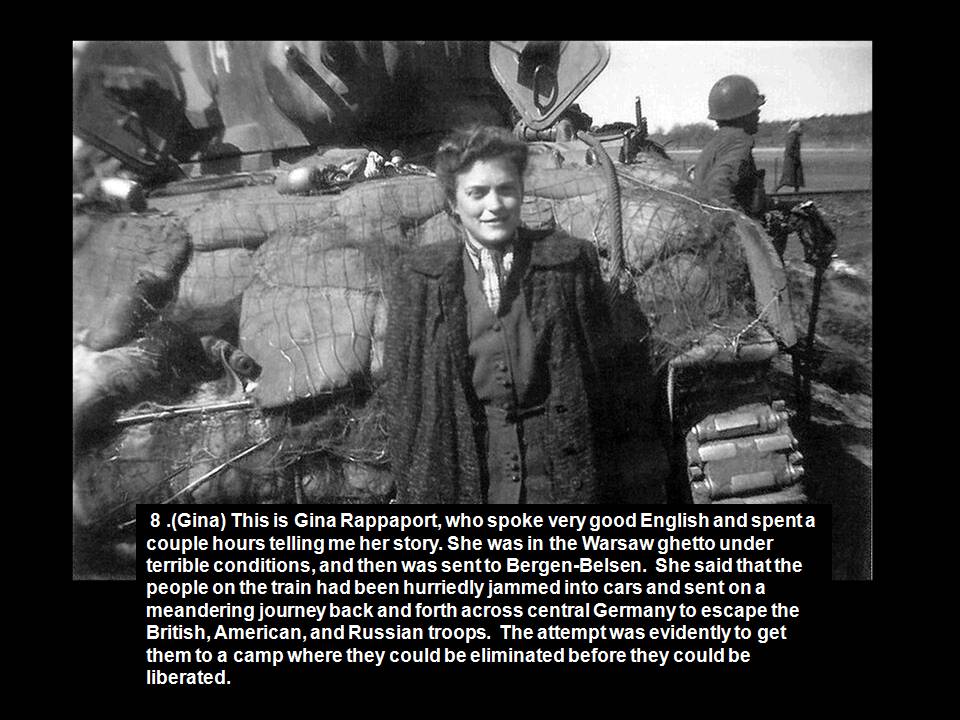
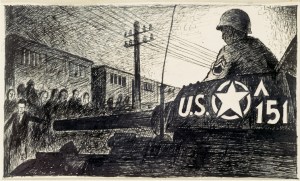
I believe that the ranking officer of the Finnish prisoners introduced himself to me and offered to set up a perimeter guard. I think I approved and asked him to organize a guard, set out pickets, and handle the maintenance and relief of the outposts. However it happened, the guard was set up swiftly and efficiently. It was moving and inspiring to see how smartly those emaciated soldiers returned to their military duties, almost joyful at the thought of taking orders and protecting others again.  They were armed only with sticks and a few weapons discarded by the fleeing German guards, but they made a formidable force, and they obviously knew their duties, so that I could relax and talk to the people. A young woman named Gina Rappaport came up and offered to be my interpreter. She spoke English very well and was evidently conversant with several other languages besides her native Polish.  We stood in front of the tank as along line of men, women, and little children formed itself spontaneously, with great dignity and no confusion, to greet us.  It is a time I cannot forget, for it was terribly moving to see the courtesy with which they treated each other, and the importance they seemed to place on reasserting their individuality in some seemingly official way.  Each would stand at a position of rigid attention, held with some difficulty, and introduce himself or herself by what grew to be a sort of formula:  the full name, followed by “a Polish Jew from Hungary”-or a similar phrase which gave both the origin and the home from which the person had been seized.  Then each would shake hands in a solemn and dignified assertion of individual worth. Battle-hardened veterans learn to contain their emotions, but it was difficult then, and I cry now to think about it. What stamina and regenerative spirit those brave people showed!
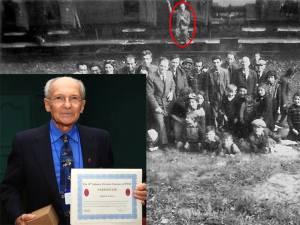
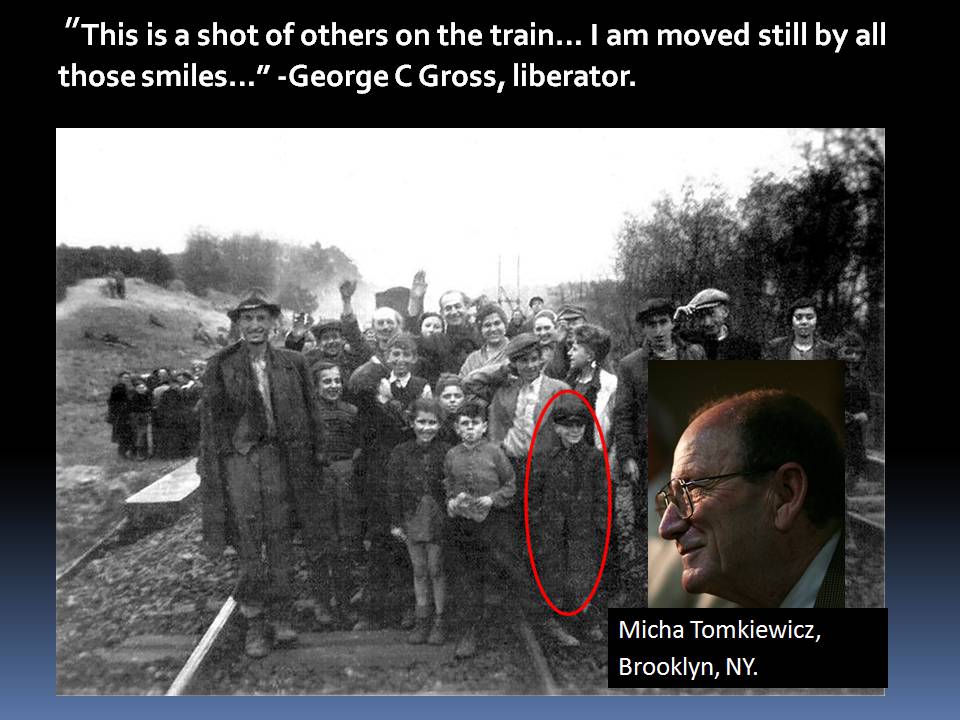
Also tremendously moving were their smiles.  I have one picture of several girls, specter-thin, hollow-cheeked, with enormous eyes that had seen much evil and terror, and yet with smiles to break one’s heart.  Little children came around with shy smiles, and mothers with proud smiles happily pushed them forward to get their pictures taken.  I walked up and down the train seeing some lying in pain or lack of energy, and some sitting and making hopeful plans for a future that suddenly seemed possible again. Others followed everywhere I went, not intruding but just wanting to be close to a representative of the forces that had freed them.  How sad it was that we had no food to give immediately, and no medical help, for during my short stay with the train sixteen or more bodies were carried up the hillside to await burial, brave hearts having lost the fight against starvation before we could help them.
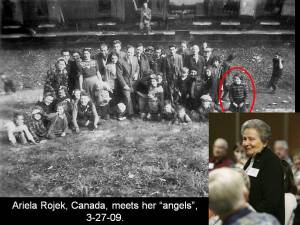
The boxcars were generally in very bad condition from having been the living quarters of far too many people, and the passenger compartments showed the same signs of overcrowding and unsanitary conditions.  But the people were not dirty.  Their clothes were old and often ragged, but they were generally clean, and the people themselves had obviously taken great pains to look their best as they presented themselves to us.  I was told that many had taken advantage of the cold stream that flowed through the lower part of the valley to wash themselves and their clothing.  Once again I was impressed by the indomitable spirits of these courageous people.

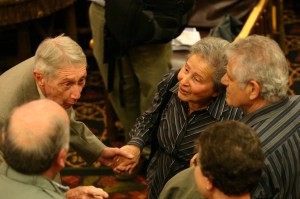
Frank Towers, a World War II veteran who helped liberate 2,500 Jews on a train bound for a Nazi concentration camp, meets Bruria Falik of Woodstock, who was on the train, at Arbor Ridge at Brookmeade in Rhinebeck. (Photos by Karl Rabe/Poughkeepsie Journal)

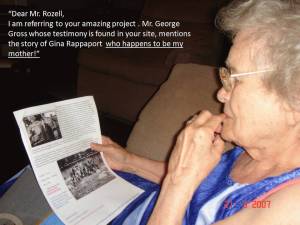
I spent part of the afternoon listening to the story of Gina Rappaport, who had served so well as interpreter.  She was in the Warsaw ghetto for several years as the Nazis gradually emptied the ghetto to fill the death camps, until her turn finally came.  She was taken to Bergen-Belsen, where the horrible conditions she described matched those official accounts I later heard.  She and some 2500 others, Jews from all over Europe, Finnish prisoners of war, and others who had earned the enmity of Nazidom, were forced onto the train and taken on a back-and-forth journey across Germany, as their torturers tried to get them to a camp where they could be eliminated before Russians on one side or Americans on the other caught up with them. Since the prisoners had little food, many died on the purposeless journey, and they had felt no cause for hope when they were shunted into this little unimportant valley siding.  Gina told her story well, but I have never been able to write it.  I received a letter from her months later, when I was home in San Diego.   I answered it but did not hear from her again.  Her brief letter came from Paris, and she had great hopes for the future.  I trust her dreams were realized.
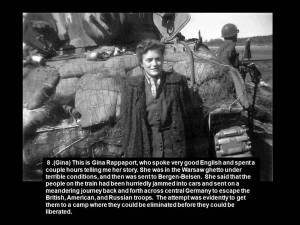
We were relieved the next morning, started up the tank, waved good-bye to our new friends, and followed a guiding jeep down the road to rejoin our battalion.  I looked back and saw a lonely Gina Rappaport standing in front of a line of people waving us good fortune.  On an impulse I cannot explain, I stopped the tank, ran back, hugged Gina, and kissed her on the forehead in a gesture I intended as one asking forgiveness for man’s terrible cruelty and wishing her and all the people a healthy and happy future. I pray they have had it.
George C. Gross

Spring Valley, California

June 3, 2001

click here for the ANNOTATED PHOTOGRAPHS

LISTEN to Carrol Walsh and George Gross share their recollections of the liberation of “A Train Near Magdeburg” (9:32)

Read Full Post »

Just back from the reunion of the 30th Infantry Division Veterans of World War II and also the Holocaust survivors whom they liberated on April 13th, 1945.


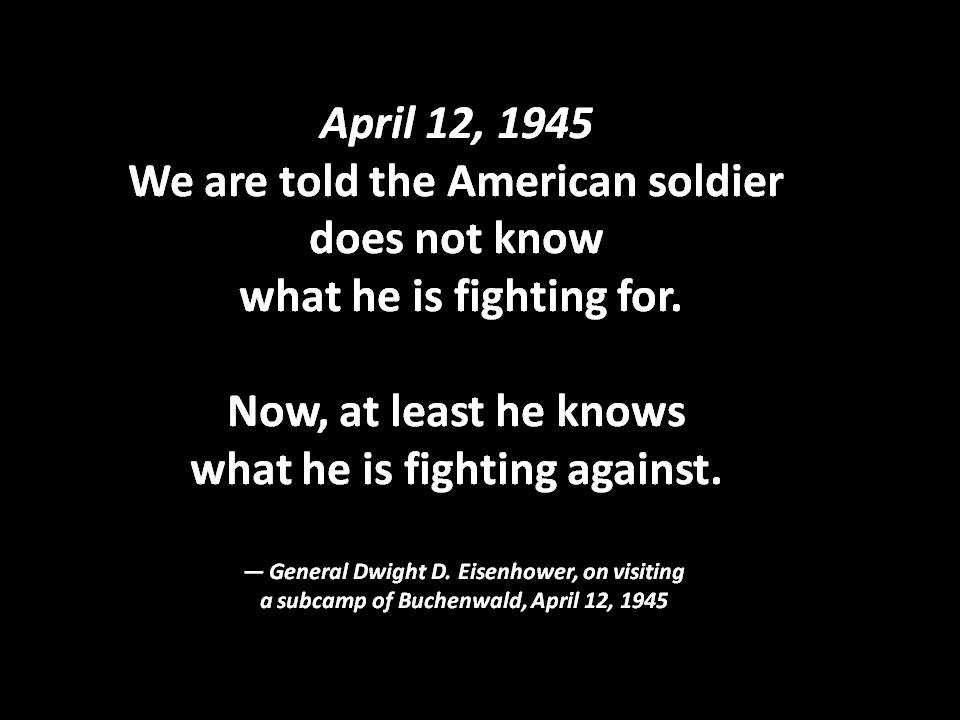
At the conclusion of my presentation, John, one of the soldiers, said to me, tears in his eyes, “Yes. This is what I fought for. We didn’t really understand why we were over there. This is what we fought for.”

The signature phrase of the United States World War II Memorial in Washington, DC, is that “Americans Came to Liberate, not Conquer.” Yet during their travails across France, the Low Countries, and into Germany itself, many soldiers wondered aloud about the circumstances that took them so far away from home. The drudgery and boredom of Army routine and regulation, not to mention the months of being shot at or shelled, were all taking their toll. However, it slowly became clear to many what they had been fighting for all along as they encountered the evidence of years of Nazi tyranny. And when our soldiers themselves witnessed the atrocities of the greatest crime committed in the history of the mankind, the Holocaust, all questioning ceased.  Americans had indeed come to liberate.

This year, besides the dozen or so old soldiers, we were joined by five Holocaust survivors: Stephen, who at age 31/2 had lost both his parents and was liberated on the train, and Bruria, who told us of how her grandfather passed away shortly after liberation, “beaming like an angel”, content that he had died a free man. George explained the history and the horrors in Bergen Belsen, including losing his father and Micha described his mother’s efforts to recount what had happened in Poland, how his father was shot after jumping from the transport from the Warsaw Ghetto to Treblinka, and how he and his mother survived . And Paul explained that how meeting and becoming friends with his actual liberators was helping him to assuage the scars inflicted upon him, so long ago, but really only yesterday.

This is what I fought for.

Read Full Post »


I am re-posting this today on the anniversary of Dr. Gross’ death.
Yesterday my son turned 11. And at about 11 pm yesterday on the West Coast, Dr. Gross died at home with his family around him.

I just found out. More than anyone else, he is the one responsible for this website and the hundreds of lives changed because of it.

You see, he took the photo that you may not really notice in the heading above, along with 9 other photographs that forever imprint the evidence not only of man’s inhumanity to man, but of the affirmation, hope and promise of mankind. It was he who wrote the prose that led me to the survivors, and vice versa. And it was he who cultivated a deep friendship with me via his wonderful writings and telephone conversation. How amazed and happy he seemed to be to hear from all the survivors.

In the summer of 2001, I did an interview with his comrade in arms, army buddy Carrol Walsh. Judge Walsh put me in touch with Dr. Gross. If you go back through the archives you know the rest of the story. It has changed my life and the lives of my students in that we are now trying to rescue the evidence, the testimony of the Holocaust and the World War Two veterans, for the United States Holocaust Memorial Museum. And today I received in the mail a bulletin from this Museum, reaffirming the mission that Dr. Gross had everything to do with setting me on.

He came into my life during a dark time for me- we had just lost our father (who thankfully, like Dr. Gross, passed on from his own bed at home), and our mother was battling the final stages of Alzheimer’s disease, or dementia, or whatever that nightmare was called…. we began a conversation that has yielded so much fruit.

Lately, I knew he wasn’t well. I actually had looked into flights across the country before Christmas for my son and I to pay a visit, but we just couldn’t seem to swing it financially, with Christmas bills coming in and holiday fares going up. My back up plan, in my head, was to go out in February, when fares were half the cost… Well, February arrived yesterday and now it is too late, I never got to shake the hand of a man who helped reshape my own life, and the lives of so many others.george-gross-1945

His 8×10 liberation photos are mounted in the front of my classroom, with his captions for all to see. So I see George and just one of the noteworthy products of his life, everyday. The captions that he wrote for each are mounted below each print, a testament to his humanity and to his graciousness.

I know it is selfish to feel so bad about the fact that I was not able to literally reach out and touch him. I’m just so damned disappointed.  Right now it’s another dark day for Matt, but I am comforted that he was surely welcomed by his beloved wife, parents, and maybe even my folks as well.

From his statement read at the occasion of the first reunion, September 14th, 2007. Please feel free to add your own comments or tributes. Matt

Sincere greetings to all of you gathered at this celebration of the indomitable spirit of mankind!


Greetings first to all the admirable survivors of the train near Magdeburg, and our thanks to you for proving Hitler wrong. You did not vanish from the face of the earth as he and his evil followers planned, but rather your survived, and grew, and became successful and contributing members of free countries, and you are adding your share of free offspring to those free societies.

You have vowed that the world will never forget the horrors of the Holocaust, and you spread the message by giving interviews, visiting schools, writing memoirs, and publishing powerful books on the evil that infected Nazi Germany and threatens still to infect the world. I am enriched by the friendship of such courageous people who somehow have maintained a healthy sense of humor and a desire to serve through all the evils inflicted upon you.


Greetings also to the dedicated teacher whose efforts have brought us all together through the classes he has taught on World War 2 and the web site he maintains at the cost of hours of time not easily found in his duty as a high school teacher. I know that several of you found your quest for knowledge of your past rewarded by the interviews and pictures Matt Rozell and his classes have gathered and maintained. Selfishly, I am grateful to Mr. Rozell for leading several of you to me, bringing added joy to my retiring years.


Greetings also to all the faculty, staff, students, parents, and friends of the school at which this important gathering takes place. Thank you for your interest in the survivors of the Holocaust and their message.


And special greetings also to my old Army buddy, Judge Carrol Walsh, and his great family. Carrol fought many battles beside me, saved my life and sanity, and resuscitated my sense of humor often. We had just finished a grueling three weeks of fighting across Germany, moving twenty or more hours per day, rushing on to reach the Elbe River. Carrol and I were again side by side as we came up to the train with Major Benjamin, chased the remaining German guards away, and declared the train and its captives free members of society under the protection of the United States Army as represented by two light tanks.

Unfortunately, Carrol was soon ordered back to the column on its way to Magdeburg while, luckily for me, I was assigned to stay overnight with the train, to let any stray German soldiers know that it was part of the free world and not to be bothered again.


Carrol missed much heartbreaking and heartwarming experience as I met the people of the train. I was shocked to see the half-starved bodies of young children and their mothers and old men—all sent by the Nazis on their way to extermination.

I was honored to shake the hands of the large numbers who spontaneously lined up in orderly single file to introduce themselves and greet me in a ritual that seemed to satisfy their need to declare their return to honored membership in the free society of humanity.

I was heartbroken that I could do nothing to satisfy their need for food that night, but I was assured that other units were taking care of that and the problem of housing so many free people.

Sixty years later, I was pleased to hear that the Army did well in caring for their new colleagues in the battle for freedom. I saw many mothers protecting their little ones as best they could, and pushing them out, as proud mothers will, to be photographed. I was surprised and please by the smiles I saw on so many young faces.

Some of you have found yourselves among those pictured children, and you have proved that you still have those smiles. I was terribly upset at the proof of man’s inhumanity to man, but I was profoundly uplifted by the dignity and courage shown by you indomitable survivors. I have since been further rewarded to learn what successful, giving lives you have lived since April 13, 1945.


I wish I could be with you in person at this celebration, as I am with you in spirit. I hope you enjoy meeting each other and getting to know Matt Rozell and Carrol Walsh. I look forward to seeing again my friends whom I have met and to meeting the rest of you either in person or by E-mail. My experience at the train was rich and moving, and it has remained so, locked quietly in my heart until sixty years later, when the appearance of you survivors began to brighten up a sedate retirement.

You have blessed me, friends, and I thank you deeply. May your lives, in turn, bring you the great blessings you so richly deserve.


Fondly yours,

George C. Gross

September, 2007


Read Full Post »

Just returned from a three day conference.

As Holocaust educators, we talk about the choices that individuals face and the patterns that one may follow in making one’s choice. The trend seems to be to focus on the role of the “perpetrator” and “bystander”  in the greatest crime in the history of the world, to examine the nuances of their behavior, to perhaps gain insight into why the Holocaust occurred. Yes. Very, very,  important.

But how about including in our discussion the actions and behaviors of the soldiers who ended the Holocaust? They faced a choice, too. They had seen their friends vaporized in front of their eyes, they were weary, and tired of being shot at, and utterly exhausted. They were twenty fours hours away from another major showdown at a “last stand” city. Many of the soldiers would not survive, though the end of the war was in sight.

But they stopped, even as the enemy was digging in behind the battlelines.

Horrified and in shock, they sprang into action. One 4 year old survivor remembers that it was the “first time in my life that I can recall an adult with a smile”. If someone were to argue that the world owes these soldiers a debt, I don’t think too many people would find that problematic.

If you have not viewed the news clips (about 3 minutes each), I welcome you to do so.  In doing so, however,  you are forewarned that there is  someone who vehemently disagrees with that argument. He even shakes his finger.

And what does that say about the soldiers in this story? We need to dissect the behavior of the collaborators and those who are complicit in the crime. But what is it about the decisions made  and actions taken by these soldiers that is important to study? Of course this is worthy of our consideration, and as I struggle with my own role  in  the future of Holocaust education, I don’t think it should be overlooked or worse, “sidebarred” in the larger narrative of choices, patterns of behavior, and decision making.

Remember, the permanent exhibition at the USHMM even opens with visitors listening to the narrative of one of these soldiers on the elevator ride up to the 4th floor.  Why? It is more than that soldier just becoming  the “set-up guy” for the shock that greets one when the elevator doors open. We need to really explore that further.

Frank Towers, a World War II veteran who helped liberate 2,500 Jews on a train bound for a Nazi concentration camp, meets Bruria Falik of Woodstock, who was on the train, at Arbor Ridge at Brookmeade in Rhinebeck. (Photos by Karl Rabe/Poughkeepsie Journal)

Thank you for allowing me the opportunity to have you consider this, with the video  interviews, as well. And to the folks who might have thought otherwise, it’s not about me, finding and bringing folks  together- those soldiers are primary actors in this drama, and are survivors in their own right as well. {And note that throughout this discussion I have refrained from using the term “liberator”. My guys are not even officially recognized as “liberators”.}

What made them tick? Would one of us have picked up and carried a sick, lice-ridden, foul smelling “semblance” of a human being, exhausted and at the breaking point ourselves ?  Look below in the next post to get a Holocaust survivor’s take on it.

Read Full Post »

{As part of the conclusion to my USHMM Teacher Fellowship project, I  am posting the unfolding nature of the discovery of the camps as Allied troops closed in from the East and the West, sixty-five years to the day that the discovery/event occurred. This post also gets an inordinate amount of hits; please be sure to visit the “About” link for context.}This was originally posted on 4-15-10.}

April 15, 1945: British troops reach the Bergen-Belsen, Germany, concentration camp and find 60,000 survivors and 27,000 unburied corpses. Following liberation, starvation and typhus will claim about 13,000 more…

(Weber, Louis. The Holocaust Chronicle. Publications International Ltd., 2007. http://www.holocaustchronicle.org)

See  Bob Spitz’ testimony of his liberation, and typhus.  In this video, filmed by my son Ned in March 2008, he is addressing his liberators for the first time since 1945.

When I was in ninth grade, my education was disrupted brutally by having been transferred into a railroad yard, packed into cattle cars of the German government and ended up in Bergen Belsen with my father. We were in Bergen Belsen from late March to February, in which my father and I were separated. We were hiding the fact that we were father and son. He was taken away from me and he was shipped to a camp in Austria, the camp was called Mauthausenwhere he was killed. So I was in Bergen Belsen, all by myself, age 14-½ -15, and my physical situation was very, very bad. You heard from other former inmates that they had doctors and birth certificates. We had no no doctors or birth certificates. More often than not we had water problems. We didn’t have running water because the water system was probably in a very bad condition. We didn’t have water available 24 hours a day. I don’t think I have to discuss food with you, you’ve heard enough stories about the lack of food … So on that particular fateful April day, we’d received our orders to go to the railroad yard to be packed in because we we are now going to Theresienstadt. Theresienstadt is so many kilometers from Prague, Czechoslovakia; it was a military camp during the existence of the Austrian-Hungary Empire. Which disintegrated in 1918. Now it became a camp for Jewish inmates under the National Socialist system, you know our train made a drastic mistake in getting to Theresienstadt. It didn’t get into Theresienstadt; it didn’t make it because of you gentlemen of the 30th Division. It was certainly a big day, as I was sitting inside of that car, cattle car, where I would estimate that there were few inmates in the cattle car that had fewer then 1,000,000 lice each. Naturally starved to death, skin and bones, very, very  bad condition. Until we heard, I heard, that somebody was fiddling with the lock of my sliding door, from the outside. Obviously that sliding door, the lock was open and first thing I know is that the sliding door is sliding toward an open position. A young man who wore, for you veterans, an ‘OD’ uniform, which means olive drab in English, and he had a white  armband with a red cross in it. Behind him there were 2 or 3 younger men without the Red Cross armbands, they were talking a language that I understood. I assume that I was the only one in my car that understood/spoke English. I had English in school with other languages. I was the only one with these guys that was able to strike up a conversation. They were, I think, more delighted than I was. I didn’t realize just how many advantages I just gained because I have successfully established a line of communication with these guys from another part of the world. They were delighted that they could start finding out information that was never available to them. At this time I think I want to stop for a minute to try to convey to you the impressions that I gained at that time from these three guys.

It’s hard for me to describe it accurately because, a) I was sick, terribly sick, b) my perception did not function at all, I had a high fever so I’m trying to remember to the best of my ability: The degree of shock, their shock, surprise, questioning on their faces-Where did these people come from? How did this happen? But within a few minutes this combination of emotions got transferred into the demonstration of concern, care, interest, a demonstration of wish, and good intentions, that was conspicuously demonstrated to each and every one of us. Before I realized just what was happening, the strong arms of that young man with the white armband grabbed me- I don’t know why, he probably didn’t know how many lice I had on my skull-

He pulled me out of that car and then the other soldiers started pulling guys out of it.

I forgot to tell you. When the first soldier opened that sliding door, some bodies-our bodies-fell on him from the railroad car. They were dead. Naturally that came as a surprise. To us, you know, it was a matter of an every day event. He pulled me out and I don’t know how, I didn’t know what was going on. I was out of it, first thing I knew, I am riding on a truck. Again I went out of it, the next thing I knew I was standing in front of a gun which was run by a gasoline-fed engine. They were spraying me with white powder, lots of it. Later on I found out that was procedure of DDT, de-lousing. Believe me they had to waste an awful lot of powder on me.

After this, they pulled me and took me into a room. Now I knew it by then that the city, the village of Hilersleben  all of a sudden gained 2500, 2600, 2700 new comers. From that train and many of them needed hospitalization. I assumed the majority needed hospitalization. I was put in a semi-private room, two people to the room. Well later I found out that the 2nd and 3rd floor consisted of wards with 70 bunks,  70 beds. Here I have a semi-private room because they could talk to me and I could talk to them. After God knows how many medical examinations and everything else the drastic change of tension in my diet was really very, very easy. Going from no diet to a diet is a drastic turnabout, but it’s an easy process. Again my food had to be supervised very carefully because many people, liberated people, got extremely sick and many died because of their food intake not being planned or controlled. A good Army major went from living quarters with a cocked 45 pistol in his hand, expressing his desire that the German peasant, the German farmer, the German citizen starts cooking for these guys. Many of these guys weren’t ready for that food. It played havoc.

So as time went on, I got better and better and I got rid of my typhus and my fever dropped. They called this “normalcy”. I have a problem with this word, normalcy, what is normal? What’s normal to you doesn’t have to be normal to me. I think it’s only a setting on a washing machine. My recovery was very nice and satisfactory except I assumed a new duty which I wasn’t aware of. Often, as the day went on, one medic after another said, ”Hey, Bob. Will you please come with me to the 3rd floor? We have a problem  with Tommy/ Billy/ etc. There’s a problem, he can’t talk to us, and we can’t talk to him.” I found myself acting as a translator. Little did I know that was going to be the beginning  of something big.

{transcribed by Ashleigh Fitzgerald, HFHS ’10.}

Read Full Post »

« Newer Posts - Older Posts »