Feeds:
Posts
Comments

Posts Tagged ‘Bergen Belsen’

Yom HaShoah ceremony and service, Jewish Federation of greater Rochester, New York, April 15, 2015. 700 folks come out on a midweek night. From an audience member: ‘The most beautiful, inspirational Yom HaShoah service I have ever been to.’

It was indeed a moving service and I was honored to have a part in it.

We stop and we pause, to reflect and remember.

Key take-aways from my presentation:


  1. The American Army was involved in a shooting war. More soldiers would die in the days to come. But they stopped. They helped these people. And some carried the trauma with them for the rest of their lives.
  2. People need heroes. But few of the liberators would like to be remembered this way. Maybe we should all take a moment to think about our own obligation to humanity.
  3. For every one person who was liberated on this ‘Train Near Magdeburg, nearly 2500 persons, keep close the reality that another 2500 perished in the Holocaust.
  4. Finally, the voices of the eyewitnesses need to always be with us. We need to keep them close. Or forget at our peril.

***

Carrol Walsh, liberator: Our lives were joined at that moment on April 13, 1945, and now we meet face to face and recall together that moment when my tank reached the train.

Steve Barry, survivor:There is no other army in this world that would stop and help 2500 lice-ridden, emaciated Jews, to save them. What army would stop, except the American army?

Steve Barry: Mounted SS troops came around, rode by the train, and started to yell ‘Raus, Raus, get out of the train!  Get out of the cars!’  And we saw them putting up machine gun nests. So obviously, even at that last moment, they were still trying to murder us.

Carrol Walsh: I had no idea who they were, where they had come from, where they were going – nothing. No idea. All I knew: here’s a train with these boxcars and people jammed in those boxcars. No idea. No, I had no idea.

Steve Barry: Very shortly after that we saw the first American GIs.  Well, actually there were two tanks.  I still get tears in my eyes. Right now I have tears in my eyes and I always will when I think about it.  That’s when we knew we were safe.

Letter  from Carrol Walsh to Steve Barry, 2008: ‘You are always expressing gratitude to me, the 743rd Tank Battalion and the 30th Infantry Division. But I do not believe gratitude is deserved because we were doing what we, and the whole world, should have been doing- rescuing and protecting innocent people from being killed, murdered by vicious criminals. You do not owe us. We owe you.  We can never repay you and the Jewish people of Europe for what was stolen from you: your homes, your possessions, your businesses, your money, your art, your family life, your families, your childhood, your dreams, and all your lives.’

Steve Barry:  Is this a beautiful person?

Carrol Walsh:  I think, I cannot believe today, as I look back on those, on those years and on what was happening, I cannot believe that the… world almost ignored those people and what was happening. I cannot believe it. How could we have all stood by and have let that happen? We owe those people a great deal. We owe those people everything. They do not owe us anything. We owe them for what we allowed to happen to them. That is how I feel.


Read Full Post »

April 17th. (1945)

Dear Chaplain;-

Haven’t written you in many months now, its funny how a few moments are so hard to find in which to write a letter way past due; it’s much easier to keep putting it off the way I’ve done. I’ll try to make up for it in this letter.

Today I saw a sight that’s impossible to describe, however I’ll try. Between 2400 and 3000 German refugees were overran by my division during our last operation; most of them were, or had been, inmates of concentration camps, their crimes the usual ones, – Jewish parentage, political differences with der Fuhrer, lack of sympathy for the SS, or just plain bad luck. Not one of these hundreds could walk one mile and survive; they had been packed on a train whose normal capacity was perhaps four or five hundred, and had been left there days without food.

Our division military government unit took charge of them, and immediately saw what a huge job it was going to be, so they sent out a call for help. Several of our officers went out to help them organize the camp they were setting up for them. The situation was extremely ticklish we soon learned; no one could smoke as it started a riot when the refugees saw the cigarette, and we couldn’t give the kiddies anything or they would have been trampled to death in the rush that would result when anything resembling food was displayed. The only nourishment they were capable of eating was soup; now the army doesn’t issue any of the Heinz’s 57 varieties, so we watered down C-ration[s] and it served quite well.  It was necessary to use force to make the people stay in line in order to serve them. They had no will power left, only the characteristics of beasts.

A few weeks of decent food will change them into a semblance of normal human beings; with God willing the plague of disease that was already underway, will be diverted; but I’m wondering what the affect of their ordeal they have been through, will be on their minds; most will carry scars for the rest of their days for the beatings that they were given. No other single thing had convinced me as this experience has that Germany isn’t fit to survive as a nation. I’ll never forget today.

I was going to write mother tonight but thought better of it. I’ll be in a better frame of mind tomorrow. I’m only a few dozen miles from Berlin right now, and its hard to realize the end is in sight. I’m always glad to receive your scandal sheet. You perhaps missed your calling, as your editorial abilities are quite plain.

As ever,

Charles.

March 11th, 2009

Dear Mr. Rozell:

My father-in-law was 1st. Lt. Charles M. Kincaid. He was a Liason Officer with the 30th. Division Artillery.  He was honored with an Air Medal in the battle of Mortain and a Bronze Medal in the battle of St. Lo.  In the battle of Mortain he won his Air Medal by calling in artillery adjustments while flying in a Piper L-4 over 4 panzer divisions on August 9, 1944.

first-lt-chuck-kincaid-sept-1944He rarely wrote home. He did write home to his minister about one event that evidently really caused him to stop and think. Attached is a copy of that letter that his sister transcribed – making copies for others to read.  The letter describes the Farsleben train and his experience there.

I need to thank you for your website and work. You and your students work enabled me to connect the letter with the actual historical event. It further enabled me to show my children the pictures and to make their Grandfather’s experience real, not just an old letter – that this event so affected him that he needed to tell his minister before he told his mother.

Thank you,
Mark A.

Read Full Post »

Friday the 13th. Today is the 70th anniversary, to the day.

This account comes to me from a survivor’s son who lives in Hungary. He had read of Carrol Walsh’s passing on the internet and contacted me. It is Carrol who is commanding one of these tanks. Sgt. George Gross commanded the other, and took photographs.

I just came across this website . My father was on this train.
He passed away twenty years ago, in April 1992.

Here is an excerpt from his memoirs about his liberation day.
—————————————————-

Translation from my father’s Memoirs pp. 302-304.
————————————————-

The day of April 13 1945 was a Friday and a sunny and windy day. In the morning, the SS opened the doors of the freight cars, after they had argued with each other whether they should kill us with their submachine guns. But the US troops were too close.

——————————————————————-

Perhaps it was an older SS man who prevented our execution. Later that day, a Jewish woman, who had been his lover in the camp, saved him from becoming a prisoner of war or worse. She got him civilian clothes, I do not know how. The same woman became the lover of an American soldier later.
——————————————————————

Several hundred people wrapped in rags streamed through the open doors, if they could be called people at all. We were all mere skeletons.

The train was idling in a deepening, so I climbed uphill, across a road and to a field. I was pulling out potatoes planted on the field, when a motorcycle approached. It was a motorcycle with a side-car. There was an elegant SS or Nazi leader in the front: I could not decide, since he was wearing a mixture of uniform and civilian clothes. It must have been his wife sitting behind him and his child in the side-car. He pulled over and offered me a cigarette. I told him I did not smoke, so he closed his silver-looking cigarette-case and started the engine.
He seemed to hesitate about the direction he should take.

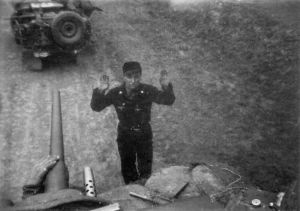
Prisoner taken. Photo by tank commander George C Gross, April, 1945.

Prisoner taken. Photo by tank commander George C Gross, April, 1945.

Then two small American tanks arrived. I was standing in the middle of the road, and noticed that the American soldier leaning out of the turret of one of the tanks aimed his gun at me.
The tank came closer and closer, and the soldier lowered his submachine gun. I must have looked terrible, so he did not take me for an enemy. I was lucky he had not shot me from the distance, since my small coat and boots vaguely resembled a military uniform. Lice were crawling all over my clothes and skin.

The few hundred former inhabitants of the concentration camp surrounded the tanks right away. Suddenly somebody remembered that the SS guarding us were still in the carriages. The SS were caught quickly, and lined up. The “intrepid” SS were trembling so heavily that their pants were flapping.

The first thing a Jewish woman asked from the soldier leaning out from the tank was money, and she received a dollar bill. She must have established her future with this dollar.

My attention was drawn to something else: in the rear of the tank there was a box of canned food. I climbed under the tank, emerged at its end, and pulled out a can. It turned out that I stole a can of oranges. This was my luck. I ate the potatoes charred in the can with the oranges, and probably this combination saved my life. Everyone who ate meat or anything greasy died within hours or within one or two days at the latest.

I felt fever in my body, undressed completely naked in front of staring women, and went into the ice-cold water of the lake next to the railroad. People warned me not to do this, but I went into the water, felt good, felt that I got rid of the lice and the burning heat of the fever. When I put on my rags again, I felt the fever ever stronger.

I asked an American soldier to sign the photo of my fiancee (I still have this photo). To my surprise, he signed the name Churchill. I thought he was joking. But he reassured me that his name was really Churchill.

(Once I read about a father named Churchill, who went to see his son’s grave in Vietnam during that war. The report mentioned that the father had been a soldier in World War II. He must have been my Churchill)

In the evening, there were news that we should flee, because the Germans pushed back the Americans. The Germans would massacre us for sure, the women had pulled out material for parachutes from a carriage in order to make clothes.

I was already so weak that I did not care whether the returning Germans would kill me: I stayed in one of the carriages, and fell asleep.

On Saturday, April 14, German peasant [horse-drawn] carts came for us by some order, so I was carried to Hillersleben. I dragged myself to the first floor of the first building, it looked like an office building, lay down under the sink of the bathroom, and fell asleep.

I am sure the American soldiers had no idea who we were and what we went through.

*******************************

First published in 2013. I am off to the last survivors/liberators reunion in Nashville Tennessee, this weekend.

Read Full Post »


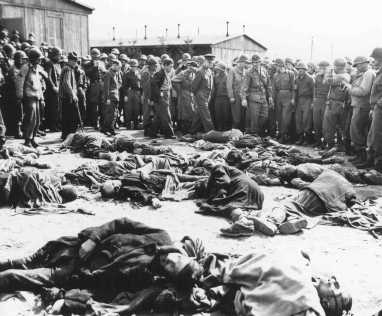
General Dwight D. Eisenhower (center), Supreme Allied Commander, views the corpses of inmates who perished at the Ohrdruf camp. Ohrdruf, Germany, April 12, 1945. — National Archives and Records Administration, College Park, Md. USHMM

We are told the American soldier does not know what he is fighting for. Now, at least he knows what he is fighting against.

— General Dwight D. Eisenhower, on visiting a subcamp of Buchenwald, April 12, 1945

April 4, 1945: The U.S. 4th Armored Division liberates the concentration camp at Ohrdruf, Germany, a subcamp of Buchenwald, the site of more than 4000 deaths during the previous three months. Victims were Jews, Poles, and Soviet POWs. Hundreds shot just before liberation had been working to build an enormous underground radio and telephone communications center. Very few inmates remain alive at liberation.

April, 1945: U.S. Generals Dwight Eisenhower, George Patton, and Omar Bradley visit the camp at Ohrdruf, Germany, and view corpses and other evidence of Nazi atrocities.

In late March 1945, the camp had a prisoner population of some 11,700, but in early April the SS evacuated almost all the prisoners on death marches to Buchenwald. The SS guards killed many of the remaining prisoners who were too ill to walk to the railcars.

When the soldiers of the 4th Armored Division entered the camp, they discovered piles of bodies, some covered with lime, and others partially incinerated on pyres. The ghastly nature of their discovery led General Dwight D. Eisenhower, Supreme Commander of the Allied Forces in Europe, to visit the camp on April 12, with Generals George S. Patton and Omar Bradley. After his visit, Eisenhower cabled General George C. Marshall, the head of the Joint Chiefs of Staff in Washington, describing his trip to Ohrdruf:

. . .the most interesting–although horrible–sight that I encountered during the trip was a visit to a German internment camp near Gotha. The things I saw beggar description. While I was touring the camp I encountered three men who had been inmates and by one ruse or another had made their escape. I interviewed them through an interpreter. The visual evidence and the verbal testimony of starvation, cruelty and bestiality were so overpowering as to leave me a bit sick. In one room, where they were piled up twenty or thirty naked men, killed by starvation, George Patton would not even enter. He said that he would get sick if he did so. I made the visit deliberately, in order to be in a position to give first-hand evidence of these things if ever, in the future, there develops a tendency to charge these allegations merely to “propaganda.”


Seeing the Nazi crimes committed at Ohrdruf made a powerful impact on Eisenhower, and he wanted the world to know what happened in the concentration camps. On April 19, 1945, he again cabled Marshall with a request to bring members of Congress and journalists to the newly liberated camps so that they could bring the horrible truth about Nazi atrocities to the American public. He wrote:

We continue to uncover German concentration camps for political prisoners in which conditions of indescribable horror prevail. I have visited one of these myself and I assure you that whatever has been printed on them to date has been understatement. If you could see any advantage in asking about a dozen leaders of Congress and a dozen prominent editors to make a short visit to this theater in a couple of C-54’s, I will arrange to have them conducted to one of these places where the evidence of bestiality and cruelty is so overpowering as to leave no doubt in their minds about the normal practices of the Germans in these camps. I am hopeful that some British individuals in similar categories will visit the northern area to witness similar evidence of atrocity.

That same day, Marshall received permission from the Secretary of War, Henry Lewis Stimson, and President Harry S. Truman for these delegations to visit the liberated camps.

Ohrdruf made a powerful impression on General George S. Patton as well. He described it as “one of the most appalling sights that I have ever seen.” He recounted in his diary that

In a shed . . . was a pile of about 40 completely naked human bodies in the last stages of emaciation. These bodies were lightly sprinkled with lime, not for the purposes of destroying them, but for the purpose of removing the stench.

When the shed was full–I presume its capacity to be about 200, the bodies were taken to a pit a mile from the camp where they were buried. The inmates claimed that 3,000 men, who had been either shot in the head or who had died of starvation, had been so buried since the 1st of January.

When we began to approach with our troops, the Germans thought it expedient to remove the evidence of their crime. Therefore, they had some of the slaves exhume the bodies and place them on a mammoth griddle composed of 60-centimeter railway tracks laid on brick foundations. They poured pitch on the bodies and then built a fire of pinewood and coal under them. They were not very successful in their operations because there was a pile of human bones, skulls, charred torsos on or under the griddle which must have accounted for many hundreds.

Source(s):

Weber, Louis. The Holocaust Chronicle. Publications International Ltd., 2007. http://www.holocaustchronicle.org

The United States Holocaust Memorial Museum, 1945- The Year of Liberation. 1995.

http://www.ushmm.org/wlc/en/media_ph.php?ModuleId=10006131&MediaId=3711

http://www.ushmm.org/wlc/en/article.php?ModuleId=10006131

*************************************************************

Matthew Rozell is a United States Holocaust Memorial Museum Teacher Fellow and teaches history at his alma mater in upstate New York. This year, he is authoring a series of posts under the heading of ‘Seventy Years’, marking the 70th anniversary of the close of World War II and of the ‘liberation phase’  of the Holocaust. His work has reunited 275 Holocaust survivors with the American soldiers who freed them.

His first book, a narrative of World War II in the Pacific as told through the previously unpublished recollections of two dozen veterans, is due out this spring. His second book, in progress, is on the power of  teaching, remembering the Holocaust, and this “Train Near Magdeburg’. He can be reached at marozell at gmail dot com.

Read Full Post »

{To commemorate the spring of 1945 and  liberation seventy years on, I  am posting the unfolding nature of the discovery of the Holocaust as Allied troops closed in from the East and the West.}

March 19, 1945:

Adolf Hitler issues the Nero-Befehl (Nero Order), a scorched-earth directive intended to leave only a ruined Germany for advancing troops.
March 19, 1945:

Two hundred survivors out of 1000 Jewish women who began a forced march from the Neusalz, Poland, slave-labor camp on January 26 are evacuated by train to the concentration camp at Bergen-Belsen, Germany; see this post.

Source: Weber, Louis. The Holocaust Chronicle. Publications International Ltd., 2007. http://www.holocaustchronicle.org

I  received this email from the son of survivors:

Dear Mr. Rozell,

My mother was one of the 200 or so that survived that “death march”!  The survivors were transported to the camp at Bergen-Belsen, where my mother was ultimately liberated on April 15, 1945.

Many years ago, she did relate to me a wartime story of hers which I wrote up in 2006, and had published.

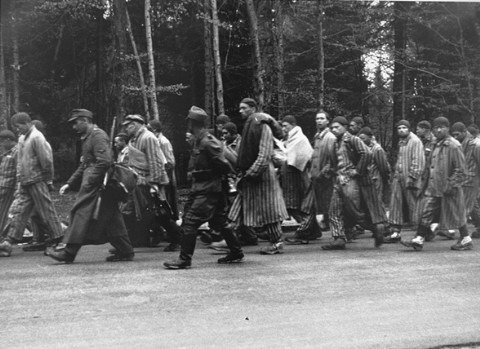
Prisoners on a death march from Dachau move towards the south along the Noerdliche Muenchner street in Gruenwald. German civilians secretly photographed several death marches from the Dachau concentration camp as the prisoners moved slowly through the Bavarian towns of Gruenwald, Wolfratshausen, and Herbertshausen. Few civilians gave aid to the prisoners on the death marches. Germany, April 29, 1945.  — KZ Gedenkstaette Dachau. USHMM

Prisoners on a death march from Dachau move towards the south along the Noerdliche Muenchner street in Gruenwald. German civilians secretly photographed several death marches from the Dachau concentration camp as the prisoners moved slowly through the Bavarian towns of Gruenwald, Wolfratshausen, and Herbertshausen. Few civilians gave aid to the prisoners on the death marches. Germany, April 29, 1945. — KZ Gedenkstaette Dachau. USHMM


The Defining Moment

By Joseph H. Danziger

It happened more than sixty years ago- and not to me- but I cannot dislodge it from my mind’s eye.  My consciousness will not surrender the thought of what it must have been like for my mother, especially on one ominous day. I am a child of Holocaust survivors.

My parents, and thousands like the, each have personal stories of their incarceration in the various concentration camps that dotted Germany, Poland and neighboring countries during World War II.

My parents rarely shared with me their accounts of that desperate period of their lives. When prodded, they might offer an occasional vignette. Seeing the pain on their faces in talking of these experiences, however, I didn’t push for details. Those are memories they certainly preferred to have long forgotten.

Of the stories that were begrudgingly told to me, one shared by my mother will haunt me forever. The soul-searching decision with which she was confronted on that fateful day so long ago is unfathomable to me. As a result of the decision she made that say, I am here to tell the tale.

My mother spent the flower of her youth- ages 17 through 20- within the confines of a concentration camp in Neusalz, Poland. It was a women’s “slave-labor” camp where yarn was processed for the war effort. Although it was not one of the infamous “death” camps such as Auschwitz, Treblinka or Sobibor, the distinction between these titles is hardly significant. In a death camp the aim was to kill as many and as quickly humanly possible. In a slave-labor camp the goal was, in effect, to work the laborers to death, with an ever-replenishing supply of labor. The death tolls in each were mind-boggling. The human skeletons who managed to survive all looked the same and had similar stories of deprivation, torture, depravity and the wanton taking of life.

In the midst of this living hell, an opportunity presented itself to my mother. She saw a possible means of escape. Despite knowing that if she got caught she would face certain death, she took the chance. She escaped, although she never explained exactly how.

Clad only in rags, she trudged through unfamiliar territory until she came to a house. She knocked on the door. She related her circumstance to the master of the house and pleaded for food and a place to hide. Although sympathetic to her plight, he told her he could not jeopardize his family. If found to have secreted a Jew, especially one who escaped from a nearby camp, he and his whole family would most likely be killed as a lesson to the community.

Yet, seeing my mother’s emaciated condition and dire need- and against his better judgment- he took pity on her. He invited her into his home, let her eat, bathe and sleep the night. Before the break of dawn, however, he said she must be gone. She thanked him and availed herself on his family’s kindness. For one night during a span of three years she had a full stomach, clean clothes and a restful night’s sleep.

She left before dawn, as promised. But where would she go? Only then did the truly desperate nature of her circumstance become apparent. For one such as she there was nowhere to go.

My mother was confronted with an unimaginable predicament, a sort of Gordian knot. Should she hazard freedom in an unfamiliar countryside filled with antisemitism where peril and betrayal would be her constant companions? Or should she attempt the inconceivable- a stealth re-entry into the camp from which she had just risked her life to escape- hoping the guards had not noticed her absence? As least there she reasoned, she had the known quantity of a controlled environment offering minimal subsistence, albeit in a horrific setting and under subhuman conditions. She chose the latter. In her mind, that choice offered the best chance for survival. As remarkable as was her original escape, doubly remarkable was her ability to re-enter the camp, unnoticed, and return to her quarters before the morning roll call.

With the memory of nearly one full day of freedom, my mother persevered. Then, in January 1945, together with 1,000 other interned women, she was set on a one-and-a-half-month forced to march to the concentration camp at Flossenburg, Germany, some 200 miles to the southwest. This was one of many so-called “death marches” that occurred toward the end of the war, in a calculated maneuver by the Nazis to deceive the Allies about the vast network of fully functioning concentration camps in operation during the war years.

Along the way to Flossenburg, 800 women were beaten, shot or left to die when they collapsed in the harsh winter. Upon their arrival, the remaining 200 women were transported to the concentration camp in Bergen-Belsen. On April 15, 1945, the British and the Canadians liberated the scant number of those remaining. One of those was my mother. One year later, after surviving family members were reunited, she married my father.

I cannot imagine any other Holocaust survivor choosing a purposeful re-entry into a concentration camp after an earlier successful escape. The very idea is mind-numbing. But she chose wisely, for which her five children and six grandchildren are her testament. I will forever marvel at the immense resolve of this remarkable woman and her relentless insistence on survival.


(Article first appeared in THE PHILADELPHIA LAWYER , SUMMER 2006. Retyped by student Jana Putzig. Used with permission.)

*************************************************************

Matthew Rozell is a United States Holocaust Memorial Museum Teacher Fellow and teaches history at his alma mater in upstate New York. This year, he is authoring a series of posts under the heading of ‘Seventy Years’, marking the 70th anniversary of the close of World War II and of the ‘liberation phase’  of the Holocaust. His work has reunited 275 Holocaust survivors with the American soldiers who freed them.

His first book, a narrative of World War II in the Pacific as told through the previously unpublished recollections of two dozen veterans, is due out this spring. His second book, in progress, is on the power of  teaching, remembering the Holocaust, and this “Train Near Magdeburg’. He can be reached at marozell at gmail dot com.

Read Full Post »

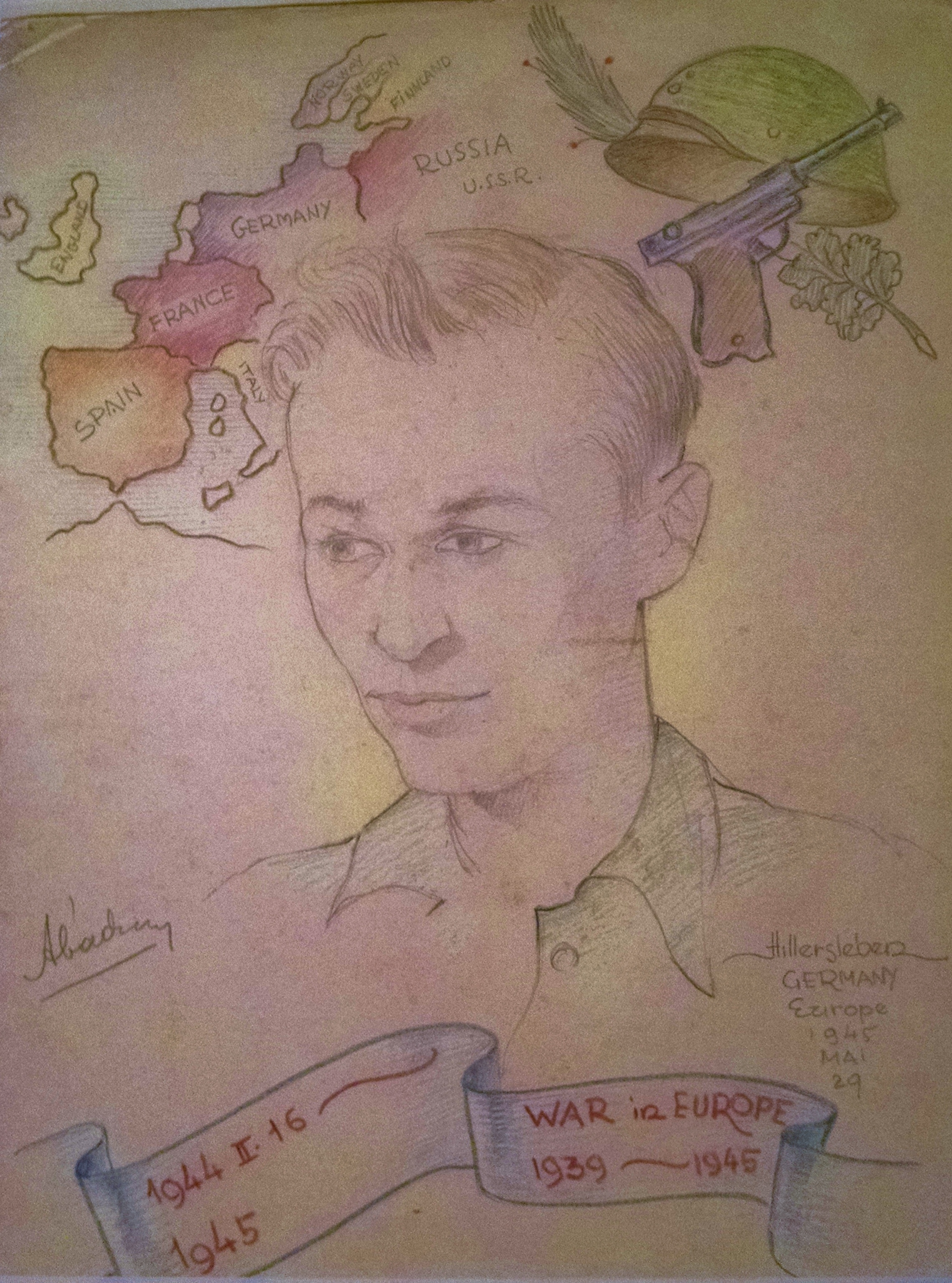
The cosmos trips once more. This month, shortly after my previous post about the discovery of previously unknown artwork by Hungarian Holocaust survivor Ervin Abadi, I was contacted by the family of another American soldier who was at Hillersleben camp as the survivors of the train were being nursed back to health by the medics of the 95th Medical Gas Battalion. They sent me most of the drawings below [Monroe Williams credit, courtesy the Williams family], published here for the first time.

Abadi’s recently discovered artwork matches that of his previously known work, some of which is housed in the archives of the United States Holocaust Memorial Museum.
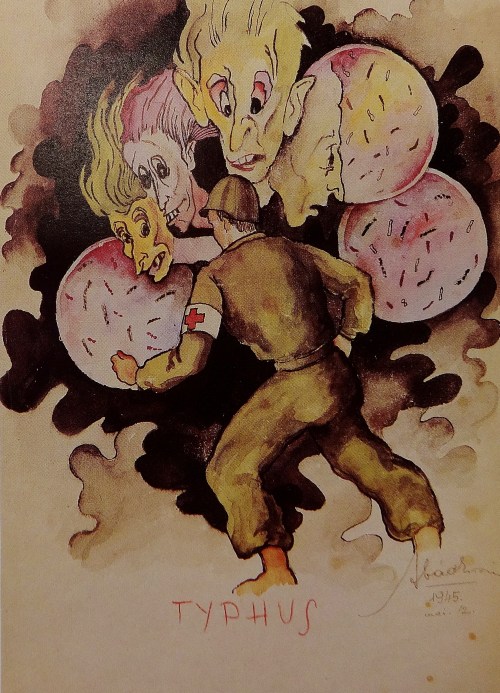
Ervin Abadi, Typhus. USHMM Collection. Probably completed at Hillersleben DP Camp, May, 1945.

Ervin Abadi, Typhus. USHMM Collection. Probably completed at Hillersleben DP Camp, May, 1945.

(If you suspect that you have any of Abadi’s art in your family, or if anyone remembers his time at Hillersleben or Bergen Belsen, please drop me a line at the bottom.)


He was driven to express his gratitude for the American soldiers who freed him from the train, brought him to the hospital at Hillersleben, nursed him back to health and protected him in his stay at the displaced persons camp. These important drawings are proof of that, and confirm his dedication to feverishly recording everything that he could about those days. He drew his surroundings, his memories of the horrors of Bergen Belsen, and the beautiful young American soldiers around him, and even their precious photos of loved ones in their wallets!

In his words:

“Let these drawings serve as proof of my everlasting gratitude towards those to whom I owe my life. … To the soldiers of the United States Army, particularly to our immediate liberators, those soldiers of the 9th regiment who first entered the village of Zilitz and gave us bread, milk, chocolate, and cigarettes….”

American soldier at Hillersleben, 'Man'.  Ervin Abadi. Completed at Hillersleben DP camp, May, 1945. Soldier Monroe Williams collection.

American soldier at Hillersleben, ‘Man’. Ervin Abadi. Completed at Hillersleben DP camp, May, 1945. Soldier Monroe Williams collection.

American soldier-medic at Hillersleben.  Ervin Abadi. Completed at Hillersleben DP camp, May, 1945. Soldier Monroe Williams collection.

American soldier-medic at Hillersleben. Ervin Abadi. Completed at Hillersleben DP camp, May, 1945. Soldier Monroe Williams collection.
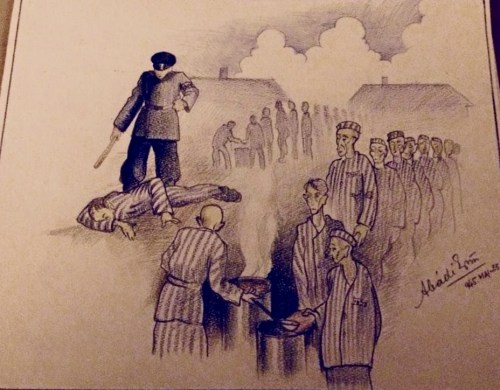
A kapo inflicts a beating at Bergen-Belsen. Ervin Abadi. Completed at Hillersleben DP camp, May, 1945. Soldier Monroe Williams collection.

A kapo inflicts a beating at Bergen-Belsen. Ervin Abadi. Completed at Hillersleben DP camp, May, 1945. Soldier Monroe Williams collection.

The American hospital at Hillersleben. Ervin Abadi. Completed at Hillersleben DP camp, May, 1945. Soldier Monroe Williams collection.

The American hospital at Hillersleben. Ervin Abadi. Completed at Hillersleben DP camp, May, 1945. Soldier Monroe Williams collection.

Soldier Monroe Williams' parents. Probably sketched from wallet photo.  Ervin Abadi. Completed at Hillersleben DP camp, May, 1945. Soldier Monroe Williams collection.

Soldier Monroe Williams’ parents. Probably sketched from wallet photo. Ervin Abadi. Completed at Hillersleben DP camp, May, 1945. Soldier Monroe Williams collection.

Ervin Abadi. Completed at Hillersleben DP camp, May, 1945. Soldier Monroe Williams collection.

Ervin Abadi. Completed at Hillersleben DP camp, May, 1945. Soldier Monroe Williams collection.

The 'casino' at Hillersleben. Ervin Abadi. Completed at Hillersleben DP camp, May, 1945. Soldier Monroe Williams collection. Note Red Cross tents in foreground. May have served as temporary morgue station.

The ‘casino’ at Hillersleben. Ervin Abadi. Completed at Hillersleben DP camp, May, 1945. Soldier Monroe Williams collection. Note Red Cross tents in foreground. May have served as temporary morgue station.

Former hospital at Hillersleben today. (Christian Wolpers photo.)

Former hospital at Hillersleben today. (Christian Wolpers photo.)

'Hillersleben-some disorderly DPs getting a shower bath (DDT?)' Soldier Luca Furnari photograph.

‘Hillersleben-some disorderly DPs getting a shower bath (DDT?)’ Soldier Luca Furnari photograph.

*****

Former American medic Walter Gantz called me out of the blue 3 years ago. Like all of the soldiers now reappearing in Abadi’s drawings, he was there. A couple newspaper articles appeared about Walter’s experience at  Hillersleben shortly thereafter. I put survivors in touch with him:

By the fall of 1944, the 95th [Medical Gas]Battalion was stationed at the Belgian-German border.

That winter, Mr. Gantz helped treat the wounded at the Battle of the Bulge in the Ardennes region, and by the spring of ’45 his unit had made its way into Germany.

In mid-April, they were in the town of Hillersleben setting up a displaced persons hospital when the Allies came across a train that had come from the Nazi concentration camp Bergen-Belsen, where over 35,000 people, the vast majority of them Eastern European Jews, had died of typhus during the first few months of that year.

All told, there were roughly 2,400 emotionally damaged, disease-ridden and terribly malnourished people aboard the train. “Walking skeletons” was an apt description, according to Mr. Gantz.

“We weren’t knowledgeable about these (concentration camps) at the time,” said Mr. Gantz, who visited Bergen-Belsen days after it was liberated. There, he saw countless dead bodies “strewn everywhere.”

“It was hard to explain,” he said. “I cried. And then I prayed for these people. Not only were you angry about what happened, but you felt so helpless.”

Mr. Gantz’s unit spent about six weeks treating the survivors. A good 70 or 80 of them died, mostly of typhus. Among the biggest challenges was acquiring enough food supplies to feed them all. Many could only take their nourishment intravenously.

“A lot of them, if you were to give them food, they would gorge themselves and kill themselves. You had to be very careful as to what they ate,” he said. “Boy, oh boy, they would scream. Those screams would go right through your body.”

“Hillersleben was a living nightmare,” he added. “You don’t shake these horrible scenes from one’s mind.” {see more https://teachinghistorymatters.com/2011/11/04/my-parents-couldnt-understand-why-i-couldnt-sleep-at-times/}

***

Blessed – or maybe cursed – with a terrific memory, he can vividly recall the screams and overall sense of dread permeating the hospital, where he and his fellow medics wore a daily uniform of surgical masks, gloves and rubber aprons.

He remembers scooping handfuls of lice out of patients’ hair and administering countless needles and the time he had to carry the body of a little girl to a tent serving as a makeshift morgue.

“I still get flashbacks to that,” he said.

Many died, mostly of typhus. Among the biggest challenges was acquiring enough food to feed them all, since a good portion of them could only take their nourishment intravenously. One of the survivors Mr. Gantz has spoken with, Lexie Keston, now a resident of Australia, told him she weighed just 30 pounds at the time of the rescue. She was 8 years old.

As a result of Mr. Rozell’s [work], a handful of Bergen-Belsen survivors have been in touch with Mr. Gantz, including Ariela Rojek, a Toronto resident who was 11-1/2 years old at the time of the rescue.

Mrs. Rojek, a Pole who lost all but an aunt during the Holocaust, was among those suffering from typhus. She spent three weeks in semi-consciousness, and remembers having to be tied to the bed by medics trying to restrain her. Mr. Gantz could have been one of them, she said.

“Those soldiers, they gave me my life. Because I was very sick,” she said.

“It was tough. Some of our guys couldn’t take it,” Mr. Gantz said. “I have to admit, I did a lot of crying. I tried not to do it around the patients.”

Now, though, he has the peace of mind of knowing firsthand that, despite all the horrors, life did go on for the survivors of Bergen-Belsen, just as it did for him and his fellow veterans. Asked once by a friend what he took from his wartime experience, Mr. Gantz thought for a moment, then replied, “It made me stronger spiritually.”

“I’ve been blessed,” he said. “I thank the good Lord every day.”

“He’s one of the angels,” Mrs. Rojek said of Mr. Gantz. “I’m really grateful. Whenever I get a name and phone number, I always call them. They gave me a second life.”

Mr. Gantz, 87, said the whole experience has made him feel “10 feet tall.”

“I have to use the word mind-boggling. I guess you’d have to put it in the category of a dream,” he said. “I have to be honest with you, it’s embarrassing. All they keep saying is, ‘Thank you, thank you, thank you.’”

{see more https://teachinghistorymatters.com/2012/03/04/it-was-tough-some-of-our-guys-couldnt-take-it/}

********

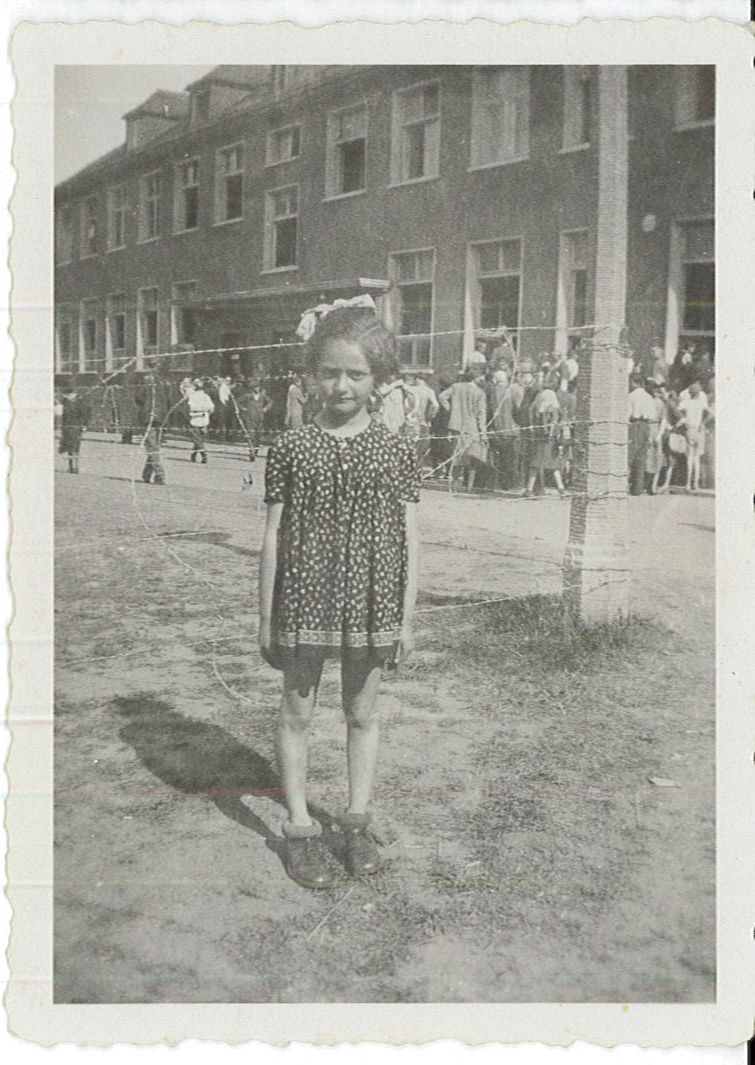
FINAL NOTE. We are also looking for this little girl, a survivor at Hillersleben. Her name was Irene. You can read the backstory here. Please contact me below.

'Hillersleben-Irene is in the flowered dress' Soldier Luca Furnari photograph.

‘Hillersleben-Irene is in the flowered dress’ Soldier Luca Furnari photograph.


*************************************************************

Matthew Rozell is a United States Holocaust Memorial Museum Teacher Fellow and teaches history at his alma mater in upstate New York. This year, he is authoring a series of posts under the heading of ‘Seventy Years’, marking the 70th anniversary of the close of World War II and of the ‘liberation phase’  of the Holocaust. His work has reunited 275 Holocaust survivors with the American soldiers who freed them.

His first book, a narrative of World War II in the Pacific as told through the previously unpublished recollections of two dozen veterans, is due out this spring. His second book, in progress, is on the power of  teaching, remembering the Holocaust, and this “Train Near Magdeburg’. He can be reached at marozell at gmail dot com.

Read Full Post »

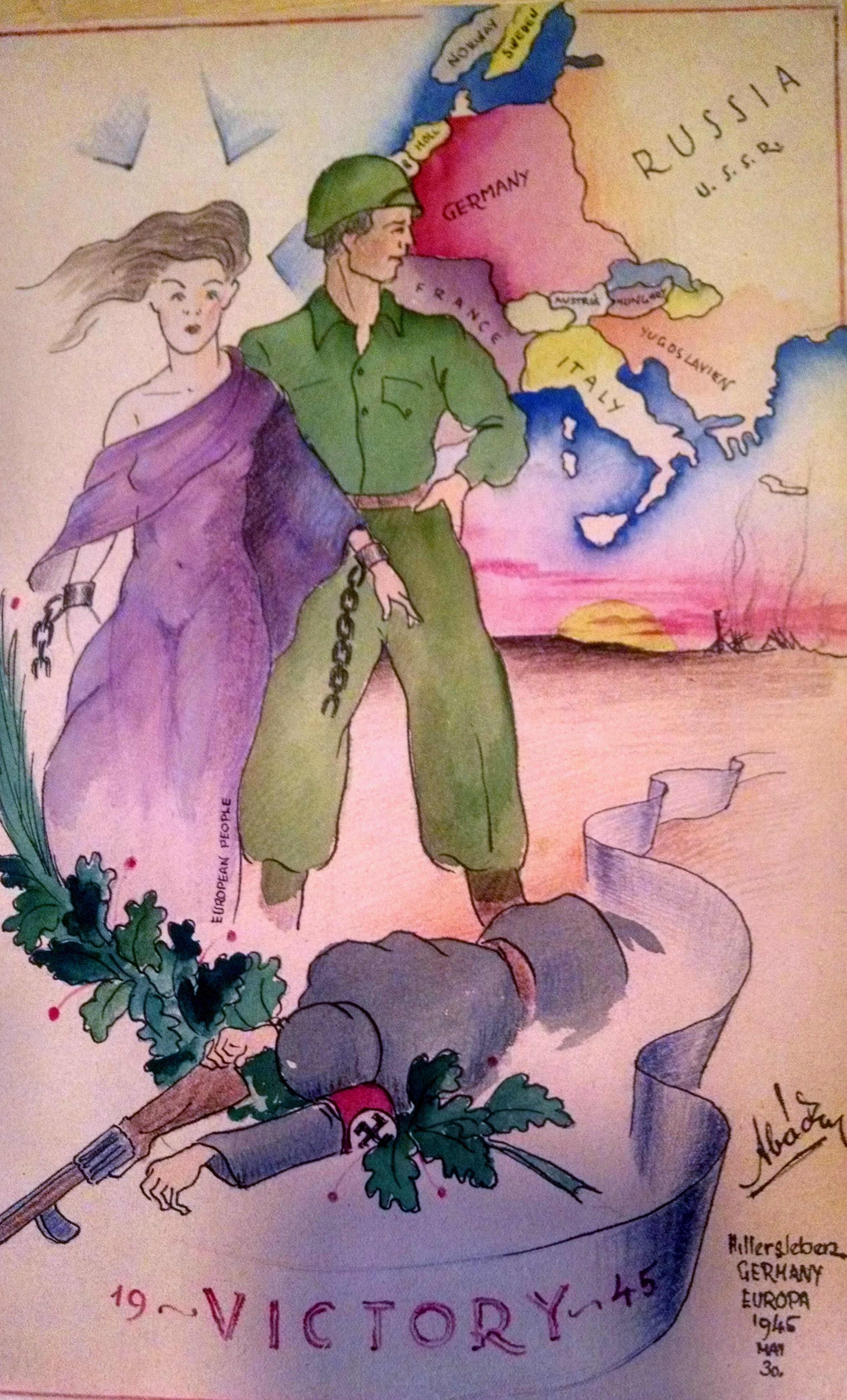
Victory, 1945. By Ervin Abadi. Hilersleben, Germany, May 1945.

Victory, 1945. By Ervin Abadi. Hillersleben, Germany, May 1945. Courtesy Chriss Brown, granddaughter of American soldier Don Rust.

The wires of the cosmos trip once more.

After almost exactly 70 years, a person came to this site on Jan. 30th with an inquiry:

I recently came across this site looking for a gentleman my grandfather became close to. My grandfather, Donald W. Rust of the 95th Medical Gas Treatment Battalion, helped him … and often spent time with him. The gentleman drew several pictures for my grandfather and I still have them today.

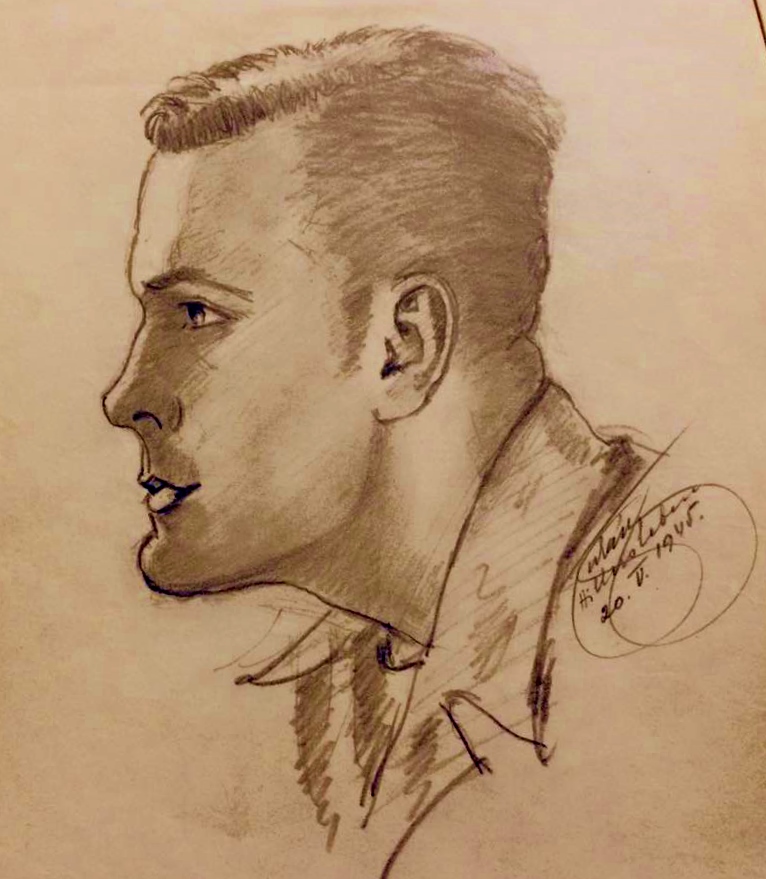
Donald W Rust of Kansas City KS. Hillersleben DP Camp, May 1945. Source: Chriss Brown, granddaughter of Don Rust.

Donald W Rust of Kansas City KS. Hillersleben DP Camp, May 1945. By Ervin Abadi. Source: Chriss Brown, granddaughter of Don Rust.

We looked while my grandfather was still alive but were unable to find any lists of the survivors until now. We cannot read his name clearly but we think the drawer’s name is ‘Albadi’ or something close to it. I would love to share the pictures he drew and also would like to hear if anyone can help me contact the survivor’s family. My grandmother turns 90 in March and it would mean the world to her to know what become of him.

My grandfather told us the gentleman was from Poland, but we don’t know what city. Unfortunately, my grandfather could not remember his name. If anyone can help, it would be much appreciated.  ~Chriss B.

***

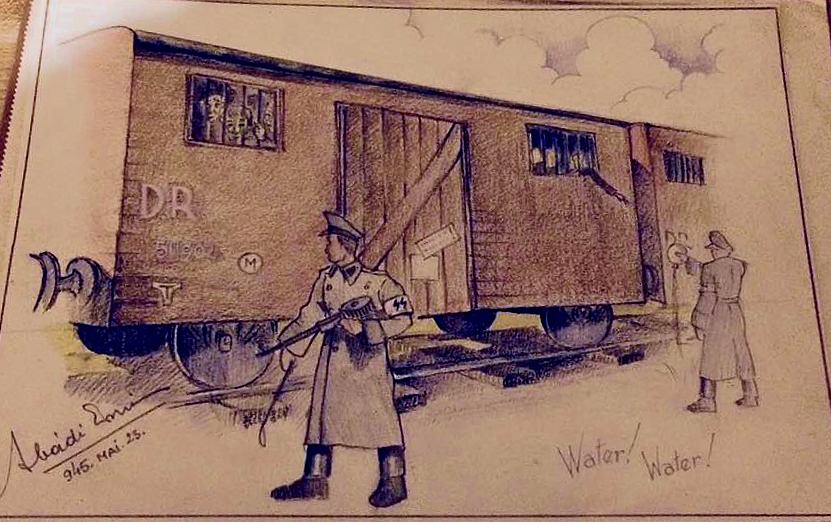
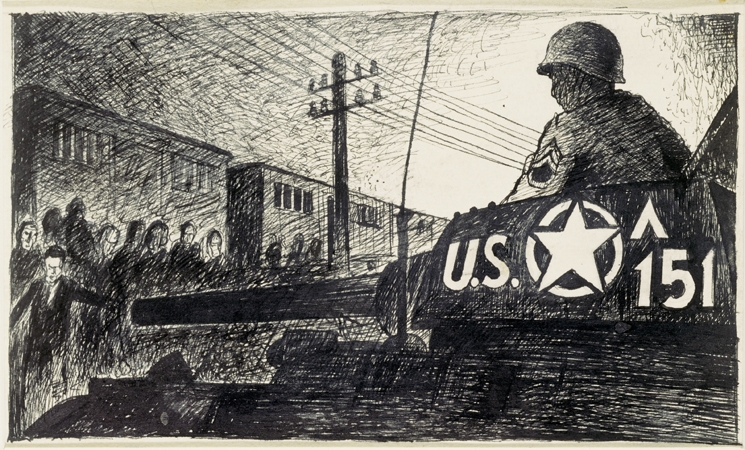
I immediately knew who she was talking about (though he hailed from Hungary, not Poland) and  got in touch with her. She sent me samples, and sure enough it was Ervin Abadi, whose work I was very familiar with. He had even sketched a drawing of the liberation with the tanks rolling in, but unfortunately he passed away 22 years before I sat down to do my interview with one of the tank commanders in the drawing.

Liberation, April 13th, 1945. Drawing by survivor Ervin Abadi. USHMM.

Liberation, April 13th, 1945. Drawing by survivor Ervin Abadi. USHMM.

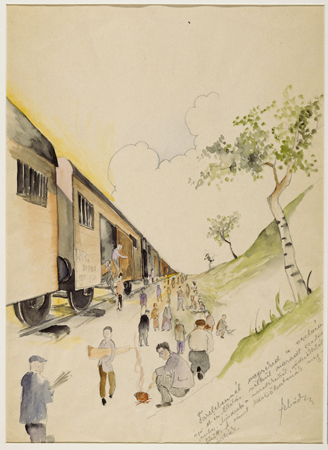
The Liberation of the Train, by Ervin Abadi. USHMM.

The Liberation of the Train, Farsleben, Germany, April, 1945. Ervin Abadi. USHMM.


Dozens of Abadi’s pieces are at the United States Holocaust Memorial Museum, and his bio there reads as follows:

In his early twenties when the war broke out, Ervin Abadi lived in Budapest, Hungary and wanted to be a painter. But, as with all Jewish males his age, he was taken to Russia by the Hungarian Army as a forced laborer. Abadi managed to escape but was captured after hiding out in the Karpet Mountains. After being brutally mistreated he managed to escape again, but was recaptured and taken to Bergen Belsen. When the camp was liberated  by the US Army [incorrect: his train transport from Belsen to Theresienstadt] on April 13, 1945, Abadi was taken to a hospital in Hillersleben, where he recovered. While in the hospital (and possibly earlier in the camp) he made 25-30 watercolors, dealing with his arrival at Bergen Belsen, life in the camp and its liberation by the US Army. Abadi returned to Budapest where he told about his life as a forced laborer and and an inmate of Bergen Belsen in a collection of 30 ink drawings. The work was published in 500 copies with Hungarian and English captions in 1946. The foreword of the book says, in part, “Let these drawings serve as proof of my everlasting gratitude towards those to whom I owe my life. … To the soldiers of the United States Army, particularly to our immediate liberators, those soldiers of the 9th regiment who first entered the village of Zilitz and gave us bread, milk, chocolate, and cigarettes….” Abadi, however, became disallusioned by Communist Hungary and managed to leave for Israel in 1947 or 1948 where he lived in Israel for the rest of his life. There he wrote 15 books in both Hebrew and Hungarian. He died in 1979.  [my emphasis]

***

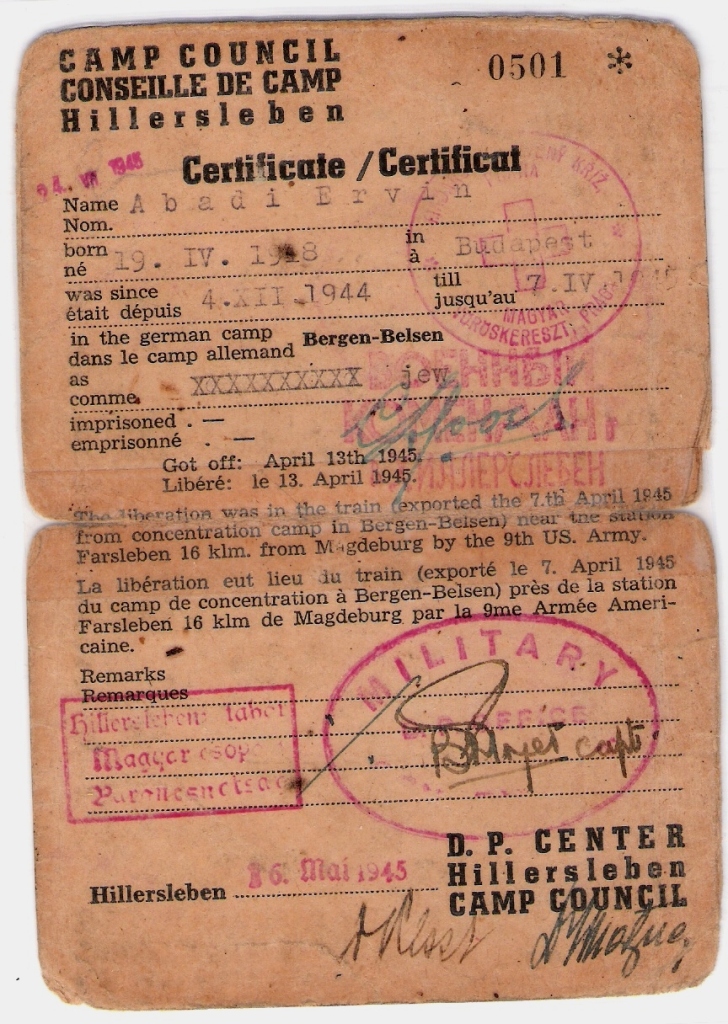
Ervin Abadi’s name is also the first on the existing manifest list. Some years ago, with the help of Varda W. in Israel, his daughter got in contact with me, and sent me his DP [displaced persons] document from Hillersleben:

Hillerleben Displaced Persons certificate-Ervin Abadi

Hillerleben Displaced Persons certificate-Ervin Abadi.

At that time, 5 years ago, his daughter wrote:

As you know, my father is a survivor from Bergen Belsen on the Magdeburg train. He got sick with typhus and was taken to the American Hospital at Hillersleben.

All my life my father told me to remember that he was saved by the Americans, and for that he will be grateful until his last day- and so must I, because if he was not to be saved- I wouldn’t be born.

My father passed away in 1979, and since then I tried to keep my promise to my father. I went to Normandy in France and walked the beaches that are soaked with the blood of the American soldiers and wanted to honor their memory, for because of them, I am living today.

A few years later I visited the World War II Memorial in Washington, DC. I met there an old gentleman and I found out that he was one of the American soldiers who fought on the beach on D-Day! I told him the story about my father and we both fell into each others arms crying. I felt like I fulfilled my promise to my father. ~Julia A. H.

**

So I dug out the letter, got in contact with Julia again,  and put her in touch with Chriss, the granddaughter of the soldier who in befriending Abadi, helped him in his recuperation.

Raymond D. Rape of Zelienople, PA ; Grafton D Junkin of Kennedy, Alabama ; Donald W Rust of Kansas City KS. Hillersleben DP Camp, May 1945. Source: Chriss Brown, granddaughter of Don Rust.

Raymond D. Rape of Zelienople, PA ; Grafton D Junkin of Kennedy, Alabama ; Donald W Rust of Kansas City KS. Hillersleben DP Camp, May 1945. Source: Chriss Brown, granddaughter of Don Rust.

From Julia, the artist’s daughter, last week:

I was very touched… 70 years after it happened, my father’s drawings came back to us.

We use to say that if his name is mentioned, a person lives forever.

Thank you again for remembering my father’s work of art.

*************************************************************


Read Full Post »

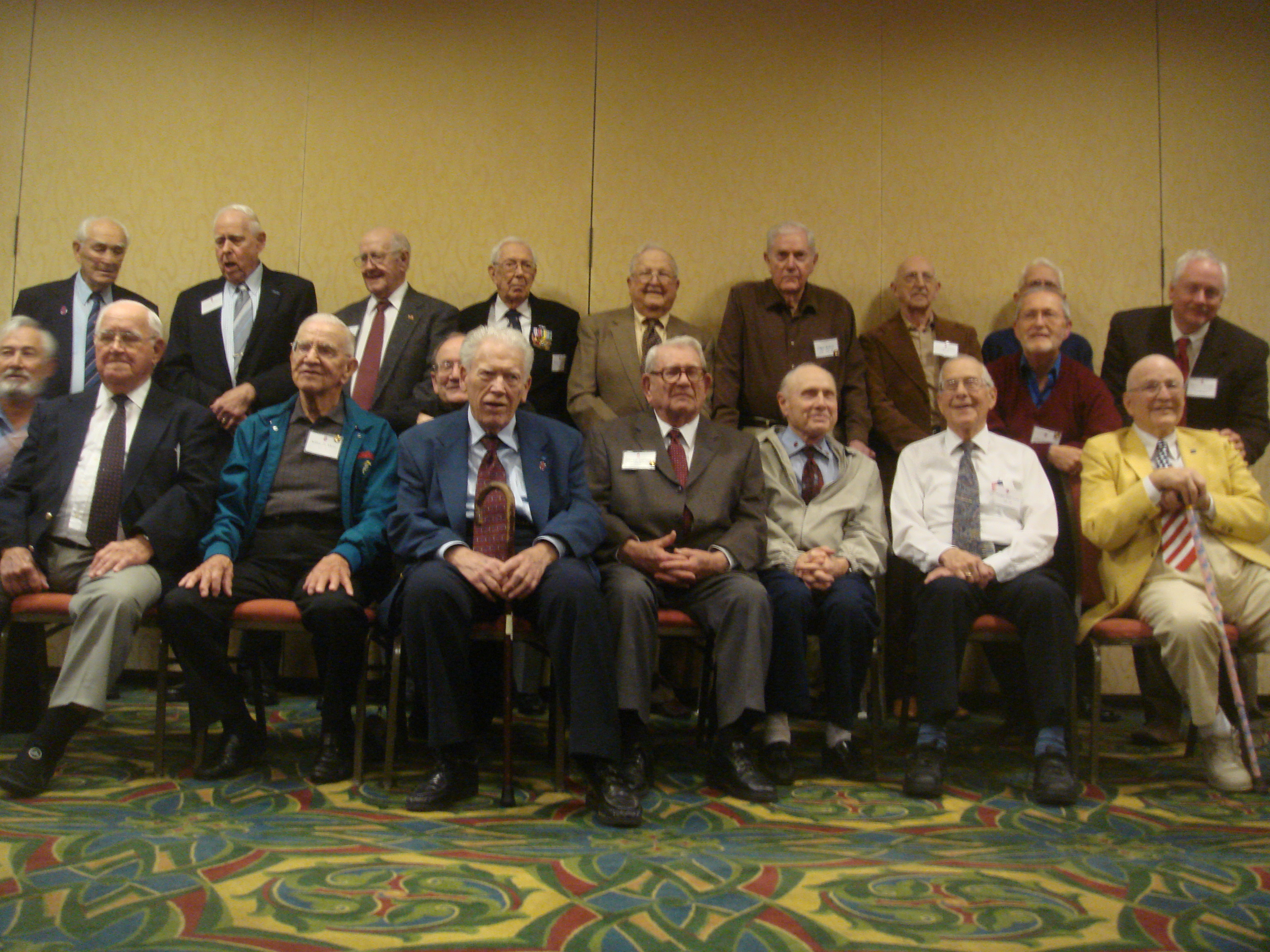
Received from Frank Towers,97 yr old Sec/Treasurer of the 30th Infantry Division Veterans of World War II.  I am going to be there. I hope to see all you survivors there, Holocaust and World War II,  for this last hurrah…love these guys. It will be the 70th anniversary of the liberation of the “Train Near Magdeburg”. In the pic below are soldiers and Holocaust survivors, and yours truly, in Nashville from 2010.

#30th Infantry Division, Survivors, M. Rozell

Nashville is Next!
And sadly to say, it will be the LAST Reunion of the“30th Infantry Division Veterans of WWII”….

30th Infantry Division Veterans of WWII
National Reunion April 15 – 18, 2015
Holiday Inn- Nashville-Opryland/Airport
Nashville, TN

The time has come when all good things must come to an end. We have had some great times in the past few years, but time and age is taking a toll on our membership, and the numbers are dwindling faster than we would like. Our Executive Committee has decided, that since our numbers of attendees has dropped off, it is becoming a financial burden to continue having reunions without adequate financial support. It takes a great deal of work on the part of the Exec. Sec-Treas. and the Reunion Chairman, Mrs. Nancy-Lee Pitts and Family, to prepare all of the necessary paper work, contract, preparing a program and the process of cleaning up and winding down from the Reunion. At our age, this is becoming a burden and almost prohibitive, so, very sadly, we must call it Adieu !!

So, all we ask is that as many of you who are able, Please come to this Reunion, to have a good time and enjoy the company of each other, and make this a memorable reunion.

This may be the last opportunity that you will have to see and visit with “old buddies”, whom you have known for the past many years.

Remember, Nashville was the site of the very first Reunion of the 30th Division Veterans in 1947, and it is quite appropriate that we should have the last one at this same site.

Come One and Come All, and make this a Big Blast, for the last time.

We will be looking forward to seeing ALL of you.


Old Hickory Re-Enactors

As usual, many, many thanks go to all of the guys who were representing the Old Hickory Re-Enactors, by Posting the Colors at each event as required, tending the bar in a most efficient manner, and best of all, their Artifacts, Weapons and other Memorabilia which is always a big hit with everyone. If you have not visited their displays, you are missing a lot ! We need to give these guys a big hand for what they do for us.


Holocaust Survivors

We cordially invite all of the Holocaust Survivors from the Farsleben Train, to join with us for this special event. If you have not been with us before, please do not pass up this opportunity to meet your Liberators. This will be the last time that you will have an opportunity to meet them, as we will not be having these Reunions any longer, so this will be your last chance. Many of you have been with us before, and we hope to see you all again. Kosher food will be available for all of those who require this.

Weferlingen – Walbeck – Grasleben

On 10 April 1945, Brunswick, Germany was captured by the 30th Infantry Division, with the next objective being Magdeburg.

The following day 11 April 1945, proceeding on towards Magdeburg, the town of Hillersleben was attacked and captured with little or no major battle. At the edge of the town, there was a large German Luftwaffe Airbase and an Armaments Research Center. This base was composed of several operations buildings, several 2 story block barracks, and several private homes for the officers and a small hospital.
Continuing to press on towards Magdeburg, during the 12th of April, the 120th Regiment over-ran the village of Walbeck, and the 117th Regiment over-ran the village of Grasleben, and in between these two villages, was another small village, “Weferlingen”, which was liberated by the 120th Regiment. [Ed. note: On 13 April the train at Farsleben was discovered.]

No mention was ever made in the journals of these regiments, about the capture of these villages, nor was any mention made of them in the 30th Division History Book or either of the Regimental History Books. Only from the Journal of the 30th Military Government, was this action discovered recently. (2012)
At Weferlingen, the site of a former potash mine was discovered – a mine operated by Jewish and D.P slave laborers, under the direction of their Nazi slave-masters. This mine had been enlarged and deepened, from its original size as a potash mine, and was in operation of fabricating submarine engines, airplane engines and rocket engines. It was deep and well protected from American bombing attacks.
This “camp” was named “ Camp Gazelle” by the Germans, and it was a sub-camp of Buchenwald, and when discovered, consisted of 421 (political prisoners), slave laborers. As any of these laborers became ill or otherwise incapacitated, they were sent back to Buchenwald, and fresh laborers were sent to the camp to take their place and to keep the labor force consistent with their needs. All of these prisoners were found in very poor physical condition, due to malnutrition because of being underfed, and overworked for 12-15 hours per day. Almost all of them required immediate medical attention.

Arrangements were made with the Burgomasters of Walbeck and Grasleben to furnish adequate food for these people. Our own 105th Medical Battalion personnel furnished them with immediate needs of medical supplies.
They were almost immediately sent back to the American Military Government and the American Red Cross, then located at Hillersleben, Germany, for appropriate processing and repatriation back to their homelands wherever possible.
It was on the basis of the liberation of this “CAMP” that the 30th Infantry Division was given the distinction of being named a “Liberating Unit” by the Center for Military History and the U.S. Holocaust Memorial Museum in Washington, DC, thereby allowing our Colors to be displayed in the lobby of the US. Holocaust Memorial Museum. This is to honor the men of the 30th Infantry Division who had a part to play in the liberation of numerous Jewish slave laborers of the Holocaust.
This was actually the very first viewing that any man of the 30th Infantry Division had of the “supposed” propaganda of the “Torture of the Jews by the Nazis”, later to be known as “The Holocaust” .These liberating soldiers had no training as humanitarians- they were trained to be soldiers, fighting a war against Nazi aggression and really did not know what they had on their hands, nor the scope of this captivity of the Jews. -Frank Towers

Taps – 2014

ADKINSON, BRUCE 743 TkBn-C Garden City, NJ
BERKEL, John J. 119-I 5/26/14 Belleville, IL
BIGOS, Adolph J. 119 Tom’s River, NJ
BURLEIGH, James 117 Golden, CO
CONLEY SR., Leo J 119 Framingham, MA
COX, Henry G. 117-F 8/17/10* Loris, SC
COX, Joe M. 117-D 5/20/14 Bluff City, TN
DEAN JR., Preston A. 531 AAA Hq
ERICKSON, Mervin L. 119-K Windom, MN
FLOYD, Thomas A. 119-G 9/30/13* Forney,
GIACCHETTI, Hugo J. 119 E Chicago, IL
GRAPKOSKI, Walter E. 119-G 11/23/11* Danbury, CT
HOFFMAN, STANLEY 120-B 1/19/14 Princeton, NJ
HOLLOWELL JR, Ernest L. 105 Med D
HOUTEKIER, Louis 119 G 7/15/14 Big Rapids, MI
IACONO, George D. 197 FA Svc, 9/30/11 St. Petersburg,
JORDAN, Joseph S. 105 Med. BN A 7/26/12 Wilmington, NC
KEATING, Hubert M. 113 FA/A 6/06/13* Paducha, KY
LEY, Charles E. 120
MARKHAM, Cameron L. 117 1BnHq 5/15/14 Charleston, WV
MARSIGLIA, Joseph M. 119 Hq. 12/.03/14 Algonquin, IL
MARZILLI, Rocco D. 30 QM Co. 10/27/13 Waterbury, CT
MC MICHAEL, Roscoe 105 Med. Bn 10/08/13* Newnan, GA
MITCHELL, Kenneth 120 C
NOWLAND, Maland C. 30th Recon E. Vassalboro, ME
ORTIZ, Oscar A 105 Med B San Francisco, CA                                                                 OWENS, Livis 120-C
PARKER, Kanneth 120 B
POLAND, Claude E. 120-G 4/49/14 Columbus, IN
RINELLA, Donald. 105 Med Bn. C 5/11/14 Truckee, CA
SMALL, George 120-A 12/19/13 Augusta, MI
SUPER, Seymour 119-A Boynton Beach, FL
WAUGH, Wilford D. 120-I Buffalo, OK
WHITE, Carlton L. 120-K 1/29/12* Elizabeth City, NC
WILEY, A.P. 120-M 6/24/14 Dallas, TX
WYATT, Nell (Wid) W 2/06/14 Waynesville, NC


Read Full Post »

This originally appeared at the Huffington Post website for Veterans Day.  Maybe it is appropriate to share for Thanksgiving.

The author contacted me in 2007 when news of our first reunion went viral  in the Associated Press. Later, in 2009, he was invited to a gathering of the soldiers who saved his father and other survivors on this train here at our high school. His talk to our gathering can be seen below, published here for the first time.

Praise for the American Soldiers Who Saved My Father From a Death Train

By Lev Raphael

 In early April 1945, my father was packed into a train with 2500 other prisoners from Bergen-Belsen as the Nazis insanely tried to keep British and American troops from rescuing them. The train was made up of 45 cars with their doors sealed shut; the crowding was horrific and of course there was no food or water.

 In the chaos of war, this hellish train wandered for a week and finally stopped at Farsleben, a tiny town not far from the Elbe, sixteen kilometers from Magdeburg, the site of one of Germany’s largest munitions plants. German communications had collapsed and the commander couldn’t get clearance to move across the Elbe, so he ended up decamping ahead of the American troops he knew were coming. When two American tanks appeared on April 13th, the remaining guards escaped.

 Frank W. Towers, a 1st Lieutenant of the 30th Infantry Division, reported that the stench when the locked cattle cars were opened “was almost unbearable, and many of the men had to rush away and vomit. We had heard of the cruel treatment which the Nazis had been handing out to Jews and political opponents of the Nazi regime, whom they had enslaved, but we thought it was propaganda and exaggerated. As we went along [in Germany] it became more apparent that this barbaric savagery was actually true.”

 The troops that had found this train were racing to the Elbe because it was the last barrier to their advance across Germany, and now they had a totally unexpected burden of some twenty-five hundred prisoners to house and provide for. The answer was about nine miles to the west. American troops had just captured several hundred Germans at the Wehrmacht base and proving ground in Hillersleben where tests had been conducted for giant railway guns manufactured by Krupp.

 It was an ironic place for Jews to be sheltered, cared for, and brought back to life. But then what place in Germany wouldn’t have been an ironic location?

 This verdant military setting with its clean, heated quarters for officers and soldiers was a virtual paradise for people who had been treated like animals for years. That’s where my parents met and fell in love. My mother was in Hillersleben because she had escaped from a slave labor camp in Magdeburg and been brought there by American troops now using it as a temporary Displaced Persons camp.

 She and my father had each lost everything in what would come to be called the Holocaust: home, families, countries. So there wasn’t any time to play any pre-war games. “Do you like me?” he asked. She did, and as my father tersely put it years later, from that moment on “She was mine and I was hers.” My mother moved in with him that night, beginning their fifty-four years together.

 Frank Towers, who is 97, is the last surviving soldier who rescued the prisoners on that train, who saved my father from almost certain death and brought about his encounter with my mother. I’ve had the honor of meeting Frank and shaking his hand, and I’ve written about him in my memoir My Germany, but on this Veteran’s Day, with the survivors of the Holocaust and their saviors dwindling faster and faster, it’s more important than ever to thank him in public, and praise the memory of those other “train heroes” who are no longer alive.

The account in this blog is excerpted from My Germany: A Jewish Writer Returns to the World His Parents Escaped.

 http://www.huffingtonpost.com/lev-raphael/veterans-day-praise-for-t_b_6124862.html

 ***************************************************

Five years ago this fall, we put on quite a show at our high school.  High school kids listening to, meeting, sharing, laughing, crying, even dancing  with octogenarian U.S. soldiers and Holocaust survivors. Here, Raphael shares his remarks with the soldiers, survivors, and students about growing up in a survivor household, and his coming to terms with Germany.


Read Full Post »

Veterans Day: Hudson Falls teacher’s stories unite veterans with survivors

Author: Liza Frenette
Source: NYSUT Communications

veterans day

Caption: Photo of Matt Rozell by Andrew Watson.

History teacher Matt Rozell knows where he will be on Veterans Day. He’ll be in same place he is every year: working with students to help veterans. This year, he and 28 of his Hudson Falls high school students will be out raking leaves and doing yard work at the homes of veterans.

In his world, the one he shares with students, veterans are held in the highest regard.

“These soldiers, and what they’ve gone through for our country…” he said, trailing off. Rozell, a member of the Hudson Falls Teachers Association, was standing in the school entryway in front of a new display called The Veterans Wall. It is filled with photographs and stories of veterans from World War II through the wars in Iraq and Afghanistan.

Their mission was protection. Rozell’s mission has been to make sure students know what that protection cost and what it preserved. In a metal filing cabinet in Rozell’s living history classroom there are 200 written student interviews with World War II veterans. Each folder includes the interview, positions papers, fact checks, photographs, letters and other primary sources.

[Hudson Falls Teachers Association member Matt Rozell on the history of Veterans Day and keeping history alive through the “power of the narrative story.”]

That’s 200 stories now documented; important pieces of history, of personal lives that intersected and collided with the deadliest war in history. These veterans became part of the Allies Forces in a brutal war from 1939 to 1945 – a war involving most nations of the world, the Holocaust, nuclear bombing, and sobering losses. According to the World War II Museum, there were 15 million combat deaths; 25 million wounded; and 45 million civilian deaths.

The front wall of Rozell’s classroom is covered with the front pages of actual newspapers chronicling stages of the war as it stormed across the world: “France Joins Britain in War on Germany;” “Roosevelt is Dead; Truman Sworn In;” “Germans Take Oslo: Sweden Gets Warning;” “Reich Scraps Versailles Pact.”

But it is on the last wall where the stories uncovered by Rozell and his students are the most personal. Here, there is a map of the world. In certain sections, it is dense with colored pushpins that students insert for tracking survivors.

The pins represent people: Jewish people who were rescued by American soldiers in Germany on a train from Bergen Belsen concentration camp, destined to be killed at the end of the war. The pins also represent the soldiers who saved them and the soldiers’ families.

“There were 2,500 Jews inside,” said the soft-spoken Rozell, whose blue eyes fill with tears telling the story. Some were already dead; all were emaciated. It was April 13, 1945. They were covered with lice. Some had typhus.

“It was at the point in the war when everything was collapsing under the Third Reich,” Rozell said. “Their final order was to murder everyone on the train.” German soldiers were to drive the train onto a bridge and blow up the bridge. But first, they ordered the men and boys off the train.

“They were going to machine gun them,” Rozell said.

Then the Americans, en route to a nearby battle, crested the hill in their tanks. They stayed 24 hours to guard the train, and then other soldiers came in to help transport the survivors.

In the last 10 years, 275 rescuers and survivors have been reunited through Rozell, the web site he created,https://teachinghistorymatters.com/tag/matthew-rozell/, and veteran Frank Towers, now 97. Towers was a soldier with the 30th Infantry Division who was charged with relocating the train survivors to a safe place for medical care and treatment the day after the rescue.

“His job was to move people out of harm’s way. He had trucks. It took all day,” Rozell said.

Towers, 97 has now met children of those train survivors, “people who would not exist if Americans hadn’t liberated the train,” Rozell said.

Rozell’s  determination to have his students experience the meaning of the closing days of WWII drew the attention not only of families and survivors, but also of the media. He and his students have been featured on NBC Learn as part of “Lessons of the Holocaust” (http://www.youtube.com/watch?v=koQCU9Rhys0.

In September 2009 ABC World News with Diane Sawyer named them as “Persons of the Week.”

Rozell also works with the Holocaust Museum in Washington, D.C.

His story of action in the classroom began years ago when he had students first start interviewing veterans and videotaping them. Then they would transcribe them and type them up.  “This was before the internet,” he said.

In the mid 90s he began putting the stories online.  Rozell also conducted interviews, and one of them was with the grandfather of one of his students, a WWII veteran. He set up a video camera and the pair talked for two hours. A retired state Supreme Court justice, Carrol Walsh had been in combat in a tank.

“He hated it. Once he was trapped for three days,” Rozell said.

As the interview was winding down, Rozell recalls, Judge Walsh’s daughter stepped in and said “Did you tell him about the train?”

Walsh was one the soldiers who came across the train full of imprisoned Jewish people as they were driving their tanks. He told Rozell how they found the people on the train and scared off the German soldiers guarding it.

liberation

Next, Walsh directed Rozell to George Gross, a fellow tank commander who had taken photographs that day from the tank. More recently, Gross had written a narrative about his part in the liberation of the train.

Rozell eventually interviewed him by speakerphone in a class interview.

Rozell posted the transcripts of the interviews with Walsh and Gross – now deceased – on the school web site under a WWII history project.

The site got hits, but it more or less languished for about four years.

Then the trickle started. A grandmother from Australia who had been a little girl on the train contacted Rozell. Then a doctor in London, a scientist in Brooklyn and a retired airline executive in New Jersey found him through his site. They were all survivors from the train.

Rozell decided to host a reunion for them in 2007 at the school, and of course Walsh was invited.

“Judge Walsh – the only soldier there – met them with a laugh, and said ‘Long time, no see!'” Rozell recalls.

The Associated Press picked up the story about the reunion, and the school’s web site got so many hits it crashed the system. Rozell heard from 60 more people who were on that train.


The AP story is how veteran Frank Towers found out about the story. He contacted Rozell and they worked together. Since then there have been over 10 reunions – three of them in Hudson Falls,one in Israel, and many organized by Towers. Besides Israel and New York, they’ve been held in North and South Carolina  Tennessee, and Florida. With the help of survivors daughter Varda Weisskopf in Israel, they have brought survivors and their descendants together with American soldiers and their descendants. Their homes are now in places such as Great Britain, Canada, Israel, America, and Australia.

In 2011, Rozell and his son were given a gift of attending one of the reunions in Israel. There, he met 65 people who were on the train.

“The survivors [and soldiers] chipped in and bought a ticket for me and my son,” he said, still awestruck about the event three years later. “I’ve never been in the Middle East.”

NBC News recently heralded Towers’ quest to reunite survivors in http://www.nbcnews.com/watch/ann-curry-reports/children-from-death-train-reunited-346382403757.

In the video, a young girl cries, trying to express how much it means to her to meet the man who liberated her grandfather on the train.

Rozell, a graduate of SUNY Geneseo, is in his 29th year of teaching history. He says his journey is about “the power of teaching.”

“We can use the power of history to get kids involved, engaged and more empowered themselves,” he said.

The Washington County Historical Society has published some of the student stories in the file cabinet, giving both students and veterans, a voice.

http://www.nysut.org/news/2014/november/veterans-day-using-the-power-of-story-to-make-history-come-alive-for-hudson-falls-students

Thanks, Liza, Andrew and Leslie for visiting our school and seeing the power for yourselves.

Read Full Post »

« Newer Posts - Older Posts »