Feeds:
Posts
Comments

Posts Tagged ‘bergen belsen concentration camp’

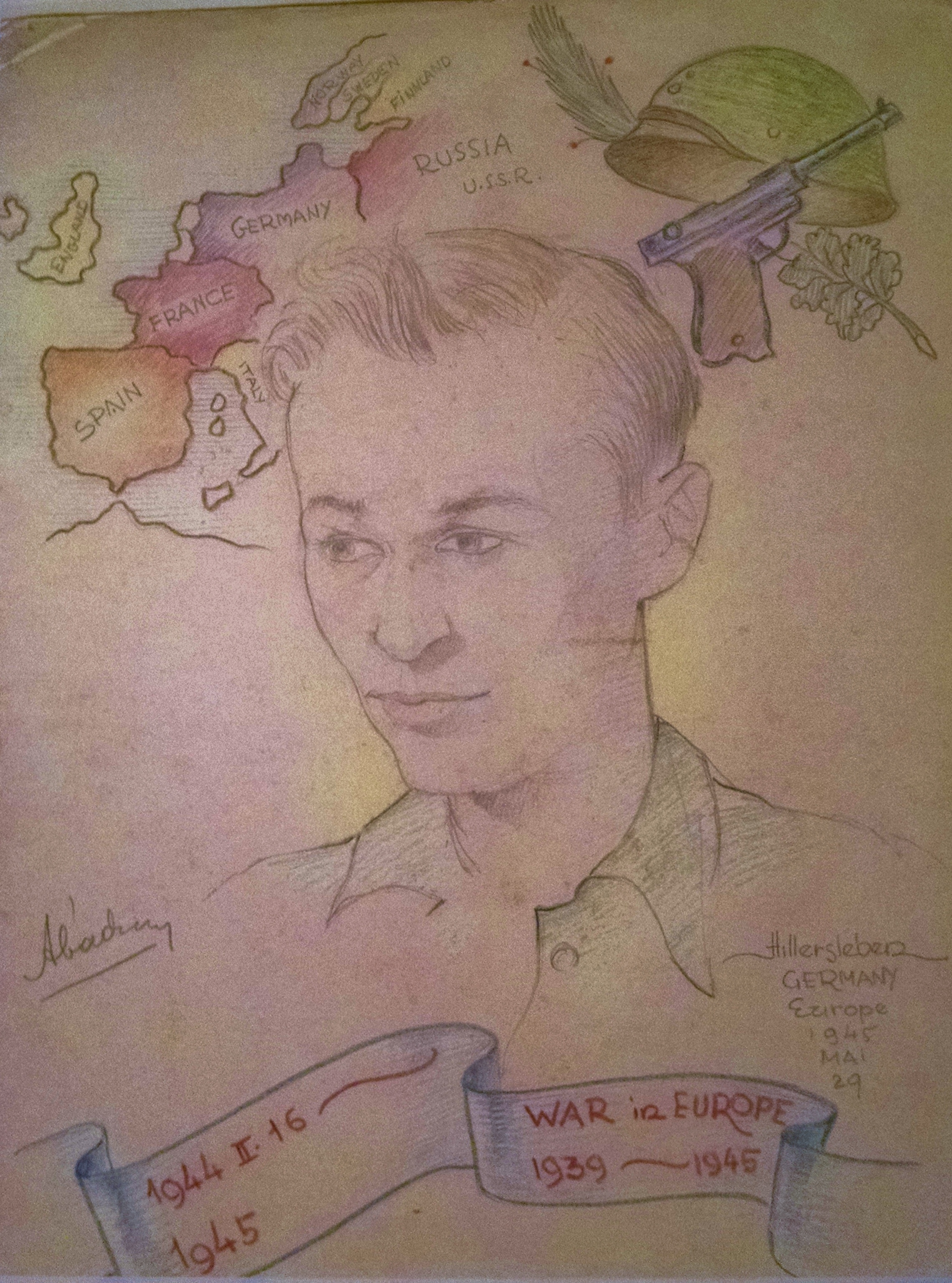
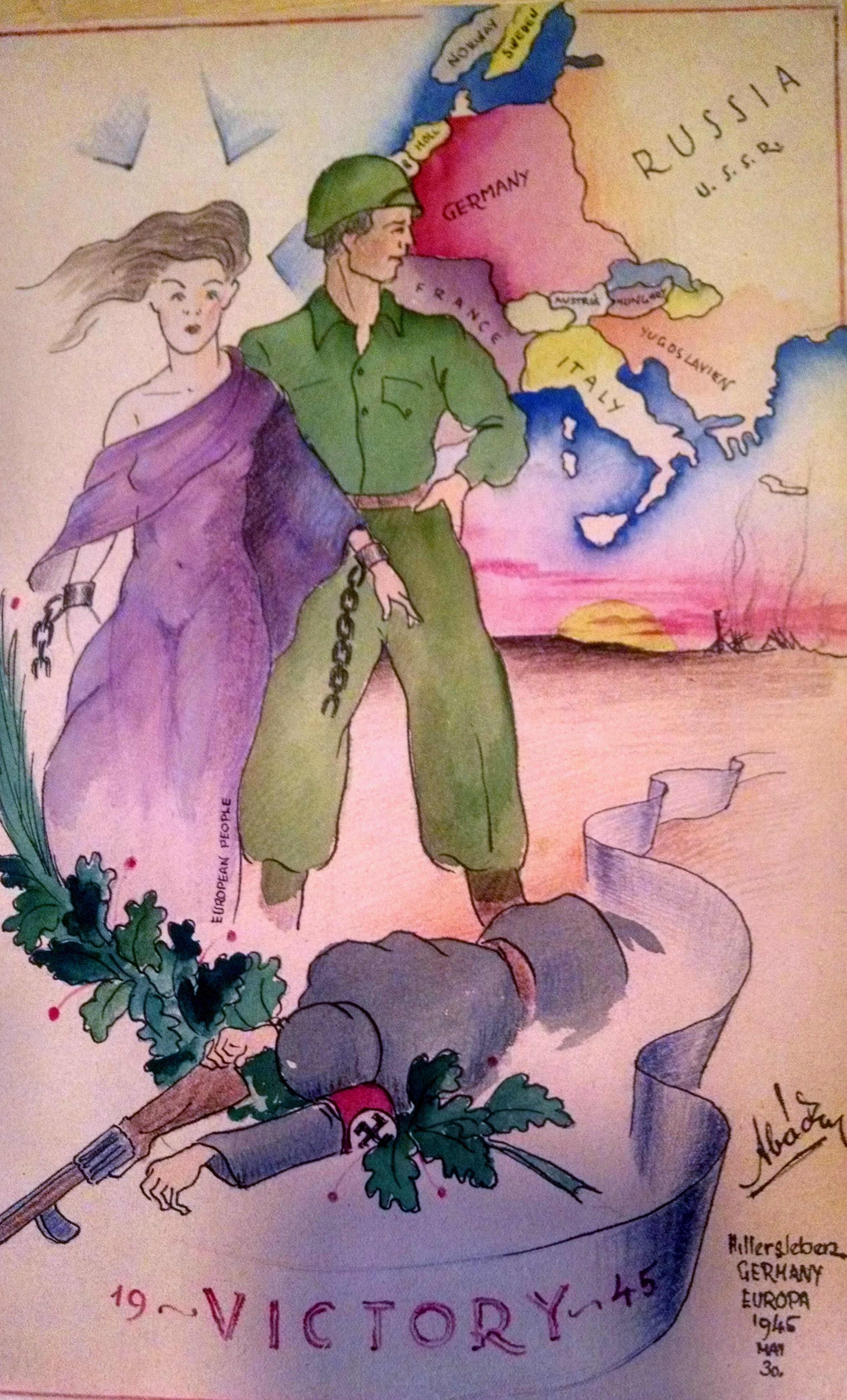
Victory, 1945. By Ervin Abadi. Hilersleben, Germany, May 1945.

Victory, 1945. By Ervin Abadi. Hillersleben, Germany, May 1945. Courtesy Chriss Brown, granddaughter of American soldier Don Rust.

The wires of the cosmos trip once more.

After almost exactly 70 years, a person came to this site on Jan. 30th with an inquiry:

I recently came across this site looking for a gentleman my grandfather became close to. My grandfather, Donald W. Rust of the 95th Medical Gas Treatment Battalion, helped him … and often spent time with him. The gentleman drew several pictures for my grandfather and I still have them today.

Donald W Rust of Kansas City KS. Hillersleben DP Camp, May 1945. Source: Chriss Brown, granddaughter of Don Rust.

Donald W Rust of Kansas City KS. Hillersleben DP Camp, May 1945. By Ervin Abadi. Source: Chriss Brown, granddaughter of Don Rust.

We looked while my grandfather was still alive but were unable to find any lists of the survivors until now. We cannot read his name clearly but we think the drawer’s name is ‘Albadi’ or something close to it. I would love to share the pictures he drew and also would like to hear if anyone can help me contact the survivor’s family. My grandmother turns 90 in March and it would mean the world to her to know what become of him.

My grandfather told us the gentleman was from Poland, but we don’t know what city. Unfortunately, my grandfather could not remember his name. If anyone can help, it would be much appreciated.  ~Chriss B.

***

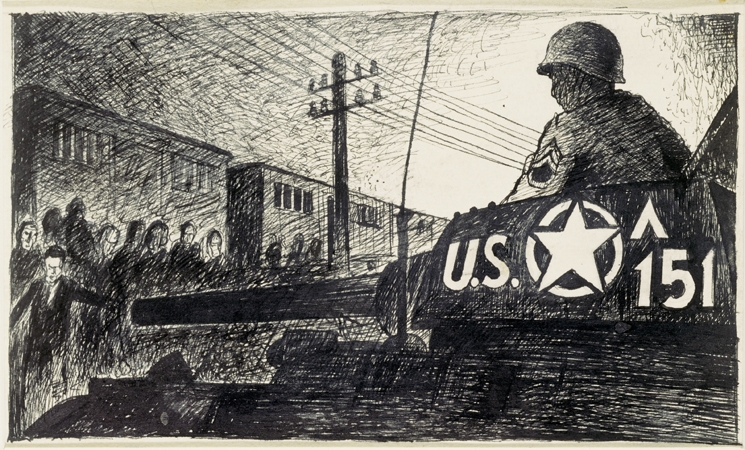
I immediately knew who she was talking about (though he hailed from Hungary, not Poland) and  got in touch with her. She sent me samples, and sure enough it was Ervin Abadi, whose work I was very familiar with. He had even sketched a drawing of the liberation with the tanks rolling in, but unfortunately he passed away 22 years before I sat down to do my interview with one of the tank commanders in the drawing.

Liberation, April 13th, 1945. Drawing by survivor Ervin Abadi. USHMM.

Liberation, April 13th, 1945. Drawing by survivor Ervin Abadi. USHMM.

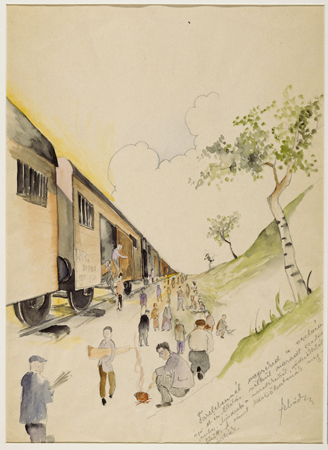
The Liberation of the Train, by Ervin Abadi. USHMM.

The Liberation of the Train, Farsleben, Germany, April, 1945. Ervin Abadi. USHMM.


Dozens of Abadi’s pieces are at the United States Holocaust Memorial Museum, and his bio there reads as follows:

In his early twenties when the war broke out, Ervin Abadi lived in Budapest, Hungary and wanted to be a painter. But, as with all Jewish males his age, he was taken to Russia by the Hungarian Army as a forced laborer. Abadi managed to escape but was captured after hiding out in the Karpet Mountains. After being brutally mistreated he managed to escape again, but was recaptured and taken to Bergen Belsen. When the camp was liberated  by the US Army [incorrect: his train transport from Belsen to Theresienstadt] on April 13, 1945, Abadi was taken to a hospital in Hillersleben, where he recovered. While in the hospital (and possibly earlier in the camp) he made 25-30 watercolors, dealing with his arrival at Bergen Belsen, life in the camp and its liberation by the US Army. Abadi returned to Budapest where he told about his life as a forced laborer and and an inmate of Bergen Belsen in a collection of 30 ink drawings. The work was published in 500 copies with Hungarian and English captions in 1946. The foreword of the book says, in part, “Let these drawings serve as proof of my everlasting gratitude towards those to whom I owe my life. … To the soldiers of the United States Army, particularly to our immediate liberators, those soldiers of the 9th regiment who first entered the village of Zilitz and gave us bread, milk, chocolate, and cigarettes….” Abadi, however, became disallusioned by Communist Hungary and managed to leave for Israel in 1947 or 1948 where he lived in Israel for the rest of his life. There he wrote 15 books in both Hebrew and Hungarian. He died in 1979.  [my emphasis]

***

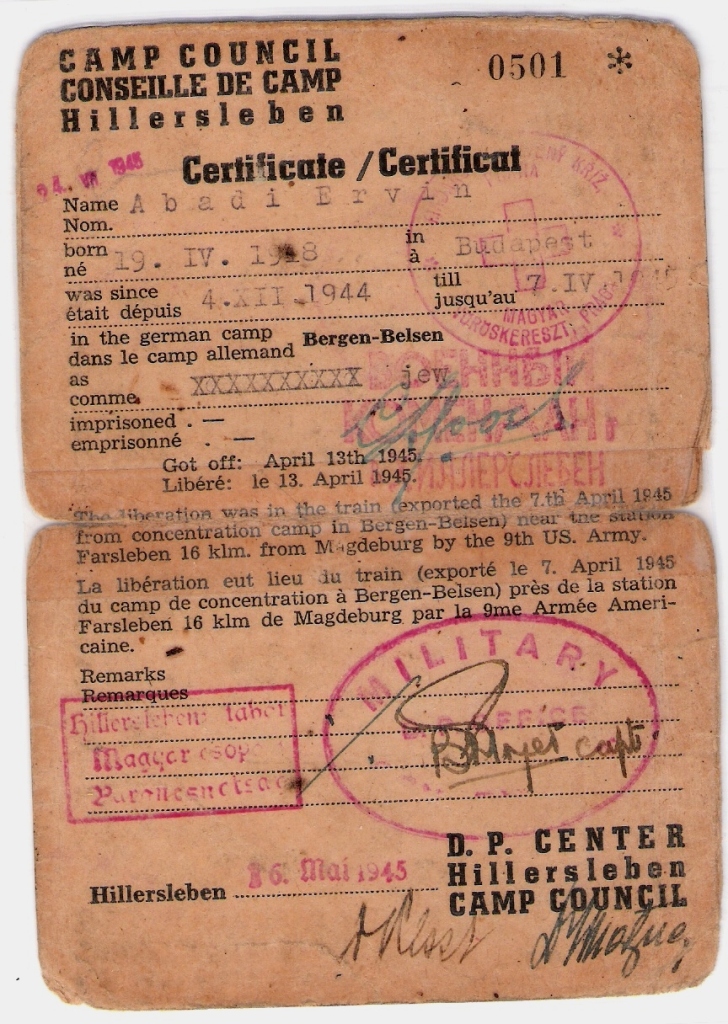
Ervin Abadi’s name is also the first on the existing manifest list. Some years ago, with the help of Varda W. in Israel, his daughter got in contact with me, and sent me his DP [displaced persons] document from Hillersleben:

Hillerleben Displaced Persons certificate-Ervin Abadi

Hillerleben Displaced Persons certificate-Ervin Abadi.

At that time, 5 years ago, his daughter wrote:

As you know, my father is a survivor from Bergen Belsen on the Magdeburg train. He got sick with typhus and was taken to the American Hospital at Hillersleben.

All my life my father told me to remember that he was saved by the Americans, and for that he will be grateful until his last day- and so must I, because if he was not to be saved- I wouldn’t be born.

My father passed away in 1979, and since then I tried to keep my promise to my father. I went to Normandy in France and walked the beaches that are soaked with the blood of the American soldiers and wanted to honor their memory, for because of them, I am living today.

A few years later I visited the World War II Memorial in Washington, DC. I met there an old gentleman and I found out that he was one of the American soldiers who fought on the beach on D-Day! I told him the story about my father and we both fell into each others arms crying. I felt like I fulfilled my promise to my father. ~Julia A. H.

**

So I dug out the letter, got in contact with Julia again,  and put her in touch with Chriss, the granddaughter of the soldier who in befriending Abadi, helped him in his recuperation.

Raymond D. Rape of Zelienople, PA ; Grafton D Junkin of Kennedy, Alabama ; Donald W Rust of Kansas City KS. Hillersleben DP Camp, May 1945. Source: Chriss Brown, granddaughter of Don Rust.

Raymond D. Rape of Zelienople, PA ; Grafton D Junkin of Kennedy, Alabama ; Donald W Rust of Kansas City KS. Hillersleben DP Camp, May 1945. Source: Chriss Brown, granddaughter of Don Rust.

From Julia, the artist’s daughter, last week:

I was very touched… 70 years after it happened, my father’s drawings came back to us.

We use to say that if his name is mentioned, a person lives forever.

Thank you again for remembering my father’s work of art.

*************************************************************


Read Full Post »

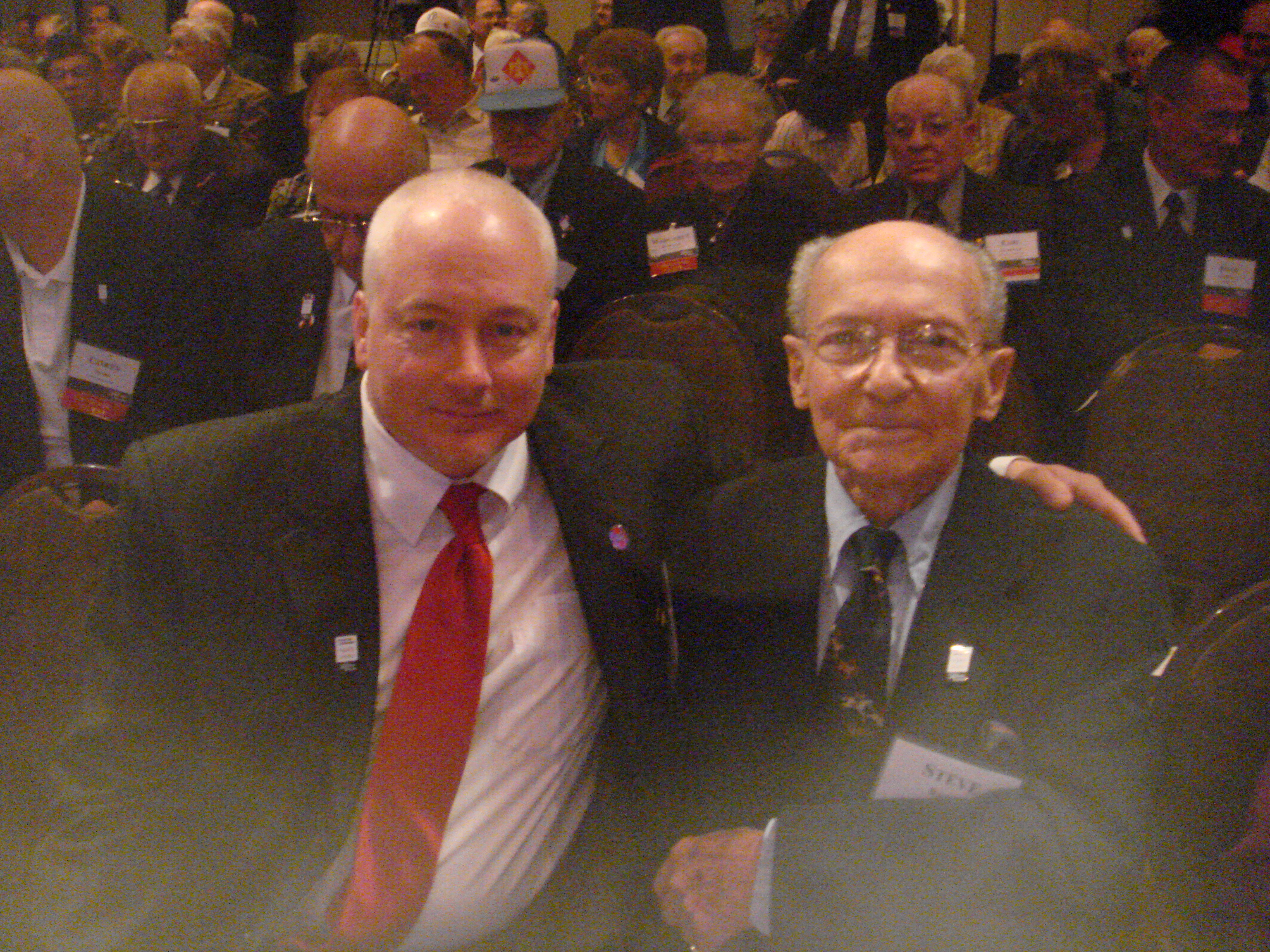
Matthew Rozell, Stephen Barry, National DOR Ceremony, Washington, DC April 2010. This photo was taken the day after the 65th anniversary of Steve's liberation in April 1945. We had just been honored by the director of the United States Holocaust Memorial Museum before the national ceremony in the Capitol Rotunda.

Matthew Rozell, Stephen Barry, National DOR Ceremony, Washington, DC April 2010. This photo was taken the day after the 65th anniversary of Steve’s liberation in April 1945. We had just been honored by the director of the United States Holocaust Memorial Museum before the national ceremony in the Capitol Rotunda.

So, the ripples continue. Somebody said it was like pebbles being tossed into the still water. This may sound strange, but I am keenly aware of the cosmic element. We tripped the wires of the cosmos.

~”It’s not for my sake, it’s for the sake of humanity, that they will remember”~

I got a nice email  recently. My friend Steve Barry was honored Tuesday evening at the United States Holocaust Memorial Museum. Steve’s daughters wanted me to know that his family made a donation in his name and set up two fellowships for scholars at the USHMM in the Stephen B. Barry Memorial Fellowship. His girls mentioned me in their speech Tuesday night in Washington. Thanks ladies. You know he was a hero. He reached out and touched an awful lot of students in the short time that we were together.

Steve will be one of the persons who will be featured in my book. Against all the odds he survived the Holocaust and later even went on to become a US Army Ranger in the Korean War! I was pretty close to him. Right now I am wistfully looking at his homemade holiday greeting cards under my desk glass, and to my left, a foot away, are the shelves containing his Holocaust library, which was passed on to me after he passed away. He was so funny, too.  He told me he nearly “choked on my bagel” a few years back when he opened his newspaper in Florida and read about me and the train he had been looking for, for so many years!

I miss the guy. You can read more about him here.


Steve's name on the wall of donors, USHMM, unveiled April 29, 2014.

Steve’s name on the wall of donors, USHMM, unveiled April 29, 2014.

The inscription kind of says it all. He uttered these words in my very classroom on a Thursday morning to a film crew from New York City, aimed at the 1500 students that he and the other survivors and American soldier/liberators had come to address. That Friday evening of our big soldier/survivor reunion, we watched it together on national news before our final banquet.

You can see the video at the bottom-he’s the one in the preview addressing the interviewer- but the transcript is below.

ABC WORLD NEWS TONIGHT, FRIDAY, SEPTEMBER 26, 2009

Diane Sawyer: And finally tonight, our Persons of the Week. It is a story that began almost 65 years ago in the darkest days of World War II. Yet this week, a new chapter unfolded. An unforgettable reunion of Holocaust survivors, and the American troops who freed them, and all made possible by a high school history class.

Matthew Rozell: This is history coming alive.
Veteran 1, entering school with his wife: Here we are, we have arrived!
Matthew Rozell: This is walking, talking, living history. They’re (the students) shaking hands with the past…

Diane Sawyer: It was 2001 when high school history teacher Matt Rozell decided to begin an oral history project. He and his students would just interview family members in the small town of Hudson Falls, New York, to capture fading stories of World War II.
Interviewer (soldier’s daughter): Did you mention the train [to Mr. Rozell] at all before?
Carrol Walsh, former soldier: No I didn’t tell him about the train.

Diane Sawyer: The students unearthed a forgotten crossroads in history. (Gunfire, archival film footage) Near the very end of World War II, April 13th, 1945, the American 30th Infantry Division was pushing its way into central Germany.
Carrol Walsh: We came to a place where there was a long train, of boxcars.

Diane Sawyer: They found a train, holding nearly 2,500 emaciated Jewish prisoners, many just children, being moved from the Bergen-Belsen concentration camp, to another camp and certain death. Their German guards had just abandoned them, fleeing the Americans.

Carrol Walsh: A feeling of helplessness. What are we going to do with all these people?
Frank Towers, former soldier: We had never ever seen anything so, (pauses) filthy.

Diane Sawyer: The American soldiers fed the prisoners, and brought them to safety.

Stephen Barry: For 42 years I collected anything that I could to try to find any article regarding the train. It just didn’t exist!

Diane Sawyer: But Mr. Rozell’s class put their interviews with veterans up on a website, along with these photographs taken by the American soldiers.

George Gross: Just very courageous people, little girls who with big smiles on their faces, one of them with their arms out, just aware that the Americans are there. [camera pans over 1945 liberation photograph]

Diane Sawyer: Out there on the web, Holocaust survivors all around the world began to notice.

Stephen Barry: I mean, how many people have a picture of their moment of liberation forever? [camera pans over 1945 liberation photograph]

(students and veterans and survivors singing “The Star Spangled Banner”)

Diane Sawyer: A reunion of the survivors and their liberators took place this week at Hudson Falls High School.

Emily Murphy, student: When they speak to us, you can’t say that you feel how they felt. But you get the feeling, you feel like you were there.

Diane Sawyer: In an age where there are still those who deny the Holocaust ever existed, these survivors say they are the living proof.

Stephen Barry: It’s not for my sake, it’s for the sake of humanity, that they will remember.

Diane Sawyer: And so we choose history teacher Matt Rozell, his class, the Holocaust survivors of that train, and the American soldiers who kept them and their story alive. And that is World News for this Friday. I am Diane Sawyer, and from all of us at ABC News, we hope you have a great weekend.

And here is a link to the 2014 United States Days of Remembrance Capitol Ceremony. Steve’s daughters and granddaughters are in the back row!


Read Full Post »

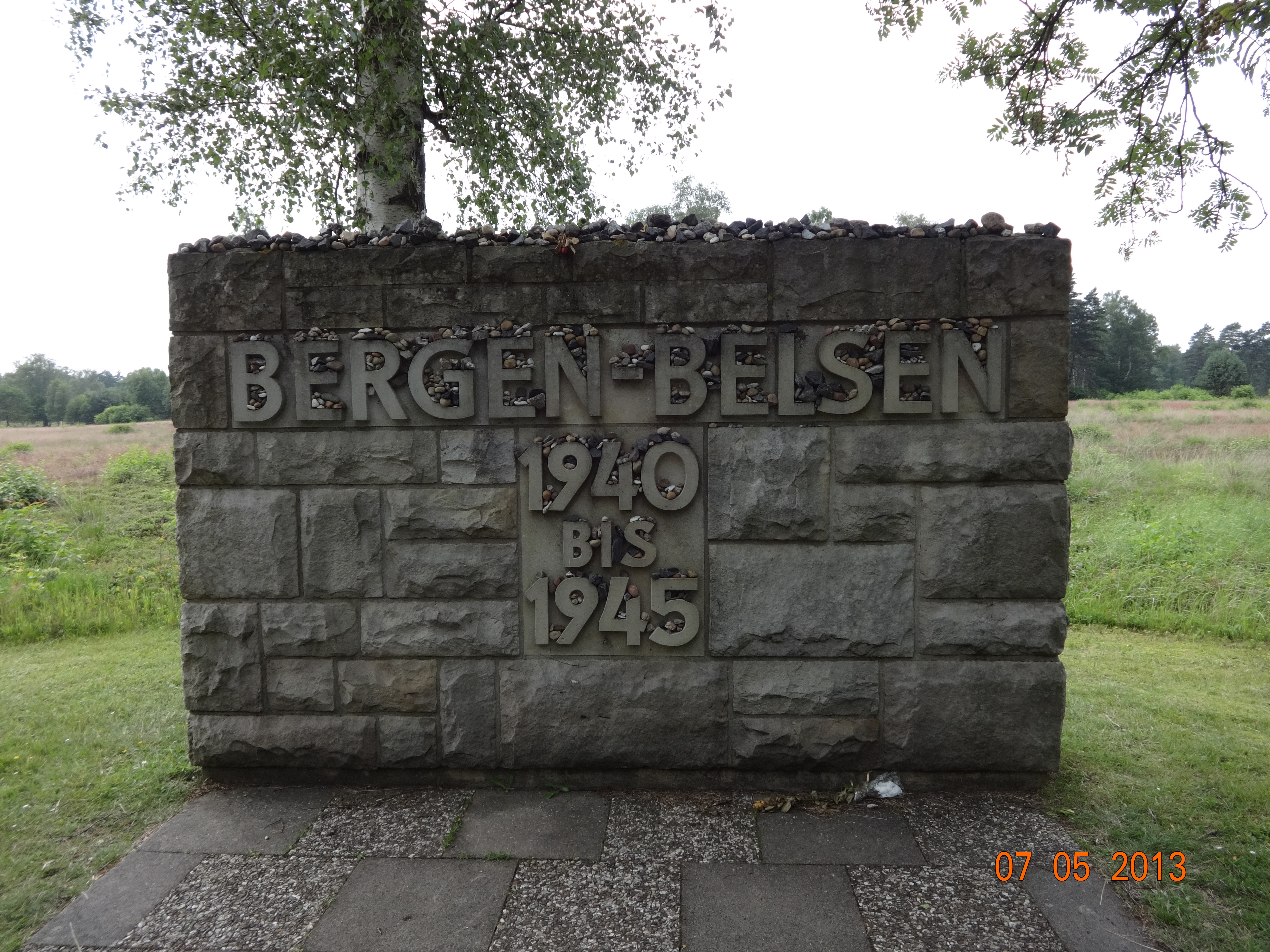
Bergen Belsen on July 5, 2013.

Bergen Belsen on July 5, 2013.

I am in Europe on a study tour of the Holocaust with 25 fellow educators of the United States. I am typing this as the morning breaks in the heart of Berlin, Germany. I had hoped to be able to get on-line and write more frequently but that is just not possible. There is too much to do while we are here visiting these authentic sites. But it is time to stop and reflect on some of the things that I have seen and experienced.

Our itinerary includes stops in Germany, the Czech Republic, and Poland. The power of visiting these sites after studying them so long can not be overstated.

Bergen-Belsen. For me, visiting this place after studying it in depth in relation to the exchange camps that were here was a powerful experience. Readers of the blog know of the stories of many of the survivors of Bergen Belsen who were in the exchange camp and their liberation on April 13, 1945 at Farsleben. Two days ago I got the back story of the exhibition panels you see here, that feature the photographs and the work that our project has uncovered.

In brief context: 120,000 prisoners passed through Bergen Belsen, and not all of them Jewish. 52,000 died here, perhaps 30,000 of them were Jewish. Belsen actually began as a POW camp- 20,000 Russians died here in the winter of 1941-42. In 1943, Himmler (the head of the SS) ordered that an exchange camp be set up for Jews who might possess foreign certificates or visas to emigrate, perhaps to use to bargain for German families interned abroad. 14,000 people went through the exchange camp. In November, 1944, thousands of women, and some children, including the Frank sisters, arrived from Auschwitz, to be “housed” near the exchange camp. What they received, in their miserable condition, were 18 oversized old tents which promptly blew down during a winter storm shortly after their arrival. With the arrival also of brutal SS administrators and guards, conditions deteriorated rapidly as the winter of 1944-45 turned into spring. The camp system began collapsing with the advance of the Red Army in the east and the British and Americans in the West. By the time the British arrived on April 15th at the camp gates, over 50,000 prisoners were suffering from extreme malnutrition, typhus, typhoid fever, and dysentery. Nearly ten thousand corpses lay about as the crematorium had long since broken down. Hundreds died on the day of liberation.

I'm here. Finally.  Jerrilyn Miller photo.

I’m here. Finally. Jerrilyn Miller photo.

So here I am. The bus guides swiftly through the beautiful German countryside. A night in the picturesque town of Celle the evening before has us well rested. The fields and forests bid us peaceful feelings as we move with our rendezvous with the past. It feels as if as we move we are stepping back in time.

Memorial site, Bergen Belsen.

Memorial site, Bergen Belsen.

We see the road signs for the memorial and I think many of us on the bus draw a collective breath as it turns into the parking lot of Gedenkstatte (Memorial) Bergen Belsen. It is surrounded by trees. We are the only persons, besides staff, who are here. As we disembark off the bus, Tif ties an Israeli flag around her neck so it drapes like a cape. It is quiet. But the birds are singing.

Now I remember that in 2007 I was beginning my first communications with Christian and Bernd, then staff members at the Memorial. They were excited about the opening of their new exhibition hall and education center. Two years later they would fly over, with the historian Thomas, to take part in our 2009 reunion. So now I am here for the first time to see them again.

We meet the staff, who are still preparing for us. I’m listed on the program at lunchtime for a talk about the exchange camps and how the project is incorporated into the exhibition. Bernd enters the room and greets me warmly.

After an introduction to the history of the site, we  watch the silent movies shot by the British beginning the second day after the liberation. Perhaps you’ve seen the photos or the films. Belsen, in 1945, was the last stop, the terminus of the Holocaust, as one historian has described it. It was a scene of horror. If you see a photo of a soldier wearing a mask, maneuvering a bulldozer to push corpses into an open pit, that was Bergen Belsen. Just over a month later, the British commander ordered the lice infested, typhus ridden barracks put to the torch.
So now we are on the grounds of the former camp. As we exit the exhibition memorial hall, we are confronted with a long narrow corridor of concrete that we must pass through, reinforcing the fact that we are moving from present to past. And now we are here.DSC00432
To some visitors, there is nothing here, just inviting walkways with interpretive signage and some markers. Woods, and open fields. But on closer inspection, we see the outlines of the past in the ruins. We walk to barracks ten of the exchange camp. You can see the outline at the woodline. Some of the foundation stones are marked with the names of those who passed through them. We retrace the steps from the barracks to the latrine, now many meters away off a footpath in the enveloping woods. Nature reclaims. Out of the corner of my eye, down the long narrow strip mowed to infinity where a fenceline once ran, I see a large deer guide out of the woods, pause and look my way, and vanish just as soon as it appeared. Is it obscene to find in this place now a feeling of inner peace, to find beauty in the stillness of a grey afternoon? Maybe so. But I feel it.
Back inside, Bernd is talking to our group at the Exhibit where the evacuation transports from the exchange camps are outlined with the photographs of Major Benjamin and Dr. Gross. He explains that between April 6 and 9th, 6700 men, women and children were evacuated on three transports. The “lucky” train was liberated by the Americans on April 13. Friday. One train did make it to the destination of Theresienstadt, where the occupants were liberated the last day of the war. On April 23rd, the third train was liberated by the Red Army at Trobitz, across the Elbe.

 Bernd Horstmann, Custodian of the Book of Names,  Matthew Rozell, History Teacher, July 5, 2013. Bergen Belsen, Evacuation transports exhibit.

Bernd Horstmann, Custodian of the Book of Names, Matthew Rozell, History Teacher, July 5, 2013. Bergen Belsen, Evacuation transports exhibit.

Bernd explains that as the exhibition was being planned, his colleague Christian discovered the photographs that I had been given by the Dr. Gross to place on my website. It altered their vision of the exhibition and he described their excitement as the corroborated the testimony of the soldiers with the photographs. Yes, this is the Farsleben transport. Yes, this is the transport that the Americans called “The Train Near Magdeburg”. My fellow teachers ask questions, and learn more about the exchange camp. They are putting faces to the victims when they see the pictures. I am happy to share this experience with them. I am here, and I am seeing it for the first time with them. They are part of this experience, at our first major stop on the trip. Later, on the bus, some are excited to see the Benjamin photo in the official Bergen Belsen guidebook. In my being caught up in the presence of the moment, I neglected to purchase one for myself, but there it is. I was not even aware of it.
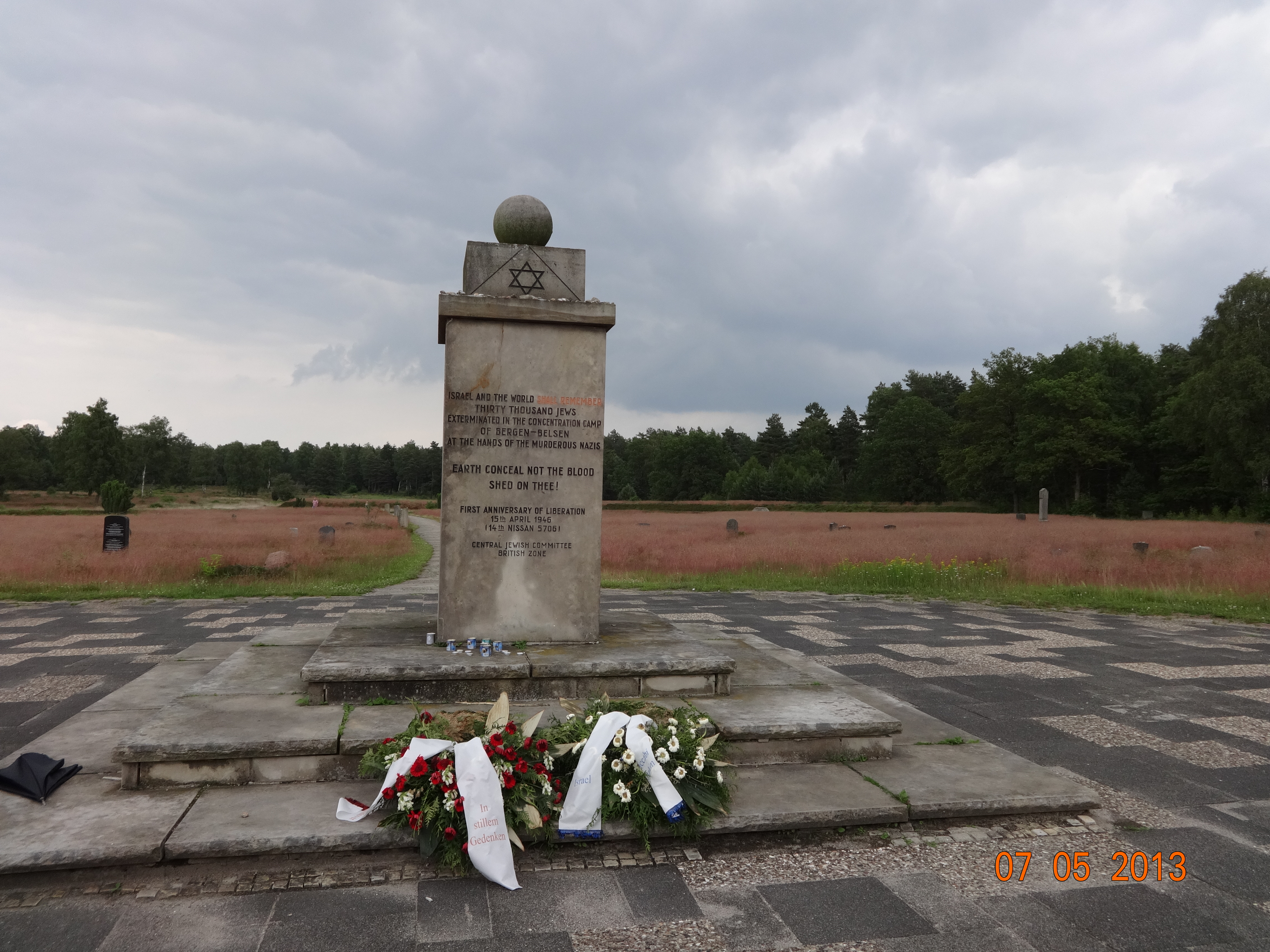
Back out to the camp. The solemn monuments marking the mass graves. 1000 Tote. One thousand DSC00490dead. 2500 Tote. Two thousand five hundred dead. And on and on, elevated mass graves. On to the commemoration room. Candles are lit, stones are placed, the prayers are recited in Hebrew and English, led by Pauline, the only other New Yorker on the trip with me. We are all moved. I think of Carrol Walsh, the tank commander who led me to this story, the liberator who did not want to be called a hero, or even a liberator. His own memorial service is today, half a world away, but I am here in this place to remember him as well. It is altogether fitting and proper. And perhaps it is also something destined to be.

This evening we depart from Hannover to Berlin. It is pretty crazy and unsettling at the Friday evening platform. 27 people have to run for the train, as the track has changed, with hundreds of others. Our original seats are taken, so we have to find other due to a mixup. But we do not lose anyone, and as I settle in next to a kind stranger, made welcome, I notice our station stops along the way- Brunswick. Magdeburg. We are roughly following the route of the train, and the 30th Infantry Division in 1945. What take us 35 minutes to cover, takes 6 nights and 7 days in April 1945.
Today was also something destined to be, the culmination of something incredible I am still trying to figure it all out- but this trip is helping me to place in proper context the elements of the greatest crime in the history of the world. As we leave this place of obscene beauty and peace, I think of  the I think of  the survivor’s words:

Remember Me.

Remember. Bergen Belsen, July 5, 2013.

Remember. Bergen Belsen, July 5, 2013.

Read Full Post »

By OMAR RICARDO AQUIJE- Glens Falls Post Star

HUDSON FALLS —Fred Spiegel was asked if he felt resentment toward the Nazis.

“Yes, to the Nazis, but not the Germans,” Spiegel said.

The question came from a student at Hudson Falls High School, at which Spiegel was invited Friday to discuss his life during the Holocaust.

On April 13, 1945, a train traveled across Germany, carrying 2,500 Jews en route to a concentration camp.

Spiegel was among them. He was 13.

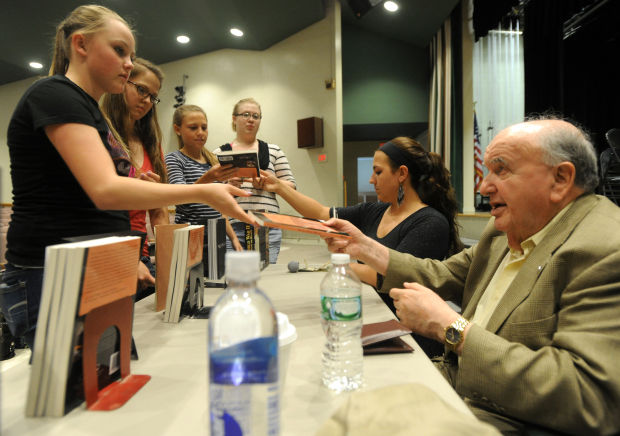
Holocaust survivor Fred Spiegel sells and autographs copies of his book, "Once the Acacias Bloomed," for students at Hudson Falls High School on Friday, May 24. Spiegel, who was liberated by U.S. troops as a young boy during World War II, spoke about his experiences and answered students' questions. (Jason McKibben -

Holocaust survivor Fred Spiegel sells and autographs copies of his book, “Once the Acacias Bloomed,” for students at Hudson Falls High School on Friday, May 24. Spiegel, who was liberated by U.S. troops as a young boy during World War II, spoke about his experiences and answered students’ questions. (Jason McKibben –

Spiegel, 81, visits schools to talk about how he survived. He brings copies of his book, “Once The Acacias Bloomed,” which explains his life as a Nazi prisoner.

Most of the schools he visits are in New Jersey, where he lives. The farthest he travels is Hudson Falls, a school he visited a few times in recent years, a school he included in his book because it was here an important moment in his life occurred.

“They invited me,” Spiegel said of his reason for returning to Hudson Falls. “How can I say no?”

During Friday’s presentation, Spiegel often said he was lucky to be alive.

Other trains carrying Jewish prisoners made it to their destination. His did not.

His train suddenly stopped near Magdeburg. Spiegel said the train’s engineer and Nazi soldiers fled for fear of capture. U.S. troops was cutting across Germany.

Then, a few U.S. soldiers on tanks found the train and freed the captives. The soldiers included Carroll Walsh, of the 743rd Tank Battalion.

Spiegel was later reunited with his family. It was 65 years later when the unexpected happened: He was invited to Hudson Falls to meet others who were prisoners on the train.

He also got to meet some of the liberators, including Walsh, who was living in Hudson Falls at the time.

Matt Rozell, a Hudson Falls history teacher, organized the reunion. He met Walsh in 2001. He interviewed the former soldier, and learned about the train near Magdeburg.

Walsh died in December. He was 91 and a former state judge.

Spiegel, a native of Germany, said people have shown more interest in the Holocaust over the years.

During Friday’s visit to Hudson Falls, he spoke to about 30 sophomores. Some of them had copies of Spiegel’s book. Others bought the book after the presentation.

Armand Ryther, a student, approached Spiegel to shake his hand.

“I find it very interesting that he could survive what he did,” Ryther said.

Ryther said he read Spiegel’s book.

Jamie Hughes, a fellow sophomore, said it was interesting to hear about Spiegel’s experiences.

“I think it’s really amazing that he would want to share his experiences with everybody,” she said.

Tara Sano, a Hudson Falls history teacher, said the event was planned near Memorial Day so students can reflect on the efforts of veterans.

“My hope is that when you are taking your three-day weekend, you think about why you have a three-day weekend,” she told students at the start of the presentation.

http://poststar.com/news/local/article_00a9219c-c648-11e2-ae69-001a4bcf887a.html

See Fred meet his liberator for the first time.

Read Full Post »

Two Toronto Holocaust survivors meet their liberators 65 years later
Two survivors of a death train out of Bergen-Belsen concentration camp finally link up with American soldiers who freed them in 1945.

A WWII-era booklet still possessed by Leslie Meisels documents his liberation as a young boy from a train destined for a death camp. Meisels, who eventually ended in Toronto, met a few of the surviving soldiers who freed him and 2,500 prisoners on the train.

A WWII-era booklet still possessed by Leslie Meisels documents his liberation as a young boy from a train destined for a death camp. Meisels, who eventually ended in Toronto, met a few of the surviving soldiers who freed him and 2,500 prisoners on the train.

Leslie Meisels is 86.

Leslie Meisels turned 68 last month.

Every April, since he was 18, Meisels has celebrated his rebirth. Sixty-eight years ago he was on the cusp of death, packed into a cattle car in a freight train with some 2,500 other skeletal Jewish prisoners. He weighed only 75 pounds.

Then a miracle. That train, which had set off from a concentration camp, was liberated by 12 shocked American soldiers in two tanks and an army jeep near Farsleben, Germany.

Up until then, the American GIs had assumed the gruesome stories they had heard about German death camps were just Allied propaganda devised to make them fight harder. But as they unlocked the boxcar doors, they witnessed humanity’s true capacity for evil.

They called it the death train. For Meisels, it was a train of life.

This past week marked the 68th anniversary of V-E Day, the end of the Second World War in Europe. It’s a good moment to tell the story of that train from Bergen-Belsen.

I heard about it last month in an email from a history teacher in upstate New York. He put me in touch with Meisels and Paul Arato: two Holocaust survivors from Hungary who in 1956 escaped their homeland, by then under Communist rule, and settled in North York.

Their stories are remarkably parallel. They grew up in nearby towns in eastern Hungary, they were both imprisoned by the Nazis in 1944, and they were sent first to Austrian farms as slave labourers and then to the Bergen-Belsen concentration camp in northern Germany.

Have you ever seen the horrifying Holocaust photos of dead, naked bodies being pushed by a bulldozer into open pits? That was Bergen-Belsen. Some 70,000 people were murdered there, including Anne Frank. They weren’t killed in gas chambers, like at Auschwitz. Instead the Nazis used starvation, sadism and disease here.

Meisels remembers mostly the hunger. They were given only watery turnip soup and a piece of bread each day. In four months, he lost 100 pounds.

Arato, just 6 then, remembers the rattling cold and twice-daily roll calls that often lasted hours. He and his older brother Oscar had to hold their mother upright, she was so weak from typhus. One day a boy in their line smiled because it was his birthday. As his “present,” an SS guard shot him dead. It was Oscar’s birthday the next day.

The horror is ungraspable.

By April 1945, the Nazis were retreating as both the Allied and Soviet armies advanced. One morning, both Meisels and Arato were awakened by guards and told to march. “We dragged our bodies over five kilometres,” says Meisels, “back to the train.”

Trains in Nazi Germany usually led to death. This one was no different. It was destined for another concentration camp in Czechoslovakia, but the guards also had orders to execute passengers. Meisels remembers one afternoon when all males 12 and older were ordered out of the packed boxcars and lined up in front of machine guns. They stood there two hours before being herded back into the putrid cars.

Over six days, the train progressed only 135 kilometres.

Arato remembers peering through between the wooden boxcar slats and seeing the SS guards drop their weapons and start running. Then he glimpsed a tank with a star on it.

The door slid open shortly and they were greeted by stunned American soldiers.

“It was hard for us to believe what we were actually seeing,” says one of those soldiers, Frank Towers, on the phone from Brooker, Fla. “We weren’t prepared for it. We were there to fight a war. We weren’t humanitarians. We didn’t know what to do.”

Says Meisels: “We cried, ‘Oh God, we are going to be free. We are going to be human beings again.’ ”

Towers, who was serving in the 30th Infantry Division, spent a day those taken off the train to convalescence homes and a hospital nearby before he had to push on with his battalion.

Meisels and Arato spent five months recovering in Germany before they could finally return to Hungary to search for the rest of their families. Eleven years later, they escaped Hungary and started their lives for a second time: getting married, building careers, having children, then grandchildren. Decades went by.

Then, a few years ago, their paths crossed at a business meeting. Arato, since retired, was an industrial designer. Meisels ran a family company making plastic moulds. At the end of the meeting, the topic of the Holocaust was raised. They discovered, to their shock, they had both been on that train from Bergen-Belsen.

Around the same time, that high school history teacher in New York named Matt Rozell stumbled upon the story.

To bring Second World War history alive, he’d instructed his Grade 10 students to interview their grandparents about the war. One summer, he visited one of his students’ grandfather: Carrol Walsh, a veteran turned New York State Supreme Court judge.

“After two hours, when the interview was ending, his daughter elbowed him and told him to tell me about the train,” Rozell says.

He learned Walsh had been in one of those tanks that chased away the SS soldiers and liberated the train.

Rozell posted the story on his website, Teaching History Matters, and a few years later a survivor from that train contacted him from Australia. Since then, 240 more have been located.

In 2007, Rozell hosted his first symposium on the train, bringing together survivors and liberators. Arato’s son came across a story about the reunion on the Internet by chance.

Arato told Meisels about it, and two years later they both traveled down to Hudson Falls, N.Y., for the second symposium. There they met Walsh and Towers.

That moment was a second liberation for Arato, now 74.

“A blanket was pulled from me,” he says. “I was always very lonesome. I didn’t share my stories with anybody. I grew up and spent all my years being angry. This meant I don’t have to be angry anymore.”

His wife, Rona, has just published a book about his story called The Last Train: A Holocaust Story.

Meisels visits schools around Toronto to speak about the Holocaust every week.

His message? “Hatred is something we have to fight against. When you hear a derogatory comment, say out loud that it is not right. When you are silent, you are not neutral. You are supporting the oppressor.”

He and Towers went to Washington, D.C. last month to celebrate the 20th anniversary of the Holocaust Museum there. Towers, now 96, is the last living U.S. veteran who liberated that train. Walsh died last December.

“We hugged,” Meisels says. “Whenever we are together, I am so overwhelmed by gratitude and joy.”

Truth can be more horrifying and wonderful than fiction. Every life is precious.

CLICK HERE FOR THE STORY OF ANOTHER TORONTO RESIDENT WHO FOUND HERSELF IN THE 1945 PHOTOGRAPHS


by Catherine Porter 

http://www.thestar.com/news/gta/2013/05/10/two_toronto_holocaust_survivors_meet_their_liberators_65_years_later_porter.html

Read Full Post »

Thanks to Alan Smason for a nice article. I have added some clarifying remarks in brackets for posterity and additional accuracy.

Soldiers, survivors converge in Louisville

April 19, 2013

By ALAN SMASON, Exclusive to the CCJN

Frank Towers remembers the day through the haze of 68 years, a footnote at the end of World War II. Matt Rozell was never there, but through his efforts and those of his students, he can dictate with amazing accuracy what happened in Farsleben, Germany those many years ago. Yet to the five Holocaust survivors who met with Towers and Rozell at a World War II reunion this past weekend in Louisville, KY, it was a day they will never forget. It was the day American forces gave them something they thought they would never see again: freedom!

30th Division U.S. Army Infantry Veterans executive secretary Frank Towers, center, welcomes Gideon Kornblum, left, and Kurt Bronner. (Photo by Alan Smason)

At 95 years, Towers is the last of the 30th Division of the United States Army Infantry members who can say he was there and had personal contact with this almost forgotten chapter of history. His testimony shows he was assigned the duty of dealing with what the Nazis regarded as human refuge on April 14, the day after the survivors, crammed into tiny freight cars, starving and in some cases dying, had been freed from their captors by members of the Tank Destroyer Batallion 743 [note: 743rd Tank Battalion. 823rd Tank Destroyer battalion assisted later in the day.]assigned to Tower’s 30th Division named for Andrew Jackson and fondly referred to as “Old Hickory.”

Rozell, a high school teacher in Hudson Falls, NY, is the conduit by which Towers and the remaining 30th Division members have connected to the Holocaust survivors, all now septgenarians or octogenarians, from the first of three trains sent out from Bergen-Belsen concentration camp on April 6. It is through his “Teaching History Matters” website set up decades ago and fueled as part of his commitment to teaching his students the lessons of World War II that he has become heralded as an authority on an event that took place years before he was born.

It is through his efforts and the resources he and his students have placed on the Internet that reunions where veterans can meet with survivors have been possible. More than 200 survivors of what Towers calls “the death train” have been identified and contacted through Rozell’s networking efforts.The five survivors who traveled to Louisville to spend time with their families touring the Louisville Slugger plant and other city sites are part of a vast network of Holocaust train survivors now living throughout the United States, Canada, Israel, Europe and as far away as Australia. The manifest of the names of all those loaded on the train is now listed on Rozell’s site and linked with the United States Holocaust Museum and Yad Vashem in Jerusalem.

This year two train survivors, Ariel University emeritus math professor Gideon Kornblum from Jerusalem and retired graphics printer Kurt Bronner from Los Angeles, were new to the gathering. They joined with retired Duke University medical professor Dr. George Somjen from Durham, NC; Brooklyn College physics professor Micha Tomkiewicz from Brooklyn, NY; and Bruria Bodek Falik from Woodstock, NY, all of whom have attended reunions with the remaining veterans beginning in 2008 and continuing ever since.

Bergen-Belsen concentration camp survivors (from left) Micha Tomkiewicz, Bruria Falik and Kurt Bronner. (Photo by Alan Smason)

In every case these Holocaust survivors brought their wives, children and grandchildren with them to meet and socialize with the children and grandchildren of the men they consider the liberators of their families.

This year only 12 veterans were in attendance. Their number was lessened in December with the passing away in Florida of Carrol Walsh, a retired New York State Supreme Court judge, who was one of the two tank commanders that captured the train in question.

It was through Walsh’s grandson, a student in Rozell’s history class more than a decade ago, that Rozell first learned of what occurred on that date. Beginning in 2001, he heard first-hand in a series of interviews with Walsh how he and fellow tank commander George Gross happened onto the train and its human cargo.

Rozell explained how the train got there. On April 6 the Bergen-Belsen commander, fearing the approach of the Soviet Army [note: the British Army] and not wanting to let the world know of the savagery of the Third Reich and its “Final Solution,” dispatched three separate trains crammed full with prisoners to Theresienstadt concentration camp, also known by the name of its garrison city, Terezin. Of the three trains sent out that date [note: not all three trains were dispatched on same day], the first with 2,500 aboard encountered a series of mishaps that made it fall into the hands of the Americans on April 13. A second train with 1,700 prisoners aboard, using information it gleaned from the first train, eventually made it to Terezin on April 20, where most of its inhabitants were liberated on May 8 by the Soviet Army. The third train with 2,400 souls aboard also was liberated by Soviet troops on April 23 at Trobitz.

With laser pointer in hand, former 1st Lt. Frank Towers prepares to show audience members where the train was liberated at Farsleben. (Photo by Alan Smason)

Walsh and Gross were on a scouting mission along with members of the 119th regiment, having been dispatched from the recently captured town of Hillersleben by Major Clarence Benjamin. Benjamin had come upon several Jews who had escaped the train while it lay in wait. They had told him of the train’s existence and he instructed Walsh and Gross to accompany him.

Despite its holding a full head of steam, the train commanded by SS Captain Hugo Schlegel and its complement of a dozen guards or SS troops were contemplating orders from the German command. In front of them were the Allied forces, while behind them the Soviet troops were advancing. The orders were chilling. Either blow up the train there with explosives found in one of the freight cars or advance the train to the Elbe River, blow up a bridge there and plunge the train into the waters below, killing all aboard including the guards.

The train was standing at a spot so remote it was originally considered as Magdeburg by the World War II veterans who first began to tell their stories. Walsh and Gross saw several Jewish prisoners milling about, but when they pressed their tanks into service, the German guards threw their rifles down, ran away or disrobed, attempting to evade capture by donning the clothes of their captives. It was in vain, though, because their much better physical condition gave them away almost immediately.

Emeritus mathematics professor Gideon Kornblum traveled from Jerusalem to be a part of the reunion of the veterans and survivors. (Photo by Alan Smason)

Gross placed his tank in front of the train, while Walsh went back to the headquarters to alert them to their finding. With their Nazi captors away or arrested, the train’s doors were flung open and the wretched survivors  began to slowly vacate the compartments to which they had been confined.

“These freight cars were much smaller than the ones we see on our normal railroads, about half to two-thirds the size of our freight cars,” Towers recounted. “These freight cars were left over and remodeled after World War I and became known as ’40 and 8s.’ They could easily hold 40 men or eight horses, thus the nomenclature.”

“These cars that they encountered contained 75 to 80 men, women and children,” Towers continued. “They’d been in these cars for six days, stopping at night to get their daily ration, which basically was a kettle of water with some potato skins or lentils. That was their ration for six days.”

When Walsh returned with backup troops, they came face to face with the horrors of the Holocaust, none of which they had seen in their march towards the heart of Germany.

Kurt Bronner, at his first reunion of the 30th Division of the U.S. Army Infantry, gives his thanks to the veterans, (Photo by Alan Smason)

“They had very little sanitary facilities. They were dirty, stinking, flea-infested and lice-infested and put into these cattle cars,” Towers recalled. “When they opened the doors of these cars, many of the victims just fell out to the ground. Some of our men just had to turn and throw up; the stench was so bad. This was inhumane. This was what the Germans were giving them: nothing. They were treated lower than animals.”

Rozell concurred, but gave an interesting sidenote. The German guards had radios and had informed the prisoners of the death less than 24 hours before of President Franklin D. Roosevelt in Warm Springs, GA. Many of the U.S. soldiers were so busy fighting battles that they first found out about his death through the freed Holocaust survivors. [note: the reporter may have heard this from someone, but it was not me. I indicated what the soldiers told me- that the column was stopped and they were notified by their own commanders. Shocked, they went on to liberate the train the next day.] The prisoners were fearful at first because the Germans had told them the Americans would shoot them when they found them.

“There was one soldier, an individual I hear many soldiers talk about,” Rozell remembered. “Apparently, he came down from the hill and he said in Yiddish ‘I’m a Jew. I’m Jewish.’ He was from Brooklyn and I’ve heard it from at least a half-dozen people because it does make an impression.”

When 1st Lt. Towers was ordered to the train the following day he had several concerns. “The first thing we wanted to do was get these people medical care,” Towers stated.

“We were sort of in the middle of a no man’s land. We had to get these people out of there,” he noted. “So it fell in my lap to get transportation to get those people out of there and to remove them back to a previous town that had been liberated the day before at Hillersleben.”

Sadly, 30 of the victims on the train had already died of organ failure or starvation and were buried immediately at Farsleben, according to Towers.  Over the course of the next two weeks, nearly another two dozen weakened survivors contracted typhus and died. They were buried in a cemetery in Hillersleben, some five miles away. One of these was Somjen’s father.[note: the number is over 100.]

Little did Towers know, but the interaction he had with transporting the victims of the Holocaust was to be short-lived. Within a few days of arranging their transportation and care by private citizens and for the sick to a nearby German field hospital, he and other segments of the 30th Division were moving out to fight the Germans in what turned out to be their final assault at Magdeburg. Within days the war was over for Towers and the entire 30th Division.

For the survivors they had liberated, most of whom were Hungarian Jews, there were many years of living in displaced persons camps, moving back to their hometowns to attempt to find parents or loved ones and, eventually, emigration to more welcoming countries as Communism gripped the Slavic states.

For Kornblum, who was only five at the end of the war and who was then an orphan, much of the story of his past was brought to life at Yad Vashem, the Holocaust memorial and museum in Jerusalem, near where he now resides with his wife Annette. Although several previous attendees had come in from European cities or like Falik had lived in Israel for a time, Kornblum is the first resident of the Jewish state to travel expressly [note: others have travelled to the USA to reunions from Israel] to a 30th Division reunion.

“Originally people gave me the impression that I was aboard the train headed for Tobitz. I was very happy to learn that I was in the so-called Magdeburg train liberated near Farsleben,” Kornblum confessed. He remembers some childhood memories such as celebrating Shabbat with his grandfather on Friday evenings in addition to the slaying of his mother at the hands of the Nazis and the death of his father at Bergen-Belsen. “But I have very little recollection,” he admitted.

Bronner, who was 18 at the time of liberation, had far more vivid memories of that day, even though he spoke no English at that time. “The first  words in English I ever learned was (sic) ‘One only,’” he said. “That was when I went to the bathroom and I closed the door. Having the privacy to be by myself: that was freedom!”

Rozell first became aware of the impact his website was making in 2006, when he was contacted via email by an elderly [note: a grandmother, but not my idea of elderly] woman in Australia who was only seven at the time of the liberation of the train. She was amazed at the images displayed on the site captured on the day of her liberation by Benjamin and Gross. Thus began countless emails and telephone calls to many excited survivors with Rozell’s website as their focus.

When Rozell contacted the archivist at the Bergen-Belsen concentration camp, he received more material, such as the manifest list of passengers, which enabled him to do outreach with other survivors, who now were scattered across the globe. Rozell, Tomkiewicz and his wife [note: Rozell, Towers and Varda Wiesskopf] have now contacted approximately 240 survivors, all 18 years or under at the time of their liberation [note: a few were older].

Rozell has held several reunions with his high school class in Hudson Falls and has had Towers and Walsh meet with the survivors of the train, beginning in 2007. He has had oral histories recorded on video and transcribed for insertion on his website. Since 2008 the 30th Division members, led by executive secretary Towers, have invited the Holocaust train survivors to be included in their reunion activities as guests. The veterans and their families have joined with the Holocaust victims and their families to ensure that this small event at the end of World War II will always be remembered.

Crescent City Jewish News

Read Full Post »
Woodstock event remembers Holocaust

WOODSTOCK, N.Y. — A Yom Hashoah event that will remember the Holocaust will take place April 7 at 3 p.m. at the Woodstock Jewish Congregation, 1682 Glasco Turnpike, Woodstock NY, 12498.

Synagogue Main Number (845) 679-2218
Email info@wjcshul.org
Persons of all faiths are welcome.

The Yom Hashoah  observance will include a candlelight memorial service, followed by an address by Matthew Rozell titled “Honoring the Hour of Liberation and Defeating the Legacy of Hitler.” Rozell is the founder of a project that has reunited survivors from the Bergen-Belsen concentration camp with the U.S. soldiers who liberated them from a train transport during the closing days of World War II. To date, with the help of Varda Weisskopf and Frank Towers, more than 240 survivors worldwide have been located, and 10 reunions have taken place since 2007. Rozell is also a teaching fellow at the United States Holocaust Memorial Museum and has spoken on behalf of its educational programs. His work can be seen at teachinghistorymatters.wordpress.com.

The ABC News video can be seen here.

Read Full Post »
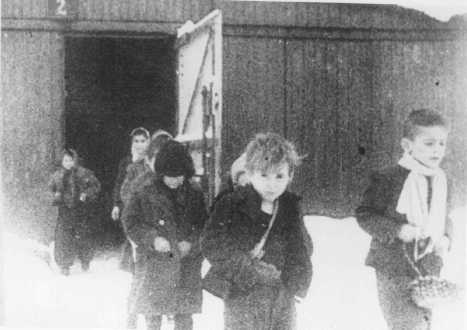
Soon after liberation, surviving children of the Auschwitz camp walk out of the children’s barracks. Poland, after January 27, 1945. — United States Holocaust Memorial Museum

Soon after liberation, surviving children of the Auschwitz camp walk out of the children’s barracks. Poland, after January 27, 1945. — United States Holocaust Memorial Museum

Today is International Holocaust Remembrance Day, the day Soviet troops over ran Auschwitz in 1945. This week I received a note from an Israeli survivor friend, shortly after the passing of one of her liberators, Carrol Walsh. Sara lost over 60 of her family there- and her immediate family was saved only because the day they arrived at Auschwitz, the death machinations were working at full capacity and her transport was rerouted to Belsen. She was liberated on 13 April on the evacuation transport near Farsleben, known here as the Train Near Magdeburg…

In her letter she asks important questions of me. I have responded the best that I could, below.

Dear Matthew,

 We were very sad to hear that Carrol Walsh passed away. Only lately did I get to know him, and he risked his life in order to save ours. It is a pity we did not get to meet more.

I can’t express in words the loving feelings for the young tank commander that for sure always had a smile on his face, and never stopped smiling after we met- 65 years after the victory. I am sure Carrol Walsh made the best out of his life; I was fulfilled to know him and his beautiful family.

I read about his profession in the years of his life. It was interesting to see how much meeting with us affected him.

I thank you for your unusual courage to initiate the exciting meeting [reunion].

I suppose you were very excited for the event you had initiated. Did the idea come in different parts? I am trying to understand the development of your thinking.
When you first wrote to me about the meeting [invitation to the proposed reunion], it was on the day we were released- the 13th of April. I got home after meeting my brothers and celebrating the release [liberation]day. I couldn’t relax, I immediately told all my brothers. I was so happy, as if it was happening again.

The meeting completed a missing part in the picture for me, after all the horrifying things we went through we couldn’t even dream of a miracle like that coming out of the blue.

I cannot go back more to the extermination camps and escort groups because I don’t have the physical nor mental power to do that anymore.

There are questions that bother me.

Are you able to answer them?

Why shouldn’t the world forget and let this be over?  

A. So, some people do want to forget. Others will say that it did not happen. For those reasons, it must never be forgotten. This is the biggest crime in the history of the world.

As Walsh states, how could humanity have stood by and let that happen?

Does my work, the hard work I do, do anything against the forgetting?

A.The most impressionable minds in the world are those of the youth. It is they who the Nazis “educated”; it made it easier for the crimes to be committed. This is why they must hear now.

The work that you, and I do, has an impression. I hope to continue this work after you must slow down. Please remember that.


You are a historian, should the memory be kept?

A.The memory must be kept. As educators it is our duty to keep it alive. We must fight those who trivialize or denigrate its importance.

Is there a proper way to keep the memory?

A.There is no one way except to be open to the discussion of humanity and how humans could do this to one another. We must also bear in mind however, that the soldiers who helped the suffering to new life bore their own pains in doing so, yet also made a choice to redeem humanity. Some did not sleep soundly for years.

I think this is so, and also must not be forgotten. The war brought out the most evil in the world. But I think it also revealed some goodness in the form of the soldiers who liberated or otherwise cared for the victims.

Who should be documenting everything, the “victim” or the “aggressor”?

A.The aggressor fades from memory. New generations asks questions. It is true that some are bothered by the questions. But the young will always be curious and want to know- is this a stain on the German people? I know some Germans today who work very hard to keep the memory alive, as you also do.

The victims give the testimony. This is all they can do. But it is the evidence of the crime, and one that new generations must work with. That is why your work is so important.

Who is in charge of making the conclusions?

A.I would say that institutions such as the United States Holocaust Memorial Museum and Yad Vashem are the world leaders in this area. I have been trained, well, I should hope, by the USHMM. I do not know enough about the German institutions but I hope to raise enough funds to travel to the camps and study there this summer.

Read Full Post »

Matthew Rozell, 30th Infantry Veterans of WWII, Holocaust survivors at Mighty Eighth Air Force Museum, March 2, 2012.

Matthew Rozell, 30th Infantry Veterans of WWII, Holocaust survivors at Mighty Eighth Air Force Museum, March 2, 2012.

Frank Towers’ invitation to soldiers, survivors, interested parties and their families to come to Louisville in the spring. The soldiers have convened annually since the end of World War II; since 2008, thanks to the project, the 30th Infantry Division has hosted Holocaust survivors and their families as well for very emotional, uplifting, and fun times. Email for details.

*********************************************************************************************************

Don’t forget the dates!!       April 11 – 12 – 13, 2013

Don’t forget to make your Hotel Reservation

and Registration!!

Hotel Crowne Plaza,  Louisville, KY

*********************************************************************************************************

Dear Fellow 30 Division Members and Friends:

I hope you all enjoyed your holiday and that the New Year holds only good things for you and your family.

Now that the holidays are over it is time to focus on making your reservations for the Reunion.  Included are the Pre-Registration Form and the Reservation Form and the information to make your hotel reservations. Please do it NOW.

We have a great program planned and will include a trip to the Louisville Slugger Factory and Museum, a professional photographer that will take a picture of you and/or your family (so bring your medals and ribbons to show off).  We will also have one of Louisville’s noteworthy news casters, Ken Schulz, MC our banquet on Saturday evening.  Our entertainment will include a local bagpiper as well as others.

Why come to Louisville?

Louisville, is a city of urban neighborhoods that have been revitalized, and some of our best known shopping areas are the Bardstown Road and Frankfort Avenue corridors with their small shops and plentiful locally owned restaurants.  The homes and buildings in the Old Louisville neighborhood is one of the largest historic preservation districts featuring Victorian architecture in the U.S.  The Downtown area has had significant renovations over the last few years with the construction of the YUM! Center which is home court for our Louisville Cardinals men’s and women’s basketball teams.  The Center, along with Waterfront Park and Fourth Street Live, have attracted new housing, shops and restaurants breathing new life into the area.

Louisville has museums to interest everyone..  Home to the Frazier International History Museum; The Muhammad Ali Center; The Louisville Science Center; The Kentucky Museum of Art and Craft and many, many more.

Our hotel, the Crowne Plaza, is locally owned and operated.  It is near the airport and offers free shuttle service from the airport to the hotel.  The Crowne Plaza also offers many amenities including indoor/outdoor pool, fitness center, boutique shop, 24 hours business center, complimentary Wi-Fi, and more.

You can see Louisville is the place to be, so much so that Louisville was named “The Top U.S. Travel Destination for 2013” by Lonely Planet’s, the world’s leading travel publisher.

We are looking forward to having you here and sharing some of our history and hospitality with you, and most of all, to meet many of your former friends and colleagues.

Best Regards,

Bill Vaughan. President

30th Infantry Division Veterans of WWII

*********************************************************************************************************

Taps – 2012

(Last 6 Months)

ADAMS, Cleveland L. 30 MP Plat. 7/30/12 Stockbridge, GA

ADKINSON, Bruce 743 TkBn B 6/17/12 Beverly, MA

DUMEY JR, (DuMay) Leon 120-G 11/23/12 Cape Girardeau, MOM

FARKAS, Louis 119-I 12/ /12 Colton, OR

HOGUE, Donald W. 117 K 6/12/12 Montevallo, AL

HOUCK, Arthur T. 120-K 6/16/12 Hampstead, MD

LAZINGER, Sol 117-B 6/13/12 Philadelphia, PA

MAXEY, James C. 120 CN 6/ 29 /12 Tullahoma, TN

MILLER, Edmund L. 120-H 9/07/12 Pewamo, MI

PITRUZZELLO, Joseph S. 119-L 5/02/08* Alexander City, AL

PRUITT, Frank H. 120-2BnHq 12/10/12 Spartanburg, SC

PULVER, Murray S. 120-B 9/21/12 Peoria, AZ

STANFORD, Arna V. Widow 8/18/10* Williamsburg, VA

STECKLER, William 105 Engr. B 9/09/12 Palm Harbor, FL

SULLIVAN, Thomas “Jack” 118 FA 8/07/12 Savannah, GA

TURNER, Woodrow W. 117-F 8/15/12 Littleton, CO

UBBES, Jean M 743 TkBn-B 7/28/12 Kalamazoo, MI

VOORHIS, Thomas K. 120-K 8/06/12 Manteca, CA

WALSH, Carrol S. 743 TkBn-D 12/17/12 Sarasota, FL

YOUNG SR., James E. 120 6/26/12 Butler, PA

Those with an asterisk (*) were received too late for a prior publication.

Our Most Sincere Condolences to the Families of These Lost Heroes

*********************************************************************************************************

As most of you already know, men of the 743rd Tk. Bn., and  30th Infantry Division, liberated over 2.500 victims of the Holocaust from Bergen-Belsen on 13 April 1945.

We will be honored to have some of these Survivors join with us again at Louisville.  Two of them have never been with us before, so they will give a resume of their life history, so be sure to come to hear these stories that have never been told before.

One of these Survivors will be coming all of the way from Jerusalem, Israel, joining with other members of his family, to meet his Liberators for the first time.  The other Survivor will be coming from San Diego, CA with his daughter, also to meet for the very first time with some of his liberators.

To make it clear, each of you veterans were “Liberators” of this group of victims.  Although you may not have had any personal hands-on experience with them at the time of their liberation, You were doing your job which was supporting the action in the local vicinity of this tremendous discovery and the release of these frail humans to Freedom.

Join with us on this occasion to meet these Survivors that you helped to liberate 68 years ago !!

This will be an Historic event !!  68 years to the date of their Liberation !!!


Read Full Post »
Friday the 13th.

This account comes to me from a survivor’s son who lives in Hungary. He had read of Carrol Walsh’s passing on the internet and contacted me. It is Carrol who is commanding one of these tanks. Sgt. George Gross commanded the other, and took photographs.

I just came across this website . My father was on this train.
He passed away twenty years ago, in April 1992.

Here is an excerpt from his memoirs about his liberation day.
—————————————————-

Translation from my father’s Memoirs pp. 302-304.
————————————————-

The day of April 13 1945 was a Friday and a sunny and windy day. In the morning, the SS opened the doors of the freight cars, after they had argued with each other whether they should kill us with their submachine guns. But the US troops were too close.

——————————————————————-

Perhaps it was an older SS man who prevented our execution. Later that day, a Jewish woman, who had been his lover in the camp, saved him from becoming a prisoner of war or worse. She got him civilian clothes, I do not know how. The same woman became the lover of an American soldier later.
——————————————————————

Several hundred people wrapped in rags streamed through the open doors, if they could be called people at all. We were all mere skeletons.

The train was idling in a deepening, so I climbed uphill, across a road and to a field. I was pulling out potatoes planted on the field, when a motorcycle approached. It was a motorcycle with a side-car. There was an elegant SS or Nazi leader in the front: I could not decide, since he was wearing a mixture of uniform and civilian clothes. It must have been his wife sitting behind him and his child in the side-car. He pulled over and offered me a cigarette. I told him I did not smoke, so he closed his silver-looking cigarette-case and started the engine.
He seemed to hesitate about the direction he should take.

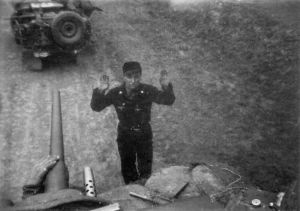
Prisoner taken. Photo by tank commander George C Gross, April, 1945.

Prisoner taken. Photo by tank commander George C Gross, April, 1945.

Then two small American tanks arrived. I was standing in the middle of the road, and noticed that the American soldier leaning out of the turret of one of the tanks aimed his gun at me.
The tank came closer and closer, and the soldier lowered his submachine gun. I must have looked terrible, so he did not take me for an enemy. I was lucky he had not shot me from the distance, since my small coat and boots vaguely resembled a military uniform. Lice were crawling all over my clothes and skin.

The few hundred former inhabitants of the concentration camp surrounded the tanks right away. Suddenly somebody remembered that the SS guarding us were still in the carriages. The SS were caught quickly, and lined up. The “intrepid” SS were trembling so heavily that their pants were flapping.

The first thing a Jewish woman asked from the soldier leaning out from the tank was money, and she received a dollar bill. She must have established her future with this dollar.

My attention was drawn to something else: in the rear of the tank there was a box of canned food. I climbed under the tank, emerged at its end, and pulled out a can. It turned out that I stole a can of oranges. This was my luck. I ate the potatoes charred in the can with the oranges, and probably this combination saved my life. Everyone who ate meat or anything greasy died within hours or within one or two days at the latest.

I felt fever in my body, undressed completely naked in front of staring women, and went into the ice-cold water of the lake next to the railroad. People warned me not to do this, but I went into the water, felt good, felt that I got rid of the lice and the burning heat of the fever. When I put on my rags again, I felt the fever ever stronger.

I asked an American soldier to sign the photo of my fiancee (I still have this photo). To my surprise, he signed the name Churchill. I thought he was joking. But he reassured me that his name was really Churchill.

(Once I read about a father named Churchill, who went to see his son’s grave in Vietnam during that war. The report mentioned that the father had been a soldier in World War II. He must have been my Churchill)

In the evening, there were news that we should flee, because the Germans pushed back the Americans. The Germans would massacre us for sure, the women had pulled out material for parachutes from a carriage in order to make clothes.

I was already so weak that I did not care whether the returning Germans would kill me: I stayed in one of the carriages, and fell asleep.

On Saturday, April 14, German peasant [horse-drawn] carts came for us by some order, so I was carried to Hillersleben. I dragged myself to the first floor of the first building, it looked like an office building, lay down under the sink of the bathroom, and fell asleep.

I am sure the American soldiers had no idea who we were and what we went through.

Read Full Post »

« Newer Posts - Older Posts »