"for the sake of humanity"… A small town American high school history project changes lives worldwide. These are the observations of a veteran teacher- on the Power of Teaching, the importance of the study of History, and especially the lessons we must learn, and teach, on the Holocaust. Click on "Holocaust Survivors, Liberators Reunited" tab above to begin.
I went up to my camp alone in the Adirondack mountains last night. Part of me needed to get away from the machinations of daily life, but I think I needed to be there to reflect by myself on a momentous anniversary.
Passover in 2025 has begun, a fitting setting to recall the significance of the eightieth anniversary of the liberation of the Train Near Magdeburg. Passover of course is the commemoration of the exodus of the Jewish people from slavery in ancient Egypt.
By the spring of 1945, the evil that had engulfed the world had led to the destruction of two-thirds of Europe’s Jews. Yet by some miracle, a handful of Jewish families were sent out of Bergen Belsen to walk to railcars headed towards an unknown destination as Passover 1945 drew to a close.
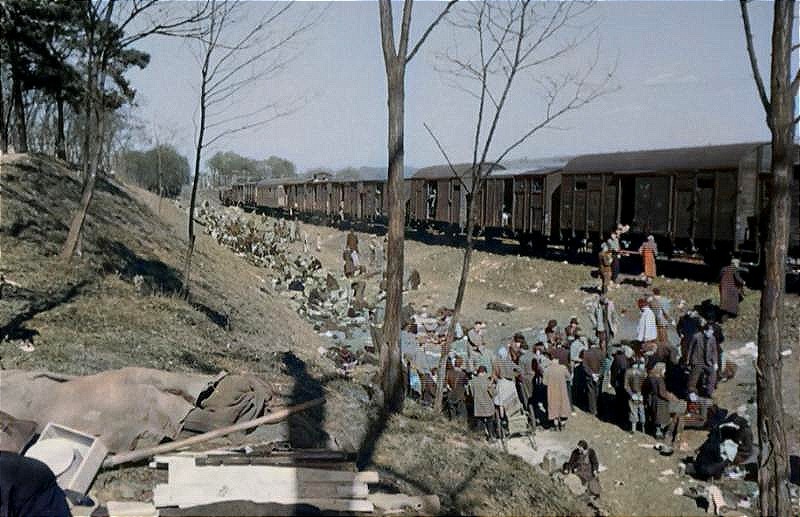
Seven days of shuttling on the tracks later, cramped and suffering, this train transport stopped in a slight ravine in a forest, hiding for cover from Allied planes but also awaiting instructions on how to proceed from German commanders as American forces approached from the west, and the Red Army appeared near the Elbe River a few kilometers away near the ancient German city of Magdeburg, which was not surrendering without a fight.
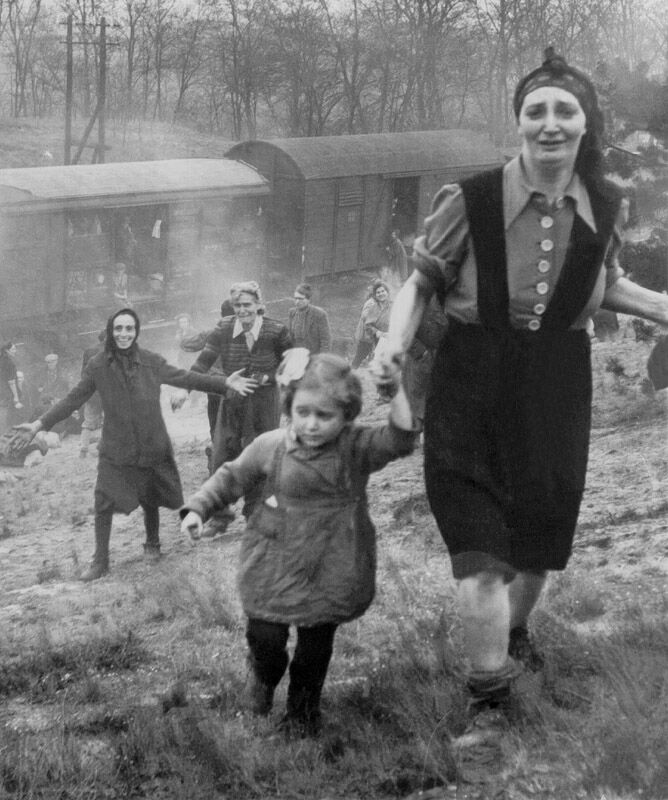
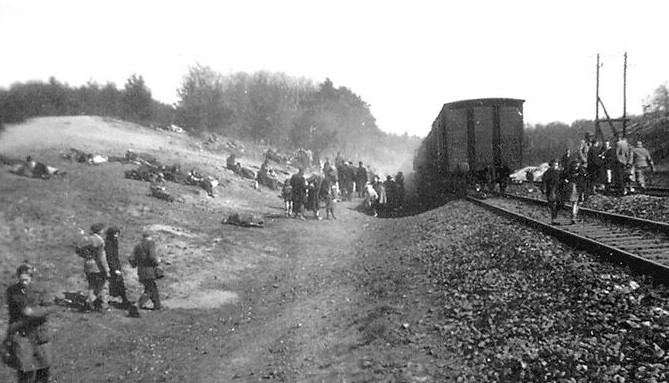
On the morning of the 13th, war weary and grieving solders in two tanks and a command jeep approached the ‘stranded train’, the U.S. soldiers just having learned that morning of the death of their commander in chief, Franklin Delano Roosevelt. They pulled up to the train. Major Clarence Benjamin of the 743 Tank Battalion stood and snapped the now famous photograph of the moment of liberation.
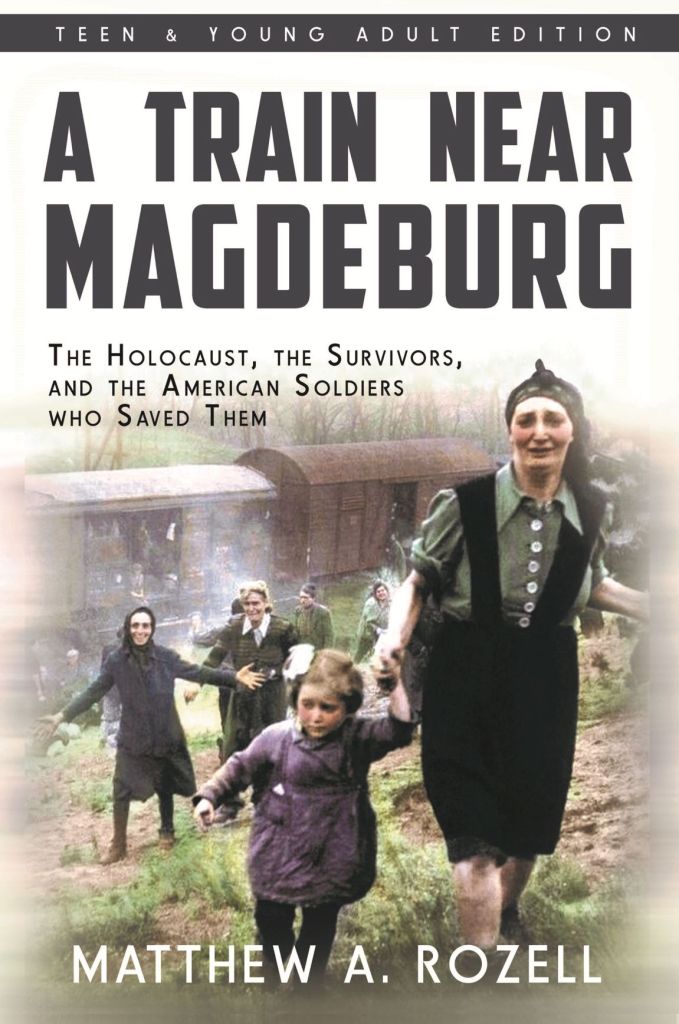
Over half a century later, I began to piece together this story that was forgotten by all except those who lived it—the survivors, and the liberating soldiers themselves. Some of the accounts that I gathered appear in my book, A Train Near Magdeburg (and in the mini-series of which is approaching completion, but no, I can’t tell you where to tune in yet, so stay tuned!). The memory below is from my friend Steve Barry, who passed 13 years ago, but who as a 21-year-old survivor on this day in 1945, remembered this:
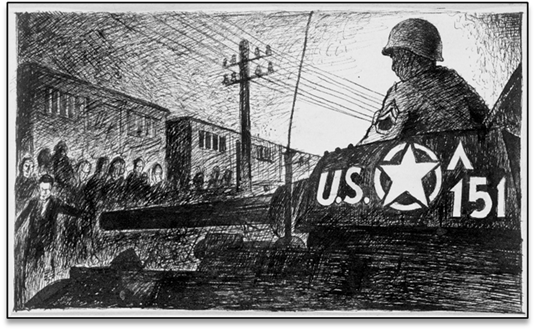
There were two tanks. I still get tears in my eyes; that’s what it was. Right now, I have tears in my eyes and I always will when I think about it. That [was the moment that] we knew we were safe.
1945 Ink drawing by Hungarian survivor Ervin Abadi,Credit: USHMM, courtesy of George Bozoki.
We found some matches in those German soldiers’ [rail]cars. We had this tiny little fire going and we were sitting next to it, and I was sitting there with this great big SS overcoat on. One GI walked down the embankment, came over to the fire, sat next to me, took out his pen knife, and he cut off the SS insignia from my coat, and slowly dropped it into the fire. [Gets emotional] If my voice breaks up right now, it always does when I say that, because it’s a moment that just can never be forgotten. I don’t know who the GI was, but it just signaled something to me that maybe I’m safe and maybe the war ended and the Germans, or the Nazis, were defeated. It was an unbelievable symbol to me. And all I can tell you is, it still touches me very deeply, and probably always will.
In this season of liberation, I pause this weekend to reflect on Steven and all the survivors and liberators and their families who have touched my life.
A friend of mine and fellow [non-Jewish] Holocaust educator, Stephen Poynor, posted this morning the words that I will close with here, ones that closely follow the message I have adopted since first sitting down with one of those tank commanders for an interview 24 summers ago, the stories preserved in my book, and in the upcoming film series. Like the soldiers and the survivors who confronted this evil, let us not forget as we continue forward to ‘heal the world’, because that is what good people are called to do.
In a world swollen with division and sorrow, where the weight of injustice falls unevenly and history is too often forgotten or denied, the story of Passover reminds us that liberation is not a moment—it is a journey. Ongoing. Fragile. Worth telling and retelling with trembling hands and hopeful hearts.
We carry these stories not as burdens but as lanterns. We light them for others to see, to feel, to understand. This week, may those lanterns burn a little brighter. May your table be full, your memory deep, and your hope unshakable.
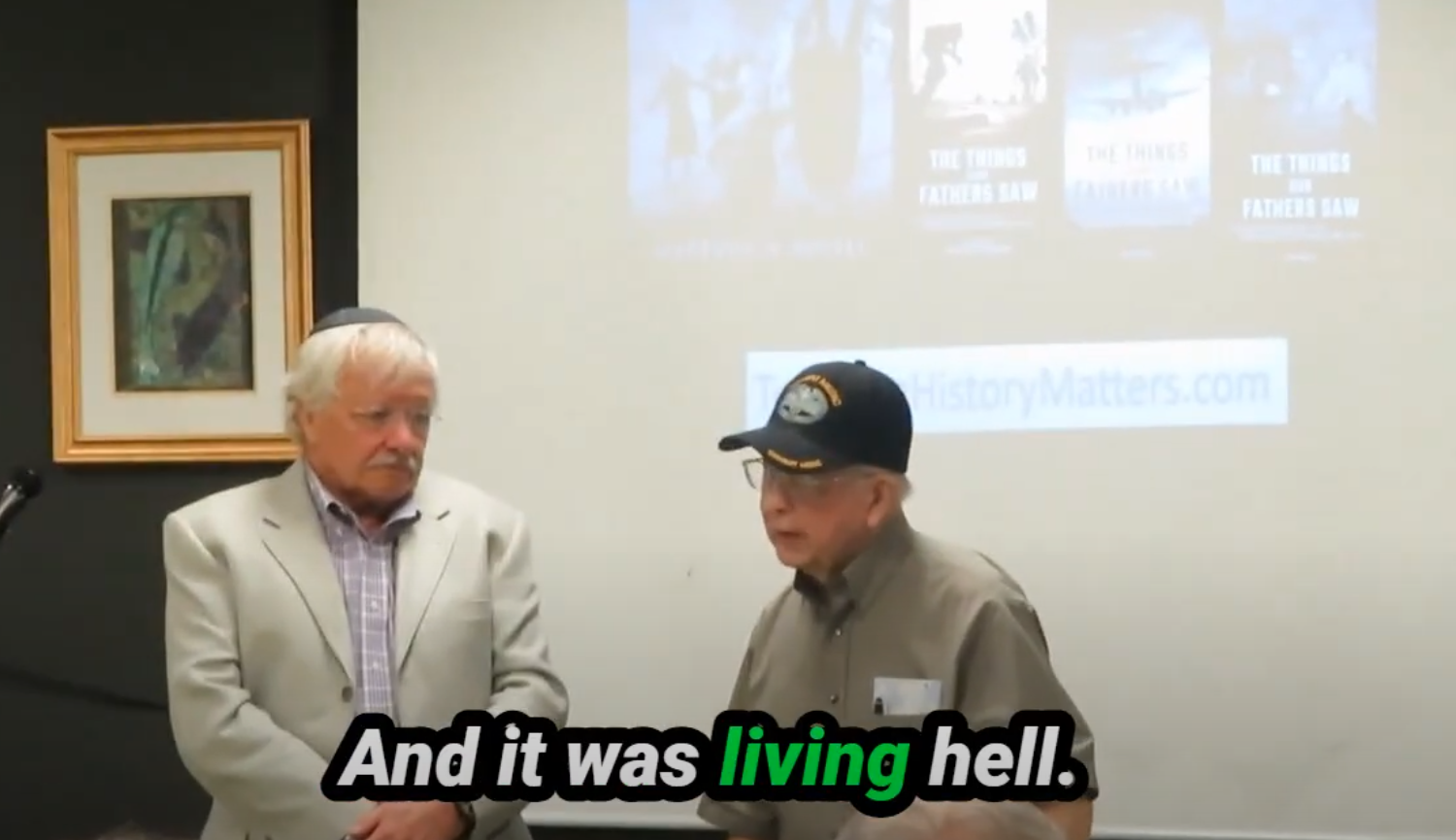
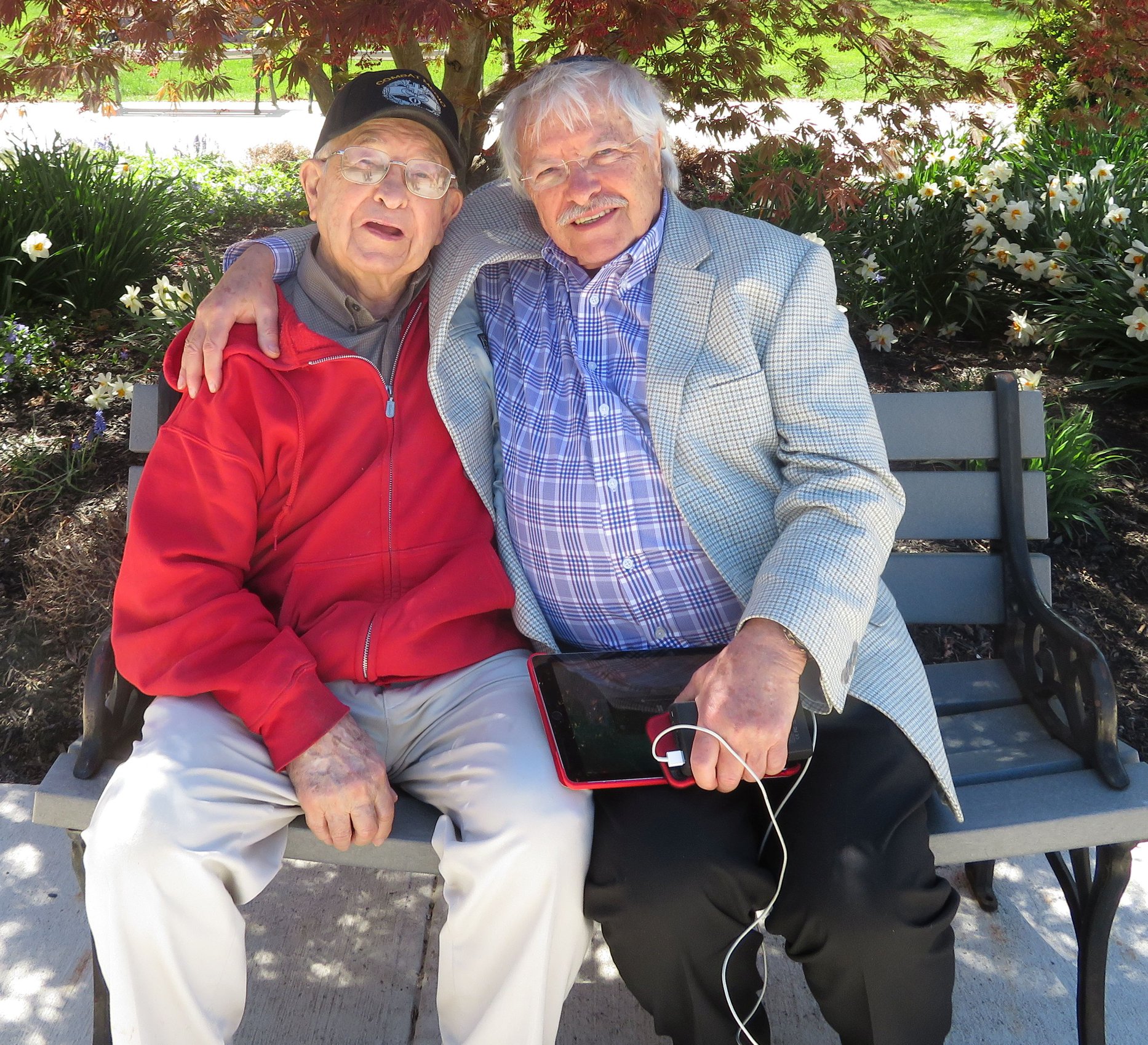
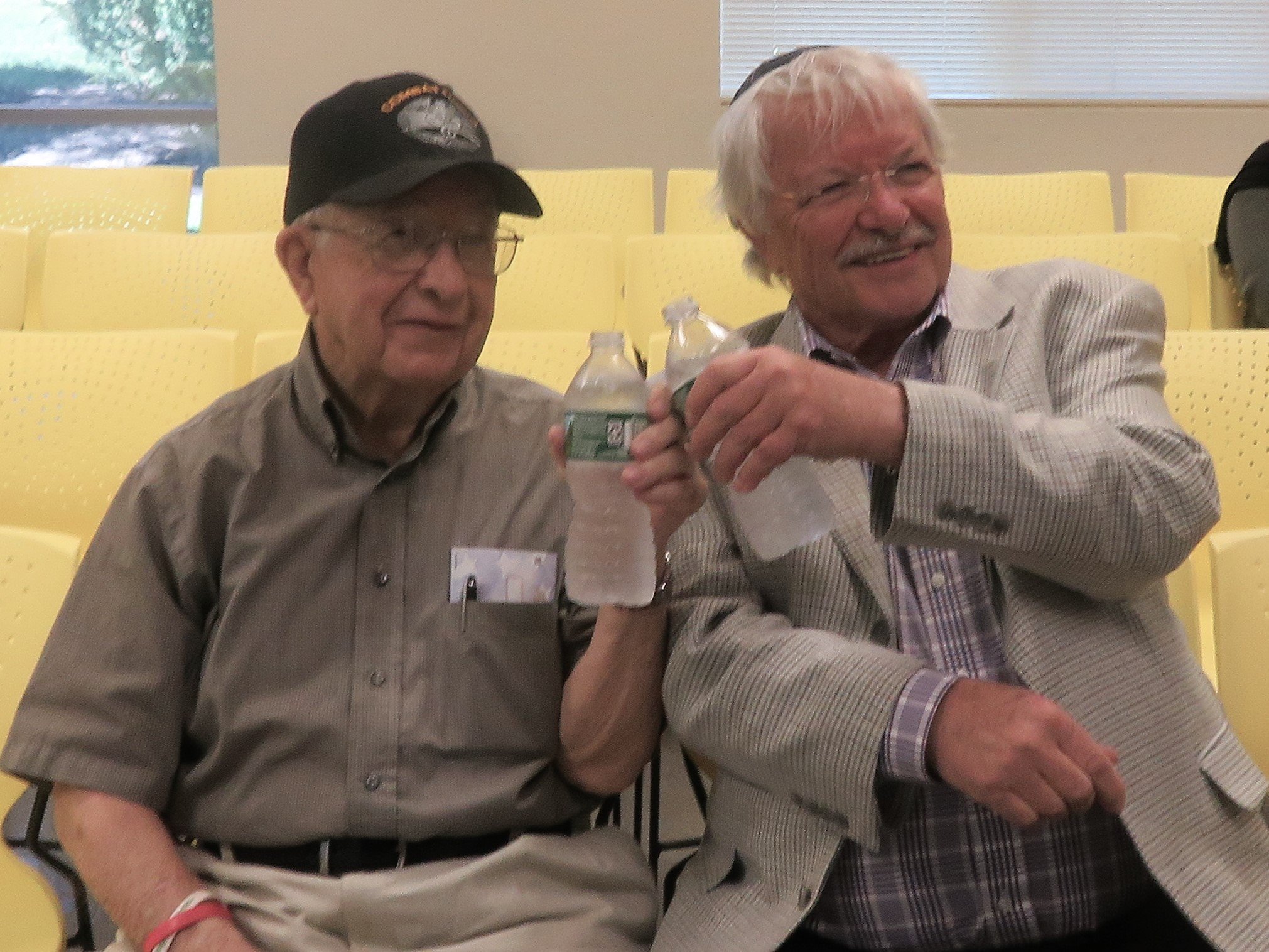
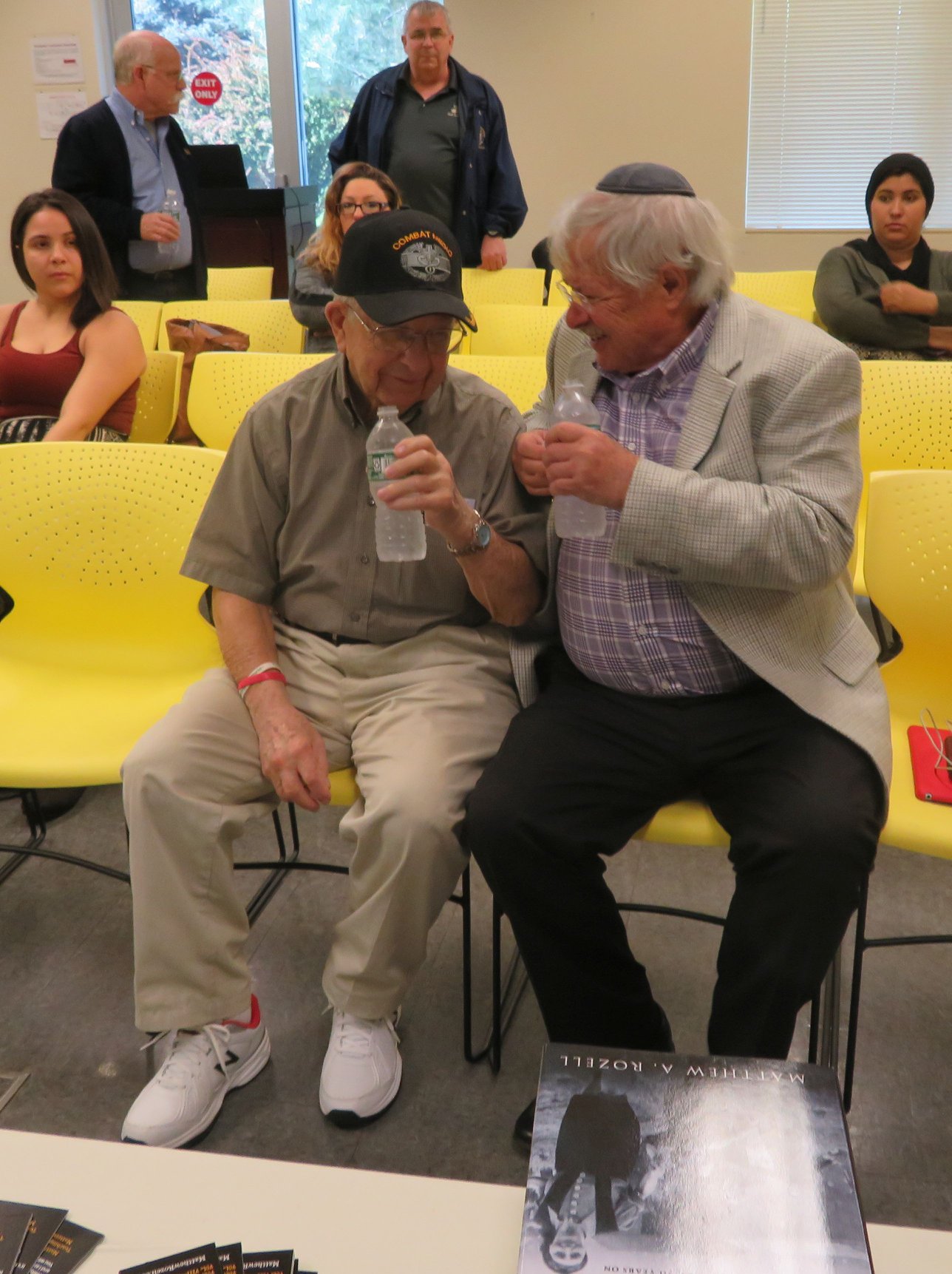
Screenshot of combat Medic Walter Gantz, and child survivor Oscar Schwartz, Warren County Community College, New Jersey, April 2019. Walter was 94 and would pass away before year’s end.
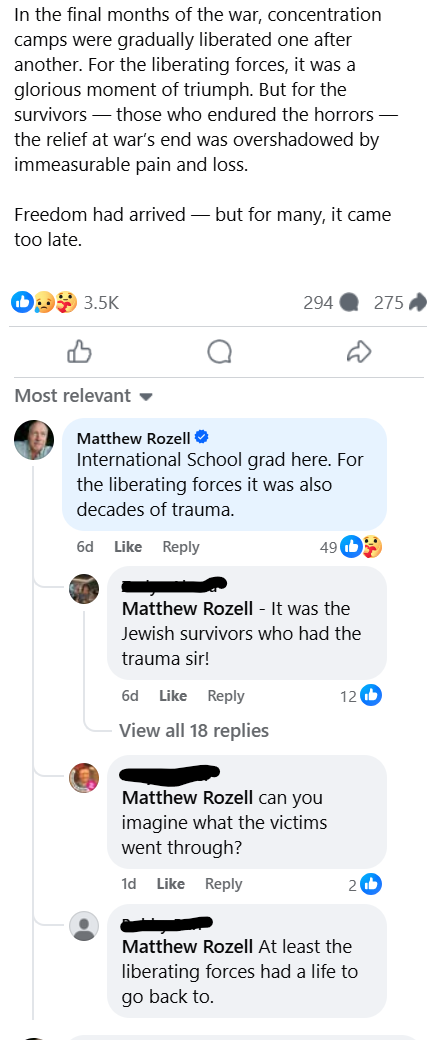
As we enter April 2025, the eightieth anniversary of liberation, more and more posts are rightly being generated on social media regarding it. Yad Vashem, World Holocaust Center, Jerusalem, earlier in the week posted a liberation photo on Facebook titled, “French soldiers meeting Jewish people who survived near Vaihingen, Germany, April 1945.” Their description:
“In the final months of the war, concentration camps were gradually liberated one after another. For the liberating forces, it was a glorious moment of triumph. But for the survivors — those who endured the horrors — the relief at war’s end was overshadowed by immeasurable pain and loss. Freedom had arrived — but for many, it came too late.”
I shared it on my Facebook page, with my own take on their description.
Well, some decided they had to take me to task in the comments, the gist of which was that in pointing out the traumatic effects on liberating soldiers, I was disrespecting the experiences of the people they saved.
I recognize the trauma—I have been honored to know literally dozens of Holocaust survivors—and I have studied for nineteen days at their International School in Jerusalem, as well as experienced several weeks of touring the authentic sites of mass murder and suffering in this greatest crime in the history of the world with top notch scholars and historians and fellow teachers. Also, having been a USHMM Teacher Fellow, I felt pretty well informed enough to add my comment there, just that for the liberating forces, far from being a glorious moment of triumph, it was decades of trauma as well.
I don’t dispute any of their comments, but I think they were making assumptions, so I clarified, “Just as liberation was not the ‘happy end of the story’ for Jewish survivors, it did not end for the soldiers either. And no one is here to ‘compare pain’.”
And that is one of the tenets of Holocaust education. No one can suppose they know what the Holocaust survivors went through, except them, and that is why memoirs are so important. But to talk to the liberating forces, decades later, was also important. Walter Gantz told me, “Matt, for forty years, when our group (95th Medical Gas Battalion) met at reunions, we NEVER talked of Hillersleben. And my parents never knew I cried myself to sleep at night, when I got back.”
I found this video I took at a college in New Jersey where Walter got to meet one of the children he helped to save for the first time, and his take on his visit to Bergen Belsen. The trauma was still apparent after almost 75 years.
That’s all I was trying to say. So now I’ll let Walter tell you. It’s a 3 minute clip. [Only 8 people in the world have watched it thus far. I hope you can, in his memory.]
A schoolkid once asked a survivor I know if anything good came out of the Holocaust. The survivor thought a minute, because it was an important question, and replied, ‘Yes. My rescuers.’ And here is where the story of the ‘Train Near Magdeburg’ will end, for now.
When we talk about the Holocaust, the sheer magnitude of it, there is no happy ending. For every single one of the approximately two-thousand five-hundred persons on the train who was set free, another two-thousand five-hundred persons perished in the Holocaust, most long before the Americans set foot upon the continent. And yet, at the end of the day, if we can say that somehow the soldiers and survivors in this book taught us something, perhaps the meaning is echoed in that three-word response. I have found that in some educational circles the role of the American liberator is presented almost as an afterthought, and I would have to agree that when one is drawn into the unfathomable study of the Holocaust, liberation perhaps figures as a literal nano-episode.
They were not rescuers, in the formal sense of the word—that title is reserved for those without weapons, who risked their lives and usually the lives of their families by hiding Jews or some such noble action—but the nobility of the would-be rescuers who had weapons, the ones still fighting and being killed, the ones wholly unprepared for the catastrophes that played out before them on an hourly basis in April 1945 deserves a larger place in our national examination of the essence of what, indeed, ‘greatness’ is all about.
And here, I hope that the lesson is also one of humility; as they themselves stated in this book, it’s not about hero worship, or glorifying the liberator as some kind of savior. Many of the liberating soldiers would resist this, to the point of rejecting the term ‘liberator’— “It all sounds so exalted, so glamorous,” said one. But they will all accept the term ‘eyewitness.’
Rehearsals and recording of the musical score and the soundtrack to our mini-series,A Train Near Magdeburg. Featuring Joshua Bell, violinist, Jim Papoulis, Composer and Conductor, with theColumbus Symphony Orchestra.
Half the episodes for the film series A Train Near Magdeburg have been completed and recording was finished in Columbus Ohio in early March. My wife and I were invited to attend the recording sessions that featured the Columbus Symphony Orchestra conducted by composer extraordinaire Jim Papoulis and featuring top shelf violinist Joshua Bell [‘m told he’s probably the greatest living violinist in the world (my aunt Kathleen at lunch the other day, a classical music guru)]. House was pretty much to ourselves: Ohio Theater, Columbus Ohio. Great to have them onboard… and all the talented musicians are a part of it now.
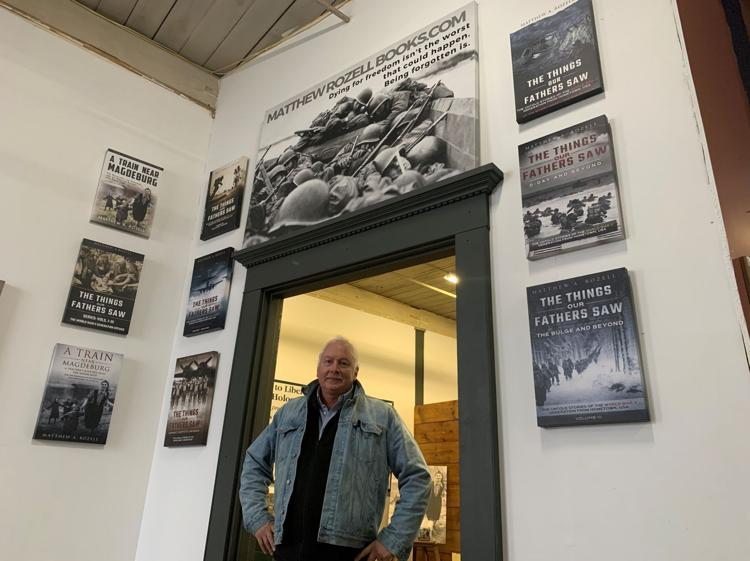
A bit sad to announce we closed the physical bookshop this month at the Glens Falls Shirt Factory on the third floor. We just don’t have the bandwidth (i.e. my physical presence in two places); originally it was a father-daughter venture, with the youngest having a photo studio there too, but she moved to Troy to continue her education/career. And my butt needs to be in the chair at home working on new titles. I hope to be back there with a booth for the holidays and a new title or two. It’s nice to interact with the fans!
photo: Gretta Hochsprung 2020
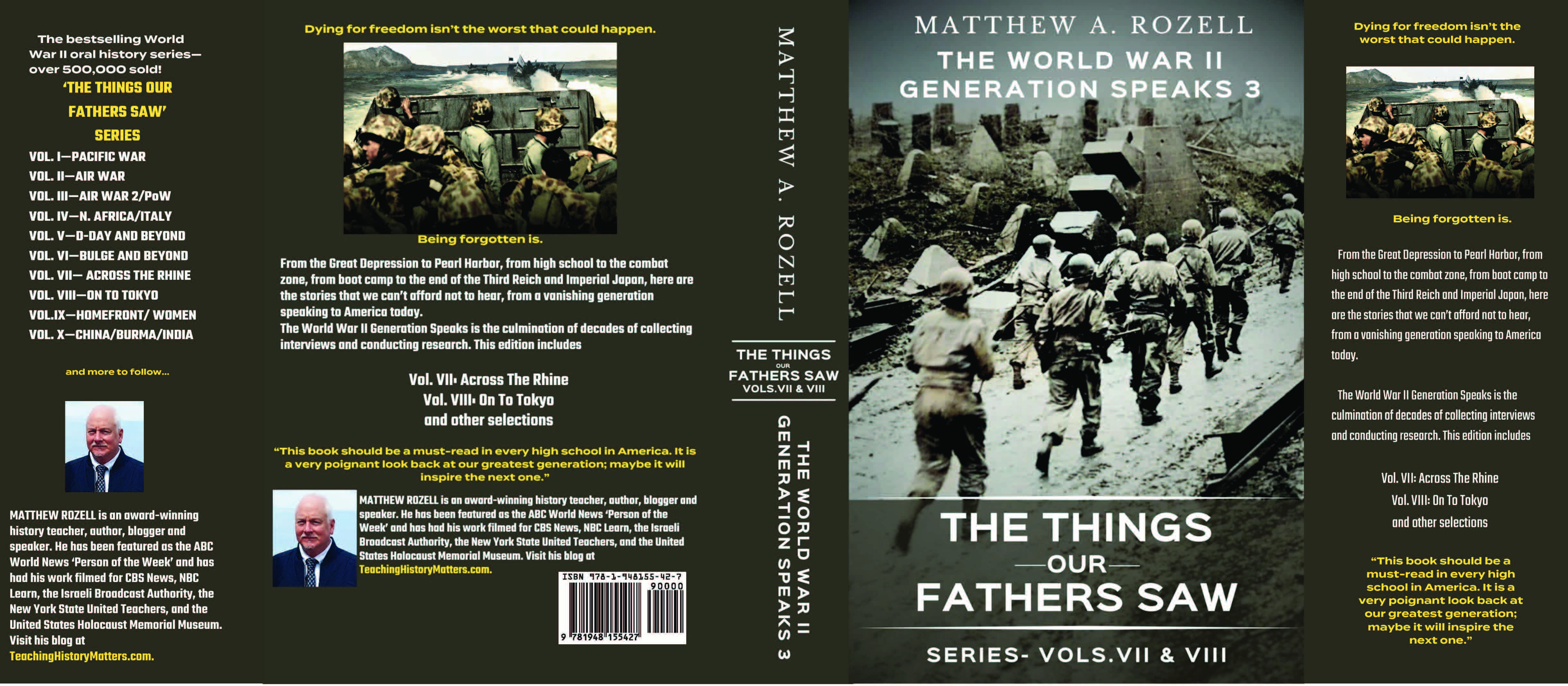
At home, my wife and I worked really hard getting books packed and shipped for the latest holiday rush; between mid November and Christmas we gained at least 2500 new readers. Then we took our annual retreat to start the next book in the series, Vol. 10, China/Burma/India, and work on the third eight-hundred page omnibus book. I think that cover came out pretty good! It will be available in a few weeks, or you can look for it at Amazon here.
Around the beginning of this month we crossed over 25,000 orders on the direct to consumer store [link below] we opened 44 months ago, or 3.75 years, around Memorial Day, 2020. Many of them are now long time subscribers; we have about the same number for followers on our official Facebook page. So thank you for that. And virtually no complaints/returns [well, maybe literally a handful from the occasional husband who admits being too lazy to open the books his wife got him for a gift!]. That tells me we are scratching an itch, and someday I will post the comments and conversations that turn into message boards that appear on some of my feeds I see online.
Today by chance in an audio shuffle, I’m listening to history podcaster Dan Carlin’s Hardcore History episodes on the War in the Pacific, “Supernova in the East”. It’s very long and involved but it is very good. And a former student tipped me off that Dan quotes from my first book in it [about an hour twenty-five minutes into this one]! I hope Dan gets a chance to pick up the other (nine)!
This week I’ll also get to preview a working draft of Mike Edwards’ film on my book, and 1/3 of my life. It will be Episode One, of four parts. And I’ll get to see it with Mike, my family and some others, the screenwriter Lee Shackleford and key film making participants Josh Fronduti and Chris Martin, all coming hundreds of miles to screen it for us for the first time.
And, timely enough, I have heard from another second generation survivor (daughter) who saw her father’s moving image on the day after he was liberated. I’m honored and welcome to share her astonishment and greetings, below.
Suffice it to say, the miracles just keep coming.
From NARA: “Summary: Numerous scenes, freed Jewish prisoners in groups along railroad tracks. Their expressions furnish a clue to the suffering they endured. Individual shots: Men, women, and children, some of them in various stages of emaciation. Flashes of US soldiers distributing food. The group surrounding the soldiers push forward to receive meager bits of food. LS, village being shelled by German artillery from across the Elbe River.”
“Hello, Dr. Matt Rozell,
I have the honor to write to you after my efforts to reach your address by Mr. Jakob Barzilay from Raanana and Mis. Varda Weisskopf .
On July 31, 2023, Channel 12 of the Israeli television broadcasted the video that was found in the basement of the archives of the Holocaust Museum in Washington after for 78 years without anyone knowing about it, which I understand was thanks to your investigation.
When I watched the video I was immediately flooded with calls from my children, my brother and nephews who all couldn’t believe their eyes. Our father (their grandfather) appears clearly in the video.
After watching the video at least five times and rubbing our eyes, we opened the booklet in which our children wrote on 1986 the family roots when they were 14 years old. We found the literal description of the valley where the train stopped, with a hill covered with trees on the one side and a lower hill with green spring grass on the other one.
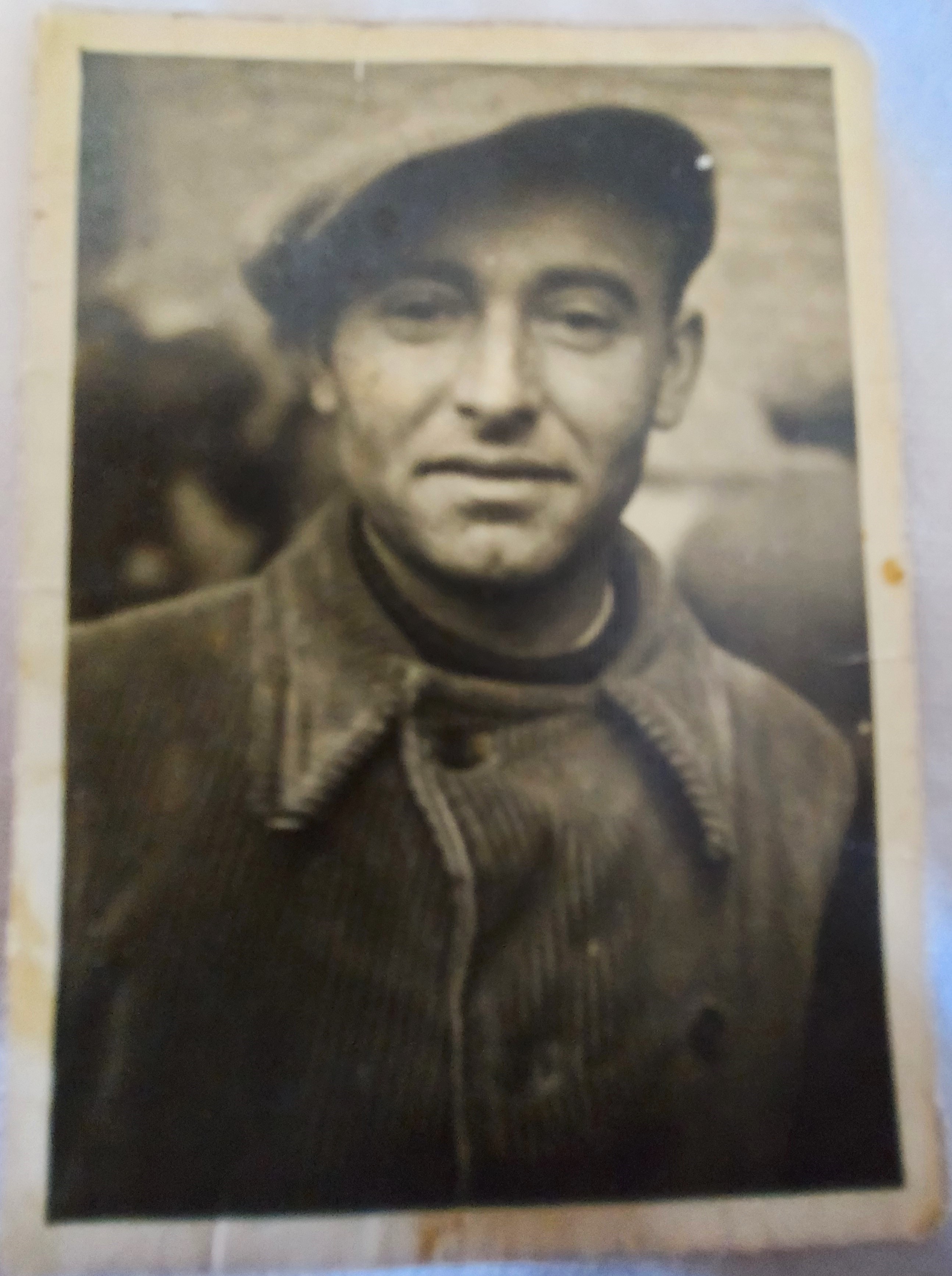
The name of my father is Michael Sonnenshein, born on 1909 in Verebly. His name appears in the list of the Bergen-Barzan release book – “NAMES” (Jewish victims of Hungarian labour battalions).
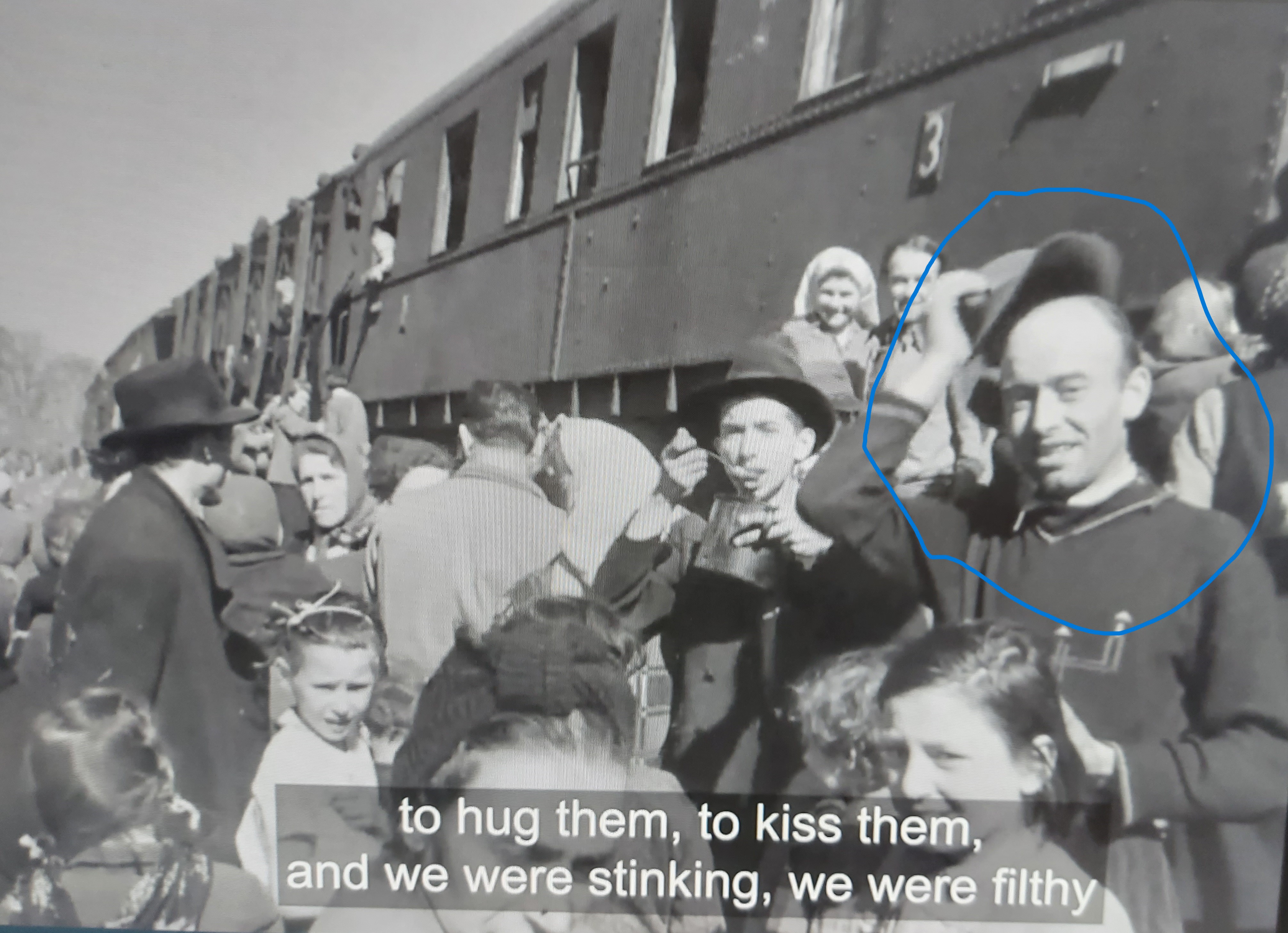
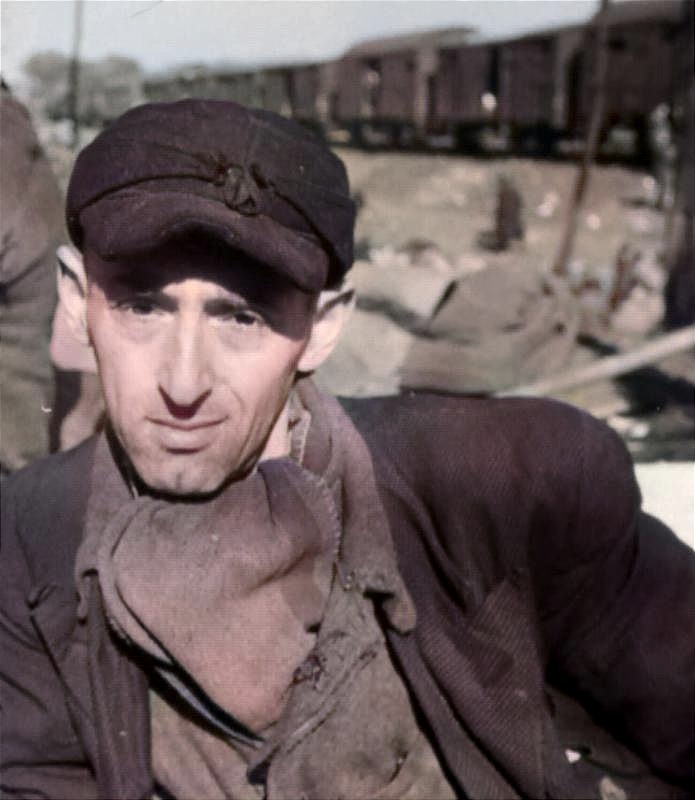
I am attaching here: 1. His name from the book; 2. A photo of my father which was taken after the War for the purpose of identification in the video; 3. A section from the video, where you see my father removing his hat in front of the photographer.
Michael Sonnenshein.
I would like very much to get in touch with you and learn more about the story of the train.
Newly discovered US Army footage of the Train Near Magdeburg surfaces after 78 years.
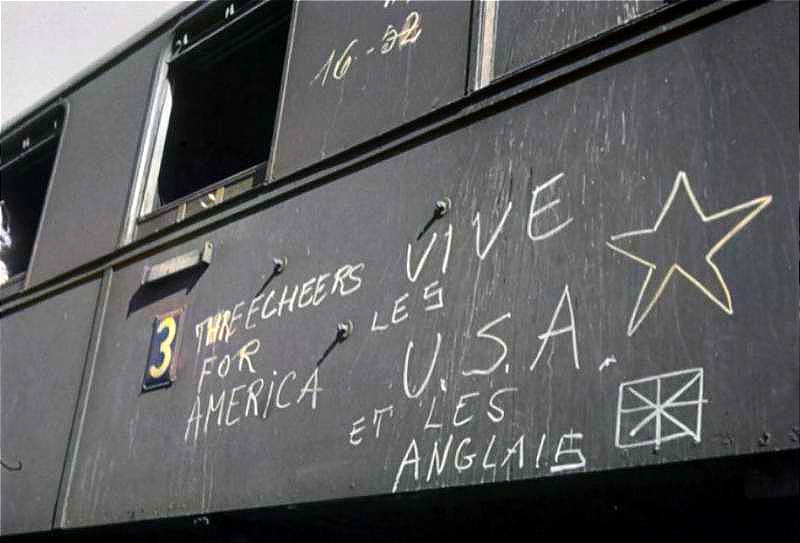
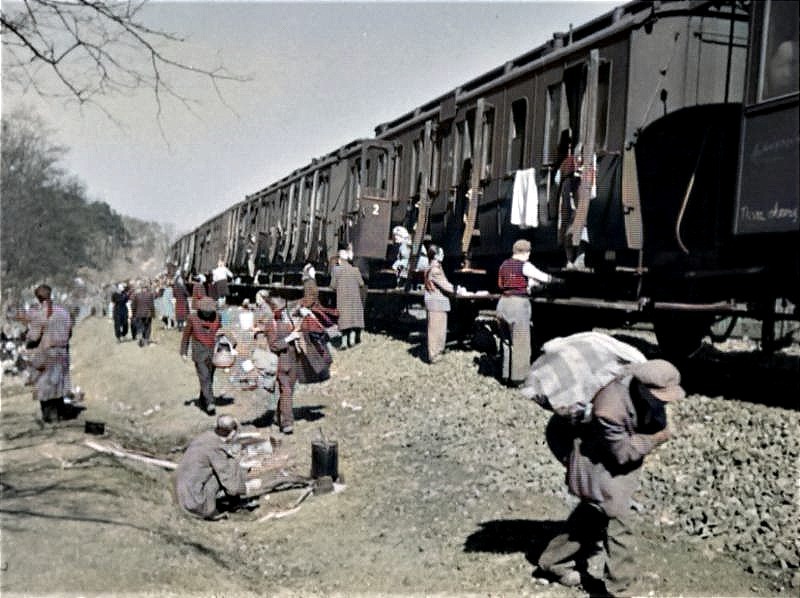
‘Three Cheers For America.’ Note numbers on car, Car #16 out of 52. Colorized still from newly discovered film.
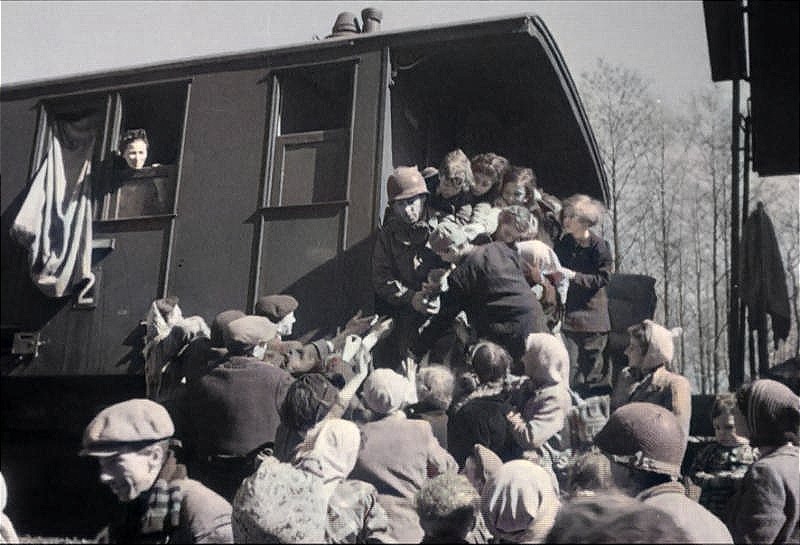
American soldier handing out food, backing up as starving people swarm him. Colorized still from newly discovered film.
If you are coming to this website cold, as a public high school history teacher, 22 summers ago I sat down with an 80 year old WWII veteran, initially reluctant to tell his story, and almost forgetting to tell this part of it, but eventually, the following came out.
In the closing days of the war, fighting across central Germany, he and another tank commander came across a train stalled by the tracks with desperate people milling about. They were 2500 Holocaust victims from Bergen-Belsen. And they needed immediate help. Their major and one of the tank commanders had a camera. After my interviews with them, they gave me permission to place the photos on the school website.
Farsleben train, moment of liberation, Friday the 13th of April,1945. Two American tank commanders and their major in a jeep liberate the train. Major Benjamin snaps the photo.
Four years ticked by. Then I heard from a grandmother in Australia who had been a seven-year old girl on the train. Others followed. I was able to re-unite the liberators with the people and the families they saved as young men. Over eleven reunions on three continents took place. So now, twenty-two years after our initial interview, this footage of the event appears in my life.
Another miracle in a story of miracles. And this one is HUGE.
A contact in Germany, Susanne at the museum in Wolmirstedt near the Farsleben, Germany liberation site outside of the city of Magdeburg on the Elbe River, recently emailed to say that she had seen part of a German documentary that included footage of people milling about a long train transport, and US Army soldiers helping, dispensing food and the like. She wondered if it was our train. Having been to the liberation site in person, and studying this story for decades, I was sure from the five seconds or so of a liberated train I watched that it was indeed our train.
Our team led by Mike Edwards inquired at the National Archives and just four weeks later, they sent the following footage to us. Of course, it had been filmed by the US Army Signal Corps in the aftermath of the Friday the 13th of April 1945 liberation, when our tankers of the 743rd came upon the train.
Newly discovered US Army footage of Farsleben train, April 1945. National Archives, public domain.NARA photo of film reel can.
US SIGNAL CORPS footage reel dated 4.17.1945, in the immediate aftermath of the train’s liberation by the 743 Tank Battalion and 30th Infantry Division. No sound. From NARA: “Summary: Numerous scenes, freed Jewish prisoners in groups along railroad tracks. Their expressions furnish a clue to the suffering they endured. Individual shots: Men, women, and children, some of them in various stages of emaciation. Flashes of US soldiers distributing food. The group surrounding the soldiers push forward to receive meager bits of food. LS, village being shelled by German artillery from across the Elbe River.”
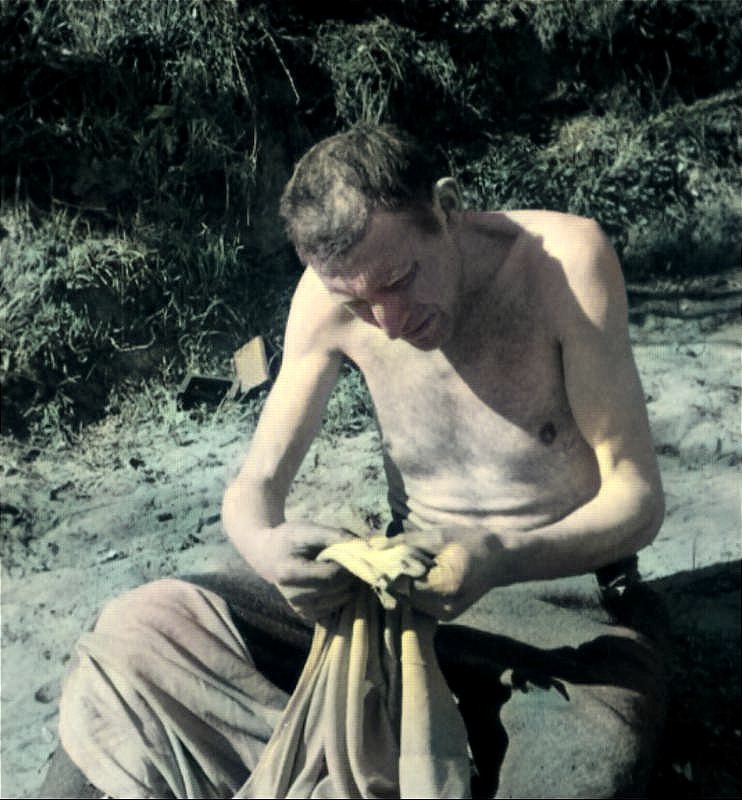
My best guess is that it was taken on Saturday 4.14.45, given the other US Signal Corps photographs from that day. What is fantastic is that this footage gives us a better perspective on liberation and its aftermath. Poignant and moving scenes: men crushing lice in their clothing. Families sprawled out, resting in the mid-April sunshine. Crowds swarming a soldier distributing food, bring to mind the Chuck Kincaid letter dated April 17, in which he expresses shock and horror at what he was seeing. A father holding his young daughter up so she can witness, and also put her hand out with the others. People in obvious distress, some likely very sick, some so exhausted they can hardly make an expression for the cameraman. The unsmiling little boy in hat, looking into the camera. The European script writing, numbering the cars, 52 of them, on the side of one of the cars; my guess is that it was done at Bergen-Belsen as they loaded the cars. And, of course, the beautiful American soldiers, trying to distribute food. Just who are they?
Red Walsh and George Gross and their tanks had departed for the final battle by the time of the Signal Corps arrival. Frank Towers was there, in and out that day, and medic Walter Gantz remembered being there that day.
I have been asked how I feel about this, surfacing 22 years to the day of my original interview with Red Walsh. With many of the stills, we have an entirely new portfolio of pictures to go through. We have already made one positive identification: the family of poet Yaakov Barzilai writes to confirm that he is visible in the footage, along with Yaakov’s mother and sister.
Top to bottom, in circle: Yaakov Barzilai, his sister Yehudit, his mother Iren, seated.Yaakov and author this spring in Israel.
So if you are a person who follows my blog from the early days, you know that not just is this an astounding development, but also one that confirms again that the past still has secrets to reveal, that in contextualizing the photos and film into the story of the Train Near Magdeburg, more healing is already taking place in our mission to ‘repair the world’. [And if you can see yourself, your family, or recognize any of the people, reach out to me here in the comments, or drop a line to matthew@matthewrozellbooks.com.]
A boy after liberation.
So, how does this make me FEEL? Frankly, it is immensely gratifying, though even without this footage, this is an incredible story. But to actually see the newly discovered film is another nail in the coffin of Holocaust denial. The soldiers didn’t lie. They WITNESSED it with their own eyes, and suffered the consequences themselves.
I cannot say that I am entirely shocked or stunned at this amazing development, because, as I told my wife, this is larger than any of us. We are part of a cosmic, maybe holy process, a process of the unfolding of the ‘so many miracles’ of this story. I’m sad that my four soldier friends mentioned above and all my survivor friends who have also now passed, are not with us to see it, to comment on it, to share in it with me and the living survivors and their families. But I am grateful to be able to live it now, and I am proud that those twenty-two years ago I had the audacity to want to have a conversation with a reluctant World War II veteran, and the curiosity to pause and take note of what he revealed upon his daughter’s prompting, to begin what would become this never-ending journey to help heal the world, and now with a team dedicated to telling this story to the world on film. It is with an undying sense of Wonder that we get to witness yet again the Power of LOVE transcending Time and Space. Of the GOOD countering the evil.
Seventy-eight years vanishes in an instant. This project is a portal, evidenced many times over. So I’m proud of it, but also humbled by it. And I’m humbled by all the people all over the world who have also come believe in it, and champion the message, and healing the world with their own love and compassion. This is larger than all of us.
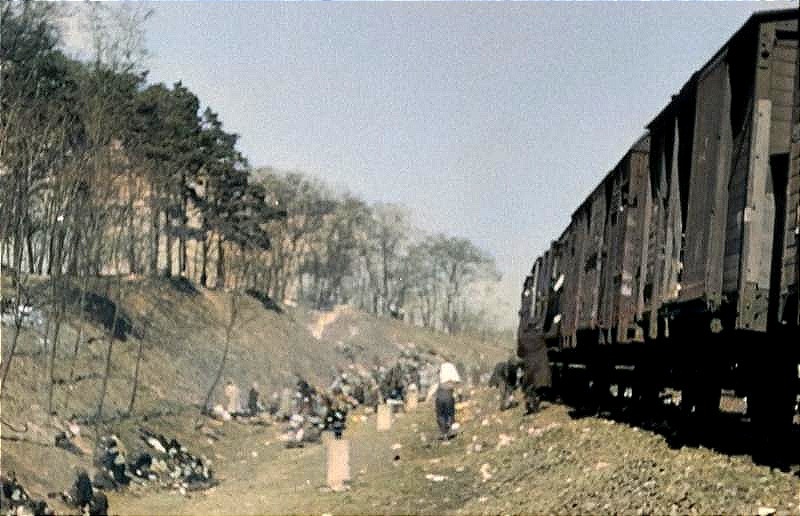
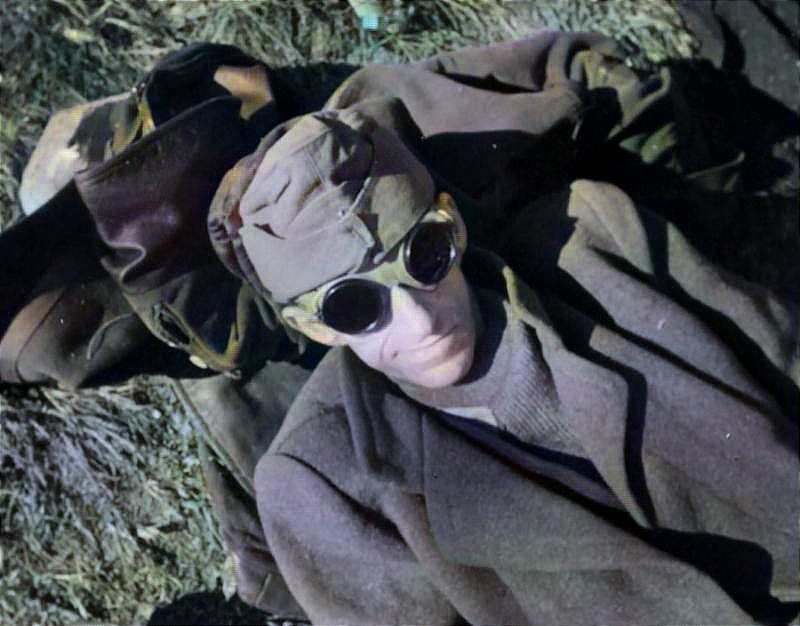
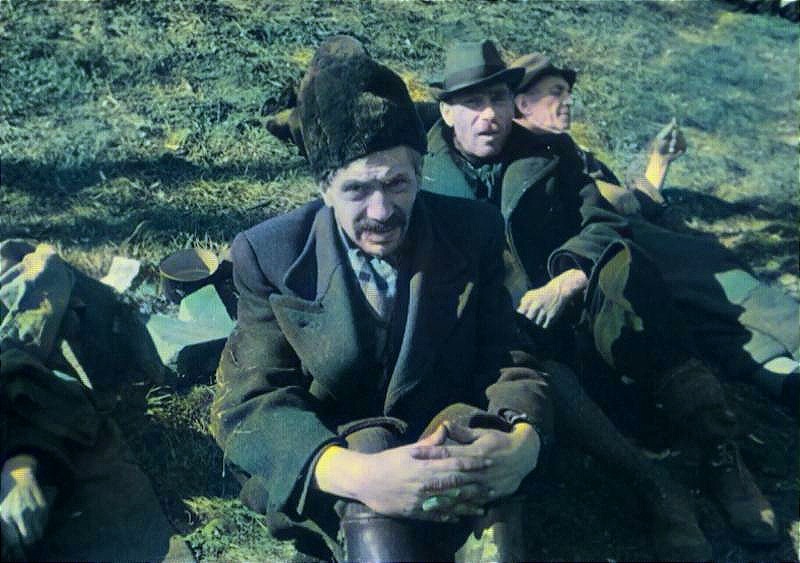
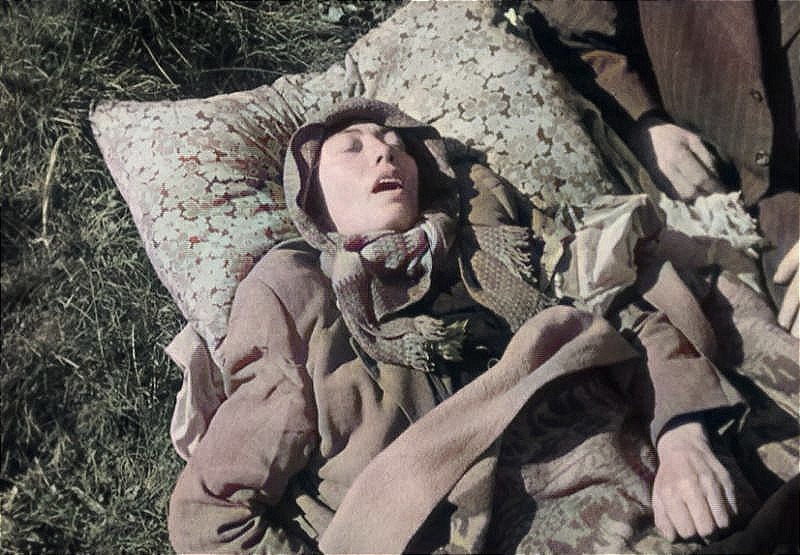
Below you will find a gallery of stills of the train and the people captured on that film 78 years ago, which I derived/created this weekend from the public domain film, and also added some color to, to highlight the scenes. [Tap the thumbnails for the information icon with my labels/captions; please write for permission if you wish to use any of them.] And don’t forget to write or comment below if you recognize someone!
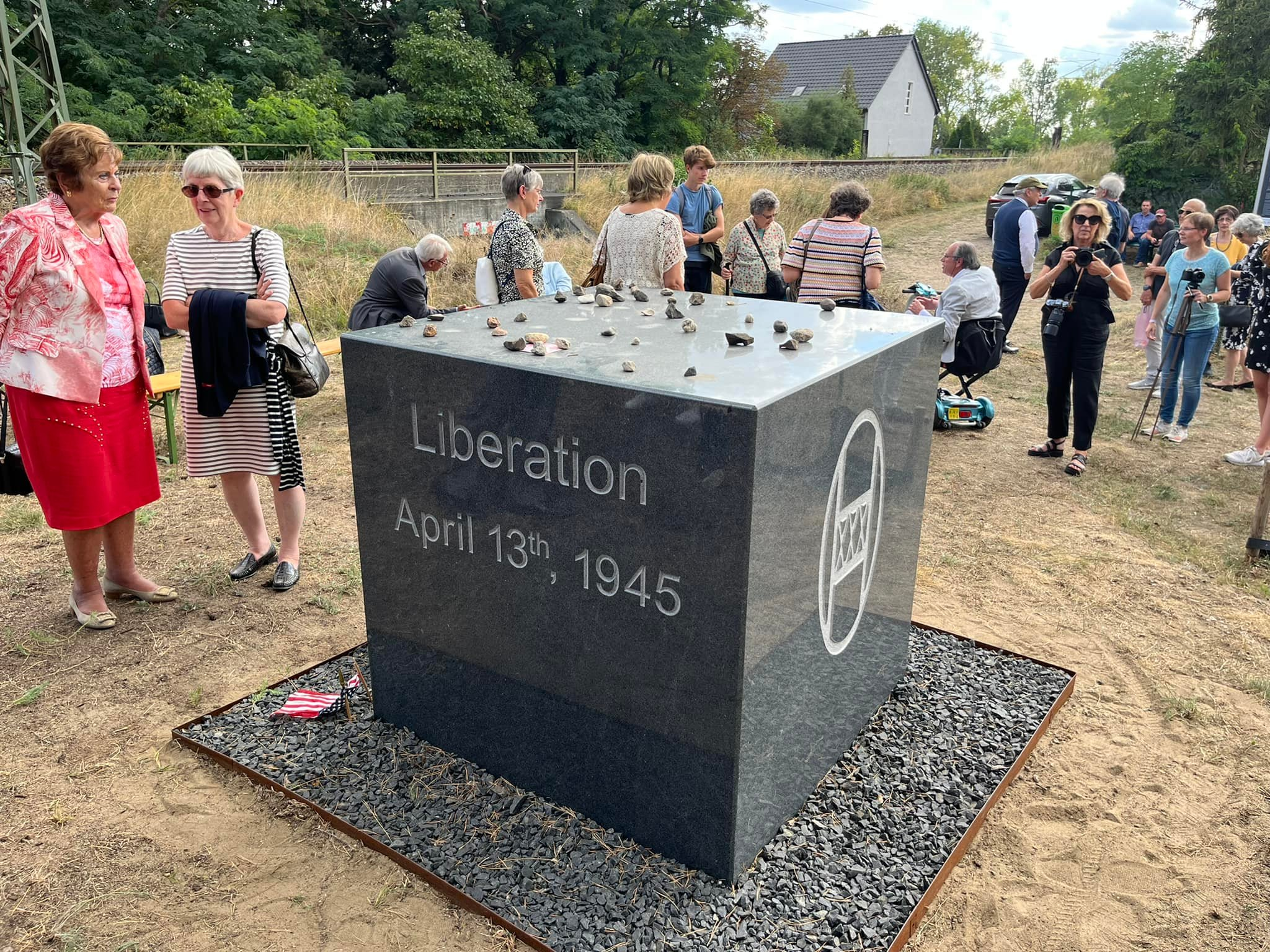
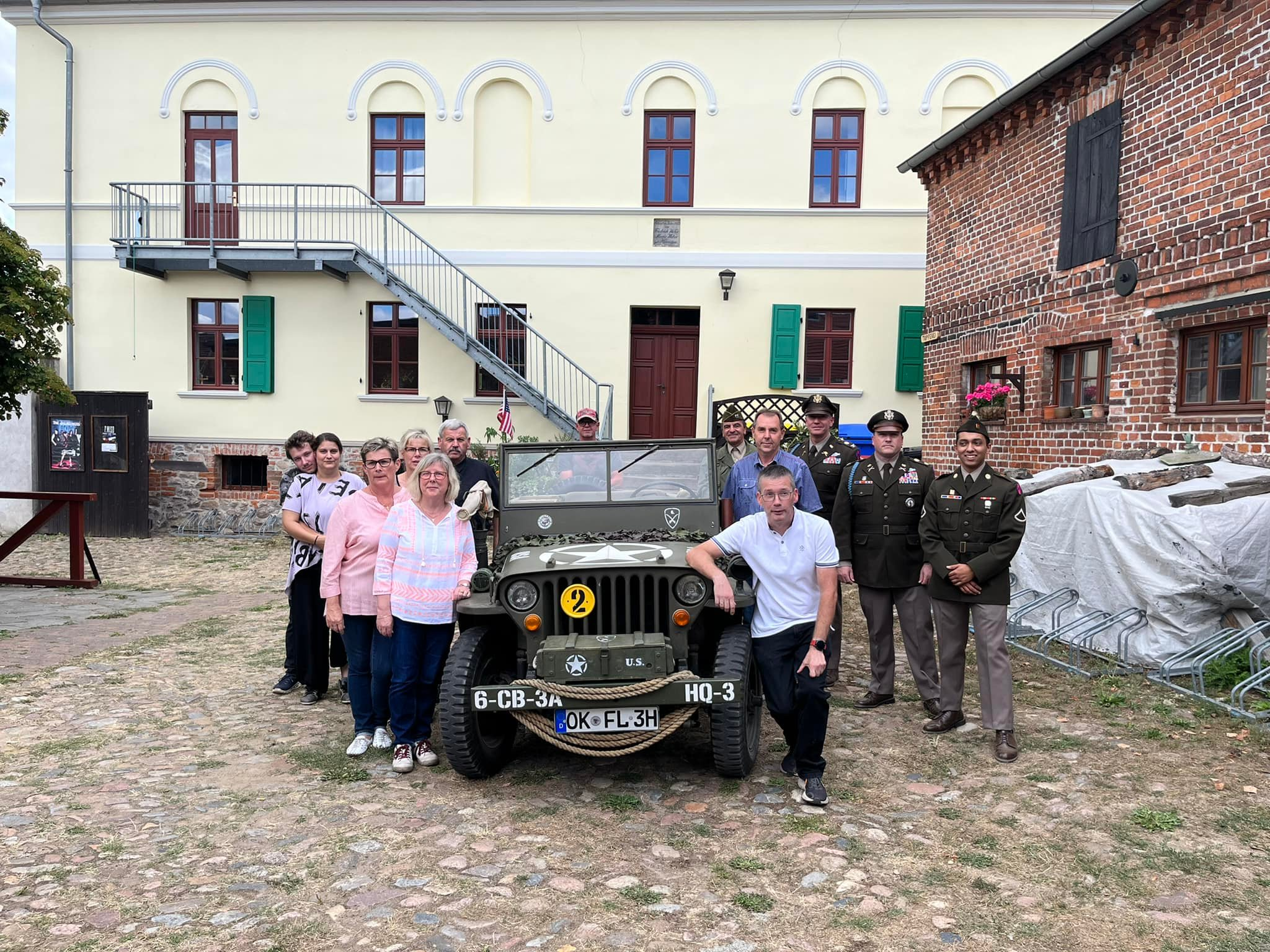
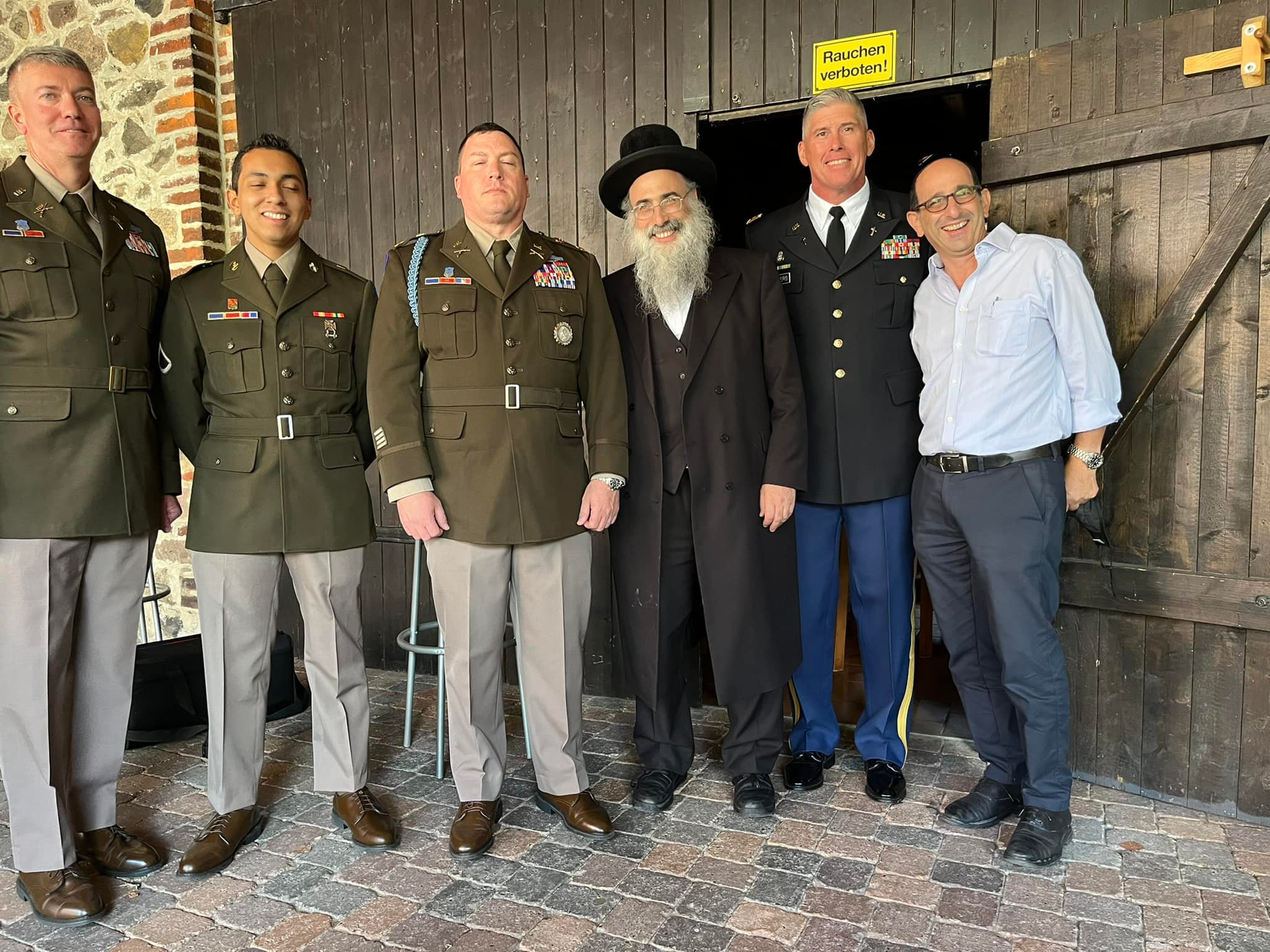
On August 30, 2022, first and second generation survivors and liberating families met to re-dedicate the monument at Farsleben which we visited and filmed at in April on the 77th anniversary, joined by the American successors the liberating soldiers, the 30th Armored Brigade Combat Team. They were welcomed by German and Dutch citizens responsible for the monument.
This article appeared in Israel yesterday; this all started when I interviewed Red Walsh in July 2001. Twenty one years ago. His daughters Elizabeth and Sharon attended; and I think Elizabeth is quoted in the article.
“We thought we were going to die”: the survivors who were freed from the death train returned to [Farsleben]
Nearly eight decades after they were released, a group of Holocaust survivors returned to Germany, to the same point where the death train stopped and they were set free. The survivors met the descendants of the American soldiers who freed them: “Near the monument and the railroad tracks, we felt the victory over the Nazis.” On the memorial erected at the site, the word “liberation” was written in Hebrew.
Itamar Eichner, Ynet News, Israel
10 Sept. 2022
“Near the memorial and the train tracks, I felt the victory of us, the survivors, over the Nazis. With every child born to me, every grandchild and every great-grandson, I said – ‘From you, Hitler, may your name perish, there is nothing left'”: these words are told excitedly by Miriam Muller, a Holocaust survivor 81. She and six other survivors returned for the first time to the German town of [Farsleben], where they were liberated by American soldiers 77 years ago.
2,500 Jews were then on a train liberated by the American 30th Division. They were taken from the Bergen-Belsen camp towards Theresienstadt, a few days before the end of World War II. Recently, the survivors returned to inaugurate a memorial that was placed near the railroad tracks, and on which was written the word “liberation” in Hebrew.
Since all the fighters who freed the train are no longer alive, at the memorial dedication ceremony the survivors met representatives of the 30th Division of the US Army, as well as the children of some of the liberators who came especially. The meeting between the survivors and the representatives of the division and the children of the liberators was emotional and full of tears .
One of the soldiers shouted in Yiddish: “I’m Jewish too”
The day of the train’s release was April 13, 1945. The Germans on the train received an order that if they could not take the train to the Theresienstadt concentration camp, they must blow it up over the Elbe River – for all 2,500 of its passengers. After six days of travel, the train stopped near the village of [Farsleben] in Germany, near the city of Magdeburg.
The exciting meeting with the representatives of the 30th Division of the United States Army. “We owe our lives to the American military”
Around four in the afternoon, an American patrol vehicle accompanied by a US Army tank arrived from the hill. These were soldiers from the 30th Division. The Nazis noticed the American tanks, and fled leaving behind 2,500 Jews, a third of them children, who thought they were being taken to their deaths.
While the Nazis were fleeing, some of the Jews – mainly women, girls and children – rose up and charged the American soldiers with shouts of joy. Only then did the soldiers notice the terrible sight of the passengers. George Gross, the American tank commander, told about the encounter: “Every one of them looked like a skeleton. They were hungry, sick on their faces. And there was something else: when they saw us they started laughing with joy, if you can call it laughter. It was More of an outburst of pure, almost hysterical relief.”
Those freed from the train near [Farsleben] in 1945. “We thought we were going to death”
The survivors said that when they saw the Americans they hugged them and cried with happiness. One of the American soldiers, Avraham Cohen, yelled at the terrified prisoners: “Ich bin ochut a-yed” (“I am also a Jew” in Yiddish), and showed them the Star of David that was hanging around his neck.
Miriam Muller, one of the freed – then a 4-year-old girl – was on the train with her family members. “These American soldiers were our angels,” she says. “When they opened the train doors, the Jewish prisoners fell out of the cars like sardines from a can. We knew we were not going to freedom. Why would the Germans send us to freedom?”
The release of the train on April 13, 1945, after the Nazis had fled
“We didn’t know where we were going, whether to Auschwitz or Dachau. They didn’t tell us anything,” she says. “We were pushed like animals, with dogs barking all around. We thought we were going to death. I was on that train with my father, mother, grandfather, grandmother and uncle. I’m the last one left alive.”
“The survivors were the real heroes”
At the ceremony, Mueller tearfully hugged American officers who represented the 30th Division. She even met the two children of the American tank commander, Carol Walsh, who rescued them. Of the 2,500 survivors of the train, only a few remained alive, mainly those who were small children at the time of liberation. Carol Walsh’s daughter said: “My father always said that they were just doing their job and were not heroes. The survivors were the real heroes.”
The new monument with the word “liberation”
Ron [Chaulet], an American-[Dutch] businessman, initiated the construction of the monument on the site. “We owe our lives to the American army,” said the survivors at the ceremony. “We are grateful that the US military saved us from a horrible death.”
Varda Weiskopf, whose father was a 15-year-old boy on the train, helped organize the ceremony. “Among the survivors of the train, few remain alive today, and it is important that this story be remembered forever,” she said. “We are happy about the initiative to erect a monument at the place of liberation, which will remind future generations of the incredible human heroism of the American army. My father passed away in December 2016, and I am sad that he did not get to see this monument.”
The representatives of the 30th division at the event
Additional photos below posted by 30th Armored Brigade Combat Team. “On August 30, a group of 30th Citizen Soldiers led by Hickory 6 attended a dedication ceremony near Farsleben, Germany to commemorate the liberation of over 2500 Holocaust Survivors by elements of the 30th on April 13, 1945- they joined survivors, their families, descendants of the liberators and the local community who made this monument a reality along with other German and Dutch Citizens.”
On this day the Train Near Magdeburg, pictured above in the 743rd Tank Battalion’s After Action Report following the 4-13-1945 liberation near the Elbe River, was just beginning its week-long final journey from the horrors of the Bergen-Belsen concentration camp.
I think back to nineteen summers ago, when I sat down to record the memories of an 80-year-old tank commander, Carrol Walsh, who had fought from Normandy, into Germany, back into Belgium for the Battle of the Bulge, and then back across Hitler’s Western Wall, who almost forgot to tell me the story of the train fifty-six years before. About his rejection of the mantle of “LIBERATOR”, but his acceptance of being a WITNESS, of being a symbol of the army that did something about what they saw.
I think today about George Gross, the other tank commander that day who had the camera and the photographs to prove that 2500 souls on their way to being murdered were in fact REAL, that the event DID happen, and that the Holocaust would never be forgotten. Of his years recounting the girls on that train, the children, and speaking to them and meeting the ones who could make the pilgrimage to meet him.
I think about Frank Towers, the lieutenant charged with getting these poor people out of harm’s way, as a new battle for the city of Magdeburg was about to unfold. The same Frank who excitedly beat a path to my door sixty-one years later to explain his role, and who went on with train survivor’s daughter Varda Weisskopf and I to track down over 275 survivors of that train all those years later, organizing over 11 reunions on 3 continents over 10 years.
I think today about the medic Walter Gantz, who suffered nightmares for decades after treating the victims on the train for six weeks after liberation, some literally dying on him, his trauma evident sixty-six years later in recalling carrying in his arms a sixty-pound fifteen-year-old girl’s body down the stairs in the middle of the night to a makeshift tent morgue. Of his call to my classroom to introduce himself, telling these thoughts to my high school seniors, and the salving of his scars in getting to speak to the former young people he saved so many decades later.
I think about all the beloved survivors and their families―such loving people who broke down, cried, laughed, danced with their liberators and fellow American WWII soldiers―so many whom I hold close in my heart forever.
I think about the words of one of them every year, an annual email that would arrive on this day from Leslie Meisels, recalling with his survivor “twins” the anniversary of their “re -birth”, their good fortune and gratitude for their liberating heroes, the miracles of survival and liberation, and the miracle of meeting them again.
And I wonder again why God put me on this path to bring a bit of healing to the world.
I have asked Him, ‘why me’, over and over.
So we planned a trip to the proposed 75th anniversary of liberation ceremony with survivors, 2nd and 3rd Generation survivors and liberating soldiers’ families. Funds were raised and a monument created. The pandemic hit, the event was postponed, and in the meantime, several survivor friends have passed. One wonders what it all means, from time to time. But German high schoolers and their teacher and others have gotten involved in the project to honor the survivors, and have been fortunate enough to meet some very special ones. Our film project is back on track, the monument has been laid, and I have published a Young Adult version of the story.
But as I string these thoughts together, I’m reminded of the notes I got in my email inbox so early on the morning of the 75th anniversary from Germany at the liberation site, and again today on the 76th, so I think also about these German students so focused now on learning more about what transpired in their country, in their own backyard―not out of a sense of atonement for the deeds of generations past―no one can atone for those crimes, and frankly that is not their ‘job’―but simply out of LOVE.
LOVE. And HOPE. And maybe even FAITH.
And I still see these young adults as some sort of new symbol, the newest witnesses, at once comforting and profound and at once a source of light, of life, and yes maybe re-birth.
Last year I could not witness the planned re-unification of the saved and the saviors, the healing touches passing in the land where the crimes were perpetrated, but in reading these narratives and seeing these photographs I am renewed by witnessing a new generation arising out of the utter destruction, the evil, and the hatred of 75 plus years ago― in this form of a girl and her teenage friends planting new seeds, literally, at this site where people expired with the words “SALVATION” and “FREEDOM” on their lips, and I see from afar the honoring of the goodness that radiated from the deeds of those American soldiers, really not so long ago.
My name is Johanna, I am 19 years old and from Wolmirstedt near Farsleben. I have always taken a huge interest in history, but other than the important happenings and times you get taught at school, I would rather be told the unknown stories, the events that, in the grand scheme of things seemed so unimportant, but still impacted numerous people deeply, moved them enormously and, unfortunately, are forgotten about way too often. When I first heard the story of the train, I thought to myself: “This cannot actually have happened so close to my home, otherwise we would have surely heard about it before. How could this remarkable story have been forgotten?”
1945 this day . The hill behind Johanna and the stone is visible. people were dead or dying there. George C Gross
So, I joined the project group of the story of the “Stranded Train”, and what started out as wanting to learn more about what had actually happened on April 13, 1945 and also seizing the opportunity to speak English more often, soon turned into this mission that I just could not let go… I suddenly found myself doing more and more research, about people who were a part of these events all those years ago and almost naturally , the stories of the survivors, those who liberated them, and those who took them into their homes after this train had stopped right on their doorstep, all became a part of my life.
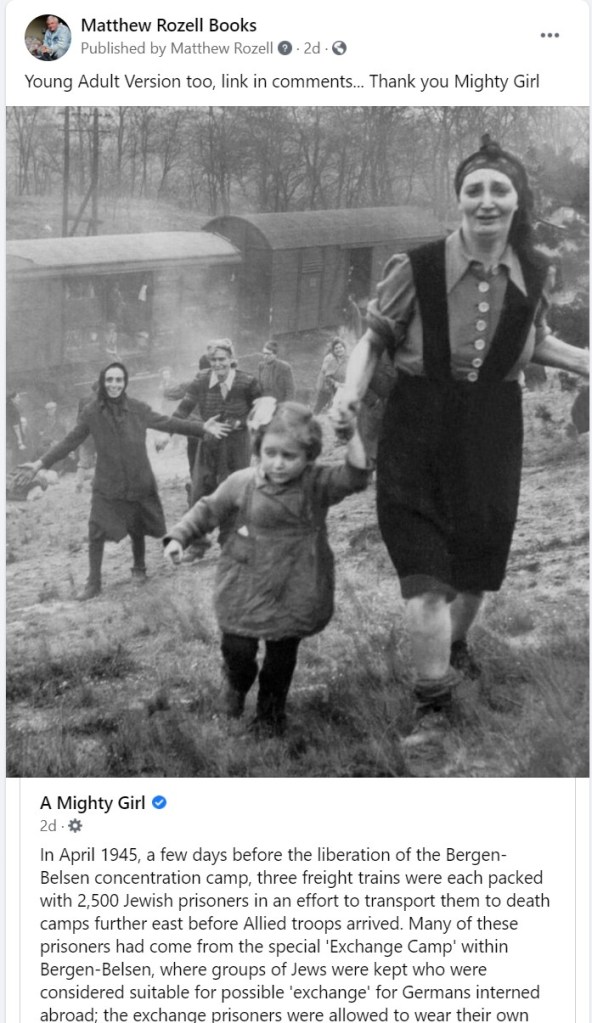
SCREENSHOT OF ‘A MIGHTY GIRL’ POST. CLICK TO READ ORIGINAL. [THEY ACTUALLY READ THE BOOK…]
RECENT UPDATES: A recent write-up on A Train Near Magdeburg was posted by “A Mighty Girl” on their FB page, with 2.5 M followers. I was impressed, they actually read the book, and continue to empower girls and young women, featured especially in the Young Adult version of the book.
Our film plans were sidelined, along with the rest of life, but now are back on track. Seeking sponsorship at all levels, especially corporate, for our PBS distributor-accepted film. Details on benefits and how to help are here (OPENS AS PDF). Thank you if you have given in the past, and be assured that it will happen!
“I have a picture of several girls,” train liberator George Gross recalled.
“They were ghostly thin, with hollow cheeks, huge eyes that had seen a lot of evil and horror, and yet smiles that broke my heart.”
So, I have been wondering about today, this day, for a long, long time. It is finally here.
The blog is blowing up and I have to return calls to people who are trying to find me, to tell me that their parent was on the train as a young person, and liberated this day, exactly 75 years ago this morning, at Passover time, springtime, Easter, the symbols of rebirth and new life.
I am supposed to be in Germany around now with maybe a hundred people at the liberation site. Dedicated planners in Europe (thanks Ron Chaulet, especially, and the German organizers at the site of the train liberation!) invited dozens of train survivors, their offspring, and the second generation of the American soldier liberators for ceremonies with German high schoolers in unveiling a monument to the survivors and the 743rd Tank Battalion, and 30th Infantry Division. And it was to be filmed professionally for the amazing documentary we are working on. A mammoth undertaking, just swept away, but not forever.
I think back to eighteen summers ago, when I sat down to record the memories of an 80-year-old tank commander, Carrol Walsh, who had fought from Normandy, into Germany, back into Belgium for the Battle of the Bulge, and then back across Hitler’s Western Wall, who almost forgot to tell me the story of the train fifty-six years before. About his rejection of the mantle of “LIBERATOR”, but his acceptance of being a WITNESS, of being a symbol of the army that did something about what they saw.
I think today about George Gross, the other tank commander that day who had the camera and the photographs to prove that 2500 souls on their way to being murdered were in fact REAL, that the event DID happen, and that the Holocaust would never be forgotten. Of his years recounting the girls on that train, the children, and speaking to them and meeting the ones who could make the pilgrimage to meet him.
I think about Frank Towers, the lieutenant charged with getting these poor people out of harm’s way, as a new battle for the city of Magdeburg was about to unfold. The same Frank who excitedly beat a path to my door sixty-one years later to explain his role, and who went on with train survivor’s daughter Varda Weisskopf and I to track down over 275 survivors of that train all those years later, organizing over 11 reunions on 3 continents over 10 years.
I think today about the medic Walter Gantz, who suffered nightmares for decades after treating the victims on the train for six weeks after liberation, some literally dying on him, his trauma evident sixty-six years later in recalling carrying in his arms a sixty-pound fifteen-year-old girl’s body down the stairs in the middle of the night to a makeshift tent morgue. Of his call to my classroom to introduce himself, telling these thoughts to my high school seniors, and the salving of his scars in getting to speak to the former young people he saved so many decades later.
I think about all the beloved survivors and their families―such loving people who broke down, cried, laughed, danced with their liberators and fellow American WWII soldiers―so many whom I hold close in my heart forever.
I think about the words of one of them every year, an annual email that would arrive on this day from Leslie Meisels, recalling with his survivor “twins” the anniversary of their “re -birth”, their good fortune and gratitude for their liberating heroes, the miracles of survival and liberation, and the miracle of meeting them again.
And I wonder again why God put me on this path to bring a bit of healing to the world.
I have asked Him, ‘why me’, over and over.
And why can’t I see this fruition one last time, on this date, with these ‘new’ teenagers discovering the history in their own backyard and their willing, enthusiastic interaction with it?
I should know better by now than to ask. I really should. But as I string these thoughts together, I’m reminded of the note I got in my email inbox so early this morning from Germany, so I think today also about this lone German high school student laying flowers at the site of the liberation―not out of a sense of atonement for the deeds of generations past―no one can atone for those crimes, and frankly that is not her ‘job’―but simply out of LOVE.
Johanna M. laying flowers 75 years to the hour at the site of the liberation of the Train Near Magdeburg, April 13th, 2020.
LOVE. And HOPE. And maybe even FAITH.
I see this single, lone young person—and yes, one who will miss finishing her own graduating year with her friends now—in this sudden age of darkness and uncertainty as some sort of new symbol, the newest witness, at once comforting and profound and at once a source of light, of life, and yes maybe re-birth. Today I can’t witness the re-unification of the saved and the saviors, the healing touches passing in the land where the crimes were perpetrated, but in seeing this photograph I am renewed by witnessing a new generation arising out of the utter destruction, the evil, and the hatred of 75 plus years ago― in this form of a girl and her teenage friends planting new seeds, literally, at this site where people expired with the words “SALVATION” and “FREEDOM” on their lips, and I see from afar the honoring of the goodness that radiated from the deeds of those American soldiers, really not so long ago.
Life never goes the way we expect it to. It always gives us new challenges to rise above and though that may seem hard at times, it is still the only way we truly learn and grow, as long as we do not lose hope.
I am sure everyone of us expected this year to be very different. For many of us students it is the last year of high school, and we definitely did not expect our graduation year to be like this, but I believe that everything happens for a reason, and we must simply trust and believe that everything is going to be okay.
Today we celebrate the 75th anniversary of the liberation of the stranded train in Farsleben, and it is not the way we planned it, but that does not mean that we cannot remember this day 75 years ago, and every person that was involved. None of us might physically be at the same place right now, but that should not stop us from letting the memory of the stranded train unite us on this day.
Sure, we wanted this entire week to be about remembering the story of the stranded train, we wanted to welcome people from all over the world in Farsleben to celebrate this day with us, we had planned a lot and we were excited, and this is not the way we wanted it to be, but we have not forgotten and no matter how difficult these times might be right now, we want to give you a reason to smile today, to never lose hope and to stay healthy and safe, so that we can welcome you here in April 2021.
On behalf of the entire project group “Stranded Train” I therefore wish you all the best in the world and send you much love from Farsleben.
Johanna
The poet Yaakov Barzilai was on the ‘Train Near Magdeburg’. Originally composed in Hebrew, a translation has been provided by fellow survivor Micha Tomkiewicz. He agreed to share his poem on the 70th anniversary of the liberation. ’11:55′ refers to the author’s recollection of the time of the day of the liberation of the train transport; ‘five minutes before the bitter end’.
Dedicated to US liberators of the death train from Bergen-Belsen on April 13, 1945
At Eleven fifty-five.
Return to the Place of Liberation, April 13, 1945, after 65 years.
The train stopped under the hill, huffing and puffing,
as though it reached the end of the road.
An old locomotive pulling deteriorating train cars
that became obsolete long ago, not even fit for carrying horses.
To an approaching visitor, the experience was of a factory of awful smell – really stinking.
Two thousand four hundred stinking cattle
heading for slaughter were shoved to the train cars.
The butterflies into the surrounding air were blinded by the poisonous stench.
The train moved for five days back and forth between Bergen-Belsen and nowhere.
On the sixth day, a new morning came to shine over our heads.
Suddenly the heavy car doors were opened.
Living and dead overflowed into the surrounding green meadow.
Was it a dream or a delayed awakening of God?
When we identified the symbols of the American army,
we ran to the top of the hill as though bitten by an army of scorpions,
to kiss the treads of the tanks and to hug the soldiers with overflowing love.
Somebody cried: “Don’t believe it, it is a dream”.
When we pinched ourselves; we felt the pain – it was real.
Mama climbed to the top of the hill.
She stood in the middle of the field of flowers and prayed an almost a silent prayer from the heart.
Only few words escaped to the blowing wind:
‘Soon…Now…..To the chimneys of death…I gave new life….to my children….
and this day… my grandchildren were born… to a good life.’
Amen and Amen.
-Yaakov Barzilai
TOP STORY
Author couldn’t travel to Germany for train liberation anniversary
by Gretta Hochsprung, Glens Falls Post-Star, April 16, 2020
HARTFORD N.Y.— Author Matthew Rozell was planning to travel to Germany to celebrate the 75th anniversary of the train liberation near Magdeburg.
“I’m supposed to be there right now,” said Rozell, who, due to the coronavirus pandemic, couldn’t travel from his hilltop home in Hartford to the small German town where Americans liberated a train of Jews 75 years ago on April 13, 1945.
A ceremony was supposed to take place at the site Friday, but that, too, was canceled due to the pandemic.
Instead, a lone German high school student named Johanna Mücke placed flowers on the base where a monument was to be dedicated. Mücke’s class had worked on an award-winning project about the liberation.
About 15 Holocaust survivors, the children of the liberators and tank commanders, German politicians — about 100 people in total — were planning to travel to this small German town this week.
Rozell, himself, was going to give a speech at the Friday event.
“We’re disappointed that we can’t be there,” Rozell said, adding, “I take immense gratification that there’s a high school kid in her class 3,000 miles away on top of this thing, and they’re not forgetting it. I think that’s really important, especially considering the fact that they’re German.”
The story of the train started in Rozell’s classroom when he was a history teacher at Hudson Falls. Rozell was interviewing veterans for the Hudson Falls High School World War II Living History Project he started.
An interview with retired U.S. Army Sgt. Carrol “Red” Walsh of Johnstown unearthed the story, which turned into Rozell’s second book and an upcoming documentary film to be aired on PBS.
In April 1945, near the end of World War II, Army Sgt. George Gross and Walsh were deep in the heart of Nazi Germany, part of the U.S. 30th Infantry Division and the 743rd Tank Battalion, when they spotted a train sitting on the tracks.
The train contained 2,500 Jews, who were saved at the last moment from extermination.
Rozell and filmmaker Mike Edwards were planning to capture the ceremony in Germany to be used in the film as well as conduct additional interviews with Germans connected to the liberation.
“We were going to film it all,” Rozell said. “And we were going to go to Bergen-Belsen, which is where the train originated from.”
Monday was the 75th anniversary of the train. Wednesday was the 75th anniversary of the liberation of Bergen-Belsen, the Nazi concentration camp.
Rozell gives credit to the students and their teacher for studying this part of their history and commemorating the 75th anniversary with Mücke’s flowers.
“This whole project started in my history class here,” Rozell said, “and I’m retired now, but these kids over in Germany with their teacher, I don’t know, it’s kind of like coming full circle in a way.”
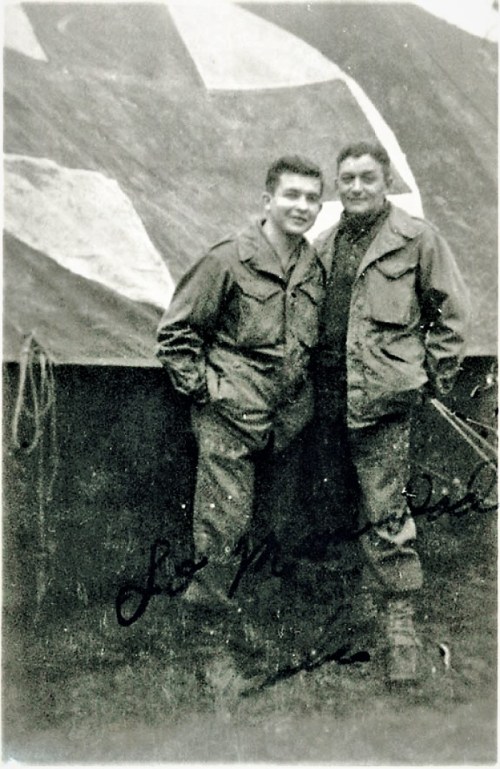
“To Mom and Dad, Babe” WW2 medic, Walter ‘Babe’ Gantz, left
The Old Coach is being buried today. As I write this, he is being eulogized by those who knew him and loved him best. Losing an old soldier is a heavy road I have been down many times, but it’s taken me a week to compose my thoughts on best serving his memory.
In a previous Army life, combat medic Walter Gantz of the 95th Medical Battalion was known as the ‘Sharpshooter’, not for killing people in wartime, but for his uncanny ability to sight in on impossible to find veins in skin-and-bones-bodies racked with disease, malnutrition, and dehydration with a life-giving needle. And he went on giving life after the war, leading by example and taking the needle himself, personally donating 27 gallons of blood to the American Red Cross and spearheading the collection of thousands more in his hometown.
I last talked to Babe, as he liked to sign off in his letters, a few months ago. It had crossed my mind to call him again on his 95th birthday this year, November 1st, but I guess I was busy or put it off to the weekend, figuring I still had time.
I wanted to ask him if he would like to return to Germany with us this coming April, to the site of the Holocaust train liberation of the Train Near Magdeburg and a monument unveiling for the 75th anniversary, in the presence of survivors and 2nd and 3rd generation descendants of survivors and other American liberators associated with the liberation of the train. And to meet the German schoolkids, one a 17-year-old who became a pen pal for a while, when I told her to write to him with her questions. Of course, he wrote back!
You see, Walter was a hero to a lot of people. Mike, the filmmaker for the documentary we are working on, remembers driving many hours to pull up at his house to meet him, to get an interview for our film—”I got out of my car, Walter took my hand and looked me straight in the eye and thanked me for coming to tell the story.”
Walter died on November 27th, in the morning, exactly a week ago. His son-in-law Ken reached out to me shortly afterwards, and I have been struggling to find the words ever since; it did not register at first because it just did not seem possible. When I met him in April—he was waiting for me in the lobby of the hotel. He had arrived an hour early, having driven himself to the hotel where we were staying.
I don’t have many heroes. But I met one in April. WW2 combat medic, Walter Gantz–and he squeezed my hands so hard…
Walter got emotional. The Old Coach in his red athletic hoodie grabbed my two hands with the grip of the 20-year-old he had been as a medic at Hillersleben, the captured German Luftwaffe base and weapons proving ground 74 years before. “Matt Rozell, God bless you!” Mike snapped a picture. “It’s a good thing I am as cool as a cucumber; otherwise I would be real nervous about all this!”
We talked for a while. He lived only three minutes away in the hills overlooking the city, the ‘Polish Alps’ as he calls it, where his parents had raised him, most of the community having emigrated from Poland in the early part of the previous century to work in the mines. He remembered attempts at conversations with the Polish survivors at Hillersleben, how he could pick up word and phrases, and he remembered child survivor Micha Tomkiewicz’s Polish mother distinctly, an educated woman who also had medical knowledge and training. He remembered Gina Rappaport, a survivor from the Krakow Ghetto who spoke seven languages and translated for the people on the train. And he was so sorry to have missed the reunions (11 in all) in the past, but I did not even know about him until he called my classroom in October 2011, shortly after our Sept. 2011 final school reunion.
We were in Scranton for a film shoot-re-introducing him to survivor Judah Samet of Pittsburgh, who came with his daughter for a meeting and lunch with Walter and his family. Walter cried.
As it happened, I was scheduled to give a talk in New Jersey the next week. Walter and his son-in-law Ken made the trip, and when a New York based train survivor learned about it, he and his family came to meet Walter in another emotional meeting. More tears were shed, and students got to witness it.
As he recalled,
“After 70 years, I still get emotional. I try to control my emotions, but it’s impossible. I know I keep repeating the word, ‘helpless.’ It’s a good way to describe this situation, really. Yet as medics we did everything humanly possible to help; I would say without a question we saved a lot of lives. We really did save a lot of lives. When you hear them saying ‘heroes,’ we medics weren’t considered heroes, but I guess we were the unsung heroes. It’s a long time ago, over 70 years. It’s a lifetime. Sadly, in time, your memories become dimmed—but there are certain events that will stay with a person all of their lifetime.
The whole experience [of being reunited with survivors over 70 years later] has made me feel ten feet tall, and I have to use the word ‘mind-boggling’—I guess you’d have to put it in the category of a dream… all the survivors keep saying is, ‘Thank you, thank you, thank you.’”
Walter signed off on one of his letters to me.
Some of the boys couldn’t take this type of duty and had to be sent back to our headquarters… My parents never knew of Hillersleben; the 95th held more than 40 reunions and barely a word was mentioned concerning Hillersleben.
Matt, I wish you well in all your endeavors. God’s blessings to you and yours.
As ever,
Walter (Babe) Gantz
Member, 95th Medical Bn.
I think the best way to serve your memory, Walter, is to keep on keeping on in our ongoing endeavor, that you and your deeds are never forgotten, and generations of people will know and celebrate the goodness in humanity in recalling your life and the lives of all the soldiers and liberators through the book A Train Near Magdeburg, and our upcoming film of the same name. God bless YOU, my friend, and Godspeed.
Walter (Babe) Gantz Obituary
Walter (Babe) Gantz, 95, South Scranton, died peacefully Wednesday morning at Geisinger Community Medical Center surrounded by his family. His wife of 69 years, Charlotte Jean Kester Gantz, died in 2018.
Son of the late Frank and Rose Slangan Gantz, he spent his entire life in the South Side area. A graduate of Central High School and Keystone Junior College, he was a member of St. Stanislaus Polish National Catholic Cathedral.
During World War II, he served as a surgical technician with the 95th Medical Battalion. He was the recipient of the Combat Medical Badge, Bronze Star, Joint Service Commendation Medal, Army Commendation Medal, Meritorious Unit Citation and many other awards. He served in northern France, Rhineland, central Europe and Ardennes campaigns. During the Korean War, he was a member of the 79th Infantry Division.
In early 1944, he volunteered on a secret mission in the wetlands of southern Florida. It was a joint effort involving American, British, Canadian and French Armed Forces. Their task was to test clothing to be used in the event of chemical warfare. He was seriously burned by nitrogen mustard gas and was hospitalized at MacDill Air Force Base. His group was placed under 24-hour guard.
One of the greatest satisfactions of his lifetime was to reunite with the boys from his medical battalion after being separated for 18 years. He always referred to it as a “labor of love.” The first three reunions were held in Scranton and the 50th anniversary was also held locally. He remained as the only president of its association.
He was a great sports enthusiast throughout his lifetime, both as a player and coach. He was a member of the YMS of R team in the first-class Scranton association, the top amateur league. He also played with some of the best softball teams in the area. In 1945, while waiting to be transferred to the Pacific, his battalion’s softball team won the championship at the Arles staging area with a record of 35 wins and five losses. The staging area, located in northern France, consisted of more than 250,000 troops. In 1960, he formed the first slow-pitch league in NEPA. An outstanding distance runner, he continued to do so in his middle 70s. He was considered one of the top speed skaters in the area. While in the service, he was an assistant coach and member of the battalion boxing team. While in his 80s, Babe was a team adviser to the women’s softball team at Baptist Bible College. He continued in this role well into his 90s. He derived great satisfaction in hearing the players refer to him as Coach Walt. Most of the young generation referred to him as the “Old Coach.”
Babe was involved in community affairs throughout his lifetime. He was elected to a six-year term on the Scranton School Board in the 1970s. As the overseer of athletics, he was successful in introducing cross county in the district. He was noted for his objectivity while on the board. In the early 1980s, when the AIDS epidemic became known, he was a member of the initial committee to study its local impact.
As an AIDS instructor, he spoke at many of our high schools and colleges. Babe also served on the hemodialysis commission. As a combat medic, it was an easy decision for him to join our blood program in 1948. He served at the head of every volunteer office at the Scranton Chapter blood program and was its first representative to the NEPA Blood Center. He was the sole remaining member of the initial committee that organized the South Scranton Ecumenical Blood Council. The group collected more than 17,000 units of blood. Leading by example, he donated 27 gallons locally. In 2015, he retired from the program after 65 years. As the Americanism chairman for the American Legion Central District, he attended many services for those who made the supreme sacrifice during the Vietnam War.
Babe was an ardent believer in physical fitness. He would say to both young and old, “Keep those legs moving.”
Babe had a perpetual smile and when greeting you by your first name, he would always follow it with “God bless you.” It was easy for him to find the good in everyone. A spiritual individual, he tried his best to walk in the path of God.
He always said that he was truly blessed that he rubbed shoulders with so many individuals. In many instances he played the role of mentor, conveying any words of wisdom that he possessed.
He enjoyed music and said it was a source of strength during difficult times. His favorites were bluegrass, hymns, big band and the classics. In the evening, he spent many hours reading in his den. His topics ranged from Abraham Lincoln, World War II and those of a spiritual nature. For many years, he and Jeanie were seen at the area polka dances. Also for many years, the family enjoyed walking around Lake Scranton. He was an ardent fisherman and spent much time at his favorite pond, saying it was a great way to relax.
One of the most memorable events in his later years was having the honor and pleasure of meeting many Holocaust survivors at the Teen Symposium sponsored by the Holocaust Education Resource Center. For a number of years, he related his experience treating survivors from the Bergen-Belsen Concentration Camp. His medical battalion set up a hospital to meet their needs. They were victims of what was known as “The Death Train at Magdeburg.”
In 2010, Babe was the recipient of the Hero of Combat, Hero of Compassion award by our local group for his humane endeavors. He is also portrayed in the book called “A Train Near Magdeburg,” written by Matt Rozell, and will be featured in the upcoming documentary by the same name.
Although he was very devoted to his family, he credits his wife, Jeanie, for faithfully providing the everyday needs of their children while he was away or on assignment.
Surviving are three daughters, Debbie Gantz, Lake Winola; Linda Guarino and husband, James, Blakely; and Doreen Klinkel and husband, Kenneth, Dalton; grandson, Tony Guarino; great-grandson, Elijah Guarino; nieces and nephews; and a sister-in-law, Shirley Angelis, Lake Ariel.
He was preceded in death by a brother, Frank Gantz, and two infant brothers, Steven and Walter Gantz.
The funeral will be Wednesday at 9:30 a.m. from the Leon S. Gorgol Funeral Home, 1131 Pittston Ave., with Mass at 10 in St. Stanislaus Polish National Catholic Cathedral. Interment with military honors will be at Abington Hills Cemetery.
There was another shooting at a synagogue on American soil. Sometimes I wonder if my efforts to teach about the Holocaust mean anything. Sometimes you just feel helpless. But I realize now that it is probably the most important job I have ever done, maybe now more than ever. Two weeks ago I introduced Pittsburgh survivor Judah Samet to the American soldier who had a lot to do with his liberation. On my newsletter list, less than a week later, I mentioned I would be talking at a college in New Jersey; the next day, the following encounter occurred. And I think it will stay with these kids for the rest of their lives, and probably those ripples will create new waves.
A few days ago I drove 5 hours to a tiny community college in a rural section of New Jersey to speak on the subject of the Holocaust. I got there early because just yesterday I learned that a ‘new’ Holocaust survivor of the train would be attending, one whom I have never met before. He wanted to attend because he was on the train, and he also did not want to miss the opportunity to meet the WWII medic, Walter Gantz, who also wanted to attend my lecture. Walter was a 20-year-old American soldier who spent seven weeks with the survivors.
I was unloading my books and equipment when Walter and his son-in-law Kenny arrived, themselves coming from 2 hours away. Ken dropped Walter off at the entrance and went to park the car; I did likewise. Just as I got back into the truck, a saw a man wearing a kippah approaching Walter, hand extended, hailing him with ‘Mr. Gantz?’ I fumbled for my camera and took a shot of the first meeting of the two in 74 years.
Oscar S. was on the train with his family, many brothers and sisters who all survived the war, all resting and recuperating at the makeshift hospital and displaced persons camp that was Hillersleben, only a few miles from the train liberation site at Farsleben. Walter was there the entire time, remembering the children quite clearly, and profoundly moved by the appearance another person who had been one of those children.
A couple classes of college kids came in. They found seats, and more seats were arranged in the back as the word got out that this might be something special. I’m sure most of them didn’t know what to expect; I began my talk by asking how many of the young people actually knew an actual veteran of World War II who was still alive. No hands went up. I waited, and asked again—sometimes young adults are shy to volunteer—and there was no response. I didn’t expect a lot of hands, but I didn’t expect that NONE of the 18 to 21-year-olds in the room would respond. I immediately realized that we were in new territory.
I began the talk by explaining that the reason for my being there to speak to them was because I had asked the same question to a roomful of high school sophomores 25 years ago, and almost every kid raised not one hand but two. So I got curious, and made up a simple 2-page survey form—what branch were you in, what was your job, do you remember when you heard of Pearl Harbor, what things would you share with young people today—and I again was flooded with genuine, heartfelt responses. I invited veterans into the classroom to tell their stories, recorded them on videotape for posterity, and went off in search of more stories in the community. And that is how I got to sit down with one tank commander who shared a story and led me to another tank commander who wrote to me about the day their two tanks came across a train with nearly 2500 refugees, as it turned out, Jewish families who had been prisoners at Bergen-Belsen, shipped away by the Germans in the final days of the war to evade the advance of the Allied armies in the west. And these Americans who came across the train had even taken photographs of the dramatic rescue as it all unfolded. So I had a story to tell, about those final days of World War II and the Holocaust, and about what had happened since. That ten years after it all started, just when I thought I would not hear from any other soldiers associated with this train rescue story—I had met several others, but none more after the first four years had come and gone since that first reunion in 2007—the phone rang in my classroom, and the greeting that would become so familiar to me rang in my ear for the first time—“Matt Rozell, God bless you!” It was Walter Gantz, now 94, once the 20-year-old medic, now sitting in the midst of 20-year-olds who could not recall a living World War II veteran, and a former 7-year-old boy who he had a hand in saving.
We moved on to the subject of the Holocaust. I asked the kids: How many people were murdered in the Holocaust? What does that number look like? And just how did that happen?
So who was responsible for the biggest crime in the history of the world? Hitler alone?
How were the people freed on the train a ‘snapshot’ of European Jewry persecuted by the Nazis-and others?
How could I make people care, today, about what happened nearly 3 generations ago?
Why is it important to listen to those who were the first witnesses? What happens when these stories are no longer with us?
Once people have absorbed the stories, do they have a moral responsibility to act on the ‘lessons’? And then, for emphasis:
Is there such a thing as ‘being a witness’, when you yourself were not there?
I spoke for an hour. I didn’t notice any outright indifference at the start [a minor concern in the case of any event outside of regular classroom hours]; kids were very respectful and I think, curious, and I had their rapt attention at the end, though I waited for a few questions. None came, and Walter took that as his cue to stand up, because he had something to say. And he got right down to the point, with passion, a rising voice from a gentle soul. He motioned for Oscar to stand up and join him, and he embraced him with emotion.
“I spent seven weeks with these people. During my stay, there was about one hundred and twenty who passed away. Basically, it was from the typhus disease; most of them were over fifty; most of the young people survived. And there were a lot of young people, I mean, little children [motions with hand, palm down to his knee], infants, and it was living hell [shakes head incredulously].
After we set up our hospital in Hillersleben, a few days later, five or six of us went back to see the Bergen-Belsen concentration camp… and—you have to believe me when I say, the bodies were piled up like cordwood [raises his hand to over his head]! Everywhere you looked, I remember looking down a lane, probably a quarter of a mile, trees on each side, bodies, hundreds and hundreds of bodies laying around…
I had a strange experience. I’m Polish, and at the time, I could speak Polish very well—and I remember a gentleman at the Bergen-Belsen concentration camp, he kept saying, [speaks with emphasis, in Polish], which means, ‘Do you understand Polish?’ And I said, ‘Yes’ [begins to cry]…and he grabbed me, and he hugged me [hugs Oscar, the survivor he met today for the first time, both cry]… and I felt so helpless! I broke down…and the stench was terrible…We are living proof that there is such a thing as the Holocaust!”
Walter Gantz, WW2 medic, recounts his visit to Bergen-Belsen in 1945.[2:30]
There were muffled sobs throughout the room. No one spoke; one girl sitting in the second row was visibly emotional and profoundly moved.
Walter thanked God again for his good health and his mobility, at being able to come out and address the young people, noting that he once coached young people their age, and he closed his impromptu remarks by bringing laughter through the tears with his admission that though he could still move, he probably wouldn’t be able to keep up with the young women in the room.
So it was time to close. I went back to the beginning. It had turned out to be an almost religious experience for everyone in the room; I didn’t have to tell them that they had been graced with a once in their lifetime opportunity in what they had witnessed in the last few minutes. And I repeated the questions:
‘Once the survivors and liberators are gone, who is left to tell the stories? Once you have heard or read the testimony, are you the new witnesses? Do you carry a moral responsibility to act on what you have absorbed?’
And I hope it sank in, for the sake of humanity.
‘…And whoever saves one life saves the world entire’


























 Teaching History Matters