From international conference at Hudson Falls High School in Sept. 2011, featuring survivor Leslie Meisels and soldier Buster Simmons. National Anthem by HFHS Choraliers under the direction of Mrs. Diane Havern. Photos by Rob Miller and others. 4 minutes. 1st of series of educational videos from conference.
HOUR OF LIBERATION
this was read at the final banquet this year to a hushed gathering of survivors, soldiers, their families, and our students. . Thanks to all for making it very special.

Robert H Miller photo. Final banquet, 9-23-11.
I very much regret that I won’t be with you at the reunion. Please convey this statement that I wanted to share with you about my hour of liberation which has been on my mind for 64 years. My name is Martin Spett. I was born in Tarnow, Poland. My family and I survived the Tarnow Ghetto, slave labor, a political prison, and two years in Bergen Belsen Concentration Camp.
It was April 7, 1945. as the American and British armies were closing in on the area where Bergen Belsen Concentration Camp was located. Five hundred people, including my family and myself, were forced to leave our Sonderlager compound. and forced to march 7 km. to a train. Although I was ill with double pneumonia, I forced myself to follow and keep up with the group. We boarded the train which already had 2,000 people aboard. Because of the surrounding allied armies, the train circled for several days. It stopped in a forest area near the Elbe river. We were not able to reach our real destination because of the bombed out bridges. We found out later that we were supposed to go to Theresienstadt Concentration Camp.
The German commandant, who was in charge of the train, not knowing what to do with us, went to a nearby village to call Berlin for instructions. When he returned, we found out that he had orders to kill everyone aboard the train. You have to visualize this situation. Here we were in the middle of a forest with seventy German guards that set up heavy machine guns for our execution were waiting for orders from their commandant. But, he apparently had a change of heart and did not wish to follow Berlin’s instructions because the American army was closing in on all sides. During the night, we saw the German army retreating near our train and we saw the American army artillery fire that was aimed in our direction. We huddled together in fear not knowing what our fate was.
The morning found us still on the train with only a small number of guards and a commandant who was waving to us from a bicycle as he was riding away. It was a beautiful sunny morning in the forest. All was calm and quiet.
Later that morning , we heard a loud metallic, rumbling sound. A few minutes later, an American army tank came into view. As the tank stopped, an American soldier came from behind the tank and he started walking down the hill towards the train. He could only go a few steps when our people in their great excitement, fell before his feet, kissing him. At that time, the German guards surrendered and we then realized that we were liberated.
The soldier stood there with tears in his eyes, telling us that President Franklin Delano Roosevelt had died the day before. It was now April 13, 1945.
At this point, I would like to thank the brave American soldiers of the 30th Infantry who rescued us from our Nazi oppressors. Your brave deed has been in my heart for over 64 years. I never forgot you.
Posted in Uncategorized |
Hudson Falls High School students hear firsthand of war, peace
The Glens Falls Post-Star
OMAR RICARDO AQUIJE | Posted: Friday, September 23, 2011 5:18 pm
PHOTOS- Jason McKibben-The Post-Star
HUDSON FALLS — Through music, literature, acting and video, Helen Patton told a story of war and peace.

Helen Patton, granddaughter of Gen. George S. Patton
Since 2004, Patton, the granddaughter of Gen. George Patton Jr., the U.S. Army officer known for his World War II military tactics, has used the arts to help people resolve conflict.
On Friday, she demonstrated it to the students of Hudson Falls High School – along with sharing tidbits of her grandfather’s legacy.
She shared the tale of Palestinian and Israeli youths, who were brought to her organization she set up in honor of her grandfather, the Patton Stiftung Sustainable Trust in Germany.
The two groups – with 10 members each – spent three days with a songwriter in a castle. They had to live with each other and write three songs.
Helen Patton played a recording of one of the songs to the Hudson Falls students. She sang the lyrics, waved her arms, and soon the students were clapping, waving and cheering, before erupting in loud applause when the performance was over.
After the three days, the two groups were sent home, she said.
“It’s damn hard to kill someone if you’ve written a song with them,” she said after the event.
She showed a video clip of a German news program that did a story on her organization, and she read a passage from a war novel.
She called on the help of a World War II veteran to tell stories of her grandfather. As the stories were told, she often acted out certain scenes.
Helen Patton, who’s an actress, singer and director, was the last guest to speak during a three-day event to teach the Holocaust at the school.
The event, entitled “Repairing the World,” united World War II soldiers with the Holocaust survivors who they freed from a Nazi train in 1945.
There were speeches from the son of a World War II veteran now deceased, a living war veteran and several Holocaust survivors who were children on the train.
Robert Miller, an author of war novels, was a speaker Friday morning. Students also watched “Paper Clips,” a Holocaust documentary.
This week’s event is the third reunion since 2007. Due to the difficulty of arranging it and the age of the war veterans and Holocaust survivors, it’s also the last.
While people were reunited, the event was aimed to educate students.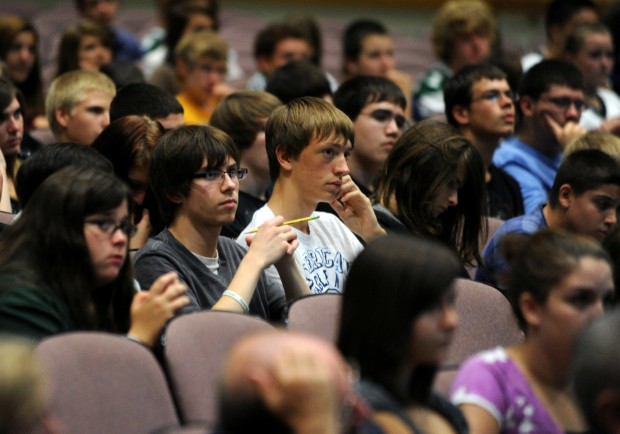
Following Helen Patton’s presentation, James Bennefield, the high school principal, told students they were the last generation that will hear Holocaust stories straight from the people who lived them.
“I hope all you students realize one thing: You are all very fortunate to hear what you heard firsthand,” Bennefield said.
The event organizers and participants also wanted to teach students the significance of learning the Holocaust to ensure it’s never repeated and to refute the arguments from people who deny it ever happened.
“It was very educational,” said sophomore Tommie Hanlon. “It is something I am never going to forget.”
Fellow sophomore Alicia Russell said hearing the Holocaust stories from people was better than reading it in a textbook.
“I thought it was very interesting to hear everyone’s story,” she said.
After Friday’s afternoon event, students had their photos taken with the former soldiers and Holocaust survivors.
Ariel Guyett, a junior, got an autograph from a veteran for her grandmother, whose husband fought in World War II.
“It’s definitely something kids should learn about because you never want to forget something like this (the Holocaust) exists,” she said.
The former soldiers and Holocaust survivors were honored one last time at the end of the event. Praise was given to the event’s organizers as well.
Matt Rozell, a history teacher and event organizer, thanked the students for their part.
“Don’t forget,” he said. “You are the witnesses. You saw the liberators this week. One person can make a huge difference.”
Posted in Uncategorized | 2 Comments »
A Final Meeting: Holocaust survivors, rescuers meet in Hudson Falls
by Omar Ricardo Aquije, Glens Falls Post-Star
Photos by Jason McKibben

Holocaust survivor Ariela Rojek, right, was 11 years old in 1945 when she and 2,500 other concentration camp prisoners aboard a train near Magdeburg, Germany, were liberated by American forces including 1st Lt. Frank Towers, left with his son Frank Towers Jr., center. "You gave me my second life," Rojek told Towers Wednesday, Sept. 21, 2011, at Hudson Falls High School during an event reuniting soldiers and survivors.
Jason McKibben Glens Falls Post Star
HUDSON FALLS — In preparing to become soldiers, they were taught many things, most of all how to fight the enemy. But on April 13, 1945, members of the U.S. Army’s 30th Infantry Division were caught unprepared.
As they cut across Germany, through cold weather and 18-hour days of fighting, they found a train. Inside were 2,500 Jews who were packed together for six days — sick, dirty, with little food, and infested with lice, fleas and ticks.
The soldiers, riding Sherman tanks, knew how to fight, but were not prepared to treat so many people or for the shock of the train conditions.
“What we were to witness in those days was something we were not prepared for,” said Frank Towers, a first lieutenant in 1945, as World War II was nearing its end.
On Wednesday, Towers, 94, discussed his role with the soldiers who found the train, during the first of a three-day program to teach the Holocaust and reunite the former soldiers with the people they liberated 66 years ago.
The event was at Hudson Falls High School and was the third of its kind there since 2007.
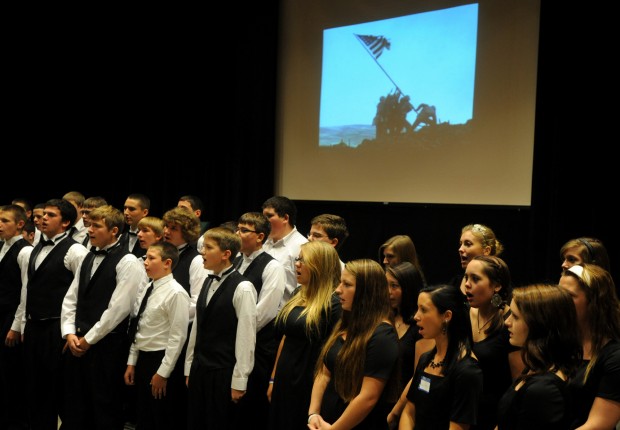
Hudson Falls High School students sing the national anthem in the school's auditorium as a photograph of American forces raising the flag at Iwo Jima is projected on a screen behind them during an event on Wednesday, Sept. 21, 2011, reuniting Holocaust survivors and the soldiers who liberated them
Jason McKibben Glens Falls Post Star
Towers, who traveled from Florida, was one of two former soldiers at the event. Along with them were four men and women who were children on the train.
The Nazis abandoned the train, which was traveling to a concentration camp.
While the U.S. soldiers did not have the resources to treat the passengers, they kept them safe until they could be transported to a military base with a hospital, Towers said.
Towers spoke at a morning event to kick off the program. Through speeches, photos and an audio recording from the 2007 event, the story of the 30th Infantry’s discovery was told. In addition, the former soldiers and Holocaust survivors were honored at the event.
Also explained was the role of the Hudson Falls school. A decade ago, Matt Rozell, a history teacher at the school, interviewed Carrol Walsh, a former soldier, to record his memories of World War II.
It was then that Walsh recalled the day his division found the train near Magdeburg, Germany.
Rozell and his students put the story of the train on a website. Then, over time, people who were passengers on the train found the website and contacted Rozell.
That spawned two reunions, the first in 2007 at the high school, where a handful of Holocaust survivors met Walsh for the first time.
Since then, Rozell has been in contact with 216 people who were on the train and three former soldiers from the 30th Infantry. Some Holocaust survivors and the former soldiers have also been able to meet on their own.
This week’s event will be the last at Hudson Falls because of the difficulty of arranging it and the age of some of the soldiers and Holocaust survivors, Rozell said.
The event uses the theme “Repairing the World” to teach about the Holocaust. There will be speeches from Holocaust survivors, author Robert Miller, and Helen Patton, granddaughter of Gen. George Patton. Helen Patton is the founder of the Patton Stiftung Sustainable Trust in Germany, which uses art and culture to create peace between groups that have sometimes been in conflict with each other.
On Thursday, the Holocaust documentary, “Paper Clips,” will be shown.
Walsh, who was present at the 2007 and 2009 reunions but was absent Wednesday because of health reasons, had a letter read at the morning event.
In the letter, he wrote that rescuing the captives from the train was part of his job as a soldier, and thus he’s owed no debt. Instead, he wrote that the Jews are owed the debt for being victims of genocide, of losing their freedom, dignity, family members and lives during World War II.
“We can best pay that debt by keeping the memories of the Holocaust alive,” Walsh wrote in his letter.
Bruria Falik, a passenger on the train who today lives in Woodstock, attended the reunion. She said she was pleased by the extent of the school to study and teach the Holocaust.
She said she felt “unexplainable gratitude” when meeting the soldiers who liberated her.
“It is overwhelming,” she said. “You can’t ignore the feeling you get to be with Mr. Towers and the other soldiers.”
Leslie Meisels, another passenger on the train, came to Hudson Falls from Toronto, where he lives and speaks at schools about the Holocaust.
“There are no words to describe that feeling,” Meisels said of meeting the soldiers and Holocaust survivors.
After the morning event, students had their photos taken with the soldiers and survivors and obtained their autographs.
Cassandra VanEvery, a high school freshman, said it was hard to believe a group of people would attempt genocide.
“It was very emotional,” Cassandra said of the event.
Freshman Jacob Dimick said the event was hard on him, too. Not only was it difficult to hear about the horrors the Jews encountered, but it also reminded him of the stories he heard from his uncle, who was a soldier during World War II.
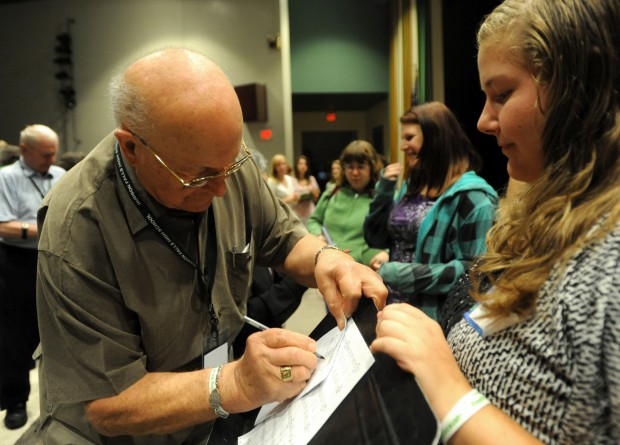
Holocaust survivor Leslie Meisels, left, signs a program for Hudson Falls senior Taylor Bump during Wednesday's "Remembering the Holocaust, Repairing the World" event. Meisels, who currently lives in Toronto, stressed the importance of relaying his experience to young people "so they remember and fight against discrimination, hatred and injustice."
Jason McKibben Glens Falls Post Star
“It’s a wonderful treat to meet them,” Jacob said of meeting the Holocaust survivors. “But people need to understand that it’s a horrible thing what happened to them.”
By recalling history and meeting others who lived it, people like Towers said it’s important for students to learn about the Holocaust so it can never be repeated.
“The message I’m trying to put forth is these students are our future,” Towers said. “I’m trying to convey to them that this (the Holocaust) should never happen again.”
Posted in Uncategorized |
 The final conference is open to the public provided you preregister by calling 518-681-4221. THE LIVE STREAM IS HERE
Holocaust survivors, WWII vets holding NY reunion
September 20, 2011
Associated Press
HUDSON FALLS — Holocaust survivors freed from a Nazi death train by American troops are getting together with two of their liberators in upstate New York.
The five survivors were children or young adults when they and about 2,500 other concentration camp inmates were liberated by members of the Army’s 30th Division in April 1945, just weeks before the end of World War II.
Four years ago this month, the first reunion of train survivors and the soldiers who freed them was held at Hudson Falls High School. That’s where history teacher Matthew Rozell’s World War II project helped the veterans and Holocaust survivors reconnect.
A welcoming dinner is being held Tuesday night at a resort near Lake George. The last of Rozell’s educational reunions is being held Wednesday through Friday at the high school.
Copyright 2011 by The Associated Press. All Rights Reserved.
Wednesday, September 21, 2011
MORNING PROGRAM 9:30am-10:59am
9:30 am- Block II at Hudson Falls High School Auditorium
THEME: THE LIBERATORS AND SURVIVORS OF A “TRAIN NEAR MAGDEBURG”
9:40am- Program begins-
Welcome by Mr. James Bennefield, High School Principal
Introduction by Mr. Rene Roberge, Hudson Falls High School / Master of Ceremonies
National Anthem
A Letter from Liberator Carrol Walsh
Speaker: Dr. Tim Gross, son of George C. Gross
Speaker: Liberator Frank Towers
Introduction of members of the 30th Infantry Division ,and Holocaust survivors
10:59 am– End of Morning Program
11:00am- 11:30am-Book Fair/Signings, Media interviews
11:30-1pm- Catered Luncheon, High School Library
12:00-1pm Film, A Special Reunion/The Story of the Liberation of the “Train Near Magdeburg”
AFTERNOON PROGRAM (Seating Limited; Middle School Here)– 1:00pm-2:20pm
Block IV- High School Auditorium
THEME: LIBERATION
1:05pm:Film, A Special Reunion/The Story of the Liberation of the “Train Near Magdeburg”
Speaker: Liberator Frank Towers
Speaker: Survivor Bruria Falik (Hungary; Woodstock, NY)
Speaker: Survivor Fred Spiegel (Germany; Howell, NJ)
2:20 pm Questions and Answers/Conclusion of Day’s Activities
*******************************************************************
Thursday, September 22, 2011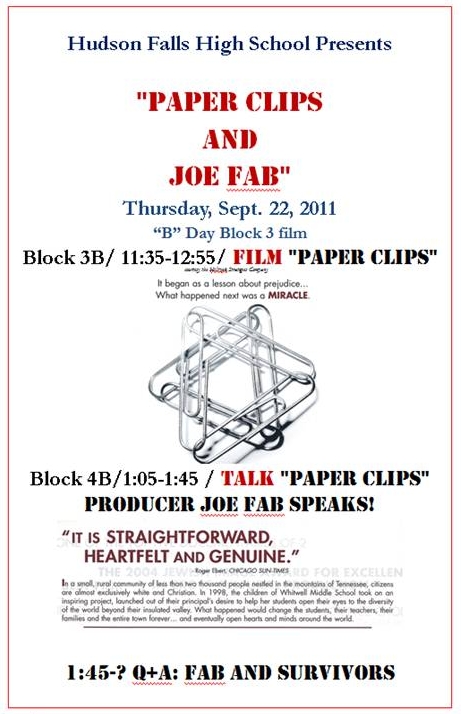
MORNING PROGRAM 9:30am-10:59am
9:30 am- Block II at Hudson Falls High School Auditorium
THEME: SURVIVAL AND LIBERATION
9:40 am- Introduction-Program begins-
National Anthem
A Letter to the Chaplain: A Liberator’s 1945 Eyewitness Account of the Farsleben Train-Mr. Rene Roberge, Hudson Falls High School
Speaker: Survivor Leslie Meisels (Hungary; Toronto, Canada)
Speaker: Survivor Ariela Rojek (Poland; Toronto, Canada)
10:59 am– End of Morning Program
11:00am- 11:30am-Book Fair/Signings, Media interviews
11:30-1pm- Catered Luncheon, High School Library
11:35-1pm Film, Paper Clips, Auditorium
AFTERNOON PROGRAM– 1:00pm-2:20pm
Block IV- High School Auditorium
THEME: HOLOCAUST EDUCATION; REPAIRING THE WORLD
1:05 pm:- Speaker: Producer Joe Fab, Paper Clips -“What One Person Can Do”
Mr. Fab has received wide acclaim for his work as producer, writer and co-director of the feature documentary “Paper Clips”.“Paper Clips” has been praised by critics and received numerous film festival awards, both from juries and audiences. It was named one of the top five documentaries of 2004 by the National Board of Review and received the Jewish Image Award in recognition of its promotion of cross cultural communication.
2pm: Survivor discussion to follow with q+a with students.
*************************************************************************
Friday September 23, 2011
MORNING PROGRAM 9:30am-10:59am
9:30 am- Block II at Hudson Falls High School Auditorium
THEME: REMEMBERING THE SOLDIERS OF WORLD WAR II
9:40 am- Introduction-Program begins-
National Anthem
Speaker: Robert Miller, author, Hidden Hell and Portraits of Service Upon returning home, too many veterans were met with indifference and did not receive continuing support, struggling to rebuild shattered lives to restore a sense of normalcy. Mr. Miller will discuss his fathers’ POW experience and his upcoming portrait book which focuses public attention on the living veterans of all wars who have experienced the horrors of war on behalf of our nation.
Hardcover version of “Hidden Hell” (formally “Finding My Father’s War”) which describes his father’s experiences as a POW in World War II. $20
Speaker: Survivor Micha Tomkiewicz (Poland; Brooklyn, New York)
Micha Tomkiewicz was born on May 25, 1939 in Warsaw Poland- three months before the German invasion that started WWII. The family lived together in the Warsaw Ghetto. Toward the end of 1942, he was moved to the Christian side of the city. After the Ghetto uprising and the destruction of the Ghetto, most of his family was transported to the Treblinka concentration camp. His father and two uncles jumped from the train; his father and uncle were shot and killed by the Germans, but one uncle survived and walked back to Warsaw. In June, 1943, Micha, his mother and the surviving uncle were transported to the Bergen Belsen concentration camp as part of a hostage program that was designed by the Germans. On April 13, 1945, the train transporting the hostages was intercepted near Magdeburg, Germany by a unit of the American 30th Division. Micha and his mother were transported to the Hillersleben Displaced Persons camp. After liberation, Micha was educated in Palestine, which in 1948 became the State of Israel. He is now Professor of Physics and Director of the Environmental Studies program at Brooklyn College of the City University of New York.
10:59 am– End of Morning Program
11:00am- 11:30am-Book Fair/Signings, Media interviews
11:30-1pm- Catered Luncheon, High School Library
11:35-1pm Film, Steal a Pencil for Me, featuring train survivors Ina and Jack Polak-Auditorium
AFTERNOON PROGRAM– 1:00pm-2:20pm Block IV- High School Auditorium
THEME: THEME: HOLOCAUST EDUCATION; REPAIRING THE WORLD
1:05pm Speaker, Helen Patton, Patton Stiftung Sustainable Trust
In 2004 Helen began drawing from the inspiration of her surroundings to reach out in a personal way for a more empathetic and compassionate world. She created The Patton Stiftung Sustainable Trust as a natural progression of the enduring peace which her grandfather George S. Patton Jr. helped restore to Europe in 1945. The Trust’s goal is to nurture constructive, sustainable culture in which difficulties can be worked out and dissonance celebrated.
2pm: Survivor discussion to follow with q+a with students.
****************************************************************************************
BOOKS FOR SALE: Rob Miller- Hardcover version of “Hidden Hell” (formally “Finding My Father’s War”) which describes his father’s experiences as a POW in World War II. $25
Fred Spiegel- Once the Acacias Bloomed- Memories of a Childhood Lost– “An extraordinary tale of one man’s indomitable drive to live, and to live in grace despite what happened to him.” $10
Posted in Uncategorized |
Steve is one of my good friends and Frank is the featured liberator coming to our 2011 Reunion. Steve wishes he could be here and so do I! I miss the guy!!
If you would like to see a nice clip of Steve reuniting with one of his liberators, you can click on the link. Steve became a US Army Ranger after he was liberated by the Americans.
Posted in Uncategorized | Tagged 30th Infantry Division, 743rd Tank Battalion, Bergen Belsen, Bergen Belsen Memorial, concentration camps, education, Farsleben, Hillersleben, history, history education, Holocaust, Holocaust survivor-liberator reunion, Holocaust Survivors, Liberators, narrative history, oral history, United States Holocaust Memorial Museum, World War II, World War II Living History Project |
Another honored speaker for our Sept. 2009 and 2011 reunion…
Holocaust survivor Leslie Meisels addresses his liberators for the first time.
“Please allow me to express my utmost gratitude for the gentlemen who liberated us, those brave American soldiers, who were saying that they didn’t do anything heroic, that they just did their jobs. But in doing their job, they gave us back our lives. And for that, I thank you, from the bottom of my heart…”
In part II, Leslie gives a harrowing description of how he narrowly escaped death a few days before liberation.
Posted in Uncategorized | Tagged 30th Infantry Division, 743rd Tank Battalion, Bergen Belsen, Bergen Belsen Memorial, concentration camps, education, Farsleben, Hillersleben, history, history education, Holocaust, Holocaust survivor-liberator reunion, Holocaust Survivors, Liberators, narrative history, oral history, United States Holocaust Memorial Museum, World War II, World War II Living History Project | 1 Comment »
I am reposting this. Ariela called me tonight to tell me that she is coming to the reunion with her cousin, who is also a survivor. This footage is from the 2009 conference. On the phone this evening she told me that I felt like a son to her. What she does not know is that she and my mom, who passed away five years ago, share the same birthyear…
I was born in Poland, where I spent time in the ghetto and a prison. I then spent two years in Bergen-Belsen.
When told to prepare ourselves for the departure in the train I was already very weak and sick. Two weeks prior I had very high fever. I was with my aunt, my father’s sister, as by then I had lost my entire family.
The Germans let us know that all those who could not walk would have to stay behind. My aunt wanted to stay because she knew that I was already very weak; however, I insisted on going. I said to my aunt, “You know that they kill the weak and the sick. We will go with the healthy people.” Although I was only 11½ years old, my aunt listened to me. I probably had a very strong will to live.
Although this might not be relevant, I would like to tell it anyway:
Before we left, they gave each of us a raw potato, and somehow we managed to bake them over wood. My aunt then said to me, “You know that now is the Passover holiday” – we barely remembered what day of the week it was, let alone the date. “On Passover, according to the story, our forefather Moses took us out of Egypt. Maybe G-d is bringing us to freedom, and maybe we will live.”
We walked a few kilometres to the train, and out of weakness we dropped most of the things that we still had with us. We reached the first car in the train, and there were a few women who saved us a spot. The train slowly moved but stopped every few kilometres because the tracks were destroyed from the bombings.
In one of the stations we saw a cargo train carrying beets. A good friend of mine convinced me to go steal the beets, and with my last strength I went. (I am actually still in touch with her today. Her and her brother are in the same picture as me, and she is the one who confirmed that I am the girl sitting on my knees on the right side of the picture). The beets tasted like the Garden of Eden, and my aunt said they tasted like melon. Of course, I didn’t remember how melon tasted.
The train continued to some place and stopped – on one side there was a forest and on the other side the Elba River. I remember the place exactly as it looks in Dr. Gross’s photograph. 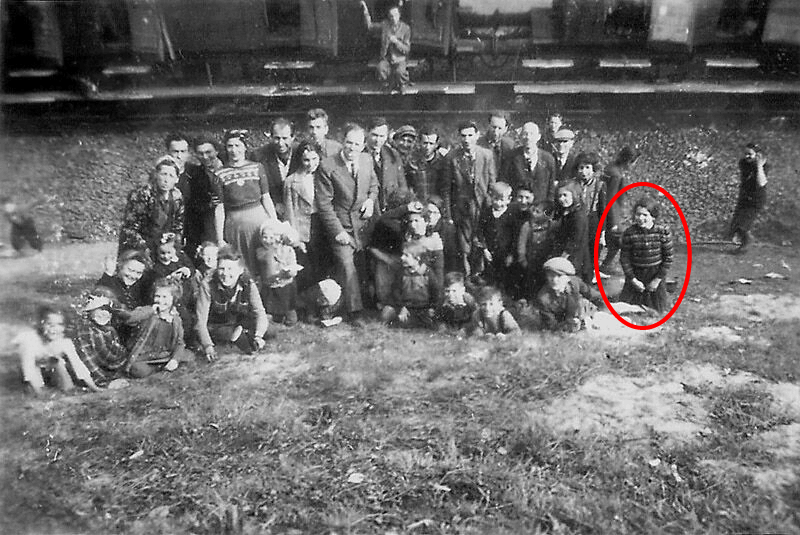
After awhile, some Germans rode by on bicycles, and when they heard it was a train full of Jews they ordered the German guards to kill us. In the meantime, American planes flew low above us and apparently took pictures that showed people and children. The German guards that were still there to watch over us started to shoot with machine guns at the planes. Our people asked them to stop shooting, but they refused. We got off the train and hid under the wheels.
I would now like to add something personal. My aunt sat with me under the wheels and took out a little notebook that contained the names and addresses of our relatives in America. She told me to learn all of this by heart because you never know who the bullet will hit – and when the war would end I should contact these relatives and ask them to take me in. I listened to her and learned everything by heart. Until today, I remember some of these names and addresses.
As you know, the Germans didn’t get a chance to kill us, and you, the American angels, came on time. The children started to run to the small village to ask for food, and again my good friend dragged me with her and we managed to get some milk and bread.
After a day or two, the American army asked us to get on trucks and go to a village called Hillersleben. We were all afraid because we had learned from the past that every transport means death. In the end, they found a Jewish American soldier who announced in Yiddish over the loudspeaker that we had nothing to be afraid of and that we would be moving to nice and clean houses. And this is how the chapter of the train ended. But for me, on a personal note, my story continued…
I want to point out that in 1995 I went with my husband to Bergen-Belsen for the 50th anniversary of the camp’s liberation. From there we went to Hillersleben. The place looked very different from what I remembered, probably as a result of the Russian influence for 50 years. We managed to find a Jewish monument in the yard of a church. On it was written: In memory of 138 Jewish survivors of Bergen-Belsen.
With regards,
Ariela R.
Toronto, Ontario
Canada
Posted in Uncategorized |
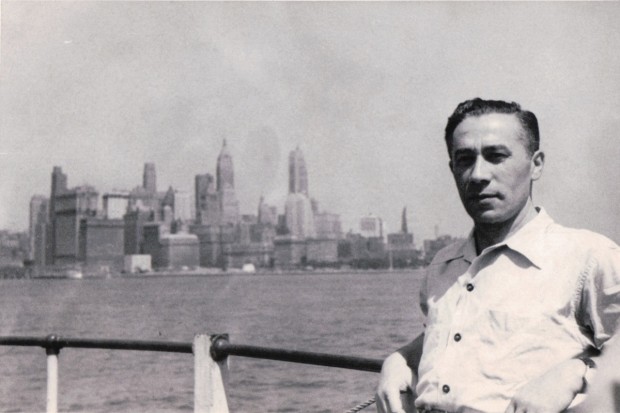
Oscar Muller, who was held in three different concentration camps during World War II, sailed from Belgium to the U.S. after he was liberated in 1945. New York City is pictured in the background.
This article appeared in the GF Post Star on August 22. Mr. Muller was liberated on this train near Magdeburg. Ironically one of his liberators, Carrol Walsh, lived 5 minutes away, but they were never able to meet. What are the odds, but then, there are no coincidences. I’ll post more on his life later.
BY Meg Hagerty, Features writer
As a young man, Oscar Muller knew when trouble was brewing in the Janowska concentration camp in the Lvov ghetto of Poland. Whenever the Nazis planned to round up Jews and lead them to their death as part of a “selection,” Oscar was forewarned by a premonition — the screech of a train whistle that blared in his head.
He’d frantically seek refuge by holing up in a nearby attic or cellar, or fleeing over a fence until the danger had passed. Then he’d go about foraging for scraps of food.
It was all part of just trying to survive during the horrific years of the Holocaust.
Oscar, of Glens Falls, died July 31 at the age of 103.
The youngest of eight children, he was studying architecture in his native Poland in 1939 when the Soviets forced him and his family out of their spacious apartment. As bad as it was to be occupied by the Russians, life for the Jews became worse when the Germans invaded.
The terror started in 1942, Oscar stated in a diary about his life during the Nazi occupation.
“The old and sick were taken to the outskirts of the city, killed and burned to make room for more,” he wrote. “Women and children were sent to Belzec where elaborate places were built to kill them by pumping gas. This made it possible to kill lots of people quickly.”
Joy Muller-McCoola, Oscar’s daughter, said her father watched most of his family, save for one brother, be murdered by the Germans.
Oscar, however, never doubted he would be able to survive the atrocities.
“He was incredibly optimistic,” Joy said.
Oscar was imprisoned at three different death camps and did what was necessary to stay useful to his captors, but would never submit to being a “policeman” for the Nazis, mornitoring the movements of other Jews.
At Bergen-Belsen in northwestern Germany, Oscar reported to an “oberstrumfuhrer,” who ordered that he keep track of the prisoners who were either sick or dead.
Joy believed it was because her father had training in architectural lettering and numbering that he was kept alive.
Oscar also tried to keep peace among the 100 starving prisoners held in the crude barracks at Bergen-Belsen by cobbling together a scale out of two pieces of cardboard, string and a piece of wood to weigh out the one slice of bread allowed per person each day.
A young boy who was held at the concentration camp remembered Oscar making the scale and later, when Martin Spett became an adult and made his way to the United States, he became an artist who painted vivid memories from the Holocaust, One work in Martin’s “Reflections of the Soul” — a collection of his pieces — shows a man cutting a very thin slice of bread surrounded by a gaunt-looking crowd of prisoners. Oscar was the younger man weighing the bread on the primitive scale.
To keep the prisoners’ minds active, Oscar made a chess set out of scraps of wood.
He also scrounged for food to feed a starving rabbi, making off with scraps while carrying kettles back to the kitchen. Joy said at first her father felt guilty for having stolen, but the rabbi convinced him otherwise.
“They stole our lives from us; we’re just doing what we can to get those back,” Joy said her father was told. “Afterward, he was proud to have done that.”
Not surprisingly, Oscar’s life was forever shaped by the events of the Holocaust, as were the lives of his children and grandchildren.
Oscar was a gifted photographer who appreciated beauty, said his son, Dan; he was also known as “the man with the golden hands,” replicating anything after looking at it just once.
After Oscar was freed from the concentration camps, he sailed to New York from Belgium in 1949. He regularly rode the subway into Manhattan looking for work and met someone who made handbags. He went to a couple of interviews, saw what the designers were doing and drew up a portfolio, which he then turned into a long career as a one-of-a-kind handbag designer.
Oscar crafted furniture for himself and his wife, Lily, in their Bronx apartment, including cupboards with broomstick handles and a daybed with storage compartments.
“He knew how to design things to stuff things away in a very small place,” Dan said. “Everything he designed, even though it was to store tools or to put linens in, they always had beautiful lines.”
“Any of those pieces could have been in the Museum of Modern Art’s design collection and it would have looked fine because that’s what he did,” Joy added.
Oscar also worked through some of the “damage” from his death camp experience with his three-dimensional art. One particular piece hangs on the wall in Joy’s Glens Falls home.
It is a square picture with cage-like bars made of nails around the perimeter, and a broken eggshell and human eyeball painted in the center. Dan and Joy interpreted the art to mean that their spunky father watched himself build a new life after breaking free of the bonds that once held him.
“He was resilient,” Joy said.
Copyright 2011 The Post-Star. All rights reserved.
Read more: http://poststar.com/news/local/after-surviving-holocaust-glens-falls-man-lived-to/article_3b24d02c-cc3b-11e0-8978-001cc4c03286.html#ixzz1Vo24LOzL
Posted in Uncategorized | 2 Comments »
2011 American Soldiers-Holocaust Survivors Symposium and Reunion
Hudson Falls High School, Hudson Falls, New York
September 20-23, 2011
Three weeks before the end of World War II in Europe, on the morning of Friday, April 13th, 1945, the 30th Infantry Division and attached units were fighting their way eastward in the final drive through central Germany toward the Elbe River. A small task force was formed to investigate a train that had been hastily abandoned by German soldiers near the town of Magdeburg, Germany. The boxcars were filled with Jewish families that had survived the infamous concentration camp at Bergen-Belsen and were now being transported away from the advancing Allies to another death camp location. Scores of children were among the prisoners. Two weeks later, Soviet troops liberated a second train transport from Belsen.
In 2001, as part of a class project collecting the testimony of World War II veterans, Mr. Matthew Rozell, a teacher at Hudson Falls High School, interviewed one of his student’s grandparents, a tank commander who told him this story. This long forgotten event was about to spring to life. Holocaust survivors all over the world who had been children aboard the death train began to find their rescuers’ narratives and even the photographs of the day of their liberation near Magdeburg in 1945 on this oral history website, www.hfcsd.org/ww2, produced by Mr. Rozell and his students. Mr. Rozell created a second website, www.teachinghistorymatters.com, devoted to collecting these testimonies and recording the unfolding organic nature of this reconnection of survivors and liberators.
Today, over 200 living survivors of this train have been located, and now have the opportunity to get together with the soldiers who freed them 66 years ago.
 Our 2011 theme is “Repairing the World”. The trauma of the Holocaust and of World War II left its mark on the survivors and soldiers of WWII; this will also be an occasion to remember the sacrifices of the veterans of all wars. In sharing stories, participants have the opportunity to help heal the world, in the Jewish tradition of tikkun olam. The primary focus of the conference will be on education; it will be witnessed by as many as 1500 students and thousands more via a live feed on our school website, and it will be recorded for educational purposes. In 2009, the United States Holocaust Memorial Museum and the Bergen Belsen Memorial in Germany sent representatives, and this year will be invited again; researchers from the National World War II Museum in New Orleans may be here as well.
In addition, a book fair and photographic exhibition will be held with several authors in attendance, speaking and signing their books. Major news organizations are expected to cover the event, and it is hoped that a documentary film crew will also be here.
Our high school facilities are “state of the art”, and our auditorium is air conditioned, just a scenic 15-20 minute ride away from hotels at the most beautiful time of the year.
Tuesday, the welcoming reception and dinner will be held at the Six Flags Great Escape Lodge Resort (www.sixflagsgreatescapelodge.com). On Wednesday morning, we will have a welcoming breakfast for you with students and school officials at a restaurant near the school. Lunches will be catered between programs at the school, on Wednesday evening, the Lake George Steamboat Company (www.lakegeorgesteamboat.com) has again generously agreed to custom charter a welcoming dinner cruise for our students, soldiers and survivors and our sponsors. Following Thursday’s school program, dinner will be held at the Six Flags Great Escape Lodge Resort; the concluding activity after Friday’s school program will be the final banquet at the Dunham’s Bay Resort (http://www.dunhamsbay.com).
The Adirondack Balloon Festival (www.adirondackballoonfest.org) is the same week, and should also provide quite a spectacle.
You may email me at marozell@gmail.com for a reunion registration form and a hotel reservation information sheet. Shuttle service is available to and from Albany International Airport (ALB), about an hour south just down I-87, the Adirondack Northway. It is highly recommended that you make your reservations as soon as possible to guarantee your places; rooms now being held will be released after 8/20. With the ADK Balloon Festival the same week, hotels are filling fast; cancellations can be made later, if necessary.
Please join us for this final reunion/educational symposium.
Posted in Uncategorized |
-
Join 23.8K other subscribers
Blog Stats
- 760,353 hits
Top Posts & Pages
-
Recent Posts
Facebook Page
Twitter Updates
Tweets by marozellArchives
- February 2026 (1)
- November 2025 (2)
- September 2025 (1)
- August 2025 (2)
- July 2025 (1)
- June 2025 (1)
- April 2025 (4)
- March 2025 (2)
- January 2025 (1)
- December 2024 (2)
- November 2024 (2)
- October 2024 (3)
- September 2024 (1)
- June 2024 (1)
- April 2024 (1)
- February 2024 (1)
- November 2023 (2)
- October 2023 (1)
- September 2023 (1)
- July 2023 (1)
- June 2023 (2)
- May 2023 (1)
- April 2023 (8)
- February 2023 (1)
- January 2023 (1)
- November 2022 (2)
- September 2022 (2)
- July 2022 (1)
- June 2022 (2)
- May 2022 (1)
- April 2022 (7)
- February 2022 (1)
- January 2022 (1)
- September 2021 (2)
- July 2021 (1)
- May 2021 (1)
- April 2021 (1)
- March 2021 (1)
- August 2020 (1)
- June 2020 (1)
- May 2020 (1)
- April 2020 (2)
- March 2020 (1)
- February 2020 (4)
- January 2020 (4)
- December 2019 (3)
- November 2019 (1)
- October 2019 (2)
- September 2019 (1)
- August 2019 (1)
- July 2019 (2)
- June 2019 (2)
- May 2019 (2)
- April 2019 (4)
- March 2019 (2)
- February 2019 (2)
- January 2019 (1)
- December 2018 (3)
- November 2018 (2)
- October 2018 (1)
- September 2018 (2)
- June 2018 (3)
- May 2018 (2)
- April 2018 (2)
- March 2018 (1)
- February 2018 (2)
- January 2018 (1)
- December 2017 (1)
- November 2017 (2)
- September 2017 (3)
- August 2017 (3)
- June 2017 (3)
- May 2017 (1)
- April 2017 (8)
- February 2017 (3)
- January 2017 (2)
- December 2016 (2)
- November 2016 (4)
- September 2016 (3)
- July 2016 (5)
- June 2016 (3)
- May 2016 (3)
- April 2016 (3)
- March 2016 (4)
- February 2016 (3)
- January 2016 (3)
- December 2015 (7)
- November 2015 (4)
- October 2015 (3)
- September 2015 (8)
- August 2015 (6)
- July 2015 (6)
- June 2015 (2)
- May 2015 (5)
- April 2015 (13)
- March 2015 (1)
- February 2015 (2)
- January 2015 (8)
- December 2014 (2)
- November 2014 (6)
- October 2014 (2)
- August 2014 (1)
- July 2014 (20)
- June 2014 (2)
- May 2014 (3)
- April 2014 (5)
- March 2014 (3)
- January 2014 (1)
- November 2013 (7)
- October 2013 (4)
- September 2013 (4)
- August 2013 (3)
- July 2013 (6)
- June 2013 (6)
- May 2013 (7)
- April 2013 (12)
- March 2013 (2)
- January 2013 (7)
- December 2012 (4)
- November 2012 (7)
- September 2012 (1)
- August 2012 (2)
- June 2012 (1)
- May 2012 (3)
- April 2012 (13)
- March 2012 (3)
- January 2012 (3)
- December 2011 (1)
- November 2011 (1)
- October 2011 (2)
- September 2011 (5)
- August 2011 (4)
- July 2011 (1)
- June 2011 (2)
- May 2011 (4)
- April 2011 (3)
- March 2011 (1)
- February 2011 (3)
- October 2010 (4)
- September 2010 (1)
- August 2010 (1)
- July 2010 (2)
- June 2010 (5)
- May 2010 (3)
- April 2010 (10)
- March 2010 (3)
- February 2010 (4)
- January 2010 (2)
- December 2009 (2)
- September 2009 (2)
- June 2009 (1)
- May 2009 (2)
- April 2009 (3)
- February 2009 (1)
- January 2009 (3)
- December 2008 (5)
- November 2008 (3)
- August 2008 (4)
- July 2008 (1)
- May 2008 (4)
- April 2008 (4)
- January 2008 (3)
- December 2007 (1)
- November 2007 (2)
- October 2007 (1)
- September 2007 (4)


 Teaching History Matters