Feeds:
Posts
Comments


Israeli educational psychologist Haim Ginott writes about a letter that teachers would receive from their principal each year:

I am a survivor of a concentration camp. My eyes saw what no person should witness: gas chambers built by learned engineers. Children poisoned by educated physicians. Infants killed by trained nurses. Women and babies shot by high school and college graduates.

So, I am suspicious of education.

My request is this:  Help your children become human. Your efforts must never produce learned monsters, skilled psychopaths or educated Eichmanns. Reading, writing, and arithmetic are important only if they serve to make our children more human.

This has become the mission statement and educational philosophy of some Holocaust education institutions and it really sums up what my mission as  a teacher is all about. But please note  below that I did not intend it that way. At all.

Today I will be a special guest for the Tennessee Days of Remembrance Ceremony at the State Capitol in Nashville with legislative members, the governor and the lieutenant governor. This evening I will give my first address to fellow Holocaust educators.

How does a kid from a small town with no experience in Holocaust education go on to add a new chapters to the stories of thousands of persons’ lives? To become a regarded figure in Holocaust and History education circles, nationwide?

The honest answer is, I just don’t know.

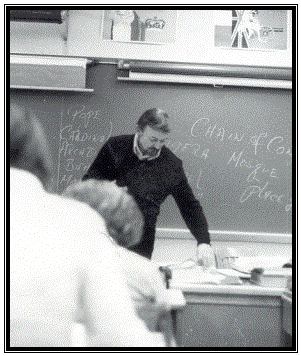
My dad in the classroom. Around the time that I puffed out my chest and claimed I certainly would not be a teacher.

But it happened. This from a kid who distinctly remembers the purposeful slight given to his dad. Dad was a history teacher in Glens Falls, the next town over. He was good, and he loved the students. Everyday he came home happy and sometimes even humming a tune. Who delivered the purposeful slight? His first born son.

Our relationship,  as I grew into the teenage years, was a bit strained. So when he asked me, as a junior or senior,  in the car riding home from school one day down Main Street, the MAIN STREET of the town that produced him, what I would like to do someday after I graduated from high school, I told him, “I don’t know, but I won’t be in HUDSON FALLS anymore, and I SURE WON’T BE A TEACHER…..”- the desired effect was achieved by the angry teen, the wound deep, the twist of the knife distinct…

Yet there I was, eight years later, living in the room out back of the family homestead on that Main Street, fending my way on the other side of the desk in the classroom of my alma mater, and not just any classroom- a history classroom, teaching the exact same subject as the old man…

What if I had never come home, as planned? What if I had not gone back to school for a teaching certificate, after graduating with that “unmarketable” history degree? What if I had landed that job in the college town I called my new home, instead if coming in 2nd for it? I would have never met the tank commanders. Then, what if Walsh’s daughter had not said, after two exhausting hours of combat tales, just as we were about to turn the camera off,   “Dad, did you tell Mr. Rozell about the train?

Things happen for a reason. I think there are no coincidences.

In the words of a former  principal of mine, we are here “to make human beings out of them” (not that they were not before, but you get his point-the exact same point of the speaker noted above.)

I am suspicious of those who will dictate to me from ” on high” what I should be doing in the classroom. Perhaps Dr.  Ginott would have agreed.


I interviewed a Holocaust refugee and another liberator on Friday last… rolled into one! A special man. A German Jew whose father was mortally injured on Kristalnacht, Henry Birnbrey was sponsored and got out of Germany as a young teen and was given special permission from FDR to join the Army-previously classified “enemy alien” for his German birth- and stumbled upon the train as a forward artillery spotter scouting positions in the lead up to the final battle at Magdeburg.  Henry was in the 531st AAA of the 30th Infantry Division- Survivor Steve Barry mentions forward artillery spotters in his memoirs- and Henry was one of them. Much of what follows is his testimony as given to the Breman Museum in Atlanta, Georgia, interspersed with his memories as privately published in  his war memoirs.

I was born in Dortmund, Germany in 1923. During 1937 and 1938 my parents made applications for me to emigrate to Palestine, New Zealand and the USA. The USA visa came in first and an emergency visa was issued to me the week Hitler invaded Austria, as the various agencies feared that this invasion would be followed by war.

I left Germany on March 31, 1938, leaving my parents behind. In the meanwhile, my father had already been arrested. He was accused of having made statements against the government. He was released with the promise to abandon his business and livelihood. Consequently, we lived without income during the years 1937 and 1938. After I left Germany, my father was picked up again on Kristallnacht (November 9, 1938) and he died a couple of months later from the wounds received when he was picked up and arrested. My mother died a few months later. The death certificate of my father stated the cause of death as “heart failure” and only in 1999 did I finally locate the documents that verified what happened in 1938, but too late to entitle me to compensation, which had been denied because their records showed a natural death.

The Birmingham Section of the council of Jewish Women sponsored my immigration to the US, and the social services were provided by the Jewish Children Service here in Atlanta. I moved to Atlanta in January 1939. In Birmingham and Atlanta I lived in foster homes.

I supported myself by working in a clothing store, later managing a shoe store, and in 1942 I went to work for a local accountant. In 1943 I joined the US Army. In 1944 I was with the Normandy invasion forces. During my service in the army, but towards the end of the war, I came across  a train of cattle cars full of Jewish concentration camp survivors and people who did not survive. We opened the cars and were shocked to see the condition of the occupants of these cattle cars. During this same week as we were advancing toward the Oder River, we passed ditches full of corpses of concentration camp inmates who had been marched to the West to escape the Russian advance. Around April 1945, I became a counter intelligence agent and interrogated German POWs and citizens.

After the war, I found out that most of my family had perished in the concentration camps. My mother was one of ten children, and out of that family, two first cousins survived. These cousins had made aliyah in 1937. My father was one of three brothers and again, two first cousins survived. One had made aliyah to Israel in 1938 and the other one survived behind the Iron Curtain. The rest of the family perished. I found documents in the Berlin archive that showed when these people were born and when they died. What I was not prepared for was the detail of information which included the place they were assembled, the number of the transport which took them to the concentration camp and all sort of sordid details.

Henry continues: During World War II, I wanted to get to our hometown but I could not because the British Army was over there and we were a little bit south of there, but my experience as a soldier I think is worth mentioning. First of all, we were in the neighborhood of Magdeburg on reconnaissance. And we had, we had this horrible odor. We didn’t know what was happening. And it turned out to be one of the freight trains full of Jews being shipped from one concentration camp to another. And therefore I was able to personally witness this terrible inhumanity that was taking place. And all of these were my fellow Jews and brothers and everything else. They were almost, they had been reduced to such a non-human state it was impossible to communicate with them. I mean, all we could do is to try to get them food and ask for help. There was nothing we could do. These people were half dead, half crazy. I mean they’d been locked in these cars, were lying on the floor. It was just a horrible thing to witness, and something I’ll never forget as long as I live.

http://www.thebreman.org

And from Henry’s memoirs…. skeptics note again a liberator describing “walking skeletons” ….We moved on to the Braunschweig (Brunswick) area. Here, along the highway, we encountered ditches full of dead concentration camp prisoners who had been marched from one camp to another and were shot before they had a chance to be liberated.
…In April of 1945 while on reconnaissance near Magdeburg we encountered a horrible odor. As we got closer we discovered an abandoned train of cattle cars. When we opened the cars they were filled with half dead and dead Jews being transported from the Bergen-Belsen concentration camp to another camp. The sub-human conditions to which these people were subjected to had reduced them to a very sorry state. We did not know how long they had been in those cars, they looked like walking skeletons and could barely speak. Unfortunately we had no food to share with them, which gave us a very helpless feeling. When headquarters was notified, someone evacuated all German civilians from a nearby village, Hillersleben and turned this village into a hospital. Unfortunately we could not stay around to learn more, to speak to and encourage these people or perform other deeds of human kindness…I was reminded of the words of the prophet Ezekiel-”He took me down in the spirit of G-d and set me down in the valley. It was full of bones.”

…and this is where I (MR) am trying to put the pieces of the story together….


Haunting cover image from Boder’s groundbreaking interview book.

Today I was visiting links on the Internet related to oral history projects. The description I found below intrigued me-interviews recorded in the summer of 1946.

“Voices of the Holocaust – Online repository that contains audio clips and transcripts of interviews done by Dr. David Boder of Holocaust survivors in 1946. The mission of Voices of the Holocaust project is to provide a permanent digital archive of digitized, restored, transcribed, and translated interviews with Holocaust survivors conducted by Dr. Boder in 1946, so that they can be experienced by a global audience of students, researchers, historians, and the general public.”

I went to the site at the  Paul V. Galvin Library at the Illinois Institute of Technology. I then clicked on places in Europe that Dr. Boder went to record his interviews, displaced persons camps or transit areas as survivors sorted out their lives and tried to plan their future. On the actual pages you can not only read the transcription, but also hear the actual recordings…. and he encouraged several survivors to sing for him on tape. Amazing.

Well, I saw some names that I thought I recognized from survivors I have met or from the manifest list provided by the Bergen Belsen Memorial. Sure enough, several of these survivors were liberated on our train near MagdeburgBelow I have the complete transcript, taken from the site, of a 24 year old Greek Jew who lost both of his parents upon liberation. If you go to the link, you can actually listen to his testimony from 1946! Below, I have taken the liberty of emphasizing his liberation story in bold print.

Dr. Alan Rosen recently published a book on this fascinating subject, and you can read his bio of Dr. Boder here. Dr. Rosen reports that his actual name is Mene Mizrahi.

*********************************************************************************************************************************************

David Boder: [In English] This is Spool 9-43B. The interviewee is Mr. Mizrachi and he speaks English. November the 21st 1950. Boder.
David Boder: This is Spool 43 continued. The interviewee is Señor Manis Mizrachi or Mr. Manis Mizrachi. Born in Greece, how old are you Mr. Mizrachi?
Manis Mizrachi: I am twenty-four years old.
David Boder: He’s twenty-four years old. He speaks good English and we will have his report in English. Also Mr. Mizrachi would you tell us again what is your full name where were you born?
Manis Mizrachi: My name is Mizrachi Mimi I have been born in Salonika.
David Boder: Yes. Your last name is really Mizrachi so we . . .
Manis Mizrachi: . . . Mizrachi, yes
David Boder: . . . call you in America “Minis Mizrachi.”
Manis Mizrachi: . . . Mizrachi, yes
David Boder: You were born where?
Manis Mizrachi: In Salonika, 1922.
David Boder: In 1922, yes.
Manis Mizrachi: The 17th of January.
David Boder: Yeah, and tell me, who were your parents and what was their business.
Manis Mizrachi: My parents – my father was Oscar Mizrachi and he was . . . he saled articles which he brought from every country and he was a representative of several firms.
David Boder: Ah! He was an importer?
Manis Mizrachi: importer yes.
David Boder: Yes, for instance what kind of articles was he selling?
Manis Mizrachi: He was selling clothing and paper, he brought paper and several other things what he could make.
David Boder: Now tell me how many people were in your family?
Manis Mizrachi: We’re three people.
David Boder: Yes.
Manis Mizrachi: My father, mother and me.
David Boder: You were the only son?
Manis Mizrachi: The only son.
David Boder: Yes, and now tell me where were you and what happened to your family when the Germans came to Greece?
Manis Mizrachi: Before the Germans came to Greece since my father was a freemason, we . . . were afraid for the Germans, them not to take him away from us. That for we made it up to go to Athens, the capital of Greece, since it is a very big country so we could . . .
David Boder: [speaking over each other] Big city you mean . . .
Manis Mizrachi: Big city, yes,
David Boder: So you could be better protected . . .
Manis Mizrachi: Better protected.
David Boder: Tell me what citizenship did your father have? Greece or Spanish?
Manis Mizrachi: My father was Spanish
David Boder: And your mother?
Manis Mizrachi: My mother was Turkish.
David Boder: Turkish? And you were considered what?
Manis Mizrachi: I have been considered Spanish.
David Boder: Because your father was Spanish. Have you lived in Spain?
Manis Mizrachi: Never, I have never in Spain.
David Boder: Yes, all right, and so you went to AthensManis Mizrachi: And so we went to Athens but anyhow the Germans took us because although the Consul of Spain has certifies us that we have no reason to be afraid that the Germans will take us and but for this obliged us not to leave and not to hide ourselves and so the Germans came one night at two o’clock and got us [the whole family, they beat us firstly] and afterwards they put us into the Greek jail.
David Boder: All right, now . . . Tell me this . . . [mutters] All right, tell me this: Were other Jews then arrested already and deported?
Manis Mizrachi: A lot of Jews, Spanish Jews, were arrested and [spread?] with our family together.
David Boder: Yes, and what was it a kind of a raid at that time or what?
Manis Mizrachi: It was a raid, it was a raid for whole Spanish in order not to leave them the time to hide themselves because one day before they arrested all Greek citizens, Jews of course.
David Boder: They arrested the Greeks citizens that were Jews. And now they began to arrest the Spanish citizens . . . well didn’t you show your papers from the Consul?
Manis Mizrachi: We showed our papers from the Consul but it [laughing a little] helped nothing.
David Boder: All right, so then what did they do with the family, go slowly step-by-step.
Manis Mizrachi: Then they put us in cars and brought us in the Greek jail where we were obliged to sleep down without any help . . . they give us no things to eat, nothing. We’re made whole day without any thing . . .
David Boder: [interrupting] Was the family together?
Manis Mizrachi: The family was together firstly; afterwards, they ordered us the men to go separately and the women from the other side. So we remained there in the jail about fifteen days and the first of April we were obliged to leave the jail and they put us into trains . . . of beasts.
David Boder: Why do you call it “trains of beasts?” They were . . .
Manis Mizrachi: Because they were closed trains were they are putting the [laughing a little] . . . horses and . . . the pigs
David Boder: . . . the trains with the openings? Because animals they transport . . .
Manis Mizrachi: No, they were closed but they were with wires.
David Boder: [Talking over each other] Where were the wires?
Manis Mizrachi: The wires were at the windows. Little window was there, very high, although they were afraid us not to look from what happened around and so they put us there and they locked us, the door so we couldn’t get out for any necessary . . .
David Boder: For any necessary? Were you men and women together . . .
Manis Mizrachi: We were men and women together. Sixty-four people in a wagon, it was very difficult to take air and to eat, we had nothing to eat.
David Boder: Didn’t they tell you to take your things?
Manis Mizrachi: No, they didn’t give – they gave us only some carrots and bottle of water and place . . .
David Boder: What do you mean a bottle of water for all or what?
Manis Mizrachi: It was . . . two big bottles
David Boder: Two big bottles of water.
Manis Mizrachi: . . . bottles of water.
David Boder: What do you think? How many liters was there in each one?
Manis Mizrachi: Twenty-five liters about.
David Boder: You mean twenty-five liters to the bottle?
Manis Mizrachi: Yes, and it was very hard we couldn’t have water enough because we had children with us and we couldn’t wash ourselves we were very dirty . . .
David Boder: Yes.
Manis Mizrachi: . . . and after the tenth day of traveling
David Boder: [astonished] . . . wait you mean you were ten days, ten days in the car?
Manis Mizrachi: In all we were fourteen days but after the tenth day they opened – they got out the wires so we could look outwards but we were without shaving ourselves and were like beasts.
David Boder: Now tell me what kind of toilet facilities did you have?
Manis Mizrachi: No one. Every two days they opened us the doors in order to get out things that . . . we couldn’t keep anymore in our leavings[?]
David Boder: Did you have a pocket for it?
Manis Mizrachi: No, it was in a piece of papers what they gave us specially for that.
David Boder: And women and men together in this . . .
Manis Mizrachi: Women and men together . . .
David Boder: . . . and children
Manis Mizrachi: . . . it was awful
David Boder: And so?
Manis Mizrachi: And so, until we arrived at six in the morning—six o’clock in the morning and the town of Celle which is some kilometers far from the camp, real camp of Bergen-Belsen. And so we went there, we were obliged to go—to step seven or eight kilometers.
David Boder: To walk?
Manis Mizrachi: To walk there with our grandfathers, with our fathers, sisters, sick women, with our children and however it was very difficult for us and this one who couldn’t walk he was beaten by the Germans, soldiers, by the capos . . . were the leaders.
David Boder: What is capos?
Manis Mizrachi: Capos were the leaders.
David Boder: Were they prisoners?
Manis Mizrachi: They were prisoners but who . . . somewhere . . . collaborated with the Germans together. And they beat us awfully we were not accustomed to this kind of manner and they were laughing at us when we made strange figures.
David Boder: Strange faces you mean?
Manis Mizrachi: Strange faces, yes.
David Boder: And well, and so how long did it last to walk these eight kilometers?
Manis Mizrachi: This eight kilometers took us about . . . one hour and a half.
David Boder: [after a pause] That’s very fast walking.
Manis Mizrachi: Yes! We were obliged to run.
David Boder: Well you had no things to carry
Manis Mizrachi: No things to carry, nothing.
David Boder: Well then . . .
Manis Mizrachi: Because we had some things we could keep with us but we were obliged to leave it in the way in order to go very fast because it was a Polish capo behind and he was beating you.
David Boder: A Polish capo?
Manis Mizrachi: A Polish, yes.
David Boder: All right, but you were together with your father and mother?
Manis Mizrachi: No I wasn’t even with my father, and my mother had been put in another range [?].
David Boder: Oh, your mother was put in another what?
Manis Mizrachi: In other file.
David Boder: In another file, all right. But she was marching the same way with you?
Manis Mizrachi: Yes, much in the same way.
David Boder: All right.
Manis Mizrachi: Afterwards we went to the camp they . . . were obliged to stay there for l’appel.
David Boder: What is the name of the camp?
Manis Mizrachi: The camp Bergen-Belsen.
David Boder: Yes
Manis Mizrachi: We were obliged to stay there about two hours waiting until the German come and ask our names . . .
David Boder: Yes . . .
Manis Mizrachi: . . . conforming to the list that he could have in Athens when he put us into the train
David Boder: Do you have a tattoo number?
Manis Mizrachi: No, in Bergen-Belsen there was no tattoo number.
David Boder: Yes.
Manis Mizrachi: My account number was one thousand four hundred sixty two.
David Boder: Uh-huh, all right
Manis Mizrachi: . . . It was my account number
David Boder: One thousand . . .
Manis Mizrachi: One thousand four hundred sixty two.
David Boder: ..sixty two. And so . . .
Manis Mizrachi: And so we have been put in big barrack . . .
David Boder: You with your father?
Manis Mizrachi: With my father and with my mother in separate barrack. And around us was the wires—electric . . .
David Boder: Oh, electric wires. Yes.
Manis Mizrachi: . . . have been charged. And we couldn’t go out firstly until the doctor came in order to see whether we’re ill or not.
David Boder: Yes.
Manis Mizrachi: And afterwards we could be with our mother and with every friend and so on because of our citizenship.
David Boder: Oh, because you were Spanish.
Manis Mizrachi: Spanish, yes. The only thing which we had. As Spanish people.
David Boder: Yes.
Manis Mizrachi: Of course, firstly we couldn’t eat what they gave us. It were carrots in boiled water. This was our eating. And we gave it to other brothers of us—other Jews—of Greece. And Polish people too who were with us in the camp. And we were obliged after one week to eat because we starved. And so we carried everything—everything green that we saw on the earth we took it out from there and we started to eat it without caring if it was dirty or clean.
David Boder: Uh-huh, without cooking?
Manis Mizrachi: Without cooking . . .
David Boder: Yes.
Manis Mizrachi: . . . like beasts.
David Boder: Yes.
Manis Mizrachi: And so they started to put us in this category of prisoners that starved to eat and wore closed and we had no rights to go out – to work – we were obliged to stay.
David Boder: Well, because the Spanish . . .
Manis Mizrachi: Because Spanish citizenship.
David Boder: . . . we were not supposed to work
Manis Mizrachi: We were not supposed to work but this was bad because the others who were out they were working at the transport of food, of legumes . . .
David Boder: Of vegetables.
Manis Mizrachi: Of vegetables. And they could have some profit in taking some of them. But for us it was impossible. And so we were obliged to live on only those things that we received from Germans.
David Boder: Did the Red Cross help in any way.
Manis Mizrachi: We had no help of the Red Cross. Never we got help from the Red Cross. Only our capos they had . . . many profits who unfortunately they put only for themselves and they never helped the others
David Boder: Were the capos Jews?
Manis Mizrachi: They were the Jews with us from Greece they came with us. And they started making friendship with the Polish capos, the old ones who were there and so they had a lot of . . .
David Boder: Polish Jewish?
Manis Mizrachi: Polish Jewish. I speak always from Jewish
David Boder: And so?
Manis Mizrachi: And so they made friendship with them and so they had everything for their own families. They had special room to live and they ate separately. We were not to see what they were eating, we smelled only the meat and everything else that they got . . . from the Germans.
David Boder: From the Germans?
Manis Mizrachi: From the Germans. And, unfortunately, our people—the people who didn’t want to beat and to collaborate with the Germans—starved and had only his home in back.
David Boder: Yes
Manis Mizrachi: This is all [slightly laughing].
David Boder: Well, and that was in . . . Auschwitz?
Manis Mizrachi: That was in Bergen-Belsen.
David Boder: In Bergen-Belsen . . .
Manis Mizrachi: Bergen-Belsen.
David Boder: Well . . . did you hear about . . . All right, so how long were you in Bergen-Belsen?
Manis Mizrachi: I have been there about eighteen months—one year and six months.
David Boder: And then, where were you taken from?
Manis Mizrachi: Then I have been taken—we have been put into a big train in order to be transported to Theresienstadt. In the last days—two days before the English came, the British troops came in Bergen-Belsen.
David Boder: Yes.
Manis Mizrachi: Um, this train was a big train of sixty-four wagons.
David Boder: Yes.
Manis Mizrachi: And have been put in, again in . . . beasts-cars . . .
David Boder: Cattle-wagons?
Manis Mizrachi: Cattle-wagons. Sixty-four to seventy people in a car and started of course many ‘spense [?] . . . many sick . . .
David Boder: Many sick people.
Manis Mizrachi: . . . many sick people. We started then with the Typhus.
David Boder: Oh yes.
Manis Mizrachi: It was then when I lost my two parents. Unfortunately, at the last days. I lost them—my father . . .
David Boder: What do you mean—in Bergen-Belsen?
Manis Mizrachi: In the train—the big train—they caught there Typhus
David Boder: Oh, in the train. About how many days before liberation?
Manis Mizrachi: The first died . . . at just at the same . . . at the moment of the liberation and my mother which was looking for [after] my father died ten days afterwards . . .
David Boder: After the liberation
Manis Mizrachi: And I got it too . . .
David Boder: You got it?
Manis Mizrachi: . . . because I was obliged to see . . . to look for [after] for my mother.
David Boder: You had to look for your mother, yes? And?
Manis Mizrachi: And so I got it also—”I meant thirty in one days”[?]
David Boder: What typhus was it? Ricket . . . Ricket . . . Spotted typhus?
Manis Mizrachi: Spotted typhus, yes.
David Boder: So then you lost your parents.
David Boder: [speaking over each other] .. of liberation. And you remained alone.
Manis Mizrachi: I remained quite alone without any help. Quite alone.
David Boder: All right, so where did you go then?
Manis Mizrachi: I was student and then the American troops were very kind with us—they helped us.
David Boder: Well, which camp were you freed or were you freed from the train?
Manis Mizrachi: From the train directly because it was an air attack.
David Boder: Oh, yes.
Manis Mizrachi: Attack of the air force.
David Boder: Yes.
Manis Mizrachi: British Air force.
David Boder: And so?
Manis Mizrachi: And so the machine . . . had been in damage.
David Boder: The, yes, the machine was damaged.
Manis Mizrachi: . . . was damaged.
David Boder: Yes, and the train couldn’t continue.
Manis Mizrachi: . . . couldn’t continue. And . . . we made some activity there we got prisoners, the Germans, the SS . . .
David Boder: Yes.
Manis Mizrachi: . . . and we waited until the American tanks.
David Boder: . . . came.
Manis Mizrachi: Came. Yes, it was ninth army. The ninth American army.
David Boder: Uh-huh.
Manis Mizrachi: . . . Which liberated us.
David Boder: Yes, so then you took the SS prisoners? Why didn’t you kill them?
Manis Mizrachi: [slightly laughing] We had no right to kill them . . .
David Boder: Why?
Manis Mizrachi: Because the capos—the chiefs . . .
David Boder: Yes.
Manis Mizrachi: . . . who directed this movement told us not to do anything until the American troops arrived.
David Boder: Yes
David Boder: And then what did the Americans do with them?
Manis Mizrachi: The Americans took their arms and they took them away, we don’t know what happened.
David Boder: They took them prisoners?
Manis Mizrachi: Prisoners, yes.
David Boder: All right, and then you were in the train,
Manis Mizrachi: And then . . .
David Boder: . . . where were you taken from there?
Manis Mizrachi: And at once, the officers, the American officers went to the village—the German village of Farsleben.
David Boder: Yes.
Manis Mizrachi: There. And he gave the order to every person to take us in, to take several families into his house.
David Boder: Yes.
Manis Mizrachi: And so, we got the place for some days.
David Boder: Uh-huh, and who was feeding you?
Manis Mizrachi: The Germans were obliged to feed us.
David Boder: Uh-huh.
Manis Mizrachi: They had a lot to feed us.
David Boder: And what did the Germans then say?
Manis Mizrachi: The Germans said that they never knew every- . . . something that happened to Jews and out of Germany and that they behaved something so ill with the Jews in the concentration camps that they let them starve and that they killed them. They didn’t know anything about those things. And whenever they knew, of course, they wouldn’t leave it . . . let the Germans . . .
David Boder: [finishing the thought] . . . they wouldn’t have let them do such things.
Manis Mizrachi: Yes.
David Boder: Uh-huh and then, where did you go and how did you go?
Manis Mizrachi: Then I was where, I got ill and I went at Hillersleben.
David Boder: Yes
Manis Mizrachi: Hillersleben is not far from them, some ten kilometers.
David Boder: Yes.
Manis Mizrachi: And then I meant the hospital, hospital El Melwani [?] there were three hospitals.
David Boder: Did you get typhus too?
Manis Mizrachi: I got Typhus too.
David Boder: So when they took you from the train did you have typhus already?
Manis Mizrachi: No I didn’t have.
David Boder: Oh, you didn’t have . . .
Manis Mizrachi: I was looking for [after] my mother.
David Boder: You were taking care of your mother?
Manis Mizrachi: Yes, taking care of her until she died.
David Boder: Yes.
Manis Mizrachi: Afterwards . . .
David Boder: Did you see your father dying?
Manis Mizrachi: I . . . . My father died on my hands.
David Boder: Yes.
Manis Mizrachi: I buried him with two other Jewish comrades.
David Boder: Yes.
Manis Mizrachi: . . . in Farsleben. And my mother died in Hillersleben.
David Boder: Yes.
Manis Mizrachi: They are seven kilometers away. I didn’t see my mother died – dead – because I was very ill at this moment. I was with 41.4 Centigrade . . .
David Boder: Temperature. Already with typhus?
Manis Mizrachi: With Typhus yes.
David Boder: And so when the freedom came . . . ?
Manis Mizrachi: When the freedom came, I was quite alone I remained quite alone . . .
David Boder: Did they take you to a hospital?
Manis Mizrachi: Yes.
David Boder: You were taken to a hospital?
Manis Mizrachi: I have been taken to a hospital.
David Boder: . . . and nurse to help?
Manis Mizrachi: Nurse help, German nurse. And they were not bad but they always tried to make sabotage.
David Boder: The Germans?
Manis Mizrachi: The Germans.
David Boder: In what way?
Manis Mizrachi: In what way . . . because they were throwing away the medicaments and whenever we were calling them but they didn’t come—only when the Brit- [corrects] an American soldier was present.
David Boder: . . . and then he would take . . .
Manis Mizrachi: . . . but not, they never took care of us.
David Boder: All right, and when you got well what happened then?
Manis Mizrachi: Then I took some days in order to get . . . stronger then because I couldn’t walk. I had forty-two kilograms.
David Boder: And where did you spend those days—in the hospital?
Manis Mizrachi: In the hospital.
David Boder: Yes.
Manis Mizrachi: And afterwards I have been taken by the American army and I said that I had parents in France. And that for they brought . . .
David Boder: You said that you had parents in France?
Manis Mizrachi: Yes, I had. I had.
David Boder: Relatives you mean?
Manis Mizrachi: I have relatives, yes. Relatives.
David Boder: Apart from your father and mother.
Manis Mizrachi: Relatives, yes. Relatives in France.
David Boder: And so they took you?
Manis Mizrachi: So they took me here and . . . unfortunately they had been displaced too. Deported and they didn’t come back.
David Boder: They did come back?
Manis Mizrachi: They did not come back.
David Boder: So you didn’t find relatives?
Manis Mizrachi: I did find. And I remained here.
David Boder: Yes. And for what are you working now?
Manis Mizrachi: Now I am working for the AJDC.
David Boder: For the American join . . .
Manis Mizrachi: [finishing] . . . distribution committee.
David Boder: What are you doing?
Manis Mizrachi: I am in the accounting department.
David Boder: Where did you learn English?
Manis Mizrachi: I learned English alone because I finished the German school . . .
David Boder: Where? Greece?
Manis Mizrachi: In Salonika, yes.
David Boder: You finished the German school where you learned Greek [corrects] where you learned English?
Manis Mizrachi: German. German and French and since I liked very much to learn English I learned it quite alone.
David Boder: with . . . [speaking over each other]
Manis Mizrachi: Just alone, myself.
David Boder: By which method? Shocked that haven’t got a better [ununintelligible] that you had to go to school?
Manis Mizrachi: No, I learned it quite alone. There was a friend of mine who went to the school . . . and I learned . . .
David Boder: And learned it alone. Now what do you plan to do in the future?
Manis Mizrachi: I am studying now; I am studying radio.
David Boder: Where, at the ORT?
Manis Mizrachi: No, quite alone, I am training myself.
David Boder: All right.
David Boder: You are studying radio and then you want to do what?
Manis Mizrachi: Then I hope to work in radio..
David Boder: Where?
Manis Mizrachi: I don’t know yet, perhaps I can go to the country I would be very satisfied.
David Boder: Which country?
Manis Mizrachi: I don’t know where to . . . the States? [Break in tape]
David Boder: . . . relatives in America?
Manis Mizrachi: . . . unfortunately, I have no one.
David Boder: You have no one.
Manis Mizrachi: No one.
David Boder: . . . Well this concludes Mr. .Mizrachi’s report. Taken on the- . . . on August the 12th at the offices of the American Joint Distribution Committee . . . recording of the Illinois Institute of Technology.
http://voices.iit.edu/interview?doc=mizrachiM&display=mizrachiM_en

Also note that the USHMM is looking for Mr. Mizrachi and several others who were interviewed that summer by Dr. Boder. For more information, click here.

Matthew Rozell, 30th Infantry Veterans of WWII, Holocaust survivors at Mighty Eighth Air Force Museum, March 2, 2012.

Ned and I are here in Savannah GA enjoying the hospitality of Carol Thompson and Jack  Sullivan as they host the annual 30th Infantry Division Veterans of WW2 reunion. At the reception desk I am greeted by Frank and Mary Towers, who are marking their sixty ninth anniversary together at the desk. There are at least a  dozen 30th Infantry Division soldiers here with us, and about as half as many Holocaust survivors.

Friday we headed out to the Mighty Eighth Air Force Museum for a tour and the memorial service; later I  gave my presentation to the group. The Savannah Morning News had this story after the presentation. Later in the evening, Larry and Claudia interviewed several of the veterans on camera; I joined to listen to the stories and share the tears  and the laughs as these guys relived events of 67 years ago.

World War II vets, Holocaust survivors convene in Savannah

By Corey Dickstein

March 3, 2012 – 12:33am

World War II vets, Holocaust survivors convene in Savannah

It was a single moment in time that occurred almost 67 years ago.

But for a group of people gathered in Savannah this weekend, it’s a moment that will forever link their lives.

Bruria Falik, Stephen Gross, Alex Larys, Micha Tomkiewicz and George Somjen were only children when they were incarcerated at the Nazi’s Bergen-Belsen Concentration Camp in northwestern Germany. In early April 1945, they were among 2,500 Jewish prisoners placed by the Nazis on a southbound train as Allied troops moved in on the camp.

While two trains carrying prisoners before theirs had made their way to other concentration camps, the train carrying Falik, Gross, Larys, Tomkiewicz and Somjen was abandoned by German soldiers near Magdeburg, Germany.

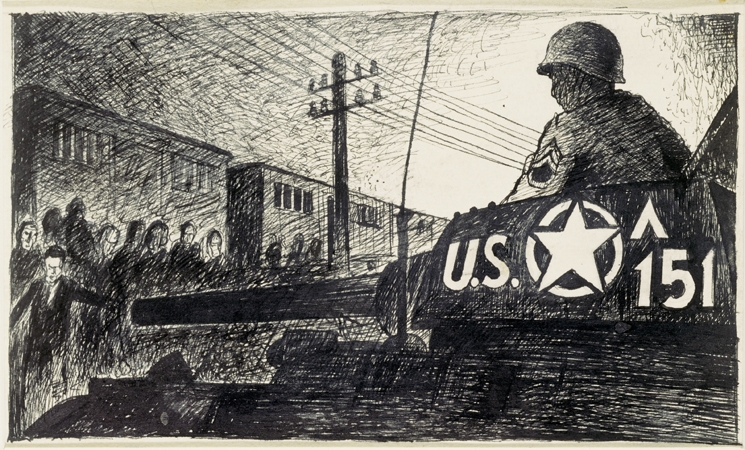
That’s where tank crews from the 743rd Tank Battalion — a unit attached to the 30th Infantry Division that had fought its way through France and into Germany in the months before — discovered the train and its human cargo on April 13.

At the time, 27-year-old Army 1st Lt. Frank Towers was among the American officers sent to liberate the Jews aboard the train.

“This was in the middle of a battle zone with German artillery coming in and American artillery falling short,” said the 94-year-old Towers on Friday. “It was determined that we had to get these people out of the area as quickly as possible.

“That was the job that was delegated to me — get transportation and move these 2,500 people to a town we had liberated the day before at Hillersleben.”

The soldiers moved the people — who were starving, filthy and on the brink of death — to a hospital in that town.

“I made two round trips to get all of these people moved back to Hillersleben,” he said. “At that point I virtually said goodbye to them — told them they’re in good hands and left.”

Decades went by before Towers even thought about the event. It was a war, he said, it wasn’t something he wanted to dwell on. But in 2005, Towers — who is currently the president of the 30th Infantry Division Association — was introduced to a website run by Matt Rozell, a history teacher in upstate New York, called TeachingHistoryMatters.com. There, Towers discovered accounts of his own story of liberating the train full of Jewish prisoners.

“That’s my story,” Towers said of finding the website. “It wasn’t exactly my story, really. But my story ran parallel to that. From that point on Matt and I started collaborating to locate more and more of the survivors.”

During a reunion for World War II veterans from the United States Army's 30th Infantry Division Friday evening in Savannah, three Holocaust survivors and a former soldier speak about their experiences during the war. Pictured, from left to right, are Bruria Falik, Micha Tomkiewicz, Frank Towers and Alex Larys. Towers was a 1st Lieutenant in the Army's 30th Infantry Division that on April 13, 1944 liberated a train that carried all three of the picture survivors. Corey Dickstein/Savannah Morning News

To date, Towers said he’s met about 60 of the survivors — he estimates there could be up to 250 still living[editor’s note-Frank said 225 have been located] — including the five who joined 13 surviving members of the 30th Infantry Division — a National Guard unit of soldiers from Georgia, North and South Carolina and Tennessee that served in both World Wars before being deactivated in November 1945 — in Savannah Friday.

“It’s a rewarding experience to talk to these people,” Towers said. “It’s been astounding. To think I had a small part to play in their liberation and getting them started on a new road to life — to see them today, where they are, that’s been my reward.”

And, said the survivors, it’s equally as rewarding for them to get the chance to say “thank you” to the men who saved their lives.

“For me it’s fascinating,” said Tomkiewicz, now 72 and living in Brooklyn, N.Y. “I knew that American soldiers saved us from the train, but for almost 60 years that was all I knew.

“Suddenly the whole thing has converted to real faces, to real people, to drinking buddies, very pleasant people. And now we are actually like family; what a great opportunity.”

Without the soldiers like Towers, said Falik, now 80 years old and living in Woodstock, N.Y., she and the other survivors would not be alive today.

“It’s such a focal point in my life because I have two wonderful children,” Falik said. “They are here because of the veterans who saved us. I will never forget that.”

http://savannahnow.com/news/2012-03-03/world-war-ii-vets-holocaust-survivors-convene-savannah

Holocaust survivor recalls kindness of US troops

Another survivor of the train near Magdeburg appears. International Holocaust Remembrance Day, 2012. I hope she finds her way to this site so she can meet her actual liberators! Thanks for Leslie Meisels for tipping us off to the article. Aliza’s memoir of life in the Warsaw Ghetto and beyond is very moving and can be found here.

By GIL SHEFLER 01/27/2012 00:34
JERUSALEM POST

“The American soldiers didn’t know what to do and they showered us with chocolates and cigarettes.”

Aliza Vitis-Shomron on Thursday vividly recalled her brush with death on the eve of her liberation from the Nazis in 1945.

The survivor, who spoke on a panel at the Kibbutz Yad Mordechai Holocaust Museum the day before the world marks International Holocaust Remembrance Day, said a rumor had spread among the group of Jewish prisoners she was part of in Poland that they were about to be murdered.

Rather than surrendering them to the Allies closing in from the east and west, the prisoners feared their captors were planning to plunge their train into the Elbe River and drown everyone.

“Panic and fear spread quickly,” recalled the Polish-born Israeli who survived the Warsaw Ghetto and the Bergen-Belsen concentration camp in Germany. “Just as we were at the point of despair, two American tanks came rolling down a hill and saved us.”

The feeble Jewish prisoners emerged from the train and embraced the stunned soldiers of the US 30th Armored Division.

the tank commanders who freed her.

“We were crying with joy,” she said. “The American soldiers didn’t know what to do and they showered us with chocolates and cigarettes.”

Vitis-Shomron said she did not feel that she had defeated the Nazis.

“I did not triumph,” said Vitis-Shomron, an educator who has four great-grandchildren.

“What happened accompanies me, but I try to live and live well. I try to teach humanitarian values to our youths. We must never do upon others what was done to us.”

The panel Vitis-Shomron was part of at Yad Mordechai, the kibbutz named after the leader of the Warsaw Ghetto Uprising (Mordechai Anielewicz), included Simcha “Kojak” Rotem, who fought in the uprising, and former defense minister Moshe Arens.

It was one of many events held in Israel and around the world commemorating the remembrance day.

On Wednesday, Israeli Ambassador to the UN Ron Prosor, American Jewish Committee Executive Director David Harris and members of the newly formed World Forum of Russian Jewry met at United Nations headquarters to honor the memory of those killed by the Nazis.

The AJC head said the lesson learned from the murder of six million Jews required the world to prevent Iran from acquiring nuclear capabilities.

“This past September, indeed on these grounds, the notorious Holocaust denier, Iranian President Mahmoud Ahmadinejad, spoke,” Harris said. “To their credit, several UN member ambassadors walked out, but, shamefully, the majority stayed in the General Assembly hall and applauded his remarks.”

The president of the World Forum of Russian Jewry, Ukrainian businessman Alexander Levin, joined the call urging the UN to take action against the Islamic Republic.

More Holocaust memorial events are planned for Israel and around the world on Friday.

Supreme Court President Dorit Beinisch, Deputy Foreign Minister Danny Ayalon and ambassadors from more than a dozen countries including Germany, the US, Egypt and the Philippines are set to gather at the Massuah Institute for Holocaust Studies at Kibbutz Tel Yitzhak near Netanya to take part in a memorial ceremony.

The UN designated January 27, the anniversary of the liberation of Auschwitz by the Red Army, as International Holocaust Remembrance Day in 2005. It is marked by governments and organizations around the world.

Israel, however, observes its official Holocaust Remembrance Day on the 26th of Nissan, the anniversary of the Warsaw Ghetto Uprising, according to the Jewish calendar. Its selection reflects the Jewish state’s preference to emphasize Jewish resistance to the Nazis.

http://www.jpost.com/JewishWorld/JewishNews/Article.aspx?id=255355

A good man left us this week. As I attempt to ponder the why, I can only fall back on the memories of one of the most honorable human beings that I had the privilege of knowing, albeit for only a small window of our respective lives.

Brent and his twin Bruce were seniors; I was a freshman in high school trying to find my way; they looked out for me. So funny, so warm, so happy, and so willing to be present for others, as his obituary attests. My heart goes out to Brent’s mom and  Bruce, and his other siblings and family members.

Here is a man whose memory I will use to guide me in the rest of my career, and I hope my life.

Teaching history is the theme of this website, but truly, it does not matter what one teaches. Here is the consummate teacher who knew that the bottom line for all educators is be happy and in touch with the moment, and by extension seemingly effortlessly creating  better human beings in living by example, touching and molding young lives, forever. What other occupation is as important?

Rest on, friend. I’ll keep you close.

Brent J. Bertrand passed away the morning of Tuesday, January 10, 2012. A Hudson Falls native born on February 5, 1958, Brent graduated from Hudson Falls High School in 1976. He earned an Associate’s degree from Cobleskill College in 1978 and a Bachelor’s degree from the State University of New York at Oswego in 1982 before embarking on a very rewarding teaching career with the Warrensburg Central School District. He earned his Master’s degree from the State University of New York at Albany in 1988.

As a high school technology teacher, Brent shared his passion as a craftsman with countless students during his many years in Warrensburg. In teaching his students to shape rough lumber into polished furniture, he instilled in the students and those around him the patience and discipline of doing things the right way and of taking pride in one’s accomplishments. His “measure twice, cut once” philosophy was his simple way of expressing the valuable life lesson of thinking before acting.

A natural born educator, Brent’s devotion extended beyond the classroom on to the athletic fields. “Coach” Bertrand spent many seasons on the Warrensburg softball fields teaching students the life lessons of success and failure on the playing field. Displaying a consistent approach to teaching in both the classroom and the ball field, Brent urged his student athletes to “practice how you play” as yet another example of doing things the right way and taking pride in what one does.

Warrensburg was a very special community for Brent. Always with a friendly smile and a genuine interest and concern for others, he shared his dedication to education and to the Warrensburg students with the other employees in the school district. He prided himself on arriving early, being available and accessible to all and never missing a day of work. He became an integral member of the Warrensburg community and valued the relationships and friendships he developed over the years.

Brent was equally as dedicated to and compassionate about his family as he was to his profession. As one of seven siblings, he developed a strong work ethic and sense of commitment, responsibility and fairness during his formative years, traits that he exemplified throughout his life. He shared his love for the farm and the lake with his parents, siblings and their spouses, and his nieces and nephews, and realized the importance and meaning of the farm and the lake as the place for the family to gather.

Brent was predeceased by his father, Frank L. Bertrand. He is survived by his mother, Jane L. Bertrand; his sister, Susan Semiz; his brothers, Bruce, Frank, Matthew, Michael and Peter; his brother-in-law, John Semiz; sisters-in-law, Jane Bertrand, Patricia Bertrand and Sally Bertrand; his girlfriend, Missy Ackley; and several nieces and nephews who idolized and adored their Uncle Brent.

Friends may call on Brent’s family from 3-6 pm, Friday, January 13, 2012 at Alexander-Baker Funeral Home, 3809 Main Street, Warrensburg.

QUOTES:

As of Thursday, hundreds of heartfelt tributes were scrawled on a 60-feet-long mural titled “Messages to Mr. Bertrand” that stretched the length of the school’s cafeteria wall.

 “Mister B” was known particularly for his ability to inspire students through his ever-present enthusiasm, sunny attitude and helpful spirit — and the messages on the mural reflected these themes. Here is a sampling of some of the messages:

#• “You were an amazing teacher — you made every student feel like they were important…”

#•“You moved every heart and touched every soul — I’m heartbroken not just for the loss of your upbeat smile and friendly waves in the halls, but for the students yet to come who will never have the pleasure of knowing you…”

“You looked past all of my flaws and actually saw me as a person…”

#• “There hasn’t been one day I’ve seen you without a smile on your face…”

#• “You were the reason I survived school…”

#• “You treated us with respect and never made us feel stupid. You knew exactly how to help us with any problem we faced…”

#• “You were the most genuine, strong and kind-hearted person I’ve ever known — You brightened the worst of people’s days and saw the good in everybody…”

#• “You inspired me to be an architect…”

#• “You taught me that no matter where I go, I will be walking into my future…”

Better man than I. A toast to you and your dad, my friend. Clink a glass with my old man.

http://www.newsenterprise.org/news/2012/jan/18/wake-teachercoach-brent-bertrand-draws-nearly-1200/

I never met Gina, but did finally meet her family on my visit to Israel last May.

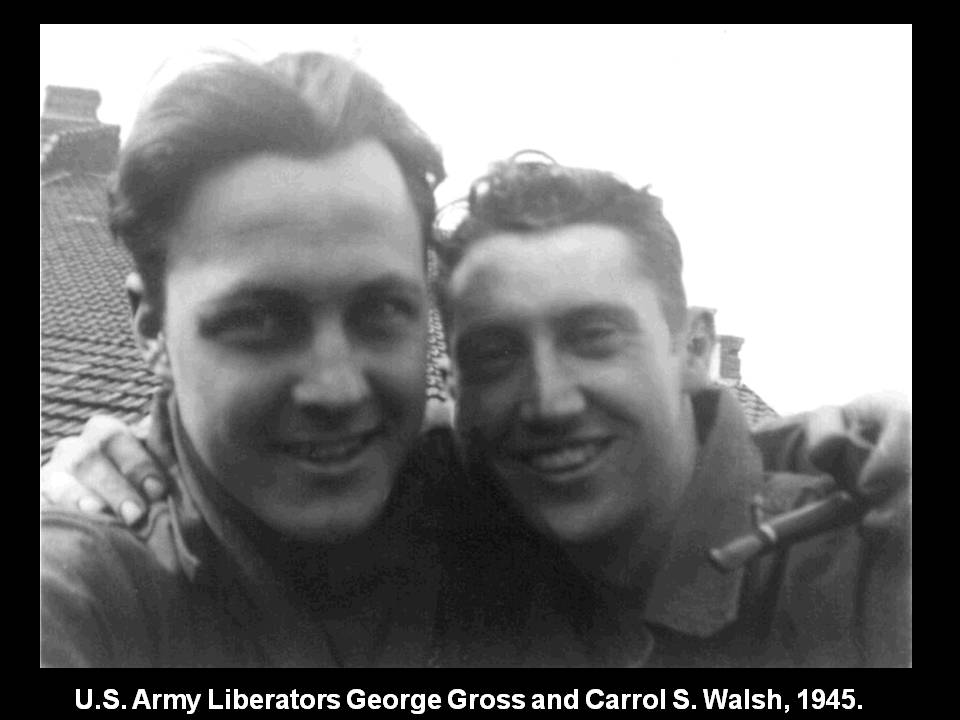
Gina was the only survivor who has been positively identified by the soldiers themselves- in this case, George C. Gross, who took a photo of her in front of his tank on April 13th, 1945, before moving out to fight the final battle at Magdeburg. He always wondered what had become of her. I would challenge you to read the last paragraph of his narrative, especially. Then refer to the photo above.

Gina passed away this week. I think that George Gross, who passed in 2009,  helped to welcome her home.

Gina Rappaport 4-13-45

From Sgt. George Gross (relayed to Matthew Rozell, March, 2002):

I spent part of the afternoon (13 April 1945) listening to the story of Gina Rappaport, who had served so well as interpreter. She was in the Warsaw ghetto for several years as the Nazis gradually emptied the ghetto to fill the death camps, until her turn finally came. She was taken to Bergen-Belsen, where the horrible conditions she described matched those official accounts I later heard. She and some 2500 others, Jews from all over Europe, Finnish prisoners of war, and others who had earned the enmity of Nazidom, were forced onto the train and taken on a back-and-forth journey across Germany, as their torturers tried to get them to a camp where they could be eliminated before Russians on one side or Americans on the other caught up with them. Since the prisoners had little food, many died on the purposeless journey, and they had felt no cause for hope when they were shunted into this little unimportant valley siding. Gina told her story well, but I have never been able to write it. I received a letter from her months later, when I was home in San Diego. I answered it but did not hear from her again. Her brief letter came from Paris, and she had great hopes for the future. I trust her dreams were realized.

We were relieved the next morning, started up the tank, waved good-bye to our new friends, and followed a guiding jeep down the road to rejoin our battalion. I looked back and saw a lonely Gina Rappaport standing in front of a line of people waving us good fortune. On an impulse I cannot explain, I stopped the tank, ran back, hugged Gina, and kissed her on the forehead in a gesture I intended as one asking forgiveness for man’s terrible cruelty and wishing her and all the people a healthy and happy future. I pray they have had it.

Today I had every intention to read aloud these paragraphs from Dr. Gross’ testimony to my 4th block tenth graders . I made it as far as the last two sentences, and had to stop, go back to my desk, and compose myself for a moment…when I passed around these two photographs and the email below, the kids understood…of course I reminded them that I was still a “tough guy”.

From my inbox, a week after the reunion…

Dear Madam /Sir,

I am referring to your amazing World War II project.

Mr. George Gross whose testimony is found in your site mentions the story of Gina Rappaport (and includes her photo) who happens to be my mother (!).

She survived the Holocaust and emigrated to Israel where she lives until today. In 1947 she married to my father  and gave birth to two children, my brother Giora and myself.

Could you please provide me with contact information of Mr. Gross? I would like to contact him as soon as possible.

Many thanks for your help!

Sincerely yours,
Eran L.
Jerusalem, Israel.

The follow up:

Dear Matthew,

Thanks for your letter and for this fascinating project which is highly important for my entire family!
I am enclosing a photograph taken yesterday showing my mother reading for the first time Dr. Gross’s article and watching her own photo in front of the tank.

With kind regards,

Eran

I got a comment on a post yesterday from a professed “skeptic” who does not leave a name, of course (they never do), nor does he share his name at his website, though on his “About” page he does reveal that it  “is about Holocaust history and what I see as malign political influences that have distorted our understanding of history. My interest in the subject came about after I was expelled from a History Honours course run by a University in the city of Melbourne after presenting some material criticising some of the more wild claims in the literature several years ago.  This traumatic experience lead me to investigate further and everything confirmed my initial suspicions.”

Hmm, sounds like a conspiracy to me. Sorry about the trauma, so as he wishes, here is what he left to be published on this site, with my responses.

Hello, I came here after reading Dan Porat’s The Boy, where some of the Hillersleben photos feature.

Hi. Yes, I was consulted by the author, and helped him get some of the photos of the liberation- which was at Farsleben, not Hilersleben.

Maybe I am missing something here, but the people on this train don’t look like walking skeletons to me. German civilian rations were 1600 calories pro Tag 1944/1945, so the fact that the photos you present show individuals that look slim but hardly starved seems to undermine your central thesis – namely History Matters. Clearly, you don’t think so or you would use your material more carefully.

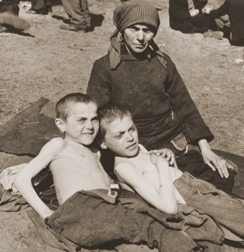
"A woman and two children rest next to a stopped train" 4-14-2011 by Harry E. Boll. USHMM Archives.

Clearly, it was not I, but a soldier who referred to the victims he cared for as “walking skeletons”.  Also, these ” slim”  individuals were so weak that many could hardly stand- again, more eyewitness liberator testimony. Maybe the soldiers are lying, something that has been suggested by skeptics before. Several “slim people” are lying dead on the hillside in the background- and the skeptic has missed the point that the ones physically able to pose for a photograph have done so. Many more could not even get out of the cars without assistance-many were dead inside the cars, literally falling out on top of horrified soldiers as they slide open the doors-something the skeptic would have learned had he/she been more thorough in his research of my work. Perhaps he would suggest that the boys in the photo to the left, taken by US forces the day after liberation, are the picture of health. And thanks for bringing in the plight of the unfortunate German civilians. Perhaps we should compare suffering here as well.

Secondly, don’t you think you are being rather disrepectful of the sacrifice shown by the American GI by continually reducing their experience down to the liberation of some detainees on a train. It verges on insulting to continually insist that people who repeatedly saw their buddies being blown away would privilege the experience of 2500 Jewish people on a train who don’t look starved at all

I think a little ironic that the post above  the one that the skeptic commented on mentions the sacrifice and not the train liberation at all(“Hell came in like a freight train. I heard an explosion and went back to where my friend was.” 67 yrs. ago this week.), a common thread throughout my work, which he must have run across if he used the link in Porat’s book to get to this site. And it is also stated at the bottom of my “About” page, which the skeptic should take the time to read before invoking one’s “skepticism”, that “if you are a Holocaust denier/minimizer/revisionist, and/or run-of-the-mill hate spewer, thank you in advance for sparing  me your epistles… I’ve already heard it all.”  It really can get tiring, but thanks for writing to remind me that I have a better job to do. Sadly, I’ll also be adding the word “skeptic” to my list.

And while I usually refrain from posting photos such as will follow, unfortunately it feels necessary now. The train survivors left this camp 12 days before this photo was taken by British troops.

THE LIBERATION OF BERGEN-BELSEN CONCENTRATION CAMP, APRIL 1945 part of "WAR OFFICE SECOND WORLD WAR OFFICIAL COLLECTION" (photographs) Made by: No 5 Army Film & Photographic Unit A British Army bulldozer pushes bodies into a mass grave at Belsen. The driver of the bulldozer wears a protective handkerchief over his mouth and nose.

 World keeps turning. Another soldier enters it. Good to know that there are more than 2 of them alive who had something to do with the liberation of the train. I got a phone call last week from a gentleman in Pennsylvania. We have found another soldier, or more correctly he has found us! Mr. Gantz talked about the trauma experienced by the soldiers in treating the survivors on the train.

Soldiers Walsh and Gross discover the train and save them, Towers transports them to safety and out of harm’s way, Gantz stays with them and nurses them back to health, or buries them at the cemetery in Hilersleben…

Later, I found this newspaper article below.

Innocence of youth helped Walter ‘Babe’ Gantz treat wounded soldiers, concentration camp survivors

By Josh McAuliffe, Scranton Times Tribune

Walter “Babe” Gantz has a ready explanation for how he coped with the horrors of war.

“I was young and carefree, as they say. And foolish, perhaps,” he said with a chuckle.

He was also very brave.

The South Scranton man spent World War II serving as a combat medic with the 9th Army’s 95th Medical Battalion. A surgical team technician, he treated infantrymen suffering from a litany of unspeakable battle injuries, earning the Combat Medics Badge, Bronze Star and Army Commendation Medal in the process.

Most notably, he tended to the emotionally scarred men who fought in the fiercely contested Battle of Hurtgen Forest, and, at the very end of the war, a train full of survivors from the infamous Bergen-Belsen Nazi concentration camp.

He was barely 20 years old at the time.

“I was a tough cookie,” said Mr. Gantz, who just turned 86. “It was tough, but in simple terms, I weathered the storm.”

Enlisted in 1943

Mr. Gantz joined the service in March 1943, less than a year after graduating from Scranton Central High School.

He was sent first to Camp Grant, Ill. Testing there showed that he had an exceptional IQ, so the Army gave him the opportunity to leave his training to take courses at the University of Illinois. The opportunity thrilled him, but after a while he got the sense that he had bigger priorities.

“I thought, ‘There’s a war going on, and I’m going to college? This doesn’t make any sense,'” Mr. Gantz said.

Despite coming from a hunting family and being “weaned on guns,” Mr. Gantz was placed with the medical corps instead of the infantry.

Before heading overseas, he spent time in South Florida, where in February of 1944 he volunteered to take part in a top-secret military experiment in which he and other GIs tested clothing that would be used in the event of a chemical weapon attack.

During the tests, a Canadian bomber plane would fly over the swamps and spray Mr. Gantz and the other volunteers with mustard gas and other chemicals. He ended up with blisters the size of half dollars on his back, but fortunately nothing more serious than that. (Unlike the First World War, neither the Germans nor the Allies resorted to chemical weapons during World War II.)

“My dear parents never knew I was there,” Mr. Gantz said, adding the Army threatened to throw him in Leavenworth Prison if he told anyone about the program.

His involvement in the program earned him the Army Commendation Medal, and he was offered an honorable discharge following the experiments. However, he declined, instead opting to join the 95th Battalion, first in England and then onward to France.

A technician 4th grade, Mr. Gantz was part of a surgical team led by an orthopedic surgeon from Toledo, Ohio. They worked 12-hour shifts out of large tents located about seven miles from the front lines.

As such, they were never out of the combat zone, and several men from his company were killed by German artillery fire.

“I got lucky,” he said. “You’re young. You realize you’re in danger, but you just don’t delve into it.”

There was no shortage of wounded soldiers to treat. He did plenty of stitching, helped out with a number of amputations, subdued and restrained scores of mangled and bloodied young men writhing in utter agony. Often, he was called upon to do things “nurses couldn’t do today,” he said.

One time, a soldier from the 2nd Ranger Battalion came in strapped to a gurney. They thought they had him sedated, but the guy sprung up and punched Mr. Gantz in the face. He lost one of his front teeth and had to get a bridge implant. To say the least, dental work in freezing cold temperatures is far from the most pleasant thing in the world, he said.

Fatigue treatments limited

By the fall of 1944, the 95th Battalion was stationed at the Belgian-German border. During that time, Mr. Gantz and the other members of the unit treated men injured during the Battle of Hurtgen Forest, a particularly brutal series of battles between the Americans and the Nazis that didn’t end until February 1945. The number of casualties was horrendously high – over 30,000 on the U.S. side alone.

Many of the men Mr. Gantz’s unit treated were suffering from “combat fatigue,” or what’s more commonly referred to today as post-traumatic stress syndrome. There wasn’t a whole lot they could do for them, he said, other than sedate them for 48 hours and give them sodium pentothal, i.e. “truth serum,” to get them to open up about the source of their distress.

“We had to strap them down because they would get violent,” Mr. Gantz said. “They would scream. They would have to relive that situation where they lost it.”

That winter, Mr. Gantz helped treat the wounded at the Battle of the Bulge in the Ardennes region, and by the spring of ’45 his unit had made its way into Germany.

In mid-April, they were in the town of Hillersleben setting up a displaced persons hospital when the Allies came across a train that had come from the Nazi concentration camp Bergen-Belsen, where over 35,000 people, the vast majority of them Eastern European Jews, had died of typhus during the first few months of that year.

All told, there were roughly 2,400 emotionally damaged, disease-ridden and terribly malnourished people aboard the train. “Walking skeletons” was an apt description, according to Mr. Gantz.

“We weren’t knowledgeable about these (concentration camps) at the time,” said Mr. Gantz, who visited Bergen-Belsen days after it was liberated. There, he saw countless dead bodies “strewn everywhere.”

“It was hard to explain,” he said. “I cried. And then I prayed for these people. Not only were you angry about what happened, but you felt so helpless.”

Mr. Gantz’s unit spent about six weeks treating the survivors. A good 70 or 80 of them died, mostly of typhus. Among the biggest challenges was acquiring enough food supplies to feed them all. Many could only take their nourishment intravenously.

“A lot of them, if you were to give them food, they would gorge themselves and kill themselves. You had to be very careful as to what they ate,” he said. “Boy, oh boy, they would scream. Those screams would go right through your body.”

“Hillersleben was a living nightmare,” he added. “You don’t shake these horrible scenes from one’s mind.”

Diverted home

When the Germans surrendered that May, Mr. Gantz was sent to the Arles Staging Area in Marseilles, France, where he would wait to be deployed to Japan. He spent the next few months playing in a GI softball league.

In August, he was scheduled to set sail for the South Pacific on the USS Santa Maria. That was until the U.S. dropped atomic bombs on Hiroshima and Nagasaki. Instead, the Santa Maria took him back to the States, arriving in Boston on Sept. 1.

Given all he had seen, the adjustment back to the normal rhythms of civilian life was a difficult one for Mr. Gantz.

“My parents couldn’t understand why I couldn’t sleep at times,” he said, fighting back tears, the scars still stinging some 65 years later.

While a lot of the vets he knew took refuge in the bottle, Mr. Gantz found solace in a life filled with family, faith (“I’ll say I’m a spiritual individual,” he said), hard work and community service. He and wife, Jeanie, raised three daughters. For 28 years, he worked as a material collector at Lucent Technologies. He helped bring slow-pitch softball to the Scranton area, and became a committed volunteer for the local chapter of the American Red Cross.

The war never left him, though, and for years Mr. Gantz took part in reunions with other members of the 95th Medical Battalion. They talked about a lot of things, but never discussed the horrors of Hillersleben.

The reunions came to an end quite some time ago, because, Mr. Gantz explained, “there’s only a handful of us left.” Which means it’s now up to him and the few remaining others to carry on the 95th’s legacy. Certainly, it’s one worth preserving.

Meet Walter ‘Babe’ Gantz

Age: 86

Residence: South Scranton

Family: Wife, Jeanie; three daughters, Debbie, Linda and Doreen; one grandson. He is the son of the late Frank and Rose Gantz.

Education: Graduate of Scranton Central High School

Professional: Prior to retirement, he worked as a material collector at Lucent Technologies for 28 years

Military service: A technician 4th grade with the Army’s 95th Medical Battalion serving in the European Theater during World War II, Mr. Gantz was part of a surgical team that treated wounded infantrymen, including those that fought at the Battle of Hurtgen Forest and the Battle of the Bulge. Toward the end of the war, his unit treated survivors from the Nazi concentration camp Bergen-Belsen. He is a recipient of the Combat Medics Badge, Bronze Star and Army Commendation Medal.
The Tennessee Holocaust Commission is focusing on our work this week!Common+Core+Standards+Alignment

Good luck to Frank and George and all the speakers and organizers. I know it will be a resounding success. Wish I could be there with you. Watch for the book at this site, or better yet!  please subscribe in the margin to the right. MR

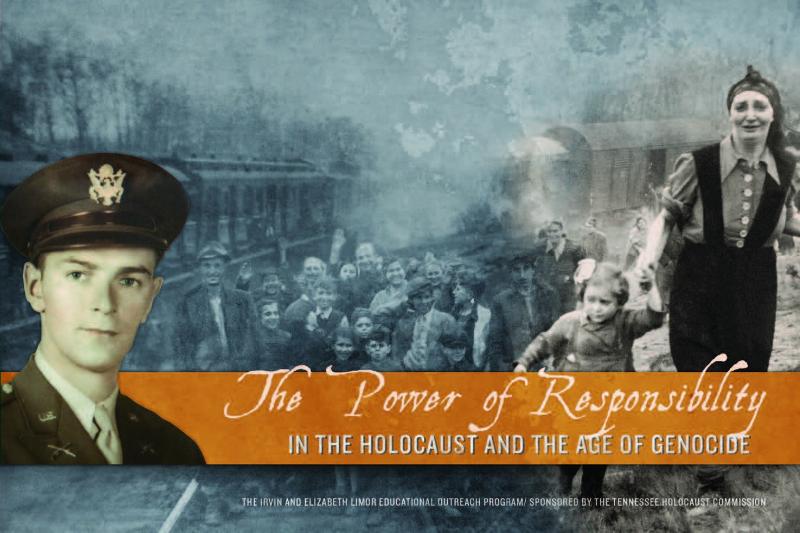
The Tennessee Holocaust Commission (THC) announces the opening of registration for the  Memphis Educational Outreach Program. The program will take place on Thursday, October 27, 2011 from 8:00 a.m. – 3:30 p.m. at Teaching and Learning Academy located at 2484 Union Avenue in Memphis, TN.
This year’s program, The Power of Responsibility in the Holocaust and the Age of Genocide, will highlight the work of the Teaching History Matters Project, the work of a United States Holocaust Memorial Museum Teaching Fellow.  This USHMM Fellow, along with his students, began studying information about a “Death Train” that was liberated at Farsleben, Germany which is near Magdeburg.   The class posted an online journal in attempt to re-connect this train transport of 2,500 Holocaust survivors with the American soldiers who liberated them on April 13th, 1945.   To date over 200 survivors and liberators from this train have been located and reunited.This one-day conference is specifically designed for middle and high school teachers to provide them with additional knowledge and resources about the Holocaust. Educators are encouraged to identify up to four mature students to accompany them to the all day workshop for hands-on activities and interaction with survivors and educators in the field of Holocaust studies.  Teachers intending to bring students are required to fill out a student registration form which can be found on the event home page.

The program is open to all middle and high school teachers, preferably with some experience in teaching the Holocaust.  There is no cost to attend the conference.  Registration is required and space is limited.

Featured Speakers:

Frank Towers
Frank Towers will speak of the experience he shared with his comrades of freeing so many from their imprisonment as well as his part in the Teaching History Matters Project.  Towers, who as a young Army first lieutenant, helped rescue the Jews from the Nazi death train at the end of World War II, recalls, “We’d heard stories about the mistreatment of Jews, about them being tortured and being put to death, but we dismissed what we thought was propaganda. We didn’t believe one group of human beings could do that to another group of human beings. It wasn’t until we saw this trainload of Jews that we believed.”

Dr. George Somjen

Dr. George Somjen, was 15 at the time of his liberation and remembers, “We were, of course, terribly happy,” he said, “but in that extremely emaciated state (I had lost 30 to 40 percent of my body weight), one has a very limited emotional scale. One doesn’t feel much except, ‘I am hungry.’ ‘I am thirsty.’ ‘I hurt.’  Dr. Somjen said of the Reunion, “Throughout my life, they (the American Army liberators) were always an abstract concept. Now suddenly they’ve got shape, voice, life.”

Christina Chavarria

Christina Chavarria, National Outreach Coordinator at the United States Holocaust Memorial Museum, will present a workshop titled, Placing Elie Wiesel’s, Night into Historical and Literary Context.  Elie Wiesel’s philosophy, “…to remain silent and indifferent is the greatest sin of all…,” is a testament to the power of responsibility and this philosophy stands as a summary of Mr. Wiesel’s, views on life and the driving force behind his work.  Night is Elie Wiesel’s personal account of the Holocaust as seen through his eyes as a 15-year-old boy. Ms. Chavarria’s workshop will help teachers to contextualize history through a series of photos as it impacts the narrative of the memoir. Specific writing prompts and themes for the book will be explored. The workshop will conclude with information regarding the US Holocaust Memorial Museum online resources on Elie Wiesel/Night.
Dr. Paul Fleming
Dr. Paul Fleming, principal of Hume-Fogg High School and co-author of The Holocaust and Other Genocides, will present a workshop for teachers on the Nuremberg Trials.  The Nuremberg Trials were the first trials in history held for crimes against humanity.  As noted by one of the lead prosecutors in the trial, Justice Robert H. Jackson, these historic trials imposed a grave power and responsibility on all parties involved. Since 1946, the Nuremberg trials have served as a basis for much of current International criminal law serving as a foundation for human rights and ethics policies around the world.

Link: http://tnholcom.org/news.php?id=38